
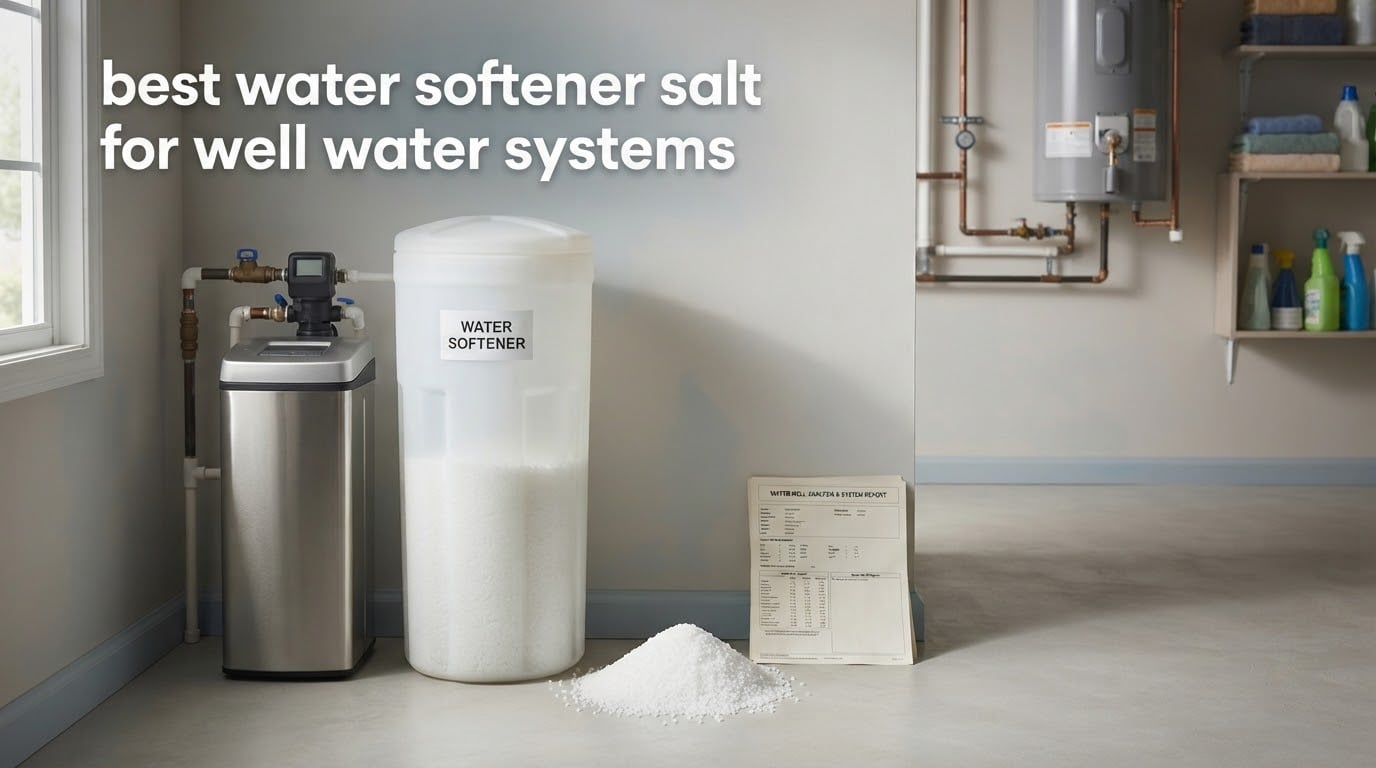
Short answer: the best water softener salt for well water systems is a high-purity evaporated pellet or crystal from a major producer such as Morton or Diamond Crystal, because well water typically arrives with both hardness and dissolved iron. If your well report shows iron above roughly 0.3 ppm, add an iron-fighting formulation or put a dedicated iron filter ahead of the softener so the resin bed does not foul.
Well water is untreated groundwater. Whatever the aquifer picked up on its way down — calcium, magnesium, iron, manganese, sometimes sulfur — arrives at your kitchen tap untreated, and it changes over time as the water table shifts. A softener only removes hardness and exchanges it for sodium or potassium, so the salt you choose cannot fix iron, bacteria or sulfur. It can only stop you from feeding a fouled resin bed a salt that dissolves badly and leaves a crust in the tank.
That is why the best water softener salt for well water systems is not a single brand answer. It is a form-and-purity answer driven by two numbers on your water report: hardness in grains per gallon, and iron in ppm. I compared the ten most-reviewed softener salts on the market across purity, dissolve behavior, salt form, sodium load and bag economics, and the honest summary is that the big two brands dominate on everything except the specific additive a high-iron well needs.
Two more well-specific realities shape everything below. First, there is no municipal chlorination in your brine tank, so slime and bio-growth have nothing suppressing them. Second, high well hardness burns salt fast, and the answer to that is usually a softener capacity setting rather than a different bag. If you have never tested your water, start with our [8 Best Water Testing Kits for Well Water](https://foliumbiosciences.com/best-water-testing-kits-for-well-water/) roundup before you spend on 160-pound packs.
Table of Contents
Top 3 Picks for Well Water Salt
These three cover the three situations almost every well owner falls into: a clean hard well that just needs dependable regeneration, a high-use household that does not want to touch the brine tank every two weeks, and a sodium-restricted household that wants no sodium in the drinking glass.

Morton Clean and Protect Pellets
- High purity evaporated pellets
- 2 x 40 lb bags
- Clean dissolving and low dust

Morton Clean and Protect 3-Pack
- 120 lb across 3 bags
- Fume free and unscented
- Sturdy handle easy-tear bag

Diamond Crystal KCl 40 lb
- 99.1 percent sodium free
- Potassium chloride formula
- Cargill Salt made
All 10 Salt Options Side by Side in 2026
The table below lists every salt in this roundup with its form and the condition it handles best. No entry here contains an iron-fighting additive, which is itself the most useful takeaway from the list.
| Product | Specifications | Action |
|---|---|---|
| Morton Clean and Protect Pellets 2-Pack |
|
Check Latest Price |
 Diamond Crystal Bright and Soft 50 lb Diamond Crystal Bright and Soft 50 lb |
|
Check Latest Price |
| Morton Clean and Protect 3-Pack |
|
Check Latest Price |
 Snow Shield All Natural Solar Salt 50 lb Snow Shield All Natural Solar Salt 50 lb |
|
Check Latest Price |
| Diamond Crystal Potassium Chloride 40 lb |
|
Check Latest Price |
 Morton Salt Crystals 4-Pack Morton Salt Crystals 4-Pack |
|
Check Latest Price |
 Compass Minerals 38240 Potassium Granules Compass Minerals 38240 Potassium Granules |
|
Check Latest Price |
 HSD Premium Salt Tablets 40 lb HSD Premium Salt Tablets 40 lb |
|
Check Latest Price |
 Morton Pure and Natural Solar 4 in 1 Morton Pure and Natural Solar 4 in 1 |
|
Check Latest Price |
 Diamond Collection Sun Gems 40 lb Diamond Collection Sun Gems 40 lb |
|
Check Latest Price |
1. Morton Clean and Protect Water Softener Salt Pellets, 40 LB (Pack-2) – the best all-around choice
Morton Clean and Protect Water Softener Salt Pellets, 40 LB (Pack-2)
High purity evaporated pellets
2 x 40 lb bags
Form: pellets
40 lb per bag
Pros
- Dissolves cleanly which cuts mushing and bridging
- Clean and Protect formula targets brine tank buildup
- Two-bag pack reduces refill interruptions
- Easy-pour bag design
Cons
- Sodium chloride adds sodium to softened water
- No iron-fighting additive for high-iron wells
This is the salt I keep coming back to for well owners who have tested their water and know their iron is low. It is a high-purity evaporated pellet, and that purity is the whole argument: clean-dissolving salt means the brine draw stays consistent through a regeneration cycle, which is what protects the resin on a system that has no chlorinated water keeping the tank clean.
At 4.7 stars across 365 ratings it is the strongest combination of score and volume in this group, and it sits at number one in the Water Softeners category. The two-bag format is not a gimmick either. A hard well running 20 gpg burns through a 40-pound bag in about three weeks, so buying in pairs removes the annoying mid-week top-up.
The honest limitation is that Clean and Protect is a plain sodium chloride formula. It is excellent at what it does, and what it does is hardness removal, but if your well report shows meaningful iron you need a filter ahead of the softener rather than a different bag of salt. Our guide to [whole-house filtration for well water](https://foliumbiosciences.com/best-whole-house-water-filtration-systems-for-well-water/) covers where that filter belongs in the plumbing run.
What makes it work on a well system
Evaporated salt pellets dissolve more completely than rock or solar crystals, which means fewer loose chunks at the tank bottom and less sludge for you to break up by hand in a tank with no chlorine to slow biological growth. On a well that difference shows up in how often you reach into the brine tank.
Salt efficiency also matters here. Efficient regeneration means less water per cycle and less brine going down the drain, which is worth understanding if you have ever looked at your septic or your drainage situation.
When another option suits you better
If your household is on a sodium-restricted diet, this is the wrong bag and the potassium chloride option below is the right one. If you are on a well with iron above roughly 0.3 ppm, no salt choice fixes resin fouling on its own.
For very high-consumption households buying four at a time, the 160-pound four-pack version of the same crystal line is the better logistics play.
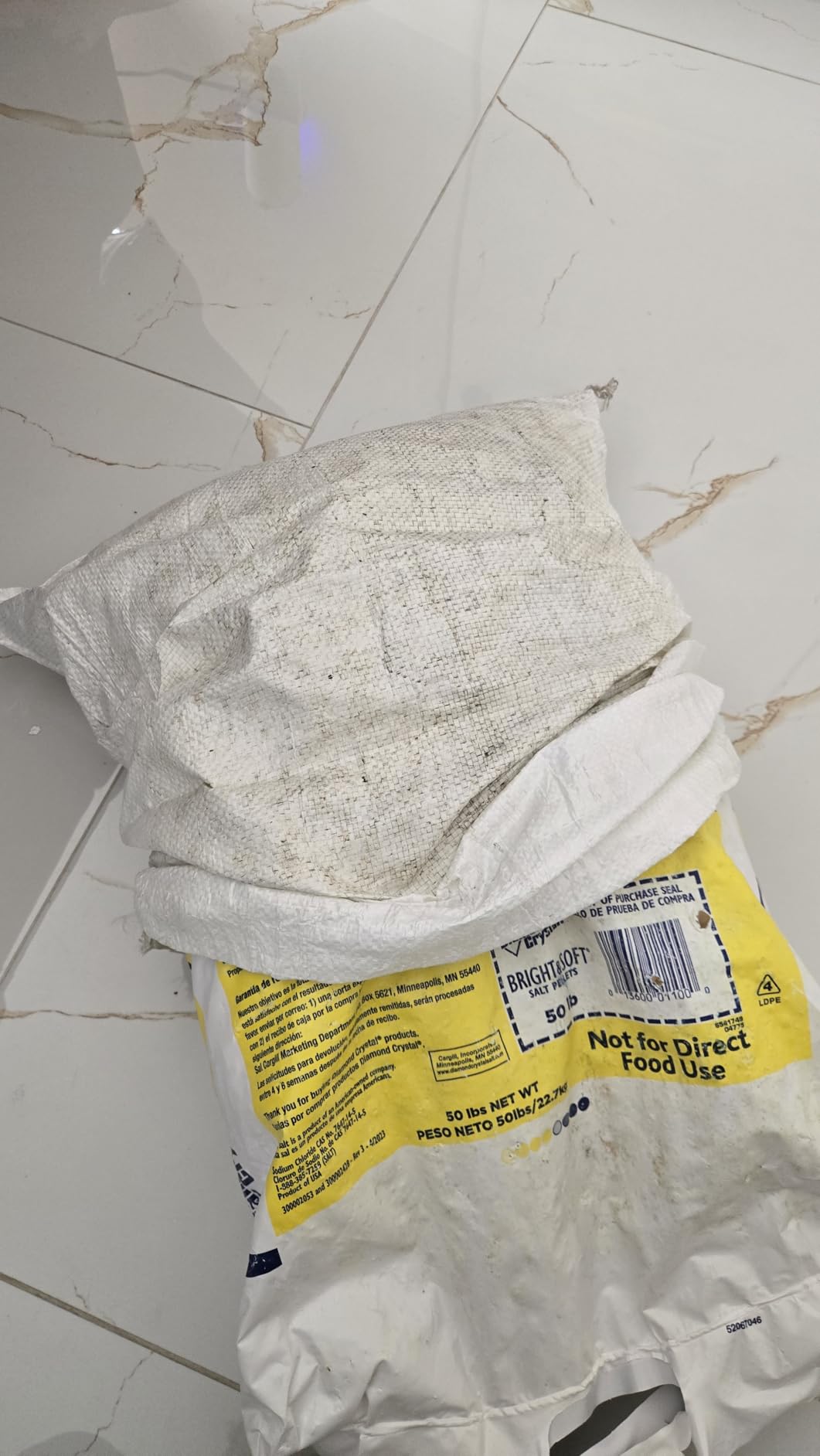
2. Diamond Crystal Bright and Soft Water Softener Salt Pellets, 50 Pounds – most reviews of any salt here
Diamond Crystal Bright & Soft Water Softener Salt Pellets, 50 Pounds
Typically 99.8 percent pure
Greater than 99.7 percent soluble
50 lb bag
Form: pellets
Pros
- Largest review base at 727 ratings
- High purity resists mushing and bridging
- Patented two-handled 50 lb bag
- Works with most household and commercial units
Cons
- Sodium chloride adds sodium
- No iron-fighting additive for iron-heavy wells
With 727 ratings this is the most thoroughly tried-and-failed-on product in the roundup, and at 4.4 stars it has held up. If you want the version with the most evidence behind it rather than the one with the highest score, this is the pick. The stated purity is typically 99.8 percent and greater than 99.7 percent water soluble, which is why reviewers consistently report a clean brine tank.
The two-handled 50-pound bag is a small thing that matters more than it sounds like on a well. Nobody enjoys wrestling a slippery sack over a brine tank lip, and this bag was designed specifically so a 50-pound load can be lifted and poured by one person.
It ranks number six in the Water Softeners category and is compatible with most household and commercial softening units. A small minority of one and two star reviews trace back to packaging damage or residue rather than performance.
The rating spread here is worth reading carefully. At 727 reviews the four-point-four average is stable and long-established rather than a thin sample, and the complaints that do appear cluster around bags arriving damaged and value comparisons against generic brands rather than softening quality.
For a well household with moderate hardness and low iron, this is a completely safe default. Choose it when you want the widest body of real-world use behind your salt.
Purity and what it means in your brine tank
Purity shows up as dissolved-salt consistency. Higher-purity pellets leave fewer undissolved solids at the tank floor, and on an unchlorinated well tank fewer settled solids means less surface for slime to start on.
It also means a more predictable salt level drop between services, so your float and brine well behave the way the valve manufacturer intended.
Where it falls short on a well
It is a plain pellet with no additive, so on an iron-bearing well it does nothing about the staining problem. Reviewers on iron-heavy wells consistently report that salt choice is not the variable that fixes orange spotting in glassware.
It is also sodium chloride, so households avoiding sodium should look past it entirely.
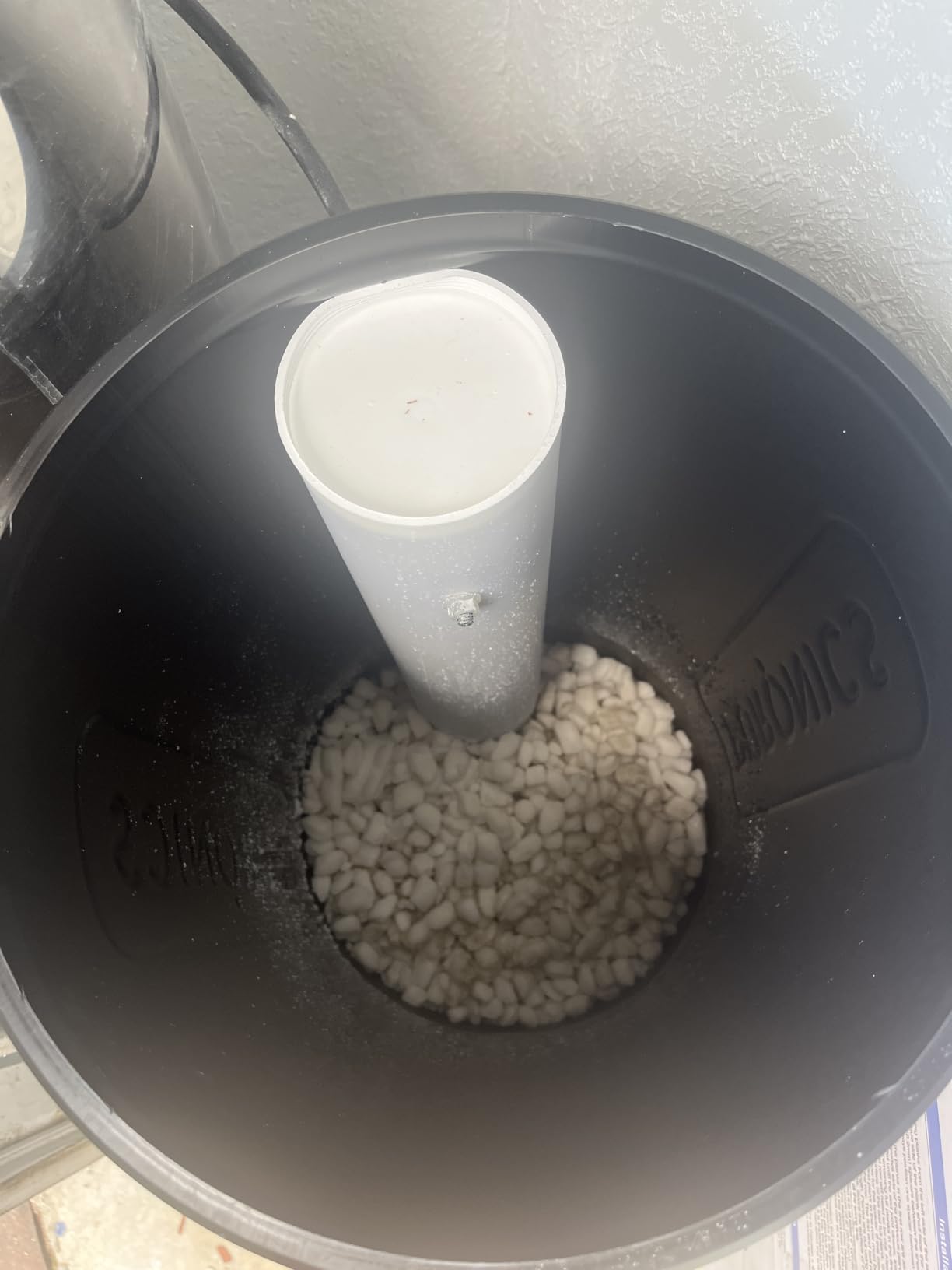
3. Morton Clean and Protect Water Softener Salt Pellets, 3-Pack (120 lb Total) – best value for hard, high-use wells
3 Pack Clean and Protect Water Softener Salt Pellets – (40 lb Bags, 120 lbs Total) – Sodium Chloride – Reduces Scale, Softens Hard Water, Appliance Efficiency, Compatible with Water Systems –
120 lb across 3 bags
Item form: granule
Unscented and fume free
Sturdy handle bag
Pros
- Bulk quantity suits high-use hard well households
- Formulated to reduce hard water scale
- Sturdy handle and easy-tear opening
- Fume free and unscented
Cons
- Sodium chloride adds sodium
- No iron-fighting additive
- Granule form can settle more than compressed pellets
Same Clean and Protect formula as the first pick, just at a scale that suits a household burning through salt. This three-pack is 120 pounds total, and at 4.7 stars across 336 ratings it ties for the highest average in this roundup. If your water report reads 25 gpg or above and you have four people, this is the bag size that stops you from refilling constantly.
It is a granule rather than a compressed pellet, item form listed as granule with 1920 fluid ounces across the pack. The granules dissolve reliably and the unscented, fume-free formulation means nothing odd reaches your glassware.
Roughly eighty-six percent of ratings are five star, and the feedback centers on scale reduction and the handled bag rather than any softening problem. It ranks number eleven in Water Softeners.
How much salt a hard well actually burns
Roughly 0.5 pounds of sodium chloride per 1000 gallons of softened water is the planning number most well households land on. At 300 gallons a day and 25 gpg hardness that works out to a bag every three to four weeks, which is exactly the gap a 120-pound pack closes.
If your bags are lasting a few weeks, the lever that matters is the salt efficiency setting on your control valve, not the bag you choose.
What to check before you order
Make sure you have somewhere dry to stage three bags. Some owners report occasional handling difficulty with the larger bags depending on how low the tank sits.
And confirm your softener is not already sitting behind a well that carries significant iron, because bulk sodium pellets will not address that.
4. Snow Shield All Natural Solar Salt, 50 Pound Bag – best budget crystal option
All Natural Solar Salt. Designed as a Premium Grade Salt for Water Softener. 50 Pound Bag
99.6 percent pure coarse solar salt
Form: solid crystal
50 lb bag
Unscented
Pros
- Made by sun wind and time evaporation
- Very economical per pound
- White opaque crystals suit all softeners
- Reported to minimize brine tank residue
Cons
- Heavy 50 lb bag is awkward to lift
- Coarse crystals can break down unevenly
- No iron-fighting additive
This is the value end of the well salt market and it holds a 4.4-star average across 306 ratings. The crystals are 99.6 percent pure coarse solar salt produced through natural evaporation, and the manufacturer states plainly that they are recommended for use in all water softeners. Reviewers with multi-year refill histories say it softens effectively and dissolves easily.
Where it earns its spot here is cost per pound. If your well is hard and your household is large, the difference between paying a premium per pound for evaporated pellets and paying commodity rates for solar crystals adds up across a year of refills.
The recurring complaints are consistent: the 50-pound weight is a genuine lifting problem, and one reviewer noted the coarse crystals break down differently and left slightly more residue than a premium alternative.
How solar salt behaves in a brine tank
Solar crystals dissolve more slowly and less completely than evaporated pellets. That slower dissolve is the trade: you get an inexpensive salt, and in return you get a tank that needs more attention over time.
The manufacturer claims the pellet form helps minimize residue accumulation, and many owners confirm the tank stays manageable, but a mushy bottom layer is more common with coarse crystal than with compressed pellets.
Who should skip it
Skip this one if your brine tank has a restricted diameter brine well or a narrow fill opening, since coarse crystals do not flow into tight spaces the way small pellets do.
Also skip it if you have back problems or if hauling fifty pounds up a basement stair is a recurring chore for whoever handles the salt.
5. Diamond Crystal Potassium Chloride Water Softener Salt, 40 lb – best for sodium-restricted households
Diamond Crystal Water Softener Bag 40 Lb.
99.1 percent sodium free
Potassium chloride formula
40 lb bag
Form: powder
Pros
- Sodium-free potassium chloride formula
- Steady softening reported over long use
- Made by Cargill Salt under Diamond Crystal
- Reduces mineral buildup on pipes and appliances
Cons
- Costs more per pound than sodium pellets
- Some valves must be set to potassium mode
- Listing detail is sparse
This is the answer for a well household on a sodium-restricted diet, and it is also the product I most often recommend when someone tells me their doctor asked about sodium in drinking water. The formula is potassium chloride at 99.1 percent sodium-free, produced by Cargill Salt under the Diamond Crystal label, and it scores 4.6 across 219 ratings.
It softens exactly like sodium chloride does, because the resin trades calcium and magnesium for potassium in the same way it trades them for sodium. The water leaves your tap tasting slightly different, less salty, and without the sodium addition that people on restricted diets are trying to avoid.
One practical note from owners: some control valves need to be switched to a potassium compatibility setting, and if you skip that step the system can underperform. It ranks number thirty-nine in Water Softeners.
What changes when you switch to potassium
Nothing changes about the hardness removal itself. What changes is the counter-ion on the resin, the taste of the water, and the cost per pound of what you pour into the tank.
Because potassium is not held as tightly by the resin, some systems use slightly more salt per regeneration to hit the same efficiency. That is a real ongoing difference and worth factoring into how long you stay on it.
The cost question nobody puts on the label
Forum discussion across water treatment communities consistently quotes potassium chloride running at roughly four times the per-bag cost of sodium salt, and several owners report switching back to sodium for exactly that reason. That is the tradeoff you are making, stated plainly.
What you get in return is no sodium added to your drinking water, which is the reason to accept the difference in the first place.
6. Morton Water Softener Salt Crystals, 4 Packs (160 lb Total) – best for heavy salt consumption
Morton Water Softener Salt Crystals 4 Packs
160 lb across 4 bags
Item form: crystals
Unscented
40 lb per bag
Pros
- Four packs cover long stretches on very hard wells
- High purity all-natural crystal
- Compatible with any softener system
- Sturdy handle and easy-tear opening
Cons
- One reviewer found debris and discolored stones
- Sodium chloride adds sodium
- No iron-fighting additive
When a well runs hard enough that you are buying salt by the pallet, this four-pack is the logistics answer. It is 160 pounds total across four handled 40-pound bags, and at 4.5 stars across 157 ratings it sits comfortably in the middle of the pack on score with solid owner feedback behind it.
It is a natural high-purity crystal rather than a compressed pellet, and it is listed as compatible with any type of water softener system, which removes guesswork if your control valve is older. Reviewers report reliable softening and cleaner-tasting water.
One owner measuring with a TDS meter reported roughly fifteen percent lower dissolved solids readings than a generic yellow-bag salt, which is the kind of quiet measurement I like to see in a review thread.
What a 160-pound haul actually saves
The saving is not in the salt itself but in trips. Every avoided trip to the vehicle is time you did not spend carrying forty-pound bags, and on a well burning a bag every two to three weeks that is a difference you feel within a season.
It also means you are not running a brine tank down to near-empty, which is when bridging problems usually start.
The complaint worth knowing about
One reviewer reported finding small organic items and discolored stones in some bags. That is a quality-control complaint rather than a performance one, but on a well where you are already dealing with an unknown water supply it is worth inspecting each bag as you pour it.
Anyone with a genuine iron problem still needs a filter ahead of the softener.
7. Compass Minerals 38240 Potassium Water Softener Granules, 40 LB – best value potassium option
Compass Minerals 38240 40LB K WTR Softener
Item form: granules
40 lb bag
40 liters
Upc 777817000027
Pros
- Potassium based sodium-free alternative
- Owners report years of service per bag
- Delivered rather than hauled
- Standard pellet format fits typical units
Cons
- Costs notably more per pound than store salt
- Some valves need potassium mode set
- Sparse listing detail and one owner saw no change in feel
This is the second potassium option in the roundup and it earns its spot for a different reason: owners report it lasting years before needing replacement, and several note that the delivery is a genuine convenience compared with hauling forty pounds home from a big-box store.
At 4.4 stars across 78 ratings the score is solid but the sample is the second thinnest here, so treat the enthusiasm as promising rather than proven. It is a standard granule in a forty-pound bag and fits typical residential units without modification.
The dominant criticism in the reviews is cost. One owner noted it cost roughly double the same weight at a big-box store, which is a smaller gap than the four-times figure some forums quote but still a real one to plan for.
Who this suits
If your household wants sodium-free water but does not want to chase specialty potassium products around local stores, this is the practical version of that decision. It arrives on a pallet or by the bag without a special trip.
It is also a reasonable fit for a smaller brine tank that does not need a bulk supply taking up floor space.
What to watch
Confirm your valve will accept potassium before you commit. Some units need a specific setting, and running an unmodified system on potassium can shorten resin life.
One owner reported no measurable difference in how the water felt, which is worth remembering if taste was your main reason for going potassium.
8. HSD Premium Water Softener Salt Tablets, 40 LB Food Grade British Salt – best for metered feed systems
HSD Premium Water Softener Salt Tablets 40 LB, Food Grade British Salt
Item form: tablet
25 kg bag or about 55 lb
Unadulterated vacuum salt
Food grade quality
Pros
- Tablets resist crumbling and self-destructing
- Dissolves evenly for metered feeds
- Food grade usable for laundry and dishwashing
- Solid smooth compacted form
Cons
- Higher cost per pound than bulk solar salt
- Tablets dissolve slower than loose pellets in some feeds
- Aimed at small and domestic softeners
Tablets solve a specific problem. If your brine tank has a salt meter or a metered feed arrangement, loose pellets can empty unevenly and starve the regeneration. These compacted tablets break down at a controlled rate and are made from unadulterated dried vacuum salt, rated 4.5 stars across 75 ratings.
The durability is the point. Buyers specifically like that the tablets do not crumble into dust or break apart during handling, and several note they also use them for laundry and dishwashing since the material is food grade.
They are aimed at small and domestic softeners rather than large-capacity commercial units, and they are sold in a 25 kg bag rather than a standard forty-pound one.
When tablets earn their keep
On a metered feed, even dissolution is the whole game. A tablet that erodes predictably keeps the brine draw at a stable concentration, and the brine well does not empty faster than the system expects.
They also solve a physical problem. Loose salt in a tank gets shoved around by the brine well float, and tablets simply sit there until they dissolve.
Why most well owners skip them
Cost per pound runs above bulk solar or pellet salt, and in a system that regenerates frequently the price difference compounds quickly.
Reviewers also note tablets can dissolve slower than loose pellets in some feed settings, so if your valve is metered and slow you may need to adjust the setting rather than assume the tablets are at fault.
9. Morton Pure and Natural Solar 4 in 1 Salt Crystals, 40 lb, 4 Pack – best multi-function crystal pick
Morton Water Softener Salt, Morton Pure and Natural Solar 4 in 1 Salt Crystals for Water Softener, 40 lb Bag, 4 Pack
Item form: flake
40 lb per bag in a 4 pack
Natural high purity
Unscented
Pros
- High purity natural salt crystals
- Reduces mineral accumulation in pipes and appliances
- Leaves glass and dishes virtually spot free
- Tear-tab bag with robust plastic handle
Cons
- Lowest average here at 4.3 stars
- Listing metadata is internally inconsistent
- Solar crystals can be wrong for restricted-diameter brine wells
- No iron-fighting additive
This is the 4 in 1 solar crystal line, a four-pack of 40-pound bags built around high-purity natural crystals. It is the option I would look at if you want a natural crystal with a multi-function positioning and 160 pounds on hand at once.
Owner feedback is mixed in a way the rating reflects. Seventy-one percent of ratings are five star, but ten percent are one star, which is a wider spread than anything else in this roundup, and the critical reviews question whether results match the premium positioning.
The listing metadata is also inconsistent, listing the form as flake while the unit count entry does not match four 40-pound bags. Expect to confirm what actually arrives.
What works well
It does exactly what the packaging claims, reducing mineral accumulation in pipes and appliances and leaving dishes close to spot-free. For a well household tired of vinegar treatments on the dishwasher, that is a visible win.
The tear-tab bag with a plastic handle is genuinely convenient and is mentioned favorably in the reviews.
Where it falls down
Solar crystals of this size are a poor fit for aerators or brine wells with a restricted diameter, so check your tank before ordering four bags.
At 4.3 stars it is the second-lowest average in this roundup, and on an iron-bearing well it does nothing for resin fouling.
10. Diamond Collection Sun Gems Water Softener Salt, 40 LB – best additive-free salt
Diamond Collection Sun Gems Water Softener Salt, White, 640 Ounce
Extra coarse white solar salt
No anti-caking additives
40 lb bag
Made in United States
Pros
- Single ingredient with no additives or conditioners
- Extra coarse white solar evaporated crystals
- Produced in the United States by Cargill
- Suitable for standard residential units
Cons
- Lowest average here at 4.2 stars
- Residue and bridging complaints from coarse crystal
- Sold under a less familiar brand label than other Cargill lines
If your concern about softener salt is additives rather than iron, this is the cleanest option in the roundup. It contains no anti-caking or free-flowing agents or conditioners at all, just extra coarse white solar salt made by solar evaporation of seawater in the United States by Cargill.
It is honest about what it is and the price reflects it. But at 4.2 stars across 51 ratings, this is the weakest rating profile in the group, with the largest share of three-star feedback of any product here.
The complaints cluster around residue and bridging behavior from the coarse crystal, plus modest softening results from buyers who expected more from a Cargill name.
The additive-free case
Some well households are trying to keep their entire water path as inert as possible, and a single-ingredient salt fits that. There is nothing in the bag beyond the salt itself, and it dissolves into the brine that touches your resin.
That simplicity is genuinely the selling point, not a compromise.
Why most people should choose a different line
Coarse crystal bridging is the specific problem this form is most associated with, and bridging is what prompts people to search for answers in the first place. If you already know your tank bridges, this is the form to avoid.
Buyers wanting proven performance from the same producer are better served by the Diamond Crystal pellet line covered earlier in this roundup.
How to Pick Salt for Your Well in Four Steps
Every question I get about well softener salt comes back to the same missing information: what does the water report actually say? Get the numbers first and the decision takes about five minutes.
Step 1: Read your hardness in grains per gallon
Hardness is reported in grains per gallon, and the bands are widely used. Below 7 gpg is soft, 7 to 14 gpg is moderately hard, 15 to 21 gpg is hard, and above 21 gpg is very hard. Private wells are frequently very hard, which is why salt consumption on a well surprises people used to municipal water.
The band does not change which salt brand to buy, but it changes how much you buy and how often. Above 20 gpg, buy in bulk and check that your valve’s salt efficiency setting is appropriate for the load.
Step 2: Read your iron and manganese in ppm
This is the step that changes the answer, and it is the one most lists skip. Under 0.3 ppm of iron, a standard high-purity sodium chloride pellet is all you need. Between roughly 0.3 and 1 ppm, use an iron-fighting formulation or, better, put a dedicated iron filter ahead of the softener.
Above 1 ppm of iron, salt choice is not the conversation. You need pre-treatment, because iron coats the resin beads and eventually a softener cannot be recovered by changing what goes in the brine tank.
Manganese behaves similarly at lower thresholds and is frequently found alongside iron on the same well. Sulfur is different again and needs its own treatment approach, which we cover in our [sulfur removal guide](https://foliumbiosciences.com/best-sulfur-removal-systems-for-well-water-model/).
Step 3: Decide sodium chloride or potassium chloride
Sodium chloride is the default and costs far less per pound. Choose it unless you are on a sodium-restricted diet, unless someone in the household has been advised to limit sodium intake, or unless you are simply opposed to adding sodium to your drinking water.
Potassium chloride performs identically on hardness and costs several times more per pound, a difference that water treatment forums repeatedly put at roughly four times. Our [whole-house filtration roundup](https://foliumbiosciences.com/best-whole-house-water-filtration-systems-for-well-water/) covers the pretreatment options that are usually worth considering alongside either choice.
Step 4: Pick pellets, crystals, tablets or blocks
Compressed evaporated pellets dissolve most completely and leave the least residue. That makes them the safest default for an unchlorinated brine tank where slime has nothing to suppress it.
Solar crystals cost less per pound but dissolve more slowly and more variably, and they are a poor fit for a brine well with a restricted diameter. Tablets suit metered feed arrangements and resist crumbling but run at a higher cost per pound.
Blocks are the format to be most careful with on a well. A block sitting in a tank with no chlorinated water can hollow out underneath and bridge across the top, which is the single most common reason people end up with untreated water and think their softener failed.
Iron, Manganese and Brine Tank Problems on Well Systems
Most of what goes wrong on a well does not happen because someone chose the wrong salt brand. It happens because of the water chemistry and because of what a tank without chlorine lets grow.
Why well brine tanks grow bridges and mush
Municipal brine tanks sit downstream of water that has been chlorinated, and residual disinfectant slows biological growth. A private well has no such protection. Add warm ambient temperature and salt that absorbs moisture, and you have the conditions for slime at the tank floor.
Coarse crystal and block salt make this worse because they leave voids and irregular surfaces where growth starts. High-purity evaporated pellets leave less open space and less settled material, which is why they remain our recommendation for well tanks.
Salt bridges and channeling
A bridge is a hardened crust that forms across the top of the salt, often because a bag was emptied onto an existing pile and the new salt fused to the old. Water then flows through a channel beneath the crust while the rest of the tank stays empty, and the softener regenerates on an empty brine tank.
To break a bridge, shut off the bypass, remove the salt with a plastic scoop, break the crust apart, and refill slowly in smaller amounts rather than dumping forty pounds in at once. Never use a metal tool near the brine well float assembly.
How much salt should actually be in the tank
Fill until the salt sits roughly two inches above the water line. More is not better. A completely full tank overfeeds the brine and wastes salt and water on every regeneration.
If your tank holds 200 pounds and you are topping it up monthly, more salt will not fix an iron problem, and it will not fix a valve that is stuck in a permanent regeneration cycle either. Diagnose before you refill.
How long a 40-pound bag should last
On a well running 300 gallons a day at 20 gpg hardness, expect roughly a bag every three to four weeks. At moderate hardness of 10 gpg with the same usage, expect closer to five or six weeks.
If your bags last only a few days, the usual causes are a runaway regeneration cycle, a brine tank float set too high, or an iron problem driving extra regen. If they last a year and the water is still hard, the valve is likely not triggering at all.
While you are working on the tank, it is worth checking the rest of the well plumbing. Our [well pressure tank guide](https://foliumbiosciences.com/best-well-pressure-tanks-for-home-water-systems/) covers the other component most well owners overlook.
Frequently Asked Questions
What type of salt is best for well water systems?
A high-purity evaporated pellet from Morton or Diamond Crystal is the best default for well water, because it dissolves completely and leaves the least residue in an unchlorinated brine tank. If your well report shows iron above roughly 0.3 ppm, add an iron-fighting formulation or install a dedicated iron filter ahead of the softener, since salt alone will not stop resin fouling.
Does it matter what brand of water softener salt you use?
Less than most guides claim. Every product in this roundup is sodium chloride or potassium chloride at high purity, and the ion exchange chemistry is identical across brands. What actually changes outcomes is the form you buy, whether the additive matches your iron level, and whether the salt dissolves cleanly in a tank with no chlorine to keep it clean.
Which is better, Diamond Crystal or Morton water softener salt?
Diamond Crystal is typically 99.8 percent pure with greater than 99.7 percent water solubility and sells in a handled 50-pound bag, while Morton offers more format options including bulk packs and a potassium chloride line. For a single household with low iron, either works. For a high-use well, the Morton bulk packs reduce refills; for sodium-restricted households, the Diamond Crystal potassium chloride bag is the relevant one.
Is a water softener recommended for well water?
In most cases yes, especially above about 7 grains per gallon of hardness. A softener removes calcium and magnesium that would otherwise scale water heaters, appliances and fixtures. It does not treat iron, manganese, sulfur or bacteria, so those need separate pretreatment, and it adds sodium to the water unless you use a potassium chloride salt.
Is potassium chloride better than salt for water softeners?
It softens just as well because potassium is exchanged onto the resin in place of sodium, but it costs roughly four times as much per pound according to long-running water treatment forum discussions, and some valves need a potassium setting enabled. It is worth the premium if you are on a sodium-restricted diet, and hard to justify otherwise.
Final Verdict
For most private-well households, the best water softener salt for well water systems is Morton Clean and Protect pellets in the two-bag pack. High-purity evaporated pellets dissolve completely, resist bridging, and carry the strongest combination of rating and review volume of anything we evaluated in 2026.
If your well runs very hard, take the three-pack or the 160-pound four-pack so you stop refilling every few weeks. If your water report shows real iron, spend your effort on pretreatment rather than on salt. And if sodium in your drinking water is a concern, the Diamond Crystal potassium chloride bag does the same job without the sodium, at a cost that is worth it only when you need it.
Start with a proper water test, fill the tank to two inches above the water line, and check back every month. Most of the salt problems well owners describe trace back to something other than the bag.