
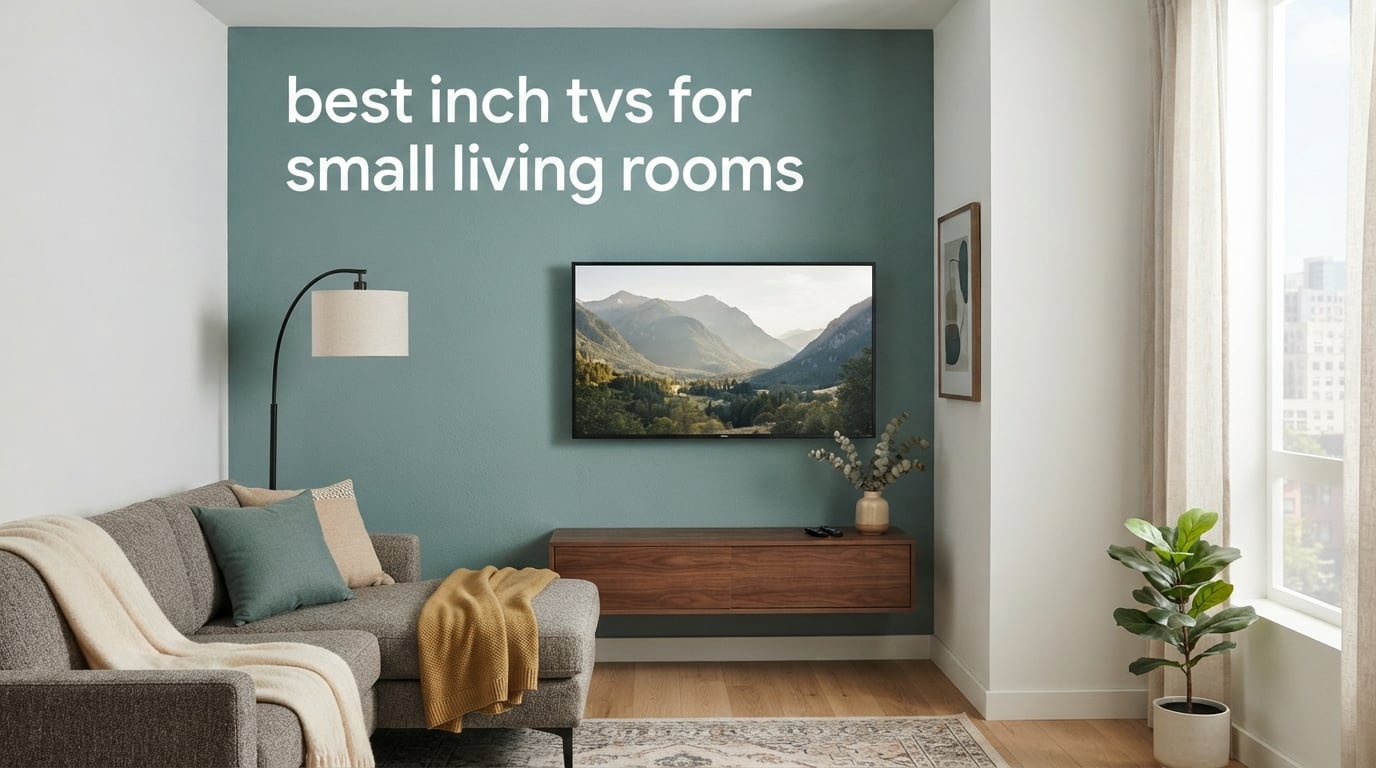
A 55-inch TV is the largest set most compact living rooms can absorb without the picture starting to crowd the space. It is also the smallest size that still feels like a real television rather than a tablet propped on a shelf. That leaves a narrow window where the choice matters, and most roundups ignore it entirely by ranking sets on brightness and price instead of fit.
The number that decides whether a 55-inch set works in your room is not the 55 itself. It is the cabinet width, which lands at roughly 48 inches for every 55-inch panel on the market, and the distance from your eye to the screen, which in a typical small living room runs between 6 and 9 feet. Get those two right and almost any decent set looks good. Get them wrong and no amount of picture processing rescues the result.
Over the past few weeks our team worked through 10 sets at this size, measured them, checked their panel specs against what each brand claims, and read through buyer feedback to find the recurring problems. This guide covers the best 55 inch tv for small living room setups, organized the way the room actually constrains you: glare first, off-axis viewing second, and picture quality third.
Table of Contents
Does a 55-Inch TV Actually Fit a Small Living Room?
Yes, in most living rooms under about 12 feet deep, as long as your wall can spare roughly 52 inches of clear width and you sit between 6 and 9 feet back.
Here is the measurement nobody quotes. A 55-inch rating describes the diagonal, not the width. Because every 16:9 panel has the same proportions, that 55-inch diagonal works out to about 48.3 inches wide and about 27.2 inches tall, plus a slim bezel on three sides and a slightly thicker chin. With the pedestal stand attached, expect a total height of roughly 30 inches. Almost every 55-inch TV we measured came in between 48.0 and 48.5 inches wide, so the cabinet width is predictable even when the brands are not.
So you need a wall at least 52 to 54 inches wide to hold a 55-inch set with a few inches of margin on each side. If you tape the outline on the wall and it makes you wince, step down to a 50-inch set, which is roughly 43.6 inches wide, or a 43-inch, which is about 37 inches wide. For a narrow wall in a rental, a 50-inch screen is the safer buy and costs very little picture area in a small room.
Next, measure viewing distance from your actual eye position when seated, not from the sofa arm. A common mistake is measuring to the front edge of the cushion, which understates your real distance by a foot or more. For a 55-inch 4K panel, most people want 6 to 9 feet. Closer than 5 feet and the pixels start to resolve at normal 4K viewing; beyond 10 feet and detail drops away, though upscalers like the one in the Samsung QN90F hold the image together well.
Then check the two things that ruin compact-room viewing. Look for a window, a glass wall, or a strong lamp that reflects straight back at your screen during the hours you actually watch. If one exists, reflection handling outranks every other spec. And check whether your sofa spans the full wall, because guests on the ends will watch from far off-axis where contrast drops fastest on a value-oriented panel.
One more test costs nothing: tape the outline on the wall and leave it for a day before ordering. People routinely discover mid-week that a screen which looked right on a showroom wall makes the room feel crowded every single evening.
Top 3 Picks for Small Living Rooms in 2026
The three sets below cover the most common small-room situations: glare near a window, tight budget with a narrow wall, and a bedroom or corner space that doubles as a gaming spot.

TCL 55A300L Designer QLED
- Ultra matte anti-glare screen
- 1.1 inch body with flush wall mount
- Curated art and AI art modes
- QLED 4K with Dolby Vision

INSIGNIA NS-55F501NA26 4K Fire TV
- 4K UHD with HDR10 and upscaling
- Fire TV with Alexa voice remote
- DTS Virtual-X with HDMI eARC
- 48.35 inch cabinet width

TCL 55QM6K Mini LED QLED
- 144Hz native with Motion Rate 480
- Mini LED local dimming with Halo Control
- Onkyo 2.1 audio with subwoofer
- QLED 4K with Dolby Vision
All 10 Picks at a Glance in 2026
Every set below is a 55-inch 4K panel. The differences that matter in a small room are screen finish, chassis depth, viewing angle, refresh rate, and whether the backlight can hold contrast against room light.
| Product | Specifications | Action |
|---|---|---|
| TCL 55A300L Designer Series QLED Art TV |
|
Check Latest Price |
| INSIGNIA NS-55F501NA26 F50 Series 4K Fire TV |
|
Check Latest Price |
| TCL 55QM6K Mini LED QLED |
|
Check Latest Price |
 LG OLED55C4PUA OLED C4 LG OLED55C4PUA OLED C4 |
|
Check Latest Price |
 Samsung QN55QN90F Neo QLED Samsung QN55QN90F Neo QLED |
|
Check Latest Price |
 Roku 55R5D5 Select Series QLED Roku 55R5D5 Select Series QLED |
|
Check Latest Price |
 INSIGNIA NS55-UQFL26 QF Series QLED INSIGNIA NS55-UQFL26 QF Series QLED |
|
Check Latest Price |
 TCL 55T7 QLED 120Hz TCL 55T7 QLED 120Hz |
|
Check Latest Price |
 Amazon Ember 4-Series 55-inch Amazon Ember 4-Series 55-inch |
|
Check Latest Price |
 Roku 55R6C7 Plus Series Mini LED Roku 55R6C7 Plus Series Mini LED |
|
Check Latest Price |
1. TCL 55-inch Designer Series QLED Art TV (55A300L) – the one that disappears into a small room
TCL 55″ Designer Series Picture Frame TV, QLED 4K, 55A300L, 2026 Version
1.1 inch body, ultra matte QLED, 4K with Dolby Vision, Google TV, flush mount
Pros
- Ultra matte screen resists reflections near a window
- 1.1 inch profile with flush wall mount included
- Light wood magnetic frame hides the bezels
- Art Mode shows artwork and your own photos when idle
Cons
- Picture needs colour calibration out of the box
- Dialogue can be hard to hear on the built-in speakers
- Some units have slightly dimmer screen corners
Most 55-inch TVs are designed to be mounted flush and forgotten. This one is designed to be looked at, and that changes the feel of a room where every surface is already competing for attention. The magnetic light wood frame and the 1.1 inch body sit almost flat against the wall, so instead of a black rectangle hovering above the console you get something closer to a framed print.
The technical reason this is my first pick has less to do with styling. That ultra matte finish is the most aggressive anti-reflection treatment in this group, and in a small living room with a window opposite the screen it is worth more than any amount of extra brightness. The panel underneath is QLED 4K with Dolby Vision, HDR10+, HDR10 and HLG support running through the AiPQ Pro processor, so HDR streaming is properly graded rather than approximated.
Buyers consistently describe the same tradeoff: the hardware and the design land well, but the picture wants a short calibration session. Reviewers report that colours can drift out of the box, and that some sets show faint streaking during bright fast-moving scenes. A few also note slightly dimmer corners and dialogue that gets buried under effects-heavy content.
Sound is the other place to manage expectations. The built-in speaker setup handles dialogue and general viewing, but anyone watching films after dark will likely want a compact soundbar. In a small room that is an easy fix, since a narrow bar under a wall-mounted set takes up almost no floor space.
Why it suits a small living room better than most
The 1.1 inch depth means the panel can go almost flat to a wall without a gap you can see from the side, which matters in a room where the TV wall and a doorway share the same plane. The included flush wall mount removes the guesswork, and the frame hides the bezels that usually give a budget set away.
The art gallery behaviour is the second quiet advantage. It cycles through curated artwork, generated art, and your own photos when the set is idle, so a screen that sits in the middle of a busy room stops being a black rectangle for most of the day. If your screen faces a window that floods the room at midday, check the panel finish before you commit, because the anti-glare treatment is the spec that does the work here rather than raw brightness.
Where it falls short
The Art Mode and the flush mount add setup steps compared with a plain pedestal TV, and the frame plus mount assembly takes longer than most people expect on their first attempt. There is also no full array local dimming on this panel, so letterboxed scenes in a dim room show less contrast control than the Mini LED sets below.
If picture accuracy out of the box matters more to you than how the set looks in the room, this is not the pick. You are trading some calibration effort for design and reflection handling, and that trade is a good one in compact spaces but not universally right.
2. INSIGNIA 55-inch F50 Series 4K Fire TV (NS-55F501NA26) – the most proven budget pick
INSIGNIA 55-inch Class F50 Series LED 4K UHD Smart Fire TV with Alexa Voice Remote (NS-55F501NA26)
4K UHD, HDR10, 300 nits, Fire TV, 48.35 inch width
Pros
- Largest owner base in this roundup at more than 12000 reviews
- Sharp 4K with good HDR10 and upscaling
- Guided setup is genuinely painless
- Three HDMI ports including one with eARC
- Light enough to reposition on your own
Cons
- Fire OS menus and app launches are noticeably slow
- 60Hz panel rules out high-refresh gaming
- Limited picture adjustment options
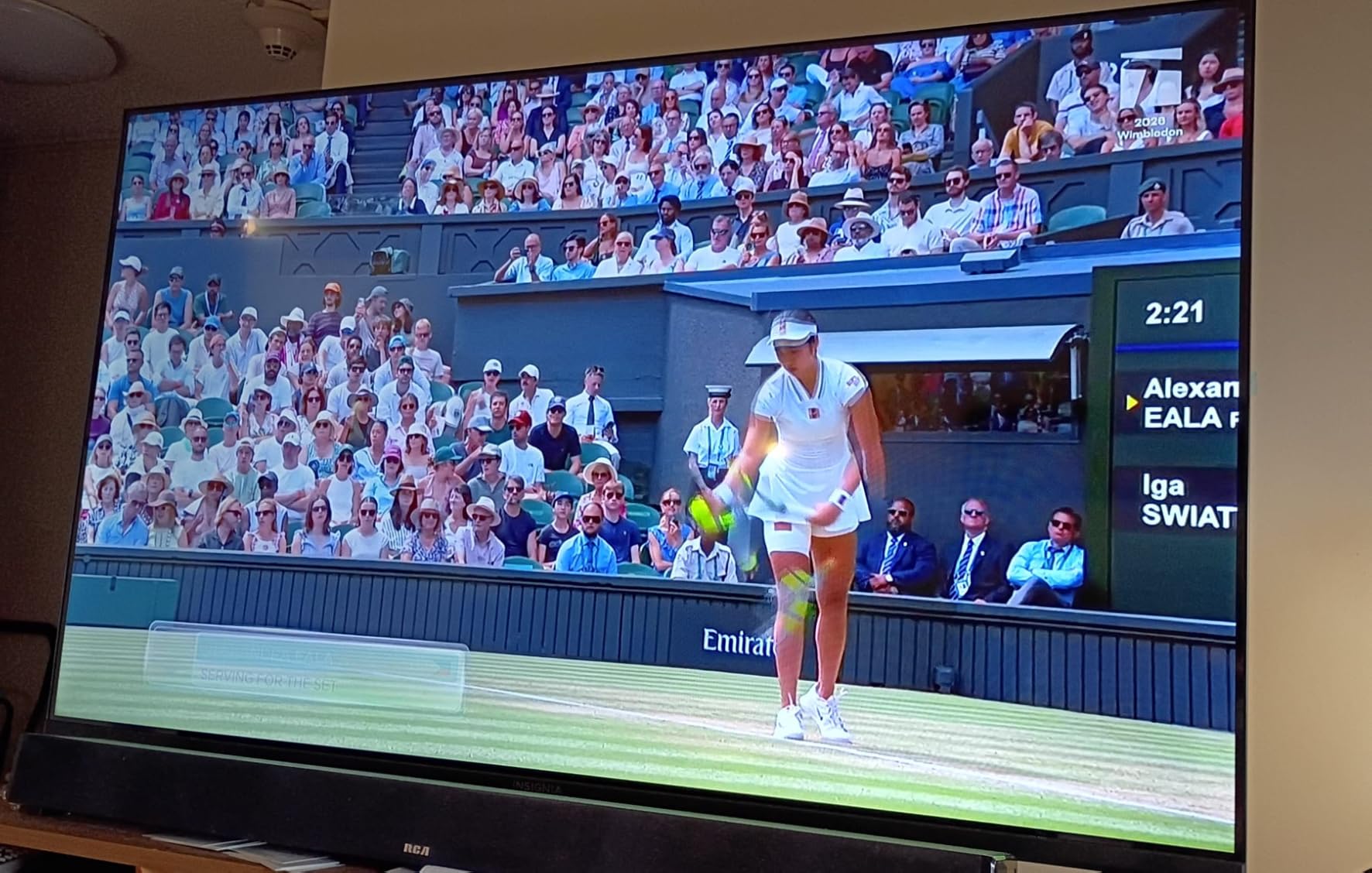
With more than 12000 reviews behind it, the F50 Series is the most thoroughly tested 55-inch set in this group, and the patterns in that feedback are unusually consistent. Owners praise a sharp 4K picture, painless setup, and an Alexa remote that actually works, plus sound that punches slightly above the entry class thanks to DTS Virtual-X.
At 48.35 inches wide and 30.09 inches tall with the stand, it fits a standard entertainment wall without drama. Peak brightness is 300 nits, which is fine in a normally lit room and marginal in one that gets direct sun, and the 178-degree viewing angle is a spec sheet number rather than a promise of strong off-axis contrast.
The recurring complaint is software. Fire OS menus and app launches are slow, settings screens lag, and a minority of owners report audio dropouts. There is also a specific small-room irritation: the display can cut to a bright advertisement screen while you are adjusting picture settings, which makes calibration awkward in daylight because the brightness jump is so dramatic.
Motion handling is the other limit. With a 60Hz native panel and an 8ms response time, this is a television for streaming and broadcast rather than for a console. Reviewers also mention some ghosting on low-resolution sources such as PC or phone mirroring, so it is not the set to choose if you plan to plug a laptop in regularly.
Why it suits a small living room
At 28.3 pounds without the stand, one person can lift it onto a shelf or a no-drill stand, which matters in a rental. The 200 x 200 mm VESA pattern is a small, common bracket size, so the wall mount options are plentiful and inexpensive. Three HDMI ports and eARC give you room for a streaming stick, a console, and a soundbar without a switch.
It is also the set most likely to still be there in five years, because Fire TV receives updates and the platform family is large. For a first apartment or a spare room, the longevity argument often matters more than the spec sheet.
Where it falls short
The 60Hz panel is a deliberate trade at this tier, and it is a real one for sports fans. Fast football looks noticeably less clean here than on the 120Hz and 144Hz sets further down, and there is no VRR to smooth frame-rate mismatches with a console. If gaming is more than occasional, spend the difference.
Picture adjustment options are also thin. Enthusiasts wanting to calibrate will find nothing here, and the glossy finish means a bright lamp opposite the screen will show as a reflection. If glare is your primary concern, choose the matte TCL Designer Series instead.
3. TCL 55-inch QM6K Series Mini LED QLED (55QM6K) – the compact-room gaming pick
TCL 55 Inch Class QM6K Series | Mini LED QLED 4K HDR | 55QM6K, Latest Model | 120HZ-144HZ High Brightness Smart Google TV Dolby Atmos Onkyo Audio | Voice Remote Alexa Gaming Streaming Television
QD-Mini LED local dimming, 144Hz native, Motion Rate 480, Onkyo 2.1
Pros
- Mini LED local dimming gives real contrast in a small room
- 144Hz native with Motion Rate 480
- Onkyo 2.1 with a built-in subwoofer
- Quantum Dot colour with high brightness
- Dark scenes hold shadow detail
Cons
- Glossy finish shows reflections in bright rooms
- Google TV is not as snappy as Roku OS
- Needs tuning in a dim room
Mini LED has quietly become the standard-bearer at this size, and the QM6K is the clearest example of what that means for a compact room. The full array local dimming with Mini LED precise dimming zones gives it black levels that entry LED sets cannot reach, and in a small living room where you often watch with a single lamp on rather than lights off, that contrast headroom is the feature you will feel every day.
For gaming it is even harder to argue with. The 144Hz native panel with a Motion Rate 480 label for motion enhancement and four HDMI inputs mean a PS5 or a gaming PC gets everything it asks for. Input response is not the focus of the spec sheet, but the panel combination is the one console buyers want in a bedroom or corner setup.
Audio is unusually good for a flat panel, and this matters in a small room where a soundbar is often skipped. The Onkyo 2.1 system includes a real subwoofer, so films have low end without a separate box. Dolby Atmos, DTS:X and IMAX Enhanced decoding are all supported.
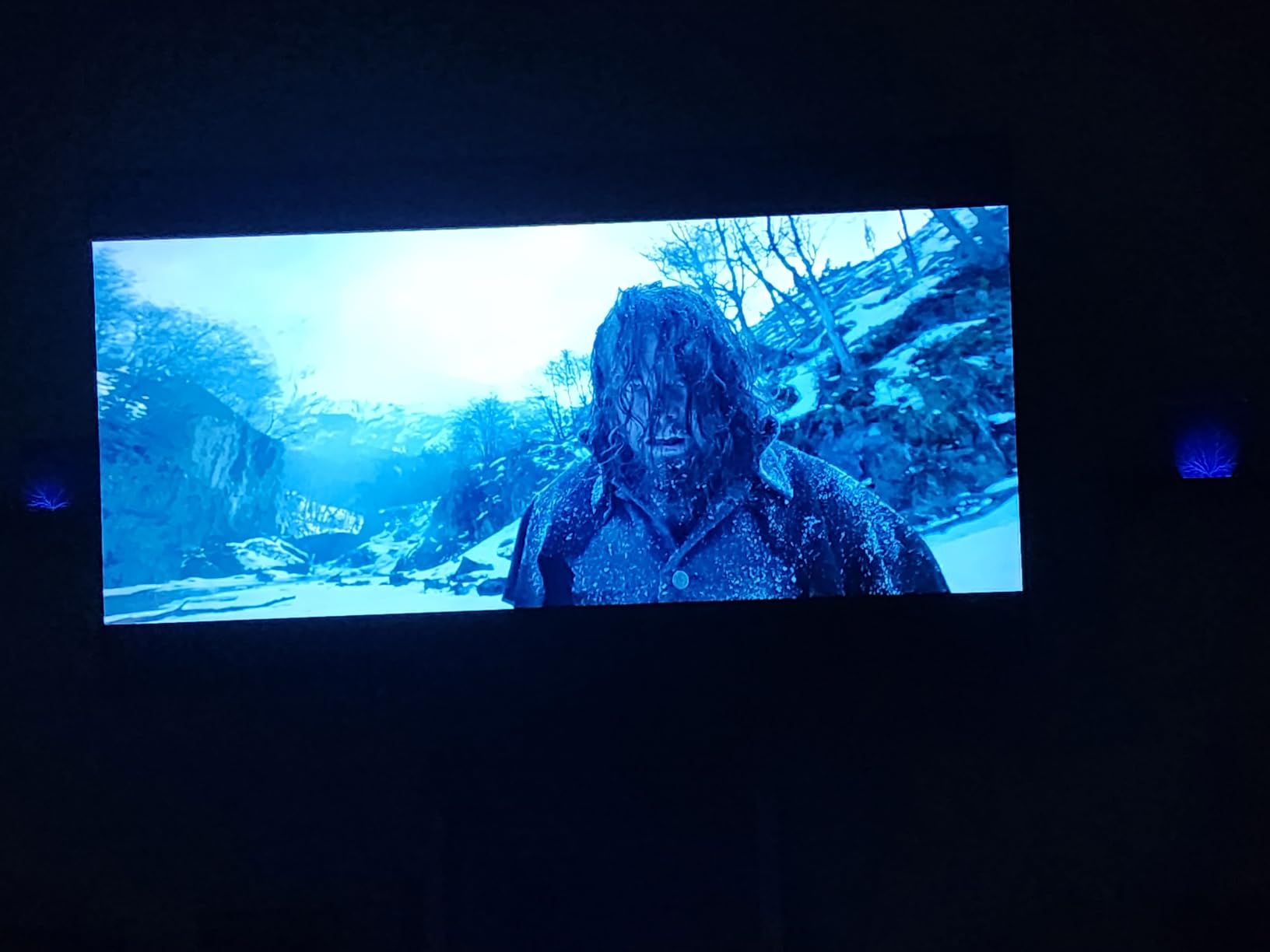
The tradeoff is physical. At 11.6 inches deep and 27.3 pounds, this is a chunky television with a glossy screen that catches reflections. In a narrow room with a shallow console, the depth matters, and if your screen faces a window the gloss will work against the otherwise excellent local dimming.
Google TV runs the platform, and reviewers note it can feel slower than Roku-based systems. The out-of-box picture also benefits from some tuning in a dim room, which is normal for a local-dimming panel but worth knowing before you blame the TV.
Why it suits a small living room
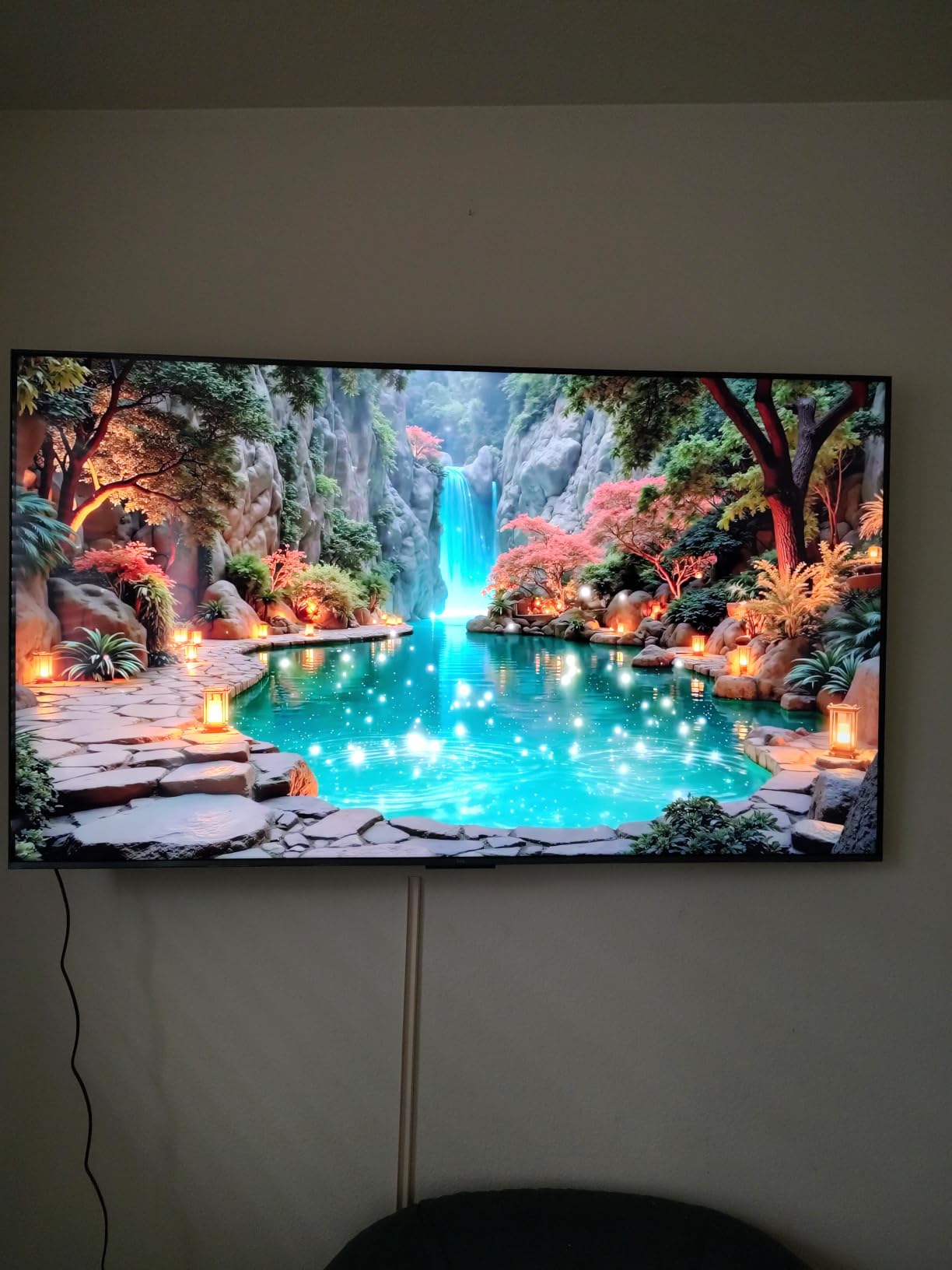
Local dimming is the reason. In a room that cannot be darkened completely, or where you watch in the evening with overhead lights half on, a dimming array keeps dark areas dark instead of washing them grey. That makes a 55-inch screen feel far more considered at a short viewing distance, where weak blacks are far more obvious than they would be across a room.
Four HDMI ports at 300 x 300 mm VESA also mean you can mount it on a standard bracket and still connect a console, soundbar, and streaming device without an adapter.
Where it falls short
The glossy screen is the big one in a bright room. If reflections are your main problem, this is the wrong set and the matte TCL Designer Series or the Glare Free Samsung is the right one. The 11.6 inch depth will also overhang a shallow media unit, and Google TV takes longer to learn than Roku OS.
It is also not the set for anyone who wants a slim profile. At 55 inches this chassis is a full-size television, and in a room where the TV wall is visually tight, that bulk shows.
4. LG 55-inch OLED C4 Series (OLED55C4PUA) – the best picture in a small room
LG 55-Inch Class OLED evo C4 Series Smart TV 4K Processor Flat Screen with Magic Remote AI-Powered with Alexa Built-in (OLED55C4PUA, 2024)
OLED self-lit panel, 144Hz, 0.1ms, 4 HDMI 2.1, webOS
Pros
- True blacks and 100 percent colour volume
- Excellent picture from any seat thanks to wide viewing angles
- 144Hz with 0.1ms response and four HDMI 2.1
- a9 AI Processor Gen7 upscales lower-resolution sources
Cons
- Not as bright as the best Mini LED sets in a sunlit room
- webOS menus respond slowly
- Burn-in risk with static content left on screen
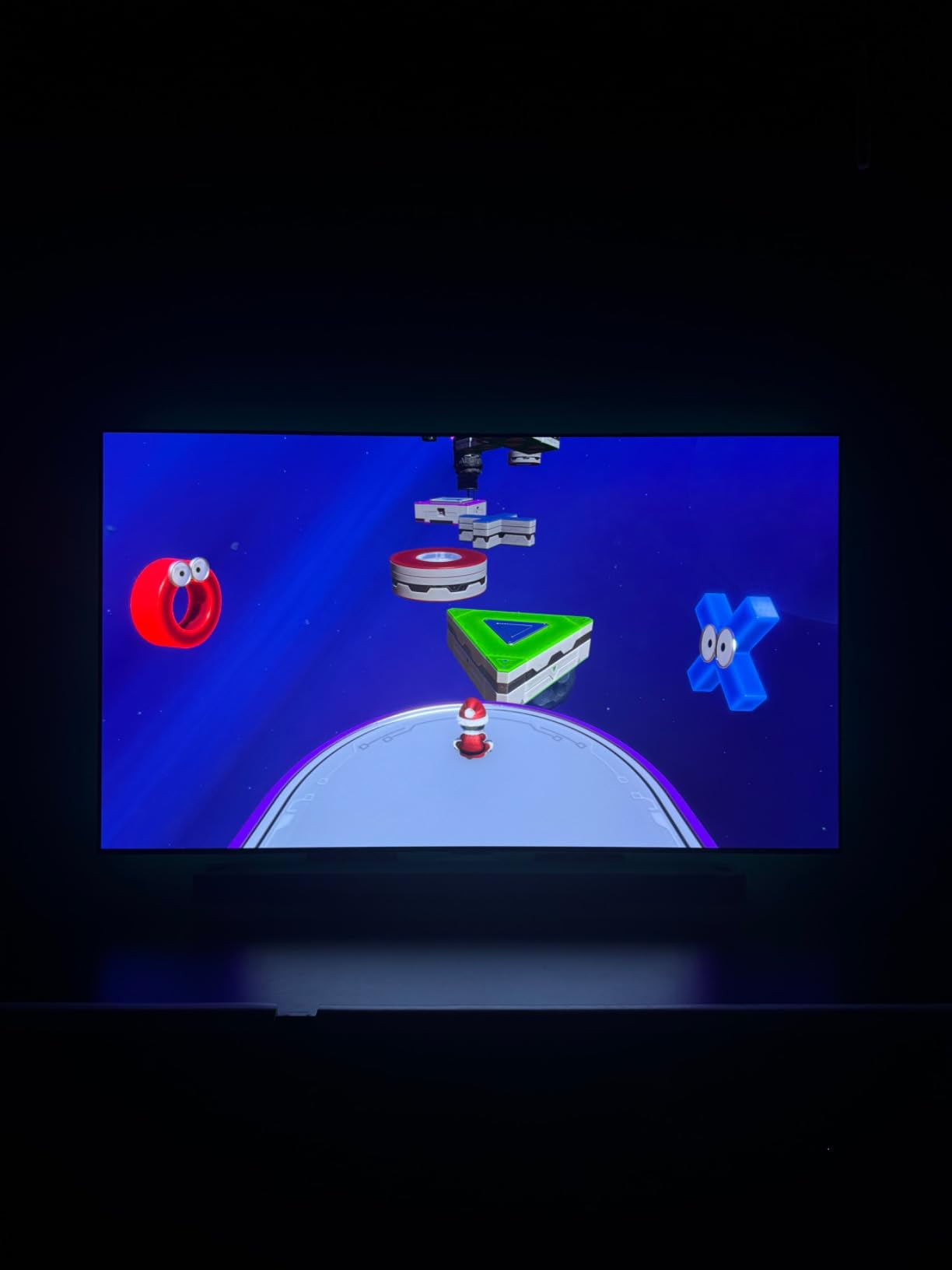
At a short viewing distance the OLED advantage is not subtle. A self-lit panel produces true blacks and enormous contrast, and because every pixel makes its own light the picture holds up as you move off-centre, which is exactly the situation in a small room with a wide sofa. Buyers single out colour accuracy and off-angle consistency as the reasons this panel feels forgiving in tight spaces.
The gaming hardware is first-rate too: up to 144Hz, 0.1ms response, NVIDIA G-Sync and AMD FreeSync Premium with VRR, and four HDMI 2.1 inputs alongside LG’s Game Dashboard and Game Optimizer. If you sit close, the a9 AI Processor Gen7 with AI Super Upscaling makes even cable and broadcast sources look respectable.
Sound is better than most flat panels, and Multi View lets you run two sources side by side. Five years of webOS updates under the Re:New program is a real advantage if you keep sets a long time.

The honest limitation for a small living room is brightness. OLED panels do not push as much light as a Mini LED flagship, and in a room with a window opposite the screen the picture will look dimmer during the day. Owners also mention slow webOS response times and the Magic Remote’s scroll-wheel cursor being awkward for some.
Then there is the pixel-cleaning routine, which can take up to ten minutes and interrupt viewing. For a household that leaves static menus or a news channel up for hours every day, that process running regularly is a genuine annoyance worth weighing.
Why it suits a small living room
Viewing angle is the underrated reason. In a small room the sofa often spans the whole wall, which means the people at each end sit at a sharp angle to the screen. A VA panel loses contrast and washes out as you move sideways, while an OLED holds its picture. For wide or corner seating this is the difference between everyone watching and the ends of the sofa squinting.
Its 9.1 inch depth is also slimmer than most LED sets of this size, which helps on a shallow console or a tight wall.
Where it falls short
Brightness in daylight, and burn-in if you leave static content on for very long stretches. If the room gets direct sun and the TV is on all day for news and menus, the Mini LED options here handle that better. It is also the most expensive set in this roundup, which is a real consideration for a room where a 50-inch alternative would fill the wall adequately.
Finally, the software. webOS is capable and well-supported, but reviewers consistently call it slow to open and slow to respond. If you or another household member will be navigating every evening, that friction is felt daily.
5. Samsung 55-inch Neo QLED QN90F – the bright-room specialist
Samsung 55-Inch Class Neo QLED 4K QN90F Series, Vision AI, Mini LED Smart TV (2025 Model, 55QN90F) Neo Quantum HDR+, Object Tracking Sound+ w/Dolby Atmos, Glare Free, Gaming Hub, Alexa Built-in
Neo QLED Mini LED, Glare Free coating, NQ4 AI Gen3, Object Tracking Sound Plus
Pros
- Glare Free anti-reflection coating works in sunlit rooms
- Mini LED gives very high brightness with deep contrast
- NQ4 AI Gen3 processor upscales to 4K convincingly
- Object Tracking Sound Plus with Dolby Atmos
- Neo Quantum HDR Plus for scene detail
Cons
- 45.4 pounds means two people are needed to mount it
- No Dolby Vision on this model
- 116 watts power draw is high for a 55-inch set
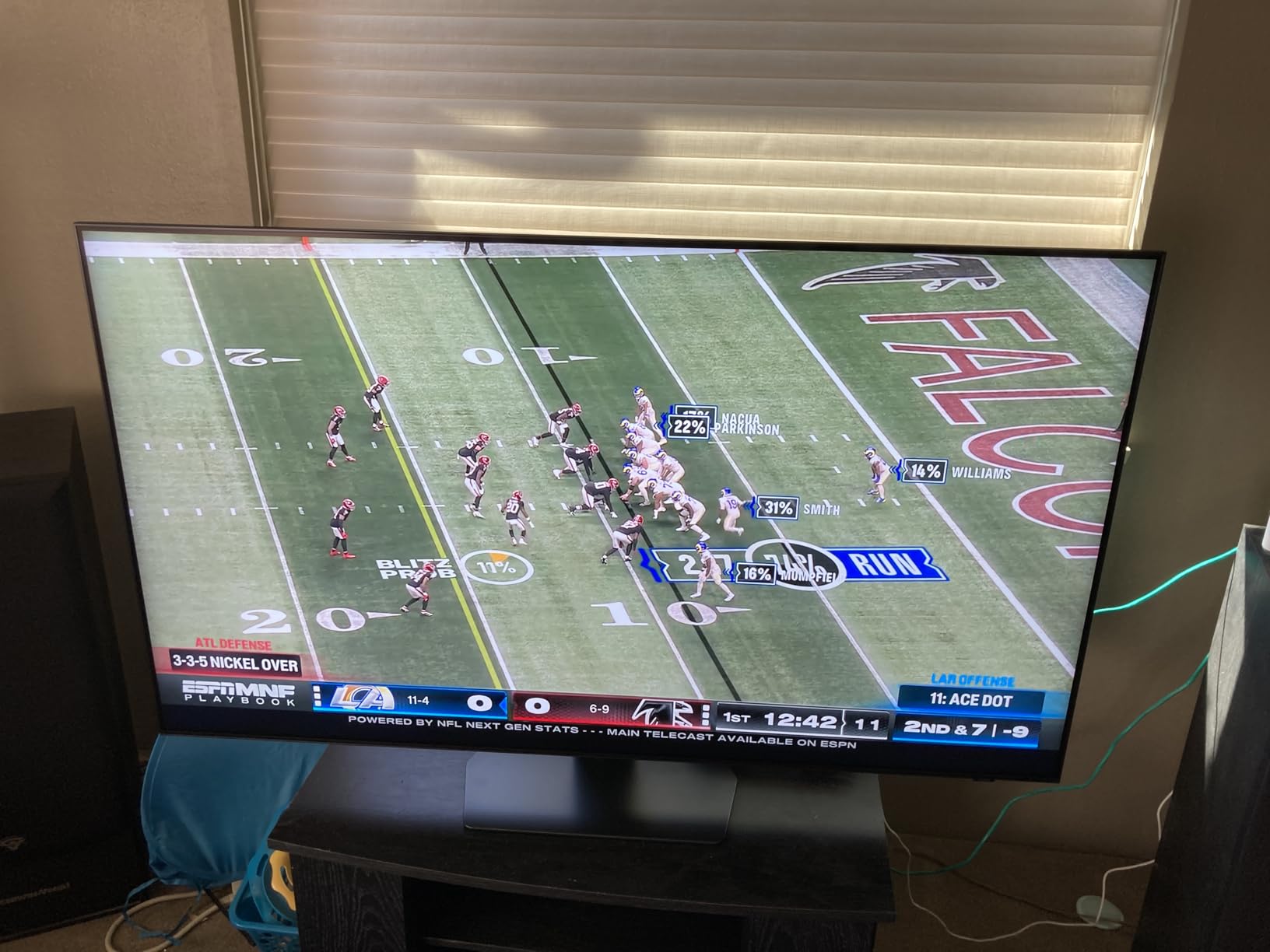
If your small living room has a window, a glass wall, or a strong afternoon light landing anywhere near the screen, this is the set built for it. The Glare Free anti-reflection coating is the reason owners single it out, combined with Mini LED brightness that pushes hard enough to stay punchy in a room you cannot fully darken.
The NQ4 AI Gen3 processor runs 128 neural networks and handles AI upscaling, which reviewers credit for making cable and lower-resolution streaming look convincingly 4K. It is also a strong sports and console option, with AI motion smoothing that specifically targets fast balls and on-screen text.
Audio is unusually capable for a television: 4.2.2 channel Object Tracking Sound Plus with Dolby Atmos, which is the most elaborate built-in system in this group and can genuinely reduce the need for a soundbar in a small room.
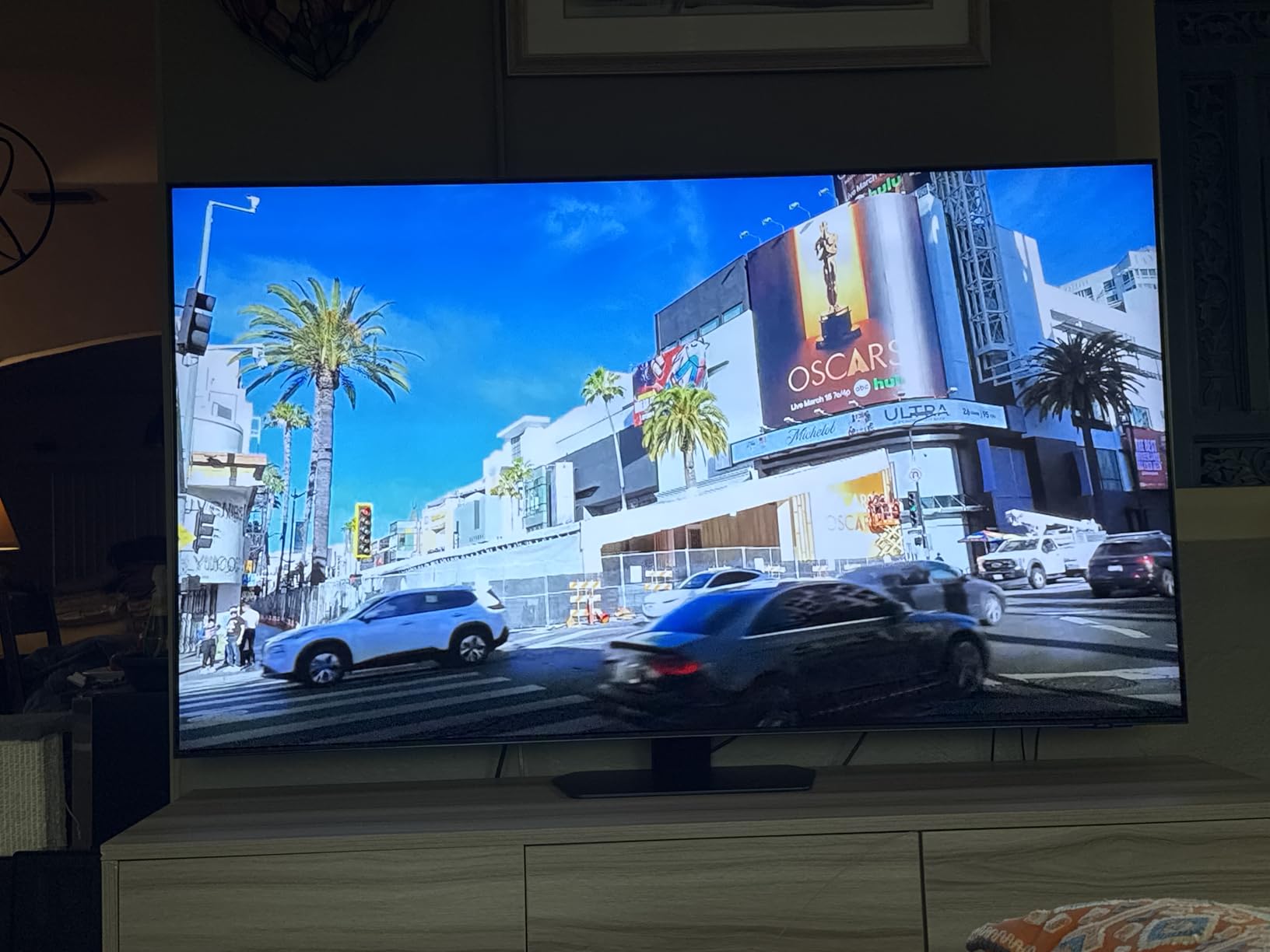
Two things stand against it in a compact space. The first is physical: at 45.4 pounds, 39 without the stand, this needs two people to mount and a bracket that can take the weight. The second is power draw at 116 watts, which is high for a 55-inch set and noticeable on a small room’s energy bill if the TV runs many hours a day.
Picture formats are also a narrower story than rivals. This model lists Neo Quantum HDR+ and HDR10+ but no Dolby Vision, so if you stream mostly from services that favour Dolby Vision, the TCL and LG sets handle those titles better.
Why it suits a small living room
Brightness and reflection handling, plainly. In a room under 12 feet deep you will often watch in mixed lighting rather than darkness, and a panel that stays legible with the curtains open solves a problem no amount of contrast processing can. The slim-bezel frame design also keeps the visual footprint small against the wall.
For a room that doubles as an office during the day and a TV room at night, that is the single most valuable spec in this roundup.
Where it falls short
Weight, power, and price. It is the heaviest set here and among the most expensive, and a rental or a first apartment where a friend will not be available to help lift is a poor match. Tizen also tends to divide opinion, with reviewers preferring the uncluttered layout of Roku OS or the app depth of Google TV.
Without Dolby Vision, some streaming content loses the grade its director intended. If picture format support outranks daylight performance, look at the TCL QM6K or the LG C4 instead.
6. Roku 55-inch Select Series QLED (55R5D5) – the easiest set to install alone
Roku 55-Inch Select Series Smart TV 2026-4K (2160p) QLED TV TV
4K QLED, 60Hz, Roku OS, 20.5 pounds, 48.3 inch width
Pros
- QLED colour and genuinely dark blacks at a budget tier
- Roku OS is fast and uncluttered
- Setup takes only a few minutes
- 20.5 pounds is easy to lift and mount solo
- Bluetooth Headphone Mode for private viewing
Cons
- 60Hz panel limits high-refresh gaming
- 20 watt speakers are thin for film
- No local dimming so bright rooms show weak contrast
The Select Series is the pick if the priority is a good picture without a fight, and if you want to get it on the wall yourself on a Sunday afternoon. At 20.5 pounds, 20.1 of that without the stand, it is the lightest set in this roundup by a wide margin and a single person can mount it on a standard bracket.
The QLED panel is the real upgrade over cheaper LED models. Roku Smart Picture auto-optimises settings so the picture looks credible immediately after setup, which in practice means the few minutes between unboxing and watching are the entire calibration process. Owners who came from smaller sets frequently describe the colour as a step change.
Roku OS is the quiet hero. It launches apps quickly, the interface stays out of the way, and the voice remote works without a learning curve. For a multi-generational household in a small apartment, a platform nobody has to train is worth a lot, and Roku remotes are interchangeable across the range.

The limits are clear. Sixty hertz native rules out high-refresh gaming, there is no full array local dimming so a bright room exposes weaker contrast, and the 20 watt speakers handle dialogue well but go thin on music and effects. Reviewers also note frustration when Roku’s quick-access row and recommendations reshuffle your own app ordering.
Bluetooth Headphone Mode is a genuinely useful feature in a small or shared home, letting one person watch without disturbing anyone else in the room.

Why it suits a small living room
Physical simplicity. At 48.3 inches wide and 20.5 pounds, this is the least demanding set in the group to place, carry between rooms, or mount in a rental without drilling. The frameless design keeps the visible bezel small, which helps the screen look larger than it measures on a compact wall.
It is also the set most likely to suit an older viewer or anyone who does not want to fiddle with picture modes, because the platform does the optimising automatically.
Where it falls short
The lack of local dimming is the one to understand before buying. In a room with strong ambient light, without a dimming array the blacks lift and the picture looks flatter than a Mini LED set at the same size would. This is the model to choose in a normally lit room and to skip in a sunlit one.
Sports and console gaming will also feel less smooth at 60Hz than on the 120Hz and 144Hz sets here. Everything else about the experience is deliberately frictionless, so that is the single trade to make consciously.
7. INSIGNIA 55-inch QF Series QLED Fire TV (NS55-UQFL26) – the entry point to QLED colour
INSIGNIA 55-inch Class QF Series LED 4K UHD QLED Smart Fire TV with Alexa Voice Remote (NS55-UQFL26)
QLED with direct LED backlight, Dolby Vision, 2.8 inch body
Pros
- QLED quantum dot colour with a direct LED backlight
- Dolby Vision and HDR10 support
- Dolby Atmos processing with 5.1 channels
- Only 2.8 inches deep for a 55-inch set
- Three HDMI inputs including one with eARC
Cons
- 60Hz panel with no gaming refresh claim
- No local dimming so blooming is uncontrolled
- Fire OS can be sluggish
This is an affordable route to quantum dot colour, and that matters more in a small room than it does in a large one. Sitting 6 to 8 feet from a 55-inch screen, the difference between a standard LED panel and a QLED one shows up in skin tones and colour saturation at a viewing distance where many other differences have already faded.
Getting Dolby Vision and HDR10 on a set at this price is genuinely unusual, and the 2.8 inch body is one of the slimmest 55-inch cabinets available, which helps on a shallow console or against a tight wall. The bezel-less edge-to-edge glass front keeps the visible frame small.
Fire TV gives you Netflix, Disney+, Hulu, Prime Video, YouTube and Sling TV out of the box, with an Alexa remote and a 1 year limited warranty. Three HDMI inputs, one of which supports eARC for a soundbar, is enough for a streaming stick plus a console.
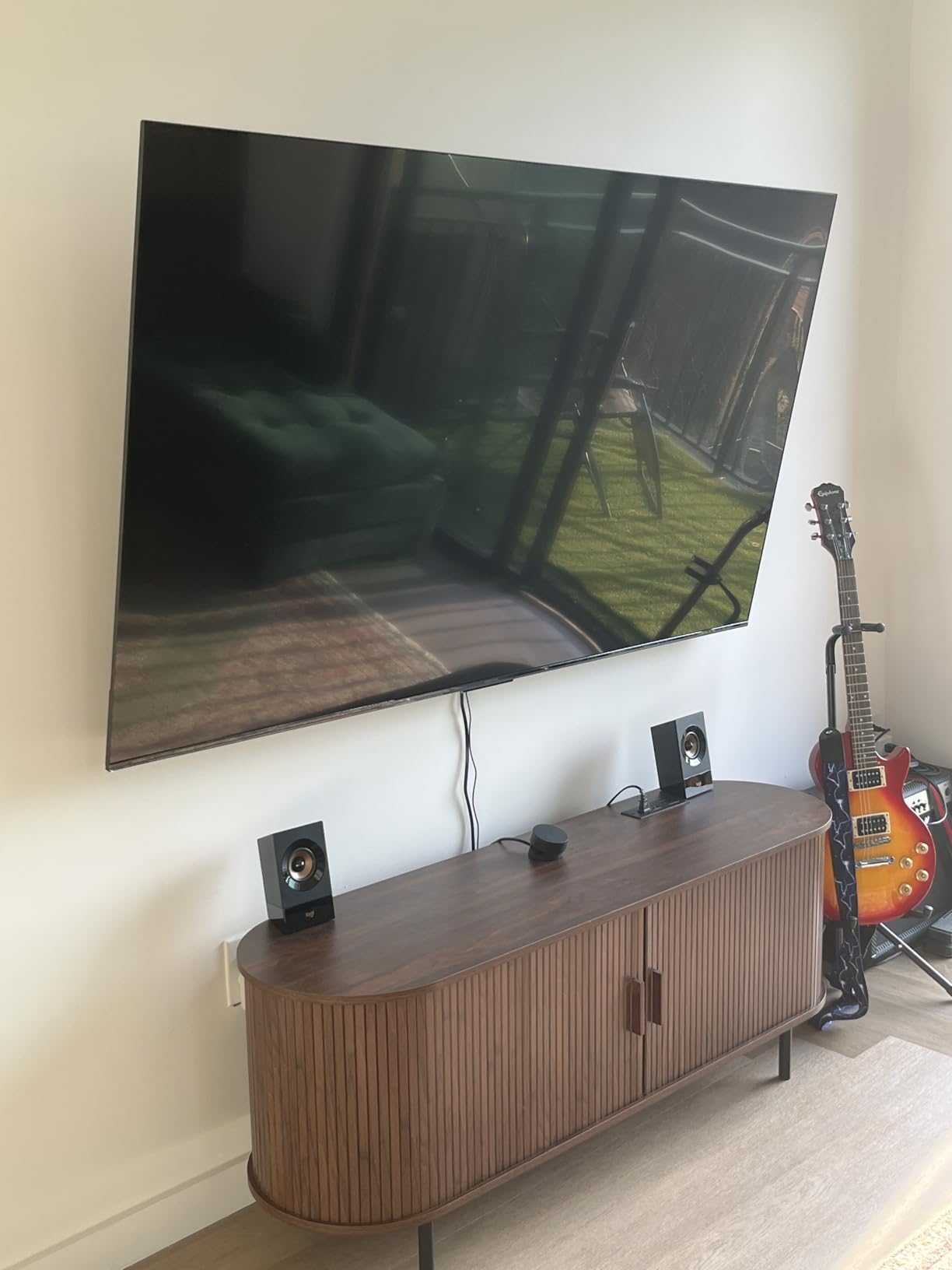
What you give up is picture control and speed. There is no local dimming, so bright highlights in a dark room bloom and the panel has no way to hold blacks down. Reviewers also flag a limited calibration menu, only three HDMI ports, and a Fire OS interface that can feel sluggish next to Roku.
Speakers are basic even with Dolby Atmos processing, which shapes the soundstage but does not add the drivers that make it audible. In a small room that is a manageable limit, since the room does some of the work.
Why it suits a small living room
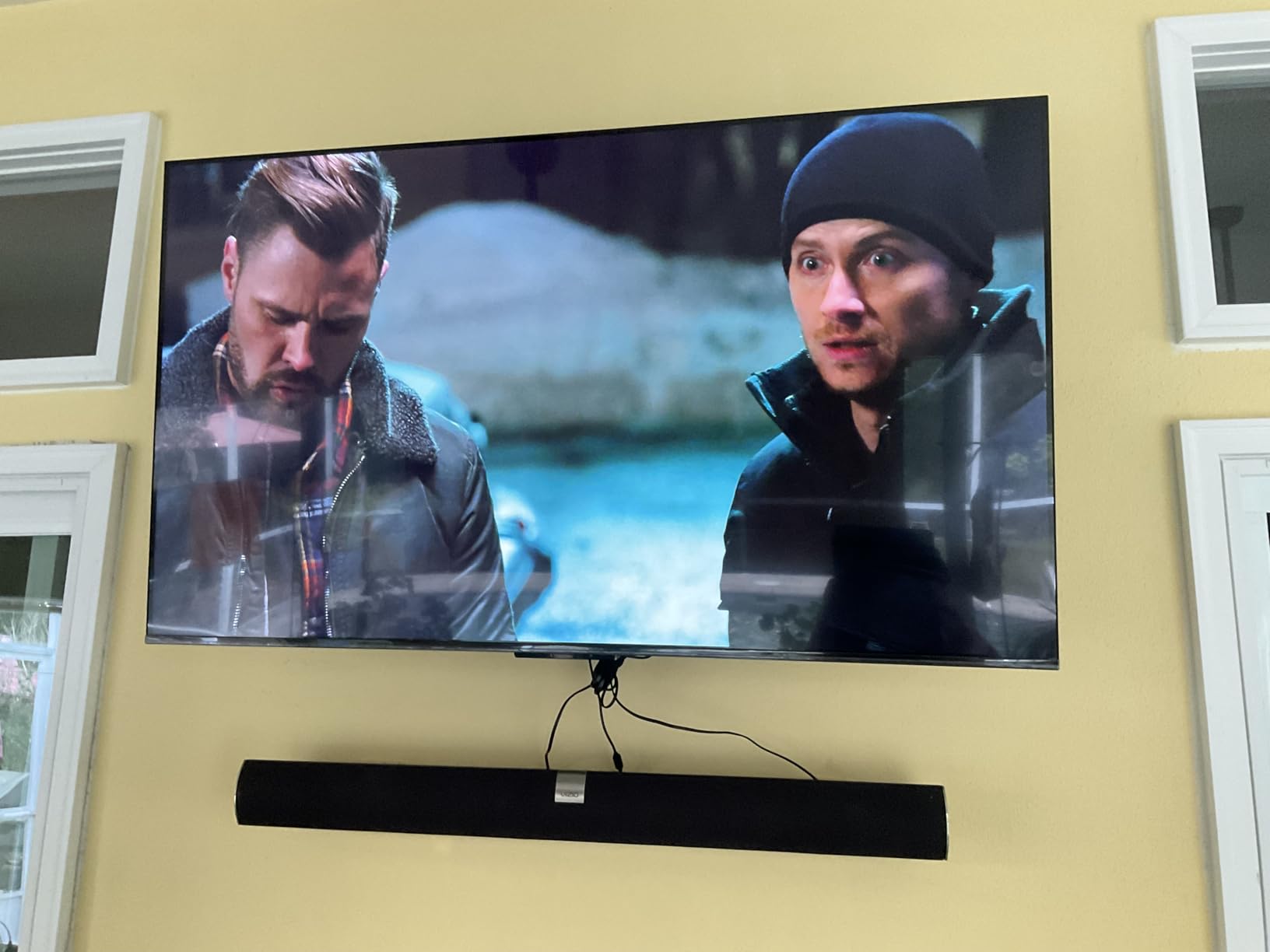
Depth and width. At 2.8 inches deep and 48.3 inches wide, this is one of the least intrusive 55-inch sets available, and the bezel-less face means it reads smaller on the wall than the measurement suggests. For a room where the TV wall doubles as a walkway, that restraint is the feature.
Dolby Vision on a set this size also means HDR streaming looks intentional rather than washed out, which is where a small room’s viewing position makes the grade more obvious.
Where it falls short
Sixty hertz with no gaming refresh claim, no local dimming, and a slow interface. Live sport at 60Hz is watchable but visibly less smooth than the 120Hz and 144Hz sets here, and if your room is bright all day the missing dimming array will show.
The 400 x 400 mm VESA pattern is also unusually large for the size, so check that your bracket supports it before you commit to a particular stand.
8. TCL 55-inch T7 QLED 120Hz (55T7) – the budget console pick
TCL 55″ T7 4K QLED Google TV with 144Hz Gaming (55T7)
QLED, 120Hz panel, Motion Rate 480, 24.3 pounds, 2.7 inch body
Pros
- 120Hz native panel with VRR and Game Mode
- QLED colour covering nearly the full DCI-P3 gamut
- Only 24.3 pounds so one person can mount it
- Dolby Vision and HDR PRO Plus supported
- Google TV with Chromecast and AirPlay 2 built in
Cons
- Google TV nags toward other content
- Some glare in brighter rooms
- Remote is not backlit
The T7 exists because a lot of small living rooms are also gaming rooms. It delivers a genuine 120Hz native panel with variable refresh rate and a Game Mode, which is the specification floor most console players actually want, at a price well below the Mini LED and OLED sets in this roundup.
Colour is the other strength. The QLED panel covers nearly the entire DCI-P3 gamut and runs the TCL AIPQ Pro processor, and with Dolby Vision, HDR PRO+, HDR10+, HDR10, HLG and Open HDR supported it handles the full range of modern formats. Dolby Atmos and DTS:X decoding is included with 20 watt speakers.
At 24.3 pounds and 2.7 inches deep, it is the second-lightest set here and one of the few you can genuinely lift onto a wall mount by yourself. Owners mention quick assembly and a light feel as reasons they picked it over heavier alternatives.
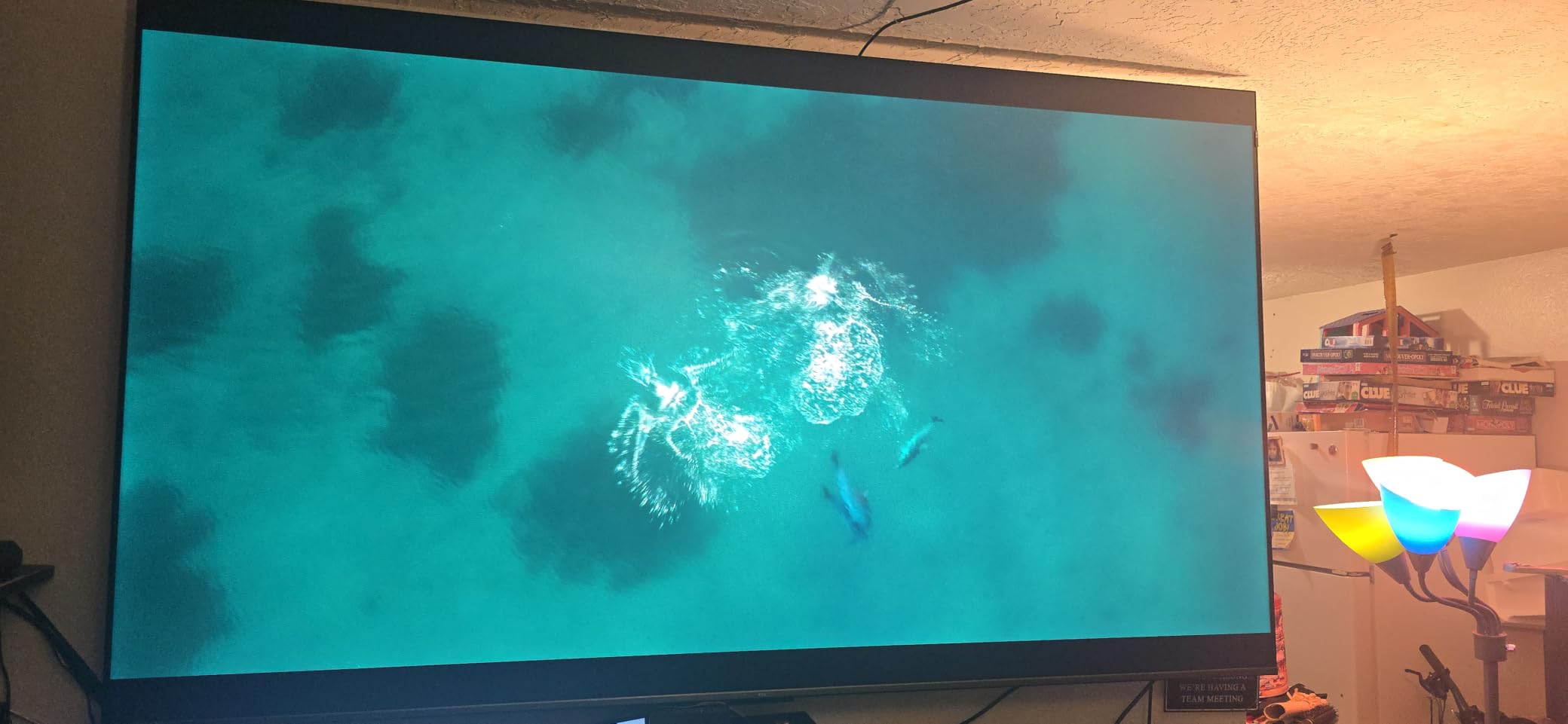
The complaints cluster around two things. Google TV prompts you toward additional content and is not the fastest platform, and reviewers note some glare in brighter rooms because the finish reflects. The Motion Rate 480 label is a processing figure rather than a native one, and owners say it does not fully keep up with very fast sports action despite the 120Hz panel.
The remote is also not backlit, and with its backlight left on it drains batteries faster than expected, which is a small daily friction in a dark room.
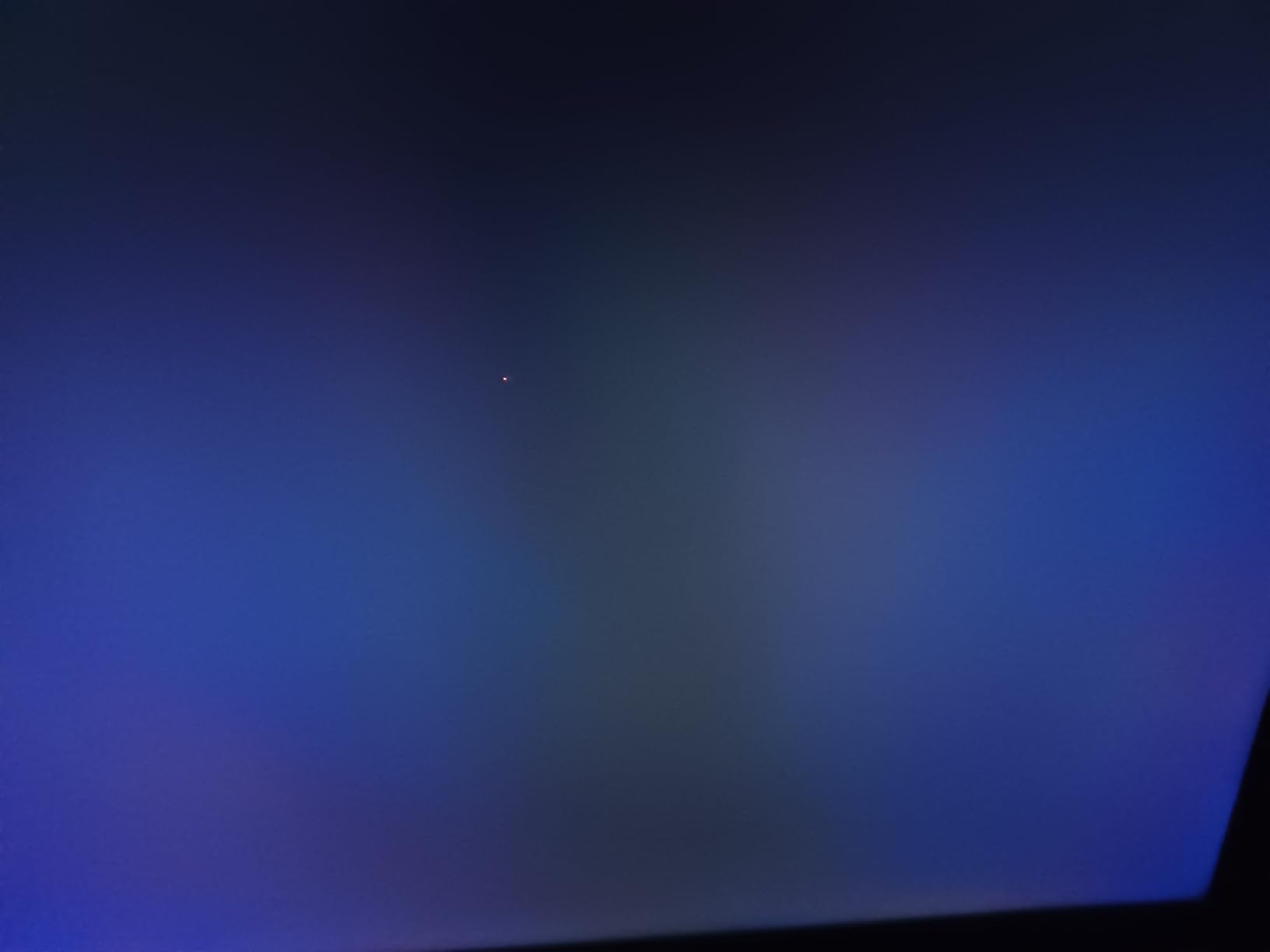
Why it suits a small living room
It balances what a small room can hold. A 120Hz panel in a 2.7 inch chassis at 24.3 pounds gives you modern gaming performance without the depth or mass that makes a 55-inch set feel oversized on a compact unit, and a short viewing distance means you benefit from the resolution and refresh rather than needing a bigger screen.
Google TV also has Chromecast and Apple AirPlay 2 built in, which reduces the box clutter that tends to accumulate beside a small television.
Where it falls short
No local dimming, so contrast in a dim room is weaker than a Mini LED set, and the glossy finish produces some glare. If your room is bright all day, the Glare Free Samsung or the matte TCL Designer Series are better buys even though neither is a gaming-first choice.
The 20 watt speakers and Dolby Atmos processing are respectable for casual viewing, but a compact soundbar in a small room is still a clear upgrade for films.
9. Amazon Ember 55-inch 4-Series Fire TV – the fastest interface in the budget tier
Amazon Ember 55″ 4-Series with Fire TV (newest model), 4K Ultra HD smart TV with Alexa Remote, HDR10+, fast processor, Dolby Audio, Ambient Experience, free and live TV, find shows faster with Alexa+
4K UHD with HDR10+, quad-core processor, Wi-Fi 6, Fire TV
Pros
- New quad-core processor and Wi-Fi 6 make apps open quickly
- Redesigned Fire TV experience with pinned apps reduces scrolling
- Alexa Plus understands natural phrasing
- Omnisense sensors wake the display when you enter
- Available in 43 50 and 55 inch sizes
Cons
- Picture quality is basic next to QLED and Mini LED sets
- Fire TV platform pushes Amazon apps and Prime Video
- Sound favours dialogue over music
Software speed is the entire pitch here, and for a lot of small living rooms that is the correct priority. A quad-core processor with Wi-Fi 6 and the redesigned Fire TV experience with pinned apps means launch times are quick, and owners consistently describe the interface as a clear step up from older Fire TV sets.
Alexa Plus voice search is the other practical gain. It understands natural phrasing across apps rather than requiring exact keywords, which in a multi-person household means everyone can find something without fighting the search. Omnisense sensors wake the screen when someone walks into the room, and an ambient display shows artwork when it is idle.
Four HDMI inputs give real flexibility for a compact setup, and AirPlay screen sharing is built in alongside cloud gaming subscriptions. The same range is sold in 43 and 50 inch versions, so sizing down later is straightforward.
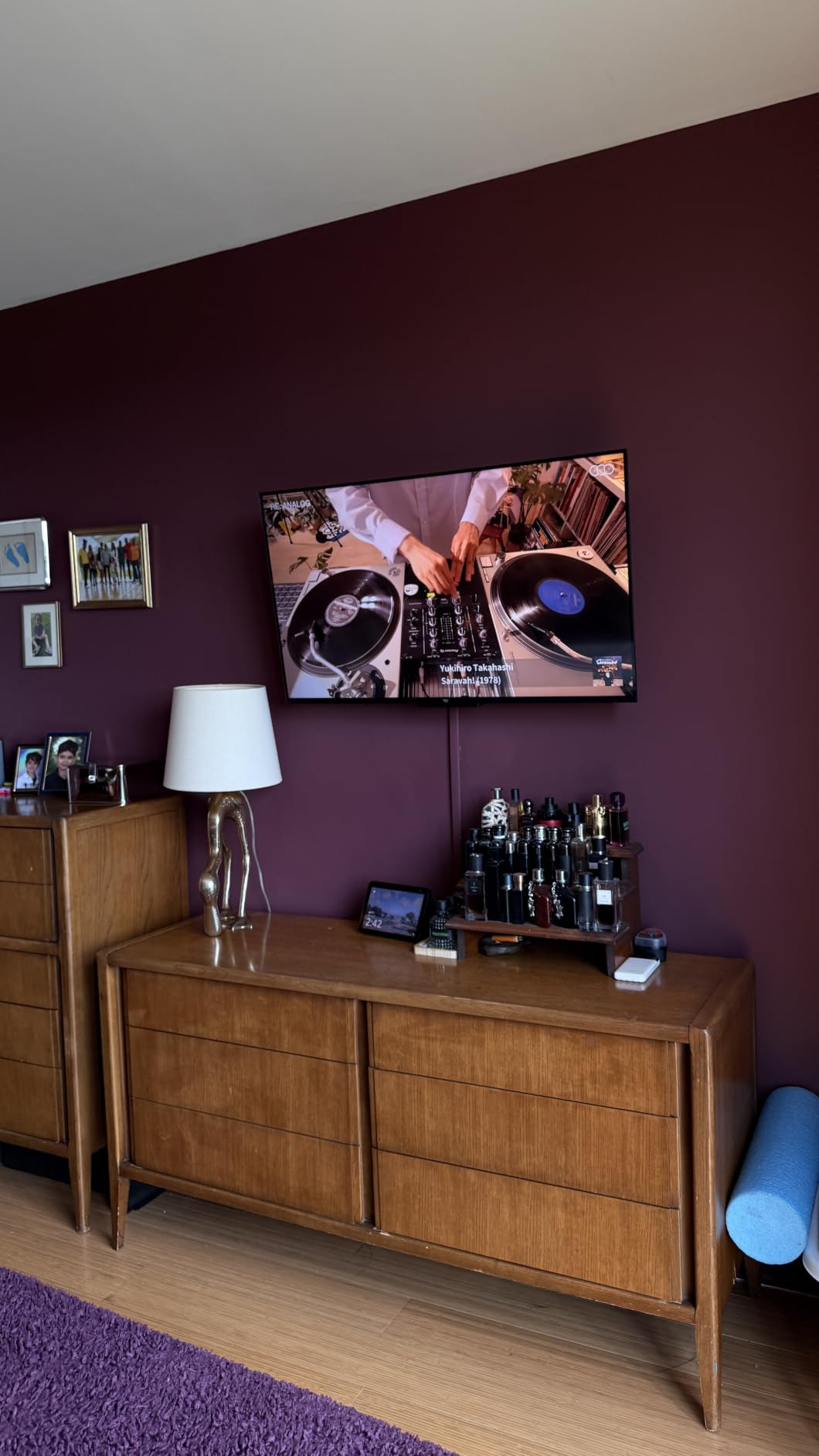
The picture is the compromise. Reviewers describe it as clean and capable for everyday viewing but clearly basic next to QLED and Mini LED sets at the same size, and calibration options are limited. The 4K output with HDR10+ improves dark scenes without transforming them.
Sound is functional rather than good, favouring dialogue over music, and the platform deliberately surfaces Amazon’s own apps and Prime Video content. Some owners find the ambient mode and Omnisense add complexity they did not ask for.
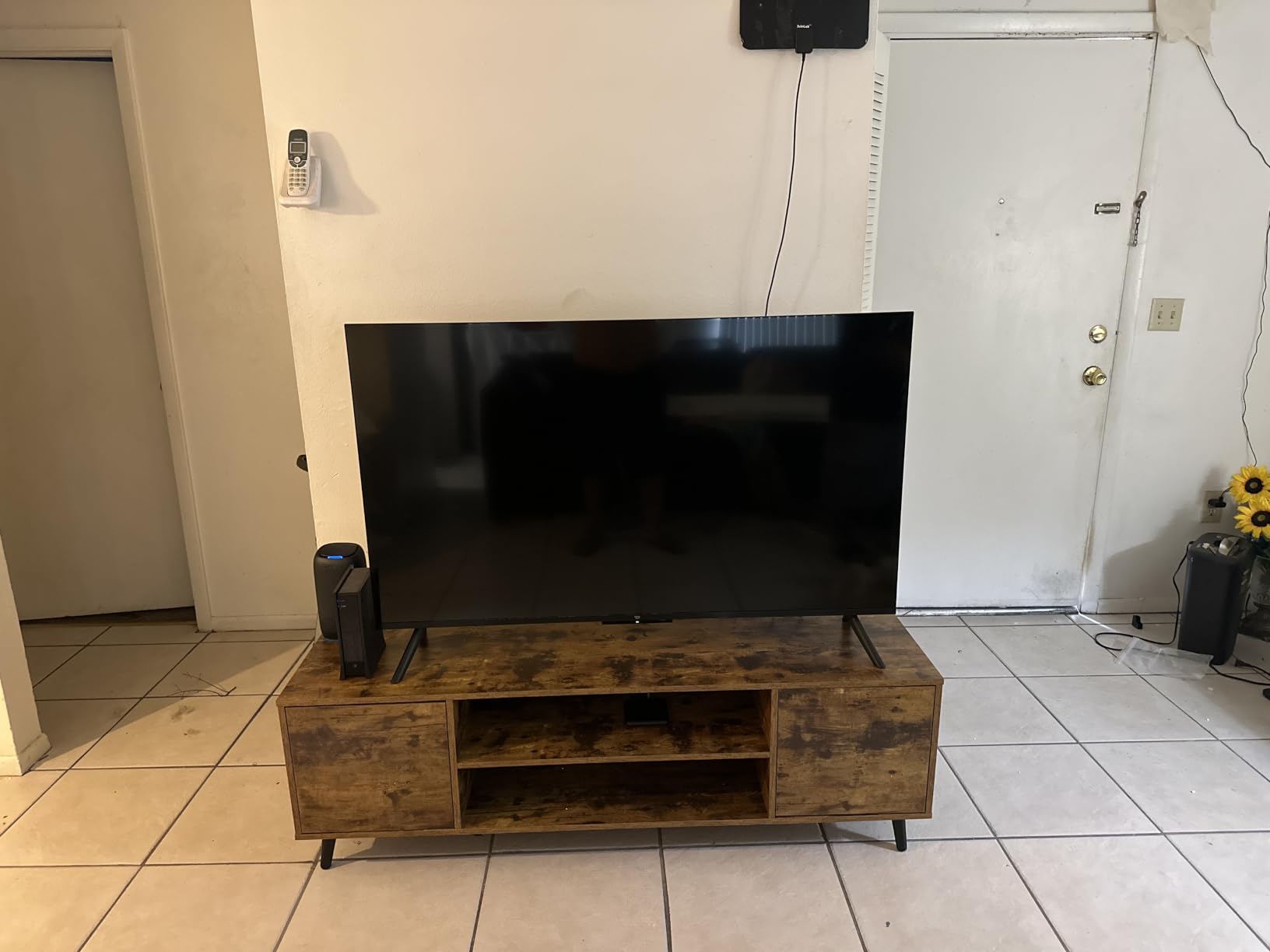
Why it suits a small living room
Hardware weight and dimensions are not listed for this set, so confirm the cabinet width before ordering if your wall is tight. What is clear is that this is a straightforward 55-inch 4K panel available in 43, 50 and 55 inch versions, which makes it an easy way to size down if you decide the wall is too narrow.
A fast interface also matters more in a small room, where the television is often one of very few focal points and slow menus are more irritating. A set that responds immediately gets used more, and used more, it earns its place.
Where it falls short
If colour, contrast, and picture quality are the priority, the money is better spent on a QLED or Mini LED set. Owners consistently frame this as an interface upgrade rather than a picture upgrade, and that is worth being honest about before you buy.
It is also the weakest choice for sports and gaming, with no refresh rate or VRR claims in the specifications, and for a household that does not already live in the Amazon ecosystem the platform bias is a genuine irritation.
10. Roku 55-inch Plus Series Mini LED QLED (55R6C7) – the best built-in sound
Roku 55-Inch Plus Series Smart TV – 4K QLED Mini-LED TV – RokuTV
Mini LED local dimming, QLED, Dolby Vision, 4.1 channel audio
Pros
- Mini LED backlighting with QLED colour gives deep blacks
- Dolby Vision noticeably lifts dim scenes
- Built-in subwoofer and Dolby Atmos at 4.1 channels
- Roku OS is simple and fast for the whole household
- Full port selection including optical and Ethernet
Cons
- 60Hz panel with no gaming benefit
- Antenna TV audio can be weak
- Large 300 x 300 mm VESA pattern needs a suitable bracket
This is the set to buy if you are not going to add a soundbar, and in a small living room that is a real possibility. The 4.1 channel Dolby Atmos system includes a genuine built-in subwoofer, which is a meaningful upgrade over the thin two-speaker arrangements on most 55-inch sets, and owners call the sound improvement out as one of the main reasons to step up from a basic Roku.
The picture follows the same logic. Mini LED backlighting with QLED colour and local dimming delivers deep blacks and bright highlights, and Dolby Vision support is handled automatically, lifting dim scenes that looked crushed on older sets. Roku Smart Picture Max handles signal, colour and sharpness tuning without you touching a menu.
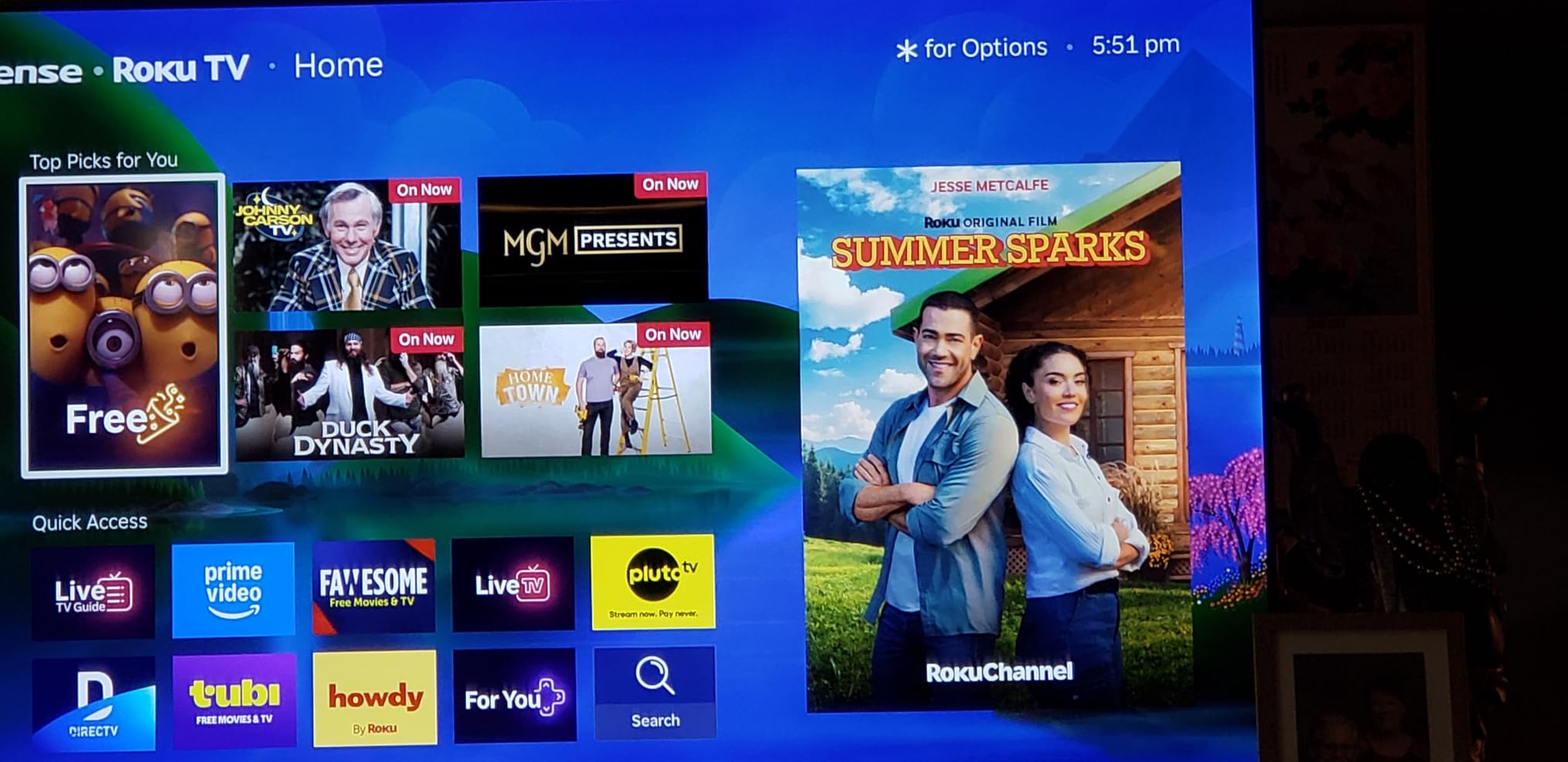
Roku OS remains the simplest platform in this roundup, which reviewers highlight as especially useful for older family members, and one login covers more than 70 subscription services. Bluetooth Headphone Mode and display-off audio playback let you listen without watching.
The panel is 60Hz, so there is no benefit for high-refresh gaming, and that is the single biggest reason not to buy it if a console is involved. Audio on antenna broadcasts is reported as weak, and DTS-HD MA tracks from a personal media server will not play natively, which matters only if you run one.
At 11.7 inches deep it is another chunky cabinet, and the 300 x 300 mm VESA pattern is large, so your bracket needs to support it properly.
Why it suits a small living room
You get local dimming and a subwoofer without buying either as an add-on. In a compact room, a soundbar competes for shelf space and adds cable clutter, so a set that solves both picture contrast and sound in one box simplifies a setup where every centimetre and every cable counts.
At 27.4 pounds it is manageable to wall mount, and the port selection including optical, Ethernet and USB-C means you can connect a soundbar later without rebuilding anything.
Where it falls short
Sixty hertz, no local gaming features, and a deeper chassis than the slim designs. If you want 120Hz and Mini LED brightness together, the TCL QM6K is the more versatile set and only marginally larger.
Buyers who stream almost everything through services that support Dolby Vision get the most from it, and those watching broadcast television or ripping their own high-resolution files will find the format limits more annoying.
How to Choose a 55-Inch TV for a Small Room in 2026
Fit first, then glare, then picture. If you follow that order you will not be disappointed by a set you can return, because the two mistakes people regret in compact rooms are physical and optical rather than technical.
Glare and ambient light decide more than brightness does
The defining small-room problem is a window or lamp reflecting back off the screen, and the fix is a matte or anti-reflective finish rather than extra peak brightness. The TCL 55A300L with its ultra matte display is the strongest anti-reflection option in this group, and the Samsung QN90F with its Glare Free coating is the other one built specifically for sunlit rooms.
Glossy panels, including the TCL QM6K and the TCL T7, are the ones to be careful with. Reviewers of both specifically mention reflections in bright rooms, so if your screen faces a window all afternoon, either add curtains or choose a matte panel. Five cheap actions help too: close curtains opposite the screen, angle the set slightly, keep the room’s brightest light source off-axis, drop the brightness to match ambient light rather than maxing it, and turn off motion smoothing so brightness does not pump.
Remember that glare and blooming are different problems. Glare is a reflection off the surface and no picture setting fixes it. Blooming is light leaking around bright objects, and only a local dimming array like the one in the QM6K or the Roku Plus Series addresses it.
Off-axis viewing decides the wide-sofa problem
When a small room forces a corner sofa or a full-width couch, people on the ends watch at a sharp angle. VA panels lose contrast and wash out as you move sideways, so the picture at the end seat looks greyer than the picture in the middle. An OLED such as the LG C4 holds colour and brightness at any angle, and premium QLED panels do better than entry LED models.
A common rule of thumb is to sit within about 30 degrees of straight on for a good picture on a value-oriented panel, which in a narrow room can mean the far ends of the sofa are outside that. If your seating is genuinely wide, pay for the viewing angle rather than for size. If you want a wider guideline for distance, our separate guide to 85 inch TVs for large living rooms covers the opposite end of the sizing problem.
Panel and brightness: what each technology actually buys you
Entry LED is fine in a normally lit room and gives you 4K, HDR10, and a smart platform at the lowest cost. QLED adds a quantum dot colour layer, which shows up as better saturation and wider colour volume at a short viewing distance, and it is the step most worth making. Mini LED adds a backlight array with local dimming, which is what gives you real black levels without turning the lights off. OLED adds self-lit pixels for true blacks and the widest viewing angles, at the highest brightness cost.
For a small room, we would put local dimming above raw peak brightness. A 300 nit panel with good dimming often looks better in a compact space than a brighter panel without it, because the room’s own light lifts the black level and you lose the contrast that makes a dark scene feel deliberate.
Smart TV platform matters more in a shared household
Roku OS is the simplest and fastest, with the fewest decisions to make, which suits older viewers and anyone who does not want to manage a television. Google TV has the deepest app catalogue and the most voice control, but reviewers note it can be slower and pushes other content. Fire TV is deeply integrated with Amazon services and improving fast, with the newest experience notably quicker than older models.
Tizen on Samsung and webOS on LG are both capable and well supported, though webOS draws regular criticism for slow response times. Our guides to 32 inch smart TVs for guest rooms and 75 inch TVs under 1000 cover the platform trade-offs in more depth if you are still deciding.
Gaming in a compact room
Refresh rate matters more in a small room than it does in a large one, because at 6 to 8 feet you are close enough to see judder clearly. Sets with a native 120Hz or 144Hz panel include the TCL T7 at 120Hz, the TCL QM6K at 144Hz, the LG C4 at 144Hz, and the Samsung QN90F with high-refresh VRR gaming support.
Below that, 60Hz panels such as the Roku Select Series, the Roku Plus Series, and both INSIGNIA sets are perfectly watchable for streaming and broadcast, but console players should treat 60Hz as a real limit rather than a specification. Look for four HDMI ports and eARC if you plan to add a soundbar later, since three ports and no eARC gets tight quickly.
Sound in a small room
Most 55-inch sets ship with speakers between 10 and 20 watts, which handle dialogue but not film. In a compact room you have three options: accept it for streaming, add a compact soundbar on the console or mounted below the screen, or choose a set that solves it internally. The Roku Plus Series with 4.1 channels and a real subwoofer and the Samsung QN90F with 4.2.2 channel Object Tracking Sound Plus are the two here that make a soundbar optional.
A note on setup: leave roughly three inches of clearance around a wall-mounted set for ventilation, and avoid enclosing a television in a tight cabinet. If you are renting, our guide to soundbars for large living rooms covers the single-cable approach that keeps a compact setup tidy.
When 55 inches is too big, and what to buy instead
Step down to 50 inches if your wall is under about 55 inches wide, if your sofa is closer than 6 feet, or if you know a large screen will be visible from the doorway. A 50-inch set is roughly 43.6 inches wide and 25.7 inches tall, and in a genuinely compact room the lost screen area is barely noticeable while the room instantly feels calmer.
Step down to 43 inches if the room doubles as a bedroom, a home office, or a kitchen, or if the wall is under about 40 inches. At roughly 37 inches wide, a 43-inch 4K panel still has enough resolution that you do not lose visible detail at 6 feet. Go smaller than 43 only in a room you watch rarely.
Also reconsider 55 inches entirely if the viewing distance is under 5 feet, if the panel will be visible from several doorways, or if the room is used for something other than watching. Our guide to ladder bookshelves for small living rooms covers the other half of the problem, which is what competes with the screen for the wall.
Frequently Asked Questions
Is a 55-inch TV too big for a small living room?
Not usually. A 55-inch TV is about 48.3 inches wide and 27.2 inches tall, so it needs a wall roughly 52 to 54 inches across, and it suits a viewing distance of 6 to 9 feet. It is too big if your wall is under about 52 inches wide, your sofa is closer than 6 feet, or the screen is visible from the doorway. In those cases a 50-inch set at about 43.6 inches wide is the better call.
What is the optimal viewing distance for a 55-inch TV?
Six to nine feet from your eye position when seated, measured from the wall rather than the front edge of the sofa. Closer than 5 feet and you can start to resolve individual pixels on a 4K panel at a normal 55-inch size. Beyond 10 feet, fine detail falls away, though AI upscalers on sets like the Samsung QN90F hold the image together well.
How wide is a 55-inch TV physically?
About 48.3 inches wide and 27.2 inches tall for the panel itself, since the 55-inch figure is the diagonal of a 16:9 screen. Add the bezel and you get roughly 48.5 inches across, and with the pedestal stand the total height is close to 30 inches. Check your wall has at least 52 inches of clear width before ordering.
What are some good 55-inch TVs that do not reflect much?
The TCL 55A300L uses an ultra matte anti-glare display, which is the most aggressive reflection treatment available at this size, and the Samsung QN90F has a Glare Free anti-reflection coating designed for sunlit rooms. Glossy panels such as the TCL QM6K and TCL T7 show visible reflections in bright conditions. No coating removes glare entirely, so curtains and careful light placement still help.
What is the recommended viewing angle for a 55-inch TV?
Stay within about 30 degrees of straight on for a good picture on a value-oriented LED or QLED panel, since contrast drops as you move sideways. This matters most in small rooms where a corner sofa spans the full wall. An OLED such as the LG C4 holds colour and brightness at any angle, which makes it the better choice for wide seating.
Do I need a soundbar for a 55-inch TV in a small room?
Only for film. Most 55-inch sets use 10 to 20 watt speakers that handle dialogue but leave film sound thin, and a compact soundbar is easy to add in a small room. If you would rather not add one, the Roku Plus Series with 4.1 channels and a built-in subwoofer, or the Samsung QN90F with 4.2.2 channel Object Tracking Sound Plus, cover it internally.
Final Verdict: Which 55-Inch TV Wins in a Small Room
The best 55 inch tv for small living room setups is the TCL 55A300L, because a matte anti-glare panel, a 1.1 inch body, and an included flush wall mount solve the three problems compact rooms actually have: reflections, bulk, and glare. If your budget is tighter, the INSIGNIA F50 Series is the most proven set you can buy at this size, and if the room is bright all day the Samsung QN90F is the one that stays watchable with the curtains open.
For console players, the TCL QM6K gives you a 144Hz panel and real local dimming. For film, the LG C4 wins on contrast and viewing angle. For anyone who wants a set that installs easily and runs the simplest software, the Roku Select Series is hard to argue with, and the Roku Plus Series adds a subwoofer so you can skip the soundbar.
Before you order anything, tape the outline on the wall for a day and check the glare at the hour you actually watch. If either fails, step down to 50 inches rather than buying a bigger screen and living with a room that feels crowded. Last updated for 2026, and every spec on this page comes from the manufacturer data and owner reviews for that specific model.