
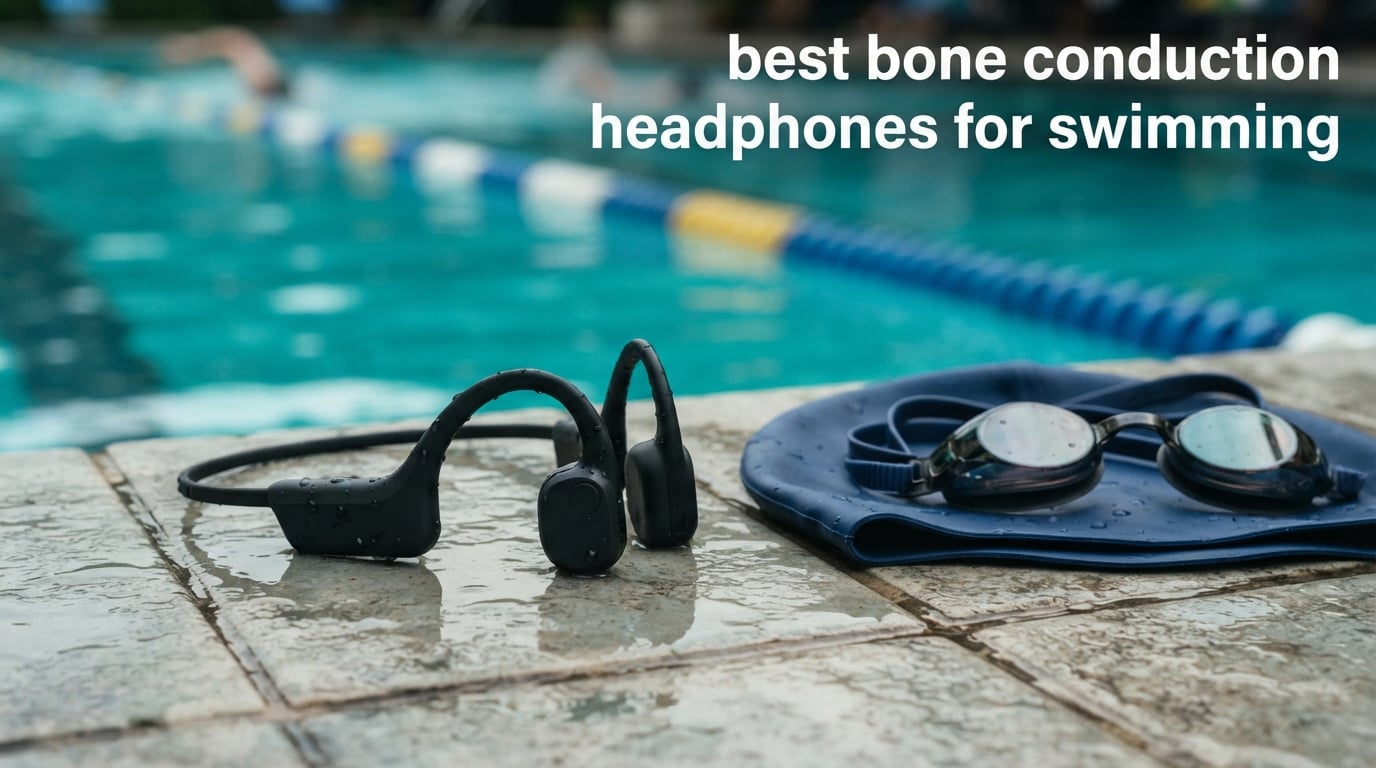
If you want the short version: the SHOKZ OpenSwim Pro is the best bone conduction headphone for swimming in 2026, and the three numbers that put it there are its IP68 rating, 32GB of onboard memory and the fact that it runs both Bluetooth and MP3 modes. The IP68 seal survives submersion to 2 m for two hours, the 32GB stores thousands of tracks with no phone in sight, and the dual mode means the same pair works for a run on dry land and a 2 km open-water block.
That third attribute is the one that actually filters this category. Bluetooth is a radio signal, radio signals do not cross water, and the moment your head goes under a paired phone the audio is gone. Every swim-rated headset here is really an MP3 player with a seal and a Bluetooth chip for the pool deck, and if a listing does not state onboard storage in the specification block, it is not a swimming headphone. It is a running headphone that will go quiet at the wall.
We compared the ten swim-rated bone conduction models below on ingress rating, storage, frame weight, control type and the fit behaviour that decides whether a pair survives a 90-minute session. Specification figures come from manufacturer listings and from what owners report in reviews, and we flag the places where those two disagree. Swimmers on r/MastersSwim reach for the Shokz more than any other brand for one practical reason: the seal holds and the band survives a flip turn, but the file-loading step strands almost everyone the first time.
One note before you scroll. If your training is mostly dry-land running, the same transducer design is covered in our [10 Best Bone Conduction Headphones for Running](https://foliumbiosciences.com/best-bone-conduction-headphones-for-running/) roundup, and swimmers training without water often build a full dry-land session around a [resistance swim belt](https://foliumbiosciences.com/best-resistance-swim-belts-for-in-place-swimming/) instead. What follows is for people who are going in the water.
Top 3 Picks for Bone Conduction Swimming Headphones in 2026

SHOKZ OpenSwim Pro
- IP68 to 2 m for 2 h
- 32GB onboard memory
- Bluetooth plus MP3 dual mode
- 9 h battery


VLOP VP01
- Hybrid bone and air drivers
- 26 g titanium frame
- 32GB onboard memory
- IP68/IPX8 sealed
The SHOKZ OpenSwim Pro takes the top slot on the combination of rating depth, seal rating and dual-mode hardware. The PSIER S18 is the value pick, matching the 32GB storage of the flagship at a fraction of the class position. The VLOP VP01 wins on audio, and its hybrid bone plus air conduction driver is the only one here that adds a second air path to restore some of the low end that water strips away.
Quick Spec Comparison of All 10 Picks
| Product | Specifications | Action |
|---|---|---|
| SHOKZ OpenSwim Pro |
|
Check Latest Price |
| PSIER S18 |
|
Check Latest Price |
 KESIEME X7s KESIEME X7s |
|
Check Latest Price |
| VLOP VP01 |
|
Check Latest Price |
 Rhyfell Fit 5 Rhyfell Fit 5 |
|
Check Latest Price |
 Tevese X9 Tevese X9 |
|
Check Latest Price |
 ANSTEN S950 ANSTEN S950 |
|
Check Latest Price |
 Sanag B33 Sanag B33 |
|
Check Latest Price |
 Dnniakm X7P Dnniakm X7P |
|
Check Latest Price |
 PSIER S18 Pro Kit PSIER S18 Pro Kit |
|
Check Latest Price |
Why Bone Conduction Works Underwater and Why Bluetooth Does Not
A bone conduction transducer rests against your cheekbone and vibrates it. The vibration travels through bone and tissue into the inner ear, so the signal never has to pass through air, or through water, to reach you. That mechanical path is why these headphones keep producing sound in a pool while a sealed in-ear bud mostly produces pressure noise and a muffled thump.
Bluetooth fails for a completely different reason. The 2.4 GHz radio signal a phone uses is absorbed and scattered by water, and the attenuation starts the moment your head is submerged, not at depth. Swimmers describe the audio cutting out mid-length, which is why a swim-rated set is useless without onboard storage and why every pick below carries 8GB or more of internal memory.
There is a second underwater effect worth knowing. Water fills the ear canal and the middle ear changes how it transmits, which strips away the low frequencies first. Pure bone conduction has very little left at the bottom end, and that thin, tinny quality is the category’s most common complaint. The two fixes are physical: block the rushing water with swim earplugs, or use a hybrid driver that adds an air conduction path back in.
How to Fit Bone Conduction Headphones Under a Cap and Goggles
Put the headphones on first, then the cap. The band needs to sit behind your head and the ear hooks need to clear the strap above your ear, and the only way to get both is to pull the cap over the hooks afterwards so the elastic traps them in place. Reversing that order leaves the band on top of the cap, where it slides on every push-off.
Fit the goggle strap before you fit the band. The strap should run above the ear and in front of the hook, not on top of it, and the band should pass behind the strap. Swimmers who fight this end up with pressure building above the ear by the 45-minute mark, which is the single most common reason people give up on bone conduction.
The poolside test takes thirty seconds and saves a season. Wear the set with your cap and goggles for 20 minutes, then do a set of push-offs at the wall and a few fast turns. If the band shifts or rotates, it is a tension problem, not a water problem, and no amount of pool time fixes it. This is the diagnostic that forum threads about cheap swim headphones keep missing, because they blame audio quality when the real issue is fit.
How to Load MP3 Files Onto Swimming Headphones
- Check the supported formats first. The models here take MP3, WMA, WAV and FLAC; several also take M4A, APE and M4A variants. Convert anything else before you copy.
- Buy your files or convert them. Streaming service libraries cannot be synced to a swim player, so subscription tracks are the most common reason a new owner finishes a session in silence.
- Connect the supplied cable. Most of these units charge and transfer over the same magnetic or proprietary lead, and a small number use USB-C.
- Open the player as a drive on your computer and drag the files across.
- Copy to the root folder, not into subfolders. Several players in this group silently ignore nested directories, which looks exactly like a failed transfer.
- Open the companion app only where the manual requires it, for EQ or firmware. App playlist builders here are basic, mostly sequential or shuffle.
- Switch the unit from Bluetooth to MP3 mode before you enter the water, then test one long track poolside. If it plays on the deck and then fails underwater, the file is fine and the switch was the problem.
How to Care for Swim Headphones After Salt Water or Chlorine
- Rinse under fresh tap water with the band and ear hooks in your palm, not pinched.
- Soak in fresh water for 30 minutes after any sea or pool session, especially if the pool is heavily chlorinated.
- Pat dry with a lint-free cloth and leave the charging contacts completely dry before they go near a cable.
- Check that the port covers or seals are fully seated and that no grit is sitting against a transducer pad.
- Store the band in a loose loop in a dry place. Do not fold the frame into a tight circle in a closed case overnight.
Salt is the quiet enemy here. It crystallises in the seams around the buttons and the seals, and left in place it works on the gasket that keeps the water out. A thirty second rinse costs nothing and is the difference between a headset that lasts two seasons and one that lasts five.
1. SHOKZ OpenSwim Pro – Best Overall for Pool and Open Water
SHOKZ OpenSwim Pro Open-Ear MP3 Headphones, Grey, IP68 Waterproof, 32GB MP3
IP68 to 2 m for 2 h
32GB onboard memory
Bluetooth 5.4 plus MP3 mode
27.3 g
9 h battery
2-year warranty
Pros
- Genuinely waterproof to 2 m for two hours with hundreds of laps reported
- Swim EQ plus separate land and water tuning
- Holds position through flip turns under a cap
- Physical buttons work with wet hands
Cons
- Streaming libraries cannot sync for MP3 mode
- Proprietary magnetic cable and no USB-C
- No mini band size so the neck sits loose on smaller heads
This is the pair most swimmers end up with, and the community reason is unglamorous: the seal holds. Owners report flawless pool use over hundreds of laps, which is a much harder standard than surviving a single product-video dunk. The triple-sealed body is rated to 2 m for two hours, deeper and longer than the IPX8 units in this list.
At 27.3 g it is light enough to forget, and the nickel-titanium frame has enough tension to stay put through a push-off without the ear-hook soreness that fixed-tension budget bands produce. The box includes swim earplugs and a nose clip, which matters more than it sounds because the earplugs are the cheapest upgrade to underwater clarity you can make.
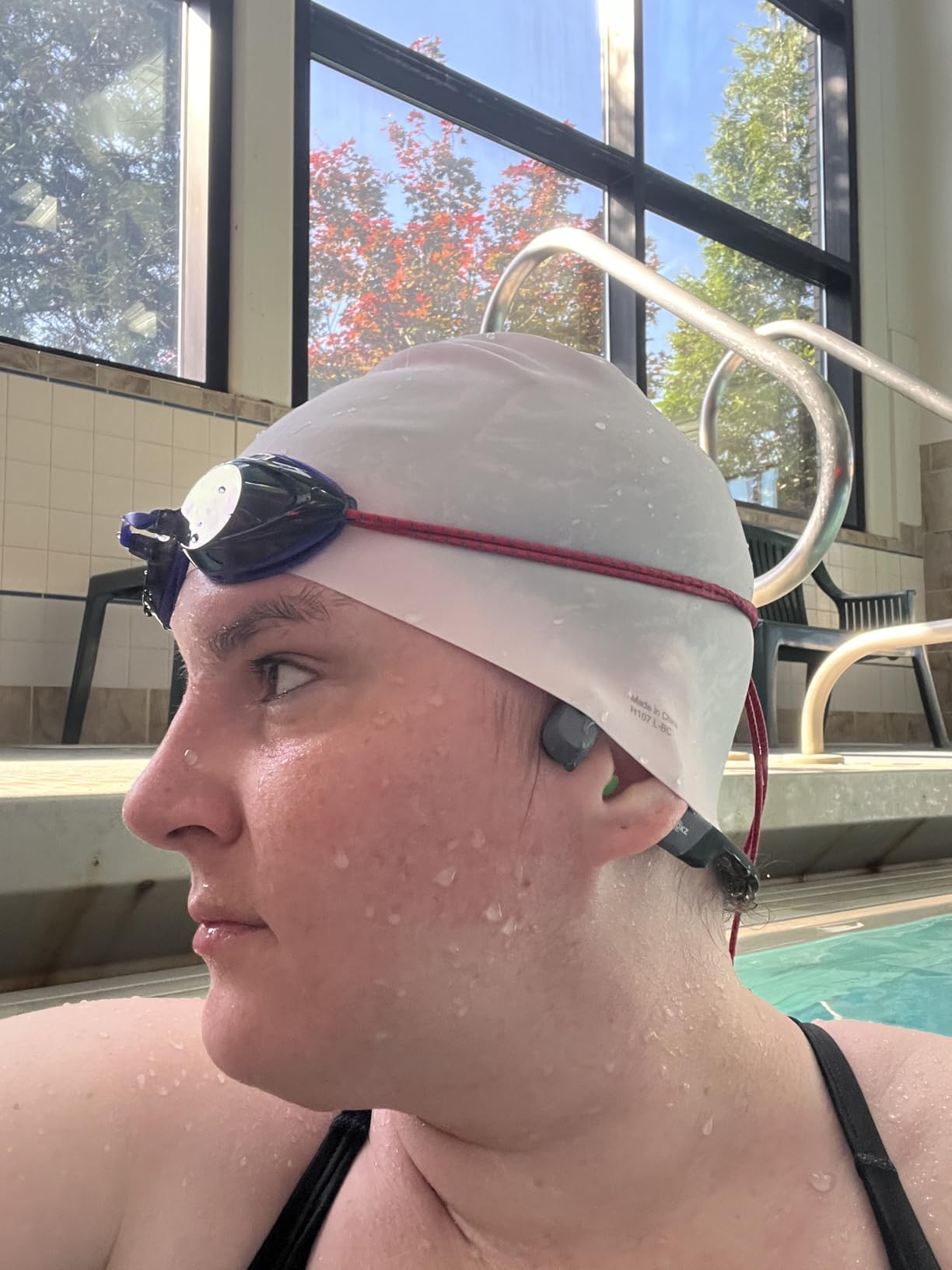
Sound is tuned separately for land and water, and the swim profile is the reason it sounds more balanced than cheaper pure bone conduction sets. Underwater it is still thin at the bottom, but the mids carry a spoken-word podcast far better than most rivals. Nine hours of battery and a ten-minute quick charge covering about three hours means a full training week without a wall.
The soft spot is the software around the file workflow. The app offers no real playlist creation, only sequential or shuffle playback, and because the same proprietary magnetic lead handles charging and data, a failed cable strands the player entirely. There is also no smaller band size, so swimmers with a small head often tune the tension down with the cap doing the real work.
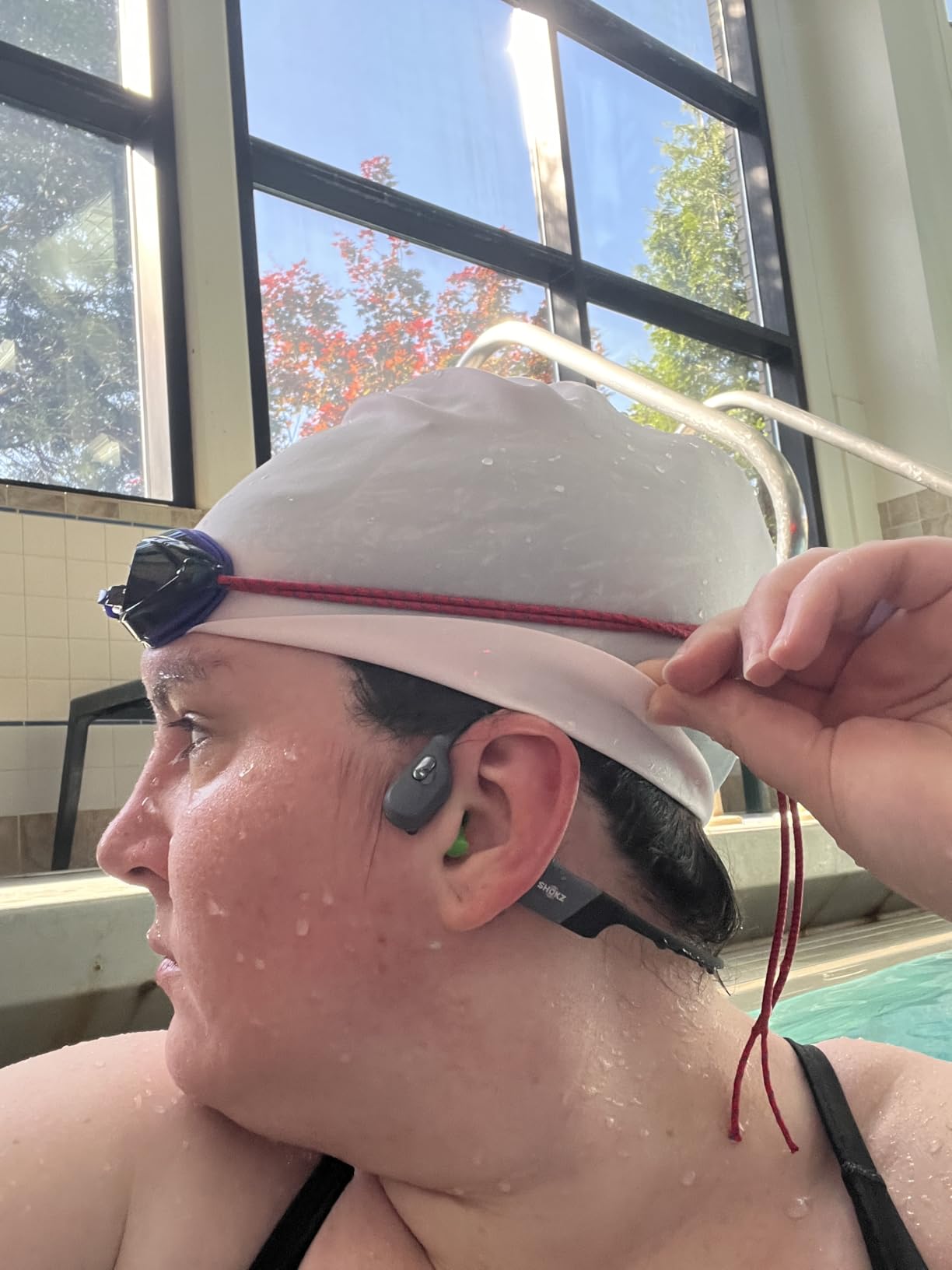
Why the swim EQ and physical buttons matter in the pool
The separate water profile exists because bone conduction in a wet ear sounds nothing like bone conduction on a dry ear, and most budget models use one curve for both. The OpenSwim Pro shifts the balance to the midrange where voices and kick drums live, which is the audible difference in an audiobook.
Physical buttons are the other quiet win. With a wet hand and one eye closed at the wall, a capacitive touch pad either misses or fires twice, and a double-fire on these units can drop you out of MP3 mode mid-length. Reviewers call the button locations easy to find without looking, and the app can remap some of them.
When to skip it and buy a cheaper pair instead
Skip it if you never swim and want Bluetooth streaming everywhere, because the price gap buys you a seal and storage you would not use. Skip it if your head is small and you do not wear a cap, since the single band size is the one fit complaint that shows up repeatedly.
Also skip it if you want a genuine streaming library in the water. Nothing in this format streams, and that limitation is a design decision forced by physics, not a shortcut by the manufacturer. If offline files are a deal breaker for you, this is the wrong category and an in-ear swim player is the answer.
2. PSIER S18 – Best Value for Daily Pool Swimmers
PSIER Bone Conduction Headphones, IPX8 Waterproof MP3 Mode for Underwater
IPX8 to 2 m for 1 h
32GB internal storage
8 h battery
14mm bone conduction driver
Bluetooth 5.6
Pros
- Holds position through 25-plus laps without shifting
- 32GB accepts MP3 WMA FLAC APE and WAV
- Several users report days of daily swimming per charge
- Responsive service that troubleshoots and replaces defects
Cons
- Silicone band is not moldable so some fits shift
- Touch controls are imprecise with wet hands
- File transfer uses a proprietary magnetic cable
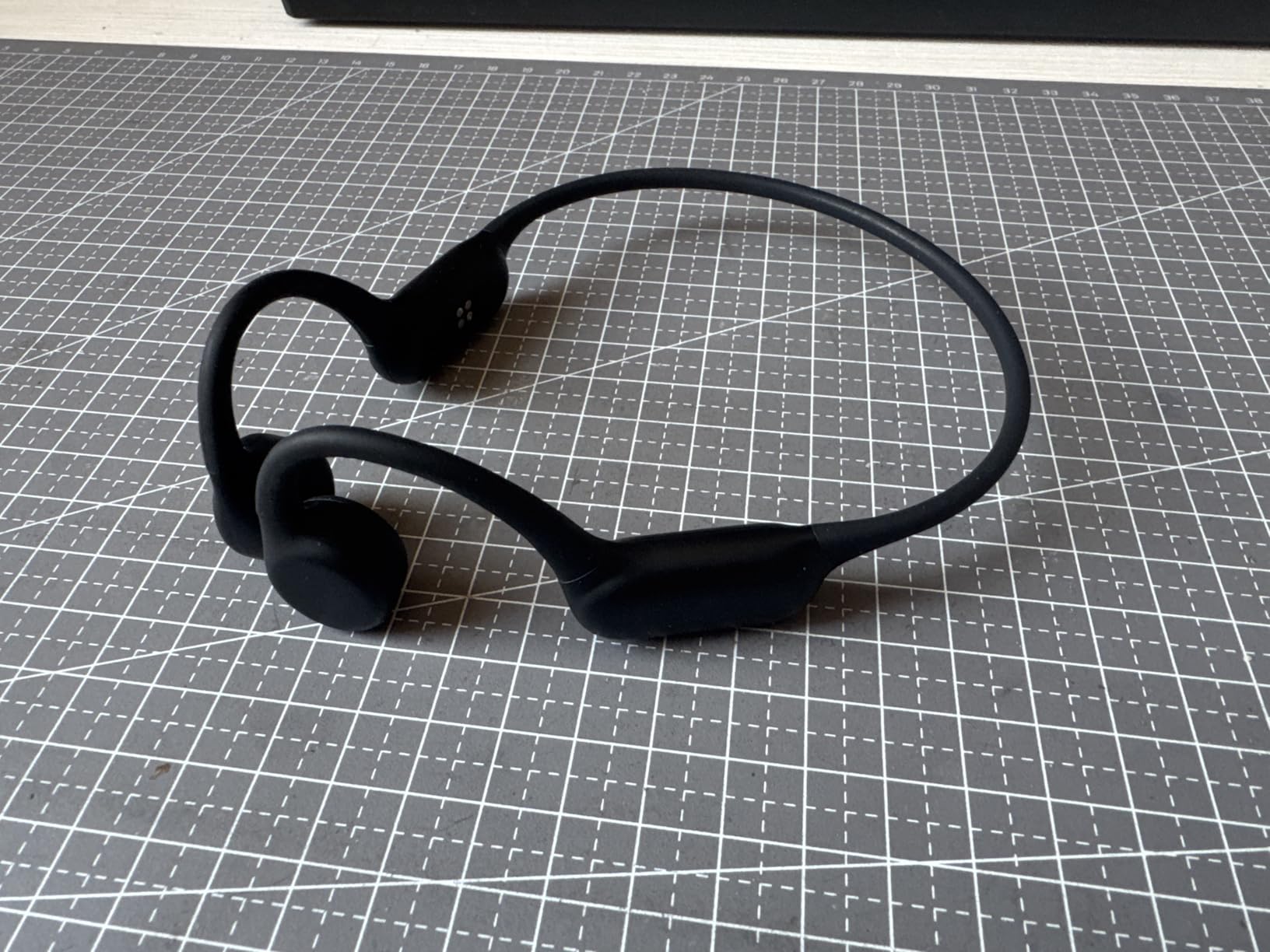
Owners treat this as the sensible alternative to a flagship, and the review base is large and loyal enough that the pattern is clear: strong sound, good battery, and a fit that works for most head shapes. The IPX8 rating covers 2 m for one hour, which is more than a pool lap session or a beach swim needs.
Storage is the standout at this tier. Thirty-two gigabytes takes MP3, WMA, FLAC, APE and WAV, so you are not forced into one codec, and the double-click mode switch is easy to find once you know it is there. The 14mm bone conduction driver with a built-in microphone handles calls well enough for a poolside check-in.
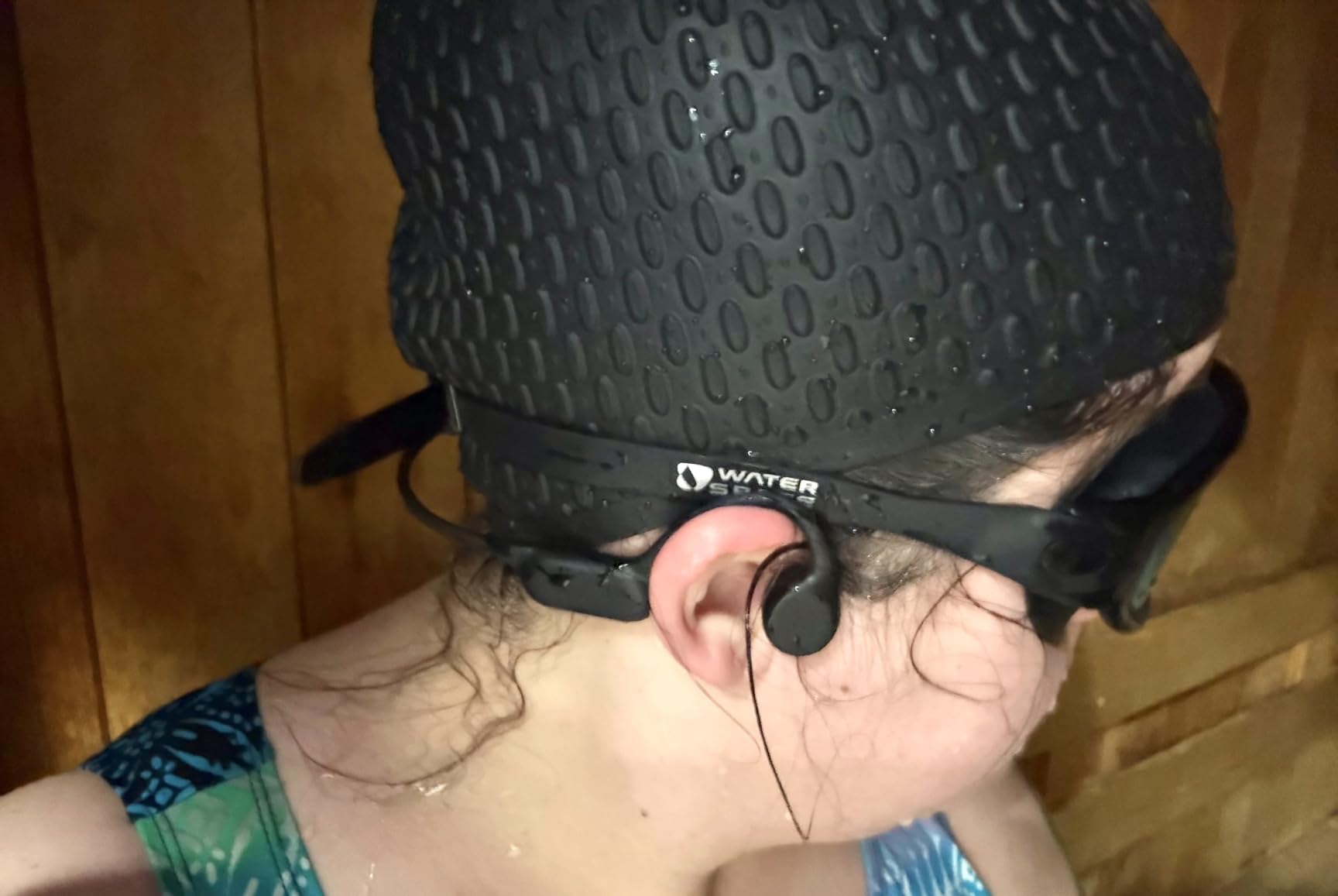
Battery life is a genuine strength: several users report several days of daily swimming on a single charge, and a full charge takes about two hours over the magnetic lead. A 20 Hz to 20,000 Hz frequency range is stated on the listing, and for spoken word and general music the output is clear and loud enough for a busy pool.
The weaknesses are structural rather than quality problems. The silicone band is not moldable, so swimmers with unusual head shapes report the fit shifting in the water, and the touch control surface is harder to use accurately with wet fingers than a physical button would be. The same magnetic cable handles charging and file transfer, so treat it as a consumable part.
Why the format list and the double-click switch matter more than they look
Accepting FLAC, APE and WAV alongside MP3 is unusual at this tier and it changes how you build a library. You can keep one high-quality folder for a laptop and copy a subset for the pool without re-encoding anything, which matters if you own a lot of music in a lossless format already.
The double-click switch to MP3 mode is the single habit that separates a good swim from a silent one. Bluetooth in and out of the water is genuinely fine on this model, which makes it easy to forget that the water needs the other mode, and the switch is fast enough that most swimmers get used to tapping it in the changing room.
When the budget model beats the flagship
Buy this over the OpenSwim Pro if your swimming is three or four pool sessions a week, you want storage headroom, and you have no interest in tuning an EQ curve. For a masters lane swimmer with a predictable routine, the difference in audio refinement is not worth chasing.
Pass if your training is mostly open water in cold conditions, if you change head shape needs, or if you are hard on gear. The one-year manufacture warranty is thinner than the Shokz two-year cover, and a non-moldable band is a real limit for anyone who has struggled with open-ear fit before.
3. KESIEME X7s – Most Versatile for Swimmers Who Want Simple File Transfer
KESIEME Swimming Headphones,IPX8 Waterproof Bone Conduction Headphones with 32GB Built-in Memory,Underwater Earphones for Swimming,Bluetooth 5.4 Open-Ear Sport Earbuds for Running, Cycling
IPX8 rated to 2 m
32GB built-in memory
200mAh battery, 10-plus h
USB-C recharge in about 2 h
37 g
Pros
- Consistent underwater MP3 playback in chlorinated pools
- Simple drag-and-drop loading as a USB drive
- 10-plus hours of playback per charge
- Works well for running and cycling too
Cons
- IPX8 only so dust ingress is not covered
- No shuffle and no fast-forward control
- Can slip off without a cap when treading
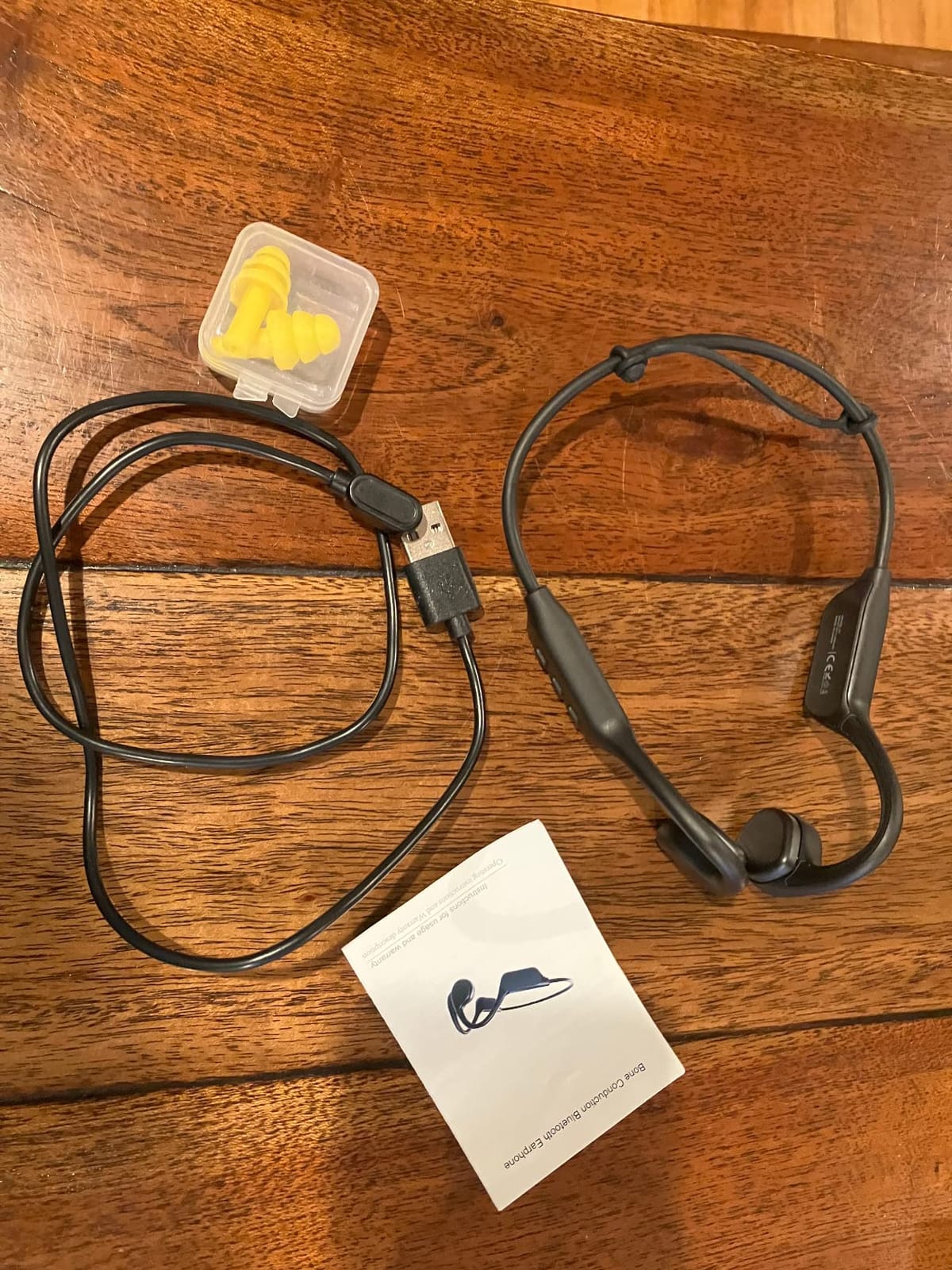
This is the model that made a lot of swimmers give up on wired swim MP3 players. The 32GB of memory and a straightforward drag-and-drop transfer mean the file workflow is the least painful in this group, and the device shows up on a computer as a plain drive with no app in the way.
Reviewers credit it with surviving chlorinated pools and delivering consistent playback in MP3 mode, and the 200mAh battery runs more than ten hours, comfortably longer than the cheap swim players that came before it. The package includes a cable, a storage bag and a pair of swim earplugs.
Fit is the dividing line in the reviews. Swimmers who wear a cap or use the goggle strap report reliable retention, while bare-headed swimmers report it slipping off during treading or any bobbing movement. At 37 g it is the heaviest frame here, and that weight shows up as a faint pressure above the ear on very long sessions.
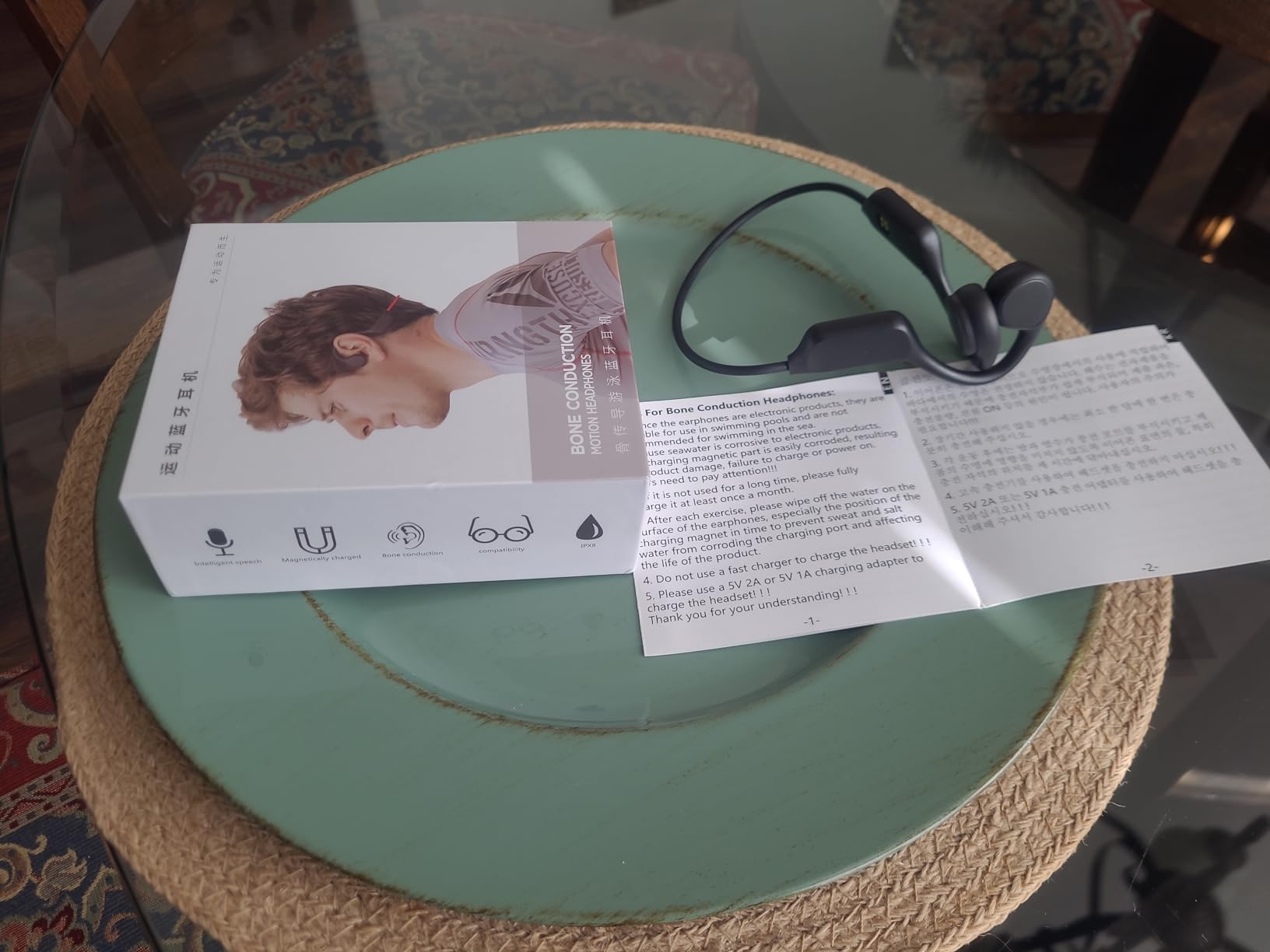
There is no shuffle function, so tracks play in load order, and no fast-forward or rewind control, which makes long audiobooks a poor fit for it. It is rated IPX8 rather than IP68, so dust ingress is not covered, and the sound is thin at the low end with a microphone that reviewers call muddy.
Why drag-and-drop transfer is the feature to buy on a budget
Most cheap swim players make you install a desktop tool with its own library manager, and those tools are where new owners get stuck. Showing up as a USB drive means you copy files and eject, and the root-folder trap that catches other models is far less likely to bite you here.
The battery figure is the other quiet reason this one keeps appearing in pool communities. Ten-plus hours per charge means a masters group can share the charging shelf for a week, and the USB-C recharge in about two hours means a full pack is a coffee break rather than an evening project.
When it is the wrong buy
Skip it for audiobooks, because no fast-forward control turns a chapter into a guessing game. Skip it for sand and grit, since IPX8 covers water and not dust, and a beach is mostly dust.
Also skip it if you swim without a cap and do a lot of treading or bobbing, because retention is exactly the complaint that ends up with these units at the bottom of the pool. A tighter band or a cap is the fix, and if you will not wear one, spend the difference on a lighter frame.
4. VLOP VP01 – Best for Underwater Sound Quality
VLOP Bone Conduction Headphones, IPX8 Waterproof Swimming Headphones, Std.
Hybrid bone and air conduction drivers
IP68/IPX8 sealed internals
32GB internal storage
26 g titanium frame
Pros
- Hybrid driver gives noticeably stronger mids and bass than pure bone conduction
- Highest satisfaction scores in this group
- 26 g titanium memory frame holds with goggles and caps
- 32GB with MP3 FLAC WMA WAV and APE support
Cons
- Bluetooth is unusable underwater so MP3 mode is a required step
- MP3 mode drains the battery faster than Bluetooth
- Low battery can trigger an automatic mode switch
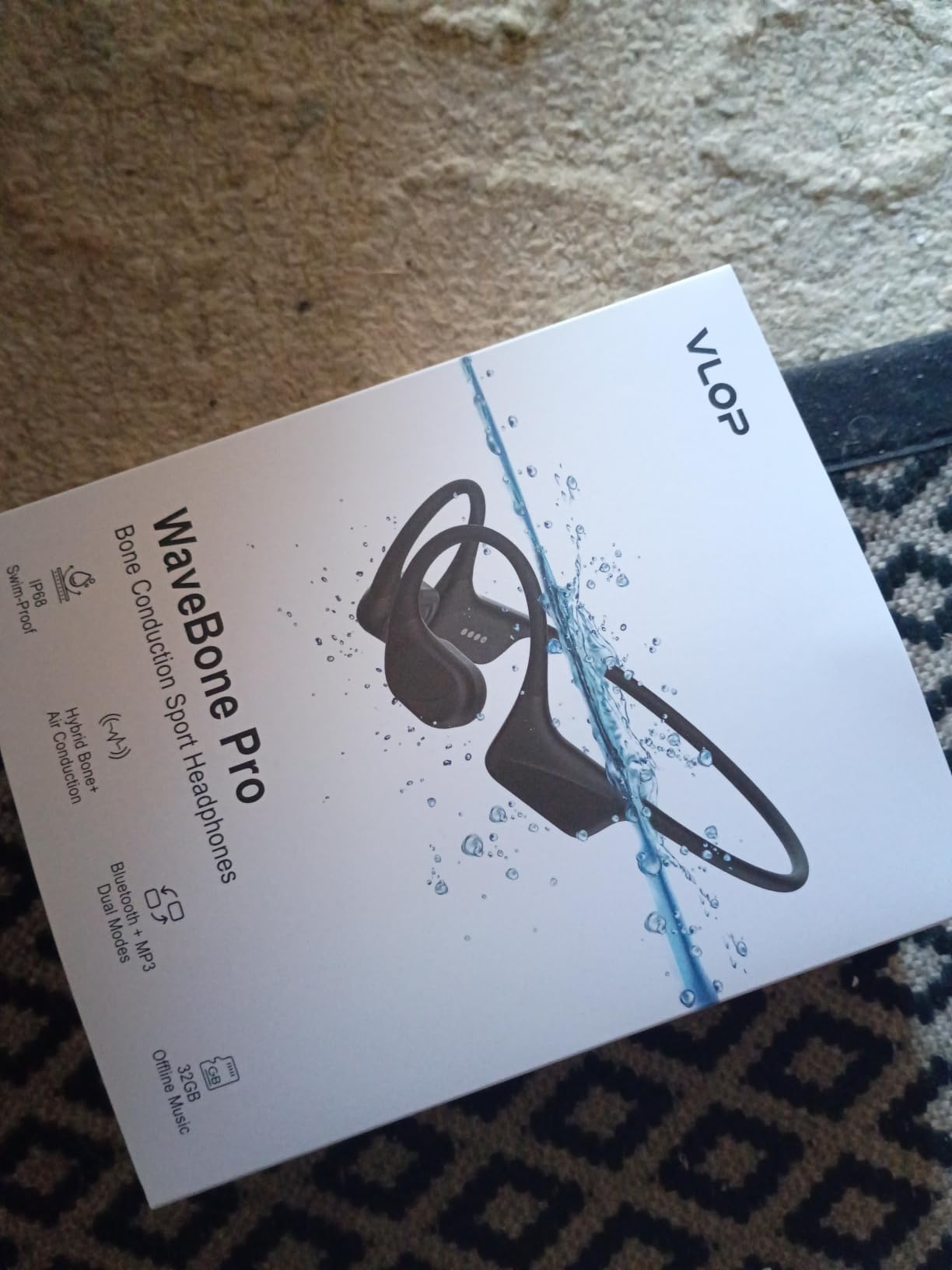
Almost every bone conduction headset here moves sound through bone only, and that is exactly why they all sound thin underwater. The VP01 adds an air conduction path on top of the bone driver, which is the single design decision that restores some of the midrange punch and low end that water strips away.
Owners consistently call the difference out against cheaper pure bone conduction models, and the 4.8 average across its reviews is the highest satisfaction score in this group. Thirty-two gigabytes of internal storage takes MP3, FLAC, WMA, WAV and APE, so a lossless library is a realistic option rather than a spec-sheet fantasy.

The frame is a 26 g titanium memory band, the joint-lightest here alongside one other, and it holds position with goggles, a cap or a bike helmet without adjustment. Magnetic charging gives a quick turnaround between sessions, and Bluetooth 6.0 with a 10 m range is a perfectly good land connection.
Two practical notes. MP3 mode consumes noticeably more power than Bluetooth, which matters more when your session is a two-hour open-water swim than a 45-minute pool set. And a low battery can trigger an automatic mode switch, which has startled more than one owner mid-length.
Why a hybrid driver changes the underwater equation
Water damps the low frequencies that reach your ear canal, and a pure bone conduction signal has very little energy left down there. A dual-driver design splits the work, sending the lower range through an air path and keeping the rest on the bone, so the water is not the only thing fighting the bass.
The trade-off is that hybrid designs leak slightly more sound than pure bone conduction, which is worth knowing if you train in a quiet lane or share a wall with someone. In a busy pool or an open bay, the audio improvement wins easily, and it is the reason this is the pick for anyone who says bone conduction sounds thin to them.
When to choose something else
Choose a pure bone conduction model if you swim in shared lanes and want minimal sound bleed, or if you mostly listen to spoken word and would rather have a long battery than a fuller low end. Choose this one if you swim with music you actually enjoy rather than a functional playlist.
Be aware that the review base is smaller than the big two in this roundup, so long-term durability evidence is thinner even though satisfaction is high. If you are keeping a pair for five years, weigh the two-year-plus support networks against the sound difference before you settle.
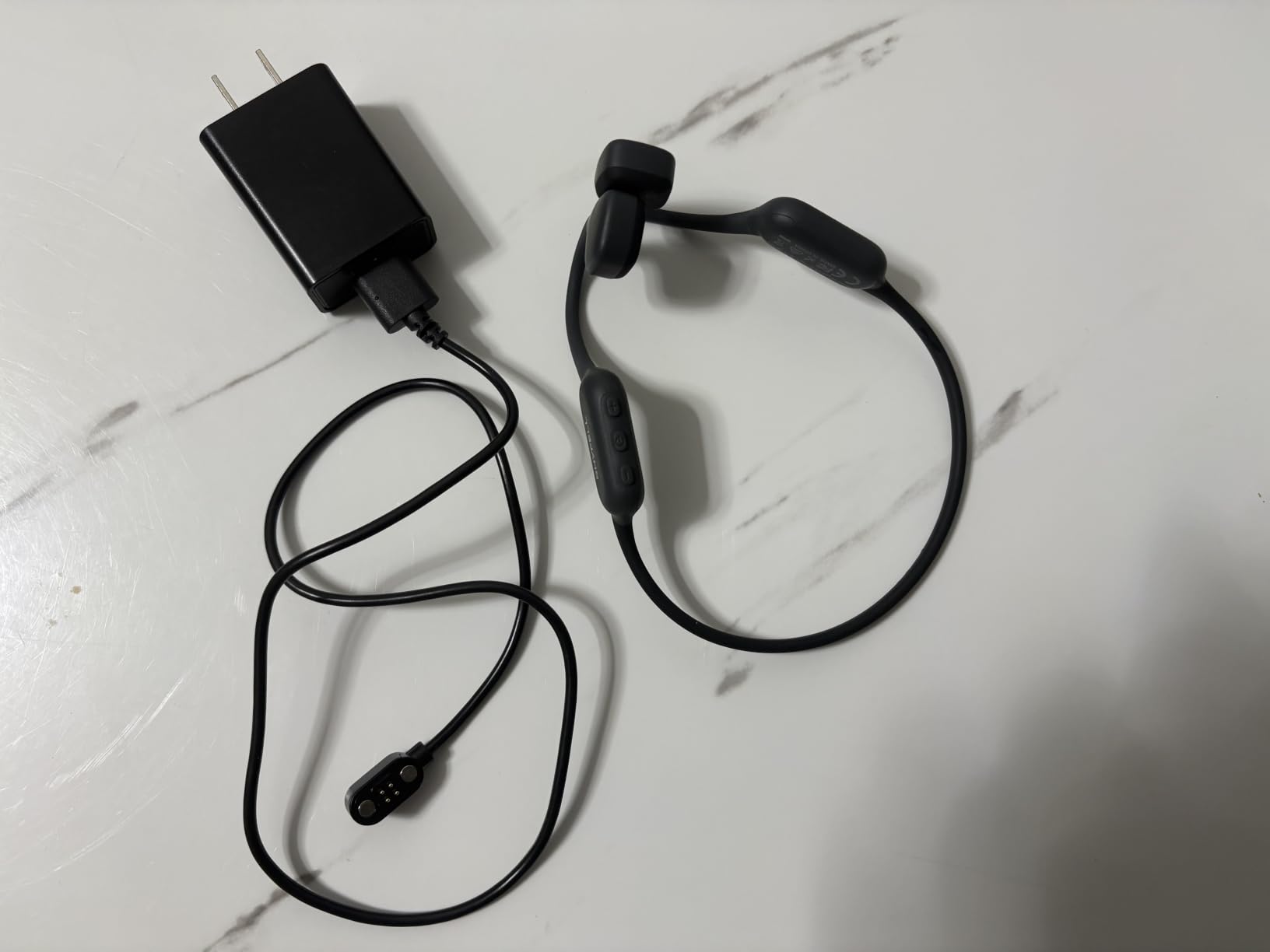
5. Rhyfell Fit 5 – Best for Open Water and Deep Submersion
Rhyfell Bone Conduction Swimming Headphones with 32GB MP3 Player
IP68 for submersion to 2-5 m
32GB at a claimed 18MB/s
28 g silicone frame
Bluetooth 6.0
1-year warranty
Pros
- IP68 rating supports submersion to 2-5 m
- 32GB with a claimed 18MB/s transfer rate
- 28 g liquid-silicone frame holds in hard training
- Bright orange finish is easy to spot underwater
Cons
- Aggregate rating of 4.0 is the lowest in this group
- Battery claim conflicts with the listed spec
- Fit and sound quality vary widely between owners
Open water is where the rating differences stop being academic. Surf, a choppy bay and bodysurfing all involve submersion deeper and longer than a pool lap, and the Fit 5 is the model here whose stated IP68 figure goes furthest, claiming 2 to 5 m of submersion with standalone MP3 playback.
The 32GB store and a claimed 18MB/s transfer rate are genuinely useful if you reload between sessions, and the 28 g liquid-silicone frame is described by owners as secure in high-intensity training. The orange finish is a small thing that matters in open water, where a dropped unit is much harder to find.
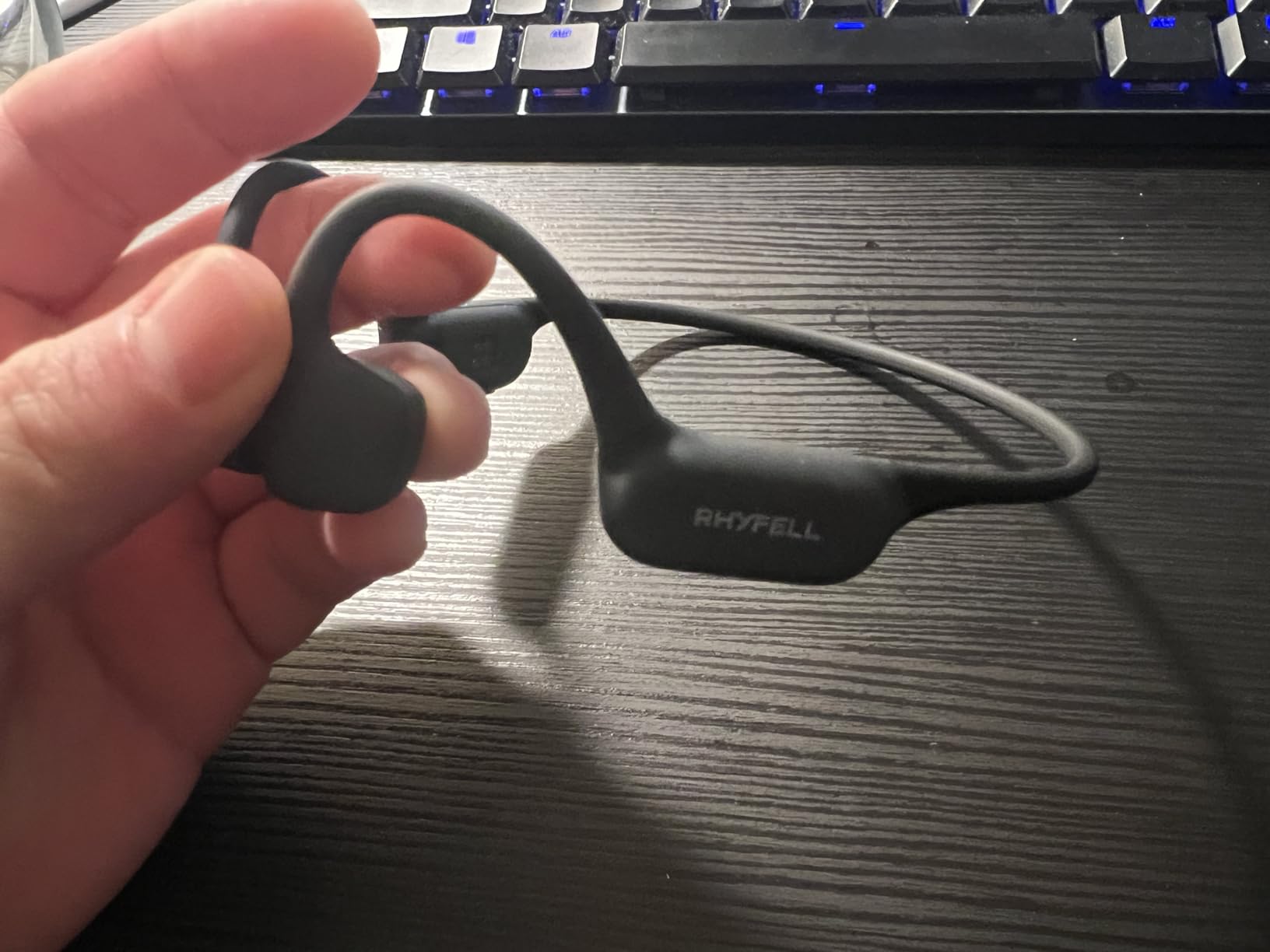
Here is the honesty part. The 4.0 aggregate is the lowest in this roundup, with a visible share of three-star and two-star reviews, and the battery figures contradict each other: the listed specification says five years while the marketing describes ten hours of playback. Treat the ten-hour claim as the working number and plan around a shorter session.
Fit and sound quality also vary more between owners than on any other model here, which points to a band that suits some head shapes and not others. Support infrastructure is smaller than the established brands, so a warranty claim is a slower process. It remains a good call for surf and open water, less so for a daily pool lane.
Why the depth rating is the deciding spec for open water
Pool swim depth is roughly waist to chest, so any IPX8 covers it. A wave face in a bay will put a band under 2 m for seconds at a time, and a bodysurf dive does it repeatedly. A rating that explicitly covers the deeper range removes a variable you cannot control on a good day at the sea.
Fast transfer matters more out there too, because you are reloading between sessions rather than sitting at a desk with a laptop. Eight thousand-plus tracks at the claimed rate means a full library swap in a couple of hours rather than an evening, and the extra capacity is real headroom for an audiobook-heavy user.
When the caveats outweigh the rating
Skip this one if you want the most consistent experience and cannot tolerate a two-star review in the pool. Skip it if you are buying for a child or a beginner who will not do the 20-minute poolside fit test, because the wide fit variation is exactly what that test catches.
Also weigh the support network. A one-year manufacturer warranty and a smaller brand means a failed seal is a harder process than it is with an established name. If your sessions are mostly pool laps, a model with a larger review base and a cleaner spec sheet is the safer pick.
6. Tevese X9 – Best for All-Day Comfort
Swimming Headphones Bone Conduction Bluetooth 6.0 IPX8 Waterproof 32G MP3
IPX8 for prolonged submersion
32GB built-in memory
Bluetooth 6.0
10 h average battery
3 h charge time
Pros
- Owners report clear underwater sound with no distortion
- Very light and comfortable with no ear pressure
- Open-ear design keeps coaches and lane traffic audible
- Stable Bluetooth with quick pairing on land
Cons
- Bluetooth cannot transmit underwater so MP3 mode is required
- Bass is shallower than in-ear headphones by design
- Review base is small and uniformly positive
Comfort is the reason this one shows up for people who do double sessions, and it is the most-cited thing in its reviews. Owners describe it as very light, with no ear pressure or soreness across a full day, which is the specific complaint that pushes people out of bone conduction in the first place.
Sound carries clearly underwater according to the swimmers who bought it, with no distortion reported at normal listening volume, and the open-ear design keeps coaches, lane traffic and poolside conversation audible. That awareness is the safety argument for this format, and it is a real one.
Battery is a 10-hour average with a three-hour charge time, and owners report days of intermittent use on a single charge, which suits a swimmer who is in the water three times a week rather than daily. Bluetooth 6.0 pairs quickly and holds steady above water for land use.
The caveats are worth stating plainly. Every review on this listing is five stars, which means there is very little critical detail to weigh against the positives, and the sample is small. Bass is shallower than in-ear headphones, which is inherent to the open-ear design and not a defect in this one.
Why weight and ear pressure decide long sessions
Open-ear headsets fail on comfort in a predictable way: pressure above the ear that builds slowly until you shift the band, then shift it again, then give up. Frames that are lighter and lower-tension avoid that, and comfort is the reason some swimmers keep a bone conduction pair for years and others trade theirs in after a season.
If you have previously abandoned a pair for comfort, test the weight and the band tension before anything else. A 20-minute wear with your cap and goggles at the wall will tell you more than an hour of audio samples, and it costs nothing. Poolside hours are hard on the knees as well as the ear, so if that is already a sore point, our picks for the [12 Best Knee Braces for Bone-on-Bone Pain](https://foliumbiosciences.com/best-knee-braces-for-bone-on-bone-pain/) are worth a look alongside the headset.
When to buy something with a heavier review base
Look elsewhere if you are buying as a long-term five-year purchase and want evidence of durability across thousands of laps. A small, uniformly positive review base tells you owners are happy, not that the seal will still be there in two winters.
Also look elsewhere if bass is the thing you care about most, because a pure bone conduction driver will not deliver it and no amount of adjustment will change that. For fuller low end underwater, a hybrid driver design is the only real answer in this format.
7. ANSTEN S950 – Best for Multi-Sport Use on a Budget
ANSTEN Swimming Headphones Bluetooth 6.0 Bone Conduction Headphones IPX8
IPX8 sealed housing
8GB onboard memory
26 g titanium frame
13mm driver
8 h playback on a 2 h charge
Pros
- 26 g build with an adjustable titanium frame that holds through sport
- Two-device simultaneous Bluetooth connection
- Bundled silicone earplugs improve underwater sound clearly
- Two-hour charge yields about eight hours
Cons
- 8GB storage is roughly 1500 songs against 32GB rivals
- Listing says water resistant while marketing claims IPX8
- 13mm driver gives less pronounced bass
The appeal here is one pair for everything. A 26 g adjustable titanium frame, Bluetooth 6.0 with two-device simultaneous connection and an IPX8 housing means the same unit covers a run, a gym session and a swim without a second set of headphones or a second charging shelf.
The included silicone earplugs are worth calling out because swimmers report a noticeable improvement in underwater sound with them in, and that is a free change to perceived clarity. AI noise reduction with a front microphone keeps calls clearer on land, which matters if you take calls between sessions.
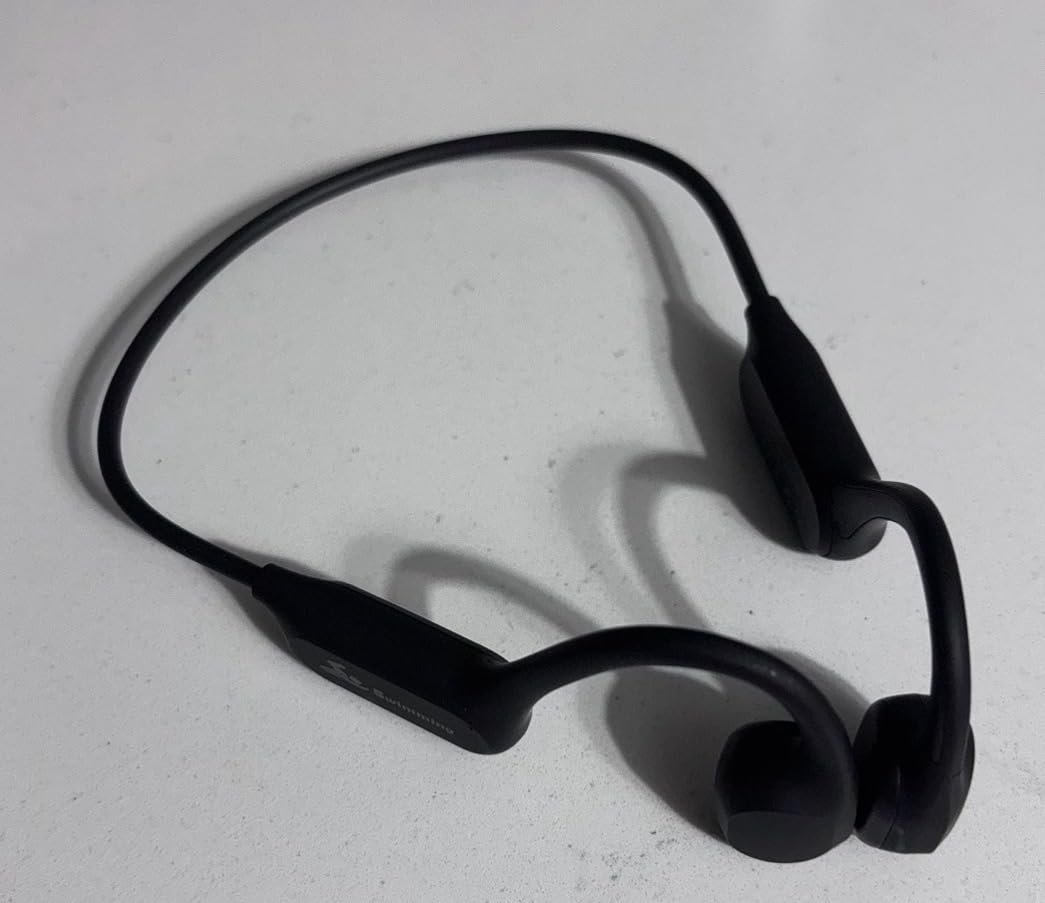
Storage is the real limit. Eight gigabytes is roughly 1,500 songs, and while that is enough for a week of laps, it is a third of what most competitors here carry and it forces you to reload between blocks. A two-hour charge returns about eight hours of playback, which is a good ratio for weekly training.
There is also a documentation problem worth flagging honestly. The marketing describes an IPX8 waterproof housing, while the specification table records the water resistance level as water resistant rather than a numbered rating, and 8GB of storage is not a lot if you also want audiobooks on there. The 13mm driver is smaller than competing units and the bass is correspondingly lighter.
Why multipoint pairing matters more to a multisport swimmer
Holding two devices at once means the phone in your pocket does not steal the connection from the laptop or the watch when both arrive in range. In practice that removes the small daily annoyance of manually re-pairing before every session, which is the kind of friction that makes people stop using a headset.
On the water that multipoint pairing is irrelevant, because Bluetooth does not work there anyway. The value is entirely on land, and it is the reason this model makes sense for a triathlete who runs, rides and swims with the same unit rather than for a single-sport pool swimmer.
When 8GB becomes a problem
It becomes a problem the moment you add audiobooks, because a single unabridged chapter can be larger than a batch of songs and you will be swapping files constantly. It also becomes a problem for a triathlete doing a long brick session who wants the whole training block on the device with no laptop in reach.
The waterproofing ambiguity is the other reason to pause. If you cannot confirm the numbered rating on the listing, treat it as unrated and look for a model that states one plainly. Our stance is that a listing with no clear IP number is a reason to keep shopping, not a reason to hope.
8. Sanag B33 – Best for Underwater Audio Clarity
Sanag Swimming Bone Conduction Headphones Earbuds IPX8 Waterproof Underwater 8H Playtime Wireless Bluetooth Earphones with 32GB MP3 for Running Cycling Sport, Black
IPX8 one-piece seal to 2 m
32GB built-in memory
Magnetic drive oscillator
8 h playback
ENC microphone
Pros
- One-piece seamless IPX8 body rated to 2 m
- Magnetic oscillator and enclosed cavity reduce underwater leakage
- 32GB memory with a switch to MP3 mode
- Three-second Bluetooth pairing at 50 ft
Cons
- Bluetooth 5.3 is older than most rivals here
- 16 percent of reviews are one star
- Touch and on-ear controls are fiddly in water
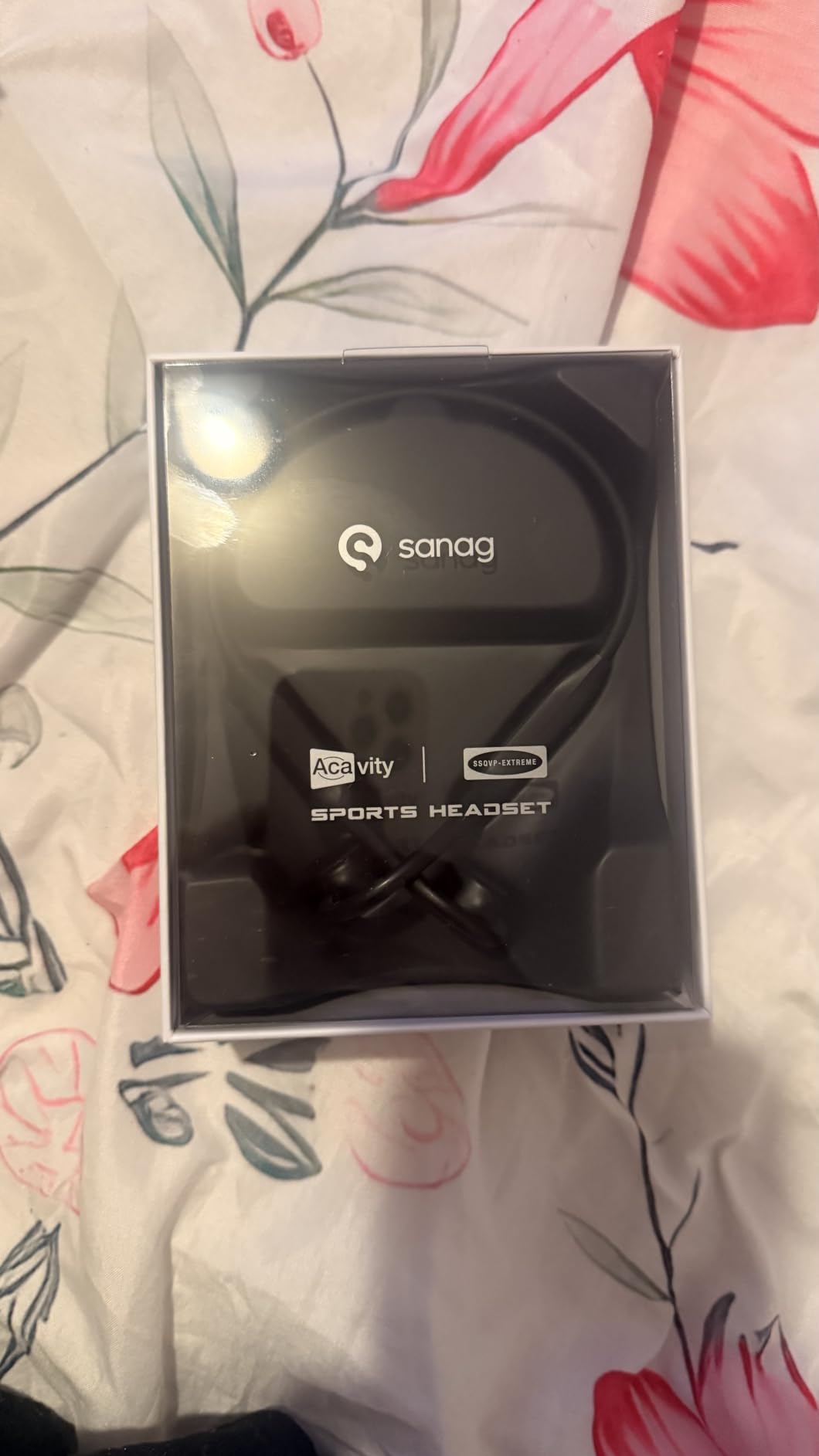
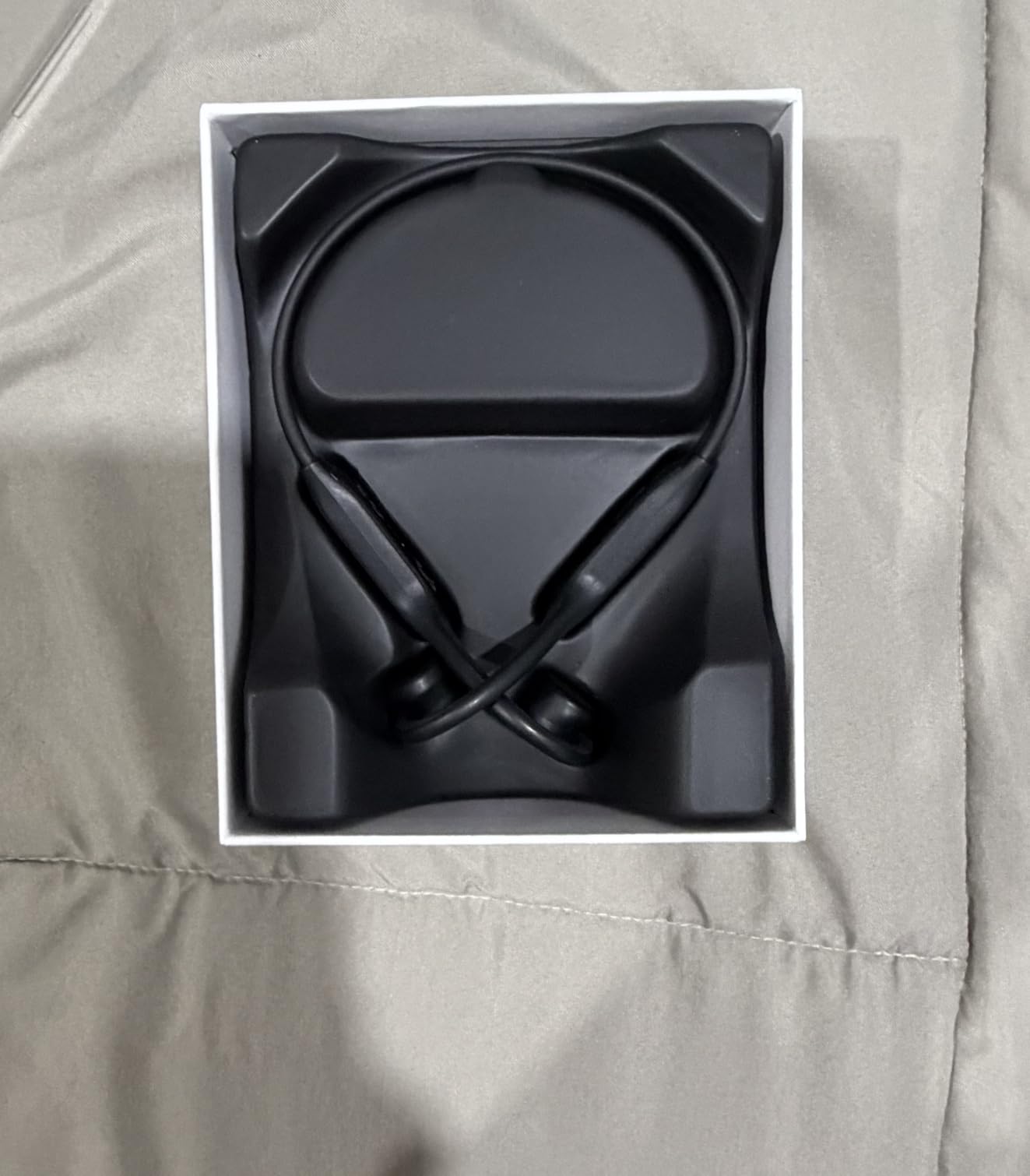
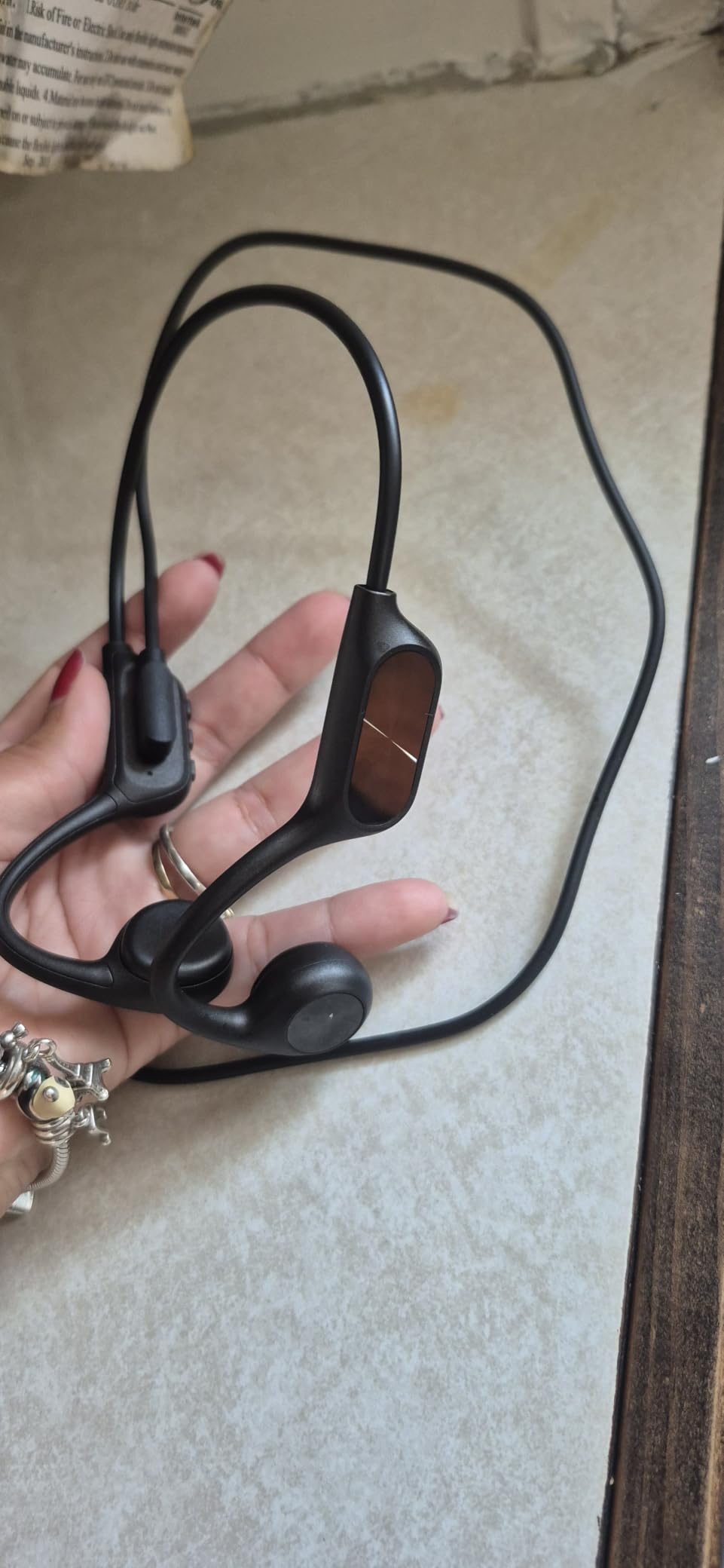
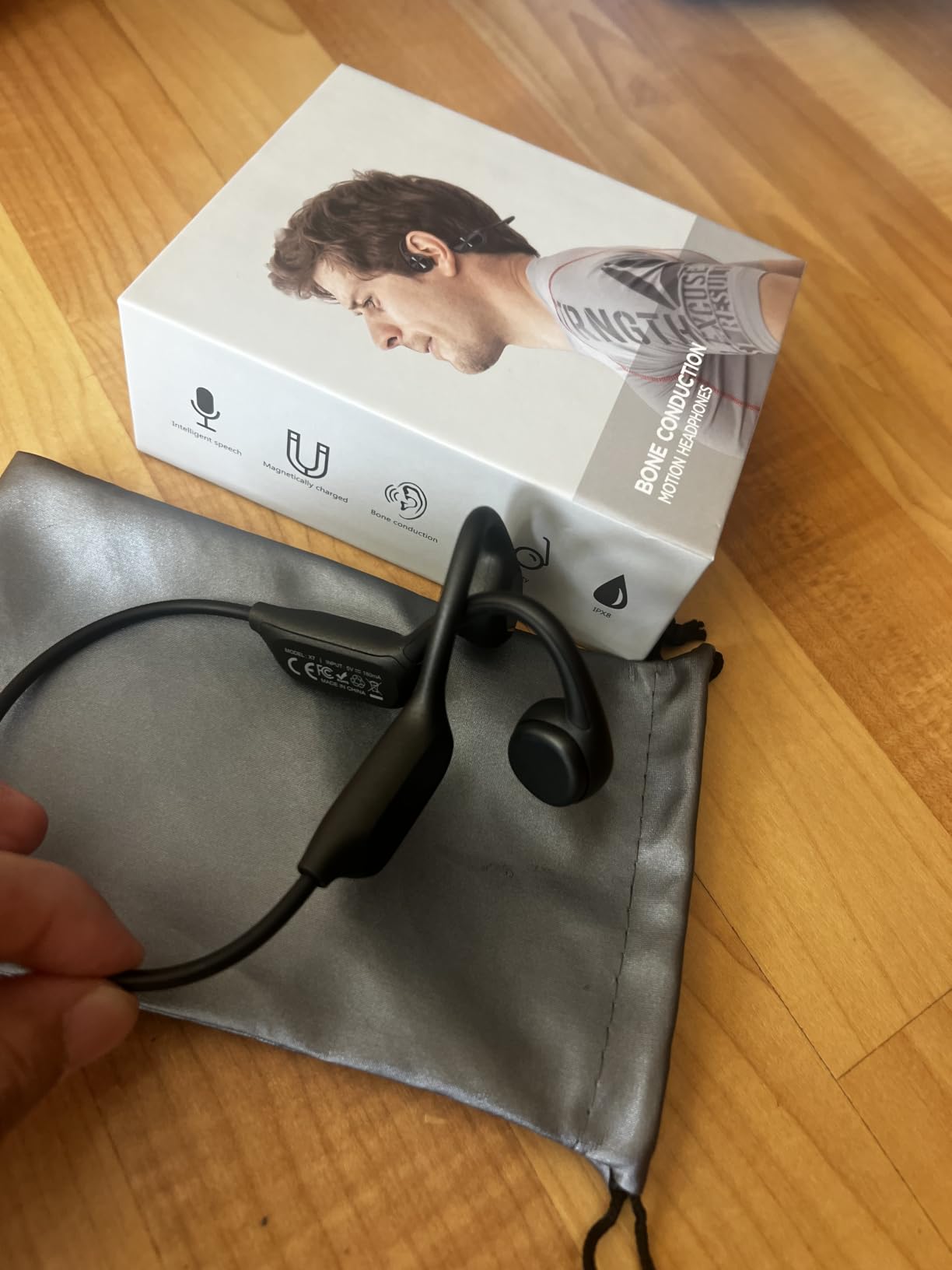
The design story here is the magnetic drive oscillator inside an enclosed cavity, and owners credit it with holding more detail underwater while leaking less sound than an open frame. For a swimmer who has been disappointed by flat bone conduction audio, that is the feature worth paying attention to.
The build is a one-piece seamless IPX8 body rated for submersion to 2 m, usable in a pool or the ocean, and the 32GB of memory gives plenty of room for offline listening. Eight hours of playback covers a full training day or a swim meet, with a charge time of about two hours.
The enclosed cavity also helps with calls, and the ENC microphone reduces background noise in a pool, gym or outdoors, which is a genuine advantage over the open frames that pick up splash and lane chatter. Bluetooth pairs in about three seconds at a 50 ft range on land.
Be careful with two things. The module is Bluetooth 5.3 rather than the 6.0 used by most of the newer models here, and 16 percent of this listing’s reviews are one star, the highest negative share in the roundup, mostly from buyers who expected more audio refinement. Touch and on-ear controls are fiddly with wet fingers.
Why the sealed cavity helps your ears and your lane-mates
An enclosed cavity traps and directs the vibrating air in front of the transducer instead of letting it escape sideways. That has two effects underwater: the sound reaching the ear path is stronger, and less of it is radiated into the water where your lane-mates hear it.
On land the same cavity is why the microphone performs, because it shields the capsule from the wind and splash that an open frame picks up. It is a mechanical explanation for a spec that would otherwise be hard to judge from a product page.
Where the premium asks too much
This sits well above the rest of the group on price without a matching jump in audio refinement, and the review distribution shows people who feel that. If you are comparing it to the models in the middle of this list, the sealed build and the oscillator are the two things you are actually paying for.
Skip it if you want large physical buttons, because the touch and on-ear controls are the most-cited friction in the pool. Skip it if you are on a tight budget and a solid IPX8 with 32GB from another brand will do the same job for a swim-only use case.
9. Dnniakm X7P – Best for Audiobooks and Long Sets
Bone Conduction Headphones for Swimming, Waterproof Swimming Headphones
IP68 sealed open-ear design
32GB for 9,000 songs
Three-press shuffle toggle
32 g frame
8 h playtime
Pros
- IP68 sealing is among the strongest in the budget tier
- Three quick presses toggle shuffle which most rivals lack
- 32GB holds 9000 songs for fully offline swimming
- Bundled waterproof earplugs and a carrying bag
Cons
- Bluetooth 5.4 rather than the 6.0 on newer models
- Adaptive noise cancellation is tuned for land and adds little in the pool
- Modest review volume means thin durability evidence
Audiobook listeners are the audience this model serves best, and the reason is the shuffle toggle. Three quick presses switch playback between sequential and shuffle, so you can hand a set of chapters to the water and let the order fall where it may instead of resetting to the start of a file every session.
Thirty-two gigabytes holds up to 9,000 songs, which for spoken word is closer to a hundred hours of narration and removes any weekly reload habit. The IP68 sealing is joint-strongest in the budget tier, and the adjustable strap on a 32 g frame keeps the fit secure and comfortable.
The box includes waterproof earplugs and a carrying bag, and the brand states a two-year after-sales service, which is a better support commitment than most products at this level offer. Bluetooth 5.4 holds a stable 10 m connection on land with eight hours of playtime.
Two things temper that. The adaptive noise cancellation is tuned for land use and adds very little in a pool, so treat it as a feature for the run rather than the swim. And the review volume is modest, so the long-term durability evidence is thinner than the rating distribution suggests.
Why shuffle and storage change what you can listen to
Sequential-only playback is fine for an album and awkward for a 30-hour audiobook, because a session that ends at chapter six restarts at chapter six forever. A shuffle toggle turns the device into something you can hand to the water without managing a cursor, which is why it is the feature that separates this from several cheaper models.
Storage is the other half of the audiobook case. At 32GB and up to 9,000 tracks, the library you build once serves a whole training block. That removes the one behaviour that makes people stop swimming with headphones, which is arriving at the wall and finding the device full of the same twelve songs.
When the land features are wasted
The adaptive noise cancellation and the Bluetooth connection earn their place only if you use the same pair for running and cycling. If this is a swim-only purchase, those features are decoration and you should compare the storage, the seal and the control layout instead.
Also weigh the review base. A 4.4 average over a modest number of reviews is encouraging, but it is not the same evidence as a large long-running base. If you are keeping this pair for years, check the stated after-sales term and make sure the seal is a replaceable part rather than a sealed assembly.
10. PSIER S18 Pro Kit – Best for First-Time Owners Who Want the App
PSIER Bone Conduction Headphones, IPX8 Waterproof Swimming Headphones
IPX8 to 2 m for 1 h
32GB with two preloaded tracks
Bluetooth 6.0 multi-device
8 h playback
Boean app
Pros
- 92 percent of reviews are five stars
- IPX8 sealed to 2 m for one hour
- 32GB internal storage with sample tracks preloaded
- Boean app adds EQ
- sleep audio and translation tools
Cons
- Shares the S18 model number with the cheaper PSIER listing
- Touch controls rather than physical buttons
- Small review base leaves durability unverified
First-time buyers usually get stuck on two things, and this model answers both. Thirty-two gigabytes comes with two sample tracks already loaded, so you can switch to MP3 mode and hear sound before you have transferred anything, and the Boean app handles EQ, sleep audio and translation tools from one place.
92 percent of its reviews are five stars, the strongest satisfaction distribution in this group, and there are no ratings below four. The sealed coating is rated IPX8 for 2 m for one hour, and Bluetooth 6.0 with multi-device pairing handles the land half of your training.
That satisfaction is not uniform praise, though. Owners note the familiar requirement to switch to MP3 mode before swimming, and the touch controls are less reliable with wet fingers than physical buttons would be, which is a real difference from the top pick.
The practical warning is about the listing itself. This shares the S18 model number with the cheaper PSIER model in this roundup, which is genuinely confusing when you are comparing two pages side by side, so check the storage, the included items and the warranty term rather than the model number alone.
Why preloaded tracks and an app lower the entry barrier
Almost every new-owner complaint in this category is silence in the first session, and it is almost always the same cause: the device is in Bluetooth mode, or the memory is empty and the owner assumed it was not. Preloaded sample tracks let you confirm sound before you do anything else, which removes the single most common reason people return these units.
The app is the other half. Adjustable EQ matters more underwater than on land because the tuning is a bigger share of what you hear, and having a sleep audio and translation section available in the same software is useful if you use the same pair off the pool deck.
When to pick a different listing entirely
Choose a different model if you want physical buttons, because touch controls are the most-cited complaint here and wet hands make that worse. Choose a different model if the ambiguous shared model number bothers you, and pick the version whose specification block matches what you actually need.
The review base is also the smallest in this roundup, so the 4.9 average reflects early owners rather than a long record. Treat it as an encouraging start, not as proof of a five-year seal, and keep the case if you travel with it.
How to Choose: What Actually Decides This Purchase
Start with the IP number, not the marketing word. IPX7 means survival at 1 m for about 30 minutes, IPX8 typically means 2 m for one or two hours, and IP68 adds a dust digit to the water figure. A listing that says water resistant with no number at all is a reason to keep shopping, and that single check eliminates more bad purchases than anything else in this guide.
Decide pool or open water before anything else. Pool lanes need an IPX8 and that is the end of the requirement. Open water, surfing and bodysurfing reward a deeper stated rating and a band that holds through a push, because the water is moving and your head is going under repeatedly.
Size the storage to your listening. 8GB is about 1,500 songs and works for a week of laps. 32GB is 8,000 to 9,000 tracks, which removes the weekly reload habit entirely. If audiobooks are part of the plan, treat anything under 16GB as a compromise you will notice within a month.
Choose the controls before the audio. Physical buttons are the single most useful hardware feature in a pool, where capacitive touch pads fire twice or switch you out of MP3 mode mid-length. Every product here has some touch control, but the reliability gap is real and it shows up in the reviews.
Weight and band tension set the session length. Frames in this roundup run from 26 g to 37 g, and the heavier ones build pressure above the ear past 60 to 90 minutes. If you have abandoned open-ear headphones before, do the 20-minute poolside fit test with your cap and goggles before you buy anything on this list.
Read the battery claim twice. One model here lists a battery figure that contradicts its own marketing copy, and another runs a 3-hour charge for a 10-hour cell. Local MP3 playback also drains faster than Bluetooth on several of these, so a long open-water block needs more headroom than a pool set.
Treat the review base as evidence. A large, long-running base with a mid-four average is more informative than a small base of pure five-star ratings. Warranty length is the other trust signal: two years beats one, and a single cable that handles both charging and file transfer is a single point of failure worth knowing about.
Buy earplugs. The cheapest audio upgrade in this whole category is a pair of swim earplugs blocking the rushing water noise, and several models here ship with a pair. Spoken word benefits far more than music, and swimmers report the difference immediately.
Bone Conduction vs In-Ear Swim Earbuds
Open-ear bone conduction wins on awareness and comfort, and in-ear swim buds win on bass and isolation. That is the whole argument, and it comes down to what you want to hear besides the music.
In your ears, water pressure dominates, so the low end that survives is mostly the vibration of the bud itself. Many swimmers describe in-ear swim playback as a muffled thump with speech on top, which is the opposite of what you want for a podcast. Plug your ears with swim plugs and an in-ear bud becomes a conventional sealed earphone again, which is why the two formats end up needing opposite accessories.
Awareness is the safety argument and it is not a marketing claim. Swimmers in forums consistently describe open-ear units as the only format that feels safe, because a lifeguard whistle, a lane-mate calling a turn, or a coach on the deck still gets through. If you swim open water, in poor light, or alone, that is worth a great deal more than bass.
Comfort runs the same way. In-ear buds need a seal to sound right, and a seal you insert before every session is another thing between you and the water. Open-ear frames go on once and stay on. If your ears are prone to infections from trapped pool water, a design that lets water drain rather than trapping it is a genuine argument on its own.
Our view: swim laps, open water, triathlon bricks and any audiobook use all point to open-ear bone conduction. Choose in-ear only if your training is short, your sessions are in a quiet pool, and music matters more to you than what you can hear around you.
Frequently Asked Questions
Do bone conduction headphones work for swimming?
Yes, but only in MP3 mode. A bone conduction transducer vibrates your cheekbone, and that mechanical signal reaches your inner ear without passing through air or water, so it keeps working underwater. Bluetooth is a radio signal and radio signals do not cross water, so any swim-rated pair must carry onboard storage. The audio stops the moment you submerge unless you have switched modes.
What is the downside of bone conduction headphones?
The main drawbacks are thin bass underwater, a lack of isolation, fit pressure above the ear on long sessions, and a file workflow that has no streaming option. Bone conduction loses low frequencies in water faster than in-ear drivers do, sound leaks slightly, and cheaper frames build ear pressure past 60 to 90 minutes. You also cannot sync a streaming library, so you must buy or convert files.
Are Shokz worth it for swimming?
For most swimmers, yes. The OpenSwim Pro carries the strongest combination of rating depth, seal and dual-mode hardware in this group, with an IP68 body rated to 2 m for two hours, 32GB of storage and a swim-specific EQ profile. The premiums are the proprietary magnetic cable and basic playlist software. If you swim three times a week and do not tune anything, a mid-tier alternative covers the same use.
How do I load MP3 files onto swimming headphones?
Check the supported formats, convert anything streaming services will not export, then connect the supplied cable and open the player as a USB drive. Drag the files to the root folder rather than a subfolder, because several models ignore nested directories. Switch the unit from Bluetooth to MP3 mode before entering the water, then test one long track poolside to separate a file problem from a seal problem.
What does OSHA say about bone conduction headphones?
OSHA regulations address workplace noise exposure and hearing conservation, and they do not prohibit open-ear listening devices. Hearing protection rules concern attenuating earplugs and earmuffs required above exposure limits, which bone conduction headphones do not provide. Nothing in the guidance applies to recreational swimming. If you work in a noisy industrial setting, follow your employer hearing conservation programme rather than any general device guidance.
Do bone conduction headphones emit eMF?
Every wireless device emits some electromagnetic field, and an open-ear bone conduction headset is no exception. The fields are low and comparable to any Bluetooth earbud, and they fall away quickly with distance from the transmitter. Bone conduction does not create a distinct new hazard; it just delivers sound mechanically instead of through the ear canal. If you have a specific medical concern, ask your clinician rather than a product page.
Why are bone conduction headphones not popular?
Two reasons. In-ear buds are cheaper, and they are what most people already own, so the format has to compete on a use case rather than on price. Bone conduction also loses bass underwater, which sounds like a defect until you understand water damps low frequencies. The format is growing rather than shrinking, and the swimmer is the one segment where the open-ear argument is strongest.
Can you stream music while swimming?
Not with onboard storage, because the audio must already be on the device. The alternatives each cost something. A transmitter case relays Bluetooth to the unit, but it drains a battery in the water and the range is short. A smartwatch relay works only with the watch worn near the cable, which costs you your wrist stats. An app that records a playlist offline and transfers it is the least costly option.
Conclusion: The Pick That Fits Your Lanes
The SHOKZ OpenSwim Pro is the best bone conduction headphone for swimming in 2026 because it is the only one here that combines an IP68 seal, 32GB of storage, a swim-specific EQ and physical buttons with a large long-running review base. The PSIER S18 is the value answer for high-frequency pool swimmers, and the VLOP VP01 is worth the step up if the reason you are here is that bone conduction sounds thin to you.
Whatever you choose, do the three things that matter: check the IP number, fill the memory before you get in the water, and wear the set with your cap and goggles for 20 minutes at the wall first.