
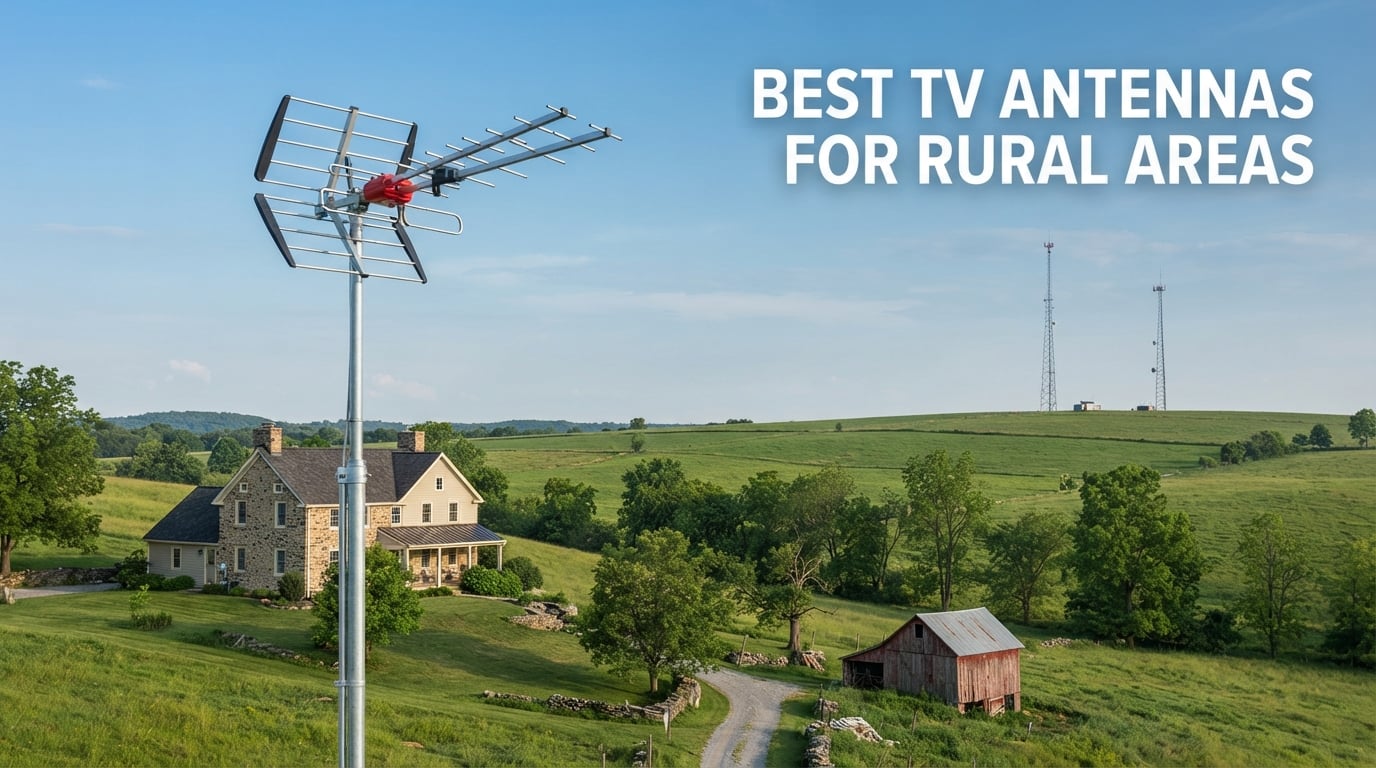
The best TV antennas for rural areas are long-range outdoor models mounted as high as you can get them, and the specific type depends on your distance to the broadcast towers. Yagi and multi-loop designs win when every station sits in one direction, multi-directional panels handle split tower clusters, and omnidirectional antennas remove the aiming guesswork entirely. Mount it on a mast, aim it, and scan.
Our team compared ten outdoor antennas covering the full distance range, from properties just outside a town to farms 70 miles from the nearest transmitter. We weighed band coverage, beam pattern, whether an amplifier is built in, what hardware is in the box, and the owner reviews behind each one. Several of the highest-mileage claims in this category are pure marketing, and we call that out below.
One expectation to set first. Rural markets rarely carry the 40-plus channels people imagine when they picture cutting cable. A homeowner in r/canton reported four stations after a full outdoor install, and experienced posters on Clark.com repeat the warning. A realistic rural target is somewhere between 6 and 15 stations, and that is normal.
If you have already tried an indoor unit, our guide to the best indoor amplified antennas for rural homes covers what indoor hardware can and cannot do.
Top 3 TV Antenna Picks for Rural Homes in 2026
These three cover the most common rural situations: the GE is the strongest all-rounder, the PBD is the easiest install for anyone who does not want to aim, and the Five Star Yagi is the low-cost route to real gain.

GE Outdoor HD Antenna
- VHF and UHF Yagi design
- 70+ mile rated range
- No amplifier needed
- Attic or outdoor J-mount

PBD Motorized Antenna
- 360 degree motorized rotation
- Dual TV outputs
- Full kit with pole and coax
- ATSC 3.0 ready

Five Star Yagi FSA-5812
- Extended Yagi elements
- 40ft coax and J pole included
- Mostly metal construction
- VHF and UHF bands
All 10 Antennas Compared in 2026
Every antenna in this guide with the details that decide whether it fits your property. Range figures are manufacturer ratings, not measured performance.
| Product | Specifications | Action |
|---|---|---|
| GE Outdoor HD Digital TV Antenna |
|
Check Latest Price |
| PBD Amplified Motorized Antenna |
|
Check Latest Price |
| Five Star Yagi FSA-5812 |
|
Check Latest Price |
 Antennas Direct ClearStream 4V Antennas Direct ClearStream 4V |
|
Check Latest Price |
 Antennas Direct DB8e Bowtie Antennas Direct DB8e Bowtie |
|
Check Latest Price |
 Five Star Amplified Rotating Kit Five Star Amplified Rotating Kit |
|
Check Latest Price |
 1byone Omnidirectional Antenna 1byone Omnidirectional Antenna |
|
Check Latest Price |
 McDuory Amplified Rotating Antenna McDuory Amplified Rotating Antenna |
|
Check Latest Price |
 PBD 4-Bay Amplified Array PBD 4-Bay Amplified Array |
|
Check Latest Price |
 Five Star Five-TV Antenna Kit Five Star Five-TV Antenna Kit |
|
Check Latest Price |
How to Get Better TV Reception in Rural Areas
Most reception failures come down to three things: the antenna is indoors, it points at the wrong bearing, or the coax run is old. Fixing those in order solves the majority of rural problems, and none of it requires a bigger antenna.
- Mount it outdoors. A roof, pole, or gable mount multiplies the signal you collect compared with anything in a living room, especially near foil-backed insulation, radiant barriers, or metal roofs.
- Aim it at your towers. Find the bearing to your broadcast towers first, then point the antenna there. A multi-directional unit forgives a poor guess; a narrow Yagi does not.
- Use fresh coax. Run new RG6 from the antenna to the house instead of reusing an old run. Cable quality and connector seating are the cheapest wins in rural reception, and r/cordcutters regulars specifically recommend a heavier run for long distances.
Height matters as much as hardware. Forum owners report the same result repeatedly: raising the antenna above the tree line resolves problems a more expensive antenna could not.
Want the amplified options compared? Our guide to the best outdoor amplified antennas for rural areas covers that.
How to Check Which TV Channels You Can Receive Before You Buy
You can build a channel list for your exact address in about ten minutes, for free. Doing this first prevents the most common rural antenna purchase mistake: buying for the wrong band or the wrong distance.
- Enter your address on the FCC DTV map or a TV Fool style reception report. Both show the towers you can reach plus the distance and bearing to each one.
- Note the channels, then cross-check each against its band: channels 2 to 6 are Low-VHF, 7 to 13 are Hi-VHF, and 14 and up are UHF. If your market depends on a channel 2 to 6 affiliate, a UHF-only antenna will miss it.
- Record the bearing to each tower group. If they cluster within roughly 40 degrees, a directional antenna is enough. If they scatter around the compass, go omnidirectional or multi-directional.
- Count the stations. If the report shows fewer than about eight, set expectations accordingly and do not expect a 40-channel result.
- Check whether your local stations carry ATSC 3.0, also called NextGen TV. Most antennas in this guide support it, but confirming keeps you from buying a legacy-only unit.
One more free test: plug your existing antenna into a single TV, run a channel scan, and note what you already receive. That baseline tells you whether the problem is hardware or an obstructed path.
How Far Can an Outdoor TV Antenna Really Reach?
A well-sited outdoor Yagi can sometimes lock stations 70 miles away and beyond, but no antenna has a guaranteed mile range. Reach depends on tower power, terrain, foliage, antenna height, and where your towers sit relative to your home. Any listing that promises a specific number as a guarantee is selling marketing, and the r/fargo threads about thousand-mile antennas exist because buyers believed them.
- Under 20 miles: almost any outdoor antenna works, and many indoor units will too. Choose a compact directional or omnidirectional model.
- 20 to 50 miles: pick a directional Yagi or multi-directional panel design and mount it high. This is where amplifier choice starts to matter.
- 50 to 70 miles: you want a large, high-gain array and a clear line of sight. Bowtie and multi-element loop designs are common here.
- Beyond 70 miles: you depend on terrain and tower power more than on antenna model. A strong mast and clean coax run matter as much as the antenna.
If hills, mountains, or dense woods sit between you and the tower, no antenna fixes it. That is the honest limit of this entire category.
1. GE Outdoor HD Digital TV Antenna – Best Overall for Rural Homes
GE Outdoor HD Digital TV Antenna, Long Range Smart TV Antenna
VHF and UHF Yagi design
70+ mile rated range
29 x 15 x 20.5 inch
3 lb weight
ATSC 3.0 ready
Pros
- Delivers major networks from 40 to 70 miles in many installs
- Compact body that hides easily in an attic
- Works well with an added inline amplifier
- Limited lifetime replacement pledge
- No amplifier noise added
Cons
- No amplifier or coax cable included
- Highly directional so small turns drop channels
- Assembly takes time
This is the antenna we recommend first, and it earns the top spot on owner feedback rather than specification alone. At 4.4 stars across more than ten thousand ratings, it holds the highest five-star share of anything we looked at. Most of the owners who rate it highly are people who had already tried an amplified unit and found the noise worse than the original problem.
The design is a passive Yagi-style array with no amplifier in the box, which is the whole point. r/cordcutters consensus is blunt: an amplifier only boosts a signal the antenna can already detect, so adding gain to a clean directional pattern is where many cheap antennas go wrong. The GE does the harder job with geometry instead.
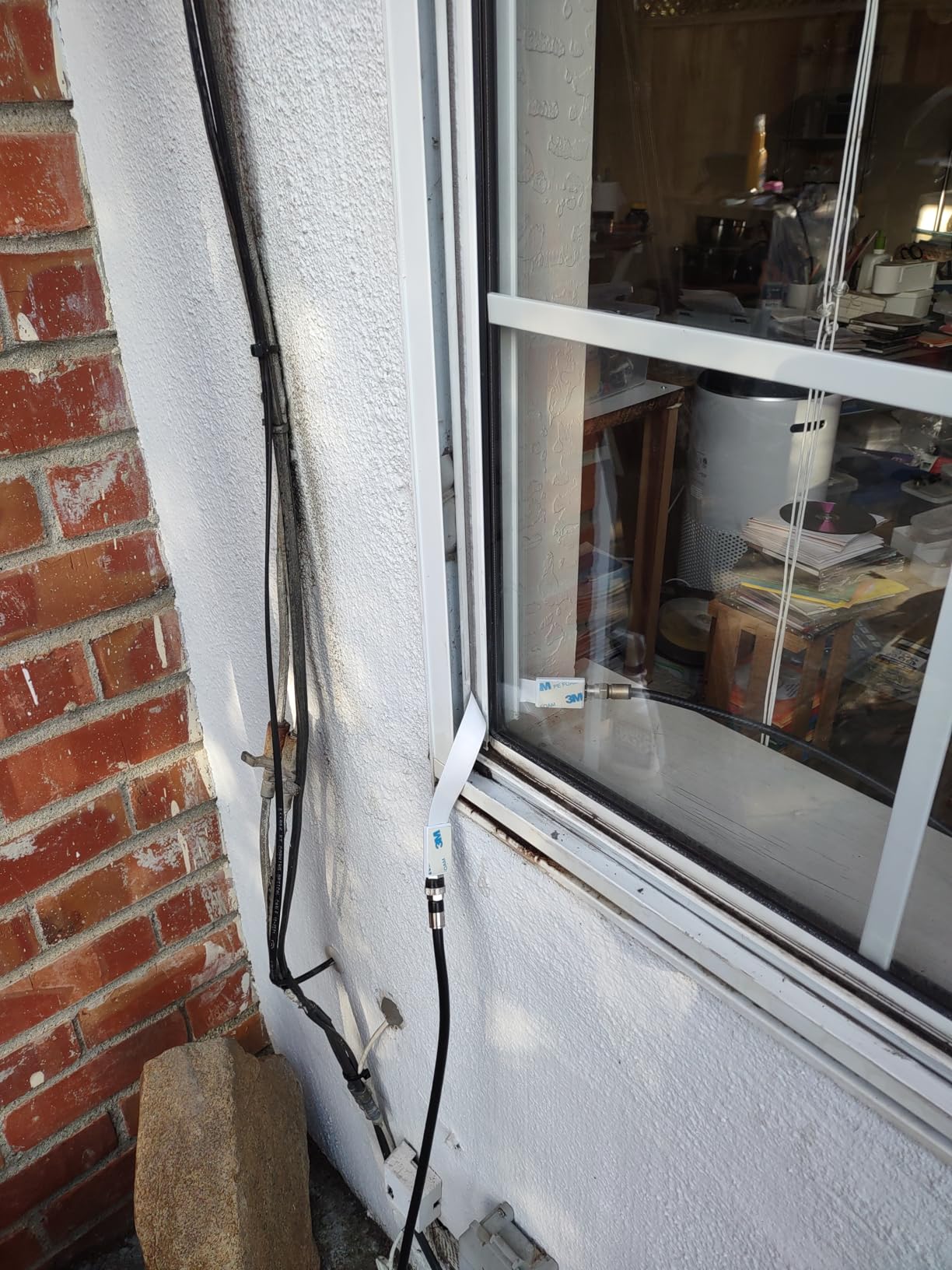
Size is genuinely practical at 29 by 15 by 20.5 inches and three pounds, and that matters more than it sounds. Deep-fringe arrays can need a serious structure to carry, and several models further down this list are far bulkier. This one fits on a modest pole or a gable end and disappears into an attic without a fight.
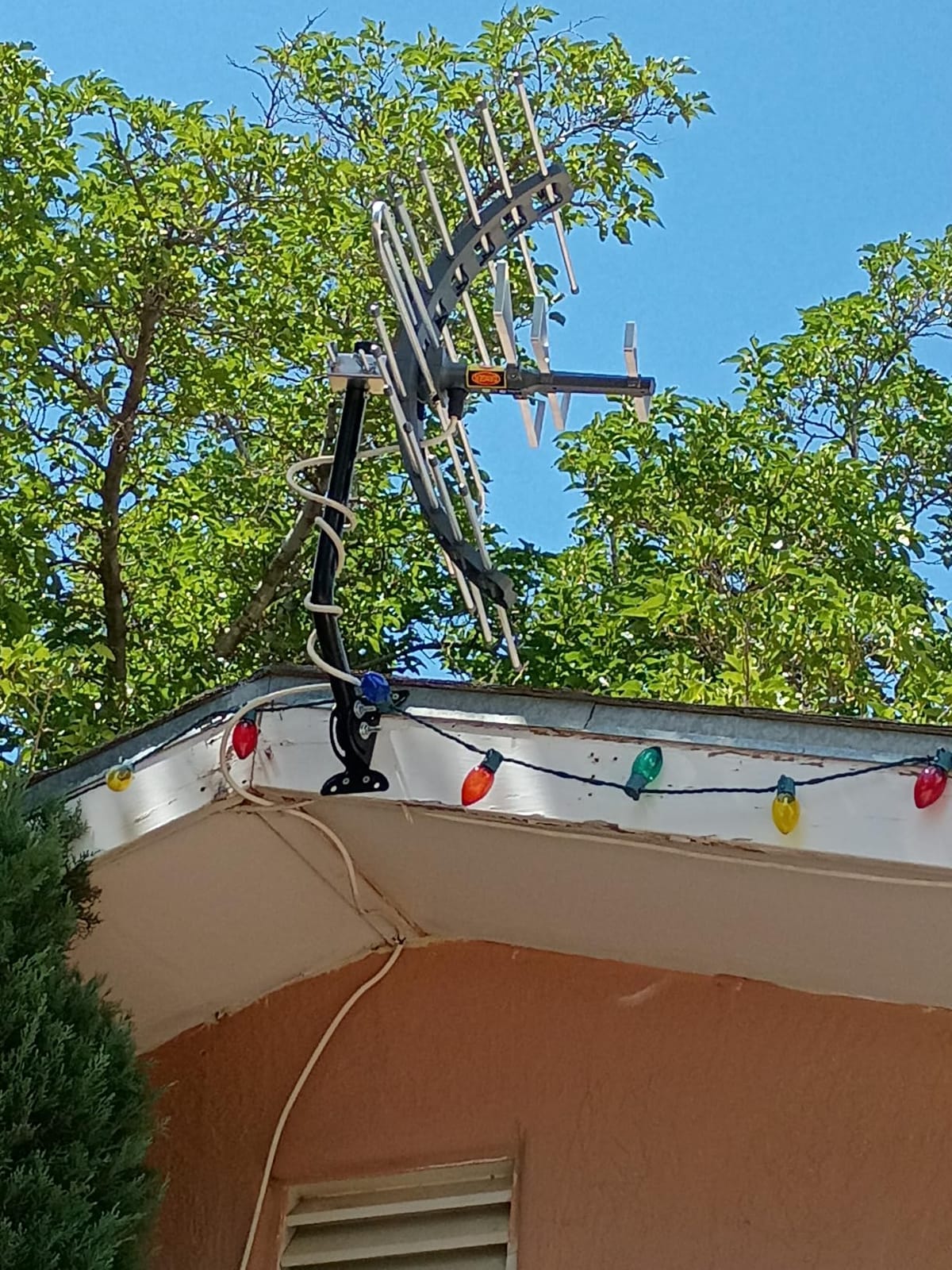
A J-mount for attic or outdoor use is included, and it is rated weather-resistant for roof or mast mounting, but you supply the coax. Reviewers also flag that the aluminum element tubes fit very tightly into the frame, so allow extra time on assembly. The printed booklet uses very small type, an easy complaint to fix with a phone light and patience.
When the GE antenna is the right call
It suits you if your towers sit in one general direction, you are 20 to 50 miles out, and you would rather buy one antenna and one amp than troubleshoot a kit. It is also the safest pick for renters with attic access but no roof access, because a low-profile body and a J-mount are far easier to handle alone.
Add an inline amplifier only past roughly 35 miles or on a long coax run. For a standard 20 to 30 mile install, extra gain usually buys nothing and occasionally costs channels. Owners who report improvement had marginal signals needing a small boost, not a wall of amplification.
When to pick something else
Choose an omnidirectional model if your towers spread across more than about 80 degrees of compass. Choose a rotating amplifier kit if you do not know where your towers are and do not want to find out. If your market runs a channel 2 through 6 station, verify coverage first, because a narrowband array can miss that affiliate.
2. PBD Amplified Outdoor TV Antenna – Best Value Complete Kit
PBD Amplified Outdoor TV Antenna for Local Channels, 360° Remote Rotation
360 degree motorized rotation
Built-in high-gain amplifier
Dual TV outputs
40ft RG6 and pole included
Lifetime warranty
Pros
- Motorized rotation from indoors makes aiming easy
- Dual TV outputs without a splitter
- Everything in one box
- Lifetime warranty with responsive support
- Most owner reviews of any model here
Cons
- Lightweight plastic feels flimsy long term
- Rotor has no position feedback
- Preamp powers through the rotor control box
With more than nineteen thousand ratings, this is the most owner-tested antenna in the guide, and the 68 percent five-star share reflects that. Owners repeatedly credit channel counts far beyond whatever they had before, which is the outcome that matters when comparing six stations against fifteen. For a first antenna purchase, that track record is worth a lot.
The motor changes the experience. A 360 degree rotor driven by a wireless remote means you can rotate from the couch and rescan until channels appear, removing the most demoralizing part of installing a directional antenna. You do not need to climb a ladder repeatedly to test bearings.
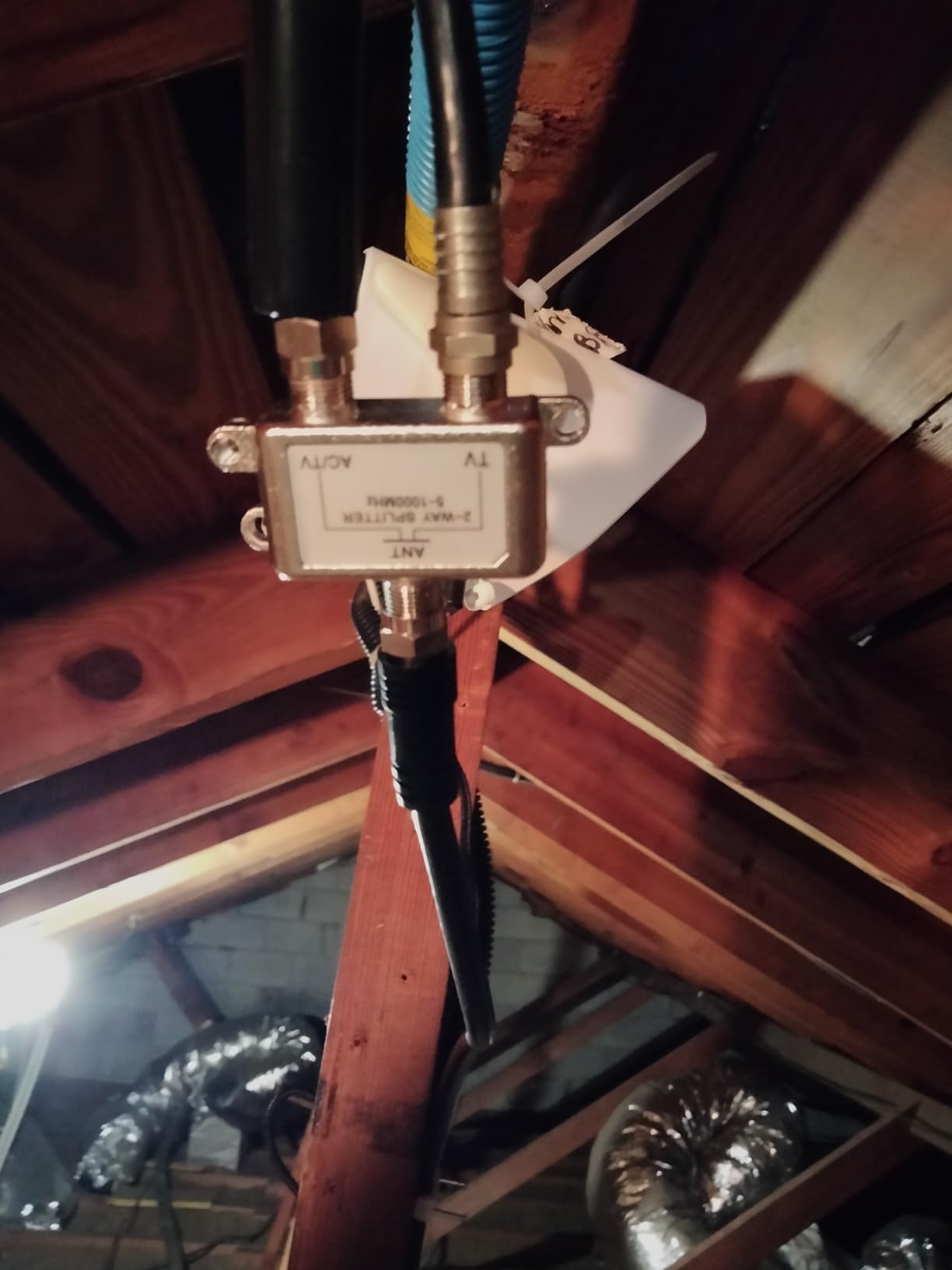
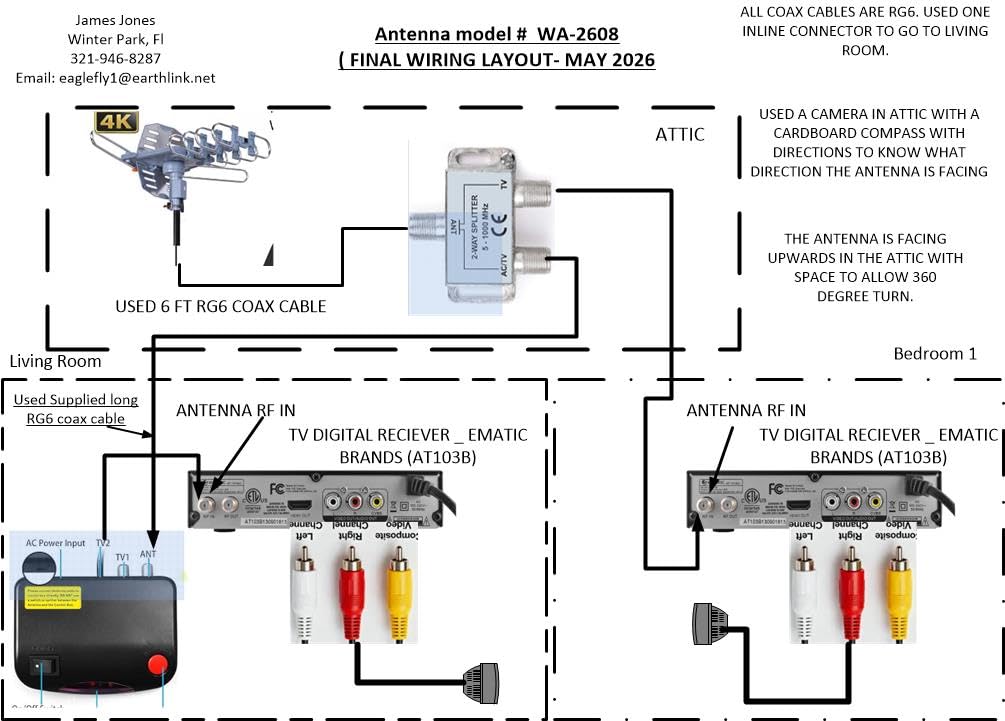
It also arrives as a genuine kit: a 40 foot RG6 run, a mounting pole, the rotor control box, and a built-in high-gain low-noise amplifier, with dual TV outputs so you do not have to buy a splitter and lose signal to it. Our comparison of the Antennas Direct and Five Star outdoor antennas goes deeper on how kit quality affects long-term installs.
The honest weaknesses are mechanical. The rotor has no position feedback, so you scan channels to figure out where it points, and the single-button remote cannot command a direction directly. The preamp also draws power through the control box, meaning it disappears if the rotor is bypassed during troubleshooting. Plan to use it as designed rather than as a modular system.
When the PBD rotator is the right call
It fits households that do not know their tower bearing, live 20 to 50 miles out, or want to feed two televisions from one antenna without buying a splitter. It is also a reasonable first move in a heavily wooded area where you can raise the antenna above the canopy but cannot fix the terrain.
Two TVs is a comfortable fit for the dual outputs. Beyond that, add a distribution amplifier rather than stacking splitters, since each split costs signal and a boosted split costs less. If you need five televisions, the Five Star five-TV kit later in this guide is the better-matched hardware.
When to pick something else
Skip it if you already know your tower bearing, because a fixed multi-directional array outperforms any rotor in the same price class. Skip it if your property is exposed and you want hardware that survives a decade of ice and wind. If your market relies on Low-VHF channels, confirm coverage, because the 792,000 foot range figure on the listing is marketing rather than real reach.
3. Five Star Yagi Antenna FSA-5812 – Best Budget Yagi for Distance
Five Star TV Antenna Indoor/Outdoor Yagi Satellite HD Antenna with up to 200 Mile Range – Attic or Roof Mount TV Antenna, Digital OTA Radio/FM Antenna for 4K 1080P with Mounting Pole
Extended-length Yagi elements
VHF and UHF reception
40ft coax and 20 inch pole
Approximately 3 feet assembled
Pros
- Metal-dominant build handles wind well
- Sharp side nulls and strong forward gain
- Coax and mounting pole both included
- Large channel gains over smaller antennas
Cons
- 200 mile claim is unrealistic
- Plain steel hardware will rust
- Single u-bolt mount makes aiming awkward
The dominant theme across more than four thousand reviews is consistent: size, height, and clear line of sight matter far more than brand or amplification. That is a genuinely useful thing for a budget pick to get right, and it is why this antenna keeps showing up in rural recommendations. Owners pair it against more expensive ClearStream units and report comparable results once height is right.
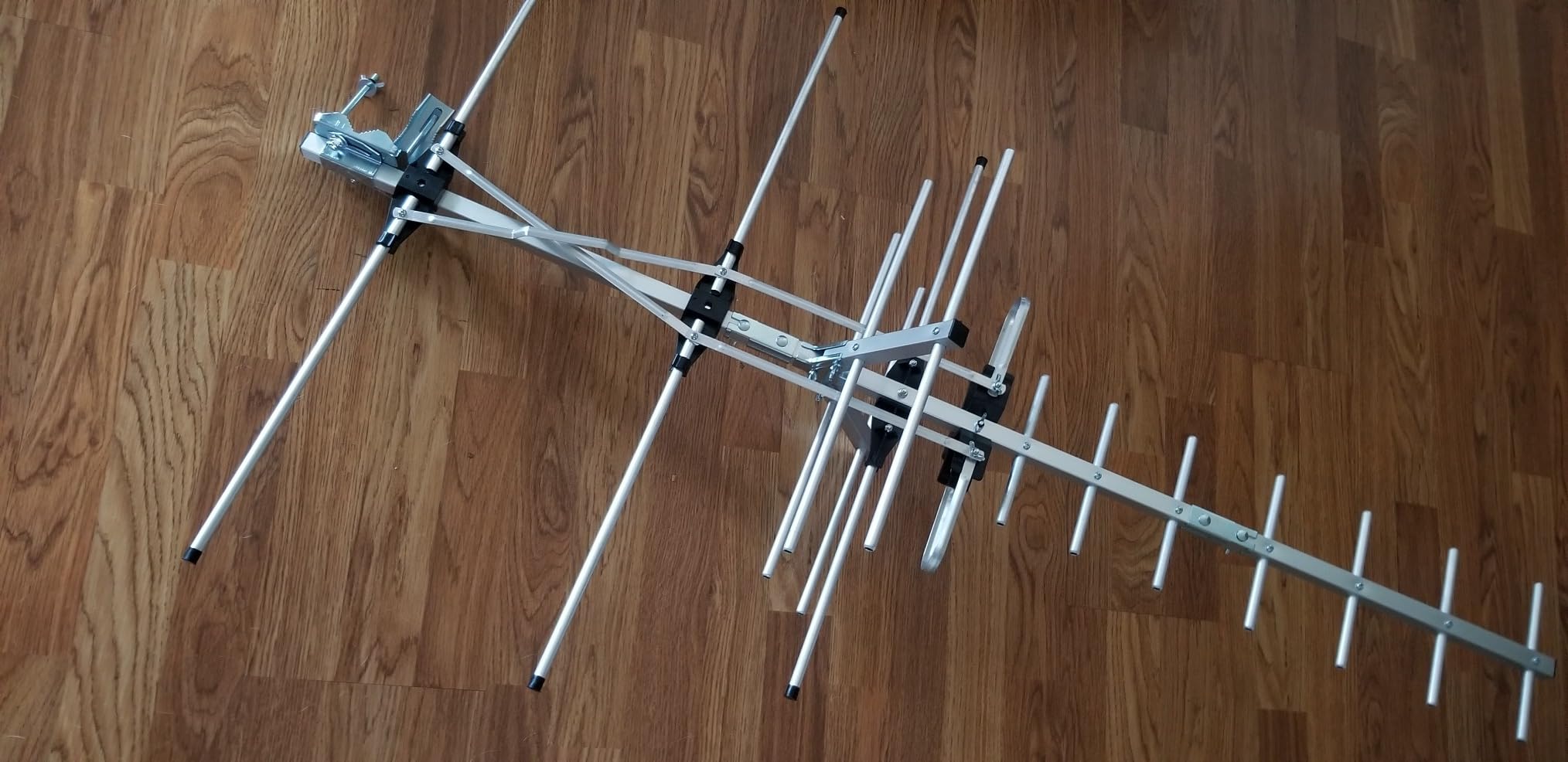
It is a real Yagi with extended element length, the design that gives you gain in a narrow beam. Reviewers like the sharp side nulls because they reject the interference that causes pixelation on lesser antennas. The mostly metal construction is a genuine upgrade over plastic amplified kits, particularly in wind.
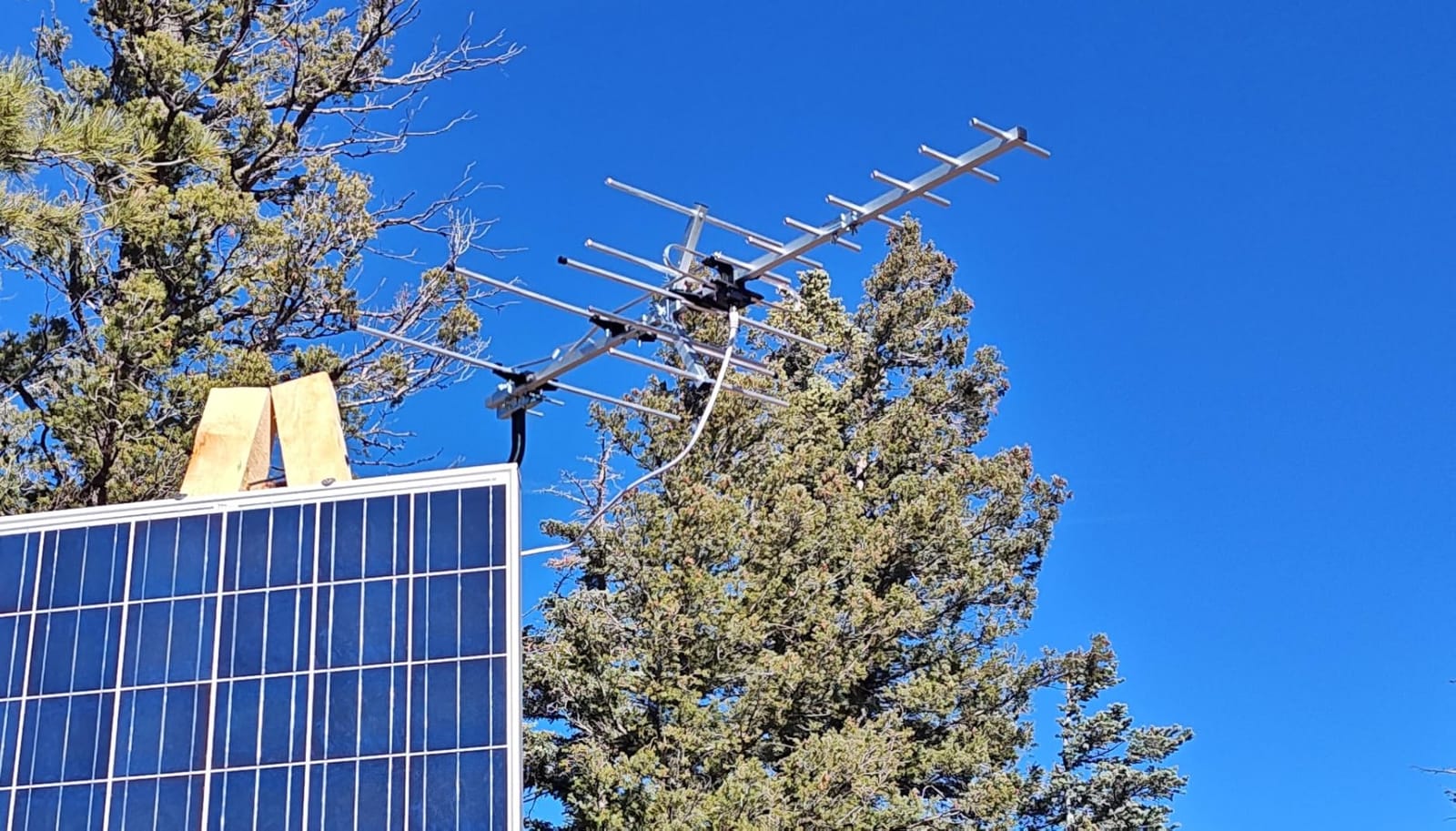
The package is unusually complete. A 40 foot coax run and a 20 inch mounting pole are both in the box, so you can put it on a pole and connect it the same afternoon. It handles FM radio too, and it arrives partially assembled so you are finishing the frame rather than building one element by element.
Two things to fix before mounting. The stamped steel hardware will eventually rust, so plan on replacing the u-bolt and wing nuts with stainless versions in year two. And the single u-bolt mount lets the antenna tilt, making precise aiming genuinely difficult, so a second clamp is a cheap improvement to the install.
The 200 mile claim is not achievable. Reviewers consistently put a realistic ceiling around 60 to 70 miles in favorable terrain, and the listing uses the word satellite even though this is a plain over-the-air broadcast antenna. Treat the number as marketing and the hardware as solid.
When the Five Star Yagi is the right call
It is the choice for a single tower cluster at 20 to 50 miles, on a budget, where you will do the aiming yourself. It also works as a roof or chimney mount for a farmhouse with a clear western or southern view, and in an attic for moderate distances if you cannot mount outside.
Pair it with fresh RG6 rather than the included run if your distance exceeds 35 miles, and check your tower bearing before you climb. Because a Yagi has a narrow beam, a few degrees of error costs you entire channel groups.
When to pick something else
It is the wrong tool if your towers sit in two opposing directions, since a Yagi will not serve both at once. It is wrong if you need low-band VHF and your market runs a channel 2 through 6 station, or if you want zero aiming effort. The assembly instructions are largely useless without a video walkthrough, so budget time for that.
4. Antennas Direct ClearStream 4V – Best Multi-Directional Coverage
Antennas Direct ClearStream 4V Outdoor TV Antenna
Four loop elements with Hi-VHF kit
43 degree horizontal pattern
20 inch mast included
4.1 lb weight
Lifetime warranty
Pros
- Multi-directional pattern catches multiple tower clusters
- Dedicated Hi-VHF elements catch low-band channels
- Reflectors improve strength and resist pixelation
- Engineered in the USA
- Complete kit with mast and hardware
Cons
- Highest price in this roundup
- Reception still limited by distance and obstructions
This is the model that appears most often in real-world rural advice, and at a 71 percent five-star share it has the highest satisfaction rate of anything we reviewed. It is also the most expensive antenna here, and the price is what you pay for a wider reception pattern without giving up gain.
Four patented loop elements with Hi-VHF elements and reflectors give it a 43 degree horizontal beam. That number is the key. A 43 degree pattern covers a broad arc in one aim, so it captures channels from more than one tower cluster where a Yagi would serve only the one it points at. For split-market rural locations, that flexibility beats raw gain.
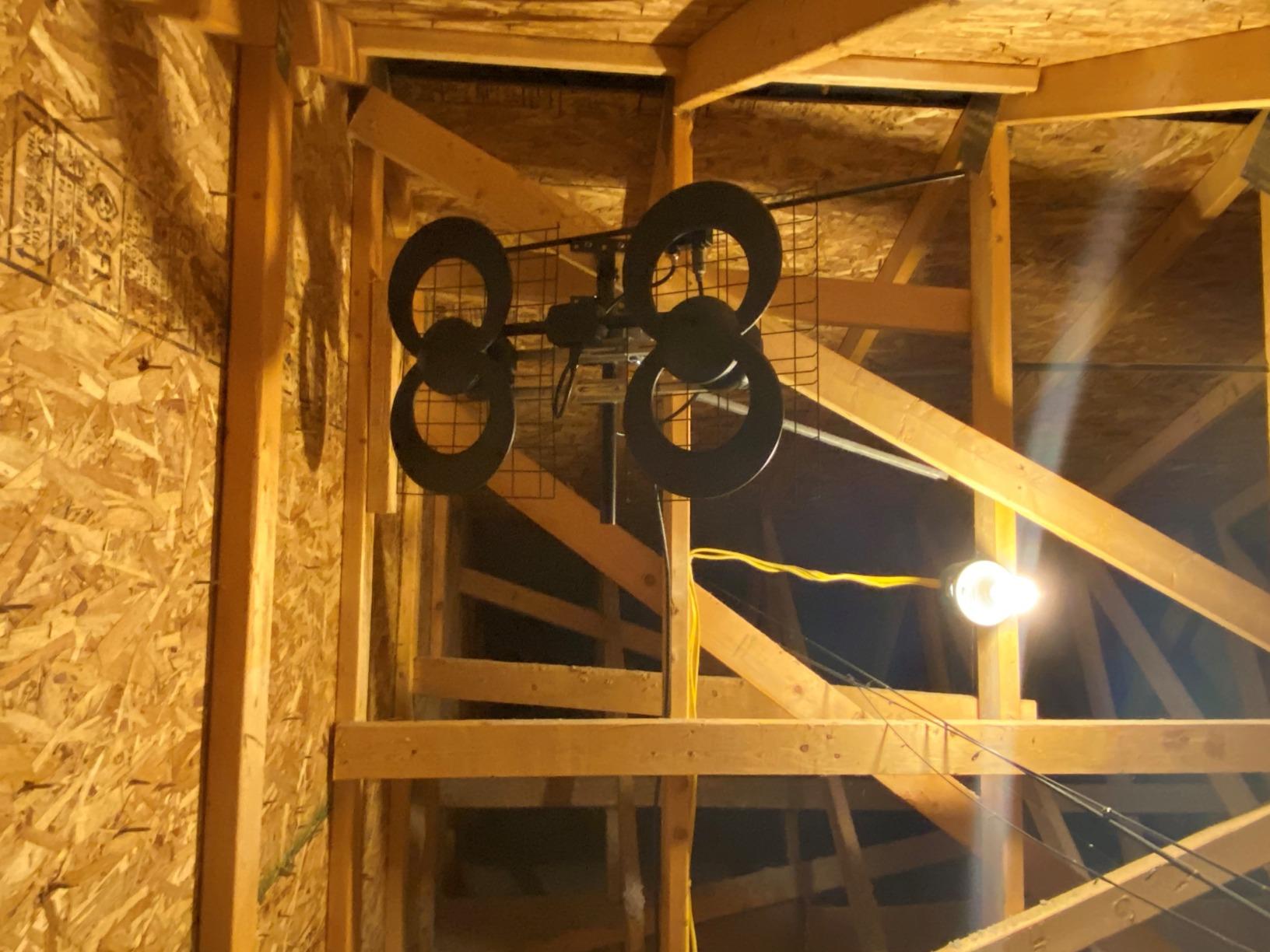
The Hi-VHF elements deserve specific attention because this is where roundups go wrong. Many UHF-focused antennas silently miss channels 7 through 13, and rural markets with smaller affiliates often depend on exactly those stations. The included Hi-VHF kit closes that gap, and owners with mixed-band markets report the difference clearly.
Reflectors add forward gain while rejecting the interference that causes pixelation, the failure mode rural users complain about most when leaves are out. A 20 inch mast with a pivoting base, all-weather hardware, an adjustable mast clamp, and a lifetime manufacturer warranty are all included in the box.
It measures 27.8 by 6 by 17.4 inches and weighs 4.1 pounds, a much easier structure to support than a 10 pound bowtie array. It is NEXTGEN TV and 8K compatible, and the whole thing is engineered and assembled in the USA.
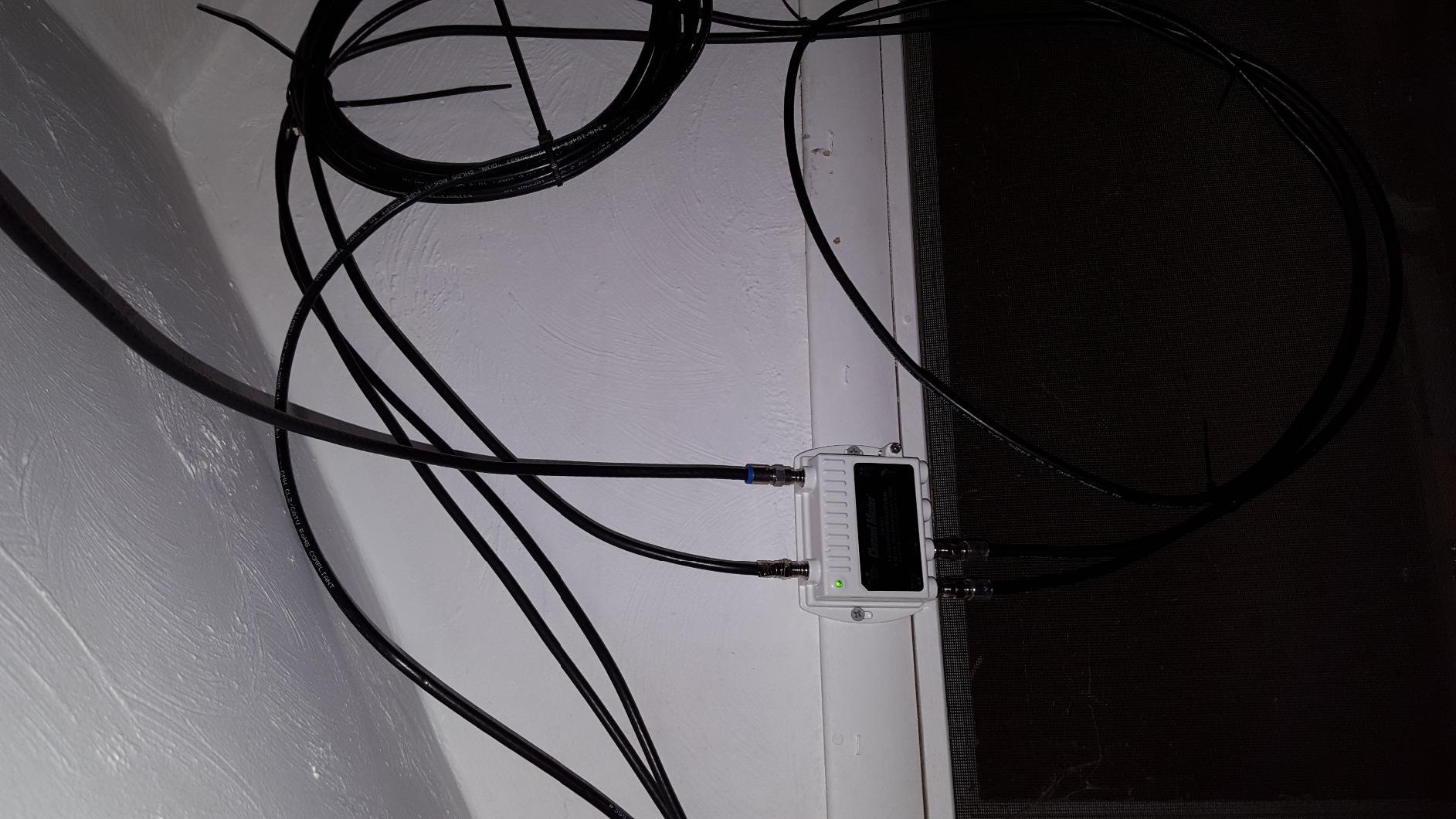
When the ClearStream 4V is the right call
It suits mixed-band markets, split tower directions, and households 20 to 70 miles out that want a single mount to serve everything. It is also the most forgiving of the high-gain options, which makes it a strong recommendation for someone who has never aimed an antenna and does not want a two-afternoon install.
It handles both 4K and 8K broadcasts and works with any TV or converter box on a standard coax connection. If you later add a second television, a distribution amplifier downstream is the clean way to split it.
When to pick something else
It is the wrong value if you sit under 20 miles from towers, where almost anything works and this costs the most. It cannot deliver cable-only channels over the air, and reception still depends on distance and obstructions. On a tight budget with towers clustered in one direction, the Five Star Yagi gets you most of the way there.
5. Antennas Direct DB8e 8-Element Bowtie – Best High-Gain UHF Array
Antennas Direct 8-Element Bowtie UHF Outdoor HDTV Antenna, Multi-Directional, 70+ Mile Range, 4K 8K UHD NEXTGEN TV – w/All-Weather Mounting Hardware
8-element UHF bowtie array
17.4 dB gain
470 to 608 MHz
10 lb weight
Lifetime warranty
Pros
- High 17.4 dB gain suits rural and wooded sites
- Multi-directional brackets target two clusters
- Reflectors cut pixelation and dropouts
- Heavy all-metal build
- Engineered in the USA
Cons
- 50 inch wide footprint is hard to mount discreetly
- UHF only so no low-band VHF
- Second highest price here
When nothing works, it is almost always because the signal is too weak, and raw gain is the answer. The DB8e is an eight-element bowtie array with 17.4 dB of gain, the highest figure in this group. It is built for rural installs where foliage and roofing materials eat into an otherwise workable signal.
The 68 percent five-star share reflects owners who value exactly that: raw gain and build quality. At 10 pounds with mostly metal construction, this is hardware that looks like it will still be there in ten years, and it carries a lifetime manufacturer warranty to match.
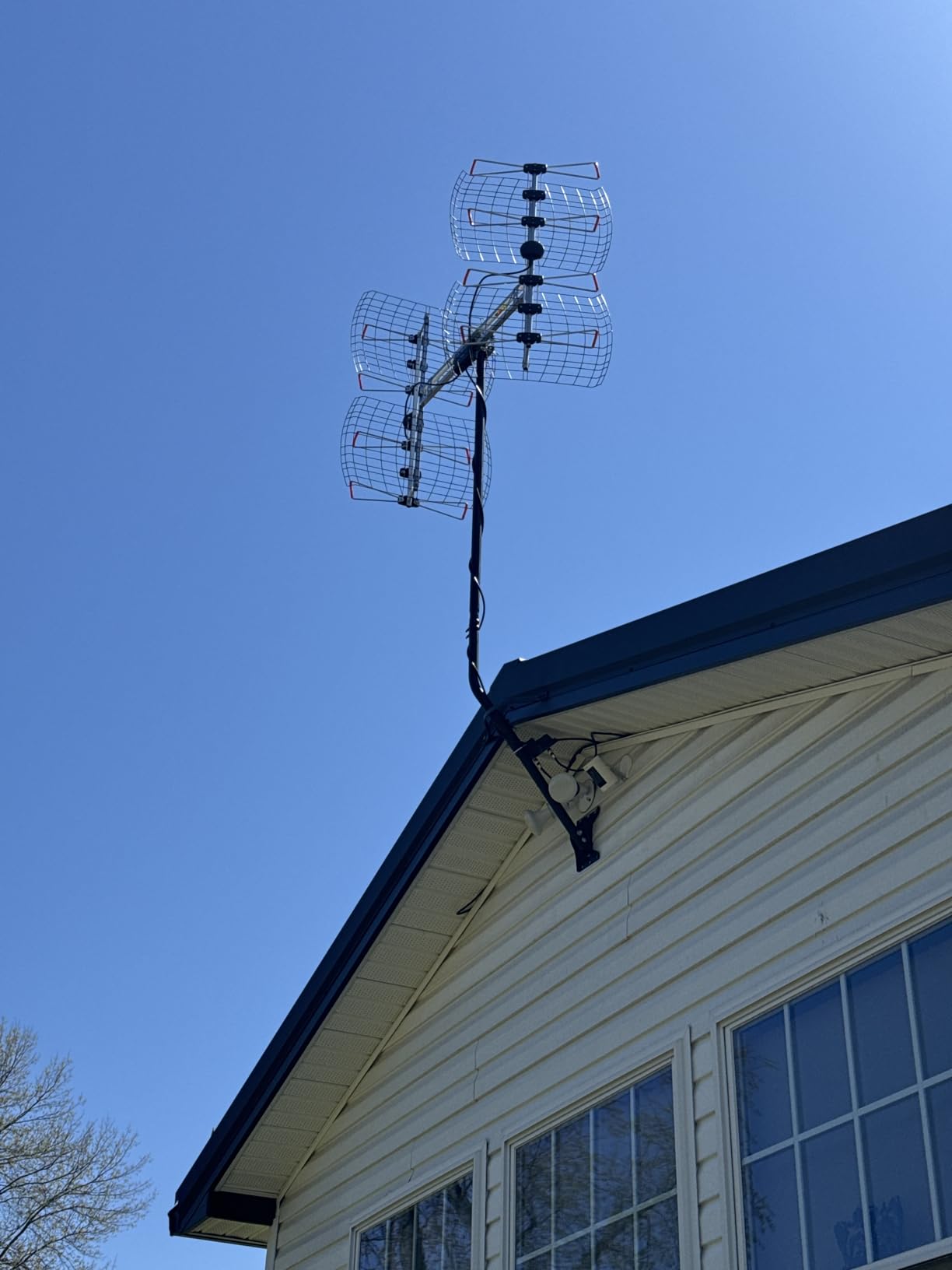
Mounting brackets let you rotate the array to target different tower directions, so it is not strictly a single-bearing antenna. That makes it usable across roughly two clusters, covering a lot of rural geography where local and regional stations arrive from slightly different directions.
Reflectors add forward gain and protect against the interference and pixelation owners complain about with smaller antennas. All-weather mounting hardware and an adjustable mast clamp are included, and the pivoting design lets you fine-tune the angle once the signal is live.
Band coverage is the caveat, and it is not small. This array covers 470 to 608 MHz, which is UHF only. If your market depends on a Low-VHF station on channels 2 through 6, you need a separate VHF antenna and a diplexer, or a different model. Check your channel list before committing.
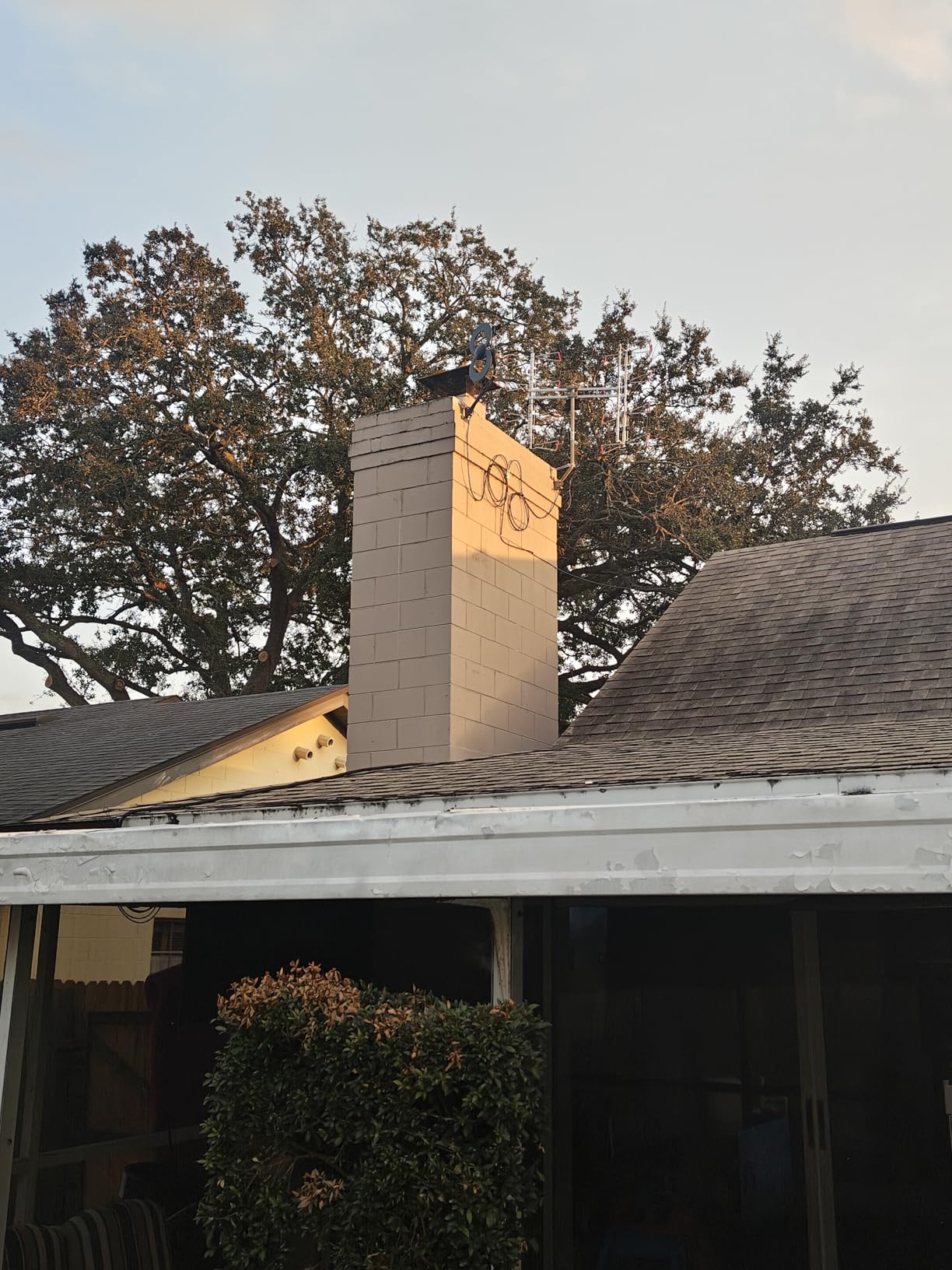
When the DB8e is the right call
It fits deep-fringe properties between 50 and 70 miles, heavily wooded lots, and homes with metal roofs or foil-backed insulation where signal is present but badly attenuated. It is also a solid second antenna for a two-TV home with a distribution amplifier, since the gain leaves headroom for the split.
Make sure you have somewhere to put it. The array is about 50 inches wide, so it needs a clear span of gable, roof face, or a pole with space around it. Anything smaller will not do.
When to pick something else
It is the wrong choice if your local stations include a VHF channel, if your towers are close enough that gain is unnecessary, or if a discreet install matters to you. It is also the second most expensive antenna here, and a 70 mile rated range remains a rating rather than a guarantee.
6. Five Star Amplified Rotating Antenna – Best Full-Band Amplified Kit
Five Star Outdoor Digital Amplified HDTV Antenna – up to 200 Mile Long Range,Directional 360 Degree Rotation,HD 4K 1080P FM, Supports 5 TVs Plus Installation Kit and Mounting Pole
VHF 40-230 MHz and UHF 470-860 MHz
Auto gain control with 15-35 dB
Motorized rotation
Feeds up to 5 TVs
Pros
- Complete kit with J pole coax splitter and clips
- One owner hit 95 percent strength on every channel after adding the amp
- Picks up stations across a wide area
- Assembly reported at 10 to 15 minutes
Cons
- Lowest rating here at 4.0 with 11 percent one-star
- Rotator drifts or keeps turning after release
- No position indicator from indoors
- Coax weather boot is very hard to seat
Look here if you want every band covered in one box and plan to run more than two televisions. It covers VHF 40 to 230 MHz and UHF 470 to 860 MHz, making it one of the few models here that touches Low-VHF without a separate antenna, and six reflector elements plus a V-band element support VHF quality.
The auto gain control chip with a 15 to 35 dB gain booster earns its reputation. One owner reported going from 52 percent signal strength to above 95 percent on every channel after adding amplification, and another picked up a station across a state border away from the nearest tower. Shielded copper cabling inside the motor is a thoughtful detail for signal stability.
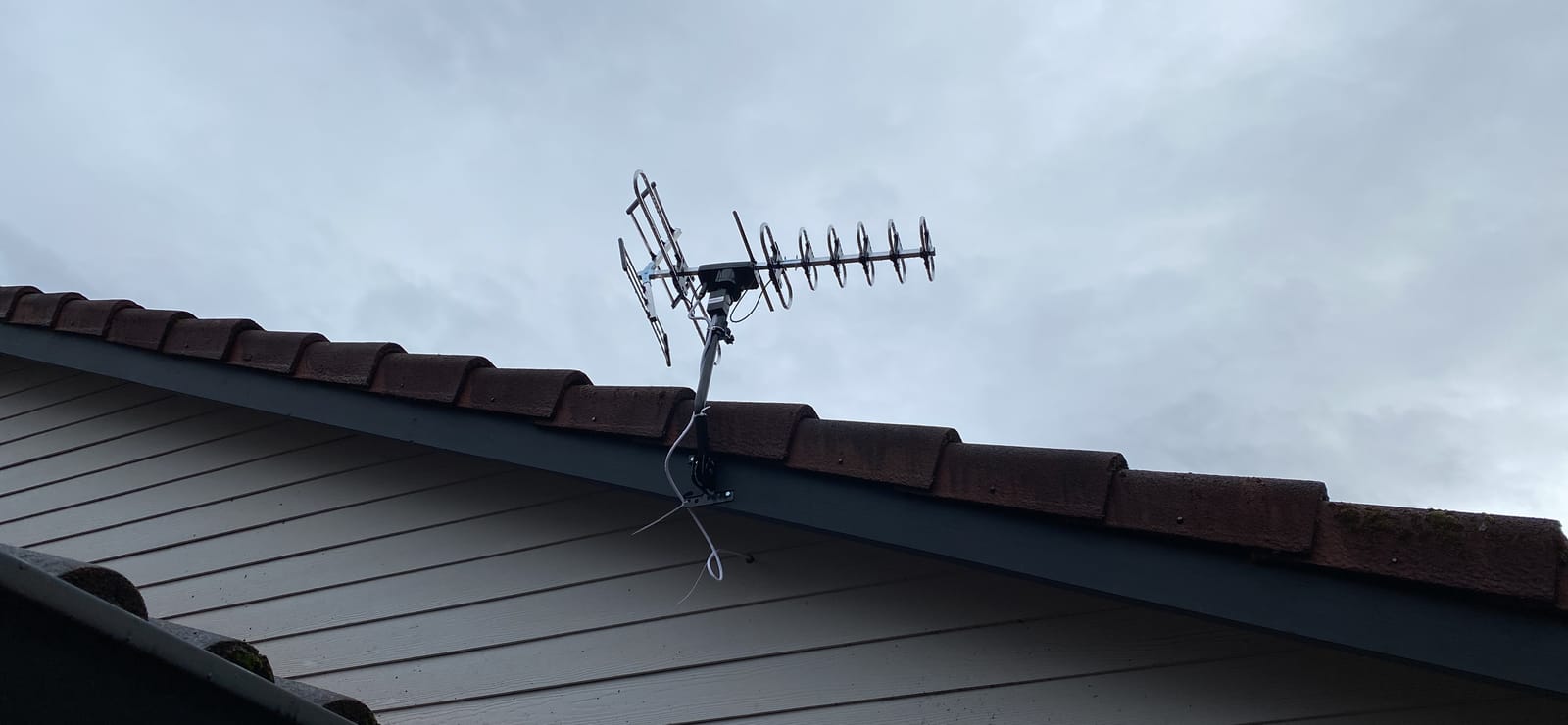
The kit contents are unusually generous: 40 foot coax, a 4-way splitter, 15 cable clips, and a J pole, with a one-year limited warranty. Feed two televisions directly, or up to five through the included splitter. For a whole-home OTA distribution build, this is the closest thing here to a complete starting system.
It is also the weakest-rated model in the guide at 4.0 stars with an 11 percent one-star share, and the reasons are consistent enough to plan around. The rotator is the main issue: it drifts or keeps rotating after you release the button, and there is no position indicator, so you cannot tell where it points from inside.
The coax weather boot is nearly impossible to seat without a heat gun, and several buyers report the included 40 foot run being too short for a roof route. That last point matters, since extra coax bought separately may not work with the motor conductors. International buyers should note the power supply is 110V only.
When this Five Star kit is the right call
It suits multi-TV homes, mixed-band markets where you do not want to research VHF coverage, and anyone who wants one box to do everything without a second shopping trip. The included splitter and clips make it the most complete package in the roundup for a whole-home build.
Expect to spend real time on the mount rather than the assembly. Reported assembly of 10 to 15 minutes is accurate, and owners repeatedly say the real problem is height, not hardware. Get it above the canopy and it will outperform costlier setups.
When to pick something else
Choose a fixed directional model if you dislike the rotator behavior or want hardware that stays put once set. Choose a passive antenna if you are within 20 miles, where amplification is wasted money. And if you are not in the US, the power supply is a genuine blocker.
7. 1byone Omnidirectional Antenna – Best When You Do Not Want to Aim
1byone Outdoor TV Antenna, 360°Omni-Directional Reception, 100+ Miles Range
360 degree omnidirectional pickup
Built-in preamp and 4G LTE filter
11.81 x 11.81 x 8.86 inch
39ft RG6 included
Two year warranty
Pros
- No aiming or rotation required
- Built-in preamp and LTE filter in one box
- Tool-free install with coax included
- Compact modern design
- Suits outdoor attic RV and marine use
Cons
- Lowest rating here at 3.8 with 18 percent one-star
- Single TV output only
- 100 mile claim is not achievable in most placements
Start with the honest caveat. At 3.8 stars with an 18 percent one-star share, this is the lowest-rated antenna in the guide, and that rating is not noise. Reviews split sharply between people delighted by the convenience and people who report unreliable reception, with results depending heavily on tower distance and line of sight. Buy it for the mounting advantage, not the marketing.
What it does well is remove the most tedious part of rural antenna ownership. A 360 degree omnidirectional pattern means no bearing research, no repeated ladder climbs, no clamping and hoping. If your towers surround the property or you genuinely cannot determine a direction, that convenience is worth real money.
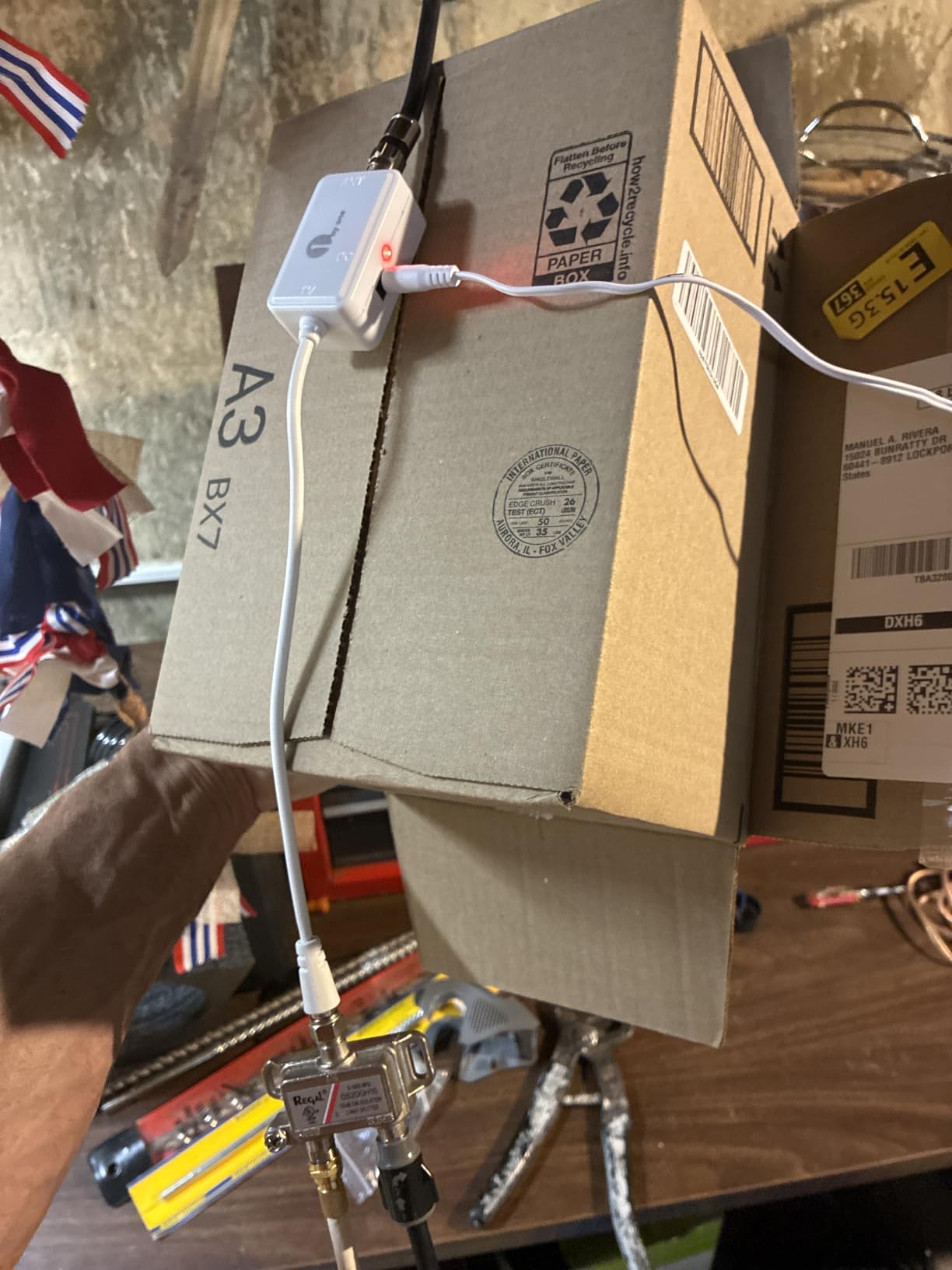
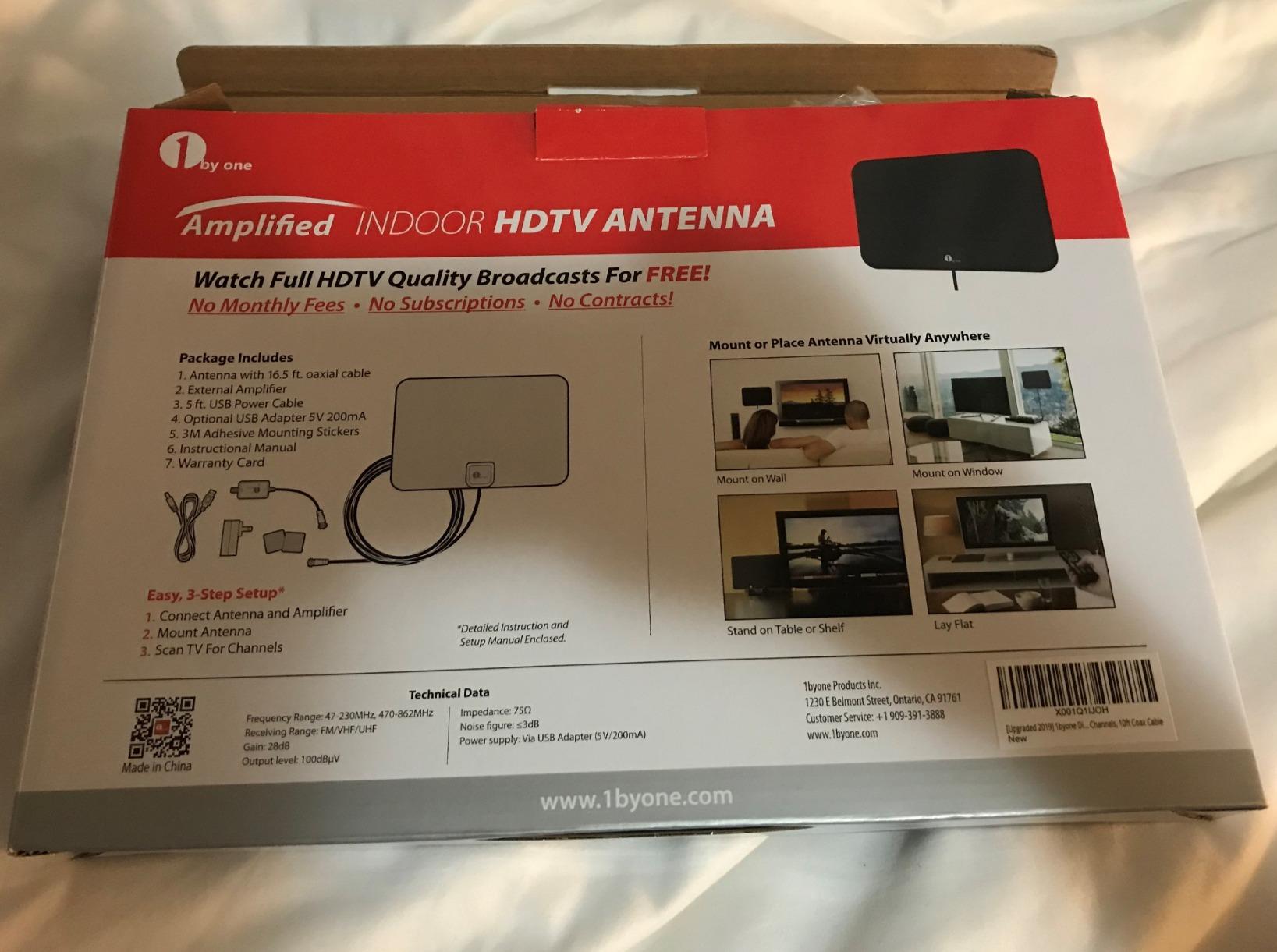
It also packs a preamplifier and a 4G LTE filter into the same housing. The filter cuts cellular interference that shows up as freeze or dropouts, and the preamp offsets long cable runs. The housing is moisture-proof and flame-retardant, which is why owners use it for RV, attic, and marine installations where a full-size Yagi would be awkward.
The footprint is 11.81 by 11.81 by 8.86 inches, genuinely small next to a bowtie array. It installs tool-free and includes up to 39 feet of RG6U coax plus mounting accessories, so it is one of the easiest additions to an RV or cabin.
The 100 plus mile claim is not achievable in most placements, and reviewers say so directly. There is one output, and the manufacturer recommends one antenna per television, so splitting this signal to multiple TVs means accepting a loss unless you add a distribution amplifier downstream.
When the 1byone is the right call
It is right for RV, boat, and cabin setups where permanent mounting is impossible, for renters needing a temporary or window-side install, and for any home whose towers are spread around the compass. It is also a decent attic antenna at moderate distances, where the omni pattern sidesteps aiming entirely.
Keep in mind the preamp is always on. If you end up close to a strong transmitter, that unattenuated gain can push signals into overload, and the fix is removing the preamp rather than buying something bigger.
When to pick something else
Choose a directional or multi-directional model if your towers cluster in one direction, because gain beats convenience past about 35 miles. Avoid it for multi-TV households without planning on a separate amplifier, and set realistic expectations about channel count in a sparse rural market.
8. McDuory Amplified Rotating Antenna – Best Budget Motorized Rotator
McDuory Amplified Digital Outdoor HDTV Antenna 150 Miles Long Range – 360 Degree Rotation Infrared Control – Tools Free Installation – Support 2 TVs
360 degree rotor with infrared remote
Built-in high-gain amplifier
VHF 170-230 and UHF 470-860 MHz
Dual TV outputs
40ft coax included
Pros
- Tool-free install with snap-on elements
- Strong reception at 20 to 50 miles often without adjustment
- Dual TV support built in
- Support replaced a faulty controller quickly
- Good channel counts for the money
Cons
- Rotor has no position feedback
- Remote direction buttons are unreliable
- Some owners report degrading reception
- Mounting pole not included
This is the simplest version of the rotating idea, and at 4.3 stars with a 66 percent five-star share it holds up well. Owners describe it as very easy to install with no tools, and many report strong reception for towers 20 to 50 miles away, sometimes without adjustment. For a first outdoor antenna, the install experience matters, and this one stays out of your way.
It covers VHF 170 to 230 MHz and UHF 470 to 860 MHz with a built-in high-gain, low-noise amplifier and dual TV outputs, so two sets run without buying a splitter. A 40 foot outdoor coax run is included, and the snap-on element assembly needs no tools.
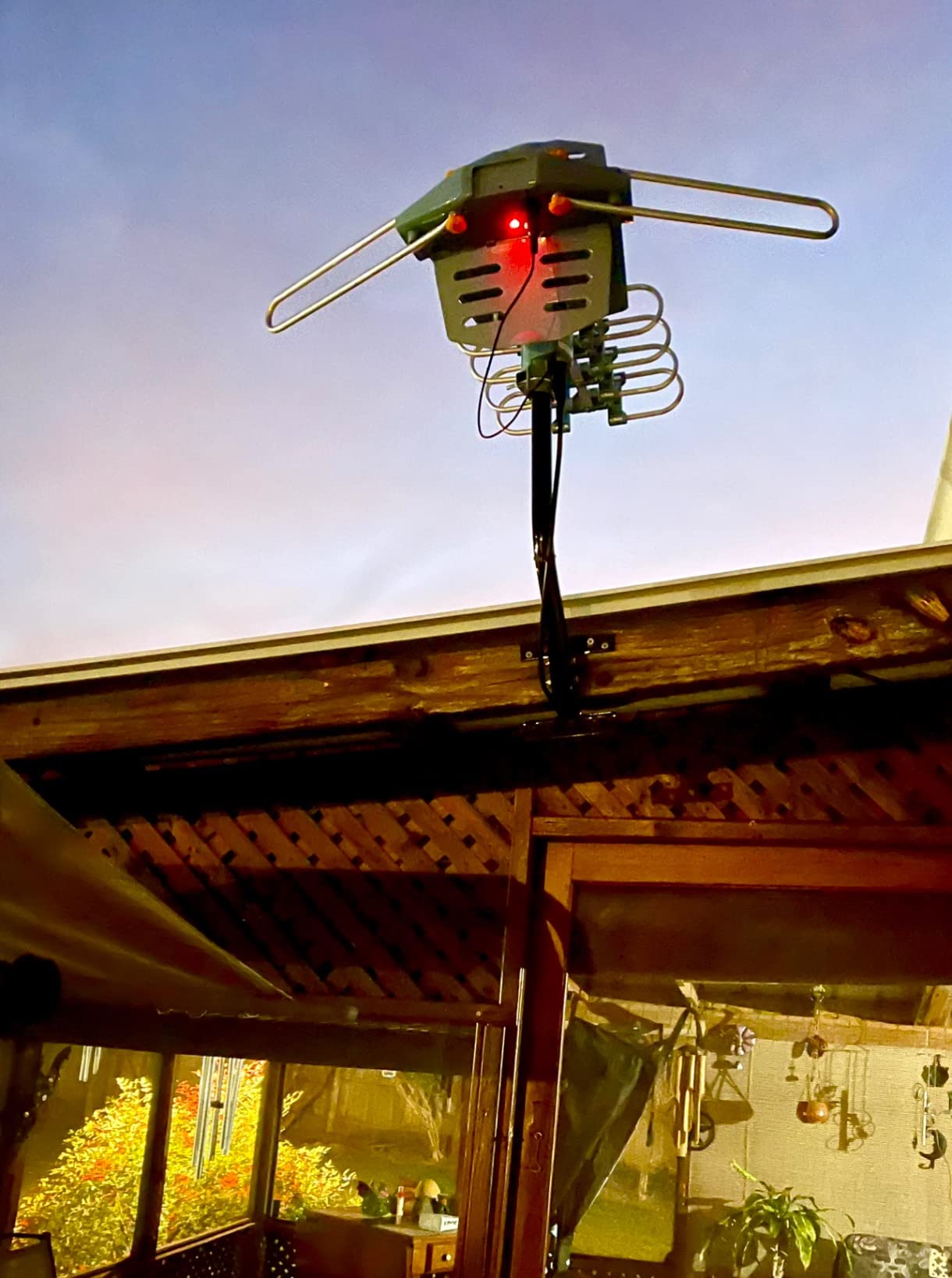
It carries grounding and lightning protection, which is worth having on any roof-mounted unit, and the element assembly is genuinely tool-free. Customer support is repeatedly credited for replacing faulty controllers and power boxes quickly, which matters when the failure mode is a dead rotor.
The rotor is its weak point, and the same complaint appears across every budget rotator. There is no position feedback, so you cannot tell which way the antenna faces, and the directional buttons on the remote do not reliably map to rotation direction. You find a working heading by rotating and rescanning, which is tedious but workable.
A small group of rural buyers report mediocre or rapidly degrading reception, so at the far end of the range this is not the safest bet. The mounting pole is also not in the box, which means one more purchase before you can install.
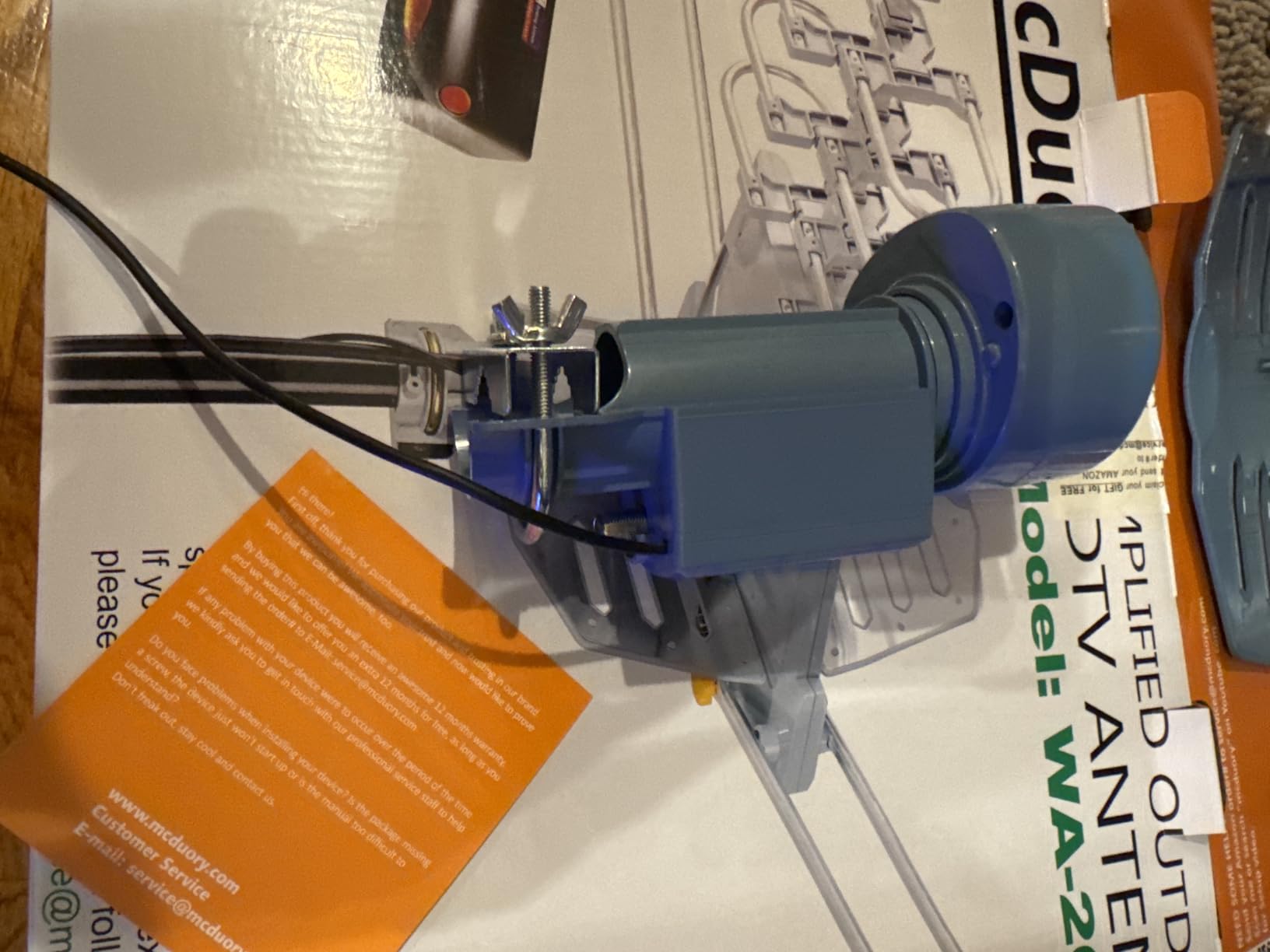
When the McDuory is the right call
It fits a first-time installer who wants to avoid aiming, households 20 to 50 miles from towers, and two-TV homes wanting a splitter-free setup. The tool-free assembly also makes it decent for an older buyer or anyone working alone on a ladder.
Because there is no position feedback, mark the mast position once you find a heading that works. A strip of tape and a note saves an afternoon the next time the season changes.
When to pick something else
Choose a fixed multi-directional antenna if you can find your bearing and want zero moving parts. Choose a higher-gain array past 50 miles, and do not expect the 150 mile claim to mean anything. If you want a mast included, the PBD or Five Star kits bundle one.
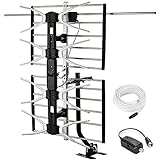
9. PBD 4-Bay Amplified Phased Array – Best Pre-Amplified Directional Array
PBD Outdoor Digital HD TV Antenna with High Gain Amplifier 150 Mile Long Range for UHF/VHF, Mounting Pole, 40FT RG6 Coaxial Cable, Easy Installation
4-bay phased array multi-directional
Built-in preamplifier
170-230 and 470-862 MHz
Pole and 40ft coax included
Lightning protected
Pros
- Preamplifier measurably helps in obstructed locations
- One owner beat a ClearStream 2V at about half the cost
- Pole and coax included for immediate mounting
- Works behind tall obstructions and heavy woods
- Support praised for fast parts replacement
Cons
- Some owners report reception collapsing after a few weeks
- Highly directional and can lose closer stations
- Included 40ft coax is often too short
- Flimsy plastic elements
This is the middle path between a bare amplified array and a full rotator, and its 64 percent five-star share reflects a sensible compromise. The 4-bay phased array is multi-directional but aimed, and the built-in preamplifier does the real work in obstructed locations. Success stories cluster around wooded and obstructed rural sites where an unamplified array would collect mostly noise.
One owner reported beating a ClearStream 2V in a head-to-head test at roughly half the cost, which is a good indicator of where this model fits. It covers VHF 170 to 230 MHz and UHF 470 to 862 MHz, handling Hi-VHF and UHF well, and it supports 720p, 1080i, 1080p, and 4K broadcasts.
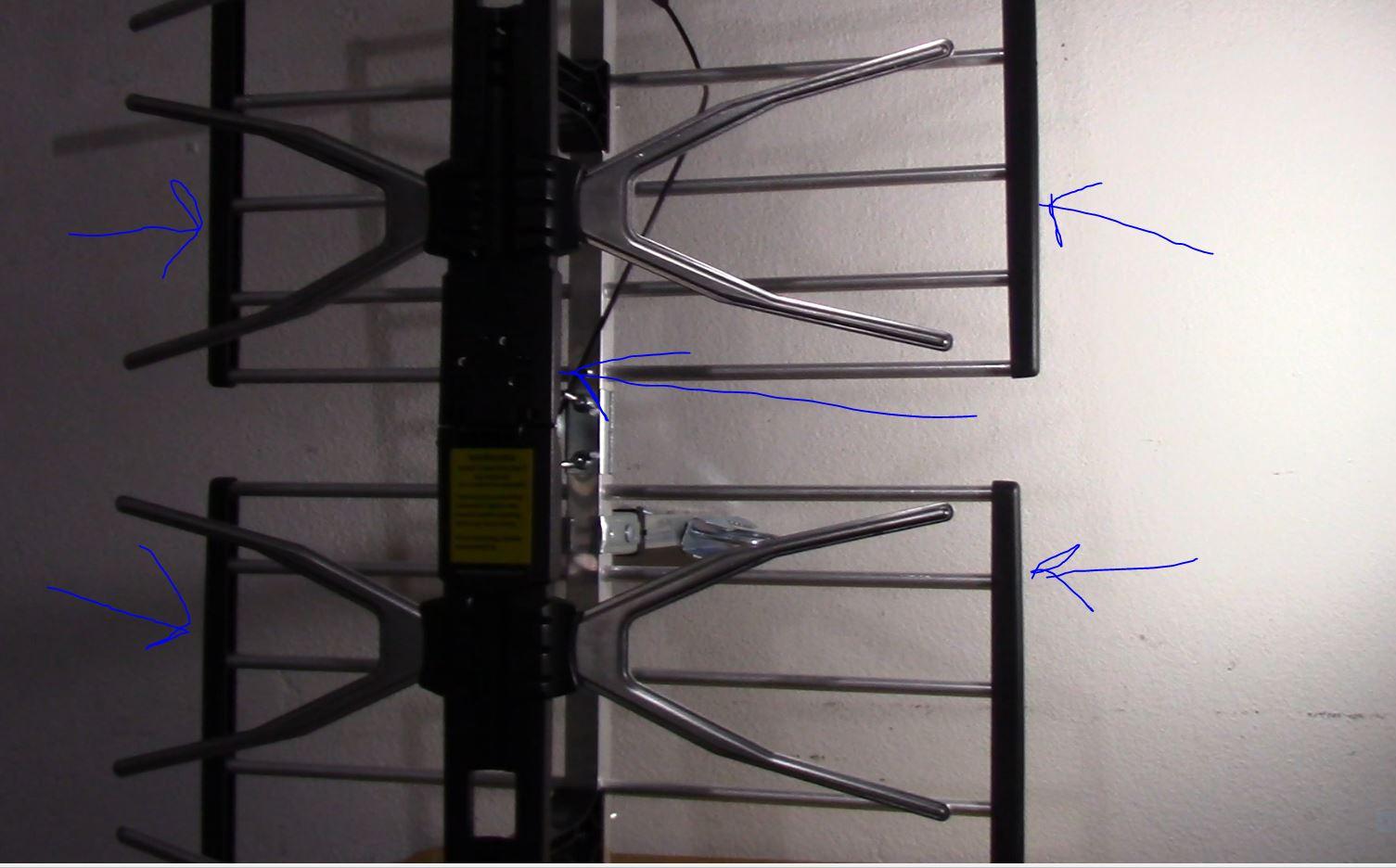
It arrives mostly assembled with a UL adapter, power insert, 40 foot RG6 run, and a mounting pole, so you can roof or attic mount it immediately. Lightning protection and grounding are specified for outdoor use, and installation is tool-free with minor assembly only. Support is repeatedly praised for fast parts replacement.
Reliability is the recurring counter-theme and deserves attention. Several owners replaced the antenna after a week or two of dropped channels, and the plastic elements feel flimsy right after assembly. If you install it high on a roof where a swap is a hassle, that history is a real consideration.
Two practical notes. The 40 foot coax is often too short for a roof run, so plan to buy more, and the antenna is highly directional, so rotating toward a distant cluster can cost you closer stations. The instructions lean on pictures rather than written detail.

When the PBD array is the right call
It suits wooded properties, sites behind tall obstructions, and moderate distances where the preamplifier makes a measurable difference. It is also a good second antenna for a home with two TVs, provided you place a distribution amplifier before the split.
It suits buyers who want a fixed, aimable array without the complexity of a rotor. Find your bearing once, clamp it, and it keeps working as long as the elements last.
When to pick something else
Skip it if you plan to leave hardware exposed for many years and cannot easily reach it, given the reported reliability history. Choose a rotator if your towers are in two very different directions, and verify Low-VHF coverage if your market carries a channel 2 through 6 station.
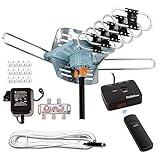
10. Five Star Five-TV Antenna Kit – Best for Feeding Five Televisions
Five Star HDTV Antenna Amplified Digital Outdoor Antenna 150 Miles Range, 360 Degree Rotation Wireless Remote, with 40FT RG6 Coax Cable Installation Kit Supports 5 TVs
Full band 45-860 MHz receiver
360 degree motor with remote
Automatic gain control
Includes 4-way splitter
Feeds 2 TVs or up to 5
Pros
- Complete kit with control box power supply coax and splitter
- Feeds up to five televisions
- Simple extend-and-insert assembly
- Automatic gain control manages signal levels
Cons
- Lowest Five Star rating at 4.1 with 10 percent one-star
- Rotation fails if a splitter sits before the control box
- Mounting pole not included
- Remote needs AAA batteries not included
If your real problem is splitting one antenna across a whole house, this is the model built for it. It supports two televisions directly and up to five using the included 4-way splitter, and it is the only kit here where the distribution hardware is designed in rather than bolted on. Owners of multi-room homes rate the completeness of the box highly.
The full-band receiver covers 45 to 860 MHz, the broadest VHF and UHF span in this guide, giving you the best shot at catching whatever your local market carries. A smart chip with automatic gain control manages signal levels, and the extend-and-insert assembly with a clear manual is easy to work through.
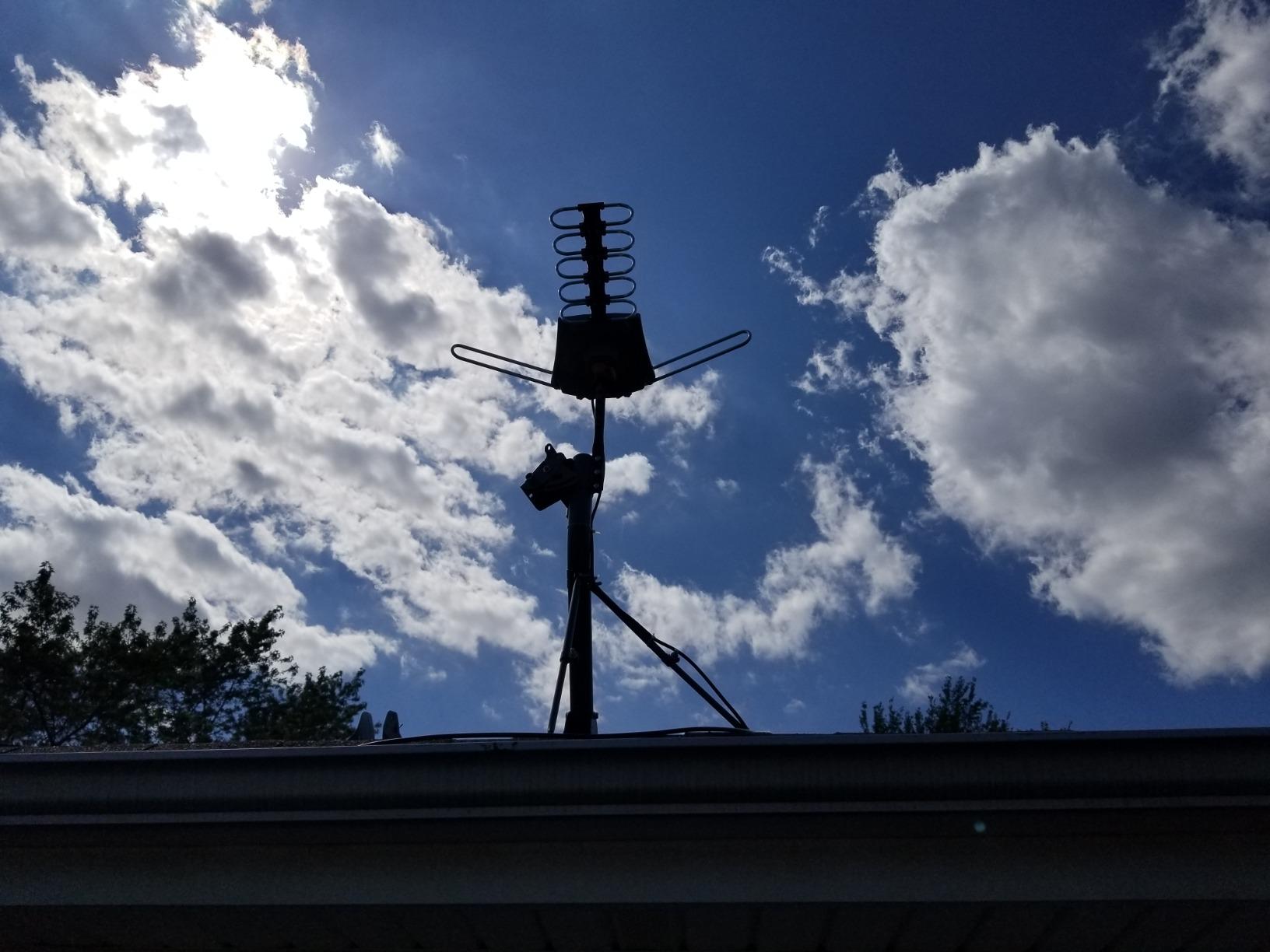
Package contents cover everything except structure: control box, remote, power supply, 40 foot RG6, and the 4-way splitter. The antenna is 24 by 29 by 10 inches, and five reflector elements extend during assembly to add gain.
The most actionable finding across reviews concerns wiring order. Rotation can fail if a splitter sits before the control box rather than after it, so the control box must be at the antenna end of the run. Get that wrong and the motor will not respond, which is exactly the kind of troubleshooting rabbit hole that eats a Saturday.
At 4.1 stars with a 10 percent one-star share, this is the weakest of the three Five Star models here. The mounting pole is not included, and the remote runs on AAA batteries that are not in the box, so allow for a second small parts run before the install.
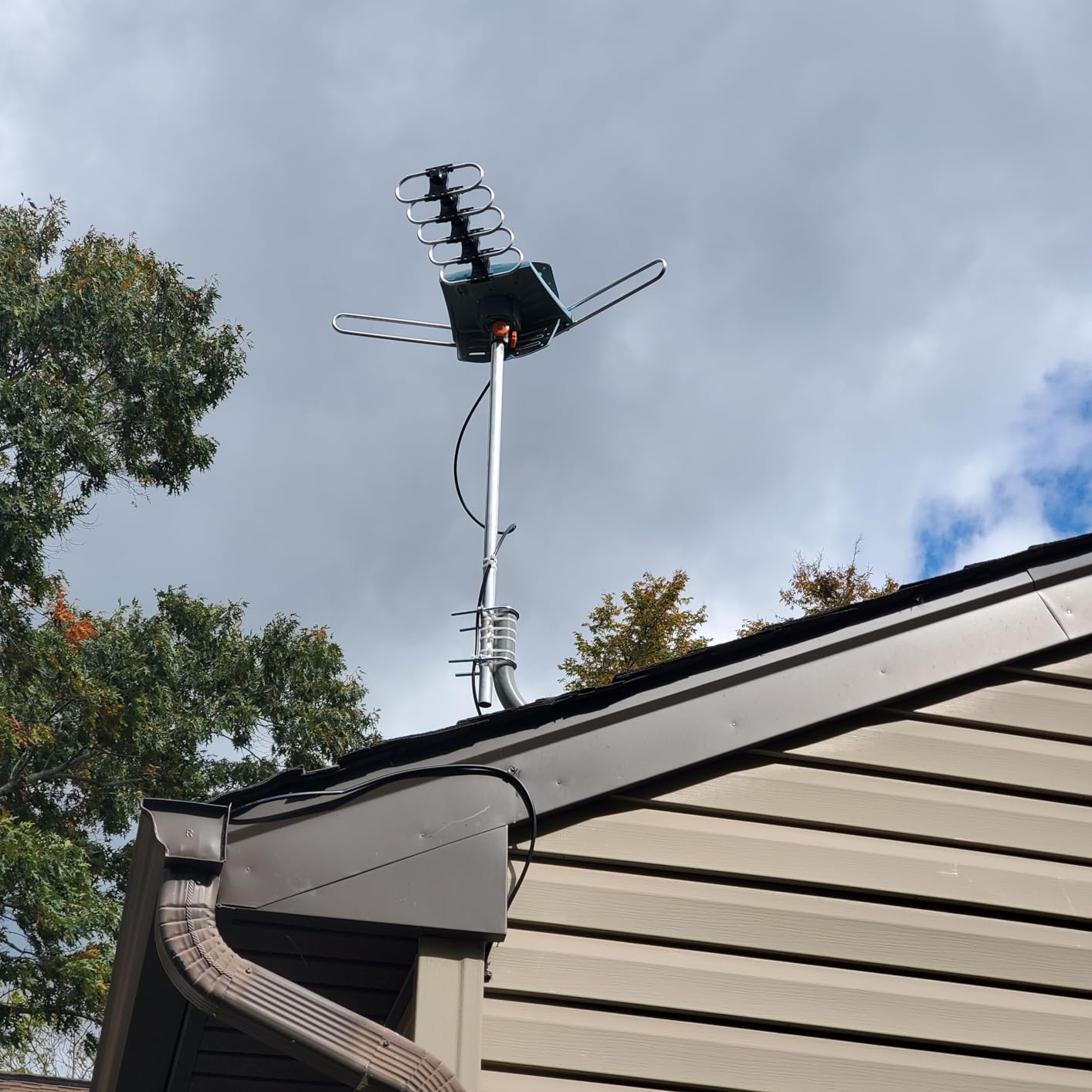
When the Five Star five-TV kit is the right call
It is built for households feeding three to five televisions across a house, a rental property, or a farmhouse where one antenna has to serve every room. The included splitter removes a common source of rural frustration: hardware that cannot serve the second TV without degrading the first.
For best results, run the antenna into the control box first, then distribute. Place a distribution amplifier downstream only if your coax runs are long, and keep each run under 50 feet where you can.
When to pick something else
One antenna and one TV does not need a splitter or a rotator, and the GE will serve you better for less. Choose a fixed array if you want no moving parts, and pick up a pole separately since it is not in this box. Automatic gain control also makes this a poor match for sites sitting very close to a transmitter.
Amplified vs Non-Amplified: Do Amplifiers Actually Work?
Amplifiers do work, but not the way most marketing suggests. As the r/cordcutters consensus puts it, an amplifier only strengthens a signal your antenna can already detect, even a very weak one. It does not increase the number of channels by magic. If no station is detectable at the antenna, a large booster amplifies noise and your channel count goes down.
- Add amplification past roughly 35 miles, on long coax runs, when splitting to multiple TVs, or when the signal reaches the antenna at a usable but marginal level.
- Skip amplification under 20 miles from towers, when a strong multi-directional or Yagi pattern already gives a good reading, or when your TV shows high per-channel numbers. A strong signal pushed through a preamp can overload the tuner and block channels.
Overload is the failure nobody explains. If your channel count drops after adding an amplifier, check the TV signal-strength meter per channel. A reading far above the typical target, roughly 20 mV per channel, means the amplifier is overdriving the tuner. The fix is to remove the preamp, not to buy a bigger antenna.
Placement matters too. A masthead amplifier mounts at the antenna and boosts the weakest point before cable loss eats the signal, the right choice for long rural runs. An inline or distribution amplifier goes after a split, the correct tool for feeding several rooms. For motorized models like the ones in this guide, the amplifier is usually powered through the control box, so bypassing the rotor also removes the gain.
If your problem is specifically weak or obstructed signal, our separate guide to the best antennas for weak signal areas goes deeper on the overload test and channel-count expectations.
Antenna Types Explained for Rural Homes
- Yagi uses one driven element with reflectors and directors for a narrow, high-gain beam. Best when every tower sits within about 40 degrees of one bearing. Sharp side nulls reject interference.
- Bowtie is a wide, flat reflector-and-element array with high gain across UHF. Best for deep-fringe UHF where distance, not direction, is the problem.
- Multi-loop places several loop elements on a common boom for a broad multi-directional pattern with reflector-based gain. Best for mixed-band markets and split tower directions.
- Phased array combines multiple bowtie-style panels with a preamplifier. A good middle ground for wooded or obstructed sites at moderate distance.
- Omnidirectional receives from all directions with no aiming. Convenient and forgiving, with lower gain than any of the above. Best under 20 miles, on an RV, or when towers surround the home.
For rotating models specifically, our guide to the best motorized rotating outdoor antennas for remote areas compares the rotor quirks in detail.
Renting With No Roof Access? Your Antenna Options
If you cannot mount on the roof, you are not out of options. Renting is the most common forum complaint nobody answers, so here is the ordered list that works.
- Attic mount. A directional array in the attic works at moderate distances, often out to around 30 miles, because the roof blocks a few dB. Keep it as far from metal roofing, foil insulation, and wiring as possible.
- Window or exterior wall mount. A suction cup or eave mount with a short lead works for omnidirectional models and moderate distances, and it comes down when you move.
- Pole-to-window feed. Mount a mast on the far side of the property and run coax directly to a window-side connector. This keeps full outdoor height without touching the building.
- RV, cabin, or camper setup. A compact omnidirectional unit is the only realistic option, worth a lower channel count in exchange for portability.
Also consider returnability before you commit. r/cordcutters regulars recommend brands bought from a retailer with painless returns, because a high roof mount is a risky install and a second attempt costs time. That applies whether you rent or own.
How to Fix TV Channels That Cut Out
Work through this in order and change hardware only at the end. Most rural dropouts are a connection or splitter problem, not a failed antenna.
- Reseat every F-connector by hand and check the coax at the mast for weather damage or a corroded boot.
- Remove all splitters and connect the antenna directly to one TV. If the full channel list returns, the problem is distribution, not reception.
- Check cable type and length. Long or undersized coax loses real signal, and a fresh RG6 run is the cheapest fix available.
- Rescan the TV. Channels missing at install often return on a rescan.
- Compare the channel list before and after removing the amplifier. A drop when amplification is added means overload, so pull the preamp.
- Only after the steps above, raise the antenna or change models. Height solves more real rural problems than a more expensive antenna does.
Seasonal change is normal. Leaf-out in spring and ice in winter change the effective path, and an antenna that worked in March can fade in July. Check for foliage growth along the line of sight before concluding the hardware failed.
Frequently Asked Questions
What is the best TV antenna to buy for rural areas?
A long-range outdoor Yagi or multi-loop directional antenna mounted as high as possible is the right default for most rural homes, since it concentrates gain toward your towers without adding amplifier noise. Choose an omnidirectional model instead if your towers sit in several directions, and choose a rotating amplified kit if you cannot determine a bearing or cannot reach your roof.
Should I use an amplified or non-amplified TV antenna?
Stay non-amplified under roughly 20 miles from towers, or whenever a strong directional pattern already gives a good reading. Add amplification past about 35 miles, on long coax runs, or when splitting to several TVs. An amplifier boosts a signal the antenna can already detect, so it cannot create channels that were never there.
Do TV antenna amplifiers really work?
They work by raising the level of a signal that already reaches the antenna, which counters cable loss and splitter loss. They cannot pull in stations the antenna never detected, and a badly placed amplifier can overload a strong tuner and reduce your channel count. Check the per-channel signal-strength meter after installing one.
How far can an outdoor TV antenna really reach?
Sometimes beyond 70 miles in open terrain, but there is no guaranteed range for any model. Tower power, hills, tree cover, antenna height, and coax quality all matter as much as the antenna. Treat any advertised mile figure as a marketing claim rather than a specification you can plan around.
What TV antenna gives you the most channels?
Channel count is set by how many stations your local market broadcasts and whether your path to the towers is clear, not by brand or gain. In rural areas the realistic result is often 6 to 15 channels. The antenna determines how many of those available stations you actually lock, so check your local channel list before buying.
Can I install an outdoor TV antenna in the attic?
Yes, and it is a common solution for renters and anyone without safe roof access. Expect to lose some signal to roofing materials, so attic installs are most reliable under about 30 miles. Keep the antenna away from metal roofing, foil-backed insulation, radiant barriers, and dense wiring, and use a directional pattern so the loss matters less.
The Best TV Antenna Choice for Rural Homes in 2026
Start with three numbers before buying anything: your distance to the nearest broadcast towers, the compass bearing to them, and which bands your local stations use. Those three facts pick the antenna for you. One tower cluster under 20 miles means almost any outdoor unit works. Twenty to 50 miles with a single bearing calls for a Yagi or a multi-directional panel. Beyond 50 miles, or with towers spread in several directions, you need a high-gain array or an omnidirectional model with real mounting height.
Among the best TV antennas for rural areas we reviewed, the GE Outdoor HD Digital TV Antenna is the pick we would install ourselves: a passive directional design with the highest satisfaction rate of the group, no amplifier noise, and a body light enough for an attic or a modest pole. If you cannot aim anything, the PBD motorized kit is the most owner-proven complete package in the roundup. For deep-fringe UHF, the DB8e wins on gain and nothing else comes close.
Mount it high, aim it at your towers, run fresh RG6, and expect a realistic single-digit to low-double-digit channel list. Use the buttons above to check the current listing for any of these picks.