
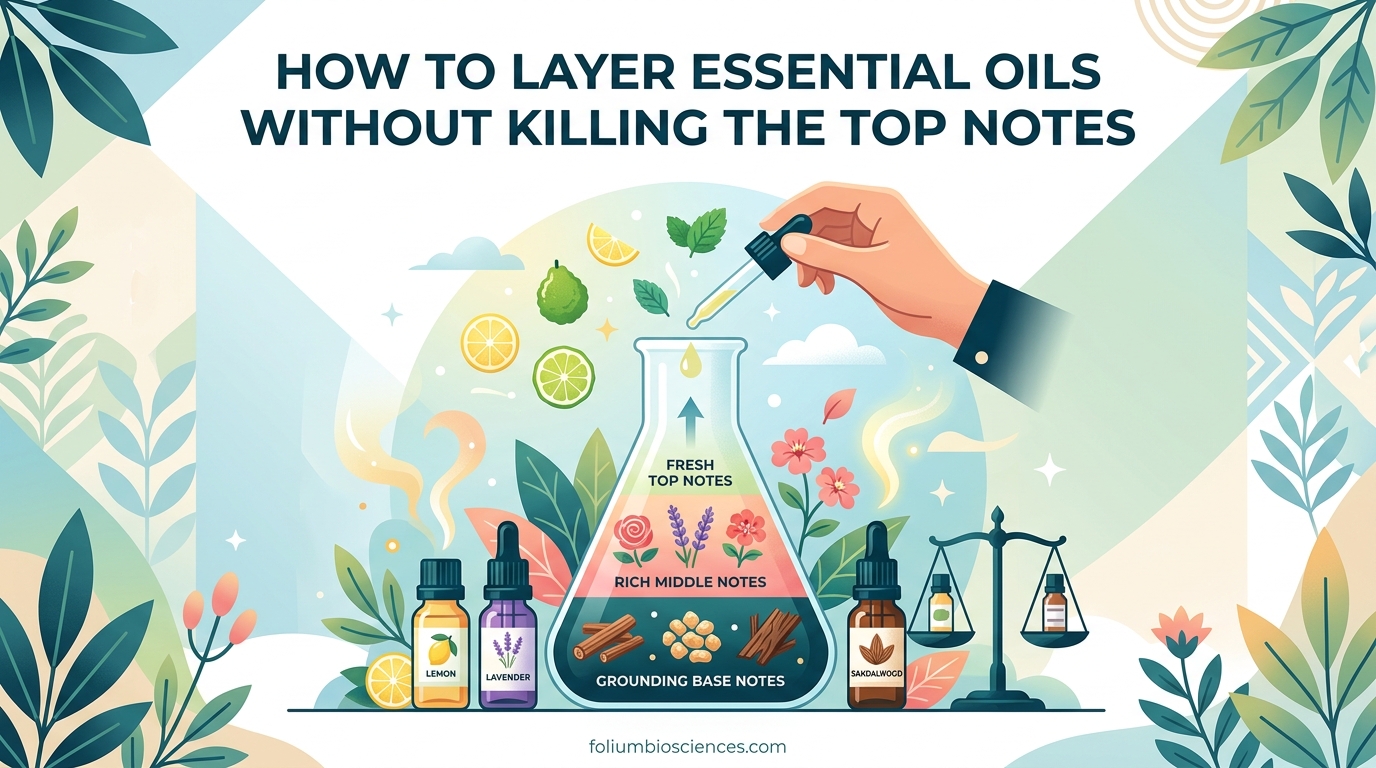
I used to wonder why my citrus diffuser blends smelled amazing for ten minutes, then turned into a flat, woody mess for hours. I was following every blending guide I could find. I measured my drops carefully. I bought quality oils. But my bergamot and grapefruit kept disappearing the moment I added sandalwood.
After months of experimentation and consulting with experienced aromatherapists, I discovered the problem. I was killing my top notes through improper layering technique. In this guide, I will show you exactly how to layer essential oils without killing the top notes so your citrus, herbs, and light florals stay vibrant from start to finish.
You will learn the science behind why top notes disappear, the step-by-step method for preserving them, the 30/50/20 blending rule that professionals use, and common mistakes that ruin your blends before you even start.
Table of Contents
What Are Fragrance Notes and Why They Matter
Understanding fragrance notes is the foundation of successful essential oil layering. Every essential oil has an evaporation rate that determines when you smell it during the life of a blend.
Top notes are the lightest, most volatile molecules. They provide the first impression of your blend but evaporate within 15 to 30 minutes. These include citrus oils like bergamot and lemon, plus herbal oils like eucalyptus and peppermint. Their molecular structure is small and light, which allows them to lift into the air quickly.
Middle notes form the heart of your fragrance and emerge after the top notes fade. They last one to three hours and include floral oils like lavender and geranium, plus leafy oils like rosemary and basil. These molecules are heavier than top notes but lighter than base notes.
Base notes are the heavy, long-lasting foundation. They anchor your blend and provide staying power for four to eight hours. These include woody oils like cedarwood and sandalwood, plus resinous oils like frankincense and myrrh. Their large, heavy molecules resist evaporation.
| Note Type | Evaporation Time | Oil Examples | Molecular Weight |
|---|---|---|---|
| Top Notes | 15-30 minutes | Bergamot, Lemon, Eucalyptus | Light, volatile |
| Middle Notes | 1-3 hours | Lavender, Geranium, Rosemary | Medium |
| Base Notes | 4-8 hours | Cedarwood, Sandalwood, Patchouli | Heavy, stable |
When you blend without understanding these evaporation rates, you create a fragrance imbalance. The heavy base notes dominate and smother the delicate top notes before you even experience them.
Why Top Notes Get Killed in Blending
The chemistry behind top note destruction is straightforward but rarely explained. Top notes contain highly volatile compounds called monoterpenes and aldehydes. These molecules are eager to escape into the air.
When you mix a heavy base note like vetiver or patchouli with a light top note like lemon, the base oil creates a physical barrier. The dense, viscous base molecules trap the lighter top note molecules, preventing them from reaching your nose. You smell the base notes immediately while the top notes remain locked beneath the surface.
Heat accelerates this problem. When you add essential oils to a warm carrier oil, the heat causes the most volatile compounds to evaporate instantly. This is why some blenders report that their citrus oils seem to vanish within minutes of mixing.
Oxidation is another killer. Once you expose top note oils to air during blending, they begin oxidizing. If you let your blend sit with the cap off while you prepare other ingredients, your top notes are literally evaporating into the room instead of staying in your bottle.
Forum discussions reveal this is a universal frustration. Experienced blenders on Reddit and specialized forums consistently report that citrus and herbal top notes fade faster than expected, even when they follow basic blending ratios.
The 30/50/20 Rule Explained
The 30/50/20 rule is the standard formula professional perfumers use to create balanced, evolving fragrances. This ratio ensures that each note type contributes appropriately without overwhelming the others.
The breakdown is simple. You use 30 percent top notes, 50 percent middle notes, and 20 percent base notes. This creates a fragrance that opens bright, develops a full heart, and finishes with lasting depth.
Here is how this translates to drops in a practical blend. For a 100-drop recipe, you would use 30 drops of top notes, 50 drops of middle notes, and 20 drops of base notes. This is the 100-drop formula recommended across aromatherapy communities.
The reason this ratio preserves top notes is mathematical. By limiting base notes to just 20 percent, you prevent the heavy molecules from overwhelming the lighter ones. The generous 50 percent middle notes create a bridge between the fleeting top notes and the enduring base notes.
Some blenders adjust this ratio for specific effects. If you want a brighter, more uplifting blend, you might shift to 40/40/20. For a deeper, more grounding fragrance, you might use 20/50/30. But the standard 30/50/20 remains the safest starting point for preserving top note integrity.
How to Layer Essential Oils Without Killing the Top Notes
The secret to preserving top notes lies in the order and timing of your layering. Most beginners make the mistake of adding all their oils to the bottle at once. This guarantees that the heavy base notes will overwhelm everything else.
Step 1: Start with base notes only. Add your 20 percent base note oils to your carrier oil first. This establishes the foundation of your blend. Use a neutral carrier like jojoba or fractionated coconut oil at room temperature. Never use warm carrier oil as heat destroys volatile compounds.
Step 2: Wait 24 hours. Cap your bottle and let the base notes meld with the carrier oil overnight. This resting period allows the heavy molecules to fully integrate and saturate the carrier. Without this step, the base notes remain too aggressive and will dominate any additions.
Step 3: Add middle notes. After 24 hours, uncap your blend and add your 50 percent middle note oils. These bridge the gap between the heavy base and the light top notes. Gently roll the bottle to mix, then cap it again.
Step 4: Wait another 12 to 24 hours. Give the middle notes time to integrate with the base. This creates a smooth transition layer that will support your top notes rather than competing with them.
Step 5: Add top notes just before use. This is the critical step that most guides miss. Add your 30 percent top note oils only when you are ready to use the blend. If you are making a diffuser blend, add the top notes right before you turn on the diffuser. If you are making a roller bottle, add the top notes just before you plan to apply it.
This timing ensures that the volatile top note molecules have not evaporated before you experience them. You get the full aromatic evolution from bright opening to deep finish.
For storage, keep your base-middle blend in an amber glass bottle with a tight cap. Store top notes separately in their own bottles. Combine them only when needed.
Common Mistakes That Destroy Top Notes
Even experienced blenders make these errors. I have made every one of them myself during my learning process.
Mistake 1: Adding all notes at once. When you combine top, middle, and base notes simultaneously, the heavy base molecules immediately overwhelm the lighter top notes. The result is a muddy scent where you only smell the base.
Mistake 2: Using warm carrier oils. Heat causes volatile compounds to evaporate instantly. If your carrier oil has been sitting in a warm room or near a window, let it cool to room temperature before blending. Even body heat from your hands can accelerate evaporation.
Mistake 3: Over-diluting top notes. Some blenders try to compensate for top note fading by adding extra drops. This actually makes the problem worse. Too much of a light oil creates an unbalanced, sharp scent that disappears even faster.
Mistake 4: Storing blends with top notes included. Once you add top notes to a blend, the clock starts ticking. Within 24 to 48 hours, most of the volatile compounds will have evaporated. Store your base-middle blend separately and add top notes fresh each time.
Mistake 5: Using oxidized oils. Citrus oils oxidize rapidly when exposed to air and light. If your lemon or bergamot oil smells flat or harsh instead of bright and fresh, it has oxidized. Oxidized top notes have already lost their volatile compounds and will not perform in blends.
Testing Strip Method for Verifying Top Note Survival
Professional perfumers use testing strips to evaluate how a fragrance evolves over time. You can use this same method at home to verify that your top notes are surviving the blending process.
You will need blank perfume testing strips or strips of uncoated blotter paper. You will also need a notebook to record your observations.
Dip one testing strip into your finished blend immediately after adding the top notes. Wave the strip gently under your nose and record your first impression. Note the brightness and character of the scent. This is your top note experience.
Set a timer for 30 minutes. Return and smell the strip again. Record what you notice. By this point, the top notes should be fading and the middle notes emerging.
Set another timer for 2 hours. Smell the strip a final time and record your observations. You should now be experiencing the base notes.
If your first impression was weak or flat, your top notes were likely killed during blending. If you smelled strong base notes immediately, the base oils overwhelmed the blend. Adjust your ratios and layering order accordingly.
Keep coffee grounds nearby during testing. Smelling coffee between strips clears your olfactory palate and prevents olfactory fatigue. This technique comes from professional fragrance evaluators and works remarkably well.
Essential Oil Examples by Note Type
Knowing which oils belong to each category helps you plan blends that preserve top note integrity. Here are the most common essential oils organized by note type.
Top Note Essential Oils: Bergamot, Lemon, Lime, Grapefruit, Sweet Orange, Tangerine, Lemongrass, Peppermint, Spearmint, Eucalyptus, Basil, Tea Tree. These provide the bright, fresh opening of your blend.
Middle Note Essential Oils: Lavender, Geranium, Chamomile, Rosemary, Clary Sage, Marjoram, Nutmeg, Pine, Juniper Berry, Ylang Ylang. These form the heart and body of your fragrance.
Base Note Essential Oils: Cedarwood, Sandalwood, Patchouli, Vetiver, Frankincense, Myrrh, Vanilla, Benzoin, Peru Balsam, Rose, Jasmine. These provide depth and staying power.
Some oils blur the lines between categories. Lavender is often classified as both a middle and top note depending on the variety. Rose can function as a middle or base note. When in doubt, test the oil on a strip and observe its evaporation rate.
For beginners, I recommend starting with clear examples. Blend bergamot (top) with lavender (middle) and cedarwood (base). This classic combination demonstrates how notes work together when properly layered.
FAQ
What is the 30/50/20 rule for essential oils?
The 30/50/20 rule is a blending guideline used by perfumers and aromatherapists. It means using 30% top notes, 50% middle notes, and 20% base notes in your blend. This ratio creates a balanced fragrance that opens bright, develops a full heart, and finishes with lasting depth. For example, in a 100-drop blend, you would use 30 drops of top notes, 50 drops of middle notes, and 20 drops of base notes.
Which essential oils are considered top notes?
Top note essential oils include citrus oils like bergamot, lemon, lime, grapefruit, and sweet orange. Herbal top notes include peppermint, spearmint, eucalyptus, and basil. Tea tree and lemongrass also function as top notes. These oils are the most volatile and evaporate within 15-30 minutes, providing the initial bright impression of a blend.
What two essential oils smell good together?
Bergamot and lavender are a classic pairing that works beautifully together. Bergamot provides a bright, citrusy top note while lavender offers a calming floral middle note. Other popular combinations include lemon and peppermint for energy, sandalwood and vanilla for warmth, and grapefruit and rosemary for focus. When layering, add the heavier oil first and the lighter oil just before use.
What is the 50 30 20 rule in perfume?
The 50 30 20 rule in perfumery refers to the same concept as the 30/50/20 rule, just ordered differently. It means 50% middle notes, 30% top notes, and 20% base notes. Some perfumers list the percentages in this order to emphasize that middle notes form the largest portion of a balanced blend. Both formulas achieve the same result: a fragrance with proper note distribution.
Conclusion
Learning how to layer essential oils without killing the top notes transformed my blending results. The difference between adding all oils at once versus using the timed layering technique is dramatic. My citrus blends now smell bright and vibrant for their full lifespan instead of disappearing immediately.
Remember the key principles. Use the 30/50/20 ratio as your foundation. Layer base notes first and let them rest 24 hours. Add middle notes and wait another day. Then add your top notes only when you are ready to use the blend.
Avoid the common mistakes of warm carrier oils, over-dilution, and storing blends with top notes included. Use testing strips to verify your results and keep coffee grounds nearby to prevent olfactory fatigue.
With these techniques, you will create professional-quality blends where every note shines through from the bright opening to the deep, lasting finish. Your essential oil layering journey starts now.