
Struggling to fall asleep at night? You’re not alone. Millions of people search for ways to improve their sleep quality, and colored noise has emerged as one of the most popular and effective solutions. But with white noise, pink noise, and brown noise all promising better sleep, how do you know which one is right for you? The answer isn’t one-size-fits-all, and understanding the science behind each type of noise can help you make an informed decision that actually works for your unique sleep needs.
Research suggests that 38% of people fall asleep faster when using some form of colored noise as a sleep aid. However, the specific type of noise that works best varies significantly from person to person. What works brilliantly for your partner might do nothing for you, or worse, keep you awake. This guide will walk you through everything you need to know about white noise, pink noise, and brown noise, including how they differ, what the science says, and how to choose the right one for your sleep goals.
Table of Contents
1What Is Colored Noise? Understanding Sound Frequencies
Before diving into the specific types of colored noise, it’s helpful to understand what “colored noise” actually means in the context of sound and sleep. The term “colored noise” comes from the audio engineering and acoustics world, where different noise types are categorized by their frequency distribution across the sound spectrum—much like how light is divided into colors based on wavelength.
Sound is measured in hertz (Hz), which describes the frequency or pitch of a sound wave. The human ear can typically detect sounds between 20 Hz and 20,000 Hz. When we talk about white noise, pink noise, and brown noise, we’re describing how the acoustic energy is distributed across this frequency range.
Quick Sound Frequency Reference
- Low frequencies (20-250 Hz): Deep, rumbling sounds like thunder or a distant waterfall
- Mid frequencies (250-4,000 Hz): Speech range, everyday sounds
- High frequencies (4,000-20,000 Hz): Sibilance, static, sharp sounds
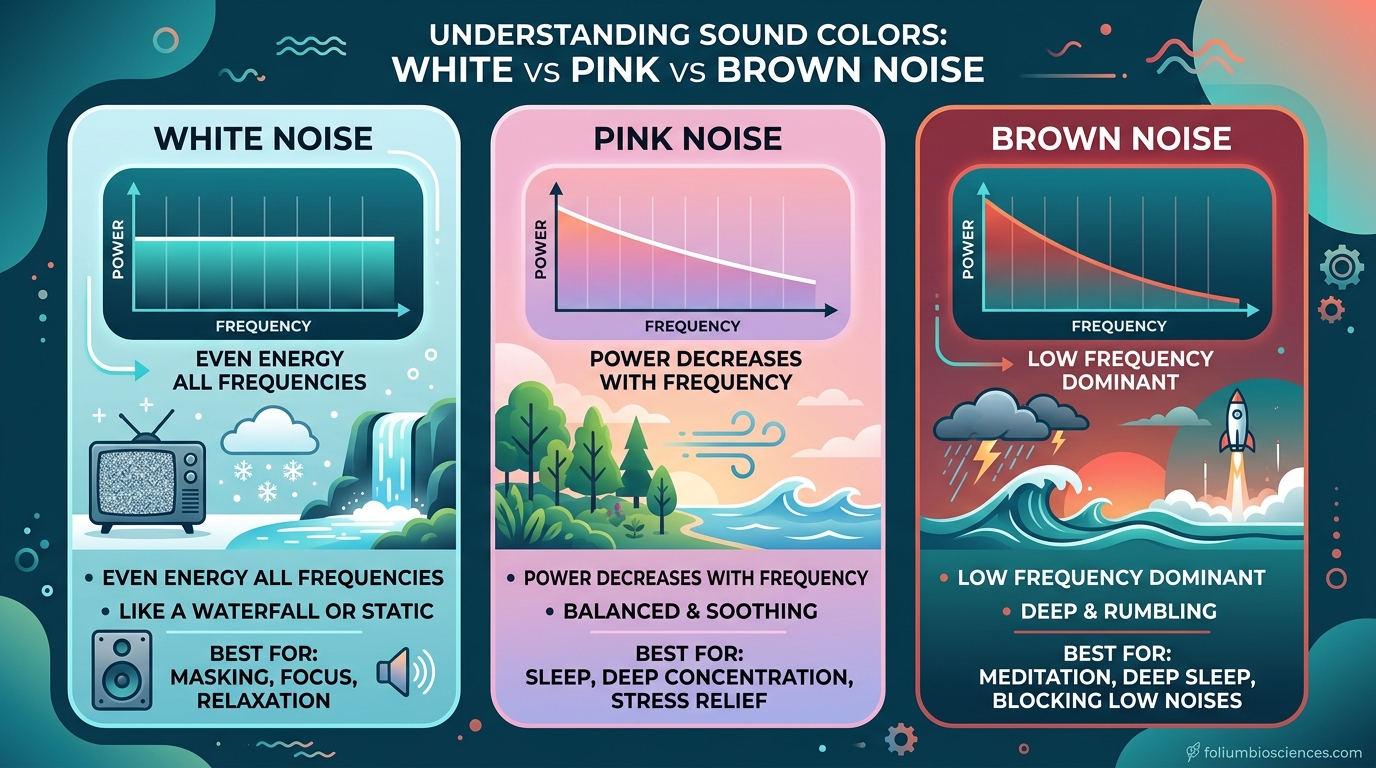
White noise contains equal energy across all frequencies, similar to how white light contains all colors of the visible spectrum. This is why it sounds like static or the hiss of an untuned radio. While this broad coverage makes white noise excellent at masking a wide range of disruptive sounds, many people find its harsh, hissy quality unpleasant for extended listening.
Pink noise reduces the energy in higher frequencies while maintaining more emphasis on lower frequencies. Think of it as a filtered version of white noise—one that sounds warmer and more natural. Pink noise is often compared to the sound of steady rain or ocean waves, which is why many find it more soothing for sleep.
Brown noise (sometimes called “red noise”) goes even further, concentrating its energy in the lowest frequencies and creating a deep, rumbling sound that many describe as similar to a distant thunderstorm or the roar of a waterfall in the distance. Brown noise does not contain the higher frequencies that can make white noise feel harsh or grating.
The key insight here is that different noise colors work differently because they interact with your environment and your brain in distinct ways. Understanding these differences is the first step to finding your perfect sleep sound.
2White Noise: The Classic Sleep Sound
White noise is the most recognized and widely used colored noise for sleep. If you’ve ever used a fan, air purifier, or dedicated white noise machine, you’ve experienced its distinctive sound firsthand.
What Does White Noise Sound Like?
White noise sounds like radio static or the consistent hiss of a television screen with no signal. It contains equal energy across all audible frequencies, which gives it that characteristic “shhhh” quality that can effectively drown out sudden noises that might otherwise wake you.
Benefits of White Noise for Sleep
- Excellent at masking disruptive sounds: Because white noise covers the entire frequency spectrum, it’s highly effective at drowning out sudden noises like traffic sounds, neighbors, or a partner’s snoring
- Widely available: You can find white noise in countless apps, machines, and even free YouTube videos
- Research-backed: Studies have shown that white noise can reduce sleep latency (the time it takes to fall asleep) significantly
- Consistent and predictable: Once you find a white noise source you like, it provides reliable, consistent sound throughout the night
Potential Drawbacks of White Noise
While white noise is effective for many sleepers, it’s not universal. Some users report that the harsh, hissy quality of white noise can feel exhausting or even agitating after extended periods. The high-frequency content in white noise can be particularly problematic for people who are sensitive to sharper sounds. Additionally, some users in online forums have noted that white noise makes them feel more tired rather than refreshed—a phenomenon that suggests personal biology plays a significant role in noise color effectiveness.
WebMD notes that white noise works by creating a consistent “sound barrier” that prevents sudden disturbances from jolting you out of sleep. However, if you find standard white noise too harsh, there are filtered versions and alternatives that may work better for your ears.
3Pink Noise: The Balanced Choice for Sleep
Pink noise has gained significant attention in recent years, particularly after research from Northwestern Medicine found that it could enhance deep sleep and improve memory consolidation. If you’re looking for a scientifically-backed option that many find more pleasant than white noise, pink noise deserves serious consideration.
What Does Pink Noise Sound Like?
Pink noise sounds warmer and more natural than white noise. Many people describe it as similar to steady rainfall, a running stream, or ocean waves gently rolling onto a beach. The reduced high-frequency content makes it less harsh while still providing the consistent sound coverage you need for sleep.
The Science Behind Pink Noise and Sleep
Research from Northwestern Medicine found that pink noise could significantly improve sleep quality, particularly by enhancing deep sleep stages. The study showed that participants who listened to pink noise while sleeping demonstrated improved memory consolidation compared to those who slept in silence. This is particularly significant because deep sleep (also called slow-wave sleep) is essential for physical restoration, memory processing, and overall cognitive function.
According to Harvard Health, pink noise has more intense, lower frequencies that make it sound deeper than white noise, while still maintaining enough higher-frequency content to effectively mask disruptive sounds. This balance is what makes pink noise particularly appealing for sleep—it provides the masking benefits of white noise without the potentially exhausting harshness.
Benefits of Pink Noise for Sleep
- Deep sleep enhancement: Scientific studies have shown that pink noise can increase the amount of deep sleep you get each night, leading to better overall sleep quality
- Memory consolidation: The same deep sleep benefits appear to support better memory processing and retention
- More pleasant sound profile: Many users find pink noise more natural and less harsh than white noise, making it easier to listen to for extended periods
- Natural environment association: Sounds like rainfall and ocean waves are commonly found in nature, making pink noise feel more organic and less artificial
Northwestern Medicine’s sleep experts suggest that pink noise may be particularly beneficial for older adults or anyone looking to improve the quality of their deep sleep. The lower frequencies help create a more soothing environment while still providing the consistent sound coverage needed to mask disruptive noises.
4Brown Noise: The Deepest, Most Soothing Tone
Brown noise (sometimes called “red noise” in audio engineering circles) has the lowest frequency emphasis of the three main noise colors. If you prefer deep, rumbling sounds and find that lower tones help you relax, brown noise might be your ideal sleep sound.
What Does Brown Noise Sound Like?
Brown noise is characterized by its deep, rumbling quality that many describe as similar to a distant thunderstorm, the roar of a heavy waterfall, or the low rumble of thunder. Unlike white noise, which has equal energy across all frequencies, brown noise concentrates its acoustic energy in the lower end of the spectrum, effectively eliminating the harsh, hissy frequencies that some people find unpleasant.
Why People Prefer Brown Noise for Sleep
User experiences from various forums and discussions consistently highlight brown noise as a favorite among those who struggle with other noise types. A commonly shared sentiment is that “white noise is incredibly harsh and grating while brown noise is like a nice, distant roar—very pleasant to fall asleep to.” This real-world feedback aligns with the acoustic properties of brown noise: its emphasis on lower frequencies creates a sound that feels more natural and less intrusive to many ears.
Brown noise can be particularly effective for people who have anxiety or stress that prevents them from falling asleep. The deep, rumbling quality of brown noise has a masking effect on anxious thoughts, creating a form of auditory camouflage that helps quiet an overactive mind. Many users report that brown noise helps them reach a state of relaxation more quickly than other noise types.
Benefits of Brown Noise for Sleep
- Deep, rumbling sound: The low-frequency emphasis creates a sound that many find inherently soothing and less harsh than white noise
- Anxiety reduction: The deep quality of brown noise can help quiet an overactive mind and reduce anxious thoughts that interfere with sleep
- Good for sensitive ears: Because it lacks the high frequencies found in white noise, brown noise is often more comfortable for extended listening
- Natural sound association: Many natural sounds (distant thunder, large waterfalls) share brown noise’s frequency profile, making it feel less artificial
However, brown noise isn’t for everyone. Some users report that it’s too bass-heavy or that the deep rumbling can feel overwhelming. Additionally, there are some concerns that brown noise might not be ideal for babies or very young children, as the extremely low frequencies could potentially affect their developing auditory systems. As with any sleep aid, personal experimentation is key.
5Comparing White, Pink, and Brown Noise for Sleep
To help you make an informed decision, here’s a comprehensive comparison of the three main noise colors based on frequency characteristics, sound quality, and ideal use cases.
| Characteristic | White Noise | Pink Noise | Brown Noise |
|---|---|---|---|
| Frequency Emphasis | Equal across all frequencies | Reduced high frequencies, balanced | Concentrated in low frequencies |
| Sound Quality | Harsh, hissy, static-like | Warm, natural, balanced | Deep, rumbling, soothing |
| Common Analogies | Radio static, fan, vacuum | Steady rain, ocean waves | Distant thunder, waterfall |
| Masking Ability | Excellent (covers all frequencies) | Good (covers most frequencies) | Moderate (focuses on low sounds) |
| Best For | People in very noisy environments | General sleep improvement, deep sleep | Anxiety relief, soothing environment |
| Potential Drawbacks | Can feel harsh after extended use | May be too quiet for some | Can be too bass-heavy |
| Research Support | 38% faster sleep onset | Deep sleep enhancement | Relaxation benefits |
Which Noise Type Is Best for Different Situations?
For light sleepers in noisy environments: White noise is typically the best choice because its full-spectrum coverage can mask sudden, jarring sounds more effectively than filtered noise types. If you live near a busy road, have noisy neighbors, or share a room with someone who snores, white noise’s consistent sound barrier can be invaluable.
For improving sleep quality and deep sleep: Pink noise emerges as the research-backed winner. Studies from Northwestern Medicine and other institutions have consistently shown that pink noise enhances deep sleep stages and supports memory consolidation. If your goal is not just to fall asleep faster but to sleep more deeply and wake up feeling more refreshed, pink noise is worth trying.
For anxiety and stress relief: Brown noise’s deep, rumbling characteristics can be particularly effective at calming an overactive mind. Many users report that brown noise helps them reach a relaxed state more quickly than other noise types. If you find that your difficulty falling asleep is primarily due to racing thoughts or anxiety, brown noise might be your best option.
For couples or shared spaces: Pink noise often strikes the best balance for mixed preferences because its warmer sound profile tends to be more universally acceptable than the harsh qualities of white noise or the potentially overwhelming bass of brown noise.
6How to Choose the Right Noise for Your Sleep
Given that everyone’s ears, preferences, and sleep challenges are different, the best approach is to systematically test each noise type to find what works for you. Here’s a practical methodology for finding your ideal sleep sound.
The Personal Preference Testing Method
Rather than relying on recommendations alone, try this approach:
- Start with pink noise: It’s a good middle ground that most people find pleasant
- Test for one week: Use the same noise type consistently for at least 5-7 nights and track how quickly you fall asleep and how rested you feel in the morning
- Switch and compare: After your test period, try a different noise type for the next week
- Consider your environment: Your living situation and typical noise disturbances should influence your choice
- Don’t be afraid to mix: Some people find that different noise types work better for different situations (e.g., brown noise for weekday sleep, white noise for weekend recovery)
Room Acoustics and Equipment Considerations
Where you place your noise source and what equipment you use can significantly impact your experience. The Hatch blog, which includes insights from audio engineers, notes that room acoustics play a meaningful role in how noise colors affect you. A speaker placed near a hard floor will reflect sound differently than one placed near soft furnishings. If you find that a particular noise type doesn’t seem to work for you despite good reviews from others, your room’s acoustics might be the culprit.
Matching Noise Type to Your Sleep Issues
- Trouble falling asleep: Brown noise or pink noise tend to work well for this issue
- Waking up to sudden sounds: White noise’s broad-spectrum coverage makes it best for this problem
- Restless or shallow sleep: Pink noise’s deep sleep enhancement can be particularly helpful
- Tinnitus or ringing in ears: White or pink noise can help mask the internal ringing
- Misophonia (sound sensitivity): Brown noise often works well because it’s less likely to trigger the aversive responses that sharper sounds can cause
Trust Your Experience
While scientific research provides valuable guidance, your personal experience matters most. Online forums are filled with stories of people who were convinced to try a specific noise type based on expert recommendations, only to find that something completely different worked better. As one Reddit user put it: “I found that brown noise helps a lot for sleep while white noise makes me feel exhausted.” This kind of individual variation underscores the importance of personal testing.
7Safe Volume Guidelines for Sleep Sounds
While colored noise can be an effective sleep aid, it’s important to use it safely. Improper volume levels or prolonged exposure to certain sounds can potentially cause hearing damage or other health issues.
CDC Recommendations for Noise Exposure
The Centers for Disease Control and Prevention (CDC) provides clear guidelines on safe noise exposure levels. For reference:
- 85 decibels (dB): The threshold at which prolonged exposure begins to risk hearing damage
- 70 dB: Considered a safe maximum for extended exposure
- 40 dB or below: Ideal for sleep environments, similar to a quiet library
Safe Sleep Sound Tips
- Keep volume low: Your noise machine should be barely audible from your pillow—loud enough to mask disturbances but not so loud that it becomes a source of potential damage
- Distance matters: Place your speaker at least 3-4 feet from your bed, or use a device designed for bedside use with built-in safety features
- Consider a timer: Many people find it helpful to have their noise machine turn off after 1-2 hours, once they’ve fallen into deep sleep
- Quality equipment: Cheaper devices may produce inconsistent sound quality or unexpected frequency spikes that could be harmful
The World Health Organization recommends keeping bedroom noise levels below 30 dB for optimal sleep quality. Most dedicated white noise machines are designed to operate within this range, but it’s worth checking the specifications of your device or app settings.
Special Considerations for Babies and Young Children
Parents should exercise particular caution when using noise machines for infants and young children. Some concerns have been raised about the potential impact of prolonged noise exposure on developing auditory systems, particularly for the very low frequencies in brown noise. If you’re considering using a noise machine for a baby, consult with your pediatrician and keep the volume at a safe, low level.
8Frequently Asked Questions
What color noise is best to help you fall asleep?
Research suggests pink noise may be the best choice for most sleepers, as it reduces the difference between background hum and jarring noises while providing a more pleasant, deeper sound than white noise. Studies show it can enhance deep sleep and memory consolidation. However, personal preference plays a significant role—what works for you may be different from what works for others.
Is white noise or brown noise better for falling asleep?
Brown noise is often preferred for falling asleep because its deeper, rumbling quality feels more soothing and less harsh than white noise. Many users report that brown noise helps them reach a state of relaxation more quickly. However, personal preference varies significantly, and some people find white noise more effective. The best approach is to experiment with both.
What is the healthiest sound to sleep to?
Pink noise is considered one of the healthiest options for sleep, as it’s associated with deeper sleep stages, improved memory consolidation, and a more natural sound profile. However, the ‘healthiest’ sound varies by individual. What matters most is finding a sound that helps you fall asleep quickly, stay asleep through the night, and wake up feeling refreshed.
Which color noise is best for the brain?
Pink noise appears to have the most benefits for brain function during sleep, particularly for memory consolidation. Research from Northwestern Medicine found that pink noise enhances deep sleep and improves next-day memory recall. This suggests that for cognitive benefits, pink noise may be the optimal choice.
Can noise colors help with anxiety?
Yes, many people find that colored noise helps reduce anxiety and promotes relaxation. Brown noise in particular is often reported to help quiet racing thoughts. The consistent, soothing sound provides an auditory focus that can interrupt anxious thought patterns. However, noise color is not a replacement for professional mental health treatment when needed.
Are noise machines safe for babies?
Noise machines can be used safely for babies when proper precautions are taken: keep the volume low (below 50 dB measured from the crib), place the device at least 3 feet away from the baby, and consider using a timer so the machine doesn’t run all night. Consult your pediatrician if you have concerns, and avoid prolonged exposure to very low frequencies (brown noise) in young infants.
What is black noise?
Black noise is the quietest type of noise, essentially referring to the absence of sound or complete silence. In technical terms, it’s a signal with no acoustic energy (like a null state). Some people use the term to describe extremely quiet environments or soundproofed rooms. For sleep purposes, black noise isn’t practical since near-total silence can actually make some people more aware of internal sounds (like their own heartbeat) or more sensitive to minor disturbances.
9Conclusion: Finding Your Perfect Sleep Sound
When it comes to colored noise for sleep, there is no universally “best” option that works for everyone. White noise, pink noise, and brown noise each have distinct characteristics that make them better suited for different needs and preferences.
White noise remains the gold standard for masking disruptive sounds in noisy environments, with research supporting its ability to help people fall asleep faster. Its broad-spectrum coverage makes it particularly effective for light sleepers who are easily disturbed by sudden noises.
Pink noise offers a compelling combination of effective masking and improved sleep quality, backed by scientific research from institutions like Northwestern Medicine. Its ability to enhance deep sleep and support memory consolidation makes it an excellent choice for anyone looking to optimize their sleep health.
Brown noise provides the deepest, most soothing sound profile, making it ideal for people who find lower frequencies more relaxing or who struggle with anxiety that keeps them awake. Its rumbling quality has earned it a devoted following among sleep aid users.
The key to finding your perfect sleep sound is experimentation. Use the comparison table and testing methodology outlined in this guide to systematically explore what works for you. Keep in mind that your ideal noise type might change over time or vary depending on your current sleep challenges.
Remember to keep volume levels safe, consider your room’s acoustics, and don’t hesitate to mix and match approaches until you find your perfect sleep formula. With patience and a willingness to experiment, you can discover the colored noise that helps you fall asleep faster and wake up feeling more refreshed than ever.
1 thought on “White Noise vs Brown Noise vs Pink Noise: Which Helps You Fall Asleep Faster?”