
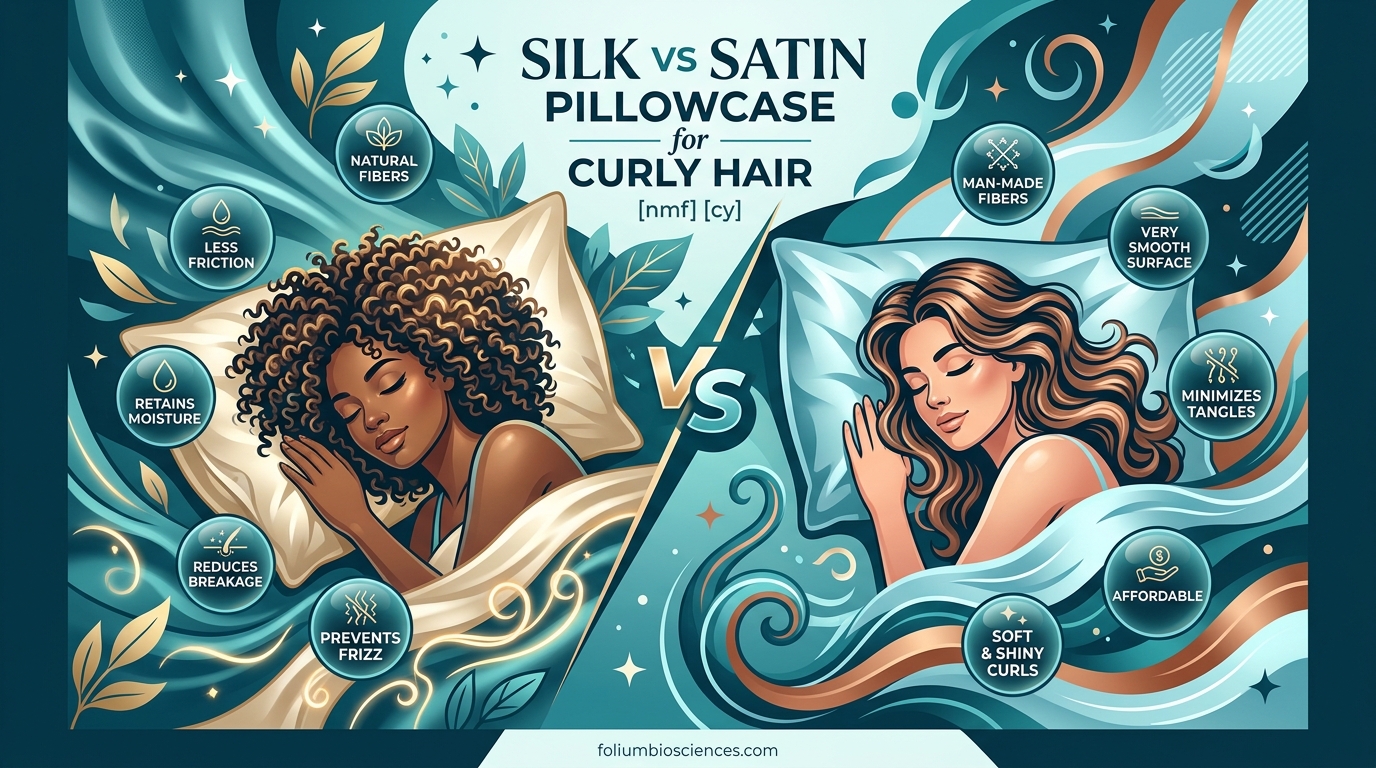
If you have curly hair, you already know the struggle of waking up to a frizzy, tangled mess after a full night of sleep. The pillowcase you rest on every night plays a massive role in whether your curls stay defined or turn into a puffball by morning. When it comes to the silk vs satin pillowcase for curly hair debate, the short answer is this: pure silk pillowcases reduce frizz slightly better than satin because their natural protein fibers create an ultra-smooth surface that also retains more moisture. But satin is still a massive upgrade over cotton and comes at a more accessible point for most people.
In this guide, we are breaking down exactly how each material works, what makes them different, and which one is the smarter choice for your specific curl pattern. We pulled insights from curl communities on Reddit, trichologist recommendations, and real user experiences to give you the most honest comparison possible. Whether you have loose 3A waves or tight 4C coils, you will walk away knowing exactly which pillowcase material is right for your hair.
Table of Contents
What Makes Curly Hair Different (And Why Your Pillowcase Matters)
Curly hair is structurally different from straight hair at the follicle level, and that difference changes everything about how it reacts to friction overnight. Each curly strand grows from an oval-shaped follicle rather than a round one, which causes the hair shaft to bend and coil as it grows. Those bends create weak points along the strand where breakage is more likely to happen.
Here is the bigger problem: sebum, the natural oil your scalp produces to condition and protect hair, travels easily down straight hair shafts. On curly hair, the coils and curves act like speed bumps. The oil gets stuck near the roots and never reaches the ends. That is why curly hair is inherently drier, more fragile, and far more prone to frizz than straight hair types.
Now add eight hours of your head rubbing against a rough pillowcase every single night. That constant friction roughs up the hair cuticle, strips away what little moisture your curls do hold, and creates the tangles and flyaways you see in the mirror each morning. For curly and textured hair, the pillowcase you choose is not a small detail. It is one of the most impactful changes you can make for your hair health.
The Problem With Cotton Pillowcases for Curly Hair
Cotton is one of the worst fabrics you can sleep on if you have curly hair. The surface of cotton fibers is covered in microscopic scales that grip and snag hair strands as you toss and turn. Think of it like rubbing your curls against a very fine towel all night long. That constant grabbing creates friction, and friction is the number one cause of overnight frizz, tangles, and breakage for curly textures.
Cotton is also highly absorbent. It pulls moisture away from whatever it touches, including your hair. For curly hair that is already struggling to stay hydrated, sleeping on cotton means waking up with even drier strands. That dryness leads to more frizz, more split ends, and more breakage over time.
Switching to a smoother pillowcase material is one of the easiest and most effective changes you can make. Both silk and satin create a surface that lets your hair glide rather than snag, which is why curly-haired people everywhere have been making the switch. But which one actually works better? Let us look at what each material really is first.
What Is a Silk Pillowcase?
Silk is a natural protein fiber produced by silkworms, specifically the Bombyx mori species. The silkworms spin cocoons made of a single continuous thread that can stretch up to 1,600 meters. These threads are harvested, unwound, and woven into the smooth, lustrous fabric we know as silk. Because it is a natural fiber made of protein (the same building block as human hair), silk has a unique affinity for hair and skin.
Not all silk is created equal. The gold standard for pillowcases is mulberry silk, which comes from silkworms fed exclusively on mulberry leaves. Within mulberry silk, quality is measured in momme weight, which indicates the density of the weave. A momme count of 19 to 25 is ideal for pillowcases. Anything below 19 is too thin and will wear out quickly, while 22 to 25 momme offers the smoothest, most durable surface.
Silk is naturally hypoallergenic, resistant to dust mites, and excellent at regulating temperature. It keeps you cool in summer and warm in winter. For curly hair, the key benefit is that silk fibers are inherently smooth at a microscopic level. There are no rough scales or textures to catch on hair strands. This is what makes silk the premium choice for frizz prevention and moisture retention overnight.
What Is a Satin Pillowcase?
Here is where a lot of people get confused: satin is not a material. It is a weave pattern. The satin weave uses a technique where the threads pass over multiple warp threads before going under one, creating a smooth, glossy surface on one side and a duller finish on the other. This weave structure is what gives satin its signature shine and slip.
Because satin is a weave and not a fiber, it can be made from many different materials. The most common satin pillowcases are made from polyester, but satin can also be woven from nylon, rayon, or even silk threads. When you see “silk satin,” that means the satin weave was made using silk fibers. When you see just “satin” on a product label, it is almost always polyester-based.
The most popular satin weave for pillowcases is charmeuse satin, which has a particularly smooth, draping quality. Polyester satin pillowcases do create a low-friction surface that helps hair glide more easily than cotton, and they are widely available at a fraction of the cost of silk. However, synthetic fibers do not offer the same natural breathability, temperature regulation, or hypoallergenic properties as real silk.
One Reddit user from r/curlyhair summed it up well: “My satin pillowcase was a big step up from cotton, but when I switched to real silk, the difference was noticeable. Less frizz, less static, softer curls in the morning.”
Silk vs Satin Pillowcase: Head-to-Head Comparison for Curly Hair
Let us put these two materials side by side across every factor that matters for curly hair. This comparison covers the most important differences between a silk vs satin pillowcase for curly hair so you can see exactly how they stack up.
| Feature | Pure Silk | Polyester Satin |
|---|---|---|
| Material Source | Natural (silkworm protein fiber) | Synthetic (polyester or nylon) |
| Friction Reduction | Excellent (naturally smooth fibers) | Good (smooth weave surface) |
| Moisture Retention | Excellent (does not absorb moisture) | Good (low absorption) |
| Breathability | High (natural temperature regulation) | Low to moderate (traps heat) |
| Hypoallergenic | Yes (dust mite resistant) | No (synthetic fibers) |
| Durability | Moderate (needs gentle care) | High (machine washable) |
| Care Requirements | Hand wash or delicate cycle | Machine wash on gentle |
| Static Build-up | Rare | Common with polyester |
| Environmental Impact | Biodegradable, renewable | Petroleum-based, not biodegradable |
As you can see, silk wins in most categories that directly impact curly hair health. But satin still outperforms cotton by a wide margin, which makes it a solid choice if you are on a budget or need something more durable for nightly use.
Friction, Frizz, and Breakage: Which Pillowcase Wins?
The core question at the heart of this guide is simple: does silk or satin reduce frizz more effectively for curly hair? To answer it properly, we need to look at what actually causes frizz while you sleep.
Frizz happens when the hair cuticle, the outermost protective layer of each strand, gets lifted and roughed up. When cuticle layers lie flat and smooth, hair looks shiny and defined. When they are lifted, light scatters unevenly and hair appears frizzy and dull. Friction from your pillowcase is one of the primary causes of lifted cuticles overnight.
Silk has a natural advantage here because each individual silk fiber is inherently smooth at a microscopic level. The protein structure of silk creates a surface that is closer to the surface of human hair itself. This means there is less mechanical resistance when your hair moves across a silk pillowcase during sleep. Less resistance means less cuticle disruption, which directly translates to less frizz.
Satin pillowcases also reduce friction compared to cotton, but the degree depends on what fibers the satin is made from. Polyester satin has a smooth surface thanks to the weave pattern, but the individual synthetic fibers are not as smooth as natural silk fibers. Some satin pillowcases can also generate static electricity, especially in dry conditions, which adds to frizz rather than reducing it.
Forum users from r/HaircareScience consistently report that silk provides a noticeable improvement over polyester satin for frizz control. One user with 3B curls shared: “I tested both for a month each. With satin, I still had some frizz at the crown. With silk, my curls were almost exactly how I left them the night before.”
So for pure frizz reduction, silk is the winner. But the gap is not enormous. If you currently sleep on cotton, switching to either silk or satin will give you a dramatic improvement. The last 10 to 15 percent of frizz reduction is where silk pulls ahead of satin.
Which Is Better for Your Curl Type? (3A to 4C Guide)
One thing almost no other guide covers is how your specific curl pattern should influence your pillowcase choice. Not all curly hair has the same needs, and understanding your curl type can help you make the right call between silk and satin.
Here is a breakdown by curl pattern type, based on hair porosity, fragility, and the experiences shared by real curly-haired people in online communities.
Type 3A to 3B (Loose to Medium Curls)
Type 3A and 3B curls are loose to medium spirals that tend to be less fragile than tighter curl patterns. These hair types still benefit significantly from switching away from cotton, but they may not need the premium performance of pure silk to see good results.
If you have 3A to 3B curls, a high-quality polyester satin pillowcase will likely give you a solid improvement in frizz prevention and style preservation overnight. Silk will still perform slightly better, but the difference may not be as dramatic as it is for tighter curl patterns. Satin can be a smart, budget-friendly choice here.
Type 3C (Tight Curls)
Type 3C curls are tight corkscrews that are more prone to dryness, shrinkage, and tangling than looser curl patterns. At this curl level, the benefits of silk become more noticeable. The natural moisture retention and smoother surface of silk help keep 3C curls hydrated and defined overnight.
Forum members with 3C hair frequently report that silk makes a visible difference compared to satin, particularly for reducing crown frizz and maintaining curl definition through second and third-day hair. If you have 3C curls and are serious about protecting them, silk is the better investment.
Type 4A to 4B (Coily Hair)
Type 4A and 4B hair features tight coils and zigzag patterns that are among the most fragile hair textures. These curl types have the highest natural porosity, meaning they lose moisture quickly and are the most susceptible to breakage from friction.
For coily hair, silk is the clear winner. The combination of superior moisture retention and the smoothest possible surface gives Type 4 hair the protection it needs. Silk helps preserve the natural oils that are already struggling to coat tightly coiled strands. If budget allows, silk is strongly recommended for Type 4A and 4B textures.
Type 4C (Kinky and Z Pattern)
Type 4C hair has the tightest curl pattern with the most shrinkage and fragility. It requires the gentlest handling and maximum moisture retention. Members of the r/curlyhair community with 4C hair consistently advocate for silk pillowcases over satin, noting that the difference in moisture retention and hair protection while sleeping is significant enough to justify the investment.
That said, any protective pillowcase is better than none. If silk is out of reach, a good satin pillowcase is still far gentler on 4C hair than cotton. Pair it with a satin bonnet or scarf for layered protection, and you will still see a meaningful improvement.
Silk vs Satin Pillowcases: 5 Myths You Should Stop Believing
There is a lot of confusion out there about silk and satin pillowcases. We combed through forums, social media comments, and common misconceptions to bust the five most persistent myths.
Myth 1: “Satin and Silk Are the Same Thing”
This is the most common misconception by far. Silk is a natural fiber made from silkworm cocoons. Satin is a type of weave that can be made from silk, polyester, nylon, or other fibers. Calling them the same is like saying wool and a knit sweater are the same thing. One is the material, the other is how that material is constructed. A satin pillowcase might contain zero silk at all.
Myth 2: “All Satin Pillowcases Work the Same”
Satin quality varies enormously depending on the fiber used and the tightness of the weave. A cheap polyester satin with a loose weave will not perform the same as a high-quality charmeuse satin. Some low-quality satin pillowcases feel smooth at first but pill or roughen after a few washes, which actually increases friction over time. Look for tightly woven charmeuse satin from reputable brands.
Myth 3: “Silk Pillowcases Are Just a Gimmick”
The science behind silk is well-documented. Silk fibers contain 18 amino acids that are structurally similar to those found in human hair and skin. The fiber is naturally smooth, hypoallergenic, and moisture-wicking without absorbing moisture from your hair. Dermatologists and trichologists regularly recommend silk for patients with sensitive skin and fragile hair. This is not marketing hype. It is material science.
Myth 4: “Satin Is Just as Good as Silk for Curly Hair”
Satin is a good option, but it is not equal to silk for curly hair care. Silk has smoother individual fibers, better breathability, zero static build-up, and superior moisture retention. Polyester satin can trap heat and create static, both of which contribute to frizz. Satin is a strong budget alternative, but equating it to silk oversimplifies the real differences.
Myth 5: “You Need to Replace Your Pillowcase Every Month”
Neither silk nor satin pillowcases need monthly replacement. A quality silk pillowcase (22 momme or higher) can last 1 to 2 years with proper care. Satin pillowcases are even more durable and can last 2 to 3 years. Replace your pillowcase when you notice visible wear, thinning, or a loss of smoothness on the surface. That is the sign it is no longer doing its job for your hair.
How to Care for Your Silk or Satin Pillowcase
Getting the most out of your pillowcase means caring for it properly. Here is exactly how to maintain both silk and satin so they keep protecting your curls night after night.
Silk Pillowcase Care
Always wash silk on a delicate cycle or by hand using cold water and a pH-neutral detergent or a detergent specifically formulated for silk. Never use bleach, fabric softener, or hot water, as these will damage the protein fibers. Air dry silk flat or on a low-heat setting if your dryer has a delicate mode. Iron on the lowest setting if needed, but most wrinkles will fall out naturally.
Wash your silk pillowcase every 3 to 4 days to keep it fresh and free from oils that can build up on the surface. Between washes, you can freshen it by hanging it in a well-ventilated area. With proper care, a quality silk pillowcase will maintain its smoothness and effectiveness for 12 to 24 months.
Satin Pillowcase Care
Polyester satin is more forgiving than silk. Machine wash on a gentle cycle with cold or warm water. Use a mild detergent and avoid bleach and fabric softeners, which can coat the fibers and reduce the smooth surface. Tumble dry on low heat or air dry. Satin is more wrinkle-resistant than silk, so ironing is rarely needed.
Wash satin pillowcases every 3 to 5 days for best results. They are more durable than silk and can withstand more frequent washing without losing their smoothness. A good satin pillowcase will last 2 to 3 years with regular care.
When to Replace Your Pillowcase
Regardless of whether you choose silk or satin, replace your pillowcase when you notice any of these signs: the surface feels rough or textured instead of smooth, you see visible pilling or thinning, the fabric has lost its shine and appears dull, or your hair is no longer sliding easily across the surface. Once the smooth surface is compromised, the pillowcase will start creating more friction rather than reducing it.
Silk vs Satin Pillowcase for Curly Hair: Frequently Asked Questions
Is silk or satin better for frizz?
Silk is slightly better than satin for reducing frizz because its natural protein fibers are inherently smoother at a microscopic level than synthetic polyester fibers used in most satin pillowcases. Silk also retains moisture more effectively and does not generate static electricity, which is a common cause of flyaway frizz with polyester satin. However, both materials reduce frizz significantly compared to cotton, so either choice is a meaningful upgrade for frizz-prone hair.
Is silk or satin better for curly hair?
For curly hair specifically, silk is the better option because it offers superior moisture retention, a naturally smooth surface that minimizes cuticle damage, and hypoallergenic properties that benefit sensitive scalps. Satin is still an effective and more budget-friendly alternative that outperforms cotton by a wide margin. The tighter your curl pattern (Type 3C to 4C), the more noticeable the difference between silk and satin becomes, with silk providing measurably better results for coily and kinky textures.
Do silk pillowcases prevent frizzy hair?
Yes, silk pillowcases help prevent frizzy hair by creating an ultra-smooth, low-friction surface that allows hair strands to glide rather than snag during sleep. This reduces cuticle damage, prevents moisture loss, and minimizes the mechanical friction that causes overnight frizz. Silk will not eliminate frizz entirely if other factors like humidity, hair damage, or product buildup are involved, but it addresses one of the primary physical causes of sleep-related frizz for curly and textured hair.
What pillowcases are best for seborrheic dermatitis?
Silk pillowcases are generally recommended for seborrheic dermatitis because silk is naturally hypoallergenic, resistant to dust mites, and less likely to trap heat and moisture against the scalp. The smooth surface also reduces friction that can irritate sensitive, inflamed skin. Polyester satin is less ideal because synthetic fibers can trap heat and may irritate already-sensitive skin conditions. For anyone managing seborrheic dermatitis, 100 percent pure mulberry silk with a momme weight of 19 or higher is the best pillowcase choice.
The Final Verdict: Silk vs Satin for Curly Hair
After looking at the science, the real-world experiences from curl communities, and the practical differences between these two materials, here is our honest take on the silk vs satin pillowcase for curly hair conversation.
Pure silk is the better choice for curly hair if your budget allows. It provides the smoothest surface, the best moisture retention, zero static, and natural hypoallergenic benefits. The tighter your curl pattern, the more you will notice the difference. For Type 3C to 4C hair, silk is worth every penny for the frizz reduction and curl preservation alone.
Satin is the smart pick if you want a meaningful upgrade without the premium price tag. A quality polyester satin pillowcase still dramatically outperforms cotton for friction reduction, and it is easier to care for and more durable than silk. For looser curl patterns (Type 3A to 3B), satin often provides enough protection to keep curls looking great.
The most important takeaway is this: switching from cotton to either silk or satin is the change that matters most. Both materials offer a genuine improvement in how your curls look and feel each morning. Pick the one that fits your budget, your curl type, and your lifestyle, and your hair will thank you.