
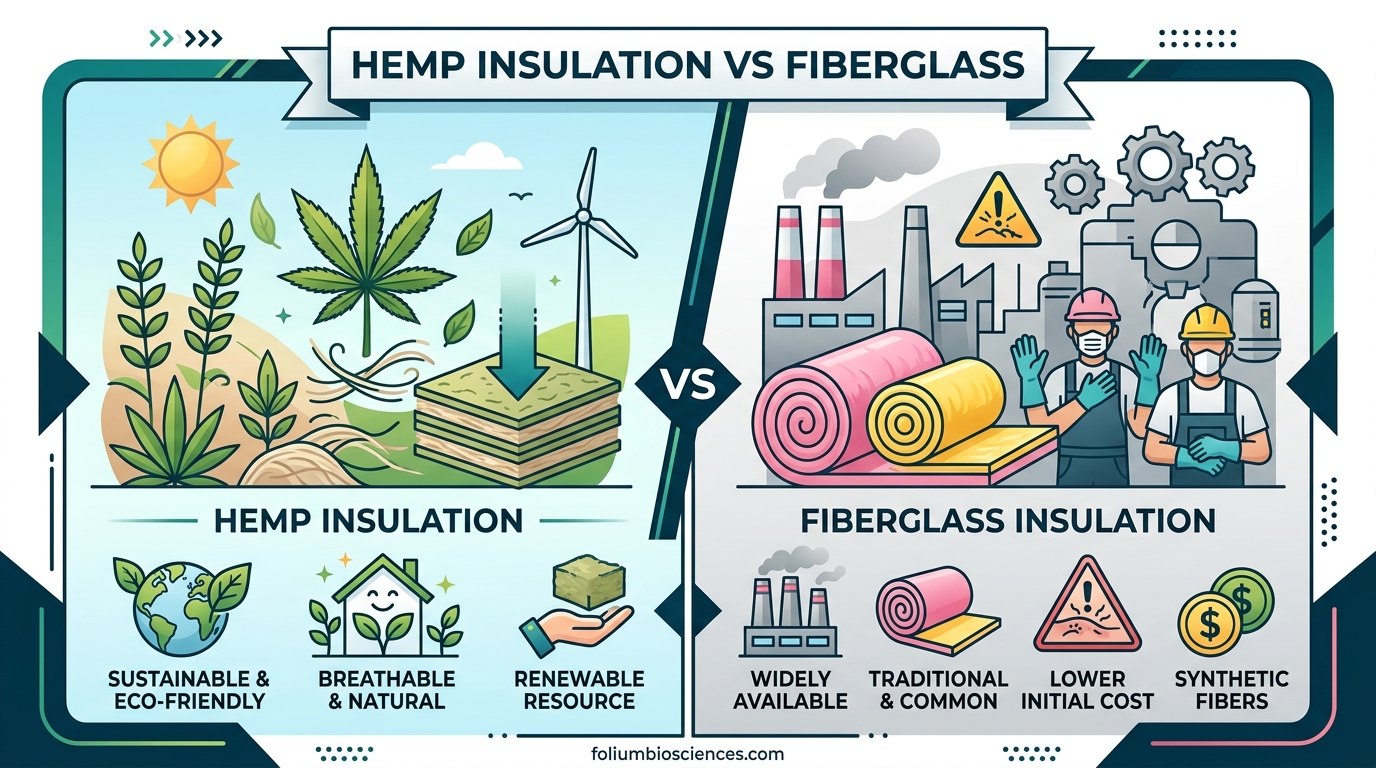
Choosing the right insulation can feel overwhelming when you’re staring at walls that need filling. I spent months researching natural alternatives after a fiberglass installation left my family coughing for weeks. Hemp insulation offers R-values of 3.5 to 3.7 per inch, comparable to fiberglass at 2.9 to 3.8 per inch, but the real differences go far beyond thermal numbers. The trade-offs between these materials affect your health, indoor air quality, moisture management, and environmental footprint for decades after installation.
This guide breaks down everything I learned comparing hemp insulation vs fiberglass, from precise R-value measurements to moisture behavior and health impacts. Whether you’re building new, retrofitting an old home, or simply want to understand your options, you’ll find clear, data-driven answers here.
Table of Contents
Hemp Insulation vs Fiberglass: How Do They Compare?
Hemp insulation is a bio-based material made from the woody core of industrial hemp stalks, while fiberglass consists of tiny glass fibers bound together with synthetic resins. Both materials trap air to slow heat transfer, but their performance characteristics differ significantly across multiple dimensions.
The R-value range tells part of the story. Hemp insulation typically delivers R-3.5 to R-3.7 per inch in batt form, while fiberglass batts range from R-2.9 to R-3.8 per inch depending on density. Higher-density fiberglass can match or slightly exceed hemp’s thermal resistance, but hemp maintains more consistent performance across varying conditions due to its natural fiber structure.
Material composition creates the biggest functional differences. Hemp fibers are hygroscopic, meaning they absorb and release moisture to help regulate humidity levels. Fiberglass is non-hygroscopic and can trap moisture against surfaces, potentially leading to mold issues when vapor barriers fail. Hemp requires fire retardant treatments to meet building codes, while fiberglass offers inherent fire resistance from its glass composition.
R-Value Comparison: Thermal Performance Breakdown
R-value measures thermal resistance, specifically how well a material resists heat flow. Higher numbers mean better insulation. Understanding the precise R-values helps you calculate the right thickness for your climate zone and energy goals.
Hemp insulation batts provide R-3.5 to R-3.7 per inch according to manufacturer specifications and third-party testing. This places hemp in the same performance tier as mid-density fiberglass and cellulose. For a standard 2×4 wall with 3.5 inches of cavity space, hemp delivers approximately R-12.25 to R-12.95, while the same cavity filled with standard fiberglass achieves R-10.15 to R-13.3.
Fiberglass offers more variation depending on product density. Low-density batts rate around R-2.9 per inch, mid-density reaches R-3.2 to R-3.5, and high-density batts can achieve R-3.8 per inch. Loose-fill fiberglass performs differently than batts, typically rating R-2.2 to R-2.7 per inch depending on installation density. The inconsistency in fiberglass products means you must verify specific product ratings rather than assuming standard performance.
Thermal mass also differs between materials. Hemp has higher thermal mass than fiberglass, meaning it absorbs and stores heat energy. This property helps moderate temperature swings and can reduce heating and cooling loads in climates with significant day-night temperature variations. Fiberglass responds quickly to temperature changes with minimal thermal storage capacity.
Health Trade-Offs: Safety for Installers and Occupants
The health differences between hemp and fiberglass insulation are substantial and represent one of the strongest arguments for choosing natural alternatives. I witnessed this firsthand during a bathroom renovation where fiberglass exposure caused respiratory irritation that lasted days.
Fiberglass insulation poses well-documented health risks during installation and can affect indoor air quality long-term. The tiny glass fibers irritate skin, eyes, and respiratory tracts on contact. OSHA lists fiberglass dust as a potential occupational hazard, and while the EPA no longer classifies fiberglass as a probable human carcinogen, the International Agency for Research on Cancer still lists certain glass wool fibers as possibly carcinogenic. These fibers can become airborne during installation, compression, or degradation over time, circulating through HVAC systems and settling on surfaces.
Proper installation of fiberglass requires protective equipment including respirators, goggles, and full coverage clothing. Even with precautions, many installers report throat irritation, coughing, and skin rashes. Homeowners who attempt DIY fiberglass installation without adequate protection often experience similar symptoms.
Hemp insulation offers dramatically different health characteristics. The natural fibers are non-irritating and safe to handle without extensive protective gear. Most hemp insulation products carry certifications for low VOC emissions and indoor air quality safety. Installers can work with hemp using basic dust masks rather than respirators, and skin contact typically causes no reaction. This makes hemp particularly attractive for DIY projects and for homeowners concerned about long-term indoor air quality.
Long-term health considerations favor hemp for occupied spaces. As hemp insulation ages, it does not shed irritating particles into the air. Fiberglass can degrade over decades, potentially releasing fibers if disturbed during renovations or repairs. The mineral oil and formaldehyde-based binders in some fiberglass products also off-gas VOCs, particularly when new or exposed to heat.
Moisture Management: Hemp’s Hygroscopic Advantage
Moisture behavior represents one of the most significant functional differences between these insulation types. How materials handle water vapor determines their long-term performance, mold resistance, and impact on building durability.
Hemp insulation is hygroscopic, meaning it absorbs moisture from the air when humidity rises and releases it when humidity drops. This property allows hemp to act as a moisture buffer, moderating humidity swings within wall cavities and living spaces. The fibers can absorb up to 20% of their weight in moisture without losing insulating properties or supporting mold growth. When humidity decreases, hemp releases stored moisture back into the air, maintaining a stable moisture balance.
This moisture regulation provides several benefits. During winter heating seasons when indoor air becomes dry, hemp releases stored moisture to maintain comfortable humidity levels. In summer cooling conditions when humidity spikes, hemp absorbs excess moisture before it can condense on cool surfaces. The buffering effect reduces the risk of condensation within wall assemblies that leads to mold and rot.
Fiberglass insulation lacks hygroscopic properties. It neither absorbs nor releases moisture, acting instead as a passive barrier. When water vapor moves through fiberglass and encounters a cold surface, condensation occurs within or behind the insulation. Wet fiberglass loses significant R-value and provides an ideal environment for mold growth. Once fiberglass becomes wet, it stays wet until actively dried, creating conditions for structural damage and indoor air quality problems.
Building science research confirms that hygroscopic insulation like hemp performs better in mixed climates with significant humidity variation. However, hemp’s moisture absorption requires careful vapor barrier planning. In extremely humid climates, hemp may absorb too much moisture without adequate drying potential, requiring enhanced ventilation strategies or different vapor barrier placement than fiberglass installations.
Environmental Impact and Sustainability
The environmental comparison between hemp and fiberglass heavily favors hemp across virtually every metric from production to disposal. For homeowners prioritizing sustainability, this difference often drives the decision regardless of other trade-offs.
Hemp insulation production requires minimal energy input and creates a carbon-negative lifecycle. Industrial hemp grows rapidly, reaching maturity in 90 to 120 days with minimal irrigation and no pesticides. During growth, hemp sequesters carbon dioxide from the atmosphere at rates exceeding most agricultural crops, storing carbon in the stalk fibers used for insulation. Processing involves decorticating the stalks and forming fibers into batts with natural binders, requiring far less energy than manufacturing synthetic materials. The finished product stores more carbon than was emitted during production and transportation.
Fiberglass production is energy-intensive and relies on non-renewable resources. Manufacturing glass fibers requires melting sand, recycled glass, and other minerals at temperatures exceeding 2,500 degrees Fahrenheit. The process consumes significant fossil fuel energy and releases carbon dioxide, sulfur dioxide, and other pollutants. The synthetic binders used to hold fibers together derive from petroleum products. Fiberglass cannot be recycled effectively and persists in landfills indefinitely.
Biodegradability presents another stark contrast. At end of life, hemp insulation can be composted or returned to the soil, completing a natural cycle. Fiberglass requires landfill disposal or specialized waste handling. Some regions classify fiberglass as construction waste requiring special disposal fees and procedures.
Renewable resource status matters for long-term sustainability planning. Hemp regrows annually, providing a perpetual raw material supply. Sand and minerals used for fiberglass are finite resources, though abundant. The renewable nature of hemp aligns with circular economy principles increasingly important in green building certifications.
Fire Resistance and Safety Ratings
Fire safety requirements affect insulation choice significantly since building codes mandate specific fire performance standards. Both materials can achieve Class A fire ratings when properly specified, but their inherent properties differ.
Fiberglass offers natural fire resistance because glass fibers do not burn. The material can withstand high temperatures without igniting, though synthetic binders may burn or release smoke at extreme temperatures. Most fiberglass insulation achieves Class A ratings with minimal additional treatment, making it straightforward for code compliance.
Raw hemp fiber is combustible and requires fire retardant treatment to meet building codes. Manufacturers treat hemp insulation with borate-based or other mineral fire retardants that prevent ignition and slow flame spread. Properly treated hemp insulation achieves Class A fire ratings comparable to fiberglass. The treatment adds cost but does not significantly affect other performance characteristics.
Smoke development differs between materials. Burning fiberglass produces minimal smoke, while untreated hemp would produce significant smoke if ignited. Treated hemp insulation meets smoke development requirements for residential and commercial applications. Always verify that hemp insulation products carry proper fire rating certifications for your jurisdiction before installation.
Installation practices affect fire safety for both materials. Gaps, compression, and improper coverage can create thermal bypasses that compromise fire barriers. Both materials require careful installation according to manufacturer specifications to maintain rated performance.
Cost Analysis: Upfront vs Long-Term Value
Cost considerations extend beyond initial purchase price to include installation expenses, energy savings, and replacement timelines. Understanding the full financial picture helps justify premium prices for hemp when health and environmental benefits matter.
Hemp insulation costs 30% to 100% more than comparable fiberglass products at current market prices. A typical hemp batt costs approximately $1.50 to $2.50 per square foot depending on thickness and R-value, while equivalent fiberglass batts run $0.80 to $1.40 per square foot. The price gap reflects hemp’s smaller production scale, limited suppliers, and processing requirements.
Installation costs favor hemp due to easier handling and faster installation. DIY installers save on protective equipment and can work longer without breaks. Professional installers charge similar labor rates, but hemp installs faster because workers require less protection and cleanup time. The total installed cost difference narrows when labor factors into the calculation.
Long-term value calculations depend on energy prices, climate, and how long you occupy the home. Both materials provide similar thermal performance, so energy savings differences are minimal. The value proposition for hemp comes from health benefits, environmental impact, and potential home value increases from green building features rather than utility bill savings.
Availability constraints affect real-world costs. Hemp insulation is not stocked at major home improvement retailers and requires ordering from specialty suppliers. Shipping costs add to the total, and lead times may extend project schedules. Fiberglass is available immediately at any building supply store, offering convenience that hemp currently cannot match.
Durability and Longevity: Which Lasts Longer?
Insulation longevity determines the true cost of ownership and affects how often you must replace or upgrade materials. Both hemp and fiberglass offer decades of service life when properly installed, though their aging characteristics differ.
Hemp insulation maintains stable performance for the lifetime of the building when protected from moisture and pests. The natural fibers resist degradation from normal temperature cycling and do not settle significantly over time. Some European hemp insulation installations from the 1990s continue performing after 30 years with no measurable R-value loss. Hemp’s natural resistance to pests including rodents and insects eliminates a common cause of insulation replacement.
Fiberglass also offers long service life, typically 50 to 80 years for wall applications. However, fiberglass is more susceptible to performance degradation from moisture exposure, compression, and settling. Wet fiberglass loses R-value permanently and may require replacement. Compression from inadequate support or foot traffic in attics reduces effective thickness and thermal performance.
Settling affects both materials differently. Hemp maintains its loft due to fiber resilience and natural binders. Fiberglass can settle over time, particularly in vertical wall cavities, creating gaps at the top where insulation density decreases. Proper installation techniques including friction fitting and support netting minimize settling for both materials.
Pest resistance favors hemp significantly. Rodents nest in fiberglass and may tunnel through it to access wall cavities. Hemp’s natural fibers contain compounds that deter rodents and insects, reducing the likelihood of pest damage requiring insulation replacement.
Frequently Asked Questions
What are the disadvantages of hemp insulation?
Hemp insulation costs 30% to 100% more than fiberglass, has limited retail availability requiring specialty ordering, needs fire retardant treatment for code compliance, and may absorb excessive moisture in extremely humid climates without proper vapor barrier design. The smaller market also means fewer installers familiar with best practices.
What is the healthiest insulation for a house?
Hemp insulation is the healthiest option for most homes due to its non-irritating natural fibers, low VOC emissions, and safe handling without extensive protective equipment. It does not shed irritating particles into indoor air over time. Other healthy alternatives include mineral wool (Rockwool) and cellulose, though hemp offers the best combination of health safety, performance, and sustainability.
Is hemp insulation better than fiberglass?
Hemp insulation outperforms fiberglass in health safety, moisture management, environmental impact, and pest resistance while delivering comparable R-values. Fiberglass wins on upfront cost, immediate availability, and inherent fire resistance. The better choice depends on your priorities: choose hemp for health and sustainability, fiberglass for lowest initial cost and easiest procurement.
Does hemp insulation need a vapor barrier?
Hemp insulation generally requires a vapor barrier or retarder depending on climate zone and building assembly, but the specifications differ from fiberglass. Hemp’s hygroscopic properties allow more moisture tolerance, potentially permitting less restrictive vapor barriers in some applications. Consult local building codes and manufacturer specifications, as requirements vary by climate zone and wall assembly design.
Can you install hemp insulation yourself?
Yes, hemp insulation is ideal for DIY installation because it does not irritate skin or respiratory systems. You need only basic tools, a dust mask, and standard safety precautions. Cut batts to fit cavities using a sharp knife, friction-fit into place, and avoid compression. The safe handling makes hemp particularly suitable for homeowners doing their own insulation work without professional protective equipment.
Final Verdict: Making the Right Choice for Your Project
The hemp insulation vs fiberglass comparison reveals clear trade-offs that depend on your priorities. Hemp delivers comparable R-values with superior health safety, moisture management, and environmental credentials. Fiberglass offers lower upfront costs, immediate availability, and straightforward code compliance.
Choose hemp insulation if you prioritize indoor air quality, have family members with respiratory sensitivities, value environmental sustainability, or plan to install the insulation yourself. The health benefits alone justify the premium price for many homeowners, particularly in occupied spaces where air quality matters most.
Choose fiberglass if upfront cost is your primary constraint, you need insulation immediately from local suppliers, or you are insulating unoccupied spaces where health impacts matter less. Standard fiberglass remains a functional, time-tested choice for basic thermal performance.
For most residential applications in 2026, hemp insulation represents the smarter long-term investment despite higher initial costs. The combination of health benefits, moisture management, and sustainability aligns with evolving building science and green building trends. As production scales increase and prices decrease, hemp will likely become the default choice for quality-conscious builders and homeowners.
1 thought on “Hemp Insulation vs Fiberglass: R-Value & Moisture (2026)”