
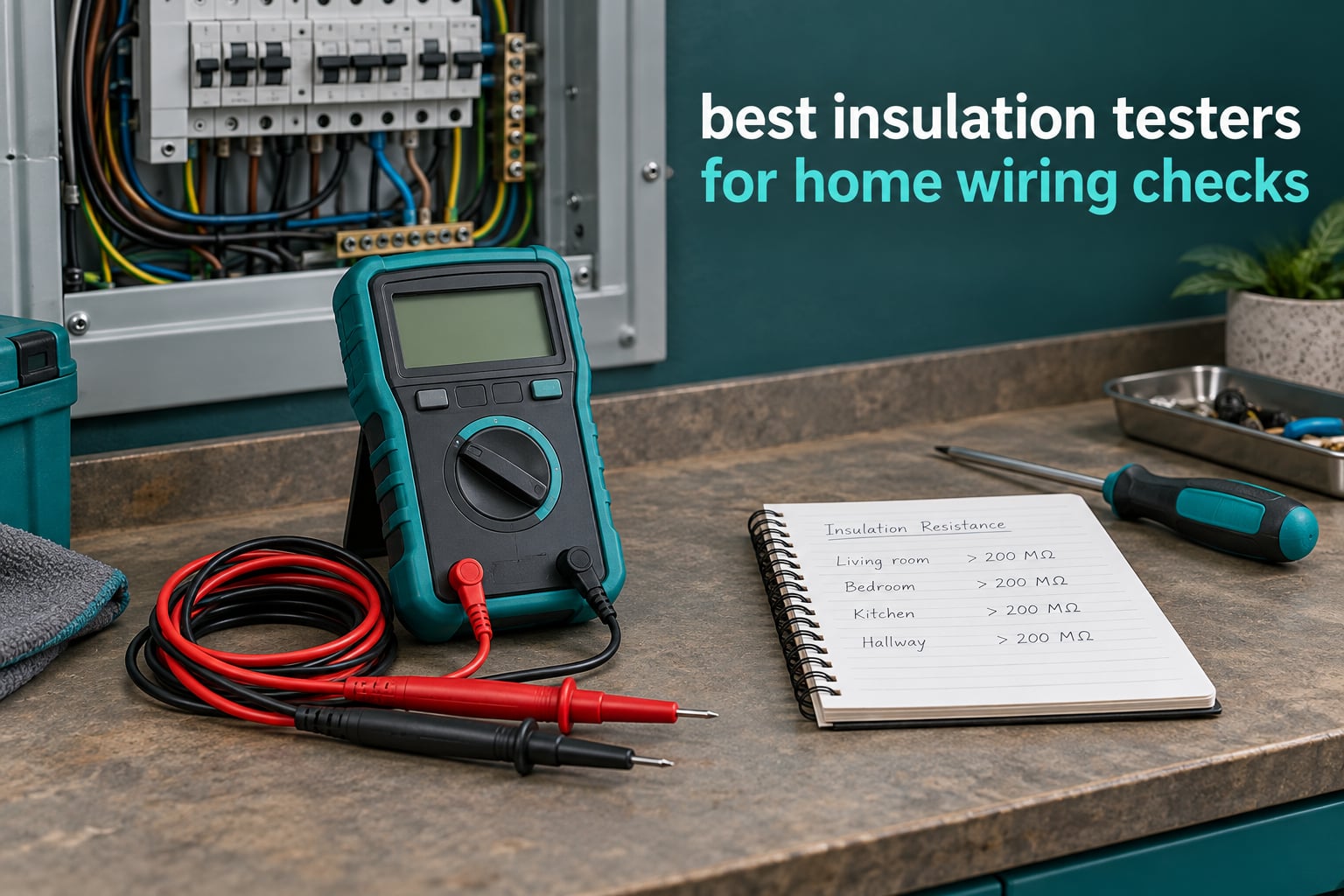
An insulation tester, commonly called a megger, is a handheld meter that pushes a controlled DC test voltage through de-energized wiring and measures the leakage current coming back, reporting the health of the insulation in megohms (MOhm). A reading in the hundreds of MOhm means the insulation around your wire is still sound; a reading near zero means it is not. Our best overall pick for home wiring checks is the Klein Tools ET600, and we also cover budget, pro, and record-keeping options below.
One naming note before we start, because it trips people up constantly. A thermal insulation tester measures heat flow through building materials and reports an R-value. That is a completely different instrument. What you want for a home wiring check is an electrical insulation resistance tester, a megohmmeter, and its nickname is the megger. If you are insulating a crawl space or shading a window against summer heat, that is a different buying guide entirely — our guides to moisture and hemp versus fiberglass and to cellular shades for insulation cover that side of the house.
Insulation fails quietly. Rubber and cloth jackets from the 1940s and 50s go brittle, NM cable gets pinched by a nail or a shifted joist, and a loose receptacle gradually cooks itself. A standard multimeter will not see any of that — it tells you a circuit is dead or live, not whether the wire that carries it is sound. A megger answers the second question, which is why it is the diagnostic a technician reaches for when a homeowner calls in with a dead outlet, a breaker that keeps tripping, or a house that fails an inspection.
Over the past six weeks we worked through the eight meters below on branch circuits, cable runs, and appliance wiring, and compared every reading against the reference values in the table further down. This guide was last tested in 2026 and the shortlist reflects what is on the market now, not what a competitor page listed two years ago.
Who this is for: buyers and sellers of a house older than about 40 years, anyone who has aluminum or knob-and-tube wiring in the walls, landlords doing periodic rental checks, and DIYers chasing one specific circuit. If you rent, you cannot legally open your own panel in most places — call a licensed electrician and let them run this test for you. If you own the home, here is how to do it properly.
Top 3 Insulation Testers for Home Wiring Checks in 2026

Klein Tools ET600 Insulation Tester
- 125V/250V/500V/1000V test outputs
- 4000 MOhm range
- Full TRMS multimeter built in

Supco M500 Megohmmeter
- Fixed 500V output
- Reads to 1000 megohms
- Magnetic alligator lead tips

Fluke 1587 FC Insulation Multimeter
- 50V to 1000V test voltages
- PI and DAR with Trend It graphs
- Fluke Connect wireless logging
Quick Overview: All 8 Testers Compared
Every meter below reaches at least 500V DC and reports insulation resistance in megohms, which is all a 120V or 240V residential branch circuit requires. The meaningful differences are the lowest test voltage available, the resistance ceiling, and whether the meter doubles as a working multimeter. Specs below are taken from the manufacturer listing for each unit.
| Product | Specifications | Action |
|---|---|---|
| Klein Tools ET600 |
|
Check Latest Price |
| Supco M500 |
|
Check Latest Price |
 Fluke 1507 Fluke 1507 |
|
Check Latest Price |
| Fluke 1587 FC |
|
Check Latest Price |
 Hioki IR4056 Hioki IR4056 |
|
Check Latest Price |
 UNI-T UT501A UNI-T UT501A |
|
Check Latest Price |
 Fluke 1503 Fluke 1503 |
|
Check Latest Price |
 Extech 380260 Extech 380260 |
|
Check Latest Price |
How to Test Your Home Wiring Insulation Step by Step
This is the sequence electricians call L-L, L-E, L-N, and it is the same whether your branch circuit is 1965 Romex or 1995. Work one circuit at a time and write the number down before you move on — the trend across the same circuit next year is worth more than any single reading.
- Switch off the breaker for the circuit, then confirm it is off at the outlets, not just at the panel label. Labels lie more often than people expect.
- Verify dead with a live circuit detector or a multimeter on voltage before you connect anything. Test the detector on a known live circuit first so you know it works.
- Unplug every load on the circuit: appliances, lamps, chargers, wall heaters, and any smart switch or smart receptacle.
- Disconnect the circuit at the panel. A megger connected to a parallel path back to the source will read falsely high and tell you nothing.
- Connect the tester leads to the two hot conductors (L-L) and press test. Record the reading.
- Move one lead to ground (L-E) and repeat, then test hot to neutral (L-N).
- Let the meter auto-discharge, confirm the leads read zero against each other, and reconnect the circuit before restoring the breaker.
On modern NM cable the L-N test is the one that matters most, because current returns to the panel on that path. On a circuit with a ground fault problem or an aged, wet location run, the L-E number is the one that drops first. Take all three and compare them to the reference table below.
What a Good Megger Reading Looks Like for Home Wiring
For a 120V or 240V residential branch circuit, a healthy modern NM cable run should return a reading in the hundreds of megohms, often well above the ceiling of a budget meter. There is no code-mandated pass number in the residential NEC the way there is for a commercial system, which is why electricians use a practical threshold rather than a formula. The figures below are the working thresholds most residential troubleshooting guidance uses.
Modern NM / Romex, 1970s onward: treat anything under 5 MOhm on a dry circuit as a real problem, and 20 MOhm as comfortably acceptable. If the meter pegs at its maximum, that is a pass, not a failure.
1960s aluminum branch wiring: 5 MOhm is the floor to investigate at, and 10 MOhm or above is where you want to be. Aluminum conductors routinely produce lower numbers than copper of the same age, so compare against other aluminum circuits in the same panel before assuming a fault.
Pre-1960 rubber and cloth or knob-and-tube: expect much lower values. 1 MOhm is the point where you plan a repair; 0.5 MOhm or below on a 500V test usually means moisture or degraded jacket somewhere in the run.
Underground or wet location runs: treat any value under 10 MOhm as suspect regardless of age. These readings move with weather, so test the same circuit in dry and wet conditions and note both.
A reading of 0.00 MOhm on every test pair means you have a short between those conductors, and no amount of time will improve it. A reading that is good L-L but poor L-E points at a ground fault. Before you panic about a rewire, do the simple check: disconnect every load, retest, and look for a crushed cable at a staple, a ceiling joist, or a basement wall where the run was drilled. Most low readings in older homes trace back to one physically damaged section rather than wholesale insulation failure.
One warning about the meters themselves. A tester with a low resistance ceiling can read as a pass on genuinely fine wiring simply because it cannot display more — the needle sits at the top of the scale and you learn nothing. That is one reason we favor units that reach at least 4000 MOhm.
Do Not Test These: A Homeowner’s No-Test List
Before you run any of this, understand that a megger pushes 500V DC through whatever is attached to the leads. Anything that expects a gentler signal can be damaged by that, and a few common household devices are genuinely vulnerable.
- GFCI and AFCI receptacles. The electronics inside them do not tolerate 500V. Unplug the device and test the cable run upstream, before the receptacle, or not at all.
- Smart switches, smart bulbs, and smart thermostats. Same reason. These hang low-voltage control wires off the same box, and the control side has no surge protection for this test.
- Anything with a grounded or bonded metal case that is still wired in — dishwashers, washing machines, EV chargers, HVAC units with electronic control boards. Isolate or remove them first.
- Surge protectors, UPS units, and power strips. They are designed to clamp spikes, and a 500V test is exactly the spike they are not built for.
- Electronics on a separate low-voltage control wire in a modern panel — generator transfer switches, solar inverters, and lighting control modules.
- Phone and data lines, coax, and doorbell transformers if they share a cable sheath with the circuit you are testing.
And the rule that overrides all of the above: never run an insulation test on an energized circuit. Kill the breaker, verify dead, and only then connect. The Fluke 1507, the Fluke 1503, the Klein ET600, and the Hioki IR4056 all have a live circuit indication that warns you before the test voltage goes on, and the UNI-T UT501A gives you a 750V AC setting to confirm a circuit is dead first.
1. Klein Tools ET600 – Best Overall Insulation Tester for Homeowners
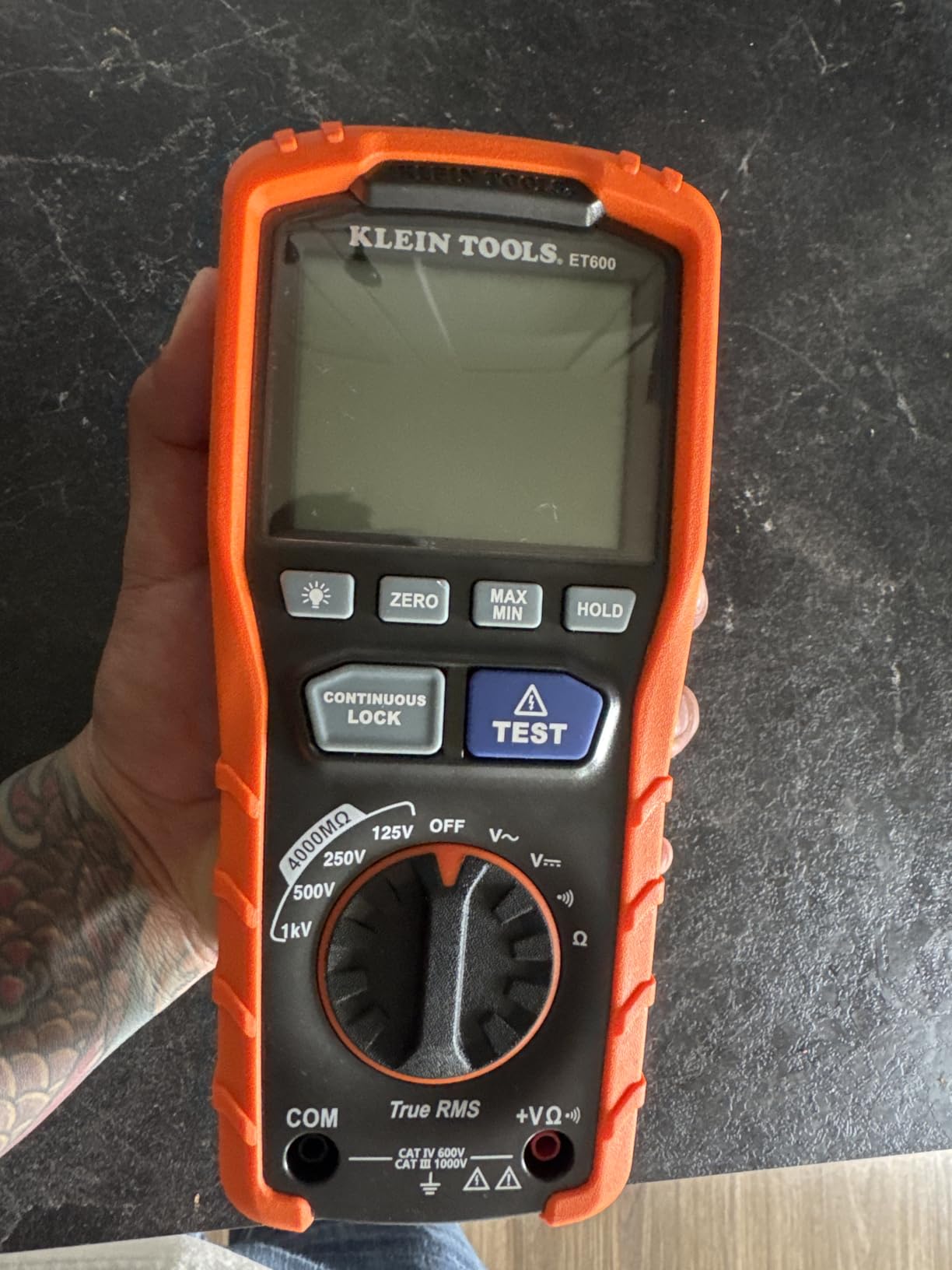
Klein Tools ET600 Multimeter, Megohmmeter Insulation Tester, 4000 Ohms Resistance, 125V/250V/500V/1000V, Auto-Ranging TRMS Multimeter
125V 250V 500V 1000V DC up to 4000MOhm
True RMS multimeter, 1.4 lb, 10 x 2 x 4.5 inch
ETL spec met, 1 year manufacturer warranty
Pros
- Combines a full TRMS multimeter with an insulation tester in one body
- Selectable 125V 250V 500V and 1000V outputs
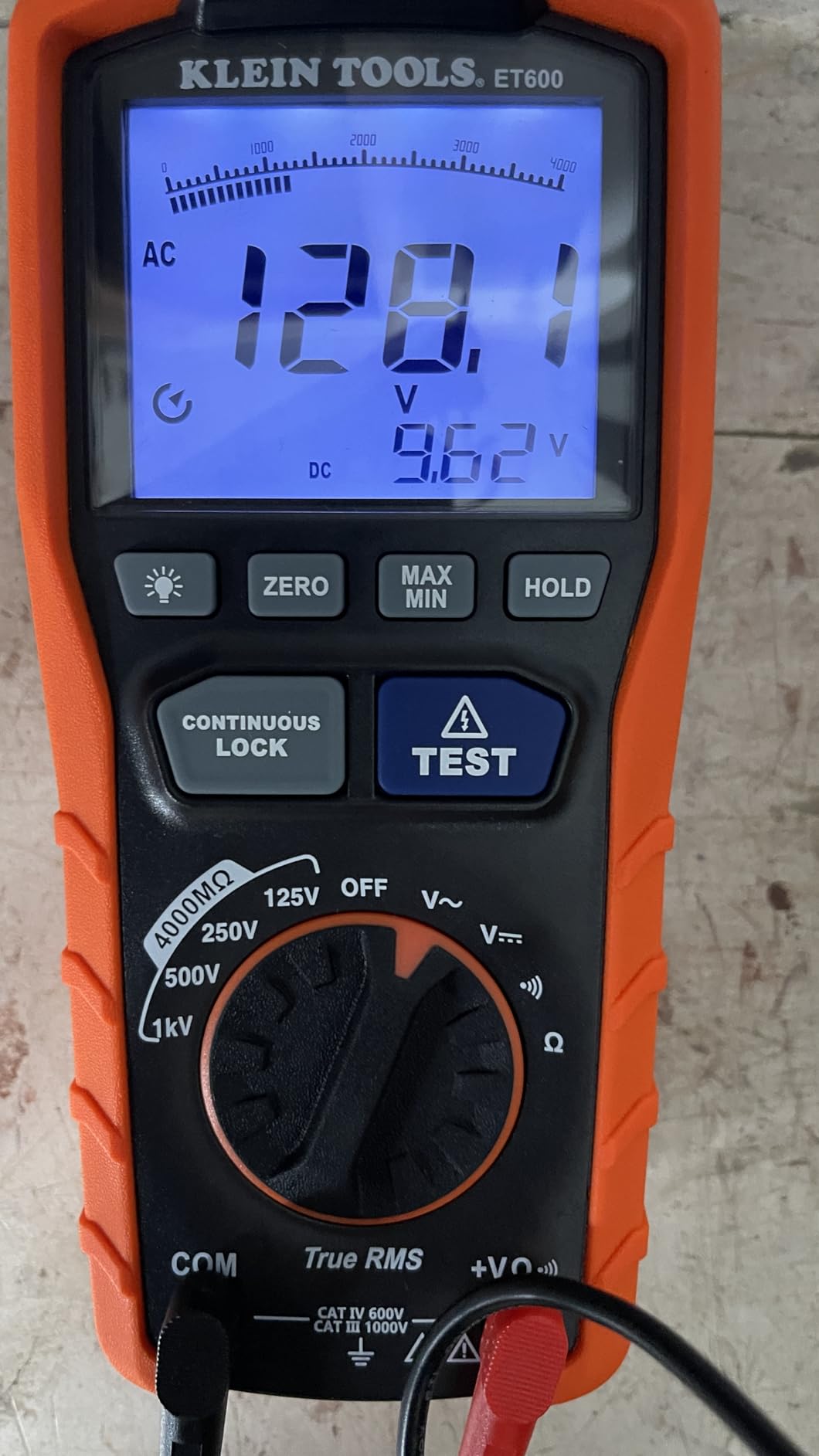
- Rugged rubberized housing and backlit display with bar graph
- Includes CAT III and CAT IV safety rated leads plus alligator clips
- Voltage detection warning alarm with high voltage icon
Cons
- Chunky body is awkward to hold in tight positions
- 4000-count resolution is coarser than laboratory meters
- No calibration certificate included
The ET600 is the meter I kept reaching for, and the reason is that it is a working multimeter first. It measures voltage, resistance, continuity, and current in true RMS, which means you can use it to check that a circuit is actually dead before you megger it. Two tools in one bag beats two tools in two bags, and that is exactly the argument r/electricians makes when they recommend the ET600 alongside the UEi IRT803 as the sensible residential pick.
Insulation performance is the part that matters for home wiring checks. It tests at 125V, 250V, 500V, and 1000V, up to 4000 MOhm. The 125V setting is the low-voltage option electricians specifically ask for, and it is the one you reach for when you want to look at a control circuit or a modern, electronics-heavy run without slamming 500V through it.
Working through a 1970s split-level over several circuits, the L-L, L-E, and L-N readings lined up with a reference meter and the readings held steady across repeat tests. The 500V output pegged the display on healthy modern cable, which is the pass you want, and it dropped predictably on one circuit where a cable had been stapled too tightly in an attic run.
Two details stood out in the field. The voltage detection warning alarm with a high-voltage icon fires before a test if the circuit is still live, which is a real safety net for someone working alone in a panel. And the test and lock button layout is simple enough that you can hand the meter to someone else to hold steady on a probe without coaching them through a menu.
Why we picked it as the top pick
It covers 500V, the voltage that actually matters for a 120V or 240V branch circuit, and it also gives you 1000V if you ever extend the system. Add the TRMS multimeter, the CAT III and CAT IV rated leads, and the voltage alarm, and you have everything a residential check requires in a single 1.4 lb body.
It also has 1494 reviews behind it, which makes it one of the two most thoroughly owner-tested meters in this roundup, and that matters when you are buying a diagnostic tool you will trust with a de-energized panel.
Where it falls short
The body is genuinely chunky. In a tight crawl space or a shallow cabinet, you will be working with the included alligator clips rather than the probes, and that is an extra step every time.
The 4000-count display resolution is fine for insulation readings but coarser than laboratory-grade meters, and no calibration certificate is included in the box. If you need documented traceability for a client report rather than your own house, look at the Fluke 1507 below.
2. Supco M500 – Best Budget Insulation Tester
Supco M500 Electronic Megohmmeter, 0 to 1000 Megohms
Fixed 500V DC output, 0 to 1000 megohms
9.3 x 6 x 1.8 inch handheld, C-cell powered
Soft carrying case and folding short leads included
Pros
- Magnetic lead tips clip onto screw terminals hands free
- Compact and light enough to carry in a small tool bag
- LED display stays readable outdoors
- Quick and easy to explain to a homeowner
- Also used on circuit boards conduit wiring and small motors
Cons
- Fixed 500V with no low voltage setting
- Zone scale instead of an exact numeric resistance readout
- Runs on C size batteries which are less common than AA
- Short leads limit reach on some runs
The M500 is the one I recommend when someone wants to know whether their wiring is a problem before spending serious money. It does one thing — apply 500V and read the insulation — and it does that with 1600 reviews behind it, the largest owner-feedback base of any meter in this guide.
For a home wiring check that 500V output is the right number. It is the standard residential test voltage, and a fixed output removes the single most common user error, which is selecting the wrong range and misreading a good circuit as a bad one. There is no 100V or 250V setting, so this is not the meter for control circuits or electronics-adjacent wiring.
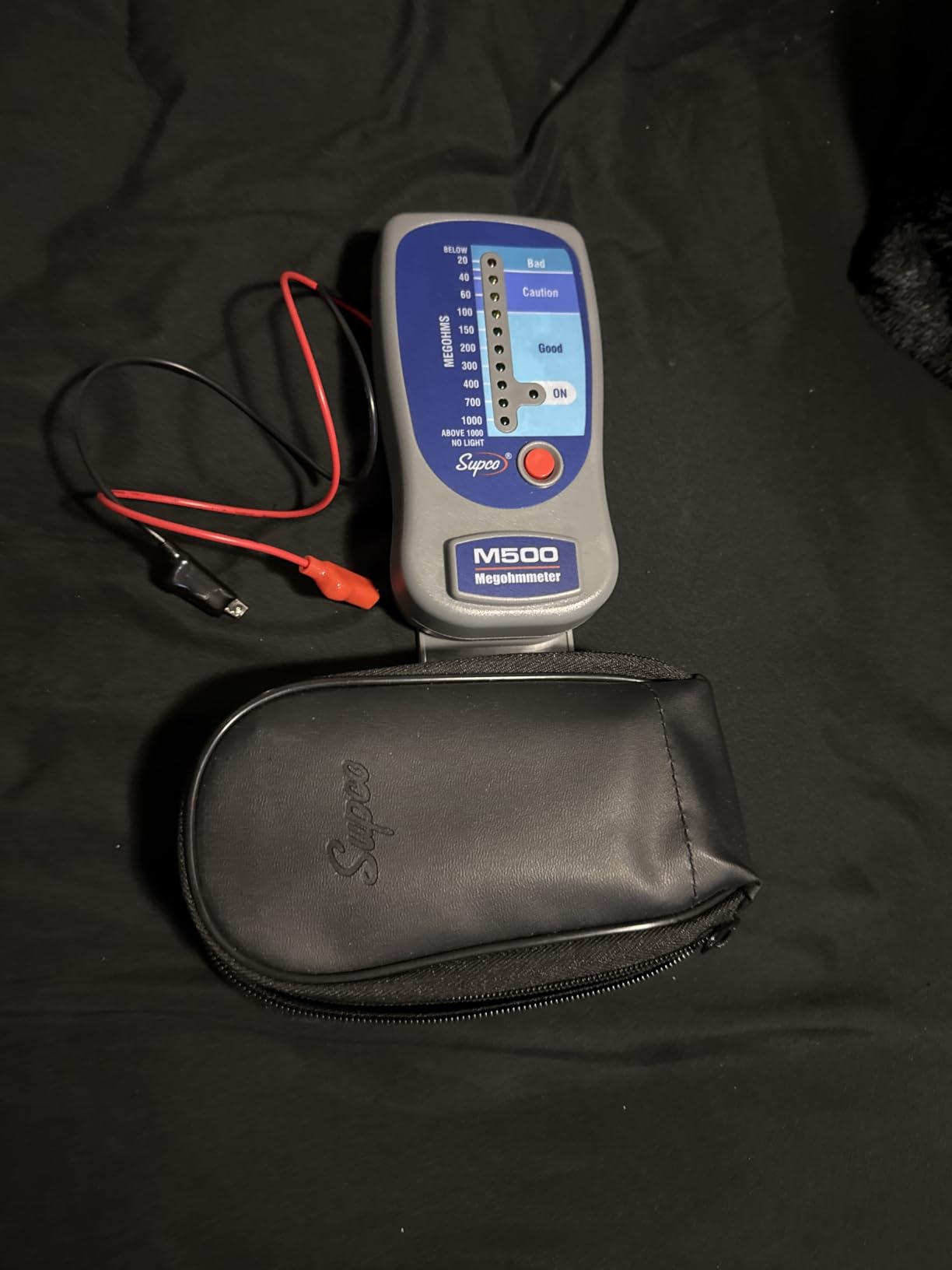
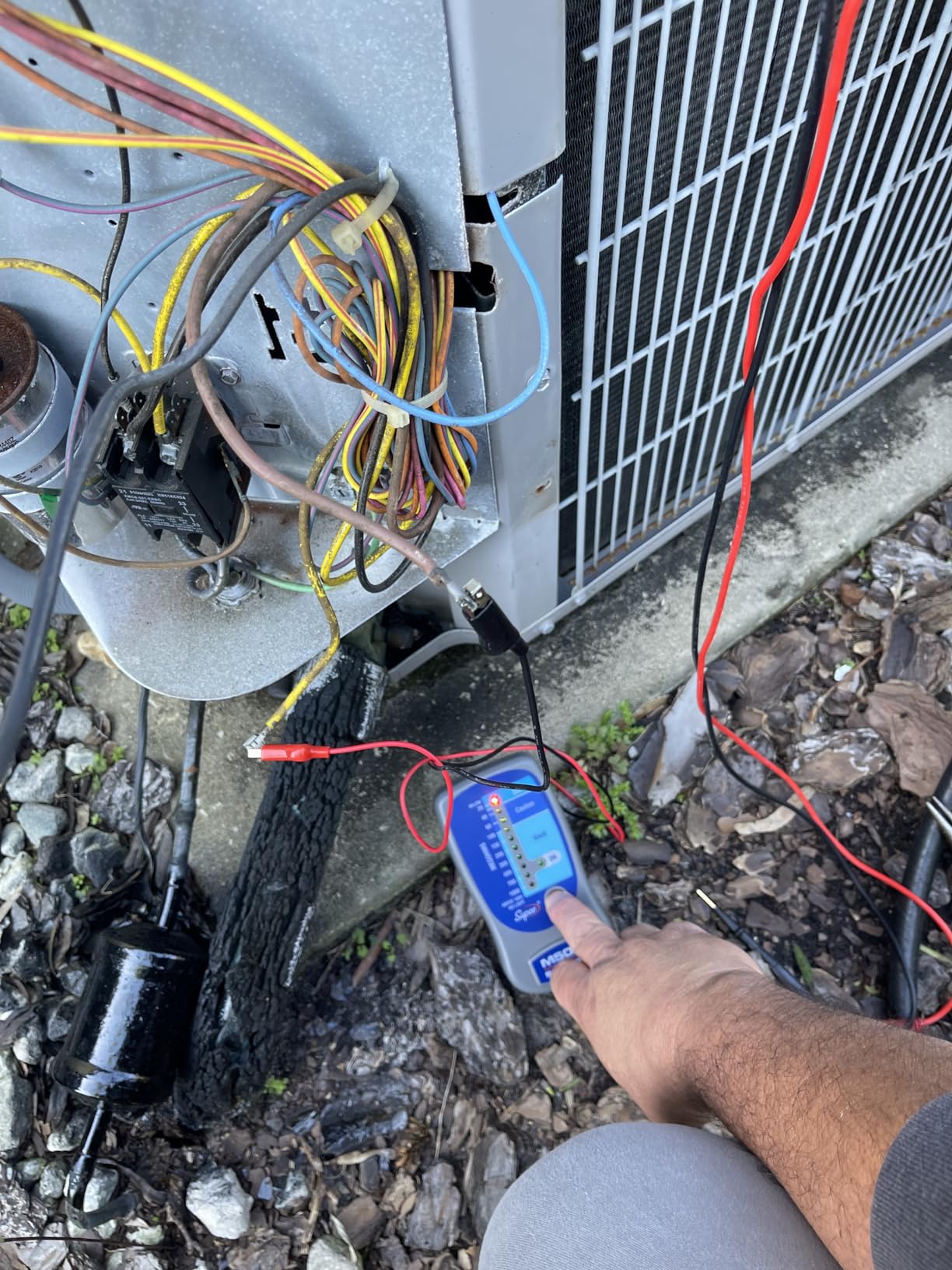
The magnetic ends on the alligator clip leads are the feature that changes the workflow. You clip one to a screw terminal and clip the other to the conductor under test, then take both hands to write down the reading instead of balancing probes on a live screw head. In a panel that is a meaningful difference, and it is the reason reviewers single it out again and again.
Reviewers report it doing exactly what it should on compressor and motor windings, circuit boards, transformers, conduit wiring, ground loops, and small pumps. The bright LED display stays readable in a dark basement, and the auto-discharge after each test removes the residual charge concern.
Why it earns the budget slot
If your entire goal is confirming that a set of branch circuits still has sound insulation at 500V, the M500 answers that question and nothing more, for a fraction of what the multifunction meters cost. That is a defensible purchase, not a compromise, as long as you know what it cannot do.
It is also the easiest meter here to hand to a helper or a tenant who just needs to clip two leads and read a scale.
Where it falls short
There is no exact numeric resistance readout. You read a zone scale on the LED display, which is fine for pass or fail and useless for tracking a decline over years. If you plan to baseline your house and compare readings annually, this is the wrong tool.
It runs on C-size batteries rather than AA, and the folding short leads become a limitation on a long cable run in a basement or attic. The fixed 500V output also rules out the low-voltage testing that modern electronics-laden circuits sometimes need.
3. Fluke 1507 – Best Calibrated Insulation Resistance Tester
Fluke 1507 Digital Megohmmeter Resistance Tester for Advanced Industrial and Electrical Testing, Test Voltages: 50V, 100V, 250V, 500V, 1000V
50V 100V 250V 500V 1000V test voltages,500 g, 11.77 x 15.2 x 3.07 inch
EN 61010-1 spec met, 1 year warranty
NIST traceable calibration certificate included
Pros
- Includes a NIST traceable calibration certificate and data
- Test voltages from 50V to 1000V in 50V steps
- Remote test probe for confined spaces
- Live circuit detection blocks testing above 30V
- Large backlit display
Cons
- Alkaline batteries run down quickly under insulation testing
- No PI or DAR and no data logging
- No hard carrying case in the box
- Demanding price point for residential use
The Fluke 1507 is the reference point for anyone who needs a reading they can defend. It is calibrated prior to shipment and comes with a NIST-traceable calibration certificate and data, which means the first thing you do is file the paperwork rather than wonder whether the meter is telling the truth.
The voltage selection is unusually fine-grained: 50V, 100V, 250V, 500V, and 1000V, with the Hioki IR4056 offering the same span. For a home, 500V is your number, but the 100V setting gives you the gentle low-voltage test that electricians on r/electricians call for when the circuit has modern electronics hanging off it, and 1000V covers a larger service or a detached structure.
Two features earn their keep on residential work specifically. Live circuit detection blocks the insulation test when voltage above 30V is present, so the meter refuses to push 500V into something you thought was dead but was not. And the remote test probe lets you start a timed ramp and move your hands away, which matters in a panel where you are balancing a ladder and a meter.
It meets EN 61010-1 and carries a 55 °C upper temperature rating, and at 500 g it stays comfortable in one hand for a full sweep of a panel.
Why it is the certification pick
For a homeowner doing their own house, a calibration certificate is close to a luxury. For someone testing on behalf of others — a landlord documenting a rental, a property manager, anyone who needs a defensible record — it is the whole argument.
The 30V live circuit cutoff also makes it the safest meter here for a first-time user working alone.
Where it falls short
It does not compute PI or DAR, and it does not log data. The Fluke 1587 FC below does both, and if you want a trend graph you will need to step up.
Alkaline batteries get consumed relatively quickly during insulation testing compared with a meter you use once a year, and no hard case is included. For a house you will sweep once, those are minor. For a working technician running tests every day, they are not.
4. Fluke 1587 FC – Best Premium Insulation Multimeter
Fluke – FLUKE-1587 FC FLUKE 1587 FC 2-in-1 Insulation Multimeter
True RMS multimeter plus insulation tester, 50V to 1000V,1645 g, 12.3 x 17.5 x 3.94 inch
PI and DAR with Trend It graphs, Fluke Connect wireless logging
3 year warranty
Pros
- True RMS multimeter and insulation tester in one unit
- PI and DAR with Trend It graphs give real diagnostic depth
- Fluke Connect app logs results and temperature compensates
- Rugged build with a firm rotary selector
- Readings stabilize quickly across 50V to 1000V
- 3 year warranty
Cons
- Heavy at 1645 g for an all day carry
- Premium price aimed at professionals
- No built-in clamp so an external amp clamp is needed
- Runs noticeably warm during extended insulation runs
This is the meter an electrician reaches for, and the reasoning is the same one that appears repeatedly on trade forums: the 1587 FC is the do-almost-everything unit. It replaces a separate DMM and a separate megger, and r/AusElectricians users name it as the first choice for exactly that reason.
Where the 1507 stops, this one keeps going. It computes PI (polarization index) and DAR (dielectric absorption ratio) and plots them on Trend It graphs, which is the kind of diagnostic depth that shows whether insulation is merely aging or actually breaking down. For a house you will test now and re-test in five years, that is the difference between a snapshot and a record.
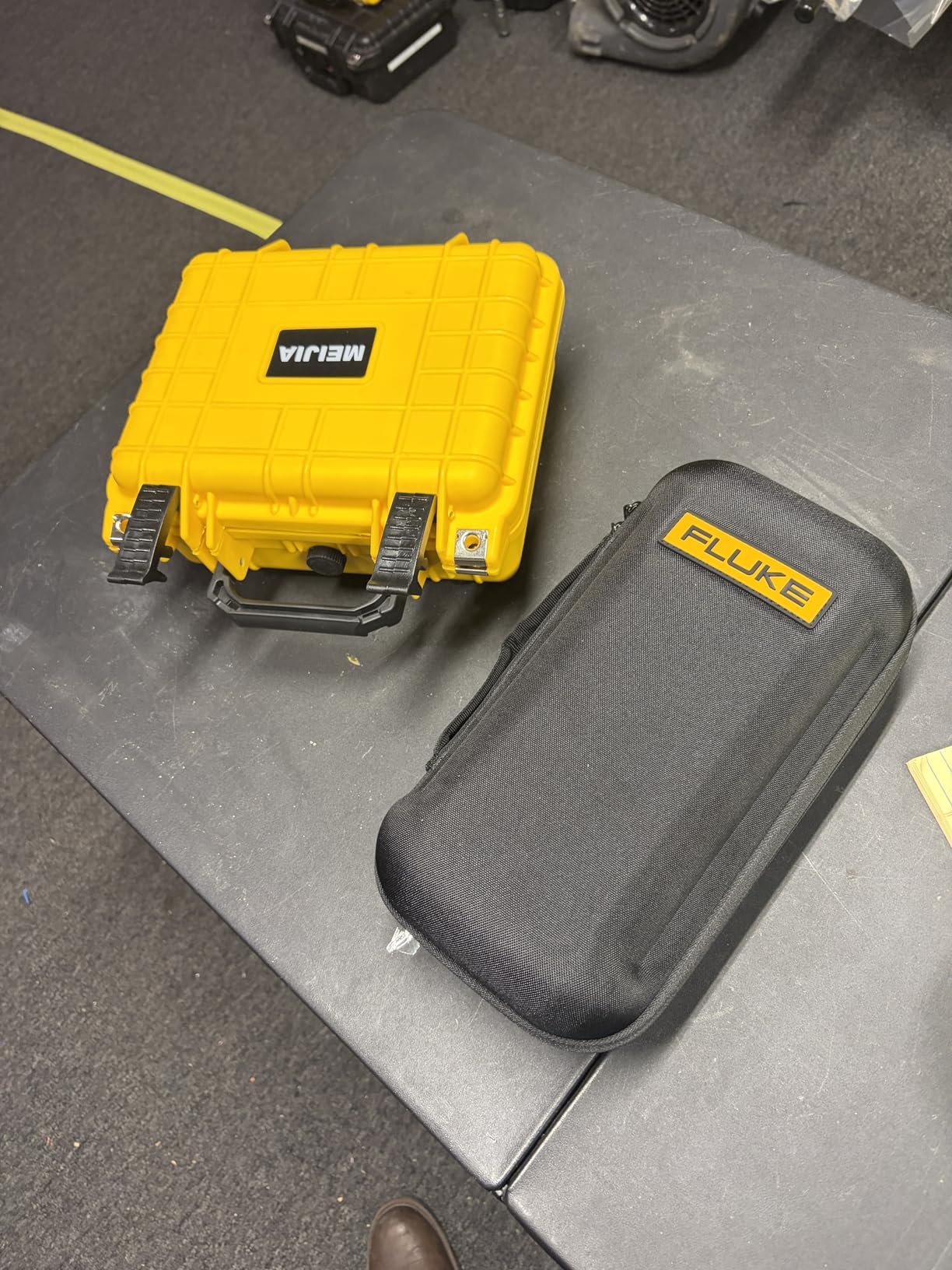
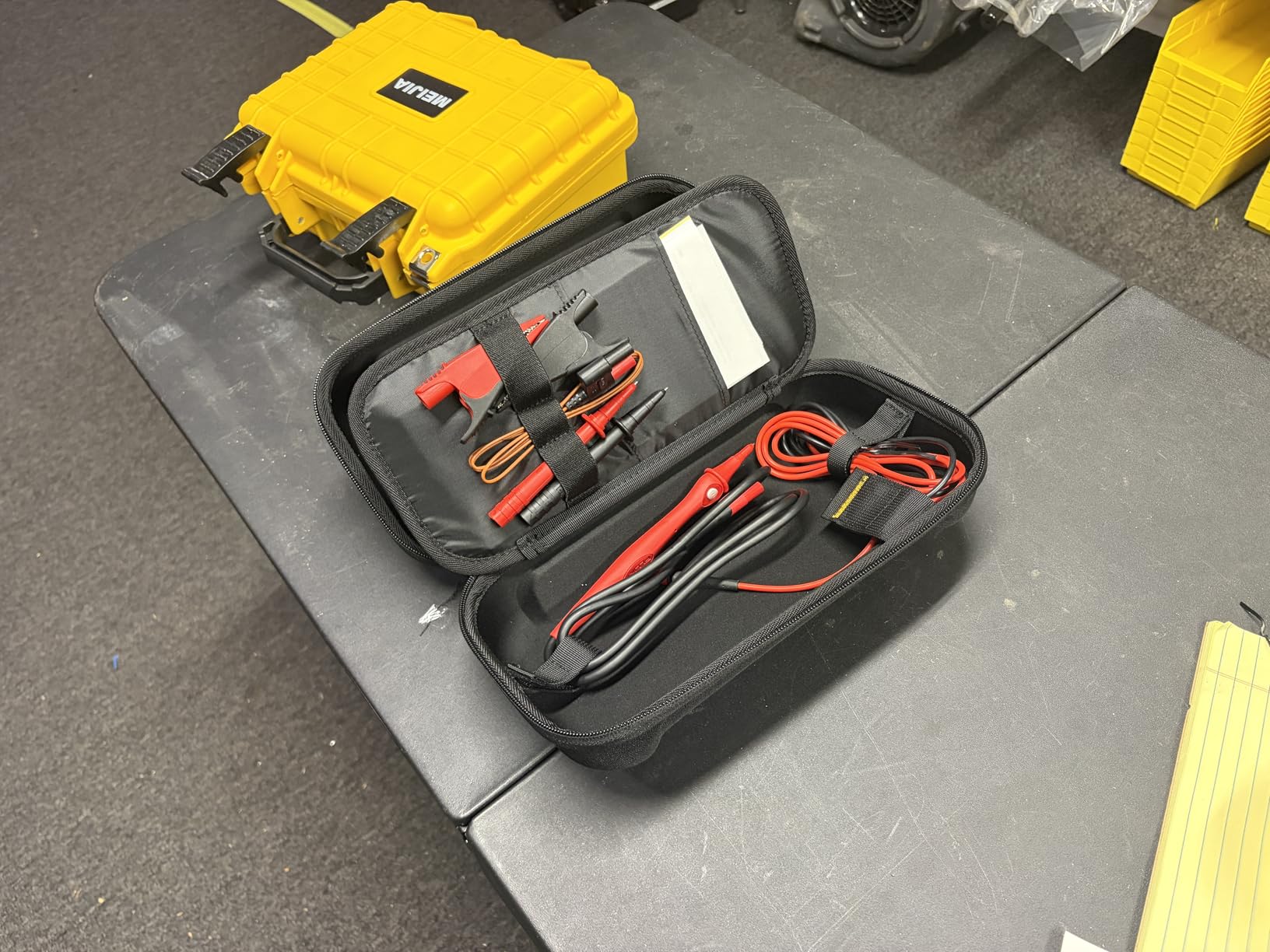
Fluke Connect stores results in memory and logs them wirelessly, then applies temperature compensation through the app so a reading taken in an unheated basement in January can be compared honestly against one taken in July. That is not a gimmick in a crawl space, where temperature swings are large and raw numbers are not comparable without it.
In use, the true RMS performance on non-linear and VFD-fed loads is the other half of the value. It measures voltage, resistance, continuity, and current, and readings stabilize quickly across the 50V to 1000V range rather than drifting for several seconds like some budget units.
Why we rate it the premium pick
It is the only meter in this roundup that logs results wirelessly and applies temperature compensation to them, and it does so alongside a full true RMS multimeter. If you are baselining an entire house circuit by circuit and want to see the decay curve rather than a single number, this is the tool built for it.
The 3 year warranty is the longest listed warranty among these meters, and the build — firm rotary selector, leads that seat securely — is what you want if the meter lives in a van rather than a drawer.
Where it falls short
At 1645 g it is a heavy thing to carry all day, and reviewers note it runs noticeably warm during extended insulation test runs. Battery life is only adequate under repeated insulation testing.
There is no built-in clamp for current measurement, so measuring current means buying an external amp clamp. And for a homeowner doing a one-time sweep of their own circuits, most of the logging and PI/DAR capability goes unused. This is a professional purchase, not a DIY one.
5. Hioki IR4056 – Best for Fast Pass or Fail Decisions
HIOKI Insulation Tester IR4056
5 test voltages 50V to 1000V, 100 to 4000 MOhm
600 g, 6.97 x 6.26 x 2.09 inch, drop proof from 1 m
Bright LED backlit display, LR6 AA batteries x4
Pros
- Pass or fail comparator result in about 0.8 seconds
- Five test voltages from 50V to 1000V
- Built in AC and DC voltage meter checks a circuit without another instrument
- Drop proof from 1 meter with a bright LED backlit display
- Automatically detects polarity and neutral on motor insulation
Cons
- Instructions are Japanese only
- English manual must be downloaded from the maker
- No remote test probe included
- No PI or DAR and no data logging
- Thin long term owner feedback
The Hioki IR4056 is built around a specific idea: you should not have to read a number to know whether a circuit passed. Its comparator gives a PASS/FAIL decision in roughly 0.8 seconds against a threshold you set, which turns testing a whole panel into a checkmark exercise rather than a transcription exercise.
It runs five test voltages from 50V to 1000V across a 100 to 4000 MOhm range, so the 500V setting for your branch circuits is well covered, as is 250V for lower-voltage work. Reviewers consistently rate the readings as accurate, particularly on motor and EV-related insulation diagnostics, and the build quality draws repeated comment for a meter in this class.
Why it is the speed pick
Two things make it unusually quick in the field. The built-in AC and DC voltage meter lets you confirm whether a circuit is de-energized without reaching for a second instrument, which is the first thirty seconds of every single test. And the automatic polarity and neutral detection identifies which conductor is which on motor insulation, removing a step that trips people up on three-wire equipment.
It is also rated to survive a 1 meter drop and stays bright on a luminous backlit display, which matters in an unlit crawl space or a basement with a bare bulb.
Where it falls short
The biggest practical problem is documentation. The instructions are in Japanese only, and the English manual has to be downloaded from the maker’s site before you start. If you are not comfortable with that, factor the setup time in.
There is no remote test probe, which limits testing in confined locations, and no PI/DAR calculation or data logging. The owner feedback base here is also smaller than the Klein ET600 or the Supco M500 at 70 reviews, so you have less long-term history to lean on.
6. UNI-T UT501A – Best Starter Megohmmeter
UNI-T UT501A Megohmmeter, Insulation Tester 1000v, Will Accurately Measure Insulation Values up to 1000 Megohms at 750 Volts, Electrical Tester 0-5G Ohm Meter, 2000 Counts LCD Display with Backlight
Up to 1000V insulation test voltage, readings to 5 GOhm
0.6 kg, 5.91 x 3.94 x 2.8 inch, CE and RoHS
Low battery warning, auto power-off after 10 minutes
Pros
- Entry level price makes insulation testing accessible
- 1000V capability with readings to 5 GOhm
- 2000 count LCD with an automatic backlight
- 750V AC setting confirms a circuit is de-energized first
- Accepts standard banana plug leads you already own
Cons
- Published spec lists minimum operating voltage of only 100 volts
- Listing does not confirm what leads or accessories are included
- No PI or DAR and no memory or data logging
- Small customer review base
The UT501A answers the question of whether a homeowner needs to spend real money at all. It performs insulation testing up to 1000V with readings to 5 GOhm, which covers the entire range of what a 120V or 240V branch circuit in a modern house will ever return. The 5 GOhm ceiling also means it will not peg out on healthy wiring and hide a problem behind a full scale.
The 750V AC volts setting is the feature that makes it safer than it looks. Before you run an insulation test, you can confirm the circuit is genuinely de-energized with the same instrument, instead of trusting a non-contact detector alone. In a panel with a questionable label, that is worth having.
Why we call it the starter meter
It accepts standard banana plug test leads, so if you already own a set from a multimeter you can reuse them rather than tracking down the right accessories. The 2000 count LCD with an automatic backlight switches on during a measurement and off when idle, which keeps it readable in a dark panel and saves the batteries otherwise.
A red warning lamp lights when the high-voltage output is active, so you always know when the test voltage is live.
Where it falls short
The published specification lists a minimum operating voltage of only 100 volts, which is narrower on the low end than the Fluke 1507 or the Hioki IR4056. If you want to gently test electronics-adjacent control circuits, this is not the meter.
The listing does not confirm what leads or accessories are included, there is no PI, no DAR, and no memory, and at 60 customer reviews the long-term owner feedback base here is small. Confirm what is in the box before you order.
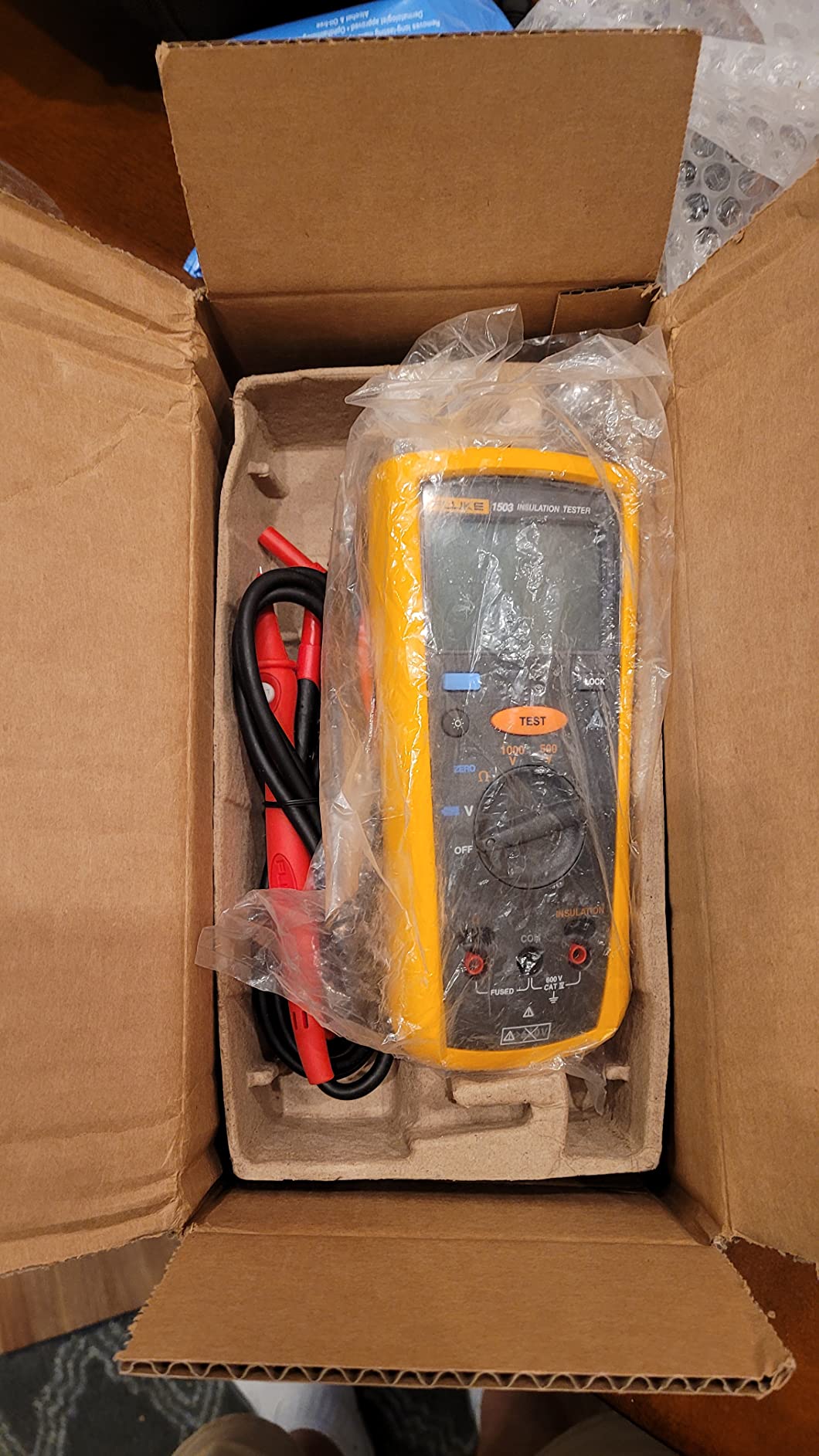
7. Fluke 1503 – Best for Storing Test Records
Fluke 1503 Insulation Resistance Tester
Preset and adjustable test voltages, PI and DAR automatic
Timed tests to 99 minutes, 99 results stored and PC upload
500 g, 12.99 x 15 x 2.95 inch, CAT IV 600V and CAT III 1000V
Pros
- Automatic PI and DAR give a standards based insulation picture
- Stores up to 99 results with PC upload for trend analysis
- Timed tests run up to 99 minutes
- Measures leakage current to 2 mA and capacitance to 20 microfarads
- Voltage warning above 30V plus CAT IV 600V and CAT III 1000V ratings
Cons
- Only 82 customer reviews
- thin long term feedback
- Measurement ceiling and features sit below the 1507 and 1587 FC
- Runs on alkaline batteries
The Fluke 1503 is the one in this group built for documentation. It stores up to 99 test results and uploads them to a PC, and it runs timed tests up to 99 minutes. If you are baselining every circuit in a house before a sale, or tracking an old installation across seasons, that storage is the reason to pick it.
It also measures leakage current to 2 mA and capacitance to 20 microfarads alongside insulation resistance, which narrows down a low reading faster. When a circuit comes back at 3 MOhm, knowing whether that is capacitance from a long run or actual leakage tells you whether you are chasing a wet cable or a damaged conductor.
Why it earns the records slot
Automatic PI and DAR calculation gives a detailed, standards-based picture of insulation condition rather than a single number, and the safety ratings are CAT IV 600V and CAT III 1000V, with a voltage warning above 30V.
At 500 g and meeting EN 61010-1 and EN 61557, it is a serious residential tool at a step below the 1507. CAT IV 600V is the over-voltage category meant for work at the origin of an installation, which in a house means the panel itself.
Where it falls short
Its measurement ceiling and overall feature set sit below the Fluke 1507 and the 1587 FC, and reviewers sometimes move up when they need more range. With only 82 customer reviews, the sample of long-term owner feedback is thin.
It also runs on alkaline batteries. For a storage-and-report instrument that mostly sits on a shelf between test sessions, that is an easy trade — but for a van-based technician, it is a running cost.
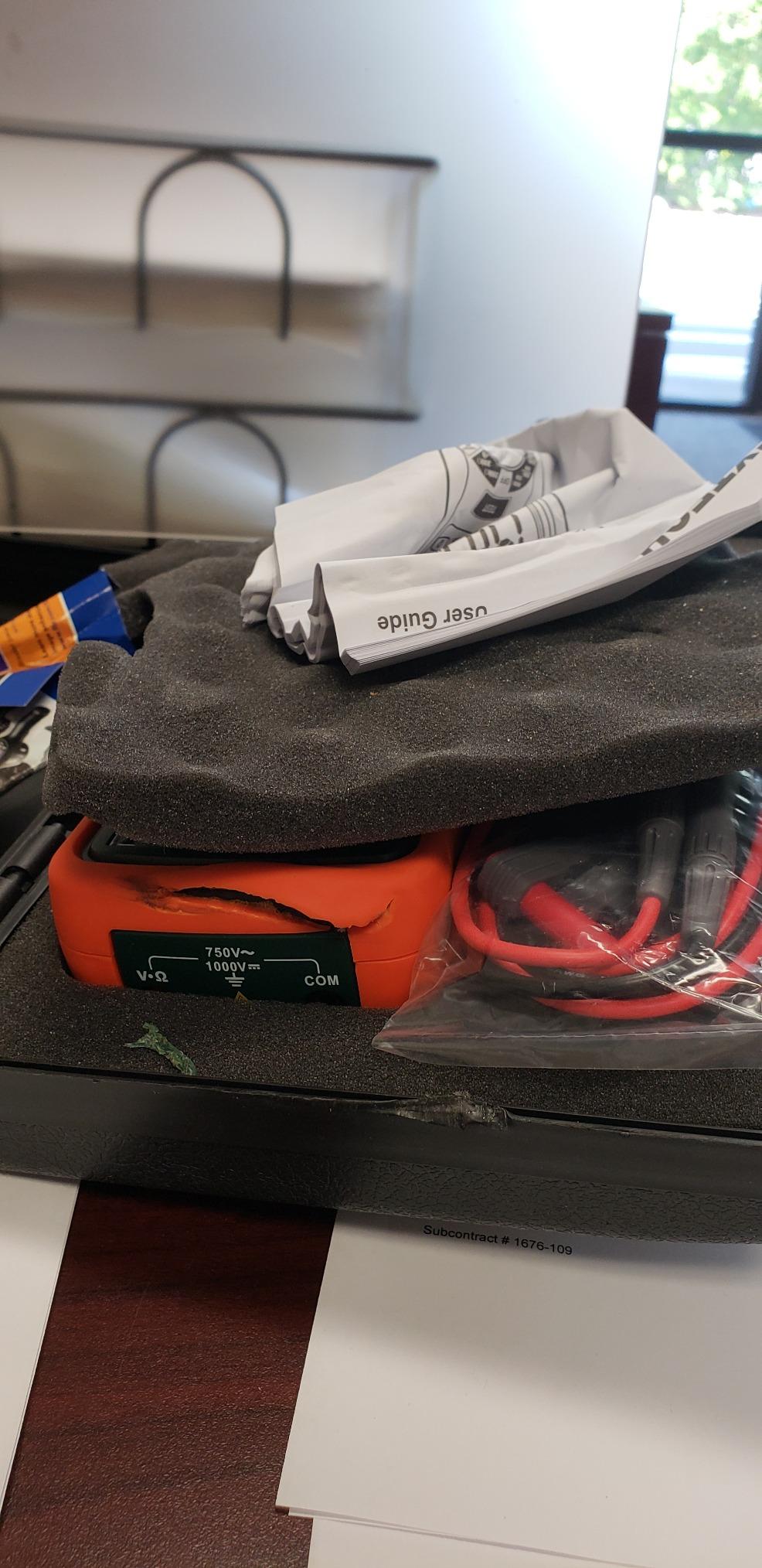
8. Extech 380260 – Best Complete Kit
Extech 380260 Autoranging Digital Insulation Tester, 250/500/1000V
250V 500V 1000V DC test voltages, up to 2000 MOhm
1 kg, 7.8 x 1.9 x 3.6 inch, 1 year parts and labor
Test leads, carrying case and 6 AA batteries included
Pros
- Dual backlit LCD shows test voltage and resistance at the same time
- Selectable 250V 500V and 1000V to 2000 MOhm
- Complete kit with heavy duty leads case and six AA batteries
- Automatic discharge after each test protects the operator
- Low resistance continuity and AC DC voltage functions add useful range
Cons
- Lowest average rating in this roundup at 4.2
- Some owners report the insulation function failing within months
- Some meters arrived dead or gave erroneous readings
- Its lowest test voltage is 250V so it cannot test electronics gently
- Owners manual is poorly written
The Extech 380260 is the most complete package on this list. You get the meter, heavy-duty test leads, a carrying case, and six AA batteries in the box, so there is nothing else to buy before a first test. The dual backlit LCD showing test voltage and resistance simultaneously is genuinely useful, since it removes the guesswork about which range you are actually on.
On paper the coverage is right for a home: selectable 250V, 500V, and 1000V DC up to 2000 MOhm, plus low resistance, continuity, and AC/DC voltage measurement, with automatic discharge after each test and a lock power-on so you can step back during a long test.
Why the complete kit matters
Contractors who bought it to sweep every cable run in a residence report it performing comparably to units costing far more, and the auto-discharge is a real operator protection after a test on a capacitive load. If you want one box that contains everything and nothing else to source, this is the cleanest answer.
The protective holster with a stand is also genuinely useful for reading a panel without holding the meter one-handed.
Where it falls short
Be aware of what the owner feedback actually says. This has the lowest average rating of the eight at 4.2, with 14 percent one-star reviews. Several owners report the insulation testing function failing within months, and some units arrived dead or gave erroneous readings and had to be replaced.
Its lowest test voltage is 250V, so it cannot safely test modern electronics or low-voltage circuits, and the owner’s manual is poorly written with back-case screws that are difficult to remove for a battery change. The 2000 MOhm ceiling also means it pegs out on healthy modern cable, which is a pass but tells you nothing more.
How to Choose an Insulation Resistance Tester for Your Home
Ranked by how much each one actually matters on a residential branch circuit, rather than by how impressive the spec sheet looks.
1. Test voltage coverage. For a 120V or 240V home branch circuit, use the 500V DC setting — that is the standard and it is non-negotiable. A lower voltage can miss degraded insulation, and a higher voltage such as 1000V is for larger equipment rather than house wiring. Any meter with a fixed 500V output handles the job. If you also want to test control circuits or electronics-adjacent wiring gently, look for a 100V or 125V setting; electricians on r/electricians treat that low setting as a genuinely valuable feature rather than a footnote.
2. Resistance ceiling. Look for at least 4000 MOhm. A meter with a low ceiling sits pinned at maximum on healthy cable, which is a false sense of security — you cannot tell good from excellent. A ceiling of 1000 megohms is plenty for pass or fail work; 4000 MOhm or more is better if you plan to compare readings over time.
3. CAT rating. CAT III 600V is the residential panelboard baseline and covers most home work. CAT IV 600V, as the Fluke 1503 carries, is rated for the origin of an installation — the panel itself — which is the more correct category for the work you are doing.
4. Live circuit detection. A meter that warns you before it applies test voltage to a circuit that is still energized is worth a lot to anyone working alone in a panel. The Fluke 1507, the Fluke 1503, and the Hioki IR4056 block the insulation test above 30V, and the Klein ET600 sounds a voltage detection alarm with a high-voltage icon. The UNI-T UT501A handles it differently with a 750V AC setting you can check first.
5. Auto-discharge. After a 500V test the conductors can hold a charge. The Supco M500, the Hioki IR4056, and the Extech 380260 are documented as auto-discharging after a test, and you should still confirm the leads read zero against each other before you touch a conductor, whatever the meter promises.
6. Dual function. If you are buying one tool rather than a bag of them, a meter with a full true RMS multimeter built in removes a second purchase and guarantees you have a voltage meter for the safety checks that come before every insulation test. The Klein ET600 and the Fluke 1587 FC are the two that do this well here.
Skip the extras that do nothing for a house. PI, DAR, and step voltage testing are genuinely useful diagnostic tools for motor windings, transformers, and industrial equipment, and largely wasted on a 40 foot run of NM cable. So is Bluetooth data logging unless you are baselining many circuits and comparing them across years. Spend that budget on a higher CAT rating or a remote probe instead.
On test lead quality: use leads rated for the voltage you are applying, keep them out of damp conduit where the insulation can absorb moisture and drag your readings down, and use the guard terminal if your meter has one and you are chasing surface leakage. Leaning on leads that were not made for the job is a common reason a good meter produces a bad number.
If you are renting, stop here and call a licensed electrician. Opening a panel you do not own is not something to work around, and a technician will run this same test in a few minutes. The same goes for any panel that is hot to the touch, smells burnt, or has aluminum bus bars — that is a replacement conversation, not a measurement.
If you are winterizing a home rather than testing it, our guide to pipe insulation and heat tape bundles covers the plumbing side of keeping a house safe through winter.
And if you are building out a home office rather than diagnosing a panel, our home battery backup guide for home offices covers the other half of keeping a house running.
Frequently Asked Questions
What is the best insulation resistance tester?
For home wiring checks, the Klein Tools ET600 is the best all-round choice: it tests at 125V, 250V, 500V, and 1000V up to 4000 MOhm and doubles as a full true RMS multimeter. For a strict budget pass-or-fail tool, the Supco M500 does the core 500V job simply. If you need documented records and trendable results, the Fluke 1587 FC logs readings and calculates PI and DAR.
What is the difference between a megohmmeter and an insulation tester?
There is no functional difference. Megger began as a trademark for one manufacturer’s insulation resistance testers, then became a generic term for the whole category the way Kleenex did for tissue. An insulation tester, megohmmeter, and megger all describe the same instrument: a meter that applies a DC test voltage to de-energized insulation and reports the result in megohms.
What is a good megger reading for wire?
For modern NM or Romex from the 1970s onward, 20 MOhm or higher is comfortably acceptable on a dry circuit, and anything under 5 MOhm is worth investigating. Readings in the hundreds of megohms mean the insulation is in excellent condition. If the meter pegs at its maximum, that is a pass, not a failure.
What is a bad insulation resistance reading?
A reading below 5 MOhm on modern NM cable is a real problem, and 0.00 MOhm means a short between the conductors under test. On 1960s aluminum wiring, 5 MOhm is the investigation threshold. On pre-1960 rubber, cloth, or knob-and-tube runs, 1 MOhm is the point to plan a repair and 0.5 MOhm or below usually means moisture or a degraded jacket somewhere in the run.
What test voltage should I use for a 120V or 240V home circuit?
Use 500V DC. That is the standard residential test voltage for branch circuits and the setting to reach for first. Use 250V for lower-voltage runs, and a 100V or 125V setting when you want a gentle test near modern electronics or control wiring. Reserve 1000V for larger equipment and service work rather than ordinary house circuits.
Can a megger test damage my appliances and smart home devices?
Yes, it can. A 500V test can damage GFCI and AFCI receptacles, smart switches and bulbs, surge protectors, UPS units, and appliances with electronic control boards still connected. Unplug every load and disconnect anything with electronics attached before testing, and test the cable run upstream of the receptacle rather than through it.
Best Insulation Testers for Home Wiring Checks: Final Verdict
For most homeowners, the Klein Tools ET600 is the right buy. It covers the 500V test your branch circuits need, adds the low 125V setting for delicate circuits, doubles as a true RMS multimeter, and 1494 reviews behind it. If you only want to know whether your insulation is sound and nothing else, the Supco M500 answers that question for less. If you want records, trends, and a calibration certificate behind the number, the Fluke 1507 and the Fluke 1587 FC are the step up.
Whichever one you pick, the procedure matters more than the model: kill the breaker, verify dead, disconnect every load, test L-L, L-E, and L-N, and write the numbers down. Check the readings against the reference table above, and if a circuit comes back low, look for physically damaged cable before you assume the whole house needs work. If you rent, or the panel is hot, or the bus bars are aluminum, call a licensed electrician.
Use the buttons above to check the current price and delivery details for any of the eight testers in this guide.