
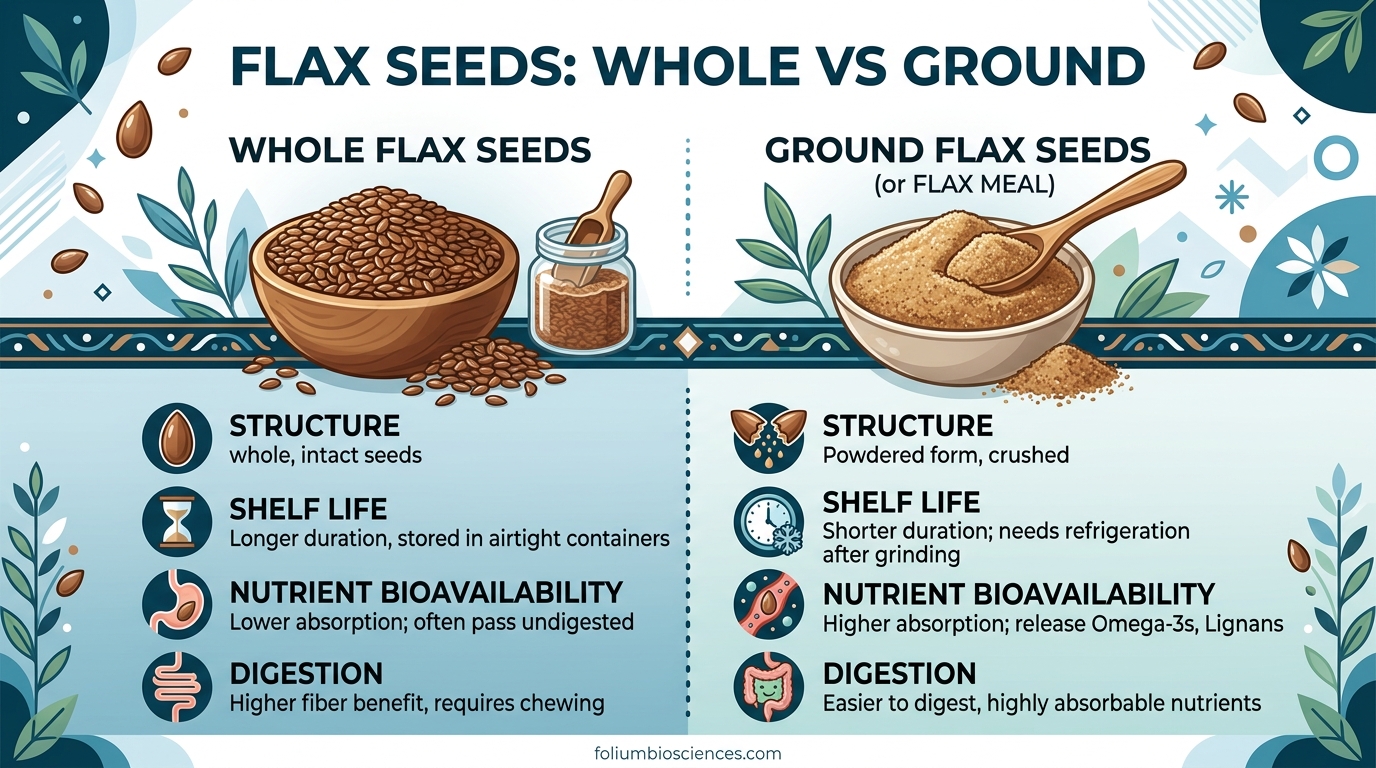
Ground flaxseed delivers significantly more omega-3 fatty acids than whole flaxseeds. The tough outer shell of whole flaxseeds prevents your digestive system from accessing the alpha-linolenic acid (ALA) inside, causing the seeds to pass through your body largely undigested. When you grind flax seeds, you break down these protective cell walls and unlock the nutritional benefits contained within.
Eating whole flaxseeds might seem like a convenient way to boost your omega-3 intake, but you are essentially missing out on the primary benefit. Our team has reviewed the research extensively, and the evidence is clear: grinding transforms flax from a fiber supplement into a potent omega-3 source.
In this guide, we will explore exactly why flax seeds whole vs ground matters for your health, the science behind nutrient absorption, and practical ways to incorporate ground flax into your daily routine.
Table of Contents
Flax Seeds Whole vs Ground: The Science Behind Grinding
Flaxseeds have a remarkably tough outer shell called the seed coat, composed primarily of cellulose and lignin. These compounds are indigestible by humans because we lack the enzymes needed to break them down. Think of it like a fortress protecting a treasure: the omega-3 fatty acids, lignans, and other nutrients remain locked inside unless you break through the walls.
When you consume whole flaxseeds, they pass through your stomach and intestines intact. Studies show that whole seeds can be found in stool samples virtually unchanged, meaning your body absorbed minimal nutrients from them. This is not just about missing out on omega-3s. The lignans, fiber, and antioxidants also remain trapped.
Grinding mechanically ruptures the cell walls of the seed. This process exposes the nutrient-rich endosperm and embryo, making alpha-linolenic acid (ALA), protein, and lignans available for absorption. The particle size matters too: finely ground flaxseed releases more nutrients than coarsely cracked seeds.
The Anatomy of a Flaxseed
A flaxseed consists of three main parts: the outer seed coat (testa), the endosperm (storage tissue), and the embryo (the living part of the seed). The seed coat is approximately 30% of the seed’s weight and contains most of the insoluble fiber. The interior contains the oil-rich endosperm where ALA is concentrated.
The seed coat is remarkably durable. It can withstand soaking in water for 24 hours without breaking down. This natural protection helps the seed survive in nature until conditions are right for germination. However, it also means your digestive enzymes cannot penetrate it during the normal transit time through your gastrointestinal tract.
Nutritional Comparison: Whole vs Ground Flaxseed
Both whole and ground flaxseed contain the same nutrients initially. The difference lies entirely in bioavailability: how much your body can actually absorb and use. Here is a breakdown of what you get from two tablespoons of each form.
| Nutrient | Whole Flaxseed (2 tbsp) | Ground Flaxseed (2 tbsp) | Bioavailability |
|---|---|---|---|
| Calories | 110 | 110 | Full absorption |
| Total Fat | 8.5g | 8.5g | Whole: 10-20% | Ground: 90%+ |
| Omega-3 (ALA) | ~6.4g | ~6.4g | Whole: Minimal | Ground: High |
| Fiber | 5.5g | 5.5g | Whole: Insoluble only | Ground: Both types |
| Protein | 4g | 4g | Whole: Low | Ground: Moderate |
| Lignans | High content | High content | Ground significantly better |
The table reveals a critical truth: the nutritional content on the label is nearly identical, but your body’s ability to access those nutrients differs dramatically. With whole flaxseeds, you are consuming the nutrients without absorbing them. With ground flaxseed, you unlock the full potential.
The Fiber Factor
Whole flaxseeds do provide some benefit as a source of insoluble fiber. They can add bulk to stools and may help with regularity. However, ground flaxseed offers both soluble and insoluble fiber in forms your body can utilize. The soluble fiber in ground flax forms a gel-like substance that helps regulate blood sugar and cholesterol levels. You simply cannot access this from whole seeds.
Understanding ALA and the Omega-3 Conversion Process
Alpha-linolenic acid (ALA) is the omega-3 fatty acid found in flaxseed. It is an essential fatty acid, meaning your body cannot produce it and must obtain it from food. However, ALA is not the same as the omega-3s found in fish oil, EPA and DHA.
Your body can convert ALA into EPA and DHA through a series of enzymatic reactions. However, this conversion process is remarkably inefficient. Research indicates that only 5-10% of ALA converts to EPA, and just 2-5% converts to DHA. This means that from a 2-tablespoon serving of ground flaxseed containing 6.4 grams of ALA, your body might generate only 300-600mg of EPA and 100-300mg of DHA.
Why is conversion so limited? Several factors compete for the same conversion enzymes. The omega-6 fatty acids common in modern diets use the same enzymatic pathway. When you consume high amounts of omega-6 (from vegetable oils, processed foods, and nuts), you effectively block ALA conversion. This is why the ratio of omega-6 to omega-3 in your diet matters significantly.
For vegetarians and vegans who do not consume fish, ground flaxseed remains one of the best plant-based sources of omega-3s. Just understand that you need to consume more ALA to achieve equivalent EPA/DHA levels compared to eating fish directly. Aim for 1-2 tablespoons of freshly ground flaxseed daily for meaningful omega-3 benefits.
How to Grind Flaxseed at Home
You do not need specialized equipment to grind flaxseed effectively. Here are the best methods depending on what you have available in your kitchen.
Method 1: Coffee Grinder (Best Results)
A dedicated coffee grinder produces the finest, most consistent grind. Use short pulses rather than continuous grinding to prevent heat buildup. Grind only what you need for a few days, as the oils oxidize quickly once exposed. Clean the grinder thoroughly afterward to prevent rancid oil flavors from transferring to your coffee.
Method 2: Blender
A standard blender works well for larger batches. Add at least half a cup of flaxseeds to ensure the blades can catch and grind them effectively. Pulse in short bursts, shaking the container between pulses to redistribute the seeds. You may need to stop and scrape down the sides several times. The result will be slightly coarser than a coffee grinder, but still effective.
Method 3: Food Processor
For very large batches, a food processor can handle several cups at once. Use the metal blade attachment and pulse until you achieve a fine meal consistency. Be patient: it takes longer than a coffee grinder but works well for bulk preparation. Store the ground flaxseed in an airtight container in the freezer immediately after grinding.
Method 4: Mortar and Pestle
If you lack electric appliances, a mortar and pestle will work for small amounts. This method requires more effort and produces a coarser grind, but it is effective for single servings. The manual grinding also generates no heat, which helps preserve the delicate omega-3 fatty acids.
Temperature Considerations
Heat damages omega-3 fatty acids. When grinding, avoid prolonged grinding sessions that generate friction heat. Short pulses with cooling breaks between sessions help maintain nutritional integrity. This is why cold-milled flaxseed products advertise their processing method: lower temperatures mean better preserved omega-3s.
Storage and Oxidation: Protecting Your Ground Flax
Once you grind flaxseed, you expose the sensitive polyunsaturated fats to oxygen. This triggers oxidation, a chemical reaction that makes the fats rancid and potentially harmful. Understanding oxidation helps you maximize the shelf life and benefits of your ground flax.
Oxidation occurs when oxygen molecules interact with the double bonds in unsaturated fatty acids. The more unsaturated a fat is, the more vulnerable it is to oxidation. ALA has three double bonds, making it highly susceptible. Heat, light, and air accelerate this process significantly.
Whole Flaxseed Storage
Whole flaxseeds are remarkably stable. Their protective outer shell creates a natural barrier against oxygen. Stored in an airtight container in a cool, dark pantry, whole flaxseeds remain fresh for up to one year. The refrigerator extends this to 18 months, while freezing preserves them for 2 years or more.
Ground Flaxseed Storage
Ground flaxseed degrades rapidly at room temperature. Once exposed to air, the countdown begins. At room temperature, ground flaxseed lasts only 1-2 weeks before oxidation significantly reduces its nutritional value. In the refrigerator, it extends to 1-2 months. In the freezer, ground flaxseed maintains quality for 3-4 months.
Forum users consistently report the freezer method as most effective. Many grind small batches weekly and store them in the freezer in an airtight glass container. Others buy pre-ground cold-milled flaxseed and transfer it immediately to the freezer upon opening.
Signs of Rancidity
Fresh flaxseed has a mild, nutty aroma. Rancid flaxseed smells sharply bitter or paint-like. If your ground flax tastes bitter or leaves an unpleasant aftertaste, discard it immediately. Consuming oxidized fats creates free radicals in your body, working against the antioxidant benefits you sought in the first place.
Soaked Flax Seeds vs Ground: Do They Compare?
A common question is whether soaking whole flaxseeds achieves the same result as grinding. After all, soaking softens the seed coat and creates a gel-like substance around the seed. Unfortunately, soaking does not provide equivalent benefits.
Soaking flaxseeds for several hours softens the outer mucilage layer, but the tough cellulose fiber beneath remains intact. Your digestive system still cannot break down the seed coat completely. While you will extract some of the water-soluble fiber and antioxidants from the outer layer, the omega-3 rich oil inside the seed remains largely inaccessible.
Soaked flaxseeds do have their place. They work well as an egg substitute in baking and add pleasant texture to cereals and smoothies. However, for omega-3 absorption specifically, grinding remains superior. If you enjoy soaked flax for texture, consider grinding some as well to ensure you are getting the full nutritional benefits.
Practical Ways to Use Ground Flaxseed
Incorporating ground flaxseed into your diet is straightforward once you establish the habit. Here are the most effective methods based on user experiences and nutritional research.
In Smoothies
Add 1-2 tablespoons of ground flaxseed to any smoothie. The mild, nutty flavor blends well with fruits and greens. For best results, add the ground flax last and blend briefly to prevent over-processing, which can create a gummy texture. This is the most popular method among forum users who report consuming flax daily.
As an Egg Substitute
Mix 1 tablespoon of ground flaxseed with 3 tablespoons of water and let sit for 5 minutes. This creates a gel that binds ingredients like an egg in baking. It works best in pancakes, muffins, and quick breads. The substitution adds omega-3s while reducing cholesterol.
In Baking
Substitute ground flaxseed for 10-25% of the flour in recipes for muffins, breads, and cookies. Reduce the liquid slightly as flax absorbs moisture. Baked goods gain a subtle nutty flavor and denser texture while boosting nutritional content significantly.
On Breakfast Foods
Sprinkle ground flaxseed over oatmeal, cereal, or yogurt. The mild flavor complements most breakfast items without overwhelming them. For optimal omega-3 absorption, consume ground flax with some fat-containing food, as fat helps transport fatty acids into your system.
In Yogurt Parfaits
Layer ground flaxseed with yogurt, fruit, and nuts for a nutrient-dense snack or breakfast. The combination of probiotics, fiber, and omega-3s supports both digestive and cardiovascular health.
Daily Serving Recommendations
Most research suggests 1-2 tablespoons of ground flaxseed daily provides meaningful health benefits without excessive caloric intake. Start with 1 tablespoon and gradually increase to avoid digestive discomfort. The fiber content can cause bloating if you introduce too much too quickly.
FAQ
Is it better to grind flax seeds or eat them whole?
Grinding flax seeds is significantly better than eating them whole for nutrient absorption. Whole flax seeds have a tough outer shell that prevents your digestive system from accessing the omega-3 fatty acids inside. When you grind flax seeds, you break down these protective walls and unlock alpha-linolenic acid (ALA), lignans, and other nutrients. Without grinding, whole flax seeds pass through your intestine largely undigested, meaning you miss most of the health benefits.
How to increase omega-3 absorption from flax seeds?
To maximize omega-3 absorption from flax seeds: 1) Grind seeds immediately before consumption or store ground flax in the freezer, 2) Consume ground flax with some dietary fat to aid fatty acid transport, 3) Reduce omega-6 intake from vegetable oils to improve ALA to EPA/DHA conversion, 4) Eat ground flax regularly rather than sporadically for consistent blood levels, 5) Store ground flaxseed in airtight containers away from heat and light to prevent oxidation.
Does cooking ground flaxseed destroy omega-3?
Cooking at moderate temperatures does not completely destroy omega-3s, but it does reduce their content and can cause oxidation. ALA is relatively heat-stable compared to EPA and DHA, but temperatures above 300°F (150°C) begin breaking down the fatty acids. For maximum omega-3 retention, add ground flax to foods after cooking or use in no-bake recipes. If baking, keep temperatures moderate and minimize cooking time.
Can flaxseed lower creatinine?
Some preliminary research suggests flaxseed may support kidney function, but evidence for lowering creatinine specifically is limited. The fiber and omega-3 content in flaxseed may help reduce inflammation and support overall metabolic health, which indirectly benefits kidney function. However, flaxseed should not be relied upon as a treatment for elevated creatinine. Anyone with kidney concerns should consult a healthcare provider.
Do soaked flax seeds have the same benefits as ground?
Soaked flax seeds do not provide the same benefits as ground flaxseed for omega-3 absorption. While soaking softens the outer mucilage layer and releases some water-soluble compounds, the tough cellulose seed coat remains intact. Your body cannot break down this protective layer, so the omega-3 rich oil inside stays trapped. For maximum ALA absorption, grinding is necessary. Soaked flax works well as an egg substitute and adds texture, but ground flax delivers superior nutritional benefits.
Conclusion: Flax Seeds Whole vs Ground
Ground flaxseed is clearly superior to whole flaxseed for omega-3 absorption and overall nutritional benefit. The tough outer shell of whole seeds prevents your body from accessing the ALA, lignans, and other beneficial compounds inside. Grinding breaks these barriers and unlocks the full potential of this powerful seed.
For the best results, grind flaxseed fresh in small batches using a coffee grinder or blender. Store ground flax in the freezer in an airtight container to prevent oxidation. Aim for 1-2 tablespoons daily added to smoothies, oatmeal, or baked goods.
Remember that while flaxseed provides valuable ALA, conversion to EPA and DHA is limited. For complete omega-3 coverage, consider combining ground flaxseed with other sources like fatty fish, algae supplements, or walnuts. The key is consistency: daily consumption of properly stored, freshly ground flaxseed will deliver meaningful health benefits over time.