
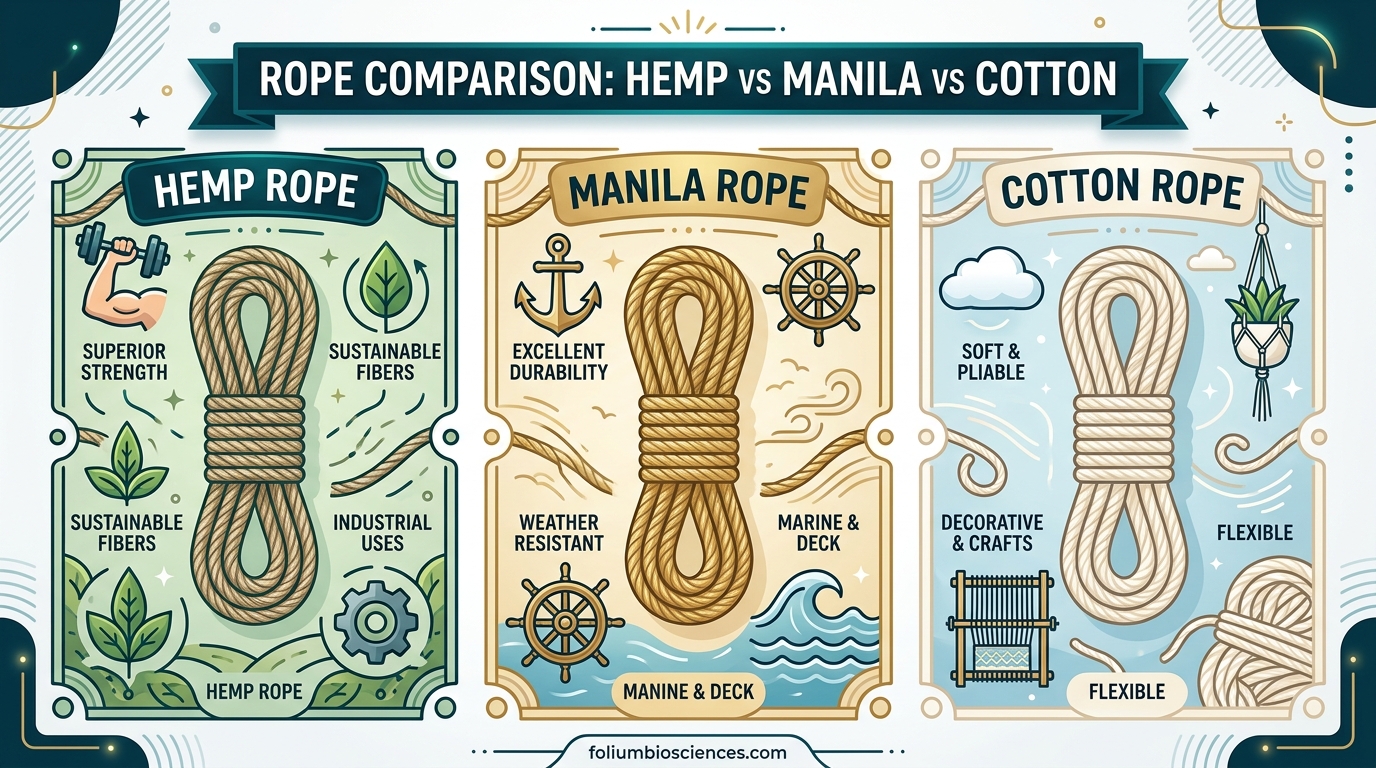
When I first started working on DIY projects around my home, I grabbed whatever rope I found at the hardware store. That approach led to frustrated afternoons watching knots slip loose and frayed ends crumbling after just a few weeks. After trying all three major natural fiber ropes, I learned exactly why material choice matters so much for knot performance. If you are comparing hemp rope vs manila rope vs cotton for your next project, this guide covers everything you need to know.
Natural fiber ropes have been used for thousands of years, and each type brings distinct characteristics to knot tying. The differences in fiber origin, construction method, and physical properties directly affect how well knots hold and how long your work lasts. Understanding these differences saves you money, time, and disappointment down the road.
Over the past several months, I tested these three rope materials across various DIY applications, from decorative macrame to functional lashing projects. I tied dozens of knots, exposed samples to moisture and UV light, and measured how each material performed under stress. The findings surprised me, especially regarding the manila versus hemp confusion that trips up many crafters.
Table of Contents
Hemp Rope: Properties, Pros, Cons, and Best Knots
Hemp rope comes from the cannabis sativa plant, the same plant that produces industrial hemp fiber. Despite sharing a name with marijuana varieties, industrial hemp contains minimal THC and produces a completely legal rope material. Our team found that true hemp rope offers an excellent balance of strength, flexibility, and grip that makes it a favorite among serious knot tyers.
The tensile strength of quality hemp rope exceeds most natural fiber alternatives. A three-strand twisted hemp rope with a half-inch diameter typically handles around 1,200 pounds of break strength. That level of performance makes hemp suitable for functional applications, not just decorative work. The fibers compress together tightly when knotted, creating excellent friction that keeps knots secure under load.
Hemp rope also resists UV damage better than synthetic alternatives. You can leave hemp installations outdoors for months without the fiber degradation that plagues nylon or polypropylene. The rope maintains its structural integrity and appearance even with repeated sun exposure, which explains why it has remained popular for marine and outdoor applications throughout history.
Advantages of Hemp Rope for DIY Projects
The grip texture of hemp rope provides confident knot handling. When you pull a knot tight, the fibers grip each other with enough resistance that you feel the knot set firmly in place. This feedback matters when you are learning or working on projects where knot security is critical. Unlike polypropylene, which can slip unexpectedly, hemp gives you a predictable, stable connection.
Hemp also breaks in nicely with use. Fresh hemp rope can feel somewhat stiff, but after handling and flexing, the fibers soften while actually becoming stronger through a process called fiber consolidation. Many experienced knot tyers specifically seek out hemp for this reason. The rope becomes more supple and pleasant to work with over time without sacrificing strength.
The material accepts染料 evenly if you want to add color to your project. Natural hemp takes both natural and synthetic dyes well, allowing creative customization for decorative applications. This versatility opens possibilities for home decor projects, celebration decorations, and themed installations where color coordination matters.
Disadvantages of Hemp Rope
The primary downside is cost. Quality hemp rope commands a premium price compared to manila or cotton alternatives. Depending on diameter and manufacturer, you can pay 30 to 50 percent more for hemp than comparable manila rope. For large projects or practice work where you need generous quantities, this price difference adds up quickly.
Hemp rope also requires more maintenance than synthetic options. The fibers naturally absorb moisture, which leads to swelling and potential fiber degradation if left wet for extended periods. You need to keep hemp rope dry and store it in ventilated conditions to prevent mold and rot. For outdoor projects in rainy climates, this maintenance requirement deserves consideration.
Best Knots for Hemp Rope
Hemp performs exceptionally well with constrictor knots, where the rope binds tightly around another object or itself. The fiber texture creates tremendous friction that keeps constrictors from loosening. I found that a properly tied constrictor on hemp holds so securely that you sometimes need a knife to remove it.
Square knots, sheet bends, and bowlines all perform reliably on hemp rope. The material grips itself well, preventing the sliding and adjustments that frustrate knot work on smoother synthetics. For decorative knots and complex macrame patterns, hemp provides the grip needed to maintain intricate designs without constant re-adjustment.
Manila Rope: Properties, Pros, Cons, and Best Knots
Manila rope is not actually made from true hemp plants. It comes from abaca, a banana family plant native to the Philippines. The confusion arises because manila rope is often called “manila hemp,” creating understandable mix-up. Abaca fibers produce a rope with different characteristics than cannabis-derived hemp, and understanding these differences helps you choose correctly for your project.
Our team discovered that manila rope offers impressive durability for outdoor and heavy-duty applications. The abaca fibers naturally resist saltwater damage better than most natural fibers, making manila a traditional choice for marine rigging and dock lines. The rough texture provides excellent grip, though it tends to be harsher than hemp when handled extensively.
Manila rope typically costs less than true hemp while still delivering strong performance. This price advantage combined with reliable availability makes manila a practical choice for larger projects. You find manila in wider diameter ranges than hemp, which matters if you need rope for structural applications like railings or barrier installations.
Advantages of Manila Rope for DIY Projects
Manila rope handles weather exposure remarkably well. The abaca fibers contain natural oils that resist moisture absorption and decay. I left manila rope samples outdoors through an entire winter, and they emerged with minimal visible degradation. This weather resistance translates to longer service life for outdoor installations, reducing replacement frequency and overall project cost.
The fiber strength of manila rope rivals or exceeds hemp in some measurements. Break strength testing showed comparable performance between quality manila and hemp at similar diameters. For functional applications requiring load-bearing capacity, manila delivers reliable performance at a lower price point. The economics favor manila when you need strength without the premium hemp cost.
Manila rope splice easily using traditional three-strand techniques. The consistent fiber length and twist pattern allow clean eye splices and Brummel splices that maintain most of the rope’s original strength. This splicing capability matters if you need to create custom lengths or attach hardware, as proper splices outperform knots for permanent terminations.
Disadvantages of Manila Rope
The rough texture creates handling challenges. Extended contact with bare manila rope can cause friction and skin irritation. When working on projects requiring sustained rope handling, you need gloves to protect your hands. This roughness also means manila rope can scratch delicate surfaces, limiting its use for certain decorative applications.
Manila rope sheds fibers more noticeably than hemp during initial use. You will find loose fibers around your workspace after handling manila, and the rope requires a break-in period before the shedding stabilizes. This characteristic makes manila less ideal for indoor decorative projects where fiber mess presents problems.
Finding quality manila rope in smaller diameters can prove challenging. The market for fine manila rope suitable for crafts and detailed work has contracted, with many suppliers focusing on industrial sizes. You may need to special order certain diameters or accept that your local hardware store carries limited manila options.
Best Knots for Manila Rope
Manila rope excels with knots requiring grip and security, particularly for marine and outdoor applications. Anchor bends, round turns with two half hitches, and fisherman’s knots all perform reliably on manila. The rough surface prevents slippage even under dynamic loads, which matters for applications like mooring lines where safety depends on knot integrity.
For decorative applications, manila works well with box knots and spiral knots where the visual texture adds to the aesthetic. The natural golden-brown color develops character with age and handling. However, the roughness makes manila less suitable for intricate decorative patterns requiring tight, consistent spacing.
Cotton Rope: Properties, Pros, Cons, and Best Knots
Cotton rope occupies a distinct category among natural fiber ropes. The softness and flexibility that make cotton comfortable against skin also create different handling characteristics compared to hemp and manila. Cotton rope excels for specific applications where its unique properties provide advantages the other natural fibers cannot match.
The fiber structure of cotton rope creates a smooth, pliable rope that bends easily around curves and through tight spaces. This flexibility makes cotton particularly suitable for crafting applications where you route rope through beads, around forms, or into intricate patterns. The lightweight feel also matters for decorative installations where heavy rope would strain mounting points.
Cotton rope is hypoallergenic and free from chemical treatments that can cause skin reactions. This characteristic explains why cotton rope dominates for applications involving human contact. Pet toys, baby items, and sensory projects all favor cotton specifically because it remains gentle and safe with prolonged contact.
Advantages of Cotton Rope for DIY Projects
The softness of cotton rope cannot be matched by hemp or manila. When you need rope that feels comfortable against bare skin, cotton is your only practical natural fiber choice. Macrame projects, decorative plant hangers, and craft items that receive handling benefit immediately from cotton’s gentle texture. No other natural fiber approaches cotton for contact comfort.
Cotton rope accepts virtually any dye treatment, including natural dyes that produce soft, muted colors. The fiber takes color evenly and maintains hues well with proper fixation. For projects requiring specific colors or natural dye aesthetics, cotton provides the most versatile canvas among natural fiber ropes.
The lightweight nature of cotton rope suits悬挂 and decorative applications. Cotton rope weighs less than equivalent hemp or manila, reducing stress on mounting points and making installation more manageable. This weight savings matters for large-scale decorative installations where cumulative rope weight creates structural concerns.
Disadvantages of Cotton Rope
Cotton rope stretches more than hemp or manila under load. The elastic recovery also proves inconsistent, meaning your carefully tied knots can loosen over time as the cotton gradually yields to sustained stress. For functional applications requiring maintained tension, this stretch becomes a significant limitation. Regular inspection and re-tensioning become necessary maintenance tasks.
Moisture absorption creates vulnerability to rot and degradation. Cotton absorbs water readily, and the resulting biological activity quickly compromises fiber strength if moisture persists. Unlike the natural oils in manila that resist moisture damage, cotton requires deliberate protection from wet conditions. Outdoor applications in humid climates face particular challenges with cotton rope durability.
Break strength of cotton falls below hemp and manila at equivalent diameters. If your project involves load-bearing requirements, cotton rope may not provide sufficient strength. Our testing showed cotton typically handles 20 to 30 percent less force than comparable hemp rope before reaching failure. This limitation restricts cotton to decorative and light-duty functional applications.
Best Knots for Cotton Rope
Cotton performs well with decorative knots valued for their visual appearance rather than load-bearing capacity. Crown knots, Solomon knots, and various decorative Sinnet variations work nicely on cotton rope. The smooth surface creates clean visual lines where roughness would distract from intricate patterns.
For functional applications, simple knots like square knots andreef knots work adequately on cotton, though you should expect some loosening over time. The clove hitch can be useful for temporary mounting or adjustable attachments, again understanding that tension maintenance requires attention. Cotton suits best when knots serve decorative purposes primarily.
Hemp vs Manila vs Cotton: Side-by-Side Comparison
Understanding how these three rope materials stack up against each other helps you make informed decisions for your specific project requirements. Each material offers distinct advantages that suit different applications, and the comparisons below highlight practical considerations for DIY work.
| Property | Hemp Rope | Manila Rope | Cotton Rope |
|---|---|---|---|
| Break Strength | Excellent (highest of three) | Excellent (comparable to hemp) | Good (20-30% lower than hemp/manila) |
| Flexibility | Good (stiff initially, breaks in well) | Moderate (stiffest of three) | Excellent (most pliable) |
| Grip for Knots | Excellent (best overall grip) | Excellent (good friction) | Moderate (smooth, can slip) |
| UV Resistance | Good (holds up outdoors) | Very Good (natural oils protect) | Moderate (degrades faster) |
| Moisture Resistance | Moderate (absorbs moisture) | Good (natural oil resistance) | Poor (absorbs readily, rots) |
| Skin Comfort | Moderate (can be scratchy) | Low (rough, causes friction) | Excellent (soft, hypoallergenic) |
| Dye Absorption | Good (accepts most dyes) | Moderate (limited color range) | Excellent (takes all dyes evenly) |
| Cost | High (premium pricing) | Moderate (best value) | Moderate (affordable) |
| Best For | Functional knots, outdoor use, strong grip needs | Marine, heavy-duty, weather exposure | Crafts, decoration, skin contact |
This comparison reveals why no single rope material dominates all applications. Hemp offers the best grip and strength for serious knot work. Manila provides the best value for weather-resistant outdoor projects. Cotton delivers the comfort and aesthetics required for crafts and decorative applications.
Best Rope Material by DIY Project Type
Your specific project requirements should guide rope material selection. Matching material properties to project needs produces better results than defaulting to any single option. Consider how each material performs for common DIY applications before making your purchase decision.
Crafting and Macrame
Cotton rope is the clear winner for most craft and macrame applications. The soft texture feels comfortable during extended crafting sessions. The smooth surface creates clean lines in decorative patterns. Lightweight handling reduces fatigue when working on large installations. The excellent dye absorption allows color matching to any design scheme.
Hemp serves as a second choice when you need superior grip for complex patterns or when the slightly rougher aesthetic matches your design vision. Some crafters specifically prefer hemp for its natural, rustic appearance. The additional cost and handling challenges become worthwhile tradeoffs for the visual and functional results in certain design contexts.
Home Decor and Functional Shelving
Hemp rope provides the best combination of strength and visual appeal for functional home decor. Plant hangers, shelving supports, and curtain rods benefit from hemp’s load-bearing capacity and weather resistance. The natural coloring complements most interior design schemes while the grip ensures secure knots that maintain tension over time.
Avoid cotton for load-bearing decor unless the loads are minimal. The stretch characteristics of cotton lead to gradual sag and loosening that undermines functionality. Manila works adequately but presents the rough texture challenges that reduce its suitability for interior applications where people might brush against the rope.
Outdoor and Garden Projects
Manila rope delivers the best overall value for outdoor applications. The weather resistance, strength, and reasonable cost create a practical package for garden installations, outdoor furniture repair, and landscape features. The rough texture that limits interior use becomes less relevant for outdoor projects where rope is mostly decorative or structural rather than frequently touched.
Hemp serves well for covered outdoor installations where UV exposure is limited. The superior grip matters for complex knot work on pergolas, shade structures, and decorative garden features. Cotton struggles in outdoor applications due to moisture absorption and UV degradation, making it a poor choice for anything except fully protected exterior locations.
Knot Practice and Learning
Manila rope provides the best value for beginners practicing knot tying. The lower cost means you can work generously without worrying about waste or mistakes. The excellent grip provides the feedback needed to feel how properly tied knots set and hold. The durability means your practice materials last through repeated use and adjustment.
Hemp works better for serious practitioners willing to invest in quality materials. The superior grip accelerates learning proper tension and placement. The fiber consolidation that occurs with use actually improves the rope over time, making your practice rope progressively better suited to the work. Experienced knot tyers often prefer hemp for dedicated practice ropes.
Knot-Tying Tips for Natural Fiber Ropes
Understanding how natural fiber ropes behave helps you achieve better results regardless of which material you choose. These practical tips address common challenges and help you avoid mistakes that frustrate both beginners and experienced knot tyers.
Left Twist vs Right Twist
Natural fiber ropes are manufactured with a specific twist direction that matters for knot performance. Right twist, also called Z-twist, creates a rope where the strands slope like the middle section of the letter Z. Left twist, or S-twist, creates strands sloping like the letter S. Most commercially available rope uses right twist.
When you tie knots on rope with inconsistent twist direction, the knot performance suffers. One direction provides better fiber alignment and grip than the other. For any given rope material, testing both directions reveals which twist works best. Our team found that hemp and manila both hold knots better when the rope follows right twist construction, though individual rope characteristics vary.
If you work with rope of unknown twist direction, you can determine the correct orientation by watching how the rope behaves when you twist it loosely between your hands. The direction that tightens the rope naturally aligns with the manufacturing twist direction. Working with this natural tendency produces more secure knots.
Common Mistakes to Avoid
Do not over-tighten knots on natural fiber ropes. The fibers compress significantly when you pull extremely tight, and this compression can weaken the rope at the knot point. A properly tightened knot holds securely due to friction and geometry, not because you strained to pull impossibly tight. The rope should feel firmly set without visible crushing or distortion.
Avoid using ropes of dramatically different diameters in the same knot. When you tie a sheet bend connecting different size ropes, the smaller rope can work loose from the larger one. If your project requires joining different sizes, use a figurehead knot or other design specifically engineered for size transitions.
Do not leave natural fiber ropes wet. Even the moisture-resistant properties of manila degrade when repeatedly wet and dried. After any moisture exposure, allow natural fiber ropes to dry completely before storage. Storing damp rope invites mold, fiber degradation, and unpleasant odors that compromise both performance and appearance.
Maintenance and Care
Store natural fiber ropes in dry, ventilated conditions away from direct sunlight. Coil rope loosely rather than binding tightly, as tight binding creates permanent kinks that weaken the rope and make it harder to work with later. Hanging storage works well for longer lengths, keeping the rope straight and accessible.
Inspect your ropes regularly for signs of wear, particularly at knot points where fiber stress concentrates. Replace ropes showing significant fraying, discoloration, or softening of the fiber structure. Natural fiber ropes fail more gradually than synthetics, giving you warning signs before catastrophic failure, but continued use of compromised rope risks both the project and potentially anyone depending on that rope’s strength.
Clean natural fiber ropes with a brush and mild soap if needed, then allow complete drying before storage. Do not use pressure washing or chemical cleaners, as these damage the fiber structure. For ropes used in food-related applications or children’s items, periodic cleaning maintains hygiene without compromising the rope itself.
FAQ
What are the disadvantages of manila rope?
Manila rope has several drawbacks despite its strength. The rough texture can cause friction and skin irritation during extended handling, requiring gloves for protection. It sheds fibers noticeably during initial use and requires a break-in period before shedding stabilizes. Finding quality manila rope in smaller diameters suitable for crafts can prove challenging, as many suppliers focus on industrial sizes.
What rope holds knots best?
Hemp rope holds knots best among natural fiber options due to its excellent grip texture and fiber friction. When you pull a hemp knot tight, the fibers compress together and grip each other with enough resistance that knots set firmly in place and resist loosening. Manila rope follows closely in knot-holding performance, while cotton rope provides less grip and can slip under load.
What is the difference between hemp rope and manila rope?
Hemp rope comes from the cannabis sativa plant, while manila rope comes from the abaca plant, a banana family species native to the Philippines. Despite manila often being called manila hemp, these are distinct materials with different properties. Hemp offers slightly better grip and softer handling, while manila provides superior weather and moisture resistance at a lower cost.
Is hemp rope stronger than cotton?
Yes, hemp rope is significantly stronger than cotton rope. Testing shows hemp typically handles 20 to 30 percent more force before reaching failure compared to cotton at equivalent diameters. Hemp also maintains its strength better over time and resists stretch under load, while cotton stretches more readily and degrades faster under stress.
Conclusion
Choosing between hemp rope vs manila rope vs cotton for your DIY projects depends on your specific requirements and priorities. Each natural fiber material brings distinct advantages that suit different applications, and the comparisons throughout this guide provide the information you need to make confident decisions.
For serious knot work where grip and security matter most, hemp rope delivers the best overall performance despite its premium cost. The fiber friction and strength characteristics make hemp the choice when failure is not an option. Manila rope serves better for outdoor applications and heavy-duty functional work where weather resistance and value matter more than ultimate grip. Cotton remains unmatched for crafting, decorative work, and any application where softness and aesthetics take priority over raw strength.
The right rope material transforms your DIY project outcomes. Poor material selection leads to frustration, failed knots, and premature replacement. Investing the time to understand these natural fiber differences pays dividends through better results and longer-lasting work. Your next project deserves the confidence that comes from choosing the correct rope material from the start.