
If you have ever stared at the wall of grow lights at a garden center and felt completely lost, you are not alone. I spent months researching the best grow light spectrum for herbs vs leafy greens vs flowering plants after killing my first batch of indoor basil with the wrong light. The truth is, different plants need different wavelengths of light to thrive indoors, and choosing the right spectrum makes the difference between leggy, pale growth and lush, vibrant plants.
In this guide, I will walk you through exactly which light spectrums work best for each plant category. You will learn the science behind why blue light grows bushy herbs, why red light triggers flowering, and how to set up a light system that actually works. Whether you are growing basil on a kitchen windowsill or running a full indoor vegetable garden, this guide has you covered.
Our team has tested different grow light setups over multiple growing seasons, and I have distilled everything into clear, practical recommendations. By the end of this article, you will know exactly which spectrum to use for every plant in your indoor garden.
Table of Contents
What Is Grow Light Spectrum?
Grow light spectrum refers to the specific range of electromagnetic wavelengths that plants use for photosynthesis and growth regulation. Measured in nanometers (nm), these wavelengths correspond to different colors of light, from violet at around 380nm to deep red at 750nm. Plants do not use the entire spectrum equally. They absorb certain wavelengths far more efficiently than others.
The most important measurement for grow lights is PAR, or Photosynthetically Active Radiation. PAR describes the range of light from 400 to 700 nanometers that plants can actually use for photosynthesis. When you see a grow light rated with a PAR value, that number tells you how much usable light energy the fixture delivers to your plants. A higher PAR value means more photosynthetic power reaching the leaves.
Plants primarily absorb two main colors of light through their chlorophyll pigments. Chlorophyll A absorbs light most efficiently at 430nm (blue) and 662nm (red), while Chlorophyll B peaks at 453nm (blue) and 642nm (red). This is why you see so many grow lights producing a purple glow. They combine blue and red wavelengths to target those chlorophyll absorption peaks directly.
Understanding PAR and nanometer ratings matters because it lets you compare grow lights on equal footing. Two lights might claim to be “full spectrum,” but their actual PAR output and wavelength distribution can vary dramatically. I always check the spectrum chart provided by the manufacturer before buying any grow light.
Understanding the Color Spectrum: Blue, Red, and Beyond
Each color in the light spectrum plays a distinct role in plant development. Blue and red light receive the most attention because plants absorb them in the highest quantities, but other wavelengths matter too. Here is how each part of the spectrum affects your plants.
Blue Light (400-500nm)
Blue light is the workhorse of vegetative growth. When plants receive ample blue light, they produce more chlorophyll, develop denser foliage, and grow shorter, sturdier stems. This is exactly what you want for herbs and leafy greens where foliage is the harvest. Without enough blue light, plants stretch toward the light source, becoming leggy and weak.
Blue light also regulates stomatal opening, which controls how much carbon dioxide enters the leaves for photosynthesis. Studies show that plants grown under blue-dominant light develop thicker leaves with more chloroplasts per cell. For indoor gardeners growing herbs and salad greens, blue light is your best friend.
Red Light (600-700nm)
Red light drives flowering and fruiting in plants. When you want a tomato plant to set fruit or a pepper to produce blooms, you need to increase the red light in your spectrum. Red light signals to the plant that it is time to shift energy from growing leaves to producing flowers and eventually fruit.
Red light also influences stem elongation and leaf expansion. Plants grown under red-heavy spectrums tend to grow taller with larger leaves. For flowering plants like tomatoes, peppers, and ornamental flowers, a high red-to-blue ratio encourages abundant blooms and better yields. Deep red light around 660nm is particularly effective at triggering flowering responses.
Green Light (500-600nm)
Plants reflect most green light, which is why they appear green to our eyes. But green light still plays a role. It penetrates deeper into the plant canopy than blue or red light, reaching lower leaves that would otherwise be shaded. This is especially important for dense, bushy plants where the upper canopy blocks light from reaching lower foliage.
In practice, most full spectrum grow lights include some green light because it supports overall canopy penetration. While you would not buy a green-only grow light, having green wavelengths in the mix creates a more natural growing environment and helps plants develop more uniformly.
UV and Far-Red Light
Ultraviolet light (UV-A at 315-400nm) can enhance the production of essential oils and antioxidants in herbs, making basil and rosemary more aromatic and flavorful. Far-red light (700-750nm) works alongside red light to regulate the phytochrome system, which controls flowering timing and stem elongation. Some advanced grow lights include these wavelengths for specific benefits, though they are not essential for basic indoor growing.
Full Spectrum Light
Full spectrum grow lights attempt to replicate natural sunlight by including a broad range of wavelengths across the entire visible spectrum. These lights typically appear white to the human eye, unlike the purple glow of red-blue combination lights. Full spectrum LEDs have become the most popular choice for indoor gardeners because they work reasonably well for all plant types without requiring you to swap lights as plants change growth stages.
The trade-off with full spectrum lights is that they are a jack-of-all-trades. They work for everything but are not optimized for any single plant type. If you are growing a mixed indoor garden with herbs, greens, and flowering plants together, full spectrum is your most practical option. But if you are dedicated to one category, a targeted spectrum will outperform full spectrum every time.
Best Grow Light Spectrum for Herbs
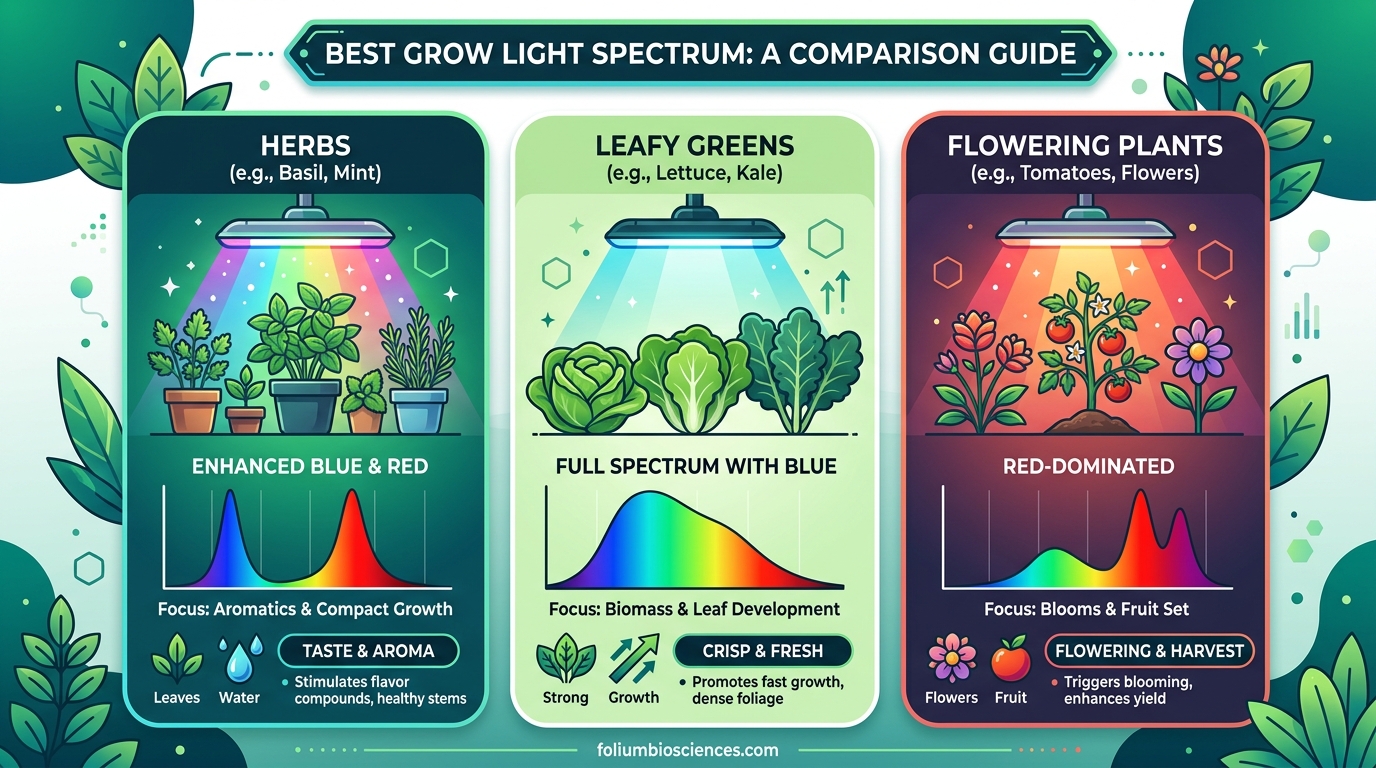
Herbs like basil, cilantro, mint, parsley, and rosemary are foliage plants, which means you want them to grow dense, leafy, and aromatic rather than tall and flower-prone. The best grow light spectrum for herbs emphasizes blue light with a blue-to-red ratio between 2:1 and 3:1. This blue-heavy spectrum promotes compact, bushy growth with strong flavor compounds.
Here is what I have found works best for specific herbs:
- Basil: Thrives under a 3:1 blue-to-red ratio with 14-16 hours of light per day. Basil loves intensity, so keep your PAR values between 200-400 micromols. The extra blue light produces those large, aromatic leaves you want for cooking.
- Cilantro: Prefers a balanced 2:1 blue-to-red ratio with 12-14 hours of light. Cilantro bolts easily (rushes to flower), and blue-heavy light helps delay bolting so you get a longer harvest window.
- Mint: Extremely forgiving and grows well under almost any spectrum, but a 2:1 blue-to-red ratio produces the best flavor. Mint can handle higher light intensity, so do not be afraid to push PAR values up to 500.
- Rosemary: This woody herb needs a balanced approach. A 2:1 blue-to-red ratio works, but rosemary also benefits from slightly higher overall light intensity. Aim for 300-600 PAR and 12-14 hours of light daily. Yes, rosemary absolutely grows under LED lights, and I have kept a rosemary plant thriving indoors for over a year under full spectrum LEDs.
- Parsley: A 2:1 blue-to-red ratio with moderate intensity (200-350 PAR) produces excellent results. Parsley is a slow germinator, so patience is key, but once established it grows steadily under consistent blue-rich light.
One important note about herbs: most culinary herbs are grown as annuals indoors, harvested repeatedly before they bolt to flower. If you notice your basil or cilantro starting to flower, pinch off the flower buds immediately. Switching to a spectrum with slightly more red light will only accelerate flowering, which is the opposite of what you want for leaf production.
From my experience and feedback from indoor gardening communities, full spectrum LEDs with a color temperature of 5000K-6500K (cool white) work well for herbs because they naturally lean toward the blue end of the spectrum. If you want to optimize further, dedicated blue-red LEDs with the ratios above will give you noticeably better results.
Best Grow Light Spectrum for Leafy Greens
Leafy greens including lettuce, kale, spinach, Swiss chard, and arugula share one important trait with herbs: you harvest them for their leaves, not their flowers. The best grow light spectrum for leafy greens uses a 3:1 red-to-blue ratio, which is different from herbs despite their similar harvest goals. Leafy greens respond strongly to red light by producing larger, broader leaves while the blue light keeps them compact and prevents stretching.
The difference between herbs and leafy greens comes down to how they allocate growth energy. Herbs benefit from denser, more concentrated foliage with high essential oil content, which blue light supports. Leafy greens grow best when they produce expansive leaf surface area, which red light encourages while the blue component maintains structural integrity.
Here are specific recommendations for popular leafy greens:
- Lettuce: A 3:1 red-to-blue ratio produces the best results with 12-16 hours of light. Keep PAR between 150-300 for baby greens and 200-400 for mature heads. Lettuce is sensitive to excessive heat from lights, so LED fixtures at 12-18 inches work better than hot incandescent or HID lights.
- Kale: Thrives under a 3:1 or even 4:1 red-to-blue ratio with higher intensity (300-500 PAR). Kale is a hardy green that handles strong light well, and the extra red light promotes those large, nutrient-dense leaves. 14-16 hours of light produces the fastest growth.
- Spinach: Prefers moderate light with a 3:1 red-to-blue ratio at 200-350 PAR. Spinach can bolt in high temperatures, so keeping lights at the right distance (18-24 inches for most LEDs) prevents heat stress. 12-14 hours of light per day is ideal.
- Swiss Chard: Grows well under the same 3:1 red-to-blue ratio with PAR values of 250-450. The colorful stems develop best with adequate light intensity. Swiss chard is a heavy feeder, so pair good light spectrum with regular fertilization for the best results.
For hydroponic lettuce and greens growers, the 3:1 red-to-blue ratio is widely considered the gold standard. Many commercial hydroponic operations use this exact ratio because it maximizes leaf size and weight while keeping plants compact enough for dense planting arrangements. If you are running a hydroponic system, I recommend looking for LEDs specifically tuned for vegetative growth with this ratio built in.
Light duration matters as much as spectrum for leafy greens. Most greens need 12-16 hours of light per day with 8-12 hours of darkness. I use a simple outlet timer to keep my light schedule consistent. Inconsistent light schedules are one of the most common mistakes new indoor gardeners make, and it shows up as stunted or stressed plants within days.
Best Grow Light Spectrum for Flowering Plants
Flowering plants like tomatoes, peppers, eggplant, strawberries, and ornamental flowers need a spectrum shift as they move from vegetative growth to flowering. The best grow light spectrum for flowering plants uses a high red-to-blue ratio of 5:1 to 8:1, with the increased red light triggering the phytochrome system to initiate and sustain flower production.
The key to success with flowering plants is understanding that their light needs change over time. During the early vegetative stage, they benefit from more blue light (similar to herbs and greens) to build strong stems and healthy root systems. Once you want flowers and fruit, you shift to a red-heavy spectrum. Here is how to handle that transition:
Vegetative Stage (First 4-6 Weeks)
Use a 3:1 red-to-blue ratio or a full spectrum light with a color temperature around 5000K-6500K. This stage is about building the plant’s framework. Strong stems, healthy root systems, and plenty of leaf surface area set the foundation for heavy flowering later. Provide 16-18 hours of light per day with PAR values of 200-400.
Flowering Stage (Until Harvest)
Switch to a 5:1 to 8:1 red-to-blue ratio or a warmer full spectrum around 2700K-3500K. The heavy red light signals the plant to begin reproductive growth. Reduce the light cycle to 12 hours on and 12 hours off, which mimics the shorter days of late summer and fall that naturally trigger flowering. Increase PAR to 400-800 for fruiting plants like tomatoes and peppers.
Specific flowering plant recommendations:
- Tomatoes: Start with 3:1 red-to-blue during veg, shift to 6:1 or higher for flowering. Tomatoes are heavy light feeders and need PAR values of 400-800+ during fruiting. They also benefit from far-red light (730nm) to increase flower production. Expect to provide 12-16 hours of light depending on the variety.
- Peppers: Similar to tomatoes but slightly more forgiving on light intensity. A 5:1 red-to-blue ratio during flowering with PAR of 300-600 produces excellent results. Peppers can handle higher temperatures than tomatoes, so you can keep lights a bit closer.
- Strawberries: Use a 5:1 red-to-blue ratio with 12 hours of light during flowering. Strawberries are day-length sensitive, so the 12-hour cycle is critical for triggering blooms. PAR values of 300-500 work well.
- Ornamental Flowers (orchids, African violets): These flowering houseplants prefer moderate light with a 4:1 to 6:1 red-to-blue ratio. PAR values of 100-300 are sufficient for most flowering houseplants. Too much intensity will scorch the leaves.
One common mistake I see with flowering plants is using full spectrum lights at a fixed setting from seed to harvest. While full spectrum works, you leave yield on the table. If your light has adjustable spectrum controls, dialing up the red during flowering makes a noticeable difference in bloom density and fruit set.
Spectrum Comparison: Herbs vs Leafy Greens vs Flowering Plants
Understanding how light needs differ between these three plant categories is the core of successful indoor growing. Here is a side-by-side breakdown that I keep posted on my grow room wall for quick reference.
Herbs (Basil, Cilantro, Mint, Rosemary, Parsley)
- Best spectrum ratio: 2:1 to 3:1 blue-to-red (blue dominant)
- Color temperature: 5000K-6500K (cool white)
- PAR range: 200-500 depending on herb
- Light duration: 12-16 hours per day
- Growth focus: Dense foliage, essential oil production
Leafy Greens (Lettuce, Kale, Spinach, Swiss Chard)
- Best spectrum ratio: 3:1 red-to-blue (moderate red lean)
- Color temperature: 4000K-6500K (neutral to cool white)
- PAR range: 150-500 depending on variety
- Light duration: 12-16 hours per day
- Growth focus: Large leaf surface area, compact growth
Flowering Plants (Tomatoes, Peppers, Strawberries)
- Best spectrum ratio: 5:1 to 8:1 red-to-blue (red dominant during flowering)
- Color temperature: 2700K-3500K (warm white) for flowering
- PAR range: 300-800+ depending on stage
- Light duration: 16-18 hours (veg) / 12 hours (flowering)
- Growth focus: Bloom production, fruit set and development
The key takeaway: herbs want blue light to stay leafy and compact, leafy greens want a moderate red lean for broad leaves, and flowering plants want heavy red light to trigger and sustain bloom production. If you can only choose one light for a mixed garden, a full spectrum LED around 4000K strikes a reasonable middle ground.
How to Choose the Right Grow Light for Your Plants
Now that you understand the spectrum needs for each plant type, let me help you pick the right light setup. The grow light market has exploded in 2026, and the options can feel overwhelming. Here is my practical framework for making the right choice.
LED vs Fluorescent vs Incandescent
LED grow lights have become the clear winner for indoor growing in 2026. They run cool, last 50,000+ hours, use a fraction of the electricity of other types, and many models offer adjustable spectrum controls. The upfront cost is higher, but the energy savings and longevity more than make up for it.
Fluorescent lights (T5 and T8 tubes) still have a place for seed starting and low-light herbs. They run cool and are affordable, but their spectrum options are limited and they need to be replaced every 12-18 months as output declines. I still use T5 fixtures for seedlings because the low heat output makes them very forgiving for young plants.
Incandescent grow lights are outdated and inefficient. They produce far more heat than usable light, which burns plants and wastes electricity. I do not recommend them for any serious indoor growing setup.
Full Spectrum vs Targeted Spectrum
Full spectrum LEDs are the best starting point for most indoor gardeners. They produce white light that looks natural in your home and grow a wide variety of plants reasonably well. Look for full spectrum LEDs with adjustable color temperature if possible, so you can shift from cool (blue-rich) to warm (red-rich) as your plants change stages.
Targeted spectrum LEDs (those purple red-blue lights) are more efficient for specific goals. If you are dedicated to growing only herbs or only flowering plants, a targeted spectrum light tuned to the exact ratios I outlined above will outperform a full spectrum equivalent. The downside is the harsh purple glow that many people find unpleasant in living spaces.
Matching Wattage and Coverage
For herbs and leafy greens, aim for 25-50 watts of actual LED power per square foot of growing area. For flowering plants, increase that to 50-80 watts per square foot. Be careful to look at actual wattage drawn from the wall, not the “equivalent” wattage some manufacturers advertise. A light claiming to “replace a 1000W HPS” might only draw 150 actual watts.
For a standard 2×2 foot growing area, a 100-200W full spectrum LED panel handles herbs and greens well. For flowering plants in the same space, look at 200-300W to hit the higher PAR values those plants demand.
Common Grow Light Mistakes and How to Avoid Them
After spending time in indoor gardening forums and making plenty of my own mistakes, I see the same problems crop up repeatedly. Here are the most common grow light mistakes and how to fix them.
Mistake 1: Lights Too Close or Too Far
This is the number one issue I see. LEDs positioned too close cause bleached leaves, curled edges, and stunted growth. Too far away and plants stretch toward the light, becoming leggy and weak. For most LED panels, 12-18 inches above herbs and greens works well. For higher-wattage flowering lights, 18-24 inches is a safer starting point. Always check your plants after adjusting light distance and look for signs of stress within 24-48 hours.
Mistake 2: Wrong Spectrum for the Plant Type
Using a warm red-heavy light for herbs or a cool blue-heavy light during flowering limits your results significantly. Match the spectrum to the plant and the growth stage using the ratios I outlined above. If you are growing a mixed garden, full spectrum is your safest default.
Mistake 3: Inconsistent Light Schedules
Plants rely on consistent day-night cycles to regulate growth and flowering. Turning lights on at different times each day or forgetting to turn them off stresses plants and reduces yields. Spend a few dollars on a timer and set it once. Your plants will thank you with consistent, healthy growth.
Mistake 4: Ignoring Plant Stress Signals
Your plants tell you when something is wrong. Pale or yellow leaves often mean too much light intensity. Stretching stems mean not enough light. Brown spots or curled leaves can indicate heat stress from lights placed too close. Watch your plants daily during the first week after setting up new lights, and adjust based on what you see.
Mistake 5: Using Regular House Lights as Grow Lights
Standard LED bulbs and fluorescent tubes designed for home lighting do not produce the right spectrum or intensity for plant growth. Plants need specific wavelengths in the PAR range at sufficient intensity. A cheap full spectrum grow light will outperform an expensive household LED bulb every time. That said, many indoor gardeners start with shop lights fitted with daylight (5000K-6500K) tubes and get decent results with herbs and greens before upgrading.
FAQ
What grow lights are best for leafy greens?
The best grow lights for leafy greens use a 3:1 red-to-blue spectrum ratio. Full spectrum LEDs with a color temperature of 4000K-6500K also work well. Leafy greens like lettuce, kale, and spinach thrive under 12-16 hours of light per day with PAR values between 150-500 depending on the variety. LED panels drawing 25-50 watts per square foot of growing area provide sufficient intensity for most greens.
What type of grow light is best for herbs?
The best grow lights for herbs are blue-dominant LEDs with a 2:1 to 3:1 blue-to-red ratio. This spectrum encourages compact, bushy growth with high essential oil content. Full spectrum LEDs at 5000K-6500K also work well for herbs like basil, cilantro, mint, and rosemary. Herbs need 12-16 hours of light per day with PAR values of 200-500.
What color grow light is best for flowering plants?
Red light in the 600-700nm range is best for flowering plants. A red-to-blue ratio of 5:1 to 8:1 during the flowering stage triggers bloom production and fruit set. Warm white full spectrum LEDs (2700K-3500K) also support flowering. During the vegetative stage, flowering plants benefit from more balanced light (3:1 red-to-blue) before shifting to the red-heavy spectrum.
Can rosemary grow under LED lights?
Yes, rosemary grows well under LED grow lights. Use a full spectrum LED at 5000K-6500K or a targeted spectrum with a 2:1 blue-to-red ratio. Rosemary needs moderate to high light intensity (300-600 PAR) and 12-14 hours of light per day. Keep the light 12-18 inches above the plant and ensure good air circulation, as rosemary prefers slightly drier conditions than many other herbs.
What is PAR in grow lights?
PAR stands for Photosynthetically Active Radiation. It measures the amount of light in the 400-700 nanometer range that plants can actually use for photosynthesis. PAR is measured in micromoles per square meter per second (umol/m2/s). Higher PAR values mean more usable light energy reaching your plants. Herbs and greens typically need 150-500 PAR, while flowering plants require 300-800+ PAR depending on the growth stage.
Conclusion
Finding the best grow light spectrum for herbs vs leafy greens vs flowering plants comes down to understanding what each plant category needs. Herbs want blue-dominant light (2:1 to 3:1 blue-to-red) for dense, aromatic foliage. Leafy greens thrive under a moderate red lean (3:1 red-to-blue) for broad, healthy leaves. Flowering plants demand heavy red light (5:1 to 8:1 red-to-blue) during bloom stage for abundant flowers and fruit.
If you are just starting out, grab a full spectrum LED and get growing. You can always fine-tune your spectrum later once you see how your plants respond. The most important step is simply starting, because even a basic grow light setup produces better results than a sunny windowsill alone. Set your timer, watch your plants, and adjust as you learn. Your indoor garden will be thriving before you know it.