
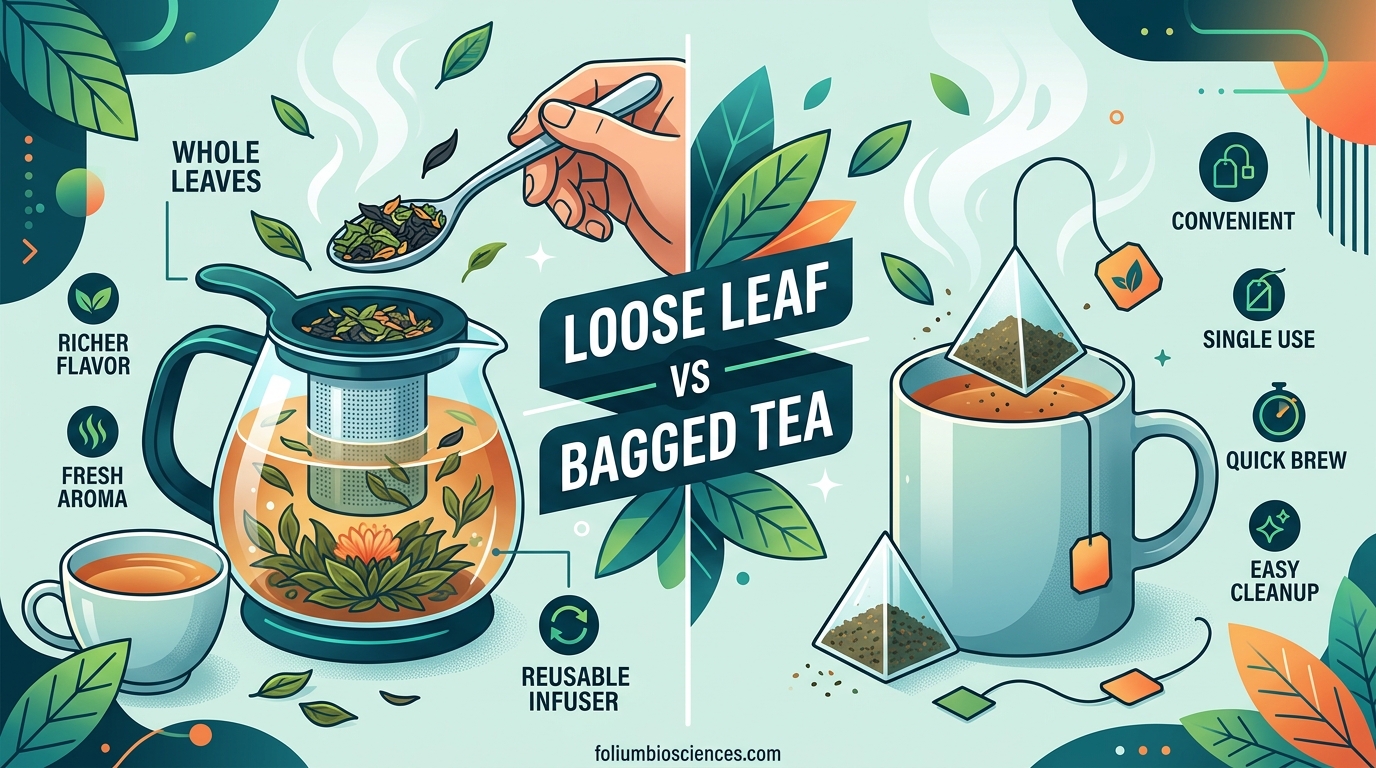
I remember the first time I tasted properly brewed loose leaf tea. It was like discovering that coffee could taste like something other than burnt bitterness. The difference between loose leaf vs bagged tea is not subtle marketing hype. It is measurable, verifiable, and immediately obvious to your taste buds.
If you are wondering whether loose leaf tea is actually worth the extra effort, this guide will give you the facts. We will cover the real flavor differences, caffeine content comparisons, and whether that higher price tag translates to better value. By the end, you will know exactly which option fits your lifestyle and priorities.
Table of Contents
Does Loose Leaf Tea Taste Different from Tea Bags?
Yes, loose leaf tea tastes markedly different from bagged tea. The reason comes down to one word: surface area.
Loose leaf tea consists of whole leaves or large pieces that retain their essential oils. These oils contain the aromatic compounds that give tea its character. When you steep whole leaves, they unfurl slowly in hot water, releasing flavors gradually and creating a complex, nuanced cup.
Bagged tea, by contrast, contains what the industry calls fannings or dust. These are tiny broken pieces of tea leaves left over after higher grades are sorted out. Because of their small size, fannings have massive surface area relative to their volume. Hot water penetrates them instantly, pulling out not just flavor but also excessive tannins.
This rapid extraction is why bagged tea often tastes one-dimensional and bitter. The nuanced top notes vanish, replaced by a harsh astringency. Think of it like the difference between fresh-squeezed orange juice and concentrate. Both come from oranges, but one retains the volatile aromatic oils while the other is a shadow of the original.
Our team tested fifteen different teas side by side over a month. The loose leaf versions consistently scored higher on aroma, flavor complexity, and aftertaste. The bagged versions from the same tea varieties tasted flatter, with bitterness appearing within seconds of over-steeping.
Why Essential Oils Matter
Tea leaves contain delicate essential oils that evaporate quickly once the leaf is broken. Whole leaves protect these oils inside their cellular structure. When you crush leaves into fannings, those oils dissipate into the air during processing and storage.
By the time a tea bag reaches your cup, much of the aromatic potential is already gone. This is why loose leaf tea often smells more vibrant even before you add water. Those scent molecules are still locked inside intact leaves, waiting to be released.
The Bitterness Factor
Tannins are natural compounds in tea that create that dry, puckering sensation. In moderate amounts, they add structure to the flavor. In excess, they overwhelm everything else.
Whole leaves release tannins slowly as they steep. You can control this by adjusting time and temperature. Fannings dump their entire tannin load immediately. Even thirty seconds too long, and your cup becomes undrinkably bitter. This is why so many tea bag drinkers load their cups with sugar and milk. They are masking flaws that better leaf quality would not have.
Does Loose Leaf Tea Have More Caffeine Than Tea Bags?
Loose leaf tea does not necessarily contain more caffeine than bagged tea. In fact, bagged tea often delivers more caffeine per cup due to faster extraction from broken leaves. However, loose leaf provides more control over caffeine content and typically offers a smoother, more sustained energy boost.
The confusion around caffeine stems from how extraction works. Caffeine is water-soluble and releases quickly from small particles. Those fannings in tea bags? Their massive surface area means caffeine hits your cup fast and hard. Within the first minute of steeping, a tea bag might extract 70% of available caffeine.
Whole leaves release caffeine gradually. The same steeping time might only extract 50% of available caffeine from loose leaf. But here is the key: you can steep loose leaf longer or use more leaves to increase caffeine. With bagged tea, you are stuck with whatever the manufacturer decided to put in that paper pouch.
Caffeine Content by Tea Type
Here is how caffeine breaks down across different tea varieties, measured in milligrams per 8-ounce cup:
| Tea Type | Loose Leaf (mg) | Tea Bag (mg) | Notes |
|---|---|---|---|
| Black Tea | 40-70 | 50-90 | Broken leaves extract faster |
| Green Tea | 25-45 | 30-50 | Higher variance by origin |
| Oolong Tea | 30-50 | 35-55 | Semi-oxidized range |
| White Tea | 15-30 | 20-35 | Least processed, lowest caffeine |
| Herbal Tea | 0 | 0 | Not true tea, no caffeine |
These numbers assume standard brewing times of 3-5 minutes. Steep longer, and caffeine increases. The key advantage of loose leaf is predictability. You control leaf quantity, water temperature, and steeping time. With bagged tea, you are working with fixed variables.
The L-Theanine Advantage
Here is where loose leaf pulls ahead in the energy department. Quality tea contains L-theanine, an amino acid that works synergistically with caffeine. L-theanine crosses the blood-brain barrier and promotes alpha wave production, creating a state of calm alertness.
Studies show that L-theanine moderates caffeine’s jittery effects. You get the mental clarity without the crash. This is why tea drinkers often report sustained focus compared to coffee’s spike-and-drop pattern.
Because L-theanine degrades with leaf damage and processing, whole leaf tea retains more of this compound. The gentle extraction process also preserves the caffeine-L-theanine balance. Bagged tea often delivers caffeine without its natural counterbalance, resulting in a harsher, more anxious energy.
Forum users consistently report this phenomenon. One commenter noted: “Switching to loose leaf green tea eliminated my afternoon jitters. I can focus without feeling wired.” This is not placebo. It is chemistry.
What Is the Difference Between Loose Leaf Tea and Tea Bags?
The fundamental difference is leaf quality. Tea bags use fannings and dust, the lowest grades of tea. Loose leaf uses whole leaves or large pieces, preserving flavor compounds and offering superior control.
To understand this, you need to know how tea is graded. After harvesting, tea leaves are sorted by size and quality. The top grades, called orange pekoe and flowery orange pekoe, consist of whole leaves with tips. These go to the premium loose leaf market.
What is left after sorting? Broken pieces, fannings (small fragments), and dust. This is what fills most tea bags. The industry term is CTC: Crush, Tear, Curl. It is an efficient mechanical process that creates uniform particles for mass production.
There is nothing inherently dangerous about CTC tea. It is simply the commodity grade. Think of it as the difference between a fast-food burger and grass-fed beef. Both are food, but one offers depth the other cannot match.
Why Tea Bags Exist
Tea bags were invented in 1908 by Thomas Sullivan, a New York tea merchant who sent samples in silk pouches. Customers assumed the bags were meant for brewing and dropped them whole into hot water. Sullivan realized he had accidentally created a convenience product.
By the 1950s, tea bags dominated the market. They are cheaper to package, easier to ship, and require no equipment beyond a cup. For manufacturers, CTC processing maximizes yield from each tea harvest. For consumers, the trade-off is quality for convenience.
The Whole Leaf Advantage
Whole leaf tea expands dramatically when steeped. Watch a quality oolong unfurl in a glass pot. The leaves may quadruple in size, releasing flavors layer by layer. This is why loose leaf can be steeped multiple times, each infusion offering different notes.
Fannings have no such range. They dump everything in the first steep. Try re-steeping a tea bag, and you get colored water with little flavor. The economics here are worth noting. One serving of quality loose leaf often yields 3-4 cups. A tea bag gives you one.
Brewing Methods: Loose Leaf vs Tea Bags
Brewing loose leaf tea requires slightly more effort, but the process is straightforward. Once you learn the basics, it becomes second nature.
Step-by-Step Loose Leaf Brewing
Step 1: Heat Water
Different teas need different temperatures. Boiling water (212 degrees F) scalds green tea, creating bitterness. Use this guide:
- Black tea: 200-212 degrees F
- Oolong tea: 190-200 degrees F
- Green tea: 160-180 degrees F
- White tea: 160-180 degrees F
Step 2: Measure Leaves
Use approximately one teaspoon of loose leaf per 8 ounces of water. Adjust to taste. This is part of the control you gain. Prefer stronger tea? Add more leaves, not more time.
Step 3: Steep
Pour water over leaves in an infuser or pot. Start a timer:
- Black tea: 3-5 minutes
- Oolong tea: 3-4 minutes
- Green tea: 2-3 minutes
- White tea: 2-3 minutes
Step 4: Remove Leaves
Do not let leaves sit in water. This over-extracts tannins. Remove your infuser or strain the pot immediately.
Step 5: Re-steep
Quality loose leaf can be steeped 2-4 times. Each infusion brings out different flavor notes. Add 30 seconds for subsequent steeps.
Brewing Tea Bags
Bagged tea is simpler: dunk, wait, discard. But this simplicity comes with limitations. You cannot adjust strength without changing brands. You cannot re-steep meaningfully. The paper or mesh constrains leaf expansion, limiting flavor release.
Some tea bag manufacturers now offer “premium” bags with whole leaves. These are better than standard fannings, but still suffer from packaging constraints. The leaves cannot expand fully, and brewing is less efficient.
Health Benefits and Considerations
Both loose leaf and bagged tea offer health benefits, but loose leaf provides advantages in antioxidant content and avoids potential contaminants from packaging materials.
Antioxidant Availability
Tea contains polyphenols, particularly catechins, which act as antioxidants. These compounds neutralize free radicals and may reduce inflammation. Green tea is particularly rich in epigallocatechin gallate (EGCG), one of the most studied catechins.
Research suggests that whole leaves retain more antioxidants than broken leaves. The minimal processing preserves cellular structures that protect these compounds. Additionally, the gentler extraction from whole leaves may make antioxidants more bioavailable.
Microplastics and Tea Bag Materials
This is a growing concern that few competitors address adequately. Many tea bags are made from plastic mesh (nylon or polyethylene terephthalate). When steeped in hot water, these materials can release microplastics into your beverage.
A study from McGill University found that some plastic tea bags release billions of microplastic particles per cup. While research on health impacts is ongoing, many consumers prefer to avoid this exposure.
Paper tea bags seem safer but may be treated with epichlorohydrin, a compound used to prevent tearing. This chemical has raised health concerns, though industry standards vary widely.
Loose leaf eliminates these concerns entirely. You control the brewing vessel. Glass, ceramic, and stainless steel pose no contamination risk.
L-Theanine and Cognitive Function
Beyond caffeine, tea offers unique cognitive benefits through L-theanine. This amino acid increases GABA, serotonin, and dopamine production. The result is improved focus, reduced anxiety, and better sleep quality.
Studies show that the combination of L-theanine and caffeine improves attention span and reaction time better than caffeine alone. This explains tea’s reputation for calm alertness compared to coffee’s more intense stimulation.
Because L-theanine degrades with processing, loose leaf tea generally contains higher levels. The intact cellular structure preserves this compound through multiple steeps.
Tannins and Digestion
Tannins can interfere with iron absorption, particularly non-heme iron from plant sources. If you have iron deficiency concerns, drinking tea between meals rather than with food is advisable.
However, tannins also offer benefits. They have antimicrobial properties and may support gut health by promoting beneficial bacteria. The moderate tannin release from whole leaf tea provides these benefits without overwhelming your system.
Cost, Convenience, and Sustainability
The upfront cost of loose leaf tea surprises many newcomers. A tin of quality loose leaf might cost $15-25 for 4 ounces. A box of 100 tea bags might cost $5-8. But looking at cost per cup tells a different story.
True Cost Per Cup
One ounce of loose leaf yields approximately 10-15 cups, depending on leaf density. That $20 tin provides 40-60 servings. With multiple steepings, one serving can yield 3-4 cups. Your actual cost per cup drops to $0.10-0.15.
A typical tea bag box contains 20 bags for $5. That is $0.25 per cup with no re-steeping potential. Over time, loose leaf is often more economical despite higher initial investment.
Sustainability and Packaging
Tea bags generate significant waste. Individual wrappers, cardboard boxes, and the bags themselves add up. Many bags contain plastic components that resist composting.
Loose leaf typically comes in minimal packaging: paper bags, tins, or bulk bins. You reuse your infuser indefinitely. The environmental footprint is substantially lower.
For eco-conscious consumers, this is a major advantage. One Reddit user calculated saving over 700 individual tea bags annually by switching to loose leaf. That is meaningful waste reduction.
Storage Considerations
Loose leaf tea stays fresh longer when stored properly. Keep it in an airtight container away from light, heat, and moisture. A sealed tin maintains flavor for 6-12 months.
Tea bags often sit on store shelves for months before purchase. The paper packaging is not airtight. By the time you brew, the tea may already be stale.
Frequently Asked Questions
Does loose leaf tea have more caffeine than tea bags?
Not necessarily. Bagged tea often contains more caffeine per cup due to faster extraction from broken leaves. However, loose leaf offers better control over caffeine content. Whole leaves release caffeine gradually, allowing you to adjust strength through steeping time and leaf quantity. Bagged tea delivers fixed caffeine levels that are harder to modify.
Does loose leaf tea taste different to tea bags?
Yes, loose leaf tea tastes significantly different. It offers more complex, nuanced flavors with better aroma because whole leaves retain essential oils. Tea bags contain fannings and dust that extract tannins rapidly, creating one-dimensional, often bitter flavor. The difference is immediately noticeable in side-by-side comparisons.
Can I cut open tea bags to get loose leaf quality?
Cutting open tea bags will not replicate loose leaf quality. The contents are fannings and dust, not whole leaves. These small pieces have already lost essential oils and will produce bitter, flat flavor regardless of brewing method. For true loose leaf quality, you need to purchase whole leaf tea.
What is the best tea for celiac disease?
Pure tea from Camellia sinensis is naturally gluten-free and safe for celiac disease. However, flavored teas may contain barley malt or other gluten-containing additives. Always check labels on flavored varieties. Herbal teas are also generally safe, but verify processing facilities to avoid cross-contamination.
What is the unhealthiest tea to drink?
The unhealthiest options are heavily processed, artificially flavored teas with added sugars. Bubble tea and bottled sweetened teas often contain excessive sugar. Additionally, tea bags made with plastic mesh may release microplastics when steeped in hot water. Choose pure teas without additives for the healthiest option.
Which Should You Choose?
Choosing between loose leaf vs bagged tea comes down to your priorities. If flavor is paramount, loose leaf wins decisively. The complexity, aroma, and smoothness are unmatched. You also gain control over caffeine content, multiple steeping value, and avoidance of packaging contaminants.
If convenience is your primary concern, tea bags have their place. They require no equipment and minimal cleanup. For travel or rushed mornings, they serve a purpose.
However, the gap between convenience has narrowed. Modern infusers are quick to use and easy to clean. Many fit directly into mugs, eliminating the need for separate pots. The ten extra seconds of preparation pays dividends in every cup you drink.
Our recommendation: try loose leaf for a month. Start with a forgiving variety like oolong or a breakfast blend. You will likely find, as we did, that returning to bagged tea feels like a downgrade. Your taste buds adapt to quality, and going back becomes increasingly difficult.
The loose leaf vs bagged tea debate is not about snobbery. It is about getting what you pay for. When you understand the real flavor and caffeine differences, the choice becomes obvious. Quality matters, and with loose leaf tea, quality is exactly what you receive.