

Charcuterie curing chambers are refrigerated spaces that hold a steady, food-appropriate temperature and relative humidity so salami, coppa, pancetta, and other whole-muscle cures can dry slowly. A commonly cited working window is about 50 to 60°F and 60% to 85% relative humidity, but the right target depends on the recipe, product stage, airflow, and food-safety process.
There is one important limitation in this roundup: the ten analyzed products are monitoring or control tools, not complete refrigerated dry curing cabinets. I would use them to measure, log, alert on, or switch equipment in a DIY meat curing chamber; they do not supply the insulated cabinet, refrigeration, humidification, dehumidification, or food-safety process by themselves.
That distinction matters because forum discussions repeatedly point to humidity stability and plug-and-play simplicity as the hard parts of a home setup. Our team’s practical takeaway is simple: start by measuring the space accurately, then add active control only after you know how your refrigerator or cabinet behaves over several days.
Table of Contents
These Are the Top 3 Tools for Home Curing-Chamber Monitoring
For an all-in-one monitoring start, I would choose the X-Sense bundle because its three sensors make it easier to check different cabinet levels. The Govee H5075 three-pack is the broad-audience alternative for Bluetooth monitoring, while the Luxbird controller is the relevant pick when a DIY chamber needs a device to run temperature and humidity equipment.

These Charcuterie Curing Chamber Tools Cover Monitoring and Control in 2026
The comparison below keeps the decision focused on what each item can actually do. A monitor tells you what the chamber is doing; a controller can switch compatible equipment according to set points; neither category turns an ordinary refrigerator into a finished dry curing cabinet without careful setup and verification.
| Product | Specifications | Action |
|---|---|---|
 TempPro TP349 Bluetooth Hygrometer TempPro TP349 Bluetooth Hygrometer |
|
Check Latest Price |
 GoveeLife H5220 WiFi 3-Pack GoveeLife H5220 WiFi 3-Pack |
|
Check Latest Price |
| X-Sense Wi-Fi 3-Sensor Kit |
|
Check Latest Price |
 Protmex HT607 Meter Protmex HT607 Meter |
|
Check Latest Price |
 Luxbird LTC-318-W Controller Luxbird LTC-318-W Controller |
|
Check Latest Price |
 Govee H5075 Bluetooth 3-Pack Govee H5075 Bluetooth 3-Pack |
|
Check Latest Price |
 ANFBYOH Mini Hygrometer 6-Pack ANFBYOH Mini Hygrometer 6-Pack |
|
Check Latest Price |
 eMylo TH08Pro WiFi Hygrometer eMylo TH08Pro WiFi Hygrometer |
|
Check Latest Price |
 GoveeLife 2.0 WiFi 3-Pack GoveeLife 2.0 WiFi 3-Pack |
|
Check Latest Price |
 SENSTREE Humidity Controller SENSTREE Humidity Controller |
|
Check Latest Price |
1. TempPro TP349 Is the Compact Bluetooth Logger for One Cabinet
TempPro TempAir Bluetooth Hygrometer Thermometer for House
±0.9F and ±2-3%RH
260ft Bluetooth
two-year data export
Pros
- Frequent 10-second refresh
- Compact display
- App alerts
- Flexible mounting
Cons
- Bluetooth needs nearby access
- Brand may vary
The TempPro TP349 is the straightforward choice when I need one independent reading inside a small cabinet. Its listed accuracy is ±0.9°F and ±2% to 3% RH, and the sensor refreshes every 10 seconds, which is more useful than guessing from a refrigerator dial.
The 260-foot Bluetooth claim is an open-path figure, so cabinet walls and the room layout can shorten usable reach. I would position it away from a cooling vent and give the reading time to settle before changing a humidifier or dehumidifier setting.
This Logger Fits a Single-Point Check
The stand, magnetic back, and hanging hole give it practical placement options. Its two-year export is a real advantage when you want to see whether a humidity change is a brief compressor cycle or a repeating pattern.
This Logger Has a Bluetooth Limitation
Bluetooth is less convenient if the cabinet sits far from the phone or behind dense walls. The product data also notes that deliveries may carry TempPro or ThermoPro branding, so inspect the received unit and app instructions before relying on it.
2. GoveeLife H5220 Is the Broad-Range Multi-Sensor Monitor
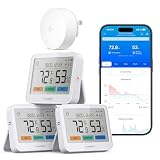
GoveeLife WiFi Thermometer Hygrometer 5-in-1, Large LCD 3-Pack with Gateway
Three sensors and gateway
±0.36F and ±2%RH
four-level alerts
Pros
- Three-sensor coverage
- Long listed range
- Precise sensor
- Large LCD
Cons
- Forecast needs another gateway
- Uses batteries
The GoveeLife H5220 package is built around a base display and remote sensing rather than a single cabinet reading. I would use the three sensors to compare the top, middle, and lower areas, because vertical differences can expose weak air circulation in a dry curing cabinet.
Its stated accuracy is ±0.36°F and ±2% RH, and its alert options include app, email, push, and gateway-buzzer notifications. That gives a DIY setup a clearer warning path if the environment strays while you are away.
This Package Fits Multi-Level Mapping
The large 3.7-inch LCD makes it easier to read a status check without opening an app. GoveeLife lists a battery life up to two years through Bluetooth or one year with the gateway, so record installation dates and replace batteries before a long cure reaches a sensitive stage.
This Package Requires Feature Checking
The weather forecast function requires the H5044 gateway, which is listed separately from that feature. For charcuterie, the chamber readings and alerts are the useful functions; an outdoor forecast does not replace an in-cabinet sensor.
3. X-Sense Is the Most Complete Three-Sensor Wi-Fi Check
X-Sense Wi-Fi Thermometer Hygrometer with LCD, 3 Sensors & Base Station
Three sensors and base
±0.36F and ±2%RH
free data export
Pros
- Three included sensors
- High listed accuracy
- Remote alerts
- Multi-user access
Cons
- 2.4GHz WiFi only
- Needs base station
The X-Sense set combines three STH0A hygrometer thermometers with an SBS50 base station. For charcuterie curing chambers, I like the idea of treating it as a mapping kit first: place sensors in separated positions and learn whether the cabinet has stable conditions before loading a major batch.
Its Swiss-made sensor is listed at ±0.36°F and ±2% RH from 0% to 99% RH. The base and app offer alerts plus maximum, minimum, and average graphs, so there is more context than a one-time temperature check.
This System Fits Shared Monitoring
X-Sense says the system supports up to 12 users, which can help when more than one person checks a long-running project. Free data export also makes it easier to retain a record of conditions alongside batch notes.
This System Requires 2.4 GHz Wi-Fi
The listed network limitation is 2.4 GHz Wi-Fi rather than 5 GHz. Confirm your network arrangement before buying, then keep the base station where it can communicate reliably with both the sensors and your home network.
4. Protmex HT607 Is the Hands-On Diagnostic Meter
HT607 Temperature Humidity Meter – Large LCD Backlight with Cover Protector
Humidity, dew point, wet bulb
Min-max hold
Backlit 2.26-inch LCD
Pros
- Four measurement modes
- Protective cover
- Data hold
- Backlit display
Cons
- No remote alerts
- Included battery details conflict
The Protmex HT607 is different from the app-centered monitors because it is a portable meter for spot checks. Its four modes—ambient temperature, relative humidity, wet bulb, and dew point—can be helpful when I want to investigate a suspicious reading rather than watch a dashboard.
Wet-bulb and dew-point figures are context tools, not automatic instructions for a cure. I would compare readings in several cabinet locations, then look for a consistent difference before assuming a permanent sensor is wrong.
This Meter Fits Troubleshooting Sessions
The Min/Max hold function, 2.26-inch backlit screen, and protective cover suit a manual inspection routine. It may also make a useful cross-check against a fixed monitor when you first build a home curing chamber.
This Meter Does Not Send Alerts
There is no listed Wi-Fi or Bluetooth notification function, so it cannot warn you overnight or while away. The battery information also uses inconsistent wording in the product details, making it sensible to check the package contents when it arrives.
5. Luxbird LTC-318-W Is the Active Dual-Zone Controller
LUXBIRD WiFi Temperature Humidity Controller LTC-318-W with Monitor, App Control for Reptile Terrarium Greenhouse Grow Tent,2-Year Warranty (Black)
Dual-zone temperature and humidity
WiFi alerts
Four operating modes
Pros
- Separate control zones
- Remote app alerts
- Split display
- Two-year warranty
Cons
- Small review base
- Needs compatible equipment
The Luxbird LTC-318-W is the first product here that is intended to control equipment, not merely report conditions. Its dual-zone design can separately manage temperature and humidity equipment, which is the central capability a DIY charcuterie system needs after the cabinet’s natural behavior has been measured.
I would read the wiring, load, and equipment compatibility instructions before connecting a refrigerator, humidifier, dehumidifier, heater, or fan. A controller follows its probe and settings; it cannot correct poor airflow, standing water, or an unsuitable cabinet by itself.
This Controller Fits a Managed DIY Build
The split display can be positioned for easier viewing than the outlet unit, while the app supplies remote control and alerts. Constant, manual, timer, and cycle modes offer different ways to run compatible equipment, but start with conservative settings and observe the result.
This Controller Has Limited Review Volume
The analyzed listing shows a 4.6 rating from 15 reviews, so the score has less weight than a rating built from thousands of reviews. The two-year warranty is listed as a positive, but register and retain the paperwork if warranty coverage affects your decision.
6. Govee H5075 Is the Familiar Bluetooth Three-Pack
Govee Indoor Hygrometer Thermometer 3Pack H5075 with Bluetooth App Control
Three Bluetooth monitors
±0.54F and ±3%RH
two-year CSV export
Pros
- Very large review base
- Three displays
- Fast two-second refresh
- Easy app pairing
Cons
- Bluetooth range limits
- App needed for full tools
The Govee H5075 package offers three individual monitors, which is useful for observing different zones without building a gateway system. The listing reports 47k+ reviews and a 4.5 rating, a much broader review base than several newer products in this list.
Each unit has a bright three-inch LCD with maximum and minimum records, and the listed sensor accuracy is ±0.54°F and ±3% RH. I would use the visible screens for quick checks and the app’s history to judge whether a change fixed a repeating swing.
This Three-Pack Fits Simple Cabinet Mapping
Pairing is listed as taking about one minute, and the devices refresh every two seconds. That fast update and three-unit format work well for an initial survey of shelf, hanging, and door-side conditions.
This Three-Pack Needs Phone Proximity
The quoted Bluetooth range is 196 feet in open conditions and may fall in a house with walls and appliances. Full alerts and data functions require the Govee Home app, so do not treat the LCD-only reading as a substitute for reviewing the data history.
7. ANFBYOH Mini Hygrometers Are the Dense Placement Option
ANFBYOH 6-Pack Mini Hygrometer Indoor Humidity Meter Digital Thermometer
Six compact displays
10-99%RH range
10-second updates
Pros
- Six-unit pack
- Very compact
- Clear display
- Wide stated range
Cons
- ±2F temperature accuracy
- No app functions
The ANFBYOH six-pack gives you many basic read points in a very small 1.87 by 1.12 by 0.57-inch body. I would see these as location scouts: one near the upper area, one lower down, and others in nearby storage or ingredient spaces where a simple display is enough.
They update every 10 seconds and cover 10% to 99% RH, with a stated temperature range of -58°F to 158°F. Their reported temperature accuracy is ±2°F, which is less precise than the higher-end sensor options here.
This Six-Pack Fits a Gradient Survey
Six displays make it possible to look for warm or dry corners before committing to a fixed layout. The 4.5 rating is based on 1,929 reviews in the analyzed data, giving the general feedback base more depth than many compact monitors.
This Six-Pack Is Not an Alert System
There is no app connectivity or smart notification feature, so every reading requires an in-person check. I would not make a high-stakes control decision from a single mini gauge without comparing it against a more precise reference monitor.
8. eMylo TH08Pro Is the Wi-Fi Display-First Monitor
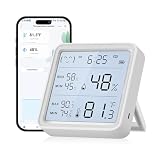
eMylo WiFi Thermometer Hygrometer with App Alerts, 3.2” Backlit Display
WiFi app alerts
3.2-inch backlit display
one-year data export
Pros
- Remote monitoring
- Large display
- Automation options
- Voice-assistant support
Cons
- 2.4GHz WiFi only
- Humidity accuracy is ±5%
The eMylo TH08Pro puts a 3.2-inch backlit display together with remote Smart Life app monitoring. I would favor it where a readable at-a-glance display matters, while still wanting alerts if the cabinet moves outside a set range.
The product data lists ±1.8°F temperature accuracy and ±5% humidity accuracy. That humidity tolerance is wider than the X-Sense and GoveeLife precision sets, so use it as a convenient trend monitor and verify important set points with a closer-tolerance device.
This Wi-Fi Monitor Fits Smart-Home Users
Alexa and Google Home compatibility, custom alerts, and automation scenes may appeal to users already working in a Smart Life setup. The listing also names free cloud storage and one year of data export, useful for tracking longer projects.
This Wi-Fi Monitor Requires Network Planning
It supports 2.4 GHz Wi-Fi, not 5 GHz, and its remote tools depend on a working network. Its 4.5 rating comes from 89 reviews, so consider the review sample smaller than the H5075’s large feedback base.
9. GoveeLife 2.0 Is the Gateway-Based Wi-Fi Three-Pack
GoveeLife 2.0 WiFi Hygrometer Thermometer with Gateway, Mini Sensor 3-Pack
Gateway plus three sensors
±0.54F and ±3%RH
two-year data history
Pros
- WiFi remote access
- Three sensors
- App and email alerts
- Up to 10 sensors
Cons
- 2.4GHz WiFi only
- Gateway required
GoveeLife 2.0 includes a Wi-Fi gateway and three thermo-hygrometers, making it a sensible fit for remote oversight across a chamber’s interior. The listing says one gateway can pair with up to 10 sensors, which gives a grow-as-needed path for monitoring more than one cabinet or nearby room.
Its Swiss-made sensor is listed at ±0.54°F and ±3% RH, with app and email notifications for thresholds you set. I would label each sensor by location in the app, because unlabeled readings are difficult to act on during a long cure.
This Gateway Set Fits Remote Recordkeeping
The analyzed data lists 20-day trend charts and two years of stored data for export. That is enough history to compare seasonal room changes, compressor cycling, or the effect of adding a small fan.
This Gateway Set Needs Its Included Hub
The Wi-Fi function depends on the gateway, and the devices support 2.4 GHz Wi-Fi only. Its 4.4 rating is based on 656 reviews, so check current setup instructions rather than assuming it operates exactly like another Govee model.
10. SENSTREE Is the Basic Plug-In Humidity Switching Controller
Digital Humidity Controller, Pre-Wired Humidity Controlled Dual Stage Outlets for Mushroom Growing, Reptile, Grow Tent, Humidifier/Dehumidifier
5-99%RH dual-stage control
Pre-wired outlets
Current and target display
Pros
- Humidity control outputs
- Plug-in setup
- Shows target and actual RH
- Controls two device types
Cons
- No temperature control
- Highest listed one-star share
The SENSTREE is a humidity-specific controller with pre-wired dual-stage outlets. It can switch a humidifier and dehumidifier or other compatible devices based on a stated 5% to 99% RH range, which is more active than any passive monitor in this article.
For a DIY dry curing cabinet, I would first test it with empty equipment and independent hygrometers. You need a separate way to manage refrigerator temperature, and you should keep its sensor out of water or soil as the listing instructs.
This Controller Fits a Simple Humidity Loop
Showing current and target humidity at the same time makes basic adjustments easier to inspect. The plug-in format may suit a user who wants an external controller instead of modifying appliance internals.
This Controller Calls for Extra Verification
The product has a 4.0 rating from 56 reviews, and the review analysis reports a 14% one-star share. That does not prove it will fail in a cabinet, but it is a good reason to validate operation, sensor placement, and cycling behavior before trusting it with a long batch.
These Buying Rules Help You Build a Safer, More Predictable Setup
Start with a definition that prevents a common purchase mistake: a humidity controlled cabinet is a system, not a single gauge. You need an appropriately refrigerated, cleanable enclosure; dependable independent readings; controlled airflow; and, where conditions demand it, compatible equipment for humidifying or dehumidifying.
Temperature Needs a Stable Starting Band
A direct answer to the common temperature question is 50 to 60°F for many dry-cured-meat workflows. Follow a tested recipe and food-safety guidance for the exact product, because fermentation, drying, and storage can call for different conditions.
Watch the actual air temperature, not just the refrigerator setting. Compressor cooling creates cycles, and a sensor near the vent or door can produce numbers that do not represent the conditions around the meat.
Humidity Needs a Measured Response, Not Guesswork
The frequently cited 60% to 85% RH span is broad because a salami, a whole muscle, and a late-stage cure do not necessarily behave alike. Too-dry air can contribute to a hardened exterior before the center dries appropriately; too-wet conditions can create unwanted surface problems.
Make one change at a time and leave enough time to see the pattern in the data. This is why data export and multiple sensors can be more valuable than a single impressive-looking display.
Sensor Placement Needs More Than One Location
Place one monitor near the intended product level, away from direct airflow, and compare it with another location above or below. Do not press a sensor against a cold wall, place it inside a drip zone, or hide it behind a dense load of meat.
The three-packs and six-pack in this guide are good for discovering gradients, while a portable meter can act as a cross-check. When two devices disagree, give them time together in one stable location before deciding which is inaccurate.
Active Control Needs Compatible Equipment and Testing
Controllers such as the Luxbird and SENSTREE switch connected equipment; they are not refrigeration units and they do not create humidity. Confirm electrical ratings, probe instructions, and the manufacturer guidance for every connected device before running a setup unattended.
Run an empty-cabinet trial long enough to observe compressor cycles, water buildup, airflow, and alarm behavior. Forum users often favor a plug-and-play cabinet because refrigerator conversions can require electrical knowledge and persistent adjustments; that trade-off is real.
DIY and Commercial Cabinets Serve Different Priorities
A DIY approach gives you flexibility, monitoring detail, and the chance to learn the environment, but it also adds responsibility for cleaning, wiring, calibration, and testing. A purpose-built cabinet may reduce setup work, although no product in this analyzed set is a purpose-built refrigerated curing cabinet.
NSF certification is most relevant when a commercial setting or local requirement calls for it. Do not assume certification from a monitor, controller, or product category label; verify the exact model documentation and check any applicable food-service rules.
Maintenance and Noise Belong in the Plan
Wipe spills, manage condensate, inspect probes and power cords, and keep air paths free of blockage. Calibrate or compare sensors periodically, especially before starting a long project where a few persistent percentage points of humidity can matter.
Noise data was not supplied for these products, and cabinet noise usually comes from refrigeration, fans, or a humidifier rather than the display itself. If the chamber will live near a kitchen or bedroom, test the assembled system in its intended location before committing to a permanent spot.
These FAQs Answer the Main Home Curing-Chamber Questions
How do you make a homemade curing chamber?
Convert a clean, suitable refrigerator or cabinet only after you have a plan for refrigeration, humidity management, gentle airflow, independent temperature and humidity monitoring, and safe electrical connections. Run it empty first, map conditions with sensors, make small adjustments, and follow a tested curing recipe and food-safety guidance before adding meat.
How long will cured meat keep in the refrigerator?
Storage time depends on the meat, cure, drying level, packaging, and refrigerator conditions, so there is no single safe number for every product. Follow the tested recipe or producer guidance, keep the product appropriately wrapped, and discard food with signs of spoilage rather than relying on time alone.
What temperature should a meat curing chamber be?
Many dry-curing workflows use a chamber around 50 to 60°F, with humidity often managed within a 60% to 85% relative-humidity range. The exact target changes by recipe and stage, so verify it with an independent thermometer-hygrometer and follow trusted recipe and food-safety instructions.
What salt is best for curing meat?
Use the salt and any curing salt specified by a tested recipe, measured accurately by weight. Curing salts are not interchangeable with ordinary salt, and their use rate matters for safety; do not substitute or estimate the amount.
These Ten Tools Make Monitoring the First Smart Purchase in 2026
For most home charcuterie curing chambers, I would begin with reliable measurement before adding a controller. X-Sense is the clearest three-sensor Wi-Fi choice from this data set, Govee H5075 supplies a widely reviewed Bluetooth three-pack, and Luxbird is the active-control option when you have compatible equipment and have tested the cabinet first.
Choose the tool that matches the missing piece in your setup, verify its readings in the actual cabinet, and keep food safety ahead of convenience. A stable environment comes from measured conditions, careful cleaning, suitable equipment, and a tested recipe working together.