
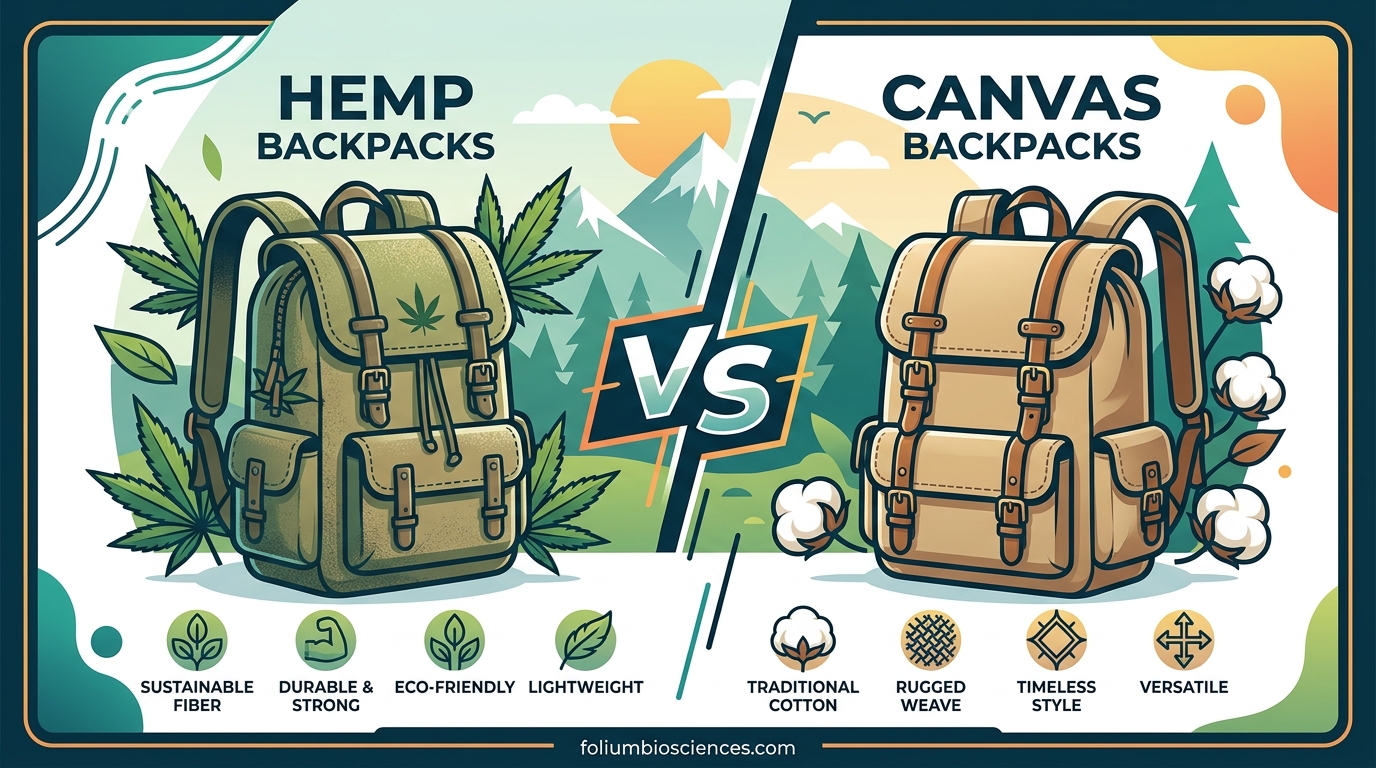
Choosing between hemp backpacks vs canvas can feel overwhelming when you need a bag that actually performs. I spent weeks researching fabric specifications, poring over user experiences from backpacker forums, and analyzing technical data to bring you the facts.
Both materials promise eco-friendly credentials, but how do they stack up on water resistance and weight capacity? These two factors often make or break a backpack for daily use.
By the end of this guide, you will know exactly which material suits your needs based on real performance data, not marketing claims.
Table of Contents
Understanding Hemp and Canvas Fabrics
Before comparing performance, you need to understand what these materials actually are. Both are natural fiber fabrics, but their construction and properties differ significantly.
What Is Hemp Fabric
Hemp fabric comes from the fibers of the Cannabis sativa plant, though industrial hemp contains negligible THC. The fibers run exceptionally long, often reaching 1 to 2 meters in length.
This fiber length gives hemp its legendary strength. Historical records show hemp was used for ship sails and rigging because it resisted rot and abrasion better than cotton.
Modern hemp fabric for backpacks typically uses a canvas weave, meaning the threads are woven tightly in a plain over-under pattern. The resulting material feels crisp and stiff when new, softening with use while maintaining structural integrity.
What Is Canvas Fabric
Canvas is a heavy, plain-woven fabric traditionally made from cotton. The name comes from the Latin “cannabis,” ironically sharing etymological roots with hemp.
Cotton canvas uses shorter fibers than hemp, typically under 3 centimeters. The weave is characterized by its weight and density, measured in ounces per square yard or grams per square meter (GSM).
Duck canvas represents a specific tightly-woven variant. The term “duck” comes from the Dutch word “doek,” meaning cloth. Numbered duck grades run from 1 (heaviest at 30 oz) to 12 (lightest at 11 oz), with lower numbers indicating thicker, more durable fabric.
Hemp Backpacks vs Canvas Water Resistance and Weight Capacity Compared
Water resistance separates good backpacks from great ones. Neither hemp nor canvas is truly waterproof without treatment, but their natural properties create different baseline performance levels.
Are Hemp Backpacks Waterproof
Hemp fibers possess natural water-resistant properties at the cellular level. The hollow core structure allows hemp to wick moisture away rather than absorbing it immediately.
Untreated hemp fabric typically absorbs 30-40% less water than cotton by weight. This means a hemp backpack exposed to light rain will stay drier inside than an untreated cotton canvas equivalent.
However, hemp is not waterproof. Prolonged exposure to rain will eventually saturate the fabric. Users on backpacking forums report that hemp backpacks handle drizzle and light spray well but need waterproof covers for heavy downpours.
Are Canvas Backpacks Water Resistant
Cotton canvas absorbs water readily without treatment. The cellulose fibers in cotton are hydrophilic, meaning they attract and hold water molecules.
A heavy cotton duck canvas will eventually become water-resistant through a phenomenon called “wetting out.” As the fibers swell with initial moisture, they tighten the weave and reduce further penetration. This takes time and means the interior gets wet first.
Untreated canvas offers minimal water resistance. A 12 oz cotton canvas backpack will soak through in moderate rain within 15 to 20 minutes based on user reports.
Water Resistance Ratings and Treatments
Both materials improve dramatically with proper treatments. Understanding the IPX rating system helps set realistic expectations.
The IPX scale measures protection against water ingress:
IPX0: No protection
IPX1-2: Dripping water protection
IPX3-4: Splashing water protection
IPX5-6: Water jet protection
IPX7-8: Immersion protection
Untreated hemp achieves approximately IPX1-2 rating naturally. Untreated cotton canvas sits at IPX0-1.
Wax treatments using beeswax or paraffin can elevate canvas to IPX3-4. Hemp with similar treatment reaches IPX4-5.
Modern synthetic coatings like polyurethane (PU) or thermoplastic polyurethane (TPU) can push either material to IPX5-6, though this reduces breathability significantly.
| Treatment Type | Hemp Rating | Canvas Rating |
|---|---|---|
| Untreated | IPX1-2 | IPX0-1 |
| Wax coating | IPX3-4 | IPX3-4 |
| PU coating | IPX5-6 | IPX5-6 |
| TPU laminate | IPX6-7 | IPX6-7 |
Forum users consistently recommend treating either material for serious outdoor use. One user noted their waxed canvas pack survived a 3-hour rainstorm in the Pacific Northwest while their untreated hemp pack soaked through in 45 minutes.
Weight Capacity Analysis
How much weight can these natural fiber backpacks actually hold? This question comes up constantly in forum discussions, and the answer depends on fabric specifications.
How Much Weight Can Hemp Backpacks Hold
Hemp boasts superior tensile strength compared to cotton. Hemp fibers achieve tensile strength ratings of 5 to 6 grams per denier (g/d), while cotton manages 3 to 4 g/d.
This strength translates to impressive load capacity. A 16 oz hemp canvas backpack using 400-500 denier fabric can comfortably handle 35 to 45 pounds of cargo when properly constructed with reinforced stress points.
The long hemp fibers distribute stress across the fabric better than short cotton fibers. This means hemp backpacks resist tearing at seams and attachment points where weight concentrates.
Real-world testing from ultralight backpacking communities suggests hemp canvas packs in the 45-50 liter range support 40-pound loads without structural compromise.
Canvas Backpack Weight Capacity
Cotton canvas strength varies dramatically by weight and weave density. Standard cotton canvas backpacks typically use 10 to 14 oz fabric.
A 12 oz cotton canvas backpack can handle 25 to 35 pounds safely. Heavy 18 oz duck canvas can push this to 40 pounds with proper construction.
Cotton fibers break down faster under load stress. Users report canvas backpacks showing stress fraying at shoulder strap attachments after 6 to 12 months of heavy daily use carrying 25+ pounds.
The shorter cotton fibers create weak points where repeated flexing occurs. This limits the long-term weight capacity compared to hemp.
Weight Capacity Comparison by Fabric Specifications
Fabric weight directly correlates with load capacity. Understanding denier and GSM measurements helps predict performance.
Denier measures fiber thickness. Higher denier means thicker, stronger threads.
GSM (grams per square meter) measures fabric density. Higher GSM indicates thicker, more durable material.
| Fabric Spec | Hemp Capacity | Canvas Capacity |
|---|---|---|
| 8 oz / 270 GSM | 20-25 lbs | 15-20 lbs |
| 12 oz / 400 GSM | 30-35 lbs | 25-30 lbs |
| 16 oz / 540 GSM | 40-50 lbs | 35-40 lbs |
| 20 oz / 680 GSM | 50-60 lbs | 40-50 lbs |
These figures assume quality construction with bar-tacked stress points and reinforced seams. Cheap backpacks with glued seams will fail regardless of fabric strength.
For heavy loads, hemp provides approximately 15-20% higher capacity at equivalent fabric weights.
Durability and Longevity
Weight capacity means nothing if the fabric wears out quickly. Durability encompasses abrasion resistance, tear strength, and long-term aging characteristics.
Abrasion Resistance
Hemp fibers excel at resisting surface wear. The coarse fiber structure creates a naturally abrasion-resistant surface that improves with use.
Canvas, while durable, shows wear patterns more quickly. The softer cotton fibers compress and fuzz with friction, though heavy duck canvas resists this better than lighter weights.
Forum users report hemp backpacks maintaining appearance and function after years of daily urban use. Canvas shows cosmetic wear sooner, though functional durability remains acceptable.
Tear Strength
Hemp’s longer fibers provide superior tear resistance. When stress concentrates at a point, the load distributes across multiple long fibers rather than breaking individual short ones.
Cotton canvas tears propagate more easily once initiated. A small cut or puncture in cotton canvas spreads under load, while hemp fabric tends to contain damage.
This matters for outdoor use where branches, rocks, and sharp objects pose threats.
Long-Term Durability
Hemp offers excellent UV resistance. The lignin content in hemp fibers naturally absorbs ultraviolet radiation, preventing the breakdown that plagues cotton.
Canvas backpacks left in sunlight fade and weaken over time. Cotton fibers degrade under UV exposure, losing up to 50% of their strength after prolonged sun exposure.
Both materials resist mold and mildew when dry, but hemp has natural antimicrobial properties. Users report hemp backpacks handling damp conditions better without developing musty odors.
A properly maintained hemp backpack can last 10 to 15 years of regular use. Canvas backpacks typically provide 5 to 8 years of service before replacement becomes necessary.
Environmental Impact Comparison
For many buyers, sustainability drives the choice between hemp and canvas. Both beat synthetic alternatives, but they differ significantly in environmental footprint.
Water Usage
Hemp requires dramatically less water than cotton. A hemp crop needs roughly 50% of the water consumed by an equivalent cotton crop.
Cotton is notoriously thirsty. Producing one pound of cotton fiber requires approximately 1,800 gallons of water. Hemp produces equivalent fiber using 600 to 800 gallons.
This water difference makes hemp significantly more sustainable in water-stressed regions.
Pesticide and Chemical Use
Hemp grows densely and rapidly, naturally crowding out weeds. This eliminates the need for herbicides in most hemp cultivation.
Hemp also resists pests naturally, reducing pesticide requirements. Most industrial hemp grows with minimal chemical intervention.
Cotton farming consumes approximately 16% of global insecticide use and 25% of pesticide use despite occupying only 2.5% of agricultural land.
Organic cotton eliminates these chemicals but yields lower fiber per acre, increasing land use requirements.
Biodegradability and End of Life
Both materials biodegrade completely. Untreated hemp and cotton fabrics break down in compost within 6 to 12 months.
Hemp’s faster growth cycle means lower carbon footprint per harvest. Hemp also sequesters carbon during growth, potentially making it carbon-negative depending on processing methods.
Cotton has a higher carbon footprint due to processing, water pumping, and chemical inputs. Organic cotton reduces but does not eliminate this gap.
| Environmental Factor | Hemp | Cotton Canvas |
|---|---|---|
| Water usage per pound | 600-800 gallons | 1,800 gallons |
| Pesticide requirements | Minimal/none | High |
| Growth cycle | 4 months | 6-8 months |
| Biodegradation time | 6-12 months | 6-12 months |
| Carbon sequestration | High | Moderate |
Care and Maintenance
Proper care extends the lifespan of either material significantly. Both require more attention than synthetic fabrics but reward the effort with years of service.
Hemp Backpack Care
Spot clean hemp backpacks with a damp cloth for minor stains. The antimicrobial properties mean you can often air out hemp rather than washing it.
When full washing is necessary, use cold water and mild soap. Hot water causes hemp fibers to shrink and potentially weaken.
Air dry hemp backpacks away from direct sunlight. While hemp resists UV damage, excessive heat from dryers stresses the fibers.
Store hemp backpacks in a dry, ventilated space. The breathable nature prevents odor buildup even during storage.
Canvas Backpack Maintenance
Canvas requires more vigilant care to prevent mold and mildew. Always dry canvas completely before storage.
Wash canvas with mild detergent in cold water. Avoid harsh chemicals that strip natural oils from the cotton fibers.
Reapply waterproofing treatments annually if you rely on water resistance. Wax-based treatments wear off with use and washing.
Check stress points regularly for fraying. Canvas backpacks benefit from early repairs at seam stress areas.
| Care Task | Hemp | Canvas |
|---|---|---|
| Washing temperature | Cold only | Cold recommended |
| Drying method | Air dry | Air dry |
| Waterproofing frequency | Every 1-2 years | Every 6-12 months |
| Mold risk | Low | Moderate |
| UV exposure tolerance | High | Low-Moderate |
Which Should You Choose
The right material depends on your specific needs and priorities.
Choose hemp if:
You carry heavy loads regularly and need maximum weight capacity.
You want superior water resistance without frequent re-treatment.
You prioritize sustainability and environmental impact.
You need long-term durability for daily use.
Choose canvas if:
You prefer a softer feel and classic aesthetic.
You want easier availability and more style options.
You accept slightly lower performance for lower cost.
You enjoy the patina that develops with canvas aging.
For water resistance specifically, hemp wins at the untreated level but equals canvas when both are waxed or coated.
For weight capacity, hemp consistently outperforms canvas by 15-20% at equivalent fabric weights.
Both materials serve eco-conscious consumers well. Hemp offers superior technical performance. Canvas offers classic style and wider availability.
FAQ
Are hemp backpacks waterproof?
Hemp backpacks are not fully waterproof without treatment, but they offer natural water resistance. Untreated hemp achieves an IPX1-2 rating, meaning it resists light dripping and spray. The hollow fiber structure absorbs 30-40% less water than cotton. For true waterproofing, hemp backpacks need wax treatments or synthetic coatings like PU, which can elevate protection to IPX5-6.
Are canvas backpacks water resistant?
Untreated canvas backpacks offer minimal water resistance (IPX0-1). Cotton fibers are hydrophilic and absorb water readily. Heavy duck canvas may temporarily resist water as fibers swell and tighten the weave, but water eventually penetrates. Waxed canvas achieves IPX3-4 protection, making it suitable for light rain. For heavy rain, canvas requires waterproof covers or synthetic coatings.
What backpacks can hold a lot of weight?
Backpacks made from heavy fabrics (16-20 oz or 500+ GSM) with reinforced construction can hold 40-60 pounds. Hemp backpacks typically handle 15-20% more weight than canvas at equivalent fabric weights due to superior tensile strength. A 16 oz hemp canvas pack supports 40-50 pounds, while 12 oz canvas manages 25-35 pounds. Look for bar-tacked stress points and reinforced seams regardless of material.
What are the disadvantages of a canvas bag?
Canvas bags have several limitations: high water absorption without treatment, UV degradation over time causing fading and weakening, heavier weight than synthetic alternatives at equivalent durability, potential for mold and mildew if stored damp, and faster wear at stress points compared to hemp. Cotton canvas also has a higher environmental footprint than hemp due to water and pesticide requirements in production.
Is hemp stronger than canvas?
Yes, hemp is stronger than canvas by most measures. Hemp fibers achieve 5-6 grams per denier tensile strength compared to cotton’s 3-4 g/d. Hemp offers superior abrasion resistance, better tear strength due to longer fibers, and greater longevity with 10-15 year lifespans vs 5-8 years for canvas. Hemp also resists UV damage and mold better than cotton canvas.
How much weight can a hemp backpack hold?
Hemp backpack capacity depends on fabric weight. An 8 oz hemp canvas holds 20-25 pounds, 12 oz manages 30-35 pounds, 16 oz supports 40-50 pounds, and 20 oz heavy-duty hemp can handle 50-60 pounds. These figures assume quality construction with reinforced seams and stress points. Hemp’s long fibers distribute load better than cotton, reducing tear risk at attachment points.
Which is more durable hemp or canvas?
Hemp is more durable than canvas. Hemp fibers are longer and stronger, providing better abrasion resistance and tear strength. Hemp resists UV damage, maintaining strength under sun exposure where cotton degrades. Hemp also has natural antimicrobial properties that resist mold and mildew. With proper care, hemp backpacks last 10-15 years compared to 5-8 years for cotton canvas. However, both materials outlast synthetic alternatives in terms of repairability and aging gracefully.
Do canvas backpacks get moldy?
Canvas backpacks can develop mold if stored damp or in humid conditions. Cotton fibers absorb and retain moisture, creating ideal conditions for mold and mildew growth. To prevent mold, always dry canvas completely before storage, store in ventilated areas, and reapply waterproofing treatments that inhibit moisture absorption. Hemp backpacks have lower mold risk due to natural antimicrobial properties and lower moisture absorption, though proper drying remains important for any natural fiber pack.
Conclusion
After analyzing hemp backpacks vs canvas across water resistance, weight capacity, and durability, hemp emerges as the technical winner. It absorbs less water naturally, handles heavier loads, and lasts longer under stress.
However, canvas remains a viable choice for those prioritizing classic aesthetics, softer feel, or budget constraints. Both materials serve the eco-conscious mission well.
Your specific use case should drive the decision. Heavy loads and wet conditions favor hemp. Light everyday carry and style preferences might suit canvas.
Either way, choosing natural fiber over synthetic represents a sustainable step forward.