
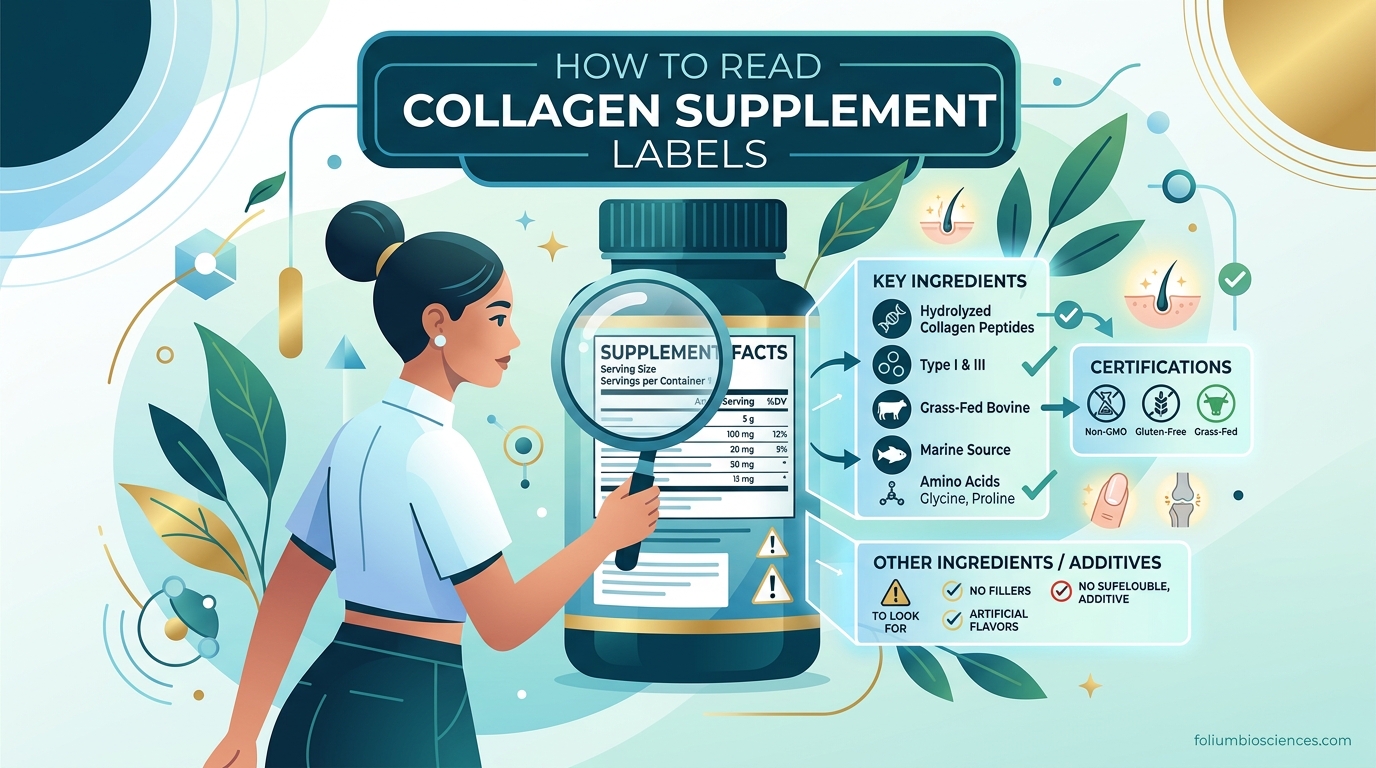
Walking through the supplement aisle, I counted 17 different collagen products on one shelf alone. Every bottle promised glowing skin, stronger joints, and healthier hair. But when I flipped them over to check the labels, I realized something troubling: most people have no idea what they’re actually buying.
Learning how to read a collagen supplement label matters because the front of the bottle tells you what the marketing team wants you to hear. The back tells you what you’re actually getting. After reviewing dozens of collagen products and speaking with our research team about quality indicators, I’ve identified the exact elements that separate legitimate supplements from overpriced powders.
In this guide, I’ll walk you through everything you need to know about reading collagen labels, with special attention to Type III collagen because it’s the most misunderstood type on the market.
Table of Contents
How to Read a Collagen Supplement Label: 7 Key Elements
When I first started examining collagen labels, I made the same mistake everyone does: I looked at the serving size and assumed that was my collagen content. That assumption cost me money and delayed my results. Here’s what you actually need to check.
1. Actual Collagen Content Per Serving
The biggest deception in collagen labeling is the gap between serving size and actual collagen content. A product might list a 15-gram serving, but only contain 10 grams of actual collagen. The rest? Fillers, flavors, and additives.
Look for the specific line that says “collagen” or “hydrolysed collagen” in the nutrition facts. This number tells you exactly how much collagen protein you’re getting, not the total powder weight.
2. Collagen Type Declaration
Quality collagen supplements clearly state which types they contain. The label should specifically say Type I, Type II, Type III, or a combination like “Types I & III.” If the label just says “collagen” without specifying the type, that’s your first red flag.
3. Source Animal Identification
The source matters for both quality and your dietary preferences. Labels should clearly state:
- Bovine (from cattle)
- Marine (from fish)
- Porcine (from pigs)
- Chicken (for Type II)
Vague terms like “natural source” or no source listed at all suggest the manufacturer doesn’t want you to know where it came from.
4. Protein Content Verification
Collagen is a protein, so the protein content on the nutrition label should closely match the collagen content. If a product claims 10 grams of collagen but only 5 grams of protein, something doesn’t add up. Pure collagen contains approximately 90-95% protein by weight.
5. Complete Ingredient List Review
The ingredient list reveals everything. Quality collagen should have a short, simple list. Our team found that the best products contain collagen and maybe 1-2 other functional ingredients like vitamin C. Long ingredient lists with items you can’t pronounce suggest unnecessary fillers.
6. Quality Certifications
Look for certification logos or statements on the label:
- GMP Certified (Good Manufacturing Practice)
- Third-party tested
- Non-GMO Project Verified
- NSF Certified for Sport
- USP Verified
These certifications mean independent organizations have verified the product’s quality and contents.
7. Manufacturer Transparency
The label should clearly state who makes the product and where. Look for complete contact information, not just a website. Companies that stand behind their products provide phone numbers and physical addresses.
Type I vs Type III Collagen: What the Label Actually Means
Most collagen supplements combine Type I and Type III collagen, but these two types serve different purposes in your body. Understanding the difference helps you choose products that match your goals.
Type I Collagen: The Skin and Bone Builder
Type I collagen makes up about 90% of the collagen in your body. It’s the most abundant type and primarily found in your skin, bones, tendons, and ligaments. When you see marine collagen on a label, it’s almost exclusively Type I because fish collagen closely mimics human Type I collagen structure.
If your goal is skin elasticity, reducing fine lines, or supporting bone density, Type I collagen should be your priority. Studies show that Type I collagen peptides can increase skin hydration and reduce wrinkles when taken consistently for 8-12 weeks.
Type III Collagen: The Support Network
Type III collagen often gets overlooked, but it plays a vital role in your body’s structural integrity. It’s found alongside Type I in your skin, blood vessels, and internal organs. Think of Type III as the scaffolding that supports Type I’s structure.
What makes Type III collagen unique is its role in tissue elasticity and wound healing. It’s particularly important for:
- Blood vessel strength and flexibility
- Skin elasticity and bounce-back
- Gut lining integrity
- Muscle structure support
When labels show “Types I & III,” you’re getting the structural support of Type I plus the elastic properties of Type III. This combination makes sense because these types work together in your body’s tissues.
Why Labels Combine Types I and III
Bovine collagen naturally contains both Type I and Type III in ratios similar to human tissue. When manufacturers use bovine sources, they get both types in their natural proportions. This is why you’ll rarely see pure Type III supplements: nature packages them together for a reason.
Marine collagen, on the other hand, contains almost exclusively Type I. If you want the benefits of Type III specifically, look for bovine-sourced collagen or products that specifically state “Types I & III.”
What Are Collagen Peptides? Understanding Hydrolysed Collagen Labels
If you’ve shopped for collagen, you’ve seen terms like “collagen peptides” and “hydrolysed collagen.” These aren’t marketing buzzwords. They describe a critical processing step that affects how well your body can use the supplement.
Collagen Peptides vs Regular Collagen
Raw collagen is a large protein molecule. Your body struggles to break it down and absorb it. Collagen peptides are simply collagen that’s been broken down into smaller chains of amino acids through a process called hydrolysis.
When a label says “hydrolysed collagen” or “collagen peptides,” it means the manufacturer has pre-digested the protein for you. This dramatically improves absorption. Studies show hydrolysed collagen has over 90% bioavailability compared to about 27% for non-hydrolysed forms.
Why Most Quality Labels Say “Peptides”
Almost all quality collagen supplements on the market today use hydrolysed forms because the research overwhelmingly supports better results. If you see a label that just says “collagen” without “peptides” or “hydrolysed,” check the molecular weight or Dalton value if listed.
Non-hydrolysed collagen typically appears in gelatin products or specific joint formulas targeting cartilage. For general supplementation, peptides are the standard you should expect.
Bovine vs Marine Collagen: How to Identify Source on Labels
The source of your collagen determines its type profile, amino acid ratios, and potential benefits. Here’s how to identify each source from label clues.
Identifying Bovine Collagen on Labels
Bovine collagen comes from cattle hides and bones. Look for these label indicators:
- “Bovine” or “bovine hide” in ingredients
- “Grass-fed” or “pasture-raised” claims
- Types I and III collagen specified
- Higher glycine and proline content
- Creamy, neutral taste profile
Quality bovine collagen labels often specify “grass-fed” or “pasture-raised” cattle. This matters because cattle raised on pasture have healthier fat profiles and potentially better collagen quality than grain-fed animals.
Identifying Marine Collagen on Labels
Marine collagen comes from fish skin and scales. Look for these indicators:
- “Marine,” “fish,” or specific fish species listed
- “Wild-caught” sourcing claims
- Type I collagen only
- Lower molecular weight (often under 3,000 Daltons)
- Fishy taste potential
Premium marine collagen labels specify the fish source: “wild-caught cod,” “Alaska pollock,” or “tilapia.” Vague “marine collagen” labels may use farmed fish or multiple species of varying quality.
Which Source Shows Which Type
Here’s the simple rule: bovine provides Types I and III. Marine provides almost exclusively Type I. If you want Type III collagen benefits specifically, you need bovine-sourced collagen or a blend that includes it.
Some labels now offer “multi-collagen” formulas containing bovine, marine, chicken, and sometimes eggshell membrane sources. These provide a broader spectrum of collagen types but require careful label reading to verify the ratios.
Collagen Label Red Flags: 6 Ingredients and Claims to Avoid
After analyzing dozens of collagen labels, our team identified recurring patterns that signal lower quality or misleading products. Here are the specific red flags to watch for.
1. Proprietary Blends Hiding Collagen Content
When a label lists a “proprietary blend” containing collagen along with other ingredients, you can’t tell how much collagen you’re actually getting. The blend might be 90% cheap filler and 10% collagen. Quality labels disclose exact amounts.
2. Excessive Fillers and Additives
Watch for these unnecessary ingredients:
- Maltodextrin: A cheap filler that adds bulk
- Artificial sweeteners: Sucralose, aspartame, acesulfame K
- Artificial flavors and colors
- Vegetable oils (often oxidized)
- Silicon dioxide (anti-caking agent in excessive amounts)
Quality collagen needs minimal additives. If the ingredient list extends beyond 5-7 items, question why.
3. Vague Marketing Claims Without Evidence
Labels that promise specific results like “reduces wrinkles by 50%” or “reverses aging” without referencing clinical studies are making unauthorized medical claims. In regulated markets, these claims aren’t allowed on supplement labels. Their presence suggests either ignorance of regulations or willingness to mislead.
4. Missing or Incomplete Sourcing Information
If a label won’t tell you whether the collagen comes from grass-fed cattle or farmed fish, there’s usually a reason. Quality brands are transparent about their sourcing because it’s a selling point. Vague sourcing suggests they’re hiding lower-quality origins.
5. No Third-Party Testing Claims
While not every quality supplement carries third-party testing logos, the absence of any quality verification combined with other red flags is concerning. Third-party testing proves the label matches the contents, which is surprisingly uncommon in the supplement industry.
6. Serving Size Disguising Low Collagen Content
Some labels list a large serving size (like 15 grams) but only contain 5-7 grams of actual collagen. The rest is flavoring, sweeteners, and fillers. Always check the specific collagen content, not just the scoop size.
Quality Certifications to Look For on Collagen Labels
Certifications provide independent verification that a product meets specific standards. Here’s what the common certifications actually mean and how to verify them.
GMP Certification Explained
GMP stands for Good Manufacturing Practice. This certification means the manufacturing facility follows FDA guidelines for cleanliness, documentation, and quality control. It doesn’t guarantee the product works, but it does mean it was made in a facility that follows standardized procedures.
Most legitimate supplement manufacturers have GMP certification. Its absence is more of a red flag than its presence is a guarantee of excellence.
Third-Party Testing Verification
This is the gold standard for supplement quality. Third-party testing means an independent laboratory verified that:
- The collagen content matches the label
- No harmful contaminants are present
- Heavy metals are within safe limits
- Microbial testing passed
Look for logos from organizations like NSF, USP, Informed Sport, or BSCG. Some companies also publish Certificates of Analysis (COAs) on their websites showing batch-specific testing results.
How to Verify Certification Claims
Don’t just trust a logo on the label. Visit the certifying organization’s website and search for the product. Most certification bodies maintain public databases of verified products. If you can’t find the product listed, contact the manufacturer and ask for their certificate number.
Amino Acid Profile: What the Label Doesn’t Always Show
Collagen’s benefits come from its unique amino acid composition. While most labels don’t show the complete amino acid profile, understanding what should be there helps you evaluate quality.
The Key Amino Acids in Quality Collagen
Collagen is rich in three specific amino acids:
- Glycine: Makes up about 33% of collagen. Supports sleep, gut health, and detoxification.
- Proline: About 12% of collagen. Essential for skin elasticity and joint cartilage.
- Hydroxyproline: About 10% of collagen. Unique to collagen and critical for stability.
Together, these three amino acids account for over 50% of collagen’s composition. Quality collagen supplements maintain these ratios.
When Labels Do Show Amino Acid Content
Some premium collagen brands include complete amino acid profiles on their labels or websites. If you see this information, check that glycine is the highest percentage, followed by proline and hydroxyproline. This confirms you’re getting genuine collagen protein, not adulterated powder.
If a label claims high collagen content but shows a weak amino acid profile with low glycine, the product may contain fillers or lower-quality protein sources.
Dalton Value Explained: Molecular Weight on Collagen Labels
Dalton values appear on some premium collagen labels, but most consumers don’t know what they mean. Understanding this technical detail helps you choose collagen with optimal absorption.
What Are Daltons?
Daltons measure molecular weight. In collagen, this tells you how small the protein chains are. Smaller chains absorb better. The Dalton value indicates the average molecular weight of the collagen peptides in the product.
Optimal Molecular Weight Range
Research suggests collagen peptides between 2,000 and 5,000 Daltons offer the best absorption while maintaining bioactivity. Marine collagen often falls on the lower end (2,000-3,000 Daltons), while bovine collagen typically ranges from 3,000-5,000 Daltons.
Collagen below 1,000 Daltons may absorb too quickly and not trigger the cellular responses that provide benefits. Above 10,000 Daltons, absorption drops significantly.
Why Not All Labels Show Dalton Values
Testing for molecular weight requires specialized equipment that smaller manufacturers may not have access to. The absence of Dalton values doesn’t mean a product is low quality, but their presence indicates a manufacturer committed to transparency and quality control.
If you’re choosing between two similar products and one lists Dalton values while the other doesn’t, the labeled product shows more commitment to quality documentation.
Quick Checklist: How to Read a Collagen Supplement Label
Here’s a practical checklist you can use when shopping for collagen supplements:
- Collagen content clearly stated (not just serving size)
- Collagen types specified (I, II, III, or combinations)
- Source identified (bovine, marine, porcine)
- Source quality mentioned (grass-fed, wild-caught)
- Short ingredient list (under 7 items preferred)
- No proprietary blends hiding collagen amounts
- No artificial sweeteners or excessive fillers
- Third-party testing or GMP certification present
- Manufacturer contact information visible
- Dalton value stated (bonus, not required)
Use this checklist to evaluate any collagen product. A quality product should check at least 7 of these 10 criteria.
Frequently Asked Questions
Is type 3 collagen better than type 1?
Neither type is universally better. Type 1 collagen supports skin, bones, and tendons and makes up 90% of your body’s collagen. Type 3 collagen works alongside Type 1, providing elasticity to skin and strength to blood vessels. For most people, a combination of both types provides better results than either alone. Choose based on your goals: Type 1 for skin and bone, Type 3 for elasticity and gut health.
How do you know if your collagen is type 1 or 2?
Check the Supplement Facts panel on the label. Quality products clearly state the collagen type. Type 1 typically comes from bovine or marine sources. Type 2 comes from chicken cartilage or sternum. If the label just says collagen without specifying the type, contact the manufacturer or choose a different product that provides this information.
What to look for in a quality collagen supplement?
Look for these key elements: clearly stated collagen content per serving (not just serving size), specified collagen types (I, II, III), identified source animal (bovine, marine, porcine), short ingredient list without fillers, third-party testing or GMP certification, and transparent manufacturer information. Avoid proprietary blends that hide actual collagen amounts.
Which collagen is best for tendons?
Type 1 collagen is best for tendon health because tendons are primarily composed of Type 1 collagen fibers. Bovine collagen provides Type 1 and Type III, both of which support connective tissue. Marine collagen contains almost exclusively Type 1 and has smaller peptides that may absorb more efficiently. Look for hydrolysed collagen peptides with molecular weight under 5,000 Daltons for optimal tendon support.
Can I take collagen while on HRT?
Most people can take collagen supplements while on hormone replacement therapy. Collagen is a protein, not a hormone, and doesn’t interact with HRT medications. However, always consult your healthcare provider before starting any new supplement, especially if you have specific health conditions or concerns. Some collagen products contain additional ingredients that could interact with medications.
Does collagen count toward my daily protein intake?
Yes, collagen counts toward your daily protein intake because it is a complete protein source containing amino acids. However, collagen has an incomplete amino acid profile compared to meat, eggs, or whey. It’s particularly low in tryptophan. While collagen contributes to your protein total, it shouldn’t be your only protein source. Aim to get most protein from complete sources and use collagen as a supplement.
What does hydrolysed collagen mean on a label?
Hydrolysed collagen means the collagen has been broken down into smaller peptides through a process called hydrolysis. This pre-digestion makes the collagen easier for your body to absorb. Hydrolysed collagen has over 90% bioavailability compared to about 27% for non-hydrolysed forms. Most quality collagen supplements use hydrolysed collagen because research shows better results.
Why is Dalton value important for collagen supplements?
Dalton values measure molecular weight. Collagen peptides between 2,000 and 5,000 Daltons offer optimal absorption while maintaining bioactivity. Smaller peptides absorb more efficiently but may trigger different cellular responses. Marine collagen typically has lower Dalton values (2,000-3,000) than bovine (3,000-5,000). The Dalton value indicates processing quality and potential absorption rate.
Final Thoughts on Reading Collagen Supplement Labels
Learning how to read a collagen supplement label protects you from overpaying for underdosed products and helps you find supplements that actually match your health goals. The key is focusing on what the label actually says rather than what the marketing implies.
Remember these essentials: check for actual collagen content (not serving size), verify the collagen types match your goals, confirm the source quality, avoid proprietary blends and excessive fillers, and look for third-party testing when possible. Type III collagen specifically offers unique benefits for skin elasticity and gut health, but works best alongside Type I.
Use the checklist in this guide the next time you shop for collagen. With practice, reading these labels becomes second nature, and you’ll quickly spot the difference between quality supplements and marketing hype.