
There is nothing quite as frustrating as growing crisp, beautiful hydroponic lettuce only to bite into a leaf that tastes like a mouthful of pennies. I have been there myself — staring at a tray of perfect-looking butterhead, wondering where I went wrong. The good news is that bitter hydroponic lettuce is almost always fixable, and once you understand the science behind it, preventing it becomes second nature.
The bitter taste in hydroponic lettuce comes from chemical compounds called sesquiterpene lactones, which the plant produces as a defense mechanism when it experiences stress. Think of it as the lettuce version of a fight-or-flight response. When the plant feels threatened by heat, age, or nutrient problems, it ramps up production of these bitter compounds to make itself less palatable to predators. Your lettuce is not broken — it is just trying to survive.
In this guide, I will walk through every cause of bitter hydroponic lettuce, share the prevention strategies that actually work, and give you quick fixes you can use right now to sweeten a harvest that has already gone bitter. Whether you are running a small indoor DWC system or managing a larger NFT setup, these principles apply universally.
Table of Contents
What Causes Bitter Taste in Hydroponic Lettuce
Bitter hydroponic lettuce is caused by the buildup of sesquiterpene lactones — naturally occurring terpene compounds that lettuce produces under stress. When growing conditions shift away from what lettuce prefers (cool temperatures, steady nutrients, moderate light), the plant shifts energy from leaf production to defense, flooding its leaves with these bitter-tasting compounds.
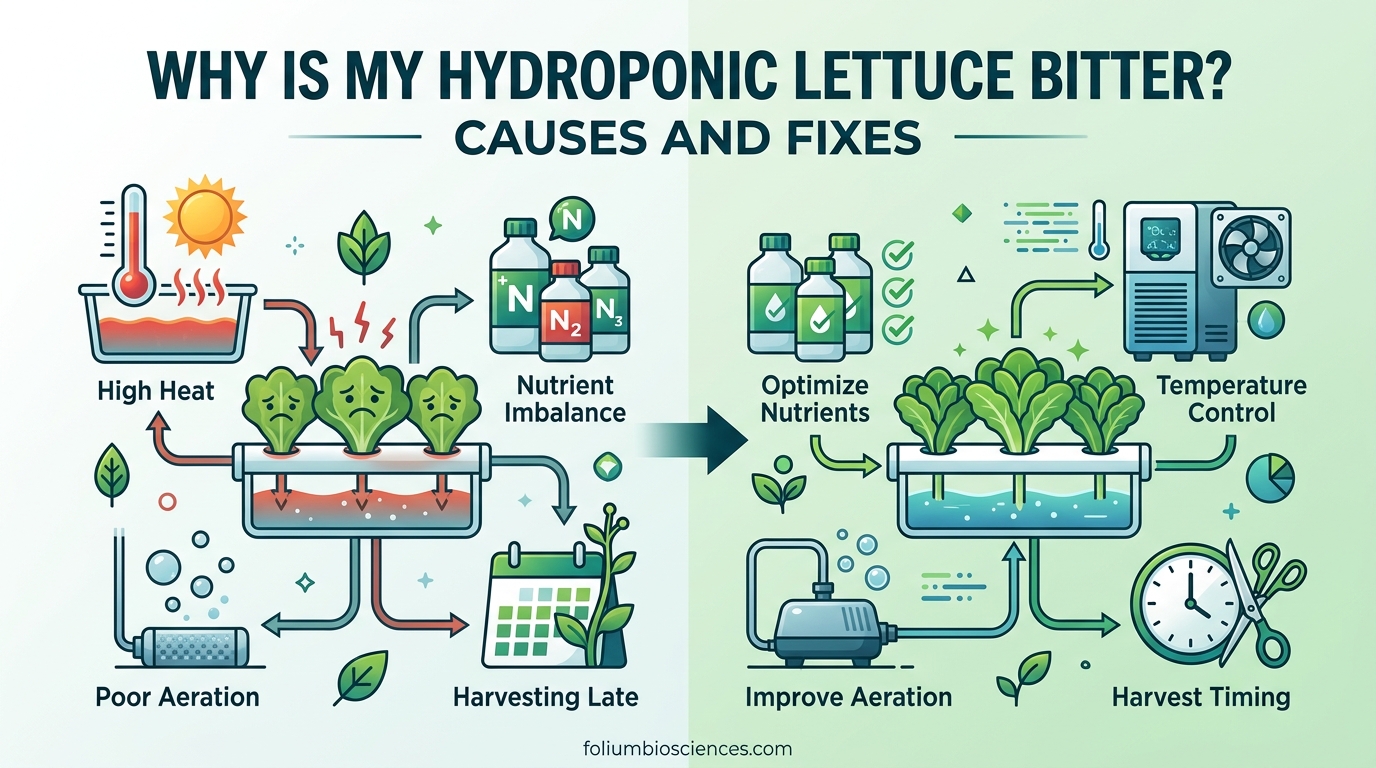
The four main triggers for this chemical shift are heat stress and bolting, plant age and maturity, nutrient and pH imbalances, and light stress. Heat is by far the most common culprit, responsible for the majority of bitter lettuce cases reported by hydroponic growers. But multiple factors can stack on top of each other, which is why some growers struggle to fix the problem even after addressing temperature.
Understanding which factor — or combination of factors — is affecting your crop is the first step toward getting sweet, tender lettuce back on your plate.
Heat Stress and Bolting: The Number One Cause
If your hydroponic lettuce tastes bitter, heat stress is the most likely suspect. Lettuce is a cool-season crop that thrives between 60°F and 70°F (15°C to 21°C). When ambient temperatures climb above 75°F (24°C), the plant begins to panic. It starts producing a flowering stalk in a process called bolting, and as it redirects energy toward reproduction, the leaves rapidly accumulate bitter sesquiterpene lactones.
Bolting is easy to spot once you know what to look for. The center of the plant elongates upward, leaves become narrower and more pointed, and the overall texture shifts from tender to tough and fibrous. Once bolting starts, there is no reversing it — the plant has decided it is time to flower and seed, and no amount of temperature correction will bring back the sweet flavor.
Air temperature gets most of the attention, but reservoir water temperature is equally important and often overlooked. In recirculating hydroponic systems like DWC and NFT, the nutrient solution acts as a thermal buffer — but when that solution heats up above 72°F (22°C), the roots themselves experience stress. Warm water holds less dissolved oxygen, which compounds the problem by stressing the root system. Root stress and heat stress together create a double hit of bitter compound production.
I learned this the hard way during a summer grow when my reservoir temperature crept up to 78°F over the course of a week. The lettuce above looked fine visually, but every leaf was inedibly bitter. After adding a reservoir chiller and keeping the water at 65°F, my next crop came out sweet and crisp. The ambient air was warm, but the cool roots made all the difference.
Plant Age and Maturity Factors
Even under perfect growing conditions, lettuce has a finite window of peak flavor. Most hydroponic lettuce varieties reach their sweet spot between 30 and 45 days from seed. Beyond that window, the plant naturally begins to mature and produce more of the defensive compounds that cause bitterness, regardless of temperature or nutrient levels.
This is a common trap for beginners — the lettuce looks great and keeps getting bigger, so you let it grow longer hoping for an even bigger harvest. But bigger does not mean better when it comes to flavor. An over-mature lettuce head at 60 days will taste noticeably more bitter than a smaller head harvested at 35 days, even if every other variable is identical.
The signs of over-maturity include thicker stems, tougher leaf ribs, and a slight yellowing of the outer leaves. The inner leaves may still look tender, but the bitterness is already present throughout the plant’s vascular system. Harvesting early is always the safer bet — you can always grow another batch, but you cannot un-bitter a lettuce that has been left too long.
Nutrient Imbalances and pH Levels
Nutrient management plays a bigger role in lettuce flavor than most growers realize, and it is one of the least-covered topics in hydroponic guides. The pH of your nutrient solution directly affects which nutrients the plant can absorb. For hydroponic lettuce, the sweet spot is a pH between 5.5 and 6.5. When pH drifts outside this range, the plant struggles to take up key nutrients — particularly nitrogen, calcium, and iron — and the resulting deficiency stress triggers bitter compound production.
Nitrogen levels deserve special attention. Lettuce needs a steady supply of nitrogen to produce tender, sweet-tasting leaves. When nitrogen drops too low (often because the EC has been reduced too aggressively), the plant shifts from vigorous leaf growth to survival mode, and the flavor suffers. A target EC of 0.8 to 1.2 mS/cm is generally ideal for lettuce in vegetative growth. Pushing higher than that can cause tip burn and nutrient lockout, but dropping too low robs the plant of what it needs for sweet growth.
Nutrient solution freshness matters too. Old, depleted nutrient solutions accumulate waste products and develop pH instability. I recommend a full reservoir change every 7 to 10 days for lettuce. Growers on Reddit’s r/Hydroponics community consistently report that flushing the system and replacing the nutrient solution reduced bitterness significantly — a real-world data point that aligns with what we know about plant chemistry.
Light Spectrum and Intensity Effects on Flavor
Light is one of the most underappreciated factors in hydroponic lettuce flavor. Too much light stress pushes the plant into protective mode, just like heat does. The Daily Light Integral (DLI) for optimal lettuce growth falls between 12 and 17 mol per square meter per day. Exceeding that range — especially with intense full-spectrum LED lights positioned too close — causes the plant to produce thicker cell walls and higher concentrations of phenolic compounds, both of which contribute to a harsher, more bitter taste.
Light spectrum also plays a role. Blue-heavy light spectrums (often marketed as “vegetative” spectrum) encourage compact growth but can increase stress compound production when overused. A balanced spectrum with some red and far-red light tends to produce sweeter, more tender leaves. Many commercial vertical farms use a ratio of roughly 3:1 red to blue light for lettuce production specifically because it produces the best flavor profile.
Photoperiod matters as well. Lettuce benefits from a dark period — it is not a plant that thrives under 24-hour lighting. A cycle of 16 to 18 hours of light followed by 6 to 8 hours of darkness allows the plant to metabolize properly and reduces the accumulation of stress compounds. Running lights 24/7 might speed up growth slightly, but the flavor penalty is real.
Choosing the Right Lettuce Varieties for Sweet Flavor
Not all lettuce varieties are created equal when it comes to flavor. Some varieties are naturally sweeter and more resistant to bitterness, while others seem to turn bitter at the slightest provocation. If you have been struggling with bitter lettuce, switching varieties might be the single easiest fix available to you.
Butterhead varieties like Bibb and Buttercrunch are widely regarded as the sweetest and most forgiving lettuce types for hydroponic growing. Their naturally soft, buttery leaves maintain a mild flavor even under slightly suboptimal conditions. Loose-leaf varieties like Red Salad Bowl and Oak Leaf also perform well, offering a balance of flavor and resilience. These varieties are less prone to bolting and tend to hold their sweetness longer as they mature.
On the other end of the spectrum, some romaine varieties can turn bitter more quickly, especially the taller, more upright types that take longer to mature. Iceberg is rarely grown hydroponically, but when it is, it demands very precise temperature control to stay sweet. If you are growing in a space where temperature control is challenging, stick with butterhead or loose-leaf types — they will give you a much larger margin of error and a sweeter harvest even when conditions are not perfect.
How to Prevent Bitter Hydroponic Lettuce
Prevention is always easier than fixing bitterness after the fact. Here are the strategies I use to keep my hydroponic lettuce sweet and crisp, ranked by impact.
1. Control Your Temperatures Relentlessly
Keep ambient temperatures between 60°F and 70°F and your reservoir water between 60°F and 68°F. If you cannot control the room temperature, focus on the reservoir — a water chiller is one of the best investments you can make for sweet lettuce. Cool roots can partially compensate for warm air, but warm roots will ruin the flavor even in cool air.
2. Harvest at the Right Time
Start tasting your lettuce at day 30. If it is sweet, start harvesting. Do not wait for maximum size — harvest at peak flavor, not peak weight. With succession planting (starting new seeds every 7 to 10 days), you can maintain a continuous supply of sweet lettuce without ever needing to push a crop past its prime.
3. Flush Before Harvest
Running plain pH-adjusted water (no nutrients) through your system for 24 to 48 hours before harvest can significantly improve flavor. This flushing period allows the plant to metabolize residual nutrients and reduces the concentration of bitter compounds in the leaves. Many commercial hydroponic farms use this technique as standard practice, and hydroponic growers on forums consistently report noticeable flavor improvement after flushing.
4. Maintain Proper pH and Nutrient Levels
Check your pH daily and keep it between 5.5 and 6.5. Maintain EC between 0.8 and 1.2 mS/cm for lettuce. Change your reservoir completely every 7 to 10 days. These three habits alone will eliminate a huge portion of the nutrient-related bitterness issues that growers encounter.
5. Manage Your Light Exposure
Position your grow lights to deliver a DLI of 12 to 17 mol per square meter per day. Use a balanced spectrum rather than pure blue light. Stick to a 16 to 18 hour photoperiod with a proper dark cycle. If you notice leaves curling or developing thick textures, reduce your light intensity — that is a stress signal.
How to Sweeten Bitter Hydroponic Lettuce After Harvest
Sometimes prevention is not enough, and you end up with a harvest that tastes more bitter than you would like. Before you throw it out, try these post-harvest techniques that can reduce or mask the bitterness.
The Ice Water Soak Method
This is the most effective post-harvest fix I have found. Separate the lettuce leaves and submerge them in a bowl of ice water for 30 to 60 minutes. The cold water draws out some of the water-soluble bitter compounds through osmosis while crisping up the cell structure. After soaking, pat the leaves dry and taste one — you should notice a significant reduction in bitterness. This method works because sesquiterpene lactones are partially water-soluble, and the cold temperature slows the enzymatic reactions that produce more bitterness after harvest.
The Baking Soda Soak
Adding a teaspoon of baking soda to your ice water soak can enhance the bitterness-reducing effect. The alkaline environment helps neutralize some of the acidic bitter compounds. Soak for 20 to 30 minutes in the baking soda solution, then rinse thoroughly in clean cold water before eating. Do not exceed 30 minutes in the baking soda solution or the leaves may become mushy.
Cooking and Pairing Strategies
If soaking does not fully resolve the bitterness, heat is your next best option. Grilling or sauteeing bitter lettuce breaks down many of the sesquiterpene lactones and transforms the flavor profile entirely. Grilled romaine with a little olive oil and lemon is a legitimate dish at high-end restaurants for a reason. You can also mask remaining bitterness with sweet dressings (honey vinaigrette, creamy dressings with a touch of sugar), by pairing with sweet fruits like strawberries or pears in a salad, or by mixing bitter leaves with sweeter greens like spinach or baby kale.
Why does my hydroponic lettuce taste bitter?
Hydroponic lettuce turns bitter primarily due to heat stress. When temperatures exceed 75°F (24°C), the plant begins bolting — switching from leaf production to flowering — and produces bitter-tasting compounds called sesquiterpene lactones. Other causes include over-maturity (harvesting past 45 days), nutrient imbalances, incorrect pH levels outside the 5.5-6.5 range, and excessive light intensity.
How to make hydroponic lettuce taste better?
To improve hydroponic lettuce flavor, keep growing temperatures between 60-70°F, maintain reservoir water at 60-68°F, harvest between 30-45 days, and flush with plain water for 24-48 hours before harvest. Post-harvest, soaking leaves in ice water for 30-60 minutes draws out bitter compounds and crisps the texture.
How to get rid of the bitter taste of lettuce?
Soak separated lettuce leaves in ice water for 30-60 minutes to draw out water-soluble bitter compounds. For stronger bitterness, add a teaspoon of baking soda to the soak and limit soaking time to 20-30 minutes, then rinse thoroughly. Cooking methods like grilling or sauteeing also break down bitter compounds effectively.
How long do you soak lettuce to get rid of the bitter taste?
Soak lettuce in ice water for 30 to 60 minutes to reduce bitterness. If using a baking soda solution, limit the soak to 20-30 minutes to prevent the leaves from becoming mushy. Always rinse thoroughly after any soaking method before consuming.
Is bitter lettuce safe to eat?
Yes, bitter lettuce is completely safe to eat. The bitter compounds (sesquiterpene lactones) are natural plant defenses and are not harmful to humans. Some people even enjoy the bitter flavor in salads. However, extreme bitterness usually indicates the lettuce is past its prime and may have a tougher, less pleasant texture.
Final Thoughts on Sweet Hydroponic Lettuce
Bitter hydroponic lettuce is a solvable problem. In nearly every case, the cause traces back to one of four triggers: heat stress, over-maturity, nutrient or pH issues, or light stress. Temperature is the factor that matters most — if you can keep your grow space between 60°F and 70°F and your reservoir cool, you have already solved the majority of the problem.
The strategies that make the biggest difference are also the simplest: control your temperatures, harvest early rather than late, flush your system before harvest, and choose forgiving varieties like butterhead or loose-leaf lettuce. These four habits, applied consistently, will produce sweet lettuce harvest after harvest.
And if you do end up with a bitter batch, remember the ice water soak. Thirty minutes in cold water has saved more of my harvests than I care to admit. Growing hydroponic lettuce should be rewarding, not frustrating — and with the right approach, every harvest can be a sweet one.