
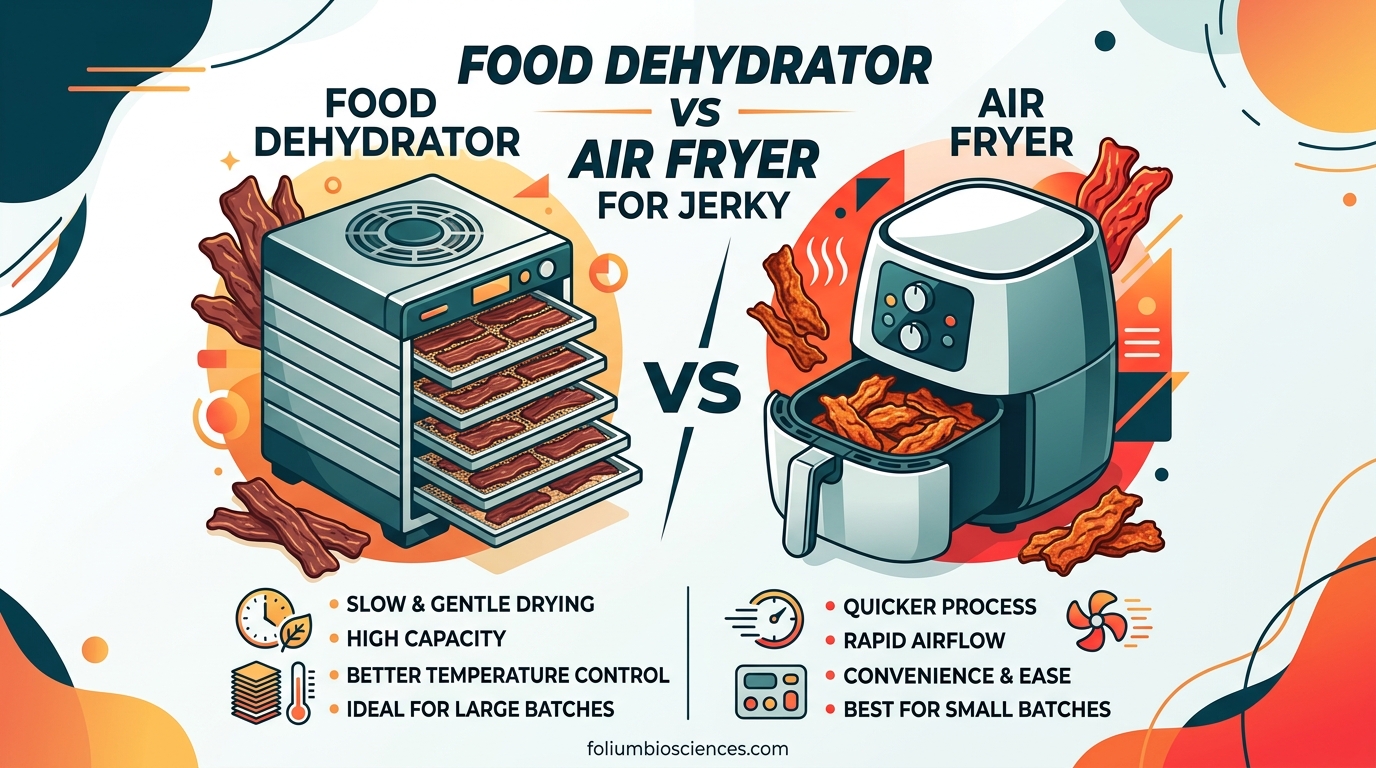
Choosing between a food dehydrator and an air fryer for making jerky comes down to two critical factors: texture and time. I have made dozens of batches using both methods, and the differences are more significant than most people realize.
Both appliances can produce excellent homemade jerky. A dehydrator offers traditional results with larger batches but takes longer. An air fryer works faster with smaller quantities but may produce slightly different texture outcomes. Your choice depends on how much jerky you want to make and how patient you are with the process.
In this guide, I will break down exactly how Food Dehydrator vs Air Fryer for Jerky compares across temperature requirements, cooking times, texture results, and batch capacity. By the end, you will know which method fits your kitchen and jerky goals.
Table of Contents
How Each Appliance Works for Jerky
Understanding the mechanics helps explain why these appliances produce different results.
Food Dehydrators: Low and Slow Moisture Removal
A food dehydrator uses low heat combined with constant air circulation to gradually remove moisture from food. The temperature typically ranges from 95°F to 160°F, which is hot enough to speed up evaporation without actually cooking the meat.
Most dehydrators have multiple stacking trays that allow air to flow around the food from all angles. The process can take 6 to 8 hours for jerky, but the low temperature preserves the meat’s proteins while removing water content that bacteria need to grow.
Air Fryers: Convection Heat with Dehydrate Function
An air fryer uses a convection mechanism with a heating element and powerful fan to circulate hot air rapidly around food. Many modern air fryers include a specific dehydrate function that operates at lower temperatures than regular air frying.
The air fryer’s smaller chamber and faster air circulation remove moisture more quickly than a dehydrator. When set to dehydrate mode at around 160°F to 170°F, an air fryer can produce jerky in 3 to 4 hours. The trade-off is limited space and the risk of slightly cooking the outer edges if temperature control is not precise.
Temperature Requirements Comparison
Temperature control is crucial for safe jerky making and achieving the right texture.
Dehydrator Temperature Range
Food dehydrators typically offer precise temperature control from 95°F up to 165°F. For jerky specifically, the USDA recommends heating meat to 160°F before dehydrating to ensure any bacteria are destroyed.
I set my dehydrator to 160°F for beef jerky. This temperature is high enough to meet food safety standards while low enough to dry the meat slowly without cooking it. The consistent low heat helps maintain the meat’s natural texture.
Air Fryer Temperature Considerations
Air fryers with a dehydrate function usually bottom out around 160°F to 170°F. Some budget models cannot go below 180°F, which is actually too hot for proper jerky making.
From forum discussions and my own testing, the sweet spot for air fryer jerky is 170°F. At this temperature, the meat dries without developing a cooked texture. If your air fryer runs hotter than this even on the lowest setting, the exterior may become tough while the interior remains moist.
Always verify your air fryer’s minimum temperature before attempting jerky. Models that cannot drop below 180°F are not suitable for dehydration.
Cooking Time Comparison
Time is where these two appliances diverge most dramatically.
Air Fryer Jerky Time
An air fryer produces jerky in 3 to 4 hours when set to dehydrate mode at 170°F. The rapid air circulation removes surface moisture quickly, and the smaller chamber means the warm air stays concentrated around the meat.
My experience matches what many Reddit users report: 3 hours at 170°F produces fully dried jerky from thin-cut beef strips. Thicker cuts may need the full 4 hours. Check the meat at the 2.5-hour mark and continue in 30-minute increments until the texture feels right.
Dehydrator Jerky Time
A food dehydrator takes 6 to 8 hours to make jerky at 160°F. The longer time results from lower temperatures and gentler air circulation.
I typically start checking my dehydrator jerky at the 6-hour mark. Factors that extend drying time include high ambient humidity, thicker meat slices, and fatty cuts that release moisture more slowly. Most batches finish within 7 hours.
Time Comparison at a Glance
Air Fryer: 3-4 hours at 170°F for 0.5-1 pound per batch. Best for quick small batches.
Dehydrator: 6-8 hours at 160°F for 4-6 pounds per batch. Best for large traditional batches.
Texture Results Comparison
Texture is subjective, but there are clear differences between the two methods.
Dehydrator Texture: Traditional and Consistent
Jerky made in a dehydrator has a uniform texture throughout each piece. The low heat and slow drying process allow moisture to escape evenly from all sides. The result is chewy jerky with a consistent bite from edge to center.
I find dehydrator jerky matches store-bought traditional jerky most closely. The texture is pliable enough to tear easily but dry enough to resist spoilage. The slow drying also helps marinades penetrate deeply, creating more flavorful results.
Air Fryer Texture: Slightly Different Edge Quality
Air fryer jerky can develop slightly firmer edges due to the more intense air circulation directly hitting the meat surfaces. The exterior dries faster than the interior, creating a subtle textural gradient.
When done correctly, air fryer jerky tastes excellent and has good chew. However, if the temperature runs even slightly high, the outer edges can become almost crispy rather than chewy. This is why temperature verification is so important.
Texture by Meat Type
Lean beef works well in both appliances. The results are nearly indistinguishable with proper technique. Venison and turkey, which are naturally lean, also perform consistently across both methods.
Fattier cuts like pork or marbled beef may behave differently. In a dehydrator, the slow process allows fat to render gradually without becoming rancid. In an air fryer, the higher heat can cause fat pockets to cook and become slightly chewy rather than integrating into the dried meat.
Batch Size and Capacity
This is often the deciding factor for home jerky makers.
Dehydrator Capacity
A standard food dehydrator has 4 to 6 stacking trays. Each tray holds approximately 1 pound of sliced meat. This means you can process 4 to 6 pounds of fresh meat in a single batch.
Some commercial dehydrators have 8 to 10 trays, handling even larger quantities. The vertical stacking design maximizes capacity while maintaining good air circulation between layers.
Air Fryer Capacity
Most air fryers accommodate 1 to 2 racks for jerky making. The cooking chamber is designed for single-layer cooking, which limits how much meat you can dry at once.
A typical air fryer holds 0.5 to 1 pound of sliced meat per batch. If you need more jerky, you must run multiple batches back-to-back. This multiplies the 3 to 4 hour time requirement, potentially making the air fryer slower overall for large quantities.
Practical Implications
If you make jerky weekly for a family or want to stock up for camping trips, a dehydrator’s larger capacity saves significant time. You can prepare a big batch overnight and wake up to finished jerky.
For occasional jerky cravings or testing new marinade recipes, an air fryer’s smaller capacity is actually convenient. You make just enough to enjoy fresh without worrying about storage.
Energy Efficiency and Operating Costs
Both appliances use electricity, but the cost per batch differs.
Power Consumption Comparison
A typical food dehydrator draws 300 to 600 watts. Running for 7 hours consumes 2.1 to 4.2 kilowatt-hours. At the average US electricity rate of $0.14 per kWh, one dehydrator batch costs $0.30 to $0.60 in electricity.
An air fryer draws 1,200 to 1,700 watts. Running for 3.5 hours consumes 4.2 to 6.0 kilowatt-hours. This translates to $0.60 to $0.84 per batch in electricity costs.
However, because the air fryer processes smaller batches, the cost per pound of finished jerky is higher. A dehydrator producing 5 pounds costs $0.06 to $0.12 per pound in electricity. An air fryer producing 1 pound costs $0.60 to $0.84 per pound.
Time-of-Use Considerations
Many dehydrator users run their machines overnight when electricity rates are lower. The quiet operation and long cycle time make this practical. Air fryers run during waking hours due to the shorter cycle, potentially at peak rate times.
Which Method Should You Choose?
Your decision depends on your specific situation and priorities.
Choose a Dehydrator If…
- You make jerky regularly for multiple people
- You want to process 4+ pounds of meat at once
- You prefer the traditional chewy texture
- You have counter space for a dedicated appliance
- You want to dehydrate fruits and vegetables too
Choose an Air Fryer If…
- You already own an air fryer with a dehydrate function
- You make small batches occasionally
- You value speed over capacity
- You have limited kitchen storage space
- You want an appliance that does multiple tasks
From my experience, serious jerky enthusiasts eventually invest in a dehydrator. The batch size and consistent results justify the dedicated appliance. Casual jerky makers can absolutely succeed with an air fryer as long as they accept the smaller output.
Step-by-Step Jerky Making Process
Here is how the process differs between the two methods.
How to Make Jerky in a Dehydrator
Step 1: Slice meat against the grain into 1/4 inch thick strips. Partially freezing the meat makes slicing easier.
Step 2: Marinate meat for 4 to 24 hours in the refrigerator. A basic marinade includes soy sauce, Worcestershire sauce, salt, and pepper.
Step 3: Arrange strips on dehydrator trays without overlapping. Leave space between pieces for air circulation.
Step 4: Set temperature to 160°F and timer for 6 hours.
Step 5: Check jerky at 6 hours. It should bend without breaking and show no moisture when squeezed.
Step 6: Cool completely before storing in airtight containers.
How to Make Jerky in an Air Fryer
Step 1: Slice meat 1/4 inch thick against the grain. Consistent thickness is even more important for air fryers due to faster drying.
Step 2: Marinate for at least 4 hours. Since air fryer batches are smaller, you can experiment with multiple marinades.
Step 3: Preheat air fryer if your model requires it for the dehydrate function.
Step 4: Arrange strips on racks in a single layer with space between pieces.
Step 5: Set to dehydrate mode at 170°F for 3 hours. If your air fryer lacks a dehydrate setting, use the lowest temperature available.
Step 6: Check at 2.5 hours. Continue in 30-minute increments until properly dried.
Step 7: Cool completely before storing.
Tips for Best Results
Use lean cuts like top round, eye of round, or London broil. Fat does not dehydrate well and can become rancid.
Pat meat dry with paper towels before placing in either appliance. Surface moisture extends drying time.
Rotate trays or racks halfway through if your appliance does not have perfectly even air circulation.
Common Questions About Food Dehydrator vs Air Fryer for Jerky
Is it better to air fry or dehydrate beef jerky?
Neither method is objectively better. A dehydrator produces more traditional texture and handles larger batches but takes 6-8 hours. An air fryer works faster (3-4 hours) with smaller quantities. Choose based on your batch size needs and available time.
How long does jerky take in air fryer vs dehydrator?
Air fryer jerky takes 3-4 hours at 170°F. Dehydrator jerky takes 6-8 hours at 160°F. The air fryer’s faster air circulation removes moisture more quickly, but it can only process 0.5-1 pound per batch compared to 4-6 pounds in a dehydrator.
What temperature for jerky in air fryer?
Set your air fryer to 160-170°F for jerky. Check that your model can reach these low temperatures. Some air fryers bottom out at 180°F, which is too hot and will cook rather than dehydrate the meat.
Can bacteria grow in a dehydrator?
Bacteria cannot grow in a properly operating dehydrator. The low heat (160°F) and removal of moisture create an environment where bacteria cannot survive. Always heat meat to safe temperatures before or during dehydration, and store finished jerky in airtight containers.
Conclusion
Food Dehydrator vs Air Fryer for Jerky ultimately comes down to your personal needs. A dehydrator delivers traditional texture, larger batches, and lower operating costs per pound. An air fryer offers speed and convenience for smaller quantities.
I recommend starting with whatever appliance you already own. Both methods produce delicious homemade jerky when you follow proper temperature and timing guidelines. If you find yourself making jerky regularly and wanting larger batches, a dedicated dehydrator is worth the investment.
The best jerky is the jerky you actually make. Whether that comes from a countertop dehydrator humming overnight or an air fryer delivering results in a few hours, you will enjoy homemade snacks that beat store-bought options every time.
1 thought on “Food Dehydrator vs Air Fryer for Jerky (October 2026): Texture and Time Compared”