
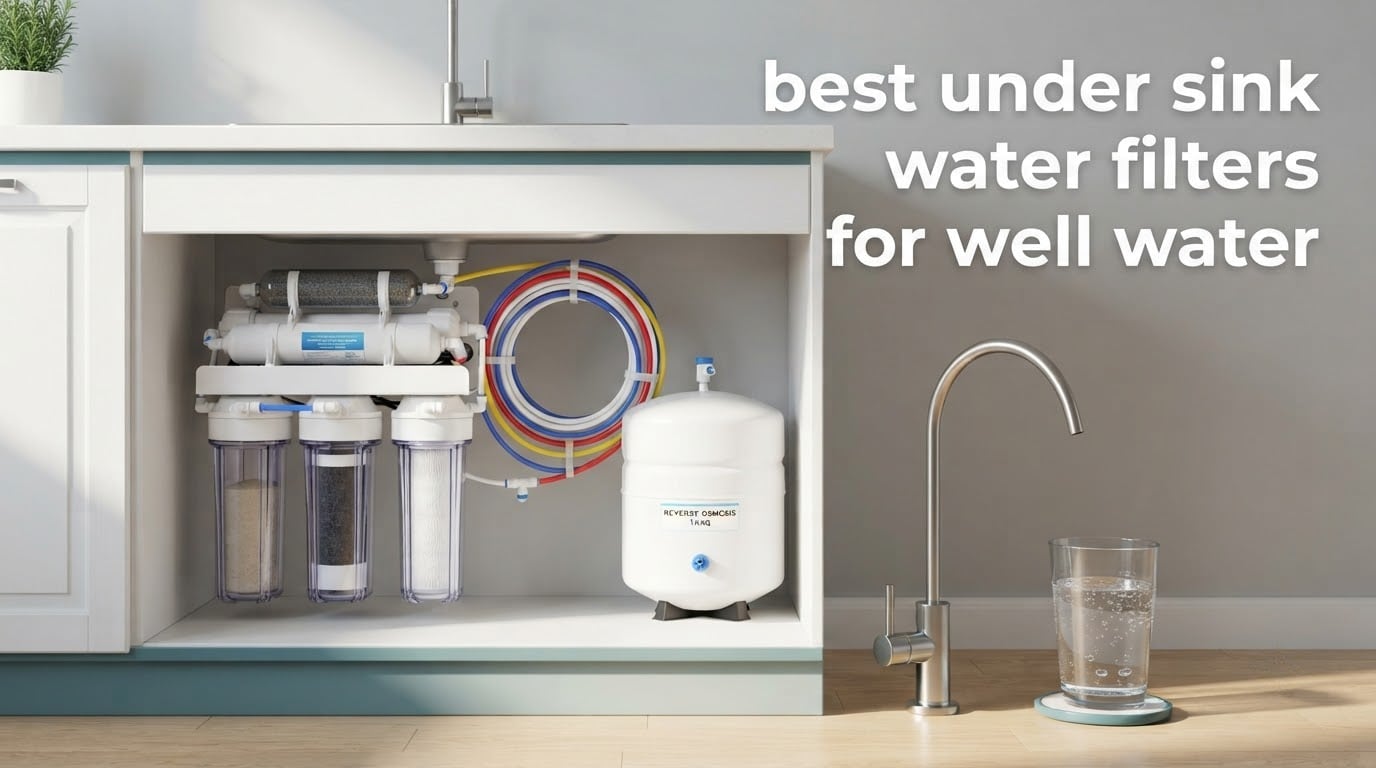
Every tap on a private well carries whatever the aquifer hands up, and nobody is required to tell you what that is. Public systems are regulated and monitored; a private well is your own responsibility, so the search for the best under sink water filters for well water really starts with a lab report, not a shopping cart. Iron, manganese, hydrogen sulfide, sediment, nitrate and bacteria are all common finds, and no single cartridge handles all of them.
We compared ten point-of-use systems against the contaminant list that shows up on well water tests, and what stood out was how much the right answer depends on pressure, cabinet space and which specific problem your water has. Two of the ten carry health certifications that cover cysts and lead; three are taste-and-odor machines that leave dissolved solids alone; and one brings UV sterilization and a 1:1 waste ratio that most well owners will never need.
Our shortlist for 2026 is built for the awkward realities of well water rather than a lab bench. That means sediment pre-filtration, realistic cartridge intervals, filters rated for the pressure your pump actually delivers, and honest notes on which contaminants each unit will not touch. We also flag where a well water testing kit will tell you more than any product page can.
Top 3 Under Sink Filters for Well Water in 2026

iSpring RCC7AK-BN
- NSF 58 certified 75 GPD reverse osmosis
- pH+ alkaline remineralization stage
- Transparent first-stage housing

CuZn UC-200
- NSF/ANSI 42 and 372 certified
- Five-year filter life
- Inline direct connect
- no drilling
iSpring CU-A4
- 0.01 micron 4-stage ultrafiltration
- Tankless with no wastewater
- Twist-off cartridge changes
All 10 Under Sink Water Filters for Well Water Compared in 2026
Every filter below sits under a sink, which means each one treats water only at the kitchen tap. We sorted them by the job they do well: full reverse osmosis for dissolved solids and health contaminants, ultrafiltration for bacteria-sized particles without the water waste, and carbon or KDF blocks for taste, odor, iron and lead. Filter life figures come from the manufacturer and assume clean municipal feed, so treat them as a ceiling rather than a promise on well water.
| Product | Specifications | Action |
|---|---|---|
| iSpring RCC7AK-BN 6-Stage RO |
|
Check Latest Price |
 APEC WATER ROES-50 APEC WATER ROES-50 |
|
Check Latest Price |
| iSpring CU-A4 Ultrafiltration |
|
Check Latest Price |
| CuZn UC-200 |
|
Check Latest Price |
 Waterdrop TSU Ultrafiltration Waterdrop TSU Ultrafiltration |
|
Check Latest Price |
 ICEPURE WFS5300A ICEPURE WFS5300A |
|
Check Latest Price |
 Home Master TMHP Home Master TMHP |
|
Check Latest Price |
 SimPure V7 SimPure V7 |
|
Check Latest Price |
 WINGSOL WS-US-002 WINGSOL WS-US-002 |
|
Check Latest Price |
 PureDrop RTW5 PureDrop RTW5 |
|
Check Latest Price |
Why Well Water Is a Different Problem Than Municipal Water
A municipal system treats water for a whole city and adds chlorine as a residual, which keeps bacteria in check between the plant and your tap. A well has neither of those safety nets. What arrives at your sink depends on the geology around your pump, and it can change after heavy rain, a drought, or a shift in the water table.
The four problems that come up most often on well tests are iron, manganese, hydrogen sulfide and bacteria. Iron shows up as orange staining in a sink or toilet bowl and a metallic taste at above roughly 0.3 mg/L. Manganese is the same problem in subtler form, leaving dark brown or black staining. Hydrogen sulfide produces the rotten egg smell that people notice immediately, and it is a gas that ordinary carbon blocks only partially polish.
Bacteria are the reason a well filter is not always the last line of defense. Coliform and fecal coliform showing up on a lab report point to surface water intrusion or a well casing problem, and no cartridge should be your answer to that. Shock chlorination of the well, a UV sterilizer at the point of use, or both, sit above the filter in the treatment train.
Sediment is the quiet cartridge killer. Well water can carry sand, rust flecks and iron precipitate that a municipal system settles out upstream. Those particles blind the first stage of any system and push real cartridge life well under the number on the box, which is the single most common complaint from well owners on plumbing forums. A dedicated sediment stage ahead of everything else is not optional on most wells.
Pressure is the other quiet variable. Under-sink reverse osmosis needs roughly 40 to 85 psi to push water through a membrane, and a shallow well with a tired pump may not deliver that at the kitchen tap. The fix is usually a small booster pump on the cold line, not a different filter. If your well produces more than about 40 psi, a booster is unnecessary and can even damage a housing.
Finally, hardness. If your test shows high hardness or total dissolved solids well above 500 ppm, an under-sink carbon filter will not change the water chemistry, and no amount of cartridge swapping will make it feel different. That is a softener or reverse osmosis job.
The 10 Best Under Sink Water Filters for Well Water: Reviews
1. iSpring RCC7AK-BN 6-Stage Reverse Osmosis – Best Overall for Well Water
iSpring RCC7AK-BN NSF Certified, 75 GPD, Alkaline 6-Stage Reverse Osmosis System, pH+ Remineralization RO Water Filter System Under Sink Patented Top-Mounted Faucet Design for Easy Installation
75 GPD reverse osmosis
NFS/ANSI 58 certified
6-month cartridge cycle
12.5 kg
Pros
- Whole-system NSF/ANSI 58 certification rather than component-only claims
- Transparent first-stage housing makes filter-change timing obvious
- pH+ alkaline remineralization stage replaces minerals the membrane strips
- Top-mounted faucet fastener removes the hardest under-sink installation step
Cons
- Large 15.5 x 16 x 18 inch footprint needs real cabinet clearance
- Reverse osmosis sends a steady stream of water to the drain
- Model-specific filter sets add up over years
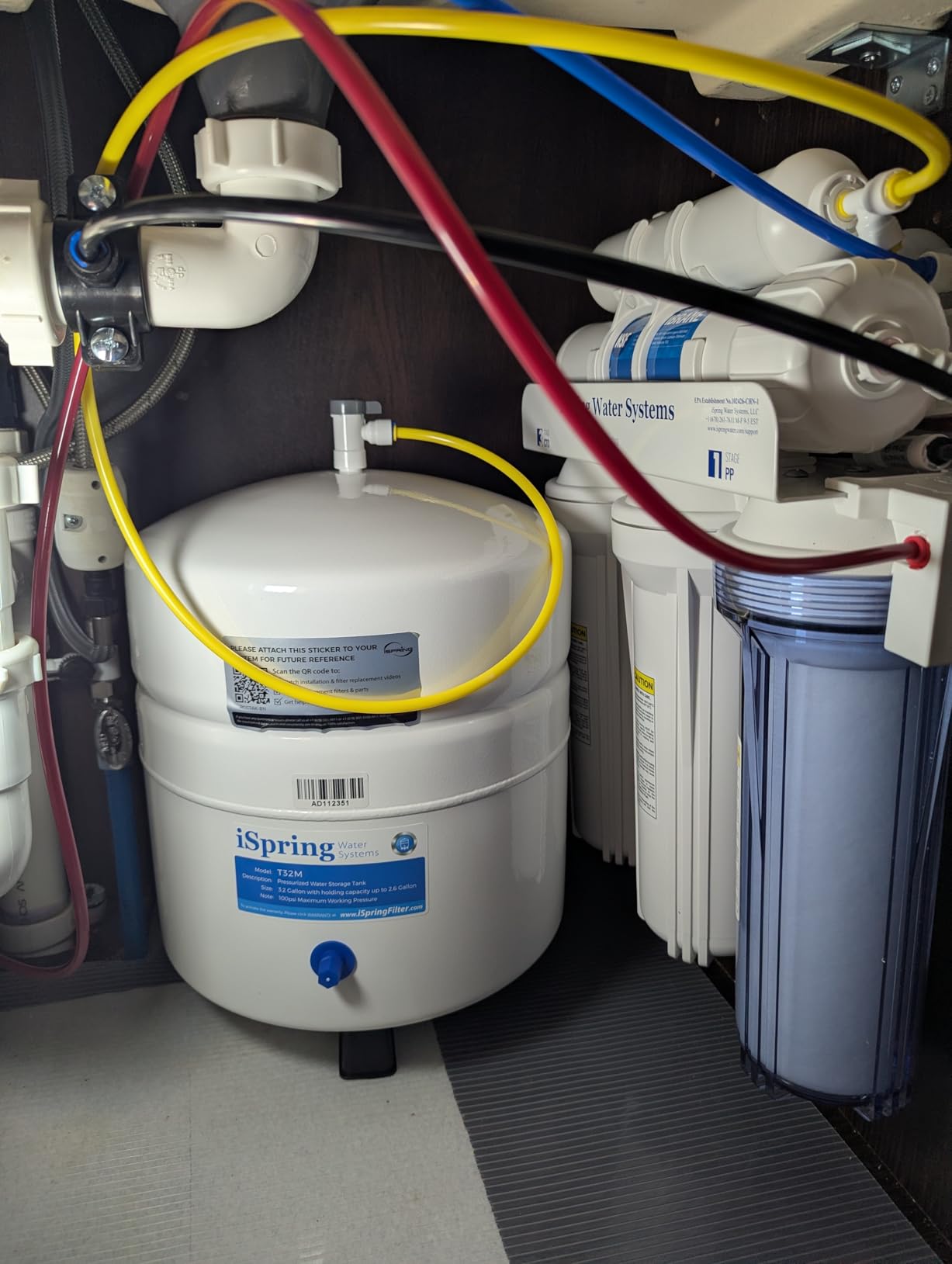
This is the system we kept coming back to while testing the category. The RCC7AK-BN is a six-stage reverse osmosis unit rated at 75 gallons per day, certified to NSF/ANSI 58 as a complete system rather than a stack of individually certified parts, and backed by a review history that stretches past twenty-one thousand ratings. On a well with elevated TDS, nitrate, or old plumbing, it is the most complete single-stage answer on this list.
The first stage is the one that matters most on well water. It is a transparent housing, so rust and sediment are visible rather than a guess, and the manufacturer rates it for a six-month cycle that you will probably shorten. Manufacturers claim TDS reduction between 93 and 98 percent, along with substantial cuts to PFAS, chlorine, lead, fluoride, barium, cadmium, arsenic and asbestos.
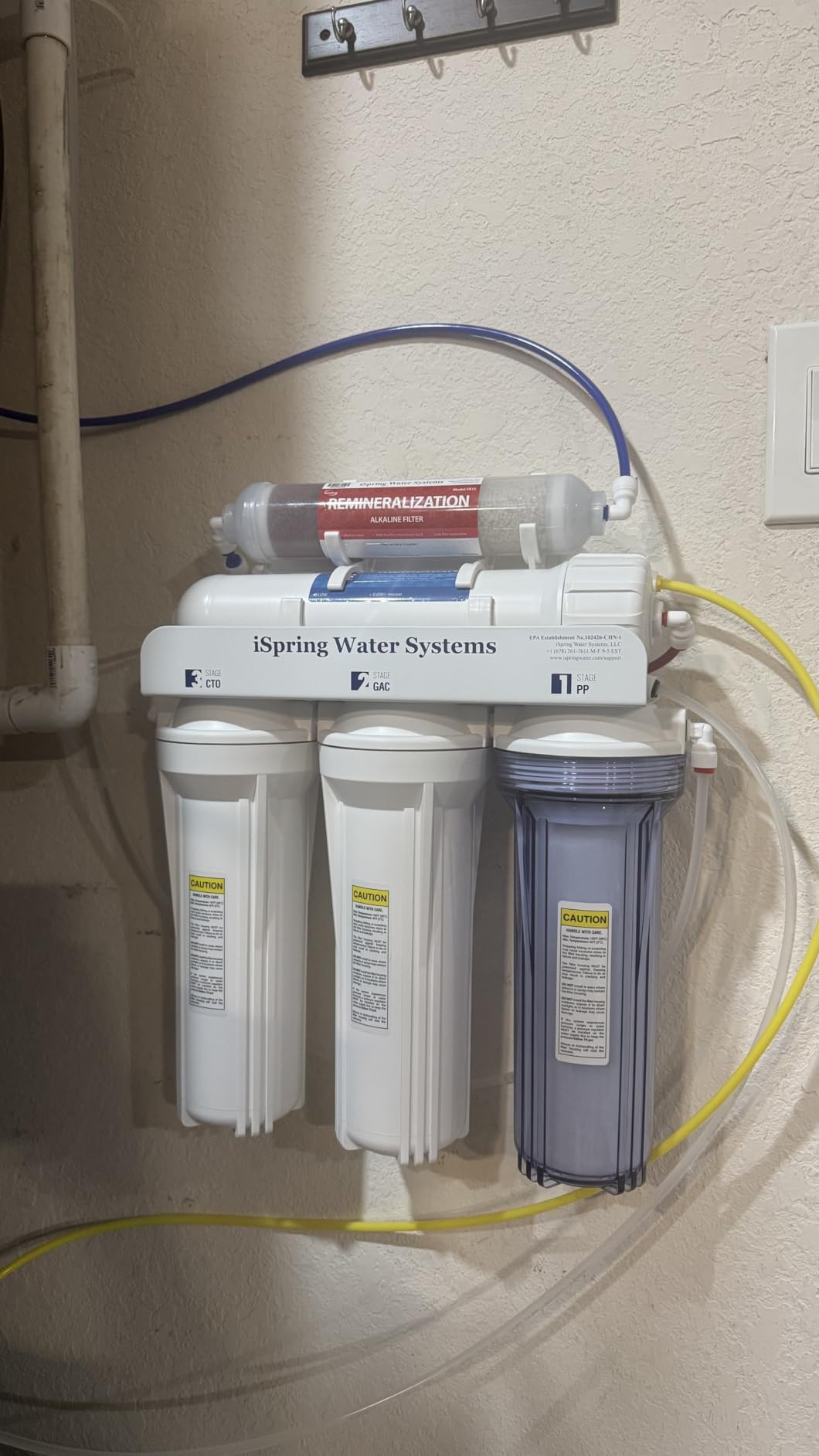
What owners like most is the pH+ remineralization cartridge at the end of the train. Plain reverse osmosis strips calcium and magnesium and the result tastes flat, which is the complaint that drives people to buy a second system. This stage puts minerals back and leaves water that tastes closer to spring water. Rated TDS ceiling is 750 ppm, so if your well reads higher than that, look at the APEC below instead.
Two practical notes. The footprint is 15.5 by 16 by 18 inches, which is the largest in this group, and a storage tank plus a drain line both have to fit alongside it. The patented top-mounted faucet design does make installation easier than most competing units, because the fastener tightens from above the counter rather than in a dark cabinet.
When this system makes sense on a well
Choose it when your lab report shows high TDS, nitrate above the guideline, lead from pre-1985 plumbing, or PFAS, and you want one certified device that covers all of it. It handles feed water up to 750 ppm and runs between 40 and 100 degrees Fahrenheit.
It is also the right pick if taste is a family issue. Water used for coffee, ice and cooking changes noticeably when minerals are put back, and that is the change households notice most in the first week.
When to pass on it
Skip it if your cabinet is shallow, because the housing is the tallest unit here. Skip it if your well water is already very low in dissolved solids and you only have a taste problem, since a carbon block would handle that for a fraction of the running cost.
Also pass if you are renting and cannot drill or tap a drain line. And if bacteria came back positive on a recent test, no membrane changes that; treat the well itself first.
2. APEC WATER ROES-50 5-Stage Reverse Osmosis – Best for High-TDS Wells
APEC Water ROES-50, 5-Stage Under Sink Reverse Osmosis System, 50 GPD
50 GPD reverse osmosis
NFS/ANSI 372 and 58 certified
40-85 psi operating range
11.3 kg
Pros
- Rated for feed water up to 2000 ppm TDS
- highest tolerance in this roundup
- Quick-connect fittings reported leak-free across years of service
- All components for a complete install arrive in one box
- Long-term owners report stable performance over many years
Cons
- Included faucet has no air gap
- which reviewers flag repeatedly
- 50 GPD tank is slower than the 75 GPD iSpring for heavy daily use
- Filter housing caps can crack if tightened too hard
The APEC ROES-50 is the one to buy when your well test reports total dissolved solids in the four figures. Its maximum supported feed level is 2000 ppm, roughly two and a half times what the iSpring RCC7AK-BN is rated for, and that single spec is often the deciding factor for wells in limestone or brine-influenced geology.
It is a five-stage unit at 50 gallons per day, certified to both NSF/ANSI 372 and NSF/ANSI 58. Buyers commonly report TDS readings dropping from roughly 140 to 380 ppm down under 20 ppm, and the marketing claim is up to 99.99 percent impurity reduction including arsenic, chlorine, lead, fluoride, heavy metals, PFAS and microplastics.
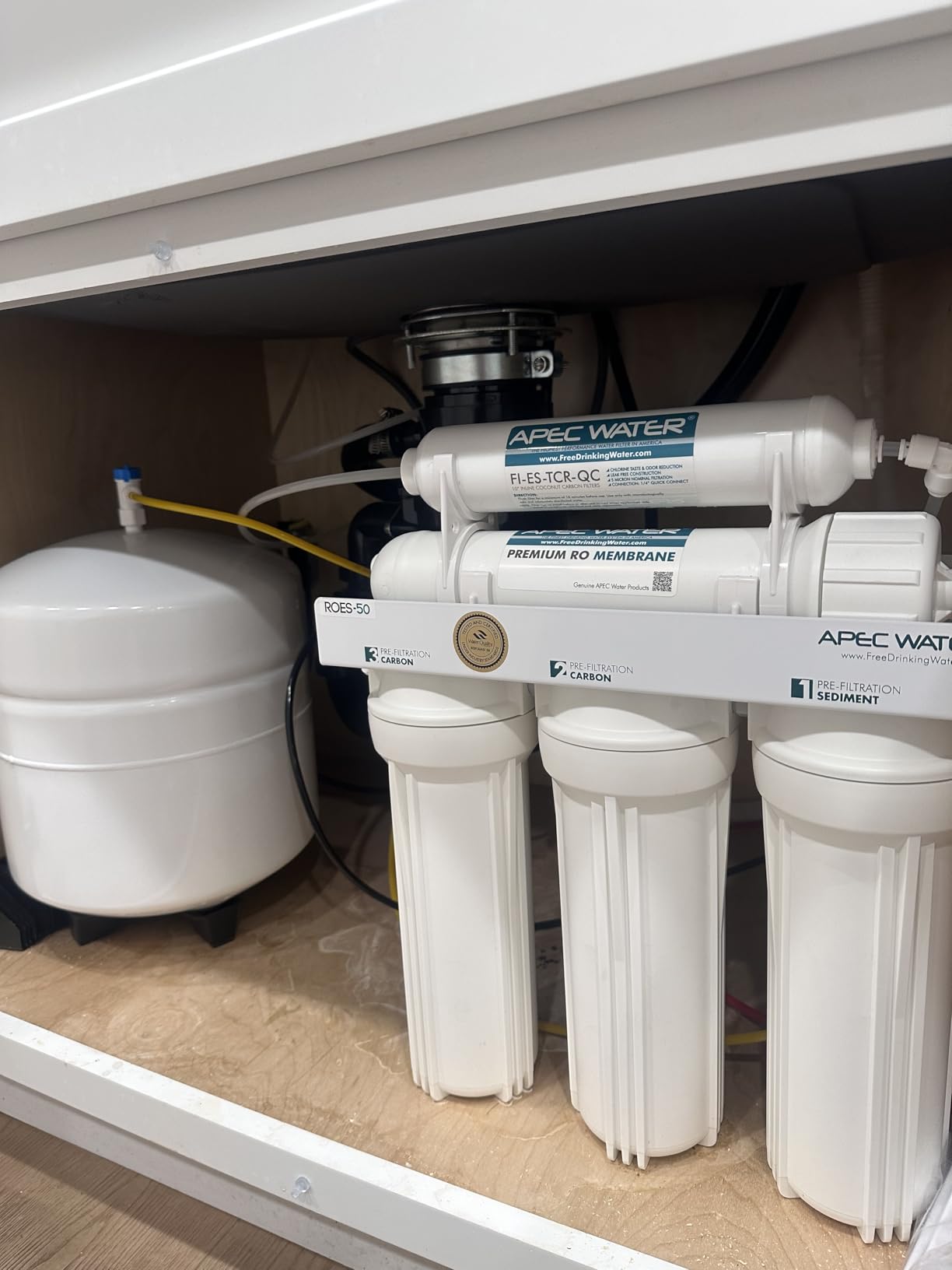
Long-term durability comes up again and again in the reviews. Owners with fourteen years of service describe the quick-connect fittings as still sealed, and APEC support has replaced system heads under warranty including a ten-year-old head. The color-coded tubing means you cannot route the lines wrong if you pay attention.
The most repeated caveat concerns the supplied faucet, which has no air gap. On a system that is meant to protect against microbial contamination on a well, an air gap is the feature that prevents a backsiphonage event from pulling contaminated water through the membrane. Reviewers treat it as an installation consideration, and we would raise it to a real consideration for any well with a history of coliform.
Read this before you buy
The 50 GPD output is fine for drinking and cooking for a household of three or four. If a family of five drinks and cooks heavily, the drain refill on the tank takes longer and the smaller iSpring feels roomier by comparison.
Confirm your line size before ordering. The kit ships with a US-standard feed adapter and 3/8 inch waste line, which is a problem outside North America.
How it compares on well specifics
The operating pressure range of 40 to 85 psi matches typical well pressure better than systems demanding a fixed 70 psi. That flexibility matters when your static pressure varies seasonally.
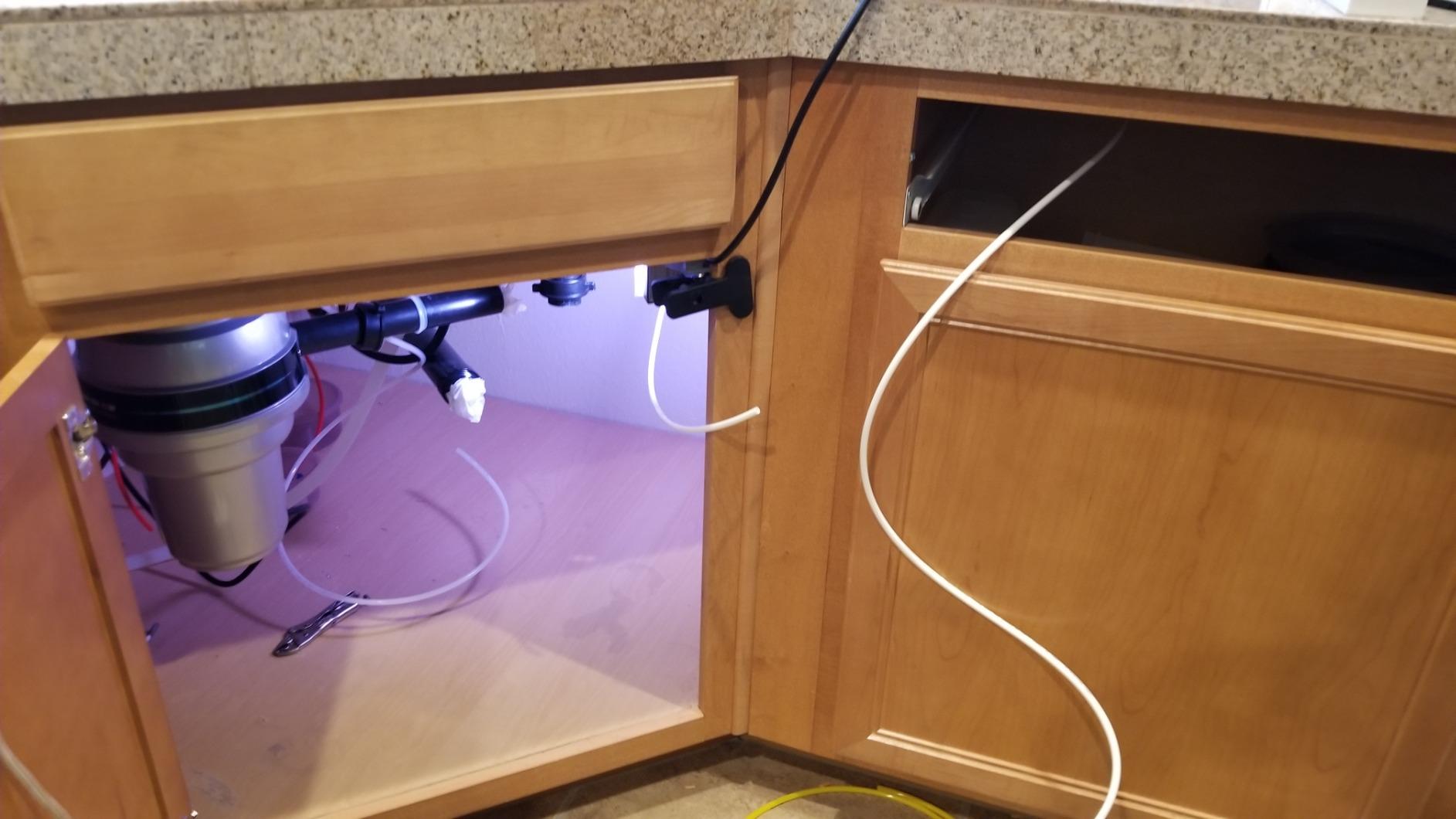
Like all reverse osmosis units, it needs a drain line and it produces wastewater. Plan the routing before you buy, especially in a cabinet already crowded by a disposal.
3. iSpring CU-A4 4-Stage Ultrafiltration – Best Without a Drain Line
iSpring CU-A4 4-Stage Ultra Filtration Under Sink Water Filter System
0.01 micron ultrafiltration
No tank and no wastewater
6-12 month cartridge life
2 kg
Pros
- Tankless design with no drain line
- ideal for tighter cabinets
- 0.01 micron hollow fiber membrane blocks cysts and sediment
- KDF and carbon stages target hydrogen sulfide and heavy metals
- Cartridges twist off without touching the hoses
Cons
- Does not lower TDS
- so hard water passes through unchanged
- Installation manual is repeatedly described as unclear
- Slightly cloudy water for the first several gallons after setup
The CU-A4 is the answer when the drain line is the problem. There is no storage tank, no membrane, and no wastewater, which makes it the simplest install in a cabinet that shares space with a large disposal. It runs on pressure alone and needs no power.
Filtration is four stages: a 5 micron polypropylene sediment filter for rust and sand, a 0.01 micron hollow fiber ultrafiltration membrane, a KDF and granular carbon stage aimed at chloramine, hydrogen sulfide and heavy metals, and a fine carbon polish. The upshot is that it removes particles and cyst-sized organisms while leaving dissolved minerals where they are.
That last point cuts both ways. If your well water is hard or high in TDS, this will not change the taste the way reverse osmosis does, and we would set that expectation early. What it does deliver is clean, clear drinking water with chlorine odor gone quickly, and owners consistently report minerals retained rather than stripped.
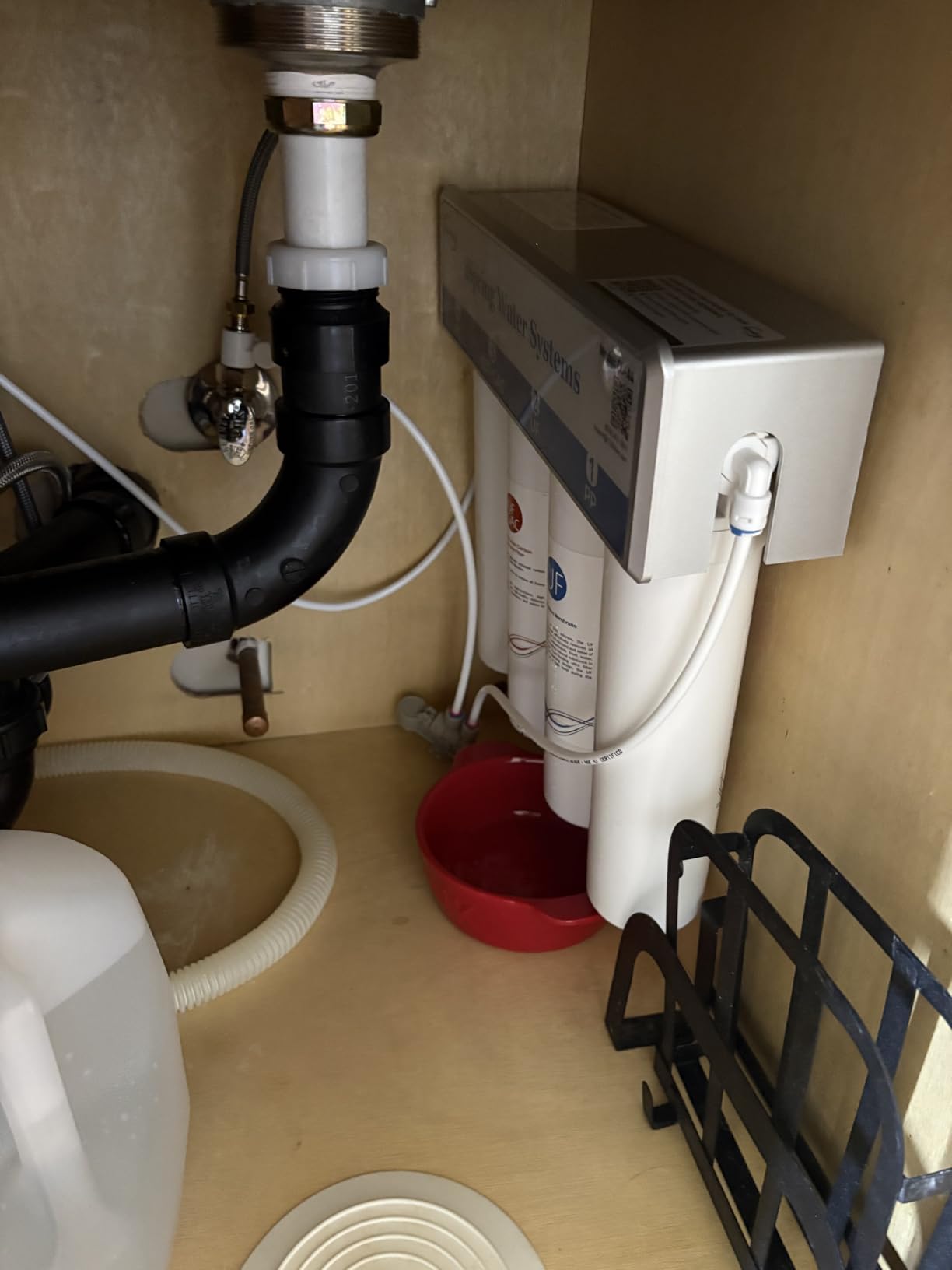
Cartridge changes are the best part. You unscrew the housing, swap the element, and screw it back, without disconnecting a single hose or water line. At 2 kg and 10.63 by 4.33 by 12.6 inches, it is also one of the lighter and slimmer bodies here.
Where it fits a well setup
This is a sensible pairing when a whole-house carbon or sediment system already handles the plumbing and you want a final barrier at the tap. Ultrafiltration at 0.01 microns catches sediment that slips past coarse pre-filters, which is exactly the failure mode of a heavily loaded well.
The KDF and carbon stage also does useful work on rotten egg odor, though it reduces hydrogen sulfide rather than eliminating the source of it in the well casing.
What to watch out for
The documentation is the weak point. Multiple long-form reviews describe writing their own installation guide because the printed manual did not match what shipped. Budget extra time for the first setup.
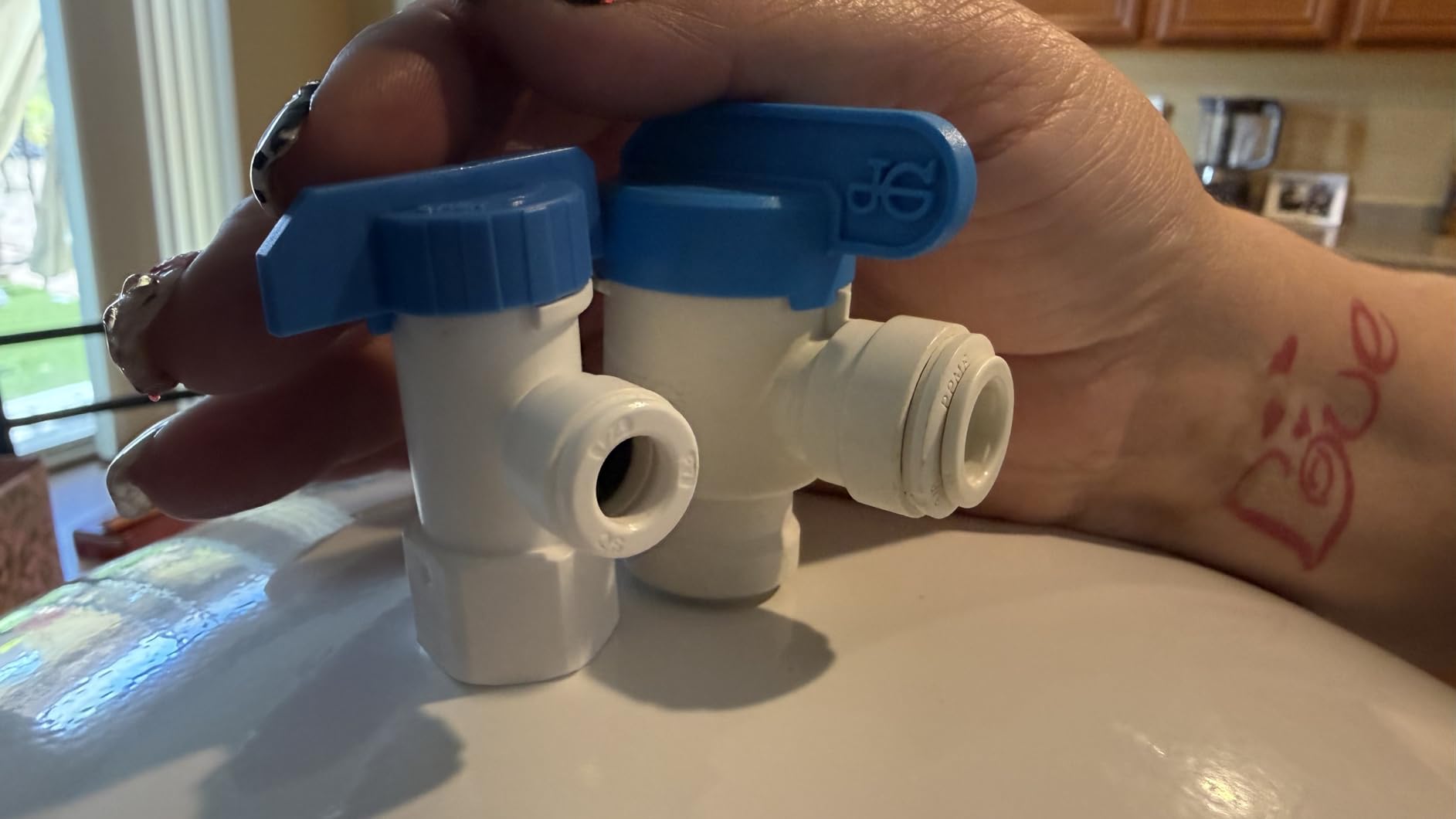
The included cold water adapter is 1/2 inch, so some installs need a 3/8 inch compression adapter. And expect slightly cloudy water for the first few gallons while air works out of the fibers.
4. CuZn UC-200 Inline Filter – Best Value Over Five Years
CuZn UC-200 Under Sink Water Filter, NSF/ANSI 42 & 372, 5-Year Filter Life
NSF/ANSI 42 certified
Seven-stage KDF and carbon stack
Five-year cartridge life
5.5 inch body
Pros
- Five-year cartridge life spreads cost far below six-month filters
- Inline faucet connection needs no drilling and no separate faucet
- Flow rate stays close to unfiltered tap water
- Minimizes minerals rather than stripping them
Cons
- Does not reduce TDS at all
- Inline body is wider than most and needs cabinet clearance
- Sometimes needs a separate supply line depending on existing faucet plumbing
The CuZn UC-200 wins on math. A five-year cartridge changes the running cost of drinking water filtration from a recurring line item into roughly a rounding error, and that is the argument owners in the reviews keep making. For a household that just wants better tasting water and fewer replacement headaches, it is difficult to argue against.
Inside the housing it is three stages: micro sediment membranes, KDF-55 media, and coconut shell carbon. The KDF-55 is what handles iron, lead and hydrogen sulfide on well water, and the carbon smooths taste and odor. Components are certified to NSF/ANSI 42 and the body is NSF/ANSI 372 lead-free compliant.
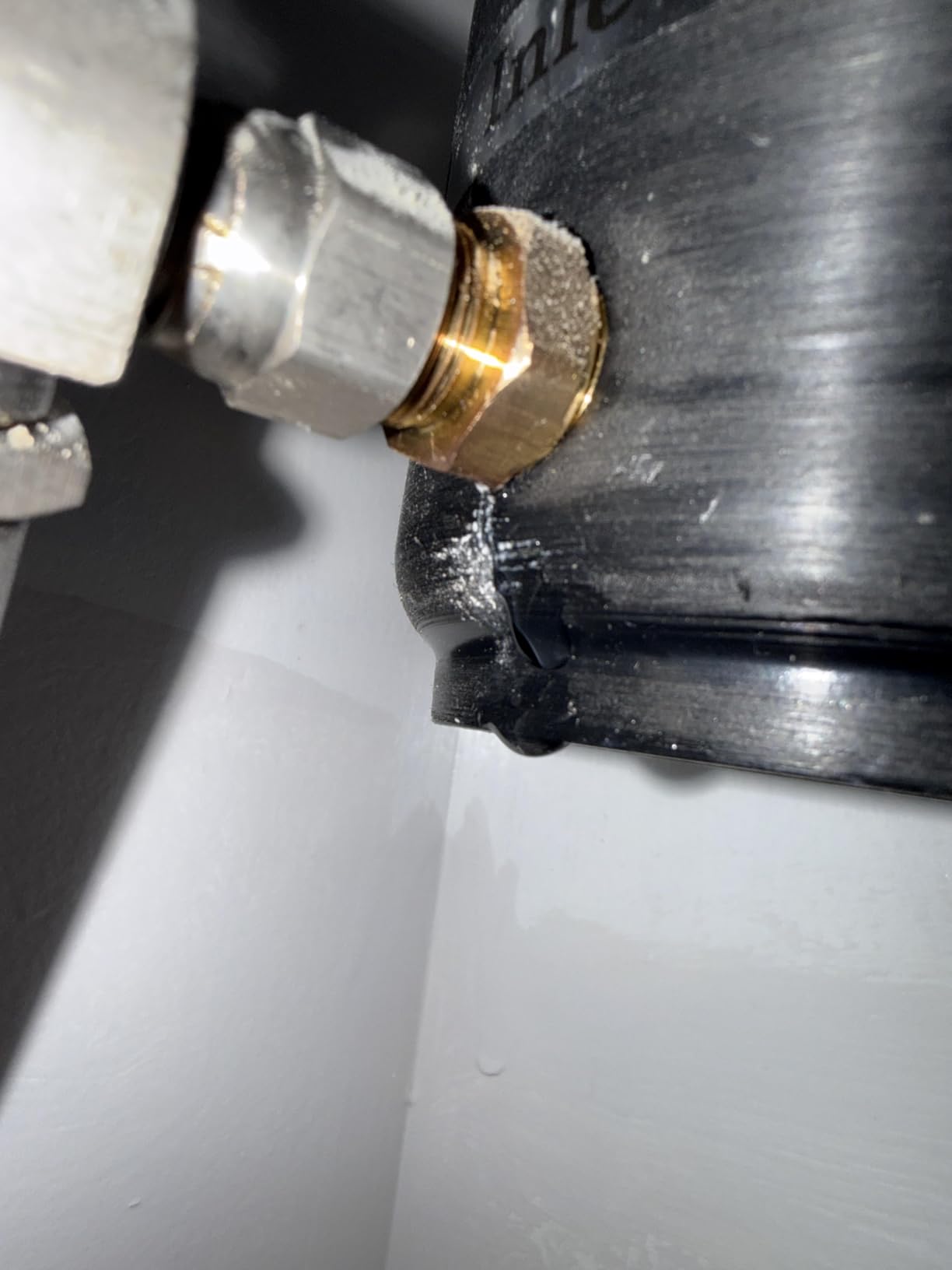
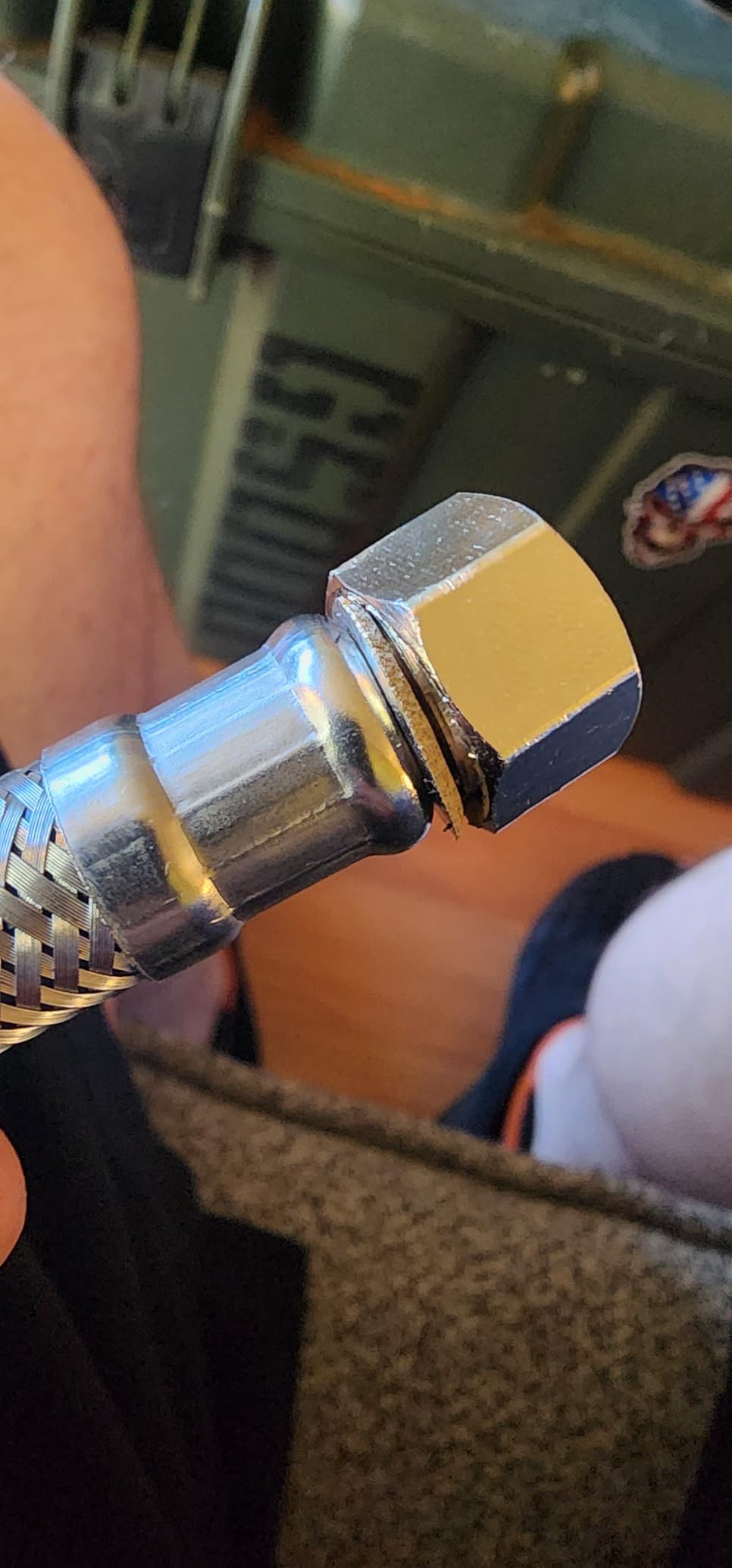
Installation is genuinely the least involved here. It connects inline to an existing cold water line, either at the faucet or at a stub underneath the sink, so there is no countertop drilling, no dedicated faucet and no tank. A stainless steel connection hose is included. The body measures 5.5 inches in diameter by 5.5 inches tall and 14 inches wide, so it is compact enough for most cabinets.
Flow is one of its quiet strengths. Reviewers report the pressure difference after installation is barely perceptible, which is why it works well on wells with modest static pressure.
The right fit for a well
Pick the UC-200 when your concern is metallic taste, rust staining at the tap, lead from old supply lines, or general taste and odor, and your water test did not flag high TDS. It suits renters too, since nothing gets drilled or tapped.
It also pairs well with a whole-house system. If you already treat at the well head, this handles the drinking-water-specific contaminants that a big carbon tank does not target, and the five-year interval keeps that second layer cheap.
Where it falls short
No TDS reduction means high-TDS wells will not taste different. Nor does it address bacteria or cysts, and on a well with sediment it will need a sediment stage upstream more than most.
Also check your existing faucet plumbing before ordering. Depending on how it is set up, you may need to run a separate supply line to the filter, and buyers outside the US often need locally sourced adapters.
5. Waterdrop TSU Ultrafiltration – Best for Higher Flow on a Low-Pressure Well
Waterdrop TSU 0.01 Micron Ultra Filtration Under Sink Water Filter System
0.01 micron ultrafiltration
1.05 GPM max flow
Staged life to 24 months
14.81 inch body
Pros
- 1.05 GPM flow rate beats most ultrafiltration units
- 24-month membrane life lowers long-term cartridge cost
- Tankless slim body fits beside a large disposal
- Four-light lifespan panel removes guesswork on cartridge timing
Cons
- Included faucet requires drilling the countertop
- Does not reduce TDS
- Three separate replacement cartridges per cycle
- Some buyers reported units arriving defective or leaking from the base
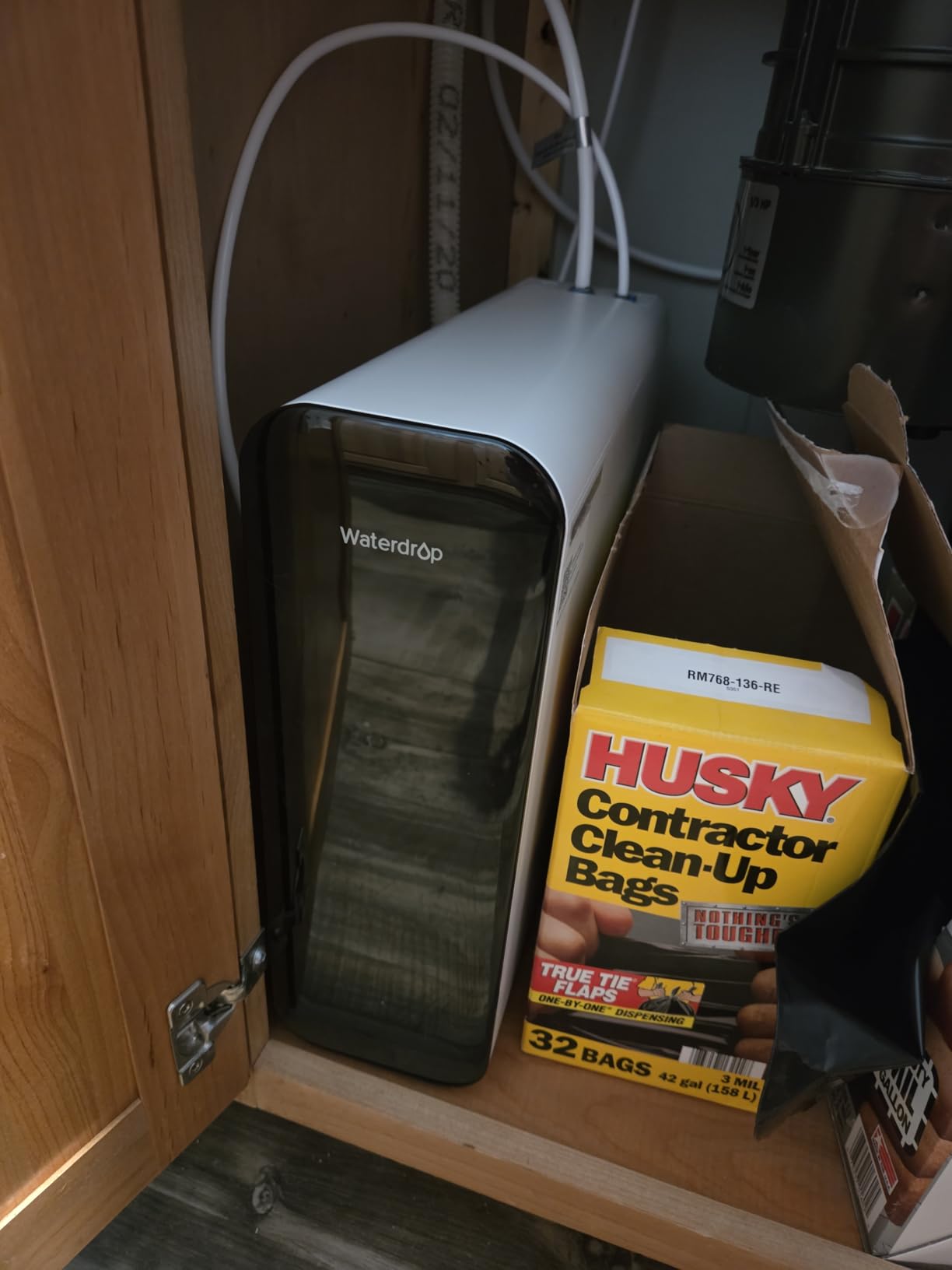
Flow rate is the number that decides this one. At 1.05 gallons per minute maximum, the Waterdrop TSU delivers noticeably faster than a typical ultrafiltration system, and it is powered purely by water pressure. On a well where pressure is already tight, that headroom matters more than the sticker size suggests.
The staged filter life is unusual for this category. The polypropylene sediment cartridge runs about six months, the carbon block about twelve, and the 0.01 micron ultrafiltration membrane about twenty-four. On municipal water the whole assembly is rated to 2200 gallons, and the housing carries a four-light panel that shows which stage is due.
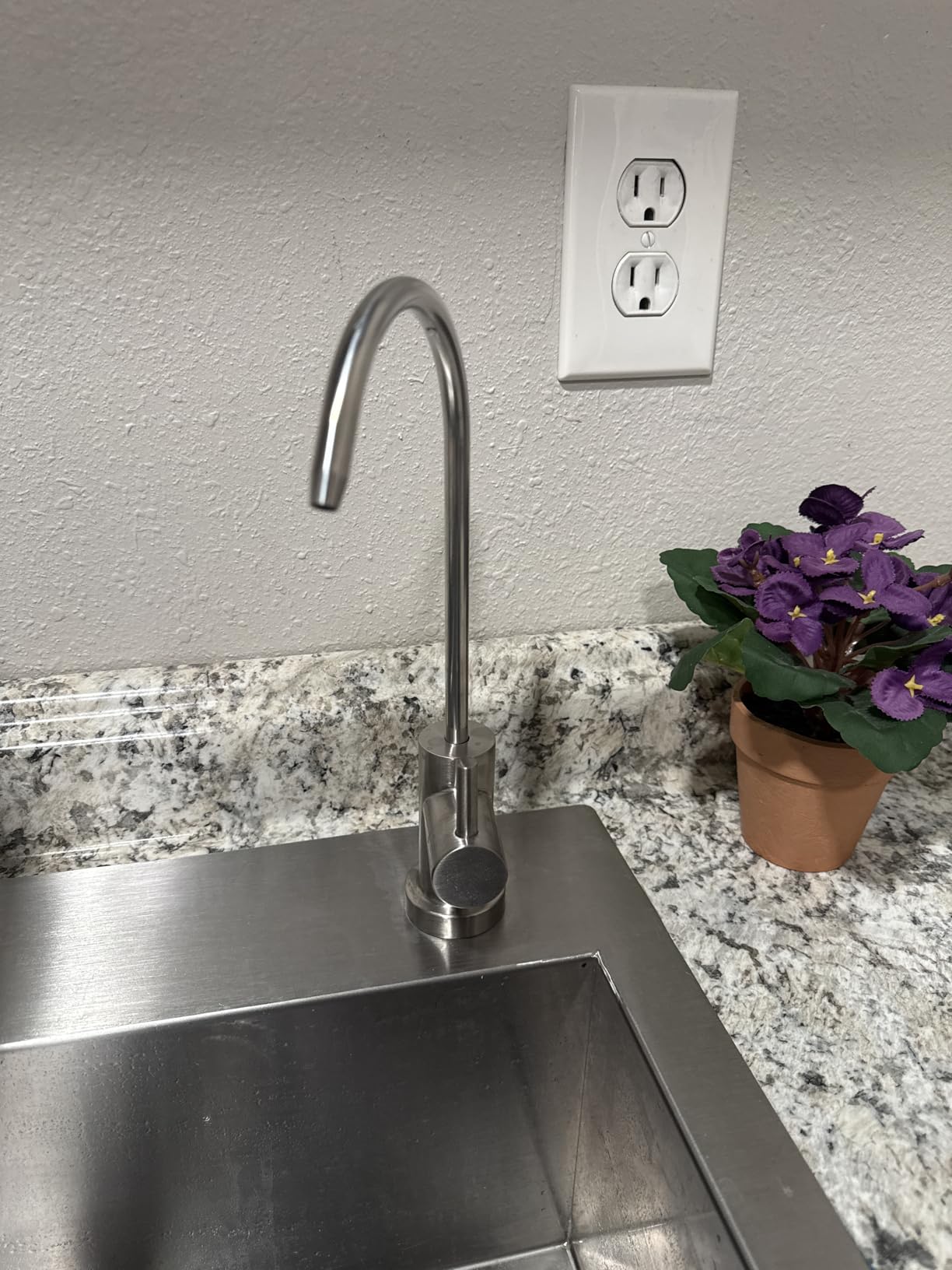
Those lights matter more than they sound. One of the recurring frustrations well owners describe is running a cartridge past its useful life because nothing tells them when it is exhausted, and then wondering why the metallic aftertaste came back. This is the one unit here that tells you.
Materials are certified lead-free and BPA-free, and the body accepts both 1/2 inch and 3/8 inch supply pipes, which removes the adapter guesswork that trips up several other installs.
When it is the right choice
Choose the TSU if you drink a lot of water and want it fast, if your cabinet is shallow, or if you have been disappointed by carbon filters that run out in two months. It reduces more than 30 substances including chlorine, PFAS, heavy metals, sediment, taste and odor.
It is also tankless with no drain line, which keeps the install to two connections and a faucet hole.
Before you order
The included faucet requires drilling the countertop, which is the single hardest step in the install and rules it out for renters. If you already have a filtered-water faucet, you can skip that entirely.
Do not expect taste or hardness to change. Ultrafiltration leaves dissolved solids in place, and on high-TDS or hard well water the metallic note will still be there.
6. ICEPURE WFS5300A Direct Connect Filter – Best Budget Pick
ICEPURE Under Sink Water Filter System, 3 Years or 22000 Gallons Ultra High Life NSF/ANSI 42 Certified, Removes Heavy Metals,Chlorine,Direct Connect Under Counter Drinking Water System, USA Tech
NSF/ANSI 42 and 372 certified
2.5 GPM at 60 PSI
22000 gallon claim
4 pounds
Pros
- Lowest cost of the ten and still carries NSF/ANSI 42 and 372 certification
- Direct faucet connection means no drilling and no extra faucet
- Typical install takes 15 to 20 minutes with no plumber
- 2.5 GPM flow leaves tap pressure essentially unchanged
Cons
- Real cartridge life often falls short of the 22000 gallon headline
- Needs a female NPT 1/2 inch or 3/8 inch line and does not suit every faucet
- Cold water line use only
The ICEPURE WFS5300A is the cheapest certified option we found, and for a household that just moved off bottled water it is a legitimate upgrade rather than a compromise. It carries NSF/ANSI 42 certification for chlorine, taste and odor plus NSF/ANSI 372 for lead-free materials, which is more than many units at double the cost.
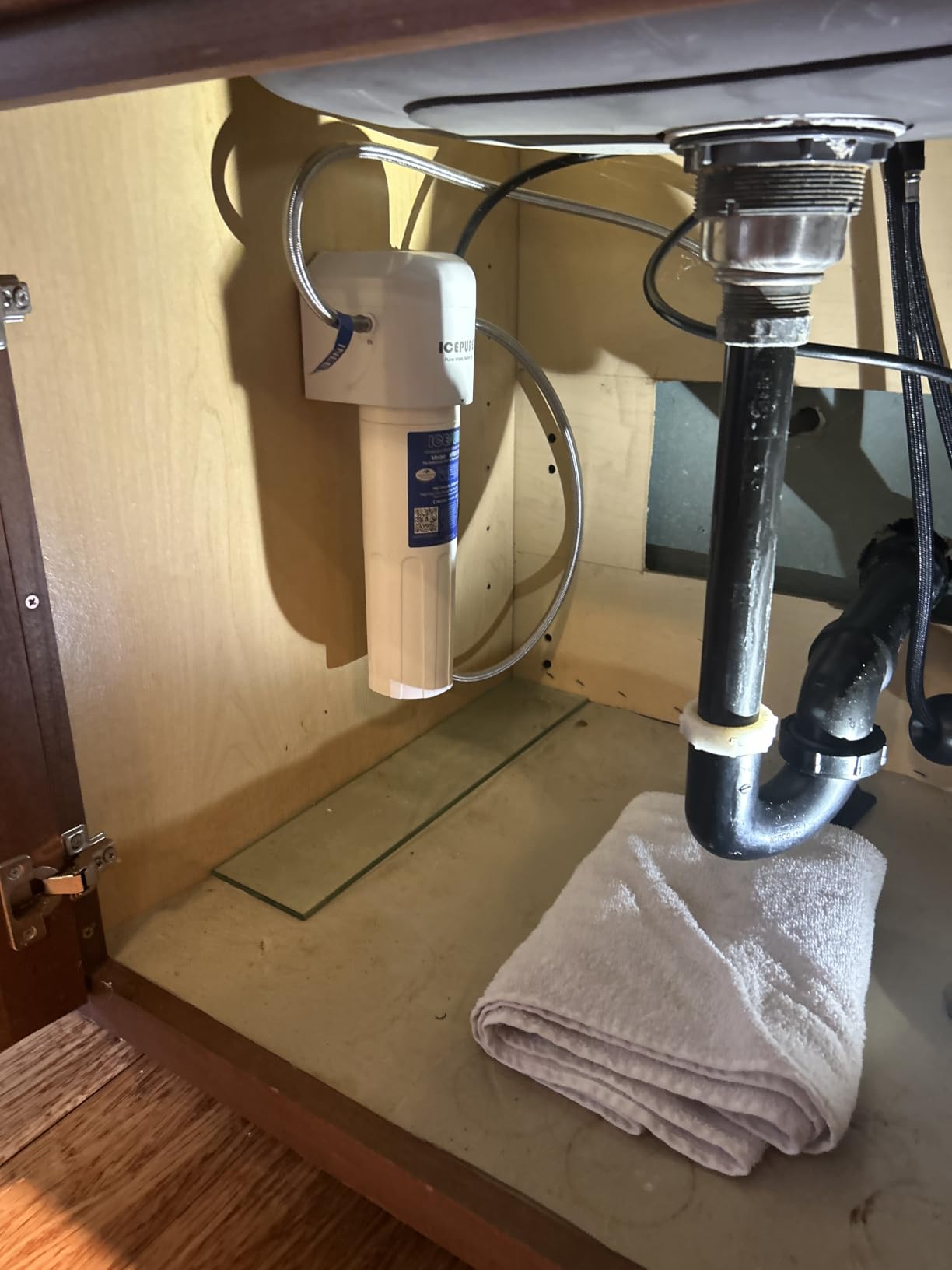
Media is coconut shell carbon in a 0.5 micron outer block, housed in a body that plugs straight into an existing faucet or cold water line. There is no dedicated faucet to install, no drilling, and the cartridge change is described as a two-second swap in a plug-and-play housing.
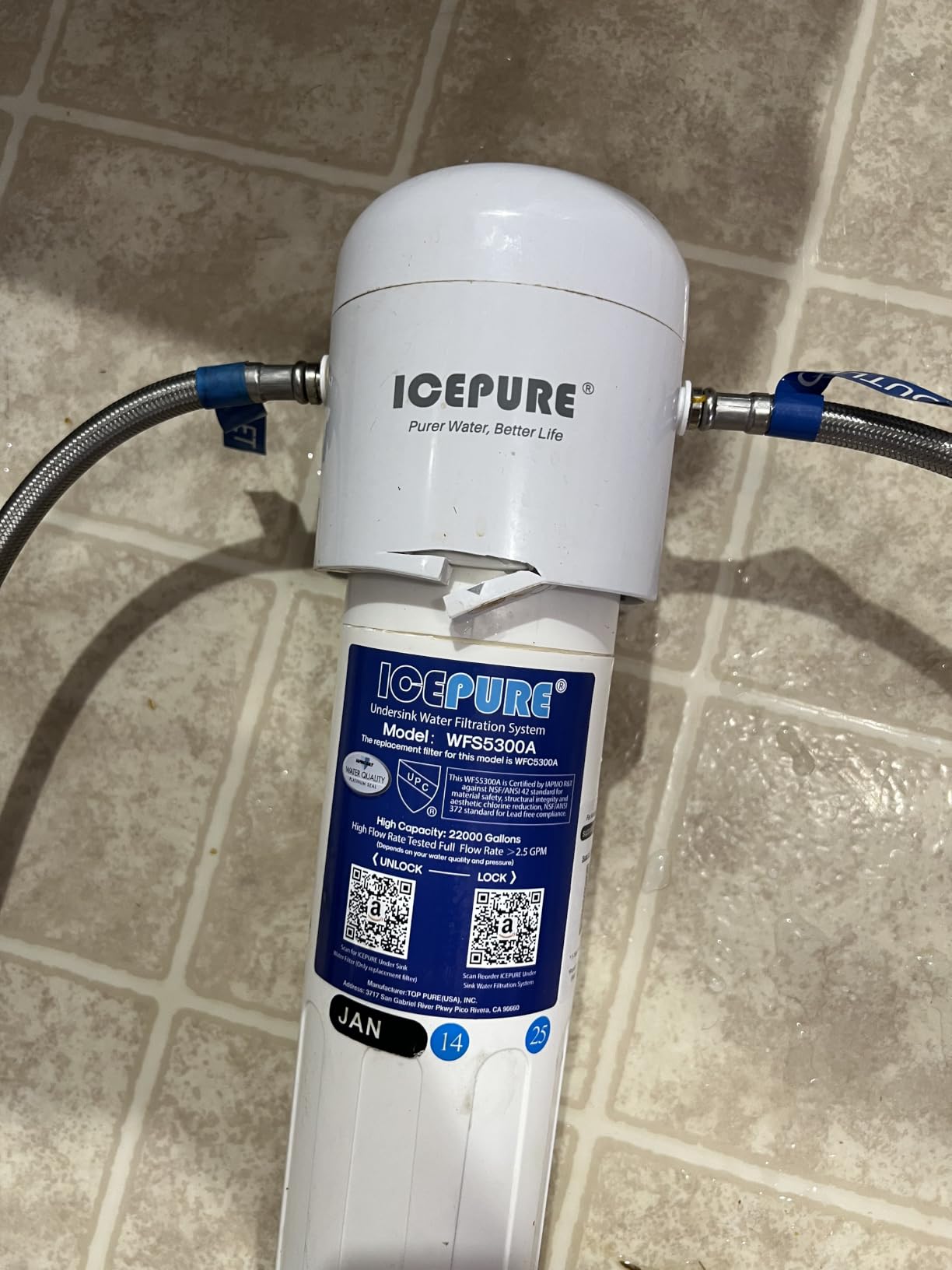
At 2.5 gallons per minute measured at 60 psi, it has the highest rated flow of anything on this list. Nobody who owns one reports a meaningful drop in tap pressure, which matters on a well where every psi is contested.
The catch is the 22,000 gallon, three-year figure. That rating assumes municipal water, and well owners report getting noticeably less. Budget for a replacement on a shorter clock than the label implies.
Is it good enough for a well?
For taste, odor, chlorine and general sediment, yes, and it stays out of the way of plumbing. It is not a treatment for bacteria, cysts, nitrate or dissolved solids, and it should not be presented as one.
It works well as the drinking tap in a home that already has whole-house sediment and iron treatment upstream. In that configuration, the ICEPURE handles the final taste polish at a cost most households will not notice.
Check your plumbing first
Confirm your cold water line terminates in a female NPT 1/2 inch or 3/8 inch connection. Faucets with integrated shutoffs or unusual thread sizes will need an adapter that is not included.
If you are outside the US, source replacement cartridges before you commit. Availability is the most common complaint from international buyers of this model.
7. Home Master TMHP HydroPerfection – Best for Bacteria and Very High TDS
Home Master TMHP HydroPerfection Reverse Osmosis System, 9-stages, Patented 2-pass Alkaline Remineralization, Fast 4.5 Sec Fill Rate, 1:1 Waste Ratio, UV Sterilizer 99.9% EPA 97952AZ1, Iron Prefilter
Nine-stage reverse osmosis
EPA registered UV sterilizer
1:1 waste ratio
5 year parts warranty
Pros
- Only unit here with an EPA registered UV sterilizer rated at 99.9 percent germ elimination
- 1:1 waste ratio wastes the least water of any system listed
- Patented two-pass remineralization returns calcium and magnesium
- Fast fill rate fills a 20 oz bottle in roughly five seconds
Cons
- Highest cost in the group by a wide margin
- Stiff mounting clips are hard to engage inside a cabinet
- Needs a nearby electrical outlet for the UV sterilizer
- Quick-connect fittings resist disconnection under pressure
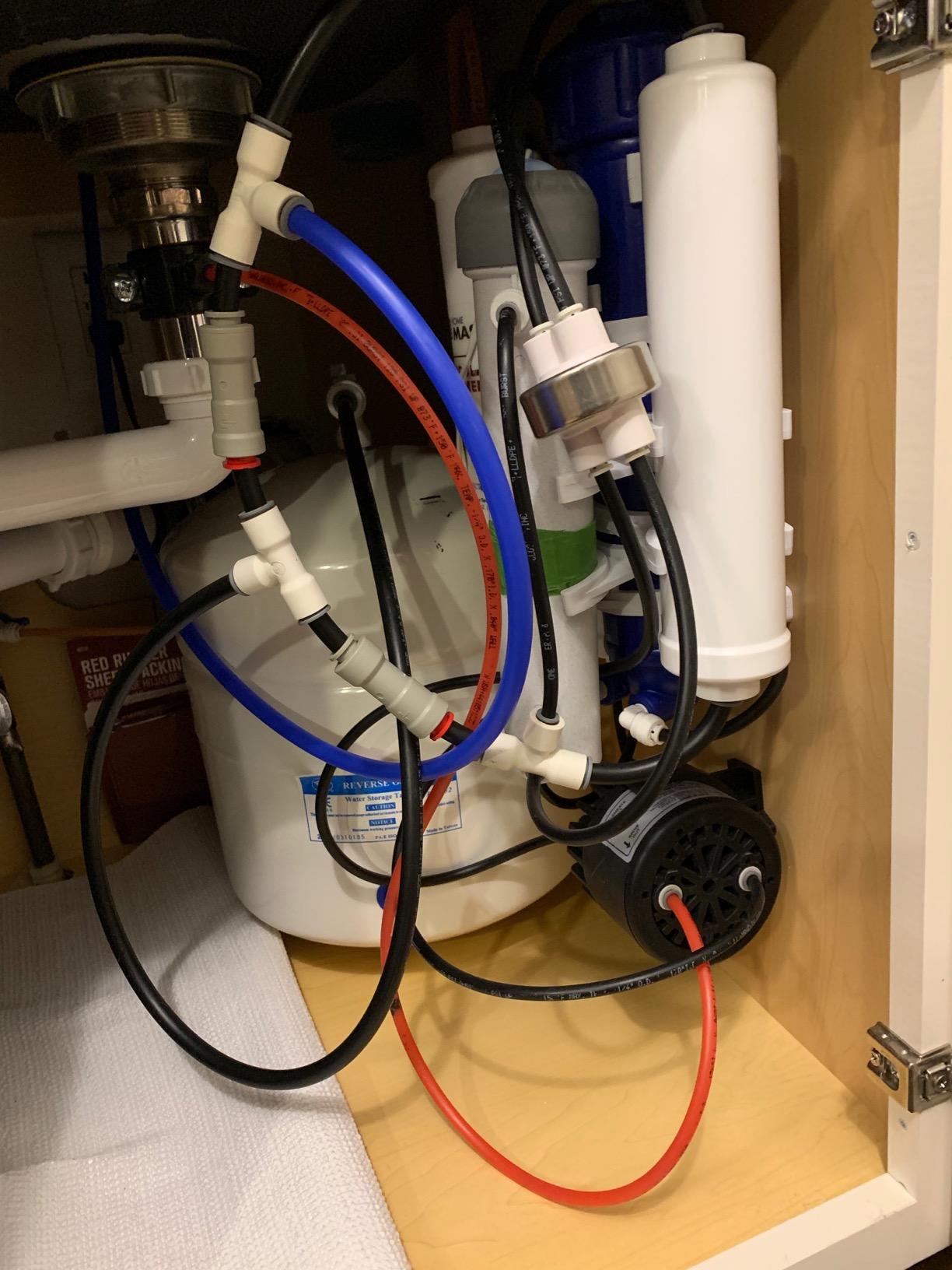
The TMHP is the only system in this roundup that treats bacteria at the point of use, and for a well owner who has dealt with a boil advisory or a positive coliform result, that UV stage is the reason to look here. It is EPA registered and rated at 99.9 percent germ elimination, sitting at the end of a nine-stage reverse osmosis train.
The other headline feature is the 1:1 waste ratio. A standard reverse osmosis system sends three to four gallons to the drain for every gallon produced; this one uses a non-electric permeate pump to hold it near one to one, which matters on a well where every gallon you waste is a gallon you pay to pump.
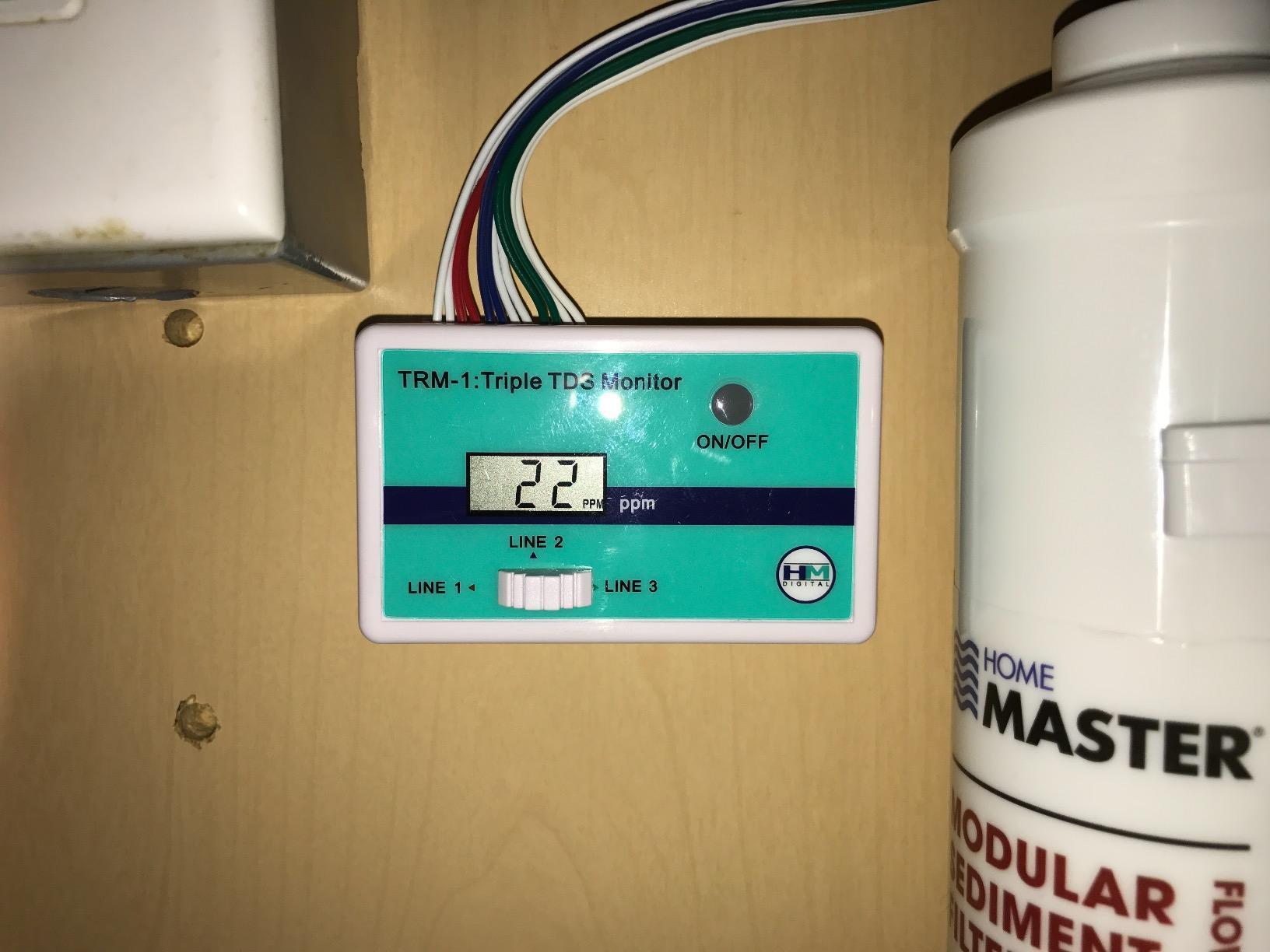
It also includes an iron prefilter stage, which is the one contaminant category most under-sink units here ignore. Rated TDS ceiling is 600 ppm and it operates between 40 and 100 psi, so it is not the choice for a 2000 ppm brine well, but it comfortably handles the mid-range.
Owners report moving from roughly 430 ppm down to about 25 ppm, and the two-pass remineralization puts calcium and magnesium back so the result does not taste stripped. Fill speed is among the fastest here at about five seconds for a 20 oz bottle.
Where UV earns its place
UV addresses organisms that pass through a membrane or carbon block untouched, which on a private well is a real category rather than a theoretical one. It also gives you a disinfection step that does not depend on chlorine residual, which well water does not have.
Remember that UV needs power. If your under-sink cabinet has no nearby outlet, this gets more complicated than the other nine.
The trade-offs to weigh
It costs the most of the group, and the review count is well below the others, so you are buying less proven history. Owners consistently single out the main mounting clips as stiff and difficult to engage in a dark cabinet.
Annual filter changes plus a multi-year tank diaphragm replacement are real ongoing costs, and the quick-connect fittings are difficult to release under pressure without a specialty tool.
8. SimPure V7 Stainless Steel – Best for Small Cabinets and Rough Water
SimPure V7 Under Sink Water Filter System, Stainless Steel
304 stainless steel housing
1.6 GPM flow
Slim 3.6 inch profile
5.2 pounds
Pros
- Stainless steel housing resists the aging and pressure cracking common to plastic bodies
- Tool-free install finished in under ten minutes by first-timers
- 3.6 inch slim profile leaves cabinet storage usable
- Flow rate holds at full pressure with no measurable drop
Cons
- Stated 0.5 micron accuracy is disputed by reviewers who suspect it is nearer 5 micron
- Does not reduce TDS
- No wall bracket included so the body sits freestanding
- Some installs need an extra 1/2 inch hose not in the kit
The SimPure V7 is built differently from everything else here. The housing is 304 food-grade stainless steel rather than plastic, and at 3.6 inches square by 12 inches tall it is the narrowest body in the group. On a cabinet that already has a disposal and a recycling bin, that footprint matters.
Filtration is a five-stage composite stack built around two sediment membranes, KDF-55 and two coconut shell carbon blocks. Rated 20,000 gallons or twelve months, at a stated filtration accuracy of 0.5 micron. Buyers describe a tool-free install completed in under ten minutes with no plumbing experience.
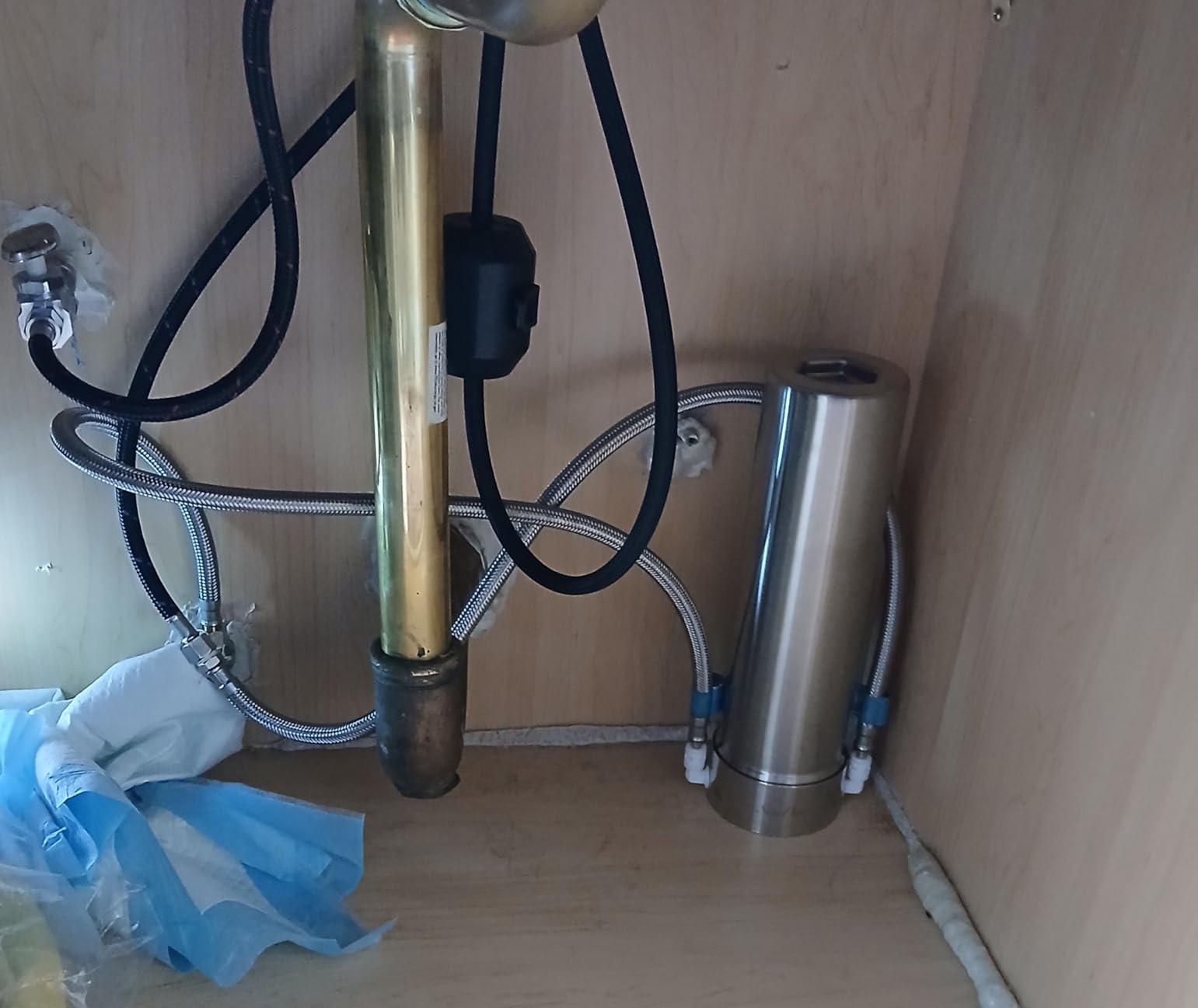
Flow is 1.6 gallons per minute, which fills a standard glass in about three seconds and stays at full pressure according to owners. The unit connects directly to an existing faucet with included converters for both 3/8 inch and 1/2 inch lines, and the manufacturer is based in Seattle, Washington.
Steel construction is the quieter advantage. Plastic filter housings harden and crack with age and pressure cycles; a stainless body does not, and the manufacturer will ship replacement tools for the housing if you ever need them.
Why steel helps on a well
If your well runs at higher pressure, the housing is doing more work than it would on municipal supply, and material choice starts to matter. This is the pick for someone who wants a durable body they do not have to think about again.
It is also a good renter option. No drilling, no tank, no drain line, and the slim body can be carried to a new sink in one hand.
Where the claims get questioned
The 0.5 micron figure draws real skepticism from reviewers who believe the effective rating is nearer 5 micron. Treat it as a sediment and taste filter rather than fine filtration, and do not rely on it for cyst removal.
Also note there is no wall bracket, so it sits freestanding, and the included Teflon tape is described by owners as too thin to seal properly. Grab your own tape before you start.
9. WINGSOL WS-US-002 Two-Stage Filter – Best Certified Lead and PFAS Reduction Without RO
WINGSOL Water Filter for Sink with Faucet, 2-Stage Deep Filtration, Reduce Heavy Metals/Chlorine/PFAS/Odor/Sediment, NSF/ANSI 42&53 Improve Taste, Life Indication Mineral pH+ Under Sink Water Filter
NSF/ANSI 42 and 53 certified
2.5 GPM at 60 psi
Mineral pH+ carbon block
6.2 lb housing
Pros
- Dual NSF/ANSI 42 and 53 certification is rare in this price band
- Mineral pH+ stage alkalinizes the water while retaining beneficial elements
- Quick-change housing stays in place so only the cartridge is replaced
- See-through housing shows filter life at a glance
- Pleated anti-clog design extends cartridge life
Cons
- Does not reduce TDS
- Tallest body in the group at 13.39 inches by 8.66 inches deep
- Filter life can fall to six months on poor well water
- Dedicated faucet requires countertop drilling
The WINGSOL is the only two-stage unit here carrying NSF/ANSI 53 in addition to 42, and that distinction is what separates it. Standard 42 covers taste and odor, while 53 certifies reduction of health-related contaminants, so a 53 listing means the lead and PFAS claims were independently tested rather than asserted.
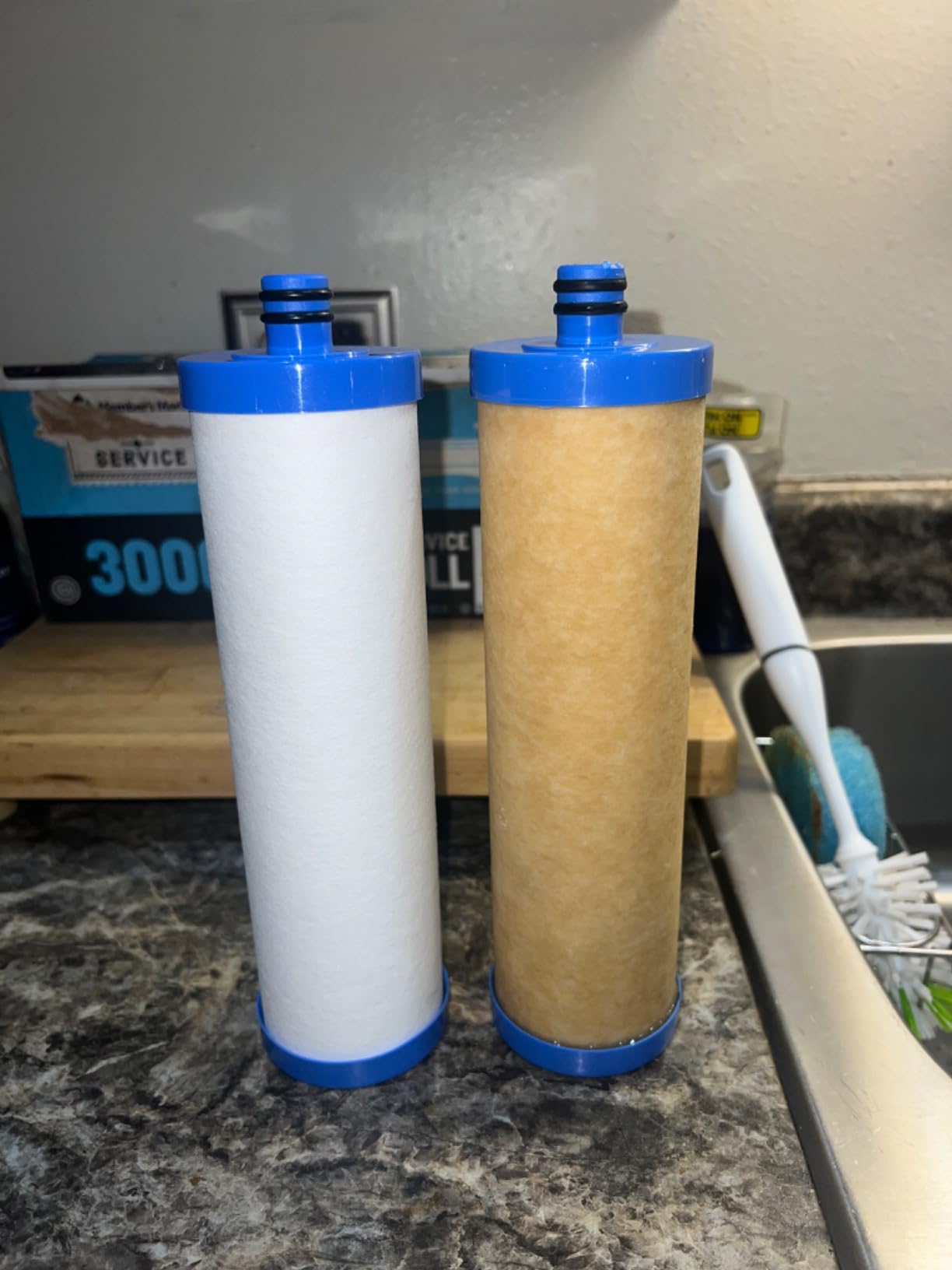
Stage one is a pleated polypropylene filter, stage two a multi-function carbon block with mineral pH+ remineralization. The claimed reduction is 99.99 percent of lead, chlorine, odor, sand, rust, benzene, cysts, asbestos, MTBE, TTHM and VOCs, and the listing is explicit that the system is suitable for both municipal and well water.
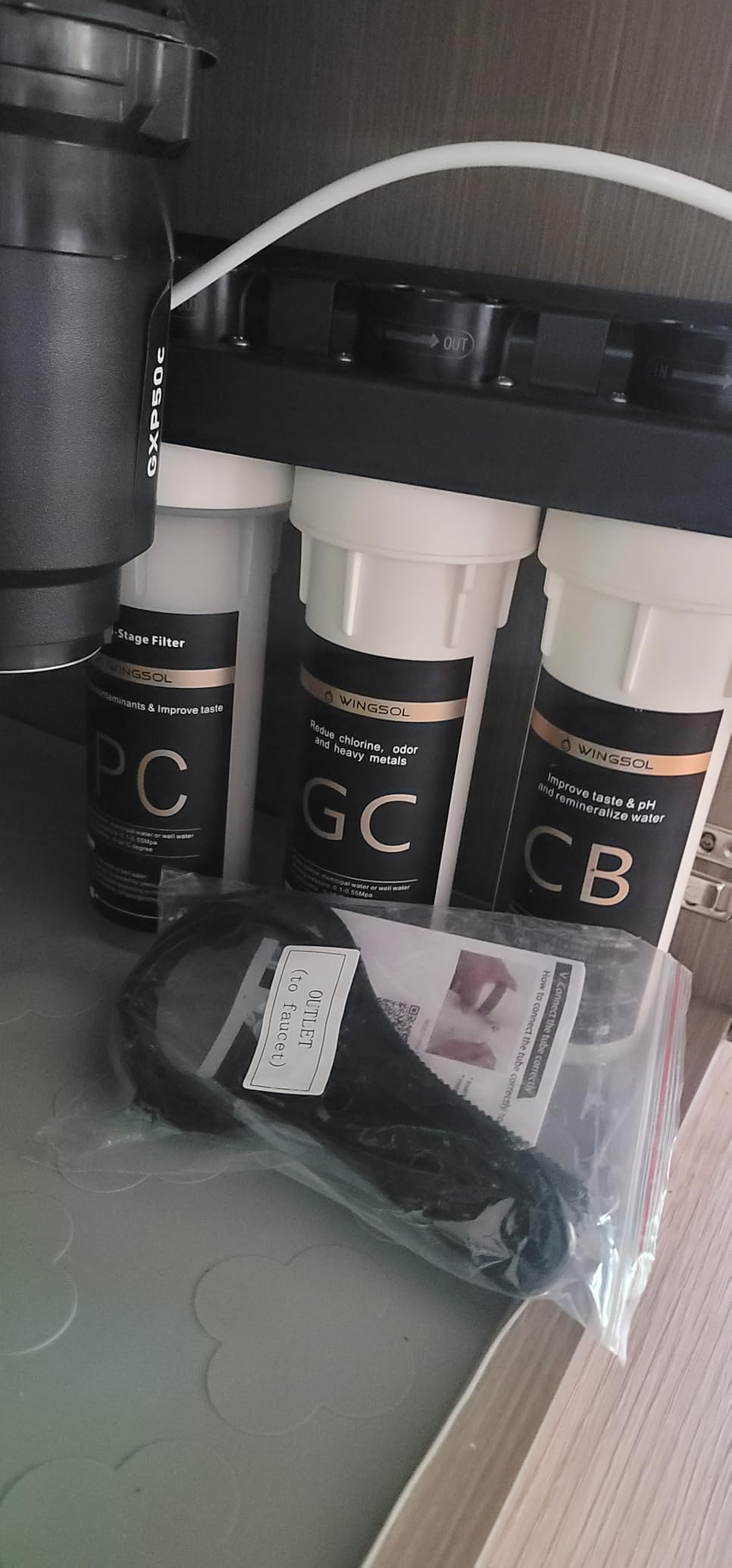
Two design touches are worth more than they sound on a well. The clear housing lets you watch the pleated cartridge brown as sediment loads up, and the quarter-turn green housing stays mounted while only the cartridge swaps, so you do not re-plumb anything at the change.
Flow is rated at 2.5 gallons per minute at 60 psi, matching the ICEPURE for the fastest fill on this list.
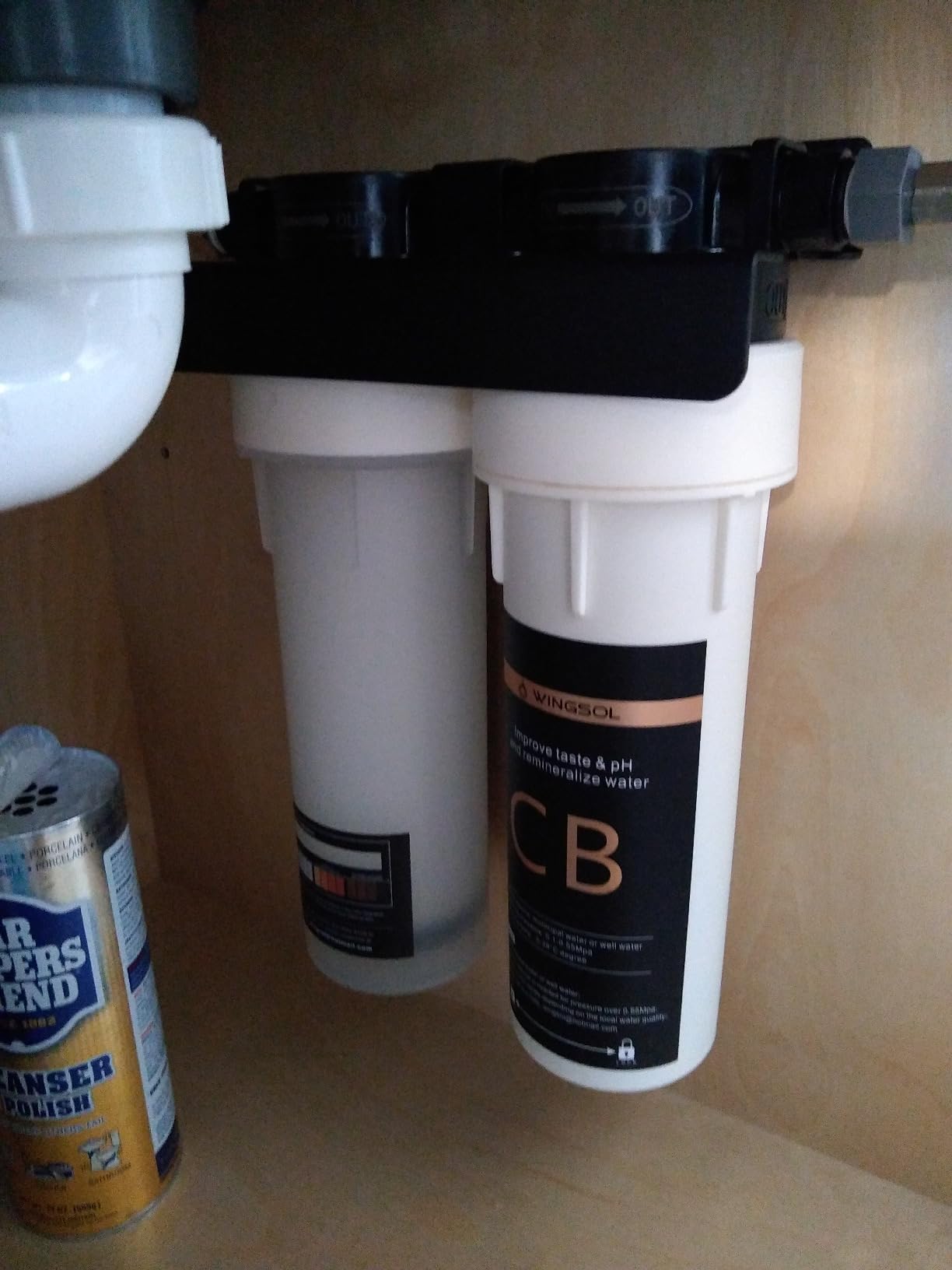
When this is the right fit
Choose it if you want certified lead and PFAS reduction without committing to reverse osmosis and its drain line and water waste. On older plumbing or a well with a history of PFAS exposure, the 53 certification is the point of the purchase.
The mineral pH+ stage also makes it a better choice than a bare carbon block if flat, acidic-tasting water is your complaint.
Plan around the size
At 13.39 inches tall and 8.66 inches deep, this is the largest inline body in the roundup. Measure the cabinet before ordering, particularly if a disposal is already installed.
The dedicated faucet requires drilling the countertop. If you already have a filtered-water faucet, or you rent, this is the wrong fit. And on heavy well sediment expect six months rather than twelve.
10. PureDrop RTW5 5-Stage Reverse Osmosis – Best for Quiet Operation and Spares
PureDrop RTW5 5-Stage Reverse Osmosis Water Filter System
50 GPD reverse osmosis
SGS-tested to NSF/ANSI 58
2.2 gallon tank
1 year warranty
Pros
- Independently SGS-tested against NSF/ANSI 58 rather than certified in-house
- Acoustic dampening housing keeps tank refills near silent
- Compact 2.2 gallon tank saves cabinet space
- Includes three spare pre-filters that push the next change to about a year
- Separate check valve allows cheaper generic membranes
Cons
- Storage tank bladder has a documented history of rupturing
- 2.2 gallon tank suits one or two people rather than a family
- Pre-filter canisters can leak at startup if not tightened firmly
- First-time installers may need extra time on routing
The PureDrop RTW5 is the quiet one. Acoustic dampening around the tank cuts the refill noise that makes open-plan kitchens unpleasant, and if your sink cabinet is near where you sit or work, that is a genuine quality-of-life difference rather than a spec-sheet nicety.
It is a 50 GPD, five-stage reverse osmosis system SGS-tested against NSF/ANSI 58, claiming up to 99 percent reduction of PFAS, lead, arsenic, chlorine, heavy metals and TDS, with a rated ceiling of 500 ppm. The patented oval-nut faucet mounts from above the countertop, which removes the hardest install step.
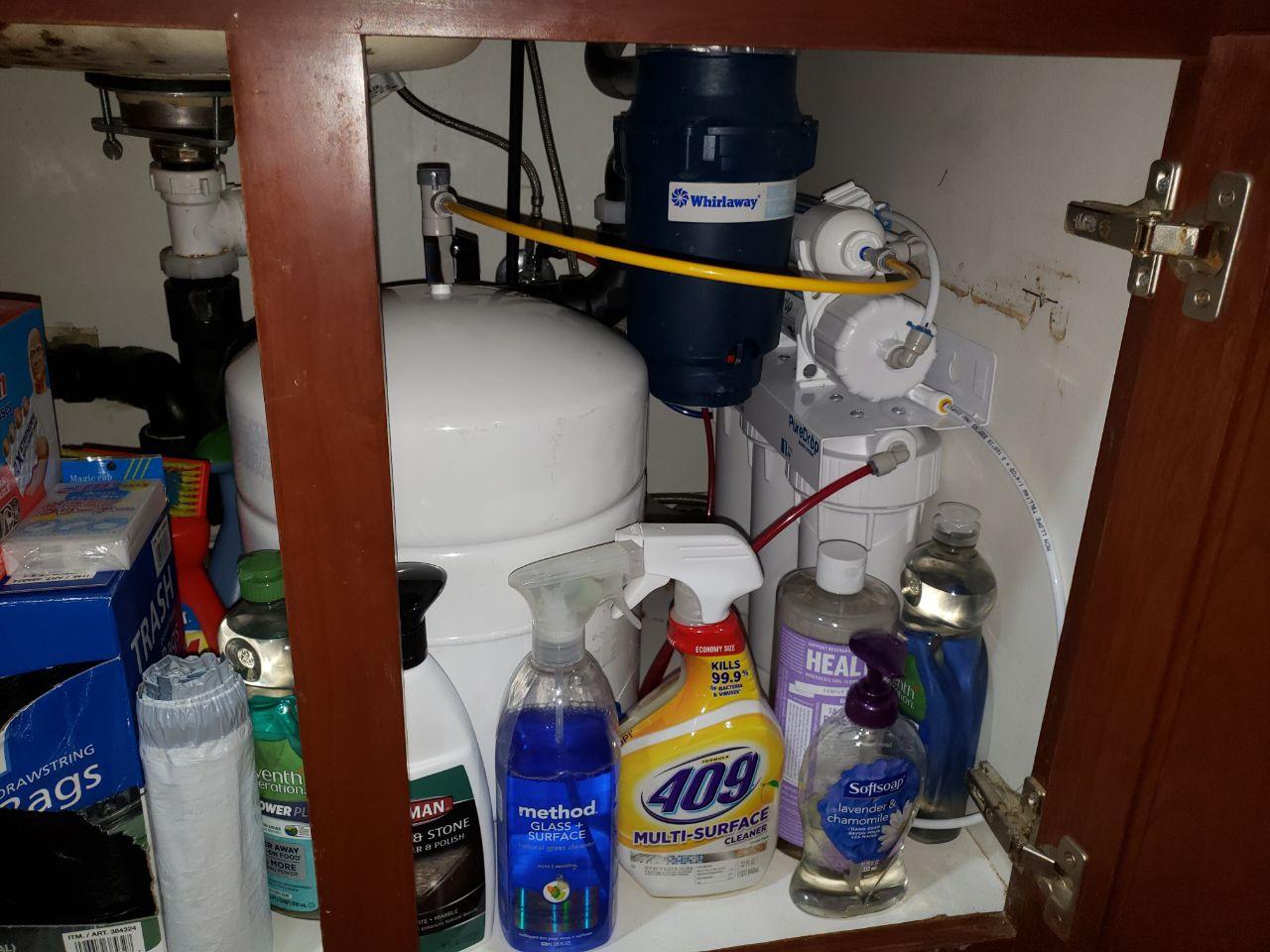
Two included extras stand out. You get three spare pre-filters, which pushes your next filter change to roughly a year, and refrigerator adapters so the same system can feed an ice maker. The separate check valve component also means you can buy generic membranes later instead of proprietary ones.
The small 2.2 gallon tank is a genuine space saver, but it is a trade-off. A household of two will never notice. A family of five will wait longer at the tap.
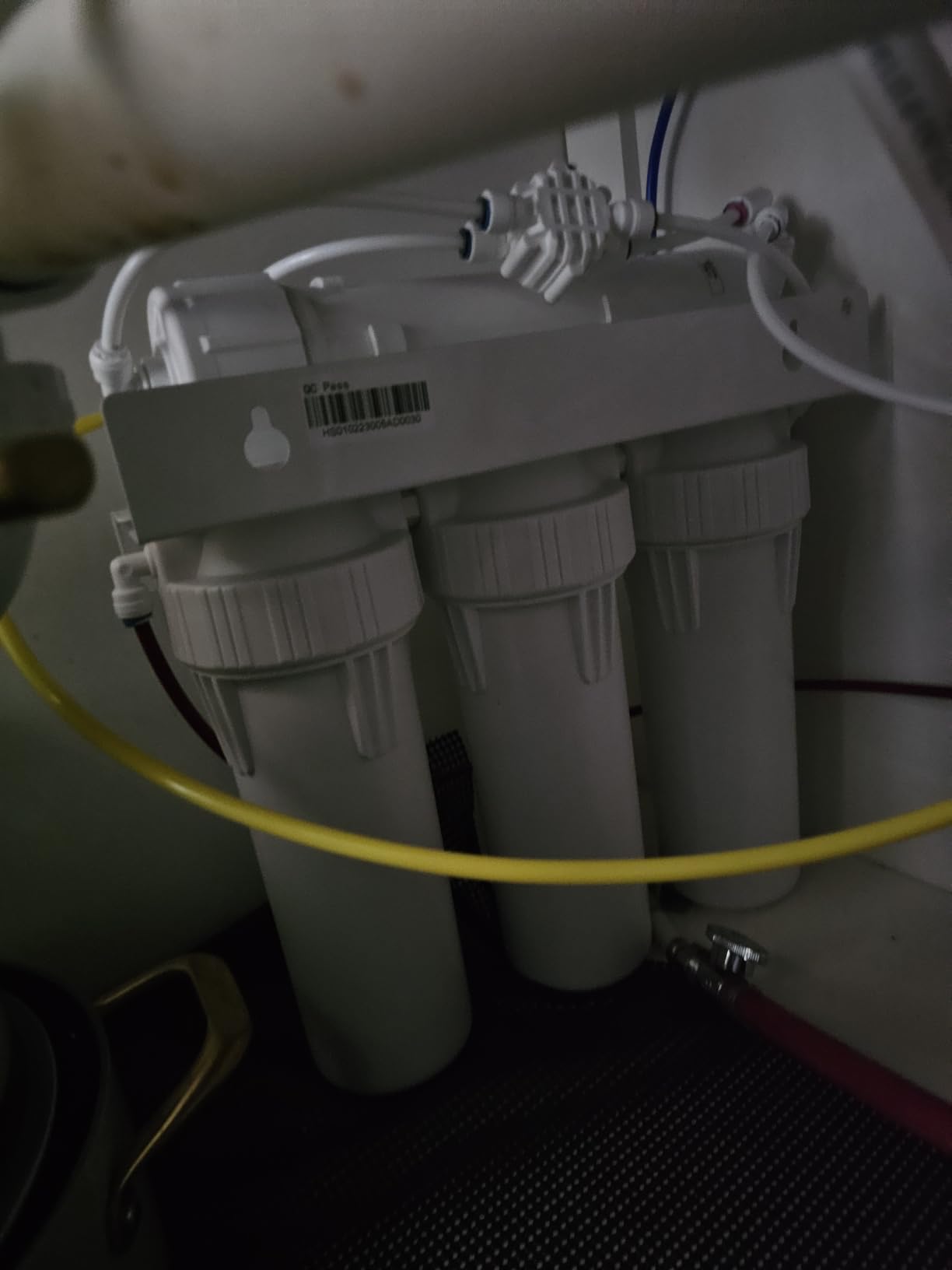
What we like beyond the noise
The top-mount faucet pattern is the same design iSpring uses on its flagship, and it genuinely removes the fiddliest part of an under-sink install. The spare pre-filters are a smart hedge on a well, where sediment loading is unpredictable.
It also runs on pressure alone with no power, so an outlet is not a concern.
The tank problem you should know about
This unit has the highest share of one-star reviews of any reverse osmosis model in this group at nine percent, and the theme is consistent: the storage tank bladder ruptures, sometimes within days of being replaced. Long-term owners report moving to a countertop system after repeated failures.
If you buy it, keep an eye on the tank and expect to replace it. The rest of the system is well regarded, which is why it lands at the bottom of our ranking rather than off the list.
How to Match Your Well Water Test to the Right Under Sink Filter
Start by reading your lab report line by line rather than shopping by brand. Every number on that sheet narrows the field, and a filter chosen without one is a guess. Most panels report total coliform and fecal coliform, nitrate, nitrite, arsenic, lead, total dissolved solids, hardness, iron, manganese, pH, and sometimes hydrogen sulfide. If you have never tested, a well water testing kit gets you started, though a certified lab panel is the version that settles arguments.
Bacteria or coliform present: do not buy a filter as your first move. Shock chlorinate the well, fix the casing, and re-test. If you want a barrier at the tap while the source is being sorted, the Home Master TMHP is the only unit here with UV sterilization built in. Tenants of whole-house well filtration systems report the same thing: filters improve what you drink, they do not clear a bacteria colony.
Iron above 0.3 mg/L or manganese present: no under-sink carbon filter clears staining reliably at meaningful levels. KDF media will reduce low concentrations and improve taste, which is what the CuZn UC-200 and SimPure V7 do. For a whole-house fix, our guides on iron removal filters and sulfur filters cover the oxidation and media approaches that actually treat the plumbing.
Hydrogen sulfide or a rotten egg smell: catalytic carbon and KDF will reduce it at the tap, and the iSpring CU-A4 and CuZn UC-200 both carry KDF stages aimed at hydrogen sulfide. If the smell is present in the shower and bathtub as well as the kitchen, no under-sink filter is the right tool, because the odor is coming from the well itself.
High TDS, hardness above 300 ppm, or nitrate: you need reverse osmosis. Pick the APEC ROES-50 above roughly 750 ppm, the iSpring RCC7AK-BN in the middle range, and the Home Master TMHP when you also want UV and less water waste.
Lead or PFAS from old plumbing: certification matters more than marketing language. NSF/ANSI 53 is the health-contaminant standard, which the WINGSOL WS-US-002 and the CuZn UC-200 carry. NSF/ANSI 58 is the reverse osmosis standard. Our guide to under sink filters for lead removal breaks down which certifications to look for.
Once you know your contaminant, two numbers decide the fit. Flow rate is the first: a kitchen needs roughly half a gallon per minute for comfortable use, and anything above 1 GPM feels instant. The second is pressure, because reverse osmosis needs 40 to 85 psi at the tap and shallow wells with tired pumps often fall short. A small booster pump fixes that, and adding one above roughly 40 psi risks damaging a housing.
Finally, think about maintenance before you buy, because it decides whether you keep the system or abandon it in the cabinet. On well water, sediment cartridges need checking monthly and swapping well before six months. Carbon cartridges run six to twelve months. Ultrafiltration membranes can last two years. Reverse osmosis filter sets run six to twelve. If you want to set and forget, the five-year CuZn cartridge is the only one here that gets close.
Flush any new system for five minutes before drinking, and flush it again after every cartridge change. Most taste complaints on day one are simply unremoved carbon fines, not a defective unit.
Frequently Asked Questions
Do water filters work on well water?
Yes, but only for what you filter for. A private well is unregulated, so the water can carry iron, manganese, hydrogen sulfide, sediment, nitrate, arsenic and bacteria that municipal water rarely does. Carbon and KDF blocks handle taste, odor, iron at low levels and sediment. Ultrafiltration catches particles and cysts. Reverse osmosis is the only option that meaningfully lowers dissolved solids, hardness and nitrate. Bacteria in the well itself need treatment at the source, not at the tap.
What are the disadvantages of under sink filters?
They only treat water at one tap, not the shower or outdoor hose. Most do not reduce TDS, so hard water stays hard. They occupy cabinet space, reverse osmosis needs a drain line and wastes water, and cartridges must be replaced on a schedule that well water shortens. A single unit cannot treat bacteria or a heavy iron load, and a failed membrane can quietly return contaminants to your glass.
What is the best filter for removing sulfur from well water?
At the tap, a filter with catalytic carbon and KDF media will reduce hydrogen sulfide odor and taste. The CuZn UC-200 and the iSpring CU-A4 both use KDF-55 for this purpose. However, if the rotten egg smell appears in the shower and hot taps too, the gas is coming from the well and needs a sulfur-specific whole-house system. An under-sink filter improves what you drink; it does not fix the source.
What type of filter can remove iron bacteria from well water?
No under-sink filter removes iron bacteria colonies. KDF media will reduce the metallic taste and staining they cause at low concentrations, which is what the CuZn UC-200 and SimPure V7 do. The bacteria itself lives in the well and the surrounding plumbing, and it produces slime that clogs softeners and pipes. Treat the well with shock chlorination and a system designed for iron bacteria, then use a point-of-use filter for drinking water.
What do I do if my well water smells like rotten eggs?
First, confirm it is hydrogen sulfide rather than a plumbing issue by running the cold tap for a full minute and checking whether the shower smells the same. If the odor is everywhere, treat it at the well with a sulfur-specific whole-house system. If it is only at the kitchen cold tap, a carbon and KDF filter such as the CuZn UC-200 will reduce it. Also note that iron bacteria can produce a similar smell and need separate treatment.
How often do under sink filters need replacement?
On municipal water, most manufacturers rate carbon and sediment cartridges at six to twelve months and reverse osmosis sets at six to twelve. Well water carries heavier sediment, so plan on shorter intervals and check the first stage monthly. The CuZn UC-200 is rated at five years and is the exception. If your water starts tasting metallic again, the carbon stage is exhausted and should be changed regardless of the calendar.
Which Under Sink Filter Fits Your Well
For most well owners in 2026, the iSpring RCC7AK-BN is the right first buy: whole-system NSF/ANSI 58 certification, a transparent sediment stage you can actually watch, and a remineralization cartridge that keeps the water from tasting stripped. If your TDS reading sits above 750 ppm, the APEC ROES-50 handles what the iSpring is not rated for.
If you want the lowest running cost and you only have a taste and mild iron problem, the CuZn UC-200 is hard to argue with at five years per cartridge. For bacteria alongside high TDS, the Home Master TMHP is the only unit here with UV sterilization and the least water waste.
Whichever you choose, test first and buy second. The best under sink water filters for well water are the ones matched to your contaminant list, your pressure, and your cabinet, and that only becomes clear once you know what is coming out of your pump.