
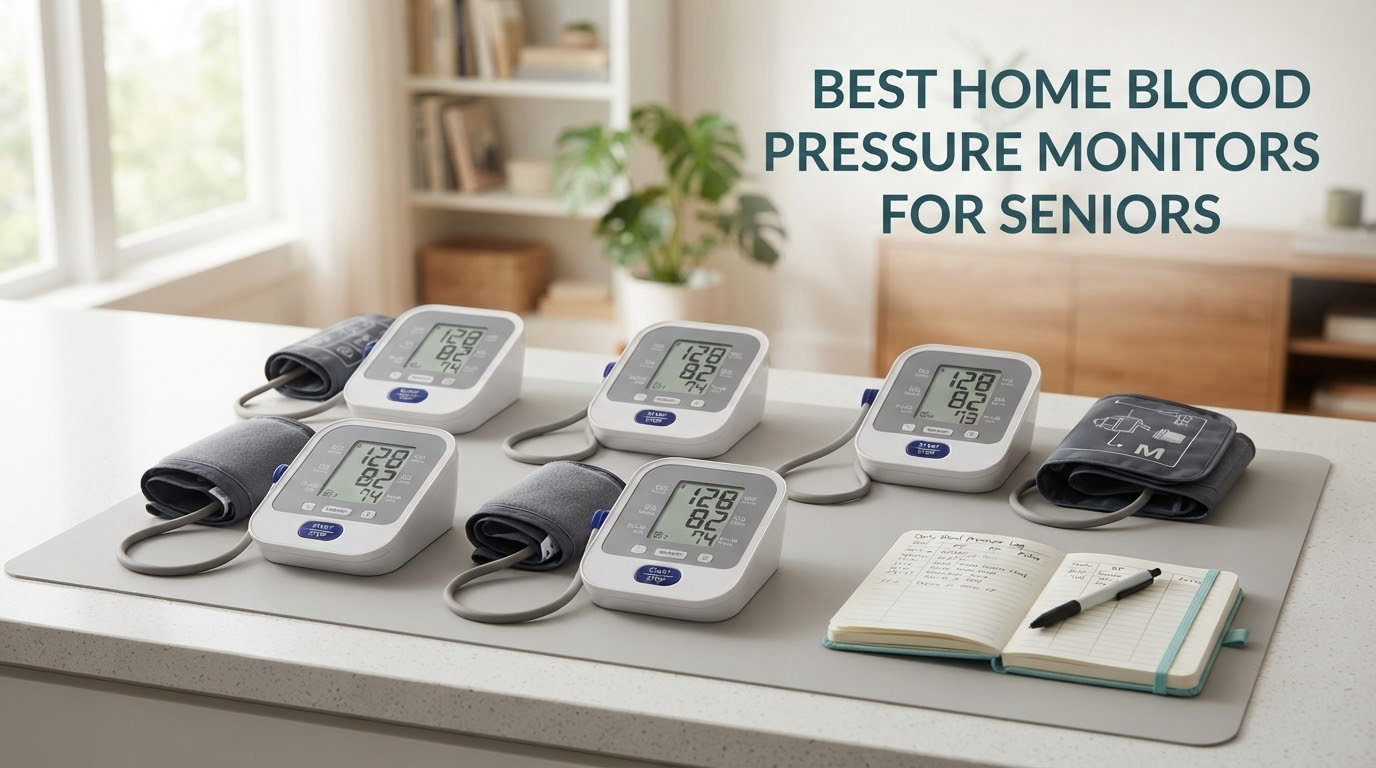
The best home blood pressure monitor for seniors is the iHealth Track Smart Upper Arm Monitor, because it pairs a wide 8.7 to 16.5 inch cuff with a large backlit color display, one-touch accuracy that needs no calibration, and 99 stored readings plus unlimited logging in a free phone app.
That is the short answer. The longer answer is that most seniors do not need the most expensive machine on the shelf — they need a monitor whose cuff actually fits their arm, whose numbers they can see from across a kitchen table, and whose readings match what their doctor’s office produces. Get those three things right and the rest is decoration.
Our team spent weeks working through the ten best-selling automatic upper arm monitors, comparing cuff ranges, memory capacity, user profiles, voice features, and irregular heartbeat detection against what real buyers report after months of use. We also read the forum threads where people ask the questions nobody puts on a product page: does this unit match my clinic, does the cuff wear out first, and can my daughter see my readings without teaching me an app.
Two framing notes before we start. This article is shopping guidance, not medical advice — a home monitor is a tracking tool, and a new device should be checked against a clinic reading before you act on its numbers. And if you are an adult child buying for a parent, the decision is not really about the machine; it is about fit, legibility, and who handles the setup. Both buyers are served below.
If you want the connected monitors instead, we track those separately in our guide to the best blood pressure monitors with app tracking.
Our Top 3 Picks for Seniors in 2026

iHealth Track Smart Upper Arm Monitor
- Wide 8.7 to 16.5 inch cuff
- Backlit color display
- 99 readings on device
- Heart rhythm detection
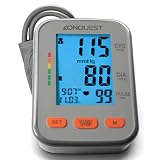
Konquest KBP-2704A
- Backlit LCD with near inch tall numbers
- 8.5 to 16.5 inch cuff
- Irregular heartbeat detection
- Multi user memory

AILE X5 FDA Cleared Monitor
- FDA cleared
- 8.7 to 16.5 inch cuff
- Two users with 99 readings each
- One touch operation
What Seniors Need in a Blood Pressure Monitor
This is the criteria list we use when we narrow a field of monitors down to a handful. If a machine fails any of the first four, it does not make the list no matter what the other features are.
An upper arm cuff, not a wrist or finger cuff. Upper arm models are the accuracy standard for home use, and specialists consistently steer patients toward them for that reason. Wrist monitors are far more sensitive to how you hold your arm, and finger monitors are not a home measurement tool at all.
A cuff that fits. Standard cuffs fit arms roughly 9 to 17 inches in circumference, and most of the monitors here cover 8.7 to 16.5 inches or a bit wider. A cuff that is too small inflates the reading and a cuff that is too loose reads low, so measure your arm circumference with a soft tape before you buy.
A large, backlit, high-contrast display. Numbers close to an inch tall, readable in a dim bedroom, with the range color-coded or clearly labeled so nobody has to work out which number is systolic and which is diastolic.
One-touch operation with no menus. Sit down, wrap the cuff, press one button, wait. If the setup involves holding a button down or navigating a menu, most older users abandon it within a week.
Voice readout if vision is the barrier. Monitors that speak the result aloud in English or Spanish solve a problem no display can, and they work for sighted users too when a reading has to be taken at night.
Irregular heartbeat detection. The monitor flags a rhythm it cannot measure cleanly so you can repeat the reading and mention it at your next appointment.
Memory, ideally two profiles. Two user profiles matter more than raw capacity when a couple tracks together, and stored readings beat a paper log when you want to show a doctor a month of data.
A replaceable cuff and a real warranty. On every one of these monitors the cuff is the consumable part. The body lasts; the cuff wears out. A long warranty is the manufacturer’s own statement about that.
All 10 Monitors Compared Side by Side
| Product | Specifications | Action |
|---|---|---|
| iHealth Track Smart Upper Arm Monitor |
|
Check Latest Price |
| Konquest KBP-2704A |
|
Check Latest Price |
 Alcedo B21 Upper Arm Monitor Alcedo B21 Upper Arm Monitor |
|
Check Latest Price |
 Paramed B22S Upper Arm Monitor Paramed B22S Upper Arm Monitor |
|
Check Latest Price |
| AILE X5 FDA Cleared Monitor |
|
Check Latest Price |
 yuwell YE660E Monitor yuwell YE660E Monitor |
|
Check Latest Price |
 OMRON Iron BP5000 Monitor OMRON Iron BP5000 Monitor |
|
Check Latest Price |
 OMRON Evolv BP7000 Monitor OMRON Evolv BP7000 Monitor |
|
Check Latest Price |
 AQESO U80B 3 Cuff Monitor AQESO U80B 3 Cuff Monitor |
|
Check Latest Price |
 ProHeal Talking Monitor ProHeal Talking Monitor |
|
Check Latest Price |
1. iHealth Track Smart Upper Arm Monitor: The Best Overall Pick for Seniors
iHealth Track Smart Upper Arm Blood Pressure Monitor with Wide-Range Cuff
Cuff fits 8.7 to 16.5 inch arms
Backlit color display with range indicator
99 on device plus unlimited app readings
Heart rhythm disturbance detection
Pros
- Backlit color display with coded range indicator
- No calibration required and meets ESH standards
- 99 readings on device plus unlimited app tracking
- Two button operation with no menu diving
- Cuff range covers most adult arms
Cons
- Needs a Bluetooth smartphone for the app features
- Only one user profile on the device itself
I have had this one on my own kitchen counter for a few months, and the thing that keeps it in place is not the app. It is the display. The numbers are large, the screen is backlit, and a green, yellow, or red band tells you at a glance where the number falls, which is exactly what you want at 7am when you are not concentrating well.
The cuff is the wide-range type and it runs from 8.7 to 16.5 inches, which covers the large majority of adult arms without a second cuff. Inflation is automatic, operation is two buttons, and the manufacturer states it meets ESH performance standards with no calibration required — so there is no yearly service appointment to remember.
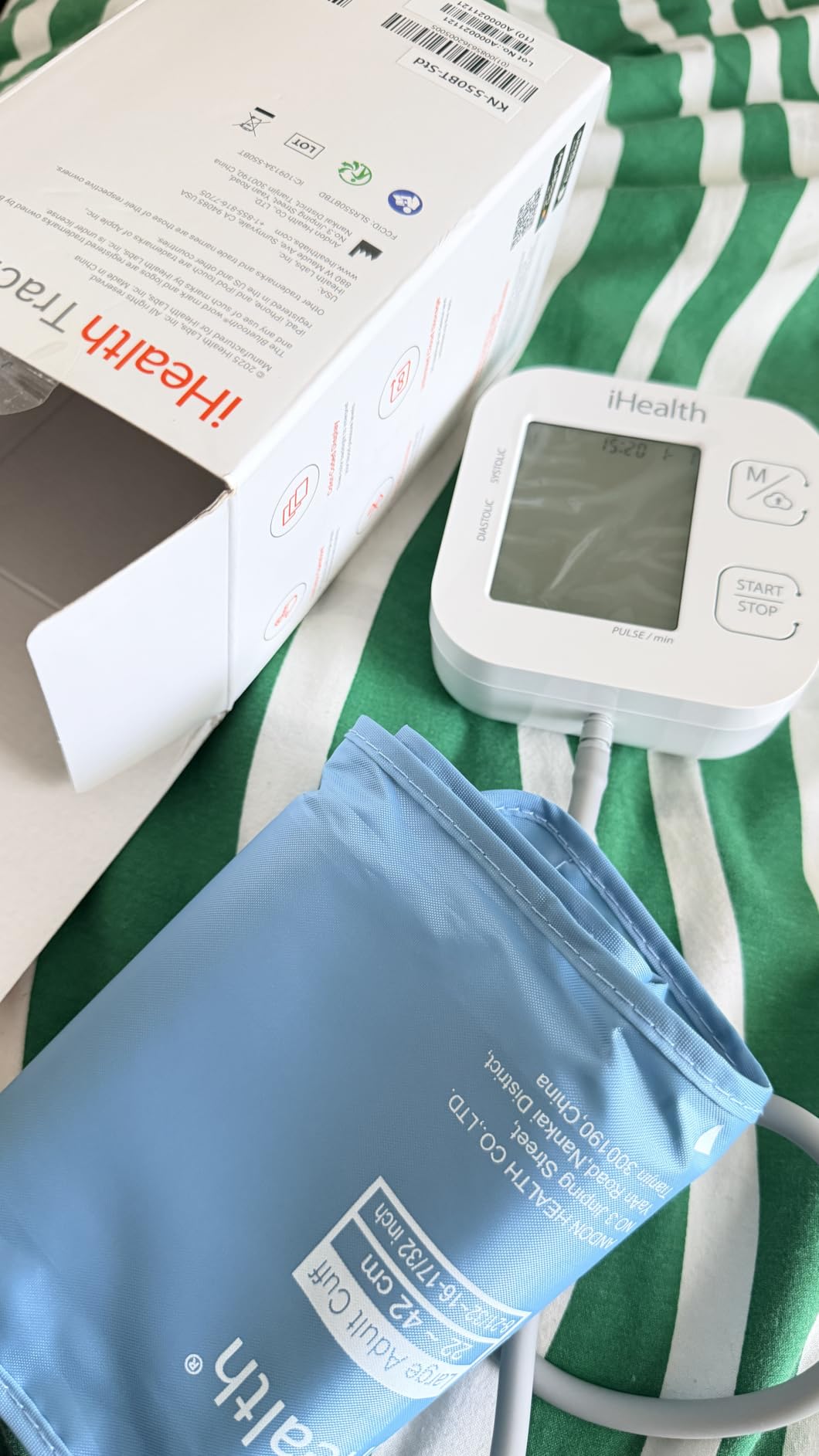
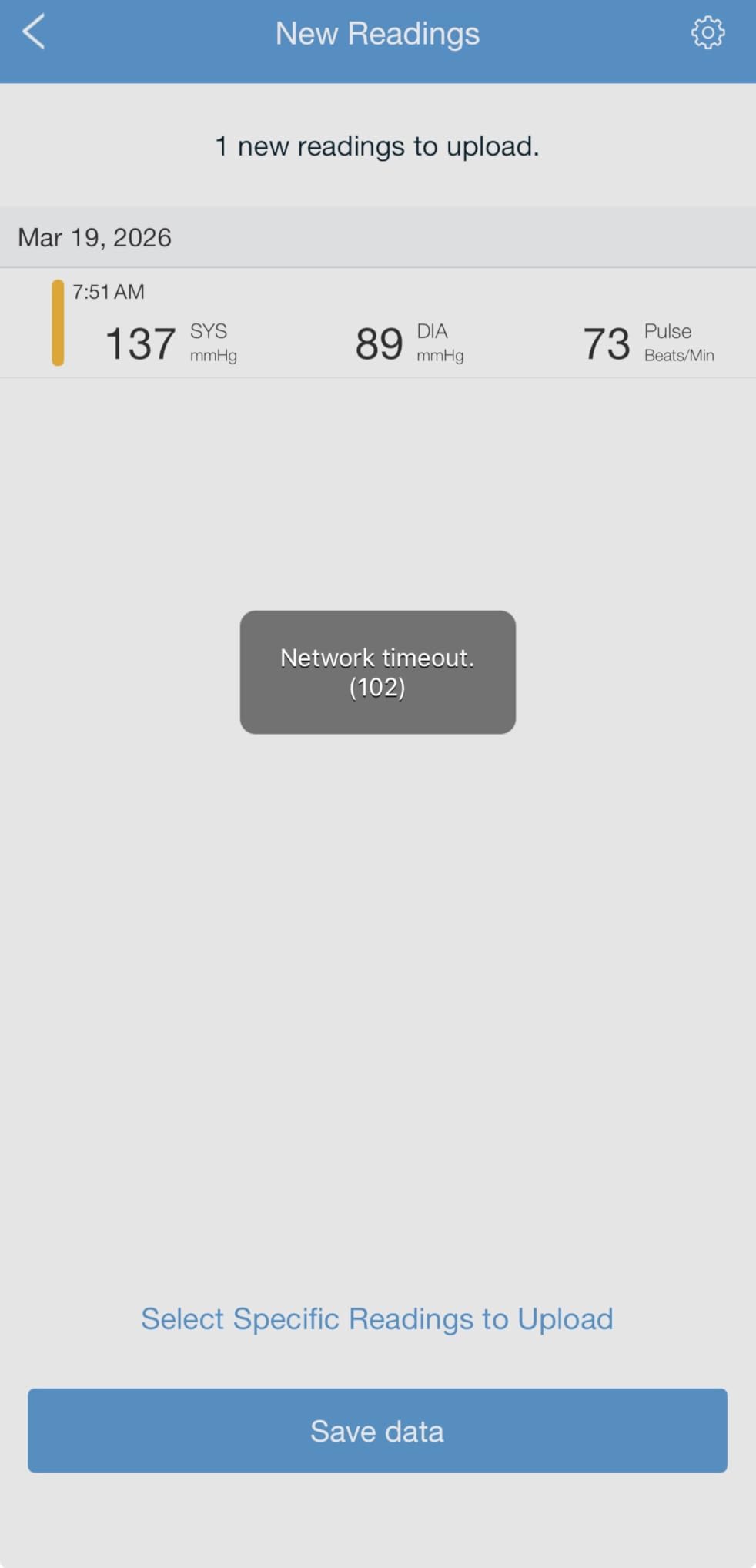
Storage is where this monitor pulls ahead of almost everything else here. It keeps 99 readings on the device itself, so it still works as a standalone log if you never pair a phone, and the free iHealth app for iOS and Android turns that into unlimited history with dates and times you can scroll. For a senior who sees the same cardiologist every three months, having a month of data to show rather than one number is worth a great deal.
It also carries heart rhythm disturbance detection. When the machine cannot get a clean reading because the rhythm is irregular, it shows a warning symbol rather than quietly printing a wrong number. That is a small feature that tells you a lot about how the product is designed.
Who this monitor suits best
It suits a senior who will actually use a smartphone, or who has a family member willing to pair it once and set up the profile. A couple can share the phone app for the log even though the device itself keeps a single profile, which is a small compromise most households absorb easily.
It also suits anyone who wants the reading to look obviously different when it is high. The color band removes the interpretation step that trips up a lot of users, and the wide cuff means you are not re-buying a different size later.
Where it falls short
The obvious limit is the dependency on a compatible smartphone for the full feature set. It needs a recent iOS or Android device, and setup involves a Bluetooth pairing, which is a genuine barrier for someone who has never paired a watch or a speaker. The device still measures and stores without the phone, so it degrades rather than breaks.
The second limit is scale. At just under four inches square and about 15 ounces, it is compact rather than generous, and a user who likes a large physical footprint may find the numbers smaller than the Konquest’s. The cuff, as always, is what you will replace first.
2. Konquest KBP-2704A: The Best Rated With the Longest Ownership Reports
Konquest KBP-2704A Automatic Upper Arm Digital Blood Pressure Monitor – Large Backlit Display – Irregular Heartbeat Detector – Blood Pressure Monitor for Home Use – Digital BP Cuff Tensiometro
Backlit LCD with near inch tall numbers
Cuff fits 8.5 to 16.5 inch arms
Automatic irregular heartbeat detection
WHO range indicator and memory
Pros
- Highest average rating in the group at 4.5 across 34k reviews
- Backlit display with numbers close to an inch tall
- Owners report two to five years of continuous use
- Self cinching cuff tightens one handed
- Carrying case and batteries included
Cons
- Display can feel busy with more indicators than some users want
- Cuff inflation can pinch if wrapped tightly
- Takes a little longer to complete a reading
This is the one we would put in front of a parent who is 82, reads glasses, and has no interest in a phone. The Konquest KBP-2704A does one thing, clearly, with a backlit screen big enough to read from a chair and a start button you can hit without aiming.
Reviewers consistently mention long ownership rather than first-week impressions. Multiple owners describe two to five years of continuous daily use, and clinical users describe the same. In a category where the loudest forum complaint is a battery clip failing or a backlight dying inside a year, that consistency is the most valuable thing on the spec sheet.
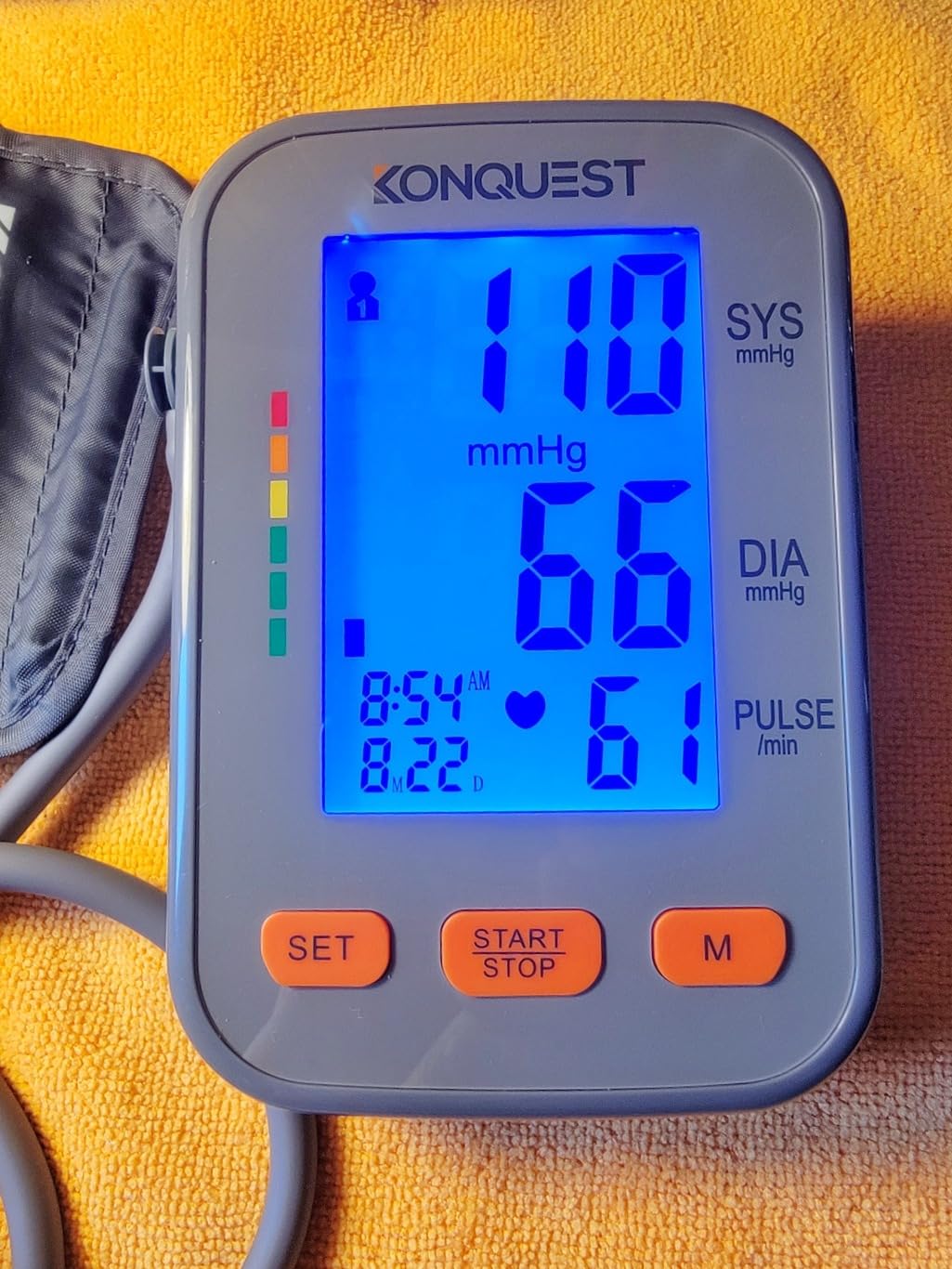
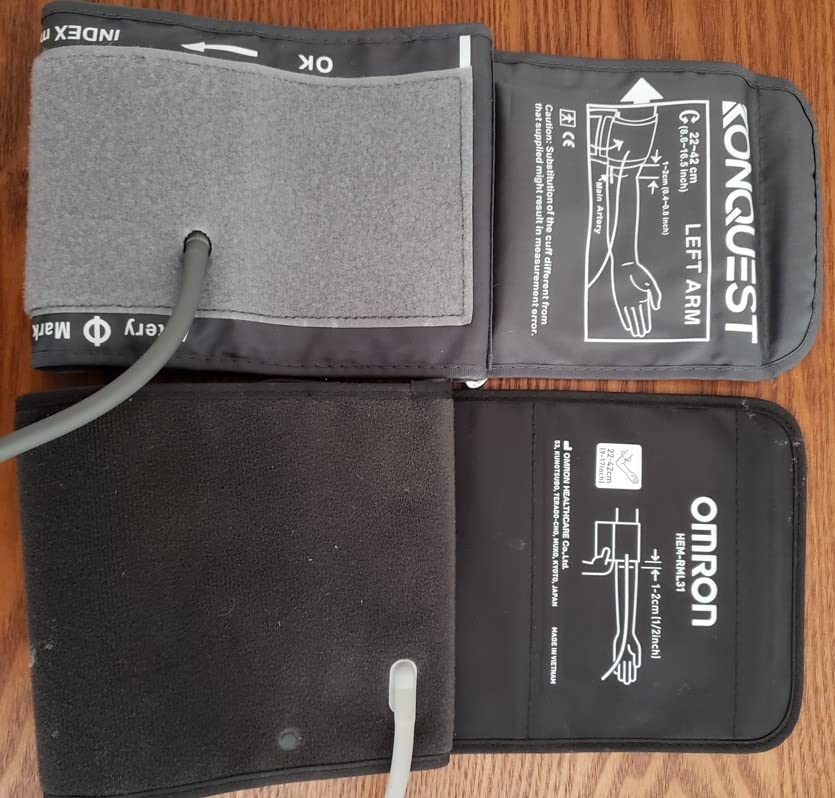
The cuff runs 8.5 to 16.5 inches, which is the widest small end of any monitor in this group and matters for a slender older adult. It is also self-cinching, meaning it tightens with one hand, so a user with arthritis in one hand can still do a reading unaided. Reviewers note it works over a t-shirt or light jacket, and that four AA batteries have carried it through a couple of sets over two years of heavy use.
On the screen you get systolic, diastolic, pulse, date, time, and a user profile indicator, plus a WHO-based indicator that classifies the reading on screen. Irregular heartbeat detection triggers an on-screen alert, and the memory function keeps readings so you can bring a log to an appointment instead of reciting numbers from memory.
Who this monitor suits best
It suits a user who wants nothing to do with an app and needs to hand a doctor a printed or remembered trend. It also suits anyone on a thin or small arm, because the 8.5 inch lower bound is the most forgiving here, and it suits a household where the person taking the reading has limited hand strength.
If you are buying for someone who lives alone and will be measuring at odd hours, the backlight and the multi-year reliability reports are the deciding factors. Battery life is measured in years, not weeks, which means no one has to think about it.
Where it falls short
The display is busy. It shows more indicators than a minimal user needs, and a few reviewers describe it as cluttered. The cuff inflation can pinch if it is wrapped tighter than it should be, which is a real issue for thin arms, and the measurement takes somewhat longer than some competing units, which can matter for someone who is impatient.
There is no voice readout, so a user with significant vision loss is not served. And at roughly 1.3 pounds with a 5.8 by 4 inch footprint, it is a home and travel unit rather than a small one.
3. Alcedo B21: Best for Couples Who Both Track Blood Pressure
Alcedo Blood Pressure Monitor for Home Use, Upper Arm Cuff BP Machine
Live voice broadcast with adjustable volume
One push button averaging 3 values
Two user mode with 120 readings each
Cuff fits 8.7 to 16.5 inch arms
Pros
- Voice broadcast praised by low vision users and everyone else
- Two user memory with 120 readings per person
- One button operation with automatic 3 reading average
- Runs on batteries or USB power for travel flexibility
- Compact enough for a bedside drawer
Cons
- Cuff may run small for very large upper arms
- Would sit better against some comparable brands on value
Two profiles is the feature that separates this from the crowd, and it is the reason this model shows up in so many homes with two people on blood pressure medication. Each user gets 120 stored readings, so the logs never interleave and neither partner has to wonder whose number they are looking at.
The voice function here is the full version. The LCD broadcasts blood pressure levels aloud with adjustable volume, and the one-push button design automatically averages three values, which quietly improves accuracy by smoothing out the effect of a single distracted moment. Reviewers describe the operation as quiet and consistent, and several have cross-checked against a clinic or pharmacy reading with close results.
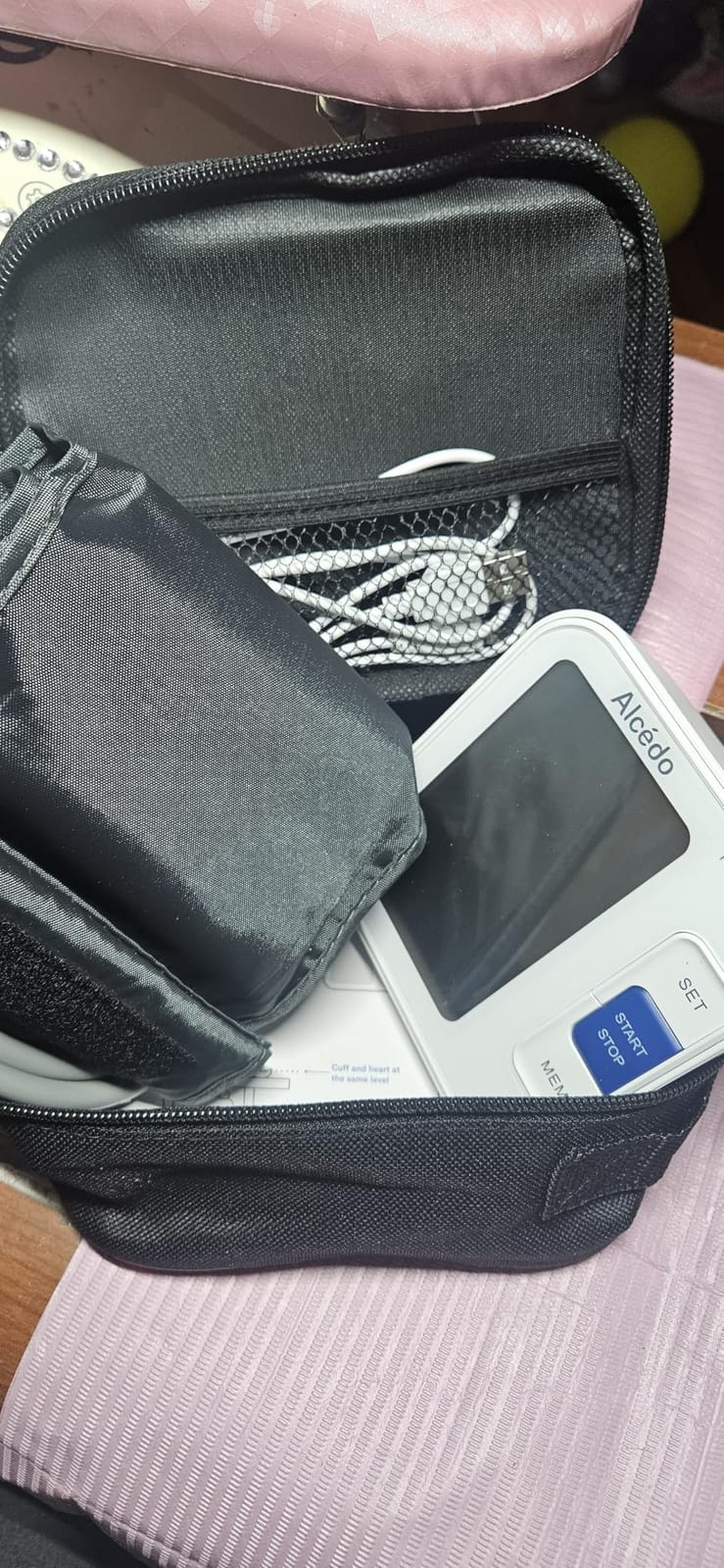
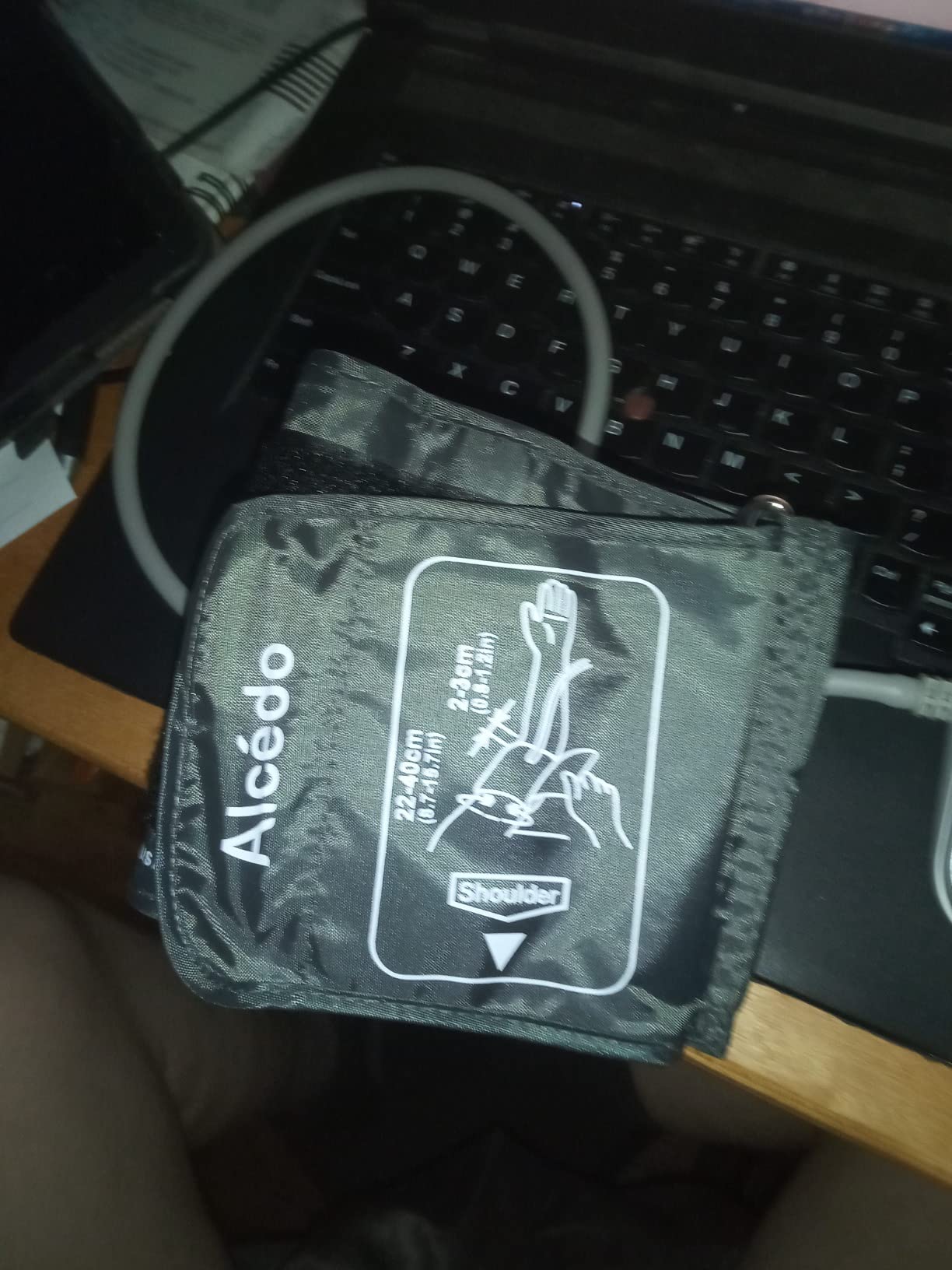
There is a cuff positioning self-check and movement detection that show a symbol when you have wrapped it wrong or moved mid-measurement, which is a quietly valuable feature for a user who cannot see the display well. The cuff fits 8.7 to 16.5 inches, and the whole unit weighs about 10 ounces and measures just over 6 inches across, so it lives comfortably in a bedside drawer or goes in a bag.
Power is flexible: four AAA batteries included, or USB power for a socket when you are not moving. The quick-start guide is written in plain English, which matters more than it sounds when the person setting it up is a son or daughter rather than the user.
Who this monitor suits best
It suits a couple who both track, because 120 readings per person is more than most monitors offer and the profiles are genuinely separate. It also suits a senior with low vision who wants the numbers spoken, or simply prefers hearing the result to reading it after a long day.
If setup will be done by a family member, this is an easy unit to hand over. One button, an obvious cuff, a printed guide, and no pairing step.
Where it falls short
The upper limit of the cuff is 16.5 inches, and reviewers with very large arms report the cuff can be too tight, which skews readings. Measure before you commit. It is also FSA and HSA eligible, but the value proposition is not dramatically stronger than its direct competitors, and a buyer focused purely on getting the most from a budget will find similar ground covered elsewhere.
The voice broadcast is the default behavior, so a user who does not want it may find it intrusive until they find the volume setting.
4. Paramed B22S: Best When the Voice Needs to Be Muted
Paramed Blood Pressure Monitor – Bp Machine – Automatic Upper Arm Blood Pressure Cuff 8.7-16.5 inches – Large LCD Display 120 Sets Memory – Device Bag & Batteries Included
Voice broadcast with adjustable volume and mute
Large LCD with oversized numbers
Two user memory across 2 profiles
Cuff fits 8.7 to 16.5 inch arms
Pros
- Voice broadcast can be turned off completely
- Oversized numbers and large buttons on the body
- Two user profiles with 120 readings
- Strong Velcro holds firm through inflation
- Quiet and fast inflation with deflation
Cons
- No backlight for low light reading
- Instructions contain a few typos
- Cuff is fixed and not easily swapped
The reason this model is on the list is a small one that turns out to matter: the voice broadcast can be muted entirely. Almost every talking monitor announces results by default, and for a senior who finds an announcing machine startling or who takes readings in a shared space, that single setting decides whether the device gets used at all.
Everything else is built for an older user. The LCD has oversized numbers, the buttons are physically large, and the cuff has a self-checking feature that confirms positioning before inflation. Reviewers report that readings matched a home monitor already tested against a doctor’s office device identically, which is the comparison that matters most in this category.
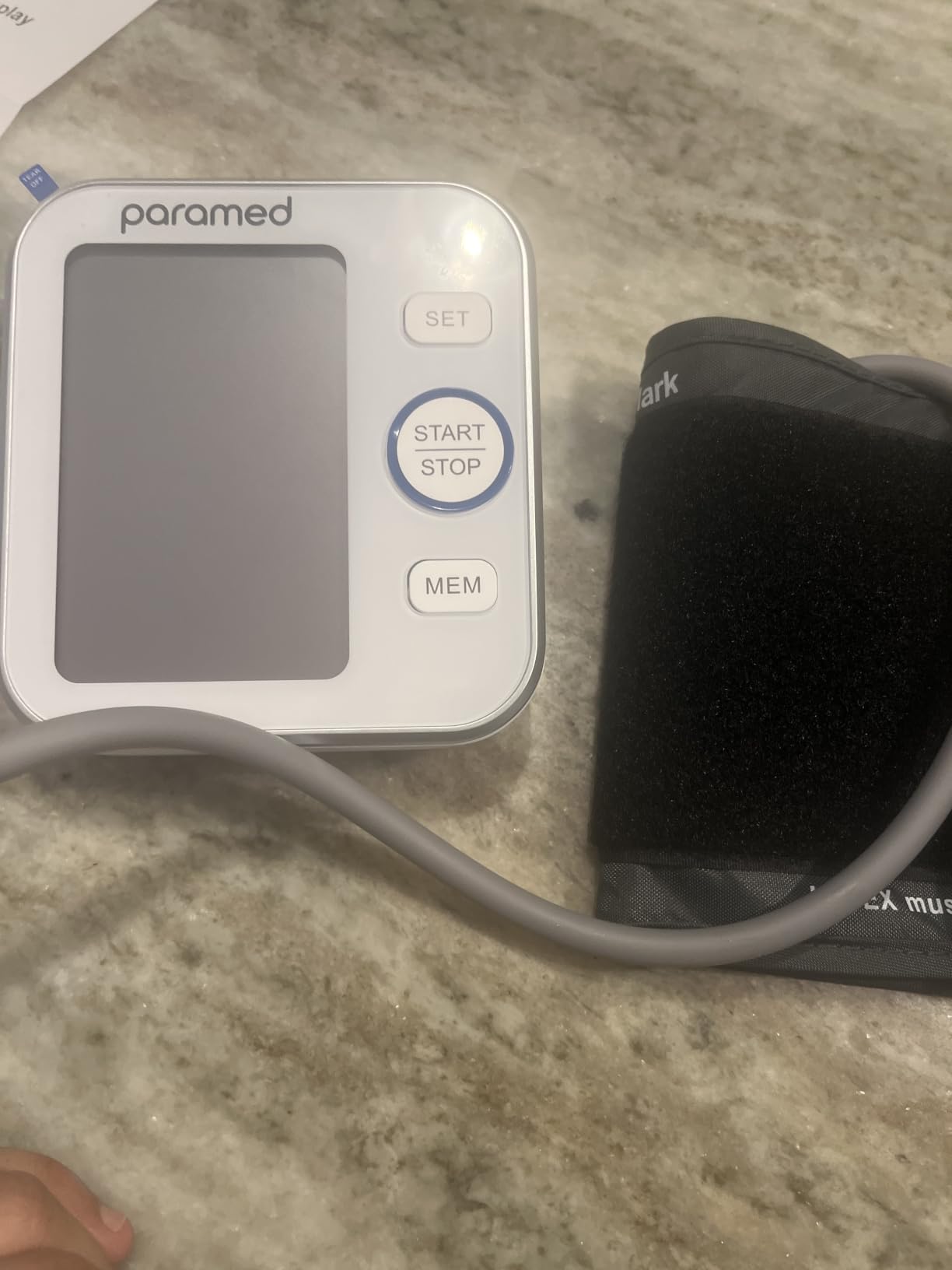
Two profiles hold 120 readings each, and the cuff width is well judged for sitting correctly on the upper arm. The Velcro is strong enough to hold through a full inflate and deflate cycle, which sounds minor until you have had a cuff that peels open halfway through a reading and produces a nonsense result.
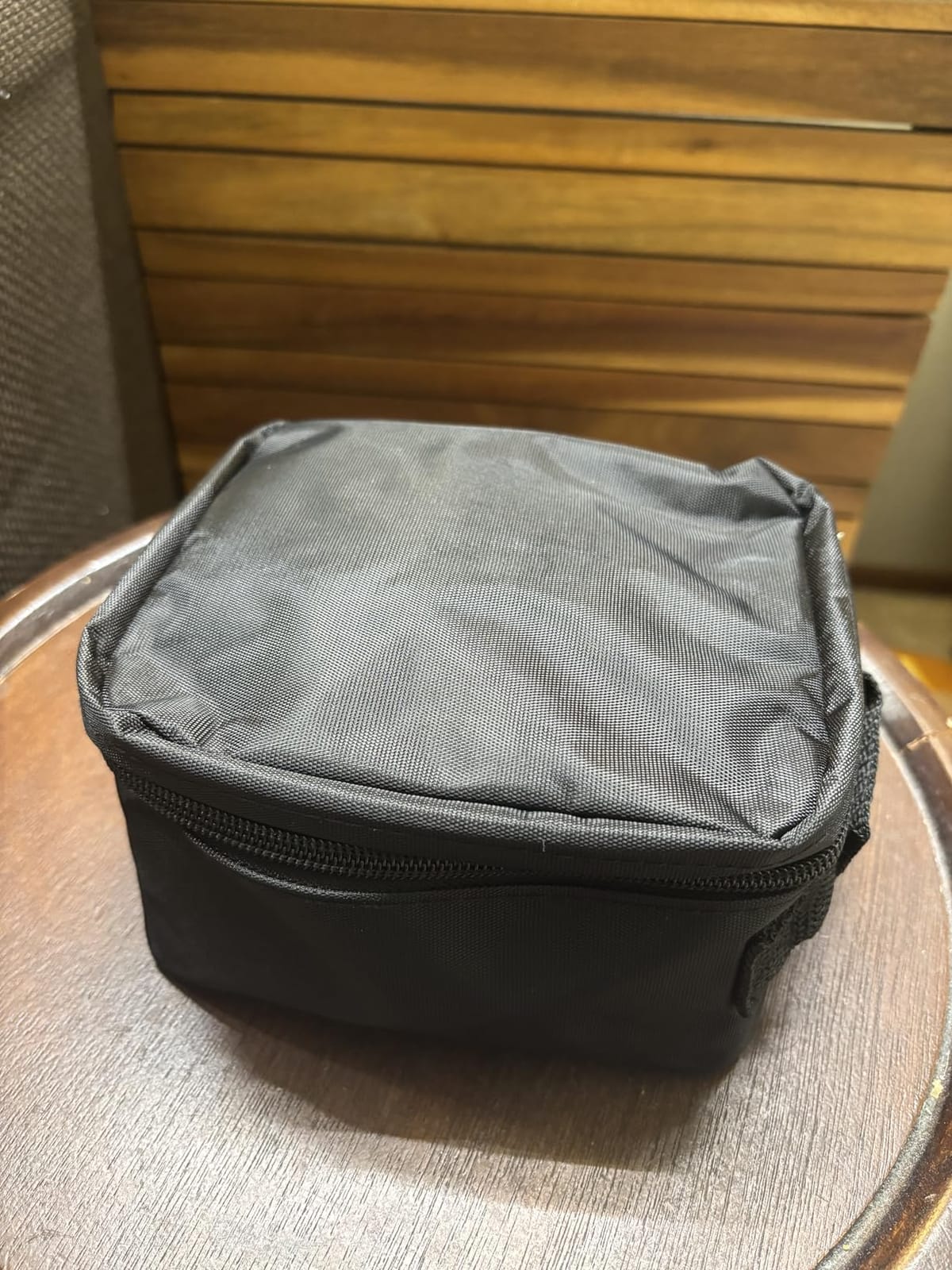
It runs on four AA batteries, and a carrying bag is listed in the box. Dimensions are about 5.9 by 4.7 inches, so it is compact without being fiddly.
Who this monitor suits best
It suits a user who benefits from hearing results in the morning but does not want an announcement in the afternoon, which is more common than retailers assume. It also suits a household sharing one device between two people, and a senior who prefers large physical buttons to a touchscreen or a menu.
Accuracy confidence is high among buyers, several of whom cross-check against a physician device, so this is a reasonable pick for anyone whose main worry is whether the number is real.
Where it falls short
The display has no backlight, and that is the most common request in the reviews. For a user taking a reading in a dim bedroom or a late evening, the numbers are harder to read than on the Konquest or the AQESO.
Some buyers wanted a case included with the monitor itself, and the printed manual contains a few typos that make first-time setup slower. The cuff is also a fixed size rather than an interchangeable one, so there is no upgrade path if the arm size changes.
5. AILE X5: The Best Budget Pick With FDA Clearance
AILE FDA Cleared Blood Pressure Monitor – Home Monitoring 2×99 Memory Track
FDA cleared for home monitoring
Cuff fits 8.7 to 16.5 inch arms
2 users with 99 readings each
One touch automatic operation
Pros
- FDA cleared
- which is rare at this level
- Generous 2 by 99 reading dual user memory
- Compact and light at 13.4 ounces
- One touch operation with no manual inflation
- Large single screen display of systolic diastolic and pulse
Cons
- No voice readout for low vision users
- No irregular heartbeat detection
- Standard cuff will not fit very large arms
This is the value pick, and the reason it appears on a list of senior-friendly monitors is specific: it is the only device here that states FDA clearance. Clearance is a different claim from clinical validation, and we explain the difference in the buying guide, but a device that carries it belongs on a shortlist for an older adult whose blood pressure decisions are medication-related.
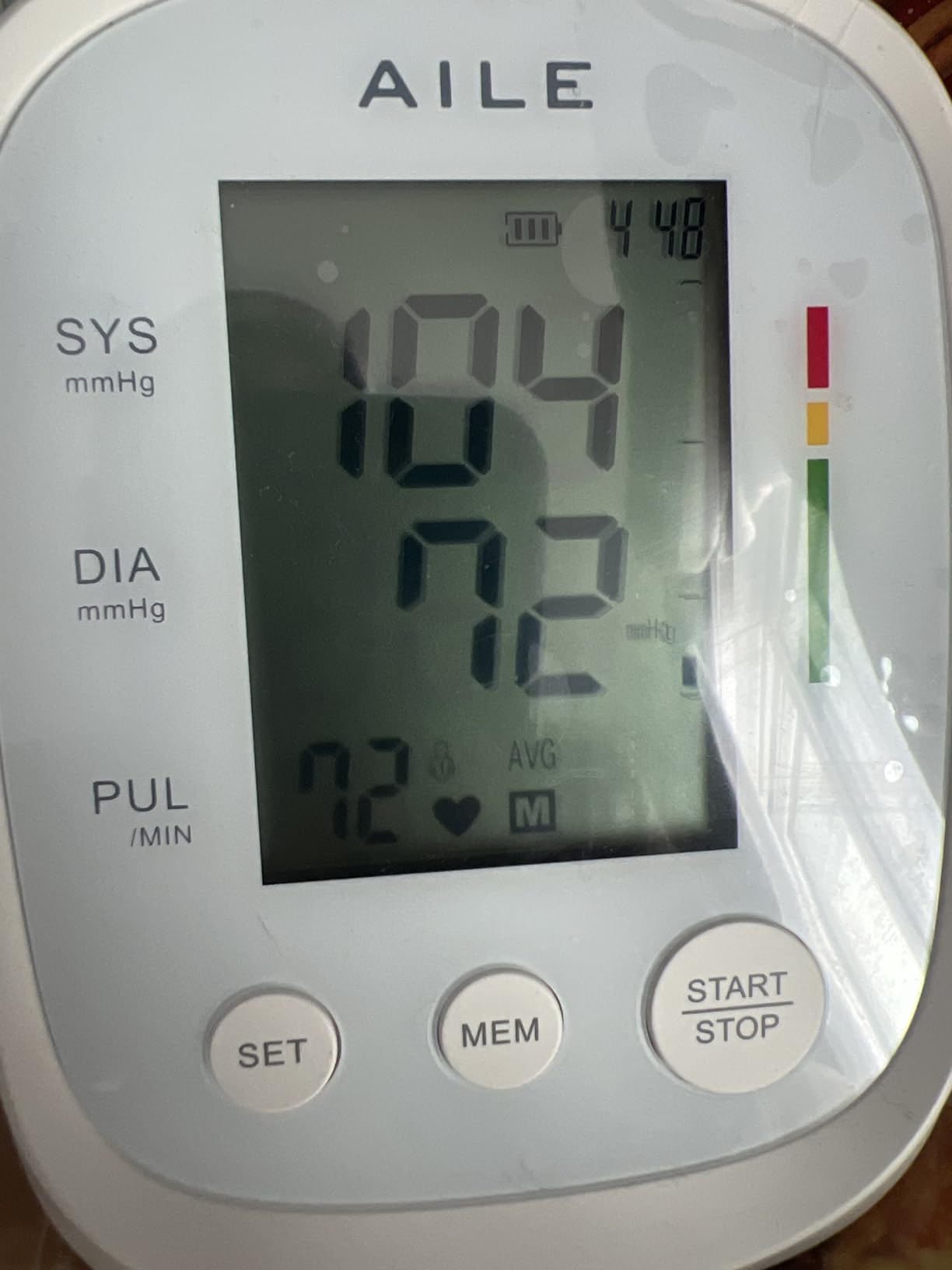
It is also unreasonably generous with memory for its class. Two user profiles at 99 readings each gives 198 stored readings with date and time, so a couple can both track on one unit. Operation is one touch, systolic, diastolic, and pulse all appear on one screen, and the display uses large digits.
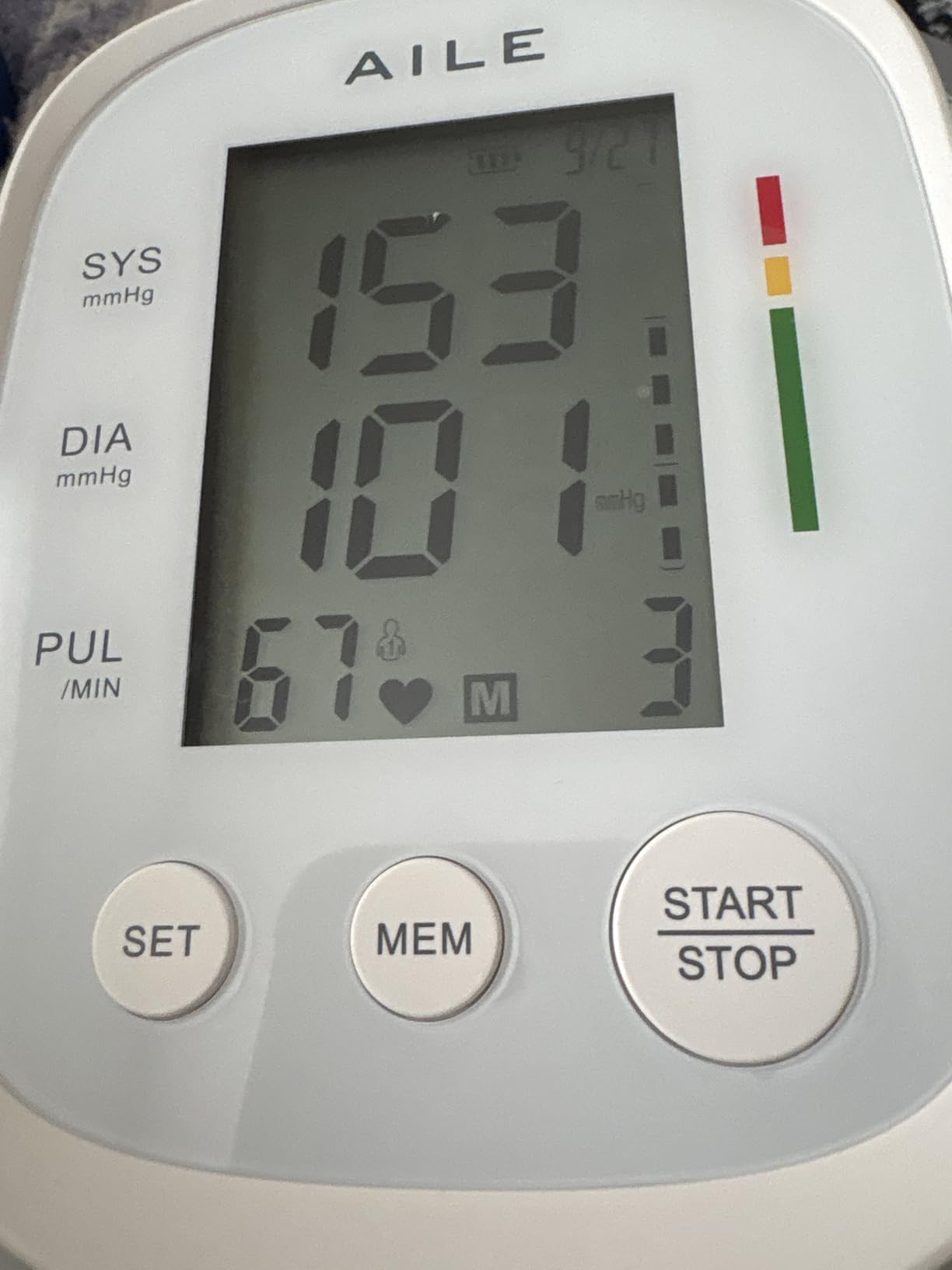
At 13.4 ounces and roughly 5.5 by 3.8 inches, it is one of the smaller units here, which makes it easy to move between a kitchen and a bedside table or to pack. It runs on four AAA batteries, with an external power option supported for anyone who would rather plug it in than think about batteries.
For a first monitor, or for a second unit in a house where two relatives each need their own, the feature set is hard to argue with. The cuff fits 8.7 to 16.5 inches.
Who this monitor suits best
It suits a senior who does not need voice readout and does not need an app, and who wants a straightforward, FDA-cleared device with a lot of history stored on it. It is a strong second unit for a second family member, since the two profiles keep the logs separate.
It also suits anyone setting up a monitor for a relative on a budget, because the single screen showing all three values removes the guessing about which number is which.
Where it falls short
There is no voice broadcast, so it is not an option for someone who cannot read the screen. It also lacks irregular heartbeat detection, which means a reading taken during an unstable rhythm may be recorded as a clean number without warning you to repeat it. On an 8.7 to 16.5 inch cuff, a very large arm will not fit properly.
At 4.4 across more than 16k reviews it sits slightly below the highest-rated models here, and the absence of detection features means it is a tracker rather than a monitoring aid.
6. yuwell YE660E: The Best Choice for Very Large Upper Arms
yuwell Blood Pressure Monitor, Large Upper Arm Blood Pressure Cuff, Digital Blood Pressure Machine for Home Use, Large Display, Stores 99 Readings, Voice Broadcasting with Power Adapter and Batteries
Cuff fits 8.7 to 17.7 inch arms
Full voice broadcast with result announcement
99 readings with average of latest 3
Meets ESH accuracy standards
Pros
- Widest standard cuff range here at 8.7 to 17.7 inches
- Readings match doctor office readings for multiple reviewers
- Metal support bar in the cuff makes self application easy
- Runs on batteries or the included power adapter
- Cuff adapter cuff manual and storage bag all included
Cons
- Voice broadcast is hard to disable for some users
- Cuff tubing is short so the unit must sit in the lap
- Cuff is very long and some users dislike the wrap
Most monitors in this category top out around 16.5 inches. This one goes to 17.7, and if you or your parent measures above 16.5 that single specification can be the difference between a usable reading and a persistently wrong one. It is the most common sizing complaint in the reviews of every other model on this list.
Several reviewers state plainly that their readings match what was taken in a doctor’s office. The manufacturer also cites ESH accuracy standards validated on clinical data from hypertension patients, and the internal memory stores 99 records while automatically averaging the most recent three measurements, which smooths out a single anomalous result.
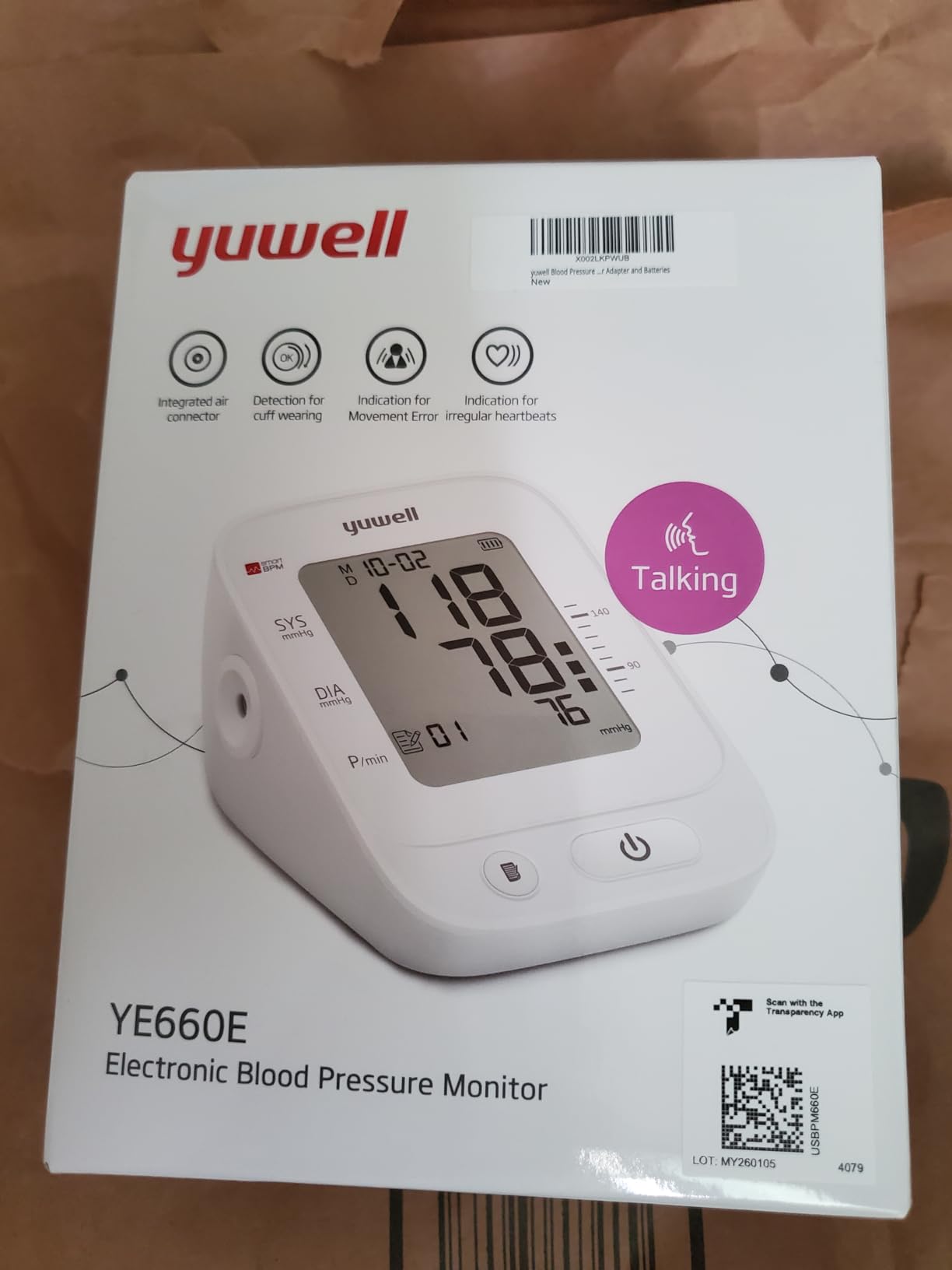
The voice feature is the most complete on the list. It guides the user through the entire measurement and then announces the result, including whether it falls in the normal or high range, so nobody has to interpret the display. There is a self-test function and mis-operation reminders, plus a hypertension indicator and an irregular heartbeat alert.
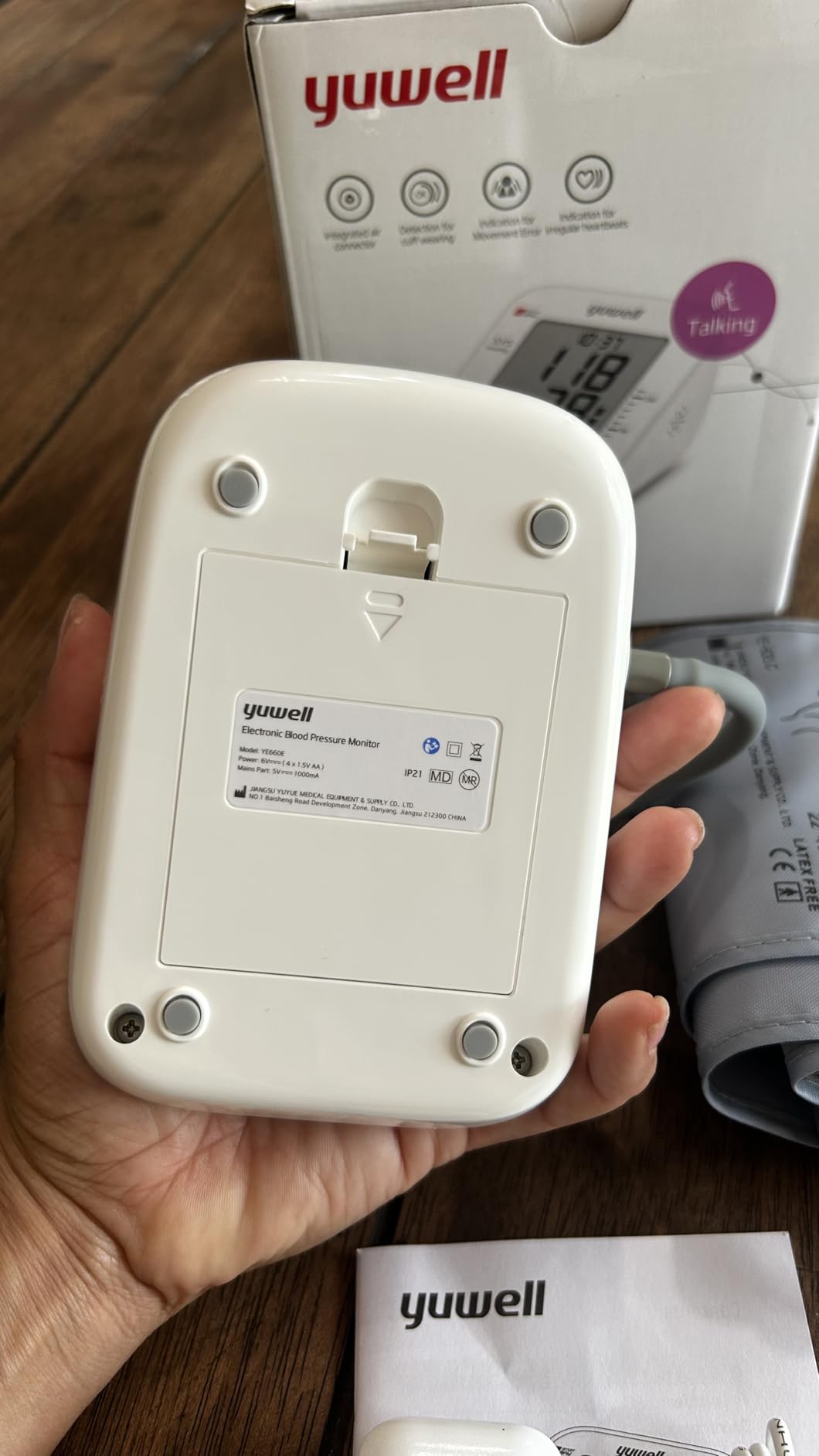
Two design details matter for an older user working alone. The cuff has a metal support bar, which makes it far easier to wrap one-handed, and intelligent pressurization reduces the discomfort of over-inflation. It runs on a rechargeable lithium polymer battery or the included power adapter, and the box contains the cuff, adapter, manual, and storage bag.
Who this monitor suits best
It suits anyone whose arm measures over 16.5 inches, and anyone who has been burned by a too-small cuff before. It also suits a low-vision user who wants the machine to walk them through the reading out loud, and a person measuring alone who appreciates the metal bar cuff and the reduced over-inflation.
For a caregiver setting this up for a parent, the included adapter and storage bag mean nothing extra needs buying on day one.
Where it falls short
The voice broadcast is not easy to disable, and that is a genuine annoyance in a shared room. The cuff tubing is short, so the monitor has to sit in the user’s lap during a reading rather than on the table, and the cuff itself is long and wraps most of the arm, which some users dislike.
Only large and extra-large cuff sizes are available, with no medium option, and it does not take rechargeable AA cells, so the lithium pack is the only power source once it ages out.
7. OMRON Iron BP5000: Best for Brand Trust From a Doctor’s Office
OMRON Iron Blood Pressure Monitor & Upper Arm Blood Pressure Cuff
Irregular heart beat and body movement detection
Wide range D ring cuff for 9 to 17 inch arms
One touch operation
Lightweight at under 9 ounces
Pros
- Backed by a brand widely recommended by doctors and pharmacists
- Two detection systems that flag bad readings rather than printing them
- One touch operation with no setup menu
- Lightweight and compact at under 9 ounces
- Quick start guide included with the manual
Cons
- No voice readout for users with low vision
- Limited internal storage means manual logging for the doctor
- Cuff is a fixed wide range D ring
Across the forum threads we read, one brand name comes up more than any other when people describe what their doctor or cardiac rehab specialist told them to buy. Omron is the recurring answer, and that matters in this category for a reason that has nothing to do with features: when a reading does not match the clinic, a familiar brand is the first place people look for an explanation.
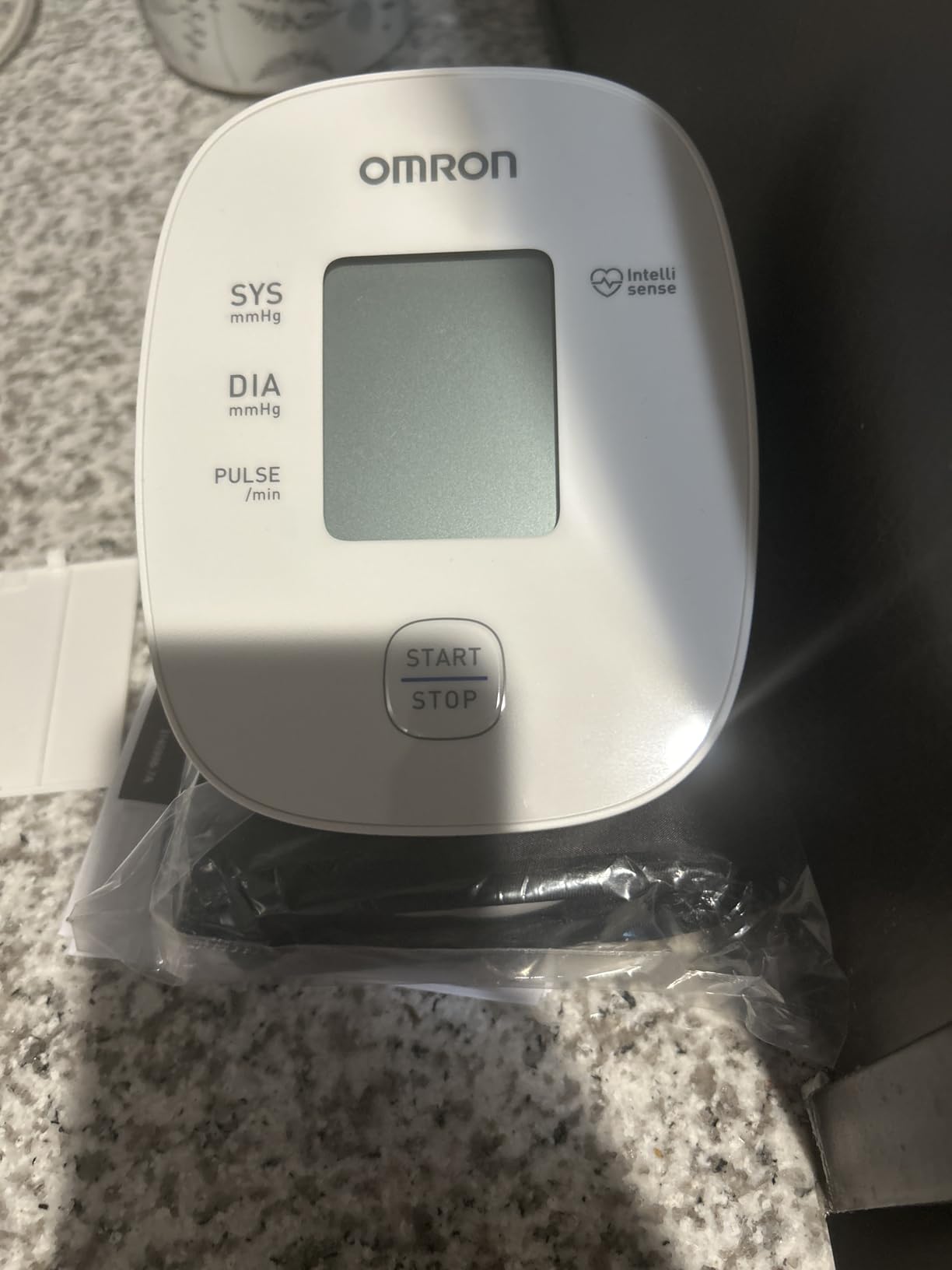
This model, the Iron BP5000, is the straightforward entry in the range. It has one-touch operation, Advanced Accuracy Technology, and two detection systems rather than one — irregular heart beat detection and body movement detection. That second one is the underrated half, because the most common cause of a falsely high home reading is simply moving or talking during the measurement.
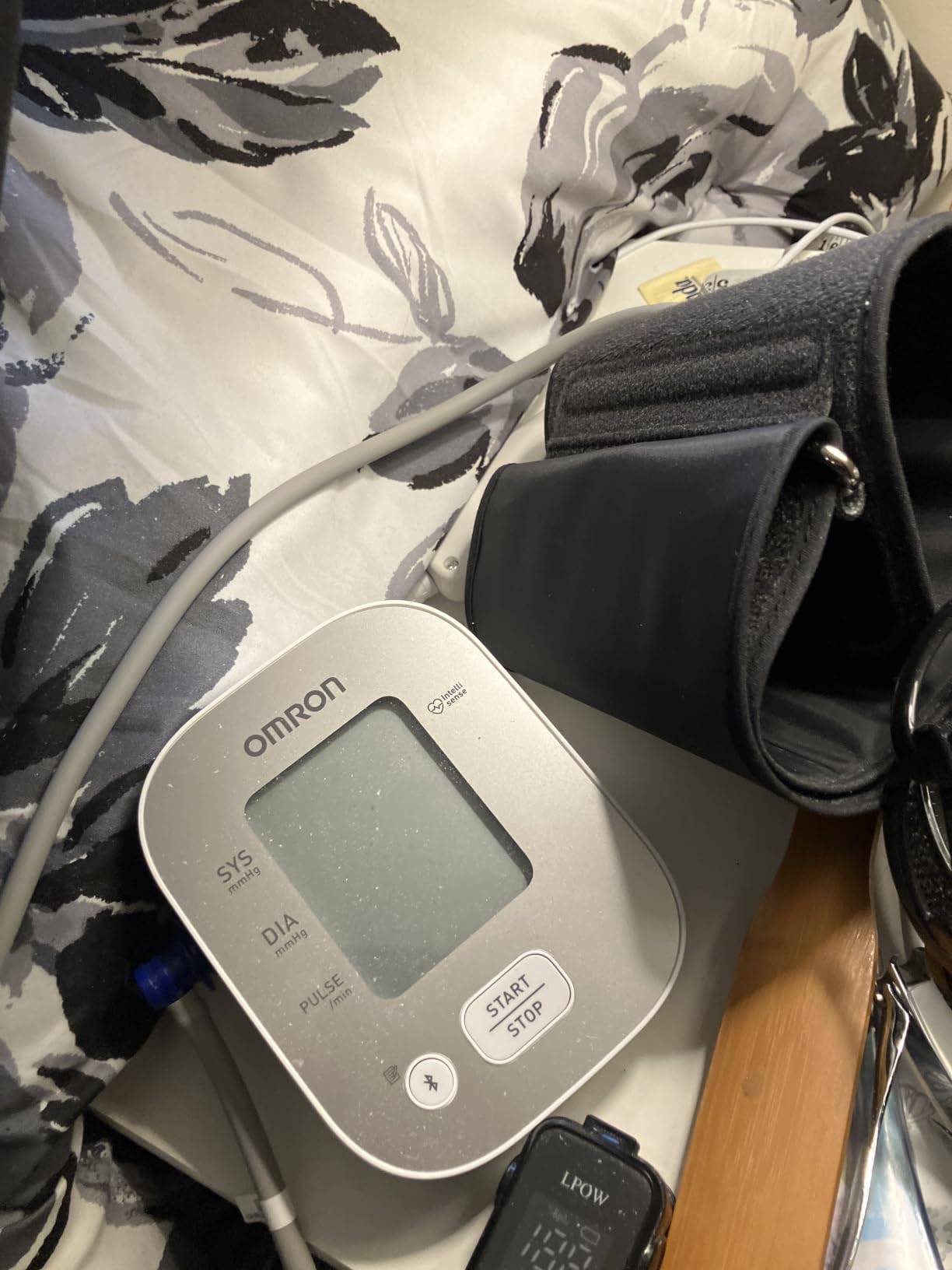
The wide-range D-ring cuff covers 9 to 17 inches, which is the standard range and slightly narrower at the small end than the Konquest or the yuwell. At under 9 ounces it is among the lightest units here, and the compact 5.5 by 3.3 by 4.3 inch footprint makes it an easy travel companion.
The instruction manual and a quick start guide are both included, and the quick start guide is the one most family members will actually read when setting it up for a parent.
Who this monitor suits best
It suits a senior who values a familiar clinic-associated name over extra features, and anyone whose doctor has already named this brand. It also suits a user who tends to fidget or talk during a reading, because body movement detection will flag a compromised measurement instead of reporting it as fact.
For travel and for a user who tires of large devices, the low weight and small footprint are real advantages. It is a sensible first monitor that does not ask the user to learn anything.
Where it falls short
There is no voice readout, so it is a poor fit for a user with significant vision loss. Internal storage is limited, which means building a log to show a doctor requires paper or a separate app, and the D-ring cuff is a fixed wide range rather than a swappable system.
It also sits at 4.4 rather than the 4.5 several models here carry, and it has less than a third of the review volume of the top picks, so there is less long-term owner history to lean on.
8. OMRON Evolv BP7000: The Best Pick for App and Phone Tracking
OMRON Evolv Wireless Blood Pressure Monitor & Upper Arm Blood Pressure Cuff
Hose free one piece design with attached cuff
Bluetooth to OMRON connect Apple Health and Google Fit
100 readings on device
LED readout works without a phone
Pros
- Hose free design makes cuff placement more accurate
- Bluetooth syncing works reliably with Apple Health and Google Fit
- App builds graphs and exports a spreadsheet for a physician
- LED readout shows numbers without a smartphone
- Compact and light at 8 ounces for travel
Cons
- Recurring movement error that appears while sitting still
- Small thin digits and low travel buttons
- Fixed cuff size that cannot be removed
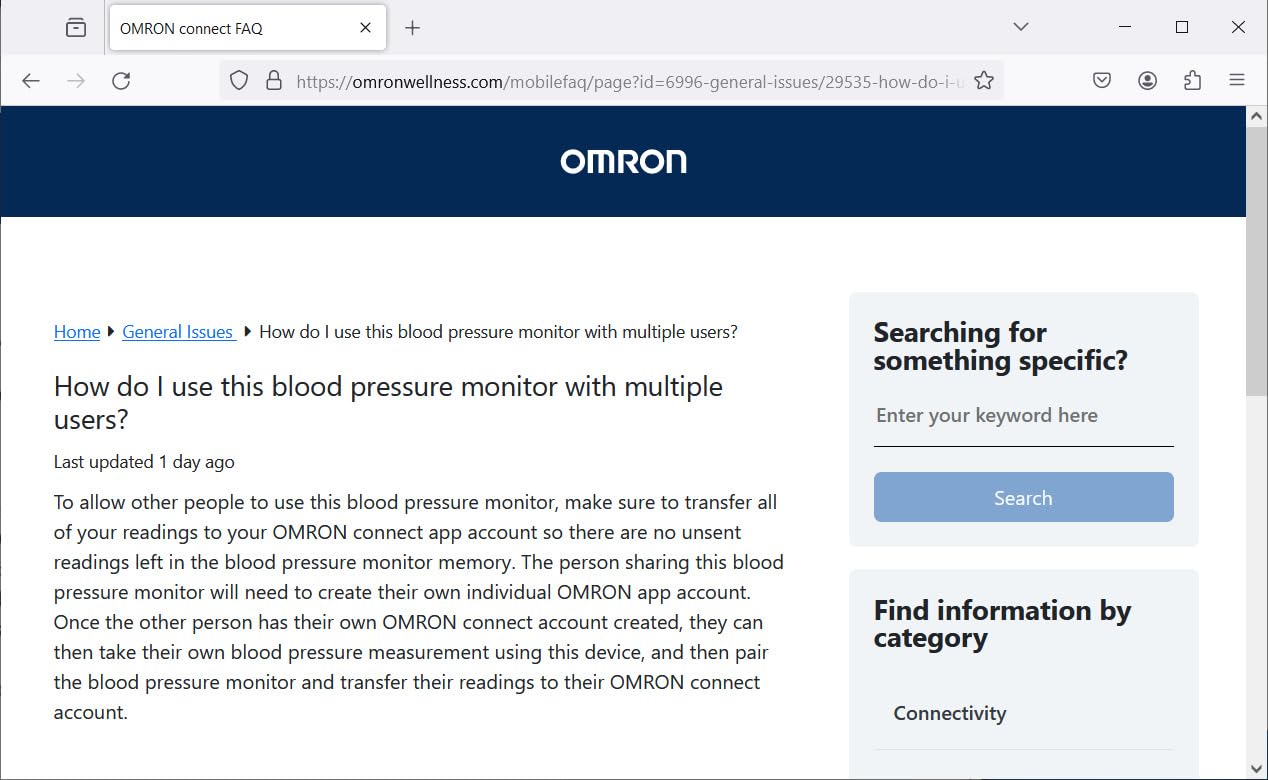
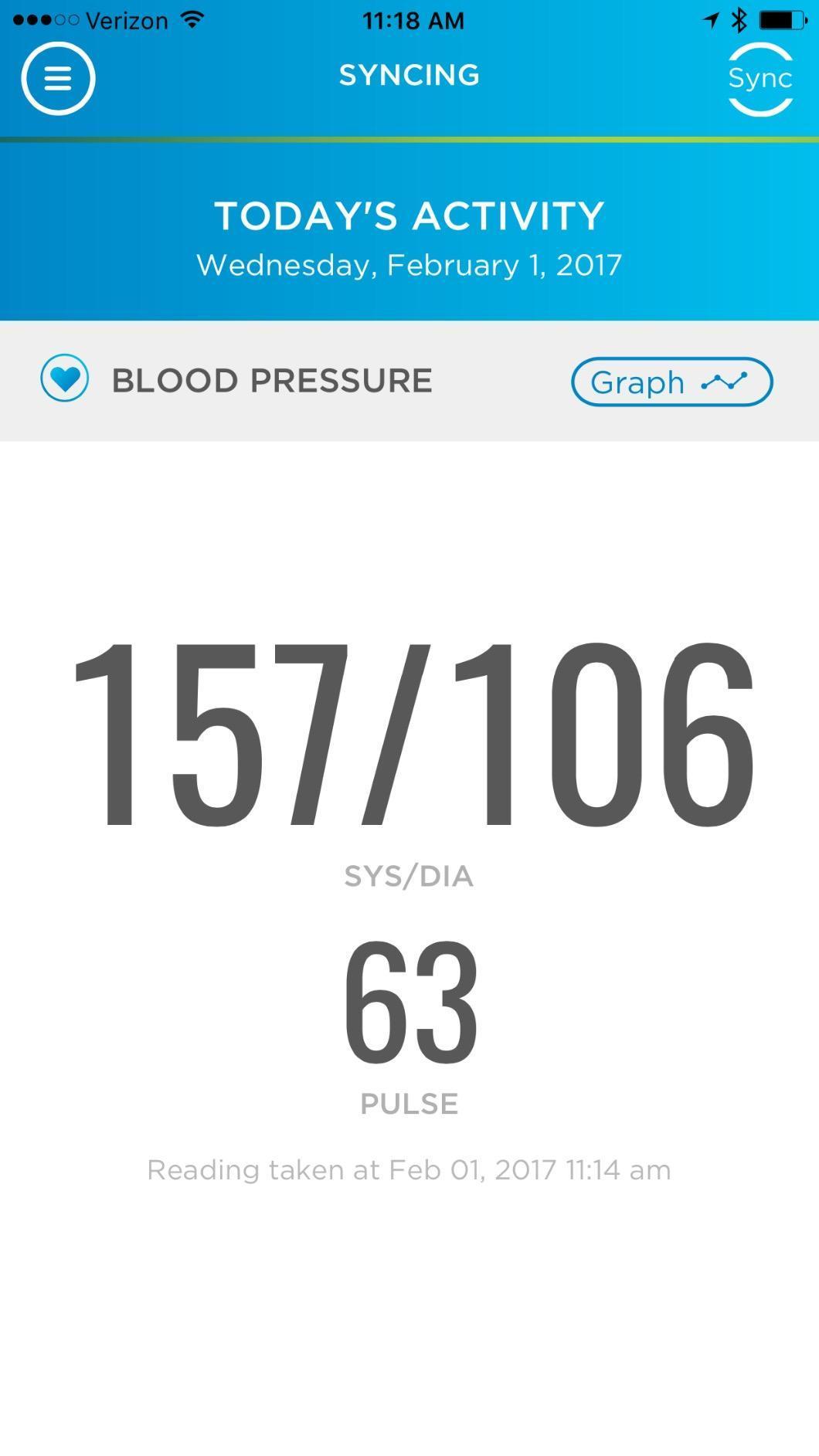
This is the model to look at if the real goal is remote monitoring — an adult child who wants to see a parent’s numbers without being in the room. It pairs over Bluetooth to the free OMRON connect app, works with Apple Health and Google Fit, and the app tabulates readings into graphs that export in spreadsheet format, which is a genuinely useful thing to hand a cardiologist.
The hose-free one-piece design is the underrated engineering decision. By attaching the cuff directly to the body, there is no air tube to route, and cuff placement becomes more accurate as a result. The attached easy-wrap ComFit cuff covers 9 to 17 inches, and 100 readings are stored on the device itself, so it still functions standalone with an LED readout that needs no phone.
At 8 ounces and roughly 3.5 by 4.6 inches, it is the smallest and lightest connected unit here. Users tracking orthostatic hypotension report that the app history makes spotting triggers far easier than a paper log would, and reviewers confirm readings matched a physician-approved device.
It is worth understanding what the app does and does not do. It does not require pairing to take a reading, and the app requires creating an Omron account before it will sync, so the person setting it up should know that in advance.
Who this monitor suits best
It suits a senior whose adult child or caregiver wants remote visibility, provided someone is willing to pair the device once and create the account. It also suits anyone who already lives in Apple Health or Google Fit and wants readings to flow into an existing record rather than a separate app.
For travel it is a strong fit, weighing 8 ounces and running on four AA batteries with no charging required. A user sensitive to cuff placement will likely find the hose-free design easier to position correctly.
Where it falls short
The dominant complaint is a movement-detection error that appears even when the user is sitting perfectly still, and several buyers say it repeated often enough to force a return. The shiny black housing and small thin digits also make the screen harder to read than a plain backlit LCD, and the low-travel buttons can be difficult for less agile fingers.
Cuff position markings are unclear and the strapping instructions are not as good as they should be, and the single fixed cuff cannot be removed or swapped. There is no carrying case. At 4.3 it carries the lowest average rating among the Omron options here, and it is the priciest unit in this group.
9. AQESO U80B: The Best Choice for Three Cuff Sizes and Huge Memory
Blood Pressure Machine Upper Arm, 3 Size Cuffs, Small 7″-9″, Medium/Large 9″-17″ and Extra Large XL Cuff 13″-21″, Accurate Automatic Digital BP Cuff Home Use, Large Backlit BP Monitor 3-User 1500 Mem
Three cuffs covering 7 to 21 inch arms
3 user mode with 1500 set memory
4 inch backlit LCD with oversized numbers
ASP processing tested on 100k plus data points
Pros
- Only monitor here with three cuff sizes spanning 7 to 21 inch arms
- 4 inch backlit display readable at night
- 1500 set memory is the largest capacity in this group
- One owner reports six years of continuous use
- Customer service replaced defective units and shipped larger cuffs
Cons
- Costs more than most single cuff models in this group
- Drains batteries quickly for some users
- USB power adapter not included only the cable
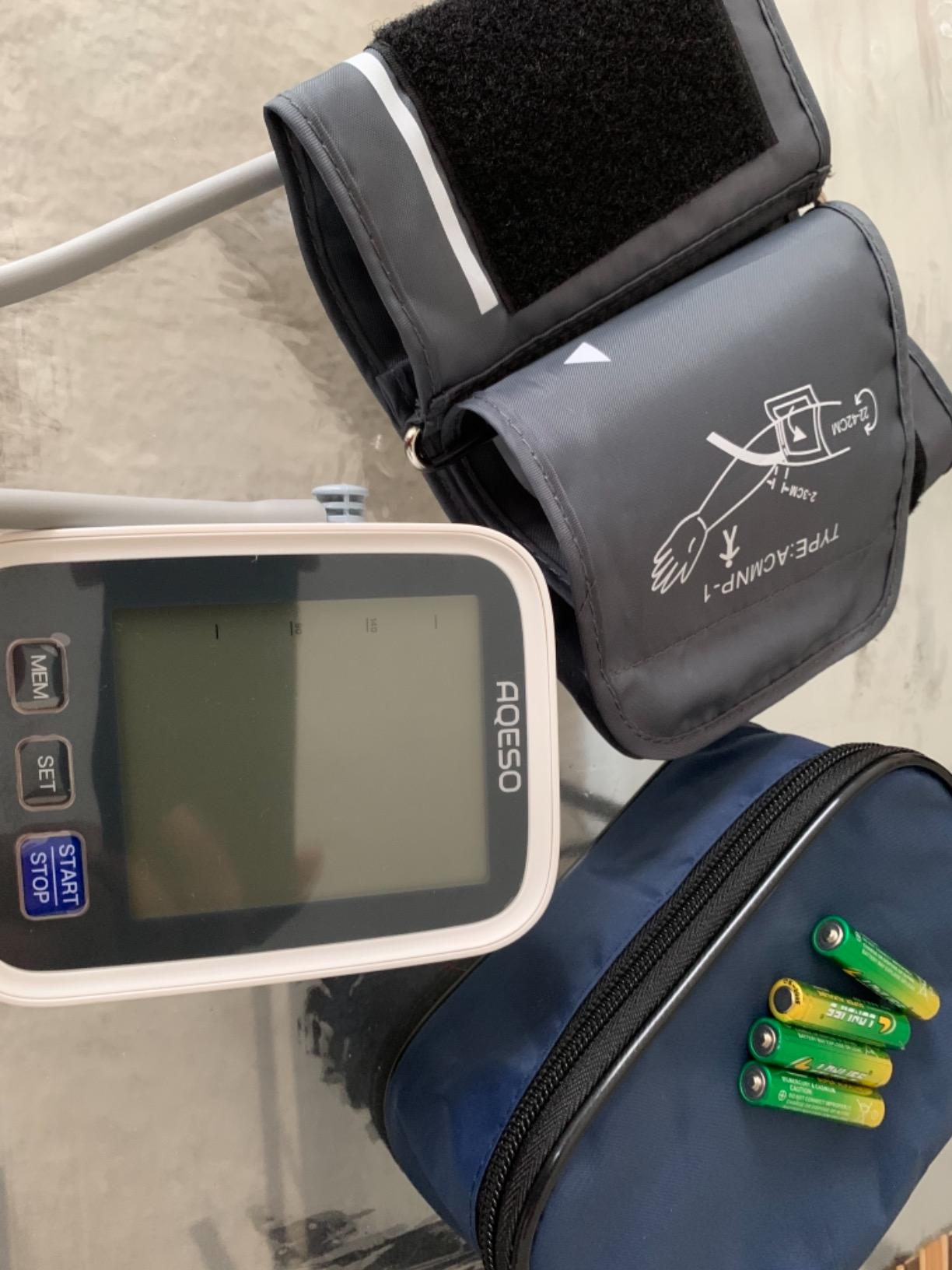
Cuff sizing is the number one complaint in this category, and this is the only monitor on the list that solves it structurally rather than by asking you to measure first. Three cuffs ship in the box: a small 7 to 9 inch, a medium and large 9 to 17 inch, and an extra large 13 to 21 inch. If a household spans three arm sizes, one device covers all of them.
The memory is the other standout. Three user modes at 500 readings each gives 1500 sets, by a wide margin the largest capacity here, and every reading is tagged with the date and 12-hour time. For someone who has been tracking for years and wants a full history rather than the most recent 100 entries, that is a meaningful difference.
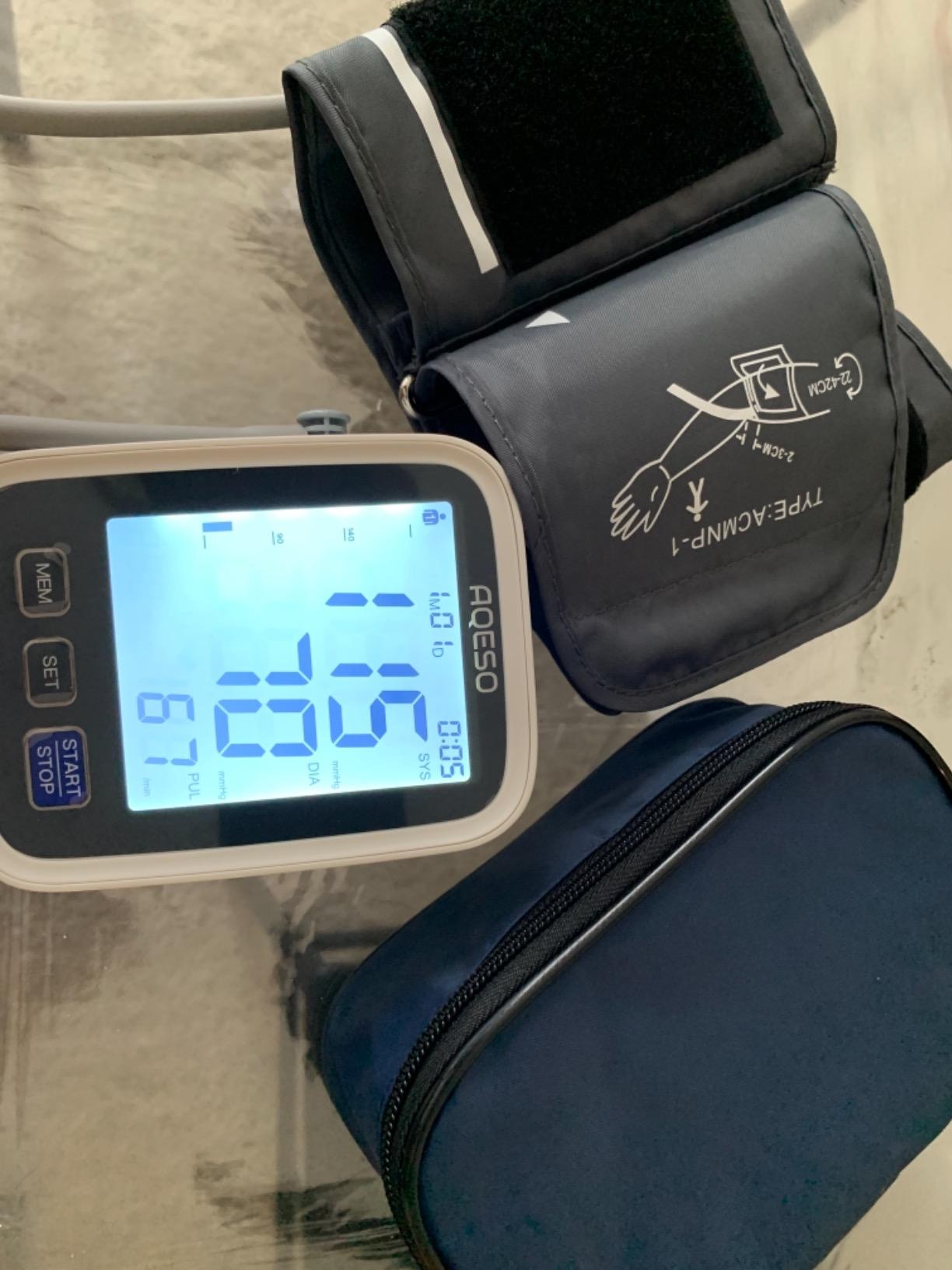
The display is a 4-inch backlit LCD with oversized numbers, which makes it the most legible screen in this group and the easiest to read at night. Operation is one touch, and the integrated D-ring with hook-and-loop fastener cuff is designed for easy donning and removal — the two things that cause bad readings when done wrong.
The manufacturer describes ASP signal processing tested against more than 100,000 clinical data points. Whether or not you read much into a claim like that, the practical detail is that customer service has repeatedly replaced defective units and shipped larger cuffs without charge, which is worth something in a product you expect to keep for years.
Who this monitor suits best
It suits a household with genuinely varied arm sizes, or one person whose arm circumference has changed and may keep changing. It also suits a long-term tracker who wants years of dated history in one device, and a user who reads at night and needs the largest, most backlit screen available.
Anyone monitoring several relatives in one home will appreciate the three profiles and the 1500-set memory more than any other feature here.
Where it falls short
It costs more than most single-cuff models in this group, and some users report that it drains batteries faster than the units it is competing with. The USB Type-C cable is included but the power adapter is not, so a low-battery user needs to source one.
It also carries the smallest review base of the leading models, a few buyers have received units with cracked screens, and there is at least one serious accuracy complaint in the reviews — a single report of a seriously low reading during a hypertensive crisis. One report does not condemn the device, but it is a reason to validate any new monitor against a clinic reading before trusting it.
10. ProHeal Talking Monitor: The Best Dedicated Monitor for Low Vision
Talking Blood Pressure Monitor for Seniors and Low Vision – Hear Your Numbers Aloud – Automatic Upper Arm Cuff, Large Backlit Display, 3 User Memory, Carry Bag and Batteries Included
Speaks systolic diastolic and pulse aloud
Adjustable volume with audio off option
3 user profiles with 240 readings
Cuff fits 8 to 16 inch arms
Pros
- Purpose built for seniors and low vision users with a loud clear voice
- Speaks the instructions as well as the results
- Announces whether the reading is high low or normal
- Large backlit digits with color coded range indicators
- Batteries USB Type-C cable and carry bag all included
Cons
- Thin instructions make first time setup harder
- Can only operate while plugged in which ties it to a wall
- 8 to 16 inch cuff can be too large for small arms
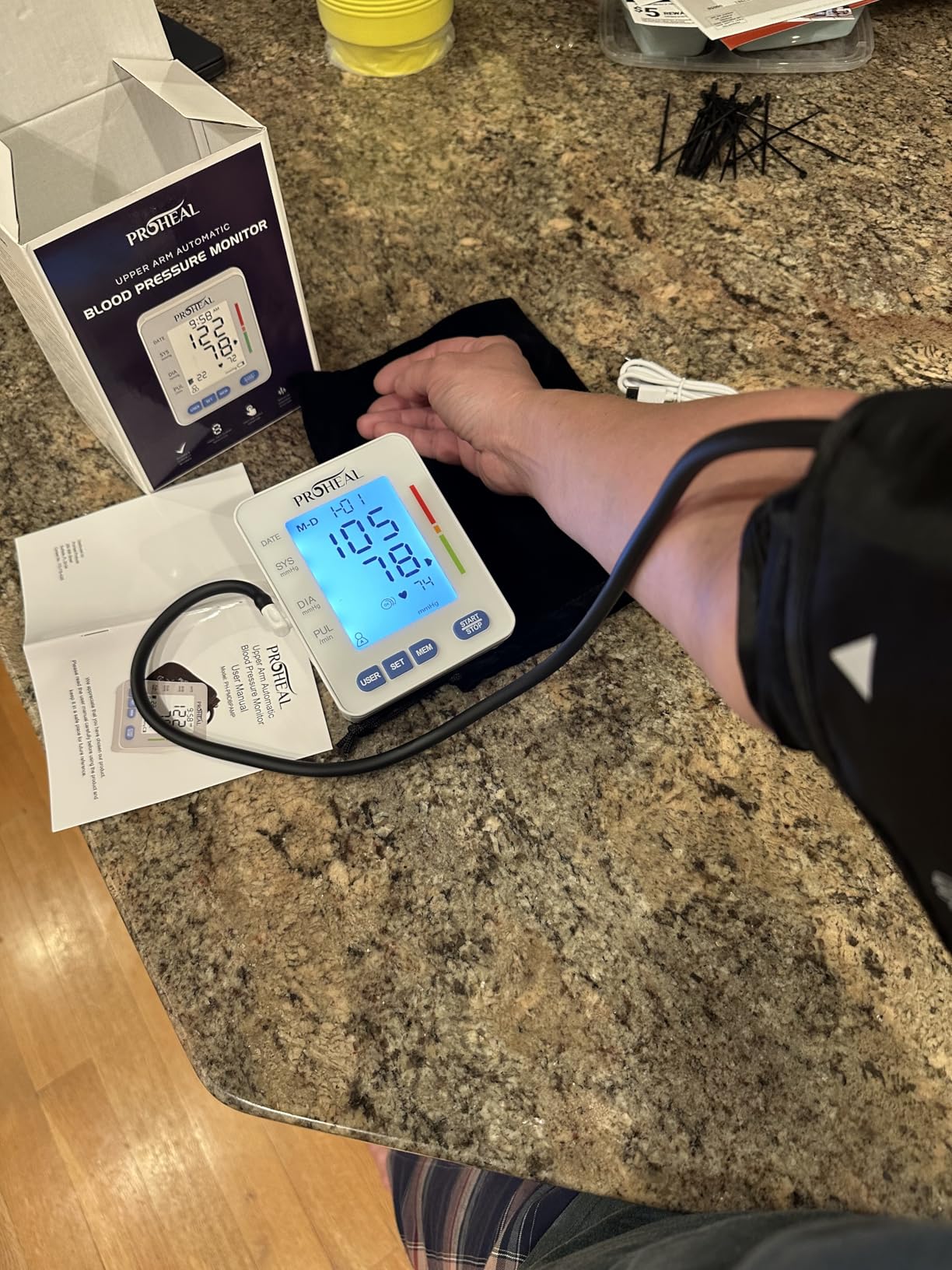
Most talking monitors add voice to a machine designed for someone who can see. This one is designed for someone who cannot, and the difference shows in the details. The voice announces systolic, diastolic, and pulse, it speaks the setup instructions as well as the results, and it tells the user whether the reading is high, low, or normal rather than leaving the interpretation to them.
The display is a genuine backup rather than the primary interface, with large backlit digits and green, orange, and red range indicators. Volume is adjustable and the audio can be switched off entirely for silent use. There is an irregular heartbeat symbol on screen for anyone who can see it.
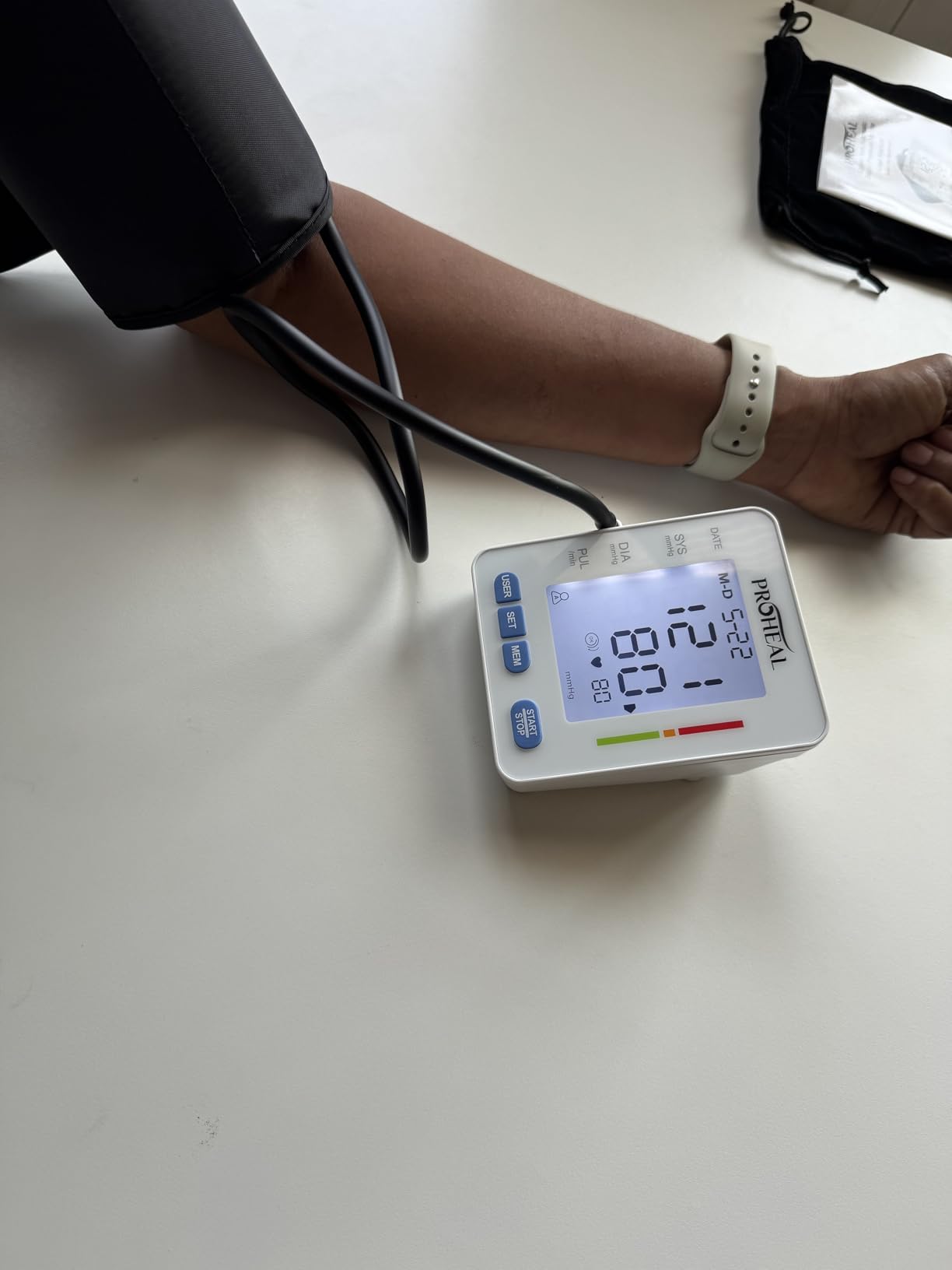
Three user profiles hold 80 readings each, 240 total, every one tagged with date and time, which is enough for a household where more than one person tracks. At 9.35 ounces it is light, the cuff fits 8 to 16 inch arms, and the box includes four AA batteries, a USB Type-C cable, and a carry bag so the unit is usable immediately.
This is also the newest model in our group, which cuts both ways. Recent designs tend to fix the mistakes of the previous generation — here that means adjustable audio and a mute option that older talking units often lacked.
Who this monitor suits best
It suits a senior with significant vision loss who needs the result spoken every time rather than as an occasional fallback. It also suits a partially sighted user who wants the color-coded display and the spoken confirmation together, and a household where several people take readings and need loud, clear audio.
The color-coded range indicators are useful for a caregiver sitting with the user, giving them something to point at while the machine reads the number out.
Where it falls short
It cannot operate cordlessly while plugged in, so the unit has to stay near a wall outlet during a reading, which limits where it can be used. The cuff tops out at 16 inches, so it runs small for larger arms, and at the other end an 8-inch lower bound can be too large for a very small arm, which produces failed or unreliable readings.
The instructions are not thorough enough for a first-time user, and at 4.2 across 536 reviews it carries both the lowest rating and the smallest review base in this group, which means the least proven long-term reliability. We would pair it with a plan to replace the cuff rather than expect it to last indefinitely.
How to Choose a Blood Pressure Monitor for a Senior
Upper arm beats wrist and finger, almost always. An upper arm cuff inflates around the upper arm, briefly stops blood flow, then deflates while a sensor tracks the vibration of blood resuming through the artery. That is how it records the systolic reading, the pressure when the heart contracts, and the diastolic reading, the pressure between beats, shown as a pair such as 120 over 80 mmHg. A wrist monitor does something similar on a much smaller vessel, which means the result depends heavily on holding your arm exactly at heart level. A finger monitor is a niche pulse oximeter-style device and is not a home blood pressure tool. The exception worth naming: if a tight upper arm cuff is genuinely painful for you, ask your clinician about a wrist model rather than forcing the arm cuff, because positioning errors will otherwise make every reading suspect.
Measure your arm before you choose the cuff. Standard upper arm cuffs fit roughly 9 to 17 inches, and most models here cover 8.7 to 16.5 inches with the yuwell reaching 17.7 and the AQESO covering 7 to 21 across three included cuffs. A cuff that is too small inflates the number and one that is too loose reads low, and this is the most common sizing complaint across the reviews. Wrap a soft measuring tape around your bare upper arm at the midpoint, note the number, and check it against the cuff specification.
Know the difference between clinical validation and FDA clearance. They are two different claims. Clinical validation means a device has been tested against a reference standard under a recognized protocol such as the AAMI, ESH, or ISO standard, and the US Blood Pressure Validated Device Listing is where you can check whether a model has been independently verified. FDA clearance is a regulatory determination that the device is substantially equivalent to a predicate device for its intended use. Neither guarantees your particular reading on a particular day, but both narrow the field. On this list, the AILE X5 states FDA clearance, the iHealth Track and the yuwell cite ESH standards, and the AQESO describes its signal processing tested against more than 100,000 clinical data points.
Decide how readings will be used before you pick features. If the person will take readings alone and read them alone, prioritize a backlit display and large buttons. If vision is a barrier, prioritize voice and confirm the model speaks the result rather than just the instructions. If an adult child will be tracking remotely, Bluetooth and a companion app matter more than raw on-device memory — and factor in who will do the pairing, because app setup is the step where most setups go wrong.
Count memory and profiles against your actual habit. If readings will be taken daily and shown to a doctor, anything from 60 stored entries upward is plenty. If two people use one device, two profiles matter more than a large total, because interleaved logs are useless. Several models here average two or three readings automatically, which is a quiet accuracy win worth having.
Treat the cuff as the consumable part. Forum consensus is consistent on this: the monitor body lasts and the cuff wears out. Before buying, check that replacement cuffs exist for the model and what they cost. The presence of a metal support bar, a D-ring, or a pre-formed wrap affects how easily the cuff goes on, which matters if the person applying it has arthritis.
Read the warranty as a longevity signal. A longer warranty is the manufacturer committing to parts and electronics for longer. Given that aging units tend to fail at the battery contacts, the backlight, or the auto-shutoff rather than at the sensor, a longer warranty is a reasonable proxy for build quality.
Expect to pay out of pocket. Home monitors are generally not covered by Medicare or by most insurance plans, with ambulatory blood pressure monitoring — the 24-hour device worn for a period — being the common exception when a clinician orders it. Some monitors are FSA and HSA eligible, which is worth checking if you use those accounts. For anyone interested in the dietary side of blood pressure alongside monitoring, we covered that separately on beetroot powder versus beet juice.
How to Take an Accurate Reading at Home
Most of the “my monitor reads too high” complaints are technique, not hardware. The sequence below is the standard method, and it costs nothing to follow.
- Avoid caffeine, exercise, and smoking for 30 minutes beforehand, and empty your bladder.
- Sit with your back supported and your feet flat on the floor. Do not cross your legs and do not sit on a sofa without arm support.
- Rest your bare arm on a table so the cuff sits at heart level. Support anything that makes you tense.
- Place the cuff on bare skin above the elbow, with the artery marker over the artery, and make sure the tube does not run down the arm holding the unit.
- Do not talk, move, or gesture during the measurement. This is the single most common cause of a falsely high number.
- Take two readings a minute apart and record both. Many monitors will average them for you.
- Measure at the same time each day, and note the time in your log so a pattern is visible rather than a snapshot.
To check whether a new monitor is right for you, do this in a single sitting. Take a reading at home, then take one in a clinic within a short window of the same visit, and compare the systolic and diastolic numbers. A small difference is normal — a handful of mmHg — because both devices are automated estimates rather than laboratory measurements. A difference that is consistently large is a reason to recheck technique, then recheck cuff size, then call your clinician rather than adjust medication on your own.
If you want to see how these devices behave with real data over time, our guide to the best blood pressure monitors with app tracking covers the connected side in more depth.
When You Should Not Rely on a Home Monitor Alone
Automated monitors measure rhythm and pressure at the same time, and an irregular rhythm can distort the result. Anyone with atrial fibrillation, a known arrhythmia, or a pacemaker should talk to a clinician before making treatment decisions from home readings, and should ask specifically whether a validated device is appropriate for them. This is the one caveat we would not leave out of a shopping guide for this audience.
A reading above 180 systolic or above 120 diastolic is a hypertensive crisis reading, and it is not something to re-measure and think about. Repeat it once after resting quietly, and if it stays that high, or if it comes with chest pain, shortness of breath, weakness on one side, or confusion, seek medical care immediately rather than logging it for later.
Finally, a home monitor is a record-keeping tool. It does not tell you why a number moved, it does not replace a clinic visit, and it should never prompt a medication change on its own.
Frequently Asked Questions
Which blood pressure monitor is the most accurate for home use?
For home use, a clinically validated upper arm cuff is the most accurate type, because the reading does not depend on holding your wrist at a precise height. Among the monitors here, the iHealth Track stands out for meeting ESH performance standards with no calibration required, and the yuwell YE660E is validated on ESH standards using clinical data from hypertension patients. Accuracy on your arm, on your day, is what matters most, so confirm any new device against a clinic reading before acting on its numbers.
Which blood pressure monitor do cardiologists recommend?
Specialists consistently point patients toward an automatic upper arm cuff from a known brand rather than a wrist unit, and Omron is the name that comes up most often in the accounts we read of doctors, cardiac rehab specialists, and nurses giving that advice. Clinics themselves tend to use established upper arm brands, which means a familiar name is easier to cross-check against a clinic reading. The practical version of this advice is: buy an upper arm cuff, buy a brand you can name, and validate it in person.
What is the ideal blood pressure for a 70 year old?
There is no single number that is ideal for everyone over 70, and an individual target depends on overall health, other conditions, and how you tolerate medication. Using the American Heart Association categories, a reading under 120 over 80 is normal, 120 to 129 under 80 is elevated, 130 to 139 or 80 to 89 is stage 1 hypertension, and 140 or above or 90 or above is stage 2. Adults over 70 are often given a somewhat higher target to reduce the risk of dizziness from over-lowering, so ask your own clinician for your personal goal rather than aiming at a general chart.
What is the easiest blood pressure monitor for seniors to use?
The easiest monitors for seniors combine one-touch operation, large physical buttons, a backlit display with oversized numbers, and no required phone setup. The Konquest KBP-2704A fits that brief, with numbers close to an inch tall and years of reported ownership, and the AQESO U80B goes further with a 4-inch backlit screen. If vision is the barrier, ease of use means voice instead of display, which points to the Alcedo B21 or the ProHeal talking monitor.
Is a wrist blood pressure monitor as accurate as an upper arm one?
No. An upper arm cuff is more accurate and produces fewer positioning errors, because a wrist monitor measures blood flow in a much smaller vessel and its result depends on holding the arm exactly at heart level, relaxed and mid-torso. Wrist monitors are portable and useful for travel, and they are reasonable when a tight upper arm cuff is genuinely unusable, but the consensus among clinicians and long-term users is that an arm cuff is the default choice. If you need a wrist unit for comfort reasons, ask your clinician first.
Does Medicare cover blood pressure monitors for home use?
Medicare generally does not cover a home blood pressure monitor, and most insurance plans treat it the same way as a consumer device. The common exception is ambulatory blood pressure monitoring, the 24-hour device a clinician can order for a period of time when standard home readings are not giving a clear picture, which is often covered. Some home monitors are FSA and HSA eligible, so check the listing and your account balance before buying.
The Bottom Line on the Best Home Blood Pressure Monitors for Seniors
The best home blood pressure monitor for seniors is the iHealth Track for anyone who will pair a phone, thanks to its wide 8.7 to 16.5 inch cuff, backlit color display, 99 stored readings, unlimited app history, and heart rhythm detection, plus the largest review base in the category. It is the unit we would put on a counter first.
Everyone else should match the machine to one constraint. Take the Konquest KBP-2704A if the goal is an uncomplicated screen with multi-year ownership reports. Take the Alcedo B21 or the Paramed B22S if two adults both track, and choose between them based on whether the voice can be muted. Take the AILE X5 for FDA clearance and generous memory at a low outlay, the yuwell YE660E for an arm above 16.5 inches, the OMRON Iron for clinic brand familiarity, the OMRON Evolv for app-based remote tracking, the AQESO U80B for three cuff sizes and 1500 stored readings, and the ProHeal for a fully spoken reading built for low vision.
Whichever one you choose, measure your arm first, run the seven-step method every time, and compare the first reading against a clinic reading before you trust it. That single habit prevents most of the disappointment people report with home monitors.
This roundup was updated for October 2026 and reflects the product data and owner reviews available at the time of writing.