
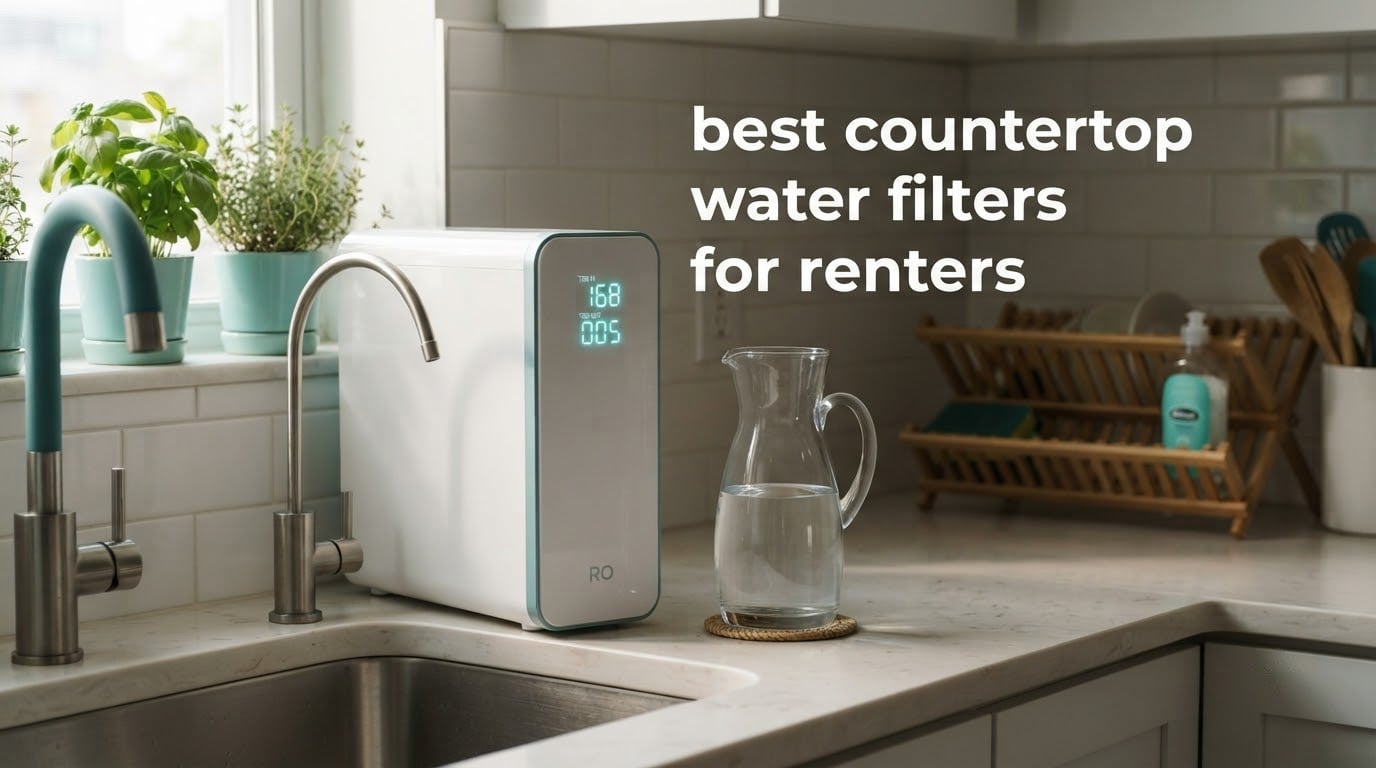
If you rent, your water options stop at the kitchen tap. Drilling a dedicated filtered-water faucet, cutting into the supply line under the sink, or routing a drain means asking a landlord, and a refusal can put your security deposit at risk. That leaves one category wide open: the best countertop water filters for renters, the models that sit on a counter, connect with a hose or a pour, and travel with you when the lease ends.
We went through published specifications, certification listings, unit dimensions, faucet thread requirements, and thousands of renter-facing reviews to build this list of the best countertop water filters for renters in 2026. We did not run our own laboratory work, and we say so plainly. What we did do is check every claim against a manufacturer’s stated certification, work out which models actually fit a small apartment kitchen, and flag the failure modes renters report most: weeping diverter fittings, undersized feed tanks, and proprietary cartridges that quietly drive up the running cost.
What follows covers the full range. There are carbon and faucet-connect filters for renters who just want chlorine taste gone, dispenser-style reverse osmosis for people who want to watch a TDS reading fall, and gravity-fed stainless towers for anyone without a compatible faucet or a spare outlet. The best countertop sparkling water machines cover a different job, so this guide stays on drinking water.
Top 3 Picks for Countertop Water Filters for Renters in 2026

Bluevua RO100ROPOT Countertop RO
- 5-stage RO with remineralization
- 2:1 pure-to-drain ratio
- Borosilicate glass carafe
- Filter life monitor display

iSpring CKC1C Chlorine Filter
- 10000 gallon carbon block
- Clear see-through housing
- Twist-switch diverter
- Tool-free faucet install

SimPure Y7P-BW UV Countertop RO
- 0.0001 micron RO plus UV
- SGS tested to NSF/ANSI 58
- 4:1 pure-to-drain ratio
- Fast 15 second cup fill
Our top overall pick, the Bluevua RO100ROPOT, combines a 4.6 rating across 3695 reviews with a 2:1 pure-to-drain ratio and a glass carafe, unusual in a category dominated by plastic tanks and 3:1 waste ratios. The iSpring CKC1C takes the budget slot because a 10000 gallon carbon block and a five-minute install solve the problem most renters actually have, which is chlorine taste and odor. The SimPure Y7P-BW is the pick for anyone who wants a UV stage and a verified 0.0001 micron membrane.
All 12 Countertop Water Filters for Renters at a Glance (2026)
| Product | Specifications | Action |
|---|---|---|
| Bluevua RO100ROPOT Countertop RO |
|
Check Latest Price |
| SimPure Y7P-BW UV Countertop RO |
|
Check Latest Price |
| iSpring CKC1C Chlorine Countertop Filter |
|
Check Latest Price |
 Big Berkey 2.25 Gal Gravity System Big Berkey 2.25 Gal Gravity System |
|
Check Latest Price |
 AquaTru Classic Water Purification Unit AquaTru Classic Water Purification Unit |
|
Check Latest Price |
 DREO Countertop RO Water Filter 3L DREO Countertop RO Water Filter 3L |
|
Check Latest Price |
 Purewell 3-Stage 0.01 Micron Gravity Filter Purewell 3-Stage 0.01 Micron Gravity Filter |
|
Check Latest Price |
 Express Water EZRO5 Countertop RO Express Water EZRO5 Countertop RO |
|
Check Latest Price |
 GLACIER FRESH C03 Coolon Purifier GLACIER FRESH C03 Coolon Purifier |
|
Check Latest Price |
 AquaTru Glass Carafe 4-Stage RO AquaTru Glass Carafe 4-Stage RO |
|
Check Latest Price |
 Aigerri 5-Stage UV Countertop RO Aigerri 5-Stage UV Countertop RO |
|
Check Latest Price |
 OEMIRY 8000 Gallon Stainless Steel Filter OEMIRY 8000 Gallon Stainless Steel Filter |
|
Check Latest Price |
Two things stand out in that table. Only four of these twelve carry a formal third-party certification listing that covers health-effect contaminants, which is why certification is the first criterion in our buying guide. And the water waste figures range from zero on the GLACIER FRESH to 5:1 on the Aigerri, a spread that changes both your long-term cost and your water bill more than most buyers expect.
What Counts as Renter-Friendly
A renter-friendly filter installs without permanently changing anything the landlord owns. That definition narrows the category to four install types: a pitcher, a faucet-mount or faucet-connect model, a standalone countertop model, and a direct-connect under-sink system that clamps onto an existing cold-water line without a drilled hole.
What you should not install as a renter: a dedicated filtered-water faucet that needs a new hole in the counter or sink, any system that cuts into a supply line, a plumbed-in chilled-water cooler, and a hardwired under-sink model needing a new electrical circuit. Those four are the modifications leases block, and they are the ones that cost a deposit.
One ambiguity deserves a direct answer. A direct-connect under-sink system using a saddle valve or T-fitting on an existing cold line touches nothing permanent, but a few leases forbid any under-sink work. If your agreement mentions plumbing, fixtures, or water heaters, send that paragraph to your landlord in writing and keep the reply.
Noise is the other invisible landlord issue. Pump-equipped reverse osmosis models hum and vibrate during a fill cycle, and in thin-walled apartments with shared walls that carries. Gravity-fed models such as the Big Berkey and the Purewell are silent, because nothing moves but water.
1. Bluevua RO100ROPOT Countertop RO System
Bluevua RO100ROPOT Countertop Reverse Osmosis Water Filter System
5-stage RO with remineralization
2:1 pure-to-drain ratio
Borosilicate glass carafe
Filter life 12-24 months
Pros
- 4.6 rating across 3695 reviews
- Remineralization filter improves taste
- Glass carafe instead of plastic tanks
- 2:1 ratio wastes less water than most countertop RO
- Display tracks filter life and water quality
Cons
- Widest model in the list at 15.4 inches
- Needs a power outlet to run
- Glass carafe is heavier and fragile
I kept returning to this model while reading reviews, because it solved three problems at once: water waste, plastic storage, and the blind cartridge change. The display shows remaining filter service life, so you are not counting months on a calendar and hoping.
Pouring is about as simple as renter filtration gets. You fill the tank, press a button, and purified water lands in a high borosilicate glass carafe. Five stages handle it, and the last is a remineralization filter that puts some minerals back so the water does not taste flat like plain membrane output.
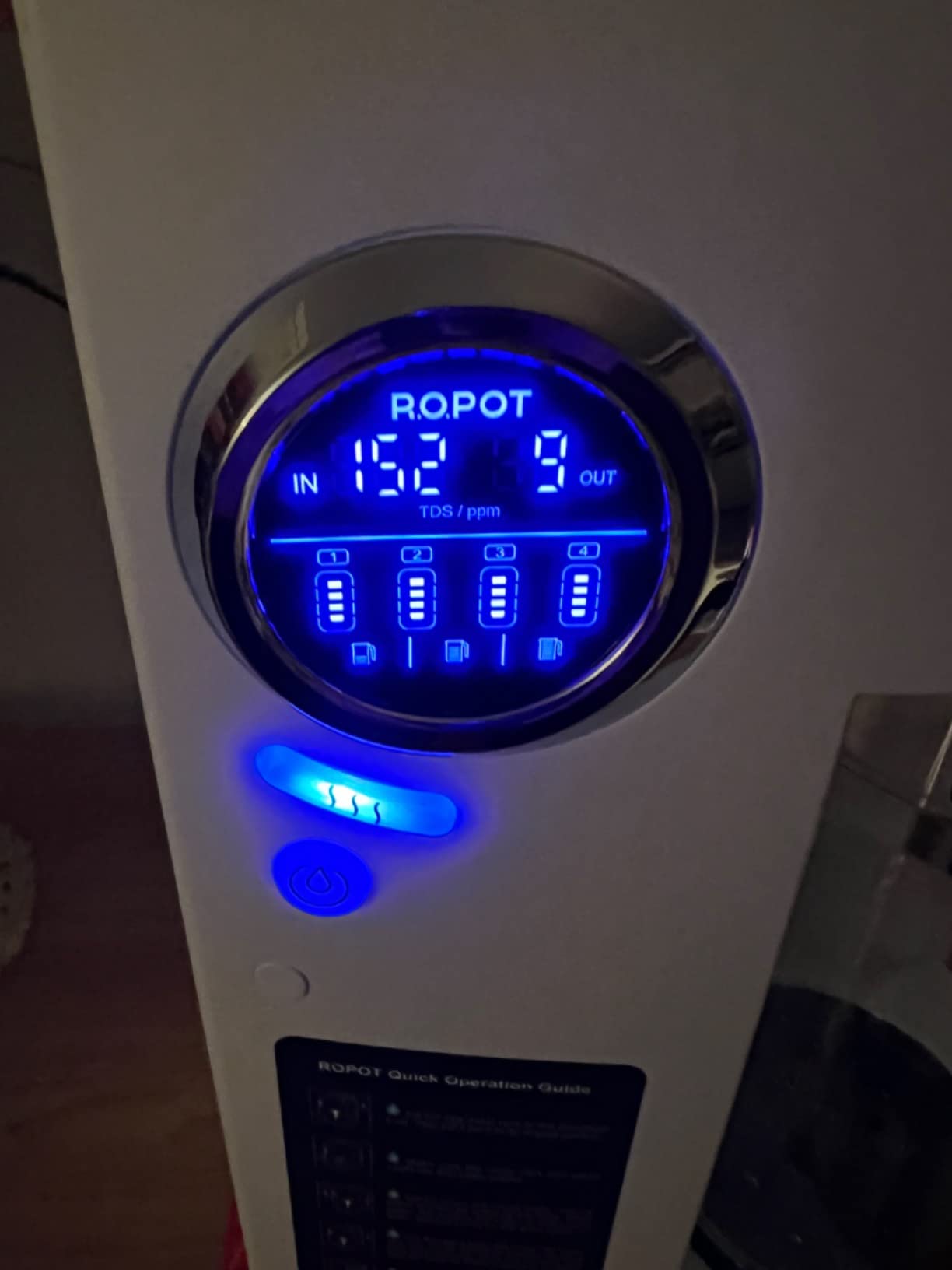
The 2:1 pure-to-drain ratio is the number I would point a water-frugal renter at. Many countertop reverse osmosis systems run 3:1 or worse, so you send three gallons down the drain to make one. This one is meaningfully closer to efficient.
Ownership cost is the quieter advantage. Filters last 12 to 24 months, longer than the six-month cadence most cartridges in this roundup use, and the stainless-and-glass construction ages better in a kitchen you do not own.
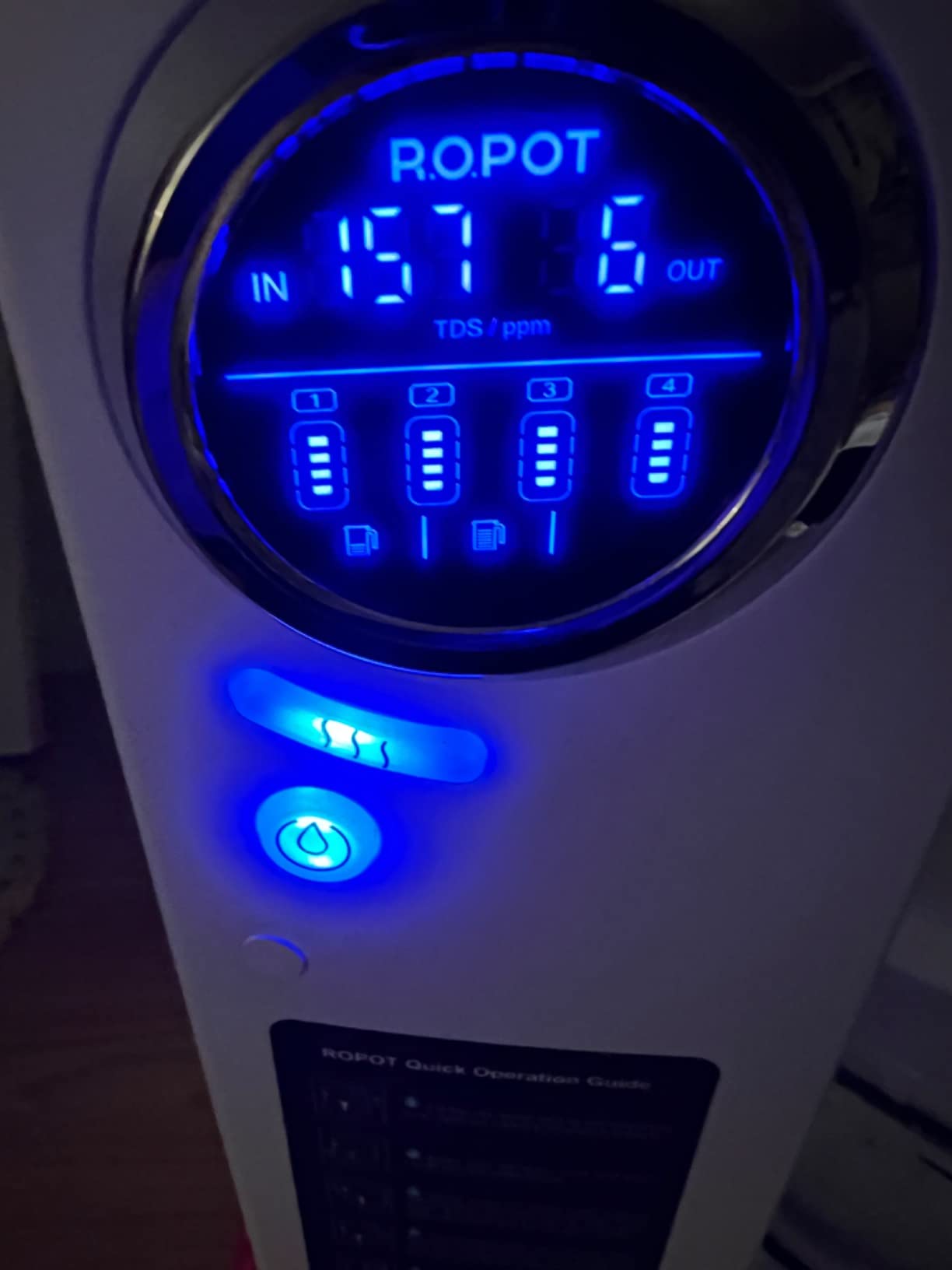
What you get that other renters do not
Two things stand apart. The glass carafe means purified water is not sitting in plastic overnight, the complaint that recurs against plastic-tank models. And the WQA and NSF certification is listed on the product rather than described in vague language, so you can look the model up yourself before buying.
Where it will frustrate you
At 15.4 inches wide it is the widest model in this list, so measure the gap between your wall and the sink edge first. It also needs a power outlet near the counter, which rules it out in a kitchen without one.
The carafe is real glass, and reviewers do report breakage when it is knocked. Set it down rather than swinging it between the sink and the fridge, particularly in a shared kitchen.
2. SimPure Y7P-BW UV Countertop Reverse Osmosis
SimPure Y7P-BW UV Countertop Reverse Osmosis Water Filter, 5 Stage RO
0.0001 micron RO plus UV
4:1 pure-to-drain ratio
418 GPD dispense rate
528 gallon filter set
Pros
- Largest review base here at 3685
- UV stage adds microbial protection with no by-products
- Plug and play with no faucet hookup at all
- Cup fills in about 15 seconds
- Slim vertical body suits narrow counters
Cons
- Small 1.3 gallon rear tank needs frequent refilling
- Requires a power outlet
- Room temperature water only
- One detailed review reports a plastic taste after a month
This is the one I would hand to a renter who has read about PFAS and lead and wants a UV stage without a plumber. It plugs into any outlet, needs no faucet at all, and does the whole job on one counter footprint.
The measured results are the strongest argument. Owners running their own TDS testers report well water dropping from 849 ppm to about 30 ppm, and municipal water from 193 ppm to 33 ppm. That is membrane-grade output, and the SGS testing against NSF/ANSI 58 gives you a document to check rather than a marketing claim.
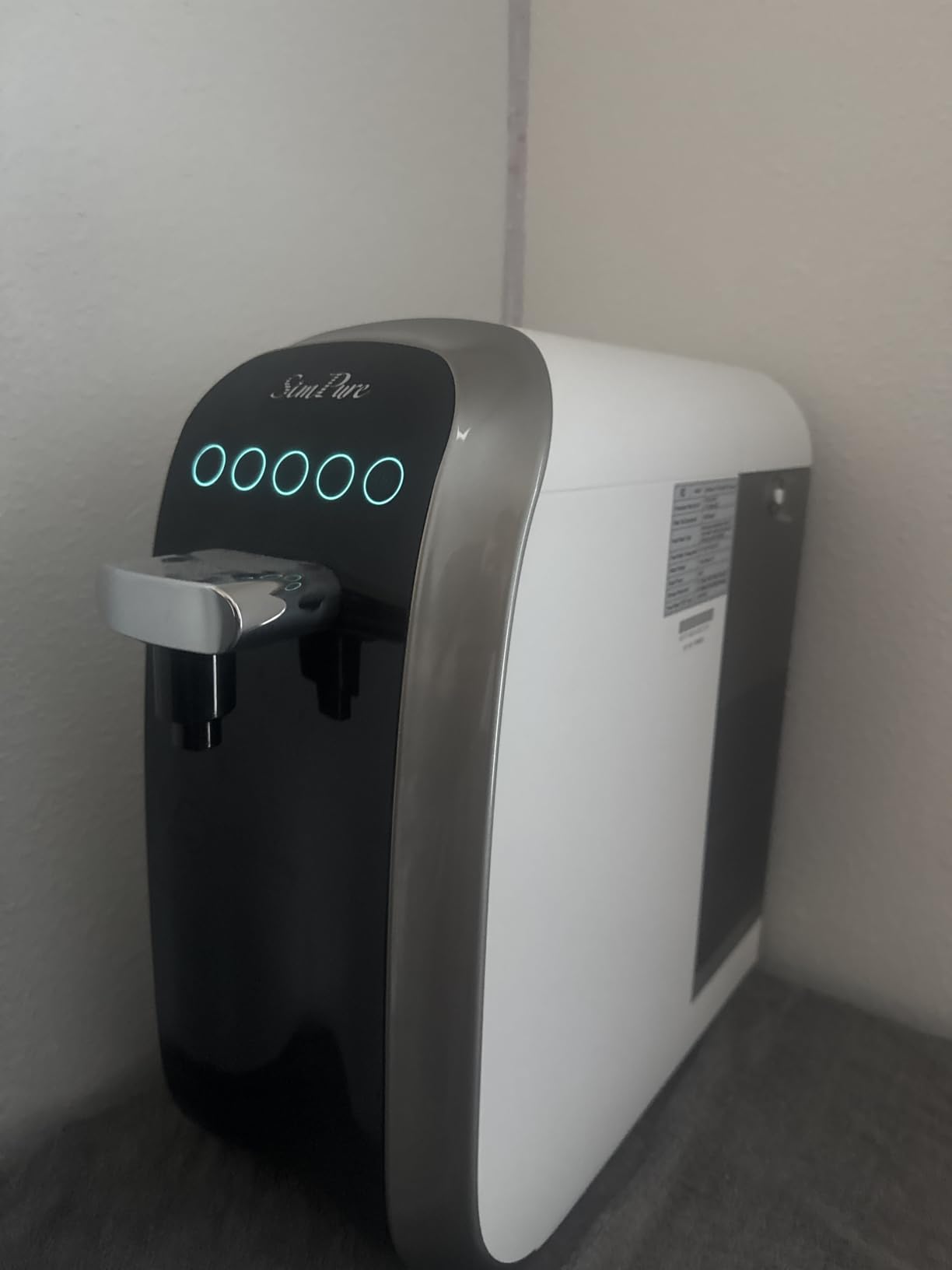
The UV stage is the differentiator. It adds a chemical-free final barrier with no by-products, which matters if your building has an older riser where microbial control is not guaranteed. Dispense speed is the everyday reason renters like it too: roughly 15 seconds a cup at a 4:1 pure-to-drain ratio, so you are not standing at the counter watching a jug fill.
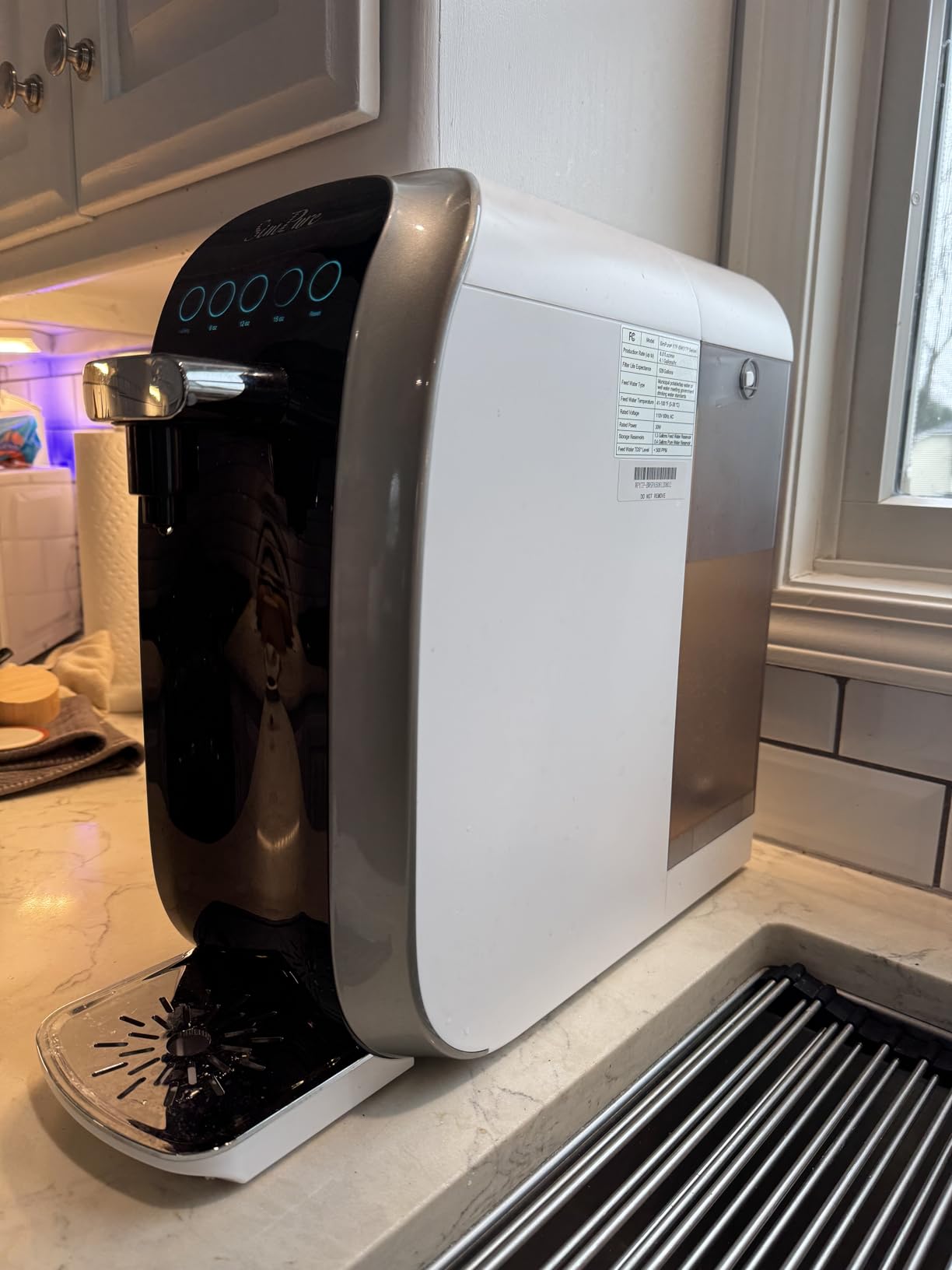
What 3685 reviews agree on
The pattern inside that large review base is consistent. Setup is described as genuinely plug-and-play, and the water quality complaints cluster around taste rather than filtration performance. Reviewers with families, though, describe refilling the small rear tank several times a day.
One detailed negative review deserves repeating rather than hiding. That reviewer reports a plastic taste developing after about a month, blames an internal reservoir that cannot be cleaned, and notes the manual calls for daily tank rinsing, monthly cleaning, and a descale flush every two to four weeks. If you will not maintain a tank, pick something else.
Who should look elsewhere
The 1.3 gallon rear tank is the practical limit, and it also needs electricity for everything including filtration. Renters chasing cold water should look at the GLACIER FRESH, and a household of three or four will be better served by a larger reservoir such as the DREO 3L or the Aigerri.
3. iSpring CKC1C Chlorine Removal Countertop Filter
iSpring CKC1C Chlorine Removal Countertop Water Filter System, 10000 Gal
10000 gallon carbon block
4.72 by 4.72 by 9.84 inches
1.4 kg
Clear housing
Pros
- 4.6 rating across 2722 reviews
- Five minute install with no plumber
- Pressure driven flow with no waiting
- Clear housing shows filter status
- Travels easily between homes
Cons
- Does not reduce TDS at all
- Round housing crowds limited counter space
- Diverter fittings can weep and need a firm hand-tightening
Most renters are not trying to strip minerals out of their water. They are trying to stop drinking something that tastes like a swimming pool, and this is the fastest fix without spending a month’s rent on a membrane system.
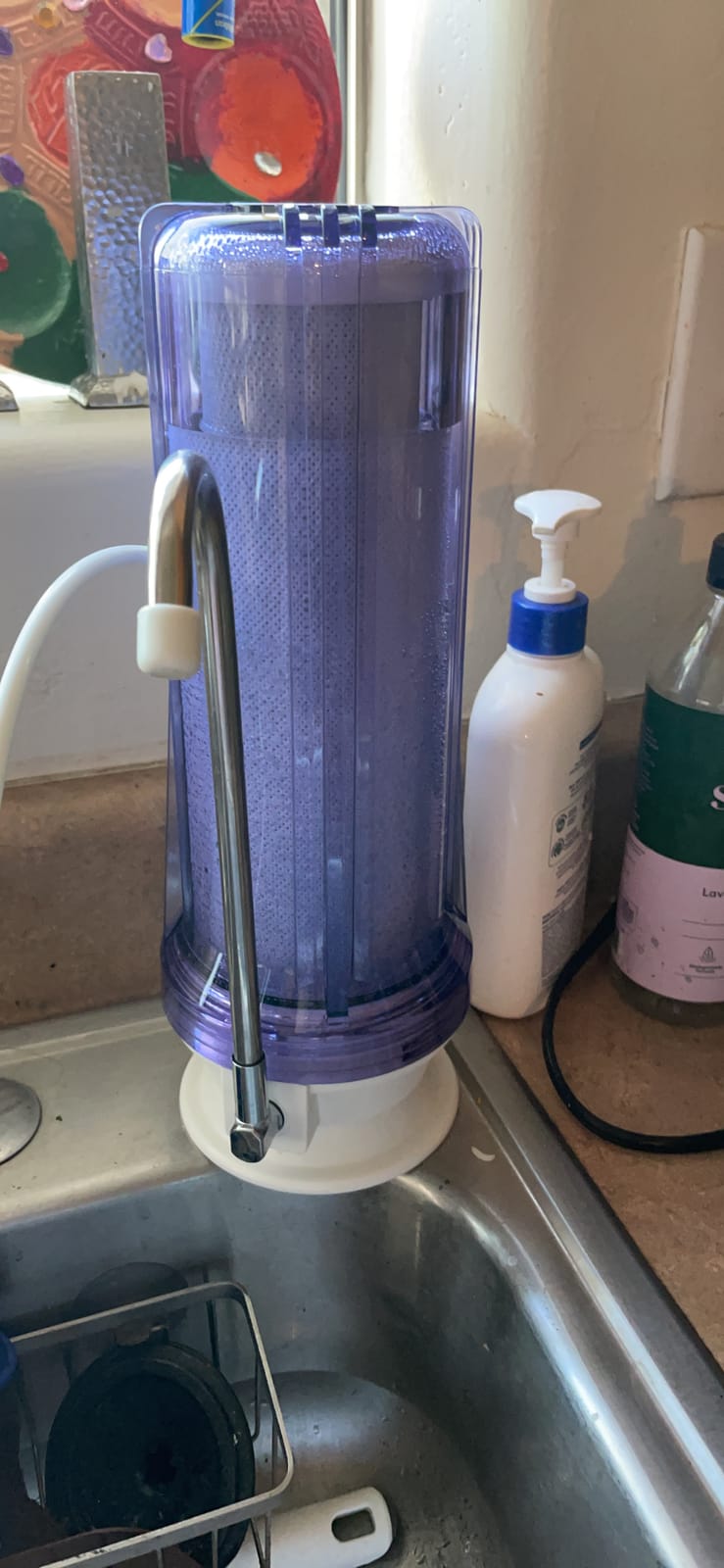
Installation took the review crowd about five minutes. The housing clamps to a standard kitchen faucet, the twist diverter switches between tap and filtered water, and the included wrench and adapters handle the fitting. There is no drilling, no plumbing, and nothing to ask a landlord about.
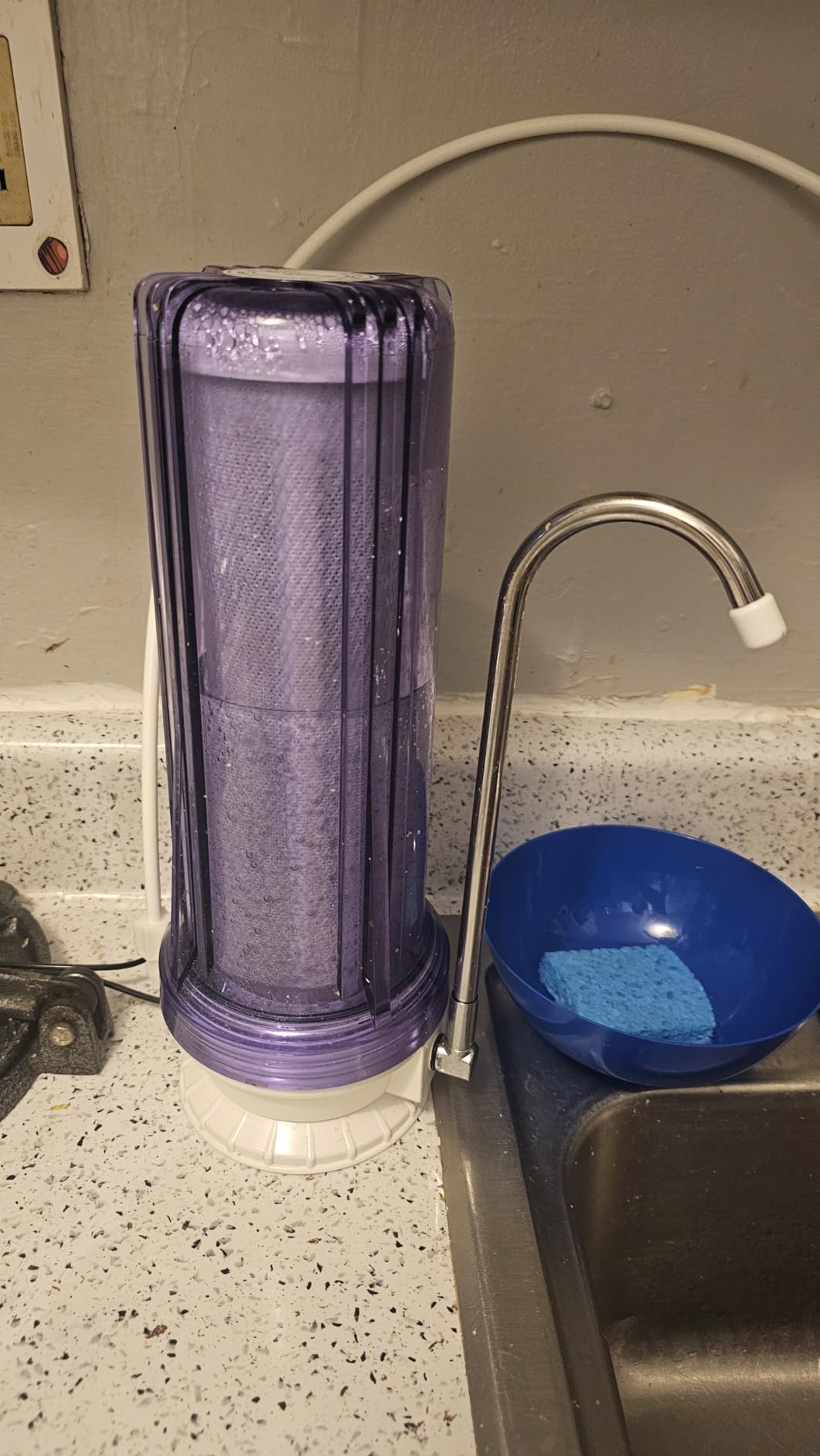
What makes it a repeat purchase is the 10000 gallon rating. At a gallon and a half a day for drinking and cooking, that cartridge runs for years, and the annual ownership cost ends up below what a single case of bottled water costs. The clear housing helps too: you can see the cartridge darken as it loads, so you change it based on what your eyes tell you.
What this filter will not do
Be direct about the limit: this is a 5 micron carbon block, and carbon blocks do not touch dissolved solids. Total dissolved solids, hardness minerals, and anything held in solution pass straight through. It also will not remove lead or PFAS, the two contaminants renters in older buildings ask about most.
Counter space and fitting notes
The body is a 9.84 inch tall cylinder, so it fits under most upper cabinets but takes a circular counter patch roughly the size of a coffee can. That matters in a galley kitchen where counter width is the binding constraint. Two fitting notes from reviews: the diverter valve can weep at the threads and occasionally needs a firm hand-tightening, and the cartridge twist is difficult for anyone with limited hand strength.
4. Big Berkey 2.25 Gallon Gravity Water Filter System
Big Berkey 2.25 Gal Gravity Water Filter System with BB9-2 Filters
Gravity fed with no power or plumbing
8.5 by 8.5 by 19.25 inches
2.25 gallon capacity
Two BB9-2 elements included
Pros
- 4.5 rating across 4211 reviews
- No electricity
- plumbing or water pressure required
- Elements last up to 6000 gallons per pair
- Stainless chambers nest for compact storage
- Reported by owners as durable over many years
Cons
- 19.25 inch tower will not fit under low cabinets
- About 30 minutes to filter 2.25 gallons
- Priming the elements takes practice
- If elements dry out they must be re-primed
This is the one I would buy for an apartment with an awkward faucet, a shared kitchen with no free outlet, or a lease that makes me cautious about anything with a plug. Gravity does the work, and nothing here touches plumbing or electricity.
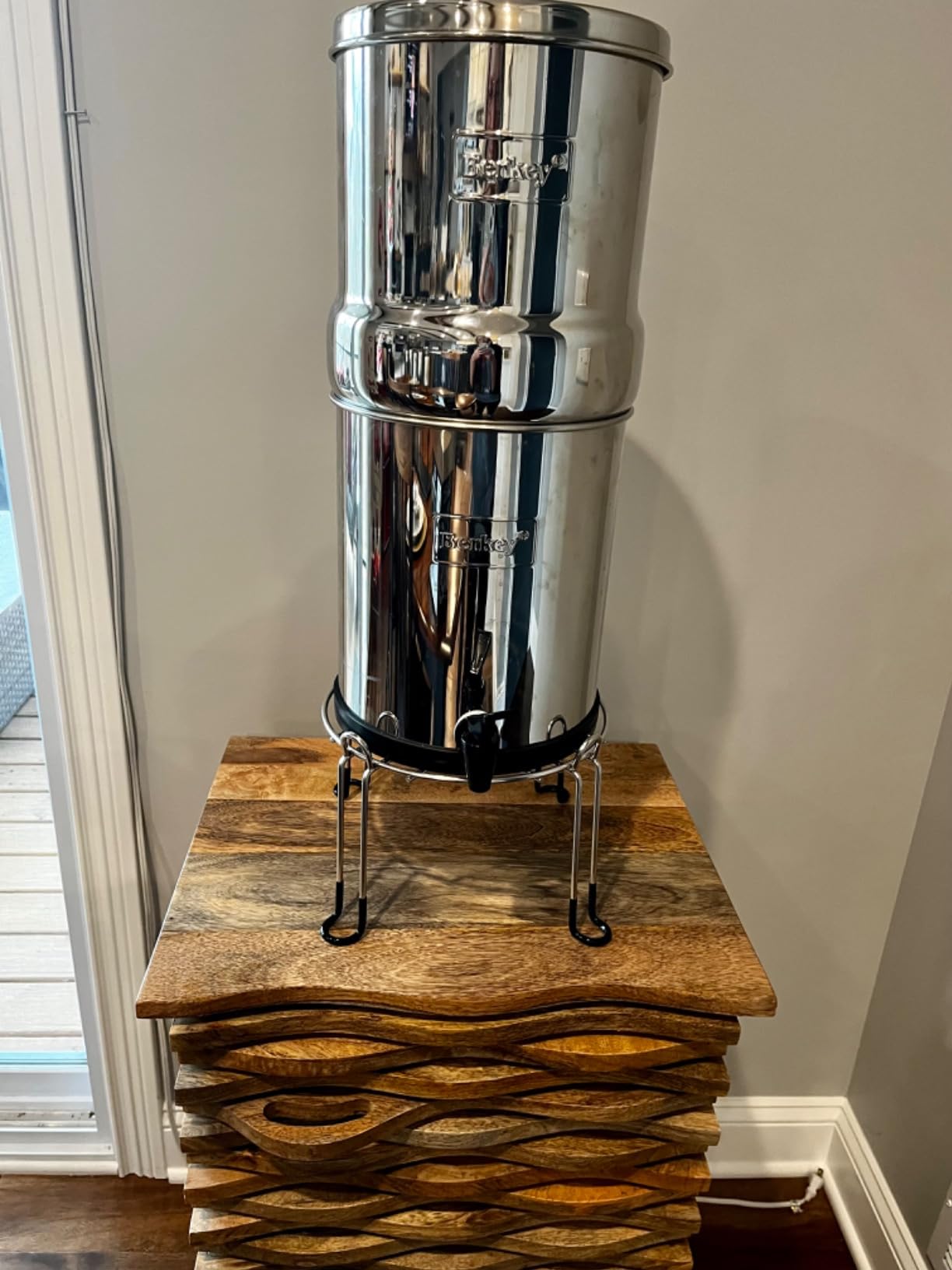
You pour tap water into the upper chamber, it works down through two Black Berkey elements, and it collects in the lower chamber with a spigot. The system is designed for one to four people, which matches most apartments, and multiple owners describe models in continuous daily use for six to ten years or more.
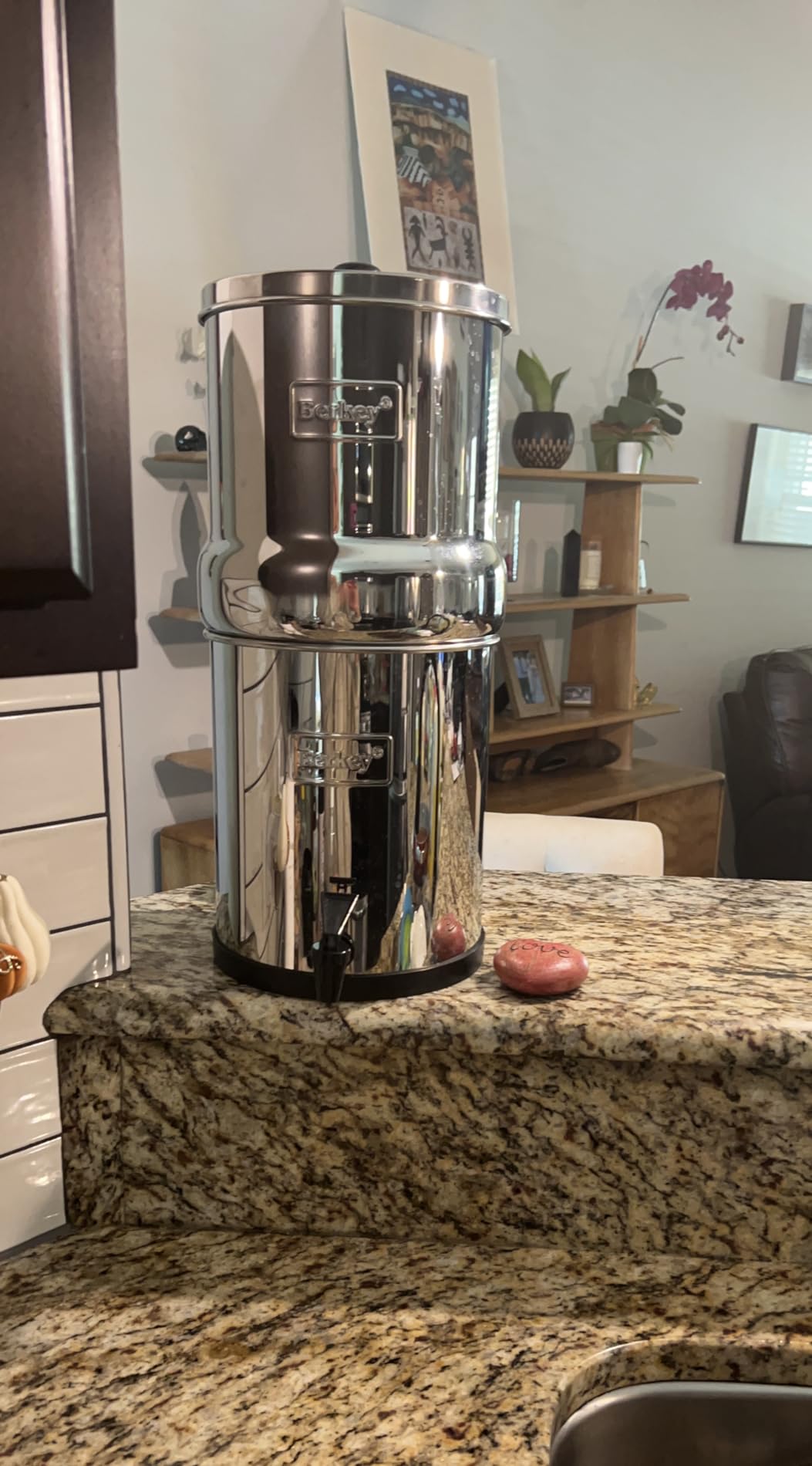
Cost per gallon is the best here, and it comes from two numbers: up to 6000 gallons per element pair, and a filtration approach that does not consume water to filter water. Unlike reverse osmosis, there is no pure-to-drain ratio at all. Taste is the other win, with owners consistently describing better coffee and tea made with the filtered water.
Why renters keep buying this one
Two practical reasons dominate. The chambers nest, so when you pack for a move the whole thing collapses to roughly the height of one chamber. And nothing can go wrong with a landlord’s system, because there is no connection to it. It is also right for a well-water rental or a rural property with inconsistent pressure, since gravity does not care what the incoming pressure is.
Plan for the two real drawbacks
At 19.25 inches tall this is one of the tallest models we covered, so measure the vertical gap between your counter and any upper cabinet honestly. Priming takes practice, the printed instructions are thin, and if elements dry out during storage or a move they must be re-primed or flow slows dramatically. That is a ten-minute task twice a year, not a dealbreaker, but it is not zero effort.
5. AquaTru Classic Water Purification Unit
AquaTru Water Purification Unit – Certified NSF/ANSI Standards, Removes 84 Contaminants, No Plumbing Required, Cost-Effective, Environmentally Friendly
IAPMO certified to five NSF/ANSI standards
84 certified contaminants
600 to 1200 gallons per set
14 by 12 by 14 inches
Pros
- Broadest certification in the roundup
- Filters rated 600 to 1200 gallons per set
- Twist and change cartridges with no tools
- No plumbing or drilling needed
Cons
- Heaviest model at 22.8 pounds
- High ongoing filter replacement cost
- Reverse osmosis sends wastewater down the drain
- Some one-star reviews report early failures and indicator faults
If you care about certification language, this is the one to check first. It is certified by IAPMO to NSF/ANSI standards 41, 53, 58, 401, and P473, covering 84 contaminants including PFOA, PFOS, and microplastics. That is a searchable listing rather than a phrase on a box.
For renters in older buildings, that list is the reason to pay more. Standards 53 and 401 cover health-effect contaminants such as lead and cyst-related parasites, and P473 covers emerging contaminants. A certified claim to that breadth is meaningfully different from a model that says it was tested to a protocol.
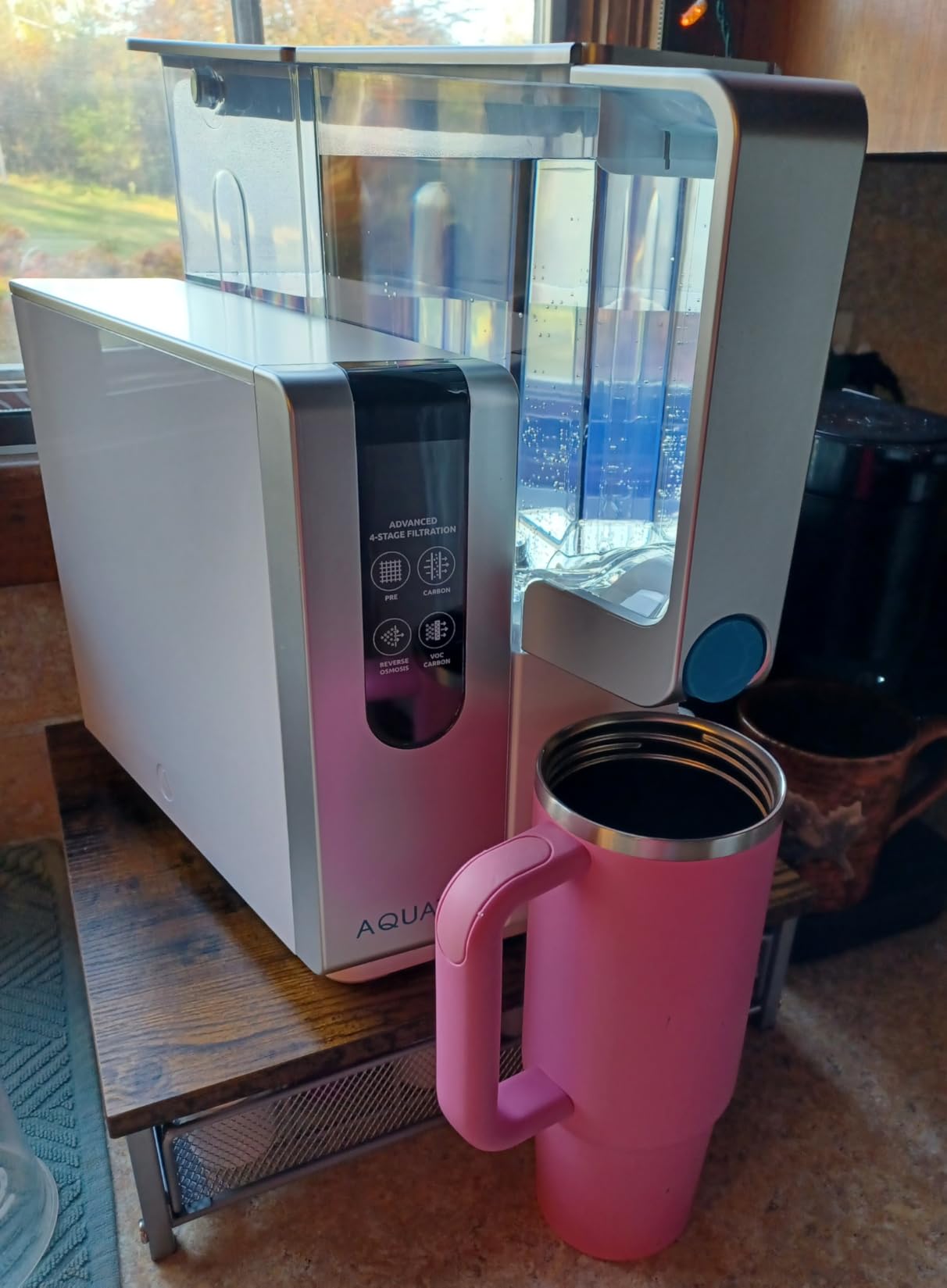
Filter intervals are long, which softens the higher purchase and replacement figures. Sets rated 600 to 1200 gallons mean a change every six months to two years depending on household size, and one set is marketed as the equivalent of roughly 4500 plastic bottles. Setup takes minutes and involves no tools, which matters for a renter who wants to move without calling a handyman.
What the certification does not cover
Certification tells you what was tested, not what your water contains. A model certified for 84 contaminants will not remove anything outside that list, and it will not push total dissolved solids below the level the membrane reaches on your supply. Also note that RO produces wastewater: unlike the gravity models here, every gallon you drink means several gallons down the sink.
Handling and cost notes
At 22.8 pounds this is the heaviest model we covered, and heavier still with water in the tank, so fill it partway rather than to the line. Replacement sets are the running cost that decides this purchase, and a portion of one-star reviews report filter-change indicator faults and early failures. If you are comfortable with a higher maintenance budget and want the broadest certified coverage, the certification alone justifies it.
6. DREO Countertop RO Water Filter 3L
DREO Reverse Osmosis Water Filter System Countertop, RO Water Filter 112 3L
3 liter reservoir
14.5 by 6.7 by 13.4 inches
265 gallon filter life
3:1 pure-to-drain ratio
Pros
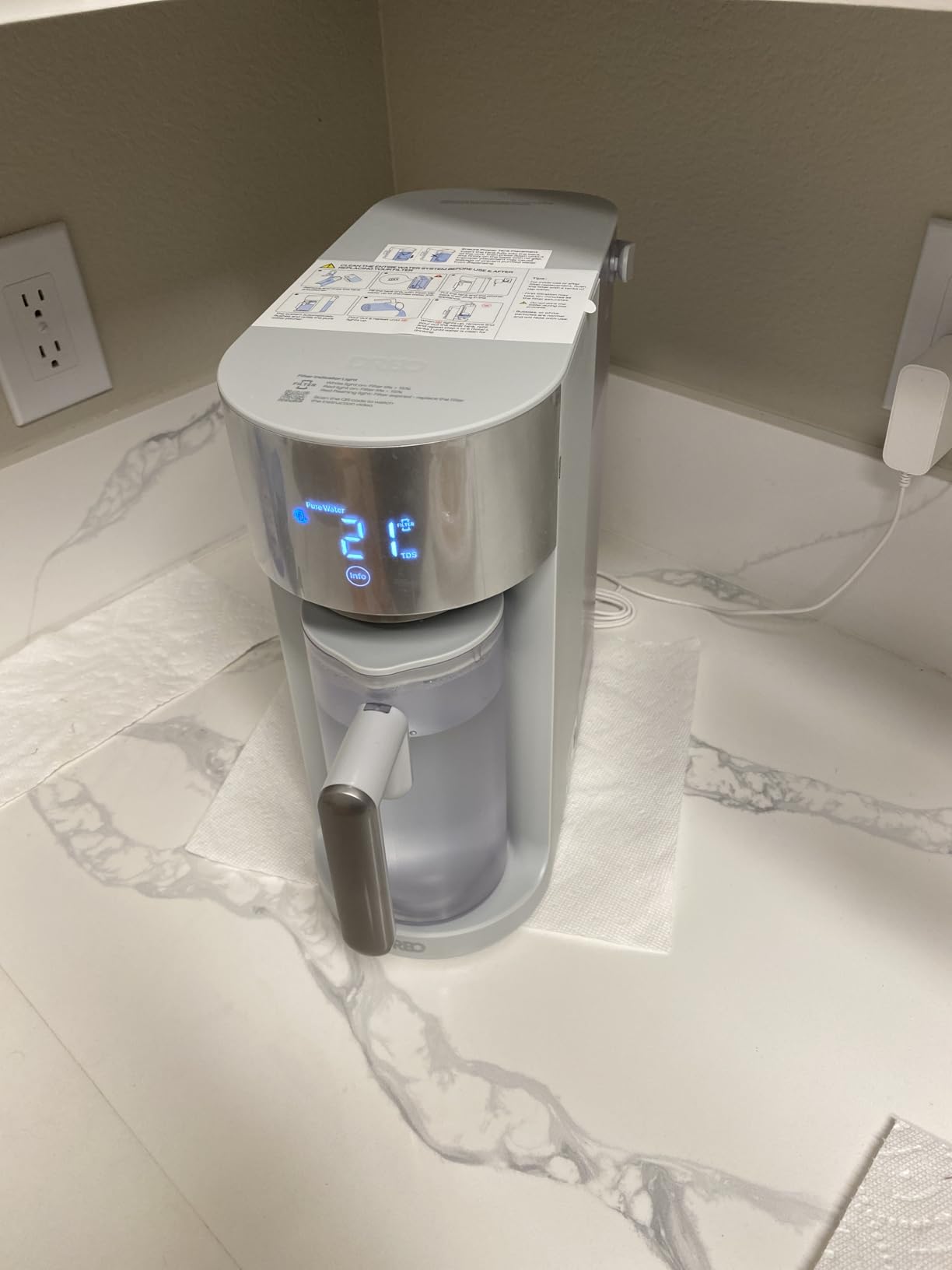
- Real-time TDS display shows tap and purified readings
- Filter change indicator built in
- 265 gallon filter life
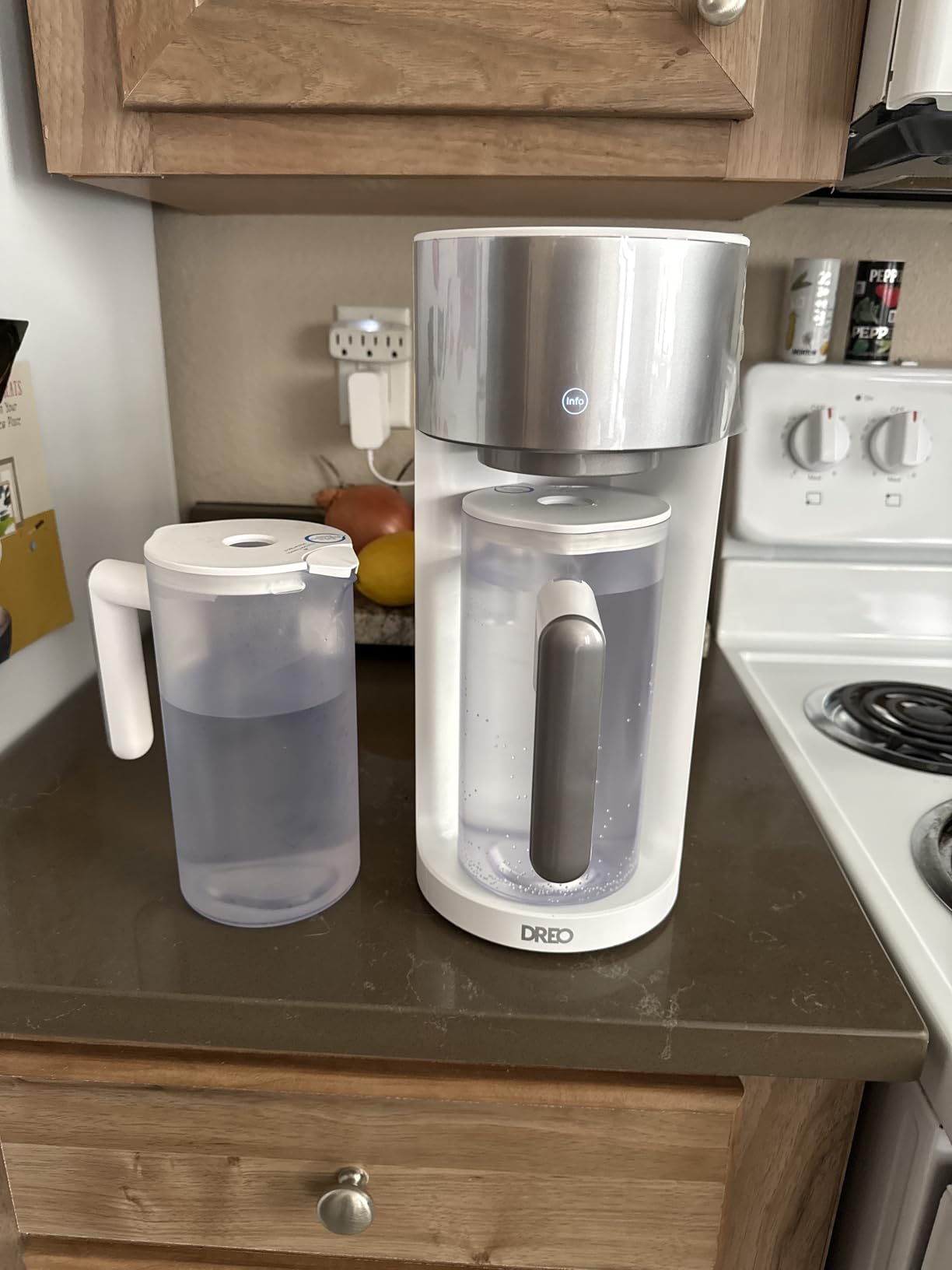
- Two BPA-free pitchers included
- Footprint close to a coffee maker
Cons
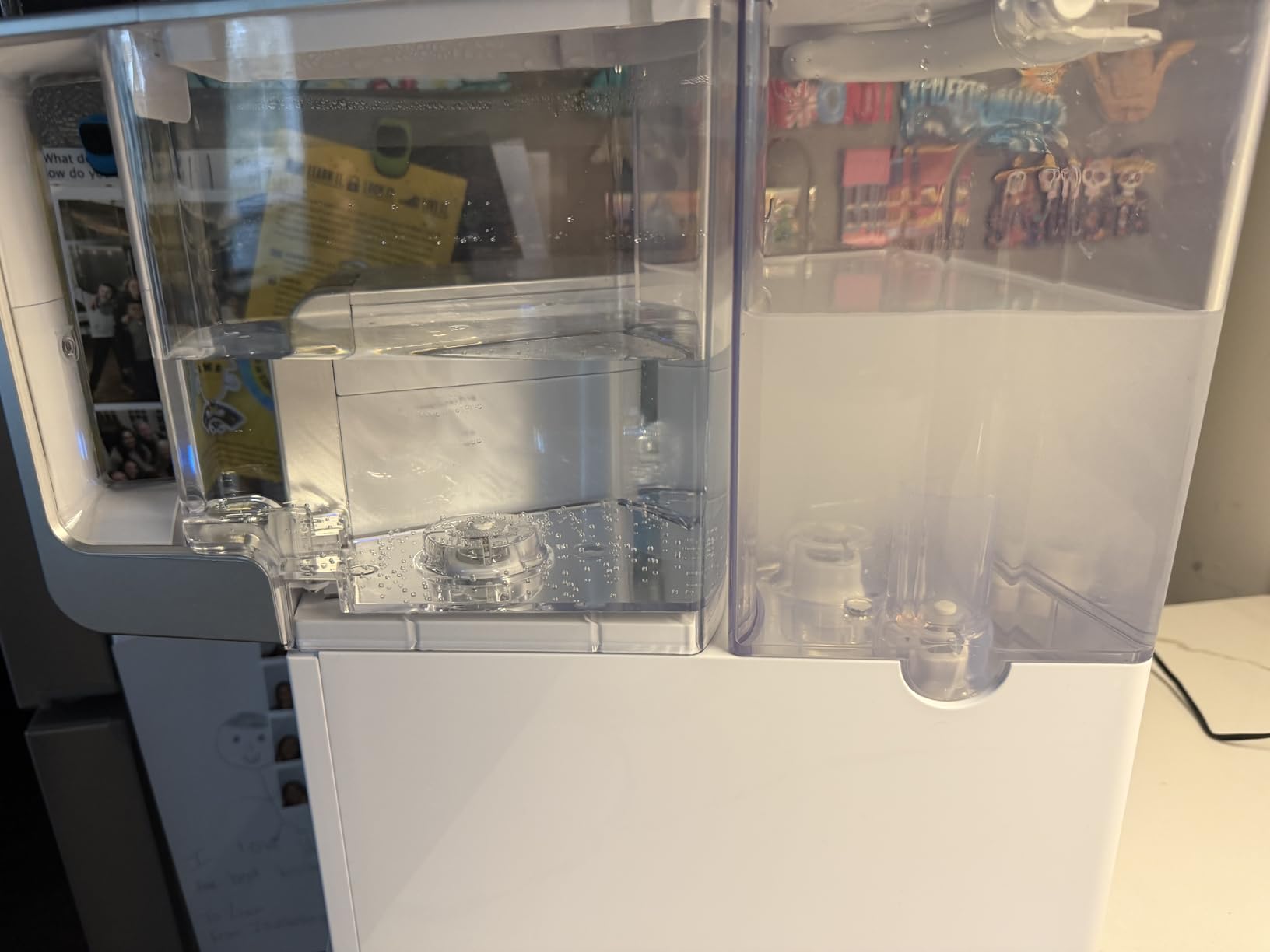
- Only dispenses into the included pitchers via auto-fill sensor
- Wastewater reservoir must be emptied after each use
- Replacement filters run roughly 40 to 50 dollars each
- All-plastic build
For renters who like evidence, this is the most satisfying model in the roundup. The built-in TDS meter shows raw and purified readings side by side, and the filter change indicator tells you when to act. You are not guessing.
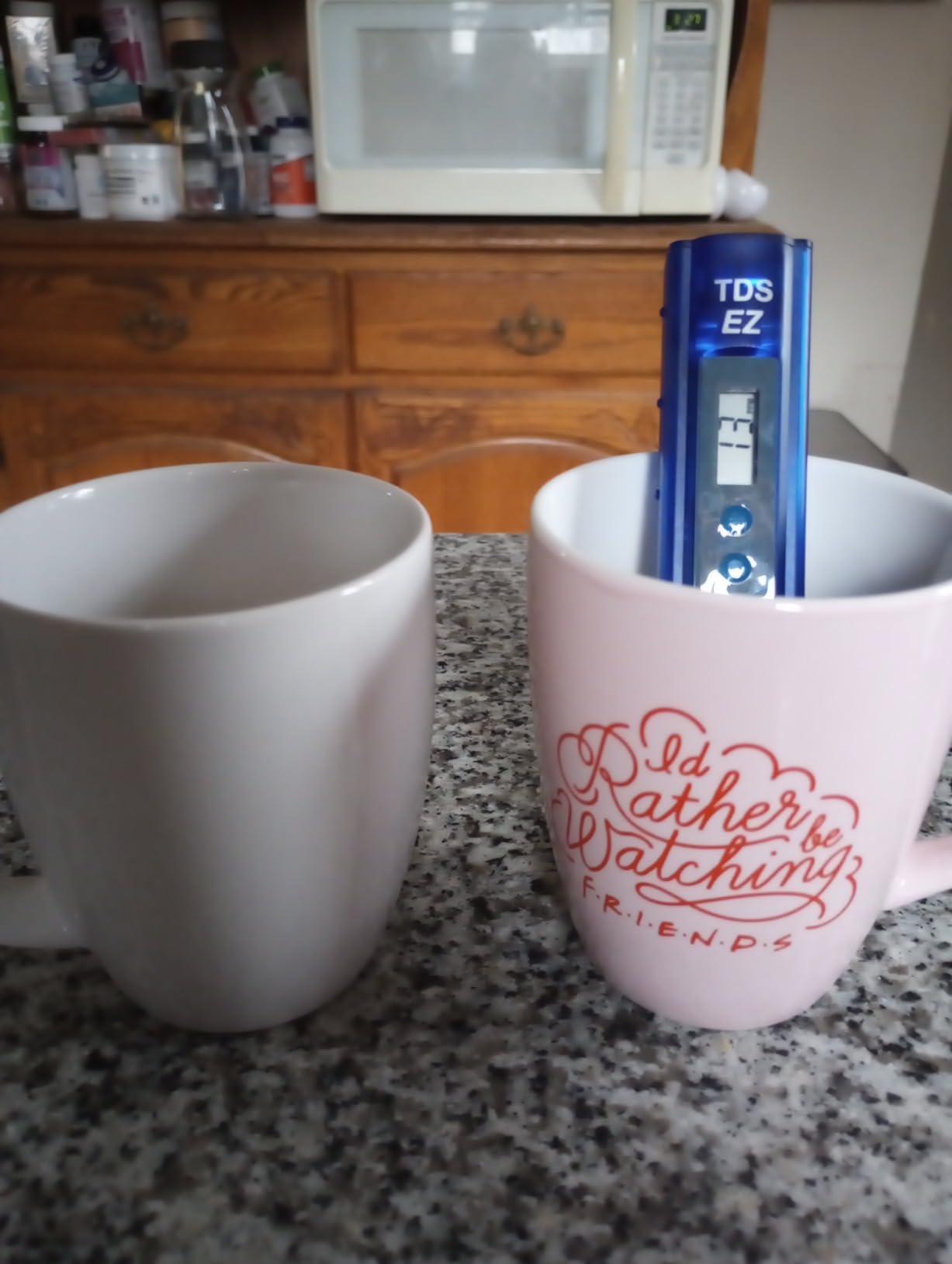
Owners report tap water in the 250 to 300 plus ppm range dropping to under 15 ppm after filtration. Seeing that number fall in real time is a better argument for a countertop filter than anything a product page can write, and it is a five-second test anyone can repeat.
Water efficiency is another strength. The 3:1 pure-to-drain ratio beats the 4:1 and 5:1 models further down this list, and self-cleaning flush cycles water through the internal tubing on its own, which reduces the stagnant-water questions that come with a permanently wetted system. It is tested by SGS to NSF/ANSI 58 and rated for incoming water up to 500 ppm TDS.
Why renters report it as a good fit
No drilling, no plumbing, and no faucet modification, so the whole model packs into a box and moves to the next apartment. The slim footprint is close to a coffee maker, and two BPA-free pitchers rotate between the fridge and the counter. One reviewer disputes the marketing claim about thousands of substances, citing 16 to 18 certified substances in the SGS report, and that is fair to keep in mind.
The pitcher limitation, in plain terms
Because of the auto-fill sensor, purified water dispenses only into the supplied pitchers. If your habit is filling a specific bottle or a large jug for the fridge, this model fights you, and that single design choice shapes ownership more than any spec. The wastewater reservoir also has to be emptied after each use, and cartridge availability varies by region.
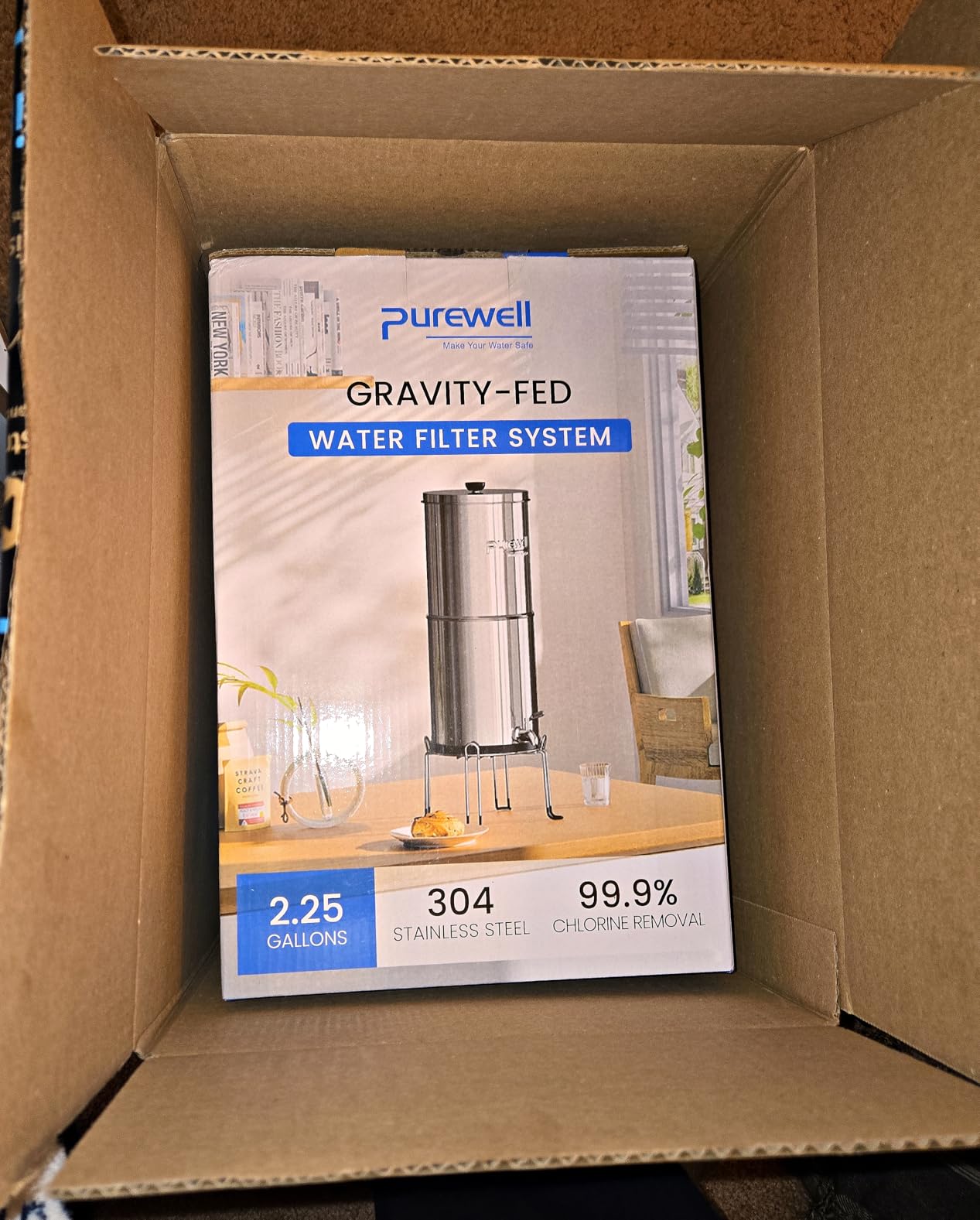
7. Purewell 3-Stage 0.01 Micron Gravity Filter
Purewell 3-Stage 0.01μm Ultra-Filtration Gravity Water Filter System, NSF/ANSI 42&372 Certification, 304 Stainless Steel Countertop System with 2 Filters and Stand, Reduce 99% Chlorine, 2.25G, PW-OB
0.01 micron hollow fiber membrane
NSF/ANSI 42 and 372 certified
2.25 gallon reservoir
8.5 by 8.9 by 20 inches
Pros
- Certified to two NSF/ANSI standards
- Gravity powered so no outlet is needed
- 304 stainless steel housing and spigot
- Two cartridges plus a non-slip stand in the box
- Works indoors or outdoors
Cons
- 20 inch height is among the largest covered
- Does not lower TDS
- Refilling the top chamber over a full bottom chamber can leak
- Elements listed for replacement every 6 months
This is the certified answer for renters with a pull-out sprayer faucet, a touchless faucet, or no faucet they want to touch. Nothing connects to your sink, so compatibility stops being a question.
Filtration is 0.01 micron hollow fiber ultrafiltration backed by activated carbon and silver ion stages, and the whole model is certified to NSF/ANSI 42 and NSF/ANSI 372. That 42 rating covers chlorine taste and odor reduction, the practical daily win, while 372 covers lead-free material compliance.
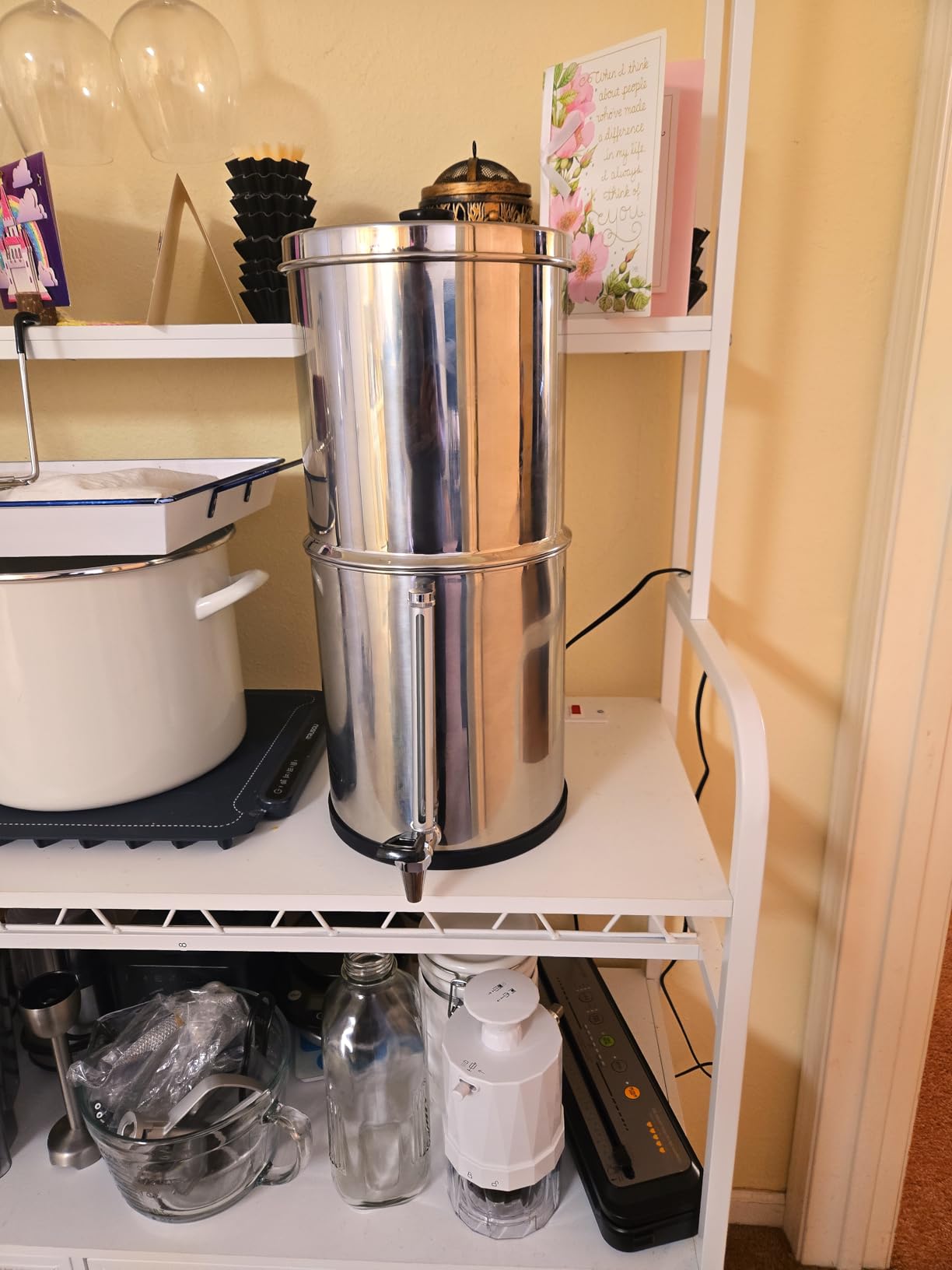
Flow is around 4 gallons per hour, faster than a typical gravity tower and slow enough that you plan for it. The upper chamber holds 2.25 gallons and the lower chamber holds finished water, so you can draw from the spigot without lifting the reservoir. Two elements ship in the box, rated at 3000 gallons each for up to 6000 gallons total, plus a non-slip stand.
Where it beats the other gravity option
Compared with the stainless towers, this model is certified to published standards and its pore size is stated precisely. For a renter who wants a document to check rather than a brand reputation, that is the deciding factor. It is also faster, moving roughly 4 gallons an hour through a finer membrane than the 30 minutes a 2.25 gallon fill takes on a Big Berkey.
What to plan around
At 20 inches tall and 8.9 inches on a side, this is one of the largest footprints in the roundup. If you have under-cabinet clearance below 21 inches, this is not the model for you. Reviewers also report a specific leak pattern: adding tap water to the top chamber while the bottom chamber is still full can cause overflow at the spigot. Empty the lower chamber first and the problem disappears.
8. Express Water EZRO5 Countertop Reverse Osmosis
Express Water Countertop Reverse Osmosis Water Filtration System, White
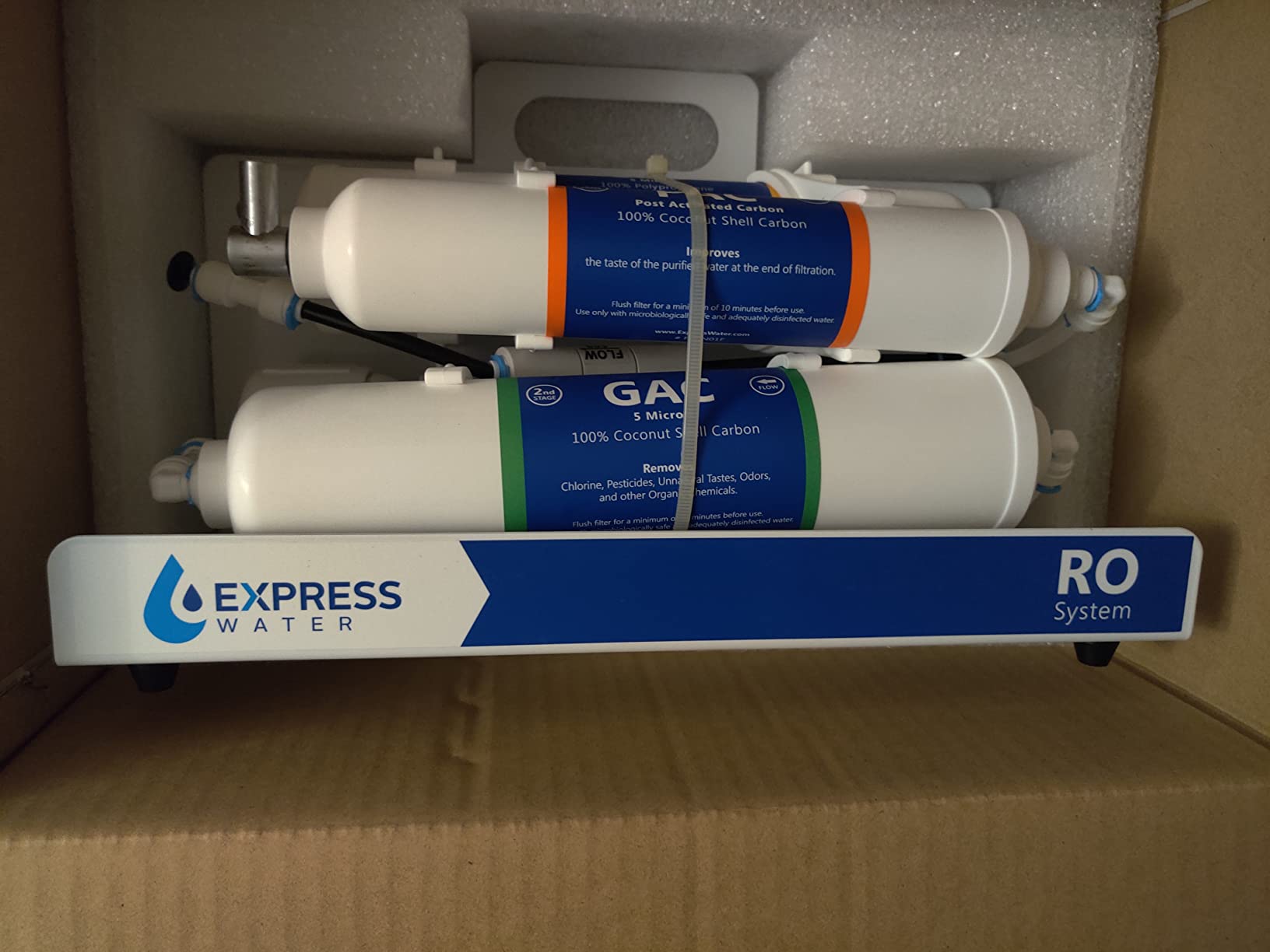
Four stage RO
Preassembled
13.25 by 6.5 by 14 inches
12 gallons per day rating
Pros
- Genuine four stage RO with a post carbon stage
- Arrives preassembled
- Setup takes about 10 minutes
- Every stage is individually replaceable
- Needs only a faucet connection
- No drilling
Cons
- Slow production at roughly 0.5 to 1 gallon per hour
- 1:3 pure-to-drain ratio
- Not compatible with sprayer or pull-out faucets
- Some buyers report build quality and instruction issues
This is the pick if you want membrane-grade water and are unwilling to pay premium-countertop money for it. Reviewers measuring with a TDS meter report tap water around 350 to 575 ppm dropping to 3 to 9 ppm, which is real reverse osmosis output.
Four stages do the work: sediment, granular carbon, the RO membrane, and a post activated carbon stage that polishes taste after the membrane strips out the dissolved solids. That last stage is what stops RO water from tasting like wet cardboard.
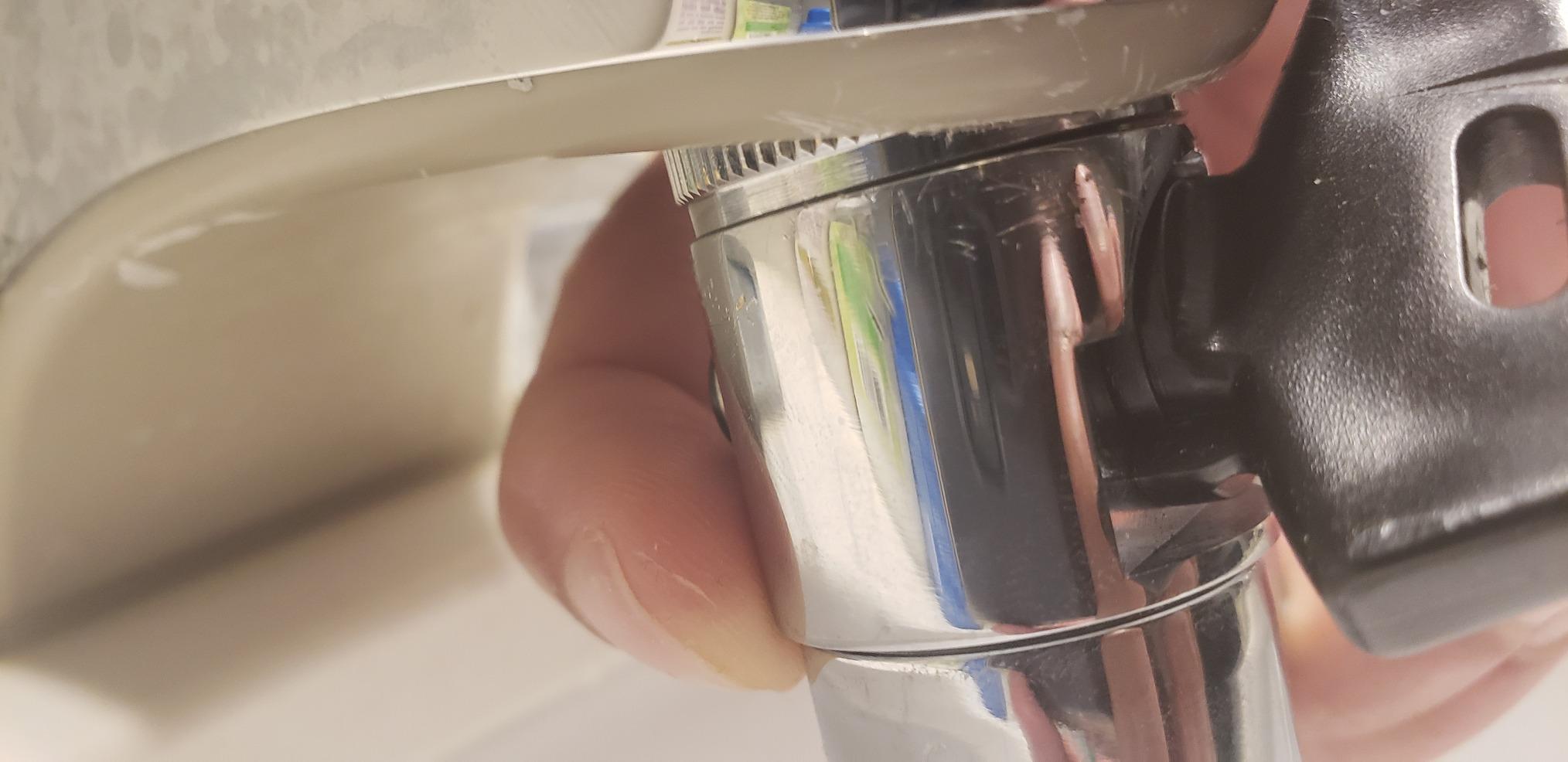
It arrives preassembled and installs in about ten minutes on a faucet with a threaded removable aerator, and the whole thing unhooks in a couple of minutes when you move. Several renters name the no-drill faucet connection as the specific reason they bought it. Every stage is individually replaceable too, so you are not locked into one proprietary set for every component.
Accept the slow fill before you order
Production runs about 0.5 to 1 gallon per hour, so a half gallon takes somewhere between 13 and 26 minutes. That is fine if you start the fill in the morning and pour a glass later, and a problem if you want to fill five bottles at once. The 1:3 pure-to-drain ratio means three gallons of wastewater per gallon produced, which matters in a rental where you pay for the water.
Check your faucet and pressure first
It needs a threaded removable aerator and does not work with sprayer, pull-out, or hand-held faucets, and it needs 45 to 80 psi of supply pressure. It is rated for incoming TDS up to 2000 ppm, covering municipal and many well supplies. Two smaller issues appear in reviews: the RO membrane end cap can weep if not tightened, and the metal spout is awkward for filling jugs without a funnel.
9. GLACIER FRESH C03 Coolon Countertop Purifier
GLACIER FRESH C03 Coolon Countertop Cold Water Purifier, Zero Wastewater
Chilled water dispensing
152 oz reservoir with 40 oz cooling
Elarisey filtration
NSF/ANSI 42 and 53 certified
Pros
- Only model here that dispenses genuinely cold water
- Zero wastewater and no drain connection
- Certified to NSF/ANSI 42 and 53
- Retains calcium and magnesium during filtration
- Tool-free setup with removable parts for cleaning
Cons
- Must be plugged in for filtration and cooling
- Needs 30 to 45 minutes powered on before the first cold serving
- Larger countertop footprint
- Does not reduce dissolved solids like RO
Every other model on this list makes room-temperature water. This one chills it, using dual cooling chips and a 40 oz cooling capacity, which for a renter replacing a refrigerator pitcher changes the daily routine.
The filtration approach is electrosorption with Elarisey media, using positively charged material to capture contaminants while leaving calcium and magnesium in the water. It is certified to NSF/ANSI 42 and 53, plus FCC and California Proposition 65, and it targets chlorine, PFAS, PFOS, microplastics, and fluoride.
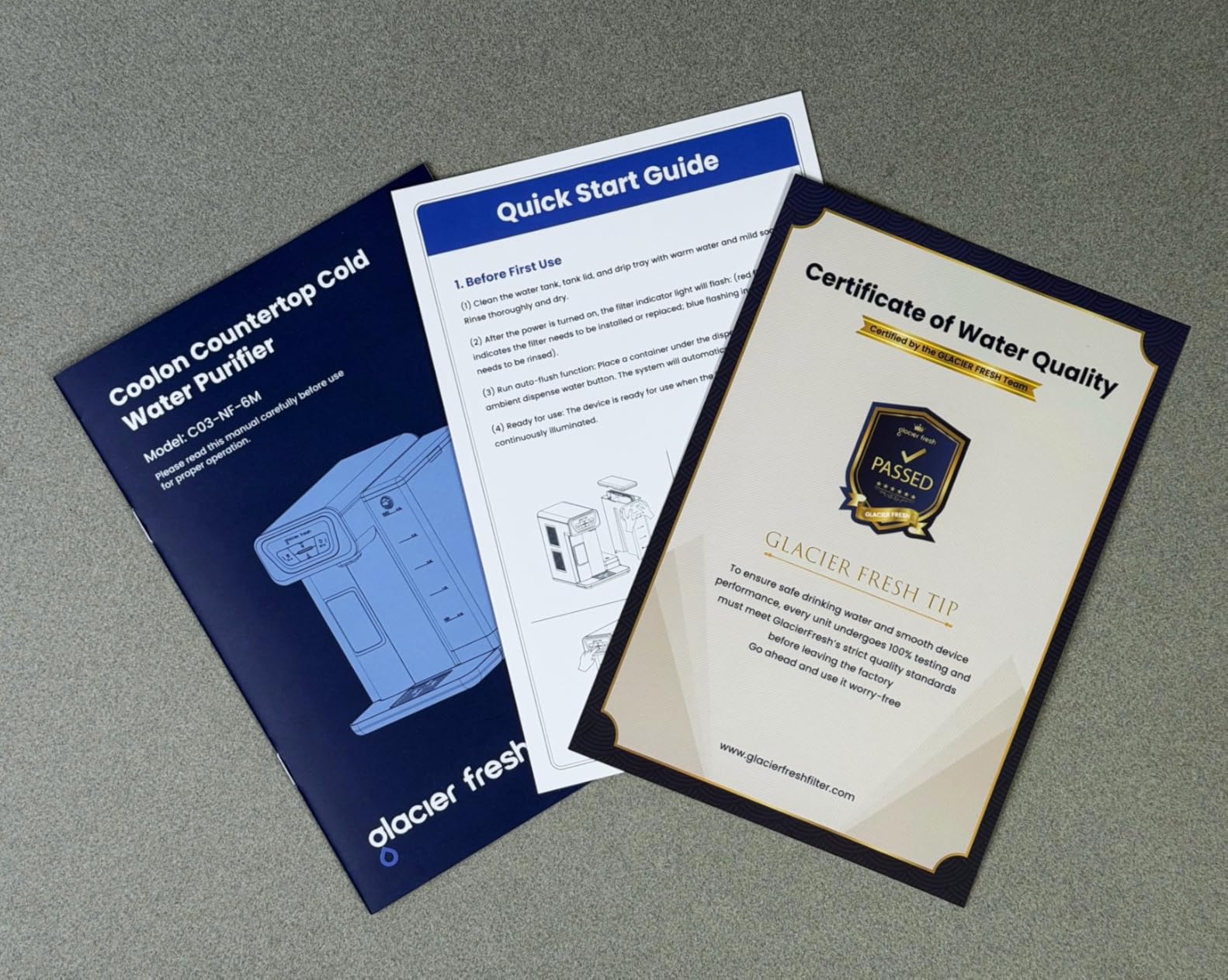
The zero-wastewater design is the second thing that sets it apart. There is no pure-to-drain ratio and no drain line to connect, so the water-waste question that dominates reverse osmosis does not apply. Setup is tool-free, and the removable components are easy to clean, which addresses the maintenance complaint that appears against most reservoir-based models here.
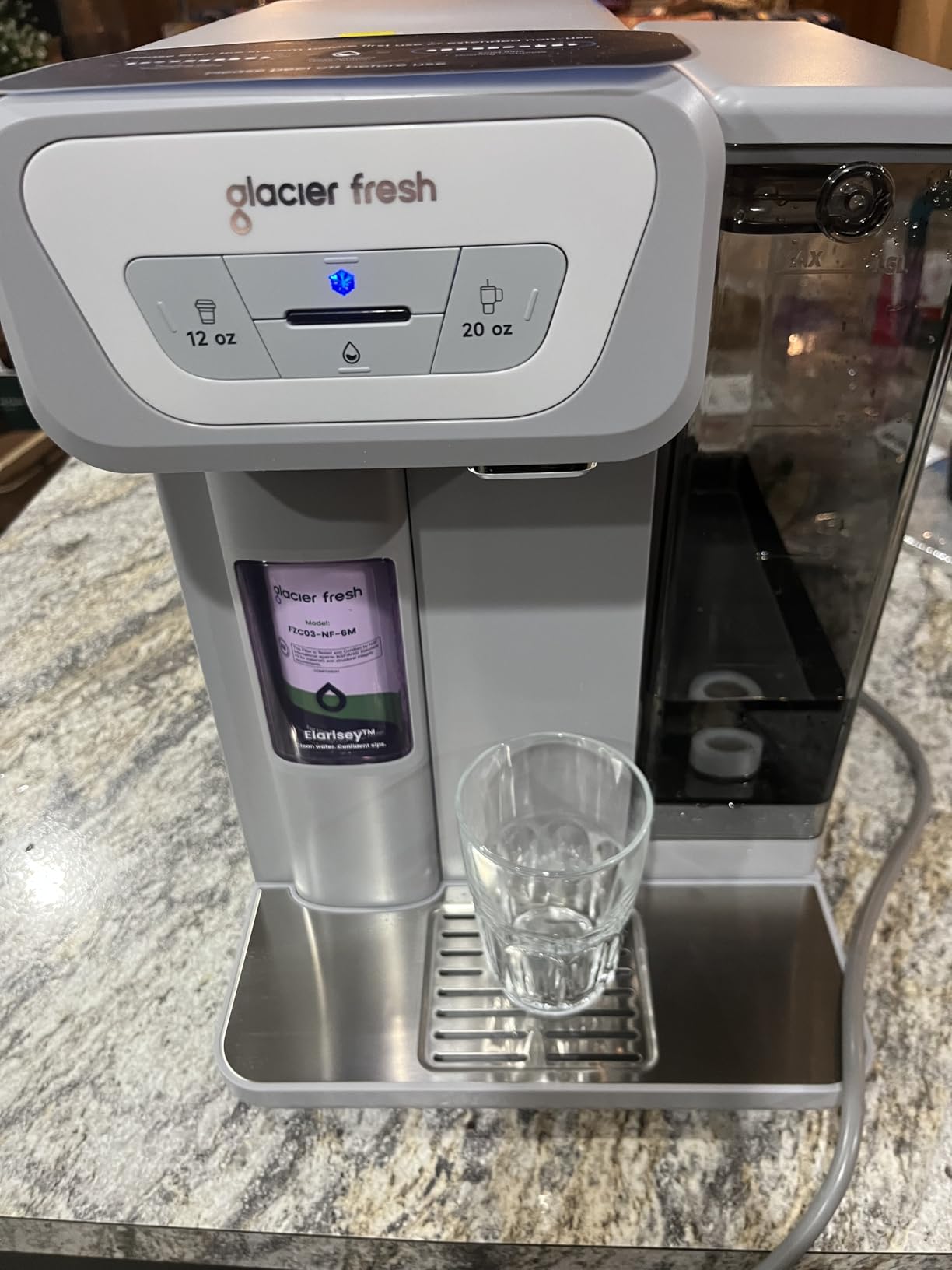
Who this suits
A renter who wants cold water on tap without a plumbing-mounted cooler, and who is not chasing dissolved solids. Electrosorption media does not reduce total dissolved solids the way a membrane does, so if your TDS reading is the number you care about, this is the wrong tool. The 152 oz reservoir is also the largest here, helpful in a shared kitchen where the fridge pitcher is always empty.
The two caveats
It needs power for both filtration and cooling, so an unplugged model is dead weight. And you wait 30 to 45 minutes of powered cooling after switching it on before the first genuinely cold glass, which is a small annoyance at 7am and irrelevant at 7pm. The footprint is also larger than a pitcher or faucet-mounted filter, so check under-cabinet height first.
10. AquaTru Glass Carafe 4-Stage Reverse Osmosis
AquaTru Glass Carafe | Countertop Reverse Osmosis Water Filter Countertop RO System Water Purifier | 4 Stage Reverse Osmosis Filtration | Removes 84 Contaminants Like PFOA + PFOS, Lead, Microplastics
Four stage RO
Removes 84 contaminants
0.5 gpm flow
14 by 7.5 by 13 inches
Pros
- Removes 84 certified contaminants including PFOA and PFOS
- IAPMO certified to NSF standards
- Glass carafe keeps purified water out of plastic
- Compact footprint near a coffee maker size
- Quiet operation
- Filters a carafe in roughly 8 minutes
Cons
- Feed tank holds only about 1.5 carafes and never fully empties
- Some buyers report RO filter life falling short of the rated 600 gallons
- Glass carafe is fragile and reviewers report breakage
- Carafe lid is plastic
- Replacement filters are among the more expensive
This is the version of the AquaTru idea that fits a smaller counter and stores water in glass. If you want the certified contaminant coverage without the 22.8 pounds, this is the one to look at.
Four stages handle the work, and the model is certified by IAPMO to NSF standards for 84 contaminants including PFOA, PFOS, lead, fluoride, chromium-6, arsenic, and microplastics. The 0.5 gpm flow rate fills a carafe in roughly eight minutes, quicker than most faucet-fed countertop models.
The footprint is one of the smallest for a full reverse osmosis system here, roughly the size of a mid-size coffee maker, and setup is simple with cartridges that snap into place. Reviewers consistently report a major improvement in chlorine and iron taste and quiet operation, which matters in a small apartment where a humming model is audible in the next room.
Filter life: what the numbers say
The published schedule is a 6-month or 300 gallon pre-carbon filter, a 1-year or 600 gallon RO filter, and a 1-year or 300 gallon VOC carbon filter. Divide the filter price by the 900 gallon annual total and you get a per-gallon number you can compare against every other model on this list. Some buyers report the RO filter failing before the rated 600 gallons, so check the TDS meter earlier than the calendar suggests.
The feed tank is the design constraint
The feed tank holds only about 1.5 carafes and, per reviews, never fully empties, so you have to dump and refill it manually. That is the most-cited drawback on this model. The glass carafe also invites breakage, and the lid is plastic rather than glass, so on a busy shared counter the DREO’s pitchers have neither the weight nor the fragility.
11. Aigerri 5-Stage UV Countertop RO System
Aigerri Countertop Reverse Osmosis Water Filter, 5-Stage RO Water Filtration System with UV, 5:1 Pure-to-Drain Ratio, No Installation Required, Portable Water Purifier for Home, Kitchen, Office & RV
5:1 pure-to-drain ratio
5L feed tank with 2L purified tank
Up to 529 gallons per set
7.4 by 16.2 by 16.4 inches
Pros
- 5:1 pure-to-drain ratio wastes the least water among the RO models here
- 5 liter feed tank reduces refilling
- UV stage adds a final purification barrier
- Up to 529 gallons per filter set
- Customer support replaces leaking models
Cons
- Several owners report feed tank valve leaks within a few months
- Occasional lack of water error that refuses to dispense
- Only three fixed dispense sizes
- Support details on the listing contain an error
Water waste is the issue that should decide this pick for some renters. A 5:1 ratio means far less wastewater per gallon of purified water than the 3:1 and 4:1 models elsewhere, and in an apartment where you pay for every gallon sent down the drain, that compounds.
Filtration runs in five stages built around a PPC filter, an RO membrane, and UV purification. Reviewers running their own tests report large reductions, with one example showing tap water at 357 ppm dropping to 17 ppm.
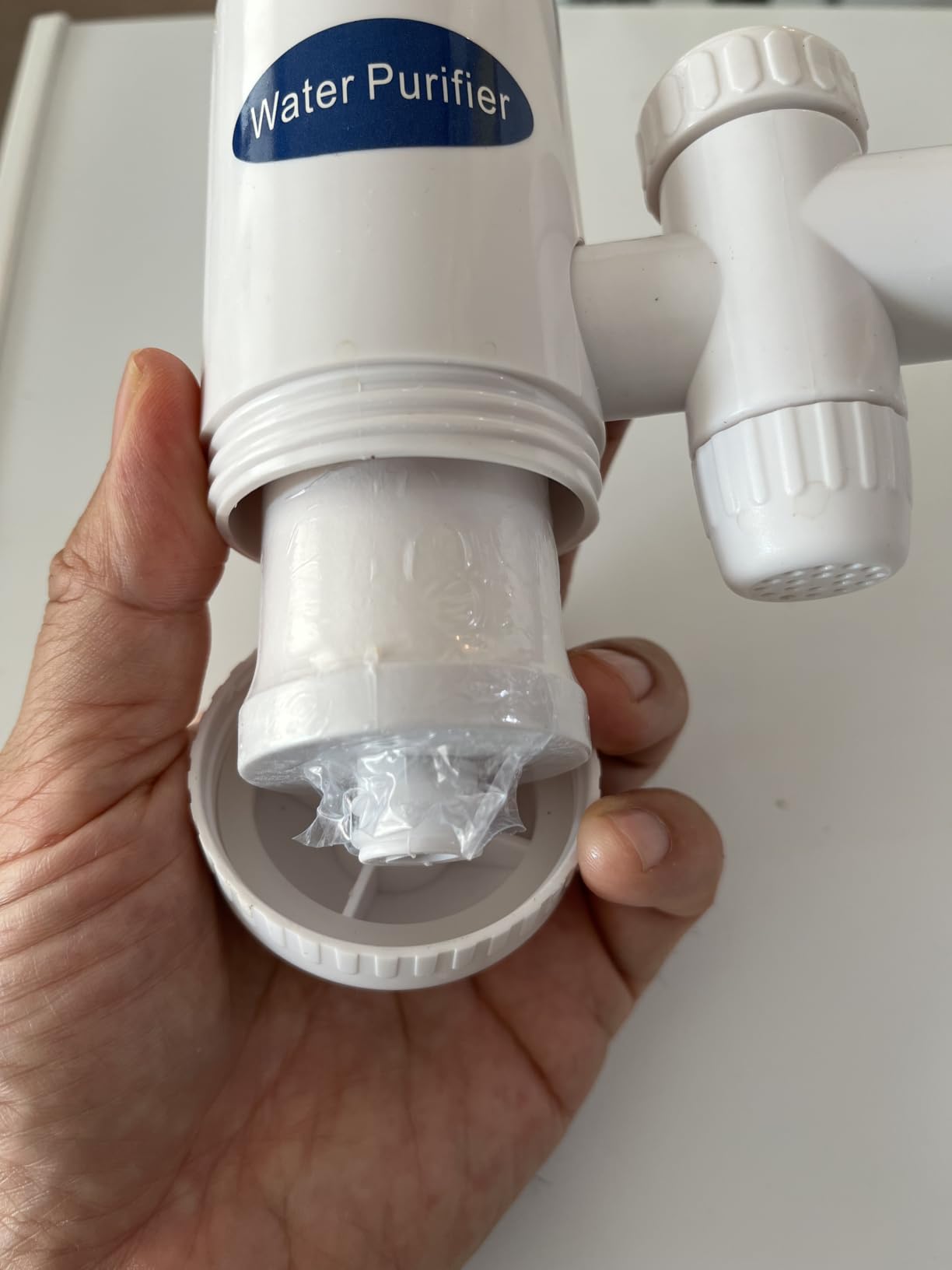
The tank arrangement is the practical strength: a 5 liter feed tank plus a separate 2 liter purified water tank, so you top up the input less often than with a single small reservoir. One filter set is rated for up to 529 gallons. Setup is genuinely plug and play, with no faucet connection, no drilling, and no landlord conversation.
Check your vertical clearance first
This is the one dimensional surprise in the roundup. The model stands 16.1 inches closed but needs roughly 22 inches of vertical clearance when opened to reach the filter and the lid. At 16.2 inches wide it is also one of the broader designs, so measure the opened height and the width before ordering.
Reliability is the tradeoff
Several owners report the feed tank developing leaks at the bottom valves within a few months, and a recurring lack of water error where the model refuses to dispense despite a full tank. Those are not fatal flaws, but they recur often enough to know about. Against that, customer support is repeatedly described as generous, sending replacement tanks and whole models rather than arguing.
12. OEMIRY 8000 Gallon Stainless Steel Countertop Filter
OEMIRY Countertop Water Filter, Stainless Steel 8000 Gal Filtration System
8000 gallon capacity
3.5 by 3.5 by 11.8 inches
1.6 gpm flow
3.9 pounds
Pros
- 304 food grade stainless steel housing with 1mm walls
- 1.6 gpm fills an 8 oz cup in 2 to 3 seconds
- 8000 gallon or 12 month cartridge life
- Zero wastewater and no electricity
- Anti-leak twist-on faucet connection
Cons
- Does not reduce TDS
- Will not fit pull-out
- sprayer or sensor faucets
- Replacement cartridges add ongoing cost
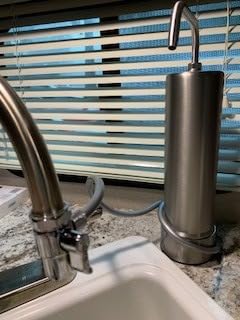
This is the narrow-counter carbon option. At 3.5 inches square and 11.8 inches tall it takes up almost no space, it runs at 1.6 gpm, and it produces no wastewater at all because it is not a membrane system.
The multi-stage setup uses non-woven fabric, a carbon block, KDF, and alkaline media, marketed to reduce up to 99 percent of chlorine, heavy metals, fluoride, and hydrogen sulfide. The 304 food-grade stainless housing has 1mm thickened walls and a brushed finish that resists fingerprints.
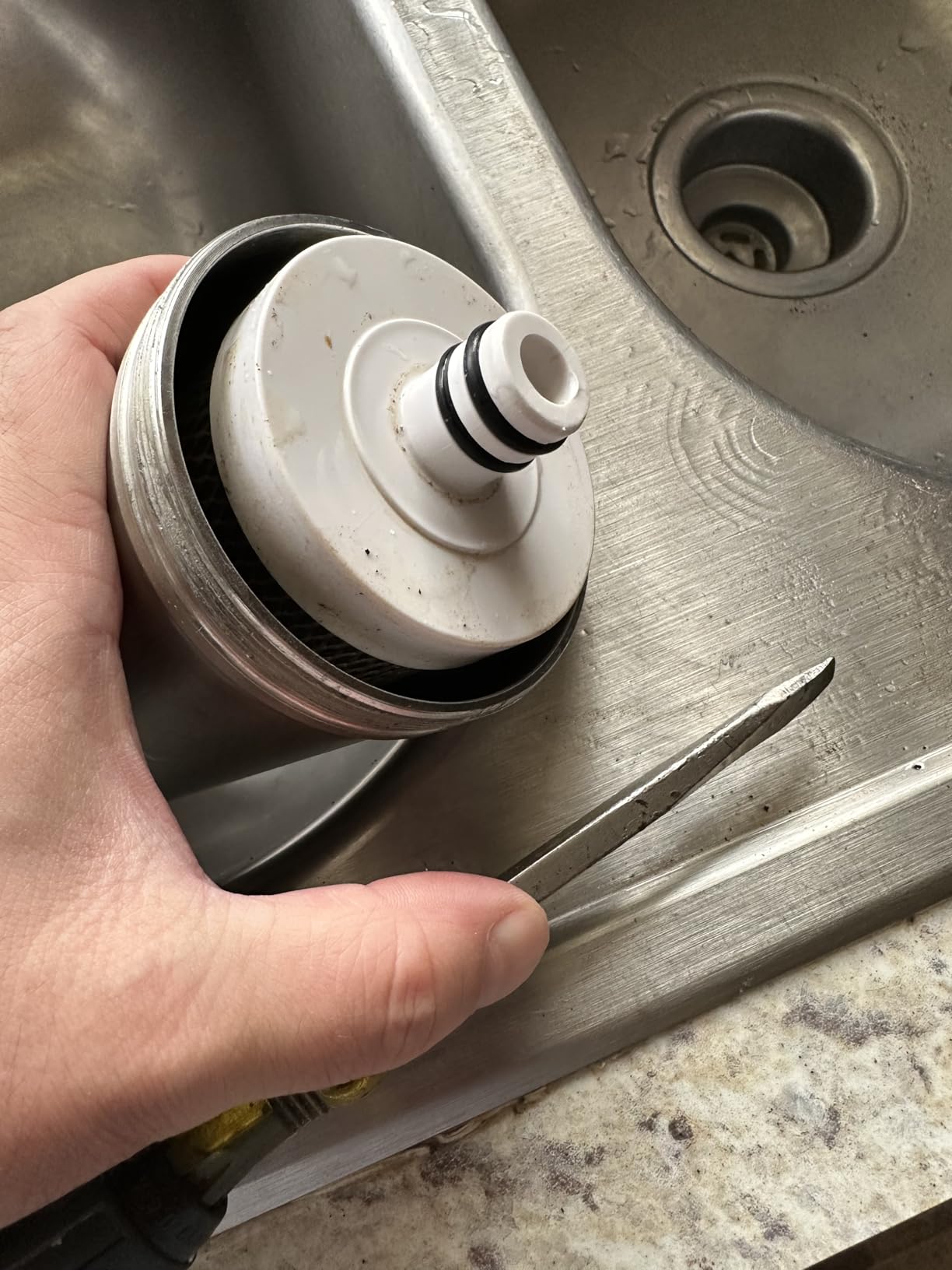
Flow is the practical headline: an 8 oz cup fills in two to three seconds with no waiting for water to drip through, which makes this the best choice here for filling several bottles quickly. Cartridge life is rated at 8000 gallons or about 12 months, the twist-on faucet connection needs no tools, and six faucet adapters plus a wrench are in the box.
Check the faucet before anything else
This is a faucet-connect model, so the thread decides whether it works. It fits standard faucets only and will not work with pull-out, handheld, spray-style, or sensor faucets unless you have an adapter that is not included. That is the most-cited caveat in the reviews. Most standard kitchen faucets take a 15/16 inch male thread, and removing the existing aerator is part of the install.
What it will not remove
It does not reduce total dissolved solids and retains minerals by design, a reasonable trade for keeping calcium and magnesium in drinking water. If you want dissolved solids and PFAS out, you need a certified reverse osmosis stage instead of a carbon and KDF stack. Replacement cartridges are also proprietary to this brand, and ongoing cost across several years is worth factoring in if you plan to move often.
How to Choose a Countertop Water Filter as a Renter
Six decisions settle this purchase, and you can work through them in about ten minutes. Start with the one that narrows everything else.
1. Match the filter to your contaminant, not to the marketing. Carbon blocks and KDF stacks handle chlorine, taste, odor, and sediment. Hollow fiber ultrafiltration adds a finer physical barrier. Only a reverse osmosis membrane pulls out dissolved solids and most of what people mean when they worry about PFAS and lead. If you do not know your water, a handheld TDS meter is a cheap first check, and several models in this roundup include one.
2. Insist on independent certification and verify it yourself. Look for a specific standard number rather than the word certified. NSF/ANSI 42 covers aesthetic effects like chlorine taste and odor, NSF/ANSI 53 covers health effects, NSF/ANSI 58 covers reverse osmosis and dissolved solids reduction, and NSF/ANSI 372 covers lead-free material compliance. A model that says it was tested to an NSF 53 protocol is not the same as one that is NSF 53 certified, and forum users consistently flag that distinction. Look the model number up in the NSF listings database before you buy.
3. Measure counter space and under-cabinet clearance. Typical figures from the models we covered: slim faucet-connect carbon filters around 3.5 inches square and under 12 inches tall, countertop reverse osmosis models 12 to 14 inches wide and 11 to 16 inches tall, and gravity towers 19 to 20 inches tall. The Aigerri needs about 22 inches of vertical clearance when opened even though it stands 16.1 inches closed. Measure the open height, not the closed height.
4. Verify faucet compatibility or plan to avoid the faucet. Most faucet-connect models need a standard 15/16 inch male threaded aerator. Pull-out sprayer, handheld, touchless, and many designer fixtures will not accept a standard diverter valve, and this is the most common renter disappointment in the category. Gravity-fed models bypass the problem entirely, so if your faucet is unusual, start there instead of hunting adapters.
5. Check the power and drain requirements. Faucet-fed carbon and gravity models need nothing but a faucet or a pitcher. Countertop reverse osmosis models that dispense into a tank need an outlet but no drain, because wastewater collects in a reservoir you empty. Membrane models with a faucet connection need enough pressure, often 45 to 80 psi. If you have no accessible outlet, that alone rules out half this list.
6. Budget for cartridges, not just the model. Carbon and sediment stages run 6 to 12 months or a few hundred gallons, RO membranes run one to two years, and gravity elements are rated in the thousands of gallons. Divide the annual cartridge cost by your household’s daily drinking and cooking water to get a per-gallon number and compare it against bottled water. One warning worth knowing: running a carbon filter past its rated capacity can produce output worse than tap water, so set a reminder rather than waiting for a taste change.
Lease Compliance, Counter Fit, and Moving Out
Most leases prohibit alterations to plumbing, fixtures, appliances, and electrical wiring, and a minority explicitly prohibit drilling. Everything on this list falls outside those categories, which is the whole reason a countertop filter is a renter’s cleanest path to better water.
Keep a written note of anything ambiguous. A direct-connect under-sink system that clamps onto an existing cold line touches nothing permanent, but if your agreement mentions plumbing work, ask by email and keep the reply. Verbal permission is hard to prove later.
A move-out pack-down takes under ten minutes for every faucet-connected model here: unplug, run the faucet cold briefly to flush pressure, unscrew the diverter or hose connection, remove the faucet aerator, empty and dry the reservoir, and pack cartridges separately so a damaged housing does not cost you a fresh set. The two models that pack down smallest are the Big Berkey and the Purewell, because gravity towers nest or disassemble into a few pieces with no water line to unhook.
One renter-specific note most guides skip: in buildings built before the mid-1980s, water reaching your tap may have traveled through lead service lines or lead-soldered joints. That is a health-effects contaminant, which means NSF/ANSI 53 or 58 coverage is the standard to look for, and carbon-only models will not address it. Ask your city for its annual water quality report, and if you are on a well or a short-term rental, treat the contaminant list as unknown until you test.
Frequently Asked Questions
What are the best water filters for apartment renters?
The four renter-friendly install types are pitchers, faucet-mount and faucet-connect models, standalone countertop models, and direct-connect under-sink systems that clamp onto an existing cold line. Among countertop options, the Bluevua RO100ROPOT covers the most ground with a 2:1 pure-to-drain ratio and a glass carafe, the iSpring CKC1C fixes chlorine taste at the lowest outlay, and the Big Berkey needs neither plumbing nor power. Avoid anything that requires drilling a faucet hole, cutting a supply line, or adding a circuit.
Do I need landlord permission to install a countertop water filter?
Almost never. Pitchers, faucet-mount models, and countertop models that connect with a hose or a twist-on fitting change nothing permanent, so they fall outside the alteration clauses most leases contain. The exceptions are a dedicated filtered-water faucet that needs a drilled hole, any system that cuts into a supply line, and hardwired under-sink models. If your lease mentions plumbing or fixtures at all, ask in writing and keep the reply.
Will a countertop water filter fit my faucet?
Most faucet-connect models need a standard 15/16 inch male threaded aerator. Pull-out sprayer, handheld, touchless sensor, and many designer fixtures will not accept a standard diverter valve, and that mismatch is the most common renter complaint in this category. Measure your thread size before ordering, and if your faucet is unusual, choose a gravity-fed model such as the Big Berkey or Purewell that never touches the faucet at all.
How much counter space does a countertop water filter take up?
Slim faucet-connect carbon filters run about 3.5 inches square and under 12 inches tall. Countertop reverse osmosis models typically measure 12 to 14 inches wide and 11 to 16 inches tall, with the widest example at 15.4 inches. Gravity towers are the exception at 19 to 20 inches tall. Check the opened height too: one model stands 16.1 inches closed but needs about 22 inches of clearance when opened.
Do countertop water filters waste a lot of water?
It depends entirely on the type. Reverse osmosis models send 2 to 5 gallons down the drain per gallon produced, so a 3:1 model wastes two extra gallons every time. A 2:1 or 5:1 ratio wastes far less, and carbon, ultrafiltration, and gravity models produce no wastewater at all. Multiply the ratio by your household’s daily drinking and cooking water to see the real annual effect on your own usage.
How often do I replace a countertop filter cartridge?
Carbon and sediment stages typically last 6 to 12 months or roughly 100 to 500 gallons. Reverse osmosis membranes are commonly rated at one to two years, and gravity elements run from 3000 to 6000 gallons each. Replace on the schedule, not by taste, because running a carbon filter past its rated capacity can make output worse than tap water. Models with a TDS display or filter-change indicator remove the guesswork.
The Bottom Line
The best countertop water filters for renters in 2026 fall into three honest tiers. Buy the Bluevua RO100ROPOT if you want the best balance of certified filtration, water efficiency, and glass storage. Buy the iSpring CKC1C if chlorine taste is your only complaint and you want the smallest commitment. Buy the Big Berkey if your faucet is awkward, your kitchen has no outlet, or you expect to move more than once.
Measure your counter, check your faucet thread, and confirm your building’s age before you order. If you also need to treat water for sulfur, odor, or hard-water conditions, our guide to sulfur filters for well water covers that problem in more depth, and our picks for bidet water filters for hard water handle a different appliance on the same plumbing. For other renter-friendly appliances, we have covered countertop freeze dryers in similar depth.