
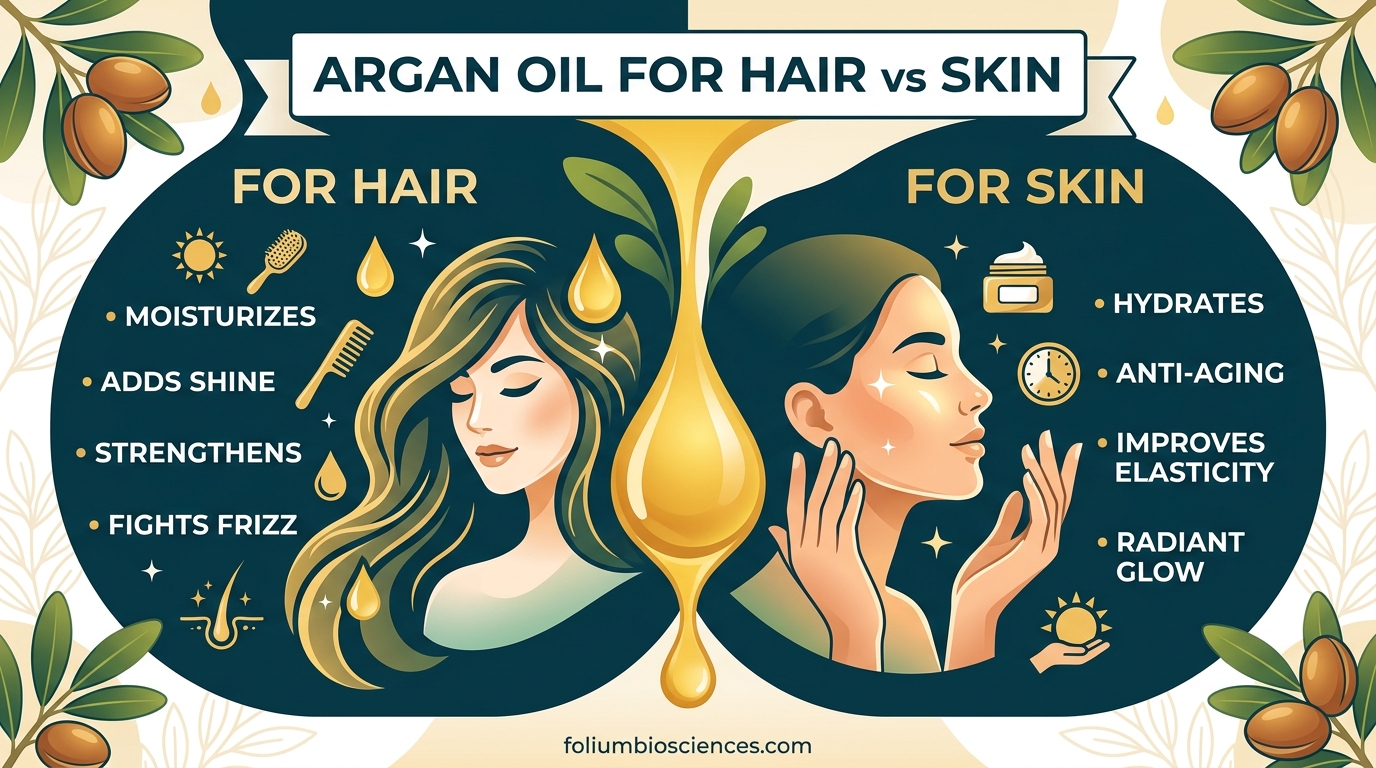
If you have ever stood in the beauty aisle holding a bottle of argan oil and wondered whether you need separate ones for your face and your hair, you are not alone. The short answer: pure argan oil is the same whether you use it on your skin or your hair. One bottle of 100% pure, cold-pressed argan oil can serve both purposes. The confusion comes from products that are labeled “for hair” or “for skin” — these are often formulated blends that contain argan oil mixed with silicones, fragrances, or other additives. But the oil itself? Identical.
In this guide, we break down argan oil for hair vs skin, explore the different grades available, and help you understand exactly what to look for so you can get the most out of every drop.
Table of Contents
What Is Argan Oil? Origin and Extraction
Argan oil comes from the kernels of the argan tree (Argania spinosa), a species native to the arid regions of Morocco. The tree has thrived in the Sous-Massa-Drâa region for centuries, and the oil has been a staple in Moroccan beauty and culinary traditions for just as long. Berber women have hand-pressed argan kernels for generations, using the resulting oil for cooking, skin care, and hair care.
Today, the oil you find in skincare products is typically extracted through cold-pressing. The kernels are cracked by hand or machine, and the seeds inside are pressed at low temperatures to preserve nutrients. This method produces what is known as virgin or unrefined argan oil — the most nutrient-dense grade available. The INCI name you will see on ingredient lists is Argania spinosa kernel oil.
Moroccan argan oil has earned the nickname “liquid gold,” and not just because of its rich golden color. Its high vitamin E content, balanced fatty acid profile, and potent antioxidants make it one of the most versatile natural oils in both cosmetic and culinary applications.
Key Components: What Makes Argan Oil Effective
The reason argan oil works so well for both hair and skin comes down to its chemical composition. Here are the key compounds that do the heavy lifting:
- Vitamin E (tocopherols): A powerful antioxidant that protects cells from free radical damage. Argan oil contains roughly 620 mg per kg of tocopherols — significantly more than olive oil.
- Oleic acid (approximately 47%): A monounsaturated fatty acid that penetrates easily, making it effective for deep moisturization of both skin and hair strands.
- Linoleic acid (approximately 33%): An omega-6 fatty acid that supports the skin barrier, reduces inflammation, and helps regulate sebum production.
- Polyphenols: Plant compounds with antioxidant and anti-inflammatory properties that help protect against environmental damage.
- Squalene: A natural lipid that mimics the skin’s own sebum, helping it absorb quickly without leaving a heavy residue.
- Triterpene alcohols: Compounds that contribute to the oil’s anti-inflammatory and wound-healing properties.
One thing worth noting: pure argan oil has a comedogenic rating of 0, meaning it will not clog pores. This makes it suitable for facial use even on acne-prone skin, which is something many heavier oils cannot claim.
Argan Oil for Hair vs Skin: The Direct Answer
This is the question that brought you here, so let us address it head-on. Can you use the same argan oil for hair and skin? Yes — with one important distinction.
If your bottle contains 100% pure argan oil with no other ingredients listed, it is safe and effective for both your face and your hair. The oil’s fatty acid profile and antioxidants benefit both tissues in similar ways: they hydrate, protect, and reduce inflammation. One bottle, multiple uses.
However, many products sold as “argan oil for hair” are not pure argan oil at all. They are often formulations that blend a small percentage of argan oil with dimethicone (a silicone), cyclomethicone, artificial fragrances, and other additives. These extra ingredients give hair an immediate slip and shine but are not ideal for facial skin. Silicones can trap debris and bacteria under a film on your face, potentially causing breakouts.
So the real split is not between “hair argan oil” and “skin argan oil” — it is between pure argan oil and formulated products containing argan oil. Here is how they compare:
- Pure argan oil: Works for skin, hair, nails, cuticles. Short, clean ingredient list. Light nutty aroma. Golden color.
- Hair argan oil blends: Designed for shine and frizz control. Contains silicones and fragrances. Should not be used on the face. Usually not 100% argan oil.
- Skin argan oil blends: May include essential oils, preservatives, or other carrier oils. Formulated for facial absorption. Can still work on hair but may be heavier.
If you want one product for everything, buy 100% pure, cold-pressed, unrefined argan oil. Simple as that.
Understanding Argan Oil Grades
Not all argan oil is created equal, and understanding the different grades will help you make better choices. The grade affects nutrient density, aroma, color, and best-use applications.
Virgin / Unrefined Argan Oil
This is the highest quality grade. Virgin argan oil is cold-pressed without heat or chemical solvents, preserving the full spectrum of vitamins, fatty acids, and antioxidants. It has a distinctive nutty aroma (some describe it as earthy) and a rich golden-amber color. This grade retains the most tocopherols and polyphenols, making it the best choice for both skin and hair care.
Refined Argan Oil
Refined argan oil undergoes additional processing — typically deodorization and bleaching — to remove the natural scent and color. The result is a lighter, nearly odorless oil that is more appealing for commercial cosmetic formulations. The tradeoff: refining strips away a portion of the vitamin E and polyphenols. It still works well for moisturizing but is less potent than the virgin grade.
Cosmetic Grade vs. Culinary Grade
There is also a distinction between cosmetic and culinary argan oil. Cosmetic argan oil is pressed from raw kernels. Culinary argan oil comes from kernels that are lightly roasted before pressing, which gives it a deeper, nuttier flavor and a darker color. The roasting process alters some of the chemical profile. While culinary argan oil is safe to apply topically, it is not optimized for skincare. Stick with cosmetic-grade for your beauty routine.
Adulterated Oils
Be cautious of extremely cheap argan oil. Some suppliers cut costs by mixing argan oil with cheaper vegetable oils like sunflower or safflower. The bottle may still say “argan oil,” but the concentration of active compounds is far lower. We will cover how to spot these later.
Benefits of Argan Oil for Skin
Argan oil has been studied extensively for its skin benefits. Here is what the research and real-world use tell us:
Hydration and Moisture Retention
The combination of oleic and linoleic acids in argan oil helps strengthen the skin’s natural barrier, reducing transepidermal water loss. A few drops applied to damp skin after cleansing can lock in moisture for hours without feeling greasy. Many users report softer, more supple skin within the first week of consistent use.
Anti-Inflammatory Properties
Linoleic acid and polyphenols give argan oil notable anti-inflammatory effects. This makes it helpful for calming redness, soothing irritated skin, and even managing conditions like eczema and psoriasis in some cases. It is also beneficial for acne-prone skin — contrary to what you might expect from putting oil on breakouts. Because it has a comedogenic rating of 0 and helps regulate sebum production, it can actually reduce the frequency of clogged pores.
Anti-Aging and Elasticity
Vitamin E is one of the most well-researched antioxidants for skin health. It helps neutralize free radicals generated by UV exposure and pollution, which are primary drivers of premature aging. Regular application of argan oil has been shown in small studies to improve skin elasticity and reduce the appearance of fine lines over several weeks.
Additional Uses
Some people ask whether argan oil can remove melasma. While it cannot eliminate melasma on its own (melasma is driven by hormones and UV exposure), the antioxidants in argan oil may help lighten hyperpigmentation over time when used as part of a broader treatment routine. Pair it with sunscreen and active ingredients like vitamin C for better results.
Benefits of Argan Oil for Hair
Argan oil is equally impressive when it comes to hair care. Here is what it does best:
Frizz Control and Smoothness
One of the most immediate effects people notice is smoother, more manageable hair. Argan oil coats the hair shaft, filling in microscopic gaps in the cuticle layer. This reduces friction between strands and helps prevent the flyaways and frizz that come from humidity and static. Users with wavy and curly hair textures report particularly good results for defining their natural pattern.
Deep Conditioning and Moisture
Because oleic acid penetrates the hair shaft, argan oil delivers moisture from the inside out — not just sitting on the surface. Applied as a pre-wash treatment, it can restore softness to dry, brittle hair. Many people mix it with their regular conditioner for an extra boost of hydration.
Protection Against Heat and Styling Damage
The antioxidant properties of vitamin E and polyphenols help shield hair from the oxidative stress caused by blow drying, flat ironing, and sun exposure. While it is not a replacement for a dedicated heat protectant, argan oil adds a layer of defense against daily environmental wear.
Split End Prevention and Scalp Health
Regular application to the ends of your hair helps seal the cuticle, which can reduce the appearance of split ends between trims. As for your scalp, argan oil’s anti-inflammatory properties can help soothe dryness and flaking. However, dermatologists caution that if you have seborrheic dermatitis or a naturally oily scalp, applying oil directly to your scalp may worsen the condition. Keep applications focused on the mid-lengths and ends.
How to Use Argan Oil for Hair and Skin
Application method matters more than you might think. The same bottle of argan oil requires different approaches depending on where you are using it. Here is how our team and experienced users recommend applying it:
For Facial Skin
Start with 2 to 3 drops. Warm the oil between your palms and gently press it into your face and neck. Apply it after cleansing and any water-based serums, but before heavier creams. Argan oil works best on slightly damp skin, which helps seal in the moisture from your cleanser. You can use it morning and night. In the morning, follow with sunscreen.
For Hair
Use 1 to 2 pumps (roughly 4 to 6 drops for medium-length hair). Rub between your palms and apply to the mid-lengths and ends of your hair — avoid the roots and scalp unless you have a dry scalp. You can apply it to damp hair before styling or to dry hair as a finishing oil for shine and frizz control. For a deep conditioning treatment, apply a generous amount to dry hair from roots to ends, leave it on for 30 minutes to an hour, then shampoo out.
For Body and Nails
After a shower, while your skin is still damp, massage a few drops into any dry areas — elbows, knees, heels. For cuticle care, massage a single drop into each nail bed. The oil absorbs quickly and will not leave your hands feeling slick.
Common Dosage Mistake
The number one complaint on forums is “argan oil made my hair greasy.” This almost always means too much was applied. Start with less than you think you need. You can always add more. For fine or thin hair, one drop may be enough. For thick or coarse hair, 3 to 4 drops is usually the sweet spot.
How to Choose High-Quality Argan Oil
Quality varies wildly in the marketplace. Here is a checklist to help you sort the real thing from the diluted imitators:
- Ingredient list: It should list one ingredient only — Argania spinosa kernel oil. If you see dimethicone, cyclopentasiloxane, fragrance, or anything else, it is a blend, not pure argan oil.
- Packaging: Look for dark amber or cobalt glass bottles. Clear glass and plastic containers allow UV light to degrade the oil over time.
- Color and scent: Pure unrefined argan oil is golden to amber in color and has a mild, nutty, earthy aroma. If it smells like perfume or has no scent at all, it may be refined or blended.
- Certifications: Cold-pressed, unrefined, organic, and fair-trade certifications are all positive signs. Reputable suppliers should be able to provide certificates of analysis on request.
- Price: Genuine argan oil is labor-intensive to produce. If a large bottle costs the same as a latte, the quality is questionable. That said, the highest price does not always mean the best quality — check the other criteria first.
Storage and Shelf Life
To keep your argan oil fresh and effective, store it in a cool, dark place away from direct sunlight and heat sources. A bathroom cabinet or drawer works well. Unrefined argan oil typically lasts 12 to 24 months after opening. If the oil starts to smell sharp, rancid, or markedly different from when you bought it, it has oxidized and should be replaced. Refrigeration can extend shelf life but is not necessary — just keep it away from your shower’s steam and heat.
Is argan oil for skin and hair the same?
What are the different grades of argan oil?
Can argan oil remove melasma?
How to tell if argan oil is good quality?
Can I use hair argan oil on my face?
Is argan oil good for acne-prone skin?
The Bottom Line on Argan Oil for Hair vs Skin
When it comes to argan oil for hair vs skin, the distinction is not about the oil itself — it is about what else is in the bottle. Pure, cold-pressed, unrefined argan oil is one of the rare ingredients that genuinely works for both your face and your hair without any reformulation. One bottle, kept in a dark glass container away from heat, can handle your facial moisturizing, your hair conditioning, your cuticle care, and your body hydration.
The key takeaway: read ingredient labels carefully. Products marketed specifically for hair often add silicones and fragrances that you do not want on your face. If the label says 100% Argania spinosa kernel oil and nothing else, you have found the real deal. Invest in quality, use the right amount for each application, and you will see why Moroccan communities have trusted this oil for centuries.