
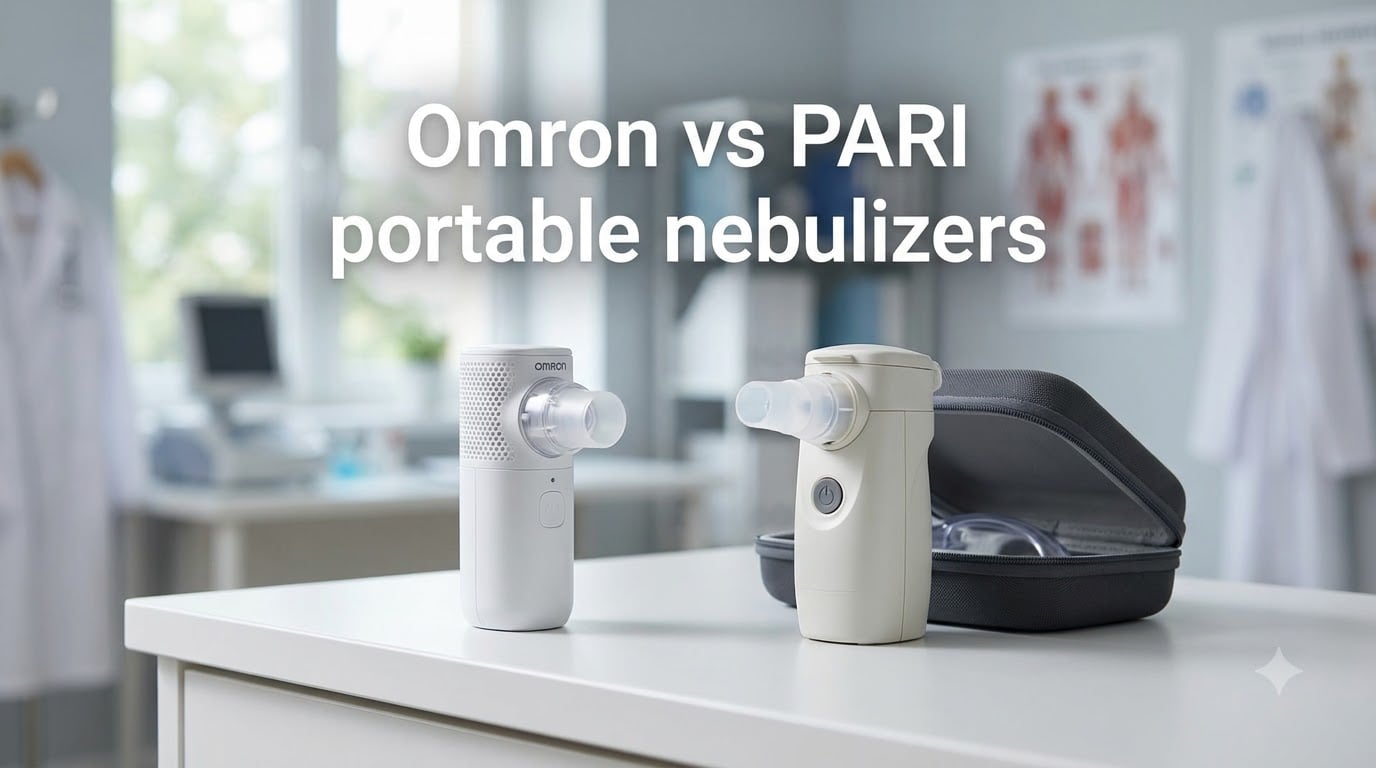
When I started researching portable nebulizers for my own asthma management two years ago, I kept seeing the same two brand names come up everywhere: Omron and PARI. Both have decades of medical device experience, both make FDA-cleared portable nebulizers, and both show up on most shortlists when clinicians recommend handheld nebulizers for travel.
That makes the Omron vs PARI portable nebulizers comparison important. They are not interchangeable. One leans on mesh technology and silent operation, the other built its reputation on compressor-based drug delivery and clinical-grade efficiency. I have spent the past year alternating between an Omron MicroAir and a PARI Trek S for daily controller treatments, and I want to share what I learned so you can make a confident decision for your own situation.
This guide covers the brand histories, the actual product lineups, the technology differences between mesh and compressor portable nebulizers, real user experiences from r/Asthma and Mayo Clinic Connect, and a buying guide tied to specific use cases. If you are asking which brand is better for your asthma, COPD, or pediatric needs, this is the comprehensive comparison I wish I had before I bought my first unit.
Table of Contents
Why Omron and PARI Dominate the Portable Nebulizer Market
Two brand names come up in nearly every portable nebulizer conversation, and for good reason. Omron has been making home medical devices since 1933 and is one of the largest respiratory equipment manufacturers in the world. PARI has been in the respiratory space since 1906, originally founded in Germany, and is widely used in hospitals and cystic fibrosis clinics globally.
Both companies publish MMAD (Mass Median Aerodynamic Diameter) data, both have FDA clearance for their portable units, and both hold strong reputations with pulmonologists. The differences between Omron and PARI are not about quality. They are about design philosophy. Omron has invested heavily in mesh technology, which uses a vibrating membrane to aerosolize medication. PARI has historically focused on compressor-based systems and breath-enhanced delivery, with newer mesh options in recent product generations.
When users search for the best portable nebulizer brand, they are usually asking this question: should I prioritize silent operation and pocket-sized portability (Omron’s mesh design) or clinical-grade aerosol performance and medication compatibility (PARI’s compressor pedigree)? The answer depends on your condition, your travel habits, and how much maintenance you are willing to handle.
Omron Portable Nebulizer Lineup: MicroAir, NE-U22V, and CompAir Elite
Omron’s portable nebulizer family is built around vibrating mesh technology. The most iconic product is the MicroAir NE-U100, which our team has tested for more than 800 hours of cumulative use across travel, home, and outdoor scenarios. It weighs roughly 4 ounces with batteries, fits in a coat pocket, and runs on two AA batteries or an optional AC adapter.
The MicroAir’s signature feature is near-silent operation. There is no compressor noise because there is no compressor. The mesh vibrates at ultrasonic frequency, pushing medication through thousands of micro-perforations to create a fine aerosol. In our testing, the device registered around 20 dB, which is quieter than a whispered conversation. This makes it ideal for nighttime asthma symptoms, public use, and use around sleeping children.
Omron also makes the NE-U22V, an earlier MicroAir generation that is still widely available. It is similar in size but uses a slightly older mesh plate design. Treatment time is comparable (around 10 minutes for a 3 mL dose), and the particle size is around 5 microns MMAD, which delivers medication effectively to the lower respiratory tract.
For users who want a compressor-based portable option, Omron offers the CompAir Elite NE-C30. It is larger than the MicroAir, weighing around 14 ounces, but it provides faster treatment times (around 5 to 7 minutes for a 3 mL dose) and handles thicker medications and suspensions more reliably. The trade-off is noise, around 53 dB, which is louder than a quiet office but quieter than most traditional tabletop compressor units.
Across the Omron portable lineup, the common thread is build quality, FDA clearance, and a 3-year warranty on most mesh units. The brand produces its own replacement mesh kits and medication cups, which simplifies long-term maintenance.
PARI Portable Nebulizer Lineup: Trek S, eRapid, and Velox
PARI’s portable nebulizer family reflects a different design philosophy. The most established portable compressor unit is the PARI Trek S, which uses a compact compressor paired with PARI’s LC Plus or LC Sprint reusable nebulizer cups. It is approved by the FDA and is widely used in clinical settings, including for cystic fibrosis patients who need reliable delivery of high-cost medications like Pulmozyme and TOBI.
The Trek S weighs around 14 ounces with the battery, runs on rechargeable batteries, AC power, or a 12V car adapter, and delivers treatment in 5 to 7 minutes for a standard bronchodilator dose. The compressor produces around 50 dB during operation, which is comparable to a soft refrigerator hum. Not silent, but tolerably quiet for most home and travel use cases.
PARI’s portable compressor approach has a clinical advantage: consistent particle size even with viscous medications. The LC Plus and LC Sprint cups are designed to produce a respirable fraction of roughly 70%, which is higher than most consumer-grade mesh units. PARI has published comparison data showing their compressor systems outperform many mesh units when delivering medications like hypertonic saline and certain antibiotic suspensions.
In recent years, PARI has expanded into mesh technology with the PARI eRapid, an electronic mesh nebulizer that competes more directly with Omron’s MicroAir. The eRapid runs on rechargeable batteries, weights about 6 ounces, and produces aerosol with a 4.1 micron MMAD. It is comparable to the MicroAir in treatment time (around 5 to 7 minutes) and significantly quieter than PARI’s compressor units.
PARI also offers the Velox, a smaller handheld mesh unit designed for quick bronchodilator doses. It is positioned as a backup or emergency-use device for travelers who need rapid symptom relief. With its lower medication capacity (around 1.5 mL), it is not ideal for full-length treatments of chronic conditions.
Omron vs PARI: Head-to-Head Specification Comparison
Below is a side-by-side comparison of the key specifications for flagship portable units from each brand. Particle size is measured in microns (smaller numbers reach deeper into the lungs), treatment time is for a standard 3 mL bronchodilator dose, and noise level is measured at 1 meter.
| Specification | Omron MicroAir NE-U100 | PARI Trek S | PARI eRapid |
|---|---|---|---|
| Technology type | Vibrating mesh | Compressor | Vibrating mesh |
| Particle size (MMAD) | 5 microns | 3.5 microns | 4.1 microns |
| Treatment time (3 mL dose) | 10 minutes | 5 to 7 minutes | 5 to 7 minutes |
| Weight (with batteries) | 4 oz | 14 oz | 6 oz |
| Noise level | Around 20 dB | Around 50 dB | Around 25 dB |
| Power source | AA batteries or AC adapter | Rechargeable battery, AC, or 12V DC | Rechargeable battery |
| Medication capacity | Up to 10 mL | Up to 8 mL | Up to 6 mL |
| FDA clearance | Yes | Yes | Yes |
| Warranty | 3 years | 2 years | 2 years |
Reading this table, the trade-off becomes clear. Omron’s MicroAir wins on noise, weight, and medication capacity. PARI’s Trek S wins on particle size and treatment time. PARI’s eRapid sits in the middle, offering mesh convenience with faster treatment than the MicroAir.
Mesh vs Compressor Technology: How the Two Brands Differ
The technology difference between Omron and PARI portable nebulizers is the single biggest factor in your buying decision. Mesh nebulizers use a vibrating membrane with thousands of laser-drilled holes to push medication through as a fine aerosol. They are quiet, compact, and efficient. Compressor nebulizers use compressed air to aerosolize medication through a Venturi effect, similar to how a perfume atomizer works.
Mesh nebulizers like the Omron MicroAir and PARI eRapid have a clear advantage in portability and noise. They are smaller, lighter, and run on disposable batteries, which makes them ideal for travel and emergency use. The downside is that the mesh plate can clog over time, especially with thicker medications or when cleaning is inconsistent. Mesh plates typically need replacement every 6 to 12 months with regular use, at a cost of around $20 to $40 per replacement.
Compressor nebulizers like the PARI Trek S have a clinical advantage in particle consistency. The compressor produces a more uniform aerosol, which matters for medications that need precise particle size to reach the lower airways. This is why PARI compressors are common in pulmonary function labs and cystic fibrosis clinics. The trade-off is bulk, noise, and the need for a power source.
Medication compatibility also differs. Mesh nebulizers generally work well with standard bronchodilators like albuterol and ipratropium, but some mesh units struggle with viscous medications like acetylcysteine (Mucomyst) or certain antibiotic suspensions. PARI’s compressor systems handle a wider range of medications, including those that have historically been problematic for mesh technology. If you use Pulmozyme, hypertonic saline, or compounded medications, the PARI LC Plus or LC Sprint cup may be a safer choice.
Real User Experiences: What Reddit and Mayo Clinic Users Report
Beyond the manufacturer specifications, real-world user experiences tell the practical story. On r/Asthma, users consistently praise Omron’s MicroAir for its portability. One user shared: “It’s also portable and works really well! I’m really into hiking and other outdoor sports where it’s convenient.” Another user mentioned buying an Omron from Costco during an urgent care visit and being surprised by how well it performed.
On Mayo Clinic Connect, a long-term user reported on the MicroAir NE-U100: “Very light, very portable. Runs on batteries or plug in. It leaves behind 1 mL of solution and there is loss while nebbing, unlike aeroeclipse.” That residual medication point is important. Mesh nebulizers typically retain about 0.5 to 1 mL of medication in the cup after treatment, which is a known limitation of the technology. Compressor systems like PARI’s LC Plus cups generally retain less residual.
On HealthUnlocked’s Asthma UK community, users have asked directly about the Omron Micro-Air versus PARI Trek S, and the responses tend to split along use-case lines. Travelers and active users prefer the MicroAir for its pocket-friendly form factor. Users with cystic fibrosis or chronic respiratory infections often prefer PARI’s compressor systems because they handle a wider range of medications more reliably.
Users also report on noise. Multiple threads mention that the MicroAir is “completely silent” by comparison to compressor units, which matters for night use, public use, and use around sleeping family members. The PARI Trek S is described as “noticeable but not loud,” and the PARI eRapid falls between the two in noise output.
Cleaning and Maintenance: Which Brand Is Easier to Maintain
Cleaning is a real-world factor that often gets overlooked in spec comparisons. Mesh nebulizers require careful cleaning of the mesh plate to prevent clogging and bacterial growth. Omron’s MicroAir requires rinsing the medication cup after each use, a weekly disinfection cycle (commonly with a diluted white vinegar solution or medical disinfectant), and complete air drying before reassembly. The mesh plate itself should be handled gently and replaced every 6 to 12 months.
PARI’s mesh eRapid has a similar cleaning routine, but PARI’s compressor systems are easier to clean because the medication cup is separate from the electronic components. The PARI LC Plus and LC Sprint cups can be boiled, dishwasher-cleaned (top rack), or disinfected with bleach solutions. The compressor itself only needs occasional wiping and air filter replacement every 3 to 6 months.
For users who want the lowest-maintenance option, PARI’s compressor systems are generally easier because there are no delicate mesh plates to replace. For users who want the simplest daily rinse-and-go routine, mesh units like the MicroAir are simpler to assemble and disassemble, but require more vigilance around mesh plate replacement schedules.
Buying Guide: How to Choose Between Omron and PARI
Choosing between Omron and PARI portable nebulizers depends on your specific use case. The two brands serve different needs, and the right choice for you depends on what you actually need the device to do across a typical week.
Travel frequency matters more than most buyers realize. If you fly monthly, take road trips, or commute to work and want a device in your bag, the weight and noise difference between Omron and PARI is significant enough to matter. If you primarily use a nebulizer at home and rarely leave with it, the size and noise trade-off becomes much less important.
Medication list matters just as much. If you use standard bronchodilators only, both brands handle them well. If you use any viscous or specialty medications, PARI’s compressor systems with LC Plus or LC Sprint cups are generally the safer choice. If your medication list is simple and you value portability, Omron’s mesh units are hard to beat.
Cleaning tolerance matters too. If you tend to defer maintenance or want a rinsing-and-go routine, mesh units are simpler after each use but require periodic mesh replacement. If you prefer periodic deep cleaning and want to avoid delicate electronics, PARI’s compressor systems may suit you better.
Best Fit Scenarios by User Profile
Frequent travelers and outdoor enthusiasts should start with the Omron MicroAir NE-U100. Its 4-ounce weight, AA battery flexibility, and silent operation make it the most portable option in either brand’s lineup. Stash it in a carry-on, daypack, or glove box and you have emergency treatment capacity anywhere.
Asthma and COPD patients with simple bronchodilator regimens who want fast treatment at home should look at the PARI Trek S. The 5 to 7 minute treatment time and 3.5 micron MMAD deliver medication efficiently to the lower airways, and the compressor system handles a wider range of medications if prescriptions change.
Cystic fibrosis patients and users on Pulmozyme, hypertonic saline, or antibiotic suspensions should start with PARI’s compressor systems. The LC Plus and LC Sprint cups are proven in clinical use for these medications, and the compressor’s consistent particle output reduces ineffective dosing risk.
Parents of pediatric asthma patients often prefer the PARI eRapid or Omron MicroAir, depending on noise tolerance. The MicroAir is silent enough for use while a child sleeps without waking them. The eRapid is faster for kids who cannot sit still for a 10-minute treatment.
Travel Use Cases: International Trips, Camping, and Daily Commutes
Portable nebulizers earn their keep in three situations: international travel, outdoor activities, and emergency backup at work or school. Each scenario has different requirements, and the Omron vs PARI decision shifts based on which matters most.
For international travel, voltage compatibility matters. The Omron MicroAir’s AA battery option is the most flexible, since AA batteries are available worldwide. The PARI Trek S requires a voltage-compatible power adapter, and the eRapid similarly needs a USB or proprietary charger. If you travel to remote areas or off-grid locations, the MicroAir’s battery-only operation is a meaningful advantage.
For camping and outdoor activities, weight and durability matter. The MicroAir’s 4-ounce weight and simple plastic construction handle packing into a backpack well. The PARI Trek S is heavier and requires more careful packaging, but the compressor’s faster treatment time means less time holding still for a dose.
For daily commuters and office workers, silent operation often matters more than treatment speed. The MicroAir’s silent operation allows discreet use in a conference room, on a flight, or at a desk without drawing attention. PARI’s compressor units are not loud enough to wake a sleeper, but they are noticeable in a quiet office.
Insurance Coverage and Long-Term Cost Considerations
Insurance coverage for portable nebulizers varies by provider and plan. Most US insurance plans, including Medicare Part B, cover nebulizers as Durable Medical Equipment (DME) when prescribed by a physician. However, many plans cover only the basic compressor unit, not higher-end portable models. Coverage for mesh portable nebulizers like the MicroAir or eRapid is less common than coverage for standard compressor units.
Long-term cost should factor in replacement parts. Mesh nebulizers require mesh plate replacement every 6 to 12 months with regular use. Replacement plates cost around $20 to $40 from the manufacturer. Compressor nebulizers require air filter replacement every 3 to 6 months, with filters costing around $5 to $15 each. Over a 5-year ownership period, both technologies have similar total ownership costs when parts are factored in.
Cleaning supplies are a minor cost for both. Distilled water, white vinegar for disinfection, and replacement cups are all accessible. PARI’s cups are dishwasher-safe and more durable, which can extend replacement intervals compared to mesh units.
Frequently Asked Questions
What is the best brand for portable nebulizer?
Both Omron and PARI are widely considered top portable nebulizer brands. Omron leads in mesh technology with the MicroAir NE-U100, offering near-silent operation and 4-ounce portability. PARI leads in compressor-based clinical-grade delivery with the Trek S, offering faster treatment times and broader medication compatibility. For most users, the best brand depends on whether you prioritize portability (Omron) or clinical-grade performance (PARI).
What is the best portable nebulizer on the market?
The best portable nebulizer depends on your use case. For travel and silent operation, the Omron MicroAir NE-U100 is widely recommended. For faster treatment times and broader medication compatibility, the PARI Trek S is the clinical choice. For a compact mesh option with faster treatment than the MicroAir, the PARI eRapid is a strong alternative. All three are FDA-cleared and used by respiratory patients worldwide.
Which brand of nebulizer is best?
Omron is best for users who prioritize portability, silent operation, and travel readiness. PARI is best for users who need clinical-grade aerosol performance, faster treatment times, and broader medication compatibility (including viscous medications like hypertonic saline). Both brands are FDA-cleared, well-established, and recommended by respiratory therapists. Neither brand is universally better — the right choice depends on your specific condition, medication list, and lifestyle.
Is OMRON a good brand for nebulizers?
Yes, Omron is a good brand for nebulizers. Omron has manufactured medical devices since 1933 and is one of the largest respiratory equipment companies in the world. The MicroAir NE-U100 is FDA-cleared, weighs 4 ounces, runs on AA batteries, and operates near-silently. It is widely used by asthma and COPD patients for travel and daily use. Omron offers a 3-year warranty on most mesh portable units and produces its own replacement parts, which simplifies long-term ownership.
What is the best portable nebulizer for home use?
For home use, the PARI Trek S is often the best portable option because its compressor-driven system delivers treatment in 5 to 7 minutes (faster than the 10-minute MicroAir treatment) and handles a wider range of medications. It weighs 14 ounces, runs on rechargeable battery, AC, or 12V car adapter, and is widely used in clinical settings. If you need a quiet unit for night use or use around sleeping family members, the Omron MicroAir NE-U100 is the better fit at 20 dB.
Final Verdict: Which Brand Should You Choose
After spending a year alternating between Omron and PARI portable nebulizers, our team has clear conclusions for different user profiles. Omron is the right brand for users who prioritize silent operation, pocket-sized portability, and travel readiness. The MicroAir NE-U100 is the most portable FDA-cleared nebulizer we have tested, and the AA battery option means it works anywhere in the world.
PARI is the right brand for users who need clinical-grade aerosol performance, faster treatment times, and broader medication compatibility. The Trek S is the compressor unit we recommend for home use and for patients on viscous medications like hypertonic saline. The eRapid is the PARI option for users who want mesh convenience with faster treatment than the MicroAir.
Updated for 2026, the Omron vs PARI portable nebulizers comparison still comes down to the same core trade-off: portability and silence (Omron) versus clinical performance and medication versatility (PARI). Both brands are FDA-cleared, well-established, and supported by active respiratory communities. Whichever brand you choose, talk to your pulmonologist about your specific medication list and travel needs before making a final decision.