
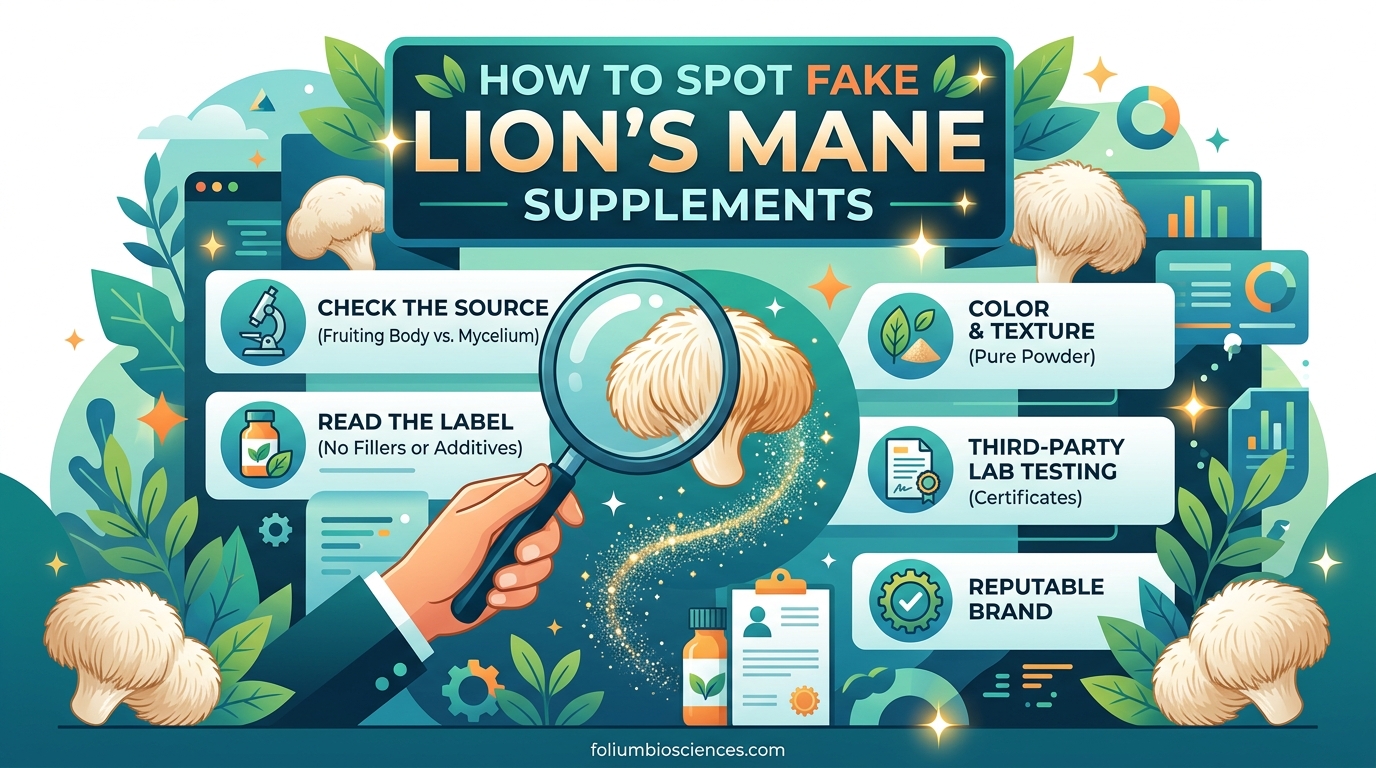
The functional mushroom industry is booming, but so is fraud. Studies estimate that a significant percentage of mushroom supplements on the market contain little to no actual bioactive compounds. This guide will teach you exactly how to read a Lion’s Mane label to separate quality products from worthless imposters.
Table of Contents
Understanding the Basics: What Real Lion’s Mane Contains
Lion’s Mane (Hericium erinaceus) is a medicinal mushroom that has been used in traditional medicine for centuries, particularly in East Asian cultures. Modern research has focused on its potential cognitive benefits, including support for nerve growth factor (NGF) synthesis, memory function, and overall brain health.
However, not all Lion’s Mane supplements are created equal. The bioactive compounds that make this mushroom valuable are concentrated in specific parts of the mushroom and in specific forms that many manufacturers fail to deliver.
Hericenones and Erinacines: The Active Compounds
Real Lion’s Mane supplements derive their efficacy from two key groups of bioactive compounds:
Hericenones (found in the fruiting body): These compounds stimulate the synthesis of nerve growth factor (NGF) in the brain. NGF is essential for the survival and function of neurons, making hericenones crucial for cognitive support.
Erinacines (found primarily in the mycelium): These triterpenes also promote NGF synthesis but are more concentrated in the mycelial culture. However, the commercial viability and concentration of erinacines in supplements varies dramatically depending on manufacturing methods.
The critical point here is that for a supplement to deliver real benefits, it must contain meaningful amounts of these compounds. Most fake or low-quality supplements contain neither hericenones nor erinacines in any significant concentration.
Beta-Glucans: The Quality Indicator That Matters Most
Beta-glucans are polysaccharides that form the structural cell walls of mushroom cells. They are widely recognized as the primary bioactive compounds responsible for the immunomodulatory effects of medicinal mushrooms.
Here is what you need to understand about beta-glucan percentages:
- Quality fruiting body extract: Typically contains 25-40% beta-glucans
- Mycelium on grain products: Usually contain only 1-5% beta-glucans (the rest is starch from the grain substrate)
- Whole mushroom powder: Contains 10-20% beta-glucans depending on processing
Key Math: If a product claims 500mg of “Lion’s Mane” but only contains 3% beta-glucans from mycelium on grain, you are getting approximately 15mg of actual bioactive compounds. A quality fruiting body extract with 30% beta-glucans would deliver 150mg of beta-glucans from the same 500mg serving.
Fruiting Body vs. Mycelium on Grain: The Critical Distinction
This is the single most important factor in determining whether a Lion’s Mane supplement is legitimate. Understanding the difference will save you from wasting money on products that deliver nothing but filler.
What Fruiting Body Actually Is
The fruiting body is the visible, above-ground part of the mushroom that produces spores. This is what you recognize when you see a Lion’s Mane mushroom with its distinctive cascading, hair-like spines.
The fruiting body contains the highest concentration of bioactive compounds, including:
- Hericenones (primarily in the fruiting body)
- High levels of beta-glucans (25-40%)
- Polysaccharides with documented health benefits
Quality supplements will explicitly state “fruiting body” or “fruiting body extract” on the label, and they will often specify the beta-glucan percentage to substantiate their quality claims.
Mycelium on Grain: The Cheap Substitute
Mycelium on grain (sometimes called “myceliated brown rice” or “mushroom mycelia biomass”) is exactly what it sounds like: fungal mycelium grown on a grain substrate, typically rice or millet.
Red Flag: When mycelium is grown on grain, the grain becomes part of the final product. This means the supplement is significantly diluted with starch (which registers as polysaccharides but provides no bioactive benefit) and may contain only 1-5% actual beta-glucans.
The problem is compounded because many manufacturers market mycelium on grain products using the same language as fruiting body extracts. Terms like “whole mushroom,” “full spectrum mushroom,” and even “mushroom supplement” are routinely used to describe products that are mostly grain filler.
Consumers Forum Evidence: Reddit communities dedicated to mushroom supplements consistently report that users feel “nothing” from products later identified as mycelium on grain, while experiencing noticeable effects from quality fruiting body extracts.
Fruiting Body vs. Mycelium on Grain Comparison
| Characteristic | Fruiting Body Extract | Mycelium on Grain |
|---|---|---|
| Beta-glucan content | 25-40% | 1-5% |
| Hericenones | Present in meaningful amounts | Negligible |
| Erinacines | Present in smaller amounts | May be present but diluted |
| Grain/starch content | None | Often 50%+ of supplement |
| Cost to manufacture | Higher (requires fruiting body cultivation) | Lower (industrial fermentation) |
| Label indicators | “Fruiting body” clearly stated | Vague terms, “mycelium,” “biomass” |
Decoding Supplement Labels: What Actually Matters
Supplement labels are designed to sell products, not to inform consumers. Understanding the difference between what regulations require on a label versus what constitutes meaningful information is essential for making informed purchasing decisions.
What Labeling Regulations Actually Require vs. Marketing Copy
In most countries, including the United States, mushroom supplements fall under food labeling regulations rather than pharmaceutical regulations. This means:
What MUST appear on the label (legally required):
- Net contents
- Supplement Facts panel (serving size, ingredients)
- Manufacturer/distributor information
- Allergen declarations
What CAN appear on the label (marketing, often misleading):
- Structure/function claims (“supports cognitive health”)
- Terms like “pure,” “natural,” “potent”
- Images of whole mushrooms (regardless of actual contents)
- High milligram counts that include inactive ingredients
The DSHEA (Dietary Supplement Health and Education Act) of 1994 essentially allows supplement manufacturers to make structure/function claims without proving efficacy, as long as they include the disclaimer “This statement has not been evaluated by the FDA. This product is not intended to diagnose, treat, cure, or prevent any disease.”
This regulatory environment is precisely why understanding label red flags is so important for consumers.
Label Terms That Should Raise Immediate Suspicion
Several label terms and presentations are commonly used to obscure the true nature of mushroom supplements. Being aware of these red flags can save you from purchasing ineffective products.
- Vague source descriptions like “Lions Mane (Hericium erinaceus)” without specifying fruiting body vs. mycelium
- Milligram counts that do not indicate beta-glucan percentage or extraction method
- Stock photography of whole mushrooms on labels for products that are actually mycelium powder
- Claims of “pure” or “100% mushroom” when the ingredient list shows mycelium or grain
The Top Red Flag Terms to Watch For
Certain terms have become ubiquitous in the mushroom supplement industry specifically because they sound impressive while conveying virtually no meaningful information about product quality.
Proprietary Blend: Hiding the Actual Ingredients
Proprietary blend is a label term that allows manufacturers to combine multiple ingredients without disclosing the individual amounts of each ingredient. The total amount is disclosed, but the breakdown is kept secret as “trade secret.”
Why this matters for Lion’s Mane: A product might list “Proprietary Blend: 1000mg” containing a mixture of mushroom powders, extracts, and fillers. You have no way of knowing whether you are getting 100mg of actual mushroom extract or 5mg.
Forum evidence suggests that heavy marketing of proprietary blend products correlates with lower actual bioactive content, as manufacturers can hide low-quality ingredients behind the blend designation.
Quality manufacturers have no need for proprietary blends when their ingredients are genuinely high-quality. If a company is proud of their formulation, they will typically disclose exactly what is in it.
“Full Spectrum” Without Specifications
Full spectrum is a marketing term that suggests the product contains everything from the mushroom. However, without specifications, this term is meaningless.
A “full spectrum” product could mean:
- Everything from the fruiting body (genuinely good)
- Everything from the mycelium including the grain (mostly worthless)
- Everything including extraction residues (questionable value)
Without a beta-glucan percentage and explicit “fruiting body” designation, “full spectrum” tells you nothing about the actual bioactive content.
Standardized Extract: A Meaningless Term
Standardized extract suggests that the product contains a specific, consistent amount of a marker compound. However, for mushroom supplements, there is no universally agreed-upon standardization marker.
Some manufacturers standardize to polysaccharides, others to beta-glucans, and others to arbitrary metrics that do not correlate with actual efficacy. The term sounds scientific but provides no comparable information across brands.
What matters is the actual percentage of beta-glucans, not whether the extract is “standardized” to some undisclosed specification.
Understanding Extraction Methods
Extraction is the process of pulling bioactive compounds from the mushroom material into a concentrated form. The extraction method significantly impacts which compounds are preserved and their final concentration.
Hot Water Extraction
Hot water extraction mimics traditional mushroom tea preparation. It effectively extracts:
- Beta-glucans (water-soluble)
- Polysaccharides
- Hericenones (to some degree)
Hot water extraction alone produces what is often called a “mushroom extract” or “water-soluble extract.” The extraction ratio (e.g., 8:1, 10:1, 12:1) indicates how many pounds of raw material were used to produce one pound of extract. A higher ratio theoretically means a more concentrated product.
However, hot water extraction does not effectively capture alcohol-soluble compounds like certain triterpenes and some erinacines.
Alcohol Extraction
Alcohol extraction captures compounds that are not water-soluble, including:
- Certain triterpenes
- Some erinacines
- Fat-soluble bioactive compounds
Alcohol extract alone is incomplete because it misses the water-soluble beta-glucans that form a significant portion of the bioactive content.
Dual Extraction: The Gold Standard
Dual extraction combines both hot water and alcohol extraction to capture the full range of bioactive compounds:
- Water extraction captures beta-glucans and polysaccharides
- Alcohol extraction captures triterpenes and alcohol-soluble compounds
- The two extracts are combined, or the mushroom material undergoes sequential extraction
What to look for on the label: “Dual extraction” or “Hot water and alcohol extraction” should be explicitly stated. The extraction ratio (typically 8:1 to 12:1 for quality products) should also be disclosed.
Be wary of products that claim to be “full spectrum” but do not mention extraction method. Without proper dual extraction, the “full spectrum” claim is hollow.
Third-Party Testing and Certificate of Analysis
Third-party testing is one of the most reliable indicators of supplement quality. When a manufacturer voluntarily submits their products for independent laboratory analysis, it demonstrates confidence in their quality claims and provides verifiable evidence.
What a Certificate of Analysis Actually Shows
A Certificate of Analysis (CoA) is a document from an accredited testing laboratory that provides objective test results for a specific product batch. For Lion’s Mane supplements, a meaningful CoA should include:
CoA Should Verify:
- Beta-glucan percentage (should be 25-40% for quality fruiting body)
- Beta-glucan content in mg per serving
- Verification that the product is NOT mycelium on grain
- Heavy metal testing (lead, mercury, cadmium, arsenic)
- Microbial contamination testing
- Identity verification (DNA testing confirming Hericium erinaceus)
Why ISO 17025 Accreditation Matters
ISO 17025 is the international standard for testing and calibration laboratories. A lab that has achieved ISO 17025 accreditation has demonstrated:
- Technical competence to perform specific tests
- Quality management systems ensuring accurate results
- Traceability to international standards
When a CoA comes from an ISO 17025 accredited lab, you can have higher confidence in the accuracy of the results. CoAs from non-accredited labs or in-house testing are significantly less reliable.
How to Verify a CoA
A legitimate CoA should include:
- Laboratory name, address, and accreditation number
- Product batch number (matching the supplement lot)
- Test dates and method references
- Clear results with units and detection limits
Action step: Reputable companies make their CoAs publicly available on their website or upon request. If a company refuses to provide a CoA, or if the CoA only shows “passes” without specific values, this is a major red flag.
Label Claims That Should Raise Suspicion
Beyond the specific terminology discussed above, certain general label claims should immediately increase your scrutiny of a product.
Extremely High Milligram Claims
You may see products claiming 1000mg, 2000mg, or even 3000mg of Lion’s Mane per serving. While these numbers sound impressive, they tell you nothing without context.
The critical question is: 1000mg of what? If the 1000mg is primarily grain starch from mycelium on grain, you are getting almost no bioactive compounds despite the impressive-sounding milligram count.
Remember: 500mg of quality fruiting body extract with 30% beta-glucans delivers 150mg of actual bioactive compound. 2000mg of mycelium on grain with 3% beta-glucans delivers only 60mg of actual bioactive compound.
Mushroom Complex or Mushroom Blend without specifics
Products that list “Mushroom Complex” or “Mushroom Blend” followed by a proprietary blend of various mushrooms without specifying which part of the mushroom (fruiting body vs. mycelium) is used are typically attempting to obscure low-quality sourcing.
Each mushroom type should be individually listed with:
- The specific mushroom species (common name and botanical name)
- The part used (fruiting body, mycelium, etc.)
- The extraction method (if applicable)
Regional Substitution Issues (Hericium novae-zealandiae)
A specific fraud issue has been identified in the New Zealand market where Hericium novae-zealandiae, a related but distinct species, is sometimes substituted for genuine Hericium erinaceus.
What to check: The botanical/mushroom name on the label should clearly state Hericium erinaceus. If you see variations like “New Zealand Lion’s Mane” or species names that do not exactly match, verify the specific mushroom species before purchasing.
While Hericium novae-zealandiae is not necessarily harmful, it has a different bioactive compound profile and the research validating cognitive benefits specifically applies to Hericium erinaceus.
The 30-Second Label Check Framework
When you are standing in a store or browsing online, you do not have time for deep research. Use this quick framework to rapidly assess whether a Lion’s Mane product deserves closer examination.
Quick Verification Steps
30-Second Lion’s Mane Label Check
- Step 1: Look for “fruiting body” or “fruiting body extract” on the label
- Step 2: Find the beta-glucan percentage (should be 25-40% for quality extracts)
- Step 3: Check for extraction method disclosure (dual extraction preferred)
- Step 4: Verify botanical name: Hericium erinaceus
- Step 5: Look for “proprietary blend” (if present, walk away)
- Step 6: Check if CoA is publicly available (should be on website or requestable)
- Step 7: Verify extraction ratio (8:1 to 12:1 is typical for quality extracts)
Good Label vs. Bad Label Comparison
| Label Element | Quality Product (Buy) | Low-Quality Product (Avoid) |
|---|---|---|
| Source declaration | “Fruiting body extract” clearly stated | “Mushroom,” “mycelium,” or vague terms |
| Beta-glucans | 25-40% specified | Not listed or very low (1-5%) |
| Extraction method | “Dual extraction” or hot water + alcohol | Not mentioned |
| Ingredient amounts | Full transparency, no proprietary blends | Proprietary blend hiding amounts |
| Botanical name | Hericium erinaceus | Missing or incorrect species |
| Third-party testing | CoA publicly available with batch number | No CoA, in-house testing only |
| Milligram claims | Reasonable (500-1000mg) with beta-glucan % | Extremely high (2000mg+) without context |
Safety Considerations and Contraindications
Lion’s Mane mushroom is generally considered safe for most adults when taken as directed. However, there are some important safety considerations to be aware of:
General Safety
Most healthy adults can safely take Lion’s Mane supplements. Reported side effects are generally mild and may include digestive discomfort in some individuals.
Allergy Considerations
Individuals with mushroom or fungal allergies should avoid Lion’s Mane supplements, as allergic reactions are possible.
Medication Interactions
If you are taking medications, particularly anticoagulants or antiplatelet drugs, consult your healthcare provider before starting Lion’s Mane supplements. While documented interactions are limited, the potential for mushroom compounds to affect blood clotting warrants caution.
Special Populations
Pregnant and breastfeeding women should consult their healthcare provider before using any supplement, including Lion’s Mane.
Epilepsy and Seizure Disorders: If you have epilepsy or a seizure disorder, consult your healthcare provider before taking Lion’s Mane supplements. There are anecdotal reports from the epilepsy community about sensitivity to certain mushroom supplements. Professional medical guidance is essential before combining with anti-epileptic medications.
Frequently Asked Questions
How to check if the supplement is original?
Check the Supplement Facts panel for “fruiting body” or “fruiting body extract” as the first ingredient. Look for a specific beta-glucan percentage (25-40% for quality extracts). Verify the extraction method is listed. Request the Certificate of Analysis from the manufacturer to confirm beta-glucan content and that no mycelium on grain is present. The botanical name Hericium erinaceus should be clearly stated.
What is the highest quality Lion’s Mane supplement?
The highest quality Lion’s Mane supplements specify “fruiting body extract” with a beta-glucan percentage of 25-40%, use dual extraction (hot water and alcohol), have third-party testing with a publicly available CoA from an ISO 17025 accredited lab, and disclose the extraction ratio (typically 8:1 to 12:1). Avoid products with proprietary blends or vague “full spectrum” claims that do not specify fruiting body sourcing.
Is there a false lion’s mane mushroom?
Yes, Hericium novae-zealandiae is a related species sometimes substituted for Hericium erinaceus, particularly in products from New Zealand. While not necessarily harmful, it has different bioactive compound profiles and may not provide the same cognitive benefits as true Lion’s Mane. Always verify the botanical name on the label matches Hericium erinaceus to ensure you are getting the studied species.
Can I take Lion’s Mane if I have epilepsy?
If you have epilepsy or a seizure disorder, consult your healthcare provider before taking Lion’s Mane supplements. While Lion’s Mane is generally considered safe, there are anecdotal reports from the epilepsy community about sensitivity to certain mushroom supplements. Professional medical guidance is essential before combining it with anti-epileptic medications.
Why do I feel nothing from Lion’s Mane supplements?
If you are not experiencing any effects from a Lion’s Mane supplement, you are likely taking a low-quality product containing mycelium on grain with minimal bioactive compounds. Most users report noticing effects from quality fruiting body extracts (typically within 2-4 weeks of consistent use), while products made from mycelium on grain deliver negligible bioactive content, explaining the lack of effect despite taking the supplement regularly.
Conclusion: Empowering Your Purchasing Decisions
The Lion’s Mane supplement market is plagued by misleading labels, vague marketing terms, and products that contain little to no actual bioactive compounds. However, with the knowledge contained in this guide, you are now equipped to make informed purchasing decisions.
Remember the fundamental principles:
- Fruiting body is essential for meaningful bioactive content
- Beta-glucan percentage is the most important quality indicator on any label
- Third-party CoAs provide verifiable evidence of quality
- Vague terminology like “proprietary blend” and “full spectrum” obscure low quality
Do not be swayed by impressive milligram counts, beautiful packaging, or claims of potency. Take a few seconds to read the actual label information. Your wallet and your health will thank you.
Quality Lion’s Mane supplements do exist. They are characterized by transparent labeling, published third-party testing, and specific declarations of fruiting body sourcing with verified beta-glucan percentages. These products may cost more than the mycelium-on-grain alternatives, but the difference in actual bioactive content makes them infinitely more valuable for supporting your cognitive health goals.