
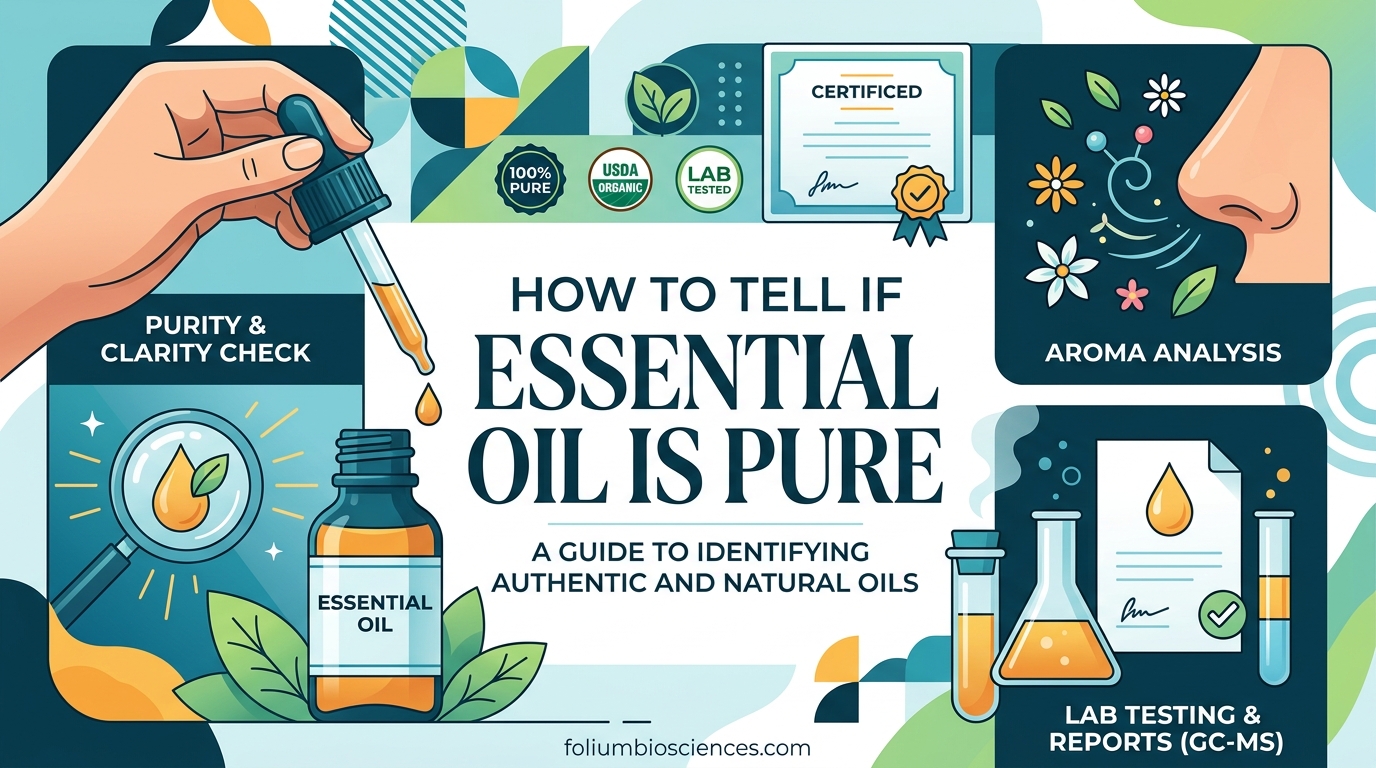
Learning how to tell if essential oil is pure could save you from wasting money on fake products that deliver none of the therapeutic benefits you are after. Our team has spent years working with essential oils in clinical and home settings, and we have learned that purity testing is not just for experts. You can perform simple, reliable checks in your own kitchen using everyday items.
This guide walks you through five at-home tests that reveal whether your lavender, tea tree, or peppermint oil is the real deal. We will also cover when these tests have exceptions and how to get professional verification if you need definitive answers. By the end, you will know exactly how to test essential oils for purity without specialized equipment.
Whether you use oils for aromatherapy, skincare, or natural cleaning, knowing what you are actually diffusing or applying to your skin matters. Let us dive into the methods that separate pure botanical extracts from clever counterfeits.
Table of Contents
How to Tell If Essential Oil Is Pure
The fastest way to tell if an essential oil is pure is to perform a simple paper blot test. Place one drop on white cotton paper and wait 24 hours. Pure oils evaporate completely, leaving no visible stain or oily residue behind.
This test works because authentic essential oils contain only volatile aromatic compounds that naturally evaporate. Adulterated oils mixed with carrier oils or synthetic fillers leave behind a permanent greasy mark. You will learn four additional tests below, but the paper test remains the most accessible starting point.
What Makes Essential Oil Pure
Before running any tests, understanding what “pure” actually means helps you interpret results correctly. A truly pure essential oil is a concentrated volatile aromatic compound extracted from a single botanical source through steam distillation or cold-pressing. It contains zero additives, synthetic ingredients, carrier oils, or diluents.
The term “therapeutic grade” sounds official, but it is largely a marketing invention. No government agency or third-party organization certifies oils as therapeutic grade. What matters are verifiable claims: botanical names on labels, third-party testing documentation, and supplier transparency.
Why Adulteration Is So Common
Essential oil adulteration is rampant because the profit margins are enormous. It takes roughly 250 pounds of lavender flowers to produce just one pound of true lavender essential oil. That production reality makes pure oils expensive to produce.
Unscrupulous suppliers cut costs by adding synthetic fragrance chemicals, diluting with cheap carrier oils like grapeseed or jojoba, or mixing expensive oils with cheaper substitutes. A bottle labeled “100% pure lavender” might contain 20% real oil and 80% synthetic linalool. You would never know without testing.
Signs Your Oil Might Be Fake
Several warning signs should trigger your suspicion before you even open the bottle. Prices that seem too good to be true usually are. If you see “pure sandalwood” for $10 per ounce, it is not pure. Real sandalwood oil costs $100 or more per ounce.
Labels lacking botanical names (like Lavandula angustifolia for lavender) suggest the supplier is hiding something. Clear bottles instead of amber or cobalt glass indicate poor quality control, since UV light degrades pure oils rapidly. Finally, oils that smell overly sweet, alcohol-like, or chemically harsh often contain synthetic additives.
The Paper Test: Your First Line of Defense
The paper blot test, sometimes called the cotton rag test, is the most popular at-home method for checking essential oil purity. It requires nothing more than a white piece of cotton paper or a coffee filter and a little patience.
How to Perform the Paper Test
Start with a clean, white piece of unlined paper or a white coffee filter. Avoid glossy paper or paper with printed text. Place one single drop of your essential oil on the paper, then set it aside in a room-temperature location away from direct sunlight.
Check the paper after 30 minutes. Pure oils will show minimal change. Check again after 12 hours, then after 24 hours. A completely pure oil evaporates entirely, leaving no visible stain, ring, or greasy residue. If you see an oily spot that remains after 24 hours, your oil likely contains carrier oils or non-volatile additives.
What the Results Mean
A clean paper with no residue strongly indicates a pure essential oil. The oil has fully evaporated, which is exactly what volatile aromatic compounds do. A faint ring might appear temporarily but should disappear completely within 24 hours.
An oily stain that persists suggests adulteration. The residue is likely carrier oil that did not evaporate. Some suppliers add just enough carrier oil to stretch their supply while claiming 100% purity. This test catches that deception.
Important Exceptions to Know
Not all pure oils pass the paper test. Citrus oils like lemon, lime, grapefruit, and orange are cold-pressed from peels and naturally contain heavier compounds that leave a slight residue. This does not mean they are adulterated; it is simply their chemistry.
Darker colored oils like blue tansy, German chamomile, and vetiver may leave a faint stain due to their natural color compounds. Pre-diluted roll-on oils will obviously fail this test because they intentionally contain carrier oil. Fennel oil is another exception that naturally leaves residue despite being pure.
Blended oils also behave differently. If you are testing a blend rather than a single oil, expect some residue from the heavier components.
The Freeze Test: Spotting Carrier Oil Dilution
The freeze test exploits the fact that essential oils remain liquid at freezer temperatures while most carrier oils solidify. This test excels at detecting whether someone has diluted your essential oil with cheaper vegetable oils.
How to Perform the Freeze Test
Place your essential oil bottle upright in your freezer. Leave it undisturbed for at least 4 to 6 hours, though overnight works best for thorough results. Remove the bottle and observe immediately.
A pure essential oil should still flow freely as a liquid. It might become slightly thicker or more viscous, but it should not freeze or solidify. If you see cloudiness, separation into layers, or complete solidification, your oil contains carrier oil dilution.
Understanding the Results
Most true essential oils have freezing points well below typical freezer temperatures of 0 degrees Fahrenheit. They remain fluid because their volatile compounds do not crystallize under normal freezing conditions.
Carrier oils like coconut, olive, grapeseed, and jojoba have higher freezing points. Coconut oil solidifies around 76 degrees Fahrenheit, so it turns rock solid in a freezer. Even small amounts of carrier oil mixed into essential oil can cause cloudiness or partial solidification.
Limitations of the Freeze Test
This test only detects carrier oil adulteration. It will not catch synthetic fragrance additions, alcohol dilution, or substitution with cheaper essential oils. Some absolutes and resinous oils like myrrh or frankincense naturally thicken at cold temperatures, so know your oil’s natural characteristics before testing.
The freeze test works best as a confirmatory test rather than a standalone check. Combine it with the paper test for more reliable results.
The Smell Test: Reading Aromatic Notes
Your nose is surprisingly sophisticated at detecting essential oil authenticity once you know what to look for. The smell test examines how an oil’s aroma develops and changes over time, revealing whether it comes from natural botanicals or synthetic chemicals.
The Three-Note System
Pure essential oils have complex, multi-layered scents that evolve. Perfumers call these layers “notes.” Top notes are the lightest, most volatile compounds you smell immediately upon opening the bottle. They evaporate within 15 to 30 minutes.
Middle notes emerge as the top notes fade. These form the heart of the oil’s character and linger for 1 to 2 hours. Base notes are the heaviest compounds that anchor the scent, sometimes lasting days on a tester strip.
Synthetic fragrances lack this complexity. They often smell strong and pleasant initially but flatten out quickly without the depth and evolution of true essential oils.
The 20/30/50 Rule for Smell Testing
Jen O’Sullivan, author of The Essential Oil Truth, popularized the 20/30/50 rule as a practical way to evaluate oils by scent. Smell the oil immediately after opening (the first 20 seconds), then again after 30 minutes, and finally after several hours.
During the first 20 seconds, note the initial impression. After 30 minutes, check whether the scent has evolved or simply faded. At the 50-minute mark or longer, see if base notes remain. Pure oils transform beautifully through these stages. Synthetic oils often disappear completely or become unpleasant.
What Synthetic Oils Smell Like
Synthetic fragrance oils tend to smell one-dimensional, overly sweet, or chemically harsh. They might remind you of cheap air fresheners rather than living plants. Alcohol scents indicate denatured or diluted products.
Trust your instincts. If an oil labeled “pure rose” smells like artificial rose candy, it probably is. Real rose otto has depth, subtle variations, and a slightly different character each time you smell it.
The Water Test: Checking Hydrophobic Properties
Essential oils are hydrophobic, meaning they repel water and do not dissolve in it. The water solubility test checks whether your oil behaves like a true essential oil or contains water-miscible additives.
How to Perform the Water Test
Fill a clear glass with room-temperature water. Add one drop of your essential oil to the surface. Observe what happens immediately and over the next few minutes.
A pure essential oil will sit on the water surface as a distinct droplet or spread into a thin film. It will not dissolve or mix with the water. You may see it forming beads or floating in separate droplets. Some oils sink slowly while others float, but none should disappear into the water.
Interpreting Water Test Results
If your oil disperses throughout the water, turning cloudy or milky, it likely contains emulsifiers, alcohol, or other additives that allow water mixing. Pure oils stay separate.
Some oils like peppermint or wintergreen naturally sink because they are denser than water. Others like citrus oils tend to float. Both behaviors are normal as long as the oil remains distinct from the water itself.
Adding the Rubbing Alcohol Check
For an additional layer of testing, dip a cotton swab in rubbing alcohol and touch it to your essential oil on paper. Pure oils may leave a faint mark but should not dissolve completely into the alcohol. Adulterated oils with certain fillers may behave differently.
However, this test has more exceptions and variables than others. Use it as supplementary information rather than definitive proof.
Professional Verification: GC-MS Testing Explained
The four tests above give you solid preliminary information, but only professional laboratory testing provides definitive proof of essential oil purity. Gas Chromatography-Mass Spectrometry, commonly called GC-MS testing, is the gold standard.
What GC-MS Testing Reveals
GC-MS analysis separates and identifies every chemical compound present in an essential oil sample. It detects the specific percentages of key constituents like linalool in lavender or menthol in peppermint. It also flags synthetic additives, carrier oils, and substitution with cheaper botanicals.
The test produces a detailed report showing exactly what is in your oil and in what quantities. Reputable suppliers provide these reports upon request or publish them openly. If a company refuses to share GC-MS results, consider that a red flag.
How to Get Your Oils Tested
Independent labs like Essential Oil University, Phytochemia, and various university extension services offer GC-MS testing for individuals. Costs typically range from $50 to $150 per sample depending on the lab and analysis depth.
To submit a sample, you usually need to send 1 to 2 milliliters of oil in a sealed container with proper labeling. Turnaround times vary from one week to one month. The lab sends you a detailed report breaking down the chemical composition.
Reading a GC-MS Report
GC-MS reports list compounds by percentage, showing the oil’s chemical fingerprint. Compare this to published standards for that oil type. For example, true lavender (Lavandula angustifolia) should contain 25% to 45% linalool and 20% to 35% linalyl acetate.
Suspicious results include unusually high or low percentages of major constituents, presence of compounds not found in that plant species, or synthetic markers. Trained aromatherapists can help interpret reports if the chemical data seems overwhelming.
The Comparison Method: Testing Oils Against Each Other
One of the most revealing approaches is testing two bottles of the same oil side by side. If you have oil from a trusted source and want to evaluate a new supplier, direct comparison quickly reveals discrepancies.
How to Compare Oils
Place drops from each oil on separate but identical pieces of white paper side by side. Label them clearly. Perform the paper test simultaneously so both samples experience identical conditions.
Observe the initial appearance, evaporation rate, and final residue. Compare the color if applicable. Smell both samples using the 20/30/50 method described earlier. Differences in how they behave or smell indicate one may not be authentic.
When Comparisons Reveal Problems
Our team once compared three tea tree oils from different suppliers. One passed the paper test perfectly. Another left a clear oily ring, indicating carrier oil dilution. The third smelled strongly of turpentine, suggesting poor distillation or adulteration.
Side-by-side testing removes guesswork. When you see two oils behaving differently under identical conditions, you know at least one is not what it claims.
How to Buy Pure Essential Oils: Label Reading Guide
Prevention beats detection every time. Knowing how to evaluate essential oils before purchase saves you from bringing home adulterated products. Here is what to look for on labels and in supplier practices.
Botanical Names Matter
Legitimate essential oils always list the botanical name, usually in Latin. Lavender should say Lavandula angustifolia, not just “lavender.” Eucalyptus might specify Eucalyptus globulus or Eucalyptus radiata. This precision matters because different species have different properties and price points.
Avoid oils listing only common names. That practice obscures which plant species was actually used and suggests the supplier either does not know or does not want you to know.
Price as a Purity Indicator
Extremely cheap essential oils are almost never pure. If you see 10-ounce bottles of “pure rose oil” for $15, you are looking at synthetic fragrance or heavily diluted product. Real rose otto requires thousands of rose petals and costs hundreds of dollars per ounce.
Research typical price ranges for oils you want. Citrus oils are generally affordable because they come from abundant peel byproducts. Sandalwood, rose, and jasmine cost significantly more due to scarcity and extraction difficulty. Prices far below market norms signal problems.
Trust Signals to Look For
Reputable suppliers typically offer third-party testing results upon request. They use proper amber or cobalt glass bottles with orifice reducers. Their websites educate customers about sourcing and sustainability rather than making vague “therapeutic grade” claims.
Look for organic certifications when relevant, though organic does not automatically mean pure. Batch numbers suggest traceability and quality control. Companies with Seed to Seal programs or similar transparency initiatives often provide superior products.
FAQ
How to test essential oils for purity at home?
You can test essential oil purity at home using five simple methods: the paper test (place a drop on white paper and check for residue after 24 hours), the freeze test (pure oils stay liquid in the freezer), the smell test (pure oils have complex top, middle, and base notes), the water test (pure oils remain separate from water), and side-by-side comparison with known pure oils.
How to tell if an essential oil is 100% pure?
The most reliable at-home indicator is the paper test. Place one drop on white cotton paper and wait 24 hours. Pure essential oils evaporate completely, leaving no oily residue or stain. If you see a permanent greasy mark, the oil likely contains carrier oil dilution or synthetic additives. For definitive verification, request GC-MS lab testing results from your supplier.
What brands of essential oils are 100% pure?
Rather than relying on brand names alone, look for suppliers who provide third-party GC-MS testing reports, list botanical names on labels, use proper amber glass bottles, and demonstrate transparent sourcing practices. Companies with established Seed to Seal or similar quality programs typically maintain higher purity standards. Request test reports before purchasing.
What is the 20/30/50 rule for essential oils?
The 20/30/50 rule is a smell-testing method to evaluate essential oil authenticity. Smell the oil immediately after opening (first 20 seconds), again after 30 minutes, and finally after 50 minutes or longer. Pure oils evolve through distinct top, middle, and base notes. Synthetic fragrances typically smell strong initially but disappear quickly or become unpleasant without the complex evolution of true essential oils.
Final Thoughts on Essential Oil Purity Testing
Knowing how to tell if essential oil is pure protects your health, your wallet, and your aromatherapy results. The five at-home tests described here give you practical tools to evaluate any oil in your collection. Start with the paper test for quick screening, use the freeze test to catch carrier oil dilution, and trust your nose with the smell test and 20/30/50 rule.
Remember that no single test is perfect. Citrus oils and dark-colored botanicals naturally behave differently than other oils. Blends and pre-diluted products will not pass every test by design. When in doubt, request GC-MS testing documentation from your supplier.
Your best defense against adulterated oils is buying from transparent suppliers who provide third-party testing, proper labeling, and clear sourcing information. Apply what you have learned here, and you will build a collection of genuine essential oils that deliver the therapeutic benefits you are seeking.