
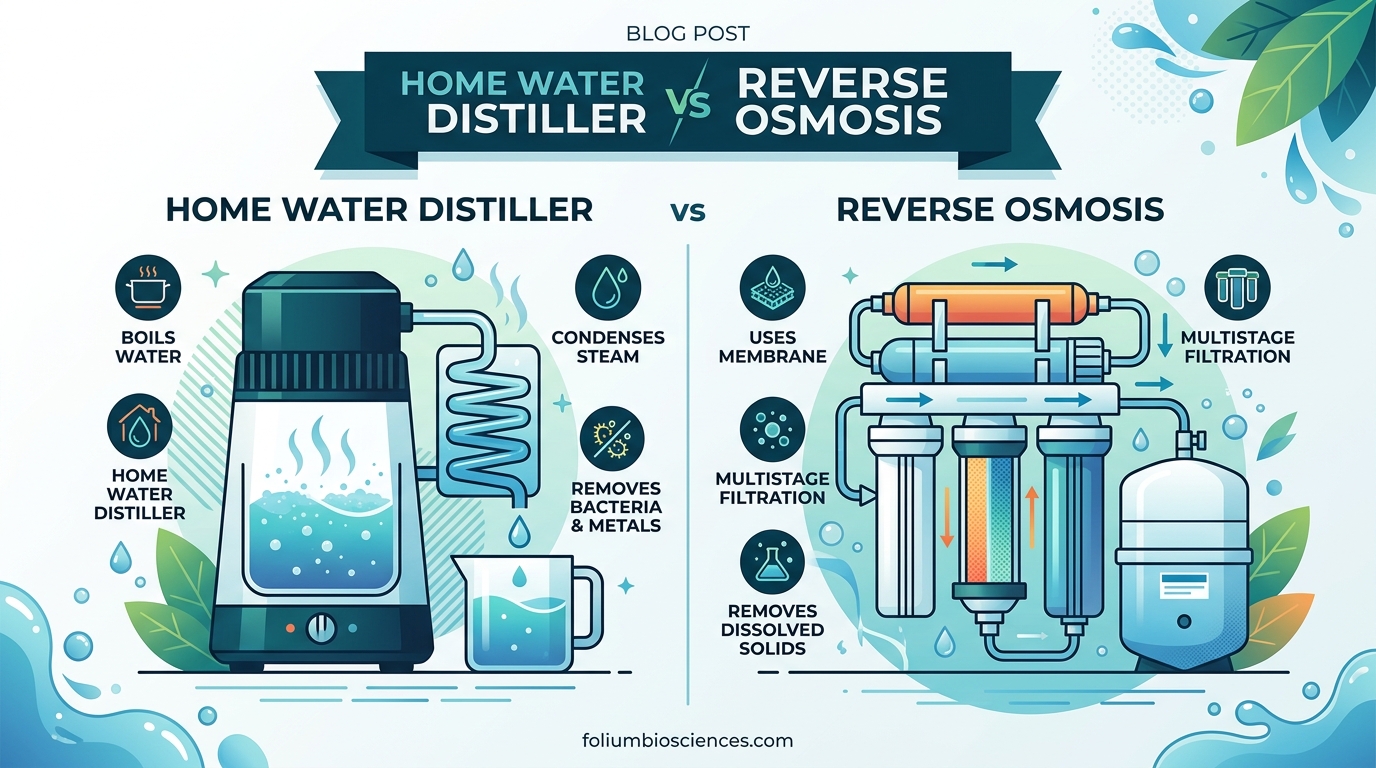
If you have been weighing a home water distiller vs reverse osmosis system, you are probably trying to figure out which one gives you the cleanest water without draining your wallet. I spent weeks digging into the real costs, the science behind each method, and what actual owners say after months of daily use. The answer is not as simple as picking the cheaper option up front.
Both water distillation and reverse osmosis produce exceptionally clean water, but they get there through completely different processes. One uses heat and phase change. The other relies on pressure and a semi-permeable membrane. The cost per gallon, the daily convenience, and even the taste vary significantly between them.
In this guide, our team breaks down the pure water cost per gallon for each method, compares contaminant removal capabilities, and walks through the pros and cons that actually matter in daily life. Whether you need purified water for drinking, cooking, a CPAP machine, or an aquarium, you will have a clear answer by the end.
Table of Contents
The Quick Answer: Water Distiller vs Reverse Osmosis
Reverse osmosis is significantly cheaper per gallon than home water distillation. RO systems produce purified water at roughly $0.02 to $0.10 per gallon, while distillation costs between $0.25 and $0.50 per gallon in electricity alone. That is a 5x to 20x difference in operating cost.
However, distillation achieves higher purity levels. A good water distiller removes 99.9% of total dissolved solids (TDS), compared to 95-99% for most reverse osmosis systems. If absolute purity is your priority, such as for laboratory use, CPAP machines, or medical devices, distillation has the edge.
For most families looking for daily drinking water, reverse osmosis wins on cost, convenience, and volume. For specialized applications where maximum purity matters, distillation is the better choice despite the higher operating cost.
Here is the side-by-side summary:
- Cost per gallon: RO wins ($0.02-$0.10 vs $0.25-$0.50)
- Purity level: Distillation wins (99.9% vs 95-99% TDS removal)
- Speed: RO wins (on-demand vs 4-6 hours per gallon)
- Convenience: RO wins (under-sink, passive vs countertop, active)
- Wastewater: Distillation wins (zero waste vs 3-4 gallons per gallon produced)
- Energy use: RO wins (near zero vs 3 kWh per gallon)
- Setup: Distillation wins (plug in and go vs plumbing installation)
How Home Water Distillation Works
Water distillation is one of the oldest purification methods on earth. It mimics the natural water cycle: water heats up, turns to steam, leaves contaminants behind, then condenses back into liquid form. The result is water that is about as pure as you can get at home.
Here is the step-by-step process inside a typical countertop water distiller:
Step 1: Heating. The distiller heats tap water in a stainless steel boiling chamber to its boiling point of 212 degrees Fahrenheit (100 degrees Celsius). This is the energy-intensive phase that drives most of the operating cost.
Step 2: Evaporation. As the water boils, it produces steam. Contaminants like heavy metals, salts, bacteria, minerals, and most chemicals have different boiling points than water. They stay behind in the boiling chamber as the steam rises.
Step 3: Condensation. The steam travels through a cooling system, usually a coiled tube or cooling fins. A small fan helps cool the steam back into liquid water droplets.
Step 4: Collection. The condensed water drips into a collection container. At this point, it is distilled water with virtually all total dissolved solids removed.
Step 5: Post-filtration (quality units only). Many better distillers pass the condensed water through an activated carbon post-filter. This catches volatile organic compounds (VOCs) that have boiling points close to water and might have traveled with the steam. Without this carbon stage, VOCs like benzene and toluene can carry over into your distilled water.
A typical home countertop distiller produces about 1 gallon of purified water every 4 to 6 hours. The energy consumption runs roughly 3 kilowatt-hours (kWh) per gallon. At the national average electricity rate of about $0.14 per kWh, that works out to roughly $0.42 in electricity per gallon. In areas with higher rates like California or New York, that cost can climb above $0.50 per gallon.
How Reverse Osmosis Water Filtration Works
Reverse osmosis takes a completely different approach. Instead of using heat to separate water from contaminants, it uses pressure to force water through a barrier that contaminants cannot pass. The heart of the system is the semi-permeable membrane, a material with pores so small they measure 0.0001 microns across.
Here is how a typical multi-stage under-sink RO system processes your water:
Step 1: Sediment pre-filter. Tap water first passes through a sediment filter that catches sand, rust, dirt, and other large particles. This protects the more expensive filters downstream from clogging. These pre-filters typically need replacement every 6 to 12 months.
Step 2: Activated carbon pre-filter. Next, water flows through an activated carbon block or granular carbon filter. This stage removes chlorine, chloramine, and organic chemicals that would damage the RO membrane. It also improves the taste and odor of the final water.
Step 3: The RO membrane. This is where the real purification happens. A high-pressure pump pushes water against the semi-permeable membrane. Water molecules are small enough to pass through the microscopic pores, but dissolved solids, heavy metals, bacteria, viruses, fluoride, arsenic, and most other contaminants are too large. They get rejected and flushed away as wastewater.
Step 4: Post-filter and polishing. After passing through the membrane, the purified water flows through a final activated carbon post-filter that removes any remaining taste or odor issues. Some systems include a remineralization stage at this point that adds beneficial minerals back into the water.
Step 5: Storage tank. The purified water collects in a small pressurized storage tank, typically 2 to 4 gallons, ready for on-demand use at your faucet. When you open the dedicated RO faucet, water flows out from this tank.
The trade-off with RO is the wastewater ratio. For every gallon of purified water an RO system produces, it typically sends 3 to 4 gallons of wastewater down the drain. Newer high-efficiency systems have improved this ratio to about 1:1, but most standard residential units still operate at 3:1 or 4:1. This wastewater is one of the most frequently discussed concerns on water treatment forums.
In terms of energy, RO systems use very little electricity. Most under-sink units run entirely on water pressure from your municipal supply and consume roughly 0.01 kWh per gallon, costing less than a penny in electricity per gallon produced.
Contaminant Removal: What Each Method Actually Removes
Both distillation and reverse osmosis are considered high-efficiency water purification methods. But they do not remove exactly the same things, and understanding those differences matters when you are choosing between them.
Bacteria, Viruses, and Pathogens
Both methods are highly effective against biological contaminants. Distillation kills and removes virtually 100% of bacteria, viruses, and cysts because these organisms cannot survive boiling temperatures and cannot travel as steam. RO membranes block pathogens physically, achieving 99%+ removal rates for bacteria and viruses.
Heavy Metals and Dissolved Solids
Distillation removes 99.9% of total dissolved solids including lead, arsenic, mercury, fluoride, nitrates, sodium, and calcium. The phase-change process leaves virtually everything behind in the boiling chamber. RO removes 95% to 99% of these same contaminants depending on the specific membrane quality and water pressure. For fluoride specifically, RO typically removes 90-95%, while distillation removes closer to 99.9%.
The VOC Problem: What Distillation Misses
This is the biggest limitation of distillation that most people overlook. Volatile organic compounds like benzene, toluene, trihalomethanes, and certain pesticides have boiling points close to or below water. That means they can evaporate along with the steam and end up in your distilled water.
This is exactly why quality distillers include an activated carbon post-filter. The carbon traps VOCs that make it through the distillation process. Without this post-filter, distilled water could actually contain higher concentrations of certain VOCs than the original tap water because they concentrate in the steam.
What Reverse Osmosis Misses
RO membranes struggle with certain dissolved gases like hydrogen sulfide (the classic rotten egg smell) and some small organic molecules. Chlorine can also damage RO membranes, which is why the carbon pre-filter is essential. Certain pesticides and pharmaceuticals with very small molecular sizes may partially pass through standard RO membranes, though most quality systems remove 95%+ of these contaminants.
Side-by-Side Contaminant Removal Comparison
- Lead: Distillation 99.9% | RO 95-99%
- Arsenic: Distillation 99.9% | RO 90-99%
- Fluoride: Distillation 99.9% | RO 90-95%
- Nitrates: Distillation 99.9% | RO 85-95%
- Bacteria/Viruses: Distillation 99.99% | RO 99%+
- VOCs: Distillation 80-95% (with carbon post-filter) | RO 95-99%
- Dissolved gases: Distillation 99%+ | RO 50-80%
- Total Dissolved Solids: Distillation 99.9% | RO 95-99%
- Pesticides: Distillation 95-99% | RO 95-99%
- Pharmaceuticals: Distillation 99%+ | RO 95-99%
For homeowners on well water with high nitrates, heavy metals, or agricultural runoff, users on water treatment forums consistently recommend RO systems. The ability to handle multiple contaminant types simultaneously with minimal user effort makes RO the practical workhorse for complex water quality problems.
Pure Water Cost Per Gallon: The Full Breakdown
This is the section most people are searching for. Let me break down the real cost per gallon for each method, including equipment amortization, energy or water costs, and ongoing maintenance.
Home Water Distiller Cost Per Gallon
Electricity cost per gallon: A typical home distiller uses about 3 kWh to produce one gallon of distilled water. At the national average electricity rate of $0.14 per kWh, that is $0.42 per gallon. In states with higher rates like Connecticut ($0.24/kWh) or California ($0.22/kWh), this climbs to $0.66 to $0.72 per gallon. In cheaper regions like Louisiana ($0.09/kWh), it drops to about $0.27 per gallon.
Equipment cost (amortized): A quality countertop water distiller runs $150 to $400. Over a 10-year lifespan producing 1 gallon per day, the equipment cost adds roughly $0.04 to $0.11 per gallon.
Maintenance cost: Carbon post-filters cost $10-$15 annually. Descaling solution runs another $10-$15 per year. Total maintenance adds roughly $0.03 to $0.05 per gallon.
Total distillation cost per gallon: $0.35 to $0.65 depending on your local electricity rate and usage volume.
Reverse Osmosis Cost Per Gallon
Electricity cost per gallon: Most under-sink RO systems run on water pressure alone and use negligible electricity, approximately $0.001 per gallon. Countertop powered units use a bit more but still under $0.01 per gallon.
Equipment cost (amortized): Under-sink RO systems range from $200 to $600. Professional installation adds $150-$300 if you do not do it yourself. Over a 10-year lifespan producing 5 gallons per day, the equipment cost adds roughly $0.01 to $0.03 per gallon.
Filter replacement cost: This is the main ongoing RO expense. Sediment and carbon pre-filters cost $20-$40 every 6-12 months. The RO membrane costs $50-$100 every 2-3 years. Post-filters add another $15-$25 annually. Total annual filter costs run $50 to $200, which translates to $0.03 to $0.11 per gallon at typical household usage of 5 gallons per day.
Wastewater cost: At a 3:1 wastewater ratio, producing 5 gallons of RO water sends 15 gallons down the drain daily. At a typical municipal water rate of $0.005-$0.015 per gallon, this adds $0.015 to $0.045 per gallon of purified water produced.
Total RO cost per gallon: $0.04 to $0.15 depending on your system quality, filter costs, and local water rates.
Five-Year Total Cost of Ownership
For a household using 5 gallons of purified water per day (about 1,825 gallons per year), here is how the math works out over five years:
Distillation (5-year cost):
- Equipment: $250 (one-time)
- Electricity at $0.42/gallon: $3,832
- Maintenance and filters: $125
- Total: $4,207 (roughly $0.46 per gallon)
Reverse Osmosis (5-year cost):
- Equipment and installation: $400 (one-time)
- Electricity: $10
- Filter replacements: $500
- Wastewater charges: $183
- Total: $1,093 (roughly $0.12 per gallon)
Over five years, reverse osmosis costs roughly one-fourth as much as distillation for the same volume of purified water. That gap narrows if you live in a region with very cheap electricity, and it widens if your electricity rates are above average.
Reddit users on r/WaterTreatment frequently point out that the true cost of distillation surprises people who only looked at the upfront equipment price. The electricity adds up fast, especially for families needing more than a gallon or two per day.
Speed and Convenience: Daily Use Comparison
The daily experience of using each system is dramatically different, and this is where the rubber meets the road for most homeowners.
Distillation speed: A typical countertop distiller takes 4 to 6 hours to produce a single gallon. If your household uses 5 gallons of purified water per day, you would need to run the distiller nearly around the clock. Some users on water treatment forums report running two distillers simultaneously to keep up with family demand.
Reverse osmosis speed: An under-sink RO system produces water continuously at a rate of about 50 gallons per day. The storage tank holds 2 to 4 gallons ready for immediate use. When you empty the tank, it refills automatically. For most households, the tank refills faster than you can use the water, giving you an essentially unlimited supply.
Distillation convenience factors:
- Sits on a countertop and takes up valuable kitchen space
- Requires you to fill the boiling chamber manually for each batch
- Generates noticeable heat during operation (can warm a small kitchen)
- No plumbing required, just plug into a standard outlet
- Portable enough to take to a cabin or RV
Reverse osmosis convenience factors:
- Tucks under the sink and stays out of sight
- Operates automatically whenever you use the dedicated faucet
- Requires initial plumbing installation (or professional help)
- Not portable once installed
- Needs periodic filter changes but otherwise runs hands-free
For busy families who want purified water available at a moment’s notice, RO is the clear winner. Distillation works better for individuals or small households with lower daily water needs who value simplicity and portability.
Taste and Mineral Content: What About Dead Water?
Both distillation and reverse osmosis produce what water treatment professionals call “demineralized water.” Both methods strip out the calcium, magnesium, potassium, and other trace minerals that give natural water its taste and that contribute to your daily mineral intake.
Distilled water often gets described as flat, bland, or even “dead water” by users. I have seen this exact phrase in multiple Reddit threads on r/Biohackers and r/WaterTreatment. The water tastes noticeably different from what most people expect because there is literally nothing in it.
RO water has a similar issue but tends to taste slightly better than distilled water. The reason is that RO does not remove absolutely everything. A tiny percentage of dissolved solids remain, and the carbon post-filters in RO systems can improve the taste slightly. Some RO systems also include a remineralization stage that adds calcium and magnesium back in, which makes the water taste closer to spring water.
The WHO Position on Demineralized Water
The World Health Organization has raised concerns about long-term consumption of demineralized water. In their research, they note that water lacking minerals may not provide the dietary calcium and magnesium that many people assume they get from drinking water. For people with mineral-deficient diets, losing this source could have health implications over time.
WHO does not say you should avoid purified water. Rather, they recommend that if you drink demineralized water regularly, you should ensure adequate mineral intake from food or supplements. Many RO system manufacturers address this by offering remineralization filters as add-ons.
Taste Tips From Real Users
Forum users who have adjusted to purified water offer a few practical suggestions:
- Add a pinch of Celtic sea salt or mineral drops to restore taste and mineral content
- Use a remineralization filter on your RO system (available for $30-$60)
- Store distilled water in glass containers rather than plastic to avoid picking up plastic taste
- For coffee and tea brewing, many users on r/Coffee prefer RO water with remineralization over distilled water, which can produce a flat-tasting brew
Pros and Cons: Water Distiller vs Reverse Osmosis
Home Water Distiller Pros and Cons
Pros:
- Highest purity available at home (99.9% TDS removal)
- No wastewater produced during purification
- Simple setup with no plumbing required, just plug in
- Portable for travel, cabins, or emergency use
- Long equipment lifespan with minimal mechanical parts to fail
- Excellent for CPAP machines, humidifiers, steam irons, and automotive batteries
Cons:
- Slow production at 4-6 hours per gallon
- High electricity cost per gallon ($0.25-$0.65 total)
- Generates heat during operation
- Requires manual filling for each batch
- Flat taste without remineralization
- VOCs can carry over without a carbon post-filter
- Not practical for high-volume daily family use
Reverse Osmosis Pros and Cons
Pros:
- Low cost per gallon ($0.04-$0.15 total)
- On-demand water available whenever you need it
- Hidden under the sink, does not take counter space
- Handles large daily volumes effortlessly
- Excellent for well water with multiple contaminant types
- Remineralization options available to improve taste
- Negligible electricity usage
Cons:
- Wastewater ratio of 3:1 or 4:1 in standard systems
- Requires plumbing installation (DIY or professional)
- Regular filter replacements every 6-12 months
- Slightly lower purity than distillation (95-99% vs 99.9%)
- Cannot be moved once installed
- Some dissolved gases and small molecules pass through
- Filter replacement costs add up over time
When to Choose a Home Water Distiller vs Reverse Osmosis
The right choice depends entirely on your specific situation, water quality needs, and how much purified water you use each day. Here is how to decide.
Choose a Home Water Distiller If:
- You need maximum purity. For CPAP machines, laboratory work, medical devices, or anyone with severe immune system concerns, distillation delivers the highest contaminant removal available outside of a commercial facility.
- You use small volumes. Individuals or couples who only need a gallon or two per day for drinking will find a distiller perfectly adequate.
- You value simplicity. No plumbing, no installation, no complex filter schedules. Fill it, turn it on, and collect the water.
- You need portability. Distillers work great for RVs, cabins, dorm rooms, or any situation where you cannot install permanent plumbing.
- You want zero wastewater. If water conservation is a priority, distillation wastes nothing.
- You need water for appliances. Steam irons, humidifiers, automotive batteries, and aquariums all benefit from the near-total purity of distilled water.
Choose a Reverse Osmosis System If:
- You need family-scale daily water. RO systems easily provide 5-50+ gallons per day on demand, making them the clear choice for households of 3 or more people.
- Cost per gallon matters. At roughly one-fourth the operating cost of distillation over five years, RO saves significant money at higher volumes.
- You are on well water. RO systems handle the complex mix of contaminants common in well water, including agricultural nitrates, iron, sulfur, and multiple heavy metals simultaneously.
- Convenience is a priority. Open the faucet and get purified water instantly. No waiting for batches.
- You want water for cooking and ice makers. RO connects directly to your kitchen faucet and can be routed to refrigerator ice makers.
- You need water for baby formula preparation. The consistent quality and on-demand availability make RO practical for preparing formula throughout the day.
Special Cases Worth Noting
Some homeowners actually use both. A common setup I have seen recommended on water treatment forums is an under-sink RO system for daily drinking and cooking, plus a small countertop distiller for CPAP machines, humidifiers, and other applications that specifically require distilled water. This combo approach costs more up front but gives you the best of both worlds.
For pet water, both methods work well. Some aquarium owners prefer RO water because they can add specific mineral mixes back in to match their fish species’ needs. Distilled water is too pure for most aquariums without remineralization.
Environmental Impact and Maintenance Requirements
Both methods have environmental trade-offs worth understanding before you commit.
Water Distiller Environmental Impact
Distillation uses significant electricity but produces zero wastewater. Over a year of producing 1 gallon per day at 3 kWh per gallon, a distiller consumes about 1,095 kWh of electricity. That is roughly equivalent to running a refrigerator for a year. The carbon footprint depends on your local power grid. In areas with renewable energy, the environmental impact is minimal. In coal-heavy regions, it adds up.
On the positive side, distillers have long lifespans (often 10+ years), and the only consumables are carbon post-filters, which create minimal waste.
Reverse Osmosis Environmental Impact
RO systems use almost no electricity but waste water. At a 3:1 ratio, producing 5 gallons per day sends 15 gallons of water down the drain daily. That is 5,475 gallons of wastewater per year. In drought-prone areas, this is a real concern. High-efficiency RO systems with 1:1 ratios are available and worth the extra cost if water conservation matters to you.
RO filter cartridges create plastic waste. You will go through 2-4 sediment and carbon filters per year plus a membrane every 2-3 years. These spent cartridges end up in landfills.
Maintenance Schedule Comparison
Distiller maintenance:
- Descale the boiling chamber every 1-3 months (depending on water hardness) using white vinegar or citric acid
- Replace the carbon post-filter every 3-6 months ($10-$15)
- Wipe down the collection container and cooling surfaces periodically
- Annual maintenance cost: approximately $20-$30
Reverse osmosis maintenance:
- Replace sediment pre-filter every 6-12 months ($10-$20)
- Replace carbon pre-filter every 6-12 months ($15-$30)
- Replace RO membrane every 2-3 years ($50-$100)
- Replace carbon post-filter every 12 months ($15-$25)
- Annual maintenance cost: approximately $50-$200
Distillation has lower maintenance costs overall, but RO maintenance is less hands-on. RO filter changes take about 10 minutes every few months, while distiller descaling requires more active effort and vinegar handling.
Both systems eliminate the need to buy bottled water, which is a significant environmental win. A household that previously bought 5 gallons of bottled water per week would eliminate roughly 260 plastic bottles per year by switching to either system.
FAQ
Which is cheaper, RO or distilled water?
Reverse osmosis is significantly cheaper than distillation. RO systems produce purified water at $0.04 to $0.15 per gallon including all filter and wastewater costs. Home water distillation costs $0.35 to $0.65 per gallon, primarily due to electricity consumption of roughly 3 kWh per gallon. Over five years of typical household use, RO costs roughly one-fourth as much as distillation.
Is distillation more expensive than reverse osmosis?
Yes, distillation is substantially more expensive than reverse osmosis. The primary cost driver is electricity. A home distiller uses about 3 kWh per gallon, costing $0.25 to $0.50 in electricity alone depending on your local rates. RO systems use negligible electricity and have lower total operating costs of $0.04 to $0.15 per gallon even after accounting for filter replacements and wastewater.
Is a water distiller better than reverse osmosis?
It depends on your needs. Distillation produces higher purity water (99.9% TDS removal vs 95-99% for RO) and is better for specialized uses like CPAP machines, humidifiers, laboratory work, and medical devices. Reverse osmosis is better for daily family drinking water because it costs less per gallon, works on demand, and handles larger volumes. Neither is universally better; the right choice depends on your specific water quality needs and usage patterns.
How much does the water bill go up with a reverse osmosis system?
An RO system with a standard 3:1 wastewater ratio wastes about 3 gallons for every gallon of purified water produced. If you produce 5 gallons of RO water per day, that means about 15 gallons of wastewater daily, or roughly 5,475 gallons per year. At typical municipal water rates of $0.005 to $0.015 per gallon, this adds about $27 to $82 per year to your water bill. High-efficiency RO systems with 1:1 ratios cut this in half.
How much electricity does a water distiller use?
A typical home water distiller uses approximately 3 kilowatt-hours (kWh) of electricity per gallon of water produced. At the national average electricity rate of $0.14 per kWh, that costs about $0.42 per gallon. Running a distiller for 1 gallon per day consumes about 1,095 kWh per year, which is comparable to running a refrigerator. In states with higher electricity rates, the annual cost can exceed $200.
Is RO water safe to drink daily?
Yes, RO water is safe to drink daily. Both the EPA and WHO consider properly treated RO water safe for regular consumption. The main consideration is that RO removes beneficial minerals like calcium and magnesium from your water. If your diet provides adequate minerals from food sources, this is not a concern. Many RO systems offer optional remineralization filters that add these minerals back in for improved taste and nutritional benefit.
Can I use distilled water in my CPAP machine?
Yes, distilled water is actually the recommended water type for CPAP machines. CPAP manufacturers specifically recommend distilled water because it contains no minerals that can build up in the machine’s humidifier chamber. Using tap water or even RO water can leave mineral deposits over time. Distilled water’s near-total purity prevents scale buildup and extends the life of your CPAP equipment.
Does reverse osmosis remove fluoride from water?
Yes, reverse osmosis removes 90% to 95% of fluoride from tap water. The semi-permeable RO membrane blocks fluoride ions along with other dissolved solids. This is one of the main reasons people choose RO systems, since standard carbon filters and pitcher filters cannot remove fluoride effectively. Distillation removes even more fluoride at 99.9%, but RO provides more than enough reduction for most homeowners concerned about fluoride levels.
Making Your Decision: Home Water Distiller vs Reverse Osmosis
After comparing a home water distiller vs reverse osmosis across every metric that matters, the decision comes down to what you need the water for and how much of it you use. Reverse osmosis delivers purified water at roughly one-fourth the cost of distillation, with the convenience of on-demand availability and under-sink installation. For families, heavy daily users, and anyone on well water, RO is the practical and financial winner.
Distillation remains the gold standard for absolute purity. If you need water for a CPAP machine, laboratory equipment, medical devices, or any application where 99.9% TDS removal matters, a countertop distiller is worth the extra cost and slower production time. The zero-wastewater advantage also matters in drought-sensitive regions.
My recommendation for most homeowners: start with your water quality report or test your water first. If your tap water has multiple contaminant concerns and your household uses more than 2 gallons of purified water per day, go with reverse osmosis. If your needs are smaller and purity-focused, a water distiller will serve you well. And if your budget allows, using both systems together gives you the convenience of RO for daily use and the purity of distillation for specialized needs.