
Last updated:
If you have been searching for a way to make your 3D printing projects more sustainable, hemp plastic for 3D printing offers a compelling alternative to conventional petroleum-based filaments. This bio-based material prints like standard PLA but carries a significantly smaller environmental footprint. In this comprehensive guide, we cover everything you need to know: material composition, mechanical properties, real-world print settings, cost comparisons, and the best brands currently on the market.
The interest in sustainable manufacturing has moved well beyond industrial applications and into the home workshop. Makers and small-scale designers are increasingly asking whether they can reduce the ecological impact of their FDM prints without sacrificing printability. Enter hemp plastic 3D printing filament, a bio-composite material made by combining PLA base resin with processed industrial hemp fiber.
Hemp plastic for 3D printing has gained traction over the past several years as an eco-friendly alternative to conventional filaments. It prints on standard PLA-compatible machines, produces a distinctive natural brown color without synthetic dyes, and offers a carbon footprint that is considerably lower than ABS or even standard PLA. But is it the right material for your next project? This guide walks through the technical details, practical challenges, and current market landscape so you can make an informed decision.
Table of Contents
What Is Hemp Plastic for 3D Printing?
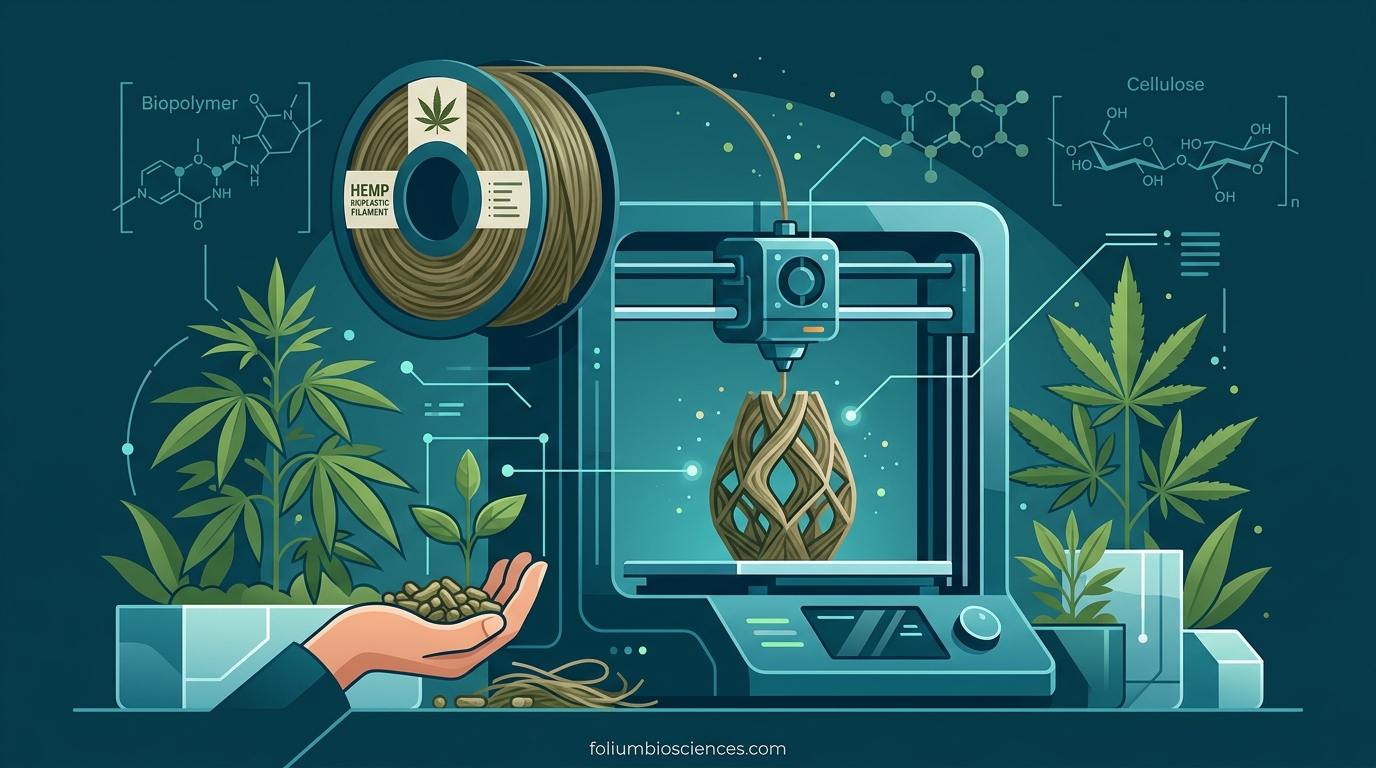
Hemp plastic for 3D printing is a composite filament material that blends PLA (polylactic acid) with processed hemp fiber. The result is a bio-based filament that runs on standard FDM printers while incorporating a renewable, plant-based reinforcement material. It falls under the broader category of natural fiber composites, which also includes filaments made with coffee grounds, beer spent grain, and other agricultural byproducts.
How Hemp Filament Is Made
The production process starts with industrial hemp, which is legally grown in many countries including the United States, the Netherlands, and Canada. Hemp plants are processed to separate the fibrous outer bast from the woody inner core known as hurd. Both components can be incorporated into filament, though most commercial hemp PLA filaments use a blend of the two.
The typical formulation mixes approximately 80% PLA resin with 20% hemp fiber or hurd by weight. The PLA provides the thermoplastic backbone that melts and flows during extrusion, while the hemp fiber adds bulk and reinforces the finished part. The composite is then extruded into standard 1.75mm or 2.85mm diameter filament, wound onto spools, and vacuum-sealed with desiccant to prevent moisture absorption during storage and shipping.
Quality manufacturers use laser measurement systems to monitor filament diameter with tolerances of plus or minus 0.05mm or tighter. This precision matters because consistent diameter ensures uniform extrusion and reduces the risk of jams or under-extrusion.
Hemp Fiber vs. Hemp Hurd in Filament
The distinction between hemp fiber and hemp hurd affects both the printing experience and the properties of the finished part. Hemp fiber refers to the long, strong bast fibers from the outer stalk of the plant. These fibers provide more structural reinforcement and can improve the tensile properties of the printed object, though they also present a higher risk of clogging due to their length and stiffness.
Hemp hurd consists of the shorter, wood-like fibers from the inner core of the hemp stalk. Hurds are essentially the byproduct of decortication, the process of separating fiber from the stalk. As a filler material, hurd creates a filament that prints more reliably but may result in slightly more brittle parts compared to a fiber-reinforced formulation.
Different manufacturers make different choices about which hemp component to use, and some blend both. The product page or Technical Data Sheet (TDS) should indicate which type is used. For the end user, the practical difference matters most when troubleshooting printing issues or evaluating strength claims.
Key Benefits of Hemp Filament
Makers choose hemp plastic for 3D printing for a variety of reasons that extend beyond simple environmental awareness. Understanding both the practical and philosophical benefits helps you evaluate whether this material aligns with your project goals.
Environmental Advantages
Hemp is a remarkably efficient crop. It grows quickly, requires minimal pesticides or herbicides compared to cotton, and it actively sequesters carbon dioxide from the atmosphere during its growth cycle. Some manufacturers claim their hemp filament is carbon-negative, meaning the hemp plant absorbs more CO2 during growth than is emitted during processing and transportation.
The PLA base in hemp filament is still derived from fermented plant starches (typically corn), so it is not completely petroleum-free. However, blending hemp fiber into PLA replaces a portion of the resin with a renewable agricultural byproduct, effectively reducing the overall carbon footprint per gram of filament. When the printed object reaches the end of its useful life, hemp PLA is biodegradable under industrial composting conditions, similar to standard PLA.
Hemp plastic filament uses industrial hemp that was specifically bred for fiber production, not for cannabis with high THC content. The material is completely legal to manufacture, sell, and use in most countries including the United States.
Printing and Aesthetic Qualities
Beyond environmental benefits, hemp filament offers some genuinely useful printing characteristics. The natural brown color produced by hemp fiber creates an earthy, organic appearance that many makers find visually appealing. Because no synthetic colorants are added, the brown hue can vary slightly between batches, giving each print a unique natural character.
Hemp filament exhibits minimal warping compared to ABS, which simplifies printing larger parts without an enclosure. The material has good layer adhesion when printed within the recommended temperature range, and most users report that it does not produce the unpleasant fumes associated with ABS printing. Some users describe a mild, pleasant plant-like aroma during printing, rather than the acrid smell of petroleum-based plastics.
For makers who want to paint or post-process their prints, hemp filament responds well to sanding and accepts acrylic paints readily. The natural fiber content is visible through thin paint coats, giving finished pieces an attractive organic texture.
Strength and Durability: Hemp vs. PLA vs. ABS
One of the most important questions surrounding hemp plastic for 3D printing concerns its mechanical properties. Can it hold up to functional use, or is it primarily a novelty material? The honest answer requires managing expectations based on how the material is actually designed to perform.
Tensile Strength and Flexibility
Hemp filament is not marketed or designed as a high-strength engineering material. The primary value proposition is environmental sustainability and aesthetic appeal, not structural performance. With that said, the tensile strength of hemp PLA is broadly comparable to standard PLA, meaning it will handle light-duty functional applications but is not a replacement for ABS or PETG when load-bearing strength is required.
Early formulations of hemp filament, notably 3D-Fuel’s first version of Entwined, were notably brittle. Version 2 formulations addressed this by adjusting the hemp-to-PLA ratio and processing methods, resulting in improved flexibility and reduced brittleness. Even with improvements, hemp filament tends to be slightly more rigid than standard PLA, and impact resistance is not a standout characteristic.
For functional parts that will experience mechanical stress, dynamic loads, or temperature exposure above 60 degrees Celsius, you should choose ABS, PETG, nylon, or a purpose-engineered composite instead. Hemp PLA is best suited for decorative objects, prototypes, and non-structural enclosures.
When Hemp Filament Makes Sense
Understanding the performance envelope of hemp filament helps you deploy it where it genuinely excels. The material is an excellent choice for aesthetic prototypes where the look and feel of the finished part matters. If you are producing consumer products and want to highlight sustainability credentials, hemp PLA prints carry a compelling story.
Educational settings benefit from hemp filament’s forgiving print characteristics and its value as a teaching tool about bio-based materials. Hobbyists who prioritize environmental responsibility in their making will appreciate the reduced carbon footprint and compostable end-of-life path. For novel prototypes and artistic installations, the natural fiber content and distinctive brown color create a unique aesthetic that conventional materials cannot replicate.
Print Settings and Recommendations
Successfully printing hemp filament requires attention to a few key parameters. Most settings fall within the PLA range, but there are critical differences that determine whether your print succeeds or ends in frustration. The single most important variable is nozzle size.
Temperature and Speed Settings
Hemp filament prints within a similar temperature range to standard PLA, though most manufacturers recommend starting slightly higher to account for the fiber content. The following settings serve as a reliable starting point:
- Extruder temperature: 190 to 220 degrees Celsius. Start at 200 to 205 degrees for a first print and adjust based on results. Signs of too-low temperature include under-extrusion and poor layer adhesion. Signs of too-high temperature include stringing, oozing, and discoloration.
- Bed temperature: 50 to 60 degrees Celsius. A heated bed is not strictly required but significantly improves first-layer adhesion.
- Print speed: 30 to 50 millimeters per second. Slower speeds improve quality and reduce the risk of jams, especially for complex geometry.
- Cooling fan: 50 to 100% after the first layer has been completed. Hemp filament benefits from active cooling for vertical surfaces.
- Layer height: 0.2mm is a good default. Smaller layer heights are possible but increase print time substantially.
Nozzle Size: The Critical Detail
This is the issue that most separates hemp filament from standard PLA, and the detail most likely to determine your printing success or failure. The hemp fiber content includes small particles that can catch on the heat break inside the nozzle assembly, causing gradual clogging or complete blockage during a print. Standard 0.4mm nozzles are particularly susceptible to this problem.
The underlying mechanism involves the heat break zone inside the nozzle, where the filament transitions from molten to solid. Hemp fiber particles can lodge in this narrow throat area and accumulate over time, eventually restricting flow. A larger nozzle provides a wider throat diameter at this critical point, making clogging significantly less likely.
Some experienced hemp filament users also report that hardened steel nozzles wear more quickly when printing composite filaments. For occasional use, standard brass nozzles are acceptable. If you plan to print hemp filament regularly and in large quantities, consider a hardened steel nozzle for extended service life, though even brass will handle moderate amounts of hemp printing without excessive wear.
Bed Preparation
Hemp filament adheres well to a variety of bed surfaces with proper preparation. A glass bed treated with PVA glue stick or standard hairspray provides reliable first-layer adhesion for most printers. PEI sheet surfaces also work, though some users report slightly worse initial adhesion compared to standard PLA on PEI.
For taller prints where warping can become problematic, use a draft shield or enclosure to maintain stable ambient temperature around the print. While hemp filament is more dimensionally stable than ABS, tall slender prints can still lift from the bed or curl at the corners if exposed to air currents.
Brim adhesion is recommended for parts with small footprint or significant overhangs. A brim of three to five lines provides a wider base and reduces the likelihood of detachment during the critical first layers.
Annealing and Post-Processing
One area where hemp filament has been underserved by existing content is post-processing. Specifically, annealing, which is the process of heating a printed part to improve its crystallinity and mechanical properties, is rarely discussed for natural fiber composites. This is a real gap because properly annealed hemp PLA prints can achieve improved strength and reduced brittleness.
How to Anneal Hemp Filament Prints
Annealing hemp PLA is similar to annealing standard PLA, with some nuances introduced by the hemp fiber content. The goal is to increase the crystallinity of the PLA matrix, which improves thermal resistance and can increase part stiffness. Here is a recommended approach:
- Place your completed print in a cold oven on a non-flammable surface such as aluminum foil or a silicone mat.
- Set the oven temperature to 100 to 110 degrees Celsius (212 to 230 degrees Fahrenheit). Do not exceed 115 degrees Celsius.
- Heat the oven gradually. Allow approximately 30 to 60 minutes for the print and surrounding air to reach target temperature.
- Hold at target temperature for 30 to 60 minutes. Longer holds within this range produce more crystallization.
- Turn off the oven and allow the print to cool completely inside, ideally overnight. Rapid cooling can introduce thermal stress and cause warping or cracking.
Annealed hemp prints exhibit improved dimensional stability at elevated temperatures, making them more suitable for applications where the part might be exposed to warmth. The process also reduces internal stresses from printing, which can reduce warping in subsequent post-processing steps like sanding.
Post-Processing Techniques
Hemp filament prints respond well to standard finishing techniques. Sanding is straightforward and the fiber content produces a smooth surface without the notoriously difficult stringing associated with some other exotic filaments. Start with 220-grit sandpaper and progress through 400 and 600 grit for a polished surface.
Acetone vapor smoothing is not recommended for hemp PLA. Unlike ABS, PLA-based composites do not respond well to acetone, and the hemp fiber content can react unpredictably. If you want a smoother surface without sanding, consider using XTC-3D brush-on coating or similar products designed for PLA-based materials.
Painting hemp prints with acrylic craft paints works well. The natural fiber texture shows through thin coats, creating an organic appearance that many makers find desirable. For a sealed finish, apply a water-based primer before painting to prevent the acrylic from soaking into the fiber-rich surface.
Cost Analysis: Hemp Filament vs. Standard PLA
Cost is a significant factor when considering hemp plastic for 3D printing. The material occupies a premium price tier that requires honest assessment of whether the environmental and aesthetic benefits justify the premium for your specific use case.
Price Per Gram Comparison
Standard PLA filament typically retails for approximately $0.015 to $0.025 per gram, translating to roughly $15 to $25 per kilogram for budget-friendly brands. Premium PLA formulations command $0.025 to $0.040 per gram. Hemp PLA filament occupies a noticeably higher price bracket at approximately $0.040 to $0.080 per gram, or roughly $40 to $80 per kilogram.
This price differential of two to four times the cost of standard PLA reflects several factors. Industrial hemp cultivation and processing is a smaller-scale industry than commodity PLA production, which benefits from enormous economies of scale. The additional manufacturing steps required to blend and extrude the composite add cost. Smaller production runs per SKU also limit efficiencies that larger manufacturers enjoy.
Value Considerations
Despite the higher cost, hemp filament delivers genuine value in specific contexts. For businesses producing consumer products where sustainability credentials matter, the premium cost of hemp PLA can be passed through to customers who specifically seek eco-friendly alternatives. In educational settings, the slightly higher material cost is negligible compared to the value of demonstrating bio-based materials science.
Some makers find that the distinctive natural appearance of hemp prints eliminates the need for post-print painting or finishing, effectively offsetting part of the material cost premium. Others value the carbon-offset narrative that a hemp print enables, particularly for product designers communicating sustainability commitments to customers or stakeholders.
| Material | Price per kg | Price per gram | Biodegradable |
|---|---|---|---|
| Standard PLA | $15 – $25 | $0.015 – $0.025 | Yes (industrial compost) |
| Premium PLA | $25 – $40 | $0.025 – $0.040 | Yes (industrial compost) |
| Hemp PLA Filament | $40 – $80 | $0.040 – $0.080 | Yes (industrial compost) |
| ABS | $18 – $30 | $0.018 – $0.030 | No |
| PETG | $20 – $35 | $0.020 – $0.035 | No |
Where to Buy Hemp Filament: Brands and Products
The market for hemp plastic for 3D printing remains niche, which means availability is more limited compared to commodity filaments. Several established brands have built reputations for quality, while others have exited the market. Knowing which ones are currently active and reliable is essential.
Brand Comparison Table
| Brand | Product Name | Price | Availability | Origin |
|---|---|---|---|---|
| 3D4Makers | Hemp PLA | From €34.95 (500g spool) | In Stock | Europe (Netherlands) |
| HempZoo | Hemp Plastic Filament | $44.99 (750g spool) | Check availability | USA |
| 3D-Fuel | Entwined Hemp Filament | $40-$70 (discontinued) | Discontinued / Used Market | USA |
| Filamentive | Hemp Bio-Fill | Varies by region | Check availability | UK/EU |
What to Look For When Buying
Whether you are purchasing from 3D4Makers, HempZoo, or another producer, there are several quality markers to evaluate before committing to a purchase. These factors help you distinguish premium hemp filament from less reliable offerings.
Diameter tolerance is perhaps the most critical technical specification. Quality brands specify a tolerance of plus or minus 0.05 millimeters or tighter, verified through laser measurement during production. Loose diameter tolerance is a primary cause of extrusion inconsistencies and jams, particularly problematic with a fiber-reinforced composite like hemp PLA.
Packaging quality matters significantly for hemp filament because the hemp fiber content makes it more hygroscopic than standard PLA. Vacuum-sealed packaging with a desiccant packet is a minimum requirement. Some brands go further by flush-sealing with nitrogen or using moisture-barrier film. If a spool arrives without adequate moisture protection, dry it in a filament dryer before use.
Technical documentation signals a brand that stands behind its product. Safety Data Sheets (SDS) and Technical Data Sheets (TDS) should be publicly accessible, detailing recommended print settings, material properties, storage requirements, and safety information. Brands that cannot or will not provide this documentation are worth approaching with caution.
Spool labeling transparency distinguishes honest sellers from the rest. Quality brands list the net weight of filament on the spool, not the gross weight including the spool itself. Checking this specification helps you verify you are getting the quantity you are paying for.
USA-grown hemp is preferred by many American buyers for both quality and environmental reasons. Domestic hemp production is subject to strict regulatory oversight, and shorter supply chains reduce transportation emissions. European brands like 3D4Makers source their hemp from European agricultural suppliers, which offers its own quality and regulatory advantages.
Common Problems and Solutions
Community discussions on Reddit and 3D printing forums reveal consistent patterns of problems that hemp filament users encounter. Addressing these directly provides practical value that general overview articles typically skip.
Nozzle Clogging
Nozzle clogging is the most frequently reported issue with hemp filament, and it is directly tied to the fiber content. The problem manifests as gradually decreasing extrusion followed by complete blockage, usually appearing mid-print rather than at the start. The root cause is hemp fiber particles lodging in the heat break zone of the hot end.
The primary solution remains switching to a 0.6mm or larger nozzle. This is not a suggestion but a practical necessity for reliable printing. If you must use a 0.4mm nozzle for resolution reasons, increase your print temperature by 5 to 10 degrees above your baseline PLA temperature and reduce print speed to 20 to 30 millimeters per second.
Performing cold pulls with PLA between hemp filament runs helps clear residual material and can extend the time between nozzle cleanings. If a clog does occur, a heat cycle followed by a cold pull with PLA will usually clear the blockage without disassembling the hot end.
Brittleness Issues
Early hemp filament formulations were notably brittle, with 3D-Fuel acknowledging this limitation directly in their product documentation for V1 Entwined. Version 2 formulations addressed the most severe brittleness, but some users still report that hemp prints feel more rigid than standard PLA.
Moisture absorption significantly worsens brittleness. Even properly stored hemp filament will accumulate some moisture over time, which weakens both the filament and the resulting prints. Store hemp PLA in an airtight container with fresh desiccant between printing sessions. If you suspect moisture has been absorbed, dry the filament at 45 to 50 degrees Celsius for 4 to 6 hours before printing.
Annealing, as described earlier, can meaningfully reduce brittleness in finished prints by relieving internal stresses from the printing process and increasing crystallinity. If your application requires maximum toughness, annealing is worth the additional processing time.
Spooling and Feed Issues
Inconsistent spool winding has been reported for some hemp filament batches, particularly from brands with less sophisticated winding equipment. Tangled filament at the spool creates feed inconsistencies and can cause the extruder to skip or grind the filament.
Before loading a new spool, visually inspect the first few meters of filament for tangles, kinks, or tight bends that could cause feeding problems. If you encounter spooling issues, carefully unwind the tangled section and re-spool it by hand, taking care to maintain even tension throughout.
Frequently Asked Questions
Can you 3D print hemp plastic?
Yes, hemp plastic filament for 3D printing works in any FDM printer that handles standard PLA. Use a 0.6mm or larger nozzle, temperatures of 190 to 220 degrees Celsius, and expect a natural earthy brown print with a pleasant mild aroma rather than the acrid fumes of ABS. The printing experience is broadly similar to PLA, with nozzle clogging being the primary unique challenge.
Is hemp filament stronger than PLA?
Hemp filament is approximately equal to or slightly weaker than standard PLA in tensile strength. It is not designed or marketed as a high-strength engineering material. For functional load-bearing parts, ABS, PETG, or purpose-engineered composites are significantly better choices. Hemp PLA excels in aesthetic and environmental value rather than structural performance.
How much does hemp filament cost?
Hemp PLA filament typically costs between $0.040 and $0.080 per gram, making it approximately two to four times more expensive than standard PLA at $0.015 to $0.025 per gram. Prices range from approximately $35 to $70 per kilogram, with European brands often priced in euros. The premium reflects smaller production runs, hemp processing costs, and the specialized manufacturing required for composite filaments.
Does hemp filament clog nozzles?
Yes, hemp filament can and frequently does clog standard 0.4mm nozzles due to hemp fiber particles catching in the heat break zone. Using a 0.6mm or larger nozzle, increasing print temperature slightly, and reducing print speed are the primary solutions. If you are committed to using a 0.4mm nozzle, increase temperature by 5 to 10 degrees and reduce speed to minimize the risk.
Is hemp plastic biodegradable?
Yes, hemp PLA filament is biodegradable under industrial composting conditions. Because it is PLA-based, it requires the same industrial composting environment as standard PLA: sustained temperatures above 60 degrees Celsius (140 degrees Fahrenheit) with specific humidity conditions. In a home compost pile, the material will degrade very slowly. It should not be disposed of in regular household waste where it will persist in landfill.
What is the best hemp PLA filament brand?
3D4Makers (Europe) and HempZoo (USA) are currently the most reliable available brands. Both offer vacuum-sealed filament with consistent diameter tolerances and provide technical data sheets. 3D-Fuel’s Entwined line was discontinued, though used V2 spools occasionally appear on the secondary market. When evaluating any brand, look for tight diameter tolerances, proper moisture packaging, and accessible technical documentation.
Conclusion
Hemp plastic for 3D printing represents a genuinely interesting intersection of sustainability and practical usability. The material prints on standard PLA-compatible FDM machines, produces attractive natural brown outputs without synthetic dyes, and offers a meaningfully lower carbon footprint than petroleum-based alternatives. The eco-friendly credentials are backed by real agricultural science, not greenwashing.
The trade-offs are real but manageable. The primary challenge is nozzle selection: plan to use a 0.6mm or larger nozzle for reliable operation. The cost premium of two to four times standard PLA is significant, but justified in contexts where sustainability storytelling and environmental credentials matter. Strength is comparable to standard PLA, not a replacement for ABS or PETG in demanding functional applications.
Several reputable brands serve the market, with 3D4Makers and HempZoo standing out for product quality and documentation transparency. The market remains small enough that availability can be inconsistent, so purchasing from established suppliers with documented quality control practices is worth the effort.
For makers committed to reducing the environmental impact of their 3D printing practice, hemp PLA filament offers a proven, accessible path forward. It is not a universal replacement for every application, but as one tool in a broader materials toolkit, it occupies a well-earned place on the shelf of the eco-conscious maker.
1 thought on “Hemp Plastic for 3D Printing: Strength, Cost, and Where to Buy Filament 2026”