
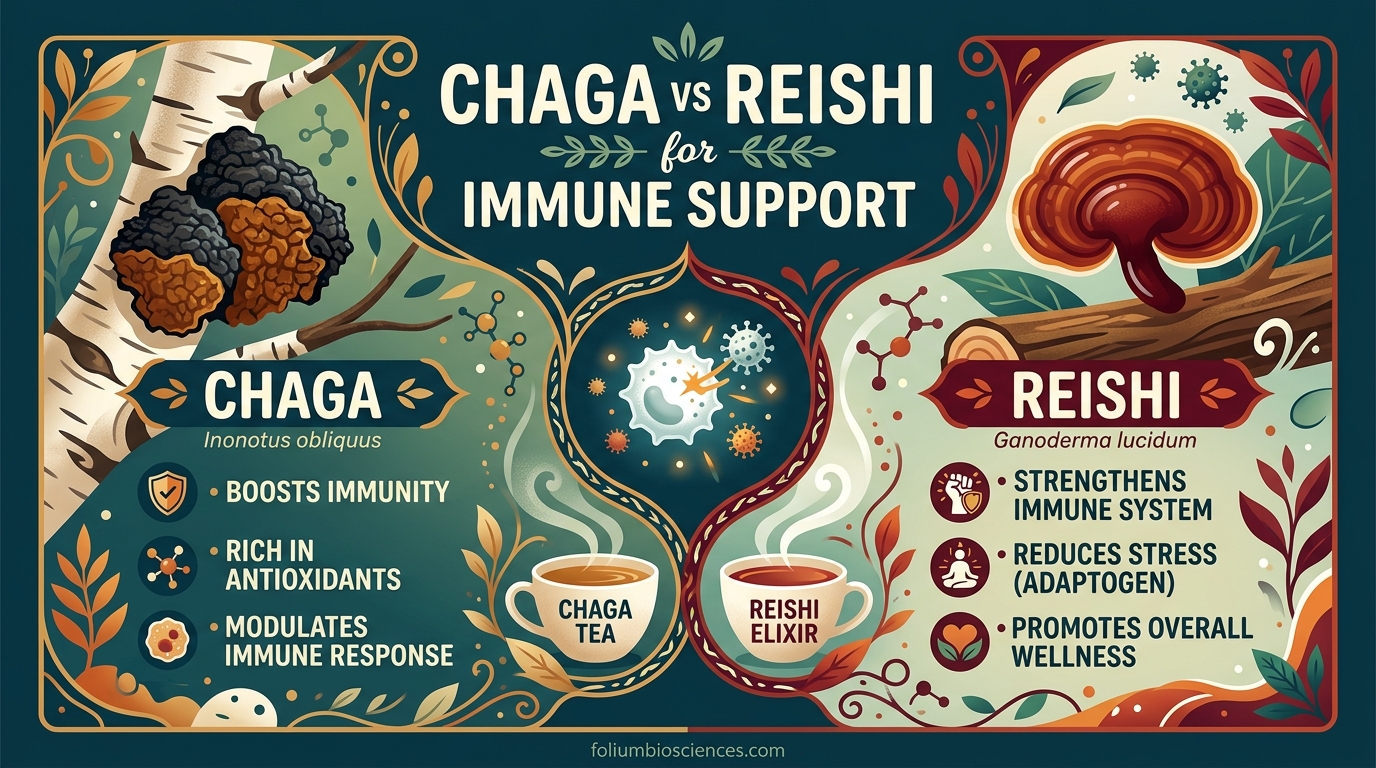
When it comes to medicinal mushrooms for immune support, Chaga and Reishi consistently rank as the top contenders. Both have been used for centuries in traditional medicine, and modern research has started uncovering how they actually work. The question that keeps coming up in our research: which one has the stronger scientific evidence for immune support?
In this guide, I will walk you through what the research actually shows. We will look at beta-glucan content, immune mechanisms, clinical study quality, and practical considerations for choosing between them. By the end, you will have a clear picture of which mushroom aligns better with your specific immune health needs.
Table of Contents
Quick Overview: Chaga vs Reishi for Immune Support
Chaga (Inonotus obliquus) and Reishi (Ganoderma lucidum) both support immune function, but they work through different mechanisms. Chaga acts primarily as an immune stimulant and antioxidant powerhouse. Reishi functions more as an immune modulator with adaptogenic properties.
When comparing the strength of evidence, Reishi currently has more robust clinical trial data, particularly from Asian research institutions and the NIH. Chaga has promising in vitro and animal studies but fewer human trials. Both contain beta-glucans and polysaccharides that stimulate white blood cells and support overall immune system function.
What Are Chaga and Reishi Mushrooms?
Before diving into the immune support comparison, let us understand what these functional mushrooms actually are and where they come from.
Chaga (Inonotus obliquus)
Chaga grows as a dark, charcoal-like conk on birch trees in cold northern climates. Despite looking like burnt wood, it is actually a parasitic fungus that has been harvested for centuries in Siberia, Russia, and Northern Europe. Traditional medicine practitioners used Chaga tea for general wellness and immune support long before scientists identified its bioactive compounds.
The key compounds in Chaga include beta-glucans, polysaccharides, and exceptionally high levels of antioxidants like superoxide dismutase. These compounds give Chaga its distinctive immune-stimulating and cellular-protective properties.
Reishi (Ganoderma lucidum)
Reishi, known as the “Mushroom of Immortality” in traditional Chinese medicine, has been documented in medical texts dating back over 2,000 years. Unlike Chaga, which grows on living trees, Reishi typically appears on decaying hardwoods and has a distinctive fan-shaped, reddish-brown appearance with a varnished look.
Reishi contains unique triterpenes called ganoderic acids, along with polysaccharides and beta-glucans. This combination creates its characteristic adaptogenic effects, helping the body manage stress while supporting immune function.
How Do Chaga and Reishi Support the Immune System?
Understanding how these mushrooms work at the cellular level helps explain why they produce different effects and which might be better suited for your needs.
Chaga’s Immune Support Mechanisms
Chaga primarily supports the immune system through direct stimulation of immune cells. The beta-glucans in Chaga activate macrophages, natural killer cells, and other white blood cells. These cells form your body’s first line of defense against pathogens.
Chaga also provides powerful antioxidant protection. The mushroom contains some of the highest levels of superoxide dismutase (SOD) found in any natural source. SOD helps neutralize free radicals that can damage immune cells and impair their function. This dual action of stimulating immune cells while protecting them from oxidative stress makes Chaga particularly effective for general immune support.
Additionally, Chaga exhibits anti-inflammatory properties that can help reduce chronic inflammation, which otherwise suppresses immune function over time.
Reishi’s Immune Support Mechanisms
Reishi takes a different approach, functioning primarily as an immune modulator rather than a pure stimulant. The polysaccharides in Reishi enhance the activity of various immune cells, including T-cells, B-cells, and macrophages. However, Reishi also contains compounds that can downregulate excessive immune responses.
This modulation ability makes Reishi unique. It can stimulate immune function when needed while also calming overactive immune responses. The triterpenes in Reishi contribute to this balancing effect and have shown promise in supporting the body’s stress response.
According to NIH research, Reishi induces what researchers call a “self-triggered immune response.” This means it helps the immune system recognize and respond to threats more effectively without causing unnecessary inflammation.
Beta-Glucan Content and Bioactive Compounds
Both mushrooms contain beta-glucans, but the amounts and types differ significantly.
Chaga typically contains higher concentrations of beta-glucans by dry weight, often ranging from 20-35% in quality extracts. These beta-glucans are primarily beta-D-glucans that directly stimulate immune cell receptors.
Reishi contains lower beta-glucan percentages, usually 10-20%, but compensates with its unique triterpene content. The combination of moderate beta-glucans plus ganoderic acids creates the characteristic adaptogenic immune modulation.
When choosing between them, consider whether you want higher direct immune stimulation (Chaga) or a balanced modulation approach (Reishi). For people with autoimmune conditions, this distinction matters significantly.
Scientific Evidence: Which Mushroom Has Stronger Research Support?
This is where we get to the heart of the question. Let us examine what the research actually shows.
Chaga Research Evidence
Chaga research has accelerated in the past decade, but most studies remain in the preclinical phase. In vitro studies show Chaga extracts stimulate immune cells and provide antioxidant protection. Animal studies demonstrate immune-enhancing effects and anti-inflammatory properties.
However, human clinical trials specifically on Chaga remain limited. Most human studies focus on general wellness or combine Chaga with other ingredients, making it difficult to isolate Chaga-specific effects. The available evidence suggests benefits, but the quality and quantity of human trials lag behind Reishi.
Reishi Research Evidence
Reishi has been studied more extensively in human populations, particularly in Asia where it has traditional medical recognition. Multiple clinical trials have examined Reishi’s effects on immune markers, cancer patients, and general wellness.
The NIH has documented Reishi’s ability to induce immune responses and act as a powerful antioxidant. Studies in cancer patients have shown Reishi can enhance immune function during chemotherapy. Research on healthy adults demonstrates measurable improvements in immune markers.
While more research is always needed, the existing human trial data for Reishi is more robust and consistent than for Chaga.
Evidence Hierarchy Comparison
When ranking the evidence quality, Reishi currently leads with more published human clinical trials, broader population studies, and institutional research support. Chaga shows promise but needs more human studies to reach the same level of evidence.
That said, evidence quality does not necessarily mean one works better than the other. It simply means we have more certainty about Reishi’s effects based on current research.
Key Differences in Immune Support Approach
Understanding the practical differences helps you choose the right mushroom for your situation.
Chaga provides direct immune stimulation plus powerful antioxidant protection. It is ideal for people looking to boost immune function proactively, especially during cold and flu season. Chaga may not be suitable for those with autoimmune conditions because of its stimulating nature.
Reishi offers immune modulation plus stress adaptation. It suits people who want balanced immune support, especially those dealing with chronic stress or autoimmune conditions. The adaptogenic properties provide additional benefits beyond pure immune support.
For general immune support in healthy adults, either mushroom can work well. For specific conditions or autoimmune concerns, Reishi’s modulation properties may offer a safer profile.
Can You Take Chaga and Reishi Together?
Many people wonder whether combining these mushrooms creates synergy or causes problems.
Based on available research and traditional use patterns, taking Chaga and Reishi together appears safe for most healthy adults. The combination may provide complementary benefits: Chaga’s stimulation plus Reishi’s modulation could offer comprehensive immune support.
However, if you have an autoimmune condition, consult a healthcare provider before combining immune-stimulating supplements. Some practitioners recommend starting with Reishi alone for autoimmune concerns, then potentially adding Chaga later if tolerated.
Start with lower doses when combining, typically half the recommended amount of each, and monitor how you respond before increasing.
Safety Considerations and Side Effects
Both mushrooms have good safety profiles, but certain groups should exercise caution.
Autoimmune conditions require special attention. Chaga’s immune-stimulating properties could theoretically worsen autoimmune symptoms in some individuals. Reishi’s modulation effects are generally considered safer for these conditions, though individual responses vary.
Drug interactions can occur. Both mushrooms may interact with blood-thinning medications and diabetes medications. Reishi specifically may interact with blood pressure medications. Always consult your healthcare provider if you take prescription medications.
Side effects are generally mild but can include digestive upset, dry mouth, and skin irritation. These usually resolve by reducing dosage or taking with food.
Frequently Asked Questions
Which mushroom is best for immune boost?
Reishi currently has stronger clinical evidence for immune support, with more human trials and NIH recognition. However, Chaga may provide more direct immune stimulation due to higher beta-glucan content. For general immune boosting in healthy adults, both work well. For autoimmune conditions, Reishi is generally considered safer due to its modulating rather than stimulating effects.
What is better, reishi or chaga?
Neither is universally better; they work differently. Chaga offers stronger immune stimulation and antioxidant protection. Reishi provides immune modulation with adaptogenic stress support. Choose Chaga for direct immune boosting and antioxidant benefits. Choose Reishi for balanced immune support, stress management, and autoimmune condition considerations.
Can I take chaga and reishi together?
Yes, most healthy adults can safely take Chaga and Reishi together. The combination may provide complementary benefits. Start with lower doses of each and monitor your response. People with autoimmune conditions should consult a healthcare provider before combining immune supplements.
Does chaga boost the immune system?
Yes, research shows Chaga can boost immune function. Its beta-glucans stimulate white blood cells including macrophages and natural killer cells. Chaga also provides antioxidant protection that supports overall immune health. While human clinical trials are limited compared to Reishi, preclinical evidence strongly supports its immune-enhancing properties.
Conclusion
When comparing Chaga vs Reishi for immune support based on scientific evidence, Reishi currently holds the advantage with more robust human clinical trials and institutional research support. The NIH has specifically recognized Reishi’s immune-modulating properties.
However, evidence strength does not tell the whole story. Chaga offers higher beta-glucan content and more direct immune stimulation, which may benefit some individuals more than Reishi’s modulation approach. The best choice depends on your specific health situation, whether you have autoimmune considerations, and how your body responds to each mushroom.
For most people seeking immune support in 2026, either mushroom provides meaningful benefits. Those with autoimmune conditions should lean toward Reishi, while those wanting maximum antioxidant and immune stimulation might prefer Chaga. And remember, taking them together remains a viable option for comprehensive immune support.