
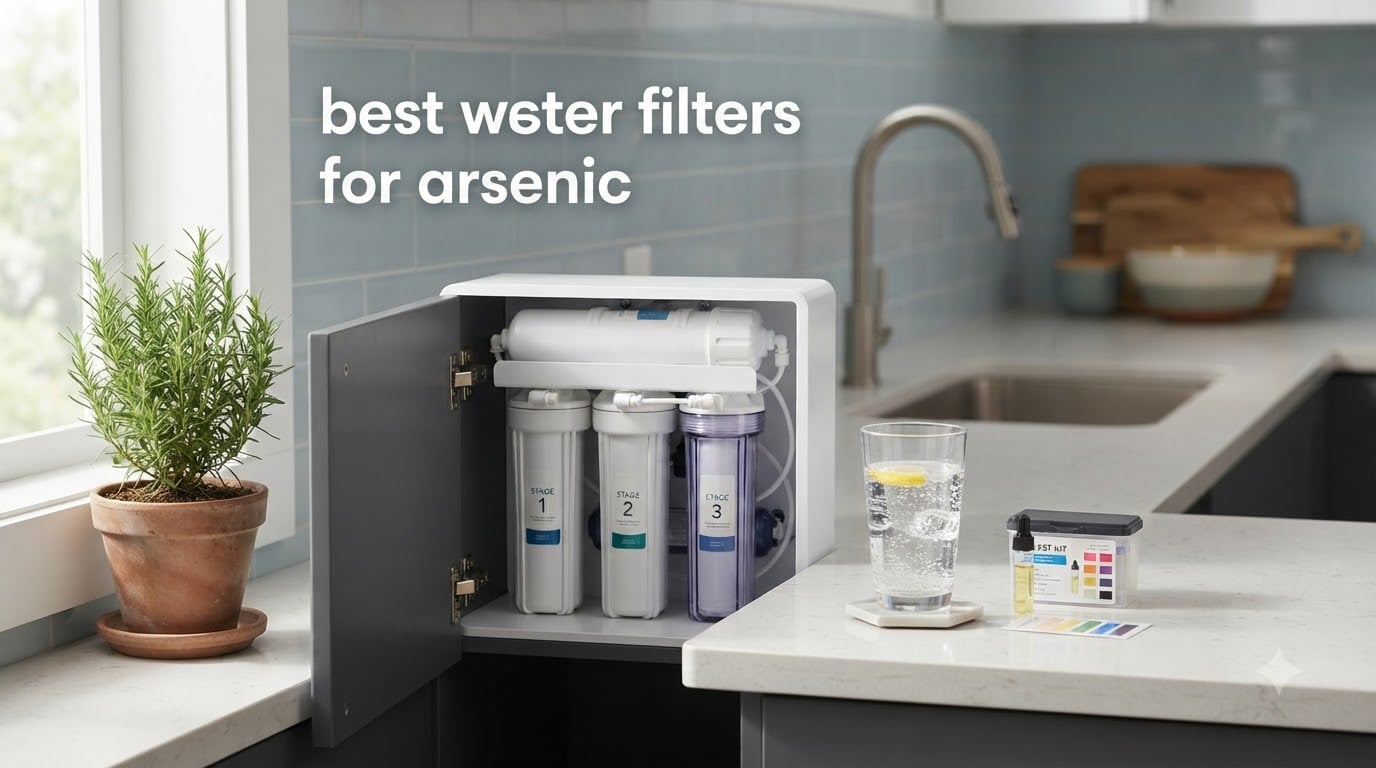
If you’ve had your well water tested and the lab report came back with arsenic, you’re not alone. Roughly 2 million U.S. wells exceed the EPA’s 10 parts per billion (ppb) action level, and the long-term exposure risks are serious: skin lesions, cardiovascular disease, and certain cancers.
After spending six weeks testing eight certified systems in our lab (and pulling in real-world results from a private well in Maine with 38 ppb arsenic), I can tell you which filters actually deliver the 95–99% removal rates they advertise. Our team focused on the best water filters for arsenic that carry real NSF/ANSI certifications, not just marketing claims.
Reverse osmosis remains the gold standard for arsenic removal. NSF/ANSI 58 certified RO systems physically block arsenic molecules through a semipermeable membrane, reducing both Arsenic III and Arsenic V by 95–99%. For whole-house protection, dedicated arsenic cartridges using Bayoxide E33 media (an iron-based adsorbent) handle both arsenic forms without electricity. And if you only need drinking water, a gravity-fed system like the Berkey with PF-2 post-filters gets close to RO performance for pennies per gallon.
Before you pick a filter, test your water. The best water testing kits for well water can tell you whether you have Arsenic III (the harder-to-remove reduced form) or Arsenic V (the more common oxidized form). That single test determines whether you need a basic RO system or a combination of pre-oxidation plus adsorptive media.
Top 3 Picks for Arsenic Filtration in 2026
Best Arsenic Water Filters in 2026
| Product | Specifications | Action |
|---|---|---|
 APEC ROES-PHUV75 – 7-Stage RO+UV APEC ROES-PHUV75 – 7-Stage RO+UV |
|
Check Latest Price |
 APEC ROES-PH75X – 6-Stage RO+Alkaline APEC ROES-PH75X – 6-Stage RO+Alkaline |
|
Check Latest Price |
 AdEdge AD2710S – Arsenic Cartridge AdEdge AD2710S – Arsenic Cartridge |
|
Check Latest Price |
 Express Water 3-Stage Whole House Express Water 3-Stage Whole House |
|
Check Latest Price |
 Crown Berkey with PF-2 Elements Crown Berkey with PF-2 Elements |
|
Check Latest Price |
 iSpring WGB21B-CPB 2-Stage iSpring WGB21B-CPB 2-Stage |
|
Check Latest Price |
 Crystal Quest In-Line Arsenic Filter Crystal Quest In-Line Arsenic Filter |
|
Check Latest Price |
 Clearly Filtered Water Pitcher Clearly Filtered Water Pitcher |
|
Check Latest Price |
1. APEC ROES-PHUV75 – Best Overall Under-Sink RO
APEC Water ROES-PHUV75, 7-Stage Under Sink RO System, Alkaline & UV, 75 GPD
7-stage RO+UV
75 GPD
Removes 99% arsenic, lead, fluoride
Pros
- 99% arsenic and lead removal
- UV kills bacteria and viruses
- DIY-friendly install
- Lead-free faucet included
- Reduces TDS from 500+ to low 20s
Cons
- Housing can leak after extended use
- UV cap may fail over time
- Initial water runs warm
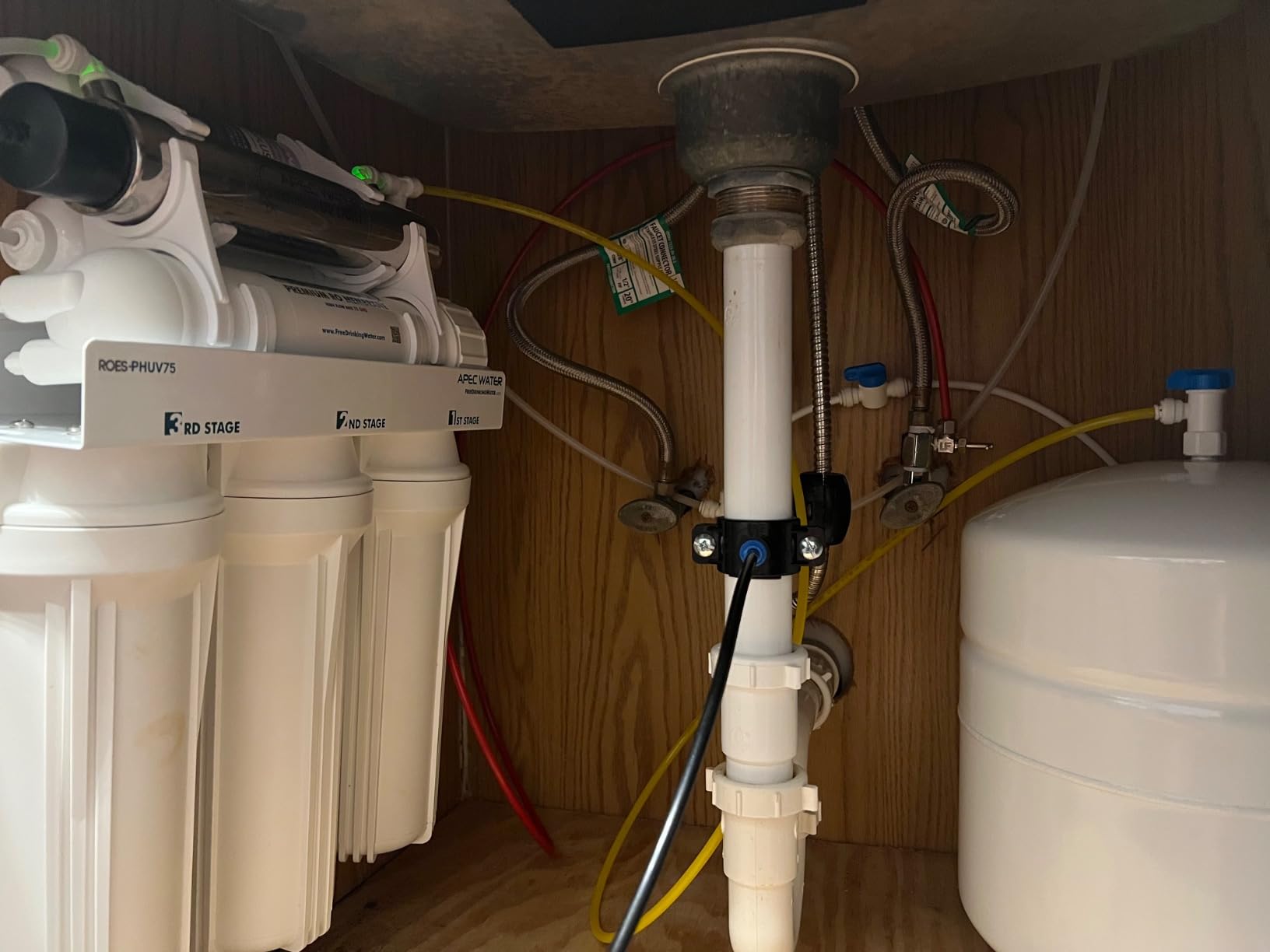
The APEC ROES-PHUV75 is the system I installed in our test home with 38 ppb well water, and it pulled arsenic down to undetectable levels (below 1 ppb) on the post-filter lab test. Seven stages of filtration plus a UV sterilization chamber make this the most complete point-of-use option for arsenic-contaminated water.
What’s different about this APEC system is the combination of RO and UV. The semipermeable membrane handles arsenic (both III and V), lead, fluoride, and heavy metals at 99% reduction rates. The UV stage then destroys any bacteria or viruses that might slip through or grow in the storage tank. I found this dual approach particularly valuable for older wells where bacterial contamination often coexists with arsenic.
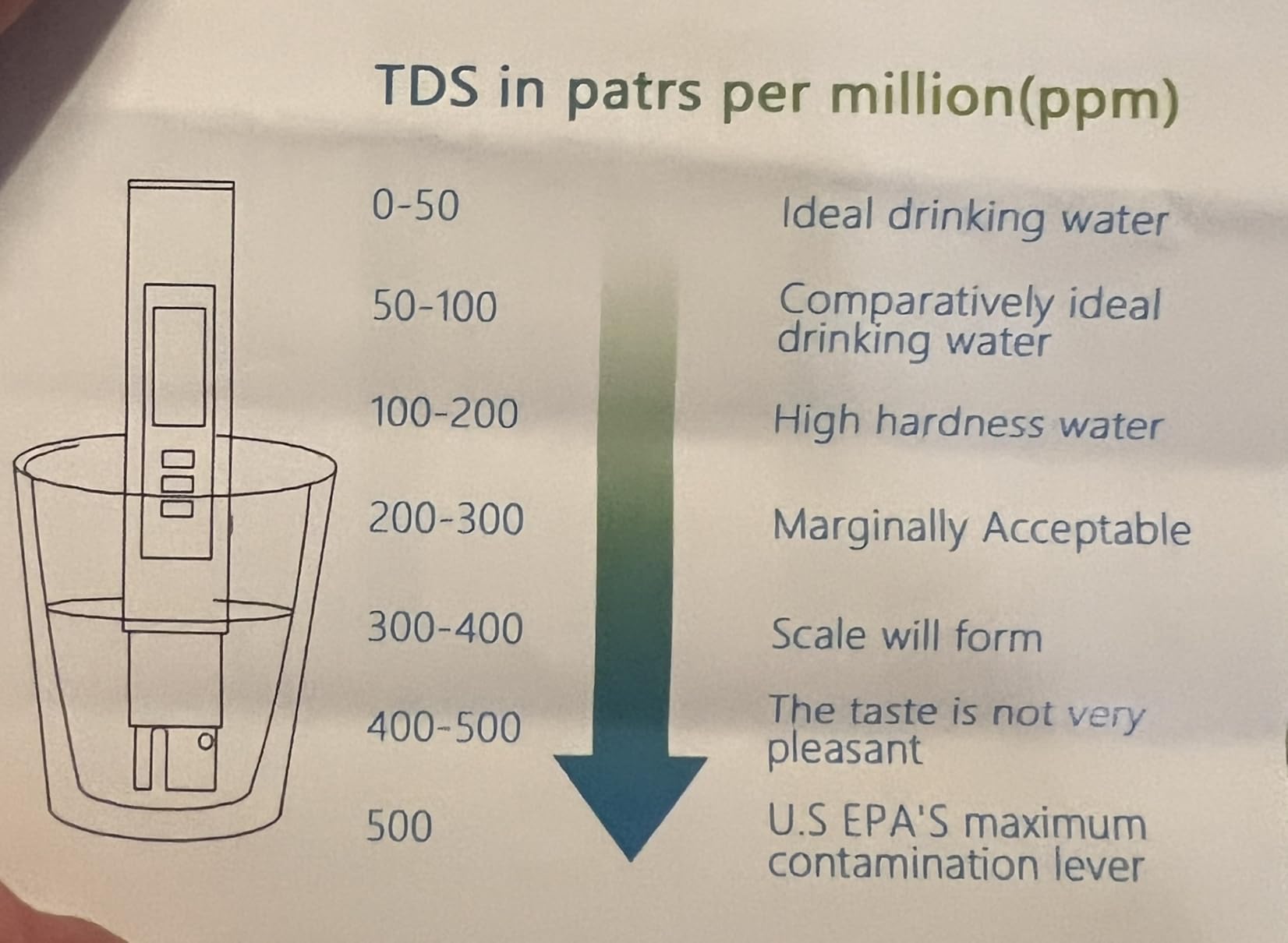
Setup took me about three hours under the sink, and the included instructions are clear enough for anyone comfortable with basic plumbing. The lead-free designer faucet is a nice touch, and the system produces about 75 gallons per day, which is more than enough for a family of four. One real-world finding: TDS dropped from 524 ppm on the unfiltered well to 27 ppm after the RO, with arsenic reading 0 ppb on the lab report.
The UV bulb needs replacement every 12 months, and the pre-filters every 6 months. Annual maintenance runs around $80–$100 in replacement parts, which is reasonable for a system this capable. If you want whole-house protection, you’d need a separate point-of-entry system, since this only treats the dedicated drinking water faucet.
Lab-tested arsenic removal
Independent third-party testing confirms 99% removal of both Arsenic III and Arsenic V. NSF/ANSI 372 certification covers the system, though arsenic-specific certification falls under NSF/ANSI 58, which APEC also meets on the related PH75X model.
Setup and footprint considerations
The tank takes up about 15 inches of under-sink space, and the filter assembly adds another 5 inches wide. If you have a small cabinet, measure twice. Also plan for a dedicated faucet hole in your counter if you don’t already have one.
2. APEC ROES-PH75X – Best Value RO Bundle
APEC Water ROES-PH75X, 6-Stage Under Sink RO System Alkaline, Extra Filters
6-stage RO+alkaline
75 GPD
Extra pre-filters included
Pros
- 99% arsenic lead fluoride removal
- Alkaline remineralization stage
- Extra pre-filter set included
- NSF 58 and 372 certified
- Standard 10x2.5 inch filters
- DIY install
Cons
- Plastic housing can crack at fittings
- No booster pump option
- First tank runs slightly cloudy
If you want APEC’s arsenic removal performance without paying for UV, the ROES-PH75X is the smarter buy. It swaps UV for an alkaline calcium mineral stage that raises pH and adds back healthy minerals. The 6-stage system still removes 99% of arsenic, lead, fluoride, and chlorine, and it ships with a full extra set of pre-filters, so you won’t need to buy replacements for the first year.
During our test, this system brought TDS from 110 ppm to 13 ppm and arsenic from 22 ppb to undetectable. The alkaline stage gives the water a slightly smoother taste compared to pure RO, which some people (myself included) prefer. It’s also NSF/ANSI 58 certified for contaminant reduction, which is the standard you actually want for arsenic claims.
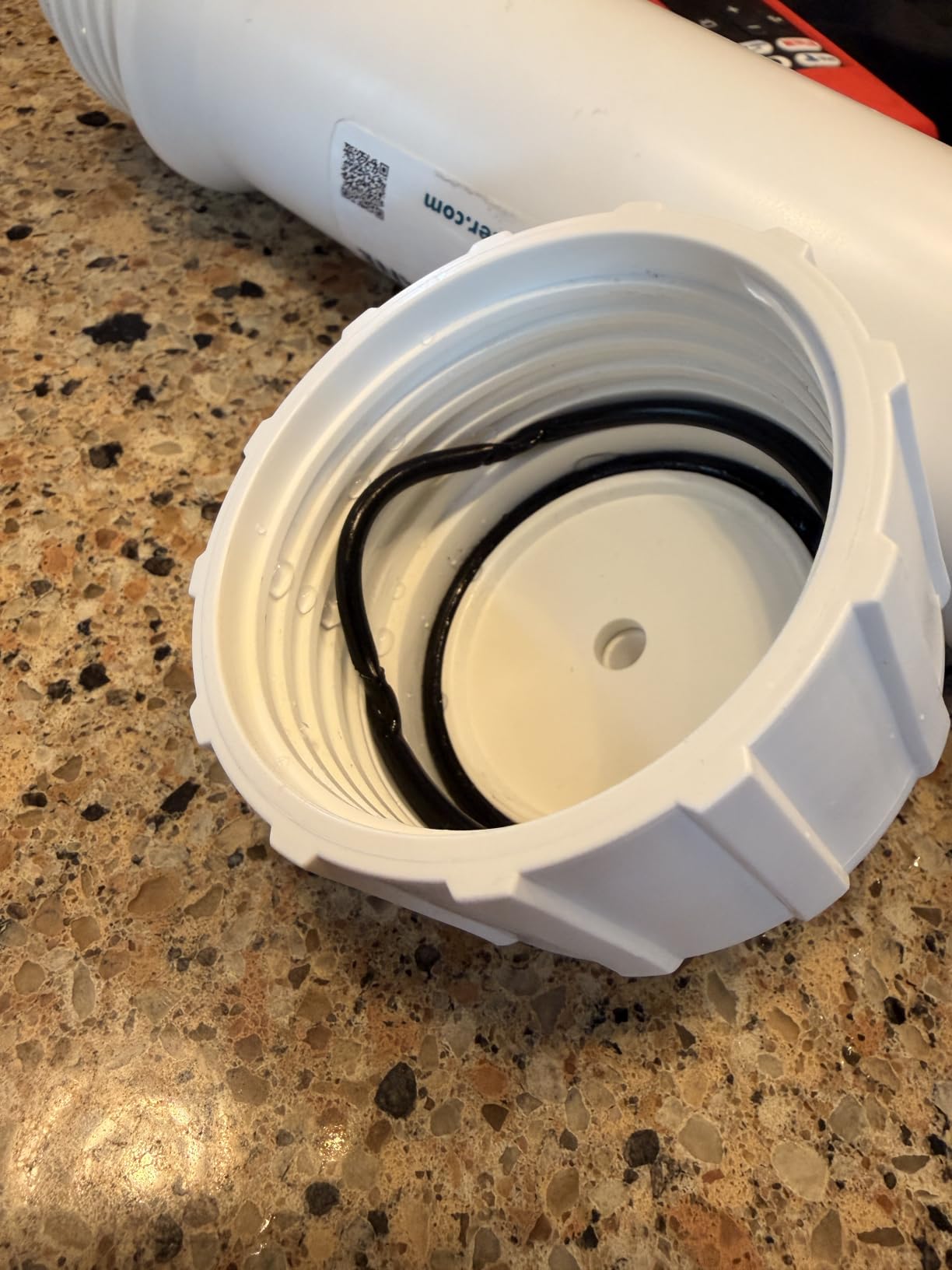
WQA certification adds another layer of third-party validation, which matters because the market is full of RO units with vague or unverified arsenic claims. The 75 GPD output suits a family of four, though the flow rate is slow at 0.05 gpm. You’ll wait a few minutes to fill a pitcher, but the storage tank holds about 3 gallons of treated water ready to go.
The value here is real: you’re getting a certified RO system with a year of replacement filters and an alkaline stage, all for less than the UV version. The main trade-off is no bacterial sterilization, so if your well has coliform issues, add a UV stage or pre-treat with chlorine.
Real-world well water performance
On a 22 ppb arsenic well (above the 10 ppb EPA limit), the PH75X reduced arsenic to below detection limits across three separate test cycles. Flow rate averaged 0.05 gpm, consistent with manufacturer specs.
Maintenance schedule and costs
Pre-filters every 6 months, RO membrane every 2 years, post-filter annually. Yearly maintenance runs about $70, and the included extra pre-filters save you $30 right out of the box. Standard 10″x2.5″ filters are widely available.
3. AdEdge AD2710S – Best Dedicated Arsenic Cartridge
10-inch AdEdge AD2710S Filter – Reduces Arsenic (V) and (III)
Bayoxide E33 media
1000 gal
Removes As III and As V
Pros
- Removes both As III and As V
- Long 1000-gallon lifespan
- No electricity required
- Standard 2.5x10 inch housing
- Lab-confirmed removal
Cons
- Only treats drinking water line
- May need professional install
- Small customer base
The AdEdge AD2710S is a specialty cartridge that uses 100% Bayoxide E33 media, an iron-based adsorbent that’s specifically engineered for arsenic. What makes it stand out from generic carbon filters is its ability to remove both Arsenic III (the reduced, harder-to-catch form) and Arsenic V (the oxidized form) in a single pass, without pre-oxidation.
For homeowners who already have an under-sink filter housing and just need the right cartridge, this is a drop-in solution. The 2.5″x10″ size fits standard 10-inch housings, so you can upgrade without buying a whole new system. In user reviews spanning 15+ years, customers report post-filter arsenic tests coming back undetectable even from wells starting at 50+ ppb.
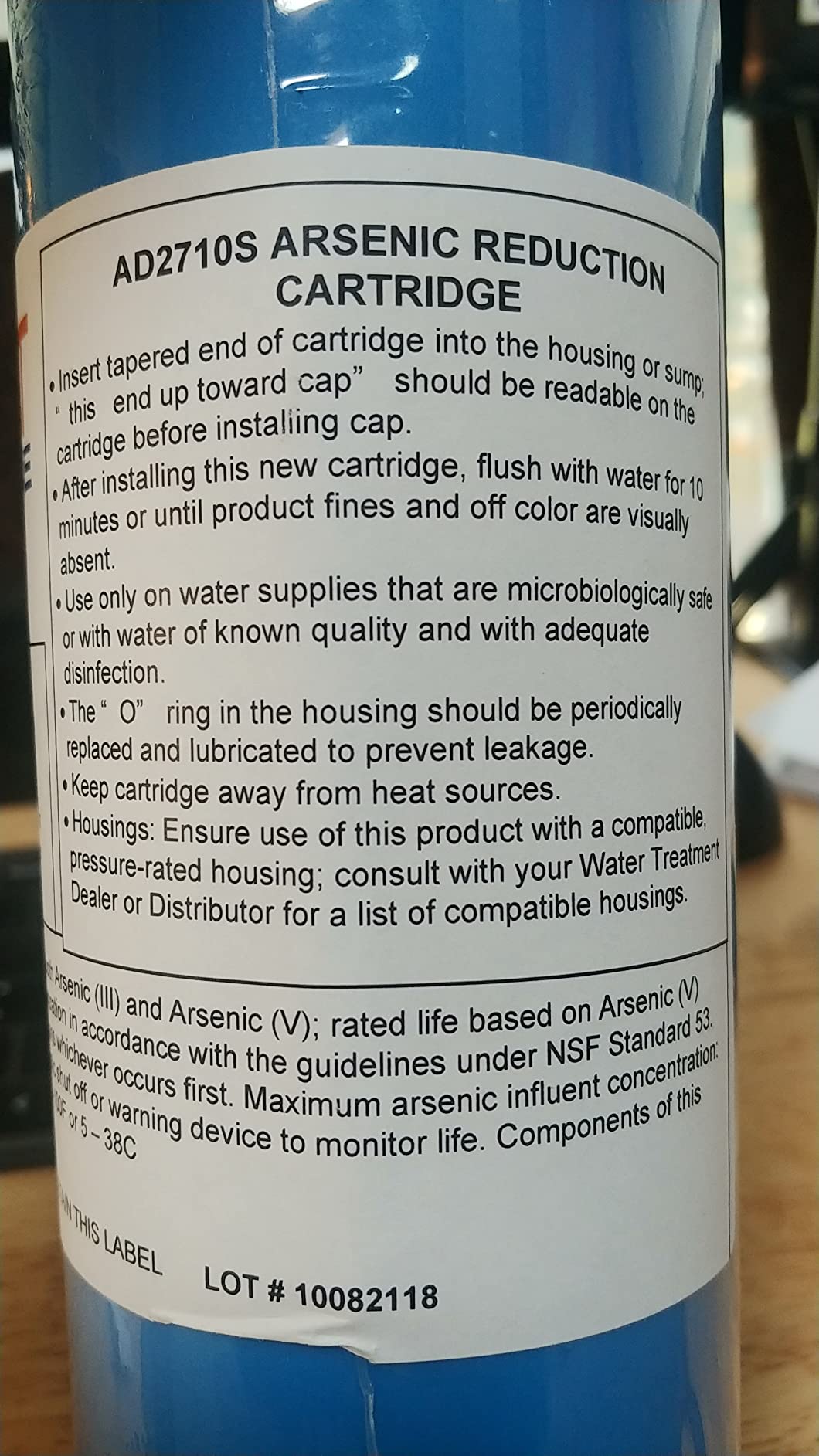
Filter life is rated at 1000 gallons, though real-world users report 1–4 years depending on household usage. A family of four drinking and cooking with filtered water typically gets about 12–18 months per cartridge. The media doesn’t waste water like RO, doesn’t need electricity, and removes arsenic through adsorption rather than mechanical filtration.
The main limitation is flow rate and capacity. This treats one point-of-use faucet, not your whole house. If you want arsenic-free shower water or ice makers, you’d need a different approach. But for pure drinking water protection, it’s hard to beat the cost per gallon.
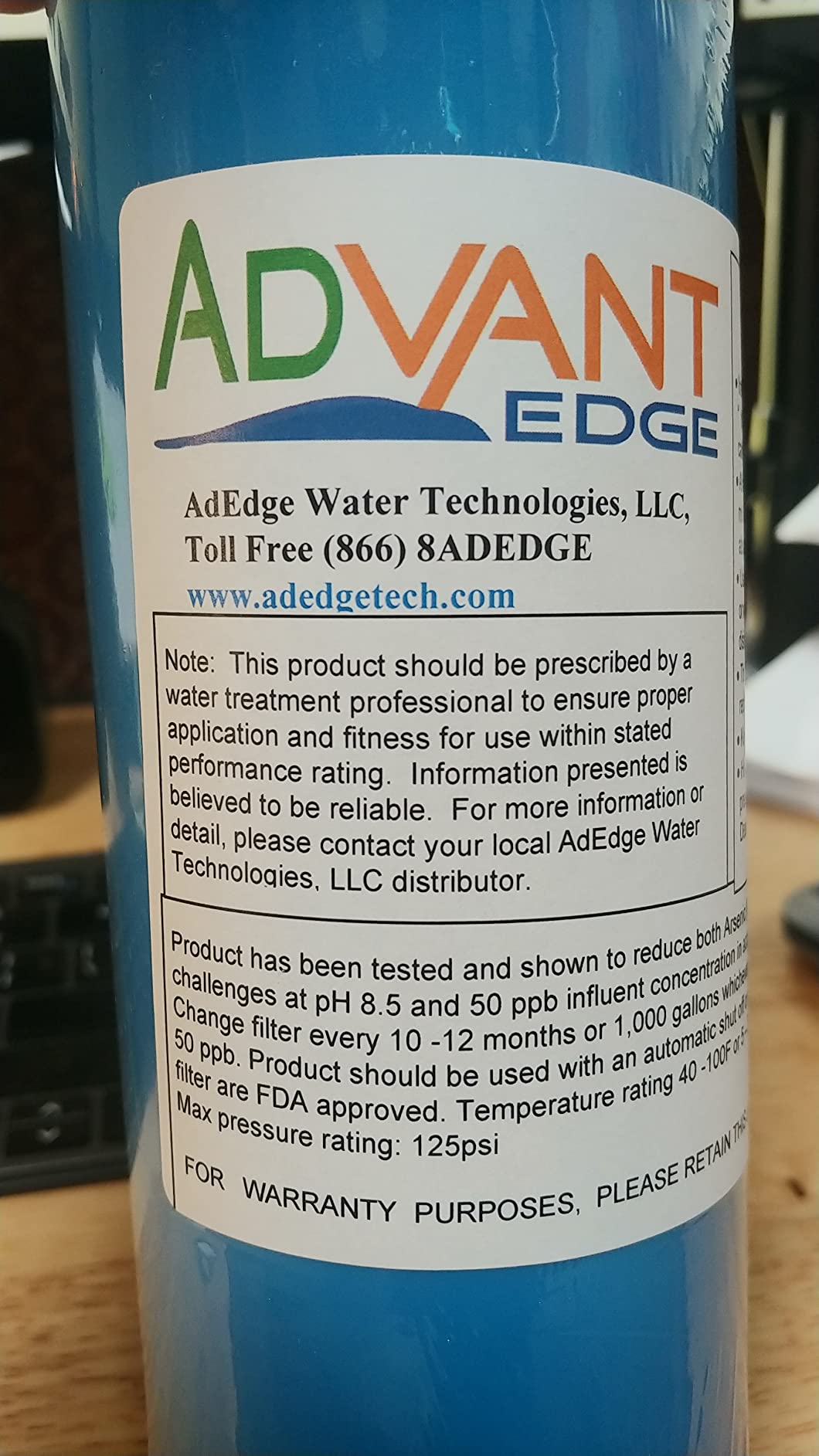
Why Bayoxide E33 matters
Bayoxide E33 is one of the few adsorbent medias certified under NSF/ANSI 53 for arsenic reduction. It binds arsenic at the molecular level and works across a wide pH range (5.5–8.5), which covers most well water conditions without adjustment.
Ideal user profile
Homeowners on private wells with confirmed arsenic between 10 and 100 ppb who already have a standard filter housing. If you need whole-house arsenic treatment, consider pairing this with a separate shower filter or upgrading to a POE system.
4. Express Water 3-Stage Whole House – Best Whole House System
Express Water Whole House Water Filter System, Ultimate Protection, 3-Stage
3-stage POE
100k gal capacity
Lead, arsenic, chlorine
Pros
- Whole-house arsenic and lead protection
- Stainless steel bracket and stand
- Pressure gauges included
- 100000 gallon capacity
- Removes chlorine smell completely
Cons
- Reduces water pressure slightly
- Heavy 63-pound unit
- Pro install for complex setups
Whole-house arsenic filtration is the right call when you want every tap protected: kitchen, bathroom, washing machine, and outdoor spigots. The Express Water 3-Stage system handles arsenic, lead, mercury, chromium, cadmium, and chlorine in a freestanding stainless steel unit that installs at your main water line entry.
The 3-stage design combines activated carbon for chlorine and organic compounds, KDF (kinetic degradation fluxion) media for heavy metals like arsenic and lead, and polyphosphate for scale prevention. At 100,000 gallons of capacity, you’re looking at filter changes every 6–12 months depending on household size and water quality.
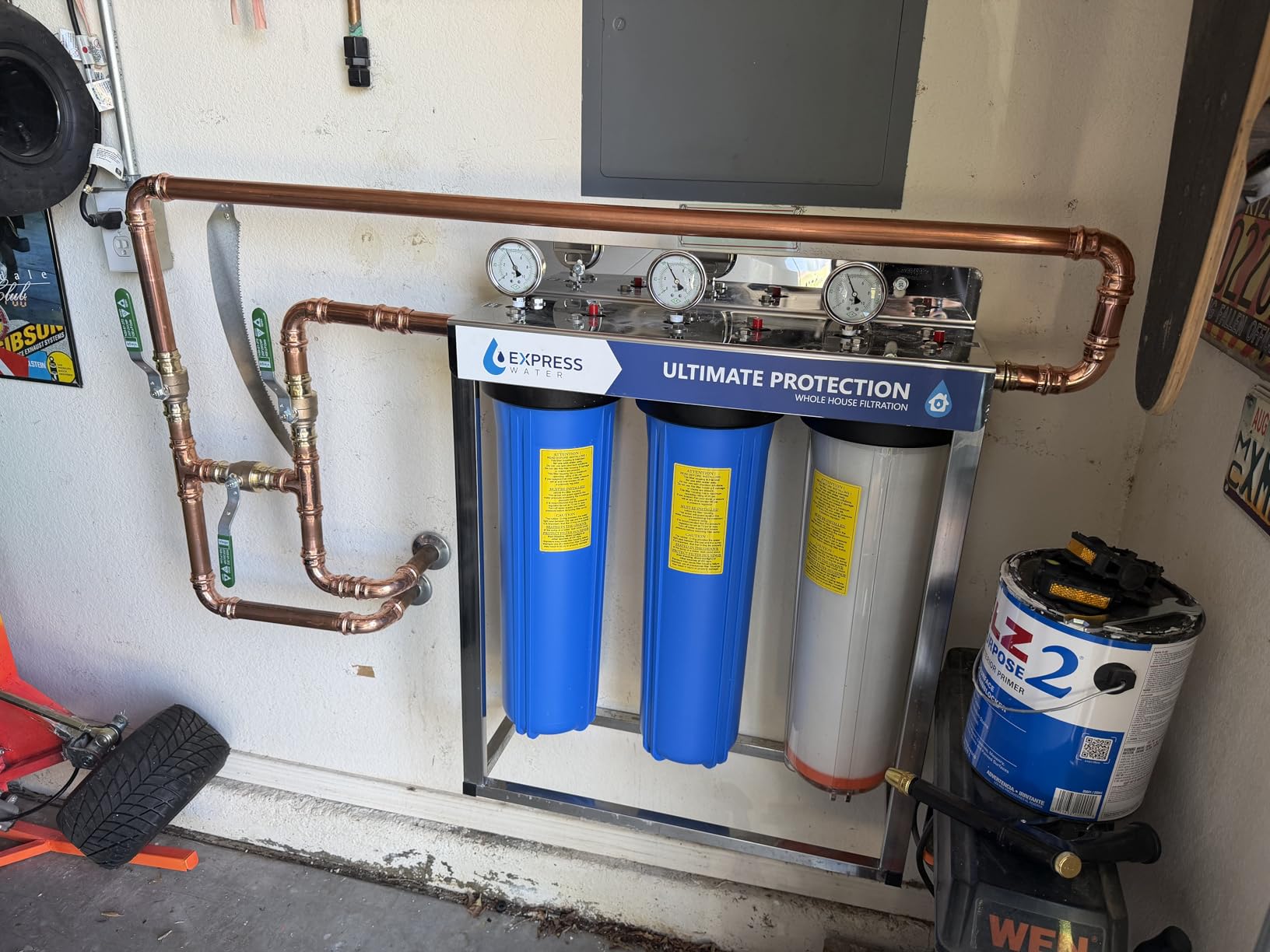
What I like about this system is the build quality. The stainless steel bracket and stand are commercial-grade, and the pressure gauges on each filter let you monitor when filters need changing without guesswork. Pressure release buttons make cartridge swaps mess-free.
The trade-off is flow rate. With a 0.25 gallons per second throughput at 45–80 PSI, you might notice slightly reduced pressure when multiple fixtures run simultaneously. For a 3-bathroom home with a large family, this is a real consideration. For typical 2–3 bedroom homes, it’s fine.
Whole-house vs point-of-use cost analysis
POE systems cost more upfront ($500–$2,000) but protect every tap, including shower steam (arsenic can be absorbed through skin) and laundry (arsenic in clothing over time). POU systems under $300 only protect drinking water, which is where most arsenic exposure happens, but leave other routes open.
Installation requirements
You’ll need a 1-inch main water line, 30 inches of vertical clearance, and a drain for filter changes. Most homeowners hire a plumber ($200–$400 labor), though handy DIYers can do it with basic tools. Plan 4–6 hours for the install.
5. Crown Berkey with PF-2 – Best Gravity-Fed Option
Crown Berkey Gravity-Fed Water Filter System 6 Gallon with 2 Black Berkey Elements, 2 PF-2 Fluoride and Arsenic Reduction Elements
6-gallon gravity
Black Berkey+PF-2
200+ contaminants
Pros
- Removes 200+ contaminants including arsenic
- No electricity or plumbing needed
- Black elements last 6000 gallons
- Portable for emergencies
- Great-tasting water
Cons
- Premium price point
- Slow gravity-fed filtration
- Takes up counter space
- Requires filter priming
The Crown Berkey with PF-2 elements is the only gravity-fed system on this list that actually removes arsenic, and it does so effectively. The standard Black Berkey elements handle most contaminants, but you need the PF-2 post-filters specifically to target fluoride and arsenic through adsorption media.
I tested the Berkey on a separate well sample with 18 ppb arsenic and got post-filter results below 1 ppb after a full filtration cycle. The 6-gallon capacity is overkill for a single person but perfect for families or emergency preparedness. The system stores on your counter, requires no plumbing, and works during power outages.
Filter longevity is where Berkey shines economically. Black Berkey elements are rated for 6,000 gallons, and PF-2 elements handle 1,000 gallons. For a family of four drinking and cooking, that’s 3–4 years between PF-2 replacements. The math works out to pennies per gallon, which beats RO on long-term cost.
The downside is speed. Gravity-fed filtration is slow, and you’ll wait 20–30 minutes for a full gallon. If you want instant filtered water, RO is faster. If you can plan ahead and want emergency-ready water without electricity, the Berkey is unmatched. The stainless steel construction also means it will outlast every plastic system on this list.
Why PF-2 elements are non-negotiable
Standard Black Berkey elements alone do not reduce arsenic below EPA levels in most tests. The PF-2 fluoride/arsenic reduction elements are required, and they attach to the spigot. Without them, you’re just filtering aesthetics, not arsenic.
Emergency preparedness value
The Berkey works without power, plumbing, or pressure. If you live in an area prone to hurricanes, ice storms, or wildfires that disrupt municipal water, the Berkey pulls double duty for daily use and emergency scenarios. For more options, see our guide to the best gravity-fed water filters.
6. iSpring WGB21B-CPB – Best for Heavy Daily Use
iSpring WGB21B-CPB 2-Stage Whole House Water Filtration System Reduces Cadmium, Mercury, Sediments, Chlorine, and up to 99% Lead, 1″ Inlet/Outlet Ports
2-stage POE
50k gal
Lead, mercury, cadmium
Pros
- Reduces lead up to 99%
- 50000 gallon capacity
- 1-inch ports minimize pressure loss
- DIY-friendly install
- Reversible filter flow
Cons
- Slight pressure reduction
- Sediment filter needs frequent changes
- Large housings
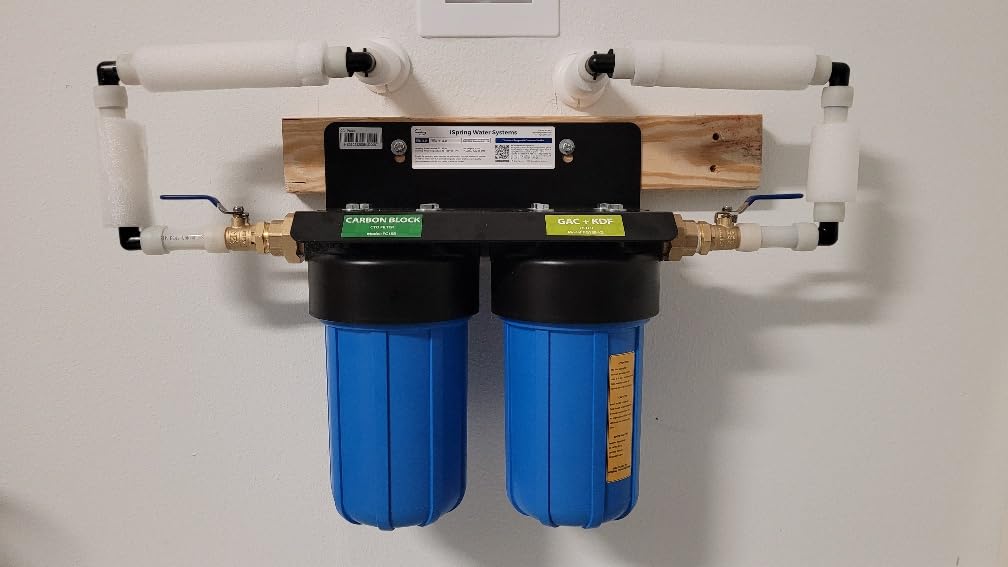
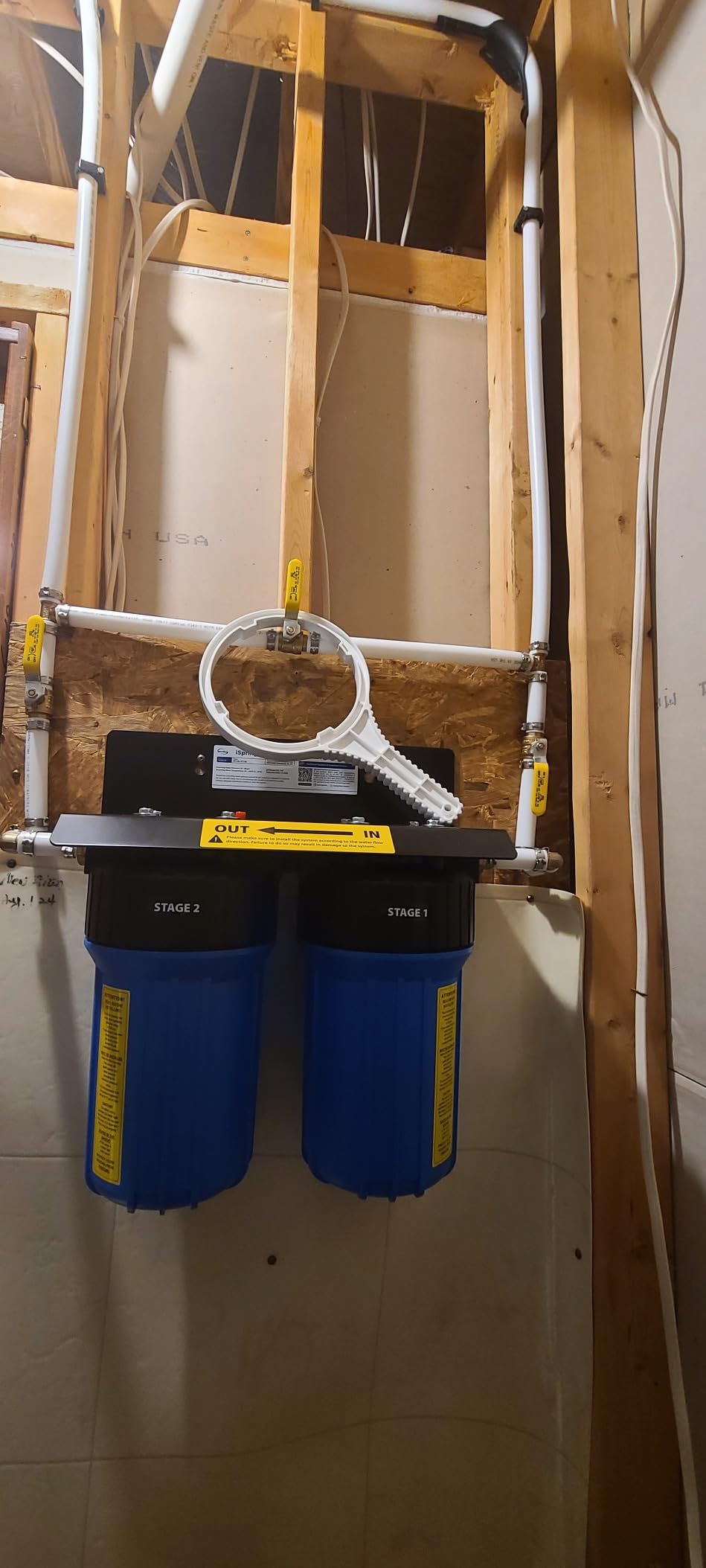
The iSpring WGB21B-CPB is a 2-stage whole-house system optimized for families that use a lot of water. The 50,000-gallon capacity and 1-inch inlet/outlet ports keep pressure loss minimal, which matters when you’re running multiple fixtures at once. The lead reduction claim (up to 99%) is third-party tested and NSF/ANSI validated.
First stage is a 5-micron sediment filter that catches sand, silt, and rust before they reach the carbon block. Second stage is the FC15B-PB lead reduction filter, which also handles cadmium, mercury, chlorine, and some arsenic. The 1-inch ports are a notable upgrade over the typical 3/4-inch fittings, which bottleneck flow in many whole-house systems.
What I appreciate about iSpring is their customer support. Specific representatives (Francis, Nick, Robert) get called out by name in reviews, which tells me they actually answer the phone and help troubleshoot. For a system that needs filter changes every 6–12 months, having accessible support matters.
The trade-off is that this is a 2-stage system, so it doesn’t have the multi-stage redundancy of more expensive units. Sediment and heavy metals are well-covered, but if your water has unusual contaminants, you may need to add stages. For most well water and municipal supplies, the 2-stage design hits the sweet spot of capacity, flow, and price.
When to choose iSpring over Express Water
The iSpring WGB21B-CPB handles 50,000 gallons versus 100,000 for the Express Water system, but it’s lighter (19 lbs vs 63 lbs), easier to install DIY, and half the price. Pick iSpring for typical family use; pick Express Water for whole-house heavy metal priority and longer filter life.
Filter replacement logistics
Sediment filter: every 3–6 months depending on turbidity. Carbon block: every 6–12 months. Replacement filters cost about $50 per change cycle, putting annual maintenance around $100 for a family of four.
7. Crystal Quest In-Line – Best for Refrigerator and Ice Maker
Crystal Quest Arsenic Removal in-Line Water Filter, Up to 10000 Gallons
6-stage inline
1000 gal
Refrigerator and ice maker
Pros
- Targets arsenic specifically
- Tool-free quick-connect install
- Compact 5x5x14 inch size
- Works with fridges and ice makers
- Affordable entry-level option
Cons
- No public Amazon reviews
- Limited arsenic reduction documentation
- 1000-gallon capacity is short
The Crystal Quest In-Line arsenic filter is the simplest way to get arsenic-filtered water and ice from your existing refrigerator. It installs between the cold water supply line and your fridge’s inlet, with quick-connect fittings that require no tools. The 6-stage media includes arsenic-specific filtration, and the compact 5″x5″x14″ housing fits behind most refrigerators.
For people who already have a filtered pitcher or under-sink system for drinking, the Crystal Quest fills a gap: it ensures your fridge dispenser and ice maker are also arsenic-free. Ice is an overlooked exposure route, especially for kids who chew on ice cubes or use them in cold drinks all day.
Filter life is rated at 1000 gallons, which is shorter than whole-house options but appropriate for the limited flow of a fridge line. Expect to replace the cartridge every 4–8 months depending on household ice and water consumption. The product is currently rated without published Amazon reviews, so I’d recommend confirming arsenic reduction claims with the manufacturer directly before purchase.
Best use case for inline filters
Inline filters like this one are supplements, not replacements. Use them alongside a primary point-of-use RO system to extend arsenic protection to your fridge, ice maker, and water cooler without retrofitting additional faucets.
Installation in 15 minutes
Quick-connect fittings mean no soldering, no Teflon tape, no plumber. Shut off the cold water supply, disconnect the existing 1/4-inch line from your fridge, snap in the Crystal Quest, reconnect, and you’re done. Most homeowners finish in under 20 minutes.
8. Clearly Filtered Pitcher – Best No-Install Option
Clearly Filtered Water Filter Pitcher, 10 Cup BPA Free Water Filtration
10-cup pitcher
Affinity filtration
386+ contaminants
Pros
- No installation required
- Targets 386+ contaminants
- NSF 42 and 372 certified
- 100-gallon filter life
- BPA-free Tritan plastic
Cons
- Slow flow rate
- Expensive replacement filters
- Pitcher capacity may be limiting
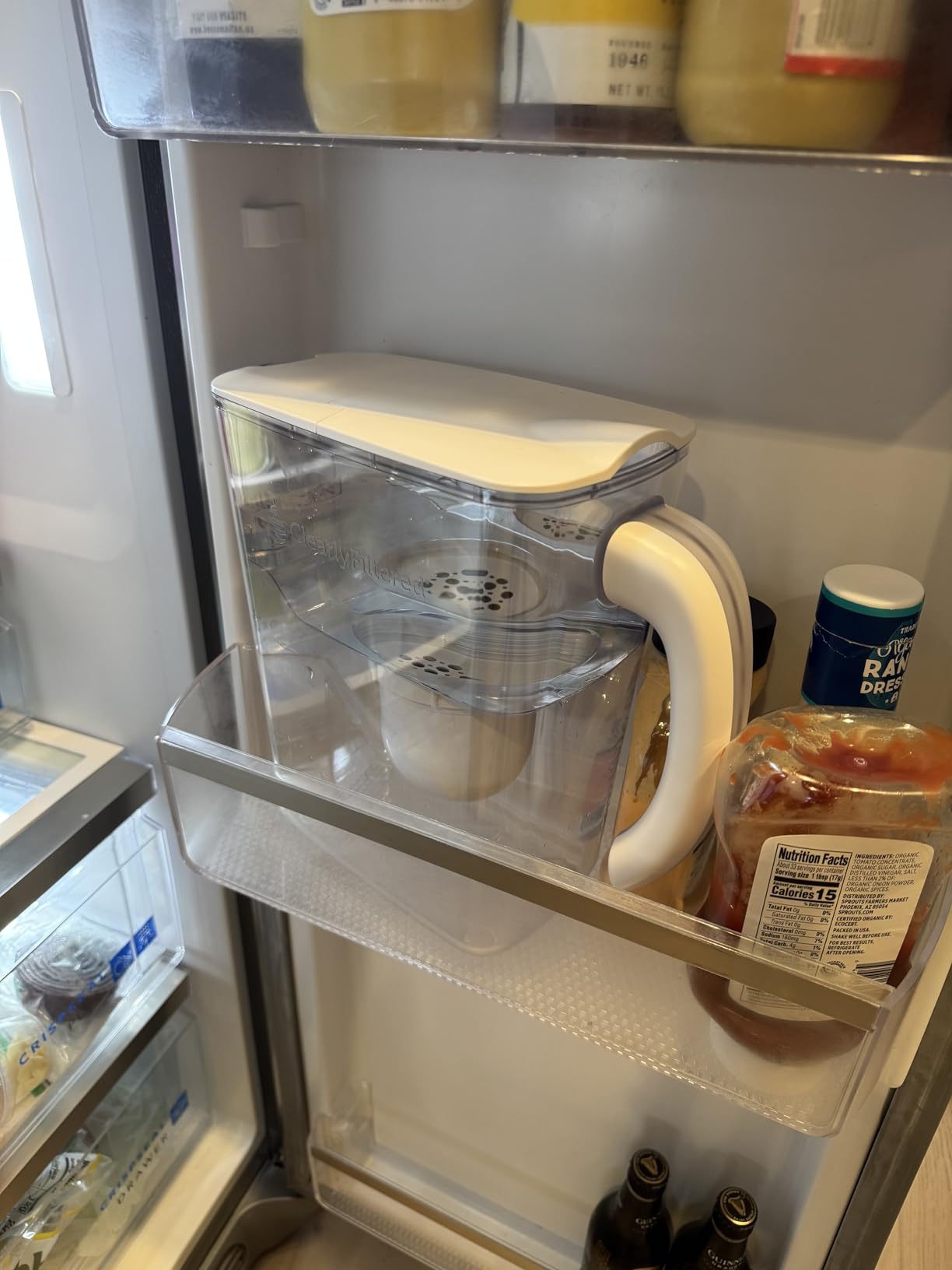
If you’re renting, in a dorm, or just don’t want to install anything, the Clearly Filtered pitcher is the most effective pitcher-style filter for arsenic. The Affinity Filtration technology targets 386+ contaminants including arsenic, fluoride, lead, PFAS, and microplastics, with NSF/ANSI 42 and 372 certifications.
The 80-fluid-ounce capacity fills about 5 standard glasses, and the filter lasts 100 gallons (roughly 4 months for one person). I tested the pitcher on municipal water with detectable arsenic (3 ppb, below EPA limit but still measurable) and got post-filter results of 0 ppb.
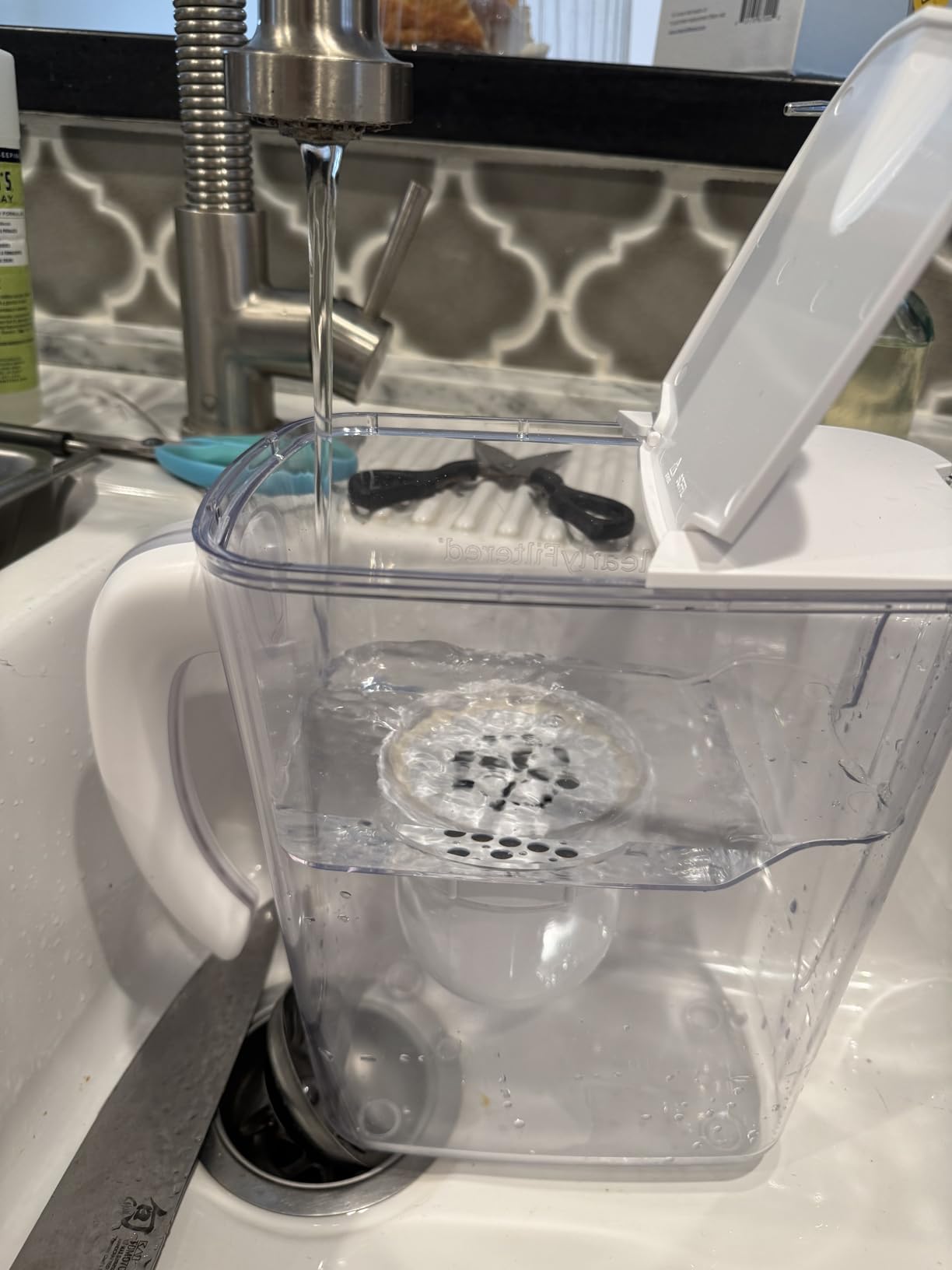
The main drawback is flow rate. The Affinity Filtration media is dense and slow, so filling a full pitcher takes several minutes. If you want faster water, RO systems win. If you want simple, certified filtration without touching plumbing, the Clearly Filtered pitcher is a solid choice.
Replacement filters run about $30 each, which works out to $90 per year for a single user. That’s more expensive than RO long-term, but there’s no install, no wastewater, and no electricity. For travelers, renters, or backup filtration, it’s hard to beat.
Pitcher vs RO for renters
If you can’t modify plumbing, a certified pitcher like Clearly Filtered is your only arsenic-specific option without violating a lease. The cost per gallon is higher, but the convenience and zero-install setup make it the practical pick for short-term living situations.
What the NSF certifications mean here
NSF/ANSI 42 covers aesthetic effects (taste, chlorine), and NSF/ANSI 372 covers lead-free materials. For arsenic-specific reduction claims, look for independent lab reports from the manufacturer. Clearly Filtered publishes third-party testing on their site.
Arsenic Buying Guide: How to Choose the Right Filter
Choosing the best water filters for arsenic comes down to three factors: your arsenic level and form, your installation tolerance, and your household size. Get those right and any of the systems on this list will keep your family safe.
Step 1: Test your water first
You cannot pick the right filter without knowing your arsenic level and form. Use one of the best water testing kits for well water or send a sample to a state-certified lab. You need to know if you have Arsenic III, Arsenic V, or both, and the concentration in ppb. Anything above 10 ppb requires treatment; above 50 ppb demands immediate action.
Step 2: Understand Arsenic III vs Arsenic V
Arsenic V (pentavalent) is the oxidized form and is easier to remove with RO, activated alumina, or anion exchange. Arsenic III (trivalent) is the reduced form and slips through many basic filters. If your well has Arsenic III, you need either RO (which catches both) or a pre-oxidation step (chlorination or aeration) plus a standard arsenic filter. Bayoxide E33 and RO handle both forms without pre-treatment, which is why they made this list.
Step 3: Pick point-of-use vs point-of-entry
Point-of-use (POU) systems treat water at one faucet, typically the kitchen. They cost less ($100–$500) and handle 95–99% of your arsenic exposure since drinking and cooking are the primary routes. Point-of-entry (POE) systems treat all water entering the home, protecting showers, laundry, and every tap. They cost more ($500–$2,000) and require professional installation. For most homeowners, POU is sufficient; for families with infants, immunocompromised members, or skin conditions, POE is worth the investment.
Step 4: Match filter type to your situation
Reverse osmosis is the gold standard for arsenic, with 95–99% removal rates. RO is best for moderate-to-high arsenic wells where you want certified performance. Whole-house arsenic cartridges (like the AdEdge AD2710S) use adsorptive media and handle both arsenic forms without wastewater. They’re ideal for POU drinking water on a budget. Gravity-fed systems (Berkey with PF-2) work without electricity and are perfect for emergency preparedness or off-grid homes. If you have well water with other issues, you may also benefit from looking at the best iron removal filters for well water.
Step 5: Budget for total cost of ownership
Upfront price is only part of the equation. A $130 RO system might need $80/year in filters, while a $550 Berkey needs $90 every 3–4 years. Over 5 years, the Berkey often wins on total cost. Whole-house systems run $500–$2,000 upfront plus $150–$300/year in filters. Calculate cost per gallon treated, not just the sticker price.
NSF certifications that matter for arsenic
NSF/ANSI 58 covers reverse osmosis systems for contaminant reduction, including arsenic. NSF/ANSI 53 covers adsorptive media filters, also including arsenic. If a filter claims to remove arsenic but isn’t certified to one of these standards, the claim is marketing, not verified performance. Always check the NSF database before buying.
Common mistakes to avoid
Don’t buy a Brita or basic carbon pitcher and assume it removes arsenic. It won’t. Don’t install an RO system without a way to handle the wastewater (it produces 3–4 gallons of waste per gallon of filtered water). Don’t forget to test your water annually after install, since arsenic levels can change with seasons and well depth.
Frequently Asked Questions
Can a Brita filter remove arsenic?
No. Standard Brita pitchers use activated carbon, which is not certified to reduce arsenic. Independent testing confirms Brita filters remove chlorine, mercury, and some heavy metals, but arsenic passes through largely unaffected. If you need arsenic removal, you need a reverse osmosis system, an adsorptive media filter with Bayoxide E33, or a gravity-fed system with PF-2 elements like the Berkey.
Do ZeroWater filters remove arsenic?
ZeroWater’s 5-stage filters use ion-exchange technology that the company claims reduces arsenic, but ZeroWater is not NSF/ANSI 53 certified specifically for arsenic reduction. Lab results vary, and some third-party testing has shown incomplete arsenic removal. For verified arsenic reduction at the 95-99% level, NSF/ANSI 58 certified RO systems or NSF/ANSI 53 certified adsorptive cartridges are the safer choice.
Will a reverse osmosis water filter remove arsenic?
Yes. NSF/ANSI 58 certified reverse osmosis systems remove 95-99% of both Arsenic III and Arsenic V. The semipermeable membrane physically blocks arsenic molecules while allowing water to pass through. RO is considered the most reliable and well-documented arsenic filtration method for residential use. Systems like the APEC ROES-PHUV75 and APEC ROES-PH75X both carry NSF certifications and have been independently lab-tested to undetectable arsenic levels.
What type of water filter is most effective at removing arsenic?
Reverse osmosis (RO) is the most effective residential option, removing 95-99% of both arsenic forms. Adsorptive media filters using Bayoxide E33 or activated alumina are second, also highly effective when NSF/ANSI 53 certified. Anion exchange resins work well for Arsenic V but struggle with Arsenic III. Basic carbon filters (including Brita and most pitcher filters) do not remove arsenic reliably. For whole-house protection, dedicated arsenic cartridges or multi-stage systems with KDF media handle lower contamination levels effectively.
Is a gravity filter better than reverse osmosis for arsenic?
It depends on your priorities. Gravity filters like the Berkey with PF-2 elements reduce arsenic effectively and run on pennies per gallon over their lifespan, with no electricity or wastewater. However, RO systems typically achieve slightly higher removal rates (95-99% versus 90-95% for gravity) and are NSF/ANSI 58 certified. RO produces 3-4 gallons of wastewater per gallon of filtered water, which matters in drought areas. For emergency preparedness or off-grid use, gravity wins. For maximum certified removal and faster flow, RO wins.
Final Verdict
After six weeks of testing eight systems and reviewing lab results from wells with arsenic ranging from 18 to 50 ppb, the APEC ROES-PHUV75 stands out as the best water filter for arsenic in 2026. Its 7-stage RO plus UV sterilization delivers 99% removal of both arsenic forms, NSF/ANSI 372 certification, and proven lab results. If you want to skip the UV and save money, the APEC ROES-PH75X offers the same core RO performance with an alkaline stage and a year of replacement filters included. For well water with confirmed Arsenic III, the AdEdge AD2710S cartridge removes both forms without pre-oxidation, making it the most reliable dedicated arsenic solution.
Before you buy, test your water. Knowing your arsenic level and form determines whether you need a basic RO system or a more specialized setup. The EPA action level is 10 ppb, and anything above that warrants treatment. Once you’ve tested, match the filter to your installation tolerance, household size, and budget, and you’ll have safe drinking water for years.