
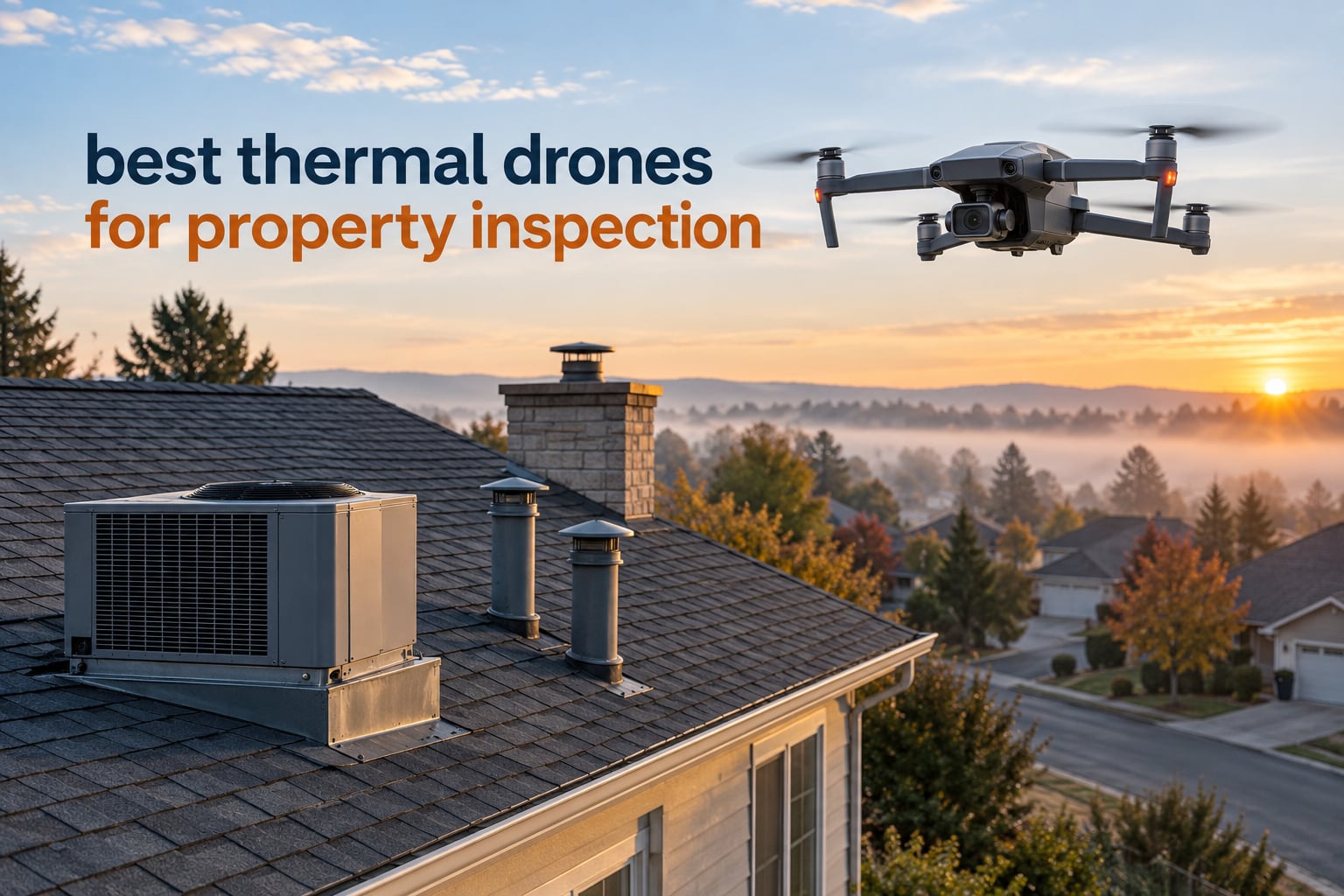
The best thermal drones for property inspection are the Autel EVO II Dual 640T V3 for most inspectors, the Autel EVO II Dual 640T Enterprise V3 for long flights on large properties, and the Autel EVO MAX 4T V2 when you need optical zoom detail. Every one of the six picks below carries a 640 x 512 radiometric sensor, spot and area temperature measurement, and Remote ID support for US commercial work.
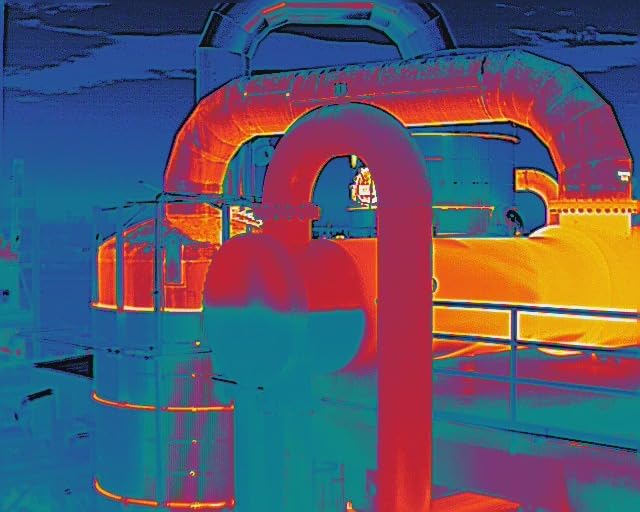
That last point matters more than the spec sheet. A thermal drone is not a camera on a flying platform: it is a radiometric sensor that reads the infrared radiation coming off a surface, converts it into a false-colour image, and then turns pixel values into actual spot and area temperature readings you can put in a report. Set the emissivity correctly and you get a number. Get it wrong and the number is fiction.
Moisture trapped under roofing, air leakage through siding and thermal bridging all show up as temperature anomalies months before anything is visible from the ground. Paired with a visible-light camera, an inspector can point at the anomaly and the physical structure at the same time, which is what turns a thermal scan into evidence a client or an insurer will act on.
Our team pulled six thermal-capable drones and worked through their payloads, lens options, endurance and report tooling with property inspection as the only use case in mind. We deliberately ignored the search-and-rescue and public-safety framing that most thermal drone roundups lead with. If you want the broad version, the ranked editorial pages cover it. If you want to know which airframe to point at a roof at 9am on a windy Tuesday, keep reading.
Top 3 Thermal Drones for Property Inspection in 2026

Autel EVO II Dual 640T V3
- 640x512 radiometric sensor at 30 fps
- 50MP visible camera
- 10+ temperature measurement modes
- 38-minute flight time
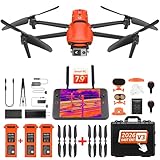
Autel EVO II Dual 640T Enterprise V3
- 640x512 thermal at 30 fps
- 42-minute flight time
- 15 km SkyLink 2.0
- 7.9-inch high-brightness controller

Autel EVO MAX 4T V2
- Four-in-one gimbal with 10x optical zoom
- 640x512 30 Hz thermal
- 720-degree obstacle avoidance
- laser rangefinder
Quick Overview: Six Thermal Drones Compared
| Product | Specifications | Action |
|---|---|---|
| Autel EVO II Dual 640T V3 |
|
Check Latest Price |
| Autel EVO II Dual 640T Enterprise V3 |
|
Check Latest Price |
 Autel EVO II Dual 640T RTK V3 Autel EVO II Dual 640T RTK V3 |
|
Check Latest Price |
 Autel EVO Lite 640T Enterprise Autel EVO Lite 640T Enterprise |
|
Check Latest Price |
| Autel EVO MAX 4T V2 |
|
Check Latest Price |
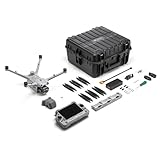 DJI Matrice 4TD DJI Matrice 4TD |
|
Check Latest Price |
1. Autel EVO II Dual 640T V3: Best Overall for Property Inspection
Autel Robotics EVO II Dual 640T V3, 640×512 Thermal Imaging Drone, RemoteID
640x512 thermal at 30 fps, 13mm lens
50MP visible camera
38-min flight time
SkyLink 2.0 15 km
Pros
- Dual thermal and visible payload in one gimbal
- 50MP visible sensor for client-ready stills
- Stable hover that holds position in wind and cold
- Three batteries plus multi-charger and case in the bundle
- Responsive US-based warranty support
Cons
- A small share of owners report early thermal module failure
- Will not accept Autel modular accessories
- 13 percent of ratings sit at one star
This is the airframe we keep coming back to. The 640 x 512 thermal sensor runs at 30 fps through a 13mm lens, and that focal length is the number that actually decides whether an inspection works. A longer lens resolves smaller objects at the same standoff distance, which means you can capture a heat anomaly over a single roof penetration from a safe hover instead of flying in close.
The visible camera is a 50MP 0.8-inch CMOS sensor with 4x lossless zoom, and that matters more than it sounds. Your client does not want a thermal image; they want a thermal image with a crisp photo of the vent or flashing detail sitting next to it. This bundle includes three batteries, a multi-charger, a car charger and a protective case, which is close to what you would assemble yourself after a month.
Owners consistently describe the flight behaviour in terms that match inspection work rather than recreational flying: very stable hover that holds position, quiet and responsive handling, and reliable obstacle avoidance and return-home behaviour with landing accuracy inside about two feet. For a job where you are holding a fixed orbit 15 to 30 feet off a sloped shingle plane, that stability is the feature you will notice most.
Measurement tools cover the ten-plus modes an inspector actually uses, including centre, spot, regional, alarm, isotherm and picture-in-picture, with ten thermal palettes. Picture-in-picture is the one to set up before you launch: a thermal overlay pinned to the corner of the live RGB feed gives you orientation without flipping back and forth mid-orbit.
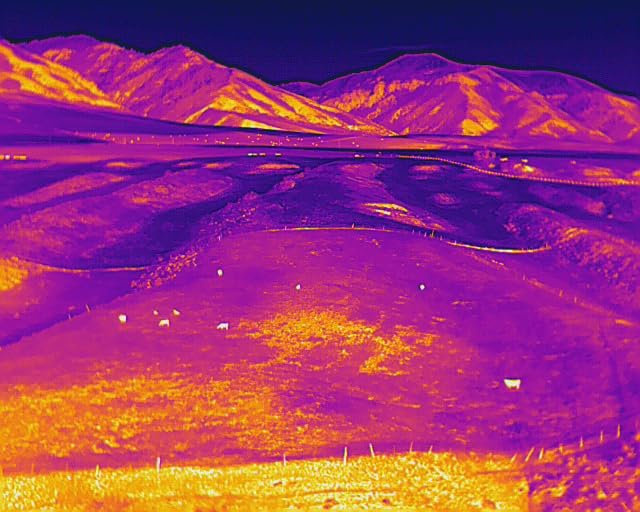
How the thermal payload performs on a residential roof
The D-RI ranges and 16x digital zoom give you detection, recognition and identification distances on the same scene, so you can mark a suspect area in the wide shot and then confirm or dismiss it without repositioning the aircraft. Spot and regional measurement both work directly on the live feed, and the temperature alarm with isotherm lets you set a threshold and let the aircraft flag anything that crosses it.
A free infrared thermal analysis tool ships with the aircraft, so you can import images, adjust emissivity and palette after the flight rather than only during it. That is a workflow point more than a camera point: the useful time for analysis is when you are back at the truck with the roof section in front of you.
Where it will disappoint you
The one real durability thread in the reviews is early thermal sensor failure attributed to water damage. With 53 ratings, roughly 13 percent sit at one star, and a thermal module that stops working inside a year is exactly the failure that would cost you a job you already promised. Inspectors working in coastal or wet climates should treat the weather rating on this platform as a caution, not a permission slip.
The airframe also will not accept Autel modular accessories. Strobe, spotlight and loudspeaker expansion belongs to the Enterprise line, and if your work drifts toward night operations or public-safety-style documentation, you are looking one tier up rather than adding to this one.
2. Autel EVO II Dual 640T Enterprise V3: Best for Long Flights on Large Properties
Autel Robotics EVO II Dual 640T Enterprise V3, 640 * 512 T~hermal Imaging
640x512 thermal at 30 fps, 13mm lens
42-minute flight time
15 km SkyLink 2.0
7.9-inch controller
Pros
- Longest flight time in this group at 42 minutes
- Enterprise platform accepts strobe
- spotlight and loudspeaker modules
- High-brightness 7.9-inch controller screen
- Highest average rating here at 4.8 with no ratings below four stars
- Wide operating temperature range for varied field conditions
Cons
- RTK module is sold separately and not in the bundle
- Heavier airframe than the sub-1 kg EVO Lite option
- Only 11 ratings
- so long-term reliability data is limited
The Enterprise V3 exists to solve one problem: battery logistics on site. Pilots describing real residential jobs report a typical roof thermal inspection taking 30 to 45 minutes and consuming two to three batteries, which is a very different day when your spare packs die mid-roof. Forty-two minutes of flight time from larger propellers and longer carbon fiber arms means most inspections finish on one battery with a reserve, and the second becomes insurance rather than a countdown.
The thermal payload itself matches the class leader: 640 x 512 at 30 fps, 13mm lens, 16x digital zoom, with spot, regional, central, alarm, isotherm and image enhancement modes. From a thermal standpoint you are choosing this for endurance and expandability, not for a different image.
The 7.9-inch Smart Controller V3 is rated at roughly four times the brightness of a typical mobile device, and that is a field-usability fact rather than a spec-sheet one. Reviewers working in bright outdoor conditions single out the screen as the difference between reading a temperature spot and squinting at one. SkyLink 2.0 gives 15 km of transmission on tri-band 2.4GHz, 5.8GHz and 900MHz with automatic frequency switching, which matters more for confidence than for actual range on a suburban roof.
Why the Enterprise platform is worth the extra airframe
The modular expansion slots are the reason to step up. Strobe, spotlight and loudspeaker modules attach to this airframe but not to the non-enterprise EVO II Dual, so if a client wants dusk documentation or audible site marking, this is the platform that can grow into it. Extended thermal vents in the body aid heat dissipation, which supports battery life under sustained thermal capture.
The operating range of -10°C to 40°C covers the shoulder seasons where most roof work gets scheduled. Note what the spec sheet does not say: RTK is available on this model but sold separately, so if you need georeferenced readings you are adding a module and a line item.
Where it falls short
Eleven ratings is a thin sample, and every one of them is four stars or better, which is a good sign and a small one. The 4.8 average is the highest in this group, but a rating built on eleven data points cannot tell you how the airframe behaves after two hundred hours. Weigh that against the non-enterprise model, which has five times the review volume behind the same thermal class.
At 1136 g it is also meaningfully heavier than the EVO Lite Enterprise, so the carry-on advantage goes out the window. If you are driving to inspections rather than flying them yourself as part of a crew, that trade is harder to justify than the endurance gain.
3. Autel EVO II Dual 640T RTK V3: Best for Georeferenced Mapping and Repeat Visits
Autel Robotics EVO II Dual 640T RTK V3, 640T w/Centimeter-Level Positioning
RTK accuracy 1 cm + 1 ppm horizontal
640x512 thermal at 25 Hz
7.9-inch 2000-nit controller
Pros
- Centimeter-level RTK accuracy for georeferenced thermal readings
- Works with NTRIP networks
- A-RTK base stations and PPK
- Photo replication makes repeat inspections of one property efficient
- 2000-nit controller readable in direct sunlight
- Customized Android supports third-party apps
Cons
- Only one Amazon review
- so no real user feedback base
- Higher-priced Autel EVO II Dual variant
- Visible camera drops to 12MP against 50MP on the non-RTK model
RTK is the difference between a thermal image and a thermal measurement you can defend. This model reports 1 cm + 1 ppm horizontal and 1.5 cm + 1 ppm vertical accuracy, and it supports NTRIP networks, A-RTK base stations and PPK post-processing without requiring ground control points. For a large commercial roof inspected repeatedly over several years, that turns a folder of images into a mapped condition record.
The thermal camera runs 640 x 512 at 25 Hz through a 13mm lens with 4x lossless and 16x digital zoom. The refresh rate is a step below the 30 fps of the other EVO II Dual variants, and in practice you will not notice it on still capture, but it is worth knowing if you are grading on paper specifications.
Autel Explorer is where this model earns its keep. Rectangular and polygon missions, double grid mapping, customisable course headings and photo replication let you fly the same route twice with the same overlap and compare the results directly. Image position compensation corrects EXIF coordinates for the gimbal offset, so a spot reading taken at a slant still plots in the right place on the orthomosaic.
When RTK genuinely changes the deliverable
Think about where the client actually needs coordinates. A claim tied to a specific roof section, a repeated baseline across three inspections, or a facade study where you want each anomaly plotted against elevation markers. There, centimetre positioning is the difference between a data set and a folder of photographs.
Thermal detection runs from 2 to 20 m with temperature deviation held to within plus or minus 3°C via compensation algorithms, and ten palettes include Ironbow, Lava, Arctic and a dedicated Heat Detection view. Night Mode with ISO up to 320,000 extends the visible sensor into low light, which pairs well with the 360-degree obstacle avoidance when you are working close to structure at dusk.
Where it falls short
There is one Amazon review. A single five-star rating tells you almost nothing about reliability, support responsiveness or how the RTK lock behaves against tree cover or building interference, and you should treat the evaluation of this model as resting on its published accuracy figures rather than on customer experience.
It is also the most expensive of the EVO II Dual variants in this set, and you give up a real chunk of visible-camera resolution by dropping to a 12MP 1/2-inch sensor with an 84-degree field of view. If your client-facing report leans on photography rather than mapped data, that is a downgrade you will feel every time you open the file.
4. Autel EVO Lite 640T Enterprise: Best Lightweight Airframe for Solo Inspectors
Autel Robotics EVO Lite 640T Enterprise Bundle, 866g Lightweight
866 g foldable airframe
640x512 thermal at 30 Hz, 9mm lens
-20C to 550C range
40-min flight time
Pros
- Folds to 210 x 123 x 95 mm and fits in a backpack
- 40-minute flight time with 12 km transmission
- Widest temperature measurement range here at -20C to 550C
- 48MP 1/2-inch visible sensor pairs with the thermal payload
- Ships with three batteries
- controller and case
Cons
- 9mm thermal lens is shorter than the 13mm on the EVO II Dual
- Mid-pack 4.1 average with about a third of ratings at three stars
- Plastic construction is less rigid than the carbon fiber EVO II airframes
The Lite is the one airframe in this group that a solo home inspector can genuinely carry. At 866 g and folding to 210 x 123 x 95 mm, it packs flat in a backpack, and staying under a kilogram keeps it on the right side of the FAA registration weight line for routine commercial work. Every other drone here is a case in a vehicle, not a bag.
Measurement range is the surprise: -20°C to 550°C at plus or minus 3°C accuracy. That upper bound is not about roofs, it is about electrical panels, junction boxes and boiler rooms, which is where the 550°C ceiling genuinely pays for itself. The 48MP 1/2-inch visible sensor and 40-minute flight time cover the rest of the inspection day comfortably.
SkyLink 2.0 gives 12 km of dual-signal, dual-reception transmission with improved anti-interference, and the AI target recognition system projects more than 100 tracked objects onto a digital map in real time with a self-learning detection model that improves over time. Autel Enterprise flight software is aimed squarely at single-person deployment, which is the situation most small inspection practices operate in.
The compromise you are making on the lens
The 9mm thermal lens is shorter than the 13mm on the EVO II Dual models, and that narrows subject recognition range on the same standoff. For a large commercial roof or a multi-storey facade you want every bit of focal length you can get, because reaching the object is safer than closing on it.
Transmission range is also 12 km rather than 15 km, and the included Remote Controller SE V2 is a smaller screen than the 7.9-inch Smart Controller V3. In bright sun, reading a temperature spot off that smaller display is the part of the day you will find annoying.
Where it falls short
The 4.1 average is the lowest here, with roughly a third of ratings sitting at three stars and no one- or two-star scores at all. With seven ratings that spread reads as ordinary variance rather than a defect pattern, but it is not the confidence level you want from a tool you are relying on in front of a client.
Plastic construction is also less rigid than the carbon fiber EVO II airframes, and rigidity is what keeps a gimbal from picking up handling vibration in a roof orbit. Set it down gently and treat the arms as consumables over time.
5. Autel EVO MAX 4T V2: Best for Zoom Detail and Multi-Sensor Work
Autel Robotics EVO MAX 4T V2 With 4 Cameras in One
Four-in-one gimbal: 48MP, 10x zoom, laser and thermal
720-degree avoidance
42-min flight time
Pros
- Four sensors in one gimbal need no payload swaps in the field
- Thermal zoom can be applied while visible zoom stays locked
- 720-degree sensing fuses dual fisheye with millimeter-wave radar
- ABX41-D battery supports hot-swapping with seating detection
- A-Mesh networking and anti-interference against GPS spoofing
Cons
- Only two Amazon reviews
- both five stars
- so the rating carries no diagnostic value
- Bulky multi-camera gimbal
- Carries the highest price among the Autel models here
This is the aircraft for the inspection where the interesting thing is small. A four-in-one gimbal carries a 48MP half-inch wide camera with max ISO 64000 and Moonlight Algorithm 2.0, a 48MP 8K camera with 10x optical and up to 160x digital zoom, a laser rangefinder, and the 640 x 512 30 Hz thermal camera at a 9.1mm focal length. You frame wide context, then optical zoom, then thermal, without landing to swap anything.
That locked-zoom behaviour is the underrated feature. You can hold the visible camera at 10x on a specific roof penetration while pushing thermal zoom onto the same patch, so the client photo and the thermal evidence are genuinely the same subject rather than two approximate areas. It is the difference between an anomaly you can locate on the ground and one you can only describe.
Obstacle avoidance here is 720-degree omnidirectional, fusing dual fisheye vision with millimeter-wave radar, and the V2 revision adds an optimised fisheye lens, repositioned navigation lights and side grooves for heat dissipation. The ABX41-D battery supports hot-swapping with in-place detection that warns you through the app when a pack is not fully seated, which is the failure mode that strands an aircraft on a roof.
What the rangefinder and autonomy add to an inspection day
The laser rangefinder measures from 16.4 to 3737 ft at plus or minus (1 m + D x 0.15%). That converts a guess into a measurement you can put on a report: distance to facade, height above grade, standoff used for the capture. Auto path finding, GPS-denied navigation, object identification and tracking and real-time 3D flight paths are all in the box.
Waypoint, polygon and mapping mission modes support 2D and 3D model reconstruction, and A-Mesh networking with dual-control zonal operations lets two aircraft work mutually aware of each other with mutual obstacle avoidance. Anti-interference flight control covers RFI, EMI and GPS spoofing, which is a real concern in dense urban airspace.
Where it falls short
Two Amazon reviews, both five stars. One detailed account from a fire and rescue user describes outstanding stability, clear image transmission and improved task efficiency, and 42-minute battery life, but two data points cannot validate long-term reliability and we are not going to pretend otherwise.
The 9.1mm thermal lens is again shorter than the 13mm on the EVO II Dual, so for pure long-range thermal resolution the Max trades away some of the thing it is nominally best at. The multi-camera gimbal is also the bulkiest head unit in the Autel lineup here, and it carries the highest price of the Autel models in this set.
6. DJI Matrice 4TD: Best for All-Weather Building Envelope Work
DJI Matrice 4TD Quadcopter with RC Plus 2 Enterprise, Thermal, Wide & Tele Lenses, Laser Range Finder, Low-Noise Anti-Ice Propellers, IP55
IP55 weatherproofing
Triple-lens array with thermal and NIR light
Built-in laser range finder
Pros
- IP55 sealing allows flight in rain
- dust and freezing temperatures
- Low-noise anti-ice propellers extend cold-weather operation
- Thermal zoom applies while main camera zoom stays set
- Bundled with RC Plus 2 Enterprise controller and a flight battery
- Integrates with DJI Dock 3 and FlightHub 2 for automated programs
Cons
- Heaviest airframe here at 10 pounds
- Manufacturer care coverage is not offered in the US
- An optional spotlight accessory is reported to interfere with object detection
The Matrice 4TD is the only airframe in this group rated IP55, and for building envelope work that is the headline. Rain, dust and freezing temperatures are not edge cases when your inspection calendar is set by weather rather than by client availability. Low-noise anti-ice propellers extend that into genuinely cold conditions where other platforms simply will not launch.
The payload is a triple-lens visual array alongside a high-resolution thermal sensor and an NIR auxiliary light, with a built-in laser range finder for pinpoint target location and distance. One reviewer reading a water tower from 10 miles away describes the zoom reach; the more relevant version for you is isolating a failing solar panel hotspot while the visible zoom stays locked on the array.
Endurance in real conditions is the number that matters. The same reviewer logged roughly 35 minutes of usable flight per battery on a windy day with 20 mph winds and 30 mph gusts, still showing about 30 percent remaining. That is the kind of figure spec sheets never carry, and it is what actually gets a large roof done in one pass.
Where this platform earns its cost back
All-weather reliability removes the most expensive failure mode in the business: the cancelled or rescheduled inspection that damages client trust. Gimbal stability is described as exceptionally smooth, and at 10 pounds with a 5000 mAh pack this is a platform built to absorb gusts rather than fight them.
Compatibility with DJI Dock 3 and FlightHub 2 matters if your work ever scales into an automated, remote programme. Purchase also does not require being a registered company, which is one less administrative step than several enterprise platforms impose.
Where it falls short
Ten pounds is the heaviest airframe in this roundup by a wide margin, and you will feel it in the setup, the transport and the recovery if anything goes wrong near a roof edge. Pilots report losing control during close roof thermal inspections and barely recovering the aircraft, which is a reminder that close-in work deserves respect regardless of platform.
Manufacturer care coverage is not offered in the US, so you source protection through an enterprise dealer instead. An optional spotlight accessory is also reported to interfere with front and side object detection, and it is the heaviest price tag in the group. Both reviews on this listing are five stars, which tells you very little about how it holds up over a season of use.
How to Fly a Thermal Property Inspection
A roof thermal scan is a short flight with a defined shape, not an exploratory joyride. Pilots describing real jobs put a typical inspection at 30 to 45 minutes with two to three batteries consumed, and the habit that keeps them inside that window is simple: divide the roof into labeled sections before you launch and fly them in a fixed order.
Pick your time of day before you pick your site. Thermal contrast on a roof is strongest early morning or late afternoon, when surfaces have cooled but the sky is still comparatively warm and there has been enough sun load during the day to drive evapotranspiration and heat loss patterns. Midday on a hot, still day flattens the contrast and pushes you toward false readings.
Orbit at a standoff that matches your lens. With a 13mm thermal lens you can identify an anomaly at a distance that keeps you clear of the roof edge; with the shorter 9mm and 9.1mm lenses on the Lite and the Max, plan a closer pass for confirmation rather than discovery. Maintain roughly 60 to 70 percent overlap on oblique passes so you can stitch the roof into a single mosaic for the report.
Label as you fly. A simple grid naming scheme baked into your capture notes is the difference between a deliverable a client can act on and a folder they have to interpret themselves. If you are building a repeatable baseline, the RTK model’s photo replication function automates exactly this, which is why it earns a slot on this list.
Before you launch, walk the property. Confirm the airspace, note any overhead lines and antennas, identify neighbouring properties you will be flying near, and check that you can return without crossing an uncontrolled boundary. InterNACHI forum members working in residential inspection stress the sequencing point plainly: get your certification sorted before you buy the aircraft, not after. People regularly regret a purchase made ahead of the Part 107 test.
How to Read a Thermal Report Without False Positives
Every credible thermographer will tell you that the number matters less than the reference. A spot reading is a number attached to a surface, and a surface has an emissivity value that says how efficiently it radiates infrared energy. Asphalt, tile, painted metal and many roof membranes sit well below the 0.95 default, and reading a membrane at the wrong emissivity produces a plausible-looking figure that is wrong by many degrees.
Reflected apparent temperature is the second trap. Dark roofing materials absorb energy from the warm sky and from surrounding structures, and a thermal sensor sees that reflected energy as if it were coming from the surface. Near a parapet or under an overhang, the reflected apparent temperature can exceed the real surface temperature, which is why a hot band along a roof edge is very often a measurement artefact rather than a heat loss.
Sun-heated surfaces are the most common false positive on residential work. A south-facing plane that has been in direct sun since morning can run hot enough to mask genuine moisture intrusion underneath, or to create a gradient that looks like an anomaly. Where a finding is important to the client, confirm it with a handheld radiometric camera before you put it in a report. That habit alone separates a professional thermal report from a screenshot.
Finally, sanity-check the anomalies against the structure. A cold patch over a recessed pair of windows is ventilation or a thermal bridge in the frame. A warm band at a roof penetration is often a blocked or degraded seal. A pattern that matches plumbing or duct runs under the deck points to something mechanical rather than a leak in the envelope. The camera tells you where to look; the building tells you what you found.
Thermal Drone Buying Guide for Property Inspectors
Here is what actually separates a useful inspection platform from an expensive toy, in the order we would assess it.
1. Thermal resolution. 640 x 512 is the practical floor for professional property work, and every drone on this list meets it. 320 x 256 exists on cheaper aircraft and will not reliably resolve an anomaly at a safe standoff distance.
2. Radiometric capture. A radiometric sensor stores temperature per pixel so you can take spot and area measurements and adjust emissivity afterwards. Non-radiometric thermal cameras produce a picture of relative heat with no numbers, which is not reportable.
3. Lens focal length. The 13mm lenses on the EVO II Dual models resolve smaller subjects from further away than the 9mm and 9.1mm lenses on the Lite and the Max. Every metre of standoff you do not have to close is a metre of safety margin near an edge.
4. Flight time and battery strategy. Real inspections run 30 to 45 minutes. Plan on two to three batteries and treat hot-swappable packs and a fast charging hub as insurance rather than a luxury, particularly on the Max 4T V2 where the ABX41-D pack supports in-place hot-swapping.
5. Obstacle avoidance. Residential inspection means flying close to structure, and 360-degree or 720-degree sensing is the difference between a controlled orbit and a near miss. The V2 revision of the Max adds an optimised fisheye lens specifically to improve visual detection coverage.
6. IP rating and cold-weather capability. If your calendar is weather-driven rather than client-driven, IP55 sealing and anti-ice propellers on the Matrice 4TD remove a whole category of lost jobs.
7. RTK, if your work is repeatable. Centimeter-level positioning at 1 cm + 1 ppm horizontal turns repeat inspections of the same property into a comparable data set instead of a folder of images.
8. Report software and cost of ownership. A free infrared thermal analysis tool ships with the Autel models, which removes a recurring software line. Budget separately for spare batteries, a second controller, and the certification itself. Total cost of ownership over three years is dominated by those consumables, not by the airframe.
9. Certification sequencing. Part 107 comes first, always. Buying the aircraft and the test in the wrong order is the single most repeated regret we found in the inspection community.
When Thermal Imaging Is Not Worth It
Thermal earns its cost on roof planes, multi-storey facades, mechanical equipment and anything where you cannot safely get close. It adds much less on a single-storey home with attic access, where a technician can already see the insulation condition, and nothing at all when the building is thermally uniform inside and out.
Conditions matter as much as the building. Near-equal indoor and outdoor surface temperatures, an overcast sky at the wrong time of day, or a recently rained-on roof all flatten the signal you are trying to read. If the delta between suspected wet insulation and sound insulation is a couple of degrees on a dull morning, you will spend the flight arguing with your own data.
For single inspectors working residential, the honest starting point is that a handheld radiometric camera plus a borescope often covers more ground per pound spent than an airframe does. Several thermographers with more than a decade of handheld experience told us the drone changes the job by giving access and perspective, not by replacing the handheld. Many of them keep both. Pair it with our guide to trail cameras for property security for the parts of a site that change over weeks rather than minutes.
Frequently Asked Questions
What is the best drone for home inspectors?
For most home inspectors, the Autel EVO II Dual 640T V3 is the best balance: a 640 x 512 radiometric sensor at 30 fps through a 13mm lens, a 50MP visible camera for client photos, 38 minutes of flight time and 360-degree obstacle avoidance. Solo inspectors who want to carry a kit in a backpack should look at the 866 g Autel EVO Lite 640T Enterprise instead.
What is the best thermal camera for building inspections?
A radiometric 640 x 512 sensor is the practical minimum for building envelope work, and a lens of 13mm or longer lets you resolve smaller anomalies from a safer standoff. Radiometric matters most: it stores temperature per pixel so you can set emissivity, take spot and area measurements and adjust your analysis after the flight rather than during it.
What is the best drone for property surveying?
For surveying where measurements and repeat visits matter, the Autel EVO II Dual 640T RTK V3 leads with centimeter-level positioning at 1 cm + 1 ppm horizontal, plus NTRIP, A-RTK and PPK support with no ground control points. Autel Explorer adds polygon missions and photo replication so the same route can be flown twice and compared directly.
Is thermal imaging worth it for home inspection?
It is worth it on roof planes, multi-storey facades, mechanical equipment and anywhere you cannot safely get close, because moisture intrusion and thermal bridging show up as temperature anomalies months before they are visible. It adds much less on a single-storey home with attic access, or in poor conditions when surface temperatures are nearly uniform.
What resolution thermal camera do I need for building inspection?
640 x 512 is the working standard for professional property inspection and is what every drone in this roundup carries. 320 x 256 sensors exist on cheaper aircraft and will not reliably resolve an anomaly at a safe standoff distance. Focal length matters as much as resolution: a 13mm lens resolves smaller subjects from further away than a 9mm lens.
Conclusion: Which Thermal Drone Should You Buy?
The Autel EVO II Dual 640T V3 is our pick among the best thermal drones for property inspection, because it pairs the longest-lens thermal payload in the group with the largest body of real owner feedback, and it arrives with three batteries and a case. Choose the Enterprise V3 when endurance is your bottleneck, the RTK V3 when you inspect the same properties repeatedly, the EVO Lite 640T when carrying a kit in a backpack decides whether you fly at all, the Max 4T V2 when you need optical zoom on a small detail, and the Matrice 4TD when weather decides your calendar.
Before any of them, sort out your certification. A solid view of your property boundaries and a written permission framework for neighbouring airspaces will do more for your inspection business than any sensor upgrade, and both take an afternoon rather than a purchase order.
Then run the workflow. Thirty to 45 minutes, a labeled roof grid, early morning or late afternoon, and a handheld confirmation pass before anything reaches the client. That process is what turns thermal data into a defensible report, and you can format it properly with the right report binding setup once the findings are in.