
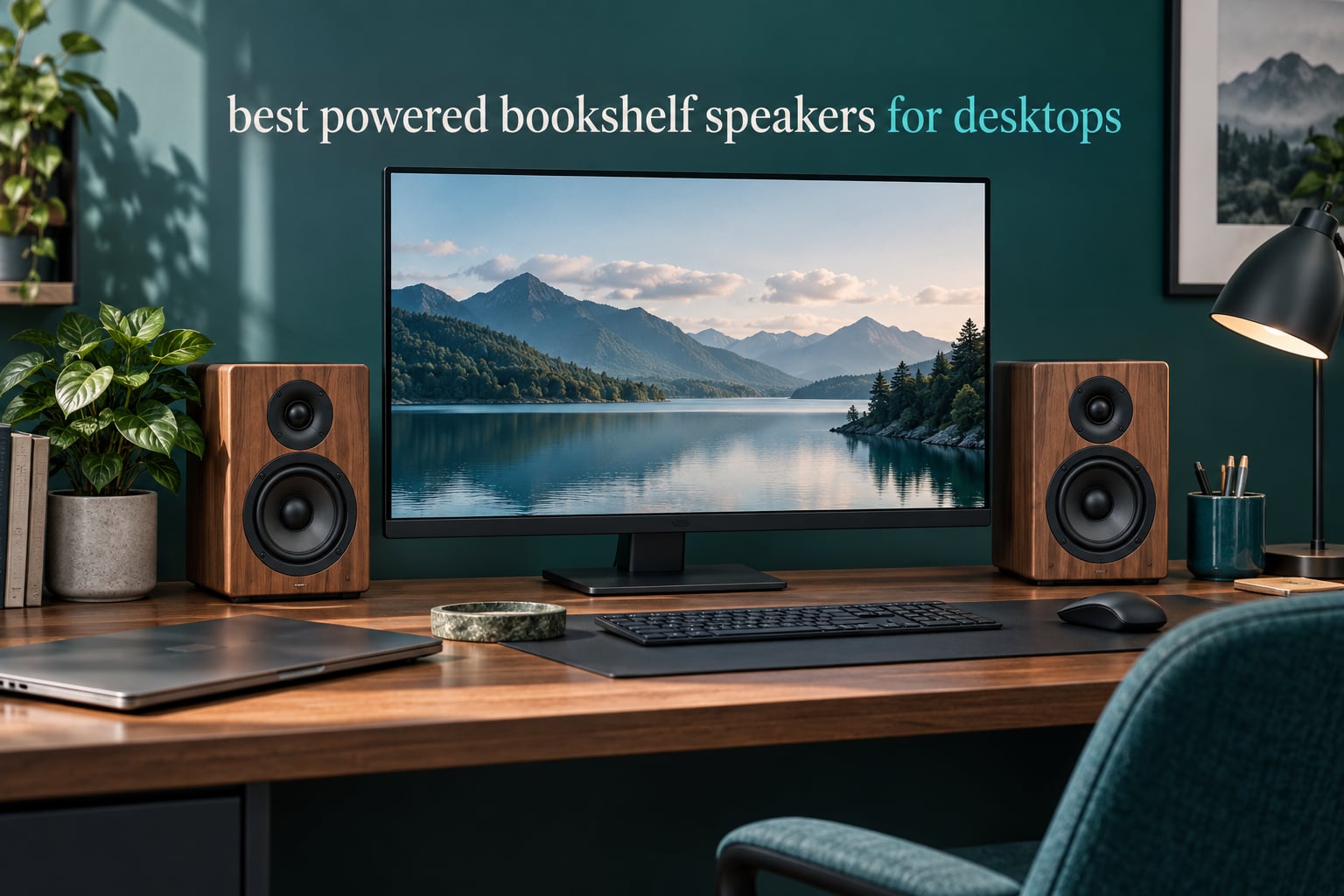
The three picks I keep coming back to are the Edifier R1280T as the all-round default, the Edifier R1280DBs when you want every input on the desk, and the Sanyun SW208 when desk depth is the deciding factor. All three are powered bookshelf speakers, which simply means the amplifier lives inside the cabinet. Pick from those three and you will not go wrong.
That combination – bookshelf-sized drivers, no separate amplifier, no extra boxes – is why powered bookshelf speakers have quietly become the default answer for desktop audio. The plastic speakers that ship with a monitor sound thin after a week, and a hi-fi stack of amplifier, DAC and passive speakers turns a workstation into a rack. An active pair sits in the middle, and it wins for a very practical reason: driver size per square inch of desk.
For this roundup I worked through ten powered bookshelf pairs sized for desks, from 2.75 inch drivers that fit in a phone-sized space to 6.5 inch cabinets that really want a stand. I compared the actual specifications in the product data, the recurring themes across thousands of owner reviews, and the physical footprint of each cabinet, because on a desk those last two things decide more purchases than the spec sheet does.
One note before we start. I do not use studio monitors as the default recommendation here, and there is a reason: they are built to be flat and revealing, which is exactly what you want while mixing and exactly what you do not want for two hours of music while you work. There is more on that in the head-to-head section below. If you would rather start with the wider world of desktop audio options, our guide to the [best powered computer speakers for desktops](https://foliumbiosciences.com/best-powered-computer-speakers-for-desktops/) covers the purpose-built side of the market.
Table of Contents
Top 3 Powered Bookshelf Speakers for Desktops

Edifier R1280T
- 4 inch full range driver
- 13mm silk dome tweeter
- Dual AUX inputs
- Bass and treble knobs
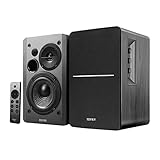
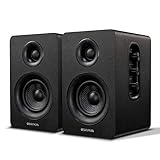
Two Edifier models and one Sanyun sit on top, and the split tells you something useful. If you want the most proven, best-reviewed pair in the category, that is the R1280T. If you want the most capable desk system per feature, the R1280DBs adds digital inputs and a subwoofer output to an otherwise identical driver layout. If desk space is the constraint, the Sanyun SW208 is the only one of the three that genuinely fits beside a monitor arm.
All 10 Picks at a Glance
Every model below is an active two-way bookshelf pair with the amplifier inside one cabinet. Woofer size and input count are the two numbers that predict whether a pair will suit your desk before you ever unbox it. Updated for September 2026.
| Product | Specifications | Action |
|---|---|---|
| Edifier R1280T |
|
Check Latest Price |
| Sanyun SW208 |
|
Check Latest Price |
| Edifier R1280DBs |
|
Check Latest Price |
 Edifier R980T Edifier R980T |
|
Check Latest Price |
 Saiyin Powered Bookshelf Saiyin Powered Bookshelf |
|
Check Latest Price |
 OHAYO 60W OHAYO 60W |
|
Check Latest Price |
 MEVOSTO DS19 MEVOSTO DS19 |
|
Check Latest Price |
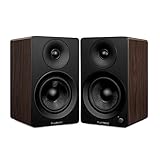 Fluance Ai61 Fluance Ai61 |
|
Check Latest Price |
 RIOWOIS RIOWOIS |
|
Check Latest Price |
 Electrohome Huntley EB10B Electrohome Huntley EB10B |
|
Check Latest Price |
1. Edifier R1280T – The Proven Default for a Desktop
Edifier R1280T Powered Bookshelf Speakers -2.0 Near Field Studio Monitor
4 inch full range driver,13mm silk dome tweeter,42W output,Dual AUX inputs
Pros
- Dual AUX inputs keep two sources connected at once
- Bass and treble knobs plus remote on the active speaker
- 4 inch full range driver and silk dome tweeter give natural room-filling sound
- MDF wood cabinet looks at home on a desk
- Review base of 19k+ means problems would have surfaced by now
Cons
- No Bluetooth
- optical or USB digital input
- 42W combined output is modest for a large room
- No subwoofer output for deeper low end
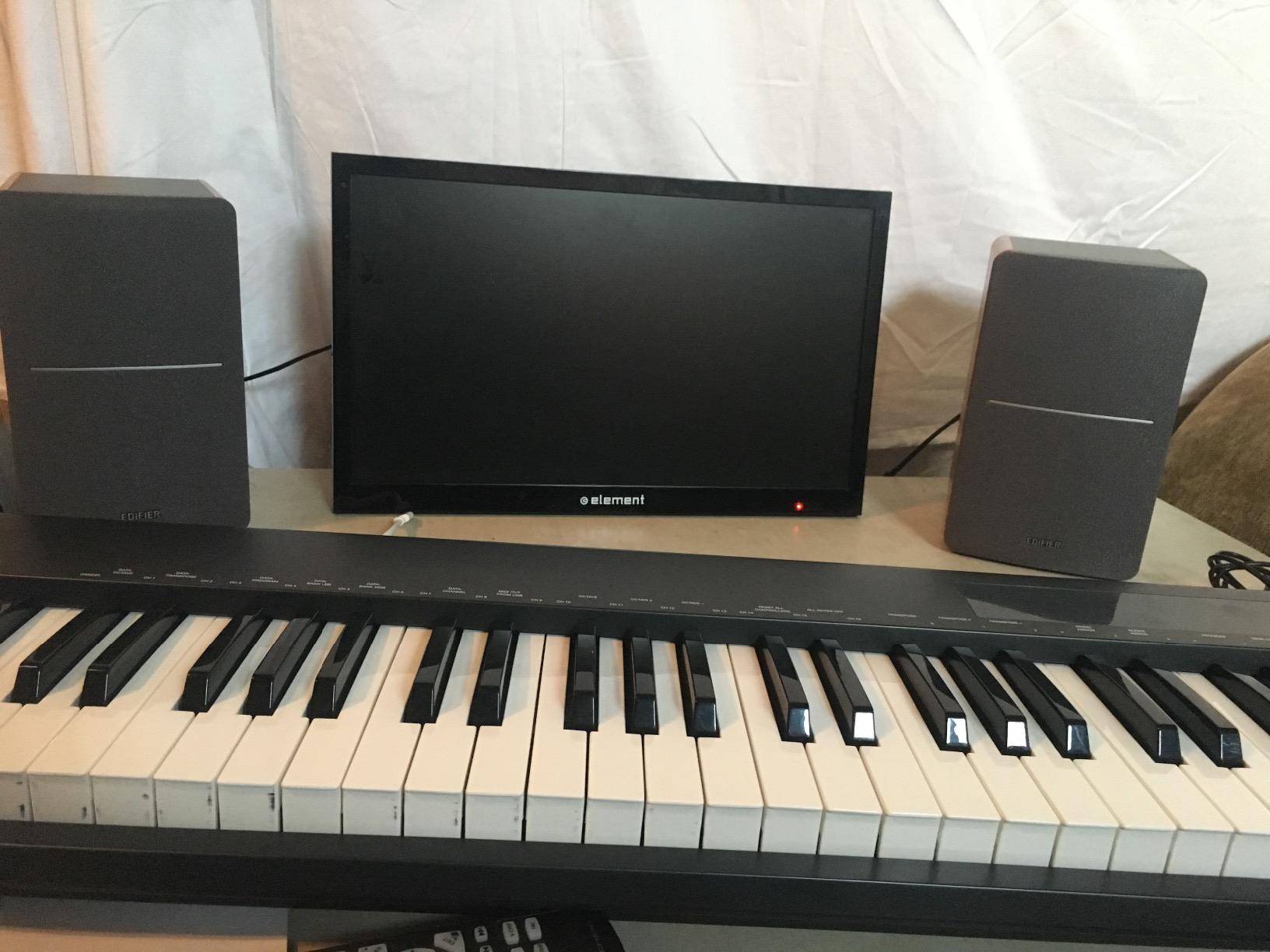
The R1280T is the pair I recommend to anyone who does not want to think about this. It has been on the market long enough that its strengths and its limits are both well documented, and in our comparison it carries the largest review base of any model here by a wide margin. Sound is warm and unhurried, with a 4 inch full-range driver handling everything below the 13mm silk dome tweeter.
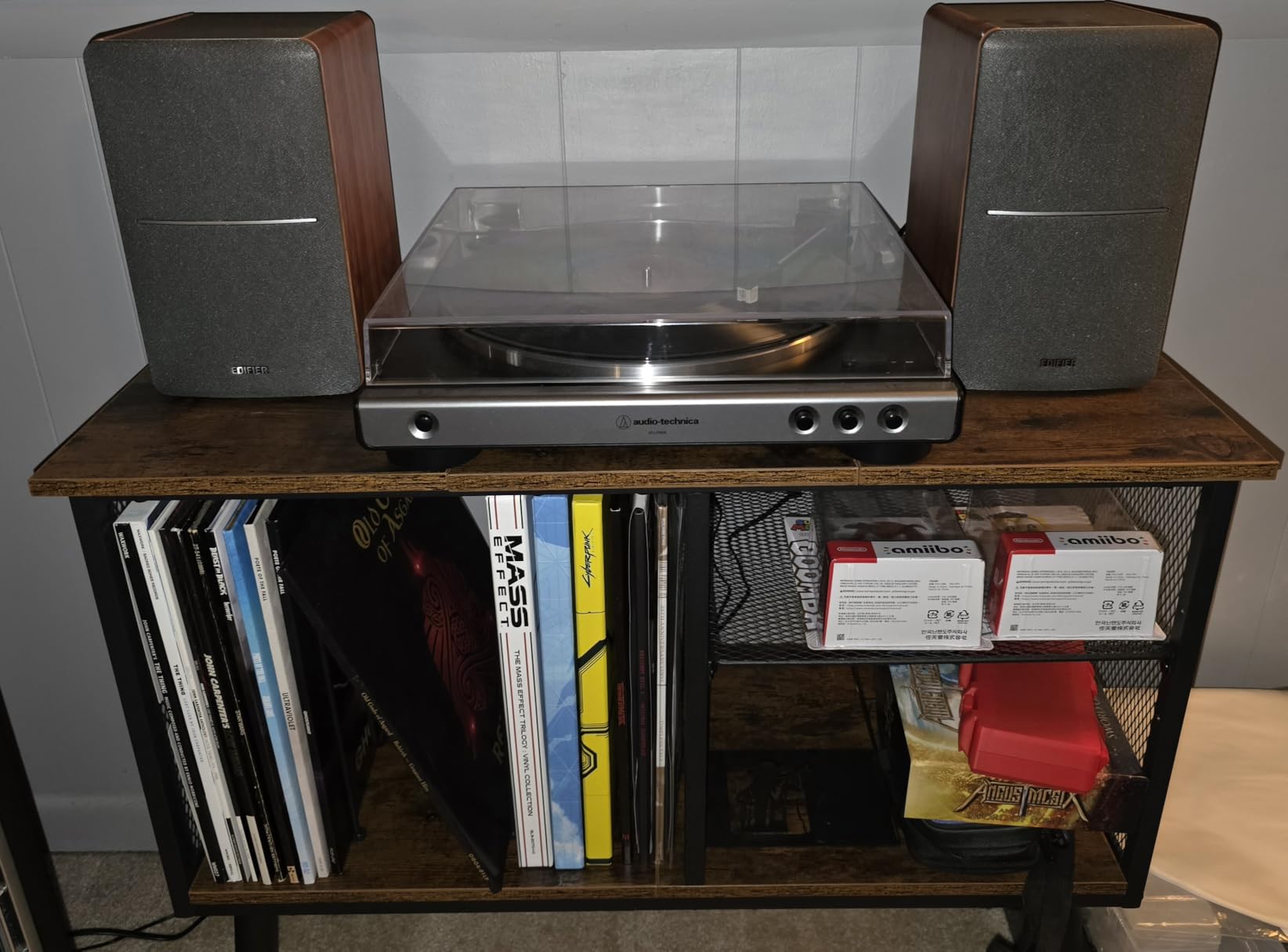
Two AUX inputs is the feature owners mention most, and it is genuinely useful on a desk. You can leave a laptop on one and a desktop or turntable on the other and switch between them with a click instead of unplugging anything. Bass and treble sit on the active speaker, volume is on the remote, and the MDF cabinet with a wood-effect vinyl finish looks more like furniture than computer equipment.
The honest limitation is connectivity. This is an analog wired system, and owners who expected wireless or a digital PC input are the recurring source of disappointment in reviews. There is no Bluetooth radio, no optical, no USB and no subwoofer output, so any deeper low end has to come from a separate powered sub or a different amplifier entirely.
Power is 42 watts maximum output, which is plenty at arm’s length on a desk and modest in a large open-plan room. Our advice: if your desk is against a wall in a bedroom or a small office, this is completely fine. If you expect to fill a loft, the Fluance Ai61 further down has far more headroom.
Who the Edifier R1280T suits
This is the right pick for someone whose PC has a 3.5mm headphone jack or dual RCA outputs and who wants one pair to handle music, calls and film. It is also the safest longevity bet in the group, since two years of warranty and a huge installed base make support problems rare.
For desk math, the cabinet is 7.7 inches tall in the usual listing, so it clears most monitor arms that clamp to the rear edge. That matters more than it sounds: a speaker taller than the arm’s clamp will force the arm up, and the arm up pushes the monitor above eye level.
Where the R1280T falls short
Buy something else if your laptop has USB-C only, if you want to stream from a phone without a cable, or if you plan to add a subwoofer later. Each of those is a closed door on this model, and there are cheaper ways to be disappointed than by owning the wrong box.
It is also the least interesting listen of the three Edifier models here. The R1280DBs adds a subwoofer output and digital inputs for a modest step up, which is why it takes the best value badge despite a smaller review base.
2. Sanyun SW208 – The Smallest Meaningful Upgrade
Sanyun SW208 3″ Active Bluetooth 5.0 Bookshelf Speakers, Built-in 24bit DAC
3 inch carbon fiber driver,24-bit USB DAC,Bluetooth 5.0,60W output
Pros
- Three input options including USB with a genuine 24-bit DAC
- Bluetooth 5.0 pairs quickly and holds
- Compact footprint that suits a 27 inch class monitor
- Bass and treble knobs on the active speaker
- Surprisingly full bass from a 3 inch driver
Cons
- Low volume ceiling and steep off-axis falloff
- Power-on sound effect plays on every switch-on
- Loudness and projection drop away quickly off axis
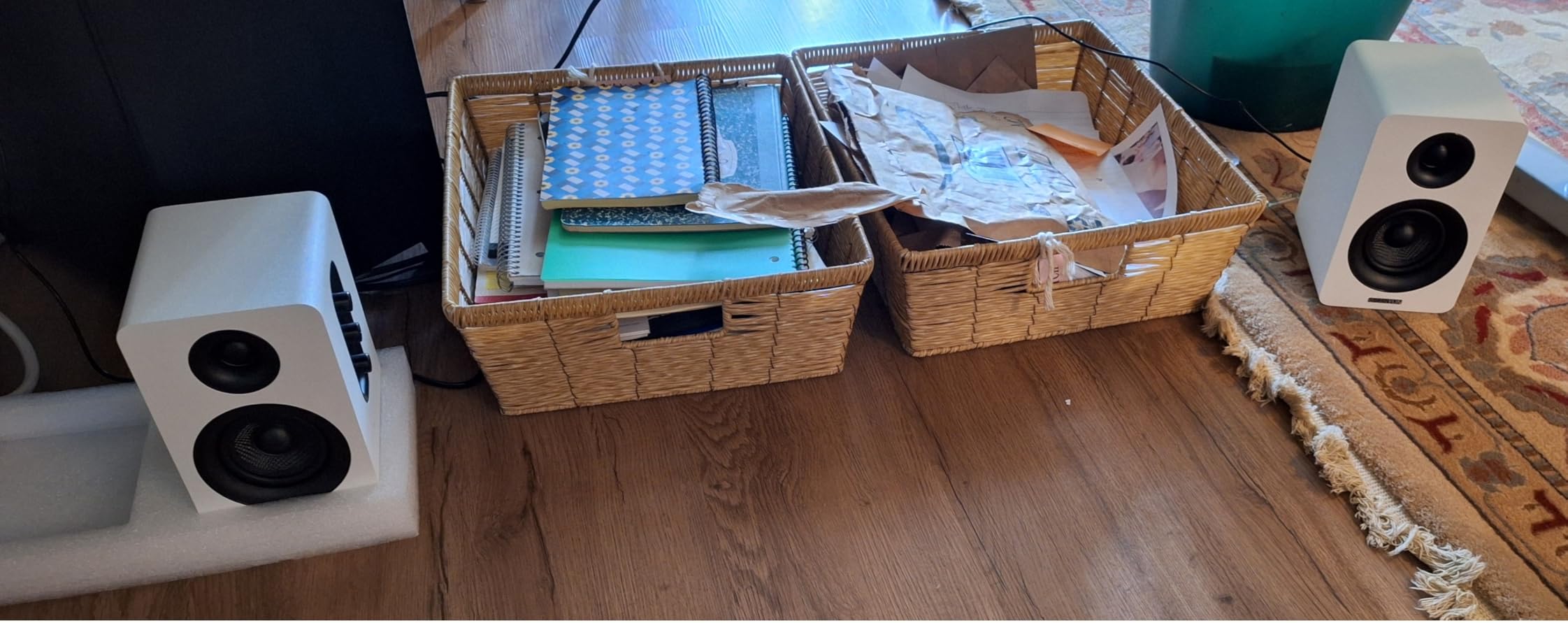
The SW208 is the smallest pair on this list that I would actually call a step up from monitor speakers. It measures under 5.4 inches tall and just over 4.6 inches wide, so it sits in the space beside a 27 inch display without a stand. For cramped desks that physical fact matters more than any specification.
The carbon fiber driver with a multi-layer voice coil produces warm mids and a low end that owners consistently describe as surprising for a 3 inch unit. The USB path is the one to use: a built-in 24-bit DAC reads the digital signal directly, and reviewers report it sounds cleaner than the 3.5mm connection.
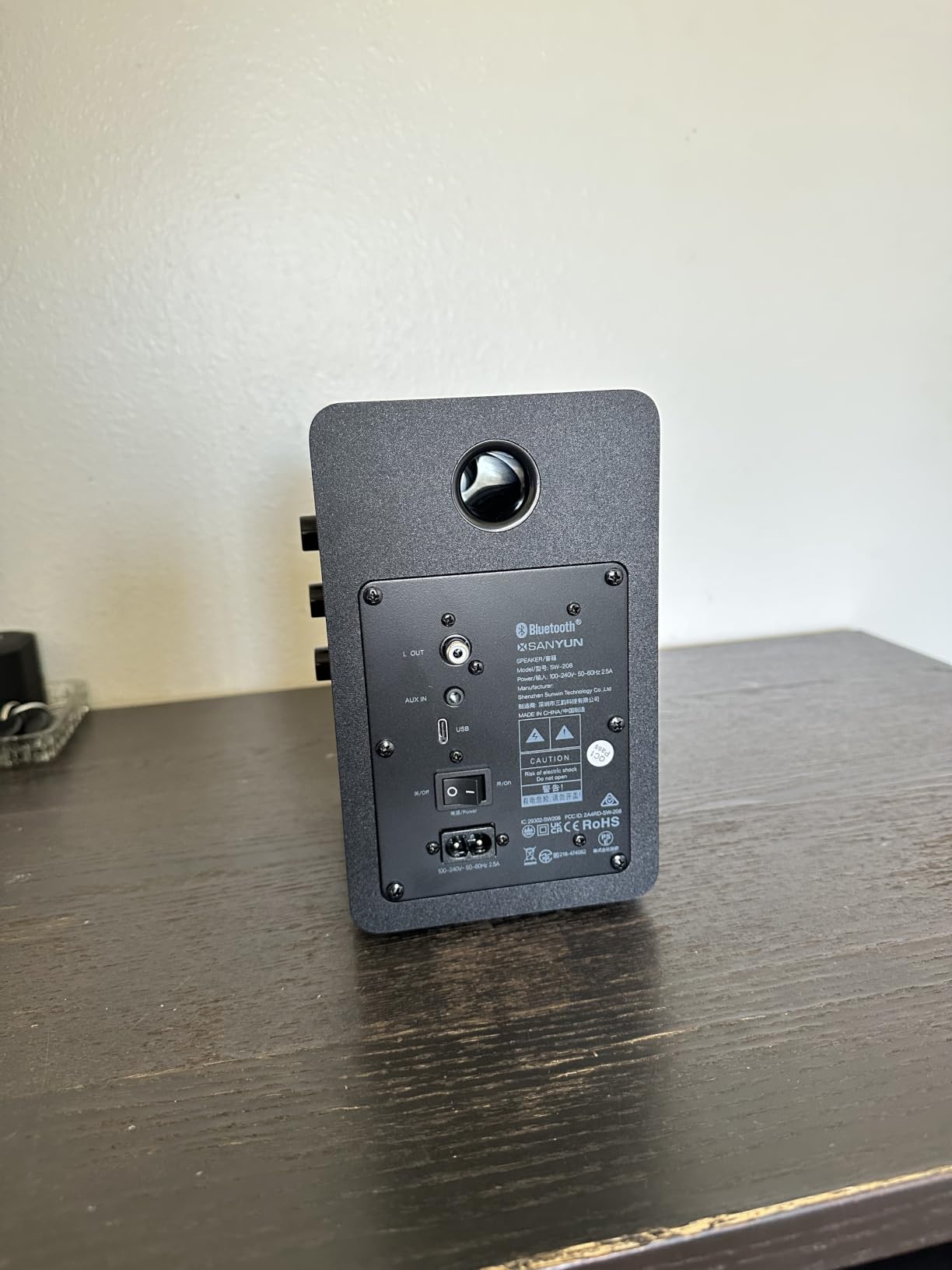
Bluetooth 5.0 is a genuine 5.0 radio here, with a stated range of 10 meters, and pairing is fast and stable. A built-in noise elimination chip filters the input and silences the speakers on standby, which reviewers appreciate more than they expected to.
What you give up is output. Sixty watts of maximum output sounds like a lot on paper, but the real limit is driver size: volume drops off sharply away from the listening position. Several owners solve it with tilted desktop stands, which push the drivers up toward ear level and narrow the angle.
Who the Sanyun SW208 suits
Dorm rooms, small home offices and anyone working on a 24 to 27 inch monitor with a rear monitor arm. It is also a strong pairing for a laptop that has drifted toward USB-C-only, since the USB input removes the need for a dongle in most cases.
If you listen at a desk while cooking or moving around the room rather than sitting still, this is the wrong choice. Near-field speakers are designed for a fixed listening position, and this one enforces that more strictly than most.
Where the SW208 falls short
Two things stand out. The volume ceiling is lower than the 60 watt figure suggests, and a cheerful power-on sound effect plays every time you switch the speakers on, with no way to disable it. That is the sort of small irritation that shows up in reviews over and over.
The tweeter is also largely decorative on this model, which makes the treble knob do very little. If you like adjusting tone by ear, the OHAYO further down gives you separate bass, treble and balance dials at a similar size.
3. Edifier R1280DBs – Every Input in One Pair
Edifier R1280DBs Active Bluetooth Bookshelf Speakers – Optical Input – 2.0 Wireless Studio Monitor Speaker – 42W RMS with Subwoofer Line Out – Black
4 inch woofer,Optical and coax digital inputs,Subwoofer out,Bluetooth 5.0
Pros
- Optical and coax digital inputs cover essentially every desktop source
- Subwoofer line out with auto crossover makes adding low end simple
- Warm detailed sound with tight low end for a 4 inch driver
- Wood veneer cabinet and a responsive remote
- Two year manufacturer warranty
Cons
- Maximum volume suits a bedroom or office and not a party
- Remote handles volume and inputs only
- Optical input tops out at 24bit 48kHz with no HDMI ARC
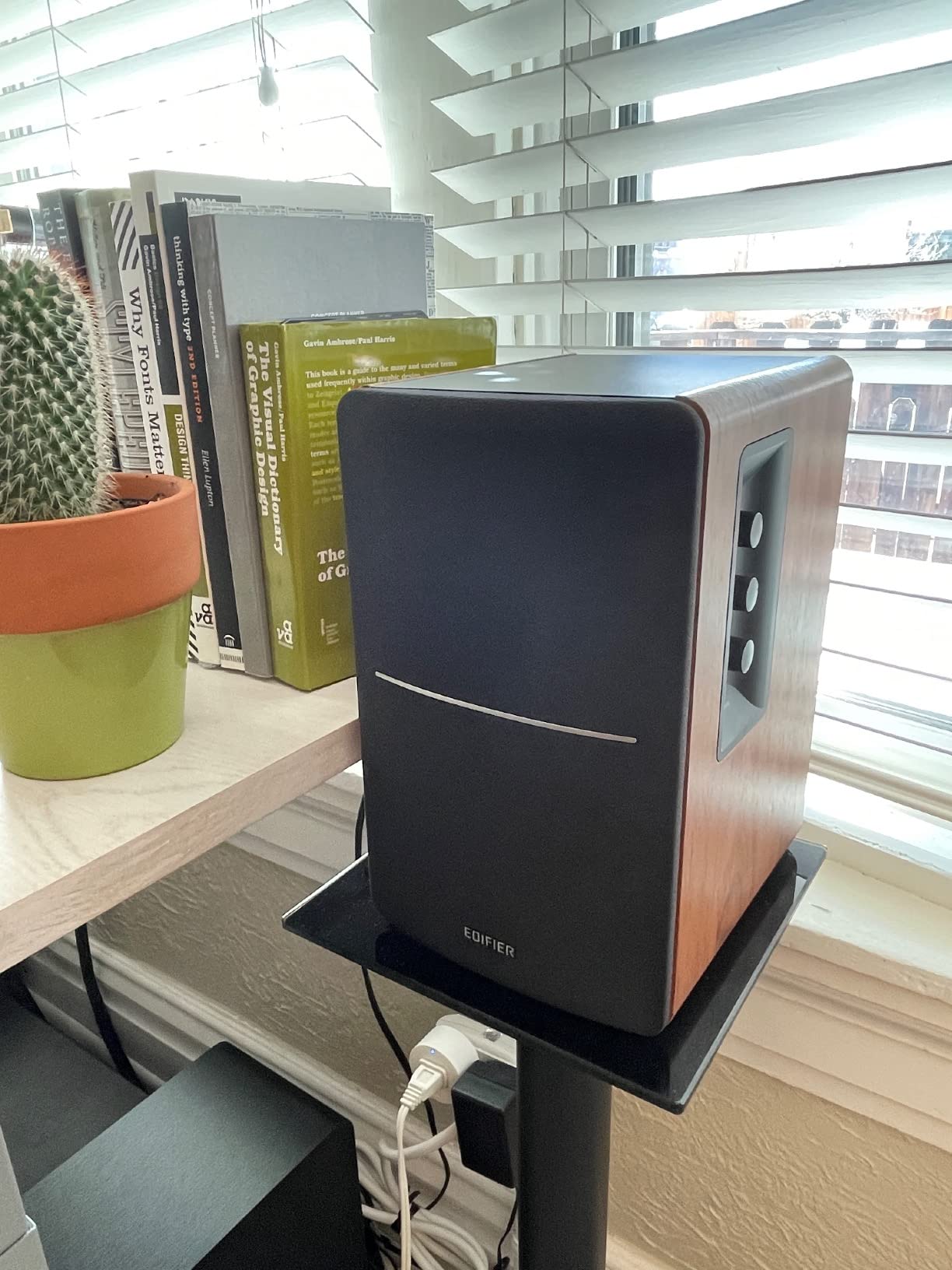
Take the R1280T and add the inputs a modern desk actually needs, and you get the R1280DBs. Optical, coaxial, RCA, Bluetooth 5.0 with a stated 10 meter range, and a subwoofer output with automatic crossover detection. On a desk with a gaming PC, a console and a laptop, that is the whole argument for spending a little more here rather than elsewhere.
Sound is the same family as the R1280T: a 4 inch woofer, a 13mm silk dome tweeter, 42 watts of continuous undistorted power, plus a Soundfield spatializer on the input path. Owners with studio backgrounds describe the result as accurate and full-bodied, and many report buying a second pair for another room.
One recurring diagnostic in the reviews is worth repeating: when a buyer hears thin bass, the cause is usually the source device rather than the speakers. A Windows machine with a mismatched sample rate or a laptop output running at low level will strip the low end before it reaches the amplifier.
The subwoofer output is the underrated feature. Because it detects the crossover automatically, you can add a sub later without a manual dial, which answers the most common question we get about 2.0 desk systems.
Who the Edifier R1280DBs suits
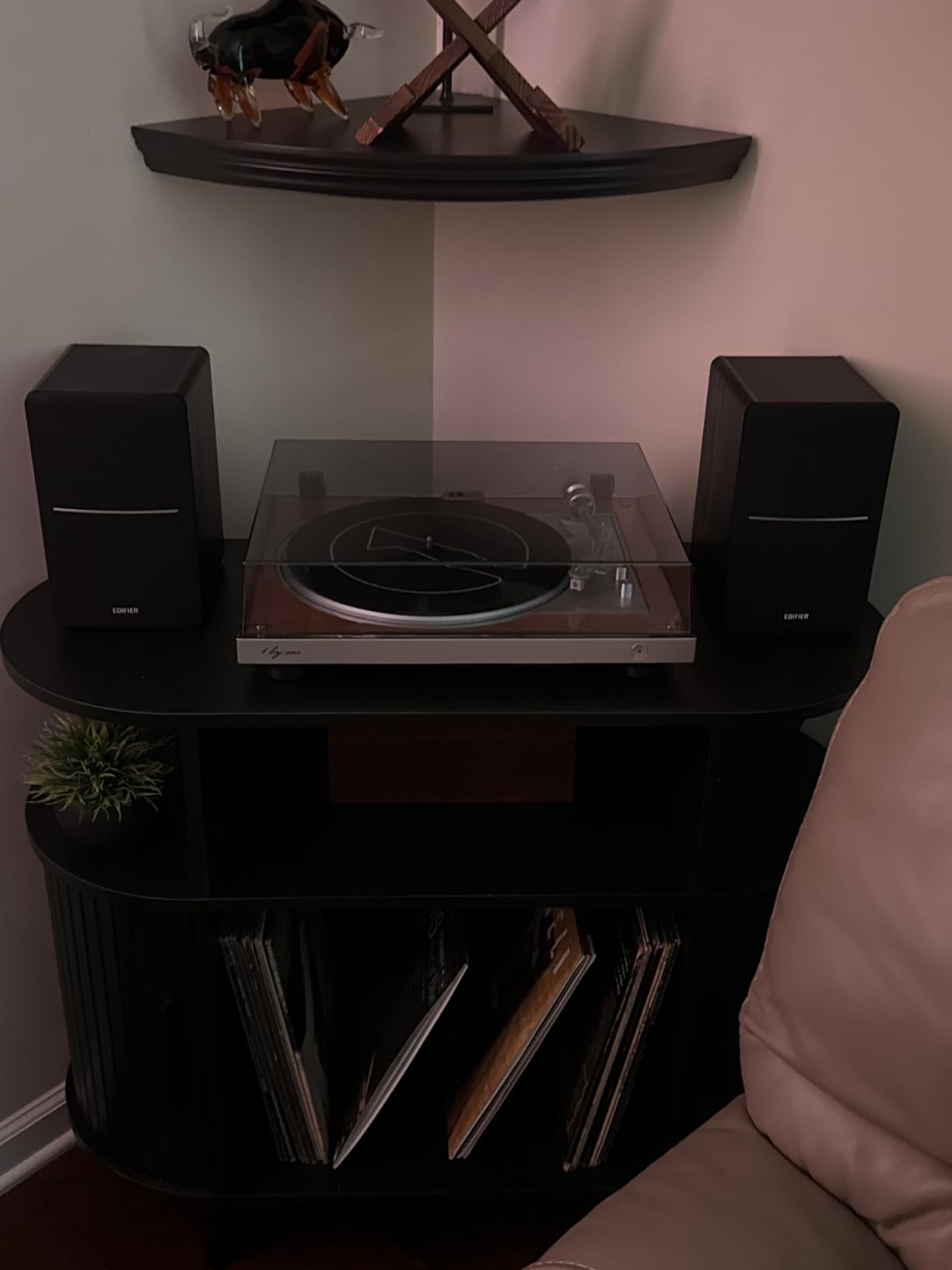
Anyone whose sources change during the day: a work PC in the morning, a console in the evening, a phone in the kitchen. Optical input from a desktop is the cleanest route and removes any USB ground-loop concern entirely, which makes it a good match for a metal desk and a tower PC.
It is also the pick for anyone who might add a subwoofer within a year. Nothing else at this driver size gives you a proper pre-out with automatic crossover.
Where the R1280DBs falls short
It is not a loud pair. Forty-two watts is fine for near-field listening at a desk and will not fill a large room, and buyers who expected party-level output report disappointment. If you listen at half volume and it still feels restrained, look at the Fluance Ai61.
Two smaller annoyances: the optical input is limited to 24-bit 48kHz with no HDMI ARC, and the grilles are fitted tightly enough that removing them is fiddly if you ever want to see the drivers.
4. Edifier R980T – Simple Wired Sound and Nothing Else
Edifier R980T 4″ Active Bookshelf Speakers – 2.0 Computer Speaker – Powered Studio Monitor (Pair)
4 inch woofer,24W RMS output,Dual AUX inputs,Wooden enclosures
Pros
- Reliable wired only design that works out of the box
- RCA and 3.5mm cables plus speaker wire all included
- Universal 110V to 240V supply travels well
- Wooden enclosures cut boxiness at this level
- Two year warranty and a large installed base
Cons
- No Bluetooth
- optical or USB input of any kind
- 24W RMS is the lowest output of the larger models
- Bulky 17 inch tall cabinets eat desk or shelf space
- No remote and fewer tone controls than the R1280 series
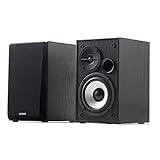
The R980T is the simplest thing that still sounds like a hi-fi speaker. Twenty-four watts of RMS output, a 4 inch woofer, a front-flared bass reflex port, and two AUX inputs so you can leave two sources connected. It holds a 4.6 average across more than four thousand reviews, which tells you how little there is to complain about.
Everything needed is in the box: RCA cable, 3.5mm cable and the wire between the two cabinets. The universal 110V to 240V power supply means it works on a laptop bag trip abroad, which is a small thing that reviewers consistently appreciate.
What you give up by choosing the simplest model is the entire input list. No Bluetooth, no optical, no USB, no remote and fewer tone controls than the R1280 series. Every one of those is a real limit in 2026, particularly wireless, which has become a basic expectation rather than a feature. A turntable owner looking at passive bookshelf options can start with our [bookshelf speaker guide for vinyl listening](https://foliumbiosciences.com/best-bookshelf-speakers-for-vinyl-listening/).
Output is the second limit. Twenty-four watts across the pair is the least among the models with 4 inch drivers here, and it suits a near-field desktop rather than a room. Bass response comes from the front-flared reflex port rather than any subwoofer output, so deeper low end means changing models, not adding a sub.
Who the Edifier R980T suits
A fixed installation with one source, such as a dedicated work PC in an office, or a turntable setup where the only input you will ever use is RCA. The wired-only design is also the most reliable category of desktop speaker, with nothing to pair and nothing to drop out.
If you like the idea of buying once and leaving it alone for years, the large review base and two year warranty make this a low-risk choice.
Where the R980T falls short
The cabinets are the real problem on a desk. At 17 inches tall they are the bulkiest pair in this roundup, and they will collide with a monitor arm unless the arm is mounted high or the speakers go on separate stands.
Buy the R1280T instead if your budget stretches that far. It costs more, adds a remote and side-panel tone controls, and gives you the same wired simplicity in a smaller box that actually fits next to a display.
5. Saiyin Powered Bookshelf Speakers – Loud, Compact and Bass-Forward
Saiyin Powered Bluetooth Bookshelf Speakers
3.5 inch woofer,0.5 inch silk dome horn tweeter,30W output,Bluetooth 5.3 with optical
Pros
- Optical
- coax
- RCA and Bluetooth 5.3 give unusual input flexibility
- Very high maximum volume with no rattle at high levels
- Deep punchy bass that reviewers call the standout
- Remote with EQ presets plus top panel buttons
- Three year warranty with responsive support
Cons
- Bass tuning is heavy enough to mask vocals
- No separate bass and treble tone controls on this model
- Tweeter output is modest for a horn loaded design
- Linking wire between cabinets is short
Where most compact pairs are polite, this one is loud. Thirty watts of maximum output into a 3.5 inch woofer and a 0.5 inch silk dome horn tweeter produces a bigger, punchier result than the numbers suggest, and the recurring owner comment is that it fills a room at a fraction of the volume the bigger models need.
The input list is unusually complete for the money: Bluetooth 5.3, optical, coaxial, RCA line in and 3.5mm AUX. That combination is why this pair turns up so often in turntable circles, and our guide to the [best powered speakers for turntables](https://foliumbiosciences.com/best-powered-speakers-for-turntables/) covers that use case in more depth.
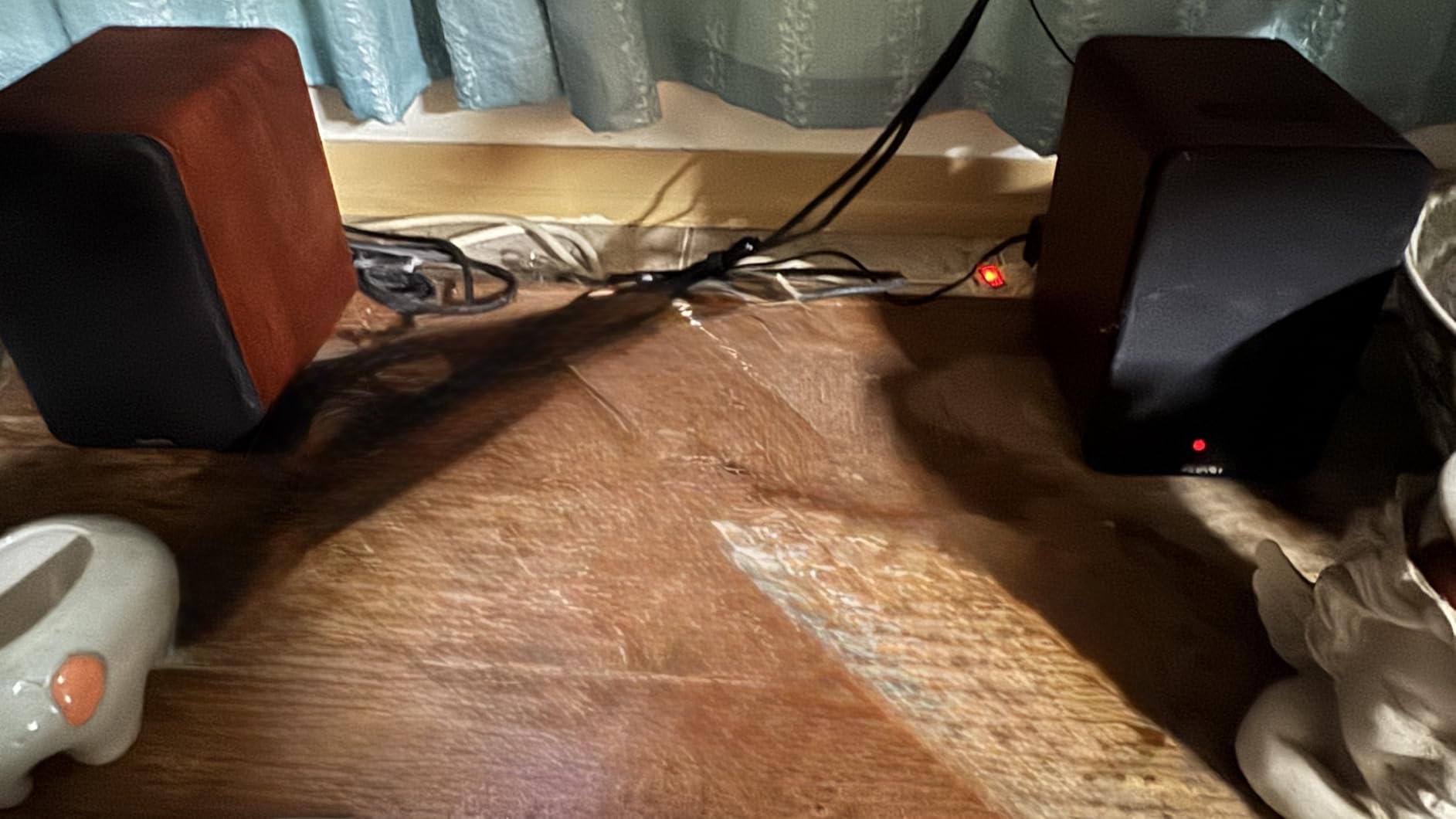
Two variants exist, a 4 inch woofer and a 3.5 inch woofer, and the choice matters on a desk. The 3.5 inch version is the one that fits beside a monitor without a stand, and it is the one we would pair with a PC.
A remote handles volume, mute, input switching and EQ presets, with matching buttons on the top panel. Support is also worth noting: one owner reports a replacement unit sent after a fault, and the warranty runs to three years.
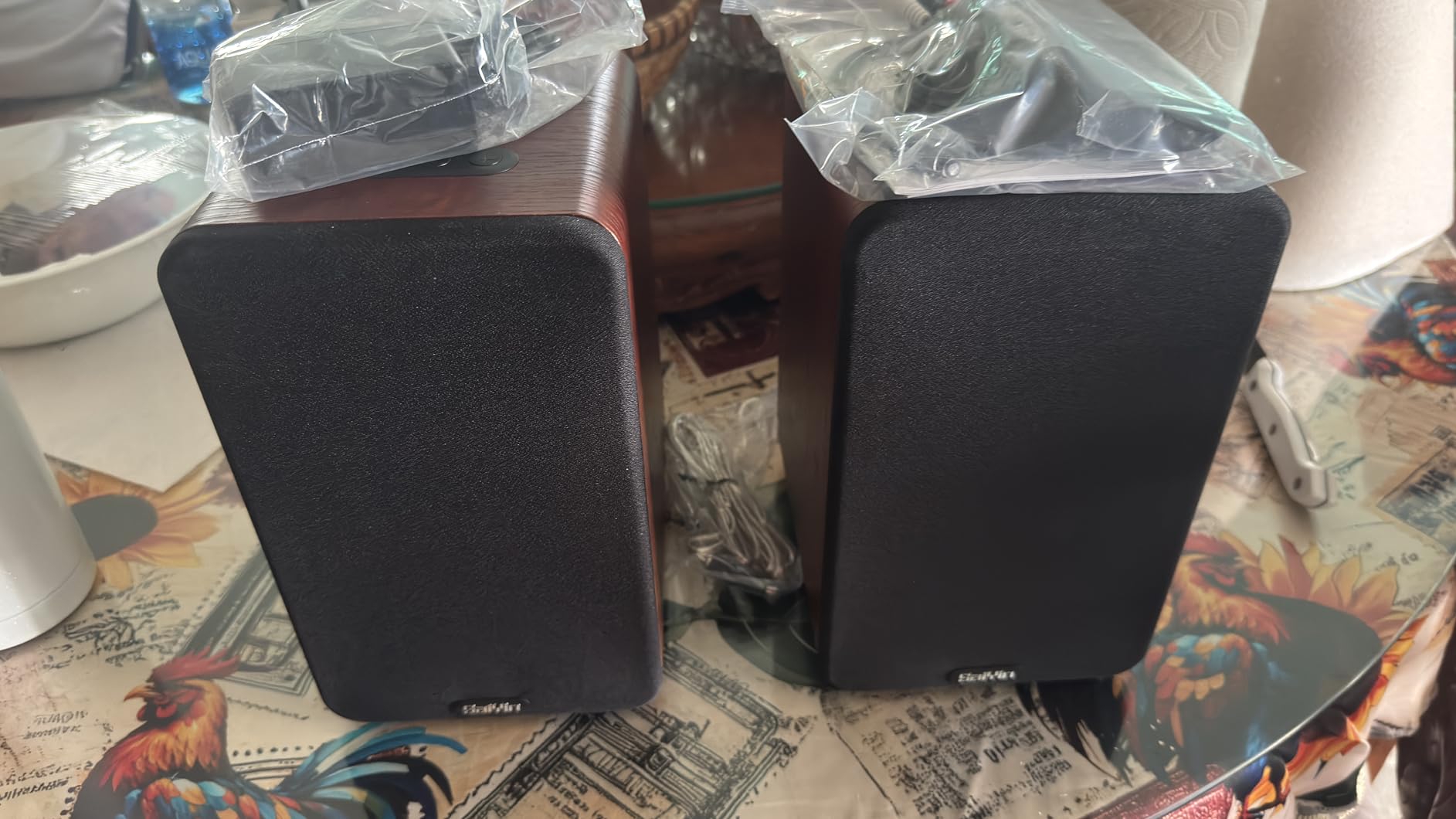
Who the Saiyin pair suits
Vinyl starters who want optical or RCA and want more output than a near-field monitor can give. It is also a good match for a turntable that only has a phono level output, provided you use a preamp, which the listing is clear about.
Choose it over the Edifier models if playing music louder, more often, matters more to you than perfect tonal neutrality at low volume.
Where the Saiyin pair falls short
The bass is tuned heavier than most people expect, and that is a double-edged sword. Owners report vocals getting masked unless the included port sponges are fitted or the remote EQ is used, so expect a few minutes of adjustment before the balance settles.
There are no separate bass and treble knobs on this model, which is odd for a speaker with this much low end. If physical tone control is important to you, the OHAYO two sections down has bass, treble and balance dials at a similar size.
6. OHAYO 60W – Four Inputs and Real Tone Dials
OHAYO 60W Computer Speakers for Music and Gaming, Active Bluetooth 5.3, Stereo 2.0 Speakers for Desktop PC or Laptop, 3.5mm Aux RCA USB Input, 1 Pair, Black
3 inch carbon fiber driver,0.75 inch silk dome tweeter,Bluetooth 5.3,USB audio
Pros
- Clear balanced sound with usable low end and no distortion
- Four input types including USB which reviewers find cleaner than 3.5mm
- Rear treble
- bass and balance dials are rare at this size
- Built-in power supply keeps a power brick off the desk
- Responsive customer service that follows up directly
Cons
- Announces PC mode loudly on every power-up
- Volume knob moves in discrete steps with a large jump
- Default bass boost needs turning down to avoid a boxy sound
- Bass depth is limited without a separate subwoofer
The OHAYO is the feature-per-input winner of the compact group. Bluetooth 5.3, RCA, AUX and USB on a 3 inch carbon fiber full-range driver paired with a real 0.75 inch silk dome tweeter, which is genuine rather than decorative. Thirty watts per side, and a built-in power supply so there is no brick to hide behind the desk.
What stands out in the reviews is the control panel. Rear dials for treble, bass and balance are close to unheard of at this size, and they let you correct the default tuning in about ten seconds rather than living with it.
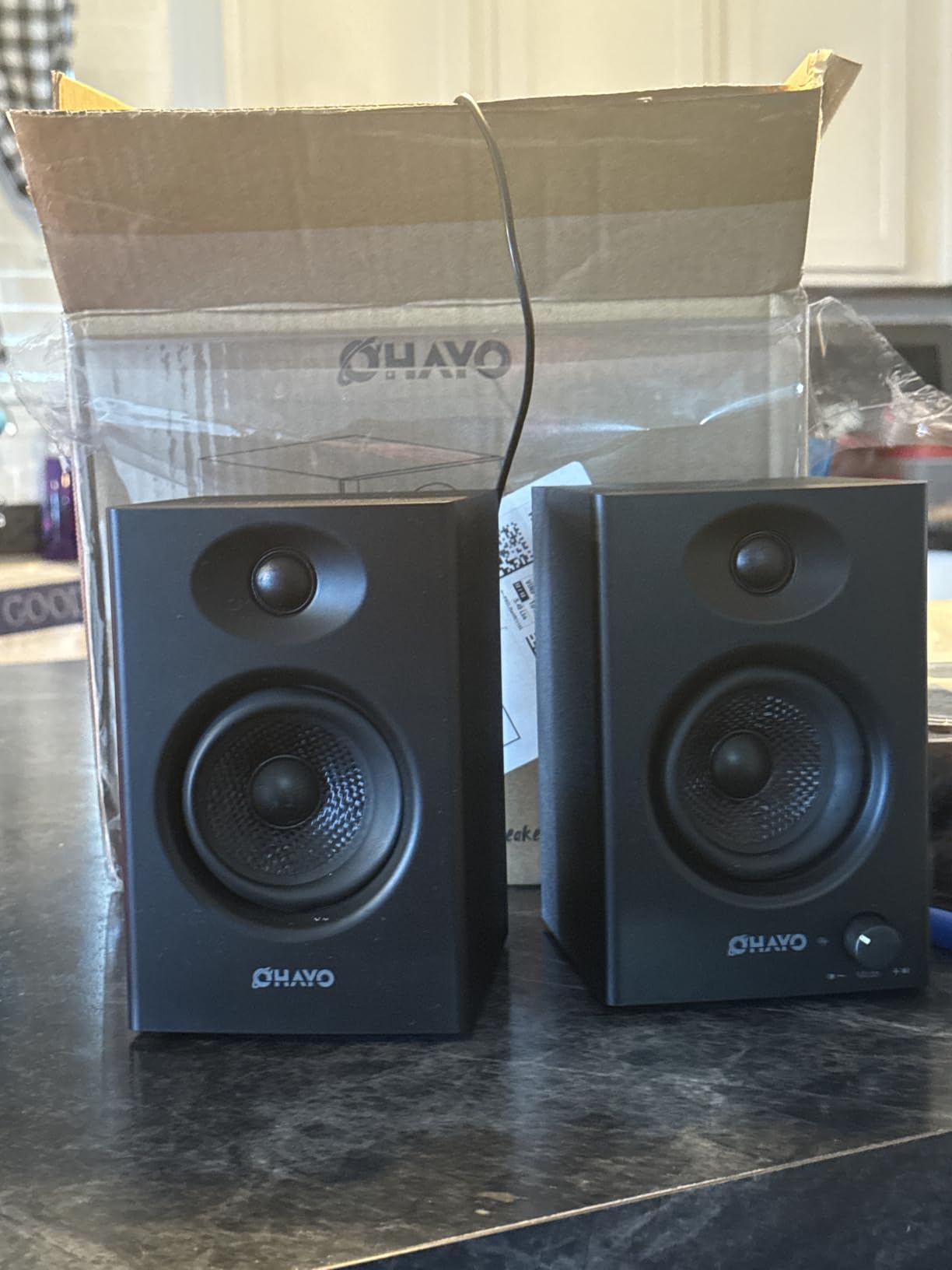
Speech clarity is the quietly excellent part. Several owners bought it for video calls and found the vocal range clean enough that they stopped reaching for a headset, which is a real quality-of-life gain on a desk.
The rear bass port and an integrated independent sound card are doing the work that gives a 3 inch driver more low end than its size suggests. The box contains both speakers, an AC cable, a data cable and a 3.5mm cable.
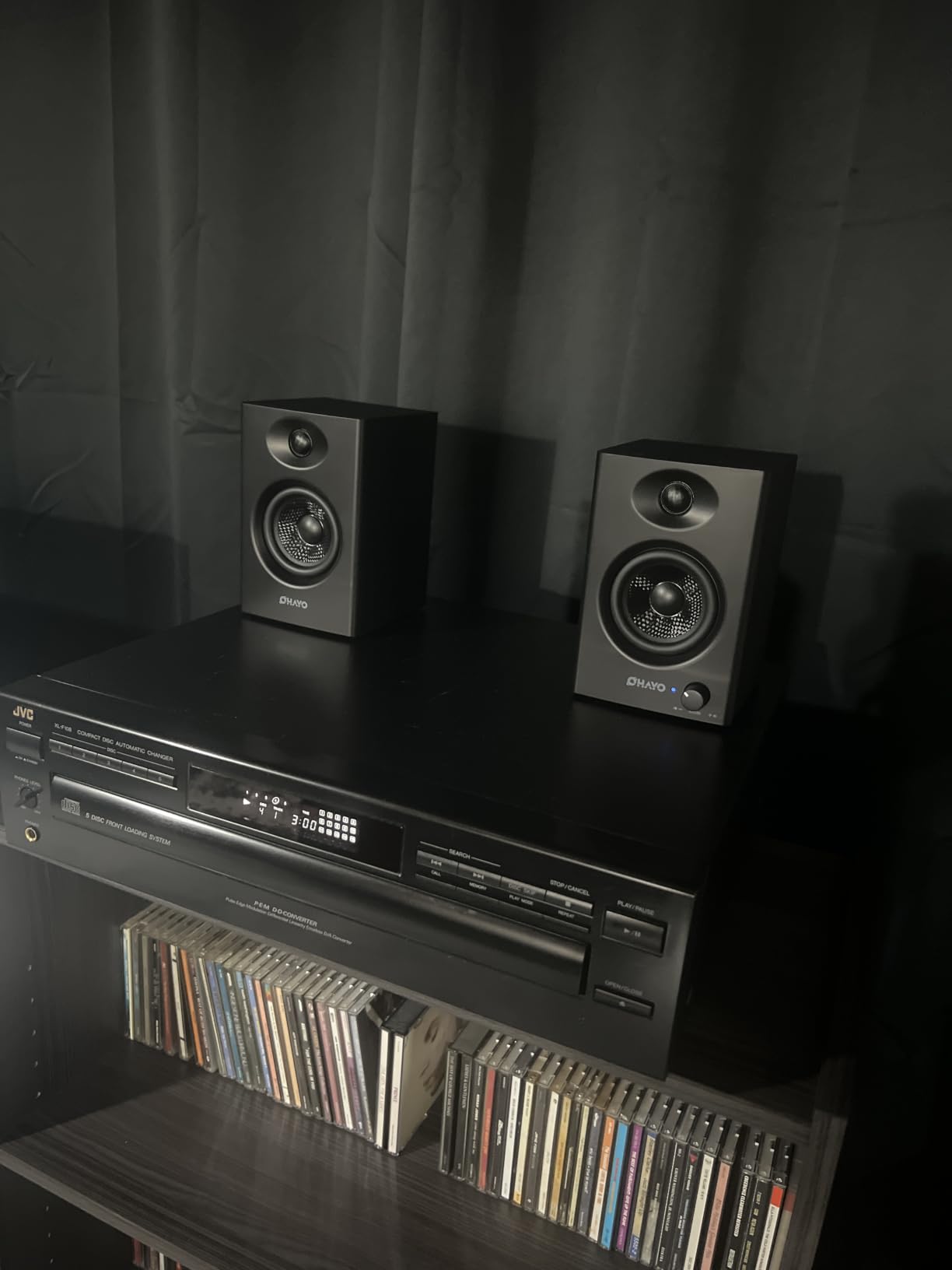
Who the OHAYO suits
A desk where a phone, a laptop and a desktop all take turns as the source, and where you like tuning the sound by hand rather than through an app. The compact 4.7 inch height also makes it one of the safer bets beside a monitor arm.
It is a particularly good fit for hybrid workers, since the balance dial and clear midrange help when the desk is doubling as a call station.
Where the OHAYO falls short
Two gripes come up more than any other. It announces PC mode loudly every time you power it on and there is no way to disable the voice prompt, and the front volume knob moves in discrete steps with a large jump between the first two positions.
The default bass boost also needs turning down on first setup, or voices can sound boxy in a small room. One reviewer also reported a unit failing when turned up loudly, which is a single report rather than a pattern, but worth knowing given the class of the product.
7. MEVOSTO DS19 – 5-Inch Woofers Where the Desk Allows
MEVOSTO 5-Inch Powered Bookshelf Speakers: PC Speakers for Record Player
Dual 5 inch woofers,1 inch silk dome tweeters,36W RMS per speaker,USB digital audio
Pros
- Largest woofers among the compact options at 5 inches
- Real 1 inch silk dome tweeters rather than decorative units
- Four input types including USB digital audio
- Physical bass and treble knobs plus a remote
- 15 meter Bluetooth range and DC power options
Cons
- Deep cabinets need a roomy desk or a shelf
- No optical or coaxial input for a television
- USB audio needs a port that outputs digital audio
- Newer listing with a much smaller review base
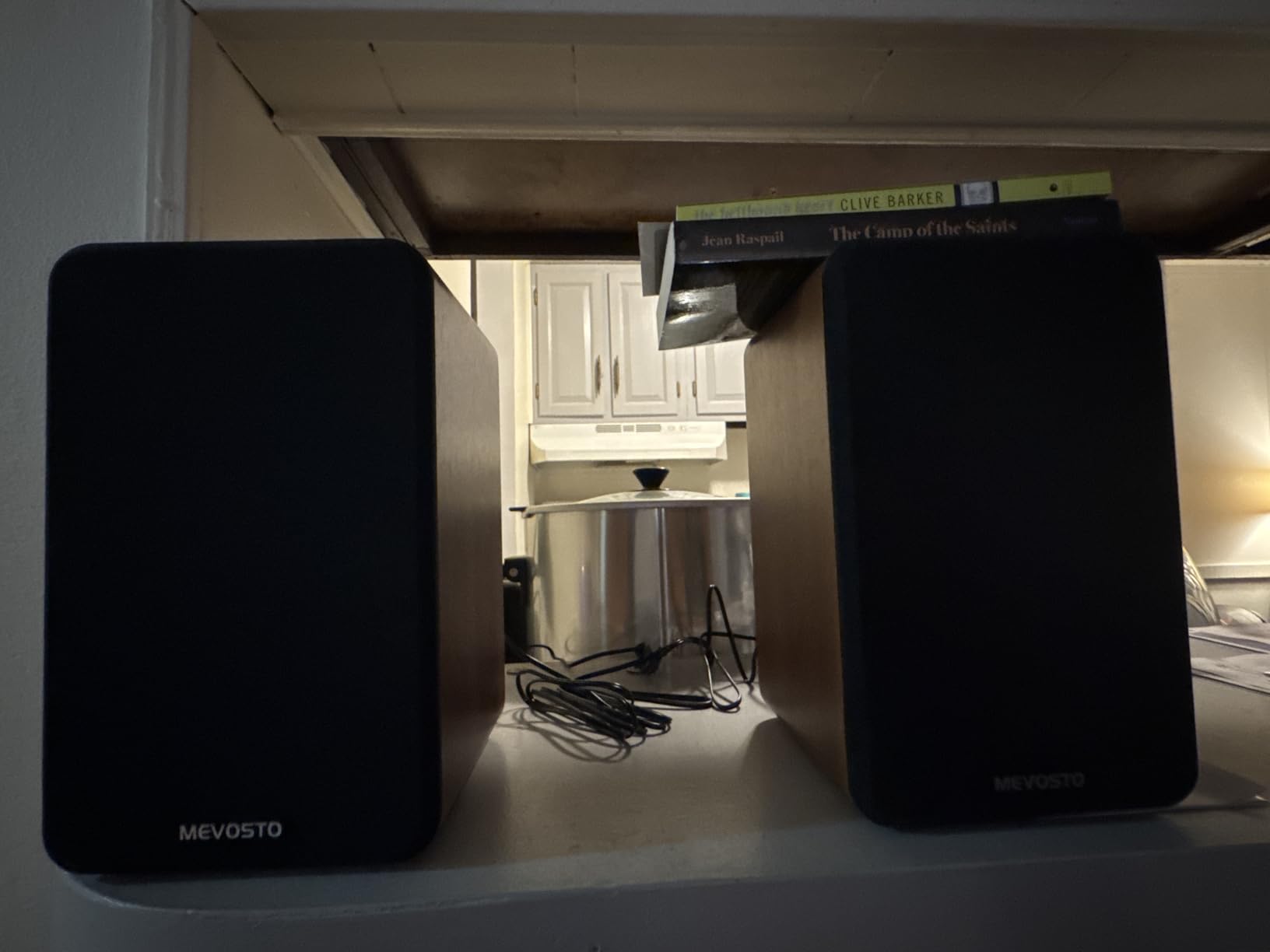
This is the point in the roundup where bass stops being an argument and starts being a fact. Each cabinet carries dual 5 inch woofers and dual 1 inch silk dome tweeters, driven by a built-in 36 watt RMS amplifier per speaker, and the result is low end that no 3 inch pair in this list approaches.
Inputs cover USB digital audio, Bluetooth 5.4 with a stated 15 meter range, RCA and AUX, and there are physical bass and treble knobs on the cabinet plus a remote. It also accepts 12V, 15V and 18V DC input, which makes it usable in an RV or on a boat with the right adapter.
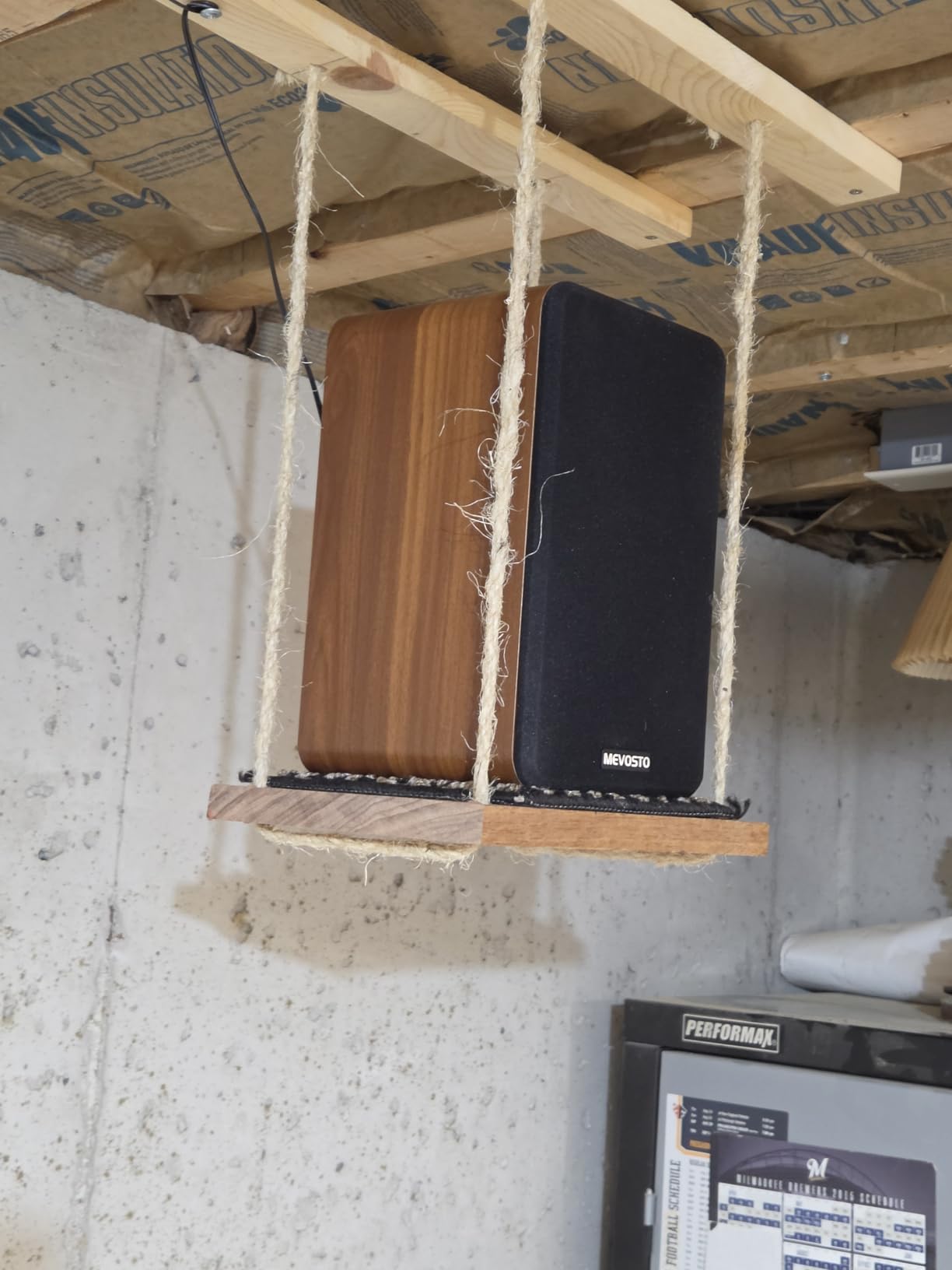
Two caveats you should know before buying. There is no optical or coaxial input, so a television is limited to RCA or Bluetooth, and USB audio requires a port that actually outputs digital audio rather than a charge-only connection.
The cabinet measures 9.7 inches tall and 6.1 inches deep, which is deeper than the compact group but far smaller than the Fluance. It is still a shelf or spacious-desk product rather than a small-monitor product.
Who the MEVOSTO DS19 suits
Anyone who has moved past tinny desktop sound and wants visible, felt bass without buying a subwoofer or a stack of separates. Two 5 inch drivers push more air than a 6.5 inch driver in a much smaller box, which is a genuinely useful trick when desk depth is limited but height is available.
It also handles a turntable with a built-in or external phono preamp over Bluetooth or RCA, so it doubles as a record player setup.
Where the DS19 falls short
The review base of a little over 700 ratings is much thinner than the Edifier models, which means long-term reliability is less well documented. The 4.5 average is strong, but a smaller sample tells you less about year three.
Do not buy it for a television, and do not buy it if your desk depth is under about 10 inches of clear space. For smaller desks, the Sanyun SW208 solves the same problem in half the space.
8. Fluance Ai61 – The Step Up When the Desk Can Carry It
Fluance Ai61 Powered 2-Way 2.0 Stereo Bookshelf Speakers with 6.5″ Drivers, 120W Amplifier for Turntable, TV, PC and Bluetooth 5 Wireless Music Streaming – RCA, Optical, USB & Sub Out (Natural Walnut)
6.5 inch woven glass fiber woofer,1 inch neodymium tweeter,120W integrated amplifier,USB Type-C
Pros
- Most powerful amplification in this group at 120W
- 6.5 inch woven glass fiber drivers deliver real detail and clean bass
- Widest input selection covering RCA and optical and USB Type-C and Bluetooth 5 and sub out
- Internally braced MDF cabinets reduce resonance
- Brushed wood finishes and a remote complete the package
Cons
- Too large and heavy for a compact desktop at 27.2 pounds per pair
- Highest cost in this roundup
- Smallest review base here at 275 ratings
- 200 ms Bluetooth latency shows on video and games
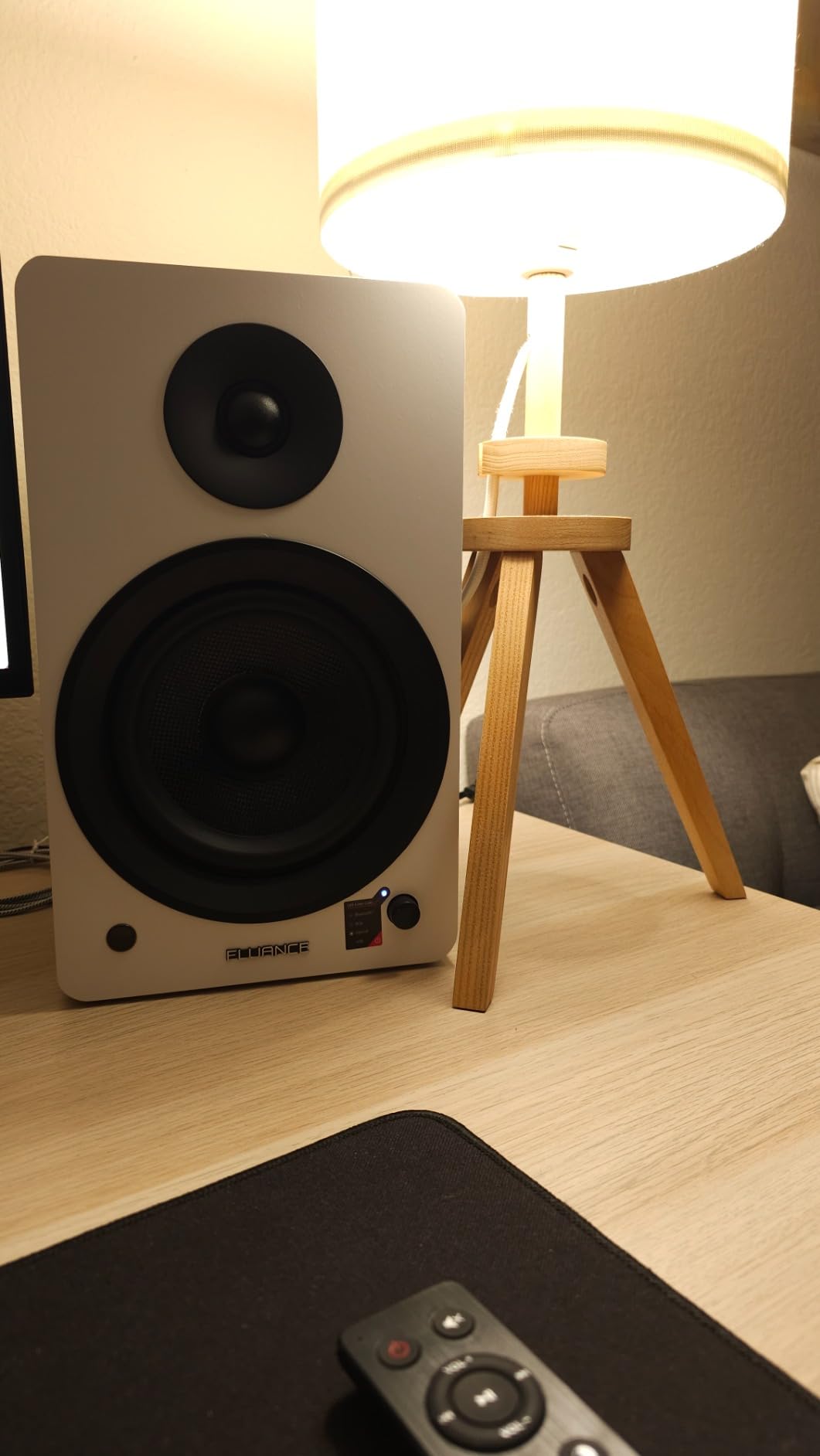
The Fluance Ai61 is where this roundup stops being about budget and starts being about sound. A 120 watt integrated amplifier drives 6.5 inch woven glass fiber drivers and 1 inch neodymium tweeters, and owners consistently describe the result as a clear step above everything else here in detail, imaging and clean low end.
The input list is the widest in the group: RCA, optical, USB Type-C, Bluetooth 5 with a stated 100 meter range, and a subwoofer out. Internally braced MDF cabinets with a rear bass port are a step up in materials, and the box includes a remote, batteries, a power cable and speaker wire.
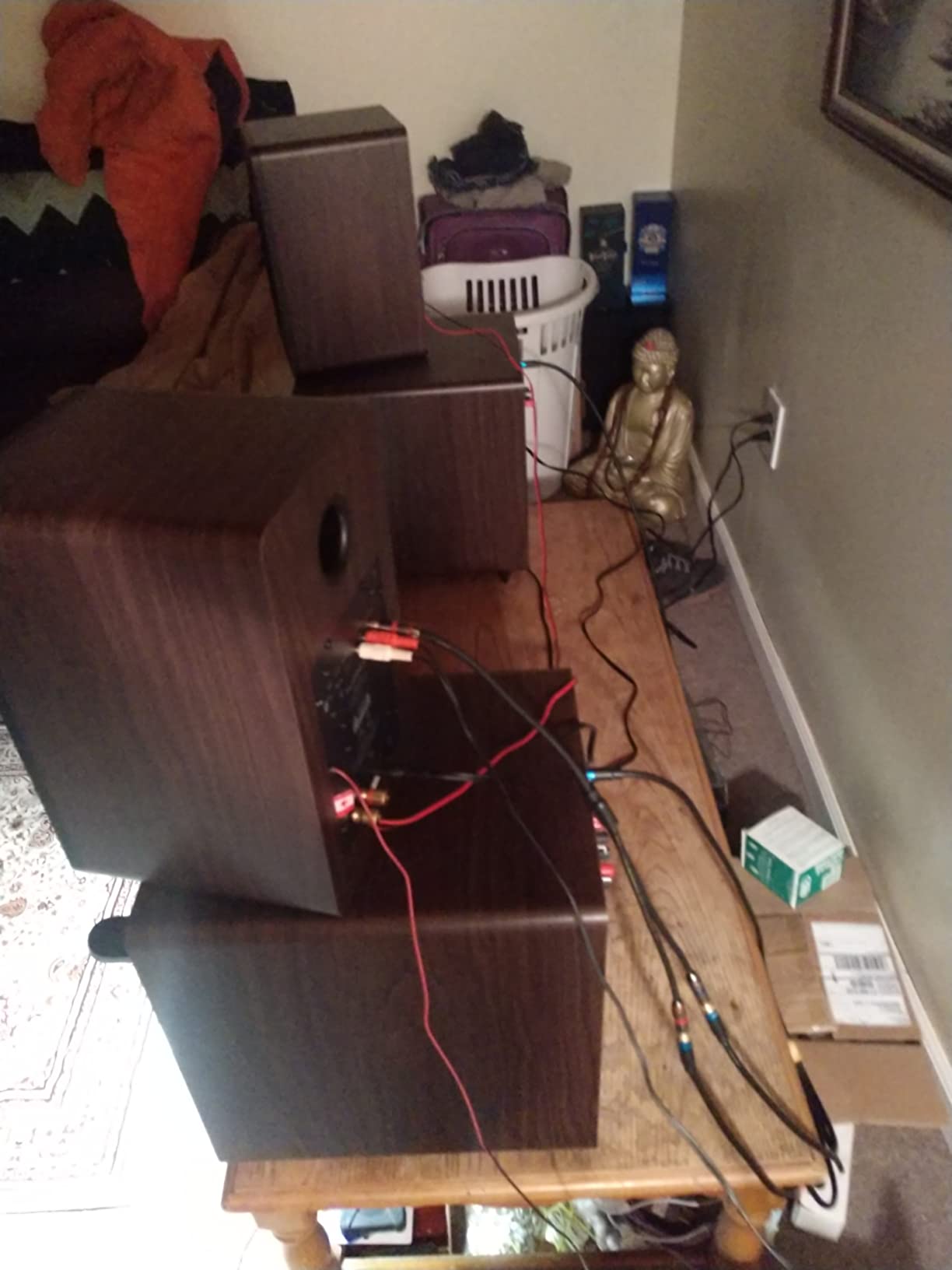
The catch is size and mass. At 15.6 inches wide, 13.1 inches tall and 27.2 pounds for the pair, these are floor or shelf speakers that happen to work at a desk. Nobody is placing these beside a 24 inch monitor on a monitor arm.
Bluetooth latency is listed at 200 milliseconds, which is clearly audible on video and painful for anything competitive. Use the optical or USB Type-C input on a PC and the issue disappears.
Who the Fluance Ai61 suits
Large desks, deep shelves and anyone whose room doubles as an office. If you want to fill a space with real low end, this is the only pair here with the amplifier headroom to do it without strain, and the sub out means you can go further still.
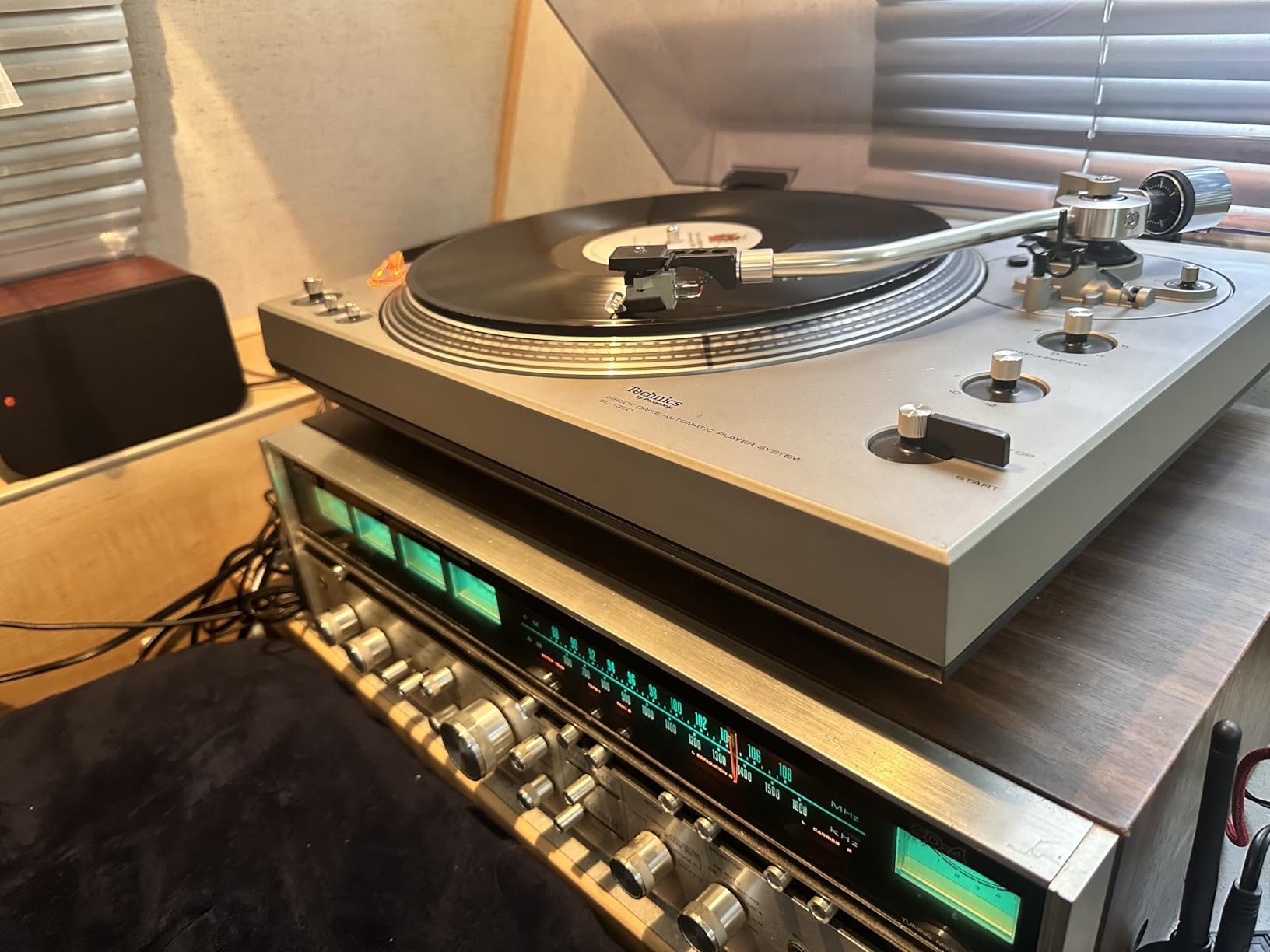
It is also the natural next step for a turntable owner moving up from a starter pair. Our guide to the [best bookshelf speakers for vinyl listening](https://foliumbiosciences.com/best-bookshelf-speakers-for-vinyl-listening/) covers that path in more detail.
Where the Ai61 falls short
It is the most expensive option here, and it has the smallest review base at 275 ratings. A thin rating base is not a deal breaker for a well-built product, but it does mean you are buying on specification and reputation rather than on a long public record.
Bluetooth at 200 milliseconds of latency rules it out as a wireless gaming or video solution, and the weight means it needs a stand rated for the load. Our honest advice is to stand them at ear height beside the chair, not on the desk behind the monitor.
9. RIOWOIS – Optical and TV-ARC on an Entry Budget
RIOWOIS Powered Bookshelf Speakers, Desktop Speakers for Record Player
2.75 inch woofer,Optical and TV-ARC inputs,Bluetooth 5.3,60W output
Pros
- Optical and TV-ARC plus AUX and Bluetooth 5.3 at an entry price point
- TV-ARC lets the television remote control the volume
- Reinforced MDF cabinet reported to reduce crackling
- Remote with three sound presets plus top panel buttons
- Light at 2.37 kg so easy to reposition
Cons
- 2.75 inch drivers give the least bass and lowest ceiling here
- Optical and ARC cables are not included
- Cannot be used with an external amplifier or receiver
- Inputs are PCM and stereo only with no Dolby or DTS
TV-ARC support at this level is the reason to look at the RIOWOIS. It means a television can control the speakers directly with its own remote, which turns a desktop pair into a legitimate TV system without hunting for an input or reaching for a soundbar button.
Alongside that you get optical, AUX and Bluetooth 5.3, a remote with three sound effect presets, and a reinforced MDF cabinet that reviewers credit with a cleaner, less crackly delivery than plastic-cased rivals of a similar price.
The 2.75 inch drivers are the smallest in this roundup, and that single fact defines the model. Bass extension and maximum volume are both limited, so it belongs on a small desk at moderate levels rather than in a room.
Two practical warnings. Optical and ARC cables are not in the box; you get a 3.5mm AUX cable and the speakers. And the input section is PCM and stereo only, so Dolby or DTS audio from a disc player or a console will not work.
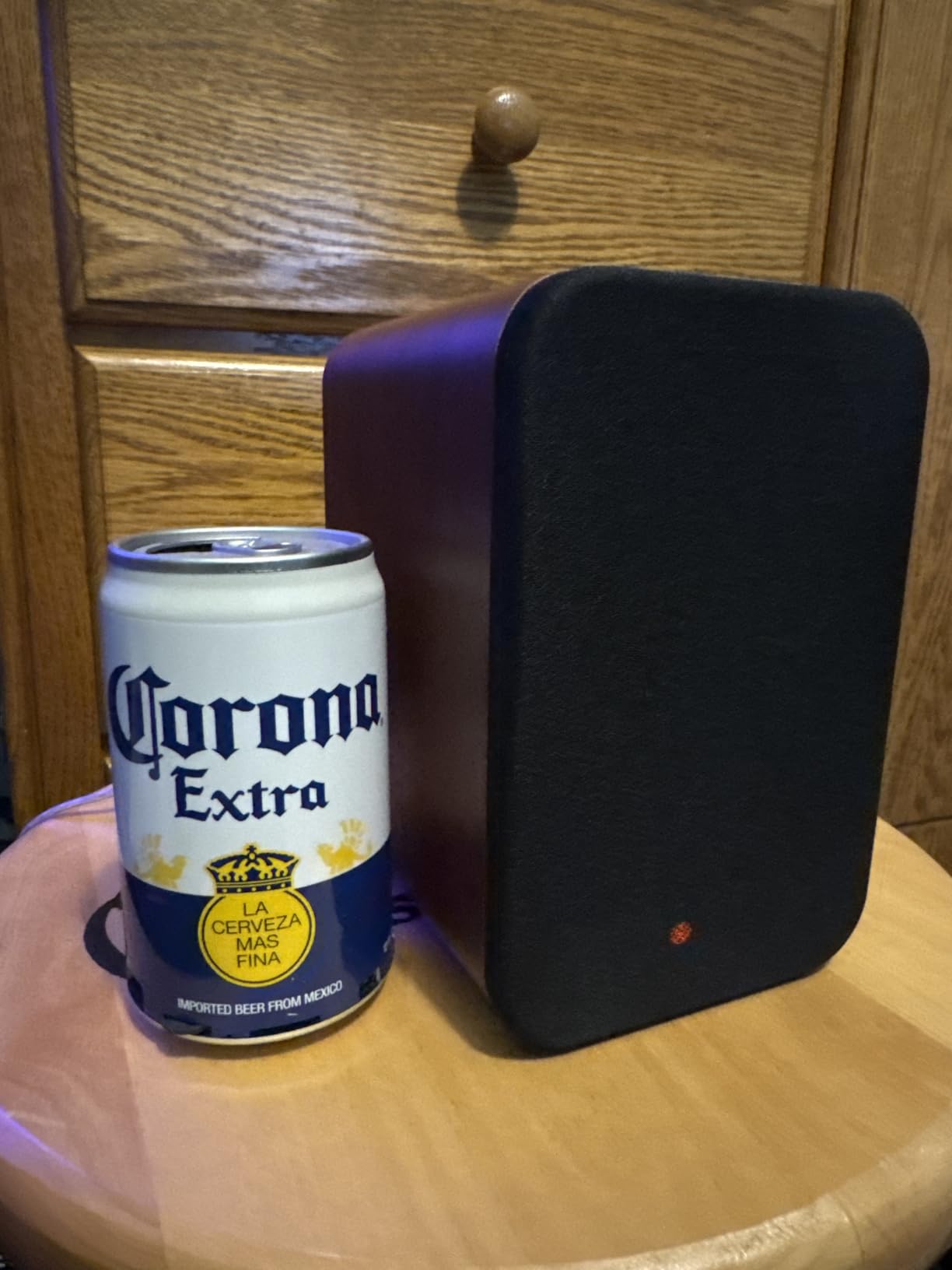
Who the RIOWOIS suits
A small desk, a dorm or a bedroom, and anyone who wants the TV-ARC convenience without spending much. At 2.37 kg for the pair it is easy to move between the desk and a shelf, and the three-year warranty is among the longer ones here.
It also works as a compact second system for a kitchen or a small office where you mostly want speech and light background music.
Where the RIOWOIS falls short
It cannot be used with an external amplifier or receiver. That is a hard limit, and it rules out any plan to grow into separates later, which is the opposite of where most of the other picks in this list can take you.
If you listen at more than moderate volume, step up to the Sanyun SW208. It is only marginally larger, has a genuine 24-bit DAC, and its drivers move more air in every direction.
10. Electrohome Huntley EB10B – Warm Retro Sound at Modest Power
Electrohome Huntley Powered Bookshelf Speakers with Built-in Amplifier and 3″ Drivers for Turntable, TV, PC and Wireless Music Streaming Featuring Bluetooth 5, RCA and Aux (EB10B)
3 inch woofer,Rear-ported wood cabinet,Bluetooth 5 and RCA,20W output
Pros
- Warm
- full-bodied and well balanced sound from a compact pair
- Works with turntables
- TVs
- PCs and consoles plus Bluetooth 5
- Rear-ported wood cabinets give more bass than the size suggests
- Retro wood styling suits a shelf or turntable setup
Cons
- 20W output is the lowest in the group
- No digital inputs and no subwoofer out
- No tone controls or remote and only touch buttons
- One year warranty is the shortest here
The Huntley EB10B is the odd one out stylistically and the most pleasant to look at. Handcrafted rear-ported wood cabinets in teak or black, 3 inch drivers tuned for a warm and detailed profile, and Bluetooth 5 alongside RCA and aux. On a shelf next to a turntable it looks entirely at home.
The rear porting does real work here. Owners regularly note that a pair this size produces more bass than the cabinet dimensions suggest, which is the same trick the compact Edifier cabinets use.
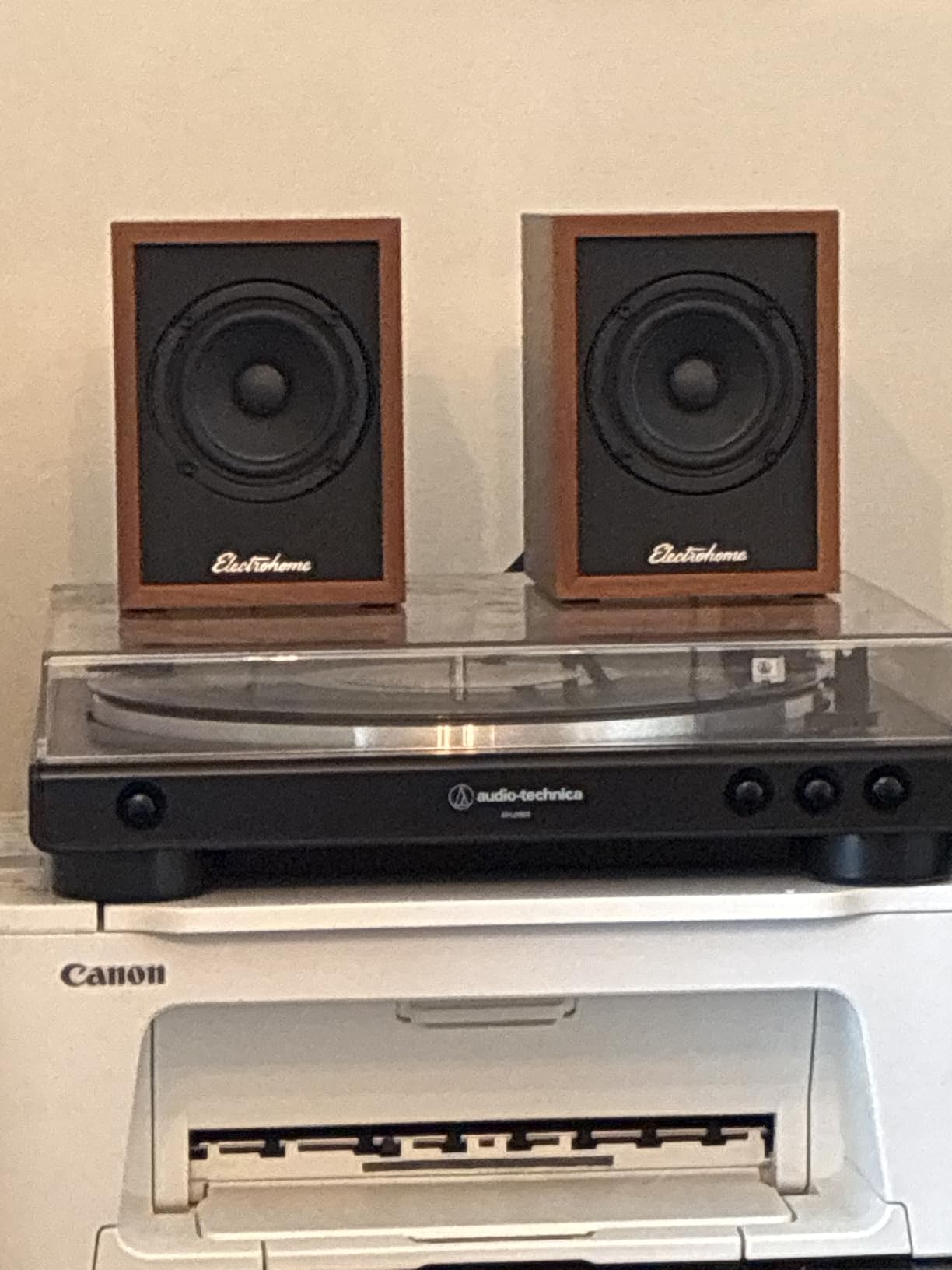
Twenty watts of output is the lowest figure in this roundup, and that defines the listening envelope. It suits near-field desktop listening or a small room and will not fill anything larger. At 4.1 pounds for the pair it is also one of the easiest to reposition.
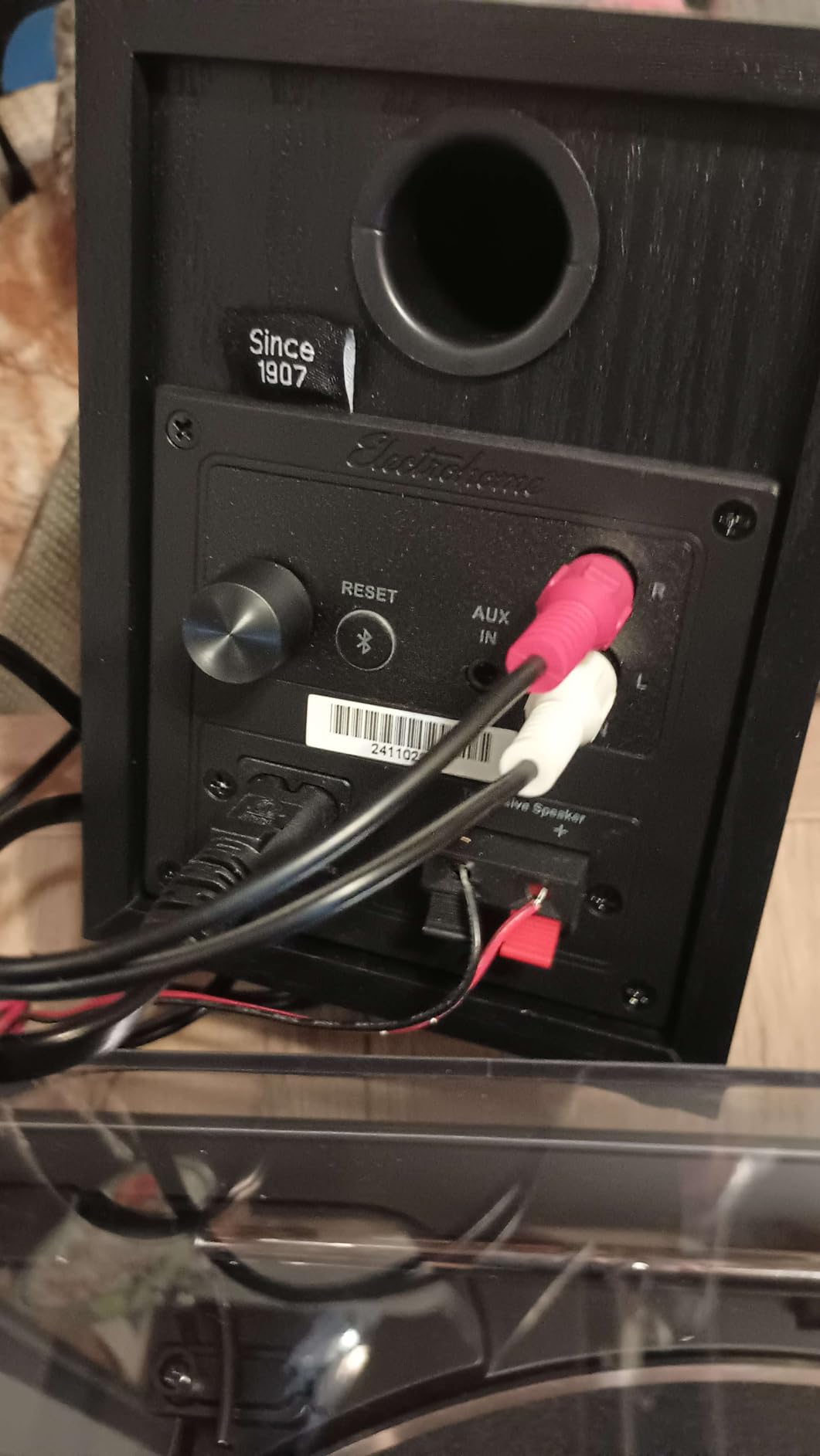
Control is touch buttons on the cabinet. There is no remote, no tone EQ, no digital input of any kind and no subwoofer out, so the sound is what the designer decided it should be.
Who the Electrohome Huntley suits
A turntable owner who wants the simplest possible path to sound, a small apartment, and anyone who wants warm, full-bodied listening rather than analytical detail. Pairing it with a record player over RCA or a 3.5mm line out takes under a minute.
The aesthetic is a genuine reason to choose it. Some desks are part of the room, and a black plastic pair ruins that faster than most other compromises.
Where the Huntley falls short
Twenty watts, no digital inputs and no EQ. There is no subwoofer out, so if you want deeper low end later, the only route is replacing the speakers rather than extending them.
The one year warranty is also the shortest here, which on a product with a modest feature set is an odd place to economise. If longevity is your priority, the three year warranties on the RIOWOIS and Saiyin pairs are worth the small step up.
Powered Bookshelf Speakers Vs. Computer Speakers: What Actually Changes
The honest answer is that a powered bookshelf pair is a different category of object, not a nicer version of the same thing. The speaker that ships with a monitor is typically a single 2 inch driver behind a plastic shell, driven by whatever small amplifier is on the main board. A bookshelf pair puts a 4 to 6.5 inch driver behind an MDF or wood cabinet with its own amplifier. That difference is the whole upgrade, and it shows up in three places.
Bass and output. A 4 inch driver moves far more air than a 2 inch driver, which is why the compact pairs in this list can produce low end that reaches well below the frequency where a monitor speaker gives up. Larger drivers also compress less at higher volumes, so the bookshelf pair stays clean when you turn it up, while the small one thins out.
Longevity. This is the factor owners mention most, and it rarely appears in spec sheets. Cheap all-in-one computer speakers tend to develop a driver or solder failure within a year or two. Every pair in this roundup carries a warranty of at least one year and several carry two or three, and several have review counts in the thousands, which means failures would have shown up publicly.
Flexibility. The purpose-built computer speaker wins on the things it was designed to do: a single cable from one socket, a mute button, sometimes a volume knob on the speaker, and nothing else. The bookshelf pair wins on everything downstream of that, because it has real inputs, real tone controls and, sometimes, a subwoofer output.
Where the bookshelf pair loses is wireless reliability when it is wireless-only, and that is a genuine warning. Bluetooth-only desktop setups are widely reported to drop out on MacBooks, drift in latency and occasionally cut out on one channel. If your desk relies entirely on Bluetooth, buy a pair with a wired digital input as a fallback.
And on studio monitors, the answer for most desks is no. They are voiced flat and revealing on purpose so that mixing decisions transfer to other systems. Long-term owners report that this reads as lifeless or clinical for pleasure listening, which is precisely the opposite of what a workday soundtrack needs.
How to Choose Powered Bookshelf Speakers for a Desktop
Six decisions account for almost everything. Work through them in order and the right pair is obvious.
Powered versus passive: does the amplifier matter?
Every model in this roundup is active, meaning the amplifier is built into one cabinet and a single cable carries signal to the other. You do not need a separate amplifier, and you do not need a DAC unless your PC lacks a usable output. A passive bookshelf speaker needs both, which means two extra boxes on a desk and a power supply to hide.
The practical test: if your computer has a 3.5mm headphone jack, dual RCA outputs, USB that supports audio output, or an optical or HDMI port, an active pair connects directly. A passive hi-fi speaker plus a DAC plus an amp is a bigger, cable-cluttered system for the same sound.
Which input, and how much does latency matter?
For a PC, a wired digital input is the right default. Optical is the cleanest and has no measurable latency, which is why the R1280DBs and the Fluance Ai61 both include it. USB and USB Type-C inputs read the signal directly, and the built-in 24-bit DAC in the Sanyun SW208 is the clearest example of that route in this group.
Bluetooth is for your phone, not for your PC. It is convenient and the pairing in these models is generally stable, but codec compression, a variable delay and the occasional dropout make it a poor default for a fixed workstation. For gaming specifically, the listed 200 milliseconds of latency on the Fluance Ai61 is the clearest illustration of why.
The practical hierarchy is: optical or USB digital first, RCA or 3.5mm second, Bluetooth for convenience only. Make sure the pair you choose has at least one of the first two.
How big a driver does your desk allow?
Bigger drivers mean more bass and more output, but they also mean a deeper and taller cabinet. The mapping is straightforward. Under 5 inches of clear depth, a 3 inch driver is your ceiling. With around 6 inches, a 3.5 to 4 inch driver fits comfortably. With 7 inches or more, a 5 inch driver is available. Beyond that, you are into stands, and stands change the placement rules entirely.
Height matters as much as depth for tweeter position. The tweeter should end up near ear height when you are seated, and that is where desk stands earn their keep. A 3 inch pair on a tilted stand, angled up, will sound noticeably more open than the same pair sitting flat on the desk surface.
Why wattage numbers mislead you
Wattage is the most quoted and least useful figure in this category. It is measured differently by every manufacturer, it is often a peak rather than continuous figure, and it says nothing about distortion at that level. A 60 watt pair with 3 inch drivers will not outplay a 42 watt pair with 4 inch drivers, and several buyers here discover that the hard way.
The two numbers that actually predict experience are driver size and whether the pair has a subwoofer output. Driver size governs how much air moves and how far down the frequencies reach. The subwoofer output governs whether you can add low end later without replacing anything. Ignore peak wattage entirely.
Should you add a subwoofer?
On a desk, a subwoofer is optional rather than necessary, and the physics are the reason. A desk pair works at near-field distances of roughly two to three feet, where the ear is far enough from the wall for the direct sound to dominate and the room is too small to reinforce low frequencies anyway. Below roughly 80 hertz, a 4 inch driver in a small cabinet simply runs out of excursion before it runs out of power.
Add one if you use the pair for film or games at a distance, or if the low end leaves you wanting. Add one later if the pair you buy has a subwoofer output with automatic crossover, which is exactly what the R1280DBs offers. Whatever you do, put the sub behind the listening seat rather than beside the monitor; that placement is repeatedly credited with removing boom and wake-up problems.
Placement, isolation and the problems that follow
Four steps fix almost any desk setup. Put the tweeters at ear height by tilting or standing the speakers. Space them roughly the width of the monitor and angle them inward, toe-in, by about ten degrees. Keep them 10 to 20 cm away from the back wall unless you want wall reinforcement, and pull them forward from the wall for a cleaner low end. Then decouple them from the desk with isolation pads, because a wooden desk becomes a speaker cone when the bass arrives.
The recurring problems are predictable and mostly fixable. A hum or buzz on a PC is usually a ground loop, and the first fix is to try optical or USB instead of the 3.5mm or RCA path. Persistent hiss at low volume is amplifier noise, and it is more audible on compact Class D designs, so turning the level up a notch often removes it. A sub that will not wake is usually a sleep setting or a crossover problem rather than a fault. And Bluetooth dropouts are cured by having a wired input available.
Frequently Asked Questions
What are the best powered bookshelf speakers?
For a desk, the Edifier R1280T is the safest all-round answer: a 4 inch full range driver, a silk dome tweeter, dual AUX inputs and the largest review base in this category. The Edifier R1280DBs is the better buy if you want optical, coaxial, Bluetooth and a subwoofer output, and the Sanyun SW208 is the choice when desk depth is tight.
What are the best powered speakers for PCs?
A wired digital input beats everything else for a PC. Optical or USB audio removes latency and ground-loop hum entirely. The Edifier R1280DBs and the Fluance Ai61 both offer optical plus USB Type-C, while the Sanyun SW208 and the OHAYO both read USB audio directly through a built-in DAC. Treat Bluetooth as a phone convenience rather than a PC default.
Can you use bookshelf speakers as computer speakers?
Yes, and most buyers find the change dramatic. A 4 inch driver behind a wood cabinet produces far more low end and far more volume before it distorts than the 2 inch plastic driver in a monitor. The practical requirements are simple: your computer needs a 3.5mm jack, dual RCA outputs, a USB port that outputs audio, or an optical output, and the speakers need a matching input.
Do I need an amplifier for bookshelf speakers on a desk?
No, not with any of the ten models here. Every one is an active pair with the amplifier built into one cabinet, so it connects straight to a PC output. You would only need a separate amplifier with passive bookshelf speakers, which are not recommended for a desk because they add an amp, often a DAC, and a power supply to an already crowded surface.
Should I add a subwoofer to my desk speakers?
Usually not, unless you use the pair for film or games. At near-field distances of two to three feet a 4 inch driver reaches lower than most listeners expect, and a small room does not reinforce low frequencies. If you do want one, buy a pair with a subwoofer output such as the Edifier R1280DBs, and place the sub behind the listening seat.
How far should desktop speakers be from my monitor?
Space them about as far apart as the monitor is wide and angle them inward by roughly ten degrees. Keep each one 10 to 20 cm off the back wall, since pushing them forward reduces the bass reinforcement a near wall creates. The aim is that the tweeters sit near your ear height when you are seated, which often means tilting or standing the speakers rather than leaving them flat on the desk.
Is USB-C better than Bluetooth for PC speakers?
Yes, by a wide margin. A USB-C or optical digital input reads the signal without a codec step and with no added delay, which matters for anything competitive in a game. Bluetooth compresses the audio, introduces a variable delay, and is the input most often reported to drop out. The 200 milliseconds of Bluetooth latency listed on the Fluance Ai61 is a good illustration of what that looks like in practice.
What size bookshelf speaker fits a small desk?
Match the driver to the depth you have. With under 5 inches of clear space, a 3 inch driver is the practical ceiling and the Sanyun SW208 or OHAYO are built for it. Around 6 inches, a 3.5 to 4 inch driver such as the Edifier R1280T fits. 5 inch drivers need roughly 7 inches of depth, and 6.5 inch cabinets such as the Fluance Ai61 belong on stands.
Why do my powered speakers buzz or hiss?
A hum that follows power-up is almost always a ground loop between the computer and the speakers, and the quickest fix is to switch from the 3.5mm or RCA path to optical or USB. Hiss that rises with volume is different: it is amplifier noise, and it is more audible on compact Class D designs. Turning the level up one notch often makes it disappear below your hearing.
Which Powered Bookshelf Pair Belongs on Your Desk
The Edifier R1280T remains the pick we send people to, because a 4 inch driver, dual AUX inputs and a huge review base cover almost every desk without asking you to compromise on anything. If your PC has a modern digital output, the R1280DBs is the smarter buy for the small step up, since optical, Bluetooth and a subwoofer output solve problems you would otherwise solve with extra boxes. If desk depth is under five inches, the Sanyun SW208 is the only one of the three that will physically fit.
Beyond those, match the driver to the space rather than the wattage to the headroom. Compact 3 inch pairs like the OHAYO or the Sanyun belong beside a monitor; the 5 inch MEVOSTO needs a real surface; the 6.5 inch Fluance belongs on a stand behind the chair, not on the desk. Measure the depth you have, pick a wired input over Bluetooth, and the best powered bookshelf speakers for desktops become a fifteen-minute decision rather than a month of research.