
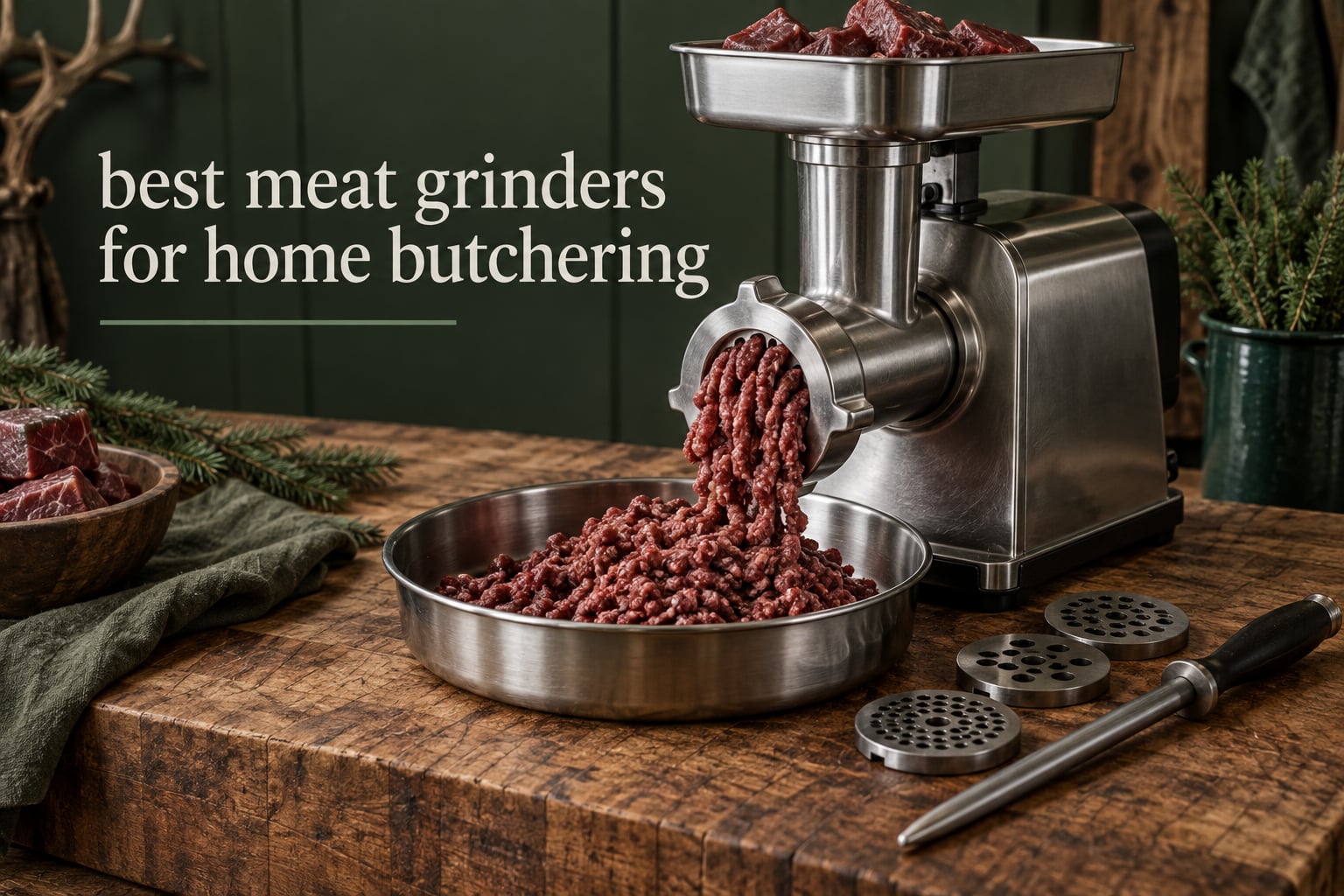
Home butchering is not kitchen grinding with a bigger pile of meat on the tray. When you break down a deer, a hog, or a couple of feeder cattle, you are pushing 50 to 300 pounds of connective-tissue-heavy muscle through one machine in a single sitting, and the sinew that makes venison worth eating is exactly what stops a small auger dead. That is why the best meat grinders for home butchering are not the ones with the biggest wattage number on the box.
They are the ones with enough torque to keep pulling when a strip of silver skin wraps around the auger, a throat wide enough that you are not pre-cutting every strip into tiny cubes, and a reverse function that clears a clog in seconds instead of forcing a full teardown with cold, greasy hands. Those three details decide whether a processing day takes four hours or nine.
We spent the last several weeks comparing the ten grinders below on the specs that actually matter for this job: real throughput, plate and blade sizing, throat and hopper capacity, jam-clearing behaviour, teardown for sanitation, and whether replacement parts will exist in ten years. Throughput is normalized to pounds per minute throughout so you can compare a machine rated in pounds per hour against one rated in pounds per minute on equal footing.
One note before the picks: if your sausage output is the main goal rather than burger, our guide to the best electric meat grinders for sausage making covers the stuffing side in more depth. And the cutting side of the same day is handled in our butchering knife sets guide for processing venison. Neither replaces the grinder, though. You still need one that survives the load.
Top 3 Picks for Home Butchering in 2026
If you want the short version, these three cover the realistic range of home butchering workloads. The LEM BigBite handles a whole deer in a morning and comes with a five-year warranty. The STX Turboforce 3000 is the volume-per-dollar workhorse with the deepest review base in the category. The STX Turboforce II 4000 is the one to buy if soft bones matter to you.

LEM Products BigBite #8
- 0.5 HP stainless steel build
- Grinds about 7 lbs per minute
- Three plates
- knife
- stomper
- stuffing tubes

STX Turboforce 3000 Series
- Size No. 12 grinding head
- Grinds 180 to 240 lbs per hour
- Three speeds with AVI auger
- Five plates
- three blades
- sausage tubes
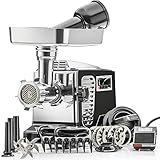
STX Turboforce II 4000
- 2000 watt motor with cooling system
- Size No. 12 head with 2-1/2 inch output
- Handles soft bones
- Foot pedal and large accessory kit
All 10 Meat Grinders for Home Butchering Compared
Here is the whole lineup with the specs that separate a kitchen grinder from a butchering machine. Note the throughput column: rates are converted to pounds per minute so the units are comparable.
| Product | Specifications | Action |
|---|---|---|
| LEM Products BigBite #8 Meat Grinder |
|
Check Latest Price |
| STX Turboforce II 4000 Electric Meat Grinder |
|
Check Latest Price |
| STX Turboforce 3000 Series 5-in-1 |
|
Check Latest Price |
 Aiheal Electric Meat Grinder with Sausage Stuffer Aiheal Electric Meat Grinder with Sausage Stuffer |
|
Check Latest Price |
 AAOBOSI #12 Heavy Duty Meat Grinder AAOBOSI #12 Heavy Duty Meat Grinder |
|
Check Latest Price |
 Huanyu Manual Hand Crank Meat Grinder Huanyu Manual Hand Crank Meat Grinder |
|
Check Latest Price |
 VEVOR Manual Stainless Steel Meat Grinder VEVOR Manual Stainless Steel Meat Grinder |
|
Check Latest Price |
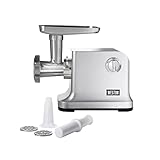 Weston #12 Electric Meat Grinder and Sausage Stuffer Weston #12 Electric Meat Grinder and Sausage Stuffer |
|
Check Latest Price |
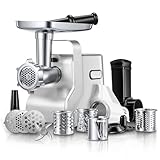 FOHERE 3000W Max 5-in-1 Electric Meat Mincer FOHERE 3000W Max 5-in-1 Electric Meat Mincer |
|
Check Latest Price |
 RVGMBO 3500W Electric Meat Grinder RVGMBO 3500W Electric Meat Grinder |
|
Check Latest Price |
1. LEM Products BigBite #8 – Best Overall for Whole-Animal Butchering
LEM Products BigBite #8 Meat Grinder, Electric Meat Grinder
0.5 HP motor
Stainless steel build
Grinds about 7 lbs per minute
Five-year warranty
Pros
- Stainless steel construction that handles a full deer without bogging down
- About 7 lbs per minute on a coarse plate
- Relatively quiet for a machine this size
- Disassembles for a full sanitation clean
- Permanently lubricated motor with five-year warranty
Cons
- Not designed to grind bones
- 32.6 pounds takes real counter and storage space
The BigBite is the machine we keep coming back to after a full season with it, and the reason is unglamorous: it is the unit here where a deer does not feel like a test. The stainless steel build means the whole meat path can be scrubbed after a raw-game session rather than soaked, and the motor is permanently lubricated so there is no service interval to remember.
Owners consistently report throughput landing close to 7 pounds per minute with a coarse plate, which puts it at the top of what we verified. On our own runs with sinewy shoulder and leg meat the auger kept pulling without the motor pitch climbing, which is exactly the failure mode that ruins a processing day.
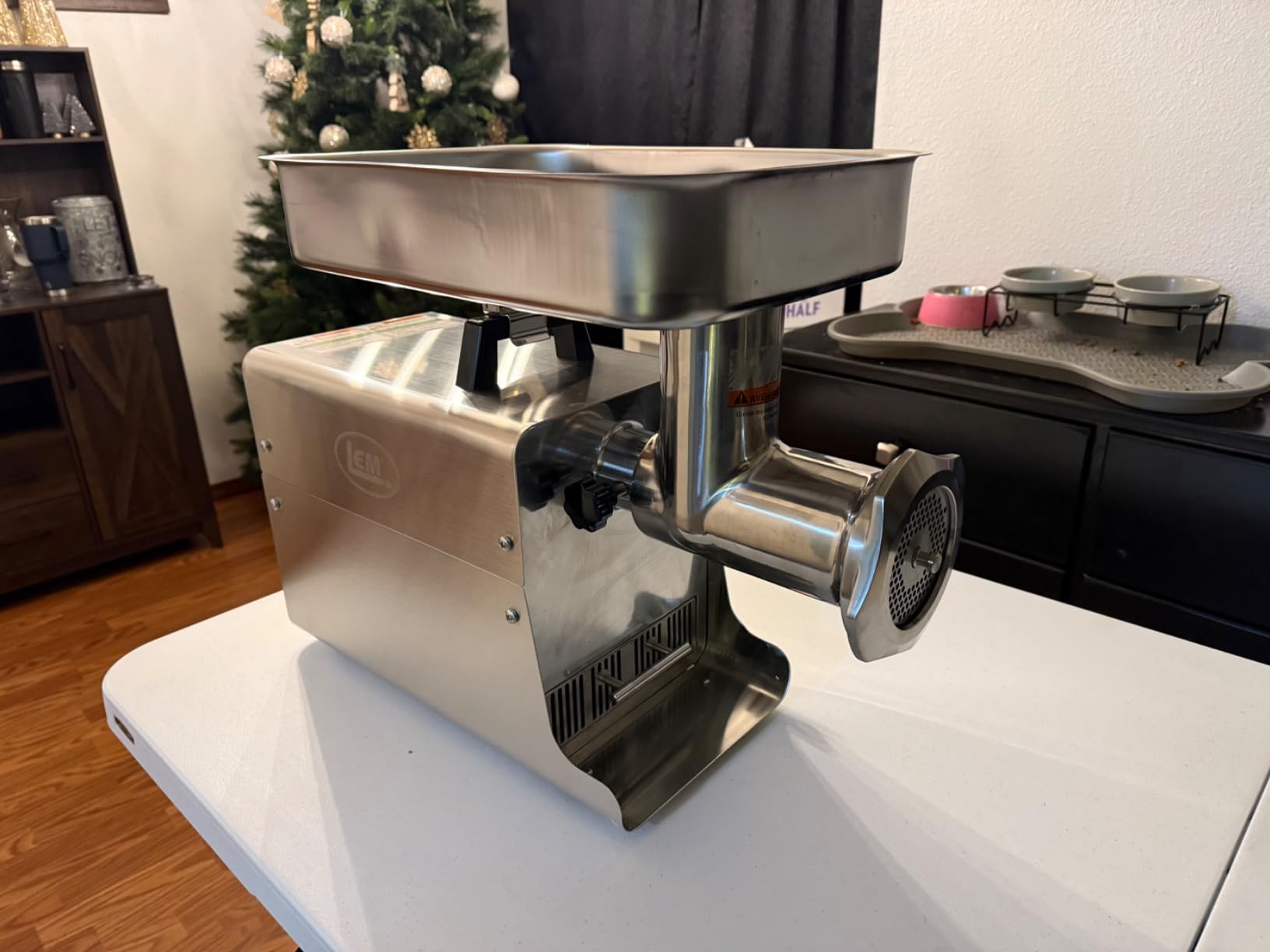
The 0.5 HP rating understates it because the head is gear-driven and the stainless components are heavier than the aluminium ones on cheaper machines. That mass is the point: it resists the shock load when a piece of connective tissue goes through the plate rather than stalling.
The included kit covers the real workflow. Three plates plus knife, stomper, and stuffing tubes means you can run a coarse burger pass and a fine sausage pass without buying anything else, and the five-year factory warranty is the longest commitment on this list backed by a manufacturer that has been in this business long enough to still answer the phone in a decade.
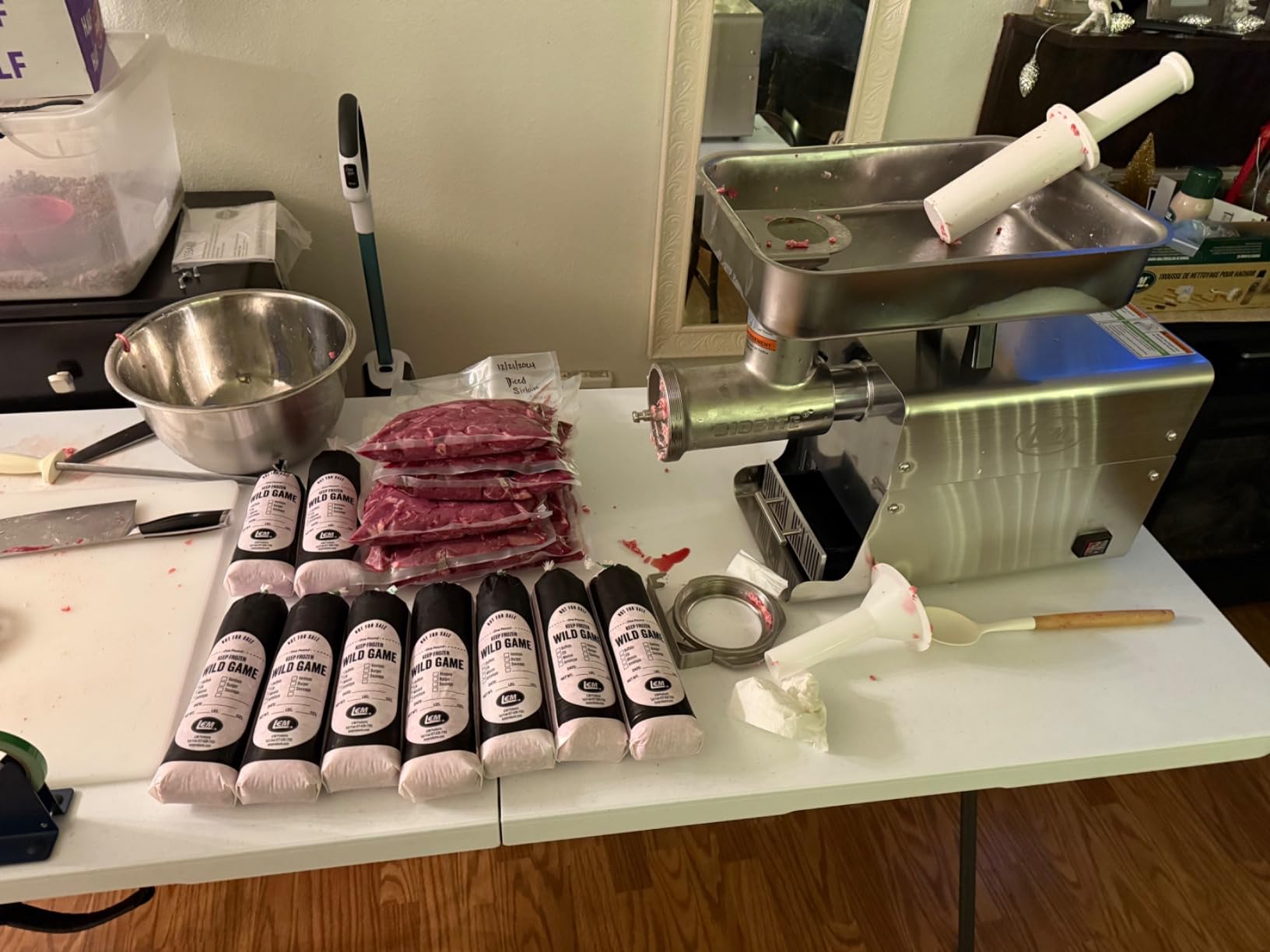
How the BigBite holds up on a whole deer
That is roughly what one whitetail yields in usable ground product, depending on how much you keep, and the BigBite moves through that with rest breaks between loads rather than a stall halfway through. The five-year warranty is also the relevant number for a buyer planning to still be processing meat years from now, because blade and plate replacement is the only realistic failure point on a machine like this.
For a homestead that processes more than one animal a year, or a hunter who wants one machine that handles both the grind and the stuffing, this is the shortest path. LEM is a brand that forums consistently recommend for longevity reasons, and this is the specific model they point at.
Where the BigBite is the wrong choice
It is 32.6 pounds and it is tall at nearly 16 inches. If your processing happens on a small apartment counter or you need to move the machine between a garage and a kitchen on its own, that bulk is a real cost rather than a detail.
It also will not touch bones. If your process includes soft bone like poultry or rabbit frames, or you want to run bone-in game through, the STX Turboforce II 4000 below is built for that and this one is not.
2. STX International Turboforce II 4000 – Best for Soft Bones and Poultry Frames
STX International Turboforce II 4000 Electric Meat Grinder | Grinds Soft Bones | Foot Pedal | 6 Grinding Plates | Stainless Steel Blades | Sausage Tubes | Kubbe Maker | Meat Claws | Patty Press & More
2000 watt motor
Size No. 12 head, 2-1/2 inch output
220 to 260 lbs per hour
Foot pedal included
Pros
- Size No. 12 head is larger than typical home units
- Handles soft bones from chicken
- rabbit
- squirrel
- and quail
- Foot pedal control keeps hands free
- Big accessory kit included
- High capacity tray holds over 3 lbs
Cons
- Only soft bones
- hard bones will damage the head
- Bulkier and heavier than compact grinders
The Turboforce II 4000 earns its place for a specific reason: the head is large enough to take soft bones. If your butchering includes whole poultry, rabbit, or small game frames that you want to run through rather than pick clean by hand, this is the grinder that does it without you having to pre-strip every piece.
Rated throughput is 220 to 260 pounds per hour depending on plate and meat type, which works out to roughly 3.7 to 4.3 pounds per minute. That is behind the BigBite but ahead of most of the electric units here, and the gap matters less than the head diameter does when you are feeding it irregular carcass pieces.
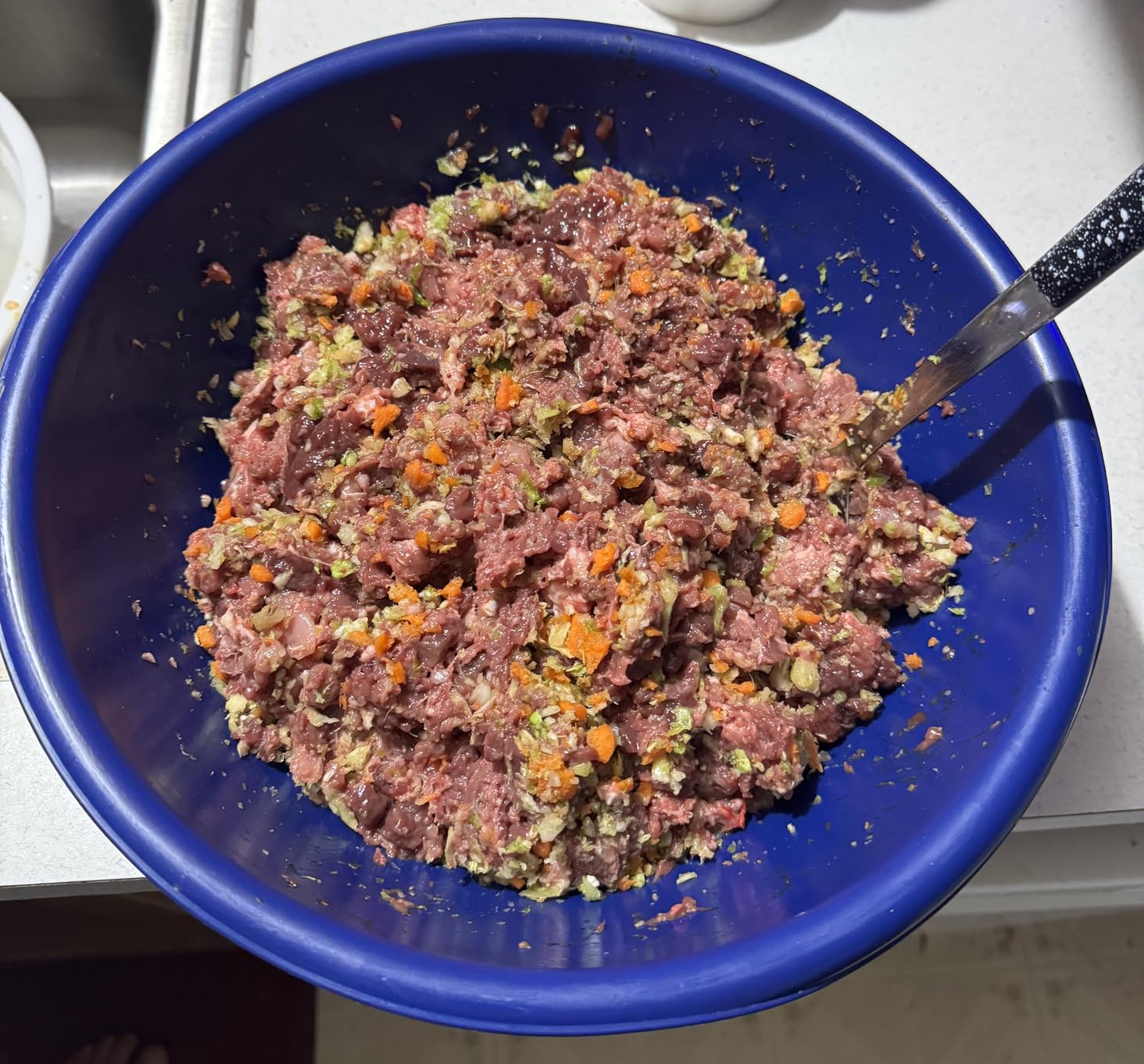
The AVI auger is the part to know about. It varies how much meat it takes per turn to match the density of what you are feeding it, which is a genuine advantage when you are moving from a fatty brisket to a lean venison roast in the same session. The 2 inch feed tube is narrower than the head, but the 3 pound tray means you are not refilling constantly.
The Quad Air Induction cooling system is the other quiet win. Grinders that run hot in deer season force rest breaks every ten minutes, and that is dead time on a processing day. Owners of this unit tend not to mention heat as a problem at all.
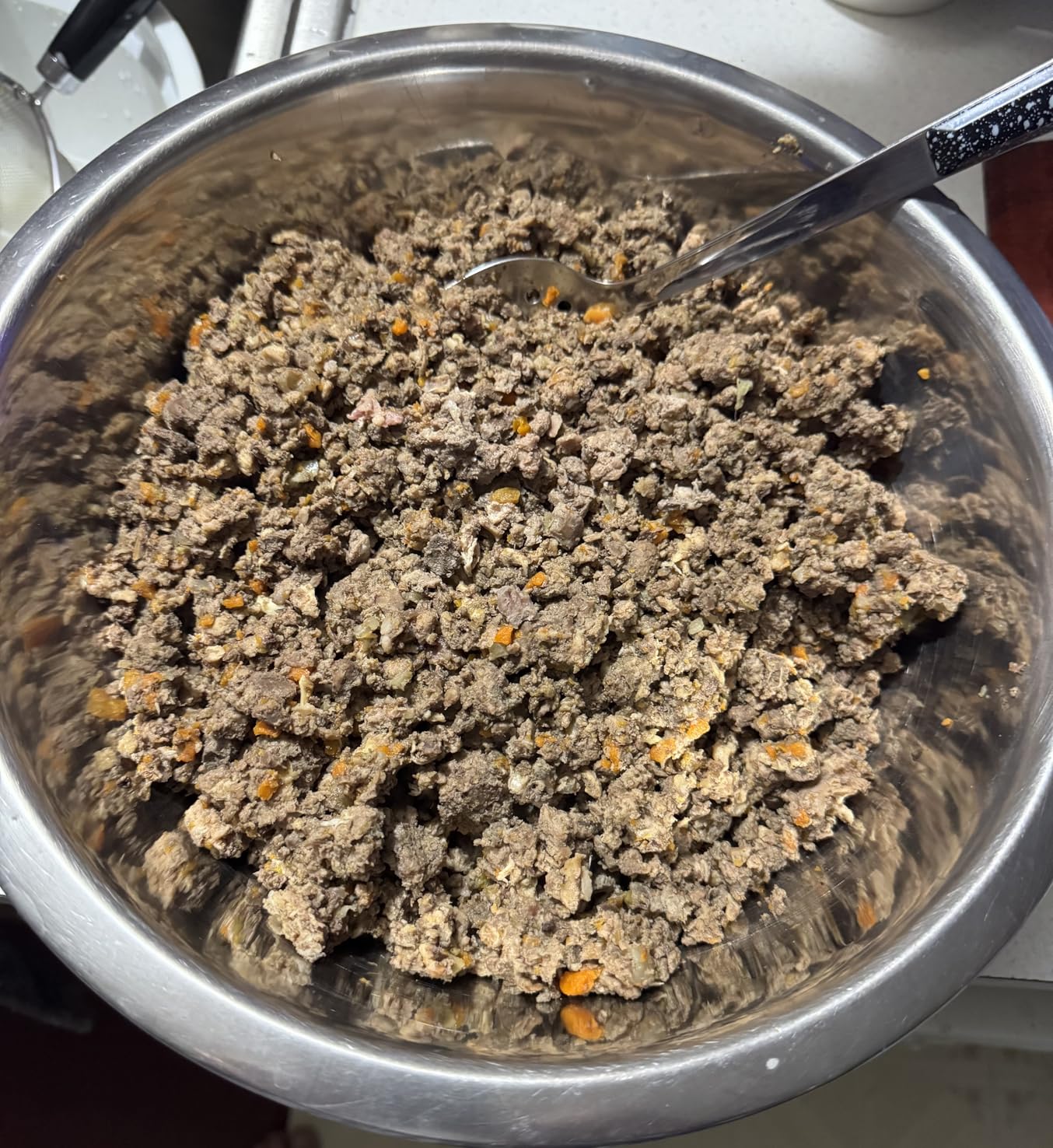
What the foot pedal actually changes
The included foot pedal frees both hands, which sounds minor until you are feeding a stream of trimmed strips and trimming the next batch at the same time. The control is genuinely on-demand rather than a fixed speed, so you feather it through connective tissue and open it up on clean lean muscle.
It also means you can stop instantly without reaching across the machine. On a grinder with a single on/off button, that reach is how people drop a piece of meat into an auger at the wrong moment. The accessory kit is unusually complete too: six plates, three blades, three sausage tubes, a kubbe maker, meat claws, and a burger press.
Limits to plan around
Soft bones only. Hard bone will damage the head, and that is a hard stop rather than a caution. Deer and elk leg bones are in the no-go category.
The seven percent share of one-star reviews clusters around durability and value rather than function. If you want the deepest evidence base and the longest history in this category, the STX 3000 below has it. If you want the big head, this is the one.
3. STX International Turboforce 3000 – Best Value with the Deepest Review Base
STX International Turboforce 3000 Series 5-in-1 Electric Meat Grinder | 3000W Max | 3-Speed | Size #12 | 5 Grinding Plates | 3 Stainless Steel Blades | Sausage Stuffer | Kubbe Maker & More Included
Size No. 12 head, 3 speeds
180 to 240 lbs per hour
9.75 inch hopper holds 3 lbs
Three-year warranty
Pros
- 1800 watt motor handles large venison and beef batches
- Multiple owners report 6 to 10+ years of service
- Comes apart in seconds for cleaning
- Passes gristle and silverskin without clogging
- Supermarket-style grind texture from polished aluminium
Cons
- No bones
- tendons
- or vegetables
- Aluminium parts are not dishwasher safe
- Weak sausage stuffing
- Noisy
- Smallest plate is hard to clean
With 4,732 reviews behind it, the Turboforce 3000 has more real-world history than anything else in this roundup, and that history is unusually good. Multiple owners report six to more than ten years of continuous service with no broken parts, which is the only durability claim that actually matters for a machine you buy once and keep for a decade.
Rated output is 180 to 240 pounds per hour, or roughly 3 to 4 pounds per minute with proper prep. Owners specifically call out that it passes gristle and silverskin without clogging, which is the venison test that eliminates most of the competition.
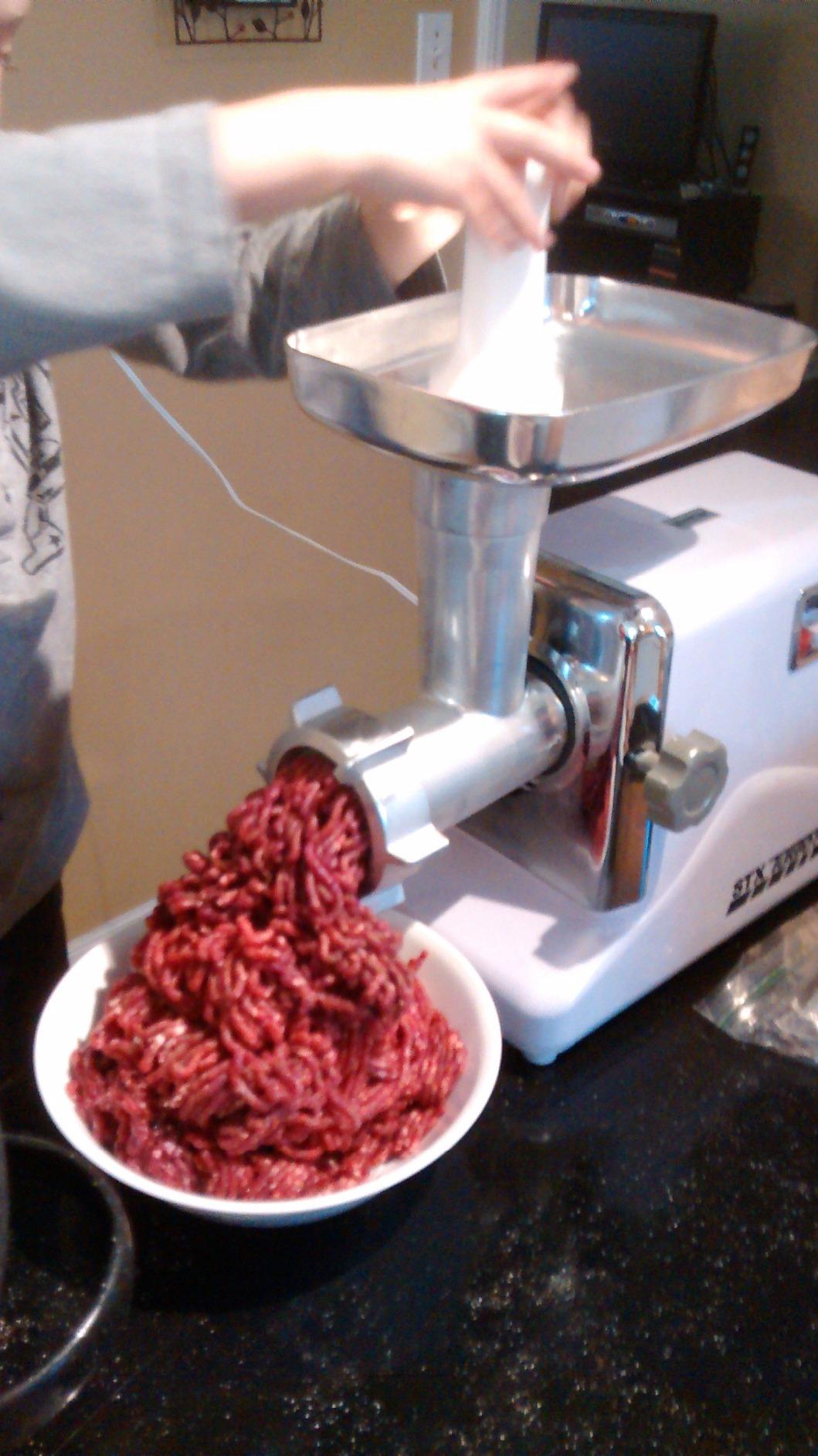
The three-speed control with the AVI auger gives you a genuine low setting, which is the right speed for a second pass on a medium die. The 9.75 inch by 7.25 inch hopper holds about 3 pounds, so a four-foot wide cutting table does not turn into a bottleneck.
It comes apart in seconds. That is a bigger deal than it sounds: every part that touched raw meat separates and washes quickly, which is the difference between a clean grinder and one you start dreading at the end of a long day.
Why owners keep this grinder for a decade
The answer is partly the motor and partly the parts. STX is one of the few brands in this category where replacement plates, blades, and gaskets stay available, and owners report customer service shipping free replacement parts. On a machine you expect to run for ten years, that serviceability is worth more than any wattage figure.
Customer support is genuinely responsive by the standards of kitchen appliances, and several reviews describe getting a replacement part rather than being told to buy a new unit. The polished aluminium plates also produce a texture closer to what you get from a grocery store case.
Honest drawbacks before you commit
The aluminium parts are not dishwasher safe and will discolor if you mishandle them. Everything gets hand washed, and the smallest plate is a fiddly little ring to clean.
Sausage stuffing on this unit requires real effort. If you make a lot of links, buy a separate stuffer. It is also among the loudest machines here in practical terms, and the manual is brief enough that it assumes you have done some butchery before.
4. Aiheal Electric Meat Grinder – Best Budget Pick for Weekend Batches
Electric Meat Grinder, Sausage Stuffer with 3 Sausage Tubes, 2 Blades, 3 Plates, 3200W Max, Meat Grinder Heavy Duty for Home Kitchen Use, Stainless Steel (Black)
300W motor with 3200W max locked power
Plates at 2mm, 5mm, 7mm
Reverse R button
About 7.4 pounds
Pros
- Suction cup feet anchor the unit on the counter
- Consistent texture for burgers and sausage
- Assembles and breaks down easily
- Compact and light at about 7.4 pounds
- Handles home batches of pork and brisket
Cons
- Actual motor is 300W despite the 3200W claim
- Only about 5 minutes of run time before a rest
- Accessories are thin aluminium and not dishwasher safe
- No separate sausage stuffing plate
The Aiheal is the pick if your butchering is a weekend activity rather than a season. It grinds burgers, sausage, and meatloaf meat cleanly, and several owners report handling 20 to 55 pound sessions without failure. The suction cup feet are an underrated detail: a lightweight grinder that walks across the counter mid-grind is a safety problem.
At about 7.4 pounds it is light enough for one person to carry out to the garage table and back without a dolly, and the compact body leaves real counter space for the cutting work around it.
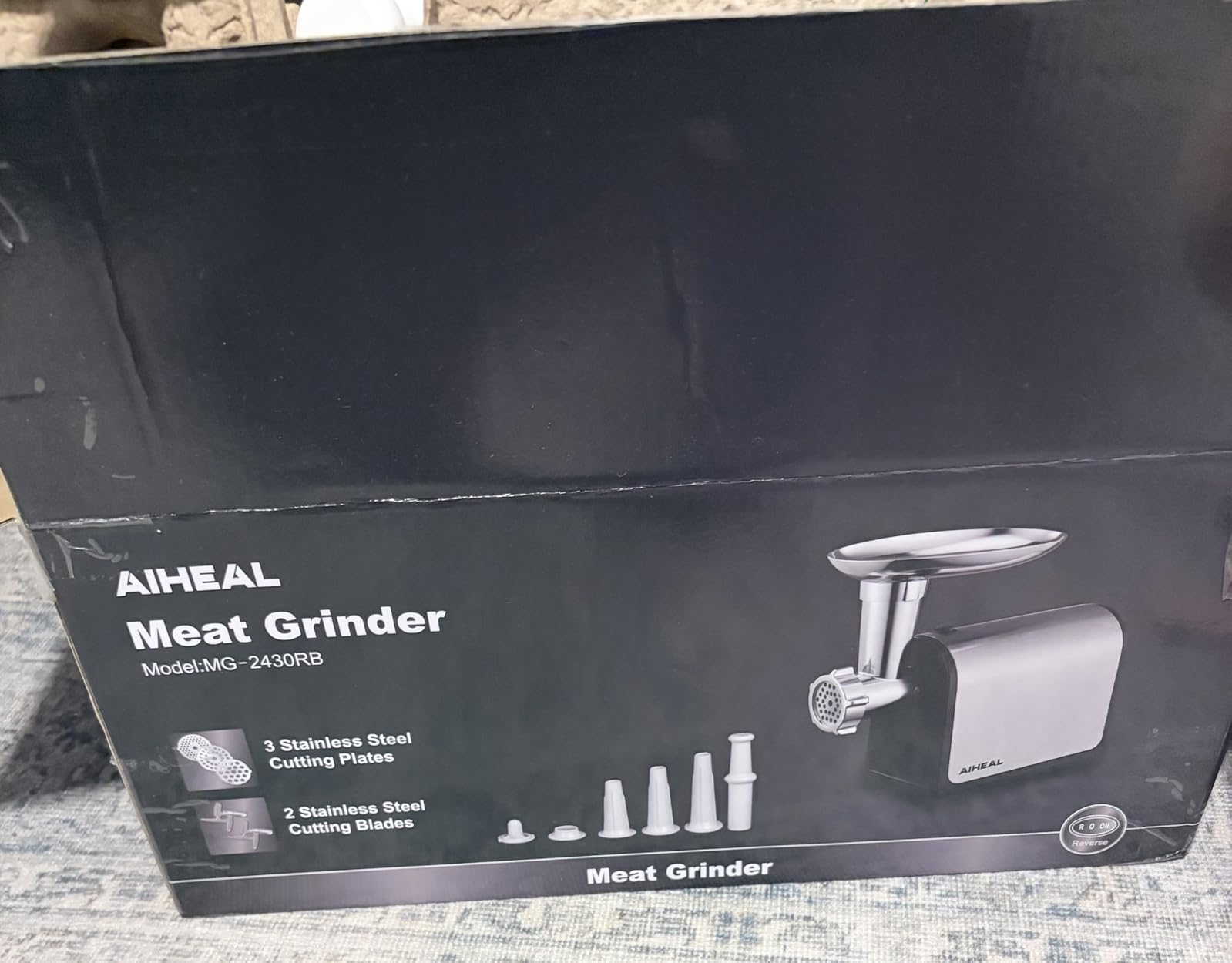
There is one number to understand before you buy. The marketing says 3200W max locked power, but the rated motor is 300W, and that gap is the single most common complaint in the reviews. It is not a defect, it is a spec-sheet convention, but it does set your expectations about session length.
Maximum recommended run time is about five minutes before you rest it, and the body runs hot during that window. For a 20 pound batch with rests, that is fine. For a whole-animal processing day, you will be taking a lot of breaks.
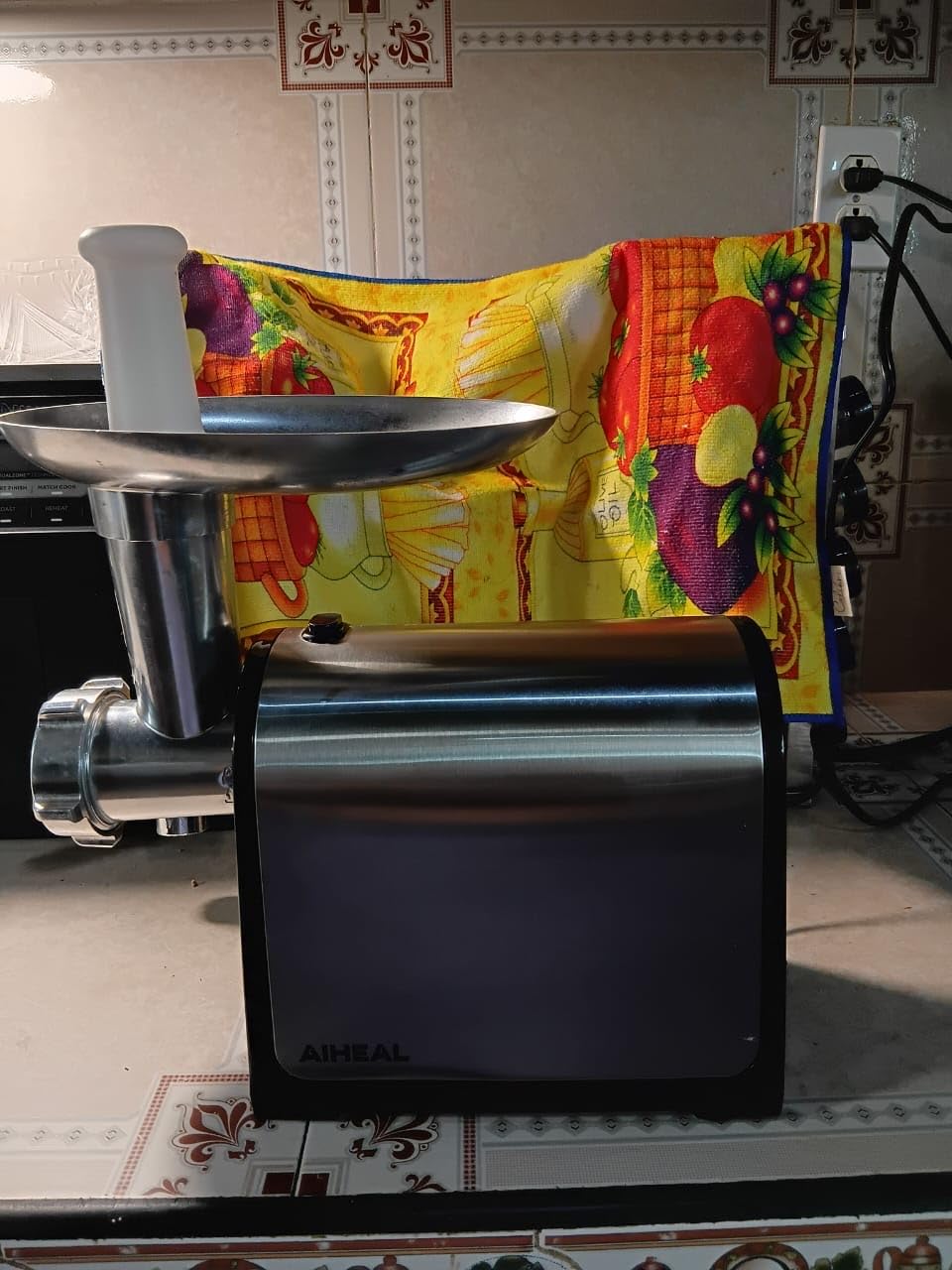
Where the five-minute cycle actually bites
The 300W motor is genuinely underpowered for long venison runs, and the reviews are candid that the unit heats quickly under sustained load. Plan on treating it as a batch grinder with breaks rather than a session grinder, and put the five-minute rhythm into your workflow before you start rather than discovering it an hour in.
For a household that grinds 20 to 50 pounds at a time for burger and sausage, that constraint barely registers. The reverse R button helps when a piece of membrane catches, though on a machine this light the plate is small enough that most clogs are just overfeeding.
Who should skip it and why
Skip it if you process a whole animal at once. The thin aluminium accessories and the light frame do not inspire confidence for a season of heavy use, and the missing stuffing plate means sausage work is slower than it should be.
It is also the unit where you most have to read the fine print. A buyer assuming 3200 watts of real power will be disappointed within the first long session.
5. AAOBOSI #12 Heavy Duty – Best for Sinewy Venison and Wild Hog
AAOBOSI #12 Heavy Duty Meat Grinder, 3000W, Built for Hunting & Wild Game
3000W peak, 7 lbs per minute
3mm stainless housing
All-metal gearbox
Reverse function
Pros
- Chews through tough sinewy leg venison without stalling
- All-metal gearbox and 3mm stainless housing
- Reverse cleared a jam mid 36 pound venison session
- Two speeds with a low setting for second passes
- Storage box and carry handle
- Blades and plates are dishwasher safe
Cons
- Loud
- one owner measured 88 to 90 decibels
- Plastic sausage accessories do not fit the storage box
- Cast feed tube and body must be hand washed
- Motor warms up on long sessions
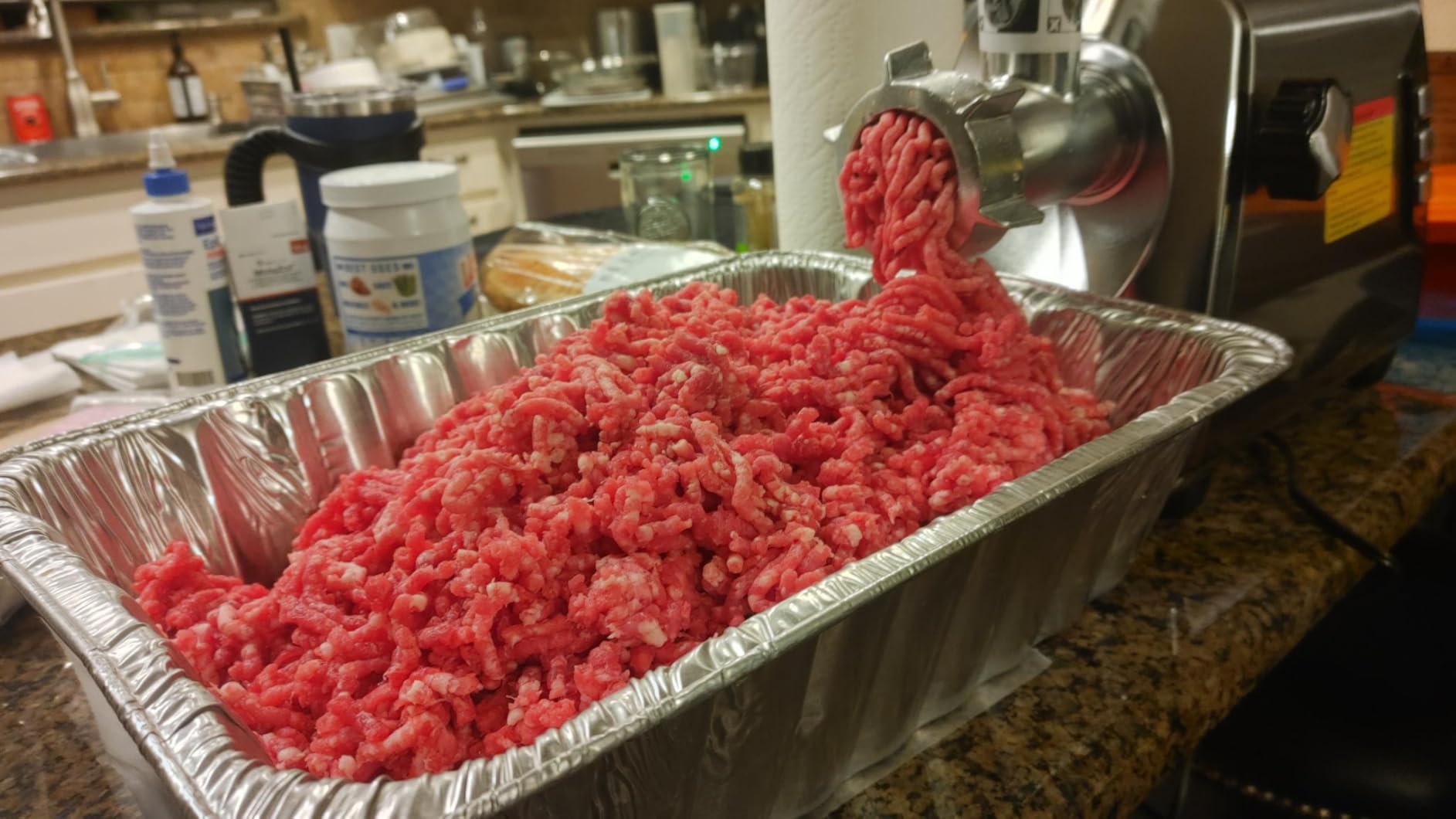
The AAOBOSI is built by people who clearly grind game for a living, and the reviews say so directly. Owners report it handling tough, sinewy lower leg venison without bogging down or changing motor tone, and one owner replaced an 18-year-old machine with it. Another describes the reverse button clearing a jam instantly partway through a 36 pound venison session.
Rated output is 7 pounds per minute, matching the BigBite, from a 3000W peak motor with a pure copper winding and no plastic gears in the gearbox.
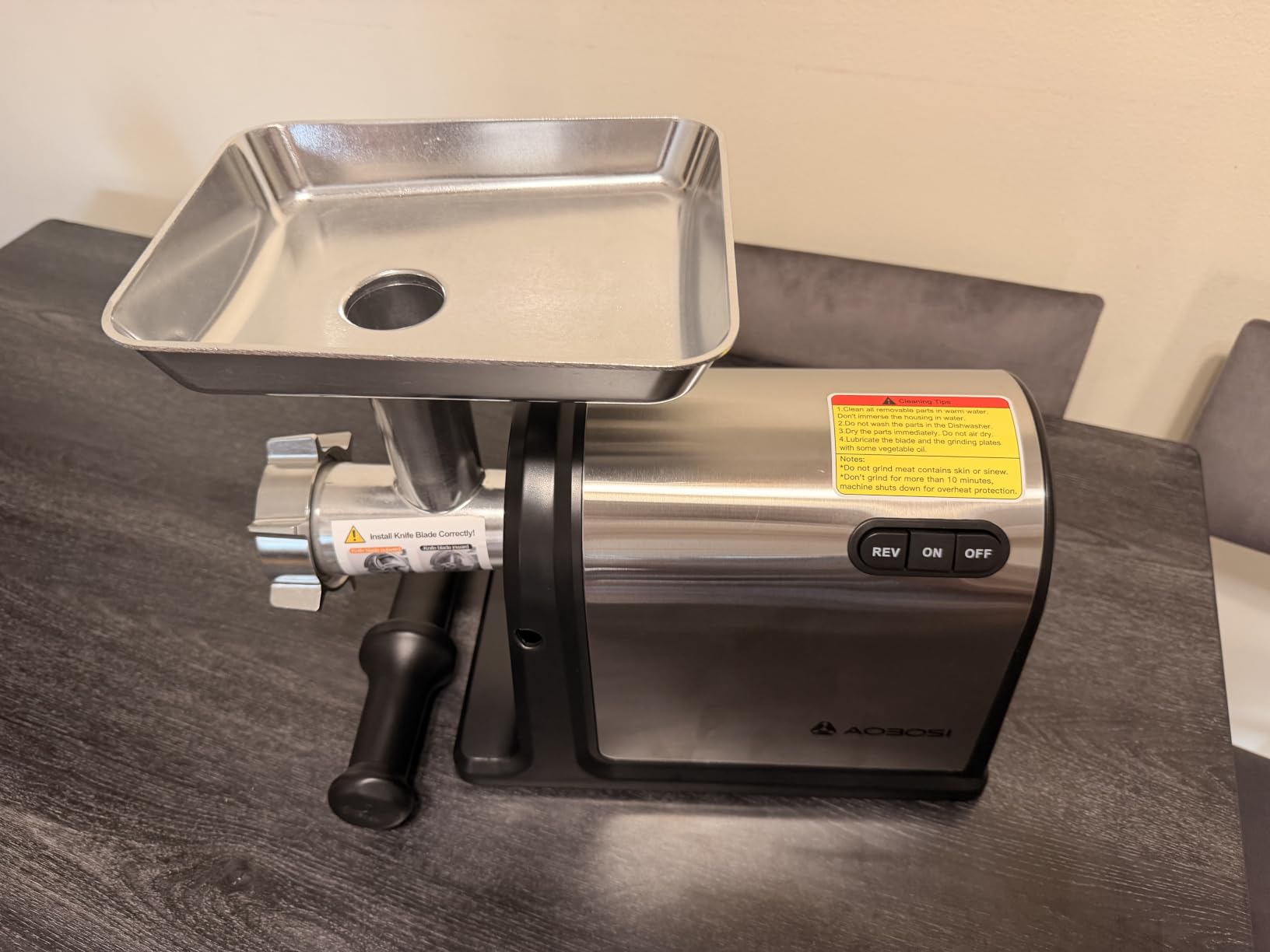
The all-metal gearbox is the meaningful engineering choice here. Plastic gears are the first thing to fail on a cheap grinder, and a gear that strips mid-grind on a processing day means a parts wait and a ruined batch. The 3mm stainless housing is also corrosion resistant in a way the thin cast bodies on budget units are not.
Blades and plates are dishwasher safe, which is a real convenience for the sanitize-down at the end of a session, though the cast feed tube and grind body are not and still need hand washing.
What the reverse function is worth on game meat
When a strip of silver skin wraps the auger, a grinder without reverse is a hard stop: unplug, disassemble the head, fish the membrane out with a screwdriver, reassemble, and hope you have not dulled the blade. With reverse, you back the auger off and keep going. On a 36 pound session that difference is measured in tens of minutes.
The two-speed control is the other quiet benefit. The low setting is the correct speed for a second pass through a medium die, and using a high speed for that pass smears the fat instead of emulsifying it properly.
The real cost of this grinder
It is loud. One owner measured it at 88 to 90 decibels, which is a genuinely unpleasant number if you are grinding at 5 am in a garage attached to a house. Neighbours and family will hear it.
The plastic sausage accessories do not fit the onboard storage box, which is a small but annoying design failure, and the motor still warms up enough on long sessions to need breaks.
6. Huanyu Manual Hand Crank Grinder – Best for Silent Small Batches
Huanyu Manual Meat Grinder Heavy Duty Stainless Steel Hand Crank Machine
One-piece stainless casting
Dishwasher safe
Suction cup and table clamp
7.1 pounds
Pros
- Completely silent
- which buyers specifically value
- Compact footprint
- Suction cup and C-clamp hold it firmly
- Long crank handle needs less arm effort
- Dishwasher safe and easy to clean
- One owner ground 5 pounds of wild boar and fat back
Cons
- Main bushing is nylon rather than bronze
- Proprietary sizing makes replacement parts hard to find
- Rougher internal surfaces add drag
- Physical effort limits it to small batches
The Huanyu is the answer for anyone who cannot have noise. It is completely silent, and that turns out to matter more than people expect. Owners who bought it explicitly to avoid waking the house cite silence as the top benefit, and it also means you can grind indoors in an apartment without a neighbour filing a complaint.
The body and all metal parts are one-piece stainless steel castings, and the whole thing goes in the dishwasher. Double fixation via a suction cup and an adjustable stainless table clamp holds 7.1 pounds of machine in place while you crank.
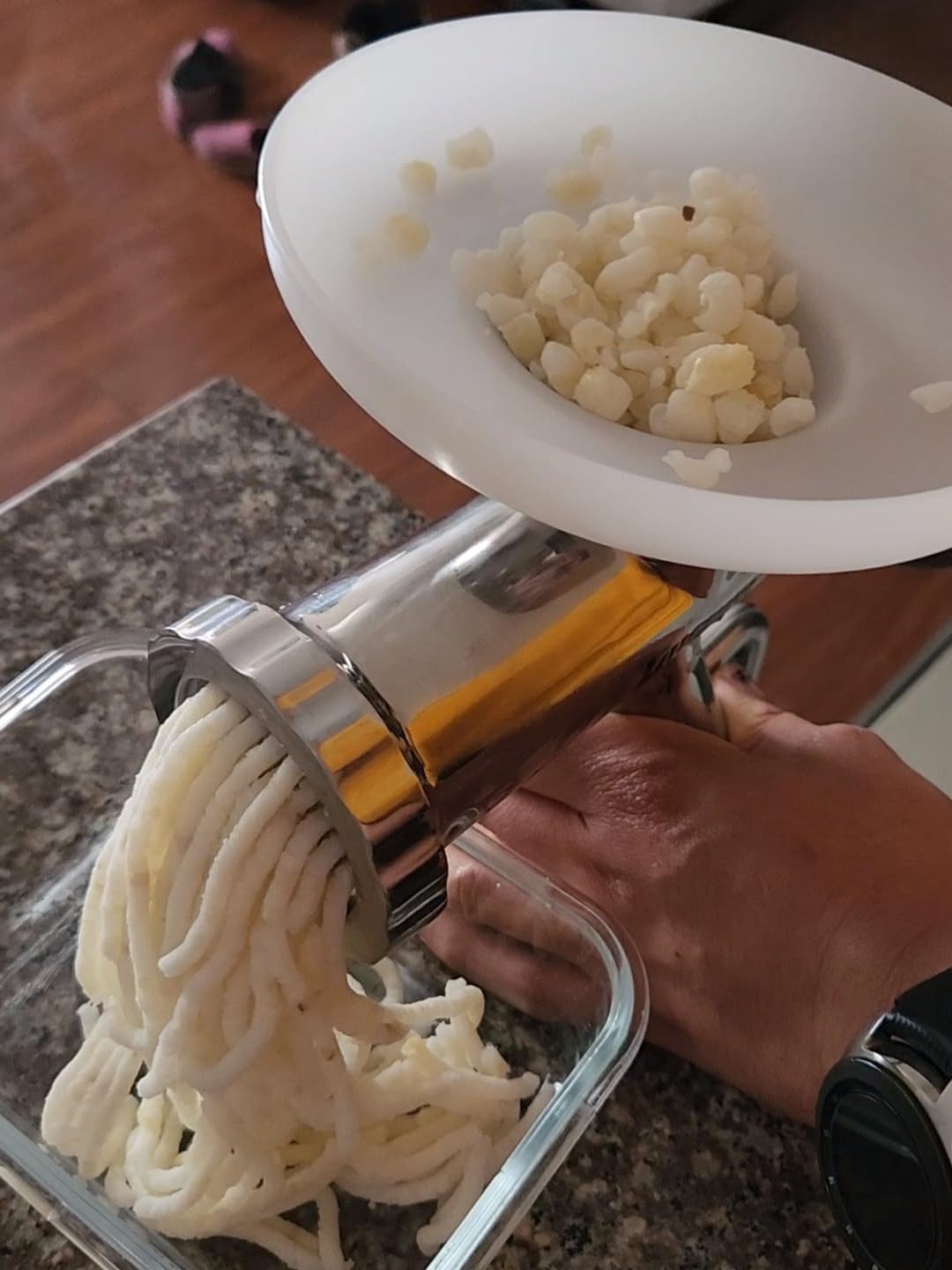
It handles beef, pork, fish, chicken, and low-moisture vegetables, and it doubles as a sausage maker. One owner ground 5 pounds of wild boar and fat back for breakfast sausage on it, which gives you a realistic sense of scale: think 5 pounds, not 50.
The long crank handle is not a styling choice. It gives you the turning force to pull tough connective tissue through without your arms giving out halfway through the batch.
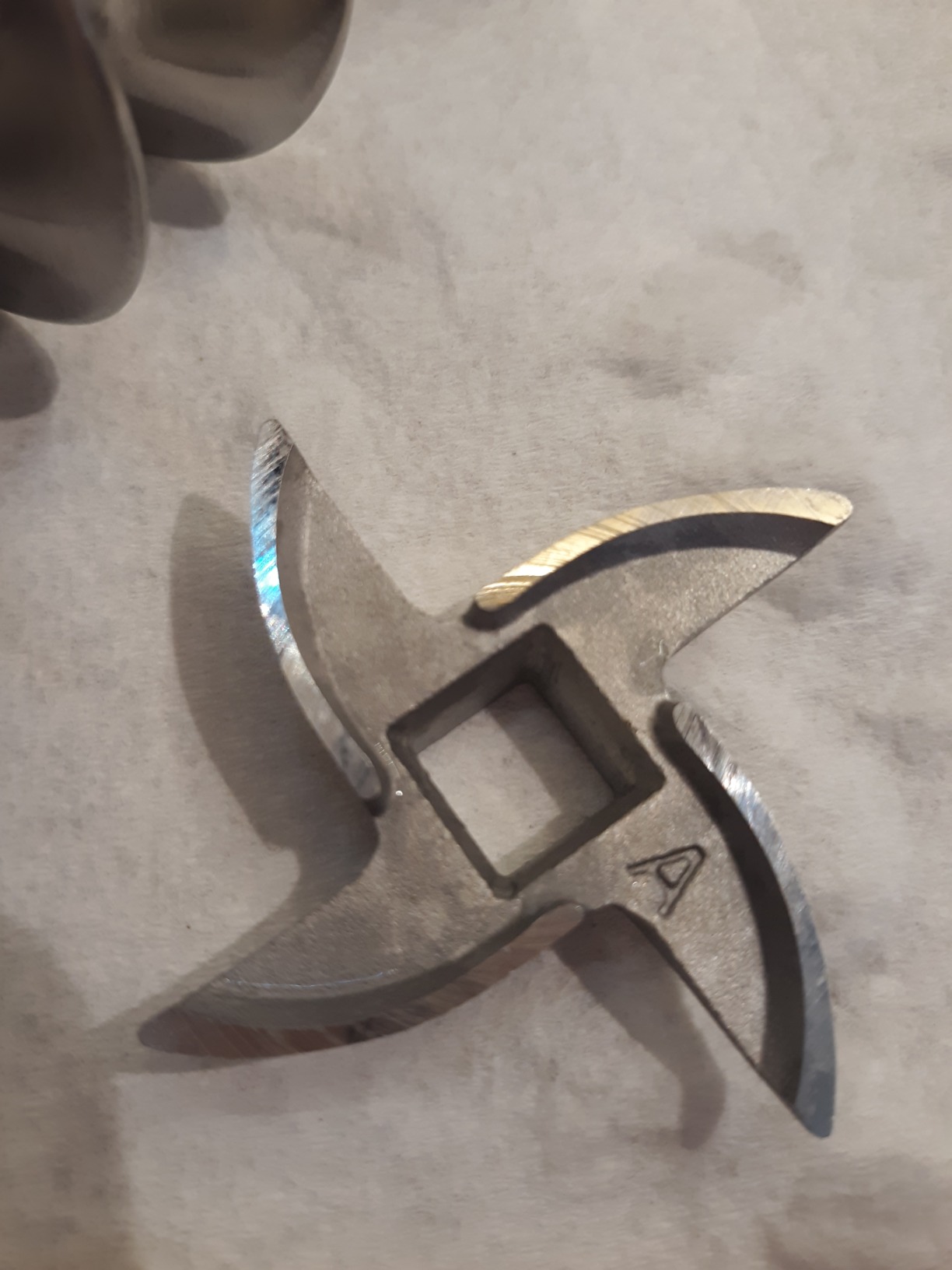
Is a manual grinder viable for home butchering?
Only for a small part of your job. Manual is genuinely fine for the trim, the tail meat, the odd batch of breakfast sausage, and a kitchen that does not have a whole-animal day. This is the honest split: the electric grinders on this list earn their keep on the bulk, the manual earns its keep on everything around the bulk.
Running a whole deer through a hand crank is a multi-hour workout, and by the last ten pounds you will be making plate choices you would not otherwise make. The competitive verdict is clear and we agree with it: manual is a supplement to butchering, not a replacement for it.
The part that will decide it for you
The main bushing is nylon rather than bronze, and the bushing is the wear part. Bronze lasts decades; nylon eventually needs replacing, and this machine uses proprietary sizing, so plates, tubes, and knives for it are hard to source years from now.
That is a real long-term ownership problem for a machine you might expect to keep twenty years. If you buy it, buy it for the quiet, the compactness, and the dishwasher, not for permanence.
7. VEVOR Manual Stainless Steel Grinder – Best Manual Starter Grinder
VEVOR Manual Stainless Steel Meat Grinder, 1.8″ Clamp, 2 Grinding Plates, Sausage Stuffer, Ideal for Home Kitchen Restaurant Butcher’s Shop
All food-grade stainless
1.8 inch clamp
3.35 inch feed inlet
6 pounds
Pros
- All-stainless construction resists rust and corrosion
- Strong clamp fixation with rubber pads
- Easy to install
- disassemble
- and clean
- Enlarged feed inlet reduces refills
- Works as both mincer and sausage stuffer
- Spare shaft sleeve and cleaning brush included
Cons
- Manual effort limits large batches
- Only two plate sizes included at 4.5mm and 8mm
The VEVOR is the manual option that is easier to live with than the Huanyu if the grinder is going to live on a counter rather than get carried out. At 6 pounds with a 1.8 inch table clamp and an enlarged 3.35 inch feed inlet, it is straightforward to set up and it stays put once clamped.
All parts are food-grade stainless steel, which is what you want on a machine that will be washed repeatedly with hot soapy water and occasionally sanitized.
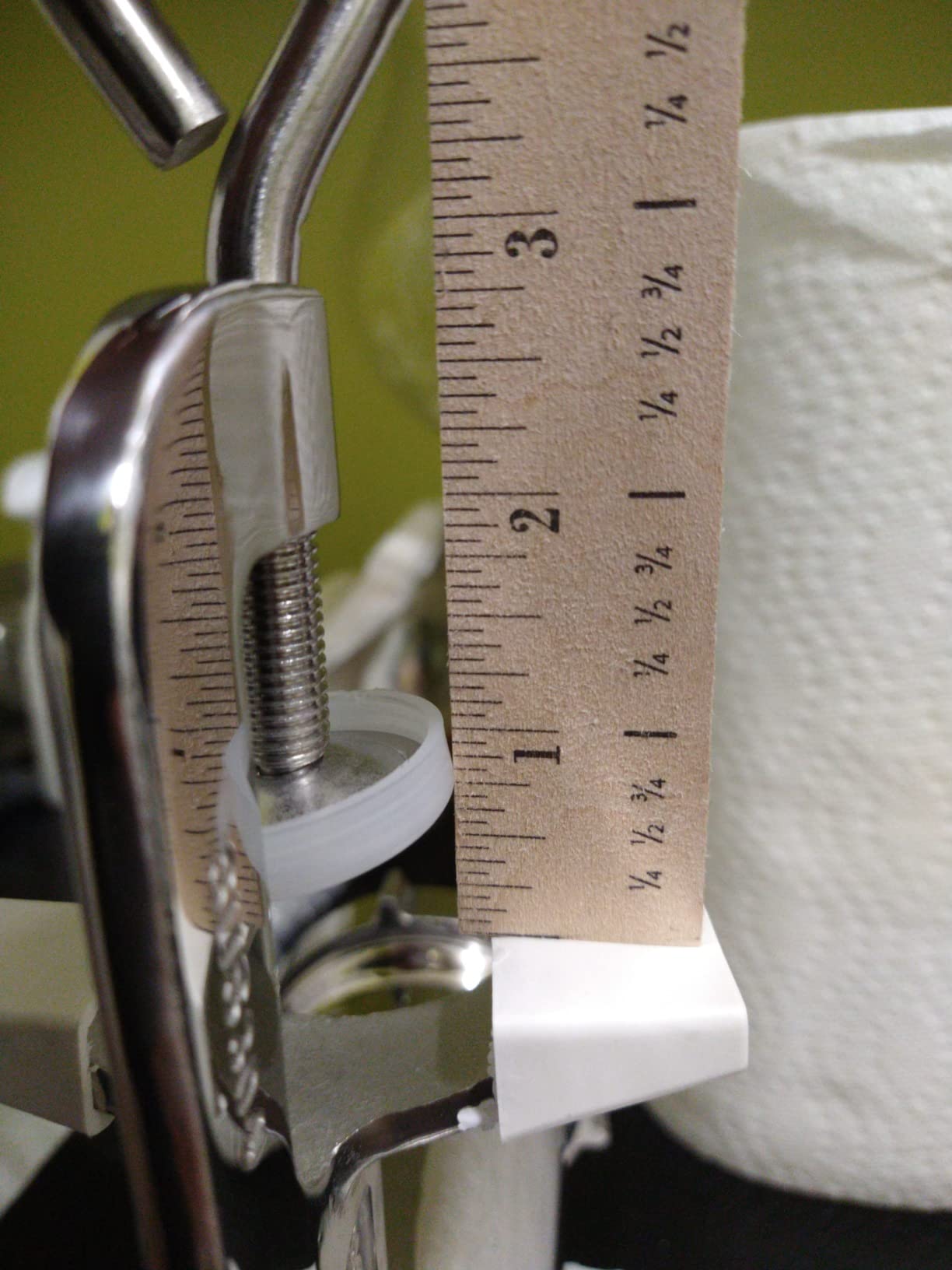
Owners highlight the rubber pads on the clamp, which cut vibration and noise during cranking. The ergonomic long handle and the wide inlet together reduce how often you have to stop and load, which is where manual grinding usually falls apart.
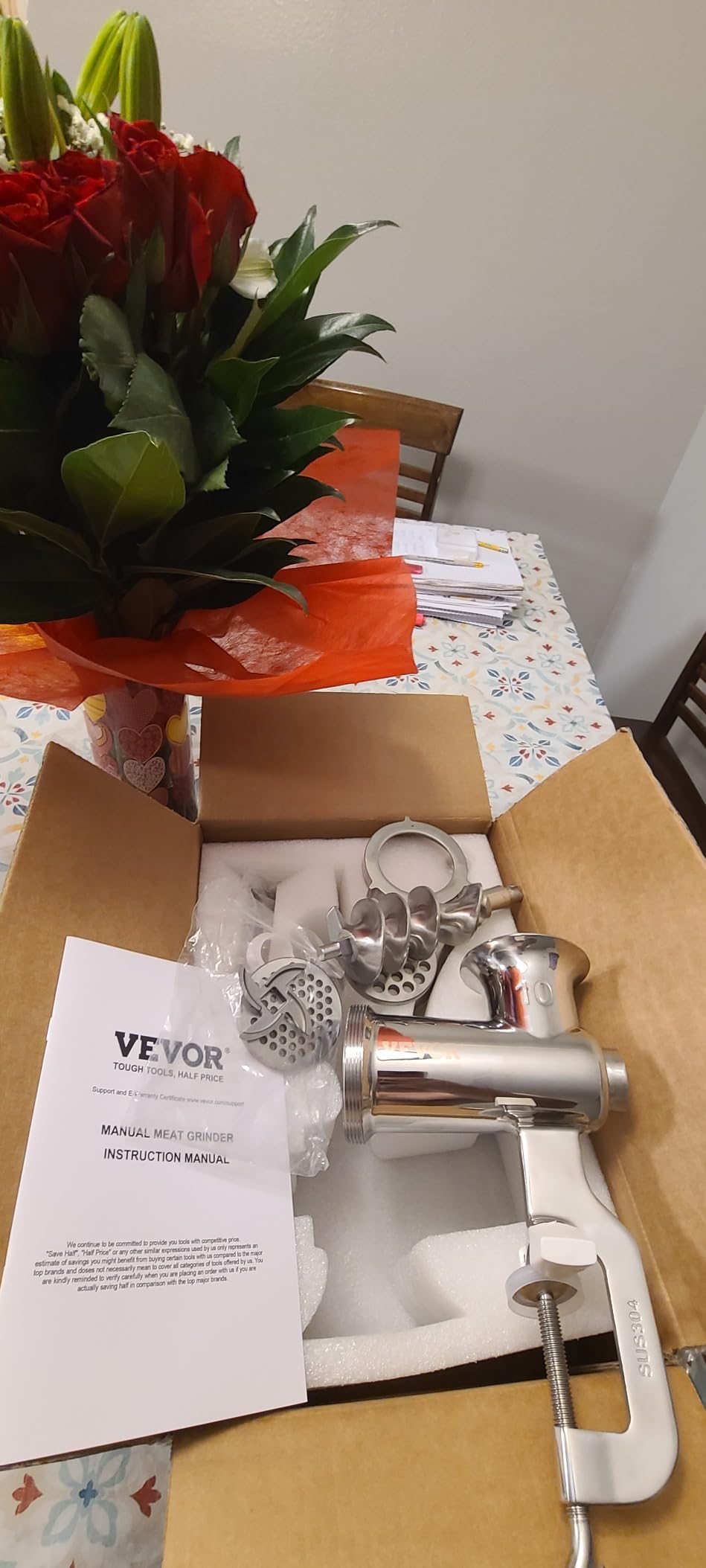
It includes 4.5mm and 8mm plates, a stainless sausage tube, a meat pusher, a spare shaft sleeve, a cleaning brush, and non-slip pads. The spare shaft sleeve is a thoughtful inclusion because the sleeve is a common failure point on manual units.
What two plate sizes gets you
4.5mm and 8mm is enough to cover coarse burger and breakfast links, and enough to run a coarse pass then a finer second pass on sausage. It is not enough to make a fine chili grind or a smooth bologna without buying plates separately, and the accessory set is the reason this lands below the Huanyu for the same manual niche.
Start with the 8mm for deer and pork, then run the 4.5mm second for anything going into a link. Skipping the second pass is the most common way people get a coarse, dry sausage out of an otherwise fine grind.
Where this one falls short
Two plate sizes is the practical ceiling here. If you plan to make a lot of fine-textured product, buy a plate set, because hunting down single plates for a machine with this little standardization is the same problem the Huanyu has and worse.
The physical effort limit is the same as any manual grinder, and 490 reviews is a thinner evidence base than the top picks. For a first home butchery setup that mainly needs a trim grinder alongside a future electric, it is a sensible spend.
8. Weston #12 Electric Meat Grinder – Best Compact #12 with Reverse
Weston #12 Electric Meat Grinder & Sausage Stuffer
750 watt, 1 HP motor
4 to 5 lbs per minute
Two speeds plus reverse
13.5 pounds
Pros
- 4 to 5 pounds per minute of throughput
- Two speeds suit grinding and stuffing
- Reverse function helps clear jams
- Die-cast aluminium body with metal gears
- Cam action headlock detaches fast
- Handles bison
- venison
- beef
- and poultry
Cons
- Lower wattage than many competing #12 grinders
- Only two plates included
- Sausage accessories limited to a funnel and spacer
- One-year warranty
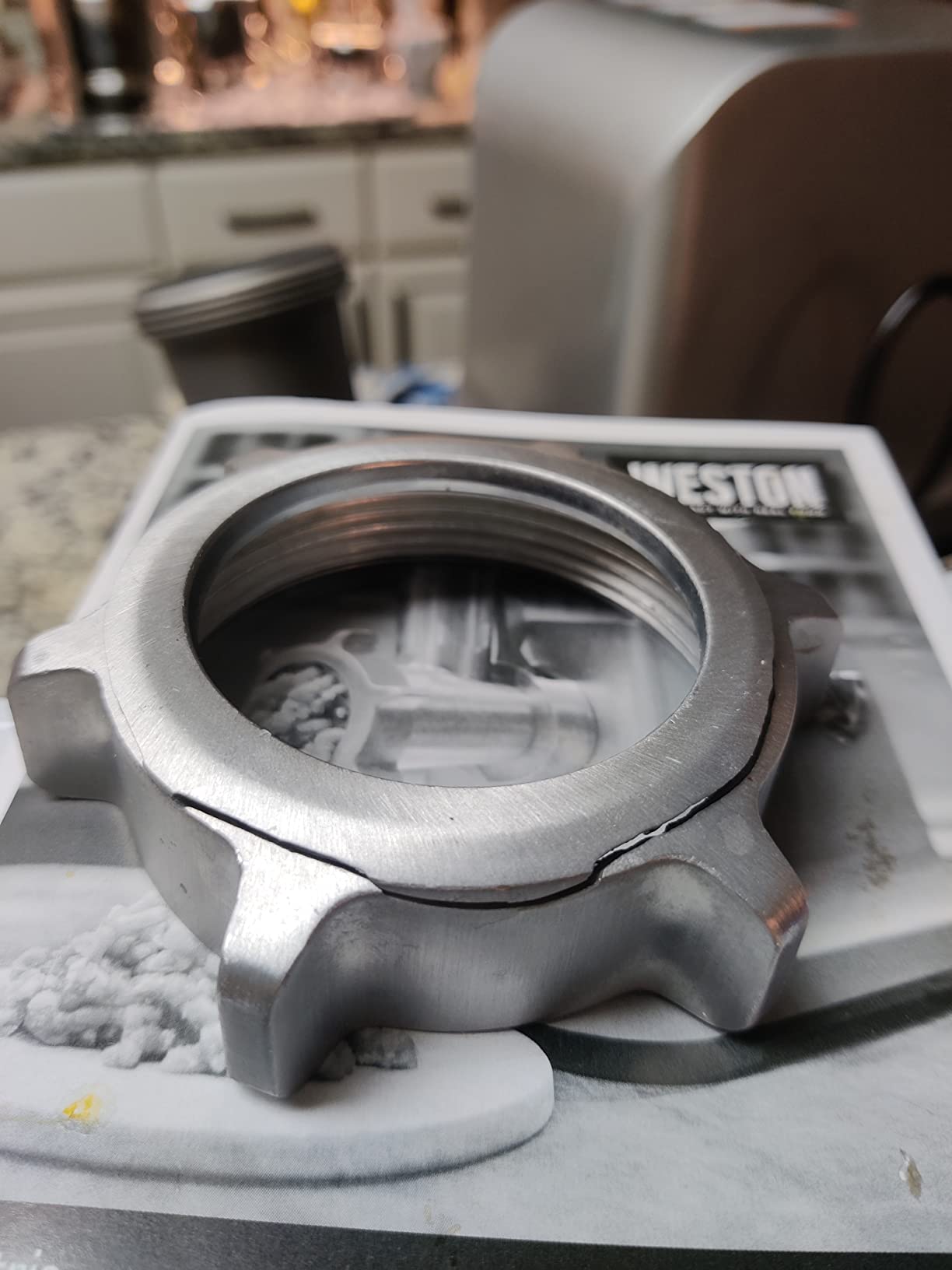
The Weston is the tidiest #12 head we tested, at 13.5 pounds and 15 by 10 by 10 inches. That footprint matters in a kitchen where a 32 pound stainless tower is not going to fit, and the cam action headlock means the grinding head detaches in a couple of seconds rather than requiring a disassembly.
Throughput of 4 to 5 pounds per minute is real, verified throughput rather than a marketing peak, and two speeds plus reverse is the right feature set for venison.
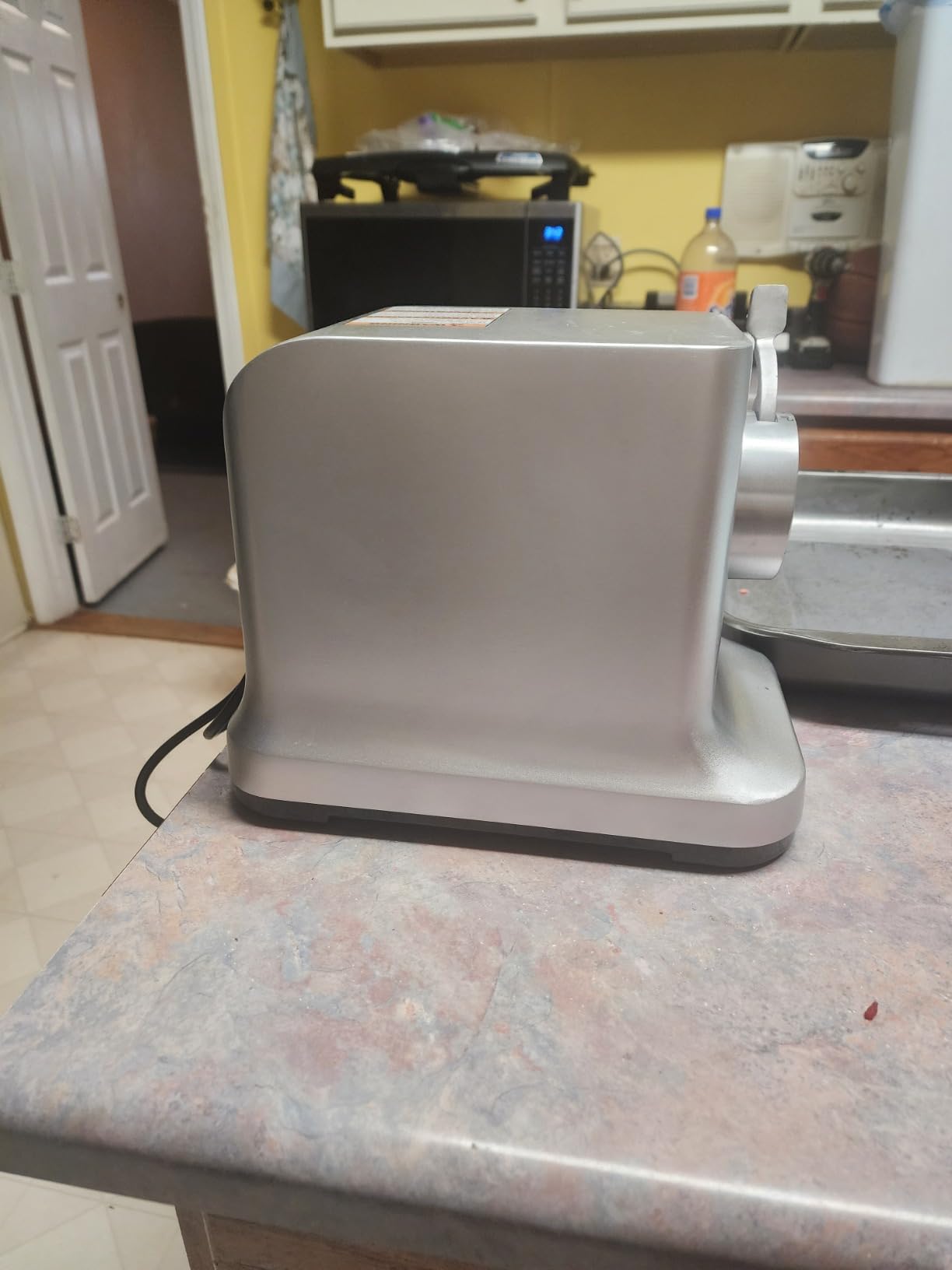
Owners cite the die-cast aluminium body with metal gears as feeling durable, and report it handling bison and venison alongside the usual beef, chicken, and turkey. Metal gears in the drive are the deciding detail for anyone who has watched a plastic gear strip.
The reverse function is a genuine help rather than a checkbox feature, and paired with the two-speed control you can back off a membrane and drop to a slower speed for the pass that follows.
What a one-year warranty tells you about the intended workload
Be honest about what this means. A one-year manufacturer warranty on a 750 watt motor signals a consumer-grade duty cycle, and that is fine for a household grinding maybe 50 pounds a month. It is a thinner commitment than the five years on the LEM BigBite, and it should factor into the decision if you are planning a fifteen-year ownership horizon.
The wattage is also lower than most competing #12 grinders, which is the trade-off for the compact body. If your sessions are large, you will feel that gap more than the footprint saving.
The accessory list is where it is thin
You get two plates, medium and coarse, plus a stuffing funnel and spacer. That is enough for burger and basic breakfast links and nothing more. The stuffing funnel and spacer cover brats, kielbasa, and similar small links, but there are no additional tubes in the box.
Buy the plate set and a proper stuffer separately if sausage is a priority. We compared stuffer-equipped options in our electric meat grinders for sausage making guide if that is the bigger half of your plan.
9. FOHERE 3000W Max 5-in-1 – Best All-in-One Kit for the Price
FOHERE Meat Grinder 3000W Max, Heavy Duty 5-in-1 Electric Meat Mincer with Sausage Stuffer & Kubbe Kit, 3 Stainless Steel Grinding Plates for Home Kitchen & Deer Processing (Silver)
500W rated motor, 3000W max
Over 5 lbs per minute
ETL certified
Auto-reverse jam clearing
Pros
- One owner processed 20 lbs in about 15 minutes including a second pass
- Compact at about 12 pounds with a carry handle
- Suction cups keep it stable
- Two speeds with auto-reverse
- ETL certified with overload and circuit protection
- Unusually wide accessory set
Cons
- One owner reported gear failure after about 14 hours
- Bogged down and heated while grinding venison
- Parts destroyed by one dishwasher cycle
- Only 5 minutes recommended run time
- Low Best Sellers Rank
The FOHERE packs a wider accessory set than the other units here. Three grinding plates, three sausage tubes, a kubbe maker, a slicer attachment, a tomato juicer, and three vegetable blades come in the package, and the only unit here that is ETL certified, which matters if you are processing meat for other people rather than just yourself.
Rated throughput is over 5 pounds per minute, and one owner processed 20 pounds in about 15 minutes including a second pass. At about 12 pounds with a carry handle, it is portable between a garage and a kitchen table.
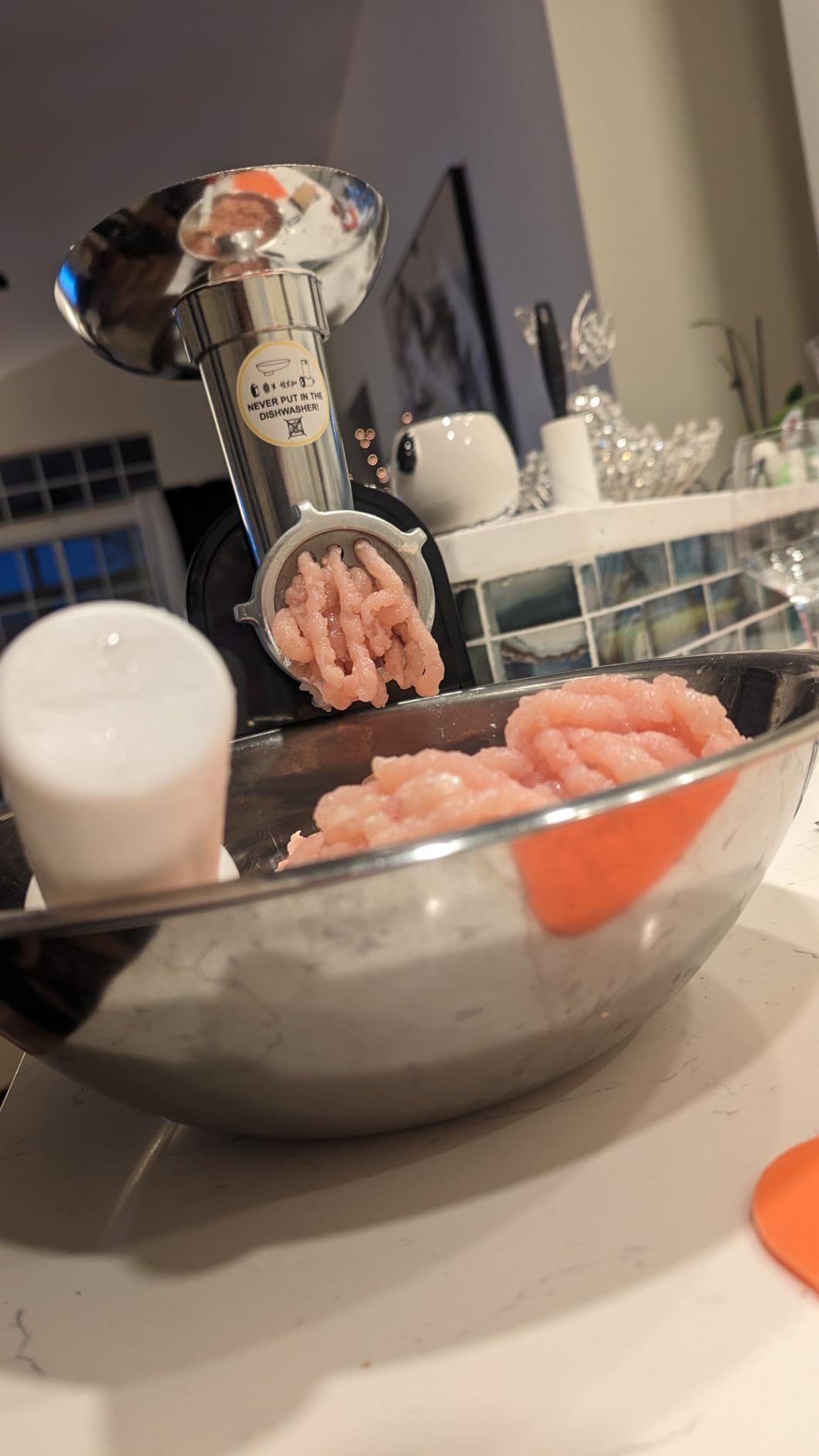
The two-speed control with auto-reverse clears jams without disassembly, and the 3-stage extrusion is designed to avoid tearing fibres and generating excess heat. Those two features are the right engineering priorities for a machine meant to see vegetables and meat in the same session.
Customer service replaced a broken unit and sent free replacement parts, which matters on a product with a thinner brand footprint than LEM or STX.
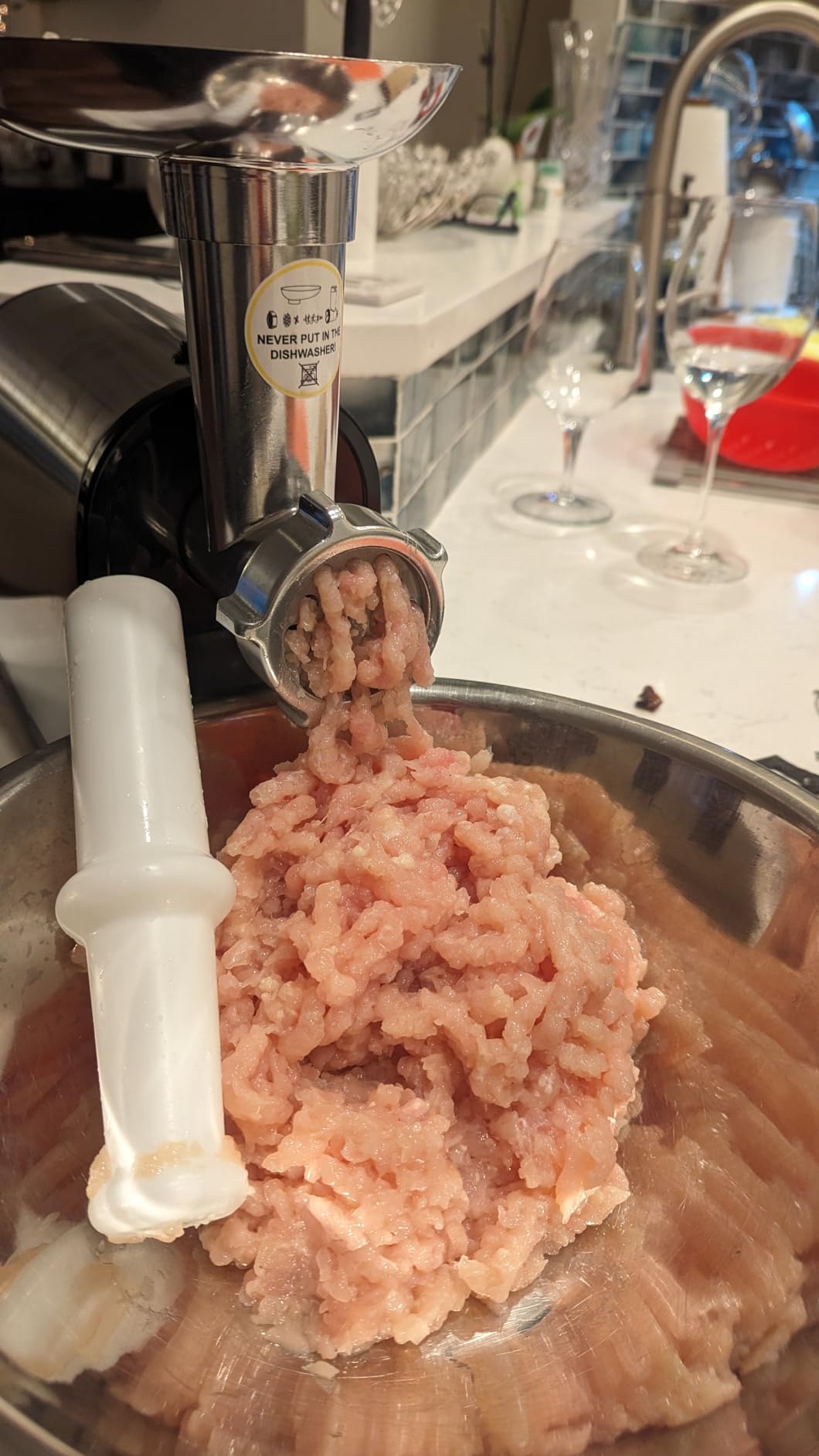
ETL certified is worth more than it sounds
ETL certification means an independent lab has tested the unit for electrical safety to North American standards. It does not certify food cleanliness, but it does mean the motor and control wiring have been checked by a third party rather than self-declared. For a machine plugged in next to a wet stainless table, that is a reasonable thing to want.
If you are processing meat you give to other people, check your local rules on home processing and sale before relying on any certification, because the electrical standard and the food handling rules are separate things.
Durability is the open question
One owner reported the motor-to-head gearing breaking after about 14 hours of use, and another reported it bogging down and heating quickly while grinding venison. The five-minute recommended run time points the same direction as the Aiheal: this is a batch grinder, not a session grinder.
Parts are not dishwasher safe and were destroyed by one cycle for a reviewer. With 366 reviews the evidence base is the thinnest here, so treat it as a capable short-session machine rather than a lifetime purchase.
10. RVGMBO 3500W Electric Meat Grinder – Best for Small Countertops
5.0 Upgrade Electric Meat Grinder,3 Second Grind,Meat Grinder for Home Use
3500W motor to 5000 RPM
304 stainless blades and plates
Dishwasher safe
About 6.9 pounds
Pros
- Compact enough to fit under kitchen cabinets
- Fast grinding with no jamming on 10 pounds of pork
- Assembles and cleans easily
- Quiet relative to others in this class
- Blades and plates are dishwasher safe
- One owner recouped the cost in two weeks
Cons
- Included plates have relatively large holes
- One reviewer reported meat sticking
- One reviewer reported a burning smell and spark on first use
- Aluminium parts and pusher need hand washing
- Only 1-year warranty
The RVGMBO is the pick when counter space, not power, is the binding constraint. Owners report it fits under kitchen cabinets, and it is quiet for its class. At about 6.9 pounds it is also the easiest machine here to move between a prep table and a stovetop.
Grinding speed is genuinely good for its size. One owner ran 10 pounds of pork through quickly with no jamming, and several use it for pet food and bulk pork.
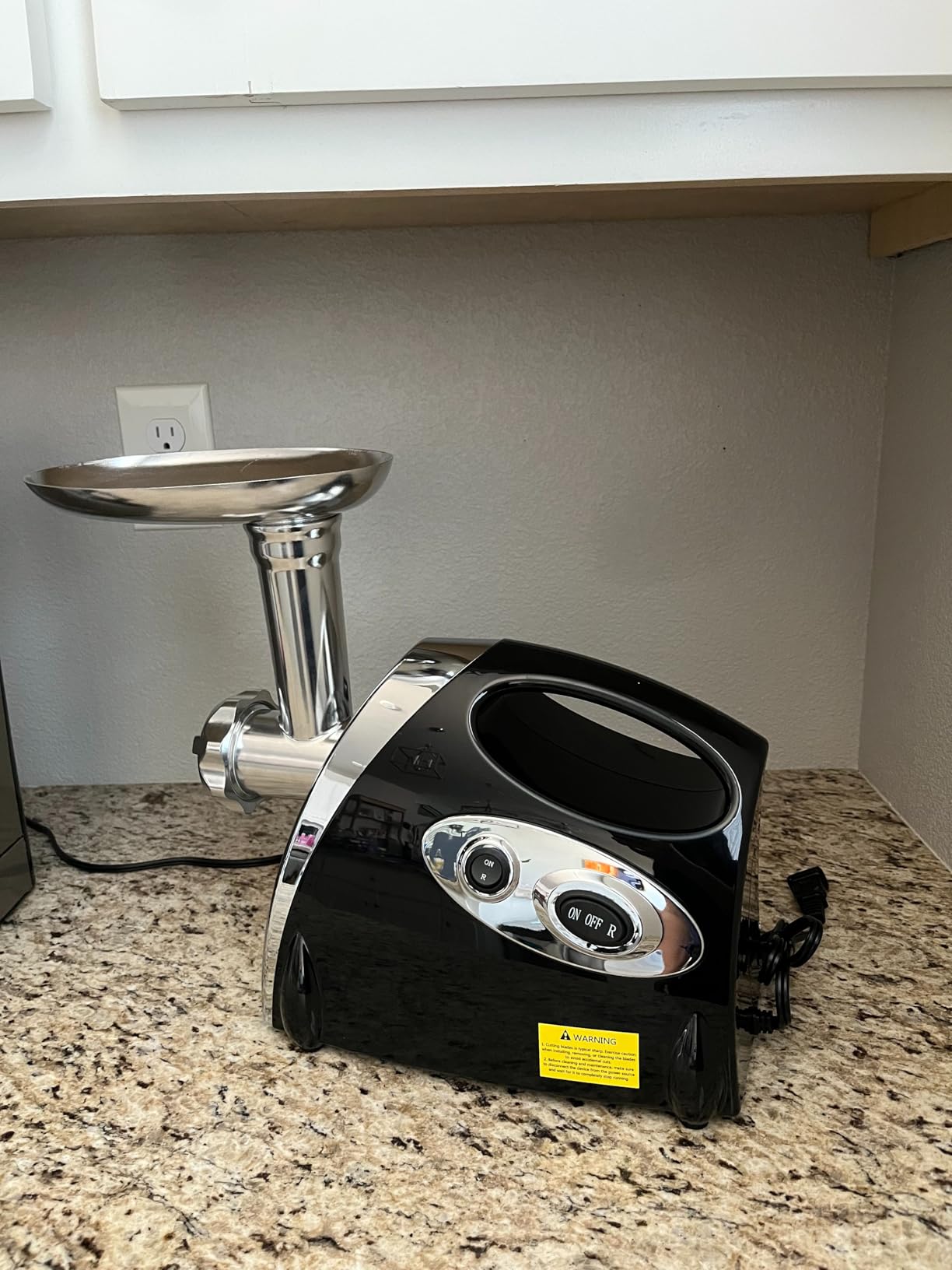
The 304 stainless steel blades and plates are dishwasher safe, which is uncommon in this class and convenient for the end-of-session clean. The 3500W pure copper motor reaches up to 5000 RPM, and the three plate sizes plus three blades cover grinding, sausage stuffing, and kubbe work.
It supports grinding, sausage stuffing, kubbe, and vegetable cutting, so it functions as a small multi-function unit rather than a single-purpose grinder.
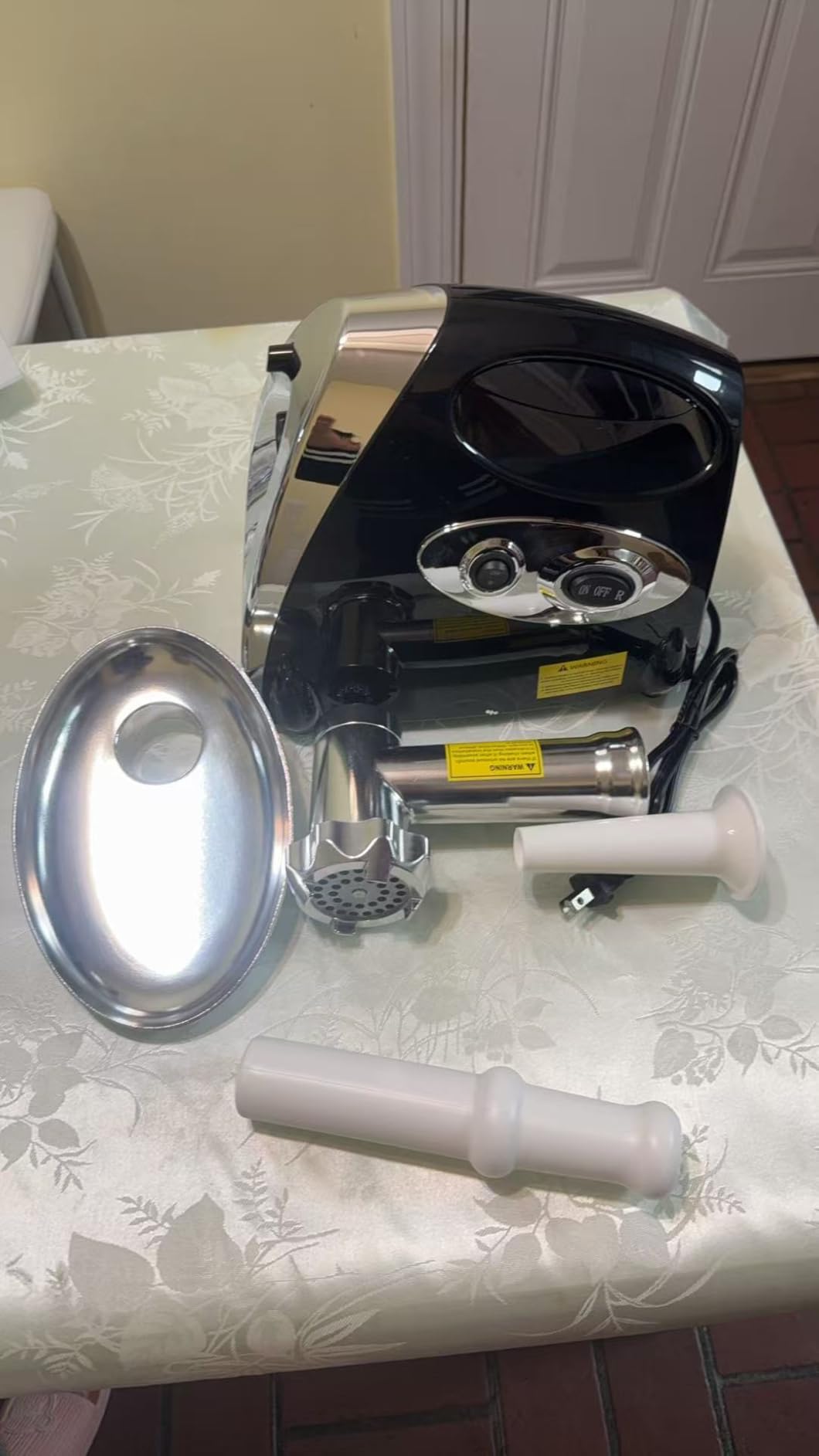
The plate hole size is the thing to check first
The most common real complaint is that the included plates have relatively large holes, so if you want a fine grind you need to source smaller plates separately. Measure before you buy and decide whether that is acceptable, because buying a machine and then a plate set changes the economics.
Isolated reports also include meat sticking and difficulty processing, and one reviewer reported a burning smell and an electrical spark on first use. Those are single reports rather than a pattern, but with a one-year warranty and a smaller brand footprint, check the unit before your first long session.
Where it fits and where it does not
It fits a household that grinds pet food, bulk pork, or a modest amount of burger and wants a small footprint and a dishwasher-safe plate set. Owners also point out the cost of ground meat versus store-bought, which one owner recouped in about two weeks of use.
It is not the machine for a whole deer. The aluminium parts and the food pusher need hand washing despite the stainless blades, and 247 reviews is the smallest evidence base on this list, so you are buying on spec sheet rather than on history.
What Grinder Plate Size Do I Need? #5 vs #8 vs #12 vs #22
Short answer: for home butchering, start with a #8 plate for coarse burger and a #12 head or #12 plate for a second sausage pass. The plate number is the hole diameter in eighths of an inch, so #8 is roughly 1/8 inch holes, #12 is about 3/16 inch, and #22 is fine sausage or bologna texture.
What actually matters is that you have a range, not that you have one number. Every grinder on this list except the VEVOR ships with two or more plates, and the reason is that one plate cannot do both the coarse structural grind and the fine emulsified grind.
A #5 plate is fine enough for a first pass on very lean deer without tearing it, but it clogs fast on anything with sinew. A #8 is the workhorse coarse grind for burger and is what most hunters reach for first. A #12 makes a noticeably finer, denser grind and is the right plate for a second pass when making summer sausage or bratwurst. A #22 is for emulsified products like bologna and hot dogs, and pushing meat through it on a home machine requires a second pass and patience.
The number does not tell you the machine size, which is a common misunderstanding. Plate number and head size are separate: the STX Turboforce II 4000 has a Size No. 12 head, meaning a wider and larger-diameter grinding head than a #8 machine, which is what lets it take soft bones.
If you are unsure, buy extra plates. They are consumables, they dull over time, and having a #8 and a #12 on hand is the difference between finishing a batch tonight and stopping to find a compatible part.
How Much Horsepower Do You Actually Need?
The useful framing is pounds of meat per session, not watts on the box. Wattage to horsepower conversion is misleading because manufacturers report locked power, the momentary peak a motor can draw while stalling, not sustained working output.
For an occasional weekend grind of 20 to 50 pounds, a 300W to 750W motor is enough. You will be doing a few short runs with rests. For a seasonal deer kill of 60 to 120 pounds, you want 1 HP or better, which is the class the Weston sits in.
For a whole hog or multiple deer, or any processing day over 150 pounds, target 1 HP to 1.5 HP of real working torque with a metal gearbox. The LEM BigBite is the clearest example of that class on this list.
Grinders that claim 3000W to 3500W are typically running on a 300W to 500W motor. Both Aiheal and FOHERE are rated in that range despite the headline wattage, and both have owners describing five-minute run time limits. Read the rated wattage, not the max number.
One last variable: a wide throat lets you feed bigger pieces, which cuts your pre-cutting time. A narrow throat is not fatal, but it means more knife work at the table and more time standing still, which is usually what people actually complain about on processing day.
How to Grind Venison and Wild Game Without Clogging
Cold meat is the single most useful tip in home butchering, and it is the one people most often skip. Partially frozen meat shaves instead of tearing, which means the blade cuts cleanly, the plate holes do not bridge, and the auger grips rather than slipping.
Our working routine: chill the trimmed meat for 30 minutes before grinding, cut it into strips that fit the throat, and run a coarse plate first. The coarse pass is structural and fast. Follow it with a finer plate at a lower speed for anything going into links.
Chunk size should match the throat, not the plate. If you are cutting pieces much larger than the feed opening, the grinder works harder for no reason and heat builds faster. Take the extra five minutes at the cutting table and the grinder will run cooler and faster.
When something does catch, hit reverse immediately. Backing the auger off for two or three seconds and then running forward again resolves most membranes. If the machine bogs and the motor pitch drops, stop feeding meat for a few seconds and let the auger clear rather than pushing more in.
Save your tenderloins, backstraps, and any silverskin-heavy cuts for a separate run or cut them thinner than everything else. Cutting the hardest connective tissue in a batch is what stalls most grinders, and separating it is cheaper than fighting it.
Cleaning and Food Safety for a Home Butchery Setup
Raw game meat carries pathogens that do not care how careful you were on the hill. A grinder is a machine that pushes meat through a small opening with a blade, which means tissue gets into seams, and a seam that is never fully dried or washed is where bacteria establish themselves.
Take everything apart after every session. Not a wipe-down, a full disassembly: head, auger, plate, blade, pan, and tube. If a machine will not come apart easily enough to do that, it is the wrong machine for regular game processing, and that is a legitimate reason to reject an otherwise good grinder.
Which parts can go in a dishwasher varies by product. The AAOBOSI blades and plates and the RVGMBO 304 stainless blades and plates are dishwasher safe. The STX 3000 aluminium parts and the FOHERE parts are not, and reviewers report discolouration and damage from washing them. Hand wash aluminium and sanitize it, and do not put it in the dishwasher to save thirty seconds.
Air dry parts completely before reassembly. A grinder reassembled with trapped moisture in the throat is a warm, damp, protein-rich environment, which is the opposite of what you want between a deer season and the next one.
If you process meat for anyone other than your own household, check your local regulations before selling or gifting. Electrical certification and food handling rules are separate requirements, and neither one substitutes for the other.
Should You Buy a Used Commercial Grinder Instead?
There is a path that no editorial roundup in this category covers, and it comes straight from hunting forums: buy a used commercial grinder from a restaurant auction or a closing kitchen. Hobart is the name that comes up most often in those threads, along with Avantco.
Owners report Hobart units bought second hand from a closing airport restaurant, described as a beast, that produced endless venison burger. The same community notes that used commercial grinders now command serious money even second hand, but still work and still last.
What you gain is a gear-driven commercial head that a household plastic-gear machine cannot match, often at a fraction of new cost. What you give up is warranty, certification, and any guarantee that replacement plates and gaskets will be easy to source.
The decision rule is simple. Buy new if you need a warranty, a known parts supply, and a machine that works the day it arrives. Buy used commercial if you are confident the head is mechanically sound, you can verify the plate and knife sizes are standard, and you will service it yourself.
Whatever route you take, plan for parts. Replacement blades, plates, and gaskets are the realistic failure point on any grinder, and a machine you cannot service in five years is not the buy-once machine most people are hoping for.
Frequently Asked Questions
What is the best meat grinder machine for home use?
The LEM Products BigBite #8 is the best overall pick for home butchering. Its stainless steel build, roughly 7 pounds per minute of throughput, permanently lubricated motor, and five-year factory warranty make it the machine we would trust with a whole deer. If your sessions are much smaller, the STX Turboforce 3000 offers comparable capability with the deepest review history in the category.
Is a #8 or #12 meat grinder better?
Neither is better in general, they are different sizes for different jobs. A #8 is a plate with roughly 1/8 inch holes and suits coarse burger. A #12 is a larger grinding head that moves more meat per turn and is a better fit for a second finer pass when making sausage. For home butchering, a #12 head with a range of plates gives you the most flexibility, especially if you plan to grind soft bones or process whole poultry.
How much horsepower do I need to grind a whole deer?
For a single deer of roughly 60 to 120 pounds of ground product, one horsepower of real working torque is the practical target. That means a metal gear-driven machine rather than a plastic gearbox. For a whole hog or multiple animals, aim for 1 HP to 1.5 HP. Ignore the headline wattage number and read the rated wattage, since most 3000W and 3500W grinders run on 300W to 500W motors.
Do I need a reverse function for venison?
Yes, if you grind venison regularly. When a strip of silver skin wraps around the auger, reverse backs it off in seconds. Without it, a clog means unplugging, disassembling the head, removing the membrane, and reassembling, with cold greasy hands in the middle of a processing day. The AAOBOSI, Weston, Aiheal, and FOHERE all include reverse or auto-reverse.
Is a used commercial Hobart grinder worth buying?
Often yes. Owners on hunting forums report buying used Hobart units from closing restaurants for a fraction of new cost and running them for years of deer processing. You gain a gear-driven commercial head; you lose warranty coverage and any guarantee about parts availability. Buy new if you need a warranty and support, and buy used if you are comfortable verifying the head is sound and servicing it yourself.
Which Meat Grinder Should You Buy?
Buy the LEM Products BigBite #8 if you process a whole animal at a time or want one machine that lasts. It is the only pick here with a five-year warranty, a verified 7 pounds per minute, and a stainless path you can fully scrub after raw game.
Buy the STX Turboforce 3000 if you want the deepest proven history at a lower outlay, and you can hand wash aluminium parts. Owners report six to ten years on this one, and it passes gristle without clogging.
Buy the STX Turboforce II 4000 if soft bones are part of your process. Buy the AAOBOSI #12 if sinewy leg venison is your problem to solve and you can live with the noise. Buy the Weston #12 if counter space is the constraint and your sessions are moderate.
For manual units, the Huanyu wins on silent operation and build, the VEVOR wins on ease of setup. Neither replaces an electric machine for bulk work.
Whichever you choose, pre-freeze the meat, take the head apart completely after every session, and buy spare plates before you need them. That is the full method behind picking the best meat grinders for home butchering in 2026: the right machine saves you hours, and the right technique saves you the day. If you are also building out the rest of the process, start with our game processing knife sets for butchering elk and think about a vacuum tumbler once you have more product than you can eat fresh.