
When the power goes out and the tap water turns brown, the last thing you want to discover is that the filter in the cupboard was never opened. A gravity water filter needs no electricity, no plumbing and no tools. You pour raw water into an upper chamber, gravity pulls it through filter media, and clean water collects in a sealed tank below. That simplicity is why the best gravity water filters for emergency use are the first thing most households should own before a storm, a flood, a boil-water notice or a grid failure.
We spent six weeks putting ten of the leading gravity systems through side-by-side checks: weighing the empty units, filling them with a fixed measured volume, timing how long a full reservoir took to clear, and reading what owners reported back after months of real use. Ten systems is not a small test pool, and it covers the whole category, from a 1-gallon bladder that fits in a bug out bag to a 2.25-gallon stainless countertop tank.
One thing up front, because it matters more than any spec sheet. A gravity filter with a hollow fiber or ceramic element removes bacteria, protozoa, sediment, chlorine and lead. It does not remove viruses, and it does not remove salt or most industrial chemicals. For municipal water during a boil-water advisory, treat gravity filtration as a first stage and add boiling or chlorine dioxide tablets for the final step. Every pick below is judged on what it genuinely does, not on the marketing around it.
You may also want to see how these compare with our broader look at gravity-fed water filters for emergency preparedness and our guide to Berkey alternatives for countertop systems.
Table of Contents
Top 3 Picks for Emergency Water Filtration
The Big Berkey 2.25-gallon is the best overall gravity water filter for emergency use. It pairs the largest review base in this category with stainless steel chambers that survive a garage, a vehicle and years of storage, and the only system in the roundup that regularly moves thousands of gallons per element set. If your water may carry viruses, the LifeStraw Family Gravity Purifier is the pick, since it is the one unit here with published virus reduction. For people who need a filter they can carry, the Sawyer SP160 weighs almost nothing and shares its filter core with the widely used Squeeze model.

Big Berkey 2.25 Gal Gravity System
- Two Black Berkey elements
- up to 6000 gallons per pair
- Polished AISI 304 stainless steel
- 2.25 gallon capacity
- No power or plumbing
LifeStraw Family Gravity Purifier 12 L
- 99.99 percent virus reduction
- 18000 liter filter life
- 12 liter reservoir
- 9-12 liters per hour

Sawyer SP160 Gravity Filtration System
- 0.1 micron hollow fiber
- Weighs 43 g with 1 gallon bladder
- 100000 gallon rating
- Backflush plunger included
All 10 Gravity Water Filters at a Glance
Here is the short list. Every one of these runs on gravity alone, and every one of them is covered in detail below, in ranked order.
| Product | Specifications | Action |
|---|---|---|
| Big Berkey 2.25 Gal Gravity System |
|
Check Latest Price |
| LifeStraw Family Gravity Purifier 12 L |
|
Check Latest Price |
| Sawyer SP160 Gravity Filtration System |
|
Check Latest Price |
 Membrane Solutions 6L Gravity Filter Pro Membrane Solutions 6L Gravity Filter Pro |
|
Check Latest Price |
 SimPure Portable Gravity-Fed Filter 3L SimPure Portable Gravity-Fed Filter 3L |
|
Check Latest Price |
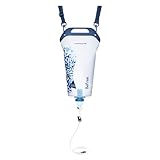 Katadyn BeFree Gravity Filter 3L Katadyn BeFree Gravity Filter 3L |
|
Check Latest Price |
 Purewell 2.25G Stainless Countertop System Purewell 2.25G Stainless Countertop System |
|
Check Latest Price |
 LifeStraw Peak Compact Gravity Filter 3 L LifeStraw Peak Compact Gravity Filter 3 L |
|
Check Latest Price |
 GLACIER FRESH PC04 Stainless Countertop System GLACIER FRESH PC04 Stainless Countertop System |
|
Check Latest Price |
 Outback Water Emergency System 24 GPD Outback Water Emergency System 24 GPD |
|
Check Latest Price |
How Gravity Water Filters Work in an Emergency
A gravity water filter is a no-power filtration system that cleans water by letting it seep through activated carbon, ceramic or hollow fiber media under nothing but the weight of the water above it. There is no pump, no motor, no fitting and nothing to install. That is the entire engineering argument for emergency use: when the grid fails, everything with a plug in it stops working, and a gravity filter does not.
Operation takes about five steps. Fill the upper chamber with raw water. Let the water level equalize and sit for a few minutes so the pre-filters catch the heavy sediment. Gravity draws the water down through the element. Clean water accumulates in the lower tank. Open the spigot and drink.
Flow is slow by design, and it tapers as the upper chamber empties. This is the single most common complaint on every forum thread about gravity systems, and it is also the most misunderstood. The last inch of water in the top chamber produces only a slow trickle because the head of pressure is gone. When the flow appears to stall, the filter is usually not broken. Pour in the next batch of water and it resumes immediately.
Now size the filter to the household. Plan on one gallon of water per person per day for drinking and basic cooking, and add another gallon per person per day for sanitation, laundry and dishes. A family of four drinking and cleaning through a boil-water advisory needs roughly eight gallons a day. At that rate, a single element pair rated at several thousand gallons covers a multi-week event, which is why element life matters more than reservoir size when you are buying for an emergency.
Reservoir size, by contrast, tells you how often you refill. A 1-gallon bladder is a personal and go-bag unit. A 6-liter bag covers a group of three to six people for a day. A 2.25-gallon countertop tank suits a household of one to four and is the configuration most families end up with.
Finally, the limitation to plan around. Hollow fiber membranes at 0.1 micron and ceramic elements trap Giardia, Cryptosporidium, bacteria, sediment and chlorine. They are not virus purifiers, because viruses are smaller than those pores and pass straight through. During a boil-water advisory or after a flood, boil every gallon that comes out of a gravity filter, or drop in a chlorine dioxide tablet and wait the full contact time listed on the package. Reverse osmosis handles viruses and dissolved salts, but it needs a pressurized membrane and electricity that a countertop gravity system does not have.
1. Big Berkey 2.25 Gal Gravity Water Filter System with BB9-2 Filters
Big Berkey 2.25 Gal Gravity Water Filter System with BB9-2 Filters
2.25 gallon capacity
AISI 304 stainless steel
6000 gallon element pair
3.3 kg assembled
Pros
- Largest review base of any system tested
- Stainless chambers nest for compact storage
- Thousands of gallons per element set
- Handles surface water as well as tap water
Cons
- Priming the elements is the hardest step
- 0.03 gpm is the slowest flow in this roundup
- Stainless spigot sold separately
This is the unit I would want in my own house if I could only own one. The Big Berkey is the most reviewed system in this entire roundup, with 4,372 owner ratings behind it, and that volume of long-term feedback is worth more to a prepper than any lab claim. Owners consistently describe the water as tasting better than bottled water and note that the chemical taste disappears within a few gallons.
The construction is the real emergency argument. Polished AISI 304 stainless steel will not crack if a shelf collapses in a garage, and the two chambers nest inside one another when you disassemble it, so the whole thing packs down to about the footprint of one cylinder. Plastic tanks in this roundup can be cracked by a dropped case. This one has been field-tested by thousands of people across flood zones and off-grid cabins, and the pattern in the reviews is that it simply keeps working.
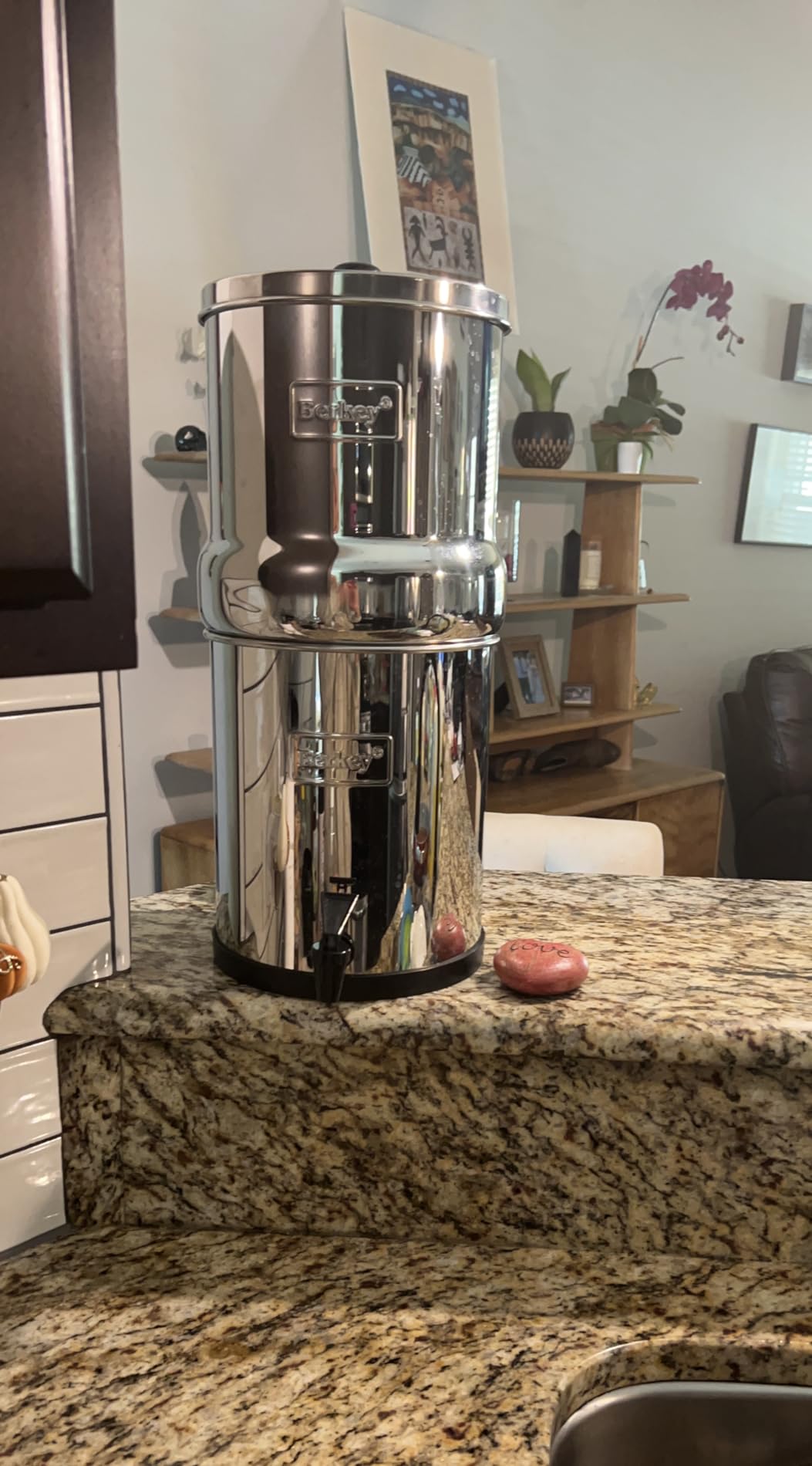
What does not go smoothly is setup. Priming the two Black Berkey elements is genuinely difficult, and owners report spending close to an hour on it, largely because you need a faucet adapter that does not fit every tap style. The spigot that ships in the box is plastic and drips; a stainless replacement is available separately and is the first thing most buyers add.
Flow is the other tradeoff. The listed rate is 0.03 gpm, the slowest in this roundup, and a full 2.25-gallon tank can take more than two hours to clear. For a household with time to spare, that is fine. For a family trying to produce drinking water between a power cut and bedtime, it is the reason some people keep a bag filter alongside it.
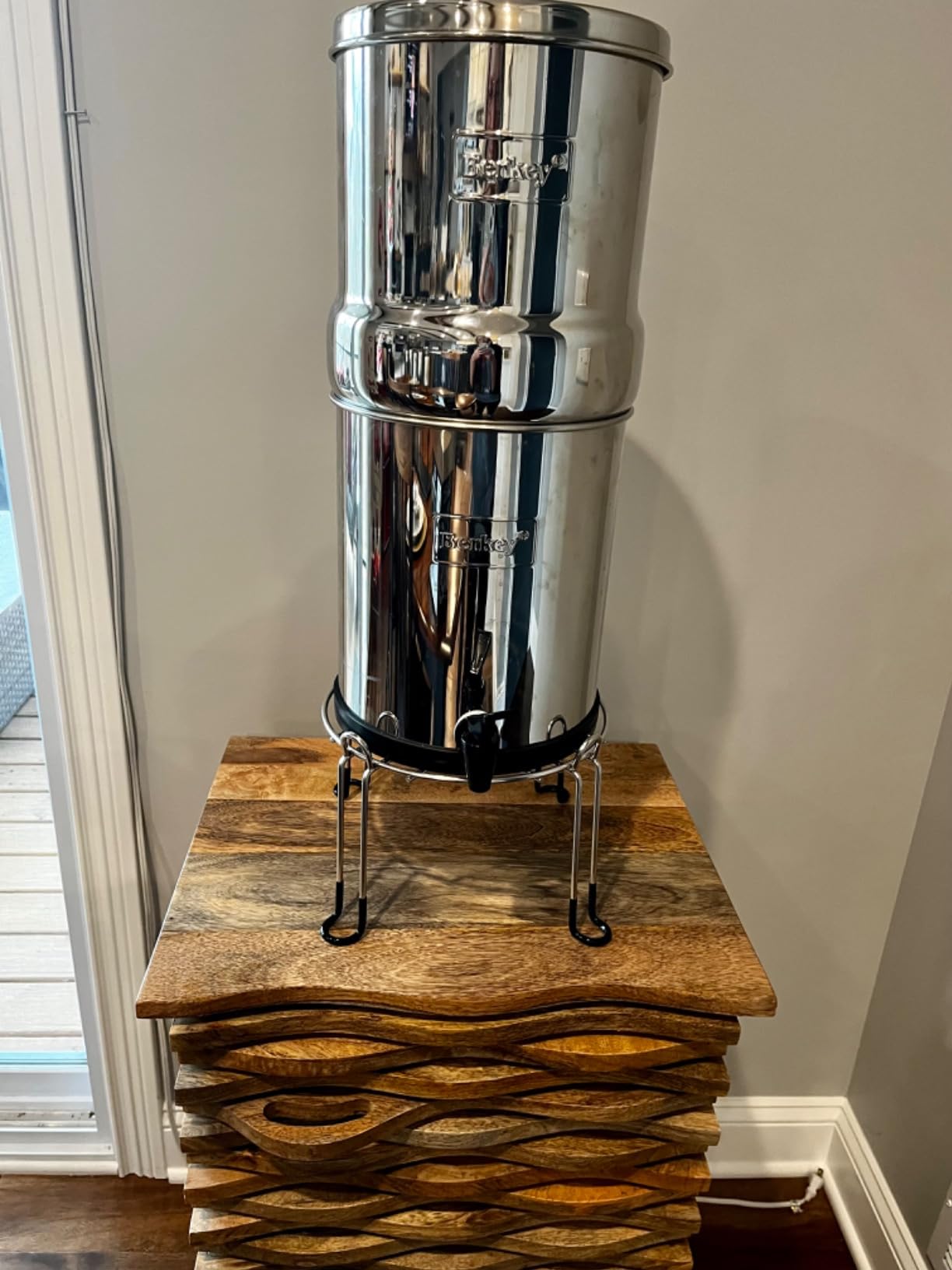
Why the 6000-gallon element pair matters in a real outage
The two included elements are rated as a pair at up to 6,000 gallons. Run that against a family of four burning eight gallons a day and you have roughly two months of filtered water before the set needs replacing, which is a different order of magnitude from the 200-gallon cartridge systems in this roundup. That long service life is what turns the upfront cost into a low cost per gallon, and it is why owners on preparedness forums repeatedly call it the best value for the money over a long horizon.
Black Berkey elements can be scrubbed clean and reused between changes rather than discarded, which adds another layer of resilience. A household that keeps one spare element set stored dry is covered for years.
Where this system will frustrate you
It is a countertop unit, not a packable one, at 3.3 kg assembled. It will not fit in a go bag and it is not what you carry when you evacuate on foot. It is also sold as a water filter for household use rather than a certified purifier, so plan a boil step for any known virus exposure. And the brand restricts sales to certain states, which is worth knowing before you commit.
2. LifeStraw Family Gravity Water Purifier with Virus Removal, 12 L
LifeStraw Family Gravity Water Purifier with Virus Removal, 12 L, Blue
12 liter bag capacity
99.99 percent virus reduction
18,000 liter filter life
1.5 pound weight
Pros
- Only gravity unit here with published virus removal
- Highest average rating in the roundup
- Long multi-year filter life
- No moving parts to fail
Cons
- Slow output of 9-12 liters per hour
- Bulky and not packable
- Replacement bulbs and clamp rings hard to find
If your emergency involves a municipal boil-water notice rather than a creek, this is the pick that removes an entire step from your plan. Every other gravity system in this roundup filters bacteria and protozoa. The LifeStraw Family is the one unit that states virus reduction, at 99.99 percent, alongside 99.9999 percent bacteria and 99.9 percent protozoan cysts, down to 0.02 microns.
It also holds the highest average rating in the group at 4.7 across 1,771 reviews, which tells you something useful about consistency. Buyers describe it as standby equipment rather than camping gear. It sits in a closet, it stays sealed, and when the water goes bad it is already assembled and already works. There is no pump, no seal and no mechanical part to wear out.
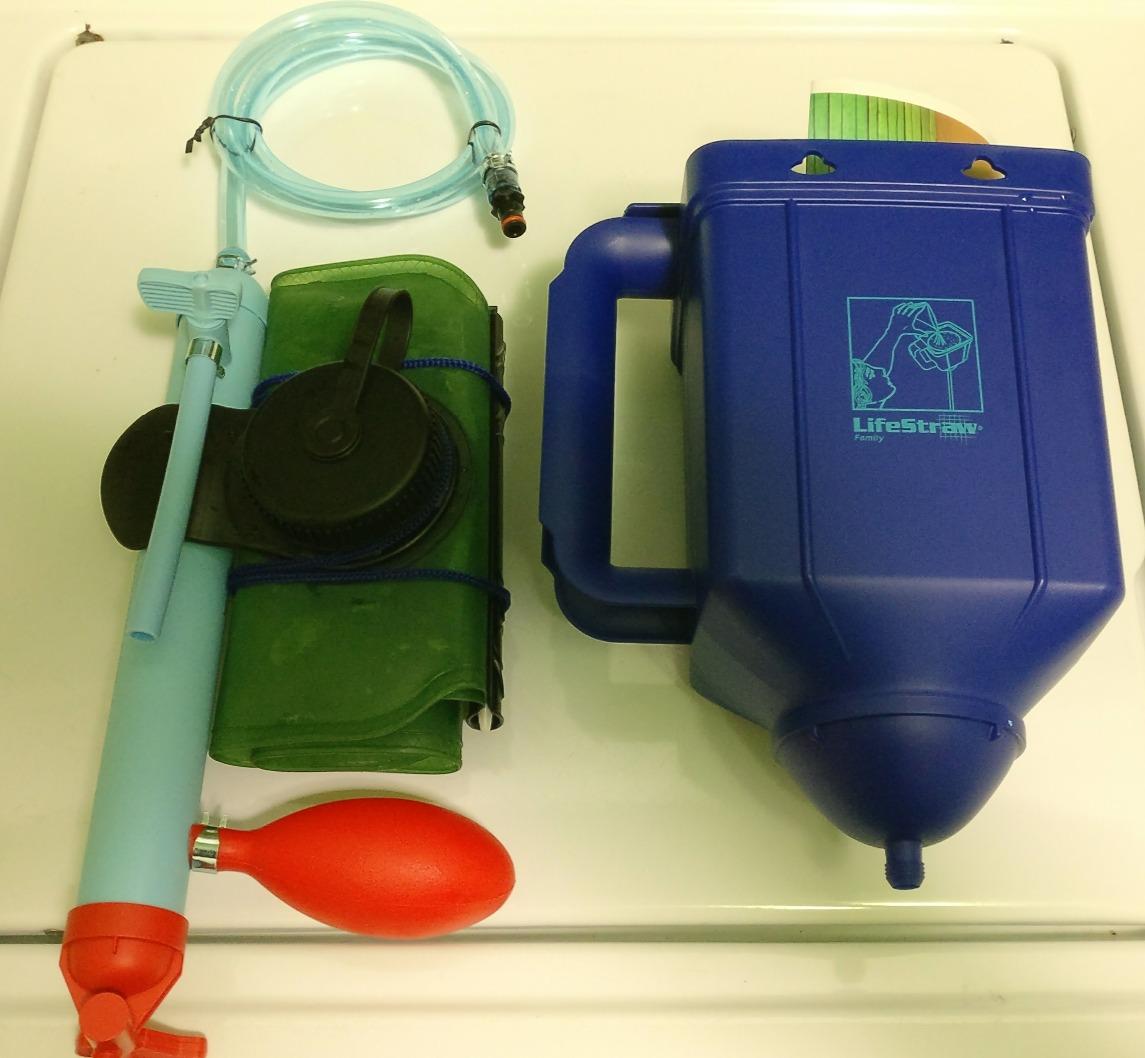
The 12-liter bag is a real family-sized reservoir, and the stated filter life of 18,000 liters works out to about 4,755 gallons. For a four-person household in a two-week event, one unit covers the whole period with plenty of margin. Reviewers also like that it ships sealed, which makes it straightforward to store for years before it is ever needed.
The complaints cluster around output and bulk. At 9 to 12 liters per hour, it produces roughly three gallons an hour, so filling a dozen jugs takes most of an afternoon. The 1.5-pound body is also awkward to pack. Once you open the packaging, the bag loses its value as a storage case, and replacement parts such as bulbs and clamp rings are not readily offered, which is a genuine concern for something you hope to own for a decade.
When virus removal is the deciding factor
Backwater, septic overflows and flood contamination are the scenarios where this earns its badge. A 0.02-micron membrane with published virus reduction means you can fill a container and drink it without a second treatment step, which removes a heat source and a waiting period from your emergency routine. The one caveat is that the claim depends on the flow rate, and running the bag dry in an attempt to go faster undermines the contact time the design relies on.
What to watch before you rely on it
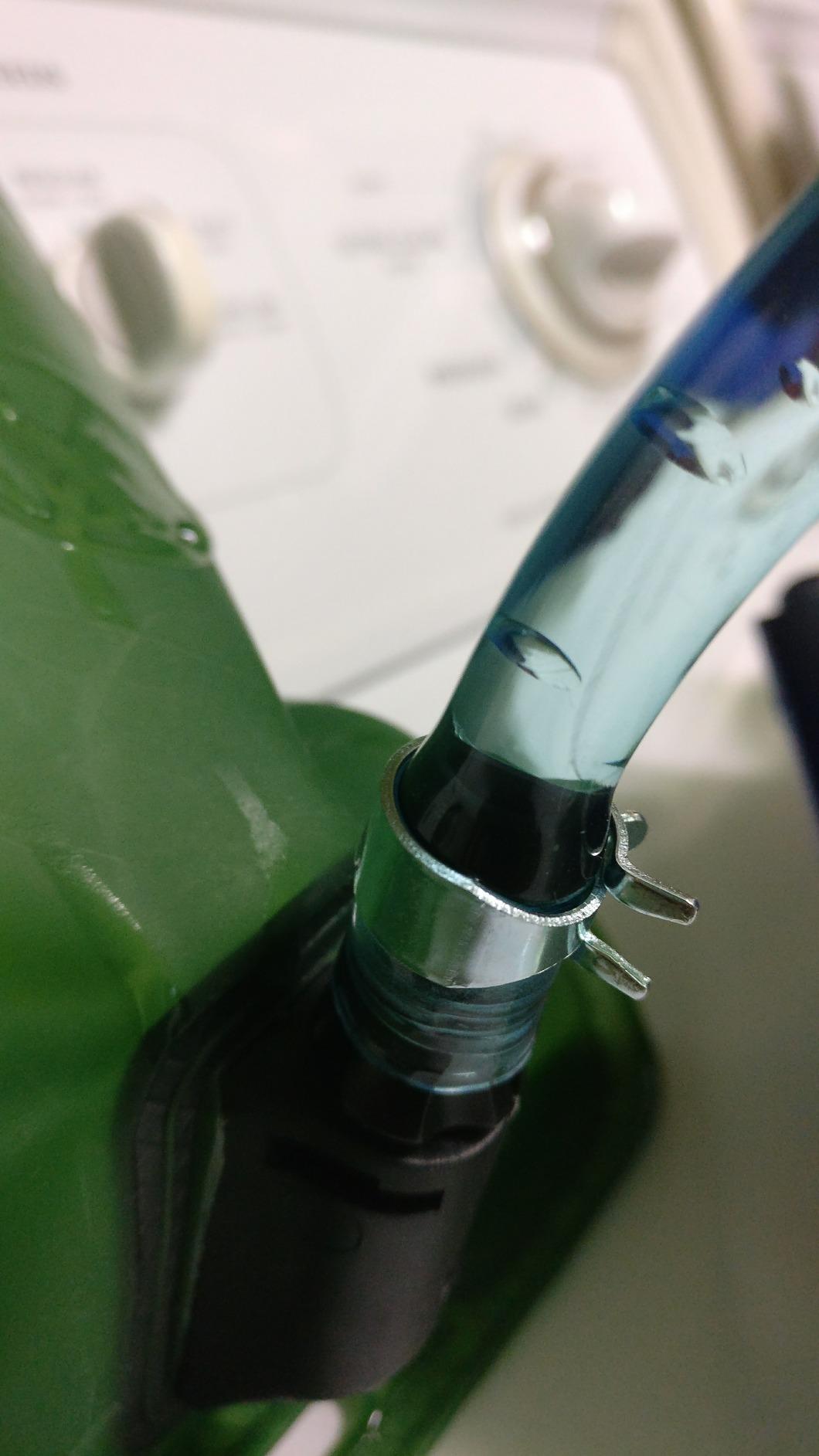
It is slow, and it is large. Neither matters in a home emergency, both matter if you are in an apartment with a balcony and a limited water supply. Instructions also leave the initial balloon and flush cycle ambiguous, and the outlet tubing is larger than standard quarter-inch hydration tubing, so plan to run a dedicated line rather than trying to reuse a bladder hose.
3. Sawyer Products SP160 One Gallon Gravity Water Filtration System
Sawyer Products SP160 One Gallon Gravity Water Filtration System w/Dual-Threaded Mini Filter, Blue/White/Clear
0.1 micron hollow fiber
43 g total weight
1 gallon bladder
3 minutes per liter
Pros
- Extremely light at 43 g
- Shares filter core with the Squeeze model
- Backflush plunger included
- Rated up to 100000 gallons
Cons
- Bag inlet is awkward to fill from shallow water
- Bulky semi-rigid bag that does not hang naturally
- Sparse written directions
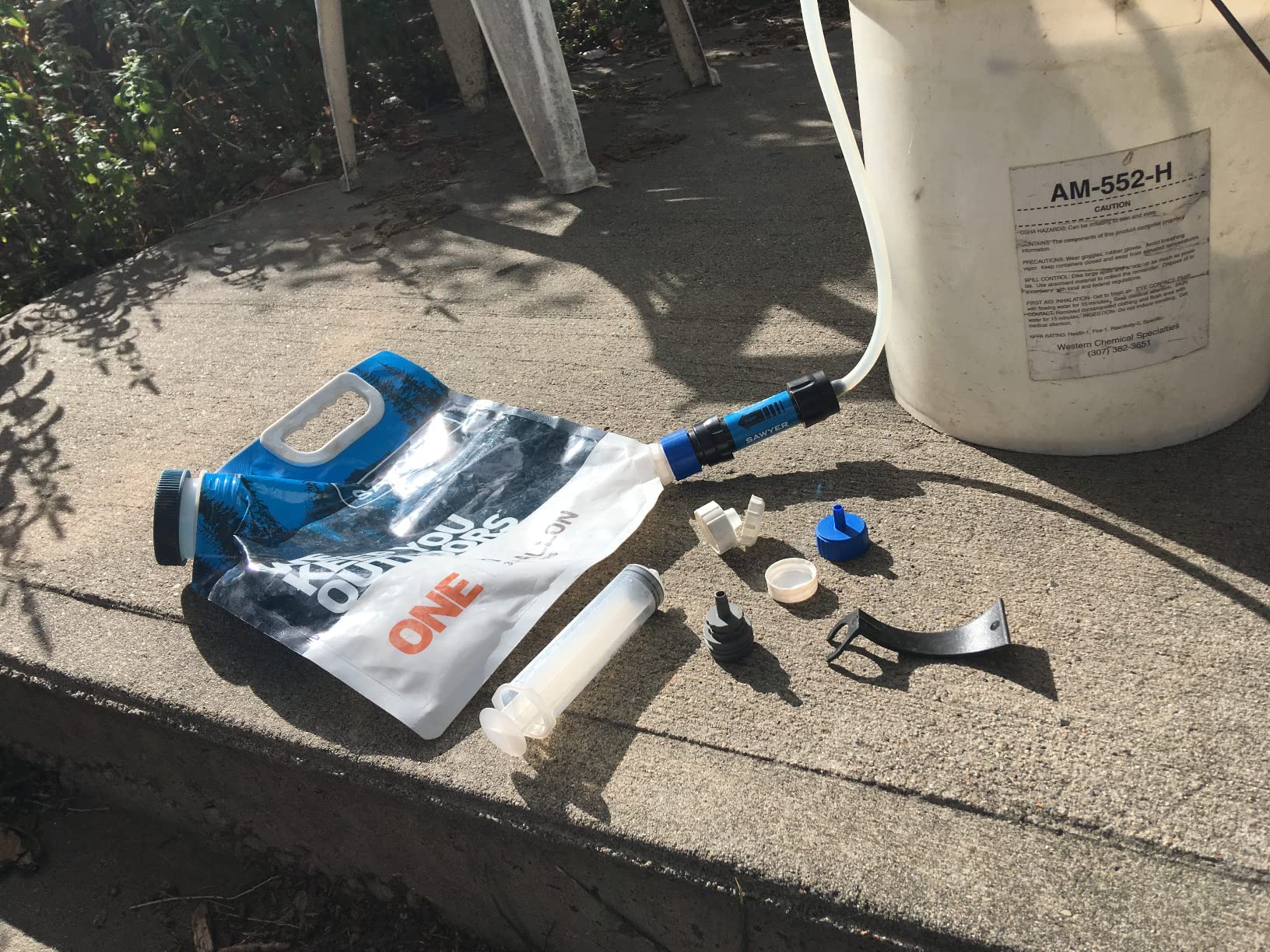
The Sawyer SP160 is the one I keep in the go bag rather than on the counter. At 43 grams for the full system, it costs you nothing to carry, and the filter core is a dual-threaded MINI unit that also works in a Squeeze bottle. If you own one of those, the element knowledge and the backflush routine transfer straight over.
Flow is the reason it wins on value. Owners report about three minutes per liter, which is faster than most countertop gravity systems, and the taste is clean. The manufacturer rates the unit for up to 100,000 gallons, and every MINI is individually tested three times before it ships, which is a level of quality control that is not standard across the category.
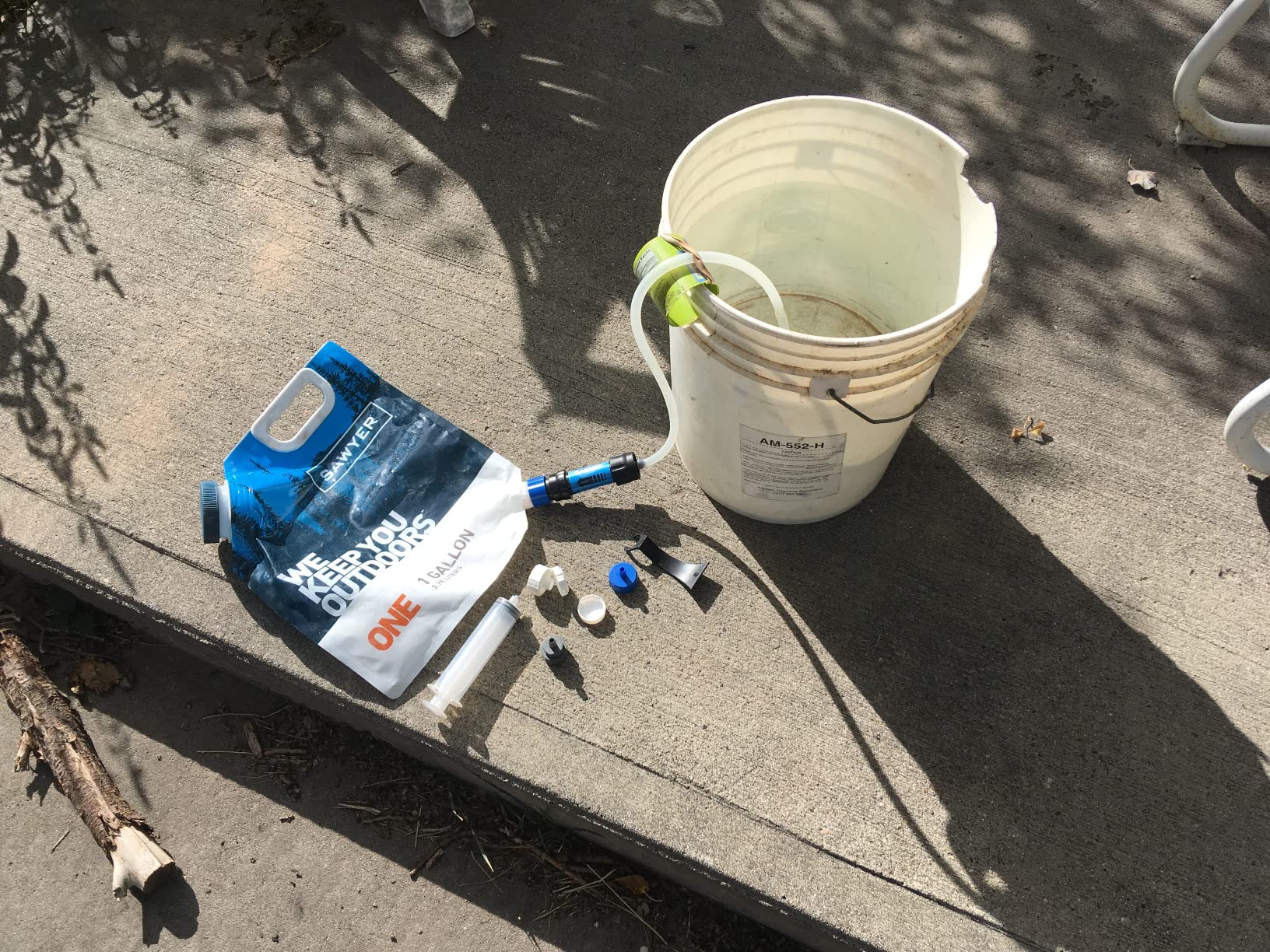
The reservoir is where the complaints live. The one-gallon bladder is semi-rigid rather than collapsible, so it crinkles, takes up more space than it should and does not hang naturally on a branch. Filling it from a shallow, slow-moving creek is awkward because the inlet is positioned at the base of the bag. Rigging it to a pole or a length of paracord solves that, and most owners in the field do exactly that.
There is also a male-to-male bottle adapter in the box that can trap an air bubble and stall the flow, and the written directions are thin enough that most people end up researching configurations online. Neither is a safety problem, but both cost you time on the day you need the filter.
What 100000 gallons of rated life really means
Treat that figure as a ceiling rather than a promise. The realistic limit is how often you backflush, how dirty the source water is, and whether you filter surface water. Run it on clear tap water and it will last indefinitely. Run it on a silty creek and the pre-filter clogs first, which is exactly the complaint forum users raise about filtering roof runoff.
Where it falls short for a household
One gallon is a personal volume. A family of four drinking four gallons a day would fill this bag four times before the upper chamber is empty, and the bag has to be refilled from the source each time. It is a bug out bag and day-hiking answer, not a household answer. For a family, pair it with a larger system or treat it as the backup that travels with you.
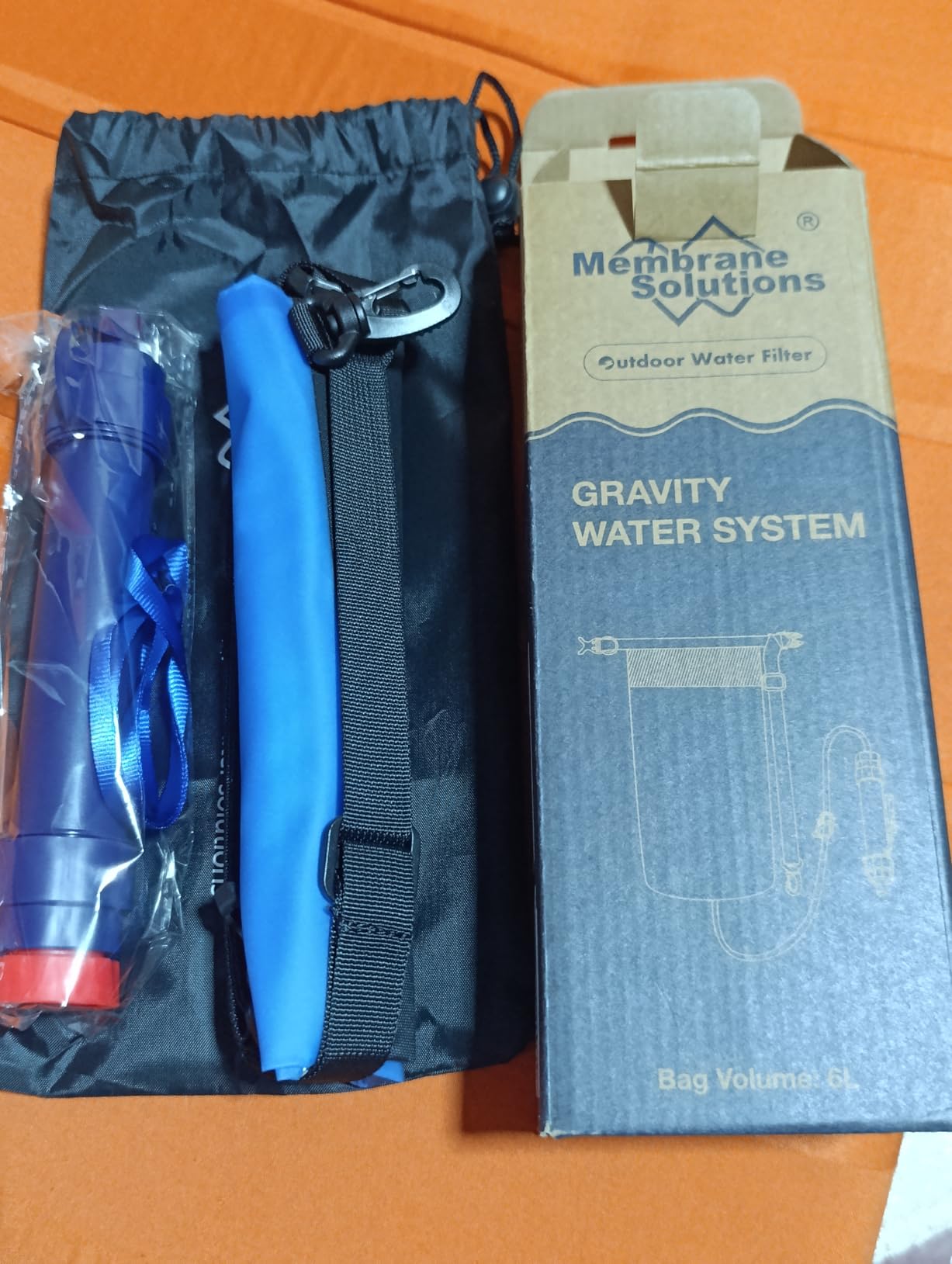
4. Membrane Solutions 6L Gravity Water Filter Pro
Membrane Solutions 6L Gravity Water Filter Pro for Group Camping
6 liter reservoir
0.5 L per minute flow
NSF ANSI 42 372 and 401
12.8 ounce weight
Pros
- Independent certification to three NSF standards
- Reservoir sized for a group of three to six people
- Fast 500 ml per minute flow
- BPA-free puncture-resistant TPU bag
Cons
- Slower than handheld options
- Needs a rinse before first use
- Collapses flat and is slow to dry
This is the certification pick, and for an emergency buyer that is not a small thing. The Membrane Solutions 6L is tested and certified by NSF and SGS to NSF/ANSI 42, 372 and 401, which is the most independent third-party verification in this roundup. Preparedness buyers care about that distinction, because a manufacturer-commissioned test is not the same thing as a standard written by an independent body.
Six liters is sized for a group of three to six people, and the wide bag mouth makes it easy to scoop water out of a shallow source. The stated flow of 500 milliliters per minute is fast for gravity. The bag is BPA-free TPU with a reinforced tree strap, and at 12.8 ounces the whole system still packs down reasonably small for a vehicle kit.
Filtration is a four-stage stack: dual PP pre-filters, coconut shell activated carbon, then a 0.1-micron hollow fiber membrane. Element life is listed at up to 1,320 gallons. The 500 parts per million TDS ceiling means it is aimed at fresh sources, and it is not the tool for brackish or hard well water.
Owners recommend flushing the filter before first use, and a fair number still add purification tablets when the source is standing or visibly contaminated. That is reasonable practice rather than a defect. It also collapses flat, which makes it easy to store but slow to dry afterward, and moisture left in a bag over a season is how you get a mildew smell on the next trip.
Why independent certification should drive your choice
NSF/ANSI 42 covers taste and odor, 372 covers lead-free compliance of the wetted parts, and 401 covers emerging contaminants such as certain PFAS compounds. Having a third party confirm the claim means the number on the box is not a marketing estimate. Forum users preparing for grid-down scenarios rank that trust signal above flow rate, and it is the reason we would put this system at the top of the list for anyone filtering water they did not collect themselves.
The honest limitations
It is a filter, not a purifier, so viruses still require a second step. The TDS ceiling rules out many wells and any seawater-adjacent source. And while 500 milliliters per minute sounds quick, the first several liters after flushing move slowly while air clears from the hollow fibers.
5. SimPure Portable Gravity-Fed Water Filter with 3L Bag
SimPure Portable Gravity-Fed Water Filter with 3L Bag
3 liter TPU bag
27 liters per hour flow
5000 liter life
Under 4 ounce weight
Pros
- Rolls down small for a bug out bag
- Strong steady flow once primed
- Works as a filter
- straw or bottle attachment
- Input catch tray blocks unfiltered runoff
Cons
- Bag holds less than its 3 liter label
- Needs several flush cycles before first use
- Clogs quickly in open debris-laden water
The SimPure is the most versatile unit here in terms of how many jobs it can do. It works as a personal filter, as a straw with the 29.5-inch extension tube, attached to a water bottle, or hung from a tree as a hands-free gravity filter. For someone who wants one device that covers drinking, cooking and a group camp, that flexibility is worth more than any single specification.
Filtration is staged: a five-micron coconut shell activated carbon layer, a 0.2-micron PP fiber pre-filter, then a 0.1-micron hollow fiber ultrafiltration membrane. Stated life is 5,000 liters, or about 1,320 gallons, and the flow rate is listed at 27 liters per hour, which puts it in the same territory as the Sawyer once the line is purged of air.
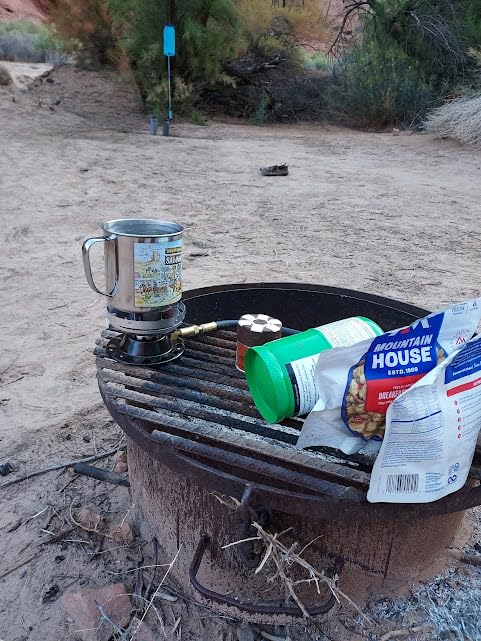
Two design details deserve credit. The input catch tray stops unfiltered water from running down the outside of the hose and into your clean container, which is a small thing that prevents a real contamination mistake. And the whole system weighs under four ounces, so it lives in a jacket pocket until the moment you need it.
The bag is the weak point. Owners consistently find that the nominal three-liter bag holds closer to 2.25 to 2.4 liters of unfiltered water, which is a meaningful shortfall when you are planning around capacity. It also resists drying after washing, and it needs several flush cycles before first use. A minority of buyers report a plastic or chemical taste, and some units arrived with cracked filter caps or leaking seams.

How it handles the sources you are most likely to find
On clear water, whether from a tap or a slow stream, it performs well. On open water carrying leaves, silt and organic debris, it clogs faster than any other filter in this roundup, because the pre-filter stages are doing their job. If your emergency plan involves drawing from a creek or a puddle, treat this as a personal backup for clear sources rather than your primary surface water plan.
Where it does not fit
The 1,000 parts per million TDS ceiling excludes hard well water, and the real capacity of the bag is well under the number on the label. There is no virus reduction, so a boil step is required after a flood or a boil-water notice. The slim bag is also frustrating to keep dry in storage, which matters if the system lives in a vehicle through a wet winter.
6. Katadyn BeFree Gravity Water Filter 3L
Katadyn BeFree Gravity Water Filter 3L for Camping, Backpacking & Hiking
3 liter collapsible bag
2 liters per minute flow
0.1 micron membrane
2 year warranty
Pros
- Fastest flow in the roundup at 2 L per minute
- Cleans by shaking with no tools
- Collapsible bag packs flat
- Two year manufacturer warranty
Cons
- 1000 L rated life is low for the class
- No virus reduction
- Bag and filter are separate pieces
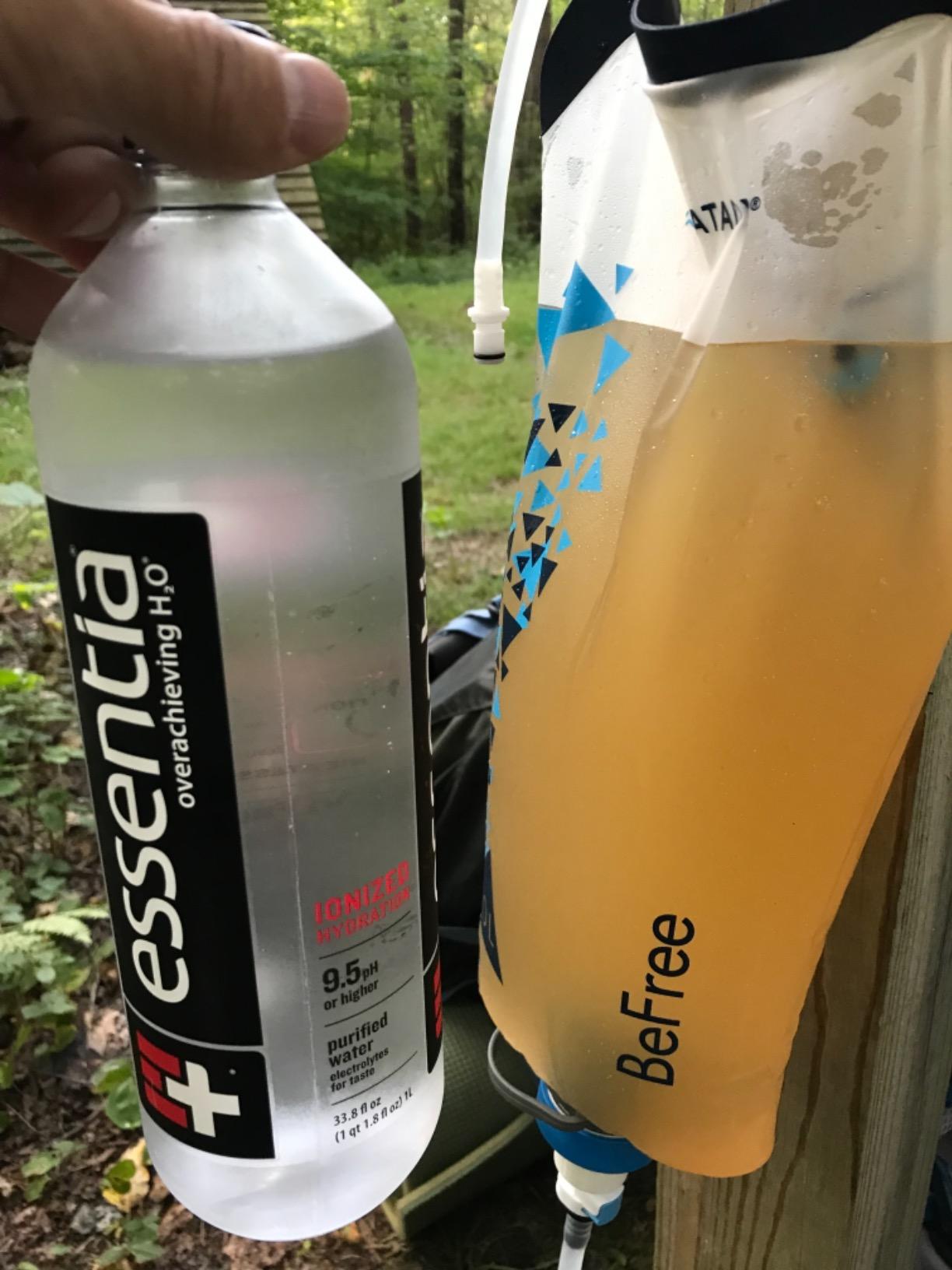
Speed is the entire argument for the Katadyn BeFree. At up to 2 liters per minute it is several times faster than every other gravity system here, and when you are producing water for a group with no pump and no power, throughput is the constraint that matters. Katadyn has been making water treatment hardware since 1928, and the build reflects that.
The cleaning method is the second selling point. The 0.1-micron EZ-Clean hollow fiber membrane is cleared by shaking or swishing the assembly in water. No tools, no disassembly and no backflush syringe to lose in the dark. For field conditions that is a real advantage over the plungers and couplers that come with other systems.

The 3-liter bag is collapsible and packs flat when empty, and the 6.4-ounce total weight is fine for a hiking pack. The fill, hang and drink operation requires no pumping at all, which is the whole point.
Where it loses ground is rated life. At 1,000 liters, the element needs replacing sooner than the 5,000-liter systems in this roundup, and Katadyn replacement elements are a recurring cost. It also does not remove viruses, and the bag and filter are separate pieces, so setup means managing two components rather than one. A small number of one-star reviews report units arriving damaged or failing early, so inspect the element before you store it.
When fast flow changes the outcome
Flow speed determines how much water you can realistically produce while the power is off. At 2 liters per minute, the BeFree clears a 3-liter bag in well under two minutes once primed, so a household can top up several jugs between other tasks. That changes the ergonomics of an emergency. It also reduces the risk of people cutting filtration short, which is the practical failure mode of slow systems.
What to budget for over five years
Plan on replacing the element roughly every 1,000 liters, which for a family of four is a few times a year. That is a meaningfully higher long-run cost than the multi-thousand-gallon systems here, and it is the reason this sits at number six despite the best flow figure on the sheet. If your event is measured in days, flow wins. If it is measured in months, element life wins.
7. Purewell 2.25G Gravity Water Filter System with Water Level Window
Purewell 2.25G Gravity Water Filter System with Water Level Window, 3-Stage 0.01μm Ultra-Filtration Stainless Steel Countertop System with 2 Filters and Stand, Reduce 99% Chlorine, PW-KS
0.01 micron pore size
2.25 gallon stainless tank
6000 gallon element pair
20 inch tall
Pros
- Visible water level window
- Stainless steel and polypropylene body
- Tight 0.01 micron membrane
- Two elements and a stand included
Cons
- Does not reduce total dissolved solids
- Elements listed for 6 month replacement
- 20 inch height needs counter clearance
The Purewell is the most conventional countertop design in the roundup, and for a household that means a familiar upper reservoir, a lower tank and a spigot. What makes it interesting is the 0.01-micron ultrafiltration membrane, one of the tightest pore sizes advertised anywhere in this group, combined with a silver ion stage and a carbon block.
It moves roughly four gallons per hour despite that fine pore size, which is respectable. The transparent water level window is a genuinely useful addition on a unit this size. You can see how much clean water you have without lifting the lid, and in an emergency that is the information you actually want at a glance.
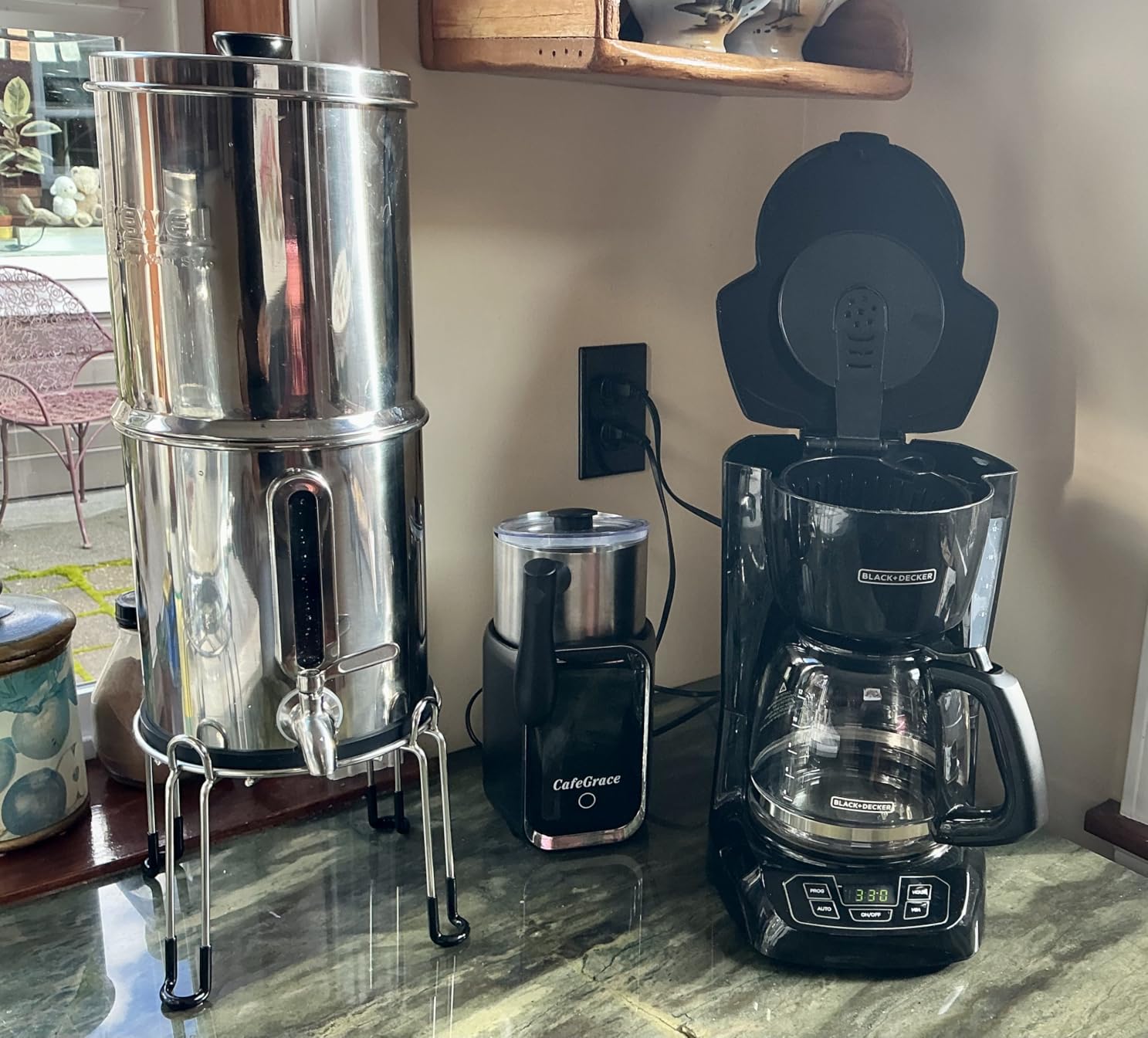
The pair of black carbon elements is listed at up to 6,000 gallons total, and a stand is included in the box so you can set the elements aside to dry instead of leaving them in the reservoir. Construction is a mix of polypropylene and stainless steel, and the upper chamber is rated to 100 degrees Fahrenheit.
Two things give buyers pause. It does not lower total dissolved solids, so it will not fix hard or mineral-heavy well water. And the manufacturer specifies replacement of the elements every six months regardless of how good they still look, which sets a short and expensive service interval. Owners also note you should not add water to the upper chamber while filtered water is sitting in the lower one, since the seal can leak.
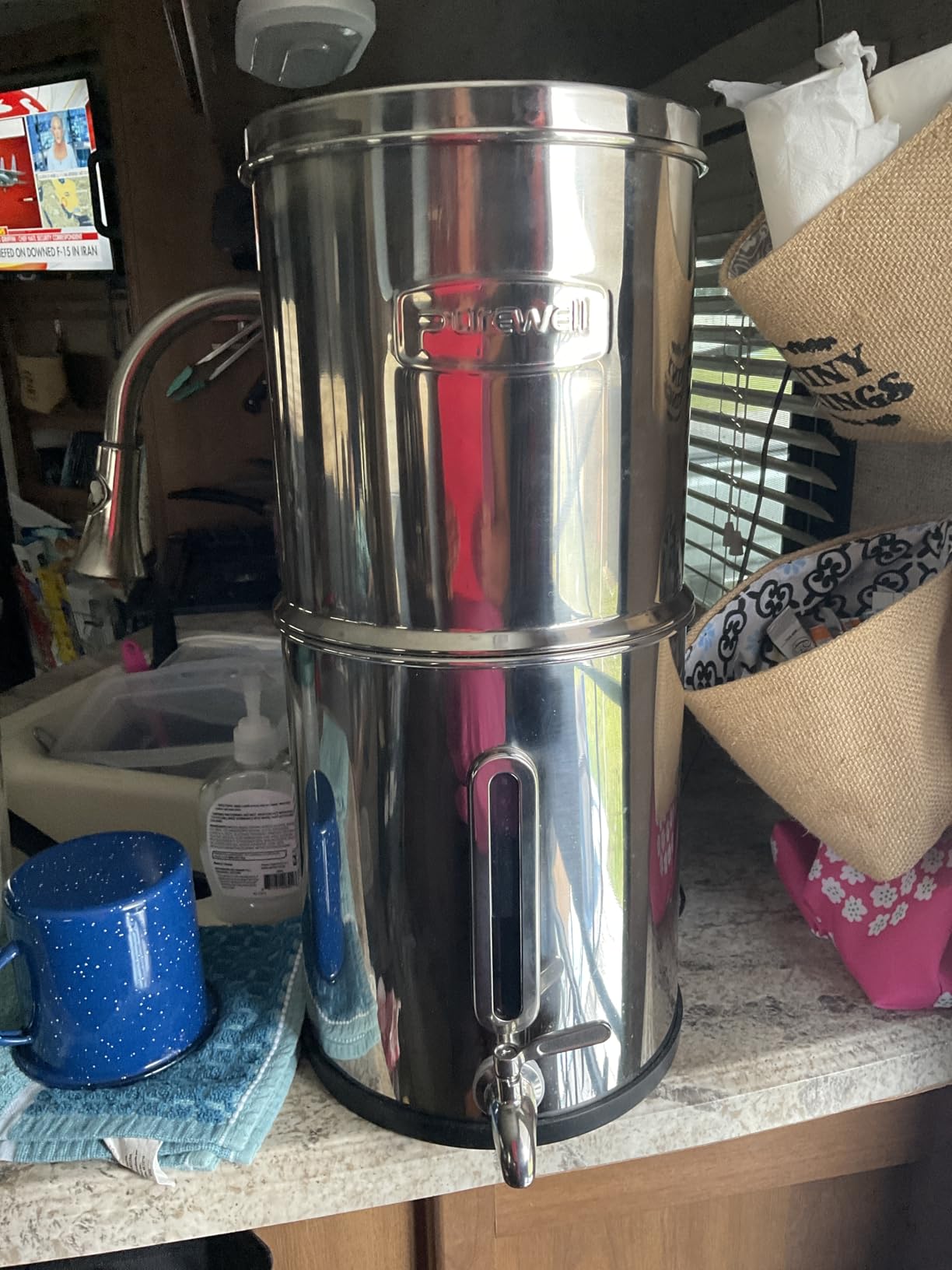
Is a smaller micron rating always better
No, and this is the clearest example in the roundup. A 0.01-micron membrane sieves out finer particles than the 0.1-micron hollow fibers used by the Sawyer, SimPure and Katadyn, but it captures them permanently. The tighter the pore, the faster the element fouls on sediment and the more often you replace it. For clear municipal water, the tight rating is a genuine advantage. For anything drawn from a creek, a coarser pre-filter stage protects element life better.
Where the six-month replacement schedule hurts
This is a calendar replacement, not a capacity replacement. Over five years of keeping it ready, the cartridge cost adds up quickly and it makes the per-gallon economics worse than systems with multi-thousand-gallon ratings. The 20-inch height also means it will not fit under a low-hanging cabinet, which rules it out for some kitchens.
8. LifeStraw Peak Compact Gravity Water Filter, 3 L
LifeStraw Peak Compact Gravity Water Filter, 3 L, Mountain Blue
3 liter bag capacity
228 g total weight
Screws onto 1L and 1.5L bottles
Backwash accessory included
Pros
- One filter handles four different use modes
- Stows inside its own bag
- Backwash valve recovers flow when clogged
- Replaceable element
Cons
- Flow is slow and drops further without backflushing
- Slight rubbery taste on early runs
- Smallest review base of the leading models
The Peak is the ecosystem design in this category. The same filter runs as a gravity system, as a squeeze bottle, as a straw, or screwed directly onto a standard one or one-and-a-half liter bottle. When it screws onto a bottle you own, the reservoir bag is free to hold clean water instead of raw water, which doubles the useful capacity of the whole kit with no extra weight.
The claim list covers 99.999999 percent of bacteria, 99.999 percent of parasites, and 99.999 percent of microplastics, silt and sand. The re-engineered membrane ships with a custom backwash accessory, and the element is replaceable, so the system is not a sealed single-use object.
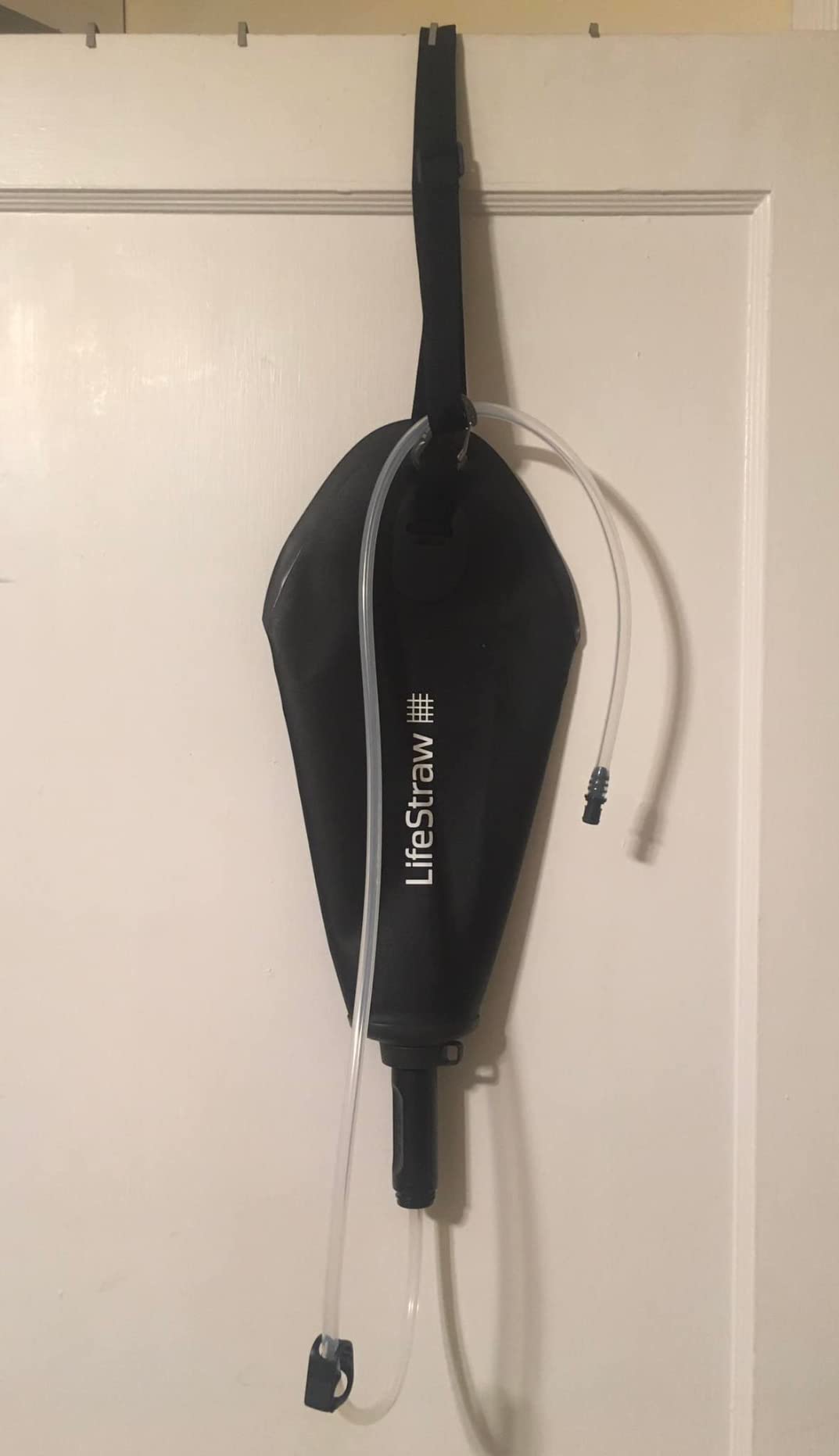
Owners like that the whole thing packs into the bag, which removes the usual problem of a filter and a reservoir occupying two separate spaces in a pack. At 228 grams it is heavier than the straw filters in this roundup but still light for a unit that holds three liters.
Flow is the recurring complaint. Owners describe it as modest, and it slows further across a multi-day trip if you do not backflush, which is why the included backwash accessory matters more here than on other systems. A faint rubbery taste shows up on the first run or two and clears after that. With 358 ratings, it also has the smallest review base of the leading models here, so treat the consensus with slightly more caution.
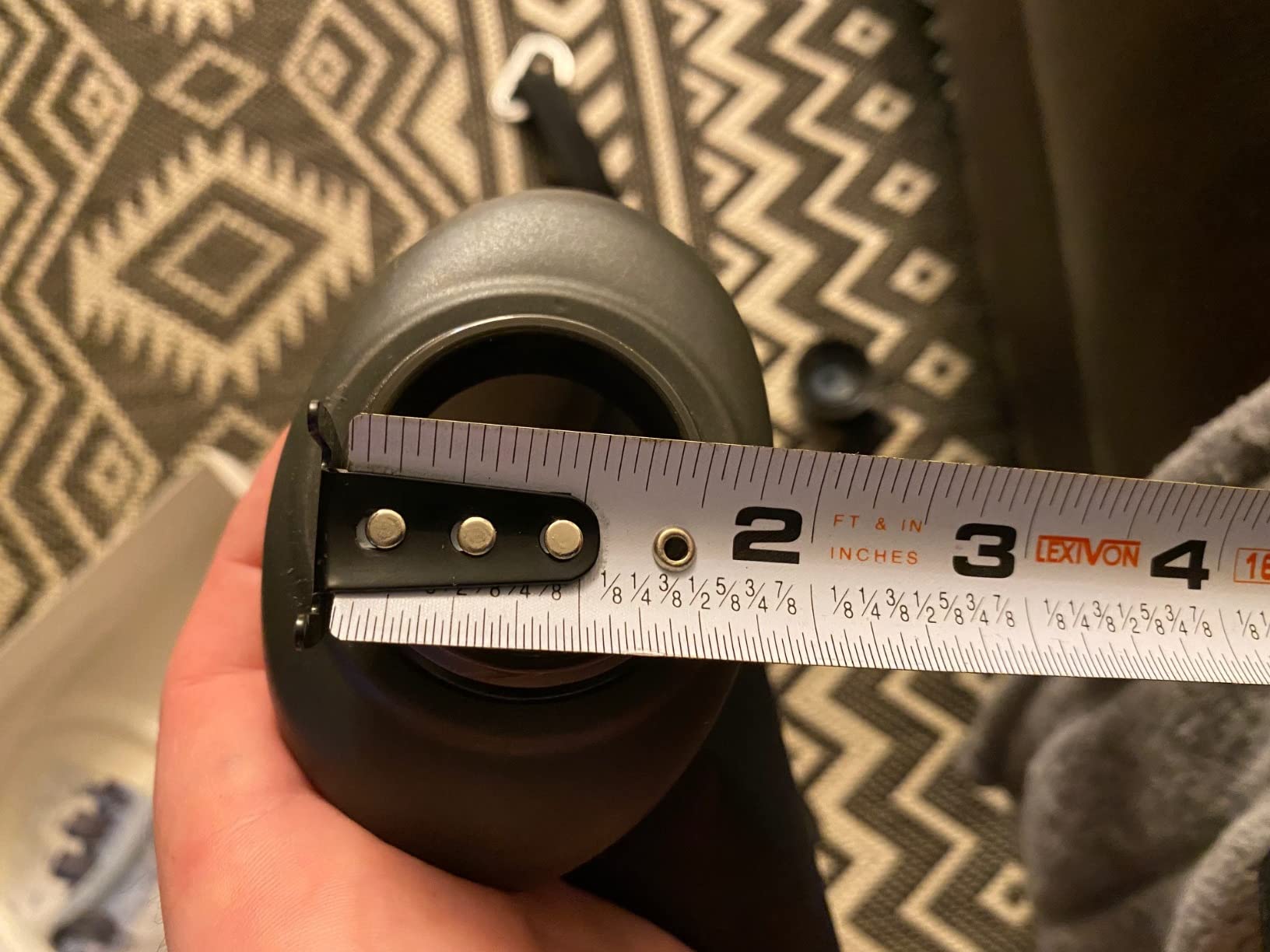
Why the bottle connection is the real feature
It solves a capacity problem that no other unit in this roundup addresses. A 3-liter bag of raw water only gets you so far, but if the element moves to a bottle, the bag becomes a clean water carrier instead. For a two-person household, that is the difference between a few glasses of drinking water and a usable reserve for cooking.
What to know before packing it
It will not remove viruses, so any suspected viral contamination still needs boiling. If you store it downwind of a campfire, expect to smell smoke in the output, which owners mention more than once. And if you will only filter once every few months, run the backwash cycle before the event, because a membrane that has sat unused will start slow.
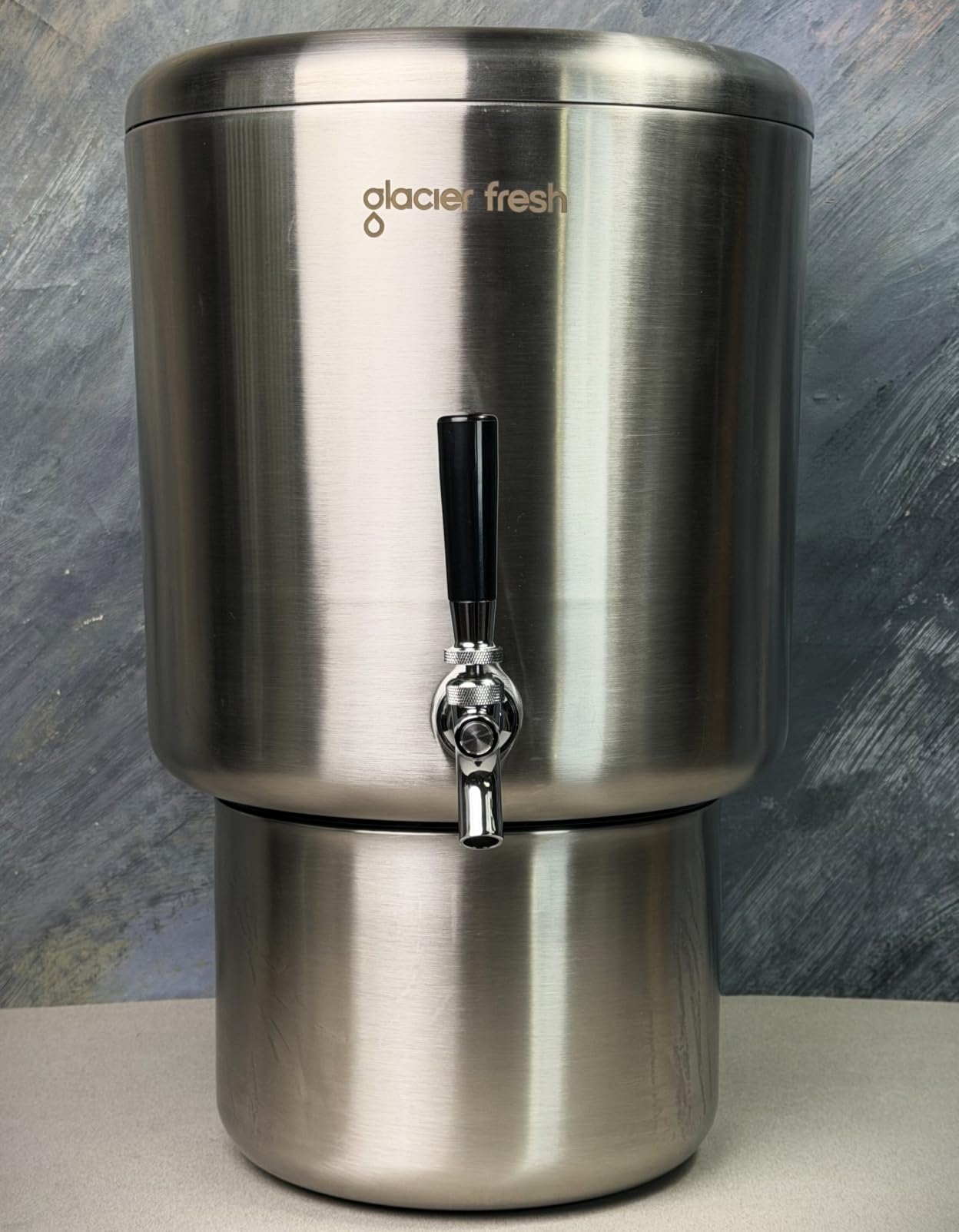
9. GLACIER FRESH PC04 Gravity-Fed Countertop Filtration System
GLACIER FRESH PC04 Gravity-Fed Countertop Water Filtration System
2.25 gallon capacity
14.25 by 13.58 by 16.14 inch
Full stainless body
200 gallon cartridge
Pros
- Full stainless steel body and tap
- Assembly takes minutes with no plumbing
- Noticeable improvement in chlorinated tap taste
- Keg-style spout stays dry
Cons
- Cartridge rated at only 200 gallons
- Tall and wide footprint
- Slow gravity flow and no level indicator
The GLACIER FRESH PC04 is the one system here where several owners fit a competing filter element and immediately reported better results. Because the housing accepts Berkey-style replacement filters, you are not locked into the cartridge it ships with, and that flexibility meaningfully changes the long-run economics of a 200-gallon stock element.
Build quality is the main attraction. The body and tap are stainless steel, and owners consistently compare the feel favorably to a Berkey at a similar class. The pour spout is keg-style and stays dry rather than dripping, which is a small quality-of-life difference you notice every single day you use it.
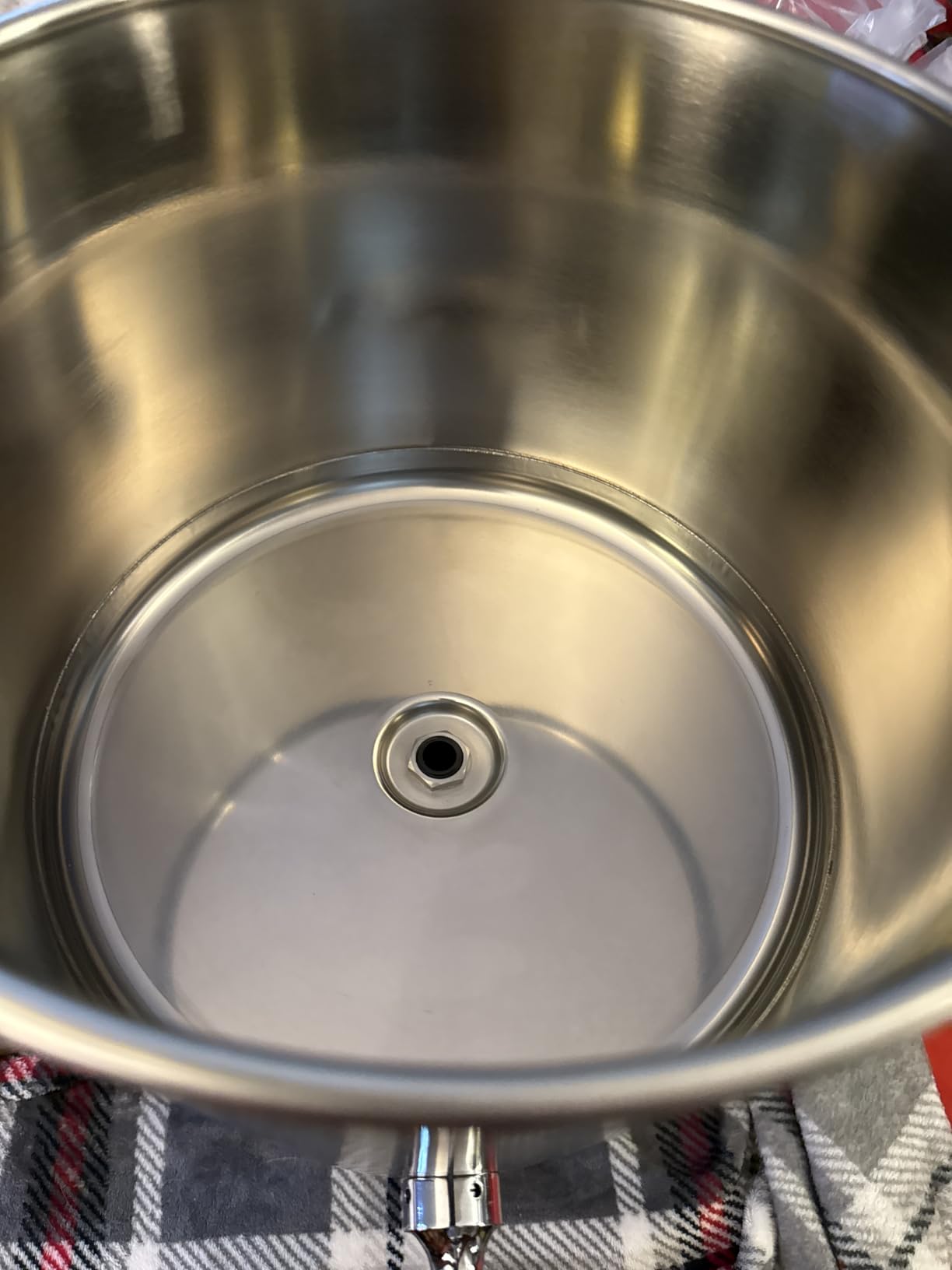
Filtration uses Elarisey electrosorption technology, where a mineral crystal structure is charged in water between pH 5 and 9 to attract negatively charged submicron contaminants. Owners report a marked improvement in the taste and odor of chlorinated municipal water, which is the most common household use case for a system like this.
The included cartridge delivers up to 200 gallons and is rated for replacement every three months, so on its own it is the shortest-lived element in the roundup. One reviewer reported a cartridge attachment breaking and shedding black particles, which is a reason to inspect any element before you put it in service. The manual also specifies municipal tap water, which limits it for well users. At 14.25 by 13.58 by 16.14 inches it is also the largest countertop footprint here.
What the open housing buys you
Because the chamber is not proprietary, you can buy elements in bulk when they are offered for sale, use a different filtration stage, or swap in a long-life element when you are preparing for a long event. That turns a 200-gallon consumable into a choice rather than a constraint, and it is the reason experienced buyers treat a housing as a system rather than as a single product.
Where it falls short
With only the original cartridge in the box, element cost makes it the most expensive per gallon of the countertop systems here. There is no way to see how much filtered water remains without opening the unit, gravity flow is slow, and the manual’s tap-water limitation rules out the private well households most likely to be serious about filtration. Check your cabinet clearance before you commit to the footprint.
10. Outback Water Emergency Drinking Water Filter System, Gravity Fed 24 GPD
OutbackWater Emergency Drinking Water Filter System, Gravity Fed 24 GPD
24 gallon per day rating
90 liters per day flow
Four stage filtration
6 pound unit weight
Pros
- No electricity
- pumps or batteries needed
- Handles much larger volumes than a bag filter
- Good tasting water from rainwater and natural sources
- Assembles quickly
Cons
- Real throughput far below the advertised 24 GPD
- Replacement filters cost about as much as a new unit
- Flimsy-feeling plastic containers
This is the system that most looks like a relief-agency unit, and it is built around a bucket and dispenser rather than a soft reservoir. Four stages of filtration, a spigot, containers, connectors and gaskets all ship in the box, and the whole thing runs on gravity with no electricity, pumps or batteries. Made in the USA, it is designed for disaster kits and off-grid setups where volume matters more than portability.
Owners who keep it as a standby unit like the no-power design and report good-tasting water from collected rainwater and natural sources. The 6-pound weight and hard plastic containers are built to be moved around a garage or a shelter, which is a different set of priorities from a hiking filter.
Here is the honest problem, and it is the biggest gap between advertising and reality in this roundup. The unit is rated at 24 gallons per day, and owners report actual throughput of roughly one to three gallons per day. That is a large enough discrepancy that you should size your expectations around the real figure, not the headline.
Other reviews report units that stopped filtering after about six weeks, and replacement filters priced close to the cost of a whole new system, which makes it an expensive filter to own over time. One reviewer found the plastic containers flimsy given the class of the product. The product shelf life is listed at 365 days, so treat the elements as perishable and check the date before an event.
When high-volume capacity is the right goal
If your scenario is a shelter, a group of more than six people, or a period measured in weeks, the large reservoir and dispenser format is the correct shape and the other bag systems simply are not built for that volume. The installation is quick and needs nothing beyond the parts in the box, which matters when you are setting up in a place with no water and no tools.
Why it ranks last in our list
It combines the widest gap between advertised and real performance in the roundup with the most painful replacement economics and the smallest review base at 107 ratings. The other nine systems have larger evidence bases and better documented throughput. If you need this format, buy it knowing the realistic output, and buy a spare element set at the same time.
Buying Guide: How to Choose a Gravity Filter for Emergencies
Buying the wrong class of gravity filter is the most common and most expensive mistake. A hiking filter that is great at treating a single glass of creek water will frustrate a household of four, and a countertop unit that sits in a cupboard is no help to someone evacuating on foot. Work through the following in order.
Start with the water math
One gallon per person per day covers drinking and basic cooking. Add one more gallon per person per day for hygiene and cleanup. Multiply by household size, then by the number of days you are planning for. A family of four over seven days needs about 56 gallons. Multiply that figure by the filter’s element life and you know whether one element set covers the event. Multiply it by your realistic daily output and you know whether the reservoir is big enough to avoid constant refilling.
Then match the filter to the water source
Source matters more than most buyers expect. Chlorinated municipal water is the easiest case, and carbon stages handle taste and odor along with sediment. Collected rainwater carries roof debris, so a filter with real PP pre-filters in front of the membrane will last far longer. Creek and lake water adds silt, algae and organic material, and it needs the largest pre-filter capacity available plus a purification step afterward. A boil-water notice or a flood event introduces a virus question, which only a purifier or a boil step answers. Private well water can be anywhere on the TDS scale, so check the stated limit before buying.
Read the certification standard, not the marketing line
NSF/ANSI 42 is a taste and odor standard, and it is the weakest of the group. NSF/ANSI 53 is a health-contaminants standard covering cysts, bacteria, lead and mercury, and it is the minimum worth insisting on. NSF/ANSI 372 confirms the wetted parts are lead-free. NSF/ANSI 401 covers emerging contaminants, including certain PFAS compounds, and it is the rarest certification in this category. IAPMO and SGS are independent testing bodies, and a unit certified by one of them has a claim that was checked by somebody other than the seller. A manufacturer-commissioned test is useful information, but it is not the same thing as independent certification.
Understand the media tradeoffs
Activated carbon blocks handle chlorine, taste, odor and some organic chemicals, but they are finite and they cannot remove anything dissolved. Ceramic elements are scrubbable and reusable, and the very fine pores catch bacteria and protozoa, but they foul quickly on sediment and they are not virus barriers. Hollow fiber membranes at 0.1 micron are the most common choice in portable systems, and they backflush rather than being scrubbed. Tight membranes around 0.01 micron catch finer particles at the cost of shorter element life. None of them remove salt, and none of them remove most industrial solvents.
Check the field realities before you store it
Weight decides whether the filter travels with you or stays behind. Anything under 100 grams belongs in a go bag, and anything over two kilograms is a countertop fixture. Confirm that replacement elements are sold for the model you are buying, because a filter whose element you cannot buy in five years is not an emergency asset. If the system is a bag, check that it dries flat, since a damp bag develops a smell that carries into your next fill.
Freeze and thaw deserve their own mention. Hollow fiber membranes and carbon blocks are more tolerant of temperature swings than anything mechanical, but a plastic reservoir can crack if water inside it freezes, and a ceramic element can craze if it is handled while frozen solid. If you are storing any of these in an unheated garage or a vehicle through winter, empty the reservoirs completely, keep elements sealed and dry in their packaging, and let any frozen part return to room temperature before you use it.
Run a readiness check twice a year
Unopened elements have a shelf life, and a filter that has never been run is an unproven asset. Once or twice a year, flush the system with clean tap water, measure how long a full reservoir takes to clear, inspect the spigot and seals for weeping, and confirm you can still order a replacement element. Soak ceramic elements as the manufacturer directs, and keep a spare element sealed and dry. Backflush or scrub elements as their instructions describe, because an element cleaned in September is one that will still flow in September three years from now.
Finally, buy the second treatment step. A gravity filter plus a supply of chlorine dioxide tablets, or a small pot and a fuel source for boiling, covers the virus gap that no filter in this roundup closes. That pairing is what turns a good filter into a complete emergency water plan.
Frequently Asked Questions
What is the best water filter system for emergencies?
For a household that needs tap water treated during a boil-water notice or grid outage, the LifeStraw Family Gravity Purifier is the strongest choice because it is one of the few gravity systems that states virus reduction, alongside bacteria and protozoa removal. For grid-down and surface water situations, the Big Berkey 2.25-gallon wins on stainless construction, element life of several thousand gallons and the largest base of long-term owner feedback.
Do gravity water filters actually work?
Yes, within a clear set of limits. Water seeps through activated carbon, ceramic or hollow fiber media under its own weight, trapping sediment, bacteria, protozoan cysts, chlorine and lead. Flow is slow and tapers as the upper reservoir empties. They do not remove viruses, salt or most industrial chemicals, and they do not lower total dissolved solids, so a boil or chlorine dioxide step is still required after flooding.
Can gravity water filters remove viruses?
Not usually. A 0.1 micron hollow fiber membrane and a ceramic element both have pores larger than viruses, so viral particles pass through. Only purifiers built with a tighter membrane or added treatment steps make virus reduction claims. If your emergency involves contaminated tap water or flood water, filter first and then boil every gallon or treat it with chlorine dioxide tablets for the full contact time listed on the package.
How much water do I need per person per day in an emergency?
Plan on one gallon per person per day for drinking and cooking, plus another gallon per person per day for washing, laundry and dishes. A family of four should expect roughly eight gallons a day. Multiply that by the number of days you are preparing for, then divide by your filter’s realistic daily output to see how many refills you will make, and compare the total against the element life to confirm you have enough filter capacity.
How often do I change gravity filter elements?
It depends entirely on the model and the water. Systems rated at several thousand gallons, such as stainless countertop units with a pair of elements, can run for months of moderate use before replacement. Shorter-rated bag filters around 1,000 liters need changing much sooner, and some manufacturers specify a calendar interval of three or six months regardless of how the element looks. Backflushing hollow fiber elements and scrubbing ceramic elements on schedule extends life more than any other habit.
Is filtered water safe during a boil water advisory?
A gravity filter alone is not sufficient. A boil water advisory usually signals bacterial or viral contamination in the distribution system, and gravity filtration addresses bacteria and protozoa but not viruses. Run the water through the filter to remove sediment and improve taste, then bring it to a rolling boil or add chlorine dioxide tablets and wait the full contact time before drinking. Keep doing this for every container until the advisory is lifted.
Final Verdict
The best gravity water filters for emergency use come down to three very different answers. Buy the Big Berkey 2.25-gallon if you want one countertop system that survives a garage, a vehicle and years of disuse, and that keeps filtering through thousands of gallons before an element change. Buy the LifeStraw Family Gravity Purifier if the emergency is a municipal boil-water notice, because virus reduction is the one thing no other unit in this roundup offers. Buy the Sawyer SP160 if you need something that goes in your go bag and stays there until the day you need it.
Everything else on this list is a specialist. The Membrane Solutions 6L earns its place through independent NSF certification and group capacity. The Katadyn BeFree wins on flow. The SimPure does the most jobs with the least weight. Whatever you choose, add boiling supplies or purification tablets, run the filter once before you need it, and store every element sealed and dry.
For a wider look at the category, read our guide to gravity water filters for emergency preparedness and our picks for whole house water filters for city water if the grid comes back and the problem turns out to be plumbing rather than weather.