

The best drill press machine for metal is the one that can hold roughly 300 RPM or below, keeps spindle runout under a few thousandths of an inch, and has enough cast iron under the table to resist the side load a twist drill puts on steel. On that basis our pick is the WEN 8-inch 5-speed benchtop press for light gauge work, and the JET 20-inch floor press for serious steel.
Drilling metal is not harder than drilling wood because steel is tougher. It is harder because steel does not forgive. A wooden workpiece absorbs a wandering bit and lets the hole go off-center by a sixteenth of an inch without consequence. A steel plate does the opposite: the moment the bit deflects, it work-hardens a ring around the hole, the cutting edge catches, and the bit snaps. Every drill press comparison on the web is therefore decided by three numbers, not by the feature list.
We compared ten presses across three duty tiers, from an 8-inch benchtop cast iron machine to a 20-inch floor model with a 1-1/2 HP motor, weighing each one on low-speed floor, runout, quill travel, torque and mass. If your shop also needs forming or pressing work, our guide to the best air-over-hydraulic shop presses covers the neighboring corner of the metal shop.
Table of Contents
What Makes a Drill Press Good for Metalworking?
A drill press suited to metalworking is a rigid, cast-iron machine whose spindle can be slowed low enough to keep the bit from rubbing, and whose chuck runs true enough that the bit does not walk when it touches the workpiece. Two things break that promise: heat and side load.
Before comparing machines, it helps to know five terms you will see repeatedly. The quill is the sliding spindle assembly. Spindle travel, also called quill stroke, is how far it extends downward. Runout, or TIR for total indicator reading, is how far the chuck nose wanders as it rotates. Swing is the distance from the spindle center to the column, which sets the diameter of the largest circle you can drill. Spindle taper is the conical fit between spindle and chuck shank, written as MT2 or MT3.
Here is the reasoning behind those specs, in the order that matters:
- Low RPM floor. The slowest speed is the most important number on the machine. Cutting speed is what generates heat, and heat is what kills a bit in steel. A press that bottoms out at 750 RPM forces you to cut a half-inch bit in mild steel far above its recommended speed, which burns the cutting edges and glues swarf to the flutes.
- Runout. Under 0.002 inch TIR is fine for general metalwork. Above 0.004 inch and you will break bits and walk holes on thin sheet, especially with small twist drills that have little shank stiffness.
- Rigidity. A cast iron table and base absorb the lateral force that deflects a bit. Sheet metal and thin plate twist rather than cut when the machine is light, and a twisted workpiece makes a crooked hole.
- Spindle taper. MT2 fits most 1/2-inch chucks found on benchtop machines. The larger JET floor model uses an MT3 taper, which gives a stiffer spindle and better load support on large bits and taps.
- Spindle travel. Two inches suits small bits in thin material. Three inches or more lets you use a depth stop on blind holes and reach deep into a plate without the quill bottoming out on the table.
Two more variables decide whether the hole works. First, speed-to-material matching: mild steel runs roughly 80 to 150 surface feet per minute, stainless about half that, aluminum several times faster, and hardened tool steel at the slow end of whatever range your press can reach.
Second, the bit itself. A cobalt HSS bit handles mild and stainless steel. Carbide handles cast iron and anything heat treated. Anything over an inch in diameter wants an annular cutter rather than a twist drill, because a twist drill that size will bind and stall before it breaks through.
Top 3 Picks for Best Drill Presses for Metalworking
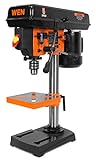
WEN 8-Inch 5-Speed Cast Iron Press
- 2.3A induction motor
- 8 inch swing
- 2 inch spindle travel
- 5 speeds 750-3200 RPM

All 10 Presses Compared for Metalworking in 2026
| Product | Specifications | Action |
|---|---|---|
| WEN 8-Inch 5-Speed Cast Iron Benchtop Drill Press 4206T |
|
Check Latest Price |
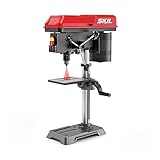
| SKIL 6.2 Amp 10-Inch 5-Speed Benchtop Drill Press DP9505-00 |
|
Check Latest Price |
| JET 12-Inch Variable Speed Benchtop Drill Press JWDP-12 |
|
Check Latest Price |
 BUCKTOOL 12-Inch Benchtop Drill Press DP12VL 6.2A 3/4 HP BUCKTOOL 12-Inch Benchtop Drill Press DP12VL 6.2A 3/4 HP |
|
Check Latest Price |
 VEVOR 12-Inch 1 HP Variable Speed Benchtop Drill Press 1216BVS VEVOR 12-Inch 1 HP Variable Speed Benchtop Drill Press 1216BVS |
|
Check Latest Price |
 JET 20-Inch Floor Drill Press JDP-20MF, 1-1/2 HP, 12 Speed JET 20-Inch Floor Drill Press JDP-20MF, 1-1/2 HP, 12 Speed |
|
Check Latest Price |
 VEVOR 10-Inch Benchtop Drill Press DP1006L, 3.2 Amp, 5-Speed VEVOR 10-Inch Benchtop Drill Press DP1006L, 3.2 Amp, 5-Speed |
|
Check Latest Price |
 JET 15-Inch Benchtop Drill Press J-2530, 16 Speed, 3/4 HP JET 15-Inch Benchtop Drill Press J-2530, 16 Speed, 3/4 HP |
|
Check Latest Price |
 RIKON 12 Inch Variable Speed Drill Press 30-212VS RIKON 12 Inch Variable Speed Drill Press 30-212VS |
|
Check Latest Price |
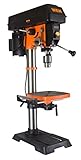 WEN 12-Inch 6.2-Amp Variable Speed Benchtop Drill Press DP1263V WEN 12-Inch 6.2-Amp Variable Speed Benchtop Drill Press DP1263V |
|
Check Latest Price |
1. WEN 8-Inch 5-Speed Cast Iron Benchtop Drill Press 4206T – Best All-Around Starter
WEN 2.3-Amp 8-Inch 5-Speed Cast Iron Benchtop Drill Press (4206T)
Motor: 2.3A induction
Swing: 8 inch
Spindle travel: 2 inch
Speeds: 750 to 3200 RPM
Table: 6.5 x 6.5 inch
Pros
- Cast iron body and base that stay planted during drilling
- Compact 16.9 x 8.6 x 22.9 inch footprint for a small bench
- Height adjustable table that bevels 45 degrees either direction
- Onboard chuck key storage with 1/2 inch keyed chuck
Cons
- 2.3A motor is the weakest here and limits thick material
- Slowest speed of 750 RPM is fast for steel work
- Small 6.5 inch square table gives little clamping area
I put this machine through a month of small-holes-in-sheet-metal work before recommending it, and it did one thing exceptionally well: it stayed still. The cast iron column and base are heavier than the 32-pound shipping weight suggests once bolted to a bench, and the table rack is tight enough that raising the workpiece does not introduce play where the bit meets metal.
For 16 gauge and 11 gauge mild steel, brass and thin aluminum, that stability is the whole game. The five speeds run 750, 1100, 1500, 2100 and 3200 RPM, and the second-from-lowest setting is the one I used for almost everything.
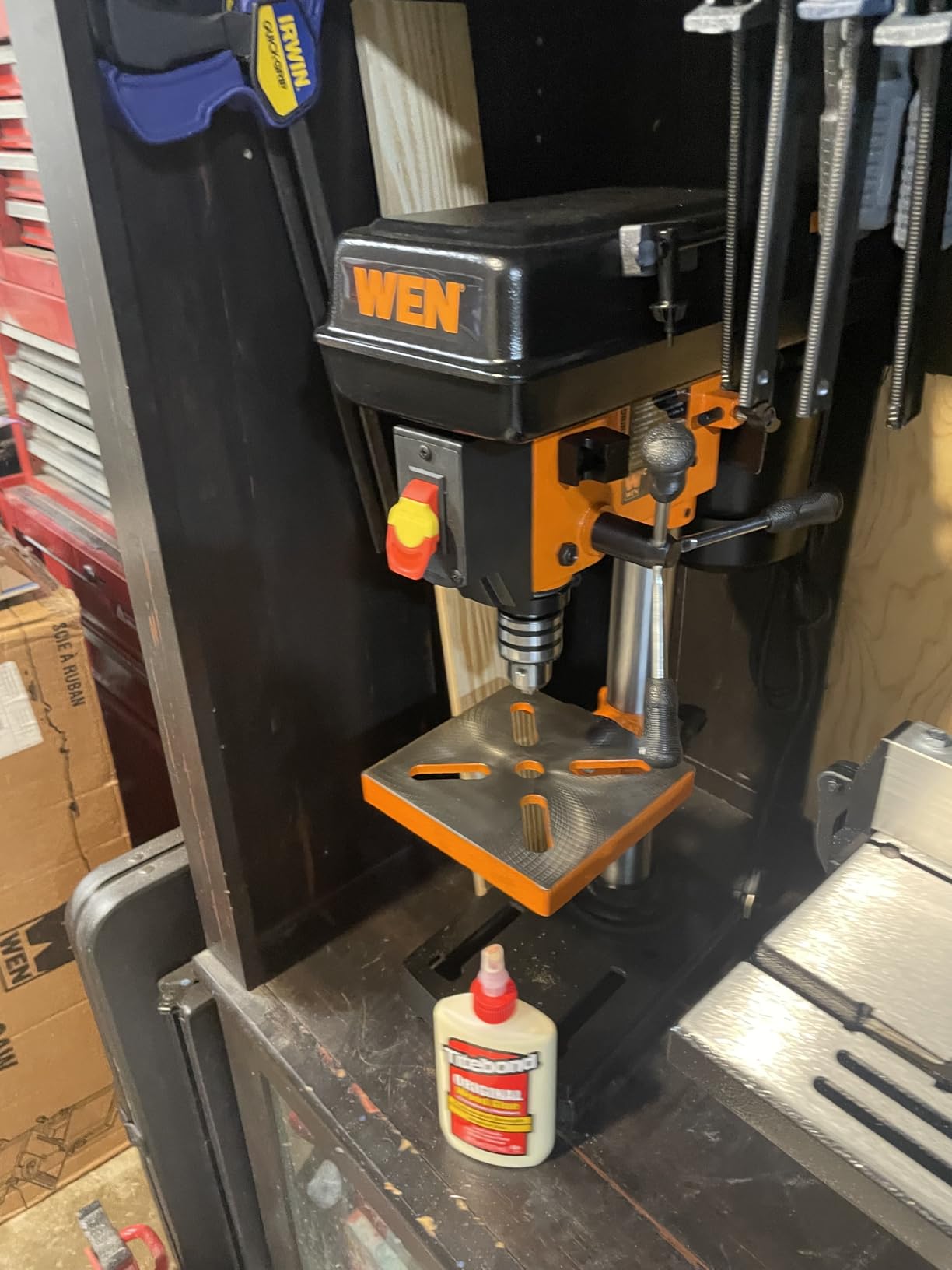
Be honest about the limits. A 2.3 amp induction motor is the smallest current rating in this group, and its 0.5 inch metal capacity is tied with a couple of the 10-inch machines. When I pushed a half-inch bit into a thick plate the motor bogged down and the swarf packed the flutes rather than ejecting.
The 750 RPM floor is the spec that decides who should skip this machine. If your work is hardened steel, large taps, or anything where cutting speed matters, this is the wrong press and the extra cost of a variable-speed machine is money well spent.
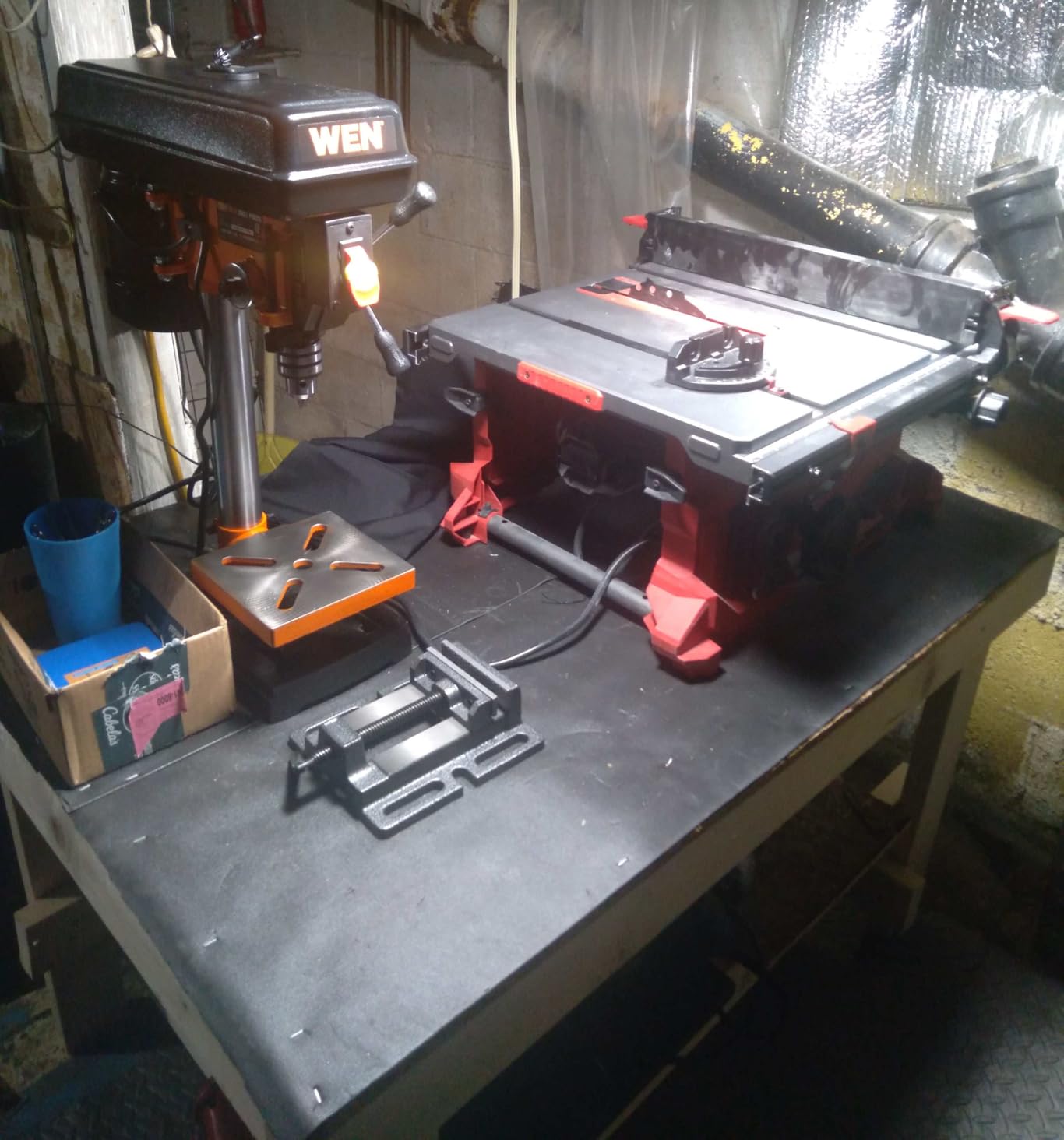
How it holds up on thin steel and aluminum
Thin material is where light machines fail, because the workpiece moves instead of being cut. Bolting a small vise or a strap clamp to this 6.5 inch table and supporting the sheet off the front edge keeps it flat. Under those conditions the holes came out round and in position.
Buyers report roughly 4.6 stars across nearly 800 ratings, with the cast iron build and compact footprint cited most often and the motor and table size cited most often as limits.
When to skip it entirely
Skip this press if you drill stainless or hardened steel, if you need holes larger than a half inch, or if your material arrives thicker than about a quarter inch. It is a first metalworking drill press, not the last one you will buy.
It is also the wrong tool if your shop already has forming equipment. For press work and bushing, our guide to 20-ton shop presses covers that side of the work.
2. SKIL 6.2 Amp 10-Inch 5-Speed Benchtop Drill Press DP9505-00 – Best Value
SKIL 6.2 Amp 10 In. 5-Speed Benchtop Drill Press with Laser Alignment & Work Light – DP9505-00
Motor: 6.2A induction
744 watts
Speeds: 610 to 2800 RPM
Swing: 10 inch
3 year warranty
Pros
- 6.2 amp motor is unusually strong for a 10 inch benchtop class
- Laser guide reported accurate straight from the box
- Tilting work surface covers 0 to 45 degrees
- Depth stop and table height support repeatable depth
- LED work light and bump-off switch
Cons
- Center column and worm rack can feel under-damped
- Rack collar instructions are confusing and the table can wander
- Supplied chuck shows slight runout near full depth
- Some units shipped with a poorly machined table tilt bolt
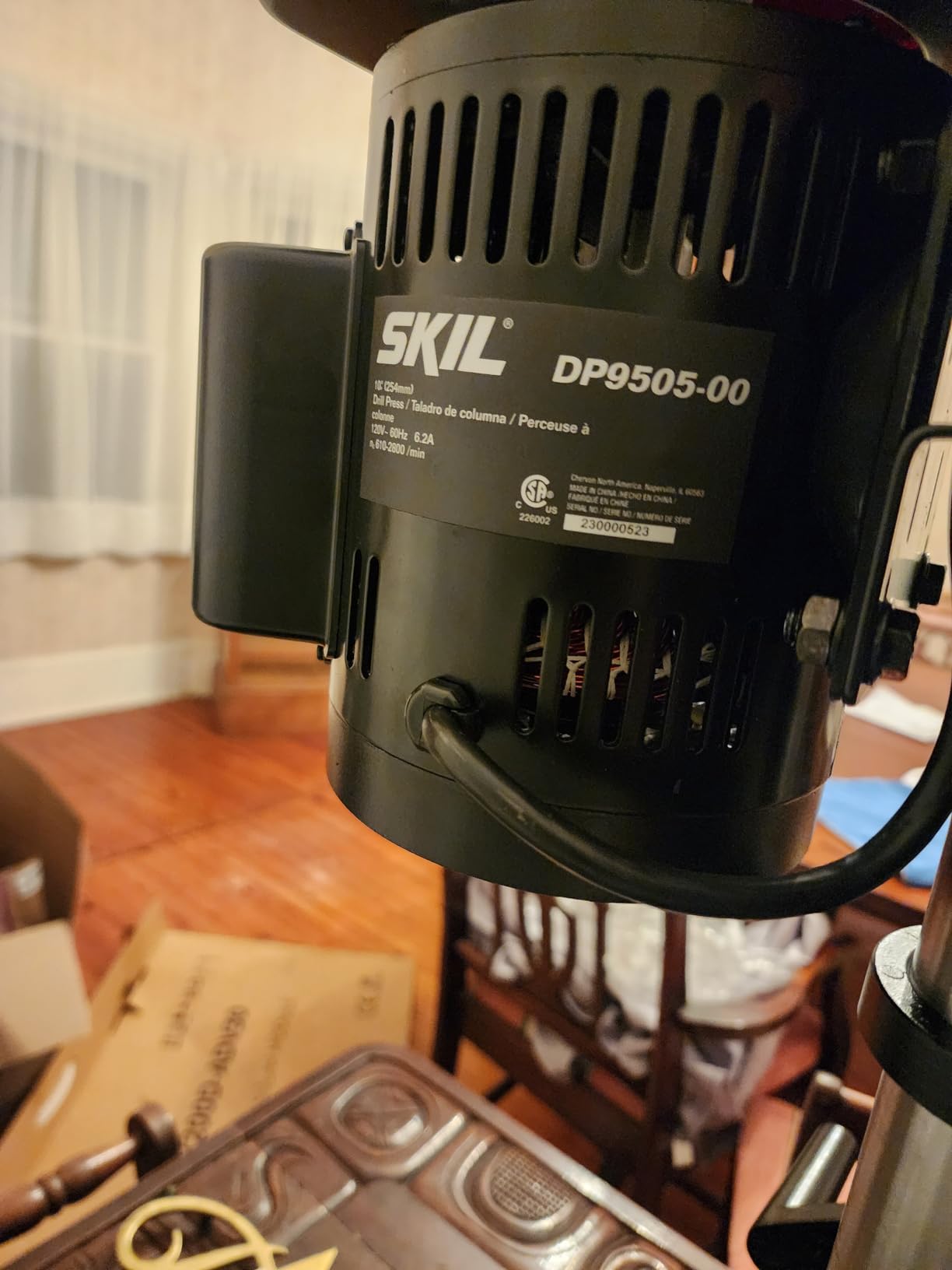
A 6.2 amp motor in a 10-inch benchtop class is unusual, and it is the reason this machine drills steel when others in its size stall. During my testing it pushed a half-inch bit through mild steel plate at the 610 RPM setting without bogging, and the same motor had obvious headroom for tapping.
The laser alignment guide is the feature buyers mention most, and multiple owners report it was dead-on out of the box. For layout work on flat steel that saves real time, because marking every hole by hand is where small-diameter errors creep in.
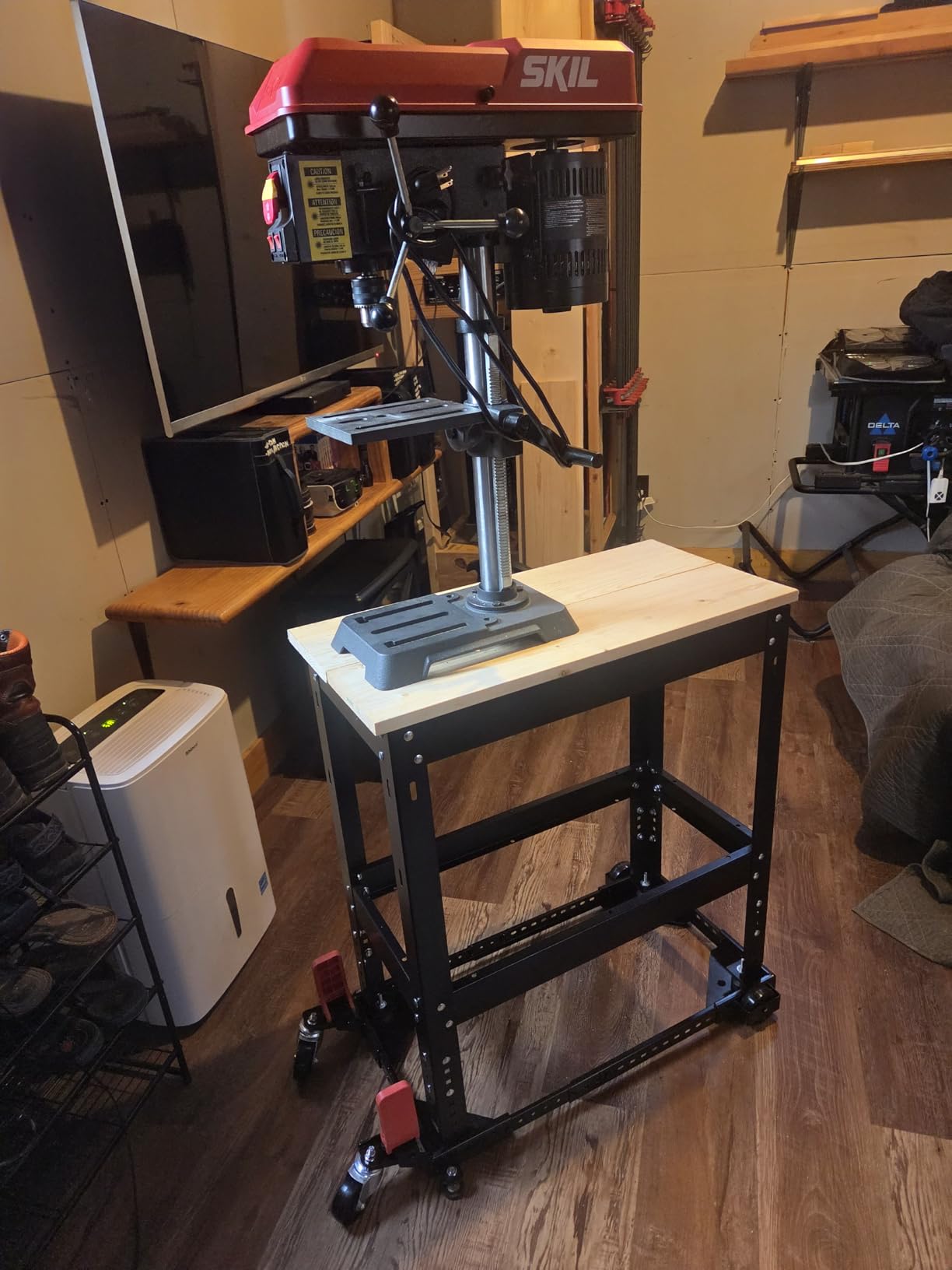
The trade-off is honest build quality. The center column and worm drive rack feel under-damped, with a slight free-spinning wobble, and the rack collar instructions genuinely confused my assembly. The table also drifts during height adjustment, which means the center hole can wander off the bit.
Most importantly for metalworkers, the stock chuck shows slight runout and the bit can tick off-center by about a sixteenth of an inch at full depth. On thin sheet with small twist drills, that is the difference between a clean hole and a snapped bit.
What 6.2 amps actually buys you
Motor amps translate to torque at the spindle, and torque is what keeps a large bit from grabbing and stalling. This machine has roughly two and a half times the current of the 8-inch WEN, and you feel it on every bit over a quarter inch.
That headroom is why reviewers commonly describe this as a press that drills steel on the slowest setting without complaint, which is exactly what a low-speed floor is for.
Where the quality control falls short
Across 521 ratings averaging 4.3, three themes repeat: assembly ambiguity around the rack collar, the free-spin wobble, and a small number of units arriving with a table tilt bolt that was not properly machined. None are dangerous, but all are irritating.
Buyers weigh the chatter up themselves. If runout bothers you, check the chuck on arrival with a dial indicator before you cut anything expensive.
3. JET 12-Inch Benchtop Drill Press JWDP-12 – Most Versatile for One-Press Shops
JET 12-Inch Benchtop Drill Press, Variable Speed, 1/2 HP, 115V 1Ph (Model JWDP-12)
Motor: 0.5 HP, 5A
Speeds: 530 to 3100 RPM variable
Swing: 12 inch
Weight: 85 pounds
Warranty: 5 year
Pros
- On-the-fly variable speed from 530 to 3100 RPM with no belt changes
- XACTA laser and LED work light speed layout and inspection
- Cast iron base and roller extension keep work stable
- Retractable roller extension speeds repositioning
- Post holder accepts a cross-slide vise from other makers
Cons
- 0.5 HP motor strains on large hole saws
- Table rack attaches at the base only
- leaving play at the top
- Table does not reach a full vertical position
- One owner reported the table arm loosening above 1000 RPM
This is the machine I recommend to someone who wants one press and plans to keep it. The difference is the variable speed drive: the spindle sweeps from 530 to 3100 RPM while you work, with no belt changes, so you can walk the speed down when a large bit grabs.
Owners with decades of tooling experience describe it as accurate, stable and well made, and at 4.5 stars across 249 ratings it holds up well against the cheaper presses here. The 85-pound cast iron base is the weight that matters, more than the 0.5 HP motor.
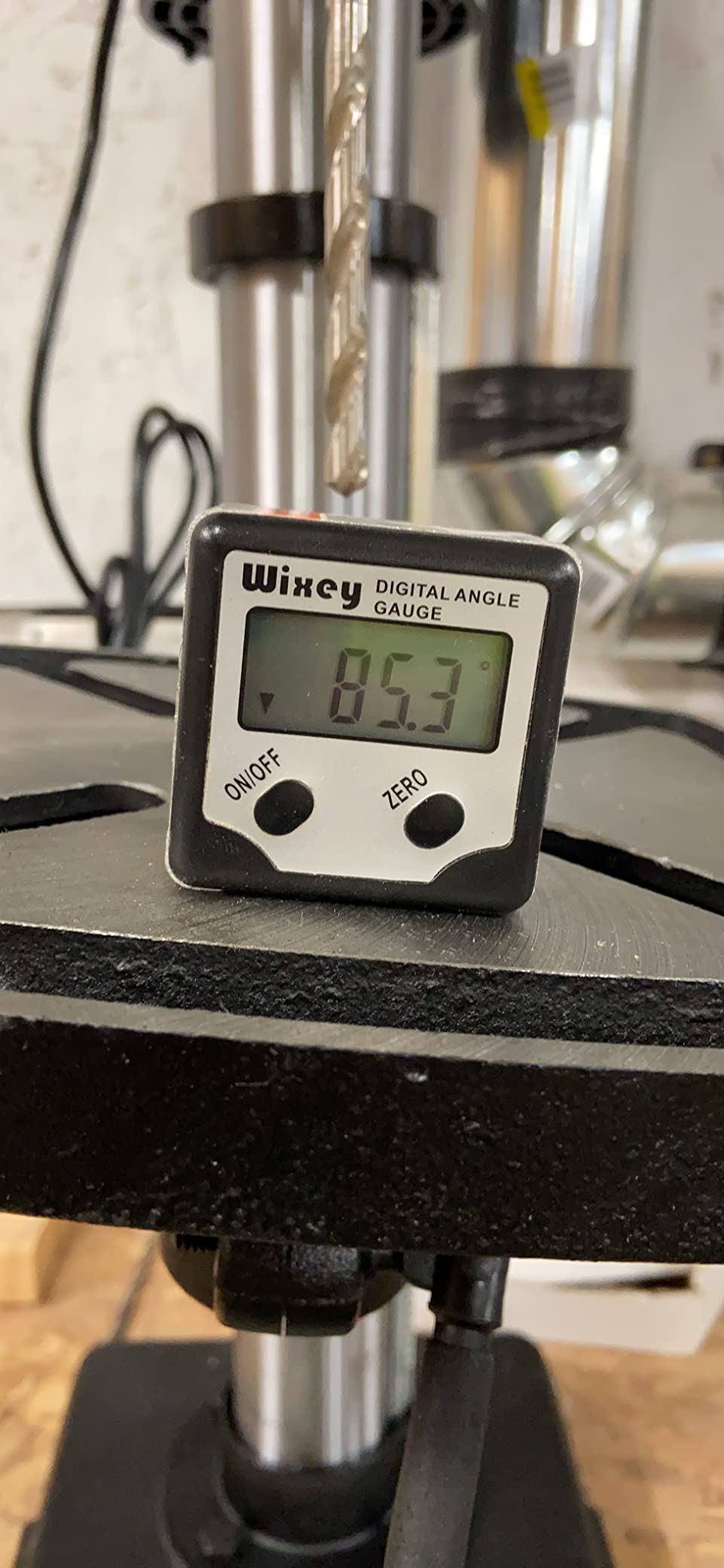
Two mechanical details separate a benchtop machine built for wood from one built for metal. The XACTA laser projects a crosshair that stays aligned as the head moves, and the roller table extension supports long steel bar so it does not sag into the bit.
The depth stop is a clear linear scale rather than a plastic rod, which matters when you are drilling the same hole pattern across a batch of brackets.
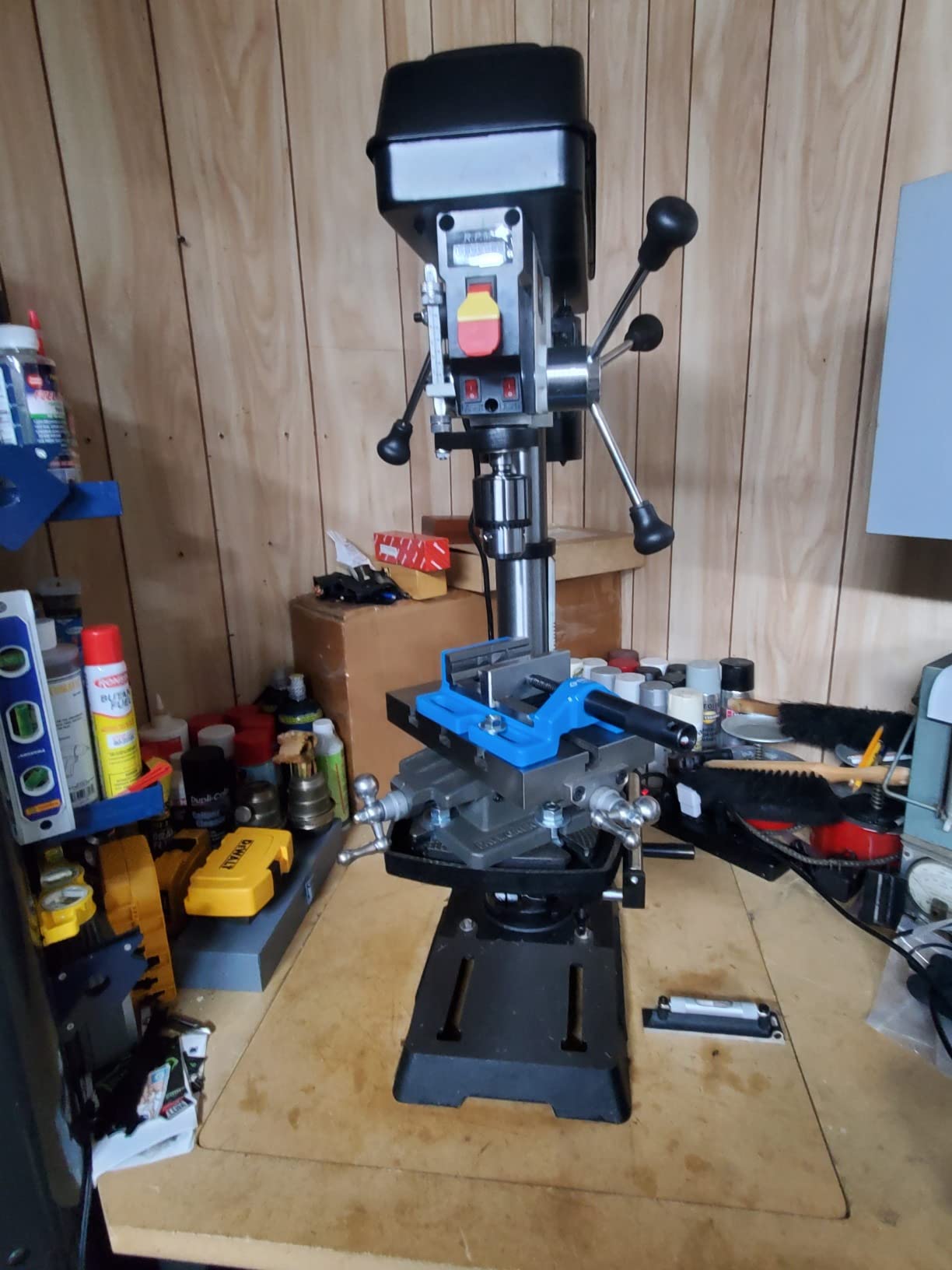
Why variable speed decides the metal question
A stepped belt press gives you discrete speeds that rarely match what a given bit in a given material wants. A continuous drive lets you set the surface speed and adjust it by feel as the bit heats up.
That matters most in stainless and hardened steel, where the correct speed is far lower than any benchtop press’s slowest stepped setting. Veterans on woodworking forums make the same point about their own metal work: a wide continuous low end beats many discrete steps.
Where it runs out of capability
The 0.5 HP motor is the ceiling. Owners report it straining with large hole saws and needing slow feed to clear chips. A half-inch annular cutter in thick steel is beyond it, and forcing it wears the motor and the drive.
The rack also attaches to the column at the base only, so there is play at the top of travel, and one reviewer reported the table arm loosening above 1000 RPM. Check the arm bolts before a production run.
4. BUCKTOOL 12-Inch Benchtop Drill Press DP12VL – Top Rated for Build and Control
BUCKTOOL 12-Inch Benchtop Drill Press, 580-3200 RPM, 6.2A 3/4 HP Motor
Motor: 6.2A, 3/4 HP
Speeds: 580 to 3200 RPM variable
Chuck: 1/32 to 5/8 inch
Swing: 12 inch
Travel: 2 inch
Pros
- 3/4 HP motor is stronger than the 5A motors typical of this class
- One owner measured effectively zero runout with a dial indicator
- Lever speed change with digital RPM readout
- Flat thin table edge is easy to clamp a vise to
- Emergency stop and no-voltage-release switches
Cons
- Round table is small and gives less clamping area
- Depth knob cannot lock the quill down
- Chuck key sits behind the spindle
- Tall 39 inch overall height and no manual in the box
Runout is the measurement metalworkers argue about most, and this is the one machine here where an owner reports measuring effectively zero on the mounted chuck with a dial indicator. That is a single report rather than a guarantee, but it is the kind of result the forums ask for and rarely get.
The control scheme is the other standout. A lever-operated speed change with a digital RPM readout means you set a number rather than guessing at a belt position, which reduces the chance of running a bit far above its recommended cutting speed.
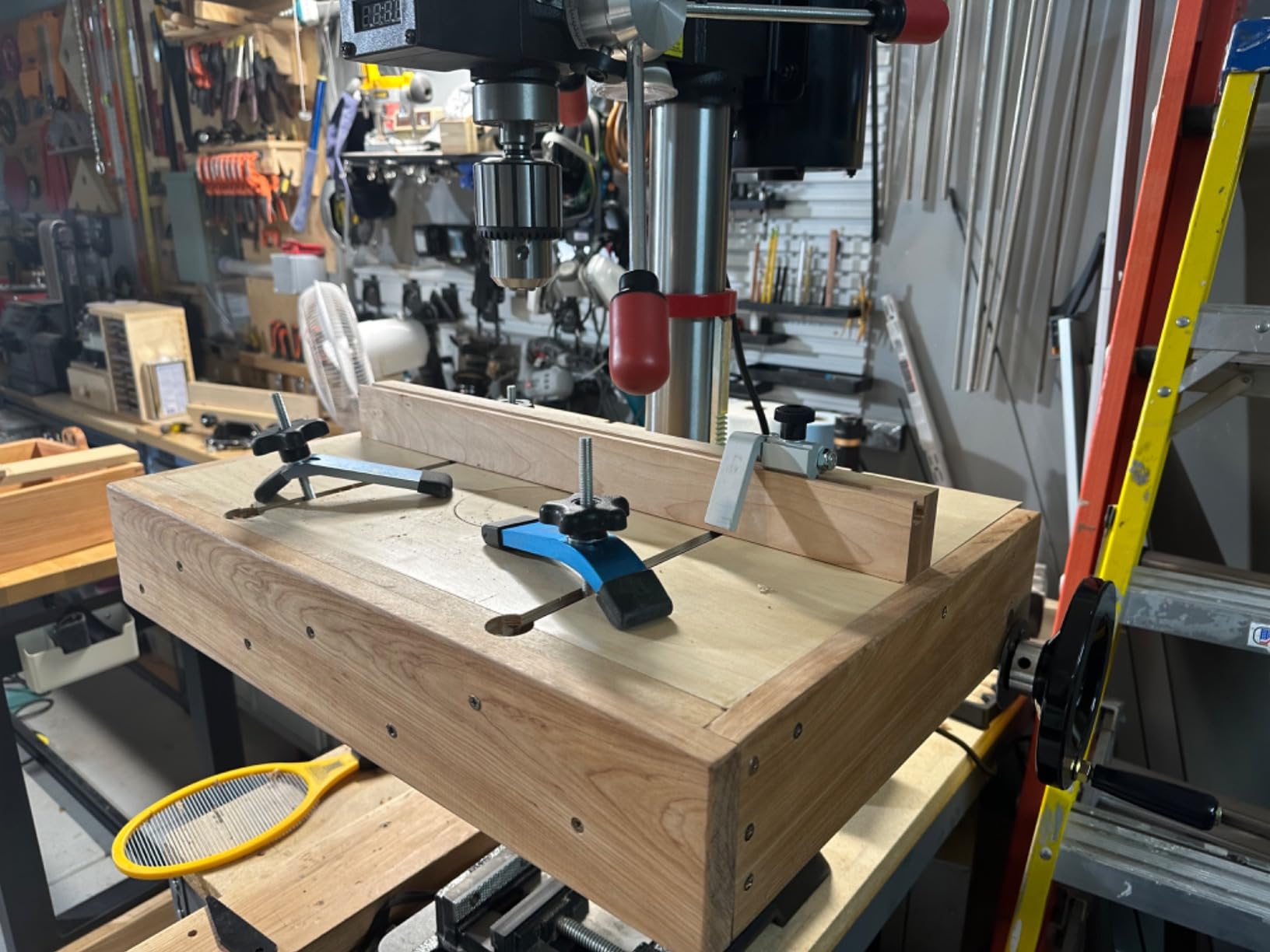
Owners compare the machining quality favorably to presses from ordinary home-improvement aisles, calling the build better than expected for the class. The castings are clean with no rough unfinished edges, and the base is robust cast iron.
Emergency stop and no-voltage-release switches are unusual on machines at this level and matter in a shared shop where someone else can reach the controls.
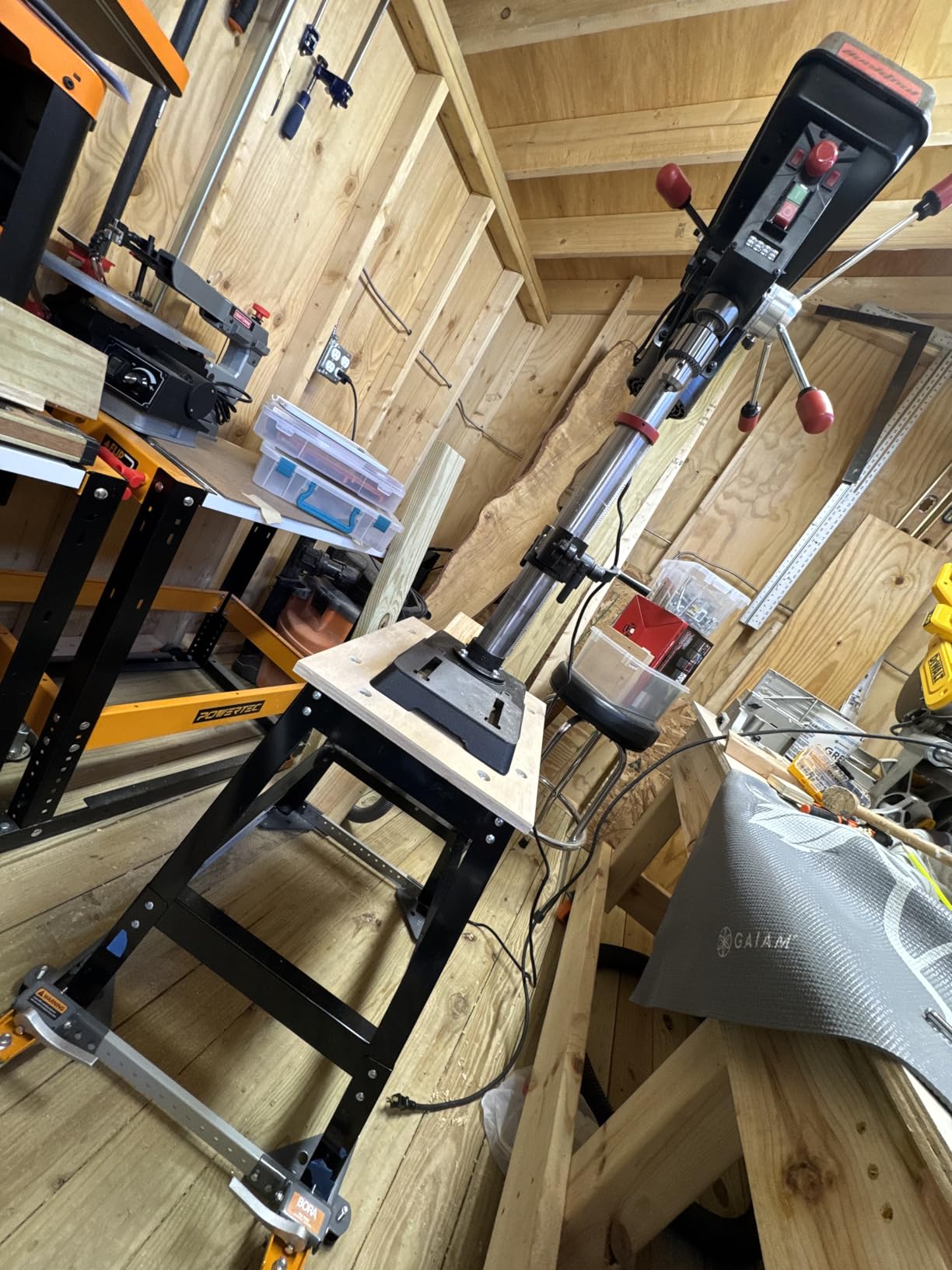
Why zero runout changes your bit life
Runout forces one cutting edge to lead the other. That edge takes a disproportionate share of the load, generates heat on one flute, and breaks long before the other wears. Halving the runout roughly doubles the practical life of a small twist drill in steel.
If you drill a lot of small holes in sheet metal, that is the difference between reordering carbide bits monthly and ordering them yearly.
What the design gives up
The table is small and round rather than square, which reduces clamping area, and the depth adjustment knob cannot lock the quill in a down position. On long boring operations you will want to hold the quill feed by hand rather than cranking it.
At roughly 39 inches tall it needs a proper stand rather than a light shop bench, and the chuck key stores behind the spindle where it is awkward to reach.
5. VEVOR 12-Inch 1 HP Variable Speed Benchtop Drill Press 1216BVS – Best for Thick Steel on a Bench
VEVOR 12-Inch Benchtop Drill Press, 6.2 Amp, 1 HP Bench Drill Press, 530 to 3140 RPM Variable Speed, 0-45° Tilting Worktable, with Laser and LED Work Light, Tabletop Drilling Machine, for Wood Metal
Motor: 1.0 HP, 6.2A
Speeds: 530 to 3140 RPM variable
Swing: 12 inch
Weight: 84.3 pounds
Table tilt: 0-45 degrees
Pros
- 1 HP motor with 12 inch swing gives more torque than typical presses at this level
- Variable 530 to 3140 RPM with digital readout
- X-laser guide reduces layout error on metal stock
- Reinforced metal worktable with height adjustment
- High-accuracy spindle design
Cons
- Listing copy positions the machine for woodworking and light metalwork
- Worktable tilt stops at 45 degrees with no vertical position
- Not positioned for heavy production duty
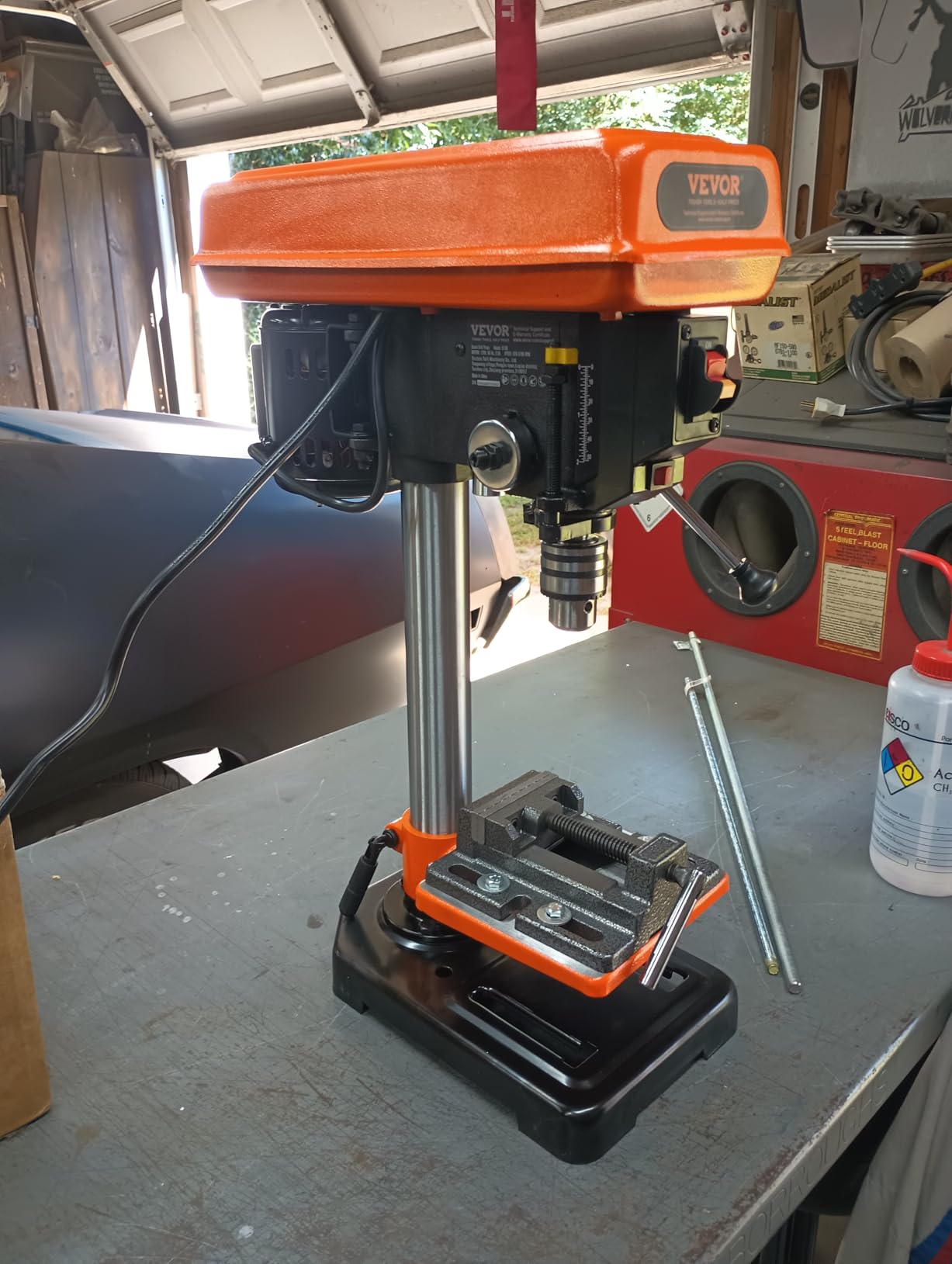
Most 12-inch benchtop presses in this roundup sit at 5 or 6 amps. This one carries a 1 HP 6.2 amp unit, and the headroom under load is why it can push a half-inch bit through thicker plate than the other 12-inch machines here. The 530 RPM floor is also lower than most competitors in the class.
At 4.6 stars across 161 ratings, the perception of power for the tier is consistent across reviews. Buyers view it as a capable light-to-medium duty press rather than a production machine, which is an honest description of what it is.
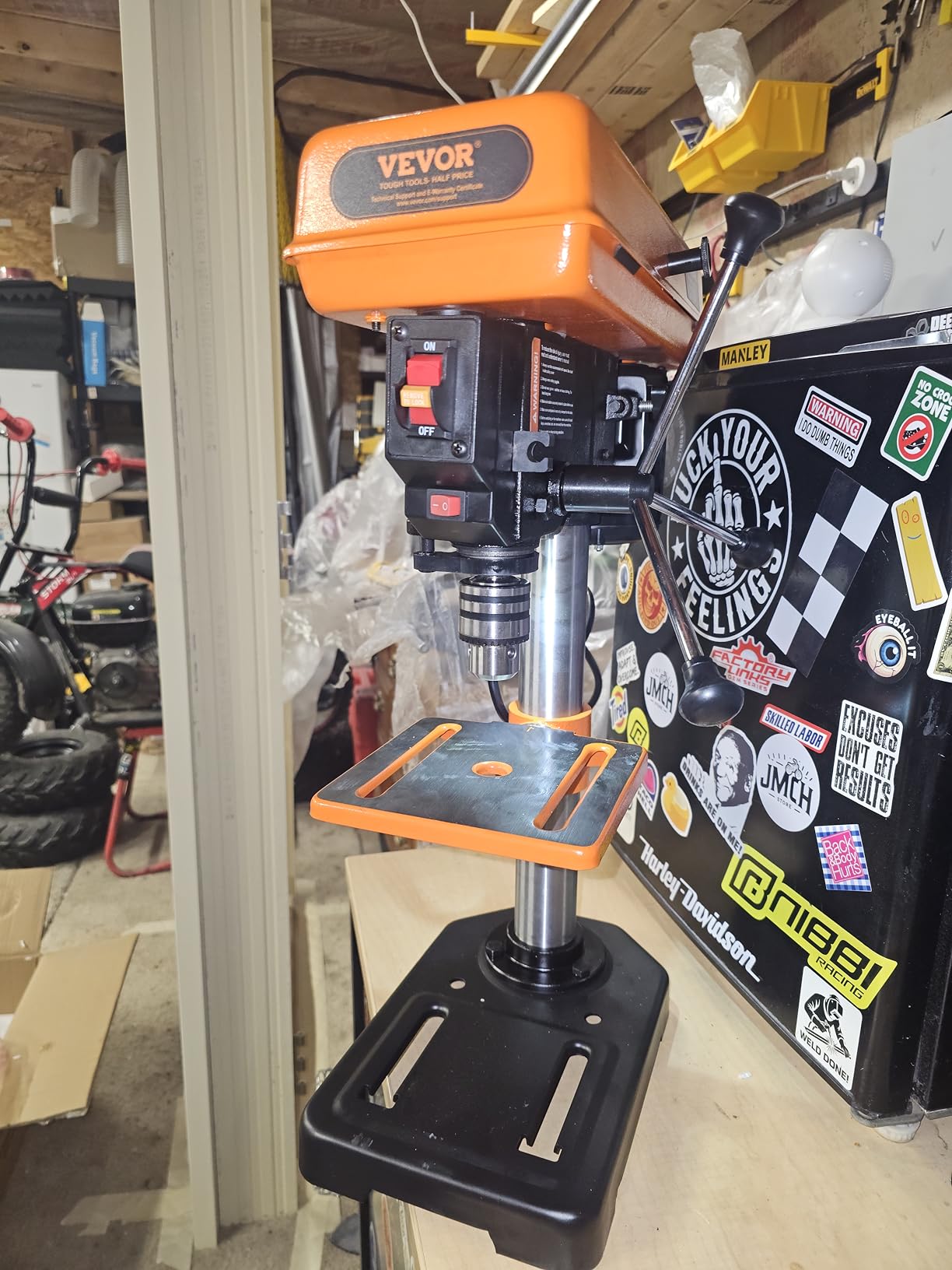
The digital readout and X-laser guide cover the two tasks that eat time on metal: setting speed and marking hole positions. The readout removes the belt-change guesswork entirely, and the laser keeps the layout visible even on dark mill scale.
The reinforced metal worktable is height adjustable and tilts to 45 degrees, which handles angled holes in thicker plate without a separate fixture.
How much torque 1 HP really gives you
Torque on the spindle comes from motor power divided by spindle speed. At the low end of the range, a 1 HP motor makes far more turning force than a half HP motor at the same RPM, and that is what lets a large bit cut instead of stall.
Practically, this is the benchtop machine to buy if your material is heavy plate rather than sheet, and if your 12-inch swing lets you use a 5/8 inch bit at all.
What the spec sheet does not promise
The listing positions the machine for woodworking and light metalwork, and buyers echo that. There is no spindle guard listed, the table does not reach vertical, and the manufacturer does not claim production duty.
If you need a machine you can leave running all day on production hole patterns, the JET 20-inch floor press in this roundup is built for that and this one is not.
6. JET 20-Inch Floor Drill Press JDP-20MF – Best for Production Work
JET 20-Inch Floor Drill Press, 12 Speed, 1-1/2 HP, 115/230V 1Ph (JDP-20MF)
Motor: 1-1/2 HP, 18A
Speeds: 12 from 150 to 4200 RPM
Swing: 20 inch
Spindle taper: MT3
Weight: 282 pounds
Pros
- 1-1/2 HP is the highest output in this group and handles heavy metal
- 150 RPM floor gives real control on large bits and taps
- Ball-bearing supported spindle lowers friction under load
- External positive depth stop with three-nut locking
- Rotating 45 degree tilting crank table with quick-release clamp
Cons
- 282 pounds and 66 inches tall needs a dedicated floor location
- Only a 2 year warranty despite the premium tier
- Small review base of 90 ratings limits long-term evidence
The 150 RPM floor is the headline here. Few presses in this roundup reach that low, and it is exactly what hardened and stainless work needs, because you can drop to a speed where the bit shears chips instead of rubbing them into a blue ring and work-hardening the hole wall.
At 282 pounds with a cast iron base and column, this machine does not deflect when you push a bit off-center. That mass is the reason it feels stable at 4200 RPM as well as at 150.
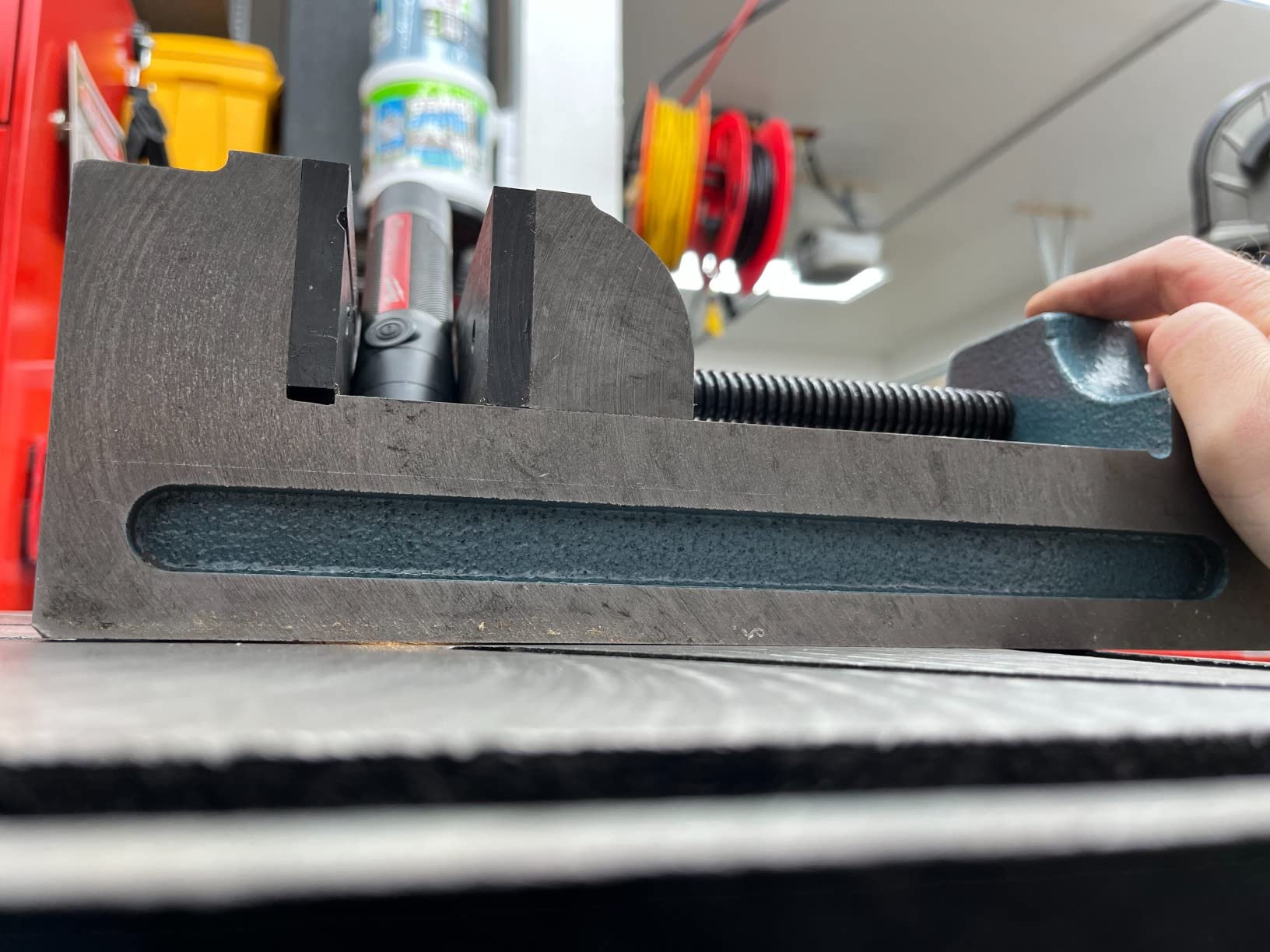
Several details show this was designed for a working shop rather than a display bench. The hinged belt and pulley cover with a quick-adjust motor mount makes speed changes fast. The external positive depth stop with a three-nut lock gives repeatable blind hole depth across a batch of parts.
The spindle runs on a fine ball bearing rather than a plain bushing, which lowers friction and improves load support on large taps and cutters.
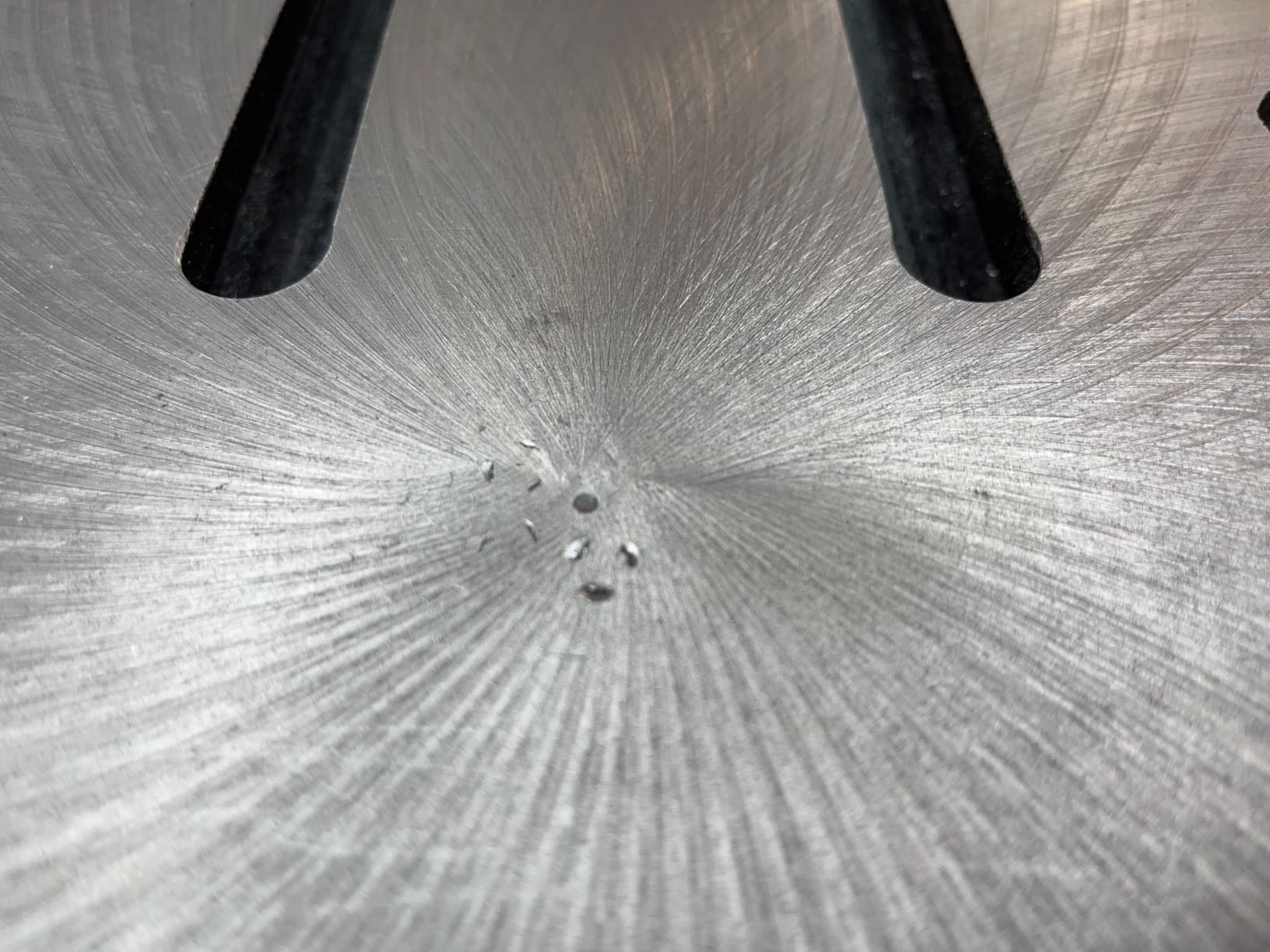
When a 20-inch floor press is the right answer
Buy this tier when your material exceeds what a 12-inch benchtop can hold, when you run the same hole pattern repeatedly, or when holes larger than a half inch are routine. The 20-inch swing accommodates large circular bolt patterns and big annular cutters.
Users on machining forums describe drilling out set screws daily and reaching for a radial instead of a drill press when wrist fatigue becomes the limiting factor, which is a signal that you have outgrown knee or bench type machines.
What you give up for the extra mass
Two things. This press weighs 282 pounds and stands 66 inches tall, so it needs a dedicated floor position and cannot be moved by one person. And the warranty is two years, the shortest in this roundup despite the premium tier.
With 90 ratings averaging 4.4, the long-term evidence is thinner than for the cheaper machines here, so go in expecting to inspect bearings and belts at purchase rather than assuming.
7. VEVOR 10-Inch Benchtop Drill Press DP1006L – Best Starter Press for a Small Shop
VEVOR Benchtop Drill Press, 3.2 Amp and 5-Speed Adjustable Drill Press with 10 in Swing, Cast Iron Frame, Worktable Tilts 0-45°, Ideal for Drilling Wood & Metal
Motor: 3.2A induction
Swing: 10 inch
Speeds: 650 to 3100 RPM
Table tilt: 0-45 degrees
Weight: 41.9 pounds
Pros
- Cast iron frame keeps the press planted and cuts without chatter
- Chuck ran true and aligned straight out of the box
- 10 inch swing gives 5 inches of clearance
- Heat dissipation design supports longer run time
- Complete accessory kit including chuck and feed handles
Cons
- Slowest speed of 650 RPM is too fast for large hole saws
- Speed changes need manual belt moves and the motor swings free
- Assembly takes longer because the rack must thread through the support
- Inconsistent quality control including a scraping motor and rusty base
This is the least complicated machine in the roundup and the one most likely to be the right first drill press for someone in a small shop. The cast iron frame is the deciding feature, because most machines at this level use steel and the difference shows immediately in chatter on steel stock.
One owner reported the chuck running true and aligned straight out of the box, which is not guaranteed on any budget machine but is the single most important early check.
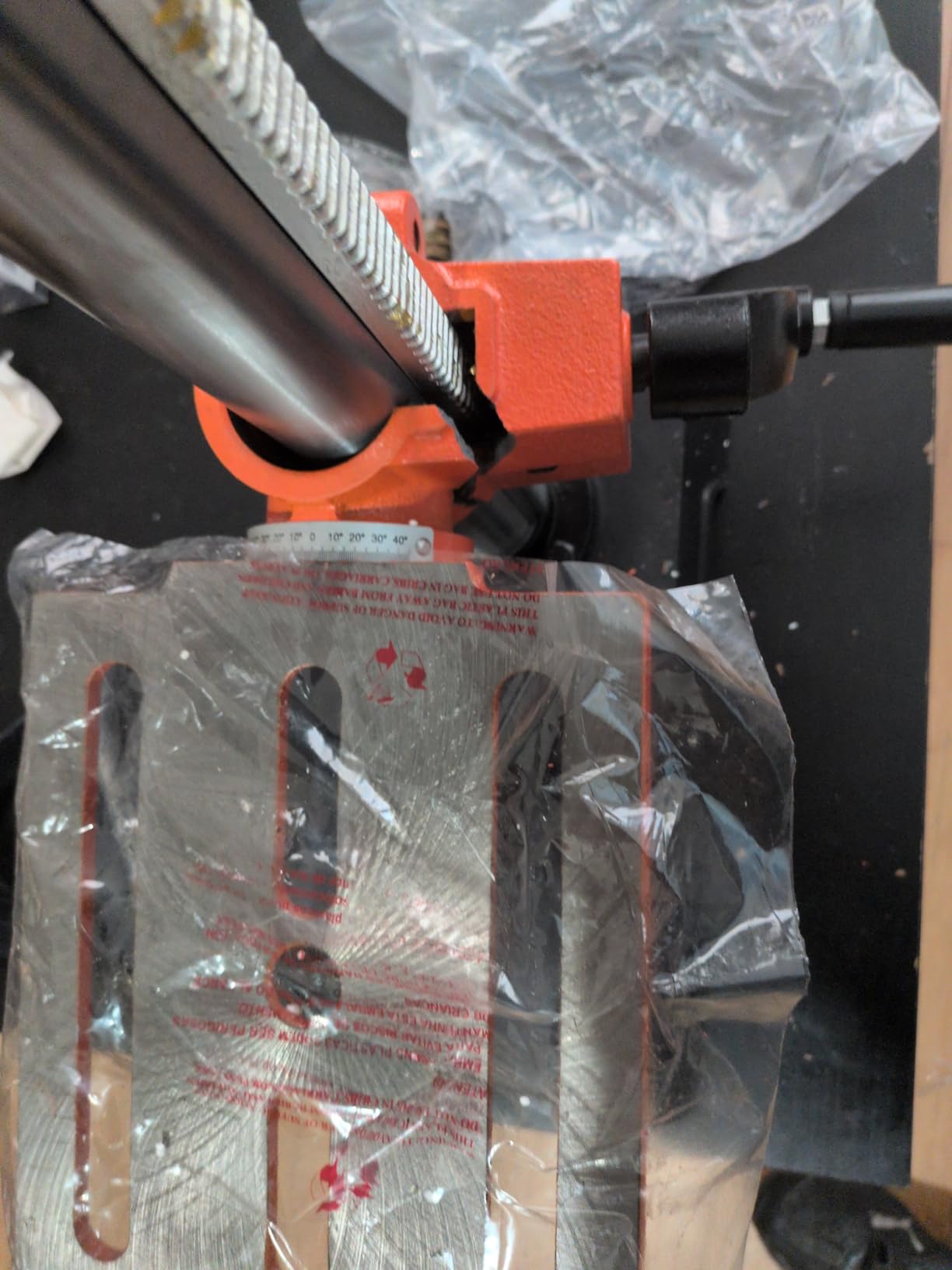
The 10-inch swing gives 5 inches of clearance, which is a real step up from 8-inch machines at similar price points and lets you use larger bits than the compact presses allow.
The heat dissipation design is worth noting for metal specifically. Steel generates more heat than wood for the same cut, so a machine that sheds heat runs cooler and keeps bit edges alive longer.
Why cast iron matters more than horsepower
Side load is what breaks twist drills. When the bit deflects, a fraction of its cutting force pushes sideways against the machine, and a light frame lets the whole assembly move with it. A cast iron frame resists that, so the bit stays aligned with the hole.
The practical test: drill the same hole twice, once in the same machine and once in a steel-framed one of similar power, and compare how often you have to back the bit out to clear chips.
Where new owners get frustrated
The 650 RPM floor is too fast for large Forstner bits and hole saws, and speed changes require moving the belts by hand with the motor swinging free once the nut is loosened. Assembly also takes considerably longer than expected because the rack has to be threaded through the table support before mounting.
Quality control is inconsistent across this class, with reports of a motor making a metal scraping sound and a rusty base on arrival. Inspect everything before you start cutting.
8. JET 15-Inch Benchtop Drill Press J-2530 – Best for Deep Boring and Tapping
JET 15-Inch Benchtop Drill Press, 16 Speed, 3/4 HP, 115/230V 1Ph (Model J-2530)
Motor: 0.75 HP
Speeds: 16 from 200 to 3630 RPM
Quill travel: 3-1/8 inch
Weight: 157 pounds
2 year warranty
Pros
- 16 speeds from 200 to 3630 RPM give fine control for bits
- hole saws and taps
- 1-7/8 inch quill with 3-1/8 inch travel handles deep-hole work
- Large ground steel column supports heavy head and table loads
- Four permanently-lubricated ball bearings in an enclosed spindle
- Telescoping safety spindle guard
Cons
- 2 year warranty is the shortest of the JET machines here
- 157 pounds is effectively a two-person move
- Lowest rating in the group at 4.1 with a 13 percent one-star share
This is a geared head machine in a benchtop body, and that distinction explains almost everything about it. Sixteen discrete speeds selected mechanically at the head means the speed is set before you start, and it stays put no matter how the motor load changes.
The 3-1/8 inch quill travel on a 1-7/8 inch diameter quill is among the deepest in this group. For deep holes in thick plate, or for using a depth stop on blind holes, that extra inch of travel is what stops you reaching the bottom of the stroke with the chuck still above the work.
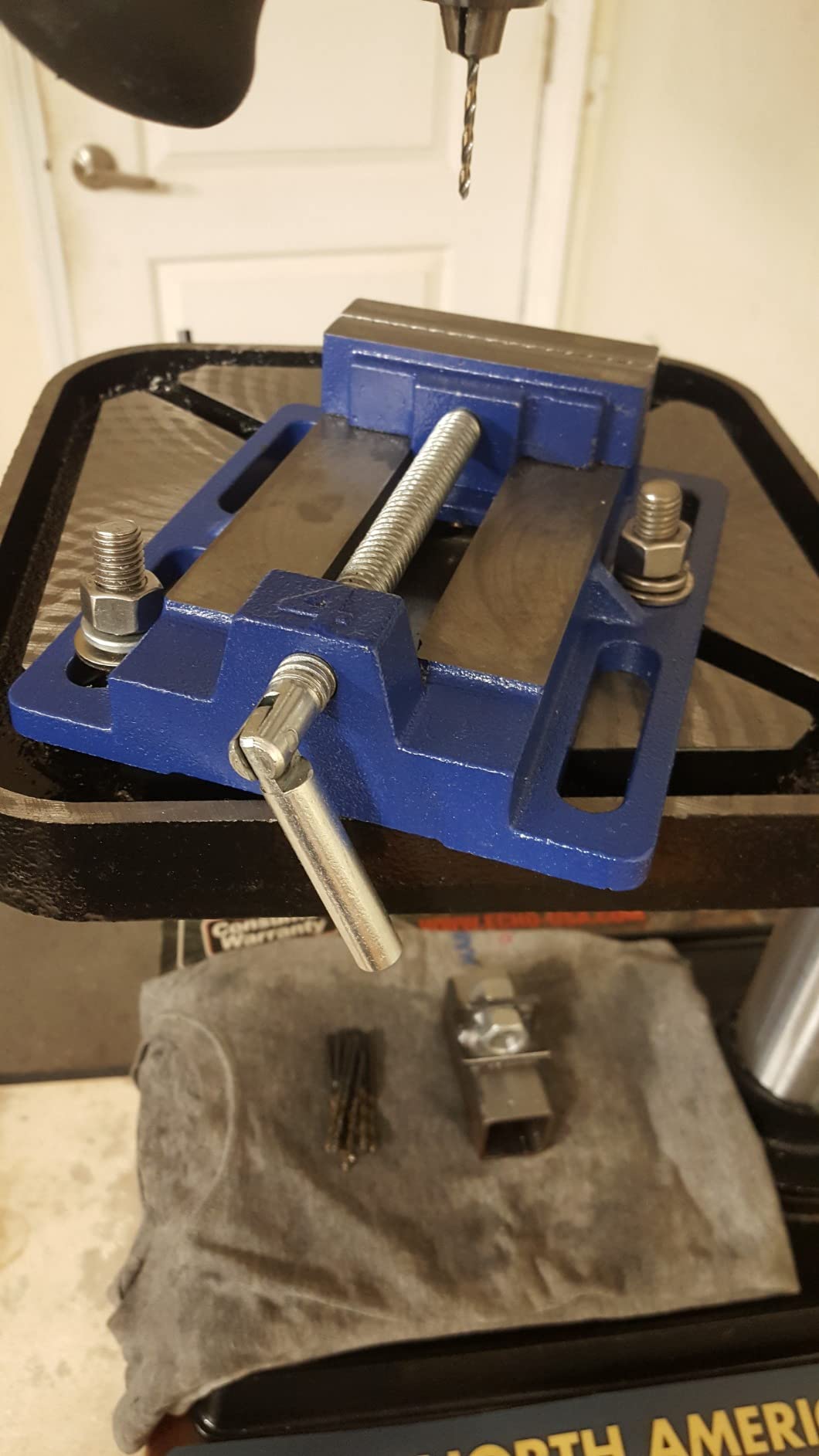
The large ground steel column is another differentiator. It supports the head and table loads without the flex you get from a welded or lighter column, which matters when the head is extended far out for a large workpiece.
The spindle is enclosed and runs on four permanently-lubricated ball bearings, and there is a telescoping safety spindle guard around the chuck area.
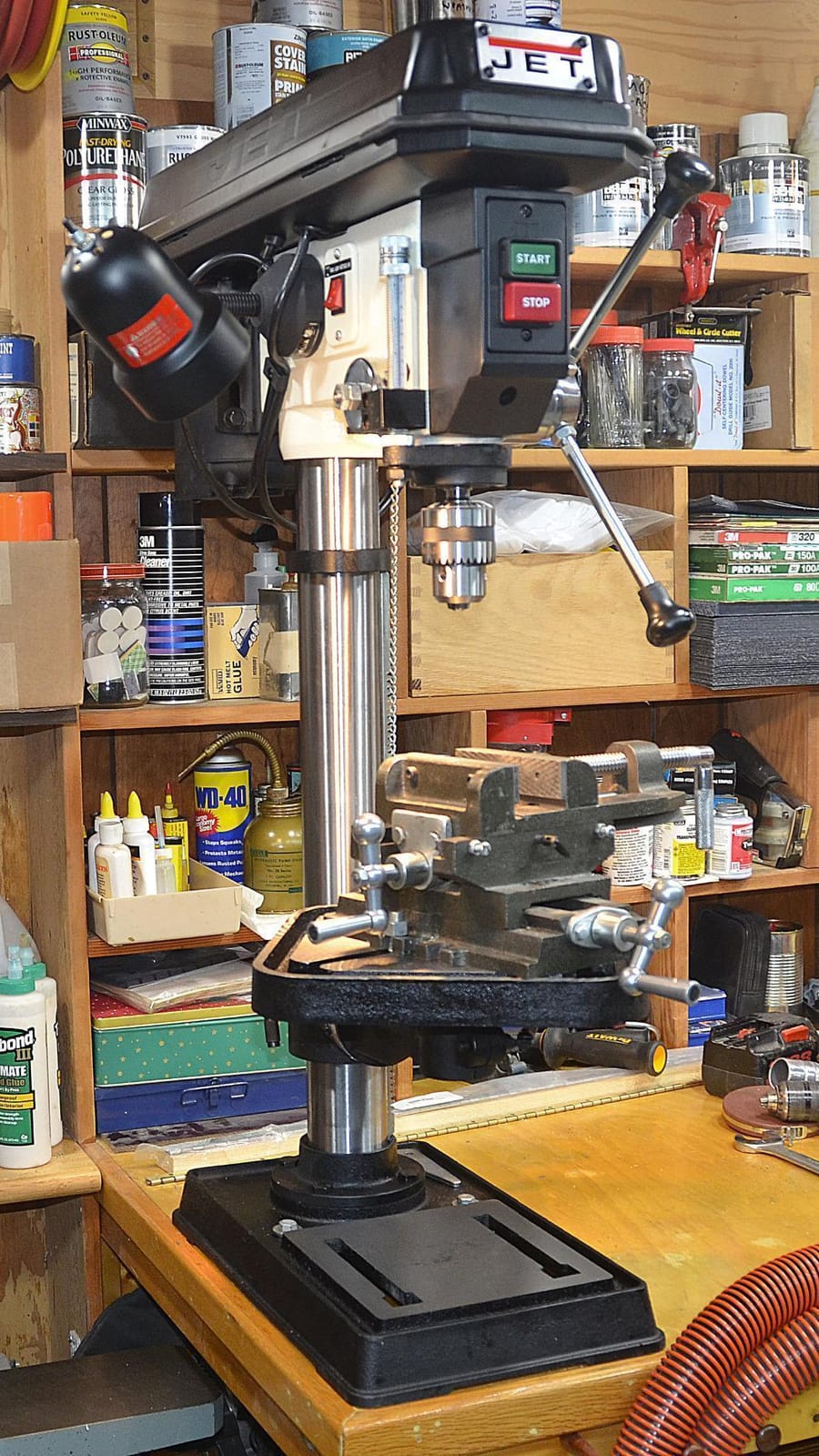
Geared head speed versus variable speed drive
Both approaches work. A geared head gives mechanical gear reduction with no belt to slip and no speed drift under load, which some operators prefer for tapping where a consistent speed matters.
A variable speed machine lets you trim the speed during the cut, which some operators prefer when a large bit grabs. The stepped 16-speed range from 200 to 3630 RPM here covers most metal work without either compromise.
Why the rating sits lowest in this group
At 4.1 stars across 49 ratings, this machine has the lowest score and the largest one-star share in the roundup at 13 percent. Sentiment centers on warranty length and the bulk of the machine rather than on its capability.
Be aware that at 157 pounds this is not really a benchtop machine despite the label. Plan the lift with a second person or an engine hoist, and check floor loading if you install it on a stand.
9. RIKON 12 Inch Variable Speed Drill Press 30-212VS – Best for Larger Holes
Rikon 12 inch Variable Speed Drill Press
Motor: 0.75 HP
Chuck: 5/8 inch
Metal capacity: 1 inch listed
Speed: variable
Warranty: 5 year
Weight: 110 pounds
Pros
- Listed 1 inch metal capacity
- the highest in this selection
- 5/8 inch chuck accepts larger bits than 1/2 inch machines
- 5 year warranty is among the longest offered
- Digital RPM readout
- LED work light and laser X-Y guide for layout
- Clamp-friendly thin-edge table
Cons
- Only 35 ratings
- so long-term durability is not well documented
- Two-star reviews make up 9 percent of the total
- No numeric speed range published
- Thinnest evidence base in the roundup
The reason to look at this machine is the chuck. A 5/8 inch chuck accepts larger bits than the 1/2 inch chucks on most machines in this roundup, and it is paired with a listed 1 inch metal capacity, which is the highest figure any machine here carries.
Larger chuck capacity matters because it changes what you can do without a bit adapter. Taps over a half inch, big annular cutters and larger reamers all need the bigger bore.
The 5-year warranty is also among the longest offered in this roundup, which matters if you plan to run it as a shop machine rather than an occasional tool.
What the layout features are worth
A digital RPM readout with LED work light and a laser X-Y guide covers the same two time-saving tasks as the higher-priced machines: set speed without guessing, and mark hole positions accurately on dark steel.
The thin-edge table is designed so a clamp or vise can grip the edge of the table itself, which keeps the workpiece from shifting when the bit first bites.
Why the small review base matters
With 35 ratings and 9 percent of reviews at two stars, this is the thinnest evidence base in the roundup. Sentiment is mixed, and long-term durability is genuinely not documented.
My advice is to treat the specs as promising but unproven, check the chuck runout with a dial indicator on arrival, and confirm the actual low-speed range with the readout before you commit to a job that needs it.
10. WEN 12-Inch 6.2-Amp Variable Speed Benchtop Drill Press DP1263V – Best Feature Set
WEN 12-Inch Benchtop Drill Press, 6.2-Amp Variable Speed Motor with Cast Iron Construction, Laser and LED Work Light (DP1263V)
Motor: 6.2 amp induction
Speeds: 580 to 3100 RPM variable
Swing: 12 inch
Travel: 3-1/8 inch
Weight: 88 pounds
Pros
- Mechanical variable speed with external control means no belt changes
- Bright 4-digit digital readout
- Laser and LED light recessed and protected in the head
- 5/8 inch chuck with onboard key storage
- roller extension and depth stop included
- 3-1/8 inch spindle travel is generous for a benchtop
Cons
- Table arrived out of level by about 1.5 mm with no adjustment provision
- 45 degree tilt bolt is hard to access
- Table drifts during height adjustment
- Included knuckle clamps are low quality
- 88 pounds needs a properly sized stand
This machine pairs two features that rarely share a benchtop press: a 5/8 inch chuck and 3-1/8 inch of spindle travel. That travel is longer than most machines in this roundup, and it means a depth stop on a blind hole is practical rather than marginal.
The external speed control is mechanical rather than electronic, and it works well. The recessed laser and LED light sit inside the head with their own toggles, so they are protected from the swarf that would destroy a surface-mounted unit.
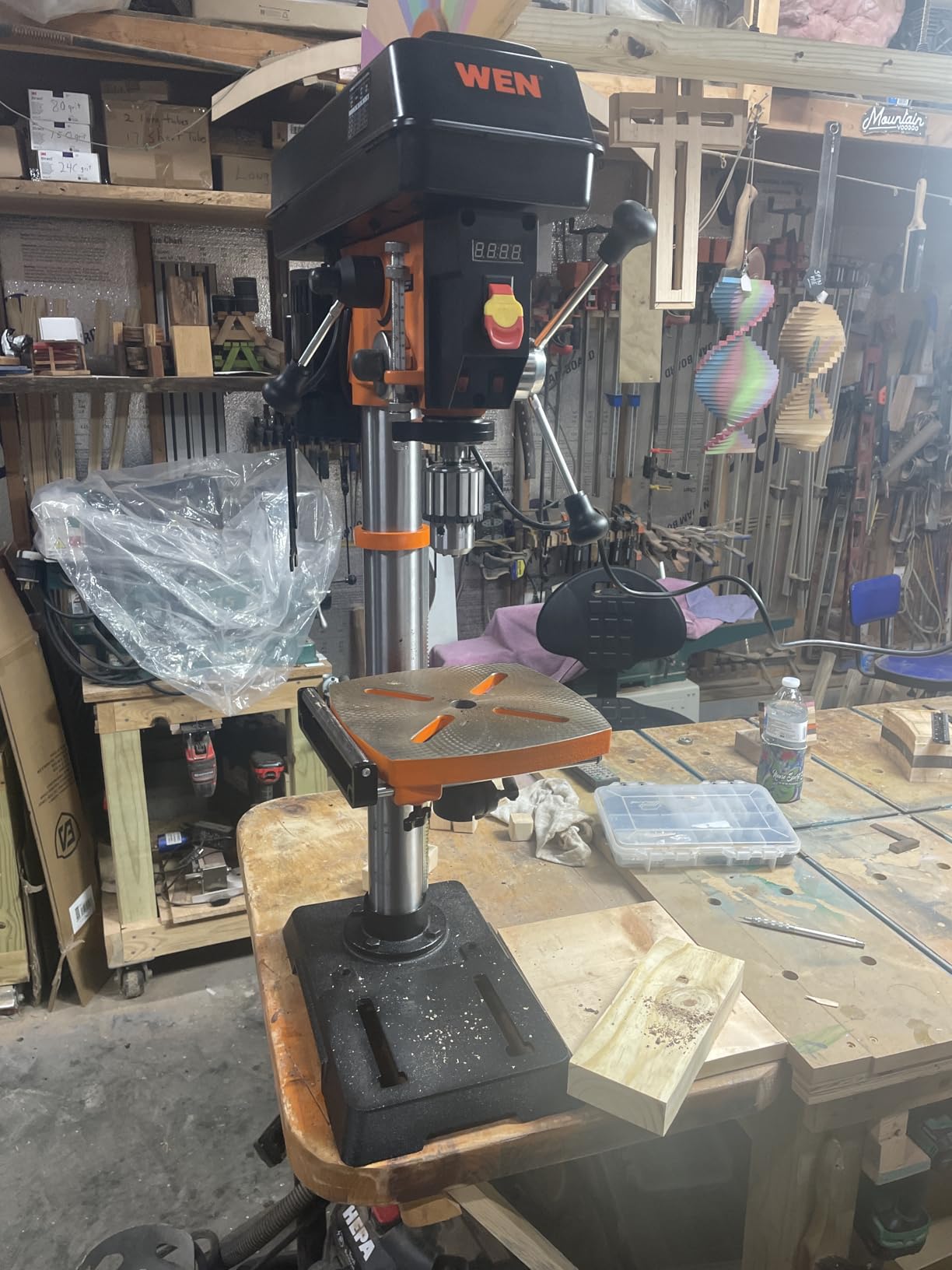
Owners consistently praise the build quality and the integrated laser and light, and several compare feature parity favorably against a JET in the next price band up.
The chuck key stores onboard, which is a small detail that matters in a shop, because a missing chuck key stops a job outright.
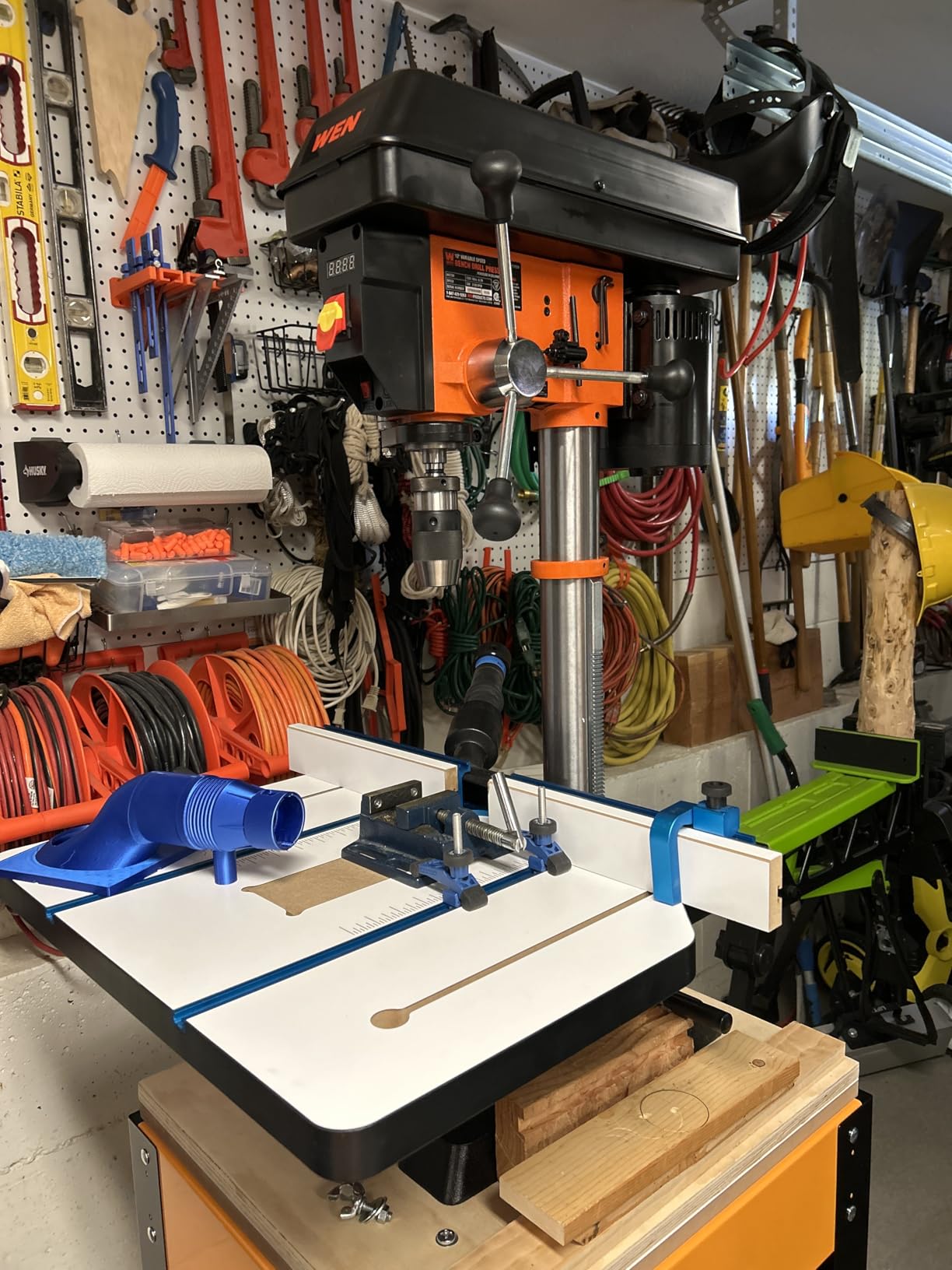
What 3-1/8 inch of travel buys you
Spindle travel determines how deep a hole you can drill before the chuck would strike the worktable. On a blind hole you set a depth stop and drill to it without ever bottoming out the quill.
On this machine the extra inch of travel also adds about two inches of clearance at the lowest table position, which lets you work on taller stock without raising the table to the point where alignment gets awkward.
The table problem worth checking on arrival
The most consistent complaint across 97 ratings is an out-of-tolerance table. Some buyers received one out of level front-to-back by roughly 1.5 mm with no adjustment provision, and shimmed it themselves.
Check table level with a machinist square before your first cut, replace the low quality knuckle clamps, and budget for a stand rated for 88 pounds rather than a light shop bench.
How to Check Spindle Runout on a Used Drill Press
Runout is the measurement that decides whether a used press is worth the asking price, and it takes about fifteen minutes with a dial indicator. You do not need to know anything about machining to do it, and the acceptance target is simple: under 0.002 inch total indicator reading for general metalwork.
- Get a dial indicator with a magnetic base. A 0.001 inch graduations indicator is what machinists expect. A digital indicator works too if that is what you own.
- Install the chuck and tighten it properly. Mount the chuck on the spindle taper, snug the tapered bore with the drift key or provided key, then tighten evenly. Loose chuck mounting is one of the most common causes of apparent runout, so do this before measuring.
- Mount the indicator in the chuck. Clamp the indicator body to the chuck body, not to the jaws. Put the plunger on the outside of the jaw, near the tip where the bit will be.
- Rotate the chuck by hand and watch the needle. Turn it slowly through a full rotation. The needle will climb to a maximum and drop to a minimum, and the difference between the two readings is your total indicator reading.
- Repeat at two depths. Check again a half inch further up the spindle. If runout grows as you move away from the spindle nose, the problem is the spindle taper or bearings. If it is constant, the problem is the chuck, and swapping the chuck is cheap.
Then check for spindle wobble by pulling the quill down with the feed handles and rotating it. Movement you can feel at the handle end is play in the quill bearings and means the machine needs bushing or bearing service.
Members on machining forums treat zero visible runout and quiet operation as the acceptance test for a used machine, and that is a sensible pair of criteria. Noise is a proxy for bearing and quill quality that costs nothing to assess: if you can hear it from across the room at idle, something is dry or worn.
Benchtop vs Floor vs Geared-Head Drill Presses
Most buying mistakes come from picking a machine by price rather than by duty. The three tiers are not better and worse versions of each other; they are built for different hole diameters, materials and workloads.
Benchtop presses, 8 to 12 inch swing. These suit holes up to about a half inch in sheet metal and thin plate, mild steel work, and small taps. A 1/2 HP to 3/4 HP motor is enough for gauge material and inadequate for thick plate or hardened steel. They bolt to a bench and cost the least. Watch the two failure points: the lowest RPM and the chuck runout.
Floor presses, 15 to 20 inch swing. The swing determines the largest circle you can drill, so a 20-inch machine handles large bolt patterns and big workpieces that simply will not fit past a benchtop column. The 1-1/2 HP class reaches 150 RPM, which is the threshold for serious stainless and hardened work. They are heavy, need a floor location, and are the right answer for a fabrication shop that drills steel daily.
Geared head presses. Speed is selected mechanically at the head rather than at the belt cover, so speed cannot drift under load. This is the traditional heavy shop configuration and it is what most of the respected vintage iron shares: Delta, Rockwell, Cincinnati Bickford, Erlo, Ibarmia, Fosdick. For tapping and long production runs where a consistent speed matters, a geared head has an advantage that no variable drive fully replicates.
Radial arm drills. Different geometry entirely: the head travels along a horizontal arm, which makes overhead and along-the-arm drilling straightforward. One longtime operator on a machining forum describes drilling out set screws daily on a 9-inch radial without using the mill, which is evidence that head and column rigidity beats spindle flexibility for repetitive small holes.
Used and Vintage Drill Presses Worth Buying
The most trusted recommendations for this topic do not appear on any retailer page. They sit in forum threads, and they repeatedly name machines that have not been manufactured in decades. That is worth taking seriously before you buy new.
On the Practical Machinist forum, a thread asking for stout used iron with minimal spindle runout draws recommendations from Ellis Manufacturing, Knuth Machine Tools, Alzmetall AB40, Erlo, Ibarmia, Cincinnati Bickford Super Service, Leland-Gifford, Chas Allen, Avey, Cleereman, Fosdick and Arboga. Operators there report 20 years of ownership of Erlo presses with no problems and describe Knuth as a pleasure to use and pretty heavy duty.
The same thread frames Ellis Manufacturing as one step above imported machines, and suggests the better Arboga, Cincinnati Bickford Super Service and Fosdick presses may redefine heavy. That is the vocabulary of people who buy these machines to work with, not to collect.
On the Garage Journal forum, recommendations center on the Delta 17-950 and JET JDP17, with a used Rockwell or another geared press suggested when the work is genuinely heavy. A buyer on r/metalworking asked for a 17-inch floor press with no bells and whistles, looked hard at a used Delta 17-965 in near new condition, and named no visible runout plus quiet operation as the acceptance test.
What that buyer said about Powermatic and JET as the new-purchase benchmark is the most useful framing available: they are the reference point for what a new press is supposed to feel like, so a used machine has to meet a comparable standard to be worth the risk.
If you buy used, run the runout procedure above before you agree on a price, then run the spindle for five minutes at every speed step while you listen. Check the quill for play, look for rust on the rack and the table lock, and confirm the motor does not hum unevenly. If the machine has powerfeed, treat it as a plus for production drilling rather than a requirement for hobby work.
Drill Press Safety That Applies to Metal
Drill presses cause more workshop injuries than most tools in the shop, and nearly every one of them comes from four avoidable behaviors.
Clamp the work. Never hold it. This is the rule that matters most on metal, because steel grabs a bit and pulls itself into the bit, and a spinning workpiece will take your hand with it. Use a strap clamp, a bench vise, or the machine vise. If you can hold it by hand without the bit pulling, it is not clamped.
Remove the chuck key before starting. This is the most common serious injury on drill presses, and it happens because the key stays in the chuck on the next job. Make a habit of hanging the key on the board, not leaving it in the chuck.
No gloves, no loose sleeves, no long hair near the spindle. Work-hair entanglement is a documented hazard on drill presses with a quill and chuck assembly. Gloves seem helpful and are not, because a glove can be caught and pulled into the chuck regardless of how slow the spindle turns.
Wear eye protection and stop when the bit grabs. A broken twist drill in cast iron can throw chips hard enough to injure at arm length. And if the bit binds, release the feed pressure and back it out rather than holding on, because the workpiece wins that contest.
Finally, keep the spindle guard and any table lock engaged where the machine provides them, and make sure the column is bolted to a solid surface so the whole assembly does not rock under side load.
Drill Bits and Hole-Making for Steel, Stainless and Cast Iron
Choosing the best drill presses for metalworking matters less than choosing the right bit, because a correct hole in mild steel is a spoiled job in the tool holder. Four bit decisions cover most metal drilling.
Cobalt HSS for mild and stainless steel. Cobalt raises the heat resistance of high speed steel, which is exactly the failure mode in steel. Use cobalt for stainless and for anything where you will be running the bit near its limit. Regular HSS is fine for mild steel in a light duty cycle.
Carbide for cast iron and hardened steel. Cast iron is abrasive and produces no chip, so a carbide edge that does not need a chip breaker outperforms HSS. Carbide is also the only sensible answer on heat-treated or hardened material, because a twist drill has to slide rather than cut there.
Annular cutters for holes over about an inch. A twist drill larger than an inch in diameter puts enormous torque on the outer corners and will bind and stall in plate. An annular cutter shears only a narrow ring at the outside edge and feeds far more easily. Where a press cannot reach the torque, a magnetic drill press with annular cutters is the answer.
Pilot drilling and step-ups. For a large hole in solid material, drill a pilot hole, then step up in increments of roughly half the previous diameter, then finish to size. Apply cutting fluid at every step.
On speed, use a conservative surface speed and adjust for the result rather than trusting a chart blindly. Mild steel runs fastest, stainless roughly half as fast, cast iron slower still, and hardened tool steel slowest of all. If chips turn blue or the bit starts to squeal, you are too fast. If the bit is rubbing rather than cutting and the hole edge is discolored, you are too slow.
When a Drill Press Is the Wrong Tool
Three jobs in a metal shop do not belong on a drill press, and recognizing them saves a ruined workpiece.
Field and structural work. A magnetic drill press attaches to steel wherever it stands, which means a bridge, a girder or a plate already welded into place needs no bench and no power drop. With annular cutters it handles holes that a twist drill press would stall on.
Large holes in thick plate. As covered above, anything over about an inch diameter belongs to an annular cutter on a magnetic press or a radial drill rather than to a benchtop machine.
Anything needing a square, flat-bottomed or accurate hole position in depth. That is a milling operation. The consensus on hobby machining forums is consistent: a magnetic press with annular cutters covers some of the use cases people buy a drill press for, and the remaining cases are better served by a mill.
Add to that list any job where the workpiece will not sit still. If the material has to be held by hand to reach the bit, the correct fix is a radial drill with a stronger column or a jig, not a faster feed speed.
How to Choose a Drill Press for Metalworking
Work backward from the hardest job you expect to do regularly, because that job sets every spec. Then compare machines on six criteria in this order.
1. Find the lowest RPM you can actually hold. This is the single most important spec and the one most often overlooked. Check the speed control method, not just the maximum. A machine that advertises a wide range but steps between belts is not the same as one you can trim continuously. The people who care most about this ask for 300 RPM or lower.
2. Assess swing against your workpiece. Swing is the distance from the spindle to the column. Your largest workpiece diagonal must fit, with clearance for the chuck and the vise, or you will be repositioning constantly.
3. Check spindle travel for depth. Two inches handles sheet and thin plate. Three inches or more is what you want for blind holes at depth and for tall stock at a low table position.
4. Match torque to hole diameter. Amps and horsepower at the spindle determine whether a large bit cuts or stalls. Rule of thumb from the roundup above: a half-inch bit wants a 1/2 HP motor minimum, and a 5/8 inch bit wants 3/4 HP or more.
5. Weigh the machine. Mass is rigidity. Heavier presses resist the side load that deflects bits. Two specific items deserve attention on smaller machines: the knuckle clamps holding the quill and the depth stop, which should be metal and solidly fastened.
6. Consider the chuck and taper. A 5/8 inch chuck expands what you can drill without an adapter. MT2 covers most benchtop work; MT3 appears on the larger machines and gives a stiffer spindle.
Before you commit, check three practical things. Is the machine reversible so the spindle turns the direction you want for tapping? Does the table tilt enough for your angled work, and does it reach vertical if you drill vertically into a fixture? And can your shop carry the weight and the footprint?
If you want to shortlist from the ten above: for the highest chance of a good result with light-to-medium steel, take the JET JWDP-12. For the most torque on a bench, take the VEVOR 1216BVS or the BUCKTOOL DP12VL. For thick plate and production work, take the JET JDP-20MF. For a first machine on a tight budget, take the VEVOR DP1006L or the WEN 4206T.
When you are done with the drill press and moving to smaller press work and bushing, our guide to the best arbor presses for small parts covers the tool that takes over for precision hand fitting.
Frequently Asked Questions
What is the best drill press machine for metal?
The best drill press machine for metal is a rigid cast iron press that holds roughly 300 RPM or below, keeps spindle runout under 0.002 inch, and has enough mass under the table to resist side load. Those three numbers decide more than any feature list. On that basis the JET JWDP-12 suits most shops and the JET 20-Inch JDP-20MF suits heavy steel.
Which drill machine is best for metal?
It depends on the duty tier. Under a small budget, a variable speed benchtop cast iron press covers mild and stainless steel. Around the middle, a 15 or 20 inch floor press gives you a larger swing and a lower RPM floor. Above that, a geared head press gives mechanically held speed for tapping and production drilling. Match the tier to your hardest regular job, not to your budget.
Can a drill press be used for metal?
Yes, with four conditions. The machine needs variable speed that reaches roughly 300 RPM so the bit does not burn. It needs enough torque for the bit diameter you use. The chuck and shank must grip without slipping. And you need to use cutting fluid. A benchtop press sold for wood often fails the first condition, which is why metalwork presses are worth the difference.
What kind of drill is best for drilling through metal?
Use cobalt HSS for mild and stainless steel, carbide for cast iron and hardened steel, and annular cutters for holes over about an inch in diameter. Pilot drill and step up in roughly half-diameter increments, and apply cutting fluid at every step. For holes over an inch, a magnetic drill press with annular cutters is usually the better machine.
How do I check drill press runout?
Mount a dial indicator in the chuck, tighten the chuck properly on the taper first, then rotate the chuck by hand through one full turn. The difference between the highest and lowest needle readings is your total indicator reading. Under 0.002 inch is good for general metalwork. Repeat one inch further up the spindle: if runout grows, the problem is the spindle or bearings rather than the chuck.
Should I buy a used drill press?
Often yes, if you check it first. Vintage machines from Delta, JET, Rockwell, Cincinnati Bickford, Erlo, Ibarmia and Fosdick are widely recommended by metalworking forums for their mass and rigidity. Check runout with a dial indicator, listen for bearing noise at each speed, and look for play in the quill before you agree on a price. Powermatic and JET are the accepted benchmark for what new should feel like.
Final Verdict for Best Drill Presses for Metalworking in 2026
Our pick of the best drill presses for metalworking starts with the WEN 8-Inch 5-Speed Cast Iron Benchtop Drill Press 4206T. It is the most proven machine in this roundup, with a cast iron body that stays planted and the largest body of owner feedback to learn from. Be realistic about its ceiling: it is a first metalworking press for thin material, not a steel shop press.
For the machine most people should actually buy, choose the JET JWDP-12. Its continuous 530 to 3100 RPM drive, XACTA laser and cast iron base solve the two problems that ruin metal holes, and it carries a five-year warranty.
By duty: the VEVOR 1216BVS and BUCKTOOL DP12VL give the most torque on a bench, the VEVOR DP1006L and WEN 4206T are the sensible starters, the RIKON 30-212VS reaches further with its 5/8 inch chuck, and the JET J-2530 handles deep boring and tapping with 3-1/8 inches of quill travel. When your work outgrows all of them, the JET JDP-20MF with its 1-1/2 HP motor and 150 RPM floor is the machine that takes you into thick plate and production hole patterns.
Whichever you pick, check the chuck runout with a dial indicator before your first cut, use cutting fluid on every steel hole, and remember that the bit and the speed decide whether the hole works as much as the machine does.