

The best circulation pumps for saltwater aquariums do more than make the surface ripple. They keep oxygen, heat, suspended food, and waste moving through the system, which helps a marine aquarium avoid the still corners where detritus can settle.
I would not choose a pump by its biggest GPH number alone. A small direct jet can overwhelm a coral or pin a fish against a rock, while broad, variable water movement can reach much more of the aquascape without turning every feeding into a storm.
A circulation pump is a submersible device that propels aquarium water to imitate ocean currents. In a saltwater tank, that motion supports gas exchange at the surface, carries nutrients toward corals, moves debris toward filtration, and reduces dead spots behind rockwork.
This guide compares ten current models using their stated flow, tank guidance, controller functions, mounting hardware, published materials, and review data. I also weighed the problems aquarists repeatedly mention in forum discussions: noise, unreliable suction cups, overly strong flow in small tanks, short cords, and the frustration of a pump failing in an established system.
The short version is simple: select a controllable, broad-flow unit for a reef with delicate corals; select a compact directional powerhead for a nano tank; and use two sources of flow rather than one hard stream when the aquarium is long or rock-heavy. Every model below is listed as suitable for saltwater, but installation, regular cleaning, and matching the unit to your glass thickness still matter.
Our ranking favors flexibility rather than a one-size answer. The hygger intelligent model has the most complete wave-control set here, the 530 GPH hygger Mini makes the most sense for many 15–40 gallon setups, and the Carefree Fish dual-head model addresses very large tanks that need water pushed from more than one direction.
Table of Contents
The top 3 picks are the hygger Intelligent, hygger Mini, and Carefree Fish models
These three cover the most common decisions: a programmable reef circulation pump, a small-tank powerhead, and high-output movement for a long display. Check the glass limit, livestock response, and actual placement before treating any stated maximum flow as a setting to run full time.

The complete saltwater circulation-pump overview is below for 2026
The comparison is a starting point, not a substitute for watching how water moves around your exact rocks and corals. Flow ratings describe the pump’s potential; corals respond to the flow pattern, distance, outlet width, and obstructions inside the aquarium.
| Product | Specifications | Action |
|---|---|---|
| hygger Intelligent Wave Maker |
|
Check Latest Price |
 hygger Mini 530 GPH hygger Mini 530 GPH |
|
Check Latest Price |
 hygger Cross Flow 1850 GPH hygger Cross Flow 1850 GPH |
|
Check Latest Price |
 AQQA 2113 GPH Controller Pump AQQA 2113 GPH Controller Pump |
|
Check Latest Price |
 hygger Lite 2114 GPH hygger Lite 2114 GPH |
|
Check Latest Price |
 hygger Nano 660 GPH hygger Nano 660 GPH |
|
Check Latest Price |
 AQQA Dual Head 6605 GPH AQQA Dual Head 6605 GPH |
|
Check Latest Price |
 AQQA Magnetic 2115 GPH AQQA Magnetic 2115 GPH |
|
Check Latest Price |
 DaToo Mini 800 GPH DaToo Mini 800 GPH |
|
Check Latest Price |
| Carefree Fish Dual 5400 GPH |
|
Check Latest Price |
1. The hygger Intelligent Wave Maker is the strongest choice for programmed reef flow
Pros
- Six flow programs
- Wireless pump linking
- Low-water protection
- Feed timer
Cons
- Only 51 reviews
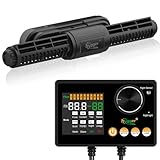
The hygger Intelligent Wave Maker is the most capable controller-based option in this group for an aquarist who wants to vary movement over the day. It has six stated programs: Constant, Pulse, Tide, Random, Quick, and alternating forward/reverse operation, rather than a single fixed outlet.
I like the practical controls here as much as the modes. The light sensor supports a day/night program, the feed function returns to operation after 10 minutes, and the pump has low-water protection, all of which are useful safeguards when a sump return is paused or the water level changes during maintenance.
A broad outlet and a rotatable head make this a better fit for distributing reef tank circulation across rock faces than aiming a narrow stream at one coral. The magnetic base has a silicone sleeve, which should help isolate vibration where the mount meets the glass.
The important limitation is evidence depth: its 4.6 rating comes from 51 reviews, so it has less buyer history than the smaller hygger Mini. Forum comments also raise concerns about reverse-direction behavior on some hygger pumps, so I would test every program in a bucket or empty section of the tank before relying on an alternating pattern around delicate livestock.
This pump suits reef keepers who want changing flow without manual daily adjustments
Choose it for a mixed reef, coral tank, or large fish tank where a feed pause, night response, and multiple wave patterns make daily operation easier. Wireless linking of multiple pump heads is especially useful when you want one side of a long aquarium to complement rather than fight the other.
Begin below maximum output and observe coral polyp extension, sand movement, and whether food circles the aquarium or lands in one place. A pump can be technically quiet and still create an undesirable flow path if it is aimed straight across a shallow tank.
This pump is less suitable for buyers who need a long record of reviews or the simplest control
The display controller offers more decisions than a basic AC powerhead, and the smaller review count leaves less long-term user feedback to examine. Keep the controller and its connections dry, use a drip loop, and disconnect power before putting hands in the aquarium.
If your tank only needs one gentle directional stream, a simpler mini powerhead is easier to set and easier to diagnose. This is a feature-first reef tank circulation pump, not the obvious pick for a bare nano aquarium.
2. The hygger Mini 530 GPH is the practical pick for 15–40 gallon tanks
hygger Mini Wave Maker for 15-40 Gallon Aquarium with Magnetic Mount Quiet Powerhead for Saltwater and Freshwater Fish Tank 530 GPH
530 GPH
15-40 gallons
360 degree head
Pros
- Compact body
- Quiet operation
- Ceramic shaft
- Magnetic mount
Cons
- Limited to 15-40 gallons
The hygger Mini is a compact 530 GPH powerhead made for 15–40 gallon aquariums, and that clear stated range is its chief strength. It avoids the common small-tank mistake of choosing a giant pump because the maximum number looks impressive.
This model uses only 3W and has a corrosion-resistant ceramic shaft, an important material detail in saltwater aquarium equipment. Its 360-degree ball joint lets you turn the output toward the surface, across the back wall, or behind rockwork without moving the mount.
I would first place it high on a side pane, aimed slightly upward and across the long dimension of the tank. That placement creates surface agitation while softening the stream before it reaches livestock, and the removable guard makes routine cleaning less cumbersome.
The magnetic base is a welcome change from a suction-cup-only mount, since hobbyists often report cups losing their grip over time. This model has 487 reviews at a 4.4 rating, which gives it a more substantial feedback base than many models in this roundup.
This pump suits nano and smaller mixed tanks that need adjustable direction, not a controller
It makes sense for a 20 gallon saltwater tank, a 29 gallon aquarium, or a modest mixed setup where a 530 GPH maximum can be directed and diffused by the aquascape. A forum insight specifically calls the 565 GPH Koralia appropriate for some 29 gallon tanks; this hygger’s stated output is in that same general small-tank conversation, though output patterns are not identical.
It is also a sensible choice when visual bulk matters. Its 2.6 by 2.16 by 4.7 inch body is compact enough to hide beside a rock structure while leaving the intake guard accessible.
This pump is less suitable for tanks beyond its stated 40 gallon range or for wave scheduling
There is no wave controller, feed mode, or variable speed setting stated for this model. On a longer reef, a single fixed 530 GPH stream may leave the far end and the lee side of rockwork under-served.
Do not run a small tank’s pump at a coral from a few inches away just because the head rotates. Re-aim it or use rockwork to diffuse the output if sand shifts, flesh retracts, or fish consistently shelter from the current.
3. The hygger Cross Flow 1850 GPH is a quiet controlled option for tanks up to 135 gallons
Pros
- Cross-flow spread
- Quiet sine control
- LED controller
- Night mode
Cons
- Plastic construction
The hygger Cross Flow pump is built around a long, low profile that spreads flow through a claimed 360-degree wave pattern. Its stated 1,850 GPH maximum and suitability for tanks up to 135 gallons put it in the mid-to-large aquarium class rather than the nano category.
It runs on 24V DC and includes an LED display controller with pulse, sine, constant, random, and cross-flow settings. The sine-wave control is designed for quieter operation, while the night, feed, and linkage modes make it easier to change behavior without unplugging the unit.
I would use the cross-flow orientation along the back wall of a long tank, then aim a second smaller circulation source across the front or behind the main rock stack. That approach creates intersecting movement and is much less likely to leave a dead pocket than pointing two heads directly at each other.
The 4.4 rating is based on 388 reviews, a useful amount of feedback for a controlled DC model. The stated construction material is plastic, so salt creep should be wiped from the external mount and cord rather than allowed to build where parts meet.
This pump suits longer reef tanks that need broad water movement and a controllable schedule
It is a good match for aquarists who want a marine aquarium wave maker that can move water around a wide reef structure without relying on a single narrowly focused nozzle. The controller gives you 30–100 flow-rate levels and 30–100 frequency levels, so acclimation can be gradual.
A gradual start matters for LPS corals, loose substrate, and fish that are new to strong circulation. Start with a low setting, watch the whole tank for a day, and change one variable at a time.
This pump is less suitable for very small tanks or people who want a purely mechanical powerhead
Its physical length and 1,850 GPH maximum are excessive for a 10 or 20 gallon aquarium even when control is available. A small tank benefits more from a compact head with modest output and a focused ability to reach behind one rock.
Controller-based DC gear adds cords and settings, so route the controller outside splash range and avoid making adjustments with wet hands. If you prefer one on/off plug with no modes, the Mini is less complicated.
4. The AQQA 2113 GPH Controller Pump is built for large tanks that need cleaning support
AQQA Aquarium Wave Maker 2113GPH, DC Circulation Pump with Controller
2113 GPH
70-180 gallons
Backwash mode
Pros
- Backwash cleaning mode
- Five wave modes
- 360 degree head
- Rubber shock absorption
Cons
- Only 57 reviews
- Plastic body
The AQQA AQ099 states a 2,113 GPH maximum and a 70–180 gallon tank range, putting it firmly in large-display territory. It pairs a 360-degree rotating head with five wave modes and adjustable flow rate and frequency, so its output is not limited to one aggressive setting.
The feature that separates it from similar units is its backwash cleaning mode. That does not replace taking the pump apart, but a reverse cleaning function may help dislodge material from the unit between proper maintenance sessions.
I would mount this on the side opposite the return outlet and point it across an open channel in the rockwork rather than into a wall of rock. Its strong magnetic suction base and rubber shock-absorbing design should help with placement stability and vibration control, provided the glass and mount are kept clean.
It has a 4.4 rating from 57 reviews, so its published feature list is more extensive than its review history. Treat the 70–180 gallon guidance as a starting range, not an automatic rule, because a sparse 70 gallon layout reacts differently from a densely packed 180 gallon reef.
This pump suits large systems where adjustable broad flow and a cleaning mode matter
Pick it when you need circulation to move through big rock structures and want a DC 24V controller, feed function, light sensor, and wireless capability. The parameter lock can be helpful when you have found a good setting and do not want an accidental button press to change it.
For a tank near the lower end of the stated range, begin with low power and use the head rotation to soften the pathway. The right result is movement across coral surfaces and toward overflow routes, not a visible trench in the sandbed.
This pump is less suitable for buyers who prioritize a deep record of owner feedback
The lower review count means there is less field history than on the 388-review hygger Cross Flow or 487-review hygger Mini. It also has a plastic construction, so regular freshwater rinsing of removable salt deposits is sensible after any cleaning session.
Never take the magnetic halves apart casually near the glass; strong magnets can snap together. Hold both sides securely during installation, confirm the stated compatibility with your glass, and keep the DC controller dry.
5. The hygger Lite 2114 GPH is a compact controlled option for 50–120 gallon reefs
hygger Lite Wave Maker For 50-120 Gallons Aquarium Adjustable Circulation Pump with Magnetic Base Fish Tank DC Powerhead for Coral Reef and Freshwater Up to 2114 GPH
2114 GPH
50-120 gallons
24V DC
Pros
- Compact body
- Protective cover
- Four modes
- Ten speed levels
Cons
- Only 15 reviews
- 12W output
The hygger Lite Wave Maker claims 2,114 GPH for 50–120 gallon tanks but measures just 1.9 by 2.7 inches. That compact detachable form is appealing when a large pump body would crowd a carefully arranged reef display.
It runs on DC 24V at 12W and offers Constant, Pulse, Sine, and Random modes. There are ten speed levels in Constant mode and ten frequency levels, which gives more adjustment than a simple fixed-output powerhead.
I would view its hard cover as a meaningful livestock feature, especially where small fish or invertebrates share the tank. The cover is intended to protect them from the intake, and the detachable design means you can clean the guard without treating the whole installation as a major project.
The magnetic base is specified for glass up to 8 mm thick. That detail is easy to overlook: confirm your panel thickness before ordering instead of assuming a compact pump’s mount will fit every aquarium.
This pump suits medium reefs that need strong adjustable movement in a small footprint
It fits a reef keeper who needs a compact DC powerhead, a feed timer that lasts nine minutes, and the ability to tune both speed and frequency. The protective cover is particularly relevant in systems with small fish, shrimp, or other invertebrates that explore pump intakes.
Place it where its output can skim across the upper third of the tank before descending around the rockwork. A second lower, gentler pump can then cover the back of the reef without creating a single harsh current line.
This pump is less suitable for people who want extensive long-term review evidence
Its 4.4 rating comes from only 15 reviews, the smallest evidence pool among the controlled models here. The stated 12W power figure also invites a careful comparison with your flow goals rather than an assumption that it will behave like every other 2,100 GPH listing.
Inspect the protective cover and impeller during routine cleaning, since a blocked intake changes both output and noise. Use the feed mode instead of repeatedly switching the unit at the wall when feeding.
6. The hygger Nano 660 GPH is made for controlled movement in 5–10 gallon aquariums
hygger Aquarium Wave Maker for 5-10 Gallon Fish Tanks, Adjustable DC Power Heads for Aquarium with Controller, Aquarium Circulation Pump With Magnetic Base for Saltwater Freshwater Tank 660 GPH
660 GPH
5-10 gallons
Three outlets
Pros
- Three outlet covers
- Six flow levels
- Power memory
- Feed mode
Cons
- Small-tank only
- Glass limit
The hygger Nano is specifically described for 5–10 gallon fish tanks, where the shape of the flow matters far more than raw maximum output. Its stated 660 GPH can sound high for that size, but the supplied three interchangeable outlet covers give you ways to change the outlet width.
The controller provides Constant, Wave, and Pulse modes plus six flow selections from 10% through 100%. It also has a 10-minute feed pause and power-off memory, two simple features that make a small system easier to run consistently.
I would start on the lowest setting with the widest appropriate outlet cover and aim along the surface or toward a side pane. In a small aquarium, a few inches can change a direct blast into a much gentler circulation loop, so placement is your first adjustment before output.
The product data lists both a 12V DC detail and a DC 24V output detail, so confirm the included power components and follow the supplied manual rather than mixing adapters. Its magnetic base is recommended for glass no thicker than 3/8 inch.
This pump suits true nano saltwater tanks that need controlled flow choices
Choose it for a small saltwater setup where fixed circulation is too blunt and you want to adapt the outlet and pump mode to the rockscape. The 4.3 rating across 177 reviews gives this nano-focused model a useful base of owner feedback.
It can also help a tiny tank maintain surface movement without taking up much interior room. Keep the intake clear and monitor snail, shrimp, and small-fish behavior after changing an outlet cover.
This pump is less suitable for larger systems or thick glass panels
A 5–10 gallon recommendation is narrow for good reason. Once the tank has a longer footprint or substantial rockwork, it is better to step up to a pump meant to reach the system rather than run a nano unit flat out.
Do not assume more output equals better coral reef water flow. In a very small tank, too much direct movement can expose coral tissue to persistent stress and keep food from settling where animals can eat.
7. The AQQA Dual Head 6605 GPH provides two directional outlets from one unit
AQQA Dual Head Aquarium Wave Maker, 360° Adjustable Circulation Pump
Dual heads
6605 GPH
Under 30dB
Pros
- Two directional heads
- Quiet stated output
- Ceramic shaft
- Protective cover
Cons
- Must stay submerged
- Re-plug caution
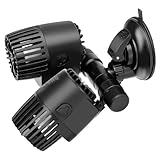
The AQQA Dual Head uses two independently movable heads to create bidirectional flow, a practical answer to an aquarium with a broad footprint. The listing states 6,605 GPH and 25W, so this is a high-output submersible circulation pump that needs thoughtful placement.
Each head rotates 180 degrees and the overall assembly can rotate 360 degrees. That geometry lets one side sweep the surface while the other works behind rockwork, which can be more useful than pointing both streams into the center.
The manufacturer states under 30 decibels of operation and uses a shock-absorber nail design to reduce vibration. It also specifies a ceramic-shaft impeller and a thickened cover intended to protect fish, both relevant in a saltwater environment where debris and salt deposits make regular checks important.
I would install it fully underwater with both outlets initially angled away from each other. A dual-head unit can create a useful gyre in a long aquarium, but direct opposing jets can meet in the middle and leave the ends under-circulated.
This pump suits large tanks where two separate flow directions solve a placement problem
It suits a fish-only marine aquarium or a large reef where one mounting point must cover two areas. The dual layout can reduce the number of devices visible in the tank while still offering two paths of water movement.
Use one head for upper-level gas exchange and the other to disturb sediment-prone lower areas without directing it into sand. Watch for debris pathways after several hours, since they reveal whether both sides of the rockwork are actually receiving flow.
This pump is less suitable for shallow tanks, tiny reef systems, or owners who need controller precision
There is no stated variable controller or feed mode, and the high claimed flow is difficult to tame in a small volume. It must remain fully submerged, and the listed caution about re-plugging to restore normal operation is worth keeping in mind during a power interruption.
It has a 4.2 rating from 63 reviews, so examine mounting security and operating behavior during the return window. A powerful unit should never be left unobserved after a major aquascape change.
8. The AQQA Magnetic DC Pump is an efficient adjustable choice for tanks up to 55 gallons
Pros
- Four speeds
- IP68 rating
- Magnetic mount
- Quiet stated operation
Cons
- Only 17 reviews
- 3/5 inch glass limit
The AQQA Magnetic DC Pump is the most modest-output controller model here, with a stated adjustable 400–950 GPH range for tanks up to 55 gallons. That range is useful when you need more flexibility than a fixed AC powerhead but do not need a very large reef pump.
It uses a DC 12V motor system and claims 3W to 8W consumption, four speed settings, and under-30dB operation. The unit also lists an IP68 waterproof rating and a magnetic mount for glass up to 3/5 inch thick.
I would treat the feeding pause as a convenience rather than a reason to ignore flow during feeding. The stated pause is 10 seconds, so it may be enough for a quick target feed but not a long coral-feeding session; watch the actual restart behavior in your own aquarium.
The 4.2 rating comes from 17 reviews, and its product data presents conflicting large title flow language alongside a technical 400–950 GPH range. The technical range is the more useful figure for deciding whether it fits your tank, but confirm the exact variant before purchase.
This pump suits medium tanks that need low-voltage control and restrained output
It is a credible choice for a saltwater aquarium where the goal is quiet, adjustable movement across a 20–55 gallon range rather than maximum force. A broad, lower-output setting can be kinder to fleshy corals and fine sand than an oversized pump dialed down only slightly.
Its magnetic mount avoids the recurring suction-cup concern cited by hobbyists. Still, wipe the glass and mounting pads clean before installation so algae film does not compromise the grip.
This pump is less suitable for tanks that demand high verified flow or lots of review history
The small review count and differing claimed flow descriptions require more care than with a plainly specified model. If you need movement for a large, dense reef, select a unit whose rated range and tank recommendation clearly meet that job.
Keep all external electrical connections away from splashes, use a drip loop, and disconnect the equipment before servicing it. Low-voltage pump operation is not a substitute for basic aquarium electrical safety.
9. The DaToo Mini 800 GPH is a basic directional pump for small saltwater setups
DaToo 800GPH Mini Aquarium Circulation Pump Ultra-quiet Fish Tank Wave Maker With Suction Cup 360 Degree Rotatable Aquarium Power Head Submersible Water Pump For Freshwater And Saltwater
800 GPH
360 degree head
Ceramic shaft
Pros
- Simple design
- Rotating head
- Anti-backsiphon
- Ceramic shaft
Cons
- Suction cup mount
- Must stay submerged
The DaToo Mini is a no-controller 800 GPH powerhead with a small 1.18 by 1.18 by 2.68 inch footprint. Its rotating ball connection gives the output 360-degree adjustment, allowing the same pump to handle surface ripple, a back corner, or a low-flow gap behind rock.
Its stated features include anti-backsiphon technology, a dense intake cover, a waterproof motor, and a corrosion-resistant ceramic shaft. Those are practical saltwater details: a ceramic shaft is preferable to leaving a metal moving part in constant marine water exposure, while the cover helps protect fish from the intake.
I would regard this as a simple supplementary pump rather than an automatic one-pump solution for every reef. Its 800 GPH can be useful in a small or lightly stocked setup, but the lack of speed control means placement and outlet direction do all the fine-tuning.
It has a 4.1 rating from 165 reviews and a one-year warranty. The listed suction-cup base is its main trade-off, especially because users frequently mention that suction cups can lose grip as they age or collect film.
This pump suits keepers who want a compact, simple supplementary circulation source
Choose it to reach a dead angle in a small saltwater tank, to create extra surface movement, or to support a larger primary wave maker from a different direction. Its size makes it easy to conceal, and the 360-degree aim is more flexible than a fixed nozzle.
Inspect the suction cup at every cleaning and replace the mount if it hardens or slips. A fallen pump can change flow suddenly, so do not treat a cup-mounted unit as maintenance-free.
This pump is less suitable for delicate systems needing speed control or a magnetic mount
It must be fully submerged and does not state a controller, feed mode, or adjustable power. A basic AC-style circulation approach is easy to run, but it cannot reduce output at feeding time or adapt a pulse pattern for coral response.
For sensitive livestock, put it behind rockwork or aim toward glass before directing it near animals. If a fixed 800 GPH stream is still too energetic, choose a controlled nano unit instead of trying to block the intake or outlet.
10. The Carefree Fish Dual Powerheads are the high-output pick for 30–300 gallon tanks
Carefree Fish Aquarium Magnetic Dual Powerheads 25W 5400Gph for 30~300Gal Fish Tank Wave Maker Quiet and Strong Submersible Water Circulation Pump for Freshwater and Saltwater
5400 GPH
30-300 gallons
Dual heads
Pros
- Very high output
- Dual directions
- Zirconia impeller
- 30dB stated noise
Cons
- AC motor
- 10mm glass limit
The Carefree Fish model is the biggest-flow option in this list, with two heads and a stated 5,400 GPH for tanks from 30 to 300 gallons. That extremely broad tank range should prompt careful judgment: tank length, aquascape density, and livestock determine whether this output is helpful or excessive.
Its dual heads adjust in different directions, and it lists 30dB operation, a zirconia ceramic impeller, and 25W AC power. Zirconia is a ceramic material described as wear- and corrosion-resistant, which is a relevant advantage where saltwater can be hard on moving components.
I would position this in a long fish-only aquarium or a large, open reef where one head can skim the upper water and the other can move water along the lower rear. The goal is a broad loop that returns debris to filtration, not two jets striking the same coral colony.
It has a 4.0 rating from 88 reviews and comes with a stated one-year manufacturer warranty. The product data notes both magnetic and suction-cup installation options, but the magnetic base is limited to 10 mm glass, so measure the panel instead of guessing.
This pump suits large or long aquariums that need two high-output flow paths from one device
It is best for an aquarist whose tank has enough open water and length to make use of dual 5,400 GPH circulation. Two independently aimed heads can cover more territory than a single nozzle and may reduce stagnant zones around large decorations.
Install it with the power off and hold the mounting pieces securely. Then observe fish behavior, surface agitation, and sand movement for a full light cycle before deciding the position is final.
This pump is less suitable for small reefs, thick glass, or buyers seeking a DC controller
The AC motor does not offer the low-voltage controller features found on the DC units above, and the stated flow is too strong for many smaller systems. Its own data notes a 10 mm magnetic-base glass limit, which can rule it out for some large aquariums with thick panels.
For a small tank, one compact adjustable pump will create a more manageable flow pattern. For a large but coral-dense reef, two independently controlled lower-output pumps may offer more precise placement than this fixed high-output dual-head design.
The right circulation pump starts with your tank shape, livestock, and flow path
GPH means gallons per hour: the amount of water a pump can move under stated conditions. It is useful for comparing models, but it is not a complete measure of real circulation because a broad cross-flow pump, a narrow directional head, and a dual-head unit distribute the same numerical flow very differently.
For a first setup, aim for water movement that reaches all areas of the aquarium without creating a constant direct blast. Instead of chasing a universal turnover number, evaluate the result: light surface movement, no chronic debris piles behind rocks, and corals and fish that can stay in their preferred positions.
A good starting flow plan is to begin low and add coverage rather than force
For a 5–10 gallon nano tank, begin with a controllable nano unit at a low setting or a carefully diffused small powerhead. For roughly 15–40 gallons, a 530 GPH directional pump can be a sensible starting point when aimed across the tank, not at livestock.
For medium and large reef tanks, one strong controllable cross-flow pump or two smaller adjustable pumps may work better than one fixed jet. Add a second flow source when the aquascape has tall rock walls, caves, or a long back section where debris collects.
Watch the animals, not just the water surface. Excessive flow can lift sand, keep fish hiding, or make soft coral tissue whip continually; insufficient flow often leaves debris in corners, produces weak surface agitation, and allows food to settle in areas that filtration does not reach.
The best placement pattern creates a loop around and through the rockwork
Place a pump high on one side and angle it slightly toward the surface and along the tank’s length. That creates oxygen exchange while the stream travels far enough to soften before descending.
Use a second unit lower and on the opposite side to reach behind the reef structure. Avoid aiming two pumps face-to-face, because they can make a turbulent collision zone while leaving the far corners still.
Move one pump at a time and give the tank time to reveal debris paths. A small amount of suspended detritus after a change is normal; a permanent sandstorm or a coral that never relaxes is a signal to lower output or redirect the head.
Saltwater durability depends on cleaning the parts that actually touch water
Every pump here is stated for freshwater and saltwater use, but saltwater always calls for attention to moving parts, intake guards, mounting pads, and cable exits. Ceramic or zirconia shafts are desirable corrosion-resistant details, yet they still need cleaning when calcium, algae, or detritus builds up.
Unplug the pump before service, remove the intake cover and impeller following its manual, and rinse loose debris away. For mineral buildup, use an aquarium-safe manufacturer-approved cleaning method, rinse thoroughly, and reassemble only after checking that the impeller spins freely.
Clean on a regular schedule based on how fast your system accumulates film rather than waiting for noise or reduced output. A sudden rattle, reduced flow, or changing vibration is a reason to inspect the pump promptly.
DC pumps offer control while AC pumps offer a simpler fixed-output arrangement
DC circulation pumps commonly add speed control, feed pauses, changing wave programs, and low-voltage pump operation. The hygger Cross Flow, AQQA AQ099, hygger Lite, hygger Nano, and AQQA Magnetic models illustrate that approach, although their stated features differ.
AC models such as the hygger Mini and Carefree Fish dual-head unit can be simpler fixed-output choices. Simplicity is useful, but it also means you tune the system mostly with pump position, head direction, and the addition or removal of a second pump.
Neither type removes the need for electrical care. Keep controllers dry, make drip loops on every cord, keep plugs above potential splash zones, and cut power before reaching into aquarium water.
A secure mount and enough cord length prevent avoidable setup problems
Measure glass thickness before selecting a magnetic model. The hygger Lite lists a limit of 8 mm, the hygger Nano lists 3/8 inch, the AQQA Magnetic lists 3/5 inch, and the Carefree Fish magnetic base is listed for 10 mm glass.
Magnetic mounts can offer steadier positioning than suction cups, but they must be kept free of trapped grit that can scratch glass. Suction cups need inspection because hobbyists commonly report that they lose grip over time.
Route cords before filling the tank, especially in a large aquarium where a short cord can force an awkward controller location. Never stretch a cord tightly over an edge or leave a connection where salt spray can accumulate.
The direct answers below cover saltwater circulation pump basics
What is a circulation pump for a saltwater aquarium?
A circulation pump is a submersible device that moves aquarium water to imitate ocean currents. It supports surface gas exchange, carries heat and nutrients through the tank, and helps prevent dead spots where detritus can settle.
What is a good starting GPH for a saltwater tank?
Start with a pump sized for the aquarium and run it gently, then adjust by observing the flow path. A 5–10 gallon tank needs a controllable nano approach, a 15–40 gallon tank can start with a directional 530 GPH model, and larger or rock-heavy tanks often need two sources of flow rather than one hard jet.
How do I maintain a circulation pump?
Unplug it before service, remove the guard and impeller according to its manual, rinse debris away, clean mineral buildup with an aquarium-safe approved method, rinse thoroughly, and check that the impeller spins freely. Also inspect mounting pads, cords, and output for salt buildup or vibration.
Can I use a freshwater circulation pump in saltwater?
Only use a pump that the manufacturer specifically states is suitable for saltwater. A marine system benefits from corrosion-resistant moving parts such as ceramic or zirconia shafts, but all saltwater-rated pumps still need regular cleaning and inspection.
Can I run multiple pumps in a single saltwater system?
Yes. Two pumps often create better coverage than one because they can move water around opposite sides of rockwork and reduce dead spots. Aim them to form a circulation loop instead of pointing them directly at each other or at one coral.
The best choice is the pump that creates calm, complete circulation in your aquarium
For most reef keepers who want settings and schedules, the hygger Intelligent Wave Maker is the fullest-featured choice. For 15–40 gallon tanks, the hygger Mini offers a compact 530 GPH directional approach, while the Carefree Fish dual-head model is reserved for large systems that can genuinely use very high output.
The best circulation pumps for saltwater aquariums in 2026 are not automatically the strongest ones. Pick the model that fits your tank dimensions, glass, livestock, rockwork, maintenance habits, and need for control; then tune it patiently until water moves through the whole aquarium without making any one area hostile.