
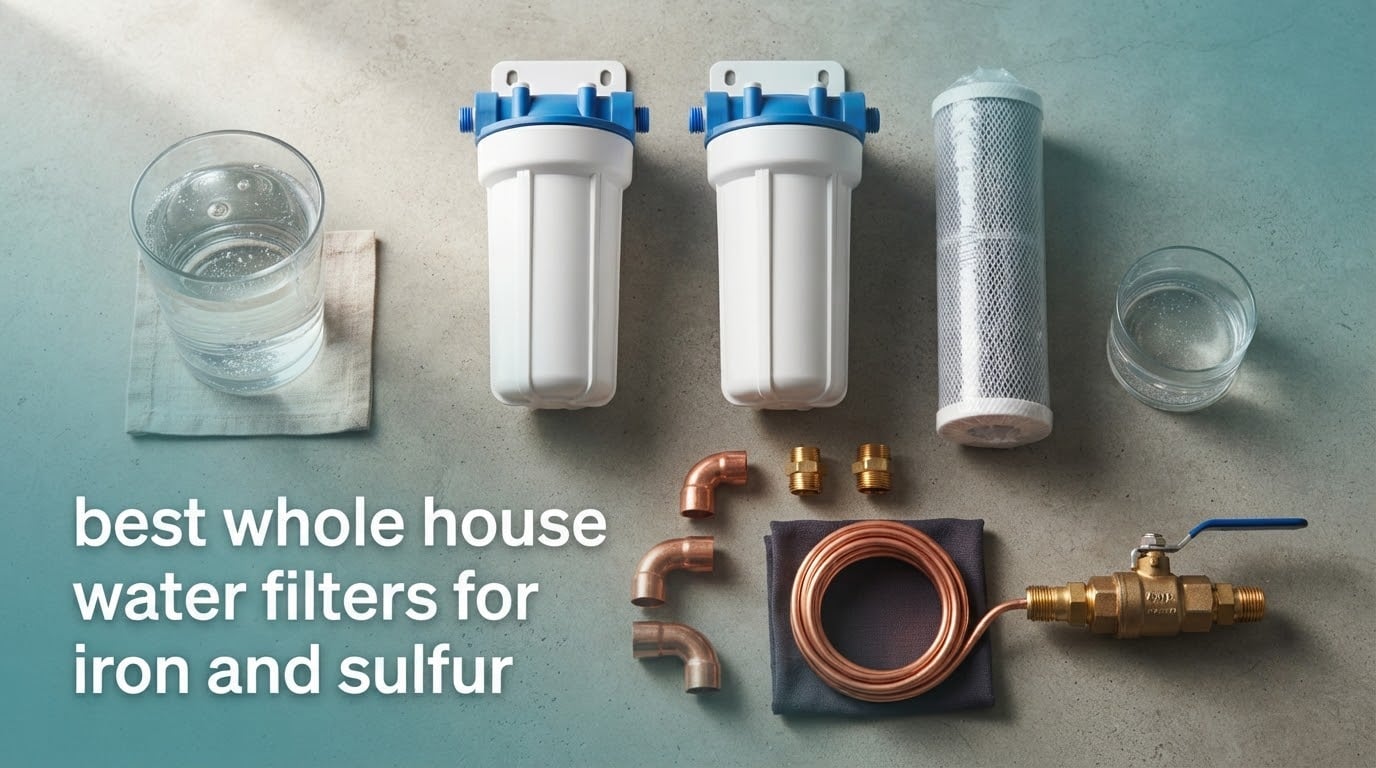
Orange rings in the sink. Black streaks down the toilet bowl. A rotten egg smell that gets worse every time you run the shower. If you own a well with iron and sulfur in it, those three symptoms are not going away on their own, and no under-sink pitcher filter will touch them because the problem enters the house at the main line.
Short answer: the best whole house water filters for iron and sulfur are backwashing media tanks that oxidize dissolved iron into filterable solids and convert hydrogen sulfide into insoluble elemental sulfur. Cartridge systems handle light loads well. They cannot handle a well running 8 ppm iron.
Over the past few months our team pulled lab reports, spec sheets and owner feedback on ten whole house systems, and ranked them on contaminant capacity, sulfur performance, flow rate, maintenance burden and the honesty of the manufacturer claims. The winners are not always the ones with the longest marketing copy.
If you are still narrowing the field, start with our guides to iron removal filters for well water and water filters for sulfur smell, then come back here for the full head to head.
Top 3 Picks for Iron and Sulfur in 2026
These three cover the realistic range of household situations. The iSpring WGB32BM is the best-supported all-round starting point. The iSpring WCFM550K is the one we would put in our own home. The AFW Air Injection Platinum is the chemical-free specialist for hard sulfur problems.

iSpring WGB32BM 3-Stage
- Three stage cartridge stack
- Iron to 3.0 ppm
- 15 GPM on 1 inch ports
- 100000 gallon capacity

iSpring WCFM550K
- Iron to 12 ppm
- Hydrogen sulfide to 20 ppm
- 12 GPM service flow
- Backwashing media tank

AFW Air Injection Platinum
- Chemical-free air injection
- Filox catalytic media
- Iron to 27 ppm
- 9-10 GPM service flow
All 10 Whole House Systems Compared in 2026
Every system below sits at the point of entry where the main line enters the home. Pay attention to the contaminant ceilings, because that single number decides whether a system solves your problem or merely slows it down.
| Product | Specifications | Action |
|---|---|---|
| iSpring WGB32BM 3-Stage |
|
Check Latest Price |
| iSpring WCFM550K |
|
Check Latest Price |
| AFW Air Injection Platinum |
|
Check Latest Price |
 DuraWater Fleck 5600 SXT DuraWater Fleck 5600 SXT |
|
Check Latest Price |
 DuraWater Fleck 5600 48K Combo DuraWater Fleck 5600 48K Combo |
|
Check Latest Price |
 Home Master HMF3SdgFeC Home Master HMF3SdgFeC |
|
Check Latest Price |
 AFW Air Injection Titanium AFW Air Injection Titanium |
|
Check Latest Price |
 iSpring WGB21BM 2-Stage iSpring WGB21BM 2-Stage |
|
Check Latest Price |
 Express Water WH300SICS Express Water WH300SICS |
|
Check Latest Price |
 Waterdrop WHF3T-FG Waterdrop WHF3T-FG |
|
Check Latest Price |
Why Iron and Sulfur Need Different Filter Technologies
Iron and sulfur behave nothing alike in water, and this is where most buying guides go wrong. Iron is a dissolved metal that has to be pushed into a solid form before a filter can hold it. Sulfur, specifically hydrogen sulfide, is a gas dissolved in water that has to be converted into elemental sulfur before it can be captured.
That single difference explains why an iron filter with a greensand or KDF cartridge will happily clear orange staining while the rotten egg smell stays exactly where it was. The media was never asked to do the sulfur job.
- Air injection oxidation. A compressor-free venturi pulls air into the water, converting dissolved iron to ferric hydroxide solids that the media traps and a backwash flushes away. Filox and catalytic carbon media handle moderate hydrogen sulfide on top of that.
- Chemical-free catalytic media. Filox and similar surface-modified media oxidize on contact as water passes through. No air compressor, no peroxide, no salt.
- Peroxide-assisted oxidation. A chemical injection pump feeds hydrogen peroxide ahead of a catalytic carbon tank. It is the most aggressive option and the most expensive to maintain.
- Cartridge and spin-down systems. Pleated or meltblown cartridges strain out iron that has already oxidized, which only happens reliably in low-iron, low-manganese municipal water. They will not clear sulfur.
- Ion exchange softeners. Resin exchanges sodium for hardness ions and can polish light iron, but the resin coating that removes iron can also feed sulfur bacteria. It is not a sulfur treatment.
Our read on the research is straightforward. If your report shows iron under 0.3 mg/L and a faint sulfur trace, a cartridge stack is enough. Once iron passes 3 ppm or hydrogen sulfide is clearly detectable, you need an oxidizing backwashing tank.
1. iSpring WGB32BM Iron and Manganese Whole House Filtration System
iSpring WGB32BM Iron, Manganese Whole House Water Filter System
Three stage cartridge stack
Iron to 3.0 ppm
15 GPM on 1 inch ports
Pros
- Three stages in one bracket with 1401 ratings behind it
- Iron rated to 3.0 ppm and manganese to 1.0 ppm
- 100000 gallon capacity covers a family of four about a year
- Media rated to outlast greensand
- US technical support that sends replacement parts
Cons
- 20 inch canisters are heavy and awkward to drain
- Leakage at plastic ports and housing O-rings during assembly
- A residual sulfur smell can remain without an added GAC and KDF stage
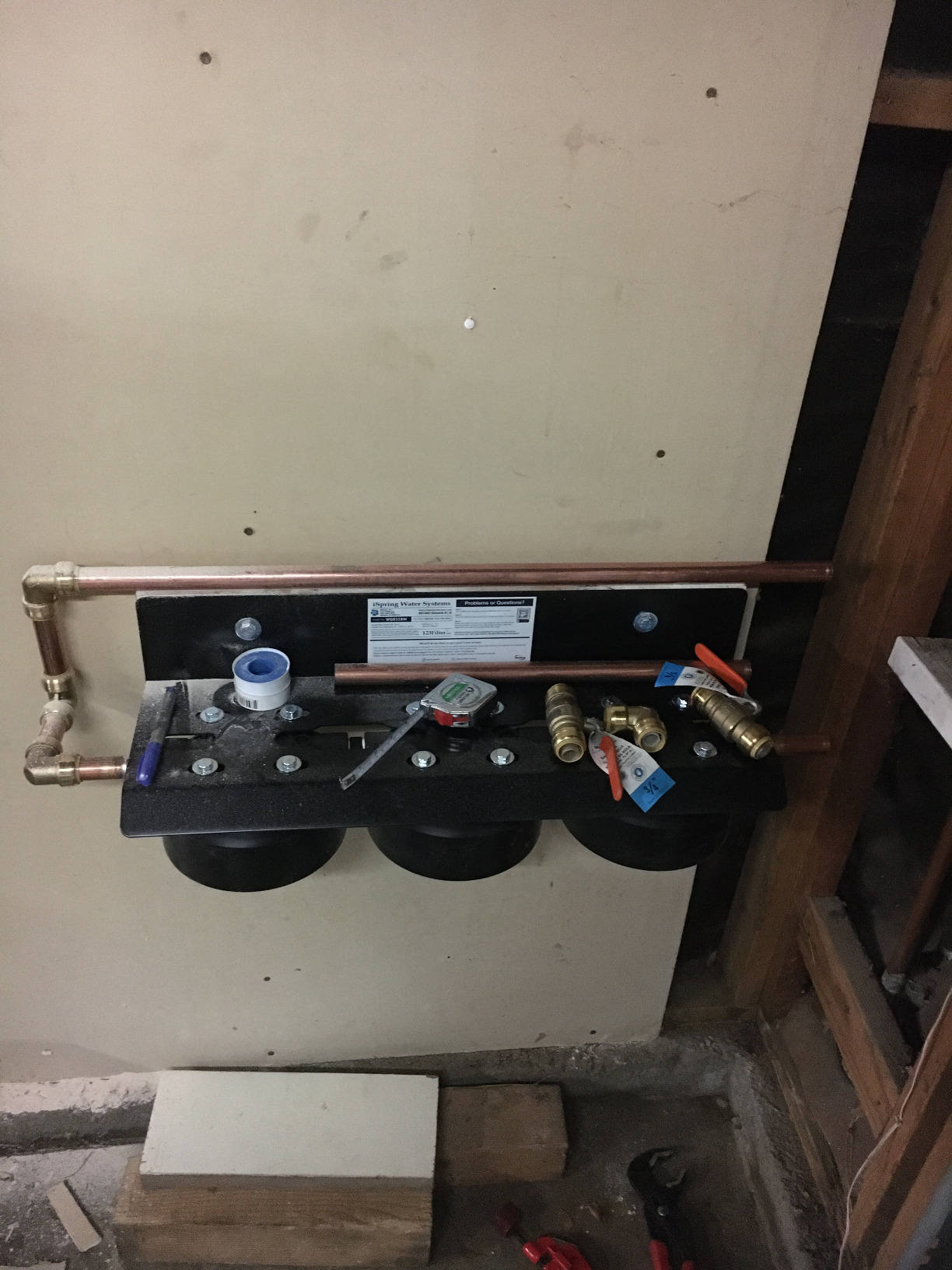
The WGB32BM is the most statistically proven unit in this roundup and the easiest to justify on evidence alone, with 1401 ratings at 4.6 stars. Three stages sit on one bracket: 5 micron sediment, a coconut shell carbon block and an FM25B iron and manganese stage.
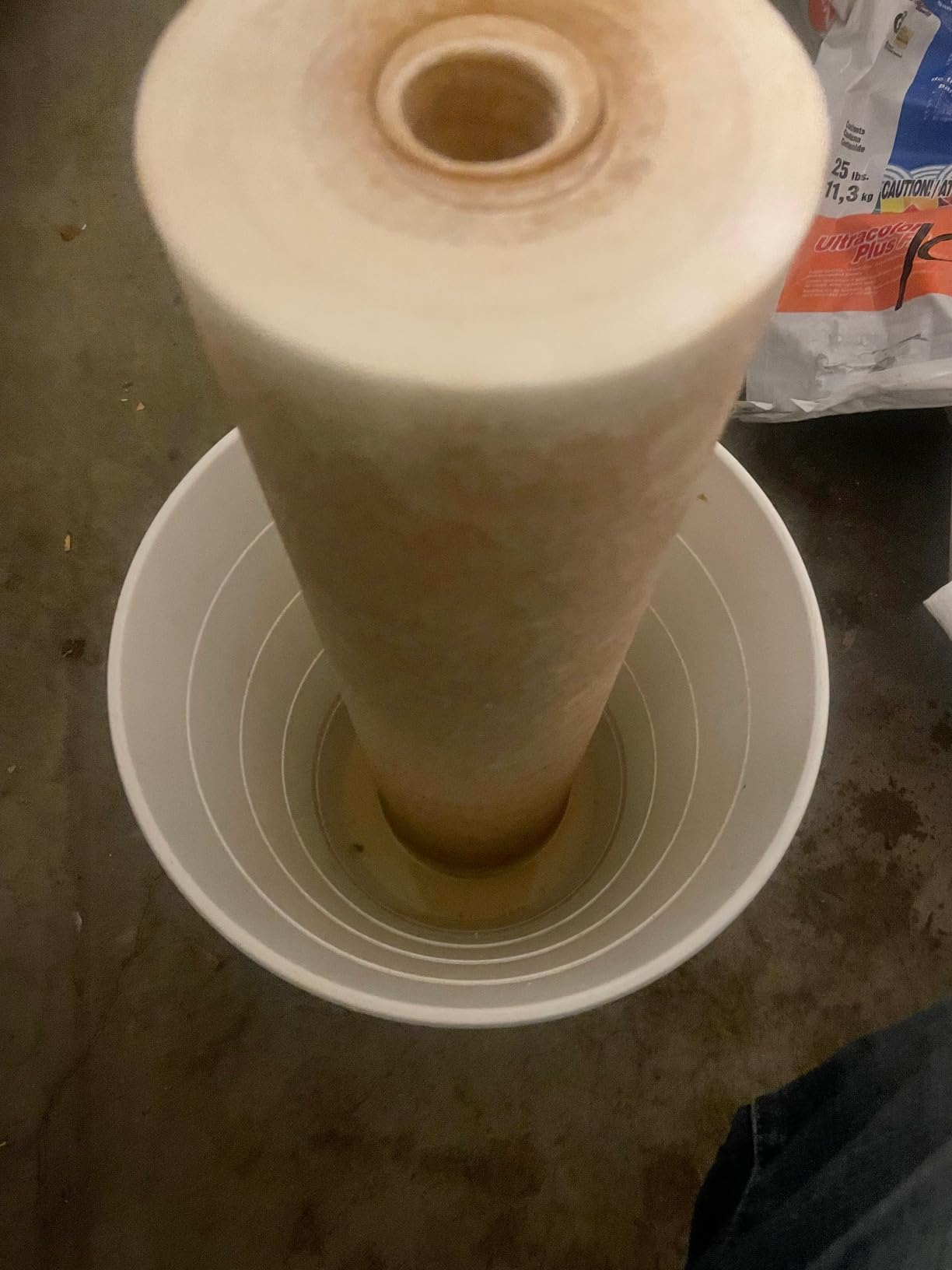
Owners with iron-stained, metallic-tasting well water report clearer water, less staining and better taste within days. Media life is rated up to three times that of greensand because the catalytic material is not consumed by the reaction.
Flow is 15 GPM through 1 inch NPT ports, and the 100000 gallon capacity works out to roughly a year for a family of four. It is third-party tested to NSF and ANSI standards with a one year warranty and lifetime technical support.
This is the system we would put ahead of a softener as the mechanical guard for the resin, which is exactly where Express Water recommends placing a similar stack.
Best used as part of a treatment train
At 3.0 ppm the iron ceiling is real. Pair it with a softener downstream for hardness and keep a sediment stage in front, and you have a clean mechanical setup for a lightly contaminated well.
It is also a sensible second whole house stage for a home already running a softener, catching what the resin misses.
Where it falls short
It will not fix a sulfur complaint. Reviewers report a residual smell that needs an additional GAC and KDF stage, and no cartridge configuration changes that chemistry.
The 20 inch canisters are heavy and hard to grip and drain, and installers frequently report leaks at the plastic 1 inch NPT ports and the housing O-rings. Support typically resolves it by sending a replacement head or O-rings, but you should plan for that call.
2. iSpring WCFM550K Whole House Iron Filter, Iron and Sulfur Water Filter
iSpring WCFM550K Whole House Iron Filter, Iron & Sulfur Water Filter
Iron to 12 ppm
Hydrogen sulfide to 20 ppm
12 GPM service flow
Pros
- Handles iron up to 12 ppm and hydrogen sulfide up to 20 ppm
- Automatic control valve with service
- backwash and air-draw stages
- Regeneration set by time or by treated water volume
- 12 GPM service flow with 26 GPM backwash
- Seven to ten year effective media service life
Cons
- Organic load in the source water fouls the media surface
- Phosphate additions upstream interfere with oxidation-based iron removal
- At 143 pounds it is a two person move
This is the system we kept coming back to while comparing specs, and the one we would install in our own house. The control valve runs three distinct stages, service, backwash and air draw, and the air draw step is what gives you real oxidation rather than a media surface that slowly saturates. Owners report the sulfur smell clearing within a few days of a tank flush.
Regeneration can be scheduled by clock or by treated water volume, which matters more than it sounds on a well. A home that is empty during the week stops wasting backwash water entirely, and that is the difference between a system that respects a septic drain field and one that does not.
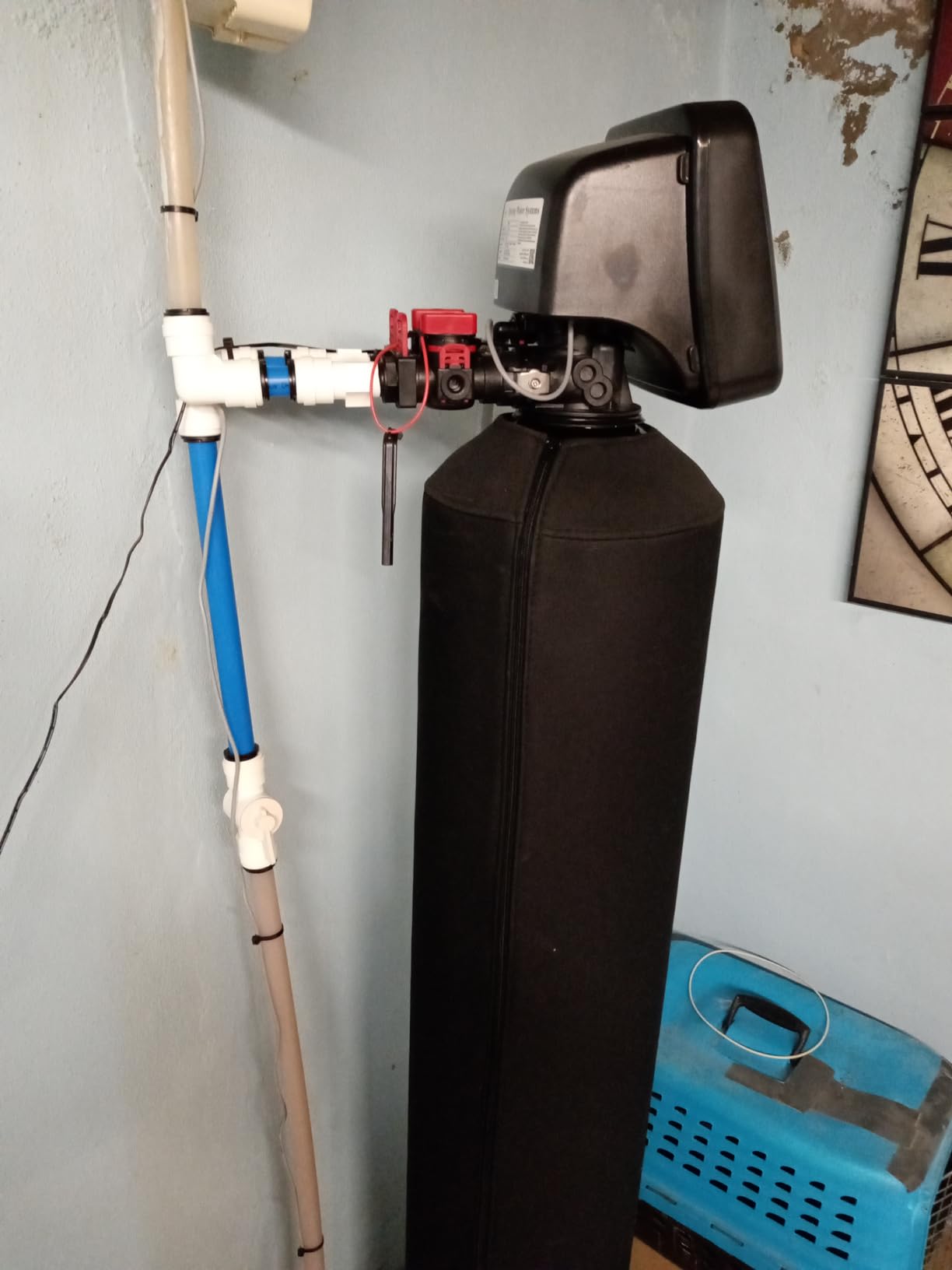
The numbers are what separate it from the cartridge crowd. Iron to 12 ppm, hydrogen sulfide to 20 ppm, manganese handled alongside, and 12 GPM of service flow on a tank that runs a 26 GPM backwash. That backwash capacity is generous enough to clear heavy iron loading without the pressure sag you get on smaller tanks.
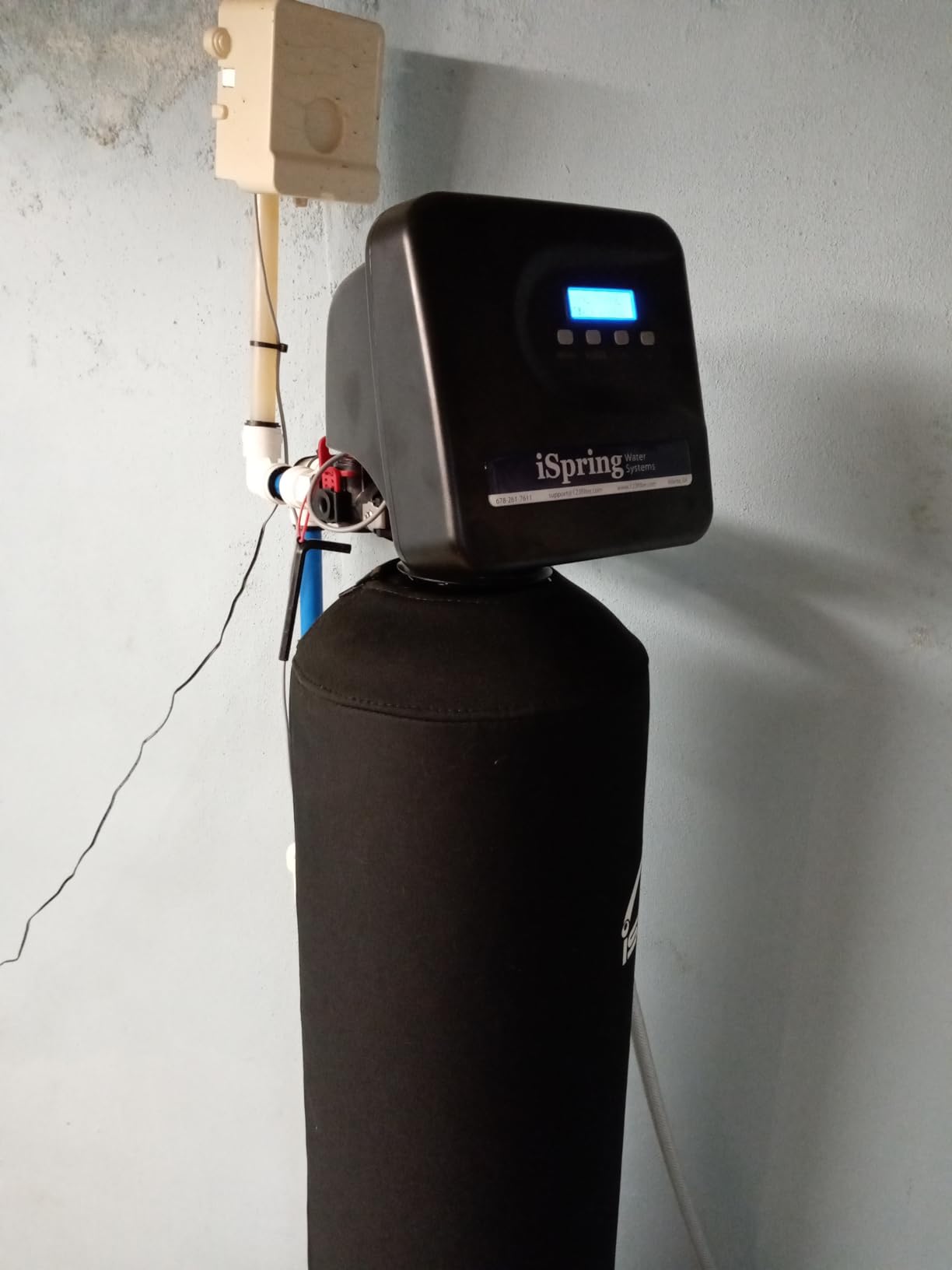
Owners also like the housekeeping features. The smart cleaning routine triggers backwash and rinse when no flow is detected, and there is a vacation mode and a delayed regeneration setting for a house that sits empty through the winter.
What you need to know before buying
Two upstream conditions will shorten this media’s life. Organic load in the source water coats the media surface, and phosphate additions from a well conditioner interfere directly with oxidation-based iron removal. If your well report shows either one, plan on pretreatment.
The unit weighs 143 pounds and measures 12 by 14 by 62 inches, so clear the floor space and plan the drain line before the tank arrives.
Where it falls short
It is a single-tank solution, so when the media finally does reach the end of its service life you are looking at a larger outlay than a cartridge swap. Budget for that eventuality rather than assuming the seven to ten year figure is fixed.
It is also overkill for a home on municipal water with a trace of iron. You would be paying for oxidation capacity you will never use.
3. AFWFilters Air Injection Platinum 1.5 Cubic Foot Iron, Sulfur, Manganese System
AFWFilters Air Injection Platinum 1.5 cubic foot Iron, Sulfur, Manganese System
Air injection oxidation
Filox catalytic media
9-10 GPM service flow
Pros
- No chemicals and no salt
- Filox media rated to 27 ppm iron and 10 ppm sulfur
- Handles manganese up to 6 ppm
- Sized for homes with three to four bathrooms
- Media doubles as a general purpose filter
- Phone support for install and operation questions
Cons
- About 242 pounds to load with media
- Fixed regeneration interval of about three days adds noticeable noise
- Occasional reports of a small leak at a tank port fitting
When sulfur is the dominant complaint, this is the strongest oxidizing system in the group. The Filox media is rated to 27 ppm iron, 10 ppm sulfur and 6 ppm manganese, and air injection handles the oxidation without peroxide, salt or an electrical outlet.
Owners on high-iron wells describe the orange staining and the rotten egg odor disappearing within days of installation, and Abundant Flow phone support comes up repeatedly in the reviews as the reason people got through setup without calling a plumber.
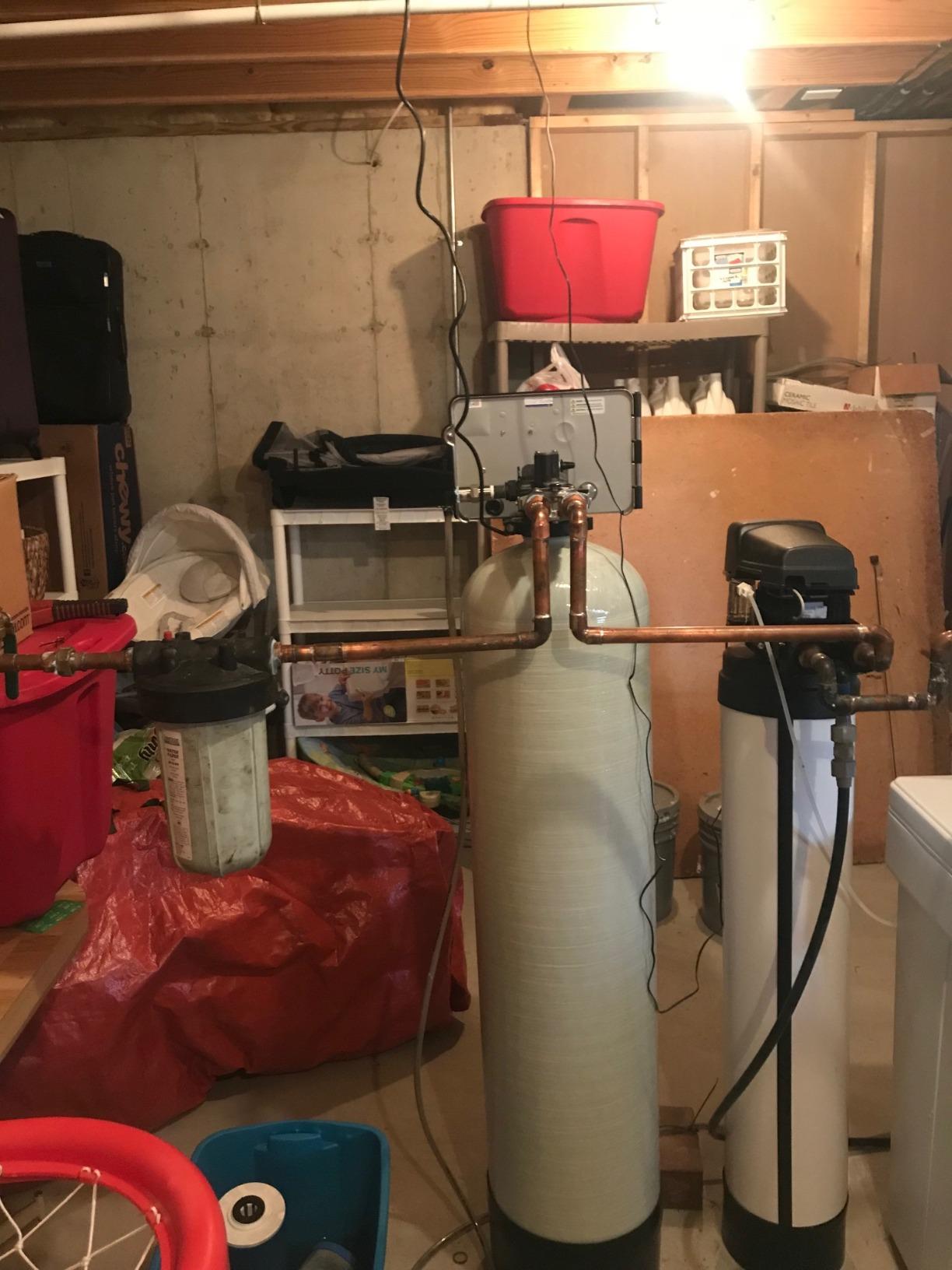
Because Filox is a dense particulate media rather than a loose bed, the same tank also works as a general purpose filter for sediment and rust. Service flow is rated 9-10 GPM, which lines up with a home running three to four bathrooms.
The trade-off is physical. At 242 pounds you are handling a genuinely heavy tank, and the media load is dense enough that loading it is a two person job with a funnel and patience.
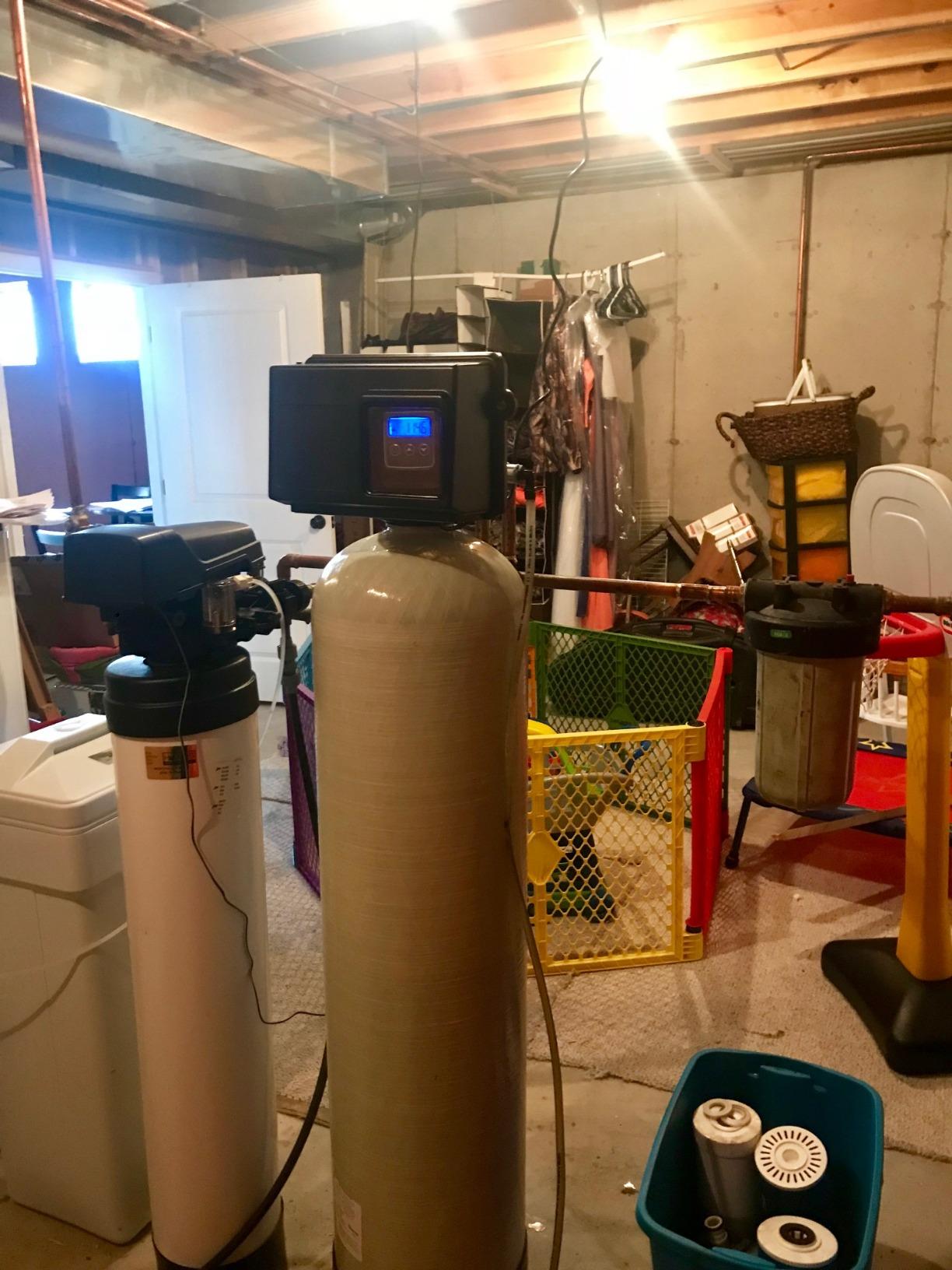
Best fit for high sulfur wells
The sulfur ceiling here is the highest among the chemical-free options, which is why we ranked it ahead of the other air injection tank. If your lab report shows hydrogen sulfide above a couple of milligrams per liter, this is the tank we would trust with it.
It is also the right pick for households that refuse salt in the water and have no interest in peroxide maintenance.
Where it falls short
The regeneration interval is fixed at roughly every three days and the cycle is loud. On a larger home or a well near its yield limit, that much backwash water can be a problem, and on a septic system it is worth confirming the drain field can take it.
A small number of owners report weeping at a port fitting traced to molding parting lines. It is a fitting issue rather than a media failure, but it is annoying to chase.
4. DuraWater Fleck 5600 SXT Air Injection Iron Eater Filter 1.5 cu ft
DuraWater Fleck 5600 SXT Air Injection Iron Eater Filter 1.5 cu ft, Black
Air injection oxidation
1.5 cu ft catalytic carbon
Standard 10x54 tank
Pros
- Fleck 5600 SXT valve with automatic daily backwash
- Clears rust staining and hydrogen sulfide odor
- Standard 10x54 tank and common softener plumbing
- Support line walks first-time installers through setup
- At 65 pounds it is far easier to handle than a loaded media tank
Cons
- Default daily backwash can overwhelm a septic drain field
- Air injection cone can weep water while drawing air
- Control valve programming is not intuitive at first
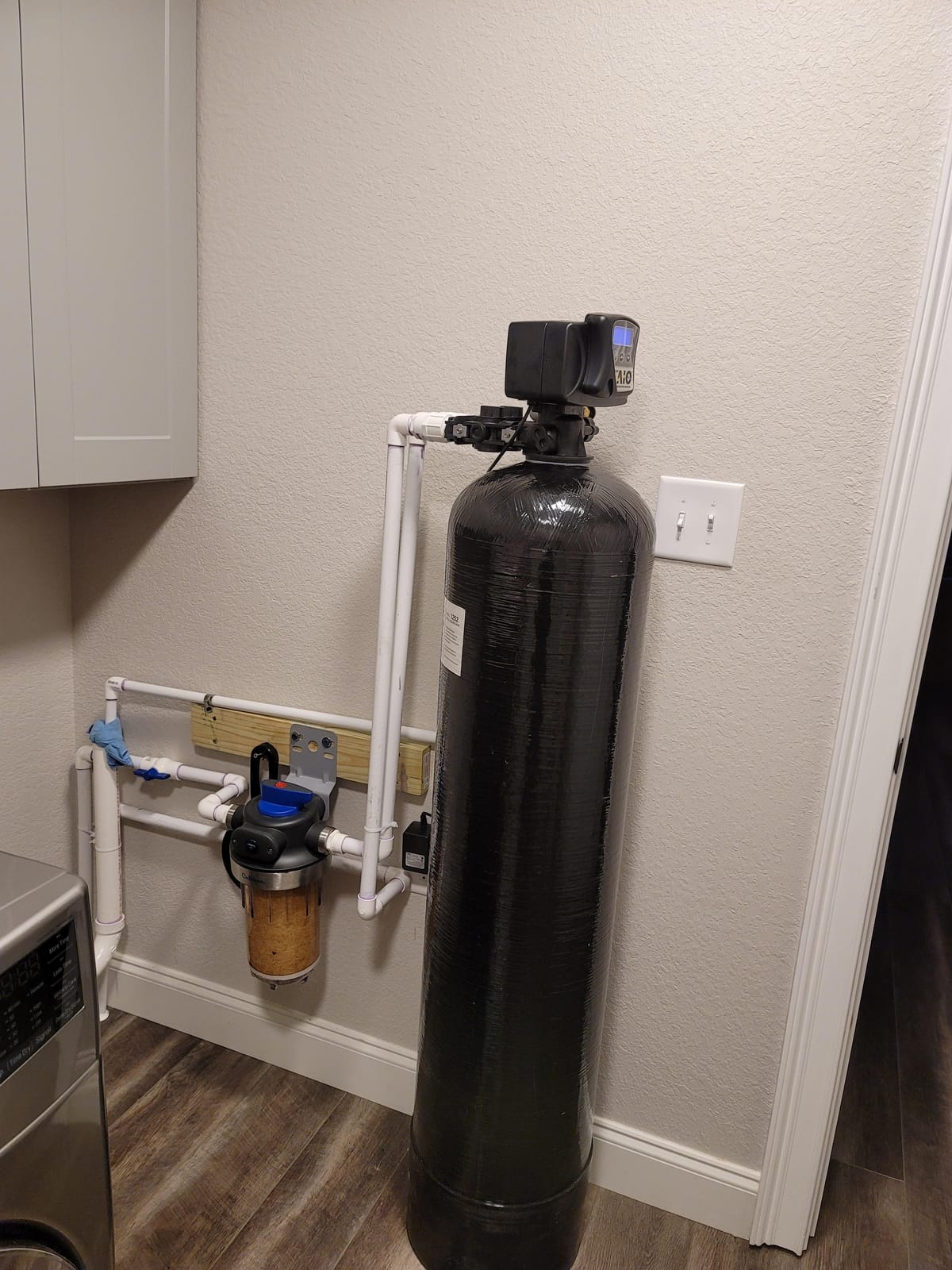
This is the one we recommend when you already have softener plumbing, a 10×54 tank pad and a drain line you trust. The Fleck 5600 SXT valve is a proven control valve and the tank is a standard footprint, so installation is a weekend job rather than a remodel.
It carries 1.5 cubic feet of Centaur catalytic carbon media with air injection in front of it, which is enough for a well in the low single digit ppm range for iron plus a noticeable sulfur smell. Owners report a 24 hour soak and a tank flush clears the fixtures.
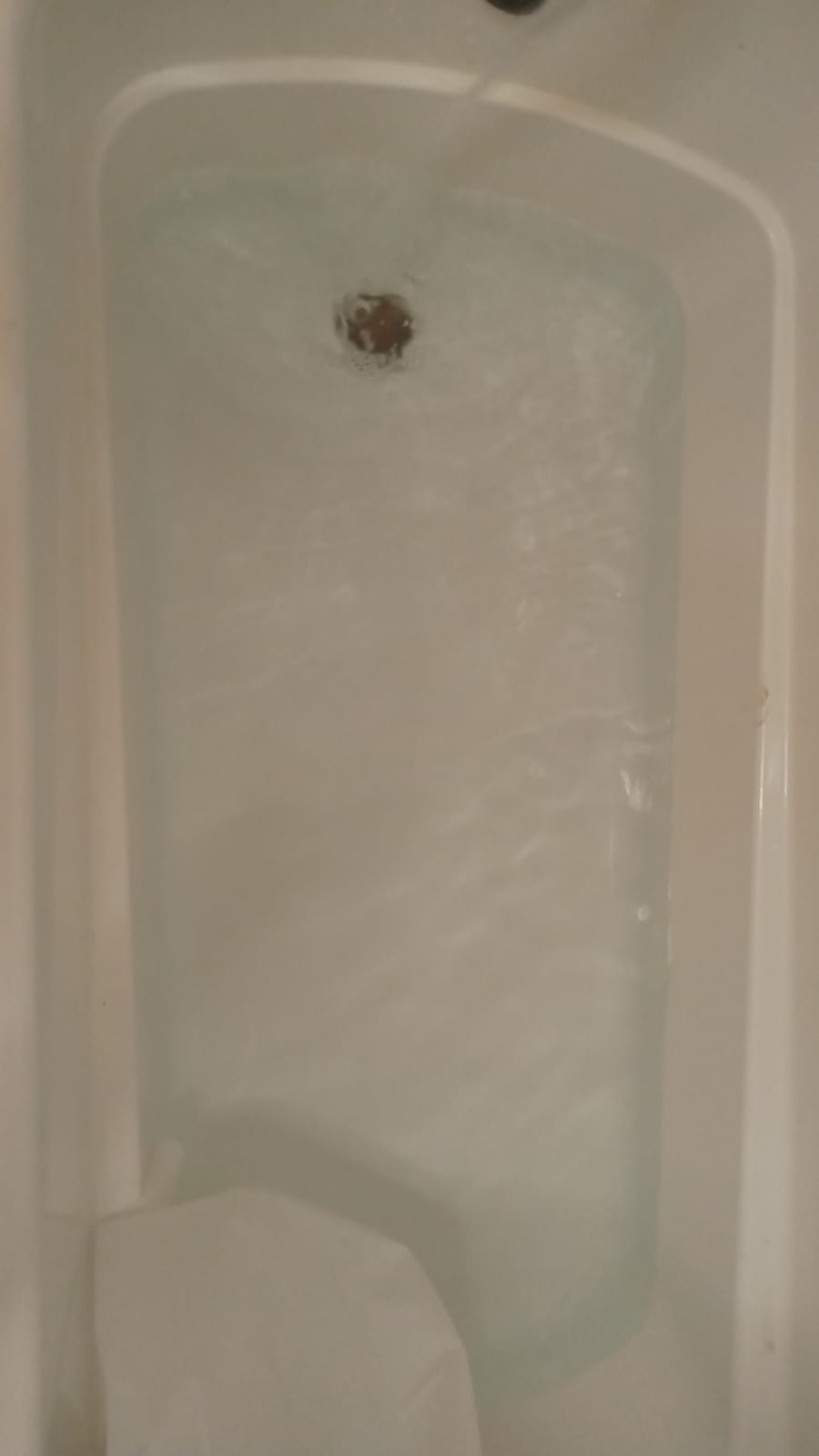
At 364 ratings it carries a solid review base among the oxidizing tanks here, and the pattern in those reviews is unusually consistent: the staining goes, the smell goes, and DuraWater support answers setup questions quickly.
Total weight of 65 pounds is the practical surprise. You can move this tank and fill it yourself, which is not true of the Filox system above it.
What most buyers get wrong
Out of the box the controller regenerates every day. On most households that is more backwash water than the filter needs, and on a property with a septic drain field it can be more than the field wants.
Programming the valve is the other hurdle. Allow an hour with the manual, and expect to call support once. Reviewers who did that ended up with a system they were happy with.
Where it falls short
The air injection cone can weep a small amount of water while it draws in air. It is normal for this design and it is not a leak that will flood anything, but it is worth knowing before you panic.
Media recharge comes sooner if you set the controller to every other day, so a rescheduled valve and a media life estimate have to be planned together.
5. DuraWater Fleck 5600 SXT 48K Water Softener and Iron Filter
DuraWater Fleck 5600 SXT 48K Water Softener/Iron Filter, 3/4″ Bypass, Black
Softener and iron filter in one tank
48000 grain capacity
14 GPM max flow
Pros
- One tank handles hardness and iron staining together
- Metered regeneration uses salt and water only on demand
- Fine mesh resin sized for two to five people
- Fleck 5600 SXT valve carries a five year warranty
- Bypass valve and DIY instructions included
Cons
- Requires salt
- so it is not a chemical-free sulfur option
- Does not address sulfur odor at all
- An hour of iron breakthrough can follow each regeneration
This is the combined system to buy when hardness is the bigger daily annoyance and sulfur is a background nuisance. A 48000 grain capacity with fine mesh iron removal resin softens and filters in one 25 by 15 by 62 inch footprint, which is a lot of function in a small space.
Owners on hard, iron-heavy well water report clearer water, better soap lather and noticeably improved laundry and silverware within days. The metered control only regenerates when demand is measured, so the salt bill stays predictable.
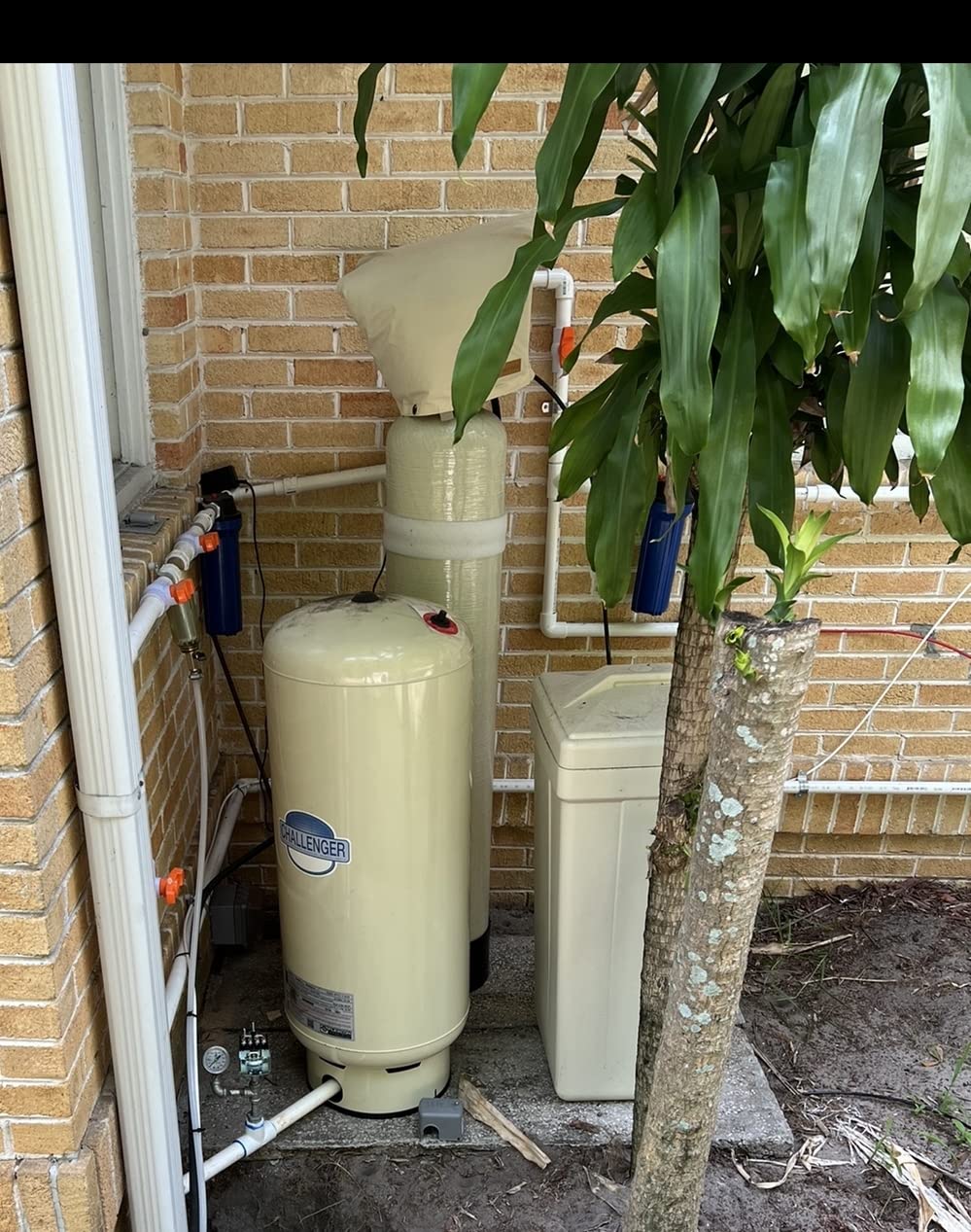
The Fleck 5600 SXT valve is the same control used on the air injection tank above, and it carries a five year warranty with a maximum flow rate listed at 14 gpm. That is comfortably above what a two to five person household pulls.
It is a legitimate two problems, one tank answer. The catch is that the resin is solving hardness and light iron, not sulfur.
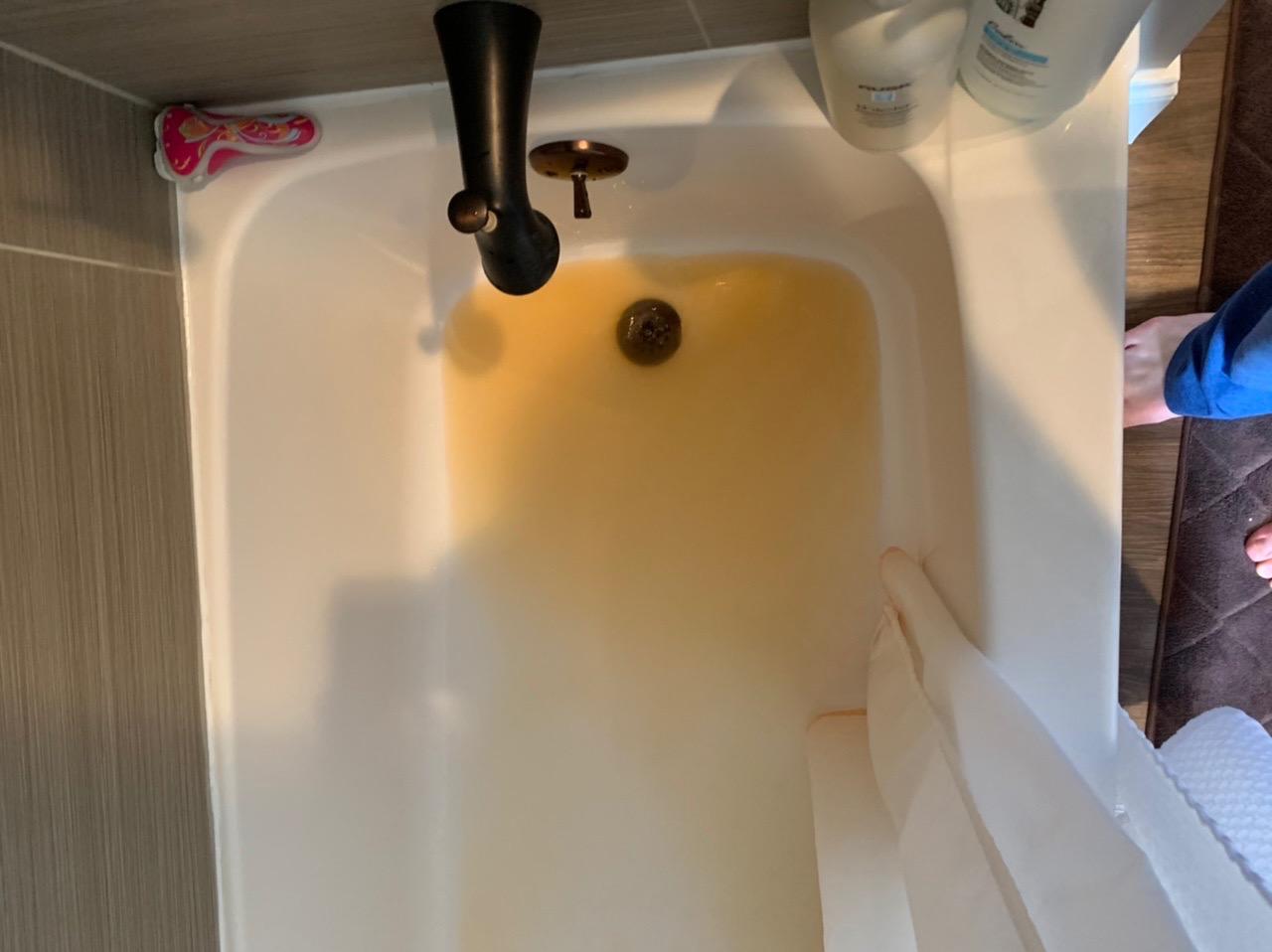
When combining makes sense
If your water report shows hardness above roughly 10 grains per gallon plus iron under 1 ppm, this is efficient. You get softening and iron filtering in a single unit with one valve to maintain instead of two.
The fine mesh resin is sized for homes of two to five people with two to three bathrooms, so match the capacity to household size rather than to the well pump.
Where it falls short
It does not touch sulfur. Owners with a rotten egg smell report it persists, which is the single most common complaint in the reviews and the clearest reason not to buy this if sulfur is your main complaint.
Brief iron breakthrough for about an hour after each regeneration is also reported. The discharge hose and clamp are not included in the box even though the listing implies a complete system, and the printed manual is a photocopy.
6. Home Master Whole House Three Stage Filtration with Sediment, Iron and Carbon
Home Master Whole House Three Stage Water Filtration System with Fine Sediment, Iron and Carbon, Blue
Three stage radial flow
Combined load to 3 ppm
15 GPM on 1 inch ports
Pros
- Up to 95 percent iron and manganese reduction
- 25-10-5-1 micron radial flow filters with high dirt holding
- 1 inch ports hold 15 GPM with little pressure loss
- Arrives pre-assembled on a steel bracket with wrench and instructions
- Two year limited parts warranty
Cons
- Rated only for a combined iron
- manganese and sulfur load of 3 ppm
- O-rings swell out of their grooves and leak during changes
- Brown water can appear when a new well has not been tested first
Home Master built this one for well water with light iron, light manganese and a faint sulfur trace, and it is honest about that. The listing puts a ceiling of 3 ppm on the combined iron, manganese and sulfur load, which is the number to read twice before you order.
Inside you get 25, 10, 5 and 1 micron radial flow stages with high dirt holding capacity, which is genuinely useful on a well that runs sand after heavy rain. Maximum flow is 15 GPM on 1 inch ports, and nothing needs power.
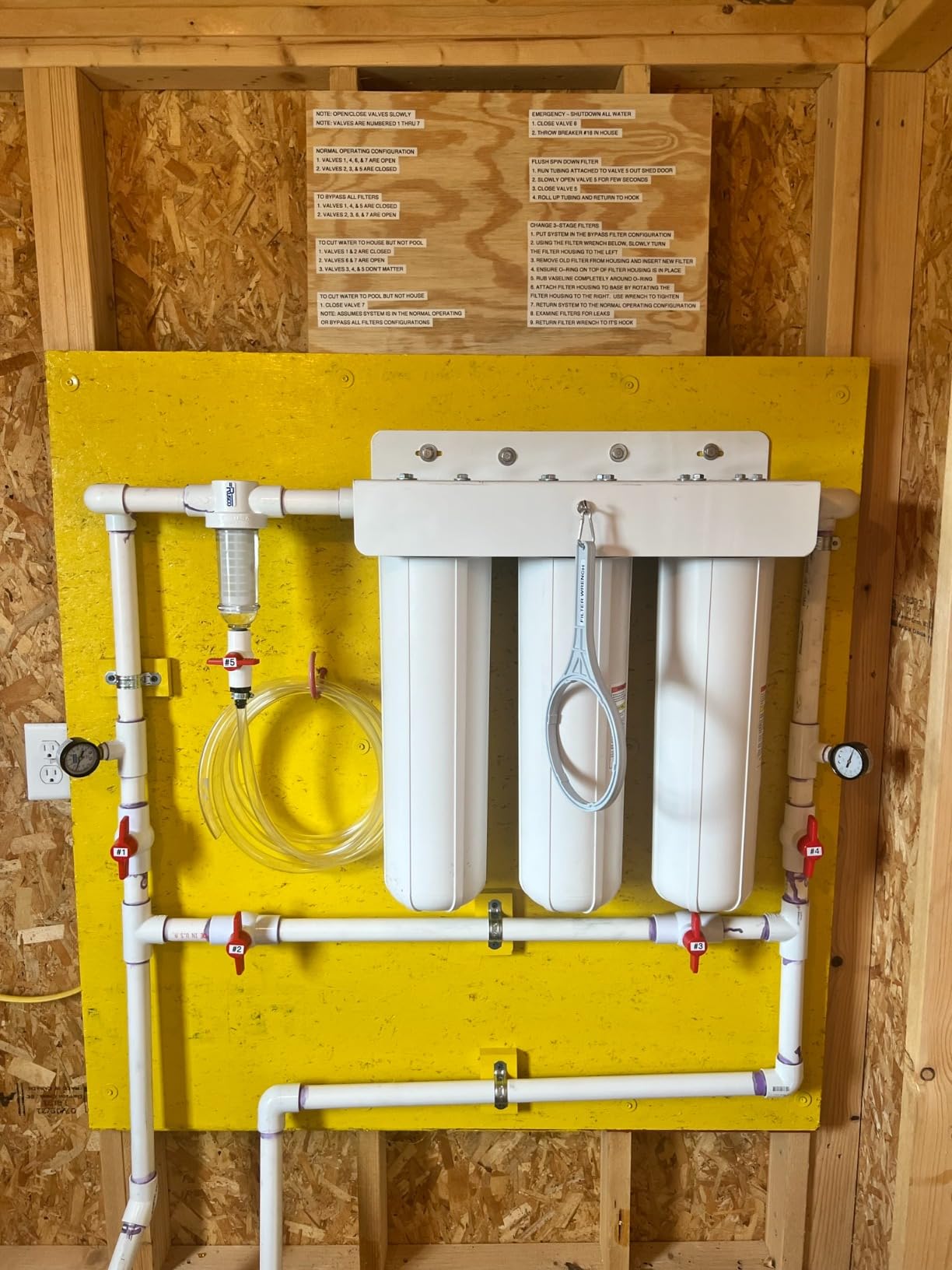
Long-term owners on light sulfur wells report the color and odor problems resolved and cartridges lasting roughly six to eleven months depending on household use. The manufacturer checking in with customers annually is an unusually good sign for support.
It is manual operation with no valve to program and no drain line to run, which makes it the least fussy installation in this roundup.
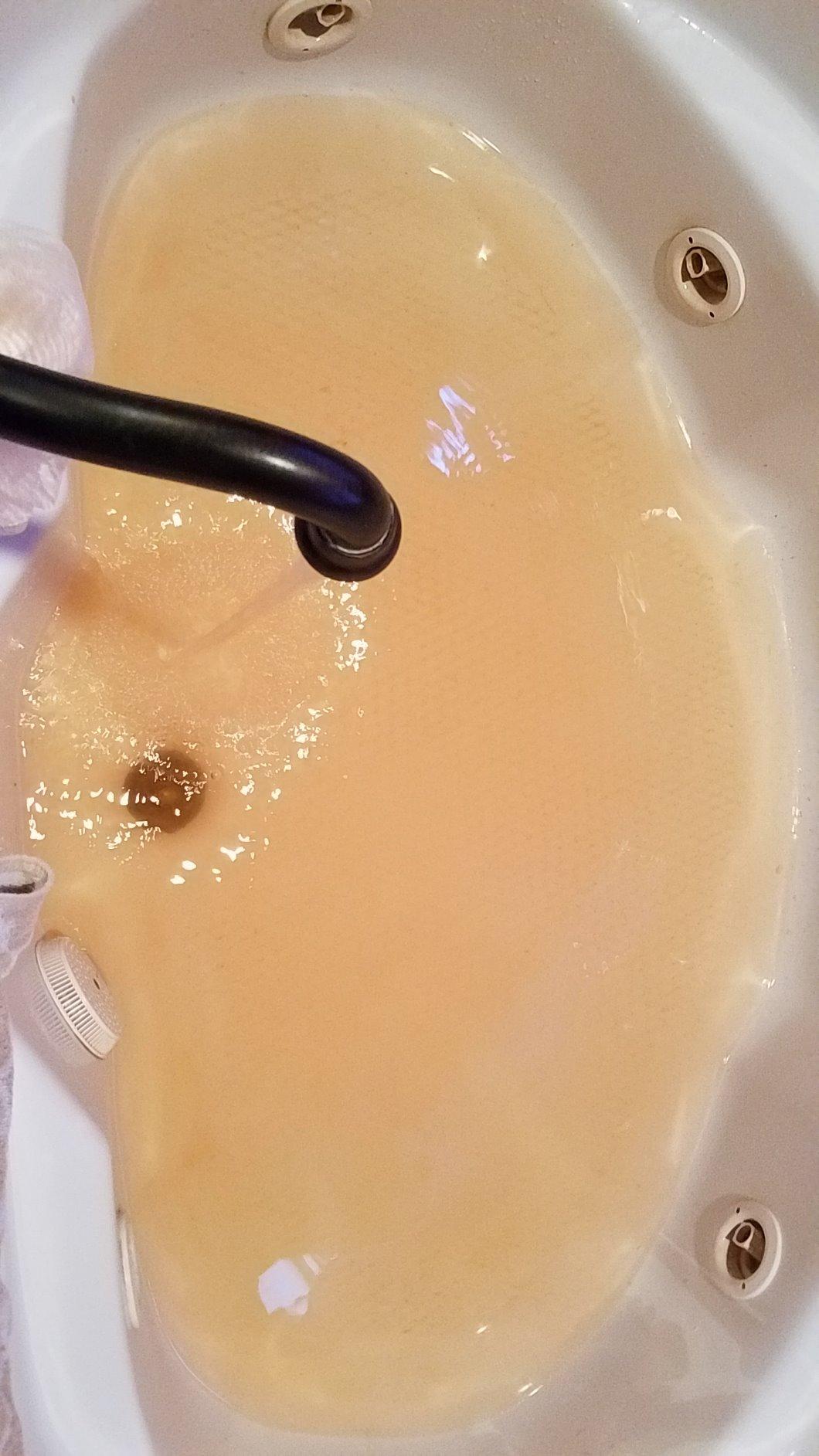
Where this three stage system actually fits
If your test report shows iron under 1 ppm, manganese under 0.5 ppm and only a whiff of sulfur, this handles the problem and protects the rest of the plumbing at the same time. The staged sediment ratings also cut pressure drop compared with a single fine cartridge.
It is also a reasonable pre-filter stage ahead of a larger system, catching the grit that clogs media.
Where it falls short
The 3 ppm combined ceiling is the deal breaker for anything above a light load. Push a well with 5 ppm iron through this and you will be replacing cartridges on a schedule that will make you question the purchase.
The most repeated complaint across the reviews is O-ring sealing during changes, where the housings swell the rings out of their grooves. A few owners also saw brown water right after installation when the well had not been tested first.
7. AFWFilters Air Injection Iron and Sulfur Chemical Free Titanium System
AFWFilters Air Injection Iron & Sulfur whole house water filter system chemical free, no salt, removes high levels of iron!
Salt-free air injection
Low backwash water use
Rated for high iron and sulfur
Pros
- No chemicals and no salt
- water pressure drives the oxidation
- K-series media needs only a fraction of standard backwash flow
- Marketed for high levels of iron and sulfur
- Install instructions on a USB drive plus phone support
Cons
- Smallest review base in this group at 37 ratings
- Some owners report limited iron reduction after several months
- Backwash noise during regeneration
The pitch here is efficiency. The K-series media is designed to backwash with a fraction of the water a standard oxidation system uses, which is the feature that matters most on a property with a tight well yield or a small septic drain field.
Operation is driven by water pressure rather than an electrical supply, so there is no control valve to plug in and no compressor to maintain. It is rated for high levels of iron and sulfur, and the tank runs up to a 1000 ppm TDS ceiling and 120 degrees Fahrenheit.
Why low water use is worth chasing
If your well produces limited yield, or you are on a septic system where every gallon of backwash matters, this is the only system here built around minimizing backwash volume. On a large lot with a shallow well that is a real constraint.
It is also chemical-free and salt-free, driven entirely by water pressure.
Where it falls short
The thin review base is the first thing to weigh. With 37 ratings you have very little to go on beyond the listing, and some owners report limited iron reduction after several months of service.
Regeneration noise is reported during backwash, and hands-on support is described as uneven compared with the Abundant Flow Platinum model from the same manufacturer.
8. iSpring WGB21BM 2-Stage Whole House Carbon Block and Iron Filter
iSpring WGB21BM 2-Stage Whole House Water Filtration System, 10” x 4.5” Carbon Block and Iron & Manganese Reducing Filters, 1″ Ports
Two stage carbon and iron
Iron 3.0 ppm to 0.01 ppm
15 GPM service flow
Pros
- Iron from 3.0 ppm down to 0.01 ppm and manganese from 1.0 ppm to 0.01 ppm
- Catalytic media outlasts greensand because it is not consumed
- Pre-assembled bracket
- reversible flow direction and included wrench
- 50000 gallon capacity is about a year for a family of four
- Removes more than 90 percent of chlorine and VOCs
Cons
- NPT fittings need heavy tape and firm tightening
- Filter order matters when carbon sits ahead of the iron stage
- Small 10 inch cartridges add pressure drop on heavy sediment
By review volume this is the most reviewed unit in the entire roundup, with 4270 ratings at 4.6 stars and 81 percent five-star feedback. It is a two stage bracket system: an FC15B carbon block followed by an FM15B iron and manganese filter.
Most owners buying it use it as a second or backup whole house stage or for city water that smells of chlorine. Buyers single out build quality, easy bracket mounting and a support line that sends O-rings and parts at no charge.
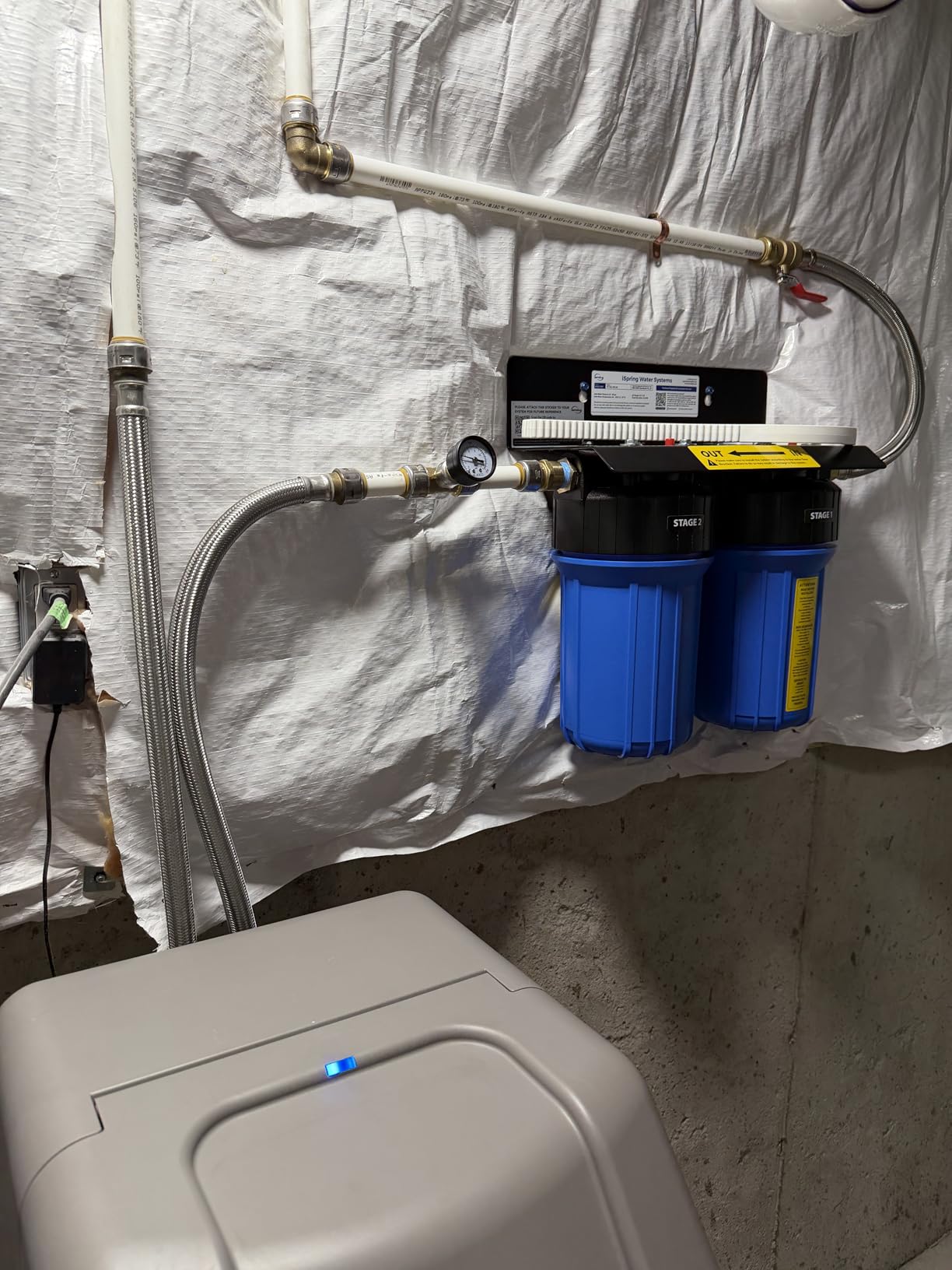
The published reduction numbers are the best in the cartridge class, iron from a 3.0 ppm maximum down to 0.01 ppm and manganese from 1.0 ppm to 0.01 ppm. Flow holds at 15 GPM on 1 inch NPT inlet and outlet, with 50000 gallon capacity.
For a household on municipal water that has both a chlorine smell and light iron, this handles both in a small 16.5 by 8.5 by 18 inch footprint with no power and no drain line.
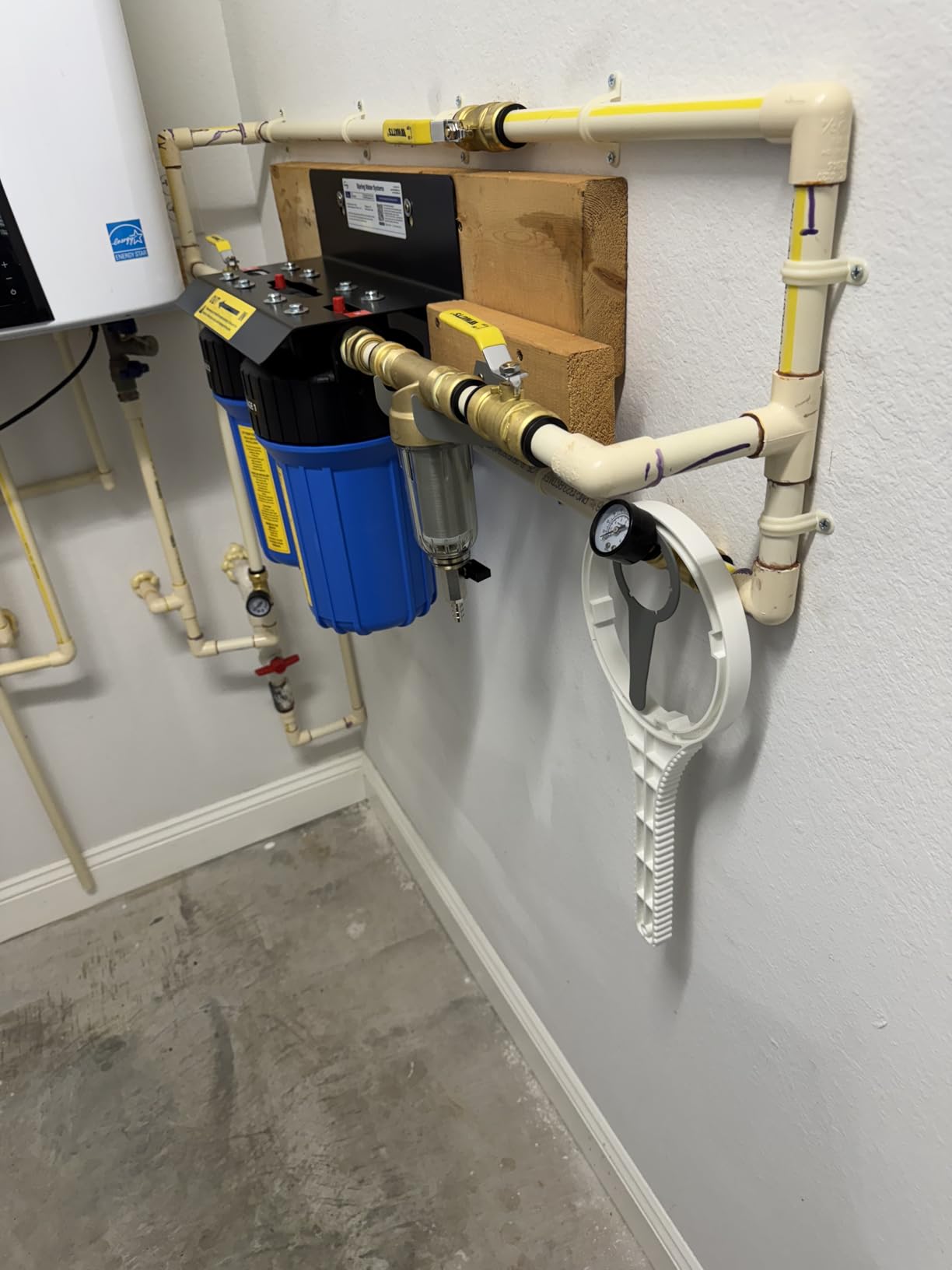
When two stages are the right call
This is the value pick for a home with moderate iron, or the second stage to add in front of a softener. The carbon block also takes chlorine and VOCs, so it earns its place on city water where chlorine is the complaint rather than iron.
At 11.7 kg it is by far the easiest unit here to install solo.
Where it falls short
It does not address sulfur, and the 3.0 ppm iron ceiling is well below the oxidizing tanks. Buyers wanting to treat both contaminants in one device need a media tank instead.
Recurring complaints are fitting leaks on first assembly, O-rings that can leak before they seat, and pressure drop when the small 10 inch cartridges load up with sediment. Filter order matters too, since carbon ahead of the iron stage reduces performance.
9. Express Water Whole House Iron and Manganese 3-Stage System
Express Water Whole House Water Filter System, Iron & Manganese, 3-Stage
Three stage iron and manganese
17 GPM on 1 inch ports
100000 gallon capacity
Pros
- Built specifically to stop reddish brown staining and metallic odor
- Highest flow rate in this group at 17 GPM
- Stainless steel stand with pressure gauges and release buttons
- NSF certified cartridges
- 100000 gallon capacity
- Recommended for installation ahead of a water softener
Cons
- Does not reduce total dissolved solids
- Cartridges need replacing two to three times a year
- Freestanding frame takes more space than inline tank systems
With 2705 ratings at 4.5 stars and 80 percent five-star feedback, this is the most popular unit in the roundup by owner count, and the reviews describe a single consistent outcome: orange staining on fixtures and laundry stops after install.
It runs 17 GPM on 1 inch connections at 45 to 80 psi, the highest flow figure of any system here, and the stainless steel stand, gauges and pressure release buttons make cartridge changes less of a chore than they usually are.
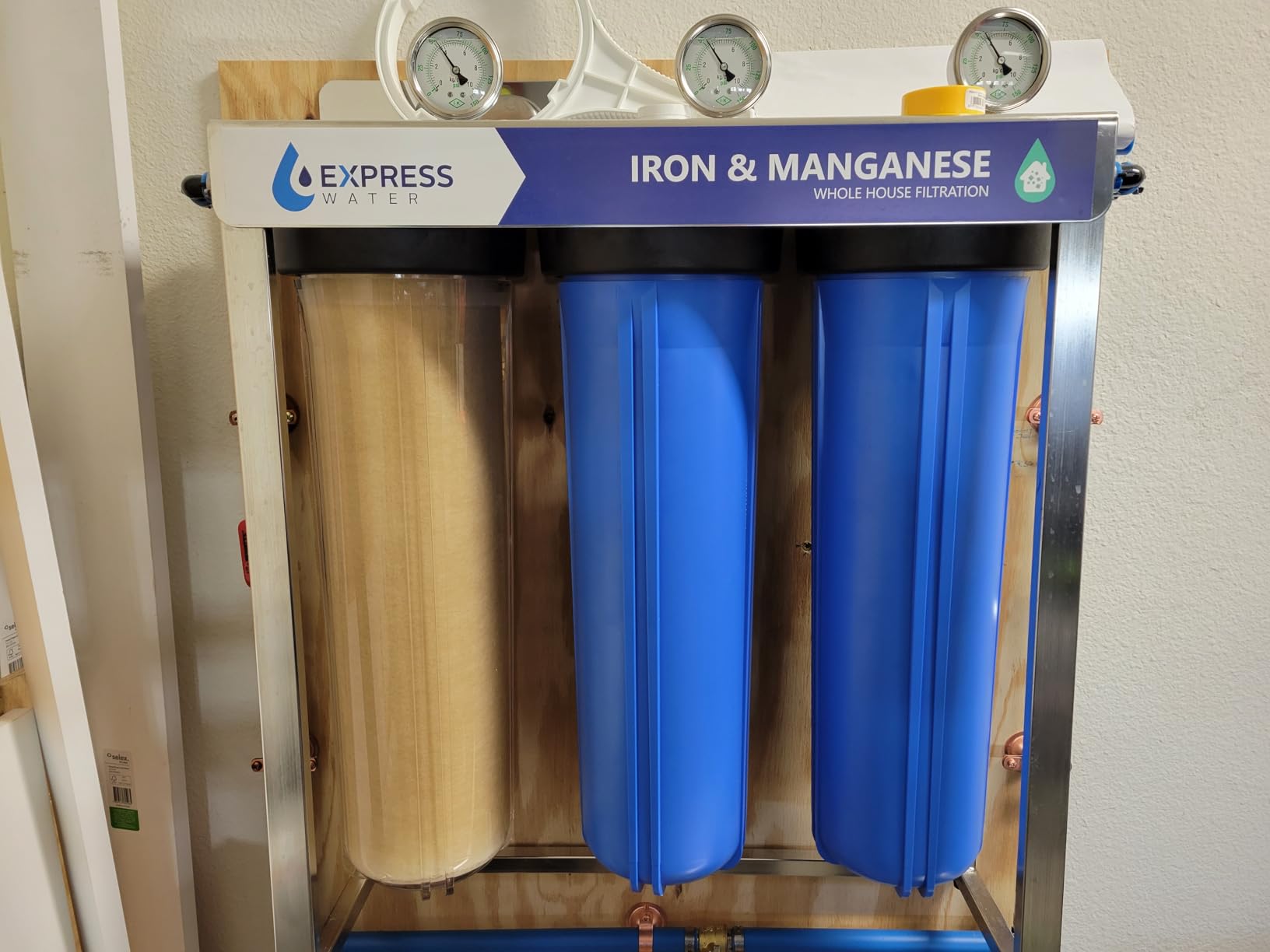
The manufacturer explicitly recommends installation before a water softener, which is the correct position in a treatment train. At the inlet it catches sediment and iron first, so the resin is not being asked to do work it was not built for.
Operating range is 20 to 80 psi, 40 to 100 degrees Fahrenheit, and the housing is rated to an 800 ppm TDS ceiling with 100000 gallon capacity.
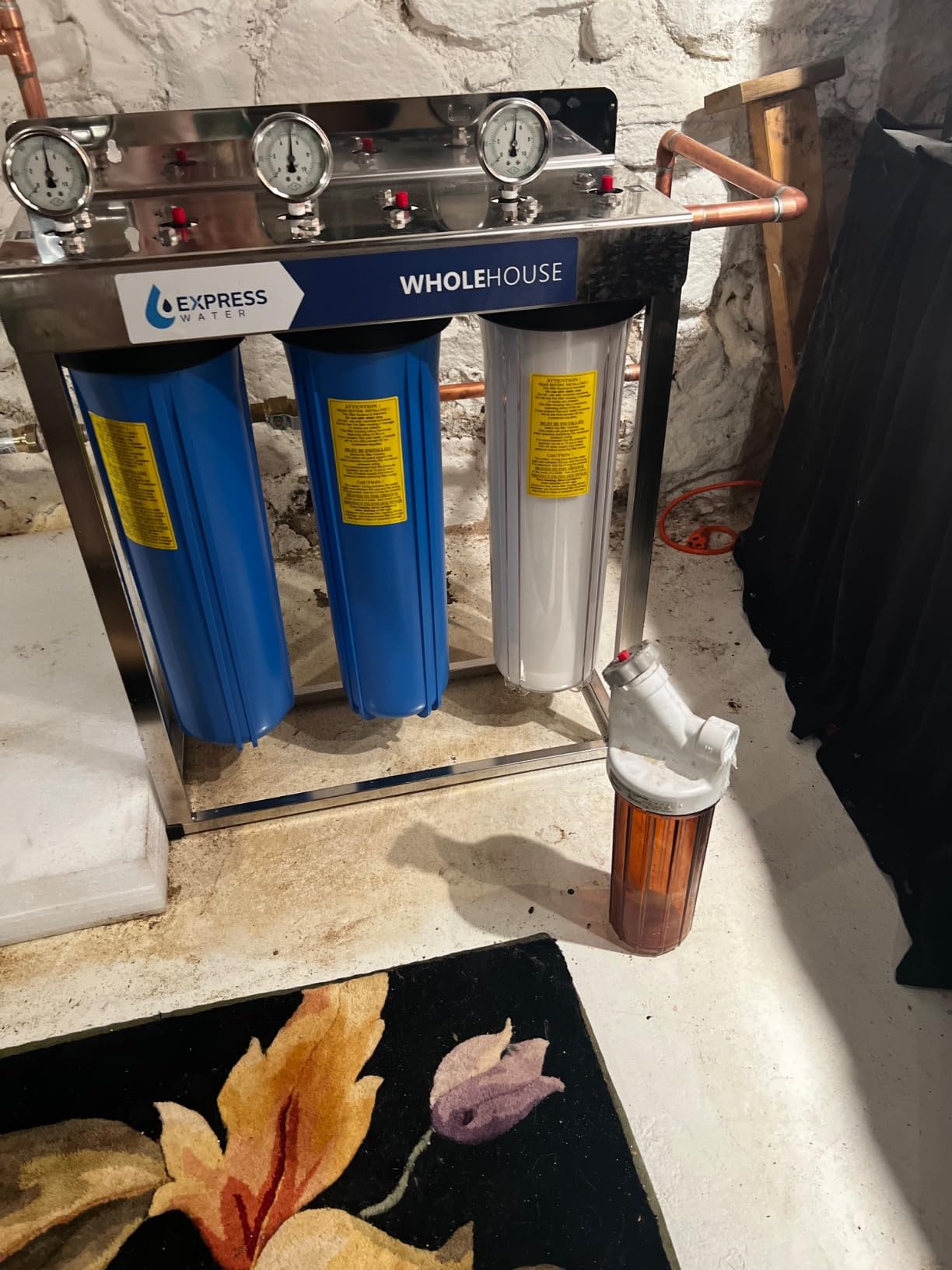
Best when the goal is protecting appliances
If your priority is stopping damage to a washing machine, dishwasher and water heater rather than improving taste, this is the most direct way to do it. Owners installing it ahead of a softener report the staining stops and clarity improves noticeably.
The 17 GPM figure also means it will not choke a large home running multiple fixtures at once.
Where it falls short
It does not reduce total dissolved solids, so if you are chasing a TDS number you need reverse osmosis, which is a different category of product entirely.
Cartridges are replaced every 6 to 12 months on typical use, which means two to three changes a year, and the freestanding frame occupies more floor space than an inline tank system.
10. Waterdrop WHF3T-FG 3-Stage Whole House Filter for Well Water
Waterdrop WHF3T-FG 3-Stage Whole House Water Filter System for Well Water
SGS tested iron reduction
15 GPM on 1 inch ports
3 housings with 7 media layers
Pros
- Independently tested at 95.9 percent iron and 99.7 percent manganese reduction
- Paired iron cartridges plus carbon fiber for a large filtration area
- 15 GPM steady flow on 1 inch inlet and outlet
- Housings passed more than 100000 water hammer tests
- NSF and ANSI 372 certified lead-free materials
Cons
- Iron and manganese cartridges change every 6 to 12 months
- 300 ppm TDS ceiling is the lowest among these systems
- New cartridges can release a brief cloudy or black discharge
The Waterdrop is the newest listing here and the one with the cleanest published test data. SGS tested the system at 95.9 percent iron reduction and 99.7 percent manganese reduction, which is a number you can hold a manufacturer to.
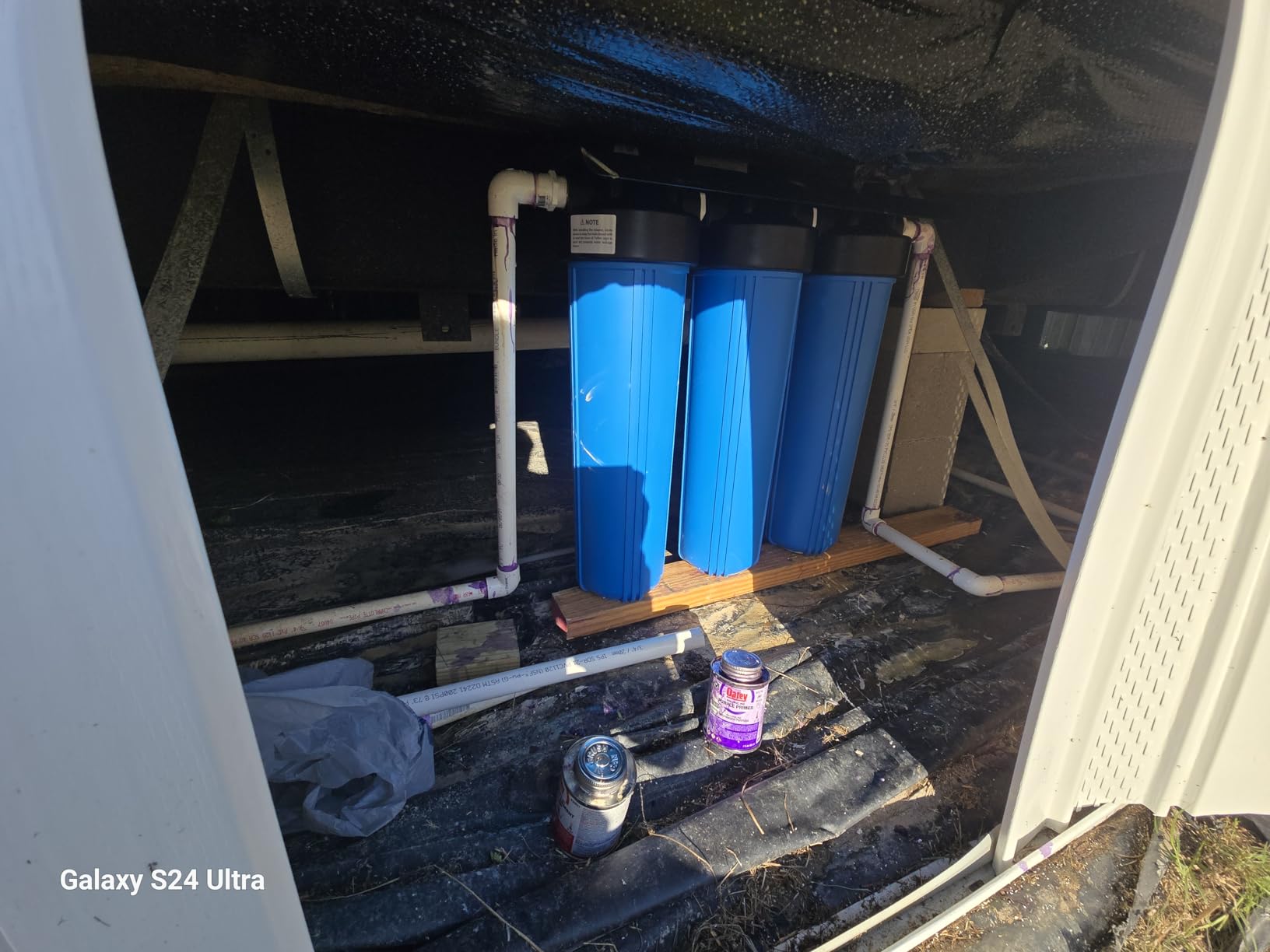
It is a three housing system with seven filtration layers, combining iron and manganese cartridges with a carbon fiber stage for a larger filtration area than a single cartridge of the same size. Flow is 15 GPM on 1 inch inlet and outlet.
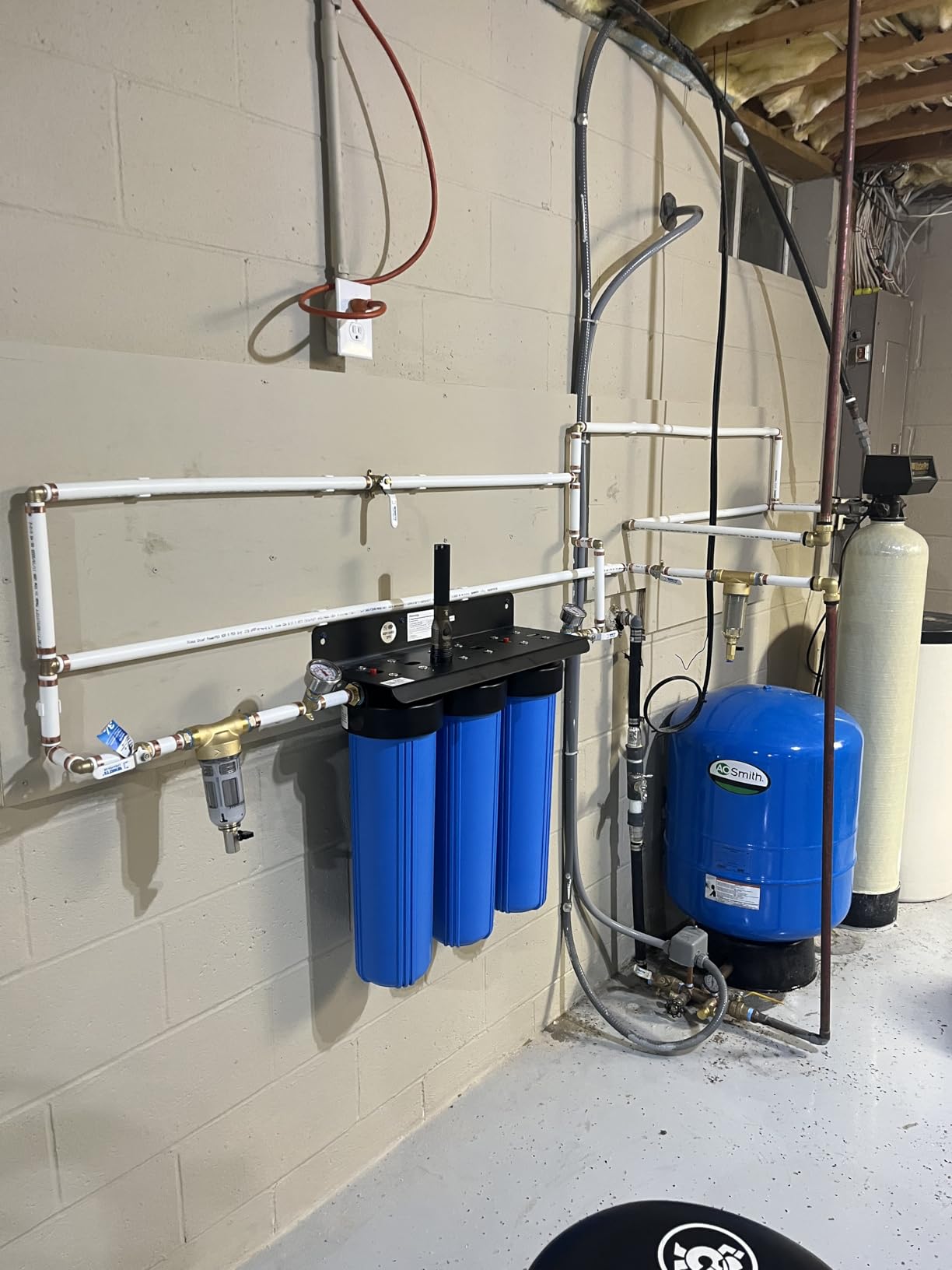
Two details stand out for a well installation. The housings passed more than 100000 water hammer tests, and the materials are NSF and ANSI 372 certified lead-free, which matters more on a private well than most buyers expect.
At 88 ratings it has the smallest installed base of the well water options, but 74 percent five-star feedback is a solid start and no owner complaints about performance dominate the reviews.
Best for buyers who want verified numbers
If you have been given vague claims from a contractor or a marketplace listing, this system has the cleanest third-party result we found among the cartridge options. Owners installing it on well water report clearer water and reduced iron staining, and they value the SGS data and lead-free certification.
It reduces iron, manganese, lead, chlorine, odor, sediment, rust and sand, which makes it a reasonable all-round well package.
Where it falls short
The 300 ppm TDS ceiling is the lowest among the systems in this roundup, and it is a cartridge system, so sulfur is not within its scope.
Iron and manganese cartridges need changing every 6 to 12 months and the carbon stage annually. New cartridges can also release a brief cloudy or black discharge right after installation, which alarms people who have not seen it before.
Buying Guide: Match the System to Your Water Report
Almost every expensive mistake in this category starts with a buyer who never looked at the lab report. Start there and the rest of the decision makes itself.
Read the report before you shop
- Get a full panel test, not a home test strip. You need iron, manganese, hydrogen sulfide, hardness, pH, bacteria and TDS in one document.
- Read the iron number. Under 0.3 mg/L is background. 0.3 to 3 ppm is cartridge territory. Above 3 ppm demands an oxidizing backwashing tank.
- Read the sulfide number. Any reliably detectable hydrogen sulfide means you need oxidation or catalytic media, not a spin-down cartridge.
- Note the pH and the manganese figure together. Low pH and manganese both shorten media life and drive the need for pretreatment.
Decide what the system has to do
Write your requirement as one sentence before you open any product page. Iron up to 12 ppm plus hydrogen sulfide up to 20 ppm is a different purchase from iron under 1 ppm with a chlorine taste, and the second one should cost a fraction of the first.
Our broader guides cover the narrower versions of this problem in more depth, including sulfur filters for well water and whole house filtration systems for well water.
Size for service flow, not tank size
A 3 gpm household is the common planning number, and a home with three bathrooms running two showers and a laundry cycle can briefly pull 8 to 10 gpm. Tanks that undersize on service flow show it as a pressure drop whenever two fixtures run together.
Also check the well yield before you pick a backwashing system. A system that backwashes 80 gallons on a tight well can borrow from the pressure tank every time it cycles.
Know where it goes relative to your softener
Put the iron and sediment system first, at the point of entry, and the softener after it. Iron that reaches resin gradually kills capacity, and every manufacturer in this roundup, including Express Water, points at that order.
Keep a sediment stage ahead of any media tank. Grit loads the media bed, shortens backwash intervals and increases pressure drop faster than any contaminant does.
Iron bacteria and the things that trip up standard filters
- Test for iron bacteria explicitly if you have ever seen slime, stringy growth or a slime ring in a toilet after a week of vacancy.
- Understand that no iron filter on this list kills bacteria. They oxidize and capture the iron, which is a different job.
- Address it with chlorine or peroxide shock at the well point, then follow with a scheduled shock routine the lab recommends.
- Add physical filtration downstream, because shock treatment can send particles through the plumbing.
Iron bacteria is the reason some perfectly good iron filters appear to fail a few months after installation. The filter was never undersized, the source water was simply feeding a biofilm faster than the media could capture it.
What maintenance really costs over ten years
Cartridge systems trade capital cost for recurring cost. Expect two to three changes a year on the three-stage units here, and the math compounds over a decade. Media tanks trade the opposite way, front loading the cost into day one and then running for years.
Count the drain water too. A daily backwash on a septic system is an ongoing line item, not a one-time decision.
Do not let a contractor quote set your expectations
In one r/WaterTreatment thread a private well owner was quoted a bundled iron and softener package by their drilling contractor and asked the forum for cheaper routes to the same result. The consensus direction in that discussion was that standalone media oxidation systems get comparable results for a fraction of a bundled contractor package.
Ask for a line by line quote. A tank, a control valve, media, a bypass and a drain line are separate items, and a bundled quote hides which one carries the markup.
Frequently Asked Questions
What is the best whole house water filter for removing iron and sulfur?
A backwashing media tank that oxidizes dissolved iron into filterable solids and converts hydrogen sulfide into insoluble elemental sulfur. On a well with moderate to high iron and a noticeable sulfur smell, an air injection or chemical-free catalytic tank in the 1.5 cubic foot class is the right shape. Cartridge stacks work for iron under 3 ppm but do not treat sulfur.
Does an iron filter remove sulfur?
Usually not on its own. A standard KDF or greensand iron cartridge is built to capture already-oxidized iron particles, and hydrogen sulfide gas passes straight through it. Sulfur removal needs oxidation plus catalytic media such as Filox or catalytic carbon, or a peroxide-assisted carbon tank. That is why we flag sulfur performance separately for every system in this roundup.
What is the best water filtration system for iron bacteria?
No standard filter on this list kills iron bacteria, because the bacteria are a living organism rather than a dissolved particle. Start with a shock treatment at the well point using chlorine or hydrogen peroxide, follow with a scheduled shock routine, then add physical filtration downstream to catch the particles the shock dislodges. Test for iron bacteria explicitly if you see slime or stringy growth in fixtures.
What is the best filter to remove sulfur smells from well water?
An oxidizing backwashing tank with catalytic carbon or Filox media, sized to your flow. Air injection systems are chemical-free and handle moderate hydrogen sulfide well, while a peroxide-assisted carbon tank is the most aggressive option for stubborn sulfur. Cartridge systems and softener resin will not fix a rotten egg smell, which is the most common expectation we see go wrong.
How do I get rid of iron and sulfur in well water?
Get a full lab panel first, then install a sediment pre-filter at the point of entry, followed by an oxidizing iron and sulfur system, then a water softener downstream if the water is hard. Reschedule the backwash frequency to match your household water use, and confirm the well can supply the backwash volume. Re-test the water six months after installation to confirm the media is sized correctly.
Is a softener enough if I already have an iron filter?
A softener handles hardness and can polish light iron, but it does not treat sulfur and its resin can be coated by heavier iron, which reduces capacity over time. The standard order is sediment stage, then the iron and sulfur system, then the softener. Putting the softener first exposes the resin to iron load and sediment that shorten its life.
Which Whole House Water Filter Is Right for You in 2026
Our best whole house water filters for iron and sulfur shortlist comes down to three decisions. If your report shows iron at or under 3 ppm with no meaningful sulfur, the iSpring WGB32BM is the best-supported place to start, with the largest review base of any three-stage cartridge we examined and a year between changes on a family of four.
If iron runs higher or you can smell hydrogen sulfide, you need oxidation. The iSpring WCFM550K is our pick for most households because it handles iron to 12 ppm and hydrogen sulfide to 20 ppm with a control valve you can schedule. The AFW Air Injection Platinum is the chemical-free alternative, with the highest iron and sulfur ceilings in the group.
If the budget is tight, the DuraWater Fleck 5600 SXT air injection tank gives you the same Fleck valve and footprint most homes already have plumbing for. Just reschedule that daily backwash before you regret it.
Read the lab report, confirm the flow, and the right system stops being a judgement call.
Our related reading covers the narrower versions of this problem if you are still deciding: whole house water softeners for hard water and iron removal filters for well water.