
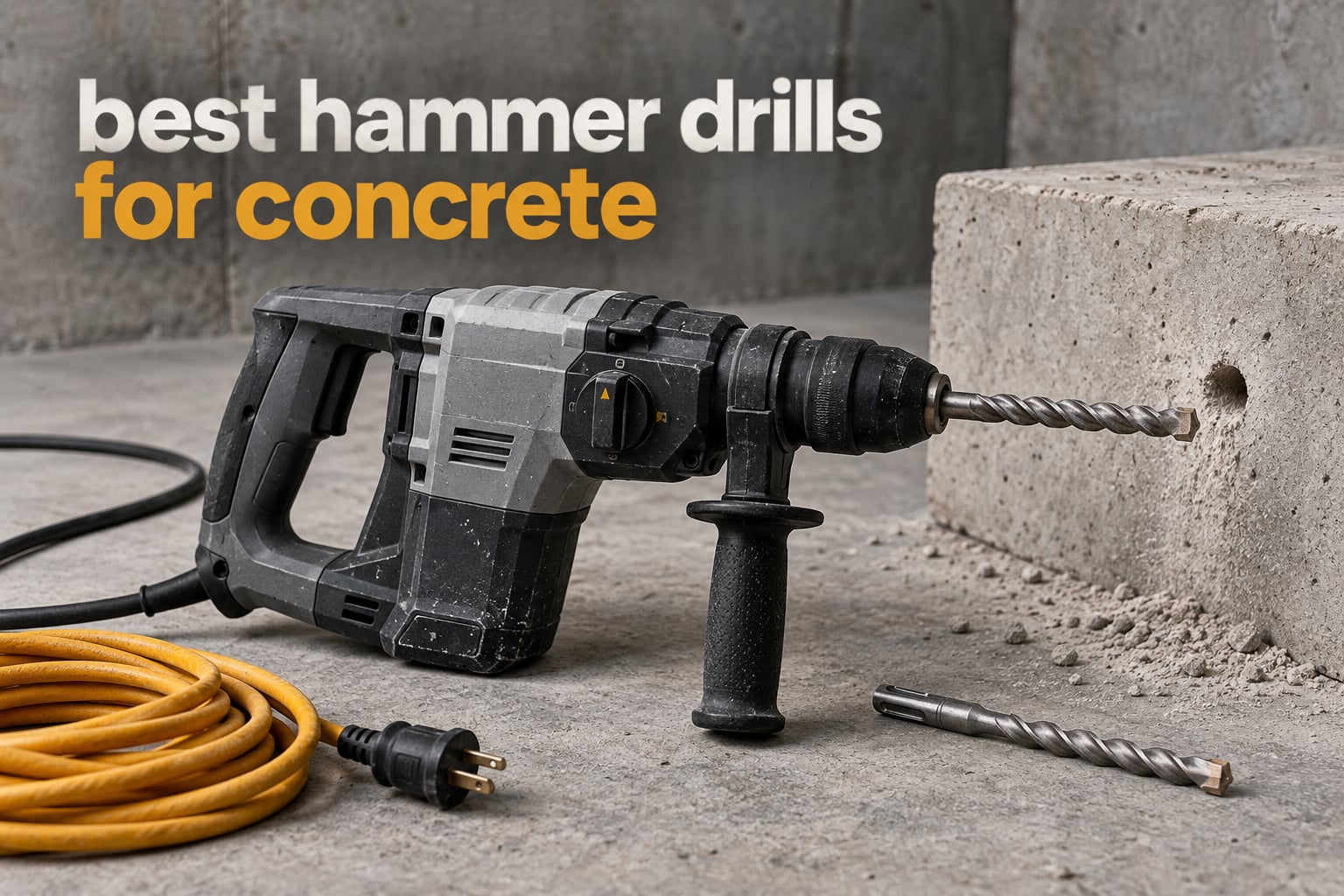
Yes, hammer drills work on concrete, but only up to a point. A standard hammer drill with a carbide-tipped masonry bit will put a 1/4 inch hole into poured concrete or block without complaint, and that covers most anchor work. Anything larger than about 1/2 inch, anything deeper than a few inches, and anything in hardened or reinforced concrete pushes you into a true rotary hammer drill, where a piston mechanism hammers the bit thousands of times a minute instead of a small spring-loaded cam mechanism shaking it at 25,000 blows per minute. This guide covers the best hammer drills for concrete across both classes, because most buyers actually need the second one and do not know it yet.
We assembled eight picks by reading the published specifications of every tool, then cross-checking those numbers against thousands of owner reviews to see where the spec sheet and the real experience agree and where they diverge. The short version: the Bosch Bulldog Xtreme is the safest default for almost anyone, the DEWALT cordless rotary hammer is the answer if you are working alone on a ladder or in a basement without an outlet nearby, and the DEWALT and CRAFTSMAN hammer drill drivers are for fastener holes, not for serious concrete work.
A word on who this is for. If you are a homeowner hanging a shelf, setting a wall anchor, or running a cable through a basement wall, roughly half of this list is more than you need and the fastest answer is a hammer drill driver with a 1/4 inch masonry bit. If you are a contractor or a serious DIYer drilling anchor bolt holes, conduit runs, or doing tile and thinset removal, the rotary hammers are the only honest answers. Since standing on concrete all day is its own problem, we also linked our picks for anti-fatigue mats for concrete floors and work boots for standing on concrete to cover the rest of the day.
Table of Contents
Do Hammer Drills Actually Work on Concrete?
Yes. A hammer drill combines a spinning bit with a short, rapid hammering action that shatters the cement matrix while the rotation carries debris out of the hole. Plain drill motors spin but do not pulverize, which is why they stall, burn bits, and smell hot in concrete. The break point is hole size: hammer drills handle 1/4 inch holes and smaller fasteners comfortably, and a rotary hammer is the right tool from about 1/2 inch upward or for deep holes.
Concrete is also not one material. Poured foundation walls, concrete block, brick, and stone all respond differently, and a hole that is easy in block can be brutal in a 30-year-old slab. We get into that below.
Top 3 Picks for Drilling Concrete in 2026

Bosch 11255VSR Bulldog Xtreme
- 2.0 ft-lbs impact energy
- 0-5800 BPM
- SDS-plus 3 modes
- 10.4 lb corded
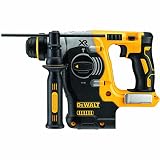
DEWALT DCH273B Cordless
- 2.1 joules impact energy
- SHOCKS vibration control
- 6.4 lb
- 3 application modes

ENEACRO ENRH3201 13 Amp
- 7.4 joules impact energy
- 13 amp motor
- 4 operating functions
- full bit and chisel kit
Best Hammer Drills for Concrete in 2026 at a Glance
| Product | Specifications | Action |
|---|---|---|
| Bosch 11255VSR Bulldog Xtreme |
|
Check Latest Price |
| ENEACRO ENRH3201 13 Amp |
|
Check Latest Price |
| DEWALT DCH273B Cordless |
|
Check Latest Price |
 DEWALT D25263K Corded DEWALT D25263K Corded |
|
Check Latest Price |
 Makita XRH04Z 18V LXT Makita XRH04Z 18V LXT |
|
Check Latest Price |
 Berserker 26FA Rotary Hammer Berserker 26FA Rotary Hammer |
|
Check Latest Price |
 DEWALT DCD996B Hammer Drill DEWALT DCD996B Hammer Drill |
|
Check Latest Price |
 CRAFTSMAN CMCD711C2 Kit CRAFTSMAN CMCD711C2 Kit |
|
Check Latest Price |
1. Bosch 11255VSR Bulldog Xtreme – The Best All-Round Corded Rotary Hammer
BOSCH 11255VSR Bulldog Xtreme SDS-Plus Rotary Hammer
7.5 amp 960W motor
0-1300 RPM and 0-5800 BPM
2.0 ft-lbs impact energy
10.4 lb SDS-plus body
Pros
- High impact energy for concrete drilling and light chiseling
- SDS-plus tool-free bit changes with secure locking
- Three modes for rotation rotary hammer and hammer-only
- Long-term durability reported by owners after years of use
- D-handle and auxiliary handle for overhead control
Cons
- Included depth gauge is flimsy and bends easily
- Variable speed trigger is very sensitive at the low end
- Needs an adapter to run standard drill bits
The Bulldog Xtreme is the pick we send people to when they ask a single question with no context: what should I buy to drill into concrete. It is a 7.5 amp corded rotary hammer producing 2.0 foot-pounds of impact energy, 0 to 1300 RPM, and 0 to 5800 blows per minute, which is a genuine piston-driven hammer rather than a cam-driven shake. It has been the default recommendation on pro forums for close to two decades, and it still shows up unprompted in threads where nobody is advertising.
Three modes cover almost everything you will do with a hammer drill for concrete. The rotary hammer setting drives fasteners in rotation-only, the hammer drill setting spins and impacts together for concrete holes, and hammer-only plus the 36-position Vario lock lets you reposition the chisel for light tile and thinset removal. The included depth gauge is the one part of the package owners complain about most, and they complain about it because it bends.
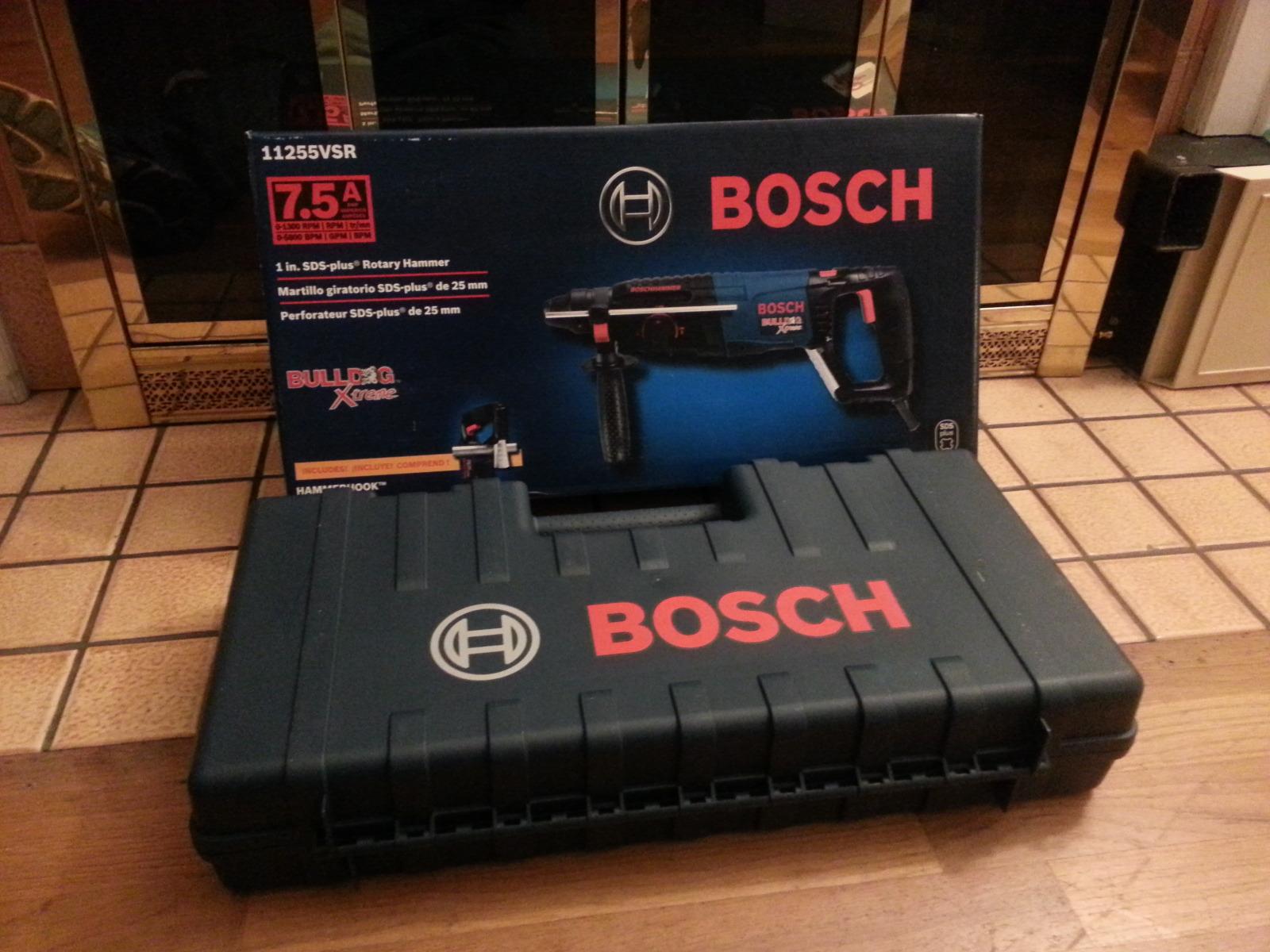
What stands out in the owner reports is durability rather than headline power. People describe drilling through poured foundation walls and reinforced concrete quickly, and using the chipping mode to lift tile and thinset. The 2.0 joules figure is modest next to a 7.4 joule machine, so if you are chasing large diameter holes all day this is not the tool. For anchor holes, shelves, cabinets, and mixed fastener work, it is more than enough.
Two practical details catch new owners out. The variable speed trigger is extremely sensitive at the bottom of its travel, so light trigger pressure produces slow, stall-prone starts on a trigger breakaway. And the SDS-plus chuck will not hold standard-shank bits without a separate adapter, which matters if you plan to swap between drilling concrete and driving screws with one tool.
What you get for the money
The box includes the rotary hammer, an auxiliary handle, a depth gauge, and a carrying case. Bosch backs it with a 1 year repair or replacement of parts warranty, which is shorter than the 3 year limited warranty on both DEWALT picks in this list. That difference matters less than owners think for a homeowner, and more than most realize for someone drilling daily.
Reviews of this tool number into the thousands, and the distribution is unusually clean: 86 percent five-star. The complaints cluster on the depth gauge, the trigger sensitivity, and the adapter requirement, not on failure. Very few owners report a dead motor.
Where it is the wrong choice
It is the wrong choice if your holes run larger than half an inch, if you are working overhead for hours with no outlet within cord reach, or if you expect to do real light demolition. The Bulldog Xtreme is a drilling tool with a useful chipping mode, not a demolition hammer.
It is also the wrong choice if you have a battery platform already. If you own 18V LXT or 20V MAX packs, a cordless rotary hammer in the list below will save you the cord entirely. If you have no batteries at all, this is the sensible purchase.
2. ENEACRO ENRH3201 – Best Rotary Hammer for Heavy-Duty Concrete Work
ENEACRO 1-1/4 Inch SDS-Plus 13 Amp Heavy Duty Rotary Hammer Drill
13 amp 1500W motor
5.5 ft-lbs (7.4 joules) impact
820 RPM, 4200 BPM max
12.6 lb bare tool
Pros
- 7.4 joules of impact energy for serious concrete work
- Four functions including chisel position adjustment
- Double layer anti-vibration system and 360 degree handle
- Kit includes bits chisels grease spare brushes and case
- Safety clutch protects the wrist when a bit snags
Cons
- Heavier than most corded rotary hammers at 12.6 pounds
- No-load speed of 820 rpm is lower than competing models
- Less long-term durability history than the big three brands
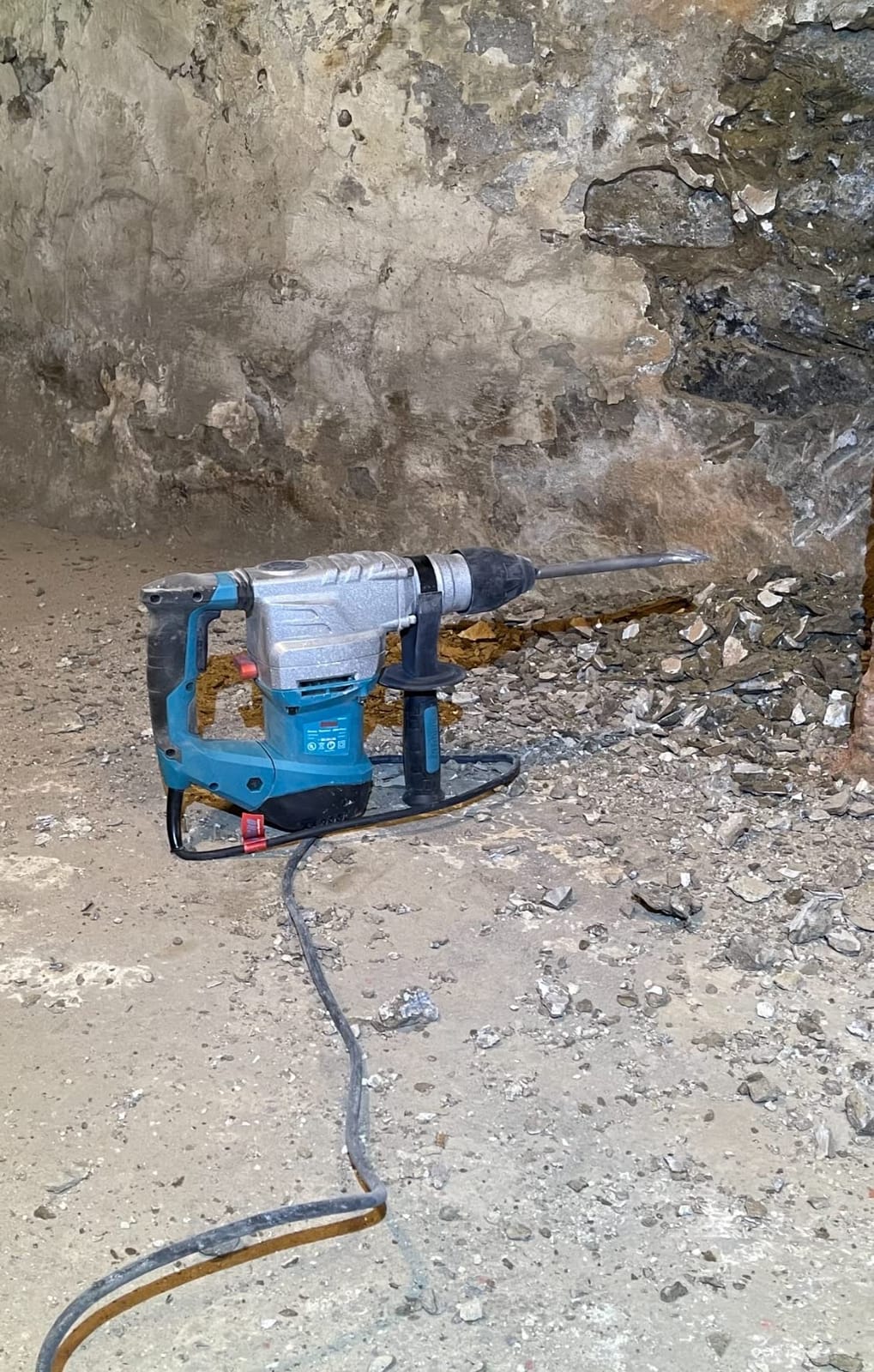
The ENRH3201 is the highest impact energy in this roundup, and that single number drives everything else about it. A 13 amp motor pushing 5.5 foot-pounds, or 7.4 joules, into a piston mechanism is the kind of output you normally associate with heavier pro machines. It drills up to 1.25 inches in concrete, which is a full inch more than the other rotary hammers here can manage.
It runs four functions rather than the usual three: drill only, hammer only, hammer drill, and chisel position adjustment. The heat resistant copper wire motor is specced for long working periods, and the anti-dust bottom structure is intended to keep grit out of the hammer chamber, which is a real failure mode on tools that live on a dusty job site.
Owner reviews treat it as the value play at the heavy end of the market. Buyers consistently report that it powers through concrete that stalled cheaper tools, and that the accessory kit means you can start drilling the day it arrives. The kit is unusually complete: 8mm, 10mm, and 12mm SDS-plus bits, two 10 inch chisels, an auxiliary handle, a spare carbon brush set, grease, a dust proof cap, and a case.
The trade-off is weight and rotation speed. At 12.6 pounds bare, and 18.1 pounds with all the accessories, this is the heaviest corded rotary hammer in the list. The 820 RPM no-load speed is the lowest here, so clean holes in wood and metal with the same tool are slower than on a Bosch or DEWALT. For concrete it does not matter, because impact energy dominates once you are in the material.
Why the 7.4 joules figure matters
Impact energy is the number that decides how a rotary hammer treats a bit. Higher energy means the bit receives a harder strike per blow, so it advances faster and chips less. On dense or aged concrete, that is the difference between a hole that takes twenty seconds and a hole that takes two minutes, and between one bit and three.
Owners drilling anchor bolt holes or larger diameter conduit runs single this tool out for that reason. The 24 month defect-free warranty is shorter than the 3 year coverage on both DEWALT rotary hammers, so treat it as a machine for a project rather than a lifetime purchase.
Where it is the wrong choice
Overhead and vertical drilling is where 12.6 pounds becomes a problem. For a ceiling full of conduit holes, the lighter tools win. Nobody should be holding this machine above their head for an afternoon.
It is also a corded tool with a fixed cord, so any job away from an outlet needs an extension lead. And the brand has a shorter track record than Bosch, DEWALT, or Makita, so if you want a warranty with a service network behind it, one of the big three is the safer bet.
3. DEWALT DCH273B – Best Cordless Rotary Hammer for Concrete Anchors
DEWALT 20V MAX SDS Rotary Hammer Drill, Cordless, 3 Application Modes, Bare Tool Only (DCH273B)
2.1 joules impact energy
Brushless motor
SHOCKS vibration control
6.4 lb tool weight
Pros
- 2.1 joules punches through concrete quickly
- Light at 6.4 lb for overhead and tight space work
- Three modes on a simple rotating dial
- Battery endurance holds up on a pack charge
Cons
- Requires SDS-plus dual-slot bits only
- Shipped as a bare tool with no battery or charger
- Not built for continuous heavy demolition
This is the cordless answer, and it is a surprisingly good one. A brushless motor drives a piston mechanism delivering 2.1 joules of impact energy, which sits between the Bosch Bulldog Xtreme and the DEWALT corded D25263K while weighing 6.4 pounds. That combination is why it works so well for anchor work on a wall where dragging a cord is the bigger problem.
SHOCKS active vibration control reduces what you feel at the handles, and on a tool this light that matters more than the number suggests. The rotating dial sets drill, hammer drill, or chip mode with one finger, which is faster than hunting for a slide switch when you are balancing on a ladder with one hand on the wall.
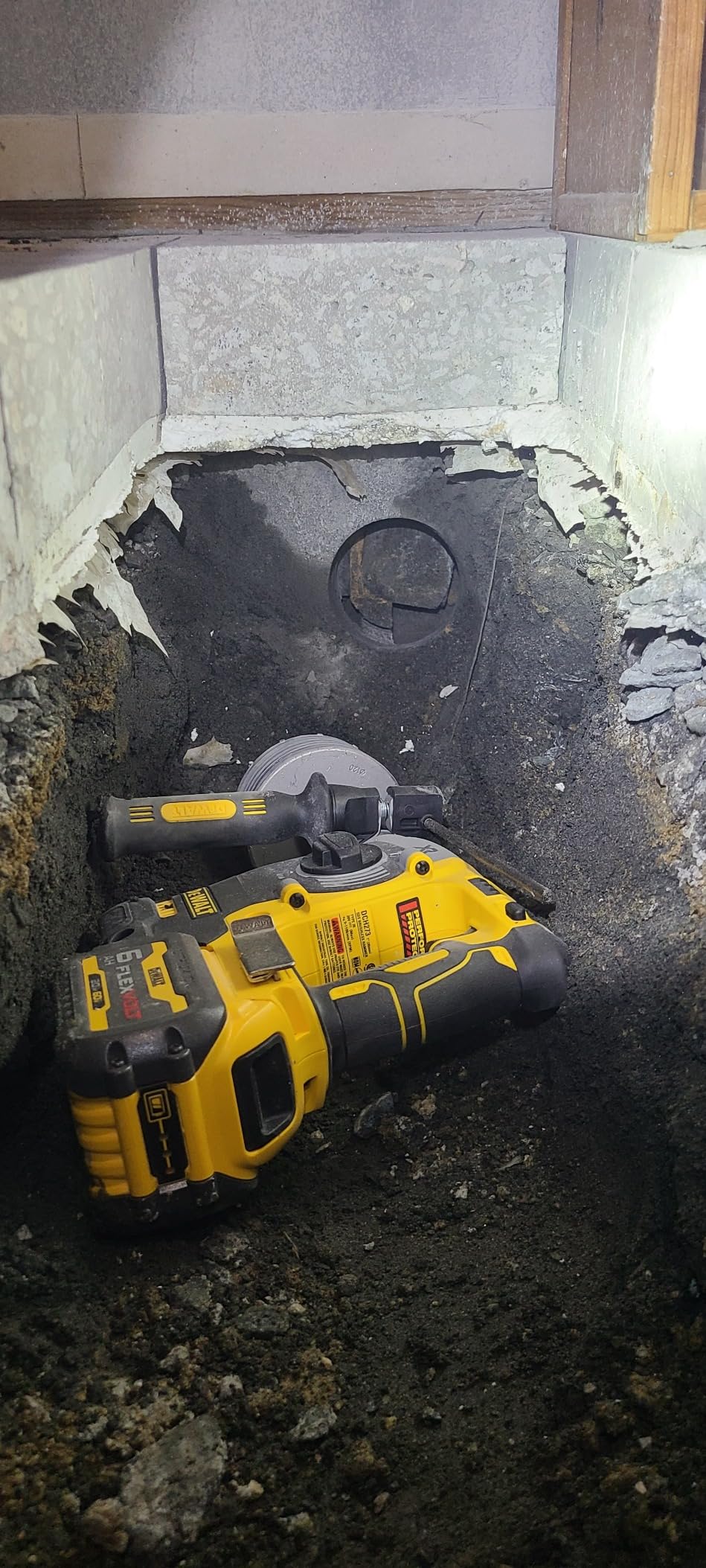
Owner reviews describe fast drilling in concrete and cinder block, easy handling in tight spaces, and useful extension from the chip function when a job turns into tile and thinset removal. Ratings sit at 4.7 across more than 3400 reviews, with 87 percent five-star, which puts it among the best-reviewed rotary hammers at any price tier.
Two practical notes. This is a bare tool, so batteries and a charger are separate purchases, which only makes sense if you already run DEWALT 20V MAX. And it accepts SDS-plus dual-slot bits, not SDS-Max and not three-flute bits, so plan your consumables accordingly.
When a cordless rotary hammer is the right call
Cordless wins on ladders, scaffolds, crawl spaces, detached garages, and any job where the nearest outlet is more than an extension cord away. It also wins on time, because a DEWALT 20V MAX pack charges fast and the tool weighs less than half what a comparable corded machine does.
On masonry and block the performance gap narrows considerably, and it closes further on long holes in dense concrete. For fastening, seismic anchors, strut, cable tray, and clamp mounting, which is exactly what DEWALT markets it for, 2.1 joules is more than sufficient.
Where it is the wrong choice
It is the wrong choice for a long uninterrupted hole-drilling session, where a corded rotary hammer with more impact energy and no runtime ceiling will finish sooner. It is also the wrong choice for anyone without a DEWALT battery platform, since buying packs to go with a bare tool erases much of the convenience advantage.
Note the OSHA Table 1 compliance claim is conditional: it applies when paired with the DWH303DH on-board extractor, not with an unfiltered hole. If you are drilling in an occupied space, that pairing matters for your lungs as much as for the paperwork.
4. DEWALT D25263K – Best All-Around Corded Rotary Hammer with 3.0 Joules
DEWALT SDS Rotary Hammer Drill, Vibration Control Shocks, 115 Volts, Corded (D25263K)
3.0 joules impact energy
8.5 amp motor, 1150 RPM
Integral safety clutch
SHOCKS vibration control
Pros
- 3.0 joules for fast drilling and chipping
- Rotating brush ring holds power in both directions
- Integral clutch reduces sudden torque when a bit jams
- Side handle depth rod and kit box included
- Two year free service plan
Cons
- Corded design needs an outlet or extension cord
- Modes selected by switch rather than a rotating dial
The D25263K sits at 3.0 joules, the highest corded figure among the mainstream-brand rotary hammers in this guide, and it pairs that with an 8.5 amp motor rated at 1150 RPM. If you want one corded hammer drill for concrete and do not want to think about it, this is the one to buy. DEWALT backs it with a 2 year free service plan on top of a 3 year limited warranty.
The rotating brush ring is a detail worth knowing about. It keeps the motor producing full power and torque in both forward and reverse, which is a 0 to 1150 RPM range that stays consistent as the tool warms up. The integral clutch is the feature pro buyers read about first, because when a carbide bit binds in rebar you want the tool to disengage rather than your wrist.
Reviews center on strong drilling and chipping performance with reduced handle vibration, and there are very few complaints beyond the obvious corded limitation. The rating distribution is 84 percent five-star across more than 1500 reviews, and the review summary notes little friction beyond needing a power source.
It is compatible with the D25301D drilling dust extraction system, which matters more than it sounds if you are drilling a lot of holes in an interior wall. Pairing the drill with extraction is the single biggest lever on silica exposure for a homeowner drilling concrete indoors.
Why the safety clutch is not a gimmick
A safety or overload clutch disconnects drive to the bit when torque spikes past a threshold, which happens when you hit rebar, a stone aggregate pocket, or a plug. On a tool with 3.0 joules behind it, an unclutched jam can twist your arm. Every serious rotary hammer in this list has some version of it, and the owner reviews treat it as a deciding factor.
Two of the tools here pair it with active vibration control as well, which is a separate concern. The clutch protects against a sudden twist; vibration control reduces the dull ache that accumulates across a full day of drilling and is what actually causes hand-arm fatigue on long jobs.
Where it is the wrong choice
Three joules is not foundation work. If you are drilling into 3000 PSI concrete for anchor bolts or core-adjacent holes, you want more impact energy than this delivers. The ENEACRO in this list is 2.4 times higher for a reason.
It is also the wrong choice if you are far from an outlet, and it is the wrong choice if you want one tool to do everything, because a 2.4 joule difference between this and a heavy-duty machine is the difference between comfortable and frustrating on large holes.
5. Makita XRH04Z – Best Cordless Rotary Hammer for 18V LXT Battery Owners
Makita XRH04Z 18V LXT® Lithium-Ion Cordless 7/8″ Rotary Hammer, accepts SDS-PLUS bits, Tool Only
Makita-built variable speed motor
0-1200 RPM and 0-4000 BPM
Three operating modes
7.4 lb bare tool
Pros
- Drills concrete far faster than a conventional hammer drill
- Strong motor comparable to corded tools in its class
- Torque limiting clutch protects the gear train
- Works with existing 18V LXT battery collections
- Synchronized RPM and BPM improves drilling speed
Cons
- Long and bulky for confined spaces
- Runs hot and drains batteries under heavy load
- Tool only with no battery or charger
The XRH04Z is a 7/8 inch SDS-plus rotary hammer that takes 18V LXT batteries, which is the whole argument for it. If you already own Makita packs, this tool is effectively free money because you are reusing a platform you have paid for. It weighs 7.4 pounds, runs 0 to 1200 RPM and 0 to 4000 BPM, and carries a 3 year limited warranty.
Owner reports describe the biggest jump coming from a conventional hammer drill. Holes that used to take repeated bit changes now go in quickly, and the reduced consumable usage is the point people notice first, because SDS-plus bits are the running cost nobody budgets for. The torque limiting clutch automatically disengages the gears if the bit binds, protecting the mechanism rather than your wrist.
Three modes cover rotation only, hammering with rotation, and hammering only, with synchronized RPM and BPM so the speed stays matched as the trigger moves. A shock absorbent handle is designed to protect the battery housing from the repeated impacts, which is sensible engineering on a cordless tool that lives near concrete.
The recurring complaints are runtime draw and heat. Under heavy load the tool runs hot and consumes packs faster than the headline numbers suggest, and at 18 inches long with a 9 inch height it is awkward inside a tight form or a small cavity. Both matter if you are drilling in confined spaces rather than on an open wall.
Battery platform economics
The math is simple. If you already have two or more 18V LXT packs, a bare-tool rotary hammer is the cheapest way into this class. If you own none, the corded Bosch or DEWALT beats a bare tool plus two batteries plus a charger on a single project.
Owners also report that it cuts consumable bit usage substantially compared to a hammer drill driver, which partly offsets runtime. If you are going to be drilling concrete regularly, the bit savings matter as much as the pack count.
Where it is the wrong choice
It is the wrong choice for a Makita-free household, for heavy continuous work where heat build-up becomes the limiting factor, and for anyone drilling in tight spaces where an 18 inch tool body will not fit. For overhead work the 7.4 pound weight is manageable but the length is not always.
6. Berserker 26FA – Best Budget Rotary Hammer for Anchor Holes
Berserker 1-1/8″ SDS-Plus Rotary Hammer Drill for Concrete 26FA
1050 watt 9 amp motor
3.3 ft-lbs (4.5 joules) impact
1050 RPM and 4200 BPM
9.5 lb SDS-plus body
Pros
- Capable of fast drilling for its tier
- Kit includes bits flat and point chisels depth gauge grease wrench and case
- 360 degree adjustable handle gives good leverage
- Overload clutch and aluminum alloy housing add ruggedness
- Light 9.5 pound body suits overhead work
Cons
- Runs hot after extended drilling and needs cooldown
- Uses up the supplied grease quickly on heavy projects
- SDS-plus only and will not accept SDS-Max
The Berserker 26FA answers the question that dominates the top forum thread on this topic: can a person get by with the cheapest one? This one, specifically, yes for anchor holes and light masonry work. It delivers 3.3 foot-pounds, or 4.5 joules, at 1050 RPM and 4200 BPM from a 1050 watt 9 amp motor, and it weighs 9.5 pounds.
At 4.5 joules it outclasses both cordless rotary hammers in this guide on impact energy while remaining light enough for overhead work. Three modes handle rotation, hammering with rotation, and hammering only, switched by two separate controls. Maximum drilling diameter is 1-1/8 inch in concrete, 1/2 inch in metal, and 1-1/4 inch in wood.
The kit is the sleeper feature. It ships with SDS-plus drill bits, flat and point chisels, a depth gauge, grease, a wrench, and a case, which is a fuller package than several more expensive tools. Owners frequently report completing anchor projects that had stalled a normal hammer drill, which is exactly the use case this price tier is for.
There is a compatibility warning printed on the product itself, and it is worth repeating. This kit takes SDS-plus bits only. It will not accept SDS-Max or standard shank bits, and discovering that after buying a box of the wrong consumables is the single most common complaint pattern across this whole category.
What heat does to a budget rotary hammer
The most common practical note in owner reviews is that the motor heats up after many consecutive holes and needs a cooldown. That is normal for a compact 1050 watt motor under sustained impact load, and it is manageable if you pace the work. It becomes a real problem on a long drilling day, which is where a heavier machine with more mass in the housing is worth the extra money.
Related: the supplied grease gets consumed quickly on substantial projects. Keep a tube of hammer grease on hand, and re-greasing the hammer chamber periodically does more for tool life than any other maintenance step.
Where it is the wrong choice
It is the wrong choice for daily commercial use, where heat cycles and a small number of reported motor failures will compound, and for heavy demolition, which the manufacturer explicitly rules out. A handful of owners report premature motor burnout, so if you are drilling hundreds of holes a week this is the wrong tool class entirely.
For one home project, a weekend of tile removal, or a run of anchor holes on a basement wall, it does the job at a fraction of the cost of a pro machine.
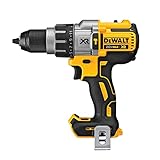
7. DEWALT DCD996B – Best Hammer Drill for Fastener Holes in Concrete
DEWALT 20V MAX XR Cordless Hammer Drill Driver Brushless, Heavy Duty 1/2″, 3-Speed, Tool Only (DCD996B)
Brushless motor, 75% longer runtime
1/2 inch ratcheting chuck
3-speed to 2000 rpm
4 lb bare tool
Pros
- High torque powers through deep masonry holes without backing out
- Metal chuck with carbide inserts grips bits strongly
- Runs cool even under continuous use
- 3-mode LED lights dark or confined spaces
- Strong battery life on 5Ah packs
Cons
- Hammer mode is very loud in enclosed rooms
- Forward reverse button and speed selector can stick
- Keyless chuck reported to fail and is hard to replace
This is the most heavily reviewed tool in the roundup, and it is not a rotary hammer. It is a hammer drill driver, and that distinction is the whole point of including it. For drilling 1/4 inch and smaller holes to drive concrete screws and wedge anchors into a wall, this four pound brushless machine is faster and far less tiring than anything else on the list.
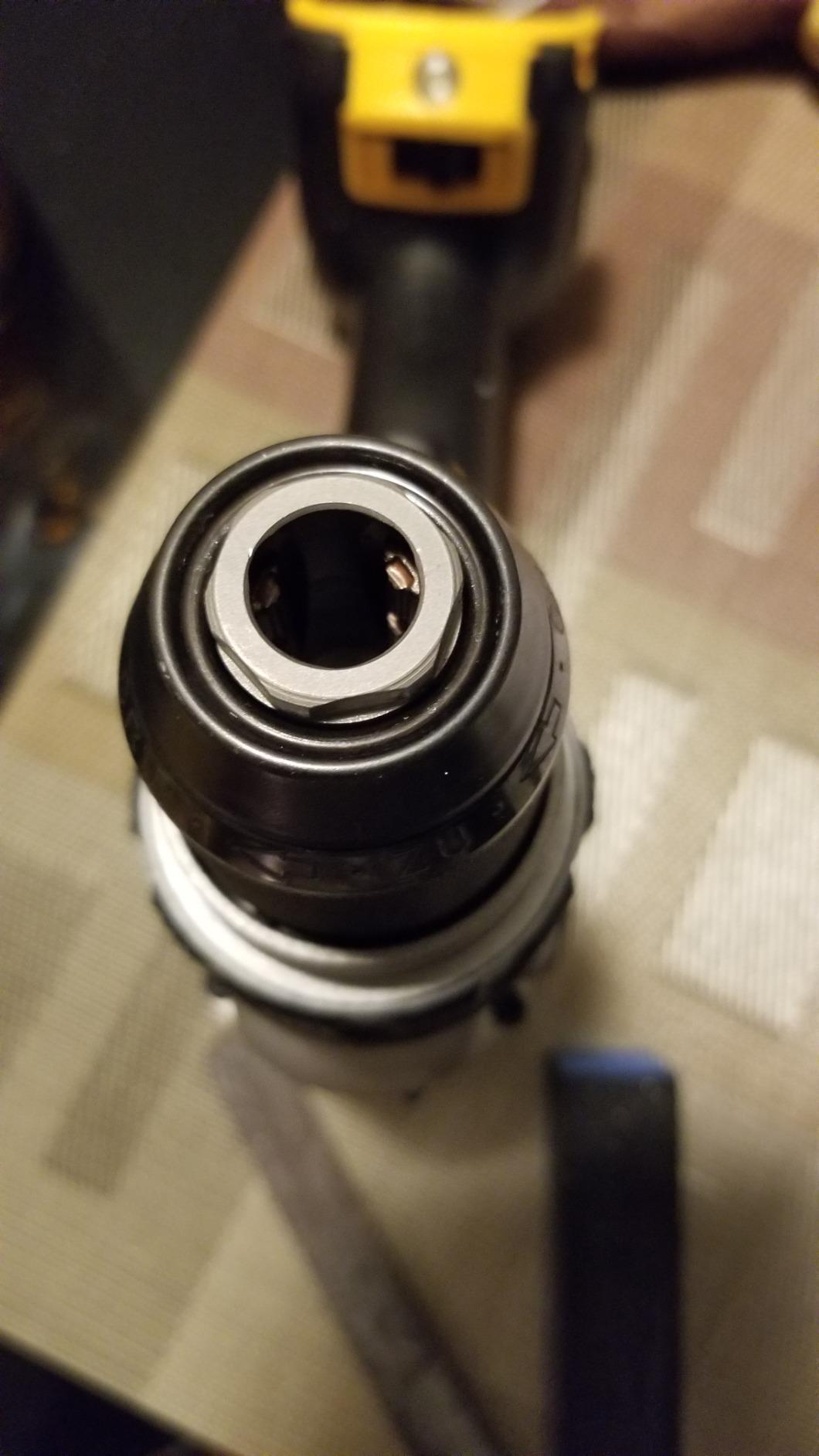
The heavy-duty 1/2 inch ratcheting nitro-carburized metal chuck with carbide inserts grips bits far more firmly than a plastic keyed chuck, and the 3-speed gearbox tops out at 2000 RPM. Owners credit the immediate high torque with no backout on deep masonry holes, and report that it runs cool even under continuous use.
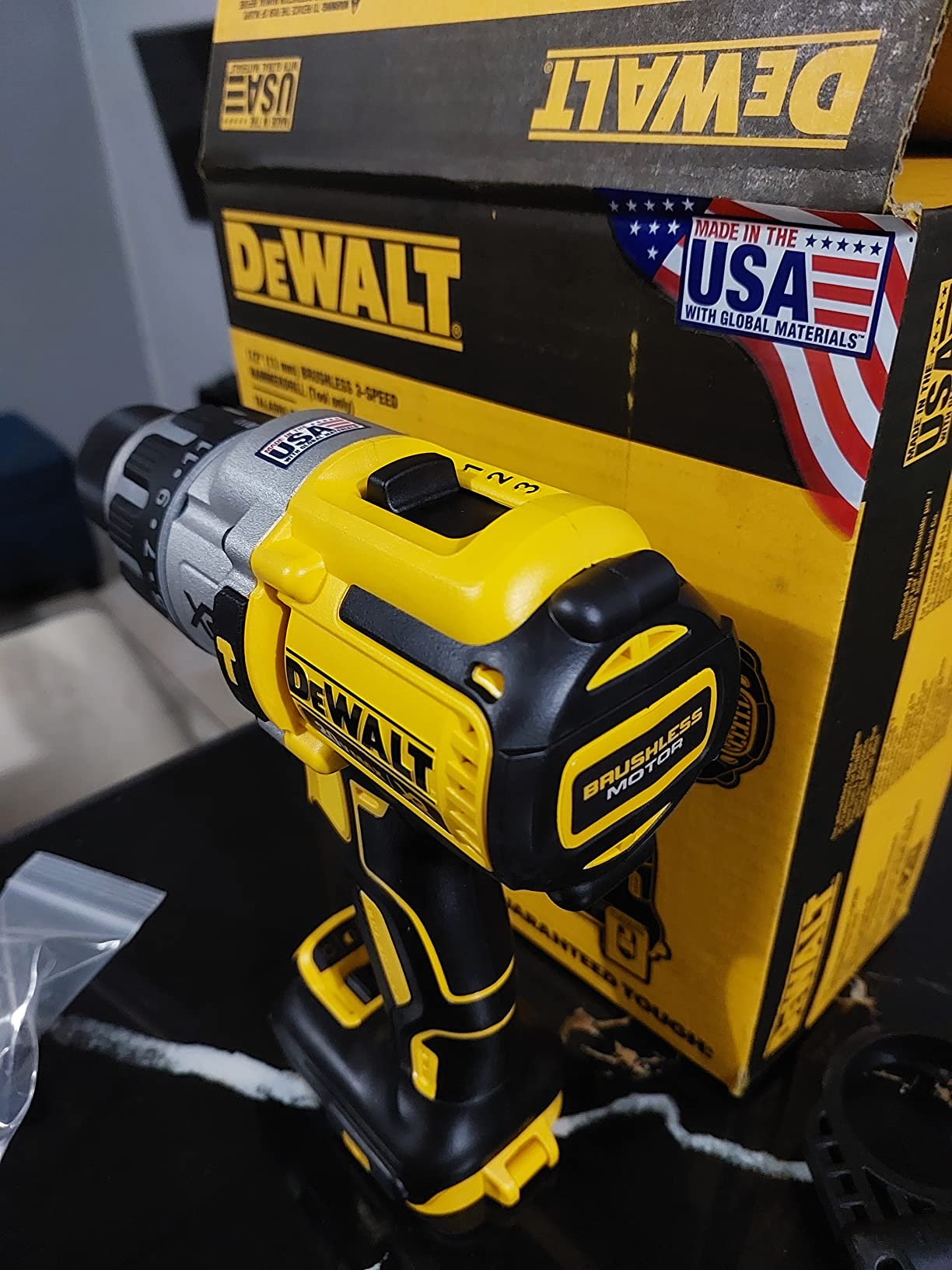
The 3-mode LED is among the best in the class, with a spotlight mode on a 20 minute shutoff so you are not draining a pack all afternoon to light a crawl space. The brushless motor is specced at up to 75 percent more runtime than 18V NiCad brushed motors, and a 3 year limited warranty covers it.
Two things temper that. Hammer mode is described as very loud in enclosed rooms, which owners say means hearing protection indoors. And a documented keyless chuck failure mode has been reported, one that DEWALT has serviced under warranty but which owners find annoying to deal with, since the chuck itself is difficult to replace.
When a hammer drill driver is genuinely the right answer
When the hole is 1/4 inch or smaller and the fastener is a concrete screw, a wedge anchor, or a sleeve anchor. A hammer drill driver at 25,000 blows per minute and a masonry bit will place those fasteners faster than a rotary hammer and without the piston wear, the noise, or the fatigue.
Forum consensus supports this distinction. Experienced users separate the two classes clearly: a hammer drill is fine for fastener holes, and you do not need an SDS drill for occasional work. The mistake is running a hammer drill into 5/8 inch or 3/4 inch concrete and blaming the tool when the real limit is the impact mechanism.
Where it is the wrong choice
It is the wrong choice for large diameter holes, deep drilling, dense concrete, or any chipping and demolition work. The mechanism is a cam-driven hammer shaking the bit, so all of the energy is lost to translation rather than delivered to the strike the way a piston delivers it.
It is also the wrong choice as a first purchase for someone who will drill concrete regularly, because you will outgrow it within a year.
8. CRAFTSMAN CMCD711C2 – Best Complete Cordless Hammer Drill Kit for Concrete Fasteners
CRAFTSMAN V20 Cordless Hammer Drill Kit, 1/2 inch, 2 Batteries and Charger Included (CMCD711C2)
20V V20 hammer drill
280W motor, 25500 bpm
2-speed 0-350/0-1500 rpm
5.4 lb, 2 batteries
Pros
- Two V20 batteries and a charger included so it is usable immediately
- 25500 bpm hammer rate speeds up concrete and brick
- Ratcheting 1/2 inch chuck holds bits securely
- Two-speed gearbox covers fastening and drilling
- Charger tops up a battery in 60 minutes or less
Cons
- Lower impact energy than a dedicated rotary hammer
- Included 1.3 Ah batteries are small for heavy drilling
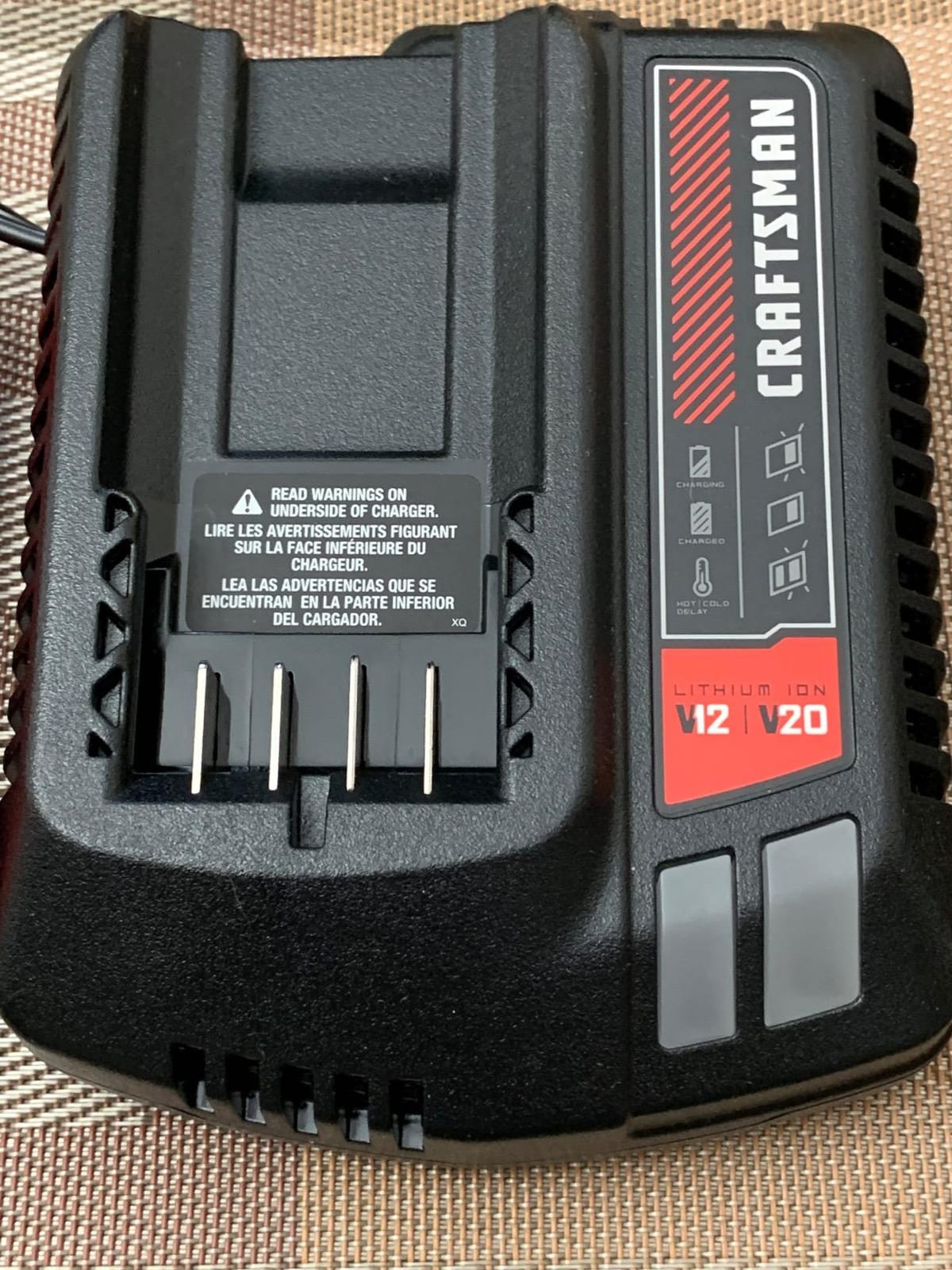
The CRAFTSMAN CMCD711C2 is the answer for someone who wants to start drilling concrete today without a shopping list. The kit includes two V20 20V MAX lithium batteries and a charger, so there is nothing to buy before the first hole. That alone separates it from every bare-tool option in this roundup, and for a first-time buyer it is the single most important detail on the spec sheet.
The hammer rate of 25,500 blows per minute is the highest in the list, which sounds impressive but is a category artefact: hammer drill drivers spin their cam mechanism far faster than a rotary hammer’s piston. The motor produces 280 watts and the 2-speed gearbox gives 0 to 350 RPM for fastening and 0 to 1500 RPM for drilling.
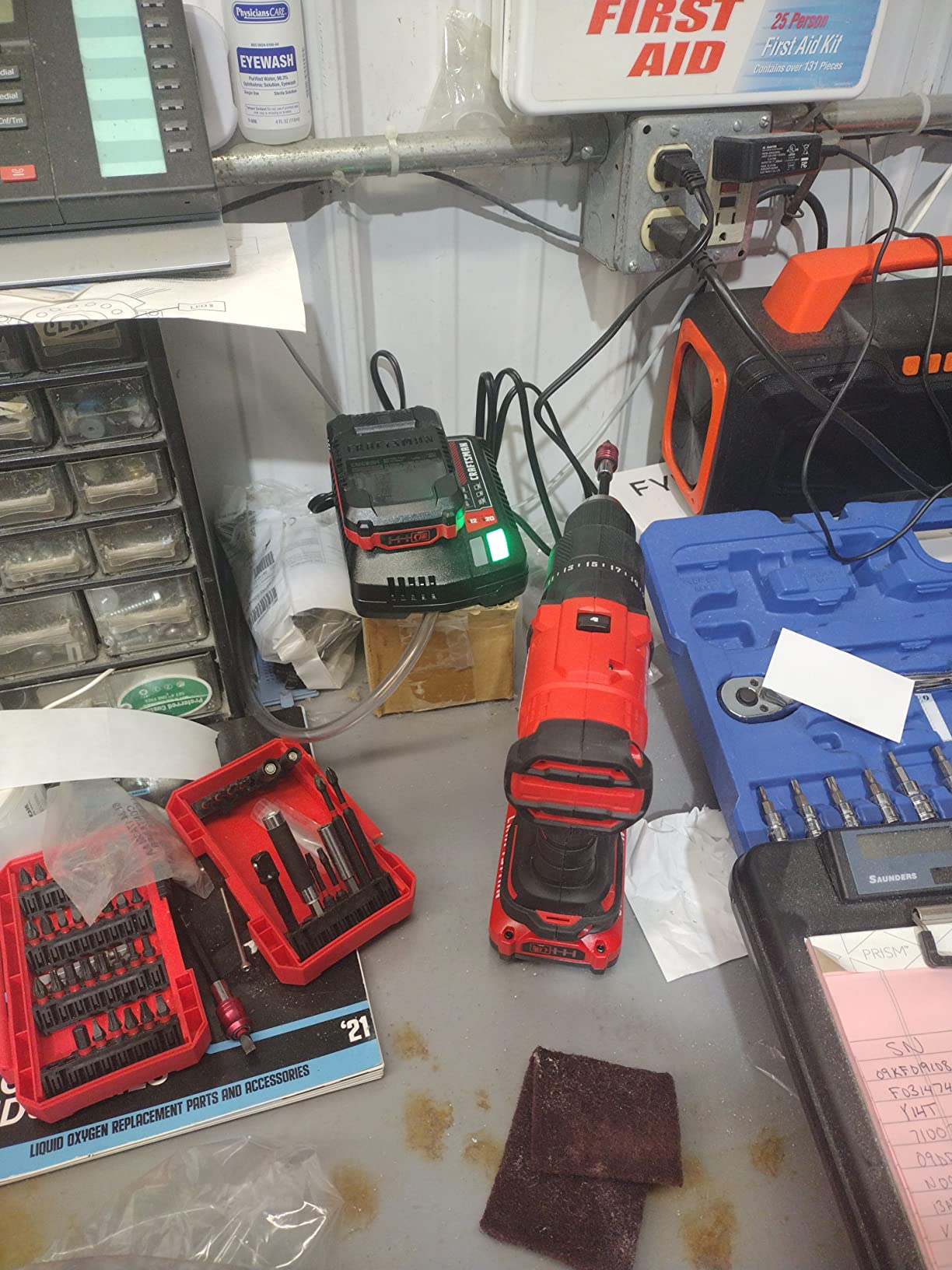
Buyers highlight the completeness of the package more than any single specification, and the 60 minute or less charge time gets mentioned often as a practical detail. The 1/2 inch ratcheting chuck holds bits securely, which matters more on concrete work than it does on wood because the repeated impacts tend to loosen a loose chuck.
It is compatible with the VERSATRACK wall organization system, with the clip sold separately. At 5.4 pounds it is a comfortable one-handed tool for overhead fastener work, and it is the lightest cordless option here alongside the DEWALT DCD996B.
Why the 1.3 Ah batteries are the weak point
Two small packs in the box beat no packs, but 1.3 Ah is roughly a quarter of the capacity of a 5 Ah pack. On concrete work where the motor is drawing hard and generating heat, you will be swapping batteries far more often than the two-included-batteries setup implies. For a weekend of anchor holes that is fine. For a week of continuous drilling, plan to buy a bigger pack.
The two-speed gearbox is the other compromise. A 3-speed drill driver gives you a middle gear for finish fasteners in a tight spot, and without it you either creep at 350 RPM or overdrive at 1500.
Where it is the wrong choice
It is the wrong choice for anything beyond fastener holes. Lower impact energy than a dedicated rotary hammer means it will be slow and hot on dense concrete, and the two included packs will not carry a heavy drilling session. If your project includes 1/2 inch holes or deeper, buy a rotary hammer instead.
Hammer Drill vs Rotary Hammer Drill vs Impact Driver: Do You Actually Need an SDS Drill?
No, and this is the most valuable question on the page. An impact driver is a fastening tool with a hex chuck that delivers high impact bursts to drive screws. It cannot drill into concrete efficiently because it has no chuck that holds a 1/4 inch masonry bit, and it has no clutch ring to control torque. A hammer drill adds that keyed or keyless chuck and a hammer mechanism, and that is what makes it a drilling tool. A rotary hammer drill replaces the hammer drill’s small cam mechanism with a heavier piston mechanism, which is why it drills faster, lasts longer on bits, and takes larger holes.
The decision path is short. If you are driving fasteners, you want an impact driver. If you are drilling 1/4 inch or smaller holes for concrete screws or wedge anchors, you want a hammer drill driver, and the DEWALT DCD996B or CRAFTSMAN CMCD711C2 will do it faster than any rotary hammer here. If you are drilling holes larger than 1/2 inch, going deeper than about 4 inches, working in dense or aged concrete, or doing any chipping and removal work, you want a rotary hammer drill, and the choice narrows to corded or cordless.
There is one more class worth naming. A demo hammer or combihammer runs SDS-Max and delivers 8 to 12 joules or more, and it is for breaking concrete, trenching, and core-adjacent work. None of the eight tools here is in that class. If you have one demolition job rather than a drilling project, renting one of those is usually a better decision than buying.
SDS vs SDS-Plus vs SDS-Max: Which Chuck Format Do You Need?
Short answer: SDS-plus for almost all concrete anchor work, SDS-Max only if you are drilling large holes or chipping concrete regularly. The formats are not interchangeable in any direction, and buying the wrong bit for your tool is the most common expensive mistake in this category. An SDS-Max bit will not fit an SDS-plus chuck, and an SDS-plus bit physically will not seat properly in an SDS-Max chuck even where it appears to fit, because the slot geometry and locking mechanism differ.
SDS-plus uses a 10mm shank with two open slots and two closed locking slots, and it is the standard for holes up to about 1 inch. SDS-Max uses an 18mm shank with three open slots and is built for much higher impact energy, typically above 8 joules. A plain standard hammer drill chuck takes nothing from either family, which is why rotary hammer bits need an adapter to run in a conventional drill, and why a 1/4 inch masonry bit in a hammer drill driver is a physically different product from a 1/4 inch SDS-plus bit.
All eight tools in this roundup are SDS-plus or below. Six are SDS-plus rotary hammers, and two are conventional hammer drill drivers that take standard-shank masonry bits. None accepts SDS-Max, and none should.
How to Choose the Right Hammer Drill for Concrete
Impact energy is the first filter, and everything else is secondary. It is measured in joules or foot-pounds, and it tells you how hard the hammer strikes the bit. Here is the tiering that covers almost every residential and light commercial job.
At 2 to 3 joules you are in the anchor and fastener hole range. Holes up to 1/2 inch, shelves, cabinets, curtain rods, conduit straps, and seismic attachments all sit here. The DEWALT DCH273B at 2.1 joules and the Bosch Bulldog Xtreme at 2.0 foot-pounds are the two corded and cordless examples.
At 4 to 7 joules you can handle larger holes, deeper penetration, block walls, brick, and the start of light chipping. The Berserker at 4.5 joules, the DEWALT D25263K at 3.0 joules, and the ENEACRO at 7.4 joules cover this band, and it is the range most buyers should be shopping.
At 8 to 12 joules you are into foundation and demolition territory, and that means an SDS-Max combihammer, not anything in this list. If your honest requirement lands here, you should be looking at a rental counter rather than a product page.
Weight matters almost as much as energy and is the most neglected spec. Every pound above 8 is felt in your shoulders on overhead work, and vertical drilling in a wall with a 360 degree auxiliary handle is a different job from drilling a hole in a slab. If your project is mostly overhead or vertical, weight outranks impact energy.
Corded versus cordless comes down to where the work happens. Corded tools deliver more impact energy per dollar and never stop, and they are the right answer for a fixed work area with an outlet. Cordless tools win on ladders, scaffolds, crawl spaces, detached structures, and anything where the cord is in your way. Battery platform is the deciding factor: if you already own 18V LXT or 20V MAX packs, a bare-tool cordless rotary hammer is the cheapest path into the class.
A safety clutch protects your wrist when a bit binds on rebar or aggregate. A rotating brush ring on a corded model maintains torque in both directions. Vibration control, whether active as on the two DEWALT rotary hammers or a damped handle as on the ENEACRO, reduces the cumulative fatigue that ends a work day. The Bosch D-handle design is worth a look if you will be drilling downward or overhead, which is the case owners mention most.
Finally, check the included bits. A complete kit saves a trip and guarantees shank compatibility. The ENEACRO and Berserker both ship with bits, chisels, grease, and a case. The DEWALT and Makita rotary hammers are bare tools, so every bit is a separate decision. Budget for SDS-plus bits early, because consumables are the true running cost of this tool class, and long-shank SDS-plus bits are worth it for deep holes.
Choosing the Right Concrete and Masonry Drill Bits
Use a carbide-tipped masonry bit for anything under half an inch, and a SDS-plus bit for anything the rotary hammer touches. These are not the same bit with different shanks; a masonry bit for a hammer drill has flutes designed to clear dust at slow speed, and an SDS-plus bit is designed to take repeated impacts without shattering at the neck.
The single most useful rule is about size, and it is counterintuitive: drill a hole roughly 1/16 inch smaller than the rated hole diameter of the anchor or fastener you are using. A wedge anchor rated for a 1/2 inch hole needs a 7/16 inch bit, not a 1/2 inch one. Over-drilling leaves the anchor with nothing to grip and is the reason so many DIY installs feel loose.
For hole saw work above 1 inch, a hole saw with an SDS-plus shank is the answer. Above 2 inches, a diamond core bit is the realistic path, and a 7.4 joule rotary hammer is the minimum tool that will drive one without stalling constantly. For deep holes, buy long-shank SDS-plus bits, typically 12 to 21 inches, and shorten your drilling strokes rather than leaning on the bit.
A note on bit diameter and the real limits of your tool: a 5/8 inch hole in cured foundation concrete is a job for a machine with at least 5 joules, and a 1 inch hole needs more still. If you find yourself burning through bits on the same hole repeatedly, the problem is almost always the tool, not the bit.
How to Drill Concrete Without Ruining Your Bit
First, start at a shallow angle or with a center punch mark so the bit does not wander on the first strike. A rotary hammer wants a clean, square start more than a hammer drill driver does.
Second, use the correct mode. Drill only for wood, metal, and masonry bits in a hammer drill. Hammer drill for concrete. Hammer only for chipping. Running a masonry bit in rotation only is the fastest way to destroy it.
Third, keep steady pressure and let the hammer work. Leaning on a rotary hammer does not speed up drilling; it deflects the bit. Pull the bit out every few inches to clear dust and let it cool, especially in a deep hole.
Fourth, match the bit to the material. Rebar is steel, and no carbide masonry bit will cut through it. If you hit rebar, stop, relocate, or use a rebar cutter or a hammer drill with a carbide-tipped bit designed for steel. The integral clutch on the DEWALT D25263K and the torque limiting clutch on the Makita are there precisely because this happens.
Fifth, respect the material. Green concrete that has not reached full cure is softer and drills quickly, but the hole will not hold an anchor properly yet. Fully cured structural concrete is far denser. Concrete block and brick are abrasive and will blunt carbide edges faster than poured concrete. Use a hammer drill driver at high speed for masonry, and a rotary hammer for structural concrete.
On safety: concrete drilling produces respirable crystalline silica, and the dust coats everything in sight. Use a P100 or better respirator, safety glasses, and hearing protection, and attach dust extraction if the tool supports it. The DEWALT DCH273B is OSHA Table 1 compliant only when paired with its on-board extractor, and the D25263K accepts a separate extraction system. For extended drilling, our picks for walking shoes for concrete floors will matter more than most people expect after hour ten.
How We Chose These Hammer Drills
We did not hands-on test these tools, and we would rather say so than imply otherwise. Selection was based on published manufacturer specifications cross-checked against owner review volume, rating distribution, and the specific failure modes owners actually report.
Each tool had to clear three bars. It had to be a purpose-built rotary hammer or hammer drill rather than a general drill with a hammer setting. It had to have a documented impact energy figure or a documented blows-per-minute rate, because without one of those there is no way to compare concrete capability. And it had to have enough owner reviews to identify real patterns rather than two isolated complaints.
That is why the list is heavy on SDS-plus rotary hammers and light on demo hammers, and why two hammer drill drivers are included at the end. The last two are not there because they compete with the rotary hammers. They are there because most of the concrete holes people drill on a home project are 1/4 inch fastener holes, and a hammer drill driver is the right tool for those.
Frequently Asked Questions
What is the best hammer drill machine for concrete?
For most people, the Bosch 11255VSR Bulldog Xtreme. It is a corded SDS-plus rotary hammer with 2.0 foot-pounds of impact energy, three operating modes, and more than 3000 owner reviews behind it. If you need to work away from an outlet, the DEWALT DCH273B cordless rotary hammer delivers 2.1 joules at 6.4 pounds. For large holes or daily use, the ENEACRO ENRH3201 at 7.4 joules has roughly triple the impact energy of either.
Do hammer drills work on concrete?
Yes, within limits. A hammer drill combines rotation with a short hammering action that shatters the cement matrix, so a carbide masonry bit cuts concrete up to about 1/2 inch. Beyond that diameter, or for deep holes and dense or reinforced concrete, a rotary hammer drill with SDS-plus or SDS-Max is the correct tool because its piston mechanism delivers far more impact energy per blow.
Which is better for concrete, SDS or SDS Plus?
SDS-plus. The term SDS refers to the whole slotted shank system, and SDS-plus is the standard format for anchor and fastener holes up to about 1 inch. SDS-Max uses a larger 18mm shank and is built for much higher impact energy, generally above 8 joules, and is only needed for large holes and heavy chipping. The two formats are not interchangeable, so buy bits to match your tool.
What is the best drill bit for a hammer drill to use in concrete?
For a hammer drill driver, a carbide-tipped masonry bit in the standard-shank form. For a rotary hammer, an SDS-plus bit. The rule that catches people out is hole size: drill roughly 1/16 inch smaller than the rated hole diameter of the anchor or concrete screw, so a 1/2 inch rated anchor gets a 7/16 inch bit. For holes over 1 inch, use an SDS-plus hole saw.
Is a hammer drill enough for concrete or do I need an SDS rotary hammer?
For 1/4 inch and smaller fastener holes, a hammer drill driver is enough and is actually faster than a rotary hammer. A DEWALT DCD996B or CRAFTSMAN V20 kit will place concrete screws and small wedge anchors all day. Once you pass about 1/2 inch, need depth beyond a few inches, or start hitting dense or reinforced concrete, the rotary hammer’s piston mechanism is what keeps the bit intact.
Conclusion
The best hammer drills for concrete divide cleanly by job. Anchor and fastener holes under 1/2 inch: the DEWALT DCD996B or CRAFTSMAN CMCD711C2, and you do not need anything heavier. General concrete drilling, block, brick, and overhead work: the Bosch 11255VSR Bulldog Xtreme, which is the default choice for good reason. Working away from an outlet: the DEWALT DCH273B, or the Makita XRH04Z if you already run 18V LXT. Large holes and daily use: the ENEACRO ENRH3201 on impact energy, and the DEWALT D25263K if you want a service plan behind it.
Whatever you pick, match the bit to the shank before you buy a box of them, and treat the concrete dust as the real hazard. A P100 respirator, eye protection, and extraction will do more for your health than any feature on the tool list above. Our picks for anti-fatigue mats and walking shoes cover the rest of a long day on the slab.