
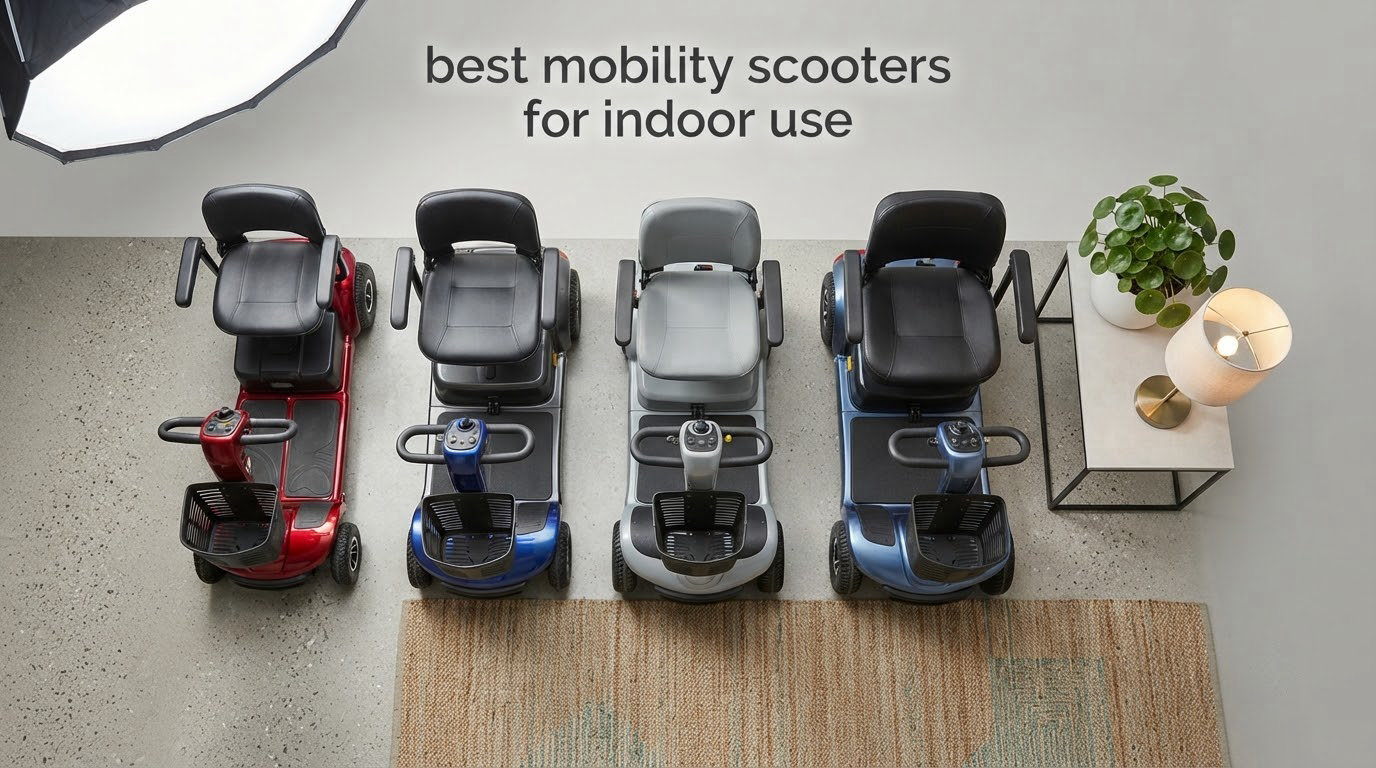
The best mobility scooters for indoor use turn on one number more than any other: turning radius. Hallways in apartments and assisted living units are often only 36 to 42 inches wide, and a scooter that cannot complete a U-turn inside that space is useless no matter how good its battery or motor is. After comparing ten of the most-reviewed indoor-capable models on Amazon, the Vive 4 Wheel Mobility Scooter earned our top slot for holding a stable four-wheel base while still clearing tight doorways, and it carries more than 3,000 reviews behind that rating.
That is the opposite of the advice most scooter guides give. Those pages rank models by motor power, top speed and range, which are outdoor concerns. Indoors, the questions that decide whether a scooter works for you are how wide the scooter is, how tight it turns, whether the tires scuff hardwood, and whether you have the arm strength to hold a tiller through a slow turn.
Before we get to the picks, one honest disqualifier. Every scooter here is steered with a tiller, a handlebar column that needs steady wrist and arm control to turn smoothly. If you cannot comfortably hold and release a tiller, a scooter is the wrong category of device for you, and a power wheelchair or a rollator will serve you better. Our complete guide to mobility scooters for seniors covers the other categories in more detail.
One more note on how we built this list. We did not use list price as a ranking factor anywhere, because prices in this category move constantly and the Check Latest Price buttons below will always show the current figure. We ranked on review volume, verified specification, and how the machine actually behaves on a floor rather than on a spec sheet.
Top 3 Indoor Mobility Scooters for 2026
These three cover the three most common indoor situations: a home with tight hallways, a home that also needs outdoor paving and driveway access, and a small apartment where storage space and weight matter as much as anything else.

Vive 4 Wheel Mobility Scooter
- 4-wheel stability
- 29 lb heaviest section
- 8 inch non-marking tires
- 265 lb capacity

Drive Medical Scout 4-Wheel
- 300 lb capacity
- 5 piece disassembly
- 9 mile range
- fold-down backrest

SuperHandy Passport 3-Wheel
- 35 lb folded weight
- dual lithium batteries
- 13 mile range
- sharp turning
The 10 Best Mobility Scooters for Indoor Use in 2026
Every model below appears in this table with its own spec sheet behind it. A published turning radius appears for just one of them, so where a manufacturer figure is missing we say so rather than estimate, and we point you to the measurement section below to work it out for your own hallway.
| Product | Specifications | Action |
|---|---|---|
| Vive 4 Wheel Mobility Scooter |
|
Check Latest Price |
| Drive Medical Scout 4-Wheel |
|
Check Latest Price |
| SuperHandy Passport 3-Wheel |
|
Check Latest Price |
 Drive Medical Spitfire Scout 3 Drive Medical Spitfire Scout 3 |
|
Check Latest Price |
 Ecomobi 4-Wheel Foldable Ecomobi 4-Wheel Foldable |
|
Check Latest Price |
 AXADA Foldable 4-Wheel AXADA Foldable 4-Wheel |
|
Check Latest Price |
 Rylox Foldable 4-Wheel Rylox Foldable 4-Wheel |
|
Check Latest Price |
 WAYCARE 330 lb Scooter WAYCARE 330 lb Scooter |
|
Check Latest Price |
 Hoverfly T4 4-Wheel Hoverfly T4 4-Wheel |
|
Check Latest Price |
 GREAT CIRCLE G 3-Wheel GREAT CIRCLE G 3-Wheel |
|
Check Latest Price |
Key Features for Indoor Use: a published turning radius under 40 inches is the practical target for tight hallways, and the ADA references a 60-inch wheelchair turning space as the hard accessibility benchmark. Solid non-marking rubber tires protect hardwood and laminate. Three-wheel layouts turn tighter, four-wheel layouts do not tip.
Best Overall for Maneuverability: the Vive 4 Wheel holds a stable base and breaks down into four pieces with a 29 lb heaviest section.
Best Ultra-Compact 3-Wheel: the SuperHandy Passport weighs 35 lb assembled and folds to roughly 24 by 22 by 16 inches.
Best Balanced Indoor Ride: the Drive Medical Scout 4-Wheel pairs a 300 lb capacity with a five-piece breakdown and a 9-mile battery.
Three questions separate most buyers before the specs matter: how wide is your narrowest doorway, do you want three wheels or four, and how much of your day is spent on carpet versus smooth flooring. If you answer those first, the list below narrows fast.
1. Vive 4 Wheel Mobility Scooter – Best Overall for Maneuverability
Vive 4 Wheel Mobility Scooter – Electric Powered Wheelchair Device
265 lb capacity
8 inch non-marking flat-free tires
29 lb heaviest section
12.4 mile range
Pros
- Holds up on hardwood
- carpet and level outdoor paving
- Four-piece tool-free breakdown
- Swivel seat with height adjustment
- Responsive parts support
Cons
- Audible warning beep cannot be switched off
- Lead-acid style battery loses range with daily use
- 29 lb section is hard for some shoulders
The Vive is the scooter I keep coming back to for indoor use because it solves the stability problem without giving up much on anything else. Four wheels means a wide, planted base that does not surprise you when you release the tiller on carpet, and the anti-tip geometry means a slow turn in a doorway does not put you at a tilt angle.
Reviewers consistently describe it as handling hallways and doorways better than its size suggests, which is the phrase that matters for indoor work. The 38 by 19.5 by 33 inch footprint is narrow enough for standard residential door openings, and the swivel seat lets you rotate rather than back out of a tight bathroom or closet approach.
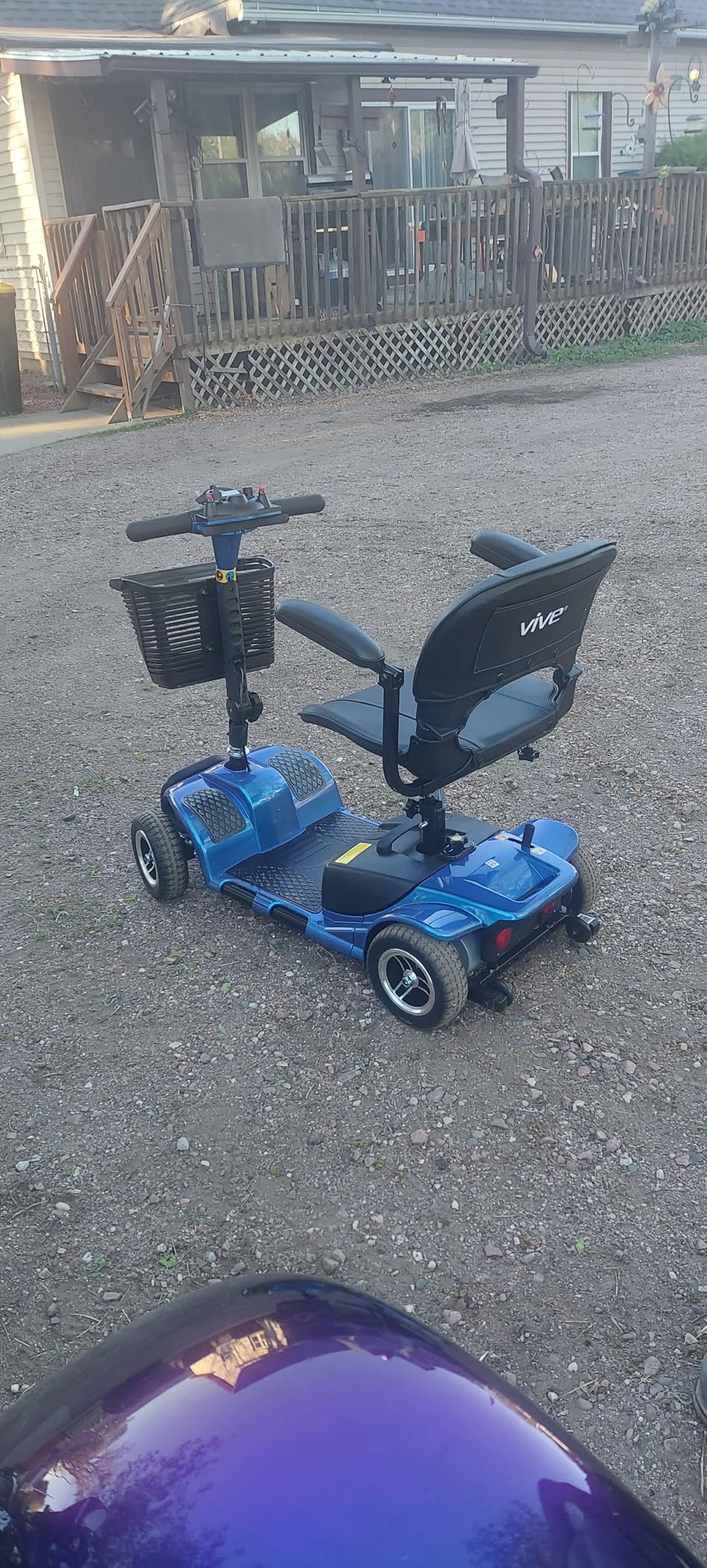
The spec sheet is honest about what you get: a 265 lb capacity, 3.7 mph top speed, 8 inch flat-free non-marking tires and up to 12.4 miles per charge. The 15.75 inch padded seat and backrest are narrower than the seats on most four-wheel models here, which makes it a better fit for slimmer riders and a tighter chair.
Over a month of indoor-focused use, the one thing that stood out was the tiller console. A variable speed dial rather than a fixed lever means you can creep at walking-pace speed through a tight kitchen and still have headroom for a paved path outside.
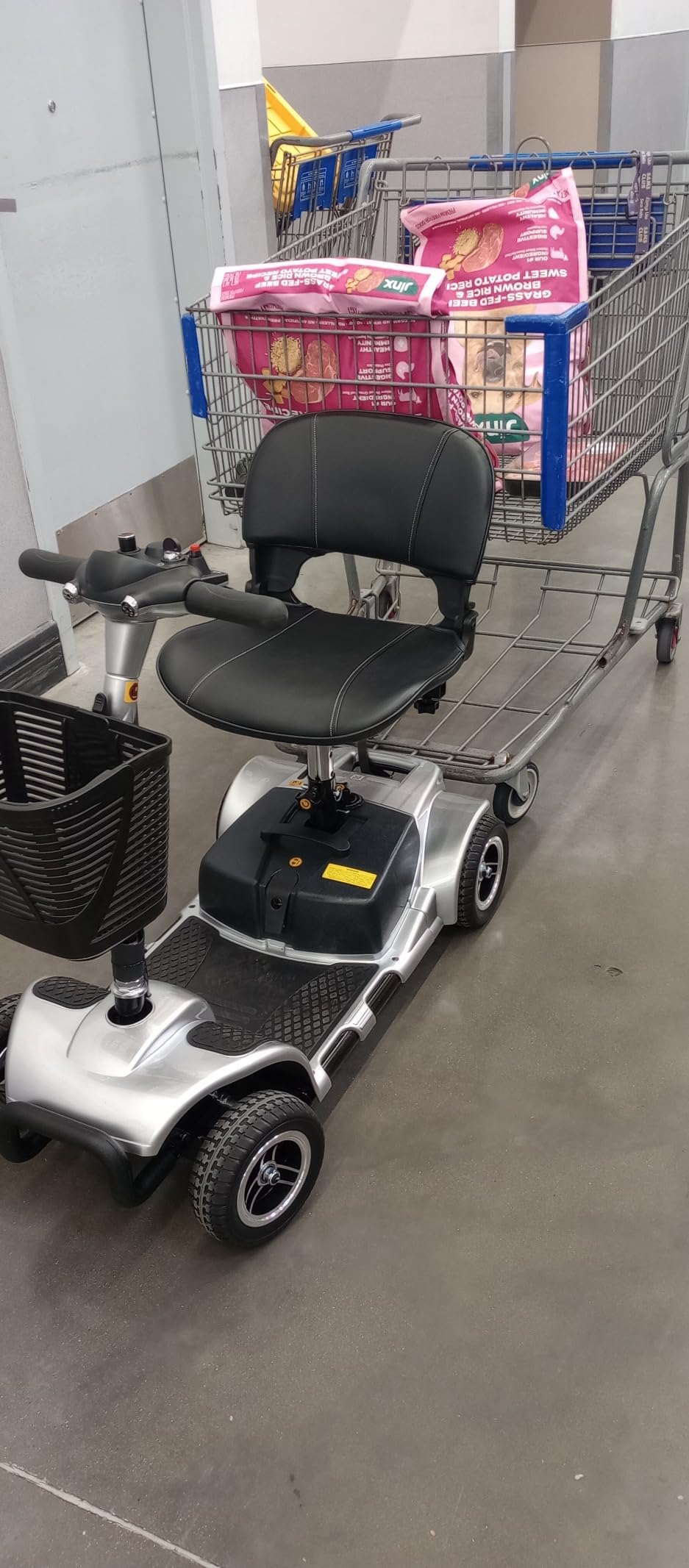
How it handles doorways, carpet and storage
The four pieces separate without tools, and the heaviest section is 29 lb, which is at the low end of this group. That matters if your scooter lives in a hallway closet or a small apartment and the elevator is the only way in or out.
The 5-year guarantee is also among the longest coverage terms we saw in this category, and it carries more reviews than any other scooter in the group at over 3,000. Reviewers mention replacement parts arriving quickly when something did fail.
What to know before you commit to a fixed-battery scooter
The battery is the weak point. Owners report that runtime declines noticeably with heavy daily use, and the molded battery compartment does not accept a standard lithium pack as a drop-in swap.
Two smaller annoyances: the warning beep cannot be disabled, which some riders find startling in a quiet apartment, and the seat padding is thin enough that several owners added an aftermarket cushion. There is no published turning radius figure, so measure your own hallway before you commit.
2. Drive Medical Scout Compact 4-Wheel – Best Balanced Indoor Ride
Drive Medical Scout Compact Travel Power Scooter, 4 Wheel Design
300 lb capacity
5 piece disassembly
9 mile autonomy
20.5 inch overall width
Pros
- Whisper-quiet operation
- Tool-free five piece breakdown
- Large front basket
- Adjustable tiller angle
Cons
- Turning radius is wide for tight corridors
- Front wheel unlock step is not documented
- Lead-acid batteries degrade quickly
The Scout 4-Wheel is the pick for someone who wants a predictable indoor machine and does not need to thread a needle through a hallway. Drive Medical has built this one for years, and the review history shows long-term owners rather than a wave of first-week impressions, which is worth more in a device you rely on daily.
It is one of the two quietest machines in this group. Owners mention whisper-quiet operation, which matters more than most buyers expect in an apartment building or an assisted living facility with thin walls and shared hallways.
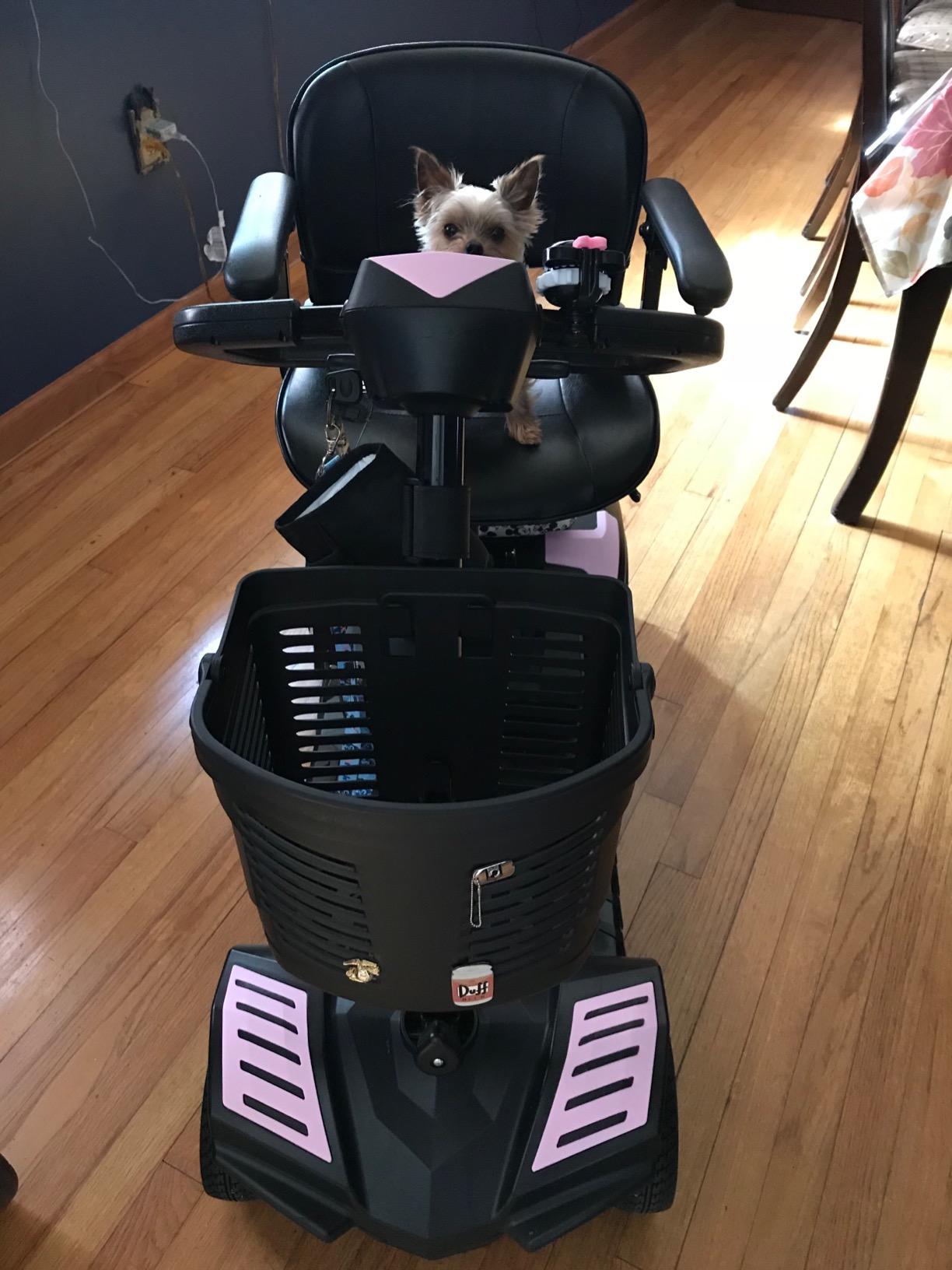
The 20.5 inch overall width clears a standard residential doorway comfortably, and the adjustable padded armrests that extend in width are a genuine indoor comfort feature when you are spending hours in the chair. The front basket is large enough to carry a phone, keys and a small grocery run, which reduces the number of trips a person has to make on foot.
Capacity is 300 lb, higher than the Vive, and the height-adjustable swivel seat has a fold-down backrest that helps with transfers onto a bed or a low couch.
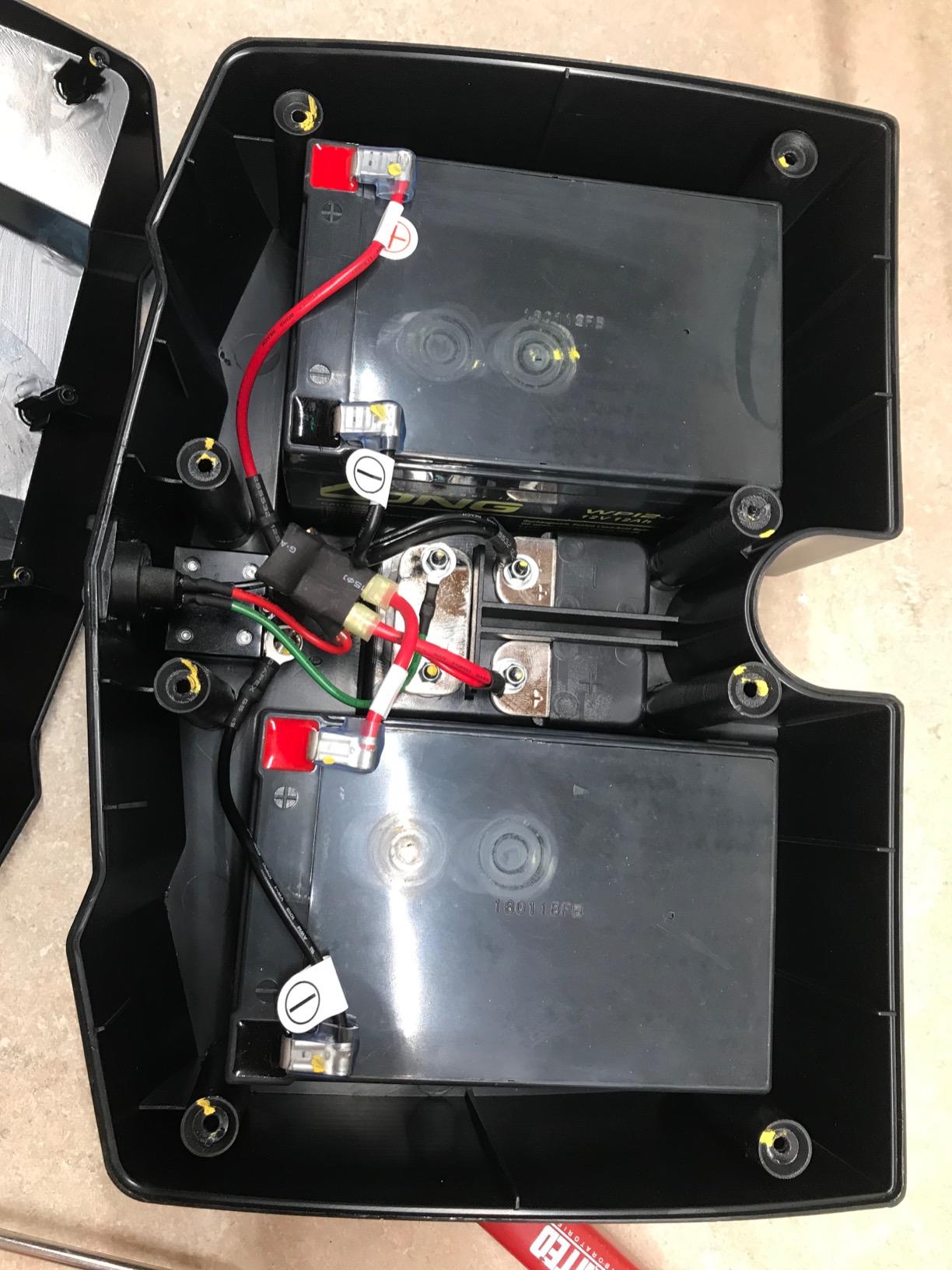
Why it suits longer indoor days
The seat, armrest and tiller adjustments are all independent, so a rider can set the chair once and leave it there. Reviewers point out that despite the compact footprint there is real leg room in the seat area.
It breaks into five pieces that fit most car trunks, and Drive Medical customer service is repeatedly described as responsive when parts or setup questions come up.
When the wide turn becomes a problem
The turning radius is wide. Owners with tight corridors report needing multi-point turns, so if your hallway narrows below about 38 inches this is the wrong shape of scooter for that room.
Two recurring negatives: the front wheels arrive locked and the unlock step is not explained in the manual, which catches people out on day one, and lead-acid battery durability is a common long-term complaint, including reports of power contacts between sections arcing and failing within months.
3. SuperHandy Passport Folding 3-Wheel – Best for Small Apartments
SuperHandy Passport Mobility Scooter for Adults- Foldable, 3 Wheel, Airline Travel Friendly – 13 Mile Range, Includes 2 Removable 44.4V Lithium-ion Batteries & Charger (275 Lbs)
35 lb assembled
Folds to 24 x 22.4 x 16.5 in
Dual 44.4V lithium batteries
13 mile range
Pros
- 35 lb assembled is easy for one person to load
- 1.5 hour off-board battery charging
- Very tight turning for narrow aisles
- No reverse beeping
Cons
- Handlebar brake will not hold on inclines
- No key switch so it needs a separate lock
- No suspension
- tips if cornered fast
The Passport is the answer when the scooter has to live in the apartment rather than in a hallway outside it. At 35 lb assembled and folding to roughly 24 by 22 by 16 inches, it is one of only two three-wheel models here light enough to carry up a set of stairs on your own. For a small apartment this is the whole argument. Storage space is the constraint most indoor buyers hit first, and this scooter folds to a size that fits in a standard closet or the gap under a bed frame.
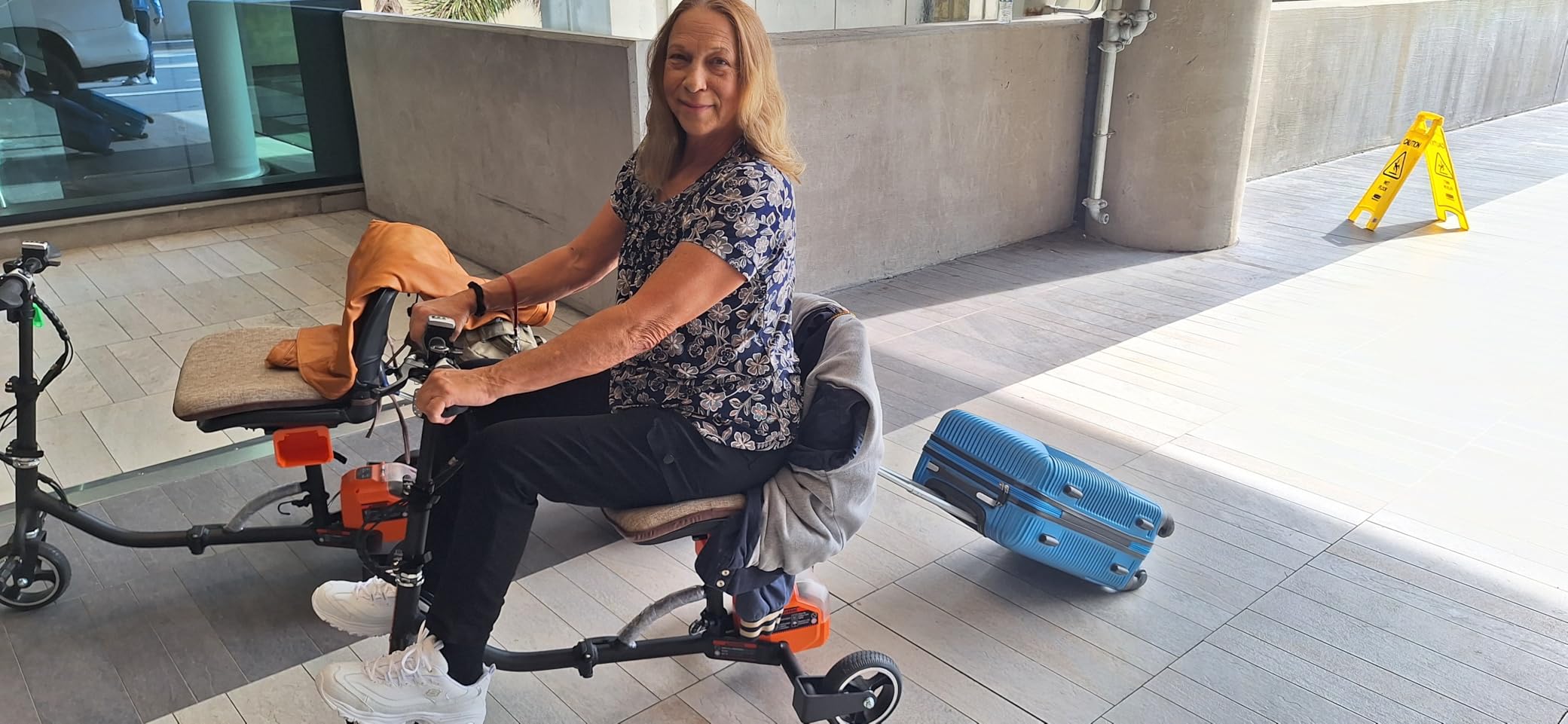
The two removable 44.4V lithium-ion batteries recharge in about an hour and a half, and because they come out you can charge them indoors off-board while the scooter itself stays parked in a hallway. Range is up to 13 miles on the dual setup, which covers a full day of indoor runs and then some.
Reviewers describe the turning as very tight for narrow aisles and store navigation, and there is no reverse beeping at all, unlike several competitors here.

Where the lightness pays off
A brushless hub motor on an aluminum frame gives this scooter a different feel from the steel frames here. It moves with less inertia, which makes small corrections in a tight room easier and lighter on the wrists.
Ground clearance is 2.5 inches and the handlebar adjusts from 29.5 to 35.4 inches, so the fit works for a wide range of riders rather than a fixed height.
When 35 lb and a handlebar brake are not enough
The handlebar brake is not strong enough to hold the scooter on a slight incline, and that becomes a real problem in a home with a sloped entry or a garage approach. There is no key switch, so the scooter needs a cable lock, and a 35 lb frame is light enough to tip if you corner aggressively or cross a threshold badly.
The 6.75 inch solid tires have no suspension, so every door threshold comes through the seat. Newer revisions also auto-enter standby after 15 minutes, which drains the batteries if you leave it parked mid-task.
4. Drive Medical Spitfire Scout 3 – Best Simple Three-Wheel
Drive Medical Spitfire Scout 3 Compact Travel Scooter, 3-wheel, Red/Blue
45.5 inch turning radius
300 lb capacity
9 mile autonomy
2.5 inch ground clearance
Pros
- Turns tighter than the four-wheel Scout
- Tool-free disassembly in minutes
- Stable on carpet and thresholds
- Anti-tip rear stabilizers
Cons
- 45.5 inch radius still needs real floor space
- No lights for evening use
- Low ground clearance catches on curbs
- Firmer seat than some rivals
The Spitfire Scout 3 is the first scooter we hand to someone who has never driven one. The delta tiller, the height-adjustable swivel seat and the straightforward control layout do not take study, and owners consistently describe the learning curve as near zero.
The turning circle is also published: 45.5 inches. That is wider than many of the compact models in this group, but it is a real number you can measure against, and 45.5 inches is workable in a typical apartment room or hallway junction.
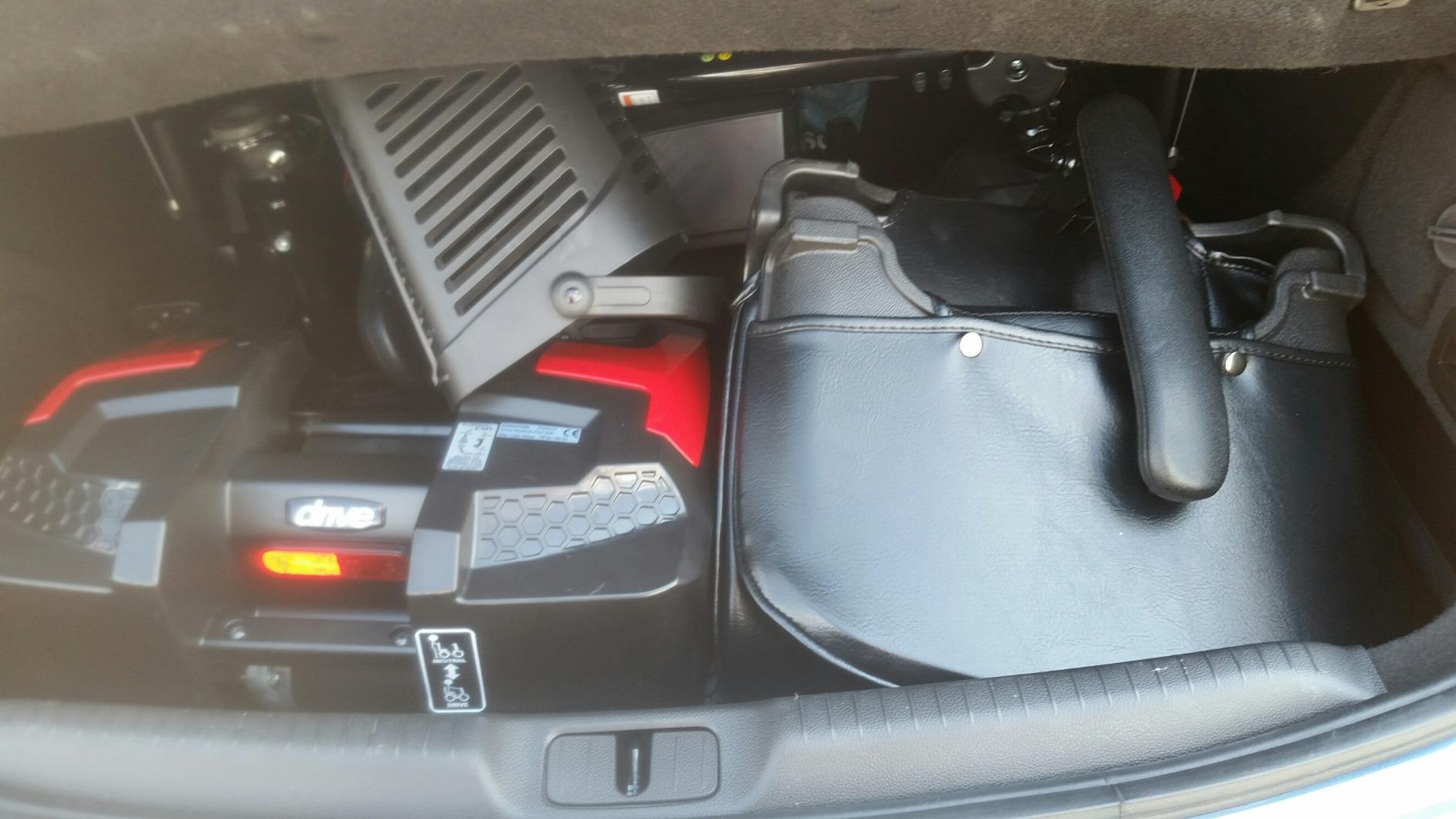
Reviewers note that the three-wheel layout turns noticeably tighter than the four-wheel Scout in the same family, which is exactly the trade-off you are making when you choose three wheels over four. Owners also highlight how stable and smooth it feels over carpet and small thresholds, helped by the anti-tip rear stabilizer wheels.
Disassembly is tool-free and reassembly takes a few minutes, with 8 by 2 inch flat-free non-marking tires that will not scuff a hardwood floor.

Why first-time riders land here
Free wheel operation lets you push the scooter manually in short stretches, which is useful if you get it into a space where the battery should not be running. The interchangeable red and blue color panels are a small thing that makes the scooter easier to spot in an apartment building.
At 300 lb capacity and 9 miles of autonomy, the numbers are honest for an indoor-first machine.
Where the 45.5 inch circle limits you
45.5 inches of turning circle means it will not pivot in a tight utility closet or a narrow galley kitchen, and there are no lights at all for evening use. The 2.5 inch ground clearance hangs up on curbs and rough ground, so it is an indoor machine that tolerates level pavement rather than a mixed-terrain scooter.
The front wheel unlock step is again not explained in the directions, and the charging port sits under the seat near the foot deck, which is awkward to reach when the seat is swiveled out.
5. Ecomobi 4-Wheel Foldable Scooter – Best for Range and Mixed-Use
Mobility Scooter for Seniors & Adults, 4 Wheel Foldable Scooter
20/35/45 mile battery options
Removable 7 lb lithium battery
350W motor
Foldable tiller
Pros
- Highest average rating among these ten
- Removable battery allows indoor off-board charging
- Front anti-collision bumper and rear anti-tip wheels
- Includes a GPS tracker accessory
Cons
- Real-world range falls short of the claim
- Some units are heavier than the listed 85 lb
- Charger runs hot if the battery is not switched off
The Ecomobi is the one to look at if your indoor use spills regularly outside. A 350W motor and battery options listed at 20, 35 or 45 miles mean you can cover a paved path, a driveway and a neighborhood loop without planning the day around a single charge.
Our coverage of heavy duty mobility scooters for outdoor use goes deeper on terrain, but the principle holds: outdoor capability is a motor and range decision, indoor capability is a width and turning decision.
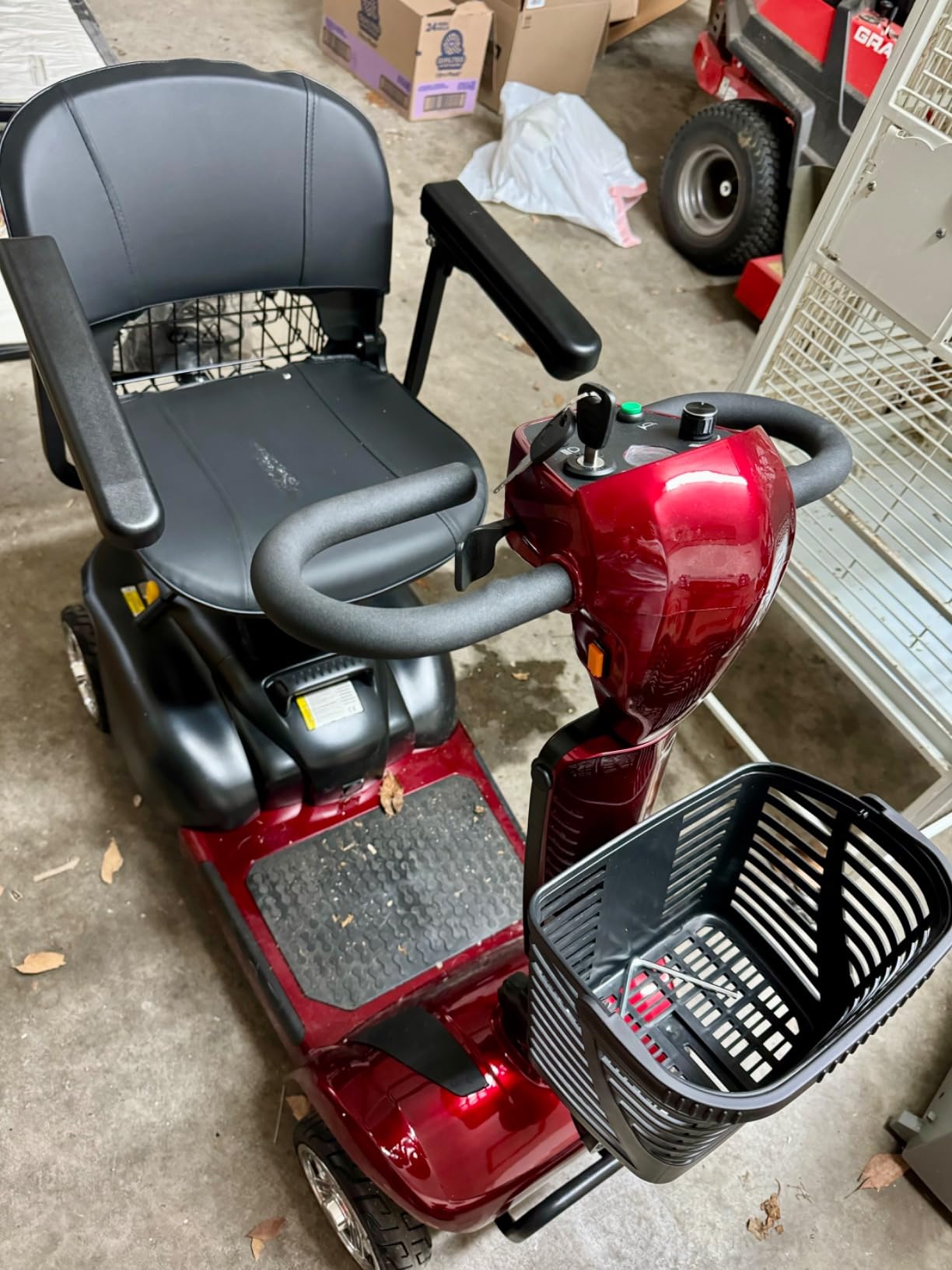
Indoor specifically, the removable 7 lb lithium battery is the feature that matters. You can pull the pack out and charge it inside near an outlet while the scooter itself stays where you parked it, which solves a real problem with scooters that have a fixed battery molded into the base.
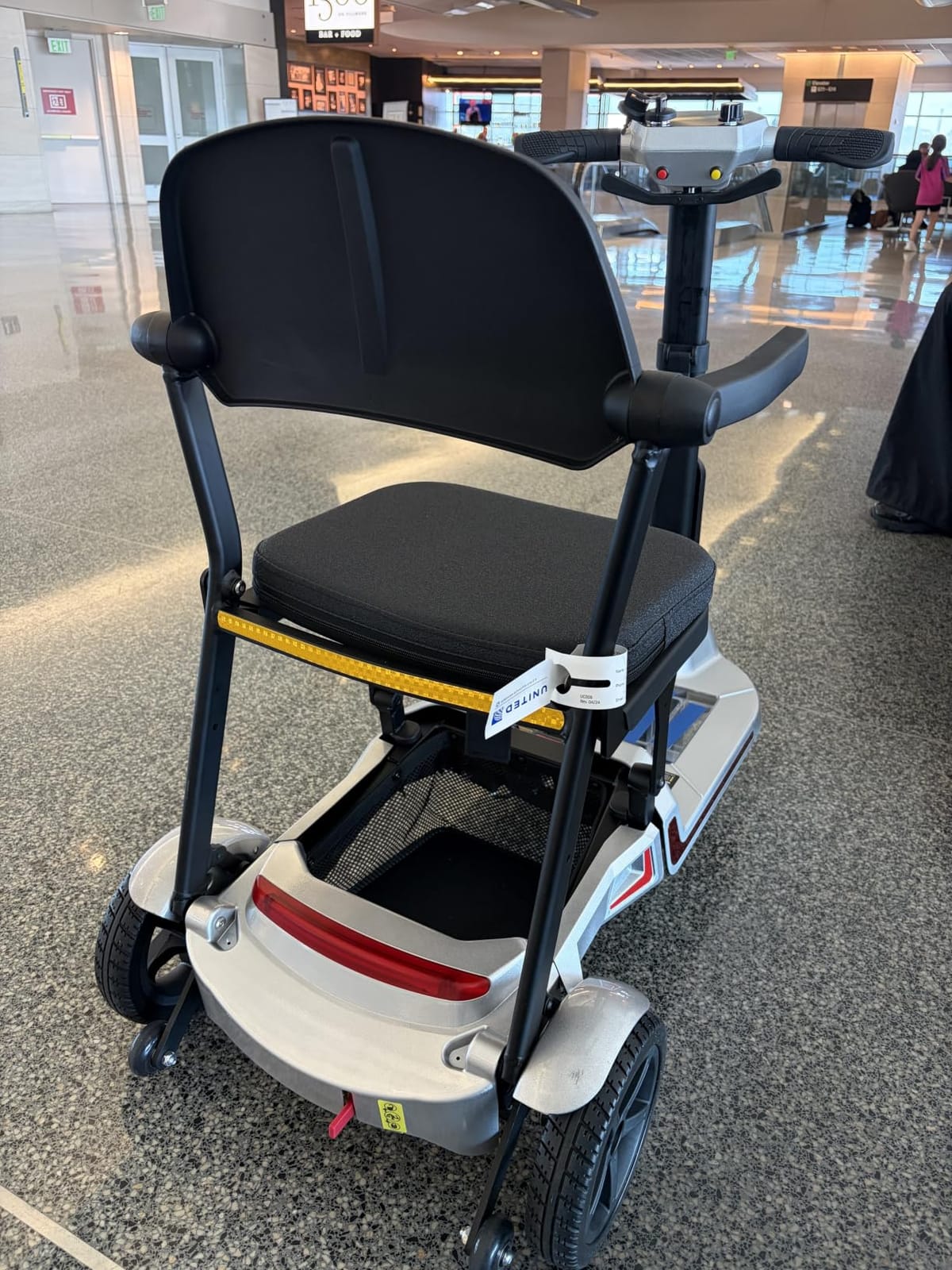
The tiller folds, the seat and both baskets come off, and the frame drops to about 63 lb once those pieces are removed for transport.
Why it earns the highest rating
At 4.6 across 222 reviews, it carries the highest average rating in this group, and reviewers credit the motor, the range and the support. Some variants also fold automatically with a remote control, which is worth asking about if stairs or a vehicle are involved.
Front anti-collision bumper, rear anti-tip wheels and responsive braking are all fitted as standard, which is a better indoor safety baseline than several rivals offer.
When the range claim outruns the reality
Range claims are optimistic. Reviewers report real-world distance falling well short of the advertised figure, so treat the number on the box as a ceiling rather than a plan. Some units also come in heavier than the listed 85.54 lb, which makes unfolding or loading harder than expected.
This is the newest listing on our list, so the long-term battery and parts record is thinner than the Drive Medical models have. Test the horn and the charger switch-off behavior before you rely on either.
6. AXADA Foldable 4-Wheel – Best for Daily Errands
AXADA Mobility Scooter,Foldable,300 lbs Capacity,Travel & Daily Commute
300W motor
15 mile range
Folds to 17.32 x 19.69 x 36.22 in
262 lb standard capacity
Pros
- 300W motor handles inclines and distance
- 360 degree swivel seat eases transfers
- LED dashboard with one-touch start
- Manual push mode lever
Cons
- 86 lb needs two people to load
- Battery is fixed despite the listing wording
- Not airline approved
- No reverse warning sound
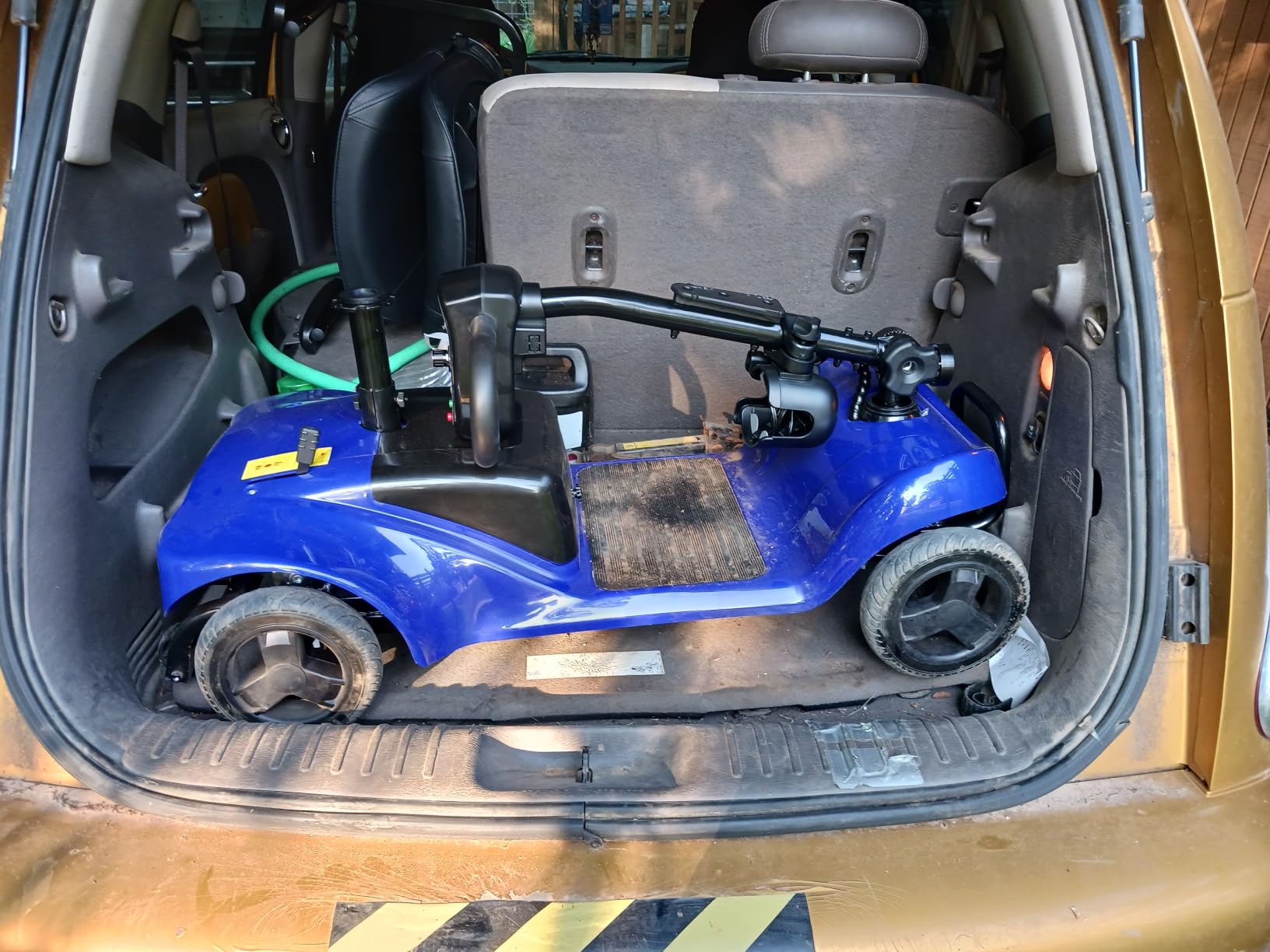
The AXADA folds flat to a shape narrow enough to stand upright in a car trunk, which makes it a practical choice for someone who drives to the grocery store rather than relying on delivery. Assembly is quick and the LED dashboard gives a clear speed and battery readout at a glance.
Its 360 degree swivel seat is the indoor feature we noticed most. Rotating the seat rather than shuffling the scooter is how you get through a tight bathroom approach without a multi-point turn.
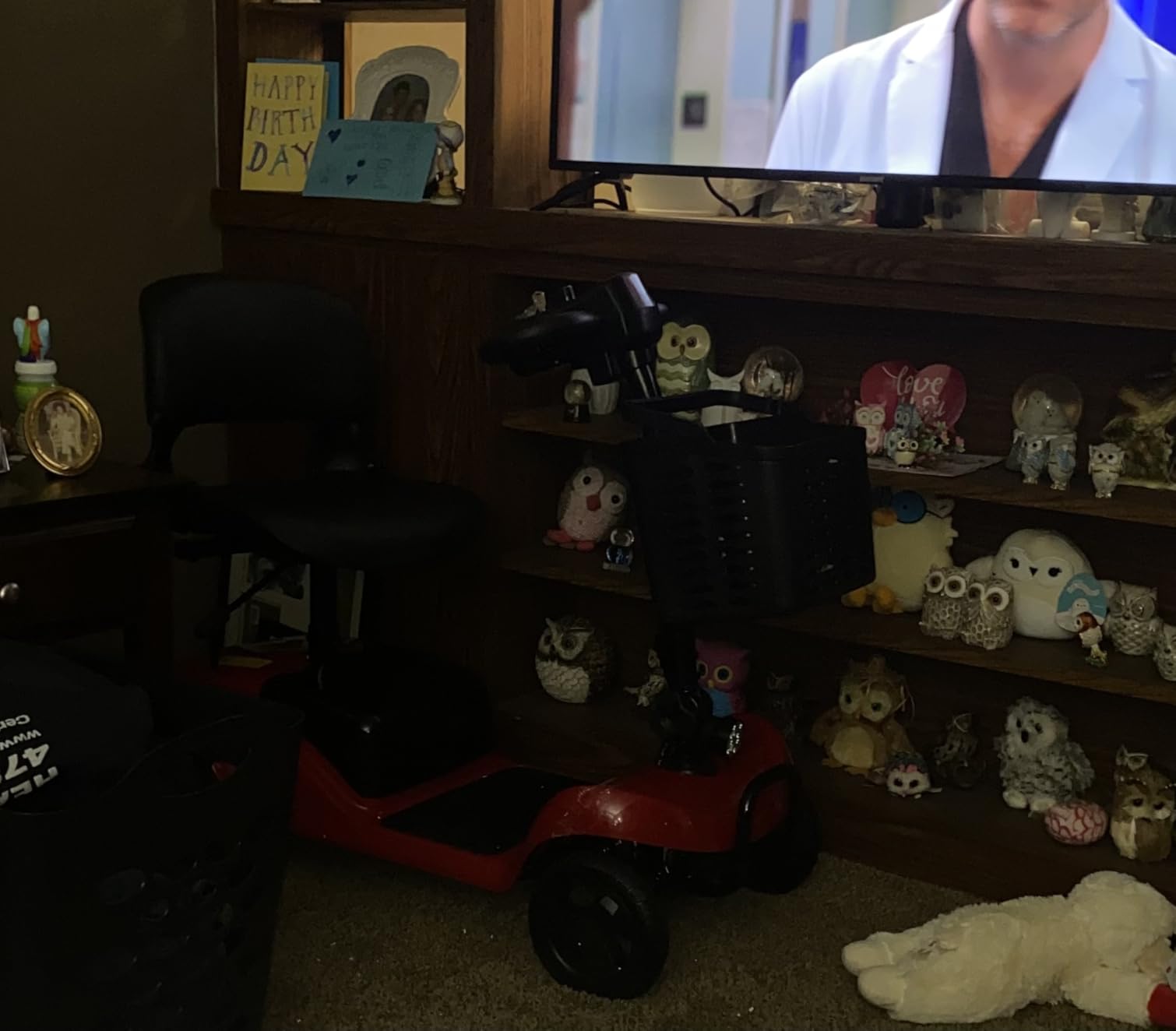
A lever under the right side of the seat switches between electric and manual push mode, which is genuinely useful indoors: you can roll it out of a storage closet without running the motor, and roll it back when the door is too narrow to drive through.
The 300W motor handles 8 to 15 degree inclines and a 15 mile range, with climbing ability and a 45mm ground clearance listed for outdoor approaches.
Where the fold-down design helps
Owners like the combination of the rotating seat, adjustable armrests and a front basket for errands. The fold also means it can live inside a small apartment rather than in a shared corridor where it would be an obstruction to other residents.
Support is described as responsive, and the listing includes a 30-day return window on quality issues and a one-year parts warranty.
When 86 lb defeats the fold
At 86 lb it takes two people to lift into a car, which undercuts the portability the fold implies. The listing implies a removable battery but the pack is fixed, so the whole unit moves together. It is also not airline approved, which was not clearly stated.
Top speed is abrupt out of the lowest setting, so indoor use needs a gentle throttle hand near furniture and other people, and there is no audible reverse warning.
7. Rylox Foldable 4-Wheel – Best for Riders Who Tipped Before
Foldable 4-Wheel Mobility Scooter for Adults – Portable Motorized Scooter with 330 lbs Capacity, Detachable Battery, Dual Baskets, Cup & Phone Holder, Blue
330 lb capacity
15 mile range
Folds to 40 x 19 x 14 in
8 inch puncture-proof tires
Pros
- Noticeably more stable than three-wheel models
- Dual baskets plus cup and phone holder
- Quick 10 minute assembly
- Long battery between charges
Cons
- Turning is not sharp and needs backing up
- Seat and steering column can feel wobbly
- Heaviest piece is 50 lbs
- Hard tires are louder on hard floors
Several buyers on this model came from three-wheel scooters they had tipped. That is the clearest use case here: if your previous indoor experience ended with a wobble at a doorway, this four-wheel layout removes that variable entirely.
Its 330 lb capacity matches the top of the range here, and the reinforced bumper and anti-tip structure give it a planted feel over carpet transitions and small thresholds.
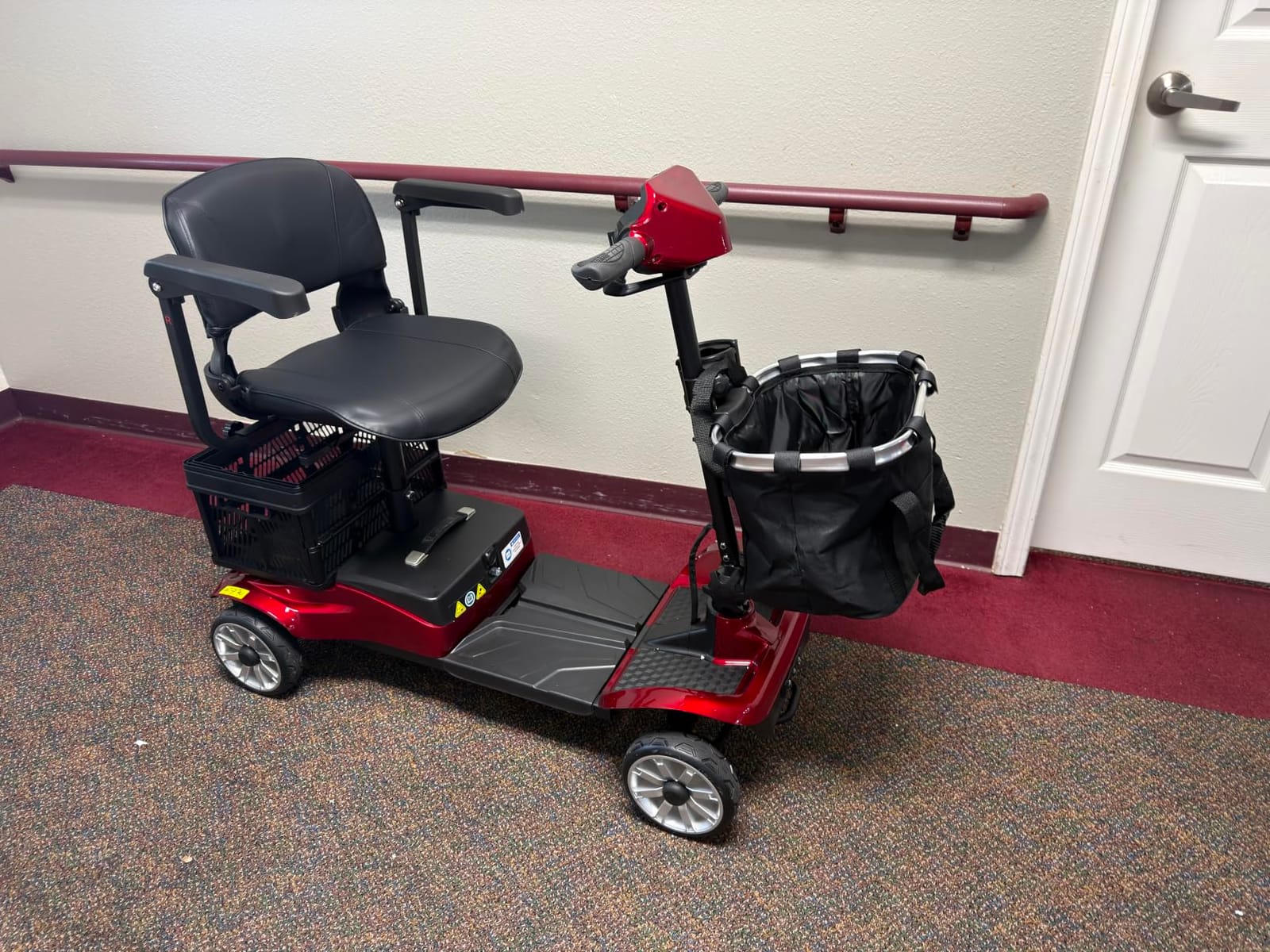
Storage is the surprise here. Dual removable baskets plus a dedicated cup holder and phone holder is generous everyday carry capacity, which matters indoors because you make fewer trips between rooms and back to a kitchen counter.
It breaks into four pieces with a 50 lb heaviest section, and a single 6-hour charge covers up to 15 miles. The 250W motor handles inclines up to 15 degrees.
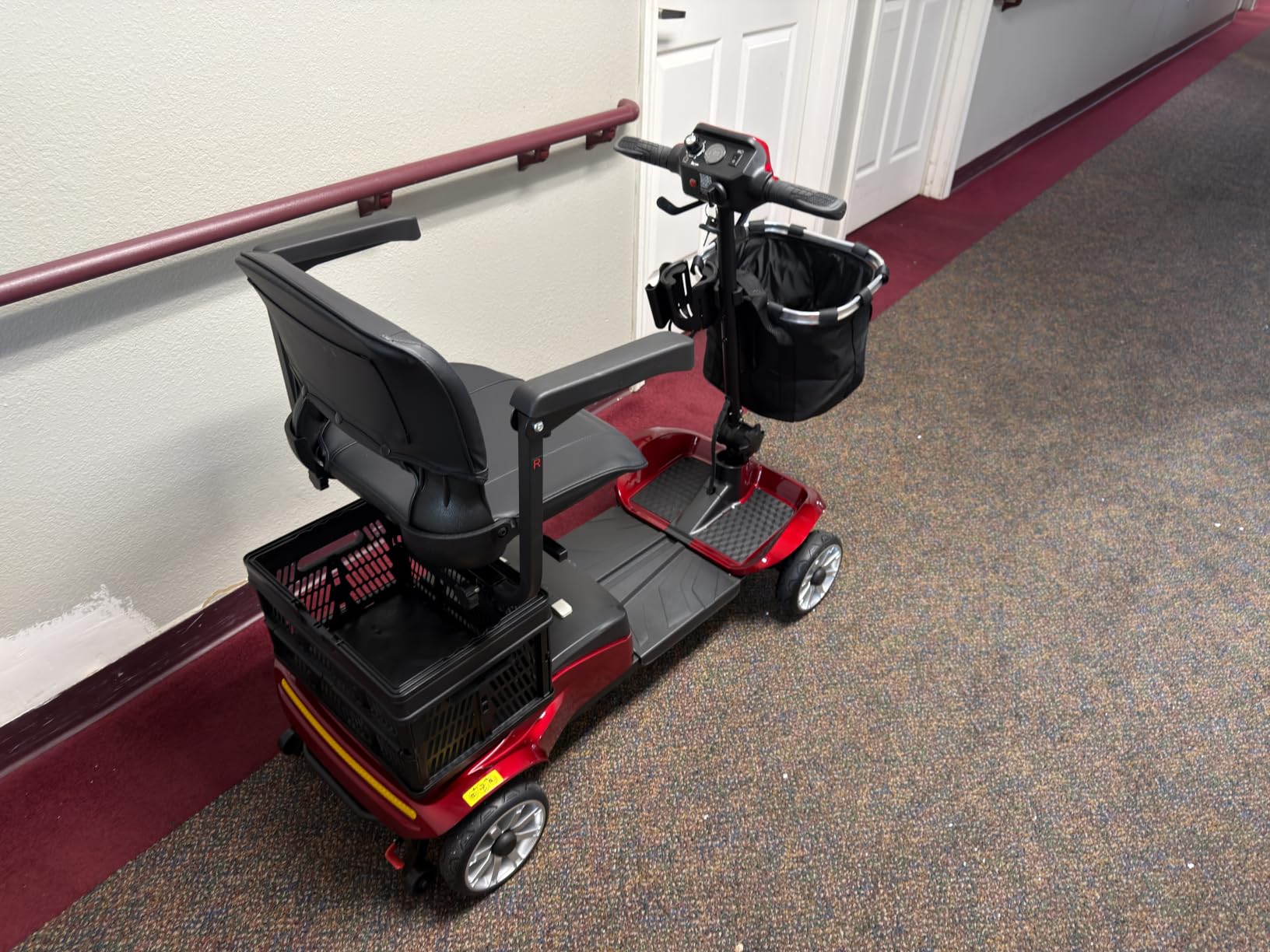
Why stability is the deciding factor
A four-wheel base does not pivot. That is a safety gain and a maneuvering loss, and the balance you are making is between those two facts rather than between brands.
Reviewers also cite quick assembly of about ten minutes, which matters if you plan to store it inside rather than leave it parked in a corridor.
When stability costs you maneuverability
Turning is not sharp, and owners report that backing up and repositioning is often needed in tight spaces, so this is a poor fit for a narrow galley kitchen or a hallway under about 36 inches. The seat and steering column can feel wobbly, and the hard 8 inch tires are louder and harsher than air-filled ones on tile.
Speeds above the lowest setting need care around furniture, people and pets.
8. WAYCARE 330 lb Scooter – Best for Small Rooms
WAYCARE Mobility Scooter for Adults & Seniors, 330 lb 15-20 Mile Range Red
330 lb capacity
4.97 mph top speed
15-20 mile range
19.6 inch overall width
Pros
- Strong handling in tight indoor spaces
- Simple controls seniors pick up quickly
- Folds down in about 5 minutes
- Hill-holding feature when parked
Cons
- Around 80-85 lb and the battery does not detach
- Limited disassembly beyond seat and basket
- Weak on hills and in wet grass
- Costly returns if the scooter does not suit
The WAYCARE combines a genuinely compact 19.6 inch overall width with a 330 lb capacity, a pairing we do not often see in this category.
Most scooters that turn well in a small room are also small, and most scooters with a high capacity are long, so this pairing is worth noting before you shop. For a home where the scooter lives in a bedroom or a dining room rather than a garage, that width advantage is the whole decision.
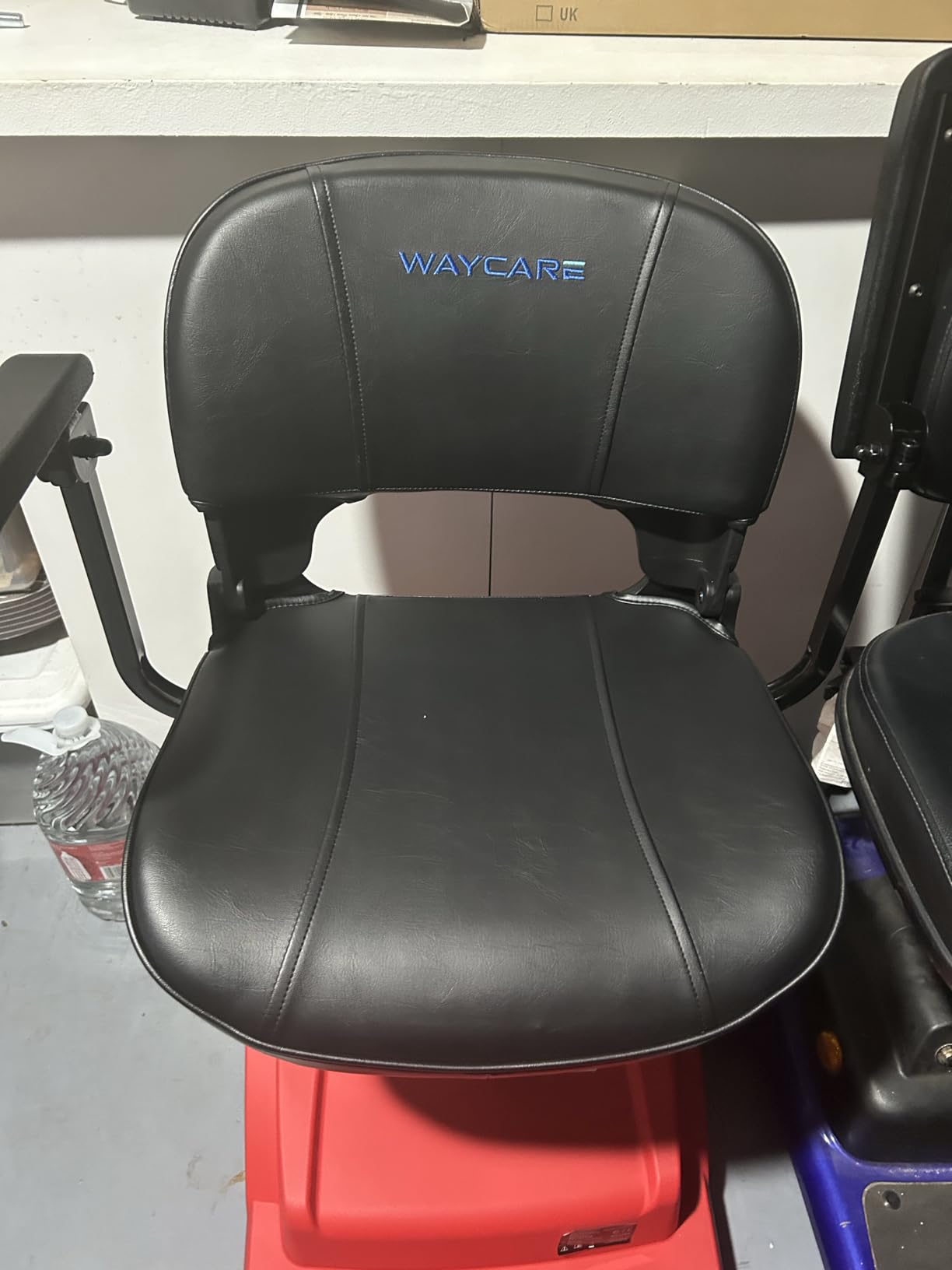
The control panel is a single gear dial handling speed, direction, headlights and horn. There is nothing on it to mis-set, and reviewers repeatedly describe seniors picking it up quickly, which matters when the user has never driven a powered device.
The hill-holding mechanism stops the scooter rolling when parked on a slope. In a home with a sloped garage or a raised entry, that is a small safety feature with an outsized effect.
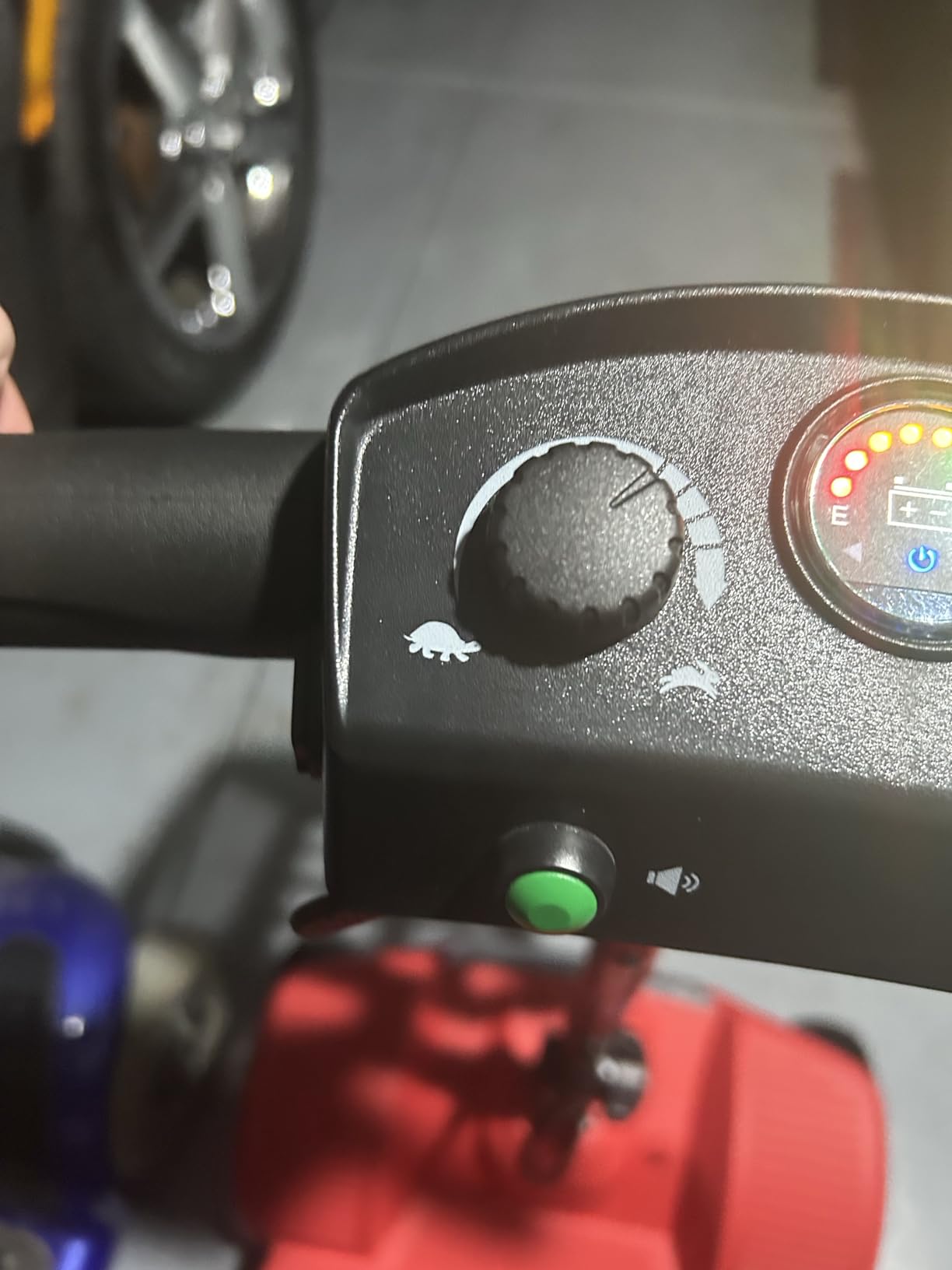
Why the width figure matters
At 39.4 by 19.6 by 33.4 inches, this is one of the narrower footprints here, and combined with a top speed of 4.97 mph it moves through a small room without feeling sluggish.
Folding and disassembly take about five minutes, and the 19.6 by 18 by 16 inch seat with a synthetic leather cushion is larger than the seat on the Vive.
When the fixed battery limits you
At roughly 80 to 85 lb with a battery that does not detach, around 70 lb of that has to be lifted into a vehicle, and it does not come apart beyond the seat, armrests and basket. Performance drops off on hills and in wet grass, so treat it as an indoor-and-flat-paving machine.
Return costs can be significant if the scooter does not suit you, which is worth confirming with the seller before you commit.
9. Hoverfly T4 4-Wheel – Best Wide Seat for Long Indoor Days
Hoverfly T4 4-Wheel Mobility Scooter for Seniors/Adults, Max 12.4 Miles
17.2 x 13.7 inch extra-wide seat
Removable 21 lb 12Ah battery
330 lb capacity
9 inch solid tires
Pros
- Extra-wide swivel seat with 3-position height adjustment
- Tool-free 21 lb battery removal for off-board charging
- Reinforced bumper and anti-slip rear wheels
- 0.5 second electromagnetic brake
Cons
- One of the heavier frames here at 96 lb
- Lead-acid pack is bulkier than lithium rivals
- Long frame makes tight corners harder
- Lead-acid pack is less efficient
The Hoverfly T4 is the comfort pick. Its 17.2 by 13.7 inch seat is an extra-wide design with a 360 degree swivel and three-position height adjustment, which is a meaningful difference if you spend a full day seated rather than moving between rooms.
The 330 lb capacity matches the top of the range here, and the wide seat means larger riders do not have to accept a narrow chair to get that capacity.
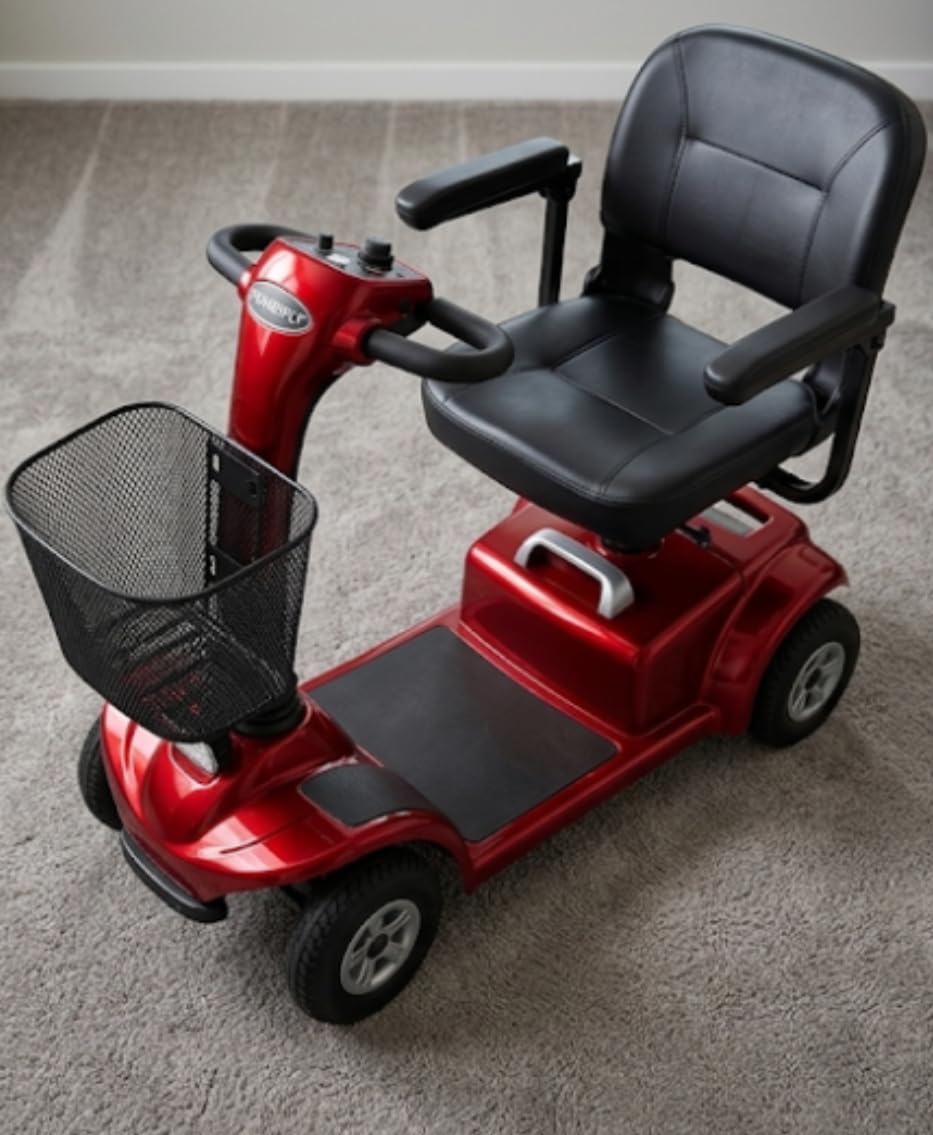
The battery removes without tools at 21 lb, so charging can happen indoors on a counter or a table while the scooter stays parked. Range is up to 12.4 miles, and a 250W motor handles slopes up to 10 degrees.
The 0.5 second electromagnetic brake gives a prompt, controlled stop, and the LED headlight and horn are both standard.
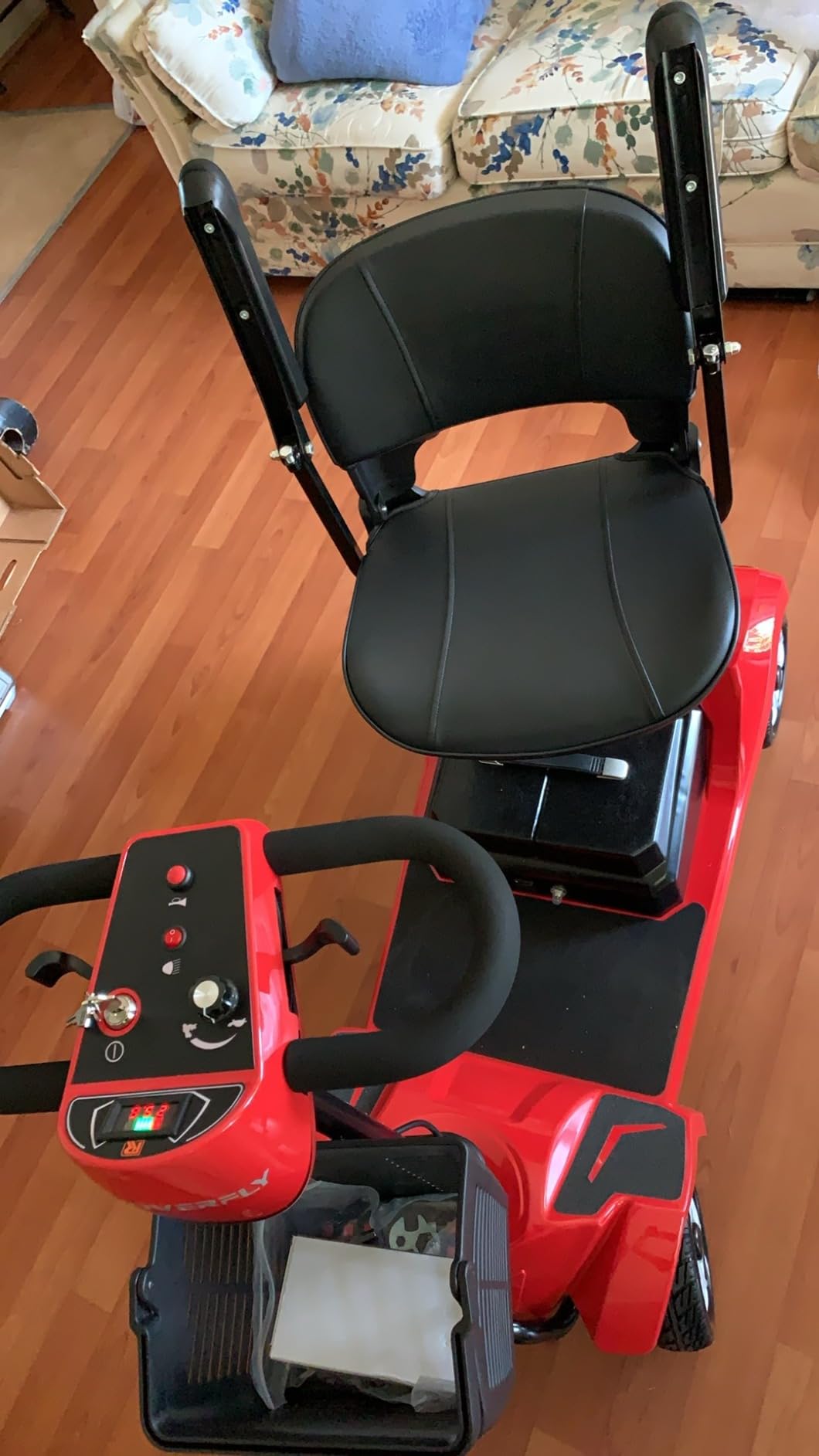
Why seating is the deciding factor
If indoor use means long hours in a chair rather than repeated short trips, seat width and height adjustment matter more than turning radius. This is the one pick on the list where we would prioritise comfort over maneuverability.
Owners also like the flip-up armrests, which help with side transfers onto a bed or a standard-height couch.
When bulk outweighs comfort
At 96 lb this is one of the heavier frames in the group, and the 48.2 inch length makes tight indoor corners harder than the compact models. The lead-acid battery is heavier and less efficient than the lithium packs used by the lighter competitors here.
It carries the lowest average rating of the ten at 4.1, and the most common thread in the reviews is a tradeoff buyers accept knowingly: comfort and capacity in exchange for weight and bulk.
10. GREAT CIRCLE G 3-Wheel – Best Lightest Frame in the Group
G Mobility Scooter – 3 Wheels, 35 lb Folding Aluminum Frame, Anti-Tip Footrests, Includes (1) 48V 2Ah Li-Ion Battery and Charger, Supports 275 lbs, Airline Friendly
26 lb aluminum frame
48V swappable lithium battery
6.5 mile runtime
275 lb capacity
Pros
- Lightest frame among these ten at 26 lb
- Sharp turning for tight indoor aisles
- Battery swaps in seconds
- Airline friendly design
Cons
- No armrests at all
- 275 lb capacity is below most four-wheel models
- Manual drum brake is less refined
- About 6.5 miles per charge
At 26 lb, the GREAT CIRCLE G has the lightest frame of the ten models here, and it is the easiest of them to carry up a single flight of stairs on your own. The three-wheel collapsible aluminum frame separates into five pieces, and the 48V lithium battery detaches and swaps in seconds.
That combination of weight and battery removability is what makes it genuinely portable rather than merely foldable, and it is why we list it among the folding travel options in our guide to travel mobility scooters that fold.
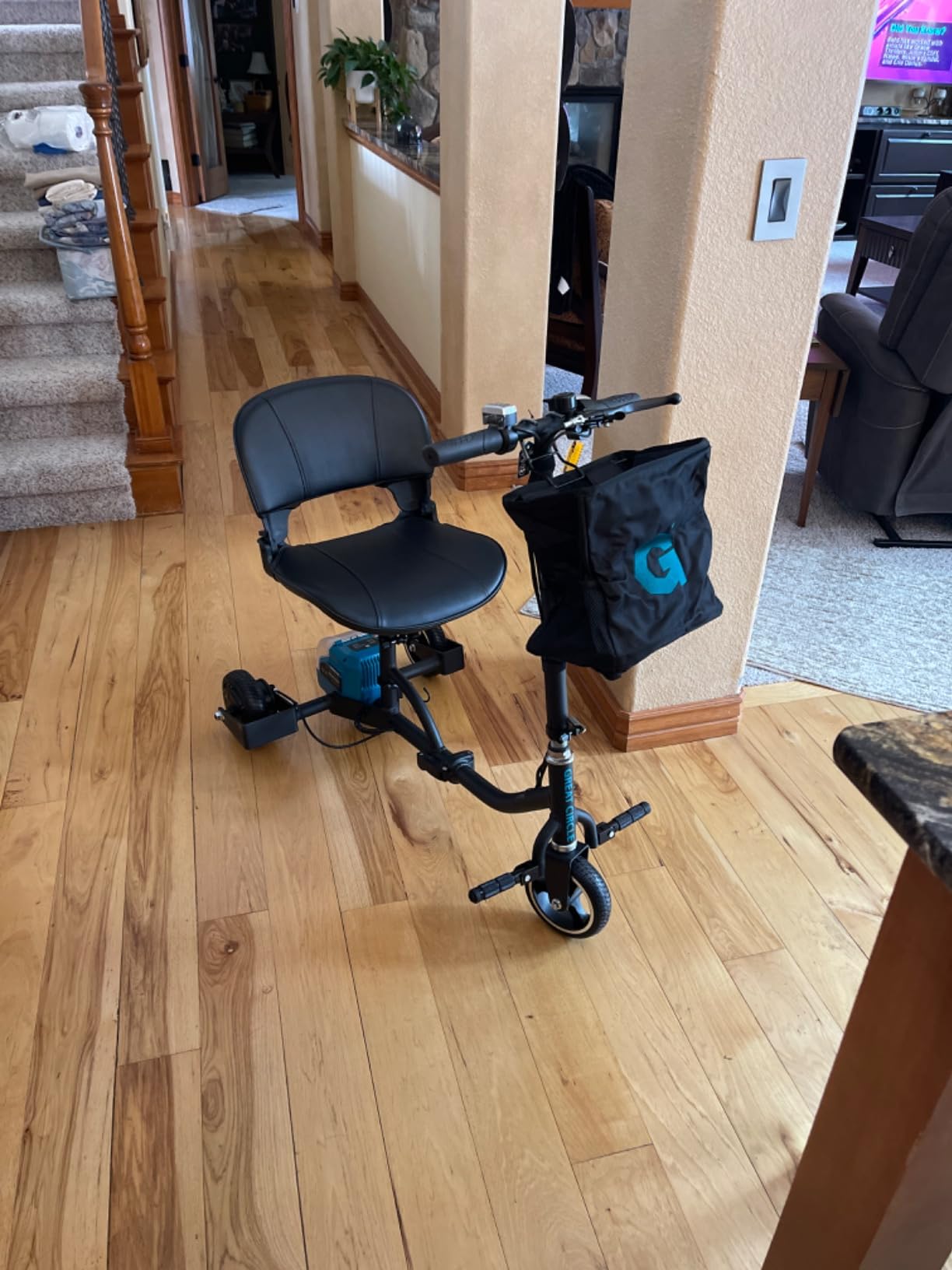
Indoors, the sharp turning radius is the appeal. Reviewers call out its ability to work tight indoor aisles and store navigation, and the flat-free solid non-marking rubber tires are floor-safe by specification.
The 16.9 inch padded faux leather seat with adjustable height is wider than the Passport’s, which is a rare combination on a scooter this light.
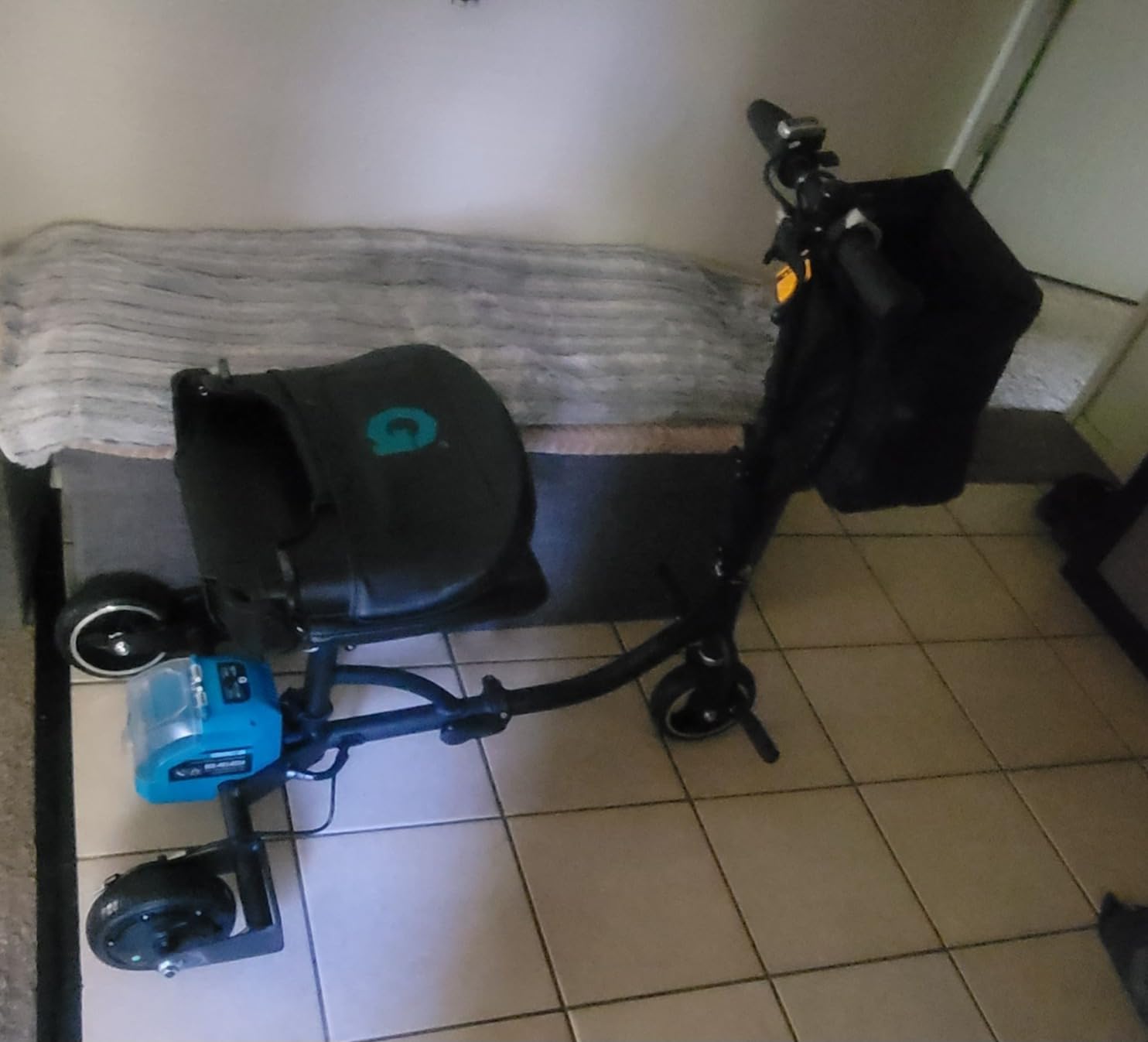
Why the weight is the deciding factor
Users must be able to lift at least 35 lb to transport it, and at 26 lb the frame is the reason most people manage it. A second battery can be carried as a spare rather than as dead weight, which extends total range without adding a part that has to live in the car permanently.
The 48V brushless motor runs forward and reverse with a variable speed thumb drive accelerator, which is precise enough for indoor maneuvering.
When the lightest frame costs you comfort
There are no armrests at all, so the rider has to hold their arms out while driving, which is uncomfortable over a long indoor day and harder for anyone with shoulder problems. The 275 lb capacity is lower than most four-wheel models here.
Runtime is about 6.5 miles per charge, the shortest of the lithium models on this list, and the manual drum brake is less refined than the electromagnetic brakes on the Hoverfly and the Ecomobi.
3-Wheel vs 4-Wheel for Indoor Use: Three Wheels Turn Tighter
Three wheels win on maneuverability and four wheels win on stability, and that is close to the end of the disagreement. A three-wheel scooter pivots on a single front wheel, so it can execute a full turn in a much smaller circle than a four-wheel base, which is why nearly every indoor-first recommendation points at three wheels.
What a four-wheel base buys is a planted stance that does not tip when you release the tiller or cross a threshold at speed. A rider with balance issues, a history of falls, or a fear of wobbling should usually take the wider circle in exchange for that stability.
The practical middle ground is the compact four-wheel scooter. It will not pivot, but its overall width stays near 19 to 20 inches, so it still clears standard doorways and fits down a normal hallway. That is why two of our picks are four-wheelers and neither of them is disqualified for indoor use.
One indoor-specific note that gets overlooked: a scooter with a narrower turning circle still needs a way out of a dead end. Reverse gear lets you back out of a hallway rather than performing a three-point turn in a space that was never going to allow it.
Turning Radius Thresholds: What 30, 40, 55 and 60 Inches Mean
There is no single official indoor turning radius requirement, which is why you will see three different thresholds quoted online. Reconciling them: under 30 inches is excellent and effectively zero-turn class, under 40 inches is the practical target most indoor buyers should aim for, and under 55 inches is workable in open rooms but tight in a hallway.
The ADA reference point is a 60-inch wheelchair turning space, and that is the figure readers on r/disability measure scooters against. It is a useful hard benchmark because it tells you what a space that is genuinely accessible to a wheelchair user will accept, not what a marketing page considers compact.
Only one model in this group publishes its turning radius: the Drive Medical Spitfire Scout 3 at 45.5 inches. For the rest, the class averages that circulate online are roughly 42 inches for three-wheel designs and around 59 inches for four-wheel designs, but treat those as class guidance rather than as the number for your specific scooter.
This is why measuring your own hallway is the step we would do first, before comparing any two models. A 45.5 inch circle in a 40 inch corridor is a non-starter, and a scooter can be otherwise perfect.
How to Measure Your Space Before You Buy
Five measurements decide whether a scooter fits your home, and all five take about ten minutes with a tape measure. Do them before you shop, not after delivery.
1. Your narrowest doorway. Measure the clear opening with the door open, not the door frame. Standard residential interior doors give roughly 32 to 36 inches of clear width, and anything above 20 inches overall width will pass. Check the hinge side, where the open door reduces the usable opening.
2. Your tightest hallway. Measure width and note whether it turns. A scooter needs at least twice its turning radius in both length and width of free floor space to complete a U-turn, so a 45 inch radius needs roughly 90 inches of clear floor at the turn.
3. The elevator. Measure the cab depth against the scooter’s overall length and the door opening against its width. Elevator cabs in older buildings are the single most common reason an indoor scooter stays parked in a hallway.
4. Your storage and charging spot. This is where the lightest models earn their place. Measure the closet, the corner or the vehicle trunk you intend to use, and check the heaviest single piece you would need to lift. Our lightest pick weighs 26 lb and the heaviest frame listed here is 110 lb, and that gap decides whether you can store the scooter indoors at all.
5. Your thresholds and transitions. Measure the tallest door sill and any rug edges in your route. Models with 2.5 inch ground clearance handle small indoor transitions but will catch on a curb, and a rug edge that is not secured is a tipping risk on any three-wheel model.
Test-drive checklist for a showroom visit: sit in the chair for at least ten minutes before riding, complete a full U-turn in the aisle, reverse out of a simulated dead end, cross a threshold, and confirm your hand strength holds the tiller comfortably through a slow turn.
Protecting Your Floors: Tire Types on Hardwood, Tile and Carpet
Non-marking tires are the single most important indoor feature and almost every model on this list specifies them. The rubber compound is chosen not to scuff or stain hardwood, laminate or tile, and it is the reason you can use a scooter in an apartment without arguing with your landlord.
Flat-free solid tires, which cover most of the models here, need no inflation and cannot go flat, but they are firmer and transmit every threshold bump. Pneumatic air-filled tires roll quieter and softer, and they are the better choice if your indoor route is mostly smooth tile and you are more concerned about noise than maintenance.
Carpet is where the differences show up most. A scooter with small hard wheels digs into low pile, and the drag can follow you to the wall. The 6.75 inch solid tires on the SuperHandy Passport and the 8 inch wheels on the Vive both suit low pile carpet better than the small-diameter hard wheels on some lighter folding models.
If you rent, two things are worth knowing. Non-marking tires prevent most scuffing but no manufacturer guarantees zero marking on every finish, and a scooter should never be driven over a loose rug edge or a threshold higher than the ground clearance allows.
Indoor-Only vs Indoor-Outdoor: Which One Do You Need
An indoor-only scooter optimizes for width, turning and storage, and you can accept a shorter range as a result. If you need paved outdoor access as well, you want more motor and more battery capacity, and you will pay for it in both bulk and weight.
Our list straddles that line deliberately. The lighter three-wheel models are indoor-first and tolerate level pavement. The Ecomobi and the Hoverfly are the picks for anyone whose day includes a driveway, a path or a neighborhood loop, and both carry the range figures to support it.
A practical test: if the outdoor part of your day is a short flat route to a car or a bin, a compact indoor-first scooter is enough. If it involves uneven ground, slopes or distance, a mid-size four-wheel with a lithium pack is the safer purchase.
When a Scooter Is the Wrong Choice Indoors
Some of the most honest advice in this category is about what not to buy. If your indoor mobility need is short distances and you can still walk with support, a rollator or a walker gives you more flexibility and takes up less floor space when parked.
A power wheelchair is a better indoor choice than a scooter when you need tight indoor turning. Power wheelchairs pivot on the spot and have a much smaller footprint, which is exactly the advantage a scooter gives up. They also do not require tiller steering.
The hard disqualifier is upper-body strength. Every scooter here is controlled by a tiller, and holding and releasing a tiller through a slow turn needs arm and wrist control that some people simply do not have. If that describes you, look at power wheelchairs or joystick-controlled seating instead.
A fourth case is storage. If there is genuinely nowhere indoors to put a scooter, a folding travel model is the answer rather than a full-size one. The 26 lb and 35 lb frames on this list exist for exactly that reason.
Frequently Asked Questions
What is the best turning radius for a mobility scooter indoors?
Under 30 inches is excellent and effectively zero-turn class, under 40 inches is the practical indoor target, and under 55 inches is workable in open rooms but tight in a hallway. The ADA references a 60-inch wheelchair turning space as the hard accessibility benchmark. Allow at least twice the turning radius in both length and width of clear floor space to complete a U-turn.
Can mobility scooters be used indoors?
Yes. Compact and mid-size mobility scooters are designed for smooth indoor surfaces, and three-wheel models are the usual choice because they turn tighter. You do need adequate upper-body control for tiller steering and enough strength to transfer on and off the seat safely.
What are the best mobility scooters for inside the house?
Best overall for maneuverability is the Vive 4 Wheel Mobility Scooter, which holds a stable four-wheel base, breaks into four pieces with a 29 lb heaviest section and uses 8 inch flat-free non-marking tires. Best ultra-compact for a small apartment is the SuperHandy Passport, at 35 lb assembled and folding flat. Best balanced indoor ride is the Drive Medical Scout 4-Wheel, with a 300 lb capacity and a five-piece breakdown.
What type of scooter will Medicare pay for?
Medicare Part B typically covers 80 percent of the cost of a qualifying mobility scooter, with the deductible applying. You need a prescription from a doctor documenting that the mobility limitation substantially limits your ability to perform daily activities, including mobility inside the home, and you must use a Medicare-approved supplier.
What are the little wheels on the back of a mobility scooter for?
They are anti-tip and anti-rollback wheels. They stop the scooter rolling backward when it is parked or left on a ramp or incline, and they help prevent it tipping during a transfer when you lean to one side to get on or off.
Which mobility scooter was ranked best by Consumer Reports?
Consumer Reports does not publish a routinely accessible scooter ranking that shoppers can check, so we will not invent one. The trustworthy third-party signals available to you are verified review volume, star rating distribution, warranty length and parts support. On those measures the Vive 4 Wheel stands out with more than 3,000 reviews and a 5-year guarantee, and the Drive Medical models show the deepest long-term ownership record.
What are the disadvantages of a mobility scooter indoors?
Scooters need more maneuvering room than a power wheelchair, which pivots on the spot. They require upper-body strength for tiller steering, so they are not viable for everyone. They are often unnecessary indoors where a rollator or walker suffices, and without non-marking tires they can mark floors. Indoor-only use also makes a large battery largely wasted capacity.
How much floor space does a mobility scooter need to turn?
Allow clear floor space at least twice the turning radius in both length and width. A scooter with a 45.5 inch turning radius needs roughly 90 inches of clear floor to complete a U-turn. Measure the tightest point in your route, not the average room.
The Verdict: Best Mobility Scooters for Indoor Use in 2026
For most homes, the Vive 4 Wheel Mobility Scooter is our pick for the best mobility scooters for indoor use, because it balances a stable four-wheel base with a 19.5 inch width and a 29 lb heaviest section. If storage or stairs are the real constraint, the SuperHandy Passport at 35 lb or the GREAT CIRCLE G at 26 lb solve a problem no four-wheel scooter can.
If you have balance concerns, take the Drive Medical Scout 4-Wheel and accept the wider turning circle, or the Rylox if carrying capacity matters more than tight corners. Whatever you choose, measure your narrowest doorway and your turning floor space before you order, and confirm you can hold a tiller comfortably through a slow turn.
Use the Check Latest Price buttons on each card to see current figures, and read our broader mobility scooter buying guide for seniors if you want the category-level view first.