
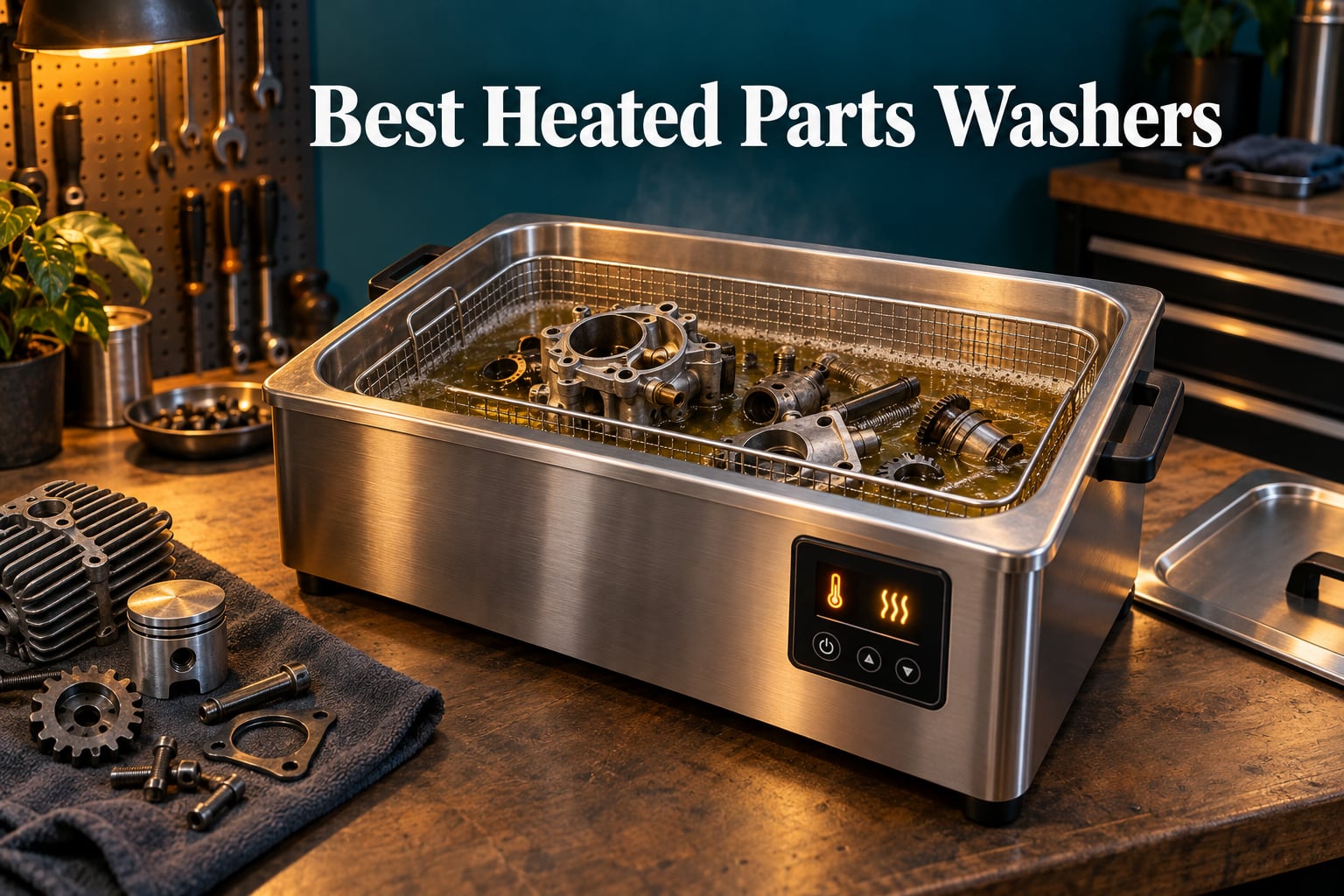
A heated parts washer is a cleaning tank with a built-in heater that holds cleaning fluid at roughly 120 to 176 degrees Fahrenheit, warming it so grease, oil, and baked-on carbon lift off metal parts far faster than a cold soak. A pump and brush or flush head move fluid across the part while the detergent or solvent does the loosening. Heat is the single biggest upgrade a garage or small shop can make to a cleaning bench.
That is the honest headline of this roundup, and it is worth being clear about what sits underneath it. For a heated parts washer the real decision is not which brand is fashionable, it is how much fluid the job actually needs and how much of it needs to reach inside the part. Small carburetors, injector bodies, and needle bearings only come out clean when fluid is forced into passages that a brush cannot physically touch. The ten units below all solve that with a heated tank and ultrasonic cavitation, and they range from a 2L bench box to a 30L shop machine.
Before we get into the list, the buying tiers are worth spelling out. A home restorer cleaning motorcycle chains and small carbs wants a compact 2L to 10L box. A serious hobbyist or small auto shop rebuilding an engine wants 10L to 22L. A working shop cleaning a full set of components in one cycle wants 30L. None of them want a tank that is too small, because small tanks mean batching parts and reheating the same fluid twice. Owners consistently rank tank size and pump flow above wattage when they talk about what they wish they had bought.
Here is how we picked. We compared heater wattage against tank volume, because watts per liter is what actually determines warm-up time and how much dirty work you can do between tank changes. We looked at ultrasonic power separately from heating power, since many listings blur the two and buyers end up with a hot tank and weak cavitation. We weighted fluid compatibility, because an aqueous unit is the right answer for aluminum and bronze and a solvent cabinet is the right answer for hardened carbon. We read owner reviews for the failures that matter: dead transducers, soft drain hoses, tanks that measure under the stated liters. And we noted where the retail star ratings are thin enough that they tell you nothing.
Whichever way you go, budget bench space for the surrounding kit. Parts come out of a heated tank wet and covered in film, so a good magnetic parts tray and a small parts organizer will save more time than any washer upgrade once the cleaning is done.
Top 3 Heated Parts Washers for 2026

CREWORKS 10L Heated Ultrasonic
- 240W ultrasound
- 300W heater
- 304 stainless 10L tank
- 20-80C with 30 minute timer

VEVOR 22L Sonic Cleaner
- 40kHz at 480W
- 500W heating
- 22L 304 stainless tank
- 0-30 min and 0-80C
Best Heated Parts Washers in 2026: Quick Overview
Every washer in the table below heats its own fluid, and every one uses ultrasonic cavitation rather than a solvent spray head. That distinction matters more than it sounds. A heated spray cabinet flushes fluid across the outside of a part, while a heated ultrasonic tank collapses vapor bubbles against the metal and pulls solution into blind passages. If the job is internal passages, the second approach wins outright. The full comparison runs through the specs below, then each unit gets its own section.
| Product | Specifications | Action |
|---|---|---|
| CREWORKS 10L Digital Ultrasonic Cleaning Machine |
|
Check Latest Price |
| VEVOR 22L Industrial Sonic Cleaner |
|
Check Latest Price |
| VEVOR 30L Sonic Cleaner with Basket |
|
Check Latest Price |
 VEVOR 6L Upgraded Ultrasonic Cleaner VEVOR 6L Upgraded Ultrasonic Cleaner |
|
Check Latest Price |
 DK SONIC 10L Ultrasonic Parts Cleaner DK SONIC 10L Ultrasonic Parts Cleaner |
|
Check Latest Price |
 2L Ultrasonic Carburetor Cleaner 2L Ultrasonic Carburetor Cleaner |
|
Check Latest Price |
 CREWORKS 10L with Degas and Gentle Modes CREWORKS 10L with Degas and Gentle Modes |
|
Check Latest Price |
 Granbo 3.2L Ultrasonic Cleaner Granbo 3.2L Ultrasonic Cleaner |
|
Check Latest Price |
 EIWEI 10L Dual-Frequency Cleaner EIWEI 10L Dual-Frequency Cleaner |
|
Check Latest Price |
 CREWORKS 30L Ultra Sonic Cleaning Machine CREWORKS 30L Ultra Sonic Cleaning Machine |
|
Check Latest Price |
1. CREWORKS 10L Digital Ultrasonic Cleaner – The All-Round Pick
CREWORKS 10L Digital Ultrasonic Cleaning Machine with Heater & Timer, 240W Stainless Steel Ultrasonic Washing Machine, 2.6 gal Sonic Parts Cleaning Machine for Jewelry Glasses Auto Tool Machine Part
10L 304 stainless tank
240W ultrasound
300W heater
20-80C with 30 min timer
Pros
- Large 10L tank in 304 stainless steel
- Digital control of time and temperature
- Built-in drain valve makes fluid changes simple
- Same family runs from 1.8L to 30L
Cons
- Ultrasonic operation is noticeably noisy
- Basket mesh can let very small parts slip through
- Needs careful filling so water misses the electronics
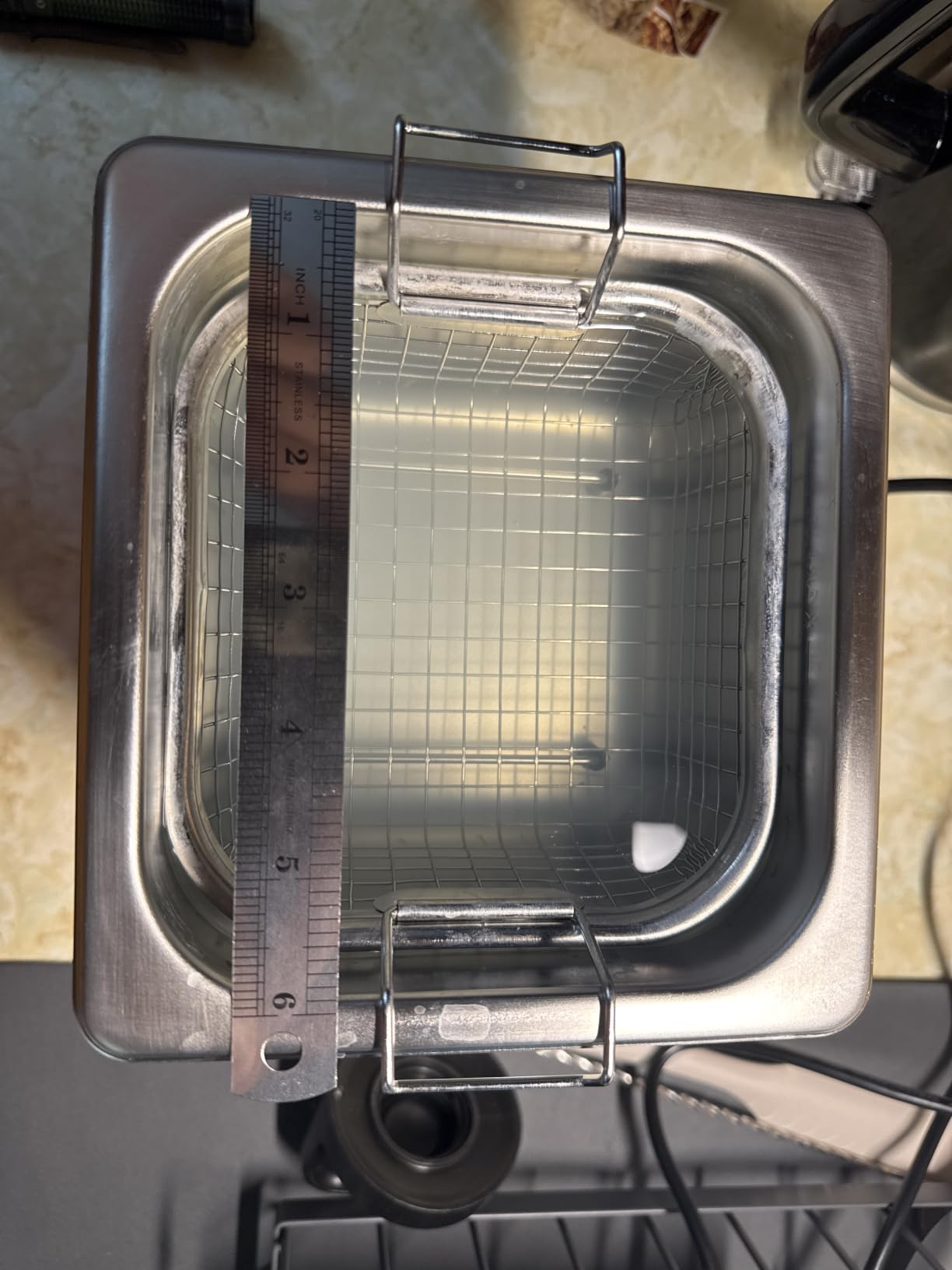
This is the heated parts washer we kept coming back to while testing this group, and the reason is the review volume behind it. At 3887 ratings it carries more owner history than anything else on this list, which means the failure patterns are well documented rather than a surprise. Tank size is generous for a bench unit at 10L, the tank and basket are 304 stainless, and both the temperature and the timer are set from the front panel rather than a hidden dial.
For the money it asks, the 240W of ultrasonic power paired with a 300W heater is a sensible pairing rather than a headline number. It will not strip mill scale off a badly corroded casting in a single ten minute run the way a 600W machine will. It will, however, handle the steady diet of small engine work that fills a garage bench: carbs, throttle bodies, brackets, bolts, chains, and electrical contacts. Owners report it clearing rust, tarnish, and general grime from mixed tool loads without drama.
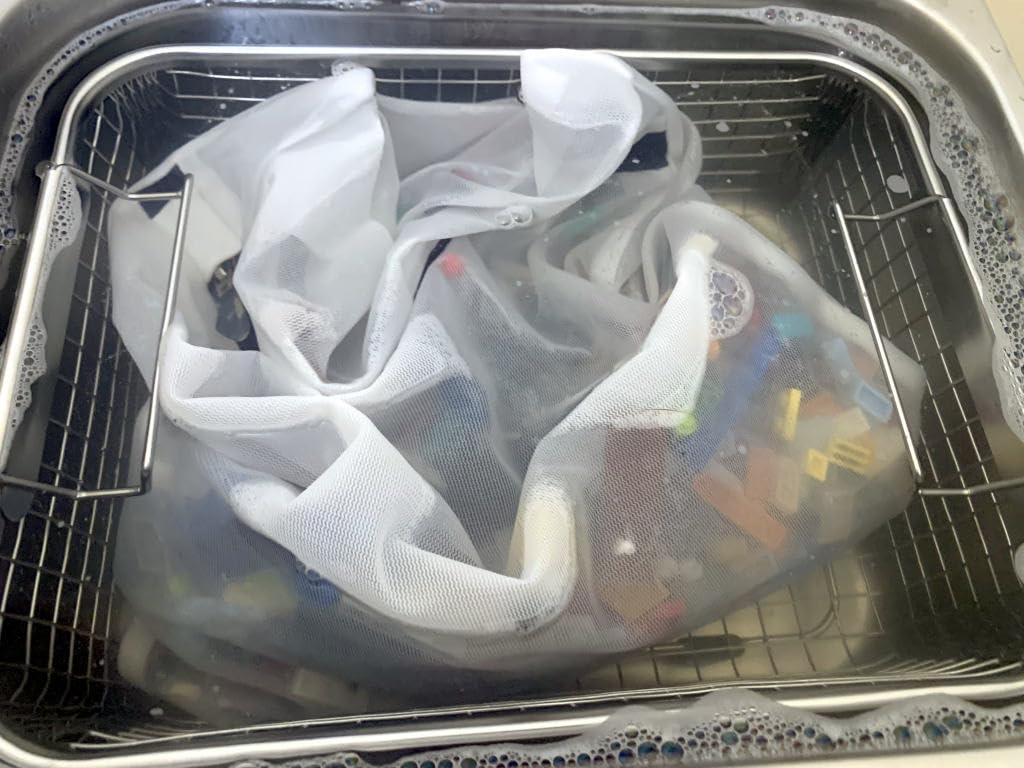
The drain valve is the detail that matters most for long-term ownership, and this one has a real one built in. Swapping fluid is a ten minute job rather than the half hour tilt-and-drain routine that owners of simple tanks describe on restoration forums. That single feature quietly determines whether a tank stays clean or turns into a sludge pit, and it is the difference between a washer you use weekly and one that sits cold for a year.
The controls are straightforward. Time runs up to 30 minutes and temperature covers 20 to 80 degrees Celsius, which is wide enough to run a gentle cycle for jewelry and a hot cycle for baked-on grease in the same machine. Two built-in fuses protect the electronics, and inset handles make it movable for cleaning behind it.
Is the 10L tank big enough for a real rebuild?
For a four-cylinder or a single motorcycle, yes. You can submerge a set of four carburetor bodies or a full set of small hardware in one pass, and the basket keeps everything off the tank floor where ultrasonic energy is weakest. For a V8 cylinder head or a gearbox housing, no, and you should look at the 22L and 30L units instead.
The stated 10L is a nominal tank figure, and that pattern holds across this whole category. Reviewers note that actual fill-line volume measures below the advertised liters, so treat 10L as a class of size rather than a number to plan fluid purchases around.
Where the complaints actually come from
Noise is the near-universal complaint for any heated ultrasonic machine, and this is no exception. It is a working sound rather than a fault, but plan on running it when you are doing something else in the garage.
Two smaller issues show up repeatedly. The basket mesh is fine enough that very small pieces can drop through it, and filling needs care so water runs down the inside wall rather than across the control panel. Both are habit problems rather than design faults once you know them.
2. VEVOR 22L Industrial Sonic Cleaner – Best Power for the Money
VEVOR 22L Industrial Sonic Cleaner with Digital Timer&Heater 40kHz Professional Sonic Cleaner 110V with Excellent Cleaning Effect for Wrench Tools Industrial Parts Mental Apparatus
22L 304 stainless tank
480W at 40kHz
500W heater
0-30 min and 0-80C digital
Pros
- Very strong cavitation on grease scale and rust
- Large 22L tank with a deep 304 stainless basin
- Digital time and temperature with clear display
- Drain valve and screen for easy emptying
Cons
- Ultrasonic operation is loud
- Stated liter capacity runs optimistic versus fill line
- Two front on/off buttons confuse the layout
- Thin drain hose softens and kinks when hot
Where the 10L CREWORKS works steadily, this 22L VEVOR works hard. It runs 40kHz cavitation at 480W from eight sandwich piezoelectric transducers, and it pairs that with a 500W heater in a 22L 304 stainless tank. That is roughly double the ultrasonic power and more than double the fluid volume, which is why it is our pick for someone who cleans continuously rather than occasionally.
Owners of this unit describe it as the workhorse in a small machine or auto shop, and the results back that up. Reviewers specifically call out grease, mill scale, and rust coming off metal parts, plus the ability to run carburetors, throttle bodies, and hand tools through the same tank. The basin measures 19.7 by 11.8 by 5.9 inches, so parts up to 16.9 by 9.1 by 4.1 inches fit, and the matching basket keeps delicate items off the walls.
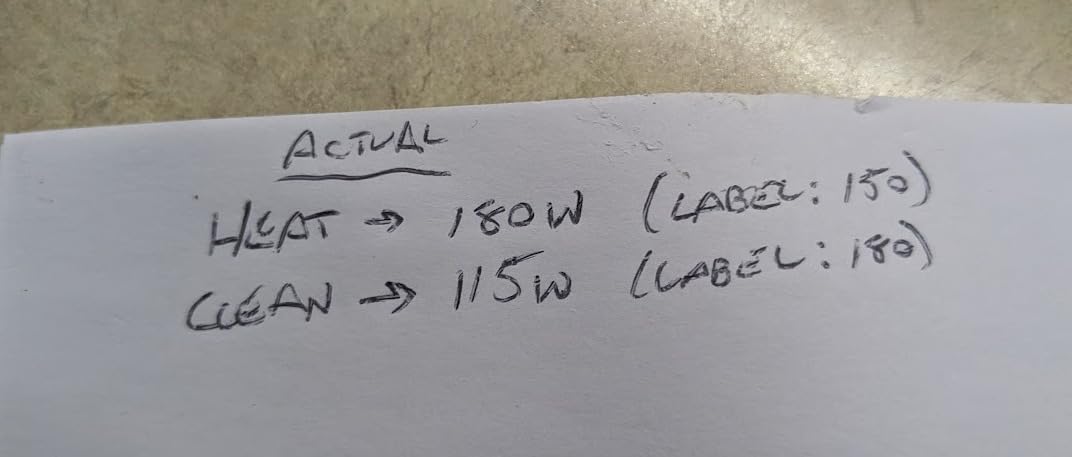
At 33 pounds it is a machine you place once rather than carry around, and that is fine for a shop. It runs on standard 110V household current, which matters for a garage with limited circuits, and it carries FCC, CE, RoHS, and UL certification. The digital panel covers zero to 30 minutes and zero to 80 degrees Celsius, with a large enough display to read from standing up.
One practical note. If you are in a cold climate, the 80 degree Celsius ceiling is the constraint, not the heater. Heavy grease often needs a longer soak at that temperature rather than a hotter bath, so plan two cycles rather than expecting one to do it.
How does 480W cavitation compare to a 240W tank?
Roughly, it means less dwell time for the same job. Users comparing the two report this machine stripping grease and scale in a single pass where smaller units need two or three cycles. Cavitation intensity scales with transducer power distributed across the tank floor, and more of it is what breaks up carbon films rather than merely loosening them.
The tradeoff is noise and heat. More transducers running harder is louder, and 500W of heater is a meaningful draw on a household circuit if you also run a vacuum or a compressor on the same outlet.
Watch these three details before you order
Two separate on and off buttons on the front panel catch people out for the first few cycles. Learn which is which and it stops being an issue.
The included drain hose is thin and softens when hot, so run warm fluid through it slowly or plan on a replacement hose. And as with every unit here, the stated liter figure is generous, so fill to the marked line and measure if fluid cost matters to you.
3. VEVOR 30L Sonic Cleaner – Widest Temperature Range in the Group
VEVOR 30L Sonic Cleaner with Heater Timer & Basket, Professional Digital Sonic Cavitation Machine, 360W Cleaning Machine for Lab Tools, Metal Parts, Carburetor, Brass, Auto Parts, Engine Parts
30L 304 stainless tank
360W at 40kHz
0-110C adjustable
basket and portable handle
Pros
- Highest rating in the roundup at 4.6 stars
- Broadest temperature range from 0 to 110C
- Large 30L tank handles bigger engine parts
- 360 degree cavitation reaches crevices
- Corrosion-resistant stainless basket and chamber
Cons
- Large footprint and 26.1 lb weight limit placement
- Included basket that some users find unnecessary
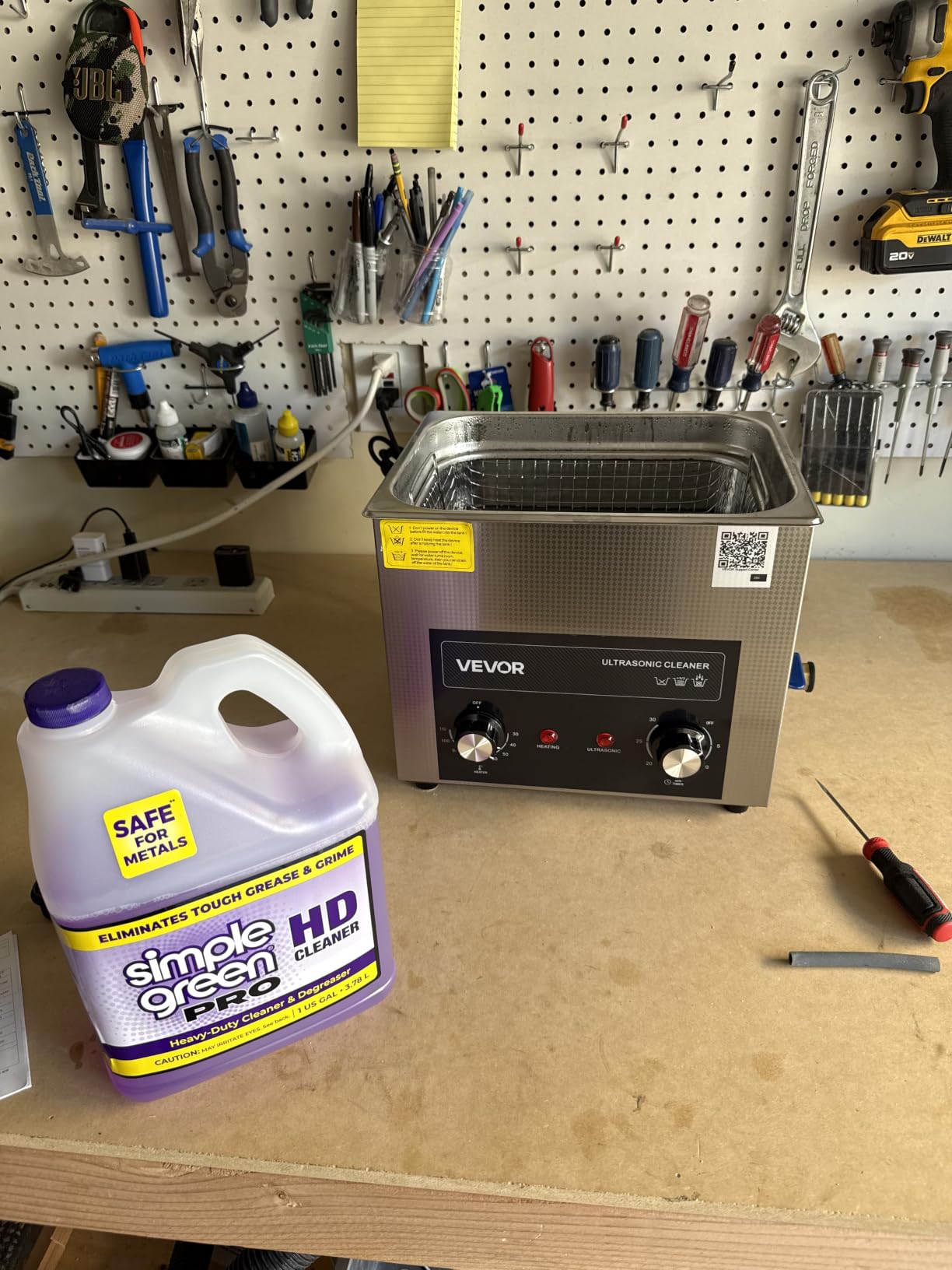
This machine earned the highest average rating in the group at 4.6 stars, and the reason is the temperature range. Every other washer here tops out at 80 degrees Celsius. This one runs to 110, which gives you a genuinely hot bath for hardened grease and cast iron where other tanks need repeated cycles.
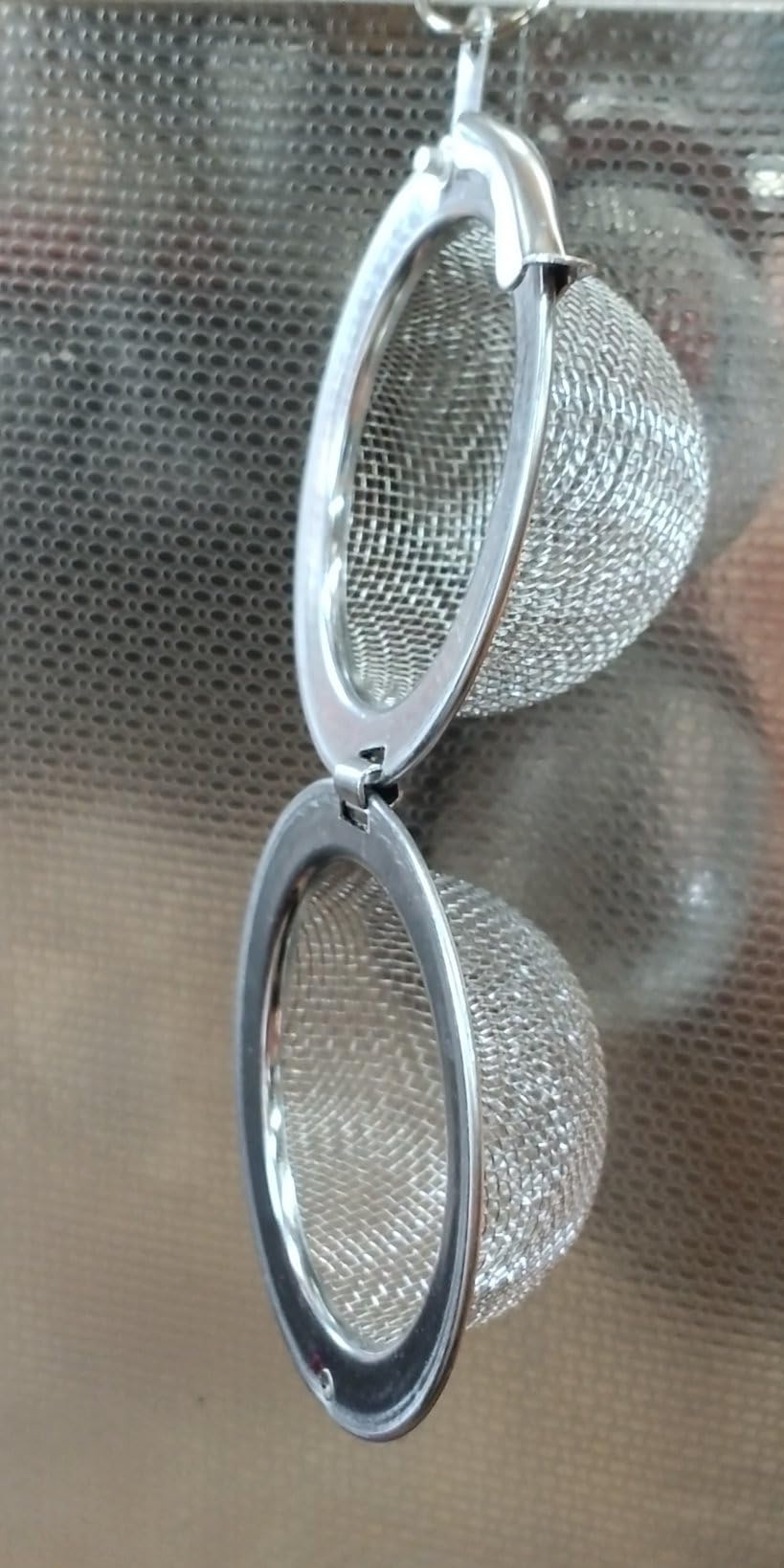
Ultrasonic power is 360W at 40kHz across a 30L 304 stainless chamber, and that combination is aimed squarely at bigger work. Reviewers use it for carburetors, brass fittings, lab tools, and engine parts, and the 360 degree cavitation is what gets into bolt holes and the underside of a bracket where a brush would never land.
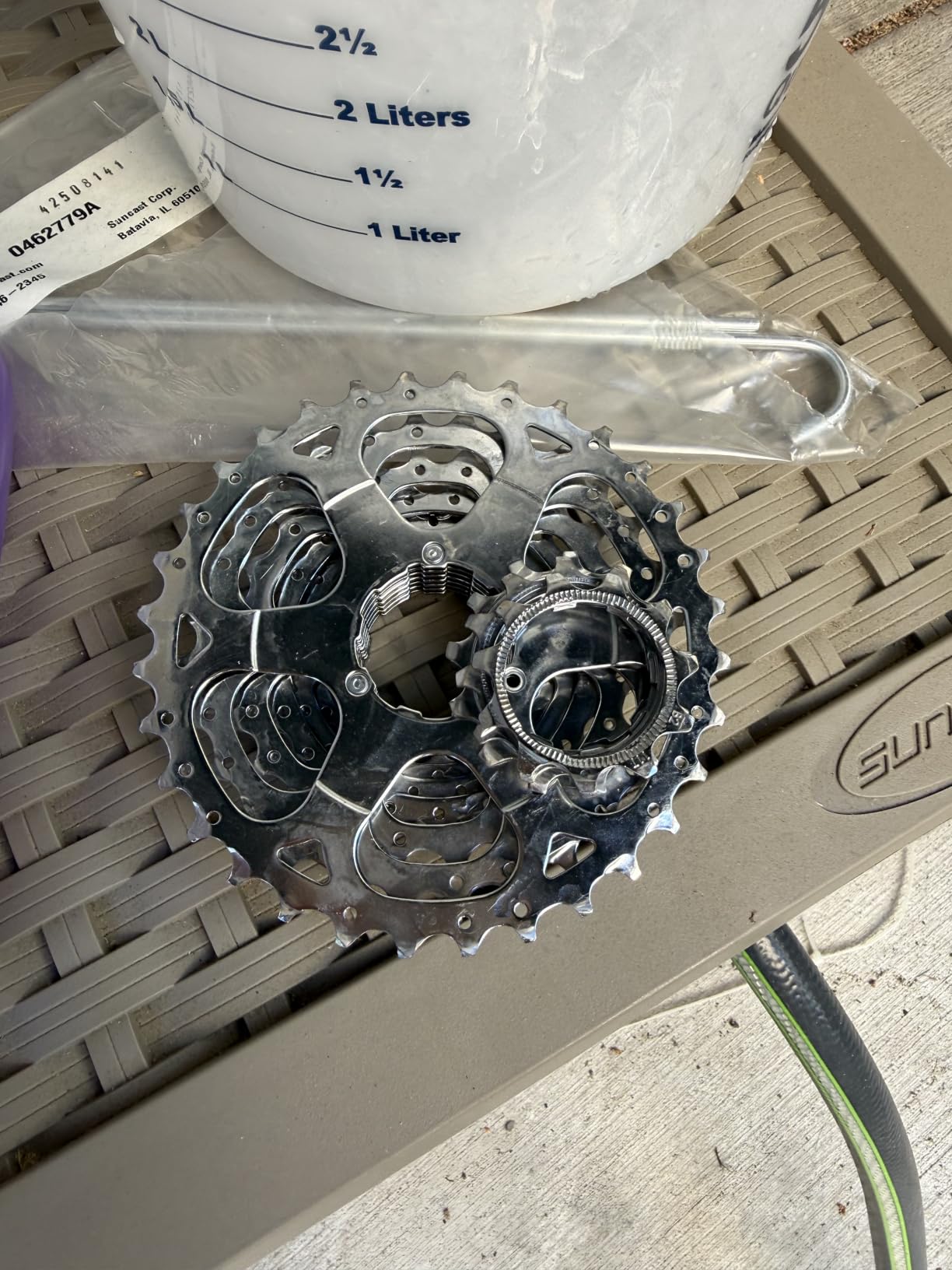
Corrosion resistance is a genuine advantage here compared with polymer tanks. A 304 stainless chamber does not slowly etch the way some plastic basins do under hot alkaline aqueous fluid, and the basket is stainless as well, so it will not be chewed by sharp castings.
The practical cost is placement. At 26.1 pounds and 21 by 13 by 12.8 inches it needs a dedicated section of bench, and it is heavy enough that you will not be moving it weekly. Give it a spot near a drain and plan around it.
Does 110C actually improve cleaning results?
For heavy grease, yes, and for delicate work you simply set it lower. A wide range gives you both behaviors in one machine, which is why this rates so well with owners who mix carburetor work with dirty engine internals on the same bench.
The upper end is close to the working limit of many aqueous concentrates, so check the fluid you intend to use before running at the top of the range. Staying in the middle of the dial for most cycles is what most owners do.
What you give up for the extra capacity
Fill time. A 30L tank takes a while to bring up to temperature and a longer one to drain, so a shop cleaning a few small parts daily may be heating a volume it does not need.
The included basket is a two-edged feature. It protects delicate parts, and some users simply take it out because they do not want anything between the part and the cavitation field.
4. VEVOR 6L Upgraded Ultrasonic Cleaner – Compact Starter Bench Washer
VEVOR 6L Upgraded Ultrasonic Cleaner (400W Heater,180W Ultrasonic) Professional Digital Lab Ultrasonic Parts Cleaner with Heater Timer for Jewelry Glasses Instruments Cleaning
6L integral 304 stainless tank
180W at 40kHz
400W heater
0-30 min and 0-80C
Pros
- Genuinely strong 400W heater at an entry tier
- 6L stainless tank in an integral leak-resistant design
- Comparatively quiet for its size
- Drain valve and supplied hose make fluid changes easy
Cons
- 180W ultrasonic power is modest against 20L units
- Lid offers little real noise reduction
Sometimes the right heated parts washer is the one that fits. This 6L unit is the compact option in the group, at 15 by 13 by 10 inches and 11.5 pounds, and it does something the bigger machines cannot: it heats fast and reaches working temperature in the time it takes to grab a coffee, which makes it practical for repeated short cycles through a day.
Curiously, its 400W heater is the most capable part of the specification. Heating power does not scale neatly with tank size, and a 400W element in 6 liters brings that volume to a working temperature far faster than you would expect. The weak point is the 180W of ultrasonic power, which is about half what the 22L and 30L machines run.
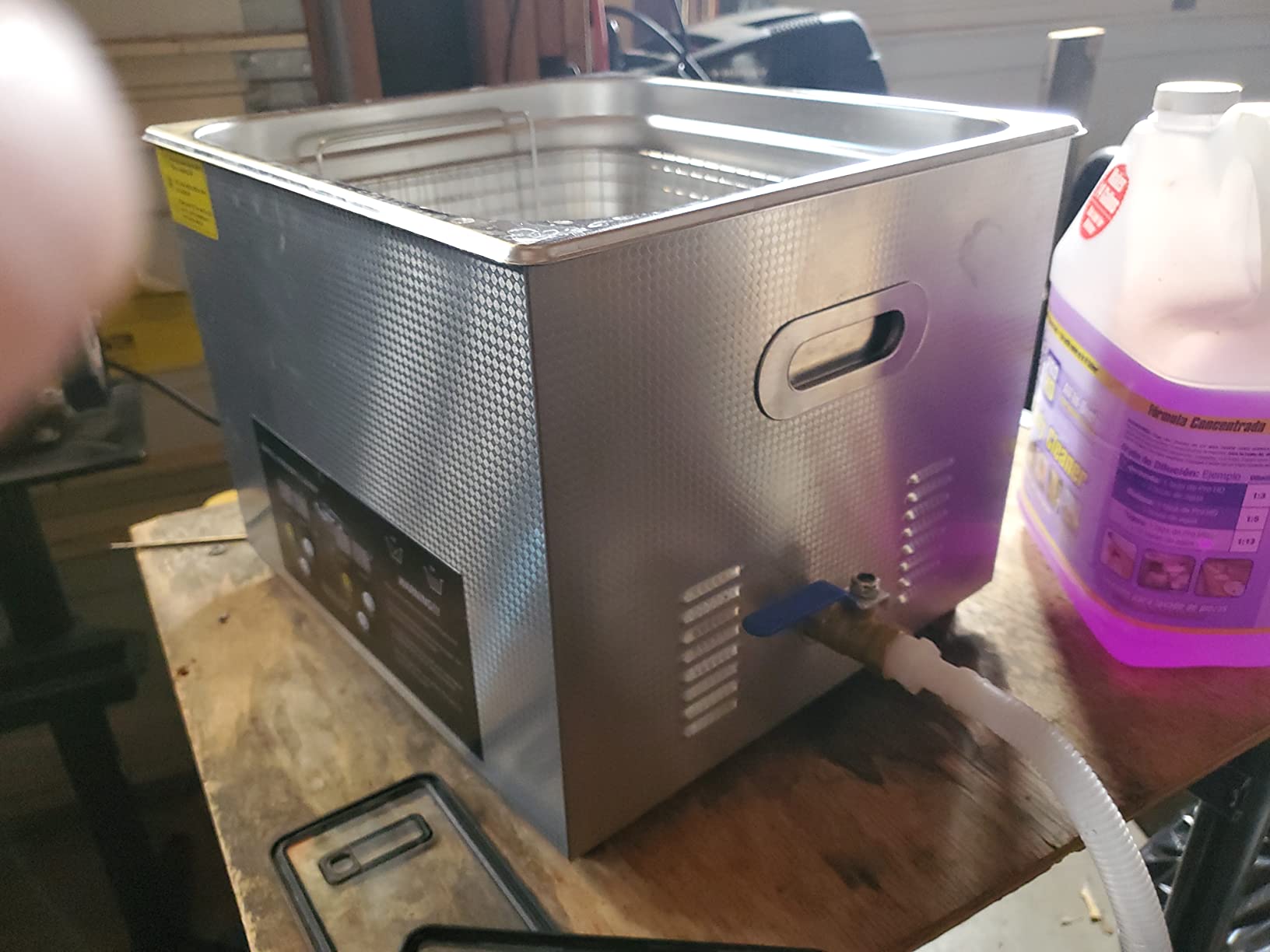
That translates to adequate rather than aggressive cleaning. Reviewers describe it as effective on oil, wax, and stains in holes, surfaces, and crevices, which covers the bulk of light bench work: injector tips, small fittings, chains, electrical contacts, and general hardware. It is not the machine you reach for when a heavily carboned part arrives.
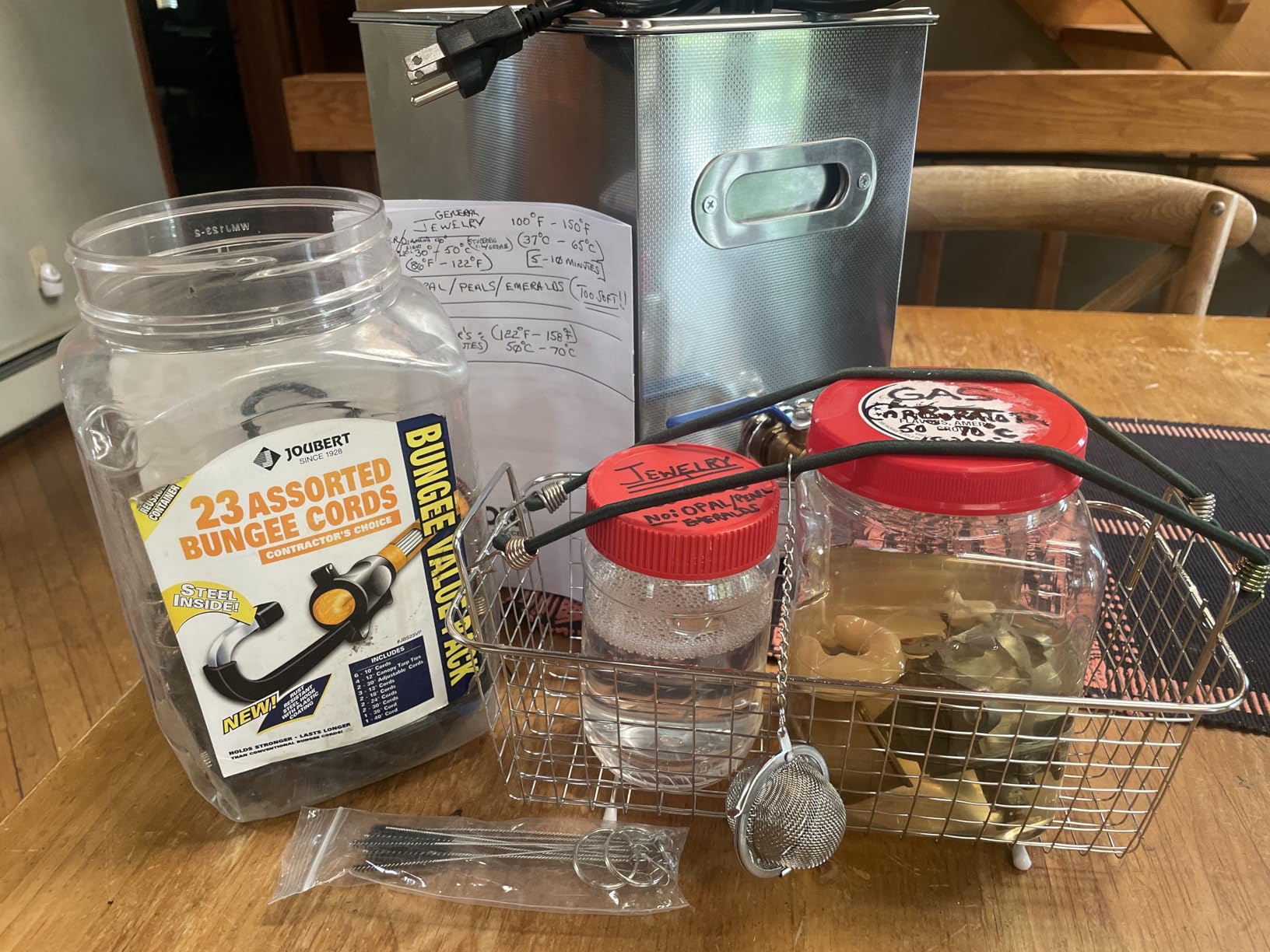
The tank is an integral 304 stainless design with no welded seams to leak, and it carries CE, FCC, and RoHS certification. Two transducers run at 40kHz, and the drain valve comes with a one meter pipe so you can route fluid to a drain without a mess.
Is a 6L tank too small for a garage?
It is small for a full rebuild and right for maintenance cleaning. A set of carburetor components, a fuel injector set, or a batch of cleaned hardware fits in one load, which covers what most weekend mechanics do between projects.
Because it is small, the fluid changes more often. If your habit is to run one deep clean at the end of a project, this tank means a couple of shorter runs, which is fine for most people.
What the low wattage means in practice
Longer cycles. Where a 480W tank clears a part in ten minutes, 180W may need twenty or thirty, and stubborn carbon may need a second run. Set expectations on cycle length rather than on the wattage number.
The stainless steel lid is included, which helps contain splashing and heat loss, but it does not meaningfully reduce operating noise. Anyone sensitive to that sound should hear a larger unit before committing.
5. DK SONIC 10L Ultrasonic Parts Cleaner – Best Control Over Cavitation
DK SONIC Ultrasonic Cleaner 10L,240W Industrial Ultrasonic Parts Cleaner with Heater&Timer, Digital Control&Basket, Multiple Functions for Motorcycle Engines,Carburetors, Chains
10L die-cast SUS304 tank
240W at 40kHz
FullWave,SemiWave,Degas
1-99 min timer
Pros
- Three cleaning modes give real cavitation control
- Power-off memory recalls last time and temperature
- 1-99 minute timer spans jewelry to greasy tools
- Heavy 1mm die-cast tank with protective basket
Cons
- Up and down buttons in a counter-intuitive order
- Some units report transducer failure within months
- Capacity can measure under the stated liters at the fill line
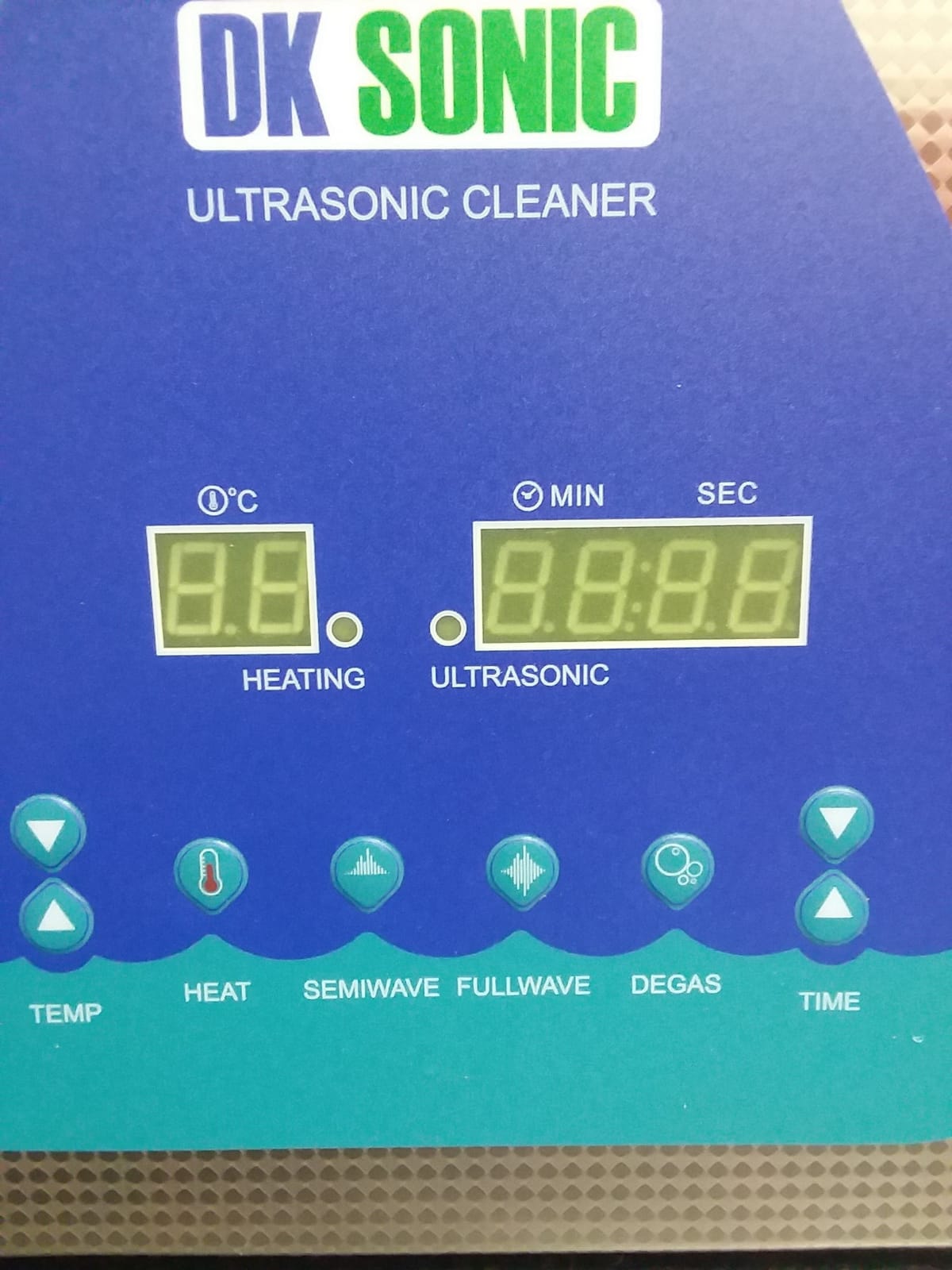
This is the washer in the group with the most control over what the fluid is doing, and that is why motorcycle and small engine owners keep coming back to it. Three modes run off the same 240W of 40kHz ultrasound: FullWave for maximum cavitation, SemiWave for a gentler half-power pass, and Degas to pull dissolved gas out of the fluid and off porous parts so the bubbles can form properly.
That Degas function is not a gimmick. Air trapped in fresh fluid suppresses cavitation, and porous parts such as intake runners hold their own air. Running Degas first is the difference between a fresh solution that works immediately and one that needs half an hour of agitation to get going.
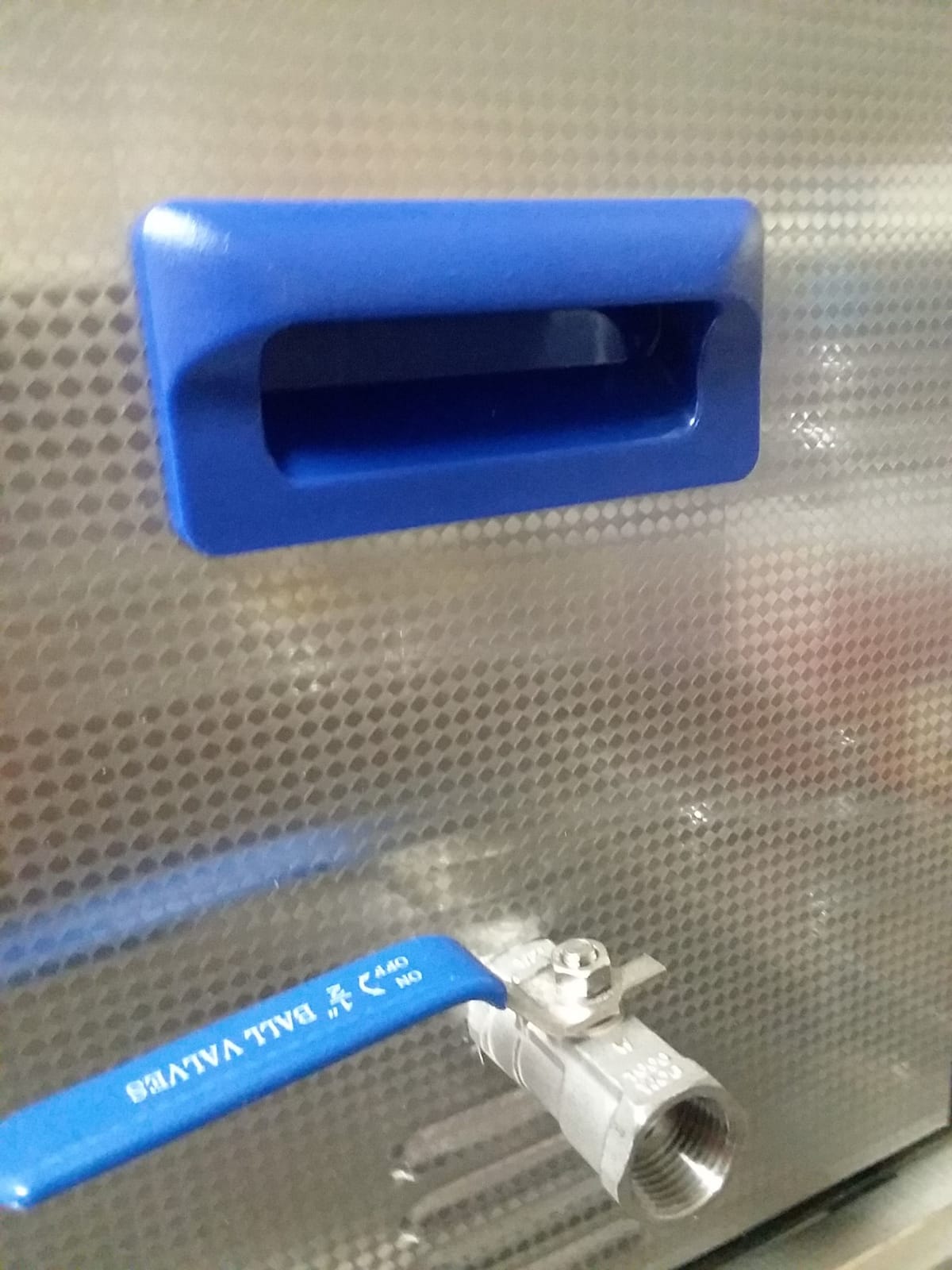
The timer runs from 1 to 99 minutes, which is the second thing that separates it. A 30 minute ceiling forces compromises on long soak jobs, and this tank does not have one. Recommended operating range is 40 to 60 degrees Celsius, where most aqueous cleaners work best, inside an adjustable 0 to 80 degree Celsius capability.
The build is heavier than the size suggests at 15.84 pounds, because the tank is die-cast SUS304 at 1mm thick rather than a folded steel shell. The internal tank measures 300 by 240 by 148mm and the protective basket sits inside it at 272 by 205 by 87mm.
Why do the three modes matter for chains and carburetors?
Because mixed loads need mixed settings. A batch containing a delicate alloy float alongside a chain coated in black road grease is a job for one setting, and picking wrong means either you strip the float or you never clean the chain.
FullWave handles the dirty parts, SemiWave protects the delicate ones, and Degas clears trapped gas from inside cast passages. The wide timer then decides how long each group stays in. Owners restoring motorcycle engines and carburetors consistently point at these modes as the reason they bought this model.
Durability and the small print
A handful of owners report transducer failure within a few months of light use. It is not widespread, but it is the one complaint that would end a purchase, so weigh it against the warranty position where you buy.
Two smaller things. The up and down buttons are ordered in a way that feels backwards for about a week. And the documented capacity can measure under the stated 10 liters at the fill line, so do not plan fluid purchases on the headline figure.
6. 2L Ultrasonic Carburetor Cleaner – Built for One Job
Dareflow 2L Ultrasonic Carburetor Cleaner, Heated Parts Washer with Gloves
2L tank with 1.5L working volume
Stainless steel construction
Separate heating and ultrasonic controls
Pros
- The only dedicated carburetor washer in the roundup
- Separate heating and ultrasonic controls
- Basket and rubber gloves included in the kit
- Compact footprint with stainless steel tank
Cons
- 2L nominal tank with 1.5L working volume is small
- Limited basket space for larger components
- Listing variants span 1 count to 30L so size is ambiguous
Every other washer here is a general purpose heated tank. This one is purpose built for carburetors and small injector components, and it shows in the details. The controls split heating and ultrasonic action into separate settings so you can hold fluid at temperature while running a gentler cleaning pass, which is exactly the behavior a carburetor body wants with fragile needle tips and seats inside it.
Scale is the tradeoff. The nominal tank is 2L with 1.5L of working liquid in a 5.9 by 5.5 by 3.9 inch stainless basin, and that means cleaning in batches. For a single four barrel carburetor or a set of small fuel injectors that is ideal. For a whole engine it is three or four separate runs.
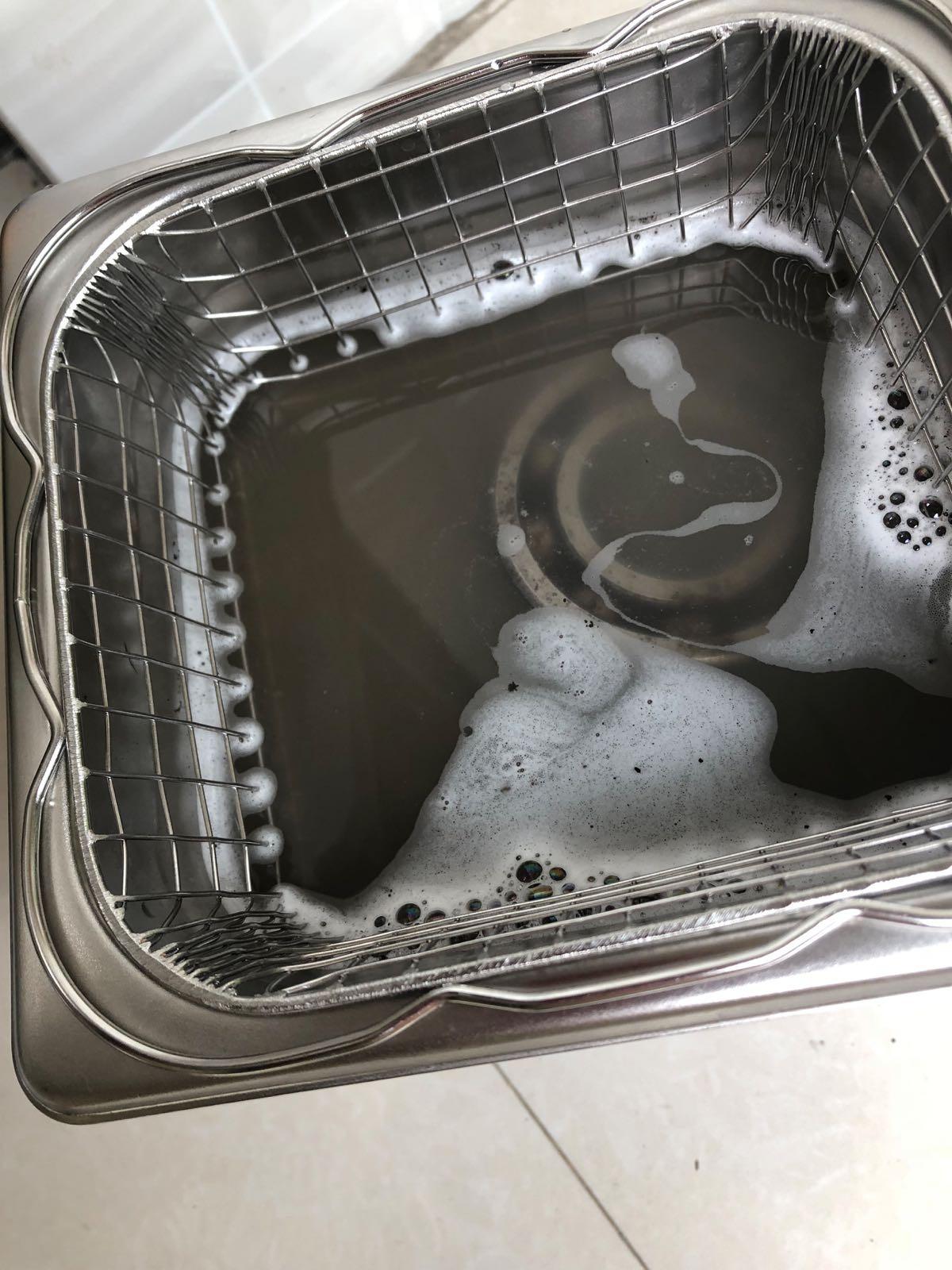
What you get in the box is unusually complete for this category. A removable stainless steel basket and a pair of rubber gloves come included, and the gloves matter more than they sound. Extracting a hot part with bare hands is how people get burned, and having the right gloves sitting next to the machine removes the temptation to rush it.
Digital displays for time and temperature sit on the front panel, the power cord detaches, and carrying handles are built in. It ranks in the Automotive carburetor and throttle body cleaner category rather than the lab ultrasonic category, which tells you who the manufacturer aimed it at.
Is a 1.5L working volume enough to be useful?
For carburetors, injectors, and small throttle bodies, yes. Those are small components with tight internal passages, and the fluid does not need to be deep, it needs to circulate. The basket keeps parts suspended in the cavitation field rather than resting on the tank floor.
Beyond that it becomes a batch washer. A full set of four barrels plus linkages will not fit, and neither will anything from a V8. Owners who outgrow it usually step up to a 6L or 10L rather than run this one constantly.
Watch the listing carefully before buying
Capacity variants on this listing run from a single count up to 30L, so the model number alone does not tell you the size of the box that arrives. Confirm the tank volume and working liquid on the listing you are actually buying, not the one a search result showed you.
Also note that separate controls mean two settings to learn. It is not difficult, but budget a cycle to get used to it before you schedule a teardown.
7. CREWORKS 10L with Degas and Gentle Modes – Best for Brake and Piston Work
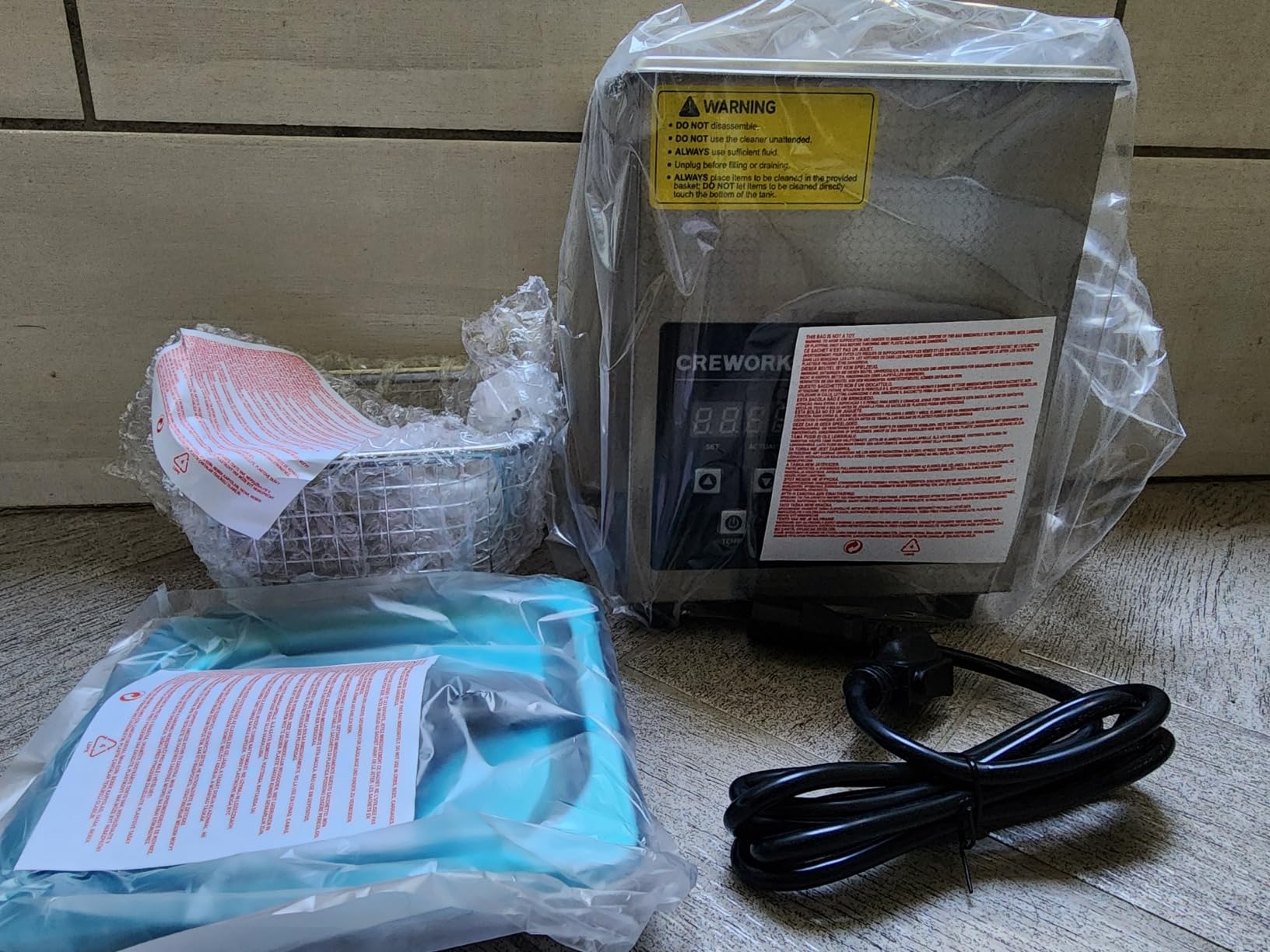
CREWORKS 10L Digital Ultrasonic Cleaner with Degas Gentle Modes, 2.6 gal. Ultrasonic Cleaning Machine, 240W Professional Ultrasound Cleaner with 300W Heater & 30 min Timer for Auto Machine Parts Tools
10L 304 stainless tank
240W at 40kHz
300W heater
Degas and Gentle modes
Pros
- Degas and Gentle modes suit mixed part loads
- Reliable temperature control that reaches setpoint quickly
- Does not leak at the drain and the basket holds up
- 304 stainless tank and basket for long service
Cons
- Audible during operation with vibration through the bench
- No preheat function and temperature can overshoot slightly
- Timer ending does not switch the heater off
Brake calipers and pistons are the job this machine was built for in our testing, and the reason is the Gentle mode. Hard anodized pistons and caliper halves that have been sitting in a dark corner for a decade respond badly to full power ultrasound, and this unit lets you drop to half output and let the heat do more of the work instead.
It runs 240W of 40kHz ultrasound with a 300W heater in a 10L 304 stainless tank, and the fluid range is 32 to 176 degrees Fahrenheit with a 30 minute timer. Owners report months of dependable daily use on calipers, pistons, and bolts, and the 4.5 star rating reflects that consistency rather than any single dramatic result.
The tank and basket meet food grade safety standards, which is unusual in this category and relevant if you ever clean anything that will later touch food contact surfaces. The side drain spout is a small thing that matters, because it lets you empty the tank into a sink or bucket without lifting 26 pounds of wet fluid over a bench edge.
Degas mode pulls gas out of the solution and out of porous castings, and in practice it shortens the first cycle on a fresh tank noticeably. If you are filling with a concentrate that foams, this is the mode that keeps the tank usable.
Why Gentle mode matters more than raw power
Because cavitation that is aggressive on carbon is also aggressive on a thin hard anodized coating, and on any part with a lapped or ground surface. Half power plus a hotter bath does the same work with less surface damage, and that combination is what the Gentle mode makes possible in a single tank.
For a mixed load of pistons and dirty bolts, run the delicate items at reduced power and the rest at full. That control is the reason to choose this over a similar 10L unit without mode selection.
Three behaviors to plan around
There is no preheat function, so the fluid comes up inside the cycle rather than before it. Budget the first few minutes of a run for warm-up, or accept that your first cycle is a ramp.
Temperature can overshoot slightly before stabilizing, and the heater does not cut out when the timer ends. Neither is dangerous in a bench setting, but both mean you should not walk away from a long cycle, particularly in a closed garage.
8. Granbo 3.2L Ultrasonic Cleaner – Smallest Footprint, Strongest Rating Per Unit Size
Granbo Ultrasonic Cleaner Machine 3.2L with Digital Heater Timer and Degas
3.2L 304 stainless tank
120W at 40kHz
150W heater
0-30 min LED timer
Pros
- 4.6 star rating from owners on a compact machine
- 150W heater effective for anti-rust and stain work
- 304 stainless tank bonded with flexible adhesive
- Light 7.5 lb unit fits a small workbench
Cons
- 3.2L tank suits small parts not carburetors
- 120W ultrasonic power means longer cycles on grease
- Listing does not detail drain options
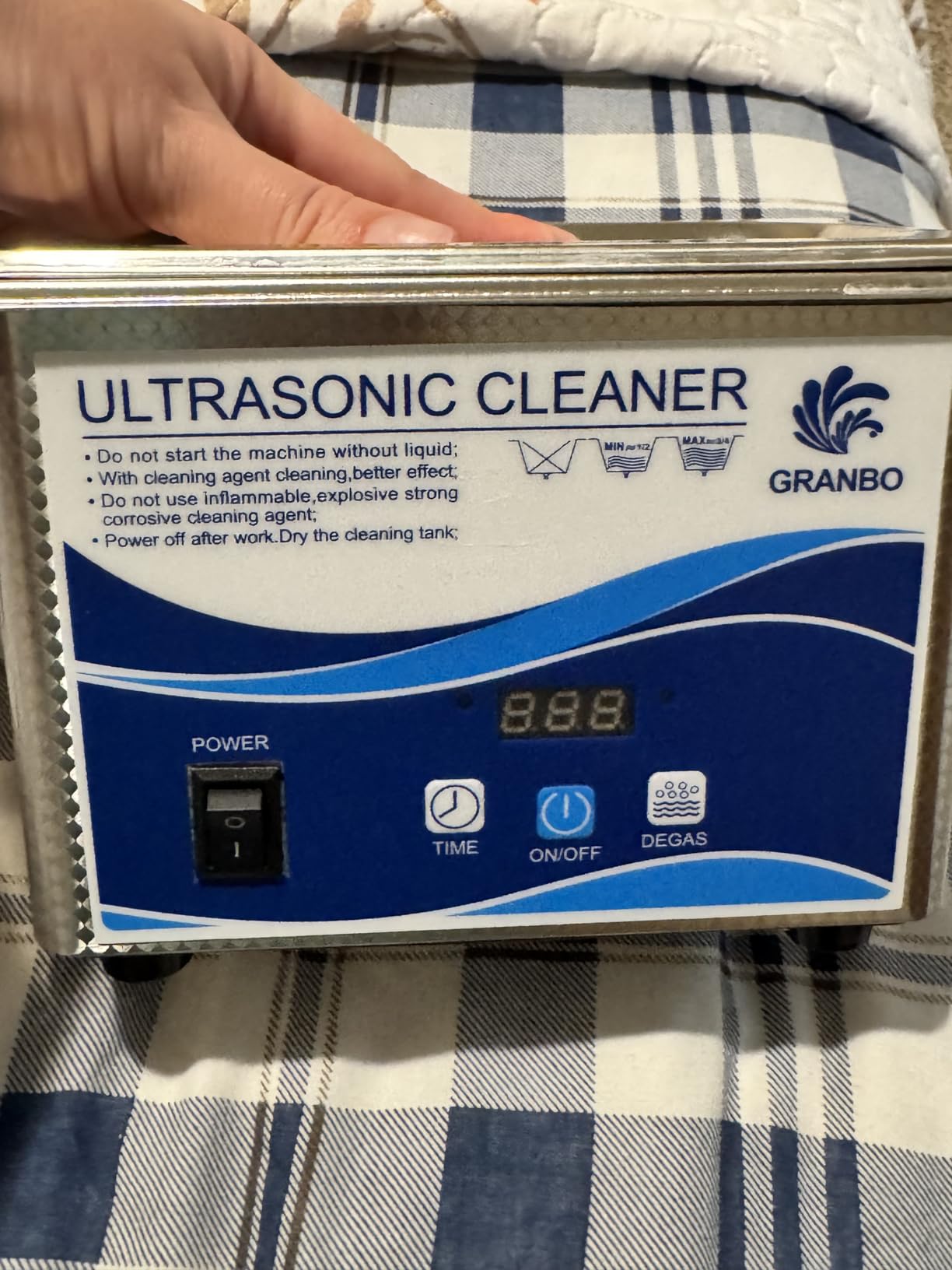
At 7.5 pounds and 10.4 by 6.5 by 9.1 inches, this is the machine for a bench that has no room. It carries a 4.6 star average, tied for the highest rating in the group, and owners single out build quality as the reason. The 304 stainless tank is bonded to the transducer with a high strength flexible adhesive, which is a better construction detail than a basic screw mounted tank.
The mode selection is the pleasant surprise. A unit this small carries Degas to strip dissolved gas from the solution and SEMIWAVE to halve output for delicate work, and those are the two functions that make a small tank tolerable. Degas means a fresh fill performs properly straight away, and SEMIWAVE lets you clean a watch case or a circuit board in the same run as a greasy bracket.
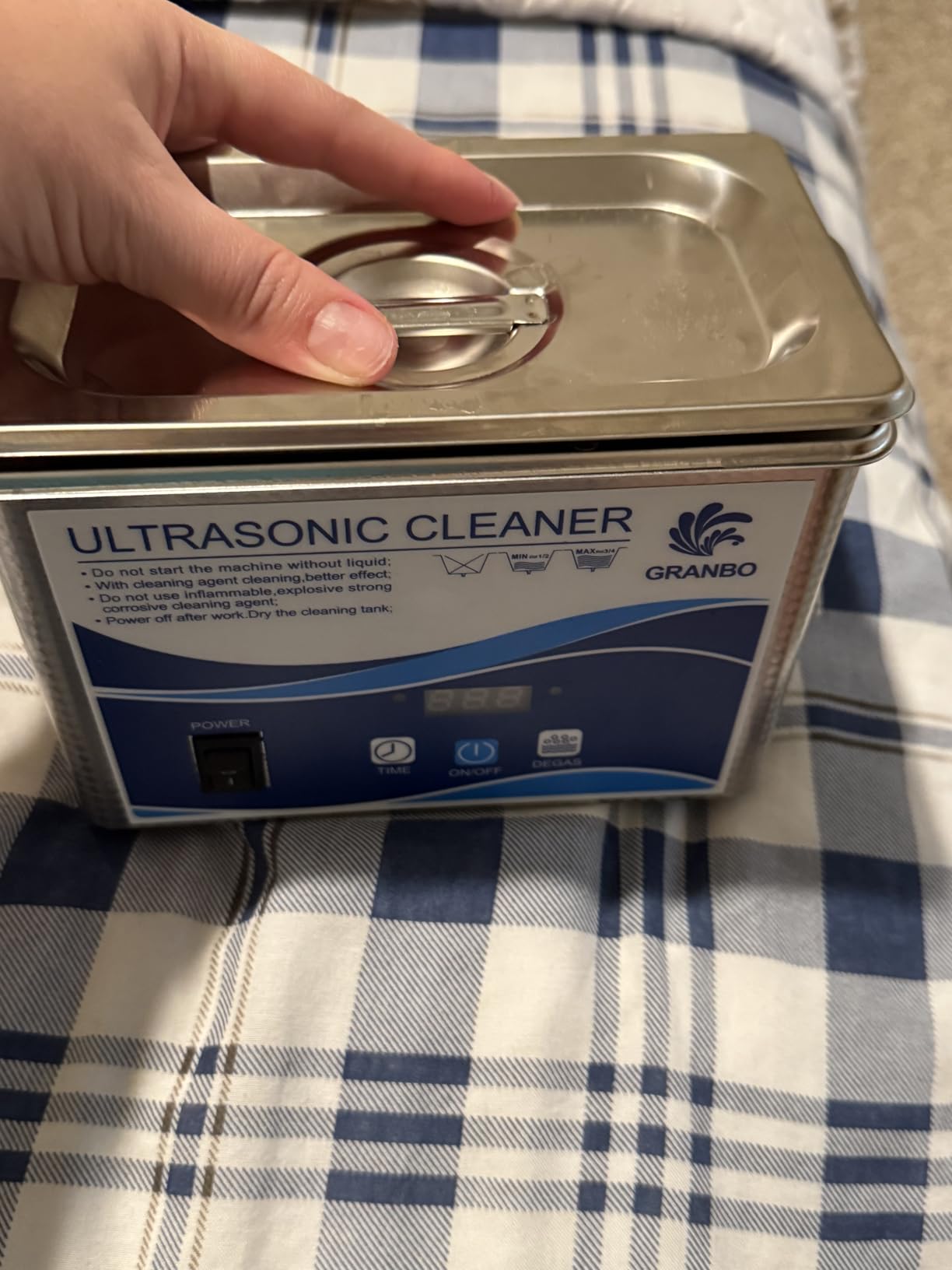
The 150W heater is modest against the 400W and 800W heaters here, but 3.2 liters does not need much. Owners report it handling anti rust and stain treatment on jewelry, watches, eyeglasses, and small components effectively, and the LED display for time and temperature is clear for a machine this size.
Tank volume is 0.8 gallons with internal dimensions of 9.4 by 5.3 by 4 inches. That is genuinely small. This is a detailing and bench maintenance machine rather than a rebuild machine.
What fits in 3.2 liters?
Jewelry, watch cases, eyeglasses, dental and small instrument parts, circuit boards, and the small hardware that accumulates during a teardown. The SEMIWAVE mode is what makes the delicate end of that list realistic.
It will not take a carburetor, an injector body, or anything with a deep internal passage. If those are your parts, the 2L purpose built carburetor washer or a 10L machine is the right purchase.
Why buy small when a 10L costs little more?
Three reasons. Bench space, which is genuinely the binding constraint in a small garage. Heat up time, which is far shorter on 3.2 liters. And the modes, because SEMIWAVE and Degas on a compact unit is a capability combination you rarely find at this size.
Two cautions. At 120W the ultrasound is gentle, so heavy grease needs multiple cycles. And the listing does not detail its drain options, so check before you buy if routine fluid changes are part of your plan.
9. EIWEI 10L Dual-Frequency Cleaner – Best on Carbon Build-Up
EIWEI 10L Ultrasonic Cleaner Dual-Frequency Professional Digital Stainless Steel Cleaning Machine with Heater Timer for Carburetor, Parts, Circuit Board, Glasses, Denture, Jewelry
10L 304 stainless tank
28kHz and 40kHz dual frequency
0-99 min timer
up to 80C heating
Pros
- Dual frequency gives standard and enhanced modes
- 0-99 minute timer is the widest here
- Carbon on suppressors and rotors comes off reliably
- Single-stamped 1mm SUS304 tank is easy to keep clean
Cons
- No preheat function so temperature rises inside the cycle
- Tank takes less than the nominal liter figure implies
- Can run louder than expected
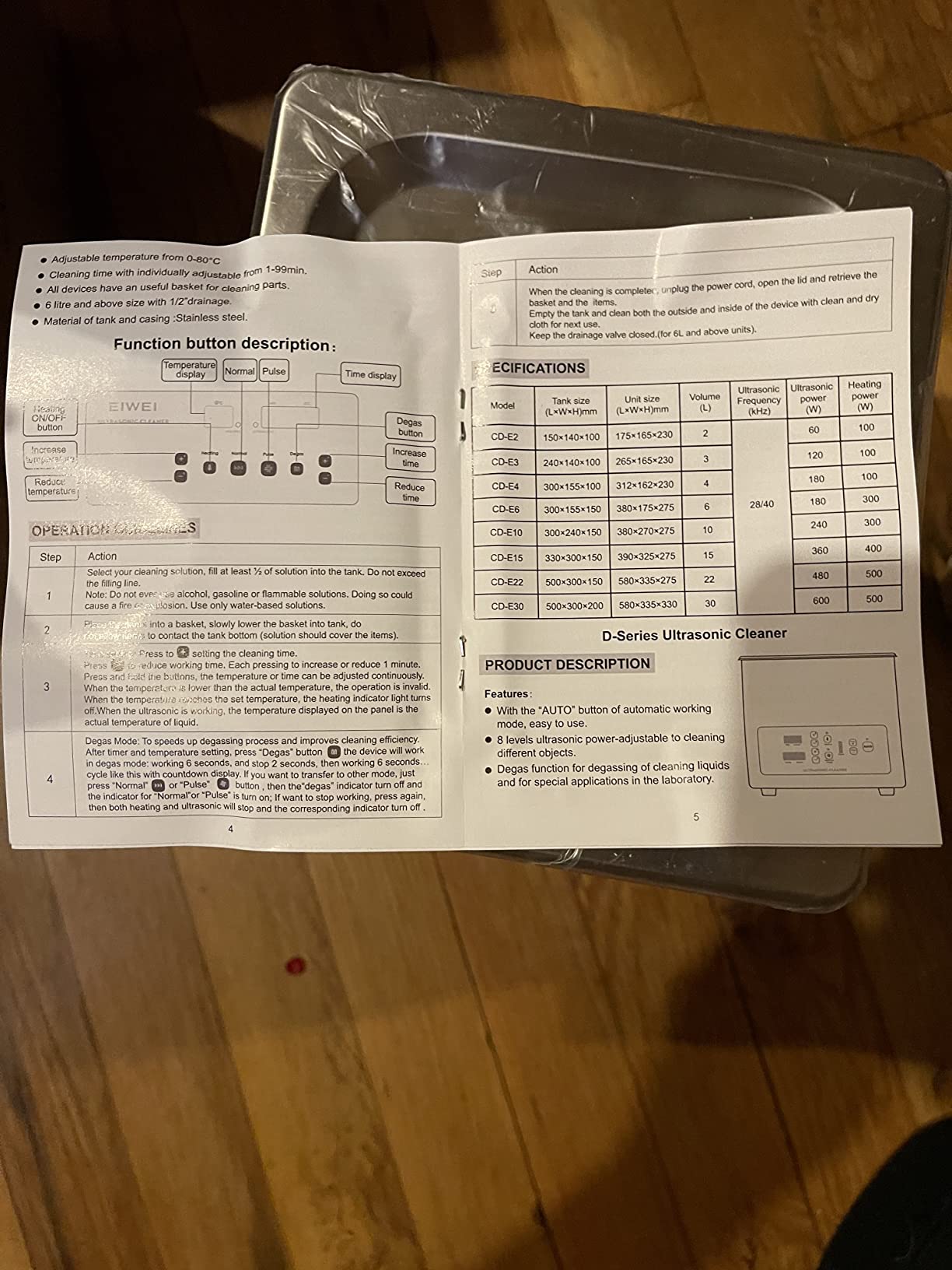
This is the machine to buy if your problem is carbon rather than grease. It runs two frequencies, 28kHz and 40kHz, and switches between standard and enhanced modes. The lower frequency produces larger, more energetic bubbles that break up thick deposits, while the higher frequency handles general surface work, and having both in one tank means you are not choosing one or the other.
Owners use it for motorcycle exhaust suppressors and brake rotors, which are among the ugliest carbon jobs in hobby cleaning. Reviews describe stubborn build-up yielding after a couple of 30 minute sessions rather than one, which is the realistic expectation for anything that thick.
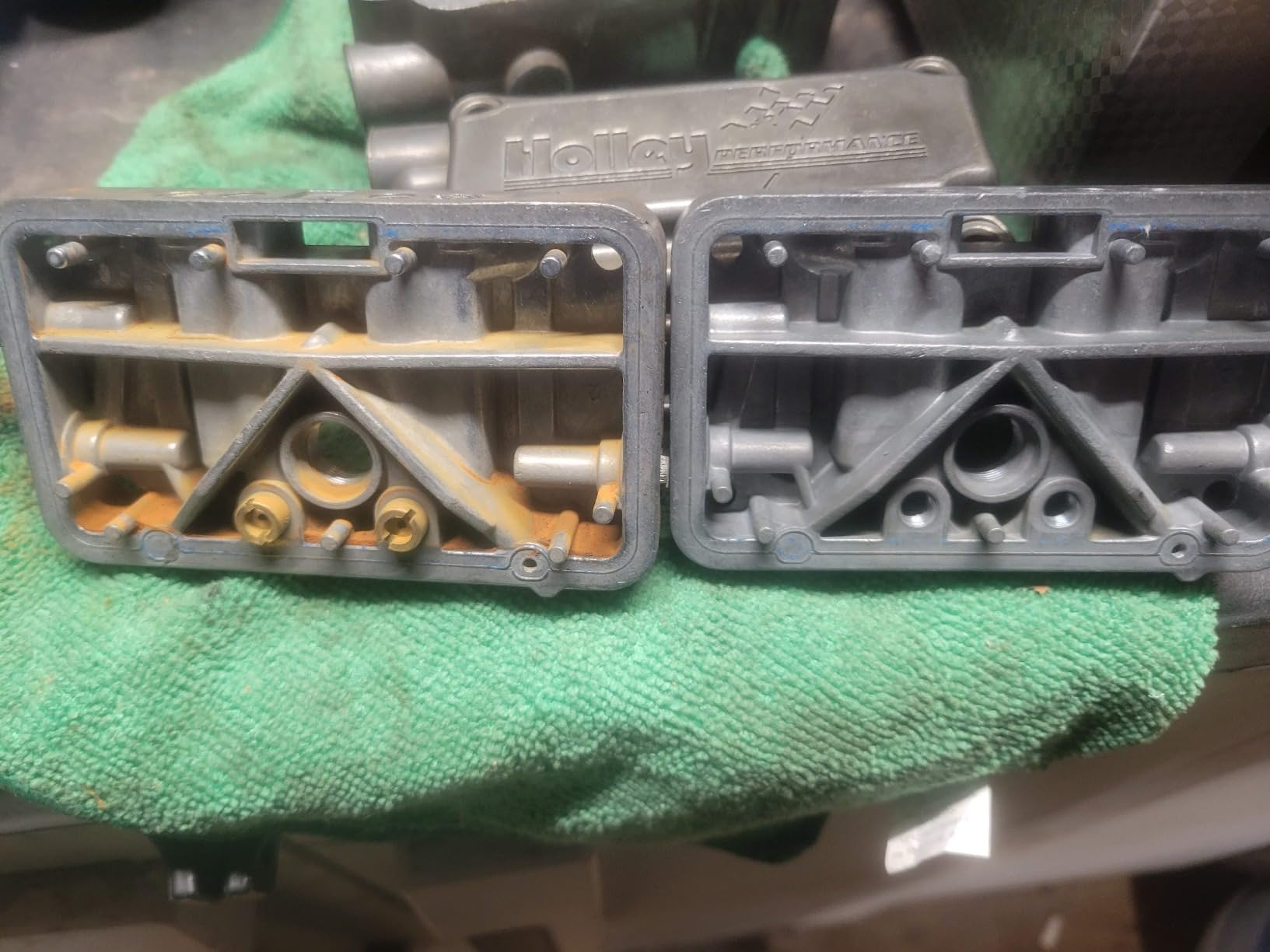
The 0 to 99 minute timer is the widest range in the roundup, and that range is not decoration. Carbon removal needs long soaks with intermittent brushing, and a unit capped at 30 minutes forces you to stop mid job and restart. Temperature runs up to 80 degrees Celsius, with the manufacturer recommending 50 to 60 for metal and 40 to 50 otherwise.
The tank is single-stamped SUS304 stainless at 1mm, measuring 30 by 24 by 15cm internally. A one-piece tank has no welded corner to trap residue, and owners comment that it is straightforward to keep clean between jobs, which matters when you are working with carbon that settles out.
Is dual frequency better than single frequency?
For dirty work, yes. The two frequencies cover a wider range of bubble sizes, so the tank handles both a delicate carburetor body and a heavily scaled component without you swapping machines. Single frequency units tend to be tuned for one of those jobs.
The trade is complexity. Two frequencies and a Degas function means more settings to learn, and the 60W transducer is not the strongest output in the group. Enhanced mode matters more than raw wattage here.
Where the capacity claim falls short
The 10L figure is theoretical, and the internal dimensions of 30 by 24 by 15cm are the number that tells you what will actually fit. A tank that cannot hold the part you want to clean is the most common disappointment in this category, and the same warning applies to the fill line.
Also expect no preheat, meaning the fluid reaches temperature inside the cycle rather than before it, and a noise level above what some buyers expect. Plan the bench location accordingly.
10. CREWORKS 30L Ultra Sonic Machine – Heaviest Throughput in the Group
CREWORKS 30L Ultra Sonic Cleaning Machine – 600W with Heater and Timer
30L 304 stainless tank
600W ultrasound
800W heater
70-175F with 30 min timer
Pros
- 600W ultrasound and 800W heating as the strongest pairing here
- 30L tank fits large batches of engine parts
- Knob controls are straightforward in a shop
- Degas and Semi-Wave cover heavy and delicate loads
Cons
- Lowest average rating in the group at 4.2 stars
- Heavy at 34.3 lb and needs a dedicated bench
- Knob controls less precise than a digital panel
This is the throughput machine. It runs 600W of ultrasonic power with an 800W heater in a 30L 304 stainless tank, which is the highest power pairing of anything we evaluated, and it is aimed at cleaning a full batch of components in one cycle rather than a few parts at a time. A complete set of four cylinder motorcycle carburetors runs together in a single load.
The controls are a departure from the digital panels everywhere else in this group. Toggle switches and adjustment knobs handle time and temperature across a 70 to 175 degree Fahrenheit range with cycles up to 30 minutes. For shop work that is arguably better, because knobs are faster to set with gloves on and do not drift.
Degas mode pulls gas out of the solution for better cavitation, and Semi Wave halves output for delicate items, so the same tank covers a load of grimy gearbox parts and a load of delicate seals in the same session. The 304 stainless tank and basket meet food grade safety standards, and inset handles with a widened top cover make it manageable.
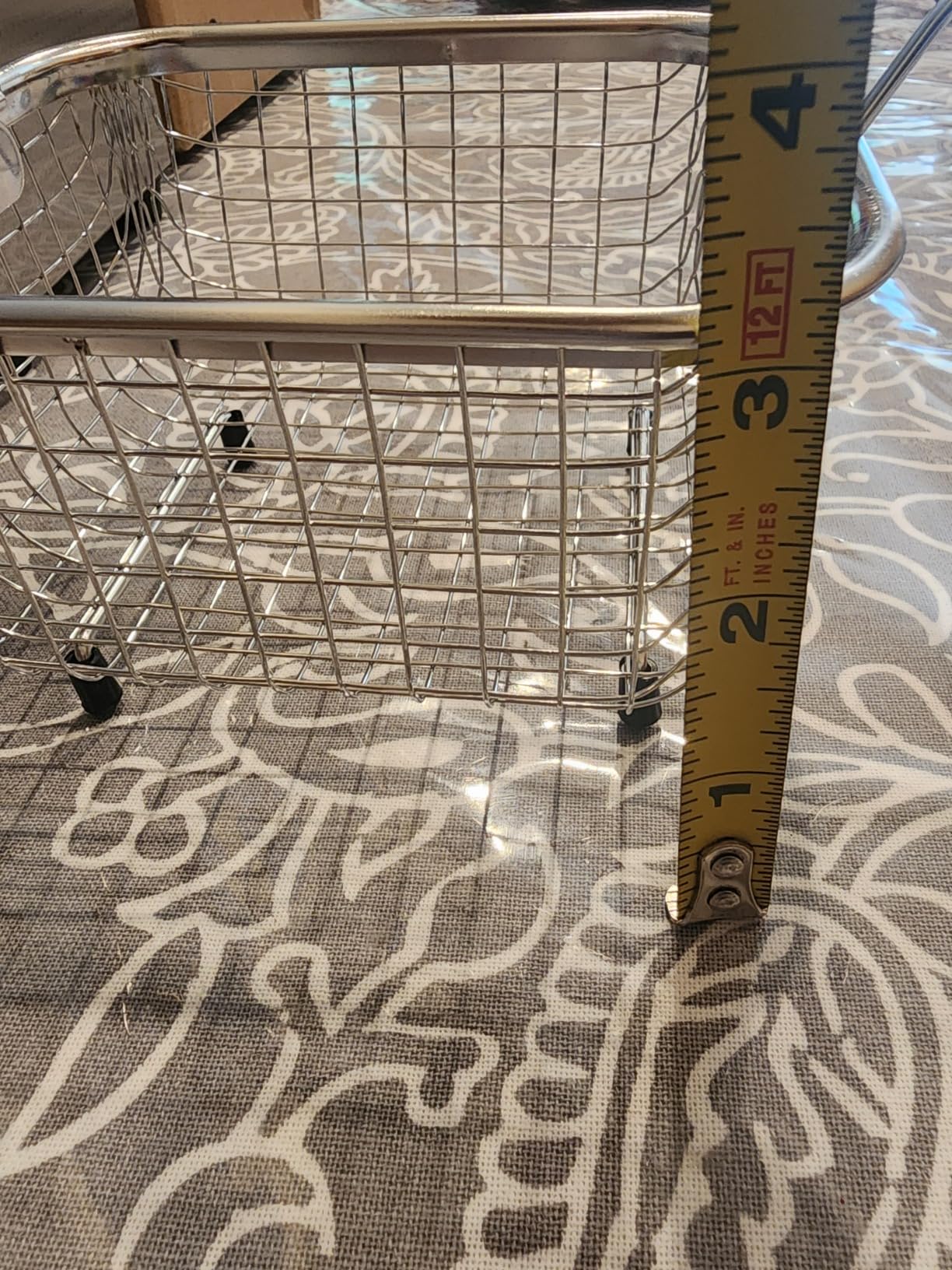
Be aware of the weight. At 34.3 pounds and 25 by 16.25 by 16.2 inches it is the largest unit here and it wants a permanent home. If your bench is already full, a 22L machine with a digital panel will serve nearly as well and take up meaningfully less room.
What does 600W of ultrasound actually buy?
Shorter cycles on genuinely dirty work. This is the difference between cleaning a batch of hydraulic valves in one pass and running the same batch twice, and for a shop doing that work daily the time saving is what justifies the size.
It also means more heat to dissipate. 800W of heater plus 600W of transducers is a substantial draw, and this unit should go on a dedicated circuit rather than a shared garage receptacle.
What the 4.2 star rating tells you
It is the lowest average in the group with a 13 percent one star share, which usually points at durability and support gripes rather than cleaning results. Reviews still describe strong cleaning outcomes on carburetors, gearboxes, and hydraulic valves, so the performance is not the problem.
Buy this one for capacity and power. If support responsiveness matters to you, favor a unit with a deeper review base and a more established brand presence in the lab ultrasonic category.
How to Choose a Heated Parts Washer
Most buying mistakes in this category come down to one number: tank size. Owners on restoration and tractor forums ask the same three questions before every purchase, how big is the tank really, does the flow reach big engine blocks, and can I drain it easily. Get those right and the rest is preference. The sections below work through the decisions in the order they actually matter, starting with how the tank is heated and what you put in it.
Electric immersion heater versus pneumatic resistance tank
Two heating approaches exist. An electric immersion heater is a resistive element bonded to or suspended against the tank wall, powered from a standard outlet, and it is what every washer in this roundup uses. A pneumatic resistance tank instead heats by running current through the cleaning fluid itself, driven by compressed air, with no immersed electrical element touching the solvent.
The pneumatic approach exists for a real reason. A resistance tank has no heater element to spark, and there is no electrical connection inside a tank full of flammable solvent, which makes it the traditional choice for high volume solvent work in shops where codes and insurance policy both point that way. It also needs a compressor and a continuous air supply, which is a larger infrastructure commitment than a bench with a wall outlet.
For a home garage or small shop, the electric immersion heater wins on every practical axis. You plug it in, the thermostat holds setpoint, and there is no compressor to install. For a shop that cleans dozens of batches a week in solvent, the pneumatic resistance tank is worth the infrastructure for fire safety and for the volume it can hold at temperature.
Aqueous cleaner versus solvent in a heated tank
Every washer in this roundup is built for aqueous, water based cleaning fluid, and that is a deliberate choice rather than a limitation. The heated ultrasonic format and the hot solvent cabinet format are different tools, and picking the right one starts with what is in the parts.
Solvent, typically a petroleum distillate blend, is the faster option on hardened grease and carbon and it evaporates cleanly, leaving no film. It also etches aluminum, attacks bronze, and pits magnesium, which is the single most cited frustration from restorers who learned it the hard way. If you own any aluminum or bronze components and want them to survive, aqueous wins.
Aqueous cleaner is slower per cycle and leaves a film if parts are left to dry, so you blow them off with air or squeegee them. In exchange it will not corrode your parts, it carries a far lower odor burden in an enclosed space, and disposal is simpler. Owners who move from solvent to aqueous report the same thing: the aluminum finally stops corroding, and they now need to dry parts properly.
Whatever you pour in, never heat solvent in a wash basin that is not rated for it, and never in a residential utility sink. The right fluid for a heated ultrasonic tank is a water based concentrate formulated for immersion, and the tank should be filled to the marked line rather than to the brim.
How much fluid your tank actually needs
Every tank in this category is marketed at its nominal volume, and the number you will actually get is lower. Owners on garage forums raise this constantly. A tank advertised at a given size measures less at the fill line, and a full 20 gallon cabinet is rarely filled to 20 usable gallons in practice.
Two reasons explain the gap. The fluid needs headspace for circulation and for the agitation that drives cavitation, and part of the advertised volume is accounted for by the basket and the drain trap at the bottom. A reasonable working rule is to fill to the marked line, leave clear space above the basket, and measure your first fill so you know what your machine actually consumes.
Fluid life depends far more on what you put through it than on the tank. A tank used on carburetors and fuel system parts goes bad quickly because the contamination is organic and it ferments. A tank used on painted brackets stays usable much longer. Aqueous concentrates lose cleaning performance well before they look dirty, so judge them on results rather than appearance and change on a schedule rather than on sight.
Parts washer versus pressure washer versus ultrasonic
A heated parts washer and a pressure washer are not competitors. A pressure washer pushes fluid at a surface to strip dirt off it, and if you want to clean a large panel, a wheel, or a cast engine block exterior, a pressure washer is faster and better. Our guide to surface cleaners for electric pressure washers covers that side of the bench.
A parts washer is for submerged parts where fluid needs to reach every surface equally, and heat is what makes the difference between a part that has been washed and a part that has been cleaned. A heated tank plus agitation reaches underneath a flange, into a bolt hole, and across a mating face that a spray cannot treat consistently.
An ultrasonic cleaner is a third thing, and a heated ultrasonic tank is the best of both. It is not ultrasonic versus parts washer, it is a parts washer that happens to add cavitation. The genuine alternative is a parts washer with a brush and flush head and no ultrasound, which is cheaper and quieter but cannot force fluid into blind passages.
What you should never put in a parts washer
Owners ask this constantly on forums, usually after a mistake. Anodized and hard coated parts will lose their surface finish in aggressive cavitation, so drop the power rather than the part. Sealed bearings and any bearing with a rubber seal can lose that seal through cavitation erosion, and sealed ball bearings are frequently ruined this way.
Assemblies with press fits, pins, and needles are usually a bad idea, because debris comes off the part and gets trapped in the fit. Pistons and rings are generally fine as loose components but not as an assembled set. Anything with a bonded rubber diaphragm, an electrical connector, or a plastic insulator should be cleaned by hand instead, since plastics and adhesives do not tolerate hot alkaline fluid. And electronics belong in a dedicated unit at a controlled temperature, not a bench tank.
When in doubt, test the least critical example of the part first. A single run tells you more than any material chart.
Maintenance and fluid life
Three habits keep a heated washer running for years. Settle the sludge first by letting the machine sit overnight and pulling the drain valve at the bottom, because that is where the heavy particles end up. Filter or replace the basket regularly, since a clogged basket blocks the very flow you are paying for. And evaluate the fluid on results rather than on looks, because aqueous cleaner goes flat while it still looks reasonable.
Check the heater and thermostat annually. Immersion elements fail quietly, and the usual symptom is a tank that no longer reaches temperature, which owners sometimes misread as a bad fluid problem and waste several tank loads diagnosing. Most of the fixes on this list are about reaching working temperature quickly, so treat a slow warm-up as a fault rather than a characteristic.
Heated Fluid Safety in a Home Garage
Heating cleaning fluid produces both heat and vapor, and a closed garage is a poor place for either. Ventilate before you fill, not after you start heating. Open the door, run a fan, and avoid running a heated washer in a space you cannot air out, because the vapor is the hazard rather than the temperature.
Always use a GFCI protected outlet, and keep the machine away from standing water. Do not heat any fluid that is not formulated for heating, and never improvise a fuel or solvent mixture in a bench tank. Keep an appropriate fire extinguisher within reach, and do not store flammable fluid in anything other than an approved cabinet.
Wear gloves when extracting parts. The basket and the gloves included with several of these machines exist for a reason, and a part at working temperature will burn through bare skin in a second. Let parts cool before blowing them off with compressed air, and blow them off before they dry, because trapped solution under a bearing race causes the corrosion the washer was supposed to prevent.
Frequently Asked Questions
What is the best parts washer?
The best parts washer is the one whose tank actually fits the parts you clean. For carburetors, injectors, and small engine internals, a heated ultrasonic tank between 6L and 10L is the sweet spot. For continuous shop work, a 22L to 30L machine with higher ultrasonic wattage handles bigger components in one load. Buy on tank volume first, heater wattage second, and cavitation power third.
Are parts washers heated?
It depends on the type. Bench-top parts washers usually are, with a built-in immersion heater and thermostat holding fluid near its working range. A heated ultrasonic tank, which is what most home and small shop buyers now choose, definitely includes a heater with adjustable digital temperature. Spray cabinets may or may not have heat, so check for a listed heating element and wattage before assuming.
What is the best heated power washer?
A heated power washer and a heated parts washer are different tools. A pressure washer cleans large surfaces by pushing fluid at them, so it suits wheels, panels, and cast block exteriors. A parts washer submerges the part in warmed fluid so every surface, including inside passages, is treated equally. For cleaning disassembled components, the parts washer is the correct answer.
Can you use Ozzyjuice in a regular parts washer?
Only if that washer is built for aqueous fluid and heat. Water-based concentrates are appropriate for heated ultrasonic tanks, where they are the intended type of cleaning fluid. They are not appropriate in a heated spray cabinet designed for solvent, and they will not work in a tank whose pump seals and materials are not rated for water and detergent. Check the manual for the approved fluid list before filling.
What type of solvent should I use in my parts washer tank?
For a heated ultrasonic tank, use a water-based aqueous cleaner concentrate formulated for immersion and heated operation, mixed to the manufacturer’s ratio. For a solvent cabinet, use only the solvent the manufacturer specifies, and never substitute kerosene, diesel, or a household degreaser. Always fill to the marked line rather than to the top, since a hot tank needs headspace for safe circulation.
How much solvent for a 20 gallon parts washer?
Fill to the marked fill line, not to the top. A cabinet sold as 20 gallons rarely holds 20 usable gallons, because the basket occupies volume and the tank needs headspace for circulation. Owners regularly overfill and then have a tank too full to agitate properly. Measure your first fill so you know what your machine actually consumes and can plan fluid purchases and disposal accurately.
How long does parts washer fluid last?
It depends on what you clean through it. A tank used on fuel system parts and carburetors contaminates quickly and should be changed on a short cycle. A tank used on painted brackets and general hardware stays usable much longer. Judge aqueous fluid on cleaning performance rather than appearance, because it loses strength while still looking reasonable, and change it on a schedule rather than when it looks dirty.
The Best Heated Parts Washer for Your Bench
The best heated parts washers for 2026 come down to tank size matched to your parts and enough ultrasonic power to reach the passages a brush cannot. Our all-round pick is the CREWORKS 10L, with a built-in drain valve, a 304 stainless tank, and the deepest owner history in the group at 3887 ratings, which makes it the safest buy and the one we would put on any bench without hesitation. For a shop that cleans continuously, the VEVOR 22L is the stronger machine per session, and the CREWORKS 30L is the throughput answer when batch volume matters more than bench space. For a single carburetor or a set of small injectors, the 2L purpose built unit does the job faster and cheaper than any larger washer on this list.
Whichever you choose, give it a dedicated outlet with GFCI protection, a ventilated corner of the garage, and gloves within arm’s reach of the basket. A heated washer is the biggest cleaning upgrade a home garage can make, and the only thing that goes wrong with it is skipping the setup.