
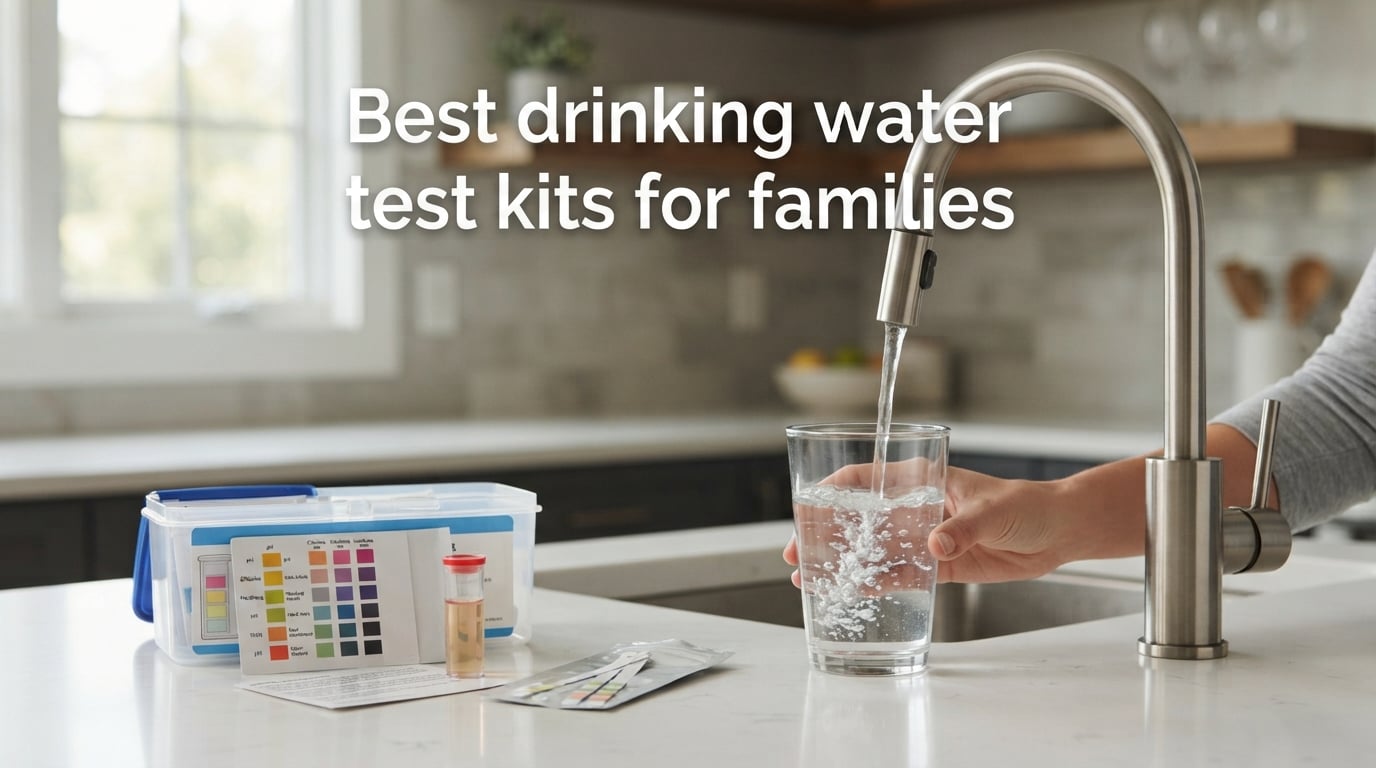
The best drinking water test kits for families give you a practical home screen for common concerns, then point you toward laboratory confirmation when a result could affect health decisions. For most households, we would start with a kit that addresses lead, bacteria, nitrates, and everyday water-quality markers, especially where children, infants, older plumbing, or private well water are part of the picture.
Our top overall pick is the Detekt Total Drinking Water Test Kit because its seven-test set includes lead plus bacteria and microbe detection in an at-home format. A home water test kit is useful for learning what to investigate, but it is not a substitute for a certified laboratory result when a screen is concerning or when you need a wide contaminant panel.
This guide compares ten drinking water testing kit options using the product information, listed test coverage, ratings, review volume, and stated limitations available for each item. We also separate what quick test strips can tell a family from what needs a lab water test kit, so the result is a calmer and more useful next step rather than a guess.
Table of Contents
Top 3 Picks: Detekt Is the Best Family Starting Point

Detekt Total Drinking Water Test Kit
- 7 essential tests
- Lead and microbe detection
- Tap and well water

Pick Detekt when a smaller, stated seven-test set with lead and microbe detection fits the question you need answered now. Pick HEVEIS when repeated household screening and an included EPA standards book matter more, or HYCHEK when you want a broad 21-parameter strip kit with separate coliform and E. coli tests.
Those badges are editorial shortcuts, not laboratory findings. Each kit has a different role: rapid strips are good for routine screening and tracking, while a certified lab is the stronger route for a comprehensive, decision-grade analysis.
These 10 Drinking Water Test Kits Give Families a Quick Overview in 2026
Do not choose by parameter count alone. A kit with many strips can be helpful for pH, hardness, chlorine, and repeat checks, yet a focused lead or bacteria component can matter more if that is the issue your family is trying to rule out.
Every product below is an at-home option. Safe Home Complete is the one item in this group that also states an optional EPA-certified laboratory path for up to 48 parameters.
1. Detekt Is Best for Focused Lead and Microbe Screening
Drinking Water Test Kit, Detekt (USA) DIY for Lead, Bacteria, Mold & pH
7 essential tests
Lead, bacteria and microbes
Tap and well water
Pros
- Microbe detection
- Lead testing
- Seven essential tests
- Made in USA
- Home and field use
Cons
- Seven tests only
- Smaller review base
Detekt is the clearest choice here when a family wants a focused water safety check rather than a large box of general-purpose strips. Its stated test types include water purity, bacteria, microbes, mold, fungus, lead, hardness, pH, and iron, while the product describes the kit as seven essential tests.
The difference is its stated proprietary lateral-flow technology for ultra-sensitive microbe detection. That focus makes sense for a household that wants an at-home signal around microbial concerns as well as lead, whether the source is tap water, a private well, or an emergency supply.
We like that the listing calls out use in homes, schools, businesses, and childcare facilities. For parents, the practical question is not whether a single kit can settle every issue; it is whether it flags the concerns that should lead to a more specific follow-up.
There are 30 listed reviews behind its 4.8 rating, so this is not the choice for shoppers who only trust a very large review base. It also covers fewer tests than the 21- and 23-parameter strip kits in this roundup.
The focused panel suits families who have a specific safety question
Choose Detekt if lead and microbe screening sit at the top of your list and you prefer a compact, at-home process. It is also one of the few products here that explicitly lists bacteria, microbes, mold, and fungus among its test types.
The seven-test scope calls for a lab follow-up when the question is broad
A family investigating PFAS, VOCs, or a full range of dissolved contaminants needs a broader laboratory panel because this listing does not state those categories. Treat a concerning home result as a reason to confirm the finding, not as a diagnosis of your water supply.
2. HEVEIS Is Best for Frequent Household Screening
21-in-1 Home Drinking Water Testing Kit – 120 Strips + 4 Bacteria Tests – Tap and Well Water Test Kit, Easy to Test and Read for Hardness, Lead, Iron, Fluoride, pH, Copper, Bacteria and More
120 strips and 4 bacteria tests
21 parameters
EPA standards book
Pros
- 124 total tests
- Four bacteria tests
- Color chart
- EPA standards book
- Support stated
Cons
- Strip-based screening
- Not Prime eligible
The HEVEIS kit is built around repeat testing: the included components list 120 premium strips, four complete bacteria tests, and a sample vial. That is useful when a family wants a baseline, then wants to watch changes after a filter replacement, plumbing work, or a shift in well-water conditions.
Its 21-in-1 coverage names hardness, lead, iron, fluoride, pH, copper, bacteria, and more. The listing also says it includes an EPA standards book, which is a helpful starting reference for parents who do not want to decode a color chart without context.
With 834 reviews and a 4.5 rating, HEVEIS has the strongest listed review volume among the higher-rated broad kits in this set. The stated 124-test count is another reason it is a practical pick for households that expect to test more than once.
Still, the readings come from a color comparison chart. A color strip can start a conversation about hardness or chlorine, but users should not treat its result as a final laboratory measurement for lead, bacteria, or an unlisted contaminant.
The large test supply supports before-and-after household checks
Use this kit if you want to record repeat results at the same faucet and compare them over time. Test cold water from the same source, follow the timing in the instructions, and keep a simple date-and-location log so the comparison means something.
The broad strip count does not replace a contaminant-specific confirmation
HEVEIS is a sensible well water test kit screen because it includes bacteria tests and names lead, fluoride, and iron. If bacteria, nitrate, or lead readings raise concern, a certified laboratory or local health authority can help determine the next action.
3. HYCHEK Is Best for a Simple Three-Step Routine

HYCHEK 21 in 1 Accurate Drinking Water Test Kit, Well Water Testing Kit
145 strips and 4 bacteria tests
21 parameters
Dip, wait, read
Pros
- 145 strips
- Four bacteria tests
- Clear color blocks
- Three-step process
- Tap and well use
Cons
- Color matching is subjective
- Not a lab substitute
HYCHEK puts its process in very plain terms: dip for one second, wait 15 seconds, and read. That stated three-step approach is appealing for a family that wants a quick, repeatable screen without an involved setup.
The kit lists 145 strips plus four separate coliform and E. coli tests. Its stated 21 parameters include nitrate, lead, fluoride, chlorine, hardness, pH, iron, copper, and more, giving it good breadth for a tap-water or well-water check.
The vivid color blocks are meant to make the strip comparison easier. We would still read that as a convenience feature rather than a claim of laboratory precision, since lighting, timing, and personal color interpretation can change how a strip looks.
HYCHEK has a 4.4 rating from 124 reviews. Its product information directly says it is not a substitute for professional laboratory testing, a limitation that is useful to state plainly for families making a health-related decision.
The fast process helps when routine checks need to stay realistic
This is a good fit for a household that will actually use a kit because the steps are short and the supply supports repeat checks. It can be particularly practical after maintaining a water softener or filter, provided you track which faucet and condition you tested.
The separate bacteria tests matter most for a private well question
For well water, bacteria and nitrate are common priorities in the research behind this guide. HYCHEK lists bacteria tests and nitrate among its parameters, but confirmation through a lab remains the stronger response to any concerning screen.
4. Safe Home Complete Is Best for DIY Screening With a Lab Path

Safe Home® Complete Drinking Water Test Kit – DIY Screening for 14 Parameters + Optional Testing at Our EPA-Certified Lab for up to 48 Parameters – Made in the USA
14 DIY parameters
Optional EPA-certified lab
Up to 48 parameters
Pros
- DIY and lab path
- ACS grade reagents
- EPA-certified lab option
- Made in USA
- Expert support stated
Cons
- Lab option needs separate purchase
- Not Prime eligible
Safe Home Complete has the most distinct two-stage setup in this comparison. It offers DIY screening for 14 parameters and states that optional testing at its EPA-certified lab can cover up to 48 parameters.
That structure addresses a common family dilemma: you may want a quick home water testing kit today without pretending it answers every question. Start with the supplied screen, then consider the laboratory route if the result, a child’s exposure concern, or an older home’s plumbing calls for deeper analysis.
The product information says the DIY portion uses ultra-sensitive ACS grade reagents and notes more than 40 years of expert support. It also carries a stated Good Housekeeping Seal, although the important decision point remains the testing method and the contaminants you need covered.
With 37 reviews and a 4.4 rating, it has a smaller review sample than many strip-heavy options. The optional lab component also has to be viewed as a separate step rather than assuming a 48-parameter lab report is included in the at-home kit.
The two-stage design gives a family room to escalate evidence
Safe Home Complete is the best match when you want to screen first and retain a stated path to a laboratory result without switching brands. That can reduce confusion after an unexpected color reading because the distinction between screening and confirmation is built into the product concept.
The laboratory option needs a clear reason and a clear sampling plan
Before selecting a lab test, decide whether the concern is city water, well water, lead from household plumbing, or a broader contaminant question. A good sample plan identifies the faucet, whether the water sat in the pipes, and which family members’ exposure concern prompted testing.
5. Safe Home Ultimate Is Best for Dedicated Lead and Bacteria Checks

Safe Home® 14-in-1 DIY Ultimate Drinking Water Test Kit – Includes The #1 Selling Lead & Bacteria Test Kits + 12 Additional Parameters – City Tap or Well Water
14 parameters
Lead and bacteria tests
City tap or well water
Pros
- Dedicated lead test
- Dedicated bacteria test
- 14 parameters
- Trilingual instructions
- Made in USA
Cons
- No lab confirmation included
- Not Prime eligible
The Safe Home 14-in-1 DIY Ultimate kit puts two family concerns at the center: lead and bacteria. Its technical details name lead, bacteria, hardness, nitrates, pH, and ten additional parameters for city tap or well water.
That is a sensible spread for a household with children because parents in the forum research repeatedly focused on lead and nitrate, while well-water users emphasized bacteria. The listing says this kit includes the brand’s lead and bacteria test kits rather than treating those as only tiny blocks on a multiparameter strip.
The product also states that it has trilingual instructions, is made in the USA, and carries a Good Housekeeping Seal. Its 4.3 rating comes from 686 reviews, providing a larger feedback pool than several newer kits in this roundup.
As with other DIY water test kits, the result is a screen. The listing itself says it is not a substitute for professional laboratory testing, and that is especially relevant if a lead or bacteria reading would change what your child drinks or what water you use for baby formula.
The dedicated tests prioritize the concerns parents raise most often
Select this kit when you want an at-home lead water test kit and bacteria check alongside routine markers such as hardness and pH. It is a more targeted family choice than a high-count strip pack when the central question is safety rather than general water maintenance.
The reported result should lead to confirmation before a major household change
If a dedicated test indicates a concern, preserve the instructions and note the testing conditions before arranging confirmation. That record helps you explain whether you tested first-draw water, cold water, or a faucet after a period of flushing.
6. VibeEsece Is Best for the Widest Stated Strip Panel

Water Test Kit for Drinking Water, 23-in-1 Water Test Strips for Tap & Well Water, Tests Hardness, Lead, Iron, Copper, Chlorine, Fluoride, pH, Nitrate & More, Fast Home Water Testing, 155 Strips
23 parameters
155 strips
Tap and well water
Pros
- 23-in-1 screening
- 155 strips
- Fast color results
- Tap and well use
- Many stated parameters
Cons
- Screening only
- No certified-lab result
VibeEsece lists the broadest parameter count in this group at 23-in-1, along with 155 strips for repeated checks. The technical details name bacteria screening, hardness, pH, lead, iron, copper, chlorine, fluoride, nitrate, nitrite, sulfate, and more.
For a family collecting a baseline across several common water-quality markers, that is a useful starting inventory. The product is listed for home water, tap water, water-quality testing, and well water, so it can serve a household that has not yet narrowed its concern.
Its results are fast color readings in seconds according to the listing. That can make testing less intimidating, but it also means the reading is tied to exact timing and careful color comparison rather than an instrument report from a laboratory.
The kit is rated 4.4 from 121 reviews. The product data clearly describes it as screening only, which is the right frame for interpreting any result involving a health-sensitive contaminant.
The 23-parameter list makes a broad baseline easy to map
VibeEsece is a fit when you want to learn which category needs attention before deciding whether a narrower test or a lab panel is warranted. Its stated nitrate and nitrite coverage can be especially relevant for a well-water family, alongside bacteria screening.
The strip result works best when you keep the question narrow
One abnormal block does not identify the cause of a water problem on its own. Use the result to choose the right confirmation test, such as bacteria analysis for a microbial concern or a lead-focused laboratory sample for older plumbing.
7. bestprod Is Best for Families Who Want a Written Test Log

Bestprod All-New 21 in 1 Drinking Water Testing Kit Strips, Home Tap and Well Water Test Kit for Hardness, Lead, Iron, Copper, Chlorine, Fluoride
120 strips and 2 bacteria tests
17-in-1 strip
Recording data sheet
Pros
- Clear range guide
- Timer-based use
- Data sheet
- Lead and bacteria coverage
- Large review base
Cons
- Lower listed rating
- Strip-based screen
The bestprod kit combines a 17-in-1 test strip with two bacteria tests and a stated 120-test unit count. Its feature list includes a data sheet for recording readings, a small but meaningful addition if your family wants to compare water changes over weeks or months.
The listing names hardness, lead, iron, copper, chlorine, and fluoride, while the stated feature set adds coliform and E. coli bacteria tests. The process is framed simply: add water, set a timer, and read results against the guide aligned on the bottle.
bestprod has the largest review base in the full list, with 3,512 reviews supporting a 4.4 rating. A large review count does not validate a particular household’s sample, but it can be useful context for shoppers comparing ease-of-use feedback.
The lower listed rating than the top few picks keeps it out of our top tier. Still, the recording sheet and broad everyday coverage make it a reasonable home water test kit for families who benefit from making testing a documented routine.
The included record sheet turns repeat strips into a useful history
Record the date, faucet, water source, whether a filter was in use, and any recent plumbing work alongside each reading. This creates a more meaningful discussion with a lab, plumber, or local water professional than relying on a single remembered color result.
The bacteria add-ons make this more than a simple pH kit
This kit is not just for pH levels and hardness; the listing also names coliform and E. coli bacterial tests. Those components can guide a well-water household toward prompt confirmation if the home screen raises a concern.
8. Novoblue Is Best for Separate Lead and Copper Testing

18-in-1 Drinking Water Test Kit with Sensitive Lead & Copper Tests
18-in-1 kit
50 strips
Lead, copper and bacteria tests
Pros
- Separate lead tests
- Separate copper tests
- Two bacteria tests
- 50 strips
- Fast home checks
Cons
- Small review base
- Limited listing detail
Novoblue is an 18-in-1 drinking water test kit that comes with 50 universal test strips, two lead tests, ten copper tests, and two bacteria tests. That component list is its main appeal: it separates lead and copper tests from the general strip supply rather than relying on one broad strip alone.
The product title also names well, tap, home, and city water, plus chlorine, hardness, and iron. It is a compact choice for families concerned about plumbing-related metals while still wanting a wider household screen.
The listed rating is 4.6, but it comes from only 16 reviews. We would view that score as promising but less settled than products with hundreds or thousands of reviews.
Because the product data does not provide a detailed parameter-by-parameter technical list beyond its components and title, it is smart to review the package instructions before using the kit for a specific concern. Do not assume an 18-in-1 label covers PFAS, VOCs, or every contaminant associated with water quality.
The separate metal tests make plumbing questions easier to frame
Choose Novoblue when lead and copper are your immediate concerns, such as after moving into a home with unknown plumbing history. Using the dedicated tests as instructed can help decide whether to seek a laboratory sample focused on those metals.
The small review count makes careful instructions more important
Follow the timing and sample directions exactly, then save the result and kit lot information if available. Where children or infant feeding are involved, a nonnegative screen should be discussed with a qualified local testing resource before drawing a big conclusion.
9. getTested Is Best for a Straightforward Color-Chart Check

getTested at-Home Water Quality Test Kit – Identify Drinking Water Purity for Your Family – Rapid 14-Parameter Results for Well, City, Tap, & More – Easy & Convenient
14 parameters
Rapid color results
City, well and tap water
Pros
- 15 plus stated factors
- Rapid results
- Color chart
- Tap and well coverage
- At-home format
Cons
- Small review base
- Not Prime eligible
The getTested at-home water quality test kit is intended for a rapid check of drinking-water purity for a family. Its listing describes 14-parameter results and says it tests 15-plus factors, with a detailed color chart and no mail-in delay.
It is positioned for well, city, tap, and other water sources. That makes it a straightforward drinking water test kit for a new homeowner who wants an initial overview before selecting a filter or ordering a more detailed laboratory test.
The stated weight is 0.64 ounces and the listed dimensions are 12.5 by 7 by 2 inches, so it is a compact kit rather than a big case of repeat strips. Its 4.6 rating is based on 11 reviews, which gives less review context than most options above.
Color-coded results have a real family benefit: they lower the barrier to taking a first reading. The trade-off is that the chart still needs careful timing, neutral lighting, and a willingness to confirm any concerning result through a more definitive method.
The simple chart can make an initial test less intimidating
Pick getTested if you want a compact at-home screen with rapid color results and you are comfortable using it as a first pass. It is particularly suited to a household asking, “Should we investigate this water source further?” rather than seeking a final compliance-style report.
The compact kit is better for a baseline than ongoing high-frequency tracking
Families planning many checks may prefer kits that state 120, 145, or 155 strips. This one has a different role: a quick broad snapshot that can inform a later choice between a targeted lead test, bacteria test, or laboratory panel.
10. Droplytix Is Best for App-Based Color Interpretation
DROPLYTIX 20-in-1 Drinking Water Test Kit with App, Digital Water Tester for Drinking Water, Home Water Test Kit, Well Water Testing Kit, Water Test Strips for Lead, Hardness, Chlorine, Nitrate & more
20 parameters
Mobile app color analysis
Lead and heavy metals
Pros
- App-based analysis
- 20 parameters
- Lead and metal coverage
- Tap and well use
- Ten-count kit
Cons
- Requires smartphone
- Lower listed rating
- Not Prime eligible
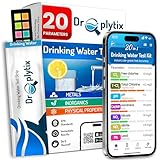
Droplytix pairs a 20-in-1 drinking water strip kit with a mobile app for digital color analysis. Its technical details name pH, hardness, chlorine, nitrate, nitrite, iron, fluoride, heavy metals, alkalinity, and salinity, while its title also names lead.
The app is designed to reduce the guesswork of matching a strip to a printed chart. For a family that already uses a smartphone for household records, that digital approach may make it easier to save and compare repeat observations.
There are ten tests in the listed unit count, so this is a smaller supply than the big repeat-testing packs. Its 4.0 rating from 426 reviews is also the lowest rating in this roundup, and the review breakdown shows a higher share of one-star reviews than the other products listed.
We would only choose it if app-based interpretation is a genuine benefit for your household. The app does not turn a strip test into a certified laboratory analysis, and the listing says a smartphone is required for that part of the experience.
The app can help families document the same test process each time
Droplytix may work well when one person is responsible for logging household maintenance and wants a digital result instead of relying only on visual memory. Use the same sample method each time so an app record reflects water changes rather than changing collection conditions.
The rating and smartphone requirement make fit more important here
This is not the easiest choice for a household that wants a paper-only process or a large pack for frequent screening. If you want a conventional color chart with more repeat strips, HEVEIS, HYCHEK, VibeEsece, or bestprod match that approach more directly.
Choose a Family Water Test Kit by Matching the Risk to the Method
Families do not need to test for every contaminant every time. Start by matching the source and situation to the question: city water with older plumbing often puts lead at the front of the list, while well water moves bacteria and nitrate higher.
A home screen can be a practical first layer, especially for pH, hardness, chlorine, and repeated observations. For a result that will guide a major health, filtration, or plumbing decision, an accredited or certified laboratory is the more defensible method.
Lead, bacteria, and nitrates are the first family priorities
Lead is a common parent concern where plumbing is old or unknown, and many families also ask about water used for baby formula. Detekt, Safe Home Ultimate, Novoblue, HEVEIS, HYCHEK, VibeEsece, bestprod, and Droplytix all state lead coverage in their provided product information.
For a private well, bacteria and nitrate deserve particular attention based on the forum research. HEVEIS, HYCHEK, Novoblue, Safe Home Ultimate, VibeEsece, bestprod, and Detekt state a bacteria component or bacteria-related coverage; check each package directions to see the exact sample and wait process.
Test strips screen fast while laboratories confirm difficult questions
Test strips give rapid, color-based readings and are useful for monitoring markers such as pH, hardness, chlorine, and other listed parameters. They are also useful for deciding whether a water issue is worth investigating further, provided you respect their timing, storage, and color-matching limits.
A lab water test kit asks you to collect and send a sample, then reports a more detailed analysis. Safe Home Complete states an optional EPA-certified laboratory test for up to 48 parameters; other families may need to seek a laboratory separately after an at-home screen.
City water and well water call for different starting questions
For city water, ask whether old service lines, faucets, or plumbing create a lead concern at the tap even when the utility treats the source water. A focused lead water test kit or a lab sample designed around metals can be more useful than a huge generic strip panel.
For well water, begin with bacteria and nitrate, then consider iron, hardness, pH, and other site-specific concerns. A broad well water test kit such as HEVEIS, HYCHEK, or VibeEsece can screen multiple areas, but a concerning result still needs confirmation.
EPA MCL context helps you read a result without overreacting
MCL means Maximum Contaminant Level, an EPA term families often see when comparing water results. It is a reference point, not a reason to interpret a strip result without checking the kit’s method, units, timing, and stated sensitivity.
Use the kit’s own chart or supplied standards guide first, then contact an appropriate laboratory, local health department, or water professional if a reading is concerning. This is more useful than changing a treatment system based only on one ambiguous color block.
A consistent sample makes repeat results more meaningful
Collect from the same faucet when you are comparing routine results, and note whether you tested cold water, whether it had been sitting in the pipes, and whether a filter was installed. Follow the product instructions rather than mixing timing rules from a different kit.
A simple log can include the date, source, test kit, observed result, and recent household changes such as renovation or filter service. That record is especially helpful if you later compare a home water testing kit screen against laboratory data.
New babies, new homes, and plumbing work are sensible testing triggers
Families with infants, pregnant people, a new home, a private well, or an older plumbing system often have a clear reason to check drinking water. Renovation can also change a household’s question because work around pipes or fixtures may prompt a new lead-focused or general screen.
Annual testing is a reasonable planning point for families with children according to the AI optimization research, with more targeted checks when circumstances change. The right frequency still depends on your water source, local guidance, prior results, and the specific contaminant you are watching.
Families Can Use These Answers to Choose and Use a Water Test Kit
What is the most accurate water test kit?
A certified laboratory water test is the most accurate option for a family making decisions about lead, bacteria, nitrates, PFAS, or other health-related contaminants. At-home kits are useful first screens; Safe Home Complete is notable here because it states an optional EPA-certified lab path for up to 48 parameters.
What is the best drinking water quality test?
The best drinking water quality test matches the concern. Detekt is our focused at-home pick for stated lead and microbe coverage, while a certified lab test is the stronger choice when a family needs broad confirmation after a screen or needs contaminants such as PFAS or VOCs assessed.
Are home water test kits accurate?
Home water test kits can be useful for quick screening when you follow their sample, timing, storage, and color-reading directions. They are less definitive than laboratory analysis, so a concerning strip result for lead, bacteria, or nitrate should be confirmed before making a major health or treatment decision.
What is the best way to test drinking water at home?
Start by naming your concern and water source, then use a kit that states coverage for it. Collect the sample exactly as instructed, record the faucet and conditions, read the result within the specified time, and use a certified laboratory to confirm any result that could affect your family’s drinking water choices.
Detekt Is Our First Pick for a Focused Family Water Screen
For the best drinking water test kits for families, Detekt is our first at-home choice when stated lead and microbe detection are the central concern. HEVEIS is the stronger match for high-frequency broad screening, while Safe Home Complete is the clearest option for households that want a stated route from DIY checks to an optional EPA-certified lab test.
Choose the kit that fits your water source and the question in front of you, then treat a concerning home reading as a prompt for confirmation. That measured approach gives families a useful baseline in 2026 without asking a strip to answer more than it can.