
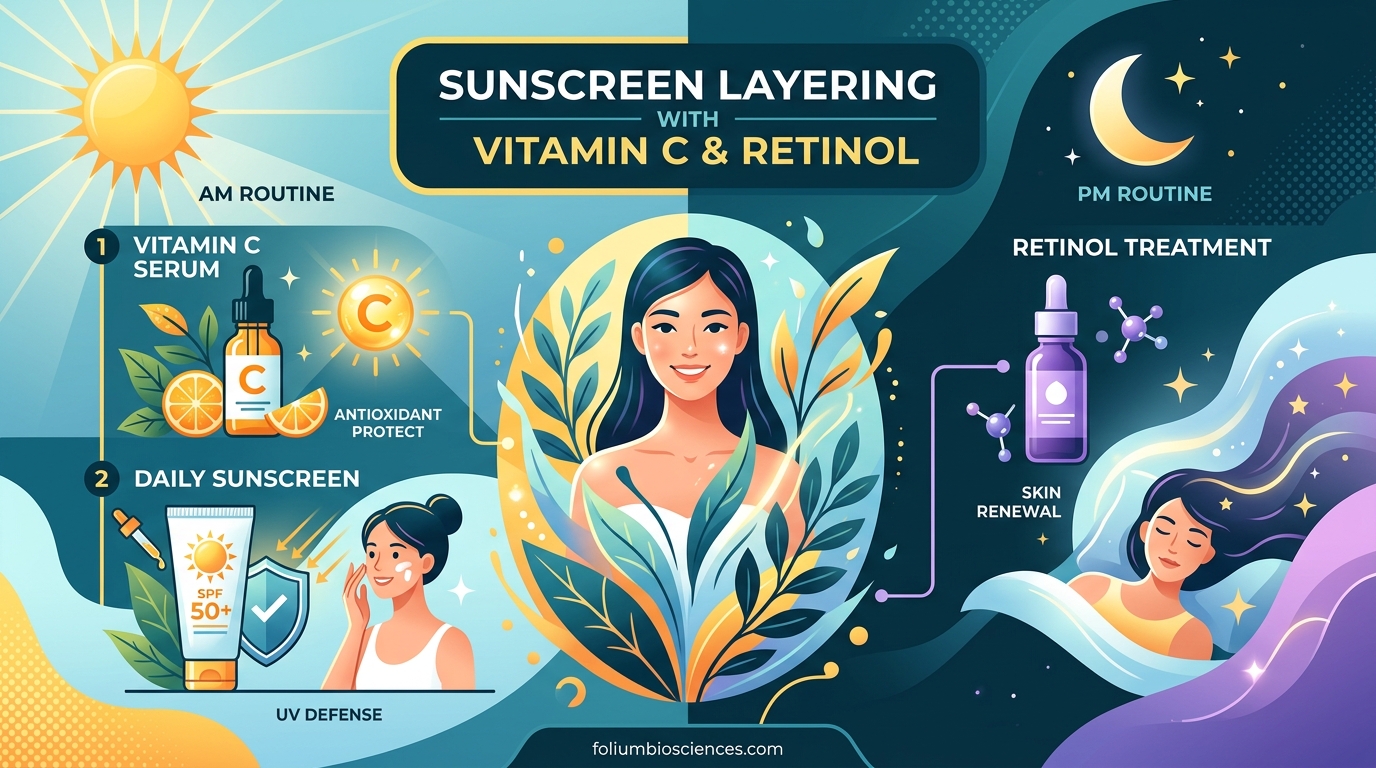
I spent three months figuring out why my skin was red, peeling, and somehow still breaking out. I was using vitamin C and retinol like everyone recommended, but I was applying them wrong. Once I understood the AM/PM split and the proper sunscreen layering with vitamin C and retinol AM PM routine, everything changed.
My skin became clearer, brighter, and the fine lines around my eyes started to fade. The secret was not just what I used, but when and how I layered it.
In this guide, I will walk you through the exact routine that transformed my skin. You will learn why vitamin C belongs in your morning routine, why retinol works best at night, and why sunscreen is the non-negotiable final step that makes everything else work.
Table of Contents
What Is Retinol and How It Works
Retinol is a derivative of vitamin A and belongs to the retinoid family. When applied to your skin, it converts to retinoic acid and works at the cellular level to speed up cell turnover.
Cell turnover is your skin’s natural renewal process. Young skin cells regenerate every 28 days, but this process slows to 40-50 days as you age. Retinol accelerates this cycle, pushing fresh cells to the surface faster.
This accelerated cell turnover does several things for your skin. It unclogs pores, fades hyperpigmentation, smooths fine lines, and stimulates collagen production. Collagen is the protein that keeps skin firm and plump. After age 25, collagen production drops about 1% each year. Retinol helps counteract this decline.
Here is the catch: retinol makes your skin more sensitive to sunlight. Fresh, rapidly turning-over skin cells are more vulnerable to UV damage. This is why retinol belongs in your PM routine, not your AM routine. Using it during the day without proper sun protection can cause more harm than good.
What Is Vitamin C and How It Works
Vitamin C, specifically L-ascorbic acid, is a powerful antioxidant that protects your skin from environmental damage. Unlike retinol, which works by speeding up cell renewal, vitamin C works by neutralizing free radicals.
Free radicals are unstable molecules generated by UV exposure, pollution, and stress. They damage skin cells, break down collagen, and accelerate photoaging. Vitamin C donates electrons to stabilize these free radicals before they can harm your skin.
Vitamin C also inhibits melanin production, which helps fade dark spots and brighten overall skin tone. It is essential for collagen synthesis, working alongside retinol to keep skin firm and youthful.
There is a common myth that vitamin C breaks down in sunlight and should not be used during the day. This is not true. While vitamin C can oxidize when exposed to air and light, modern formulations are stable. More importantly, vitamin C actually boosts the effectiveness of your sunscreen when layered underneath it. Your morning vitamin C serum and sunscreen work as a team.
AM Routine: Vitamin C + Sunscreen Step-by-Step
Your morning routine focuses on protection. You are defending your skin against the day’s environmental stressors. Here is the exact order I follow every morning.
Step 1: Cleanse
Start with a gentle cleanser. You want to remove any sweat, oil, or leftover products from your night routine without stripping your skin barrier. Look for a pH-balanced cleanser around 5.5.
Step 2: Apply Vitamin C Serum
Apply your vitamin C serum to clean, slightly damp skin. I use 3-4 drops for my entire face and neck. Wait 1-2 minutes for it to absorb before moving to the next step. This waiting period lets the active ingredients penetrate properly.
Step 3: Moisturizer
Follow with a moisturizer suited to your skin type. This creates a hydration barrier and helps lock in the vitamin C. If you have oily skin, a lightweight gel moisturizer works well. Dry skin benefits from a richer cream.
Step 4: Sunscreen (SPF 30 or Higher)
This is the most critical step. Apply sunscreen SPF 30 or higher as your final layer. I use a quarter teaspoon for my face alone, plus another quarter teaspoon for my neck and chest. Let your moisturizer absorb for 1-2 minutes first to prevent pilling.
The vitamin C serum underneath your sunscreen provides an extra layer of protection against free radical damage. Studies show this combination offers superior protection compared to sunscreen alone.
PM Routine: Retinol Step-by-Step
Your evening routine focuses on repair. While you sleep, your skin enters regeneration mode. Retinol takes advantage of this natural repair cycle.
Step 1: Double Cleanse
Remove makeup, sunscreen, and daily buildup with an oil-based cleanser first, then follow with your regular cleanser. Clean skin allows retinol to penetrate properly.
Step 2: Wait for Completely Dry Skin
This is crucial. Wait 10-20 minutes after cleansing before applying retinol. Applying retinol to damp skin increases penetration and irritation risk. Your face should feel completely dry to the touch.
Step 3: Apply Retinol
Use a pea-sized amount for your entire face. Yes, that is all you need. Dot it on your forehead, cheeks, nose, and chin, then gently spread it out. Avoid the eye area unless you are using a product specifically formulated for it.
Step 4: Moisturizer
Wait another 10-20 minutes after retinol before applying moisturizer. This buffer layer helps reduce irritation while still letting the retinol work. Some people prefer the sandwich method: moisturizer, then retinol, then moisturizer again.
Step 5: Occlusive (Optional)
If you have very dry skin, finish with a thin layer of occlusive like petroleum jelly or a sleeping mask. This locks in moisture and reduces transepidermal water loss overnight.
Why Vitamin C in AM and Retinol in PM
The AM/PM split is not arbitrary. It is based on how these ingredients interact with your skin and the environment.
Retinol increases photosensitivity. When you use retinol, your skin becomes more susceptible to sun damage for several reasons. The accelerated cell turnover brings delicate new skin cells to the surface. These cells have not developed full sun protection yet. UV exposure on retinol-treated skin can cause redness, burning, and even hyperpigmentation.
Vitamin C works best during daytime exposure. Your skin faces the most free radical damage during the day from UV rays and pollution. Vitamin C neutralizes these threats in real-time. It also works synergistically with sunscreen, boosting its protective capabilities.
pH levels play a role too. L-ascorbic acid works best at a low pH around 3.5. Most retinol products are formulated at a higher pH. Using them together can destabilize both ingredients. The AM/PM split keeps each ingredient in its optimal pH environment.
Your skin has a natural circadian rhythm. Cell repair and renewal peak at night. Retinol supports this natural process. In the morning, your skin switches to protection mode. Vitamin C supports this protective function.
Benefits of the AM/PM Split Approach
Separating vitamin C and retinol into different routines gives you the best of both worlds without the downsides.
You get 24-hour protection and renewal. Vitamin C guards your skin during the day while retinol repairs it at night. This creates a continuous cycle of protection and regeneration.
Irritation risk drops significantly. Both ingredients are powerful actives. Using them at the same time can overwhelm your skin barrier. The split routine lets you enjoy both benefits while keeping your skin calm.
Each ingredient works at peak efficiency. Vitamin C maintains its stability in your AM routine. Retinol penetrates better in your PM routine without competing with other actives. Your sunscreen becomes more effective with vitamin C underneath.
The routine is sustainable long-term. You can maintain this approach indefinitely without hitting a tolerance wall. Many people find they can eventually increase their retinol strength using this method.
Building Tolerance: The 1-2-3 Rule for Retinol
The 1-2-3 rule is the safest way to introduce retinol without destroying your skin barrier. I wish I had known this when I started.
Weeks 1-2: 1 Time Per Week
Apply retinol just once during your first two weeks. Choose a night when you can stay home the next day in case you experience any redness or peeling. This gives your skin time to adjust to the ingredient.
Weeks 3-4: 2 Times Per Week
If your skin tolerates the once-weekly application without excessive dryness or irritation, increase to twice weekly. Space the applications out, like Monday and Thursday. Never use retinol on consecutive nights at this stage.
Week 5 and Beyond: 3 Times Per Week and Build Up
Increase to three times weekly, then gradually build from there. Most people can eventually use retinol 4-5 nights per week. Some skin types tolerate nightly use, but this is not necessary for results. Three to four times weekly is enough for most people to see significant improvement.
Watch for signs you are increasing too fast. Persistent redness, stinging when applying other products, excessive peeling, and increased sensitivity are all signals to scale back. When in doubt, slow down. Retinol is a marathon, not a sprint.
Common Side Effects and How to Minimize Them
Even with the AM/PM split, you may experience some adjustment symptoms. Knowing what to expect helps you distinguish between normal adjustment and problematic irritation.
Retinol dermatitis is the most common issue. Your skin may become red, dry, flaky, and sensitive. This usually happens in the first 2-4 weeks. The key is buffering. Apply moisturizer before and after retinol, or mix your retinol with moisturizer to dilute it.
Vitamin C can cause tingling or mild stinging, especially with L-ascorbic acid formulas. This should subside within a few minutes. If it lasts longer or causes redness, you may need a gentler vitamin C derivative like sodium ascorbyl phosphate or magnesium ascorbyl phosphate.
Purging is different from breaking out. When retinol speeds up cell turnover, it pushes clogged pores to the surface faster. This can look like acne but resolves within 4-6 weeks. True breakouts from irritation will not improve and may worsen.
If irritation becomes severe, stop all actives and focus on barrier repair for 1-2 weeks. Use only gentle cleanser, moisturizer, and sunscreen. Once your skin calms, reintroduce vitamin C first, then retinol slowly using the 1-2-3 rule.
Sensitive Skin Approach
If you have sensitive skin, rosacea, or eczema, you can still use this routine with modifications.
Start with lower percentages. Look for retinol at 0.25% or 0.3% instead of 0.5% or 1%. For vitamin C, start with a derivative like sodium ascorbyl phosphate at 10% rather than pure L-ascorbic acid at 15-20%.
Use the sandwich method for retinol. Apply a thin layer of moisturizer, wait 5 minutes, apply your retinol, wait another 5 minutes, then apply more moisturizer. This dramatically reduces irritation while still delivering results.
Patch test everything. Apply new products to a small area behind your ear or on your jawline for 3-5 days before using them on your entire face. This catches reactions before they affect your whole face.
Focus on barrier repair first. If your skin barrier is compromised, actives will only make it worse. Spend 2-4 weeks using only gentle cleanser, hydrating toner, moisturizer, and sunscreen. Once your skin feels resilient, add vitamin C. Wait another 2 weeks before introducing retinol.
Dos and Don’ts of Vitamin C and Retinol Layering
Keep this quick reference guide handy while you build your routine.
Do:
Use vitamin C in the morning and retinol at night. This is the golden rule that makes everything else work.
Wait between layers. Give each product 1-2 minutes to absorb before applying the next step.
Apply sunscreen every morning. SPF 30 minimum, every single day, even when it is cloudy.
Start low and slow. Lower percentages and gradual introduction prevent most irritation issues.
Patch test new products. Always test before committing your entire face.
Don’t:
Don’t use retinol and vitamin C in the same routine until your skin is fully tolerant. Even then, most experts recommend keeping the AM/PM split.
Don’t apply retinol to damp skin. This increases penetration and irritation. Wait for completely dry skin.
Don’t skip sunscreen when using retinol. Your increased sun sensitivity makes protection essential.
Don’t start with high percentages. More is not better. Start at 0.25% retinol and work up over months.
Don’t give up during the purge phase. Initial breakouts often clear up within 4-6 weeks as your skin adjusts.
Frequently Asked Questions
How to layer vitamin C and retinol at night?
You should not layer vitamin C and retinol together at night when starting out. Use vitamin C in your morning routine and retinol in your evening routine. If you want to use both at night, apply vitamin C first, wait 20-30 minutes, then apply retinol. However, the AM/PM split is recommended for beginners to minimize irritation.
What is the 1 2 3 rule for retinol?
The 1-2-3 rule is a gradual introduction method for retinol. Weeks 1-2: use retinol 1 time per week. Weeks 3-4: increase to 2 times per week. Week 5 and beyond: use 3 times per week and gradually build up from there. This slow introduction helps your skin build tolerance without excessive irritation.
Can I use vitamin C and retinol together?
Yes, you can use vitamin C and retinol together, but the AM/PM split is gentler and more effective for most people. Vitamin C works best in the morning for antioxidant protection, while retinol works best at night for skin renewal. Using them 12 hours apart maximizes benefits while minimizing irritation.
What are the 7 steps of skincare?
The 7 steps of skincare are: 1) Oil cleanser, 2) Water-based cleanser, 3) Exfoliant (1-2 times weekly), 4) Toner or essence, 5) Serum (vitamin C in AM, retinol in PM), 6) Moisturizer, 7) Sunscreen in AM or occlusive in PM. You do not need all 7 steps. A simple routine with cleanser, serum, moisturizer, and sunscreen works for most people.
How long should I wait between applying vitamin C and sunscreen?
Wait 1-2 minutes between applying vitamin C serum and sunscreen. This gives the vitamin C time to absorb and prevents your sunscreen from pilling or becoming less effective. Some people prefer to add a moisturizer between vitamin C and sunscreen, which also works well.
Why does retinol make skin more sensitive to sun?
Retinol accelerates cell turnover, bringing fresh, immature skin cells to the surface. These new cells have not developed full protective capabilities yet and are more vulnerable to UV damage. Retinol can also thin the outermost layer of skin slightly. Daily sunscreen SPF 30 or higher is essential when using retinol.
How long before I see results from this routine?
Most people see initial improvements in skin texture and brightness within 4-6 weeks. Significant changes in fine lines, hyperpigmentation, and acne typically appear after 3-4 months of consistent use. Results require patience and consistency. Skin cell turnover takes time, and collagen production is a gradual process.
Conclusion
The sunscreen layering with vitamin C and retinol AM PM routine is one of the most effective approaches for brighter, smoother, more youthful skin. By using vitamin C in the morning for protection and retinol at night for renewal, you give each ingredient the optimal environment to work.
Remember the three keys to success. Start slowly with the 1-2-3 rule for retinol introduction. Never skip sunscreen, especially when using retinol. Be patient and consistent, because skin transformation takes time.
I have been following this routine for over a year now. My skin has never looked better. The fine lines that were starting to bother me have softened. My skin tone is more even. Most importantly, my skin feels strong and resilient, not irritated and angry like it did when I was using these ingredients wrong.
Start today with one step. Add vitamin C to your morning routine this week. Once that feels comfortable, introduce retinol using the 1-2-3 rule. Your future skin will thank you.